 NEET Notes
Waves
Waves transport energy, and the pattern of disturbance has information that propagates from one point to another.
On this page · 21 sections
- 01Syllabus Map
- 02Introduction
- 03Transverse and Longitudinal Waves
- 04Displacement Relation in a Progressive Wave
- 05Amplitude and Phase
- 06Wavelength and Angular Wave Number
- 07Period, Angular Frequency and Frequency
- 08Table: Progressive-Wave Quantities
- 09The Speed of a Travelling Wave
- 10Speed of a Transverse Wave on a Stretched String
- 11Speed of Sound
- 12Table: Speed of Sound in Some Media
- 13The Principle of Superposition of Waves
- 14Table: Interference of Two Harmonic Waves
- 15Reflection of Waves
- 16Standing Waves and Normal Modes
- 17Normal Modes of a String and an Air Column
- 18Table: Normal Modes
- 19Beats
- 20Trap Pairs
- 21Points to Ponder
Transverse and longitudinal waves, the progressive-wave relation, wave speed on a string and in sound, superposition, reflection, standing waves, pipes and beats, from NCERT Ch 14, with 5 NEET PYQs.
Syllabus Map
- NMC Unit: PHYS-U10, Oscillations and Waves. NCERT Chapter 14, Waves (Class XI, rationalised book, keph207.pdf, Reprint 2026-27). The PDF title page reads CHAPTER FOURTEEN - WAVES, with sections 14.1 to 14.7, one table (14.1) and Figures 14.1 to 14.16. All section and figure references in this chapter use the current book numbering so they can be traced to the PDF.
- Subtopics in this chapter (NCERT XI, Ch 14): introduction (14.1); transverse and longitudinal waves (14.2); displacement relation in a progressive wave (14.3); the speed of a travelling wave (14.4); the principle of superposition of waves (14.5); reflection of waves (14.6); beats (14.7).
- Subtopic checklist: (1) waves as moving disturbances, mechanical, electromagnetic and matter waves; (2) transverse and longitudinal waves, shearing and compressive strain; (3) $y(x, t) = a \sin(kx - ωt + φ)$, amplitude, phase, wavelength, angular wave number, period, angular frequency, frequency; (4) $v = ω/k = λ/T$ = λν; (5) string speed $v = (T/µ)^{1/2}, sound speed v = (B/ρ)^{1/2}, bar v = (Y/ρ)^{1/2}, Newton v = (P/ρ)^{1/2}, Laplace v = (\gamma P/ρ)^{1/2}$, Table 14.1; (6) superposition, $interference, A(φ) = 2a \cos(φ/2)$; (7) reflection at rigid and open boundaries, phase change π or 0; (8) standing waves, nodes, antinodes, normal modes of strings and pipes; (9) beats, $νbeat = ν1 - ν2$.
- Out of scope (named here, not covered): oscillations and SHM, the spring and the simple pendulum (NCERT Ch 13, the same NMC Unit 10); the Doppler effect (not in this NCERT chapter and not in NMC Unit 10; dropped, see the audit); electromagnetic waves (Class XII).
- Note on symbols: NCERT prints the frequency with the same letter v as the wave speed. This chapter writes frequency as ν (ν) and speed as v, so the two are never confused.
Introduction

- In the previous chapter, the motion of objects oscillating in isolation was studied. A material medium is a collection of such objects: elastic forces bind the constituents to each other, so the motion of one affects that of the other.
- Drop a little pebble in a pond of still water: the water surface gets disturbed, and the disturbance propagates outward along a circle. Cork pieces on the disturbed surface move up and down but do not move away from the centre of disturbance. The water mass does not flow outward with the circles; a moving disturbance is created. In the same way, when we speak, the sound moves outward from us without any flow of air from one part of the medium to another. These patterns, which move without the actual physical transfer or flow of matter as a whole, are called waves.
- Waves transport energy, and the pattern of disturbance has information that propagates from one point to another. All our communications depend on transmission of signals through waves.
- Not all waves require a medium for their propagation. Light waves can travel through vacuum. The most familiar type of waves such as waves on a string, water waves, sound waves, seismic waves, etc. is the so-called mechanical waves. These waves require a medium for propagation; they cannot propagate through vacuum. They involve oscillations of constituent particles and depend on the elastic properties of the medium.
- The electromagnetic waves that you will learn in Class XII are a different type of wave. They do not necessarily require a medium - they can travel through vacuum. Light, radiowaves, X-rays, are all electromagnetic waves. In vacuum, all electromagnetic waves have the same speed c, whose value is: $c = 299,792,458 m s-1$ (14.1).
- A third kind of wave is the so-called Matter waves. They are associated with constituents of matter: electrons, protons, neutrons, atoms and molecules. They arise in quantum mechanical description of nature.
- In this chapter we will study mechanical waves, which require a material medium for their propagation.
- The first scientific analysis of wave motion dates back to the seventeenth century. Some of the famous scientists associated with the physics of wave motion are Christiaan Huygens (1629-1695), Robert Hooke and Isaac Newton. Waves in elastic media are intimately connected with harmonic oscillations. (Stretched strings, coiled springs, air, etc., are examples of elastic media).
- Consider a collection of springs connected to one another as shown in Fig. 14.1. If the spring at one end is pulled suddenly and released, the disturbance travels to the other end. The first spring is disturbed from its equilibrium length. Since the second spring is connected to the first, it is also stretched or compressed, and so on. The disturbance moves from one end to the other; but each spring only executes small oscillations about its equilibrium position. A stationary train at a railway station is a practical example: different bogies are coupled through a spring coupling, and a push given by the engine is transmitted from one bogie to another without the entire train being bodily displaced.
- Now consider the propagation of sound waves in air. As the wave passes through air, it compresses or expands a small region of air. This causes a change in the density of that region, say δρ; this change induces a change in pressure, δp, in that region. Pressure is force per unit area, so there is a restoring force proportional to the disturbance, just like in a spring. If a region is compressed, the molecules in that region are packed together, and they tend to move out to the adjoining region, thereby increasing the density or creating compression in the adjoining region. Consequently, the air in the first region undergoes rarefaction. Thus, the compression or rarefaction moves from one region to another, making the propagation of a disturbance possible in air.
- In solids, similar arguments can be made. In a crystalline solid, atoms or groups of atoms are arranged in a periodic lattice. Displacing one atom, keeping the others fixed, leads to restoring forces, exactly as in a spring. So we can think of atoms in a lattice as end points, with springs between pairs of them.
Transverse and Longitudinal Waves
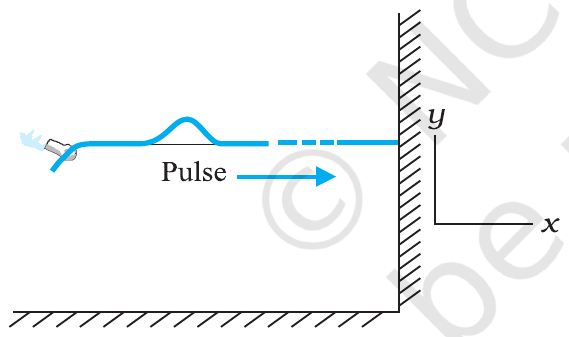
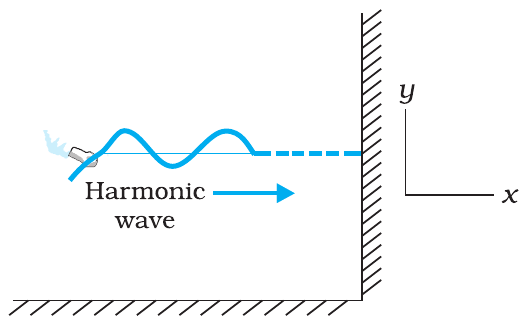
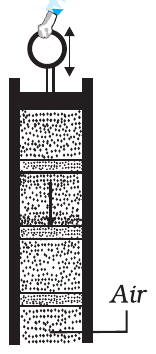
- Motion of mechanical waves involves oscillations of constituents of the medium. If the constituents of the medium oscillate perpendicular to the direction of wave propagation, we call the wave a transverse wave. If they oscillate along the direction of wave propagation, we call the wave a longitudinal wave.
- Fig. 14.2 shows the propagation of a single pulse along a string, resulting from a single up and down jerk. If the string is very long compared to the size of the pulse, the pulse will damp out before it reaches the other end and reflection from that end may be ignored. Fig. 14.3 shows a similar situation, but this time the external agent gives a continuous periodic sinusoidal up and down jerk to one end of the string. The resulting disturbance on the string is then a sinusoidal wave. In either case the elements of the string oscillate about their equilibrium mean position as the pulse or wave passes through them. The oscillations are normal to the direction of wave motion along the string, so this is an example of transverse wave.
- We can look at a wave in two ways. We can fix an instant of time and picture the wave in space: this gives the shape of the wave as a whole in space at a given instant. Another way is to fix a location, i.e. fix our attention on a particular element of string and see its oscillatory motion in time.
- Fig. 14.4 describes the situation for longitudinal waves in the most familiar example of the propagation of sound waves. A long pipe filled with air has a piston at one end. A single sudden push forward and pull back of the piston will generate a pulse of condensations (higher density) and rarefactions (lower density) in the medium (air). If the push-pull of the piston is continuous and periodic (sinusoidal), a sinusoidal wave will be generated propagating in air along the length of the pipe. This is clearly an example of longitudinal waves.
- The waves considered above, transverse or longitudinal, are travelling or progressive waves since they travel from one part of the medium to another. The material medium as a whole does not move. A stream, for example, constitutes motion of water as a whole. In a water wave, it is the disturbance that moves, not water as a whole. Likewise a wind (motion of air as a whole) should not be confused with a sound wave which is a propagation of disturbance (in pressure density) in air, without the motion of air medium as a whole.
- In transverse waves, the particle motion is normal to the direction of propagation of the wave. Therefore, as the wave propagates, each element of the medium undergoes a shearing strain. Transverse waves can, therefore, be propagated only in those media which can sustain shearing stress, such as solids and not in fluids. Fluids, as well as solids, can sustain compressive strain; therefore, longitudinal waves can be propagated in all elastic media. For example, in medium like steel, both transverse and longitudinal waves can propagate, while air can sustain only longitudinal waves.
- The waves on the surface of water are of two kinds: capillary waves and gravity waves. The former are ripples of fairly short wavelength - not more than a few centimetre - and the restoring force that produces them is the surface tension of water. Gravity waves have wavelengths typically ranging from several metres to several hundred meters. The restoring force that produces these waves is the pull of gravity, which tends to keep the water surface at its lowest level. The oscillations of the particles in these waves are not confined to the surface only, but extend with diminishing amplitude to the very bottom. The particle motion in water waves involves a complicated motion - they not only move up and down but also back and forth. The waves in an ocean are the combination of both longitudinal and transverse waves.
- It is found that, generally, transverse and longitudinal waves travel with different speed in the same medium.
- Example 14.1 (NCERT): state in each case if the wave motion is transverse, longitudinal or a combination of both: (a) Motion of a kink in a longitudinal spring produced by displacing one end of the spring sideways - transverse and longitudinal. (b) Waves produced in a cylinder containing a liquid by moving its piston back and forth - longitudinal. (c) Waves produced by a motorboat sailing in water - transverse and longitudinal. (d) Ultrasonic waves in air produced by a vibrating quartz crystal - longitudinal.
Displacement Relation in a Progressive Wave
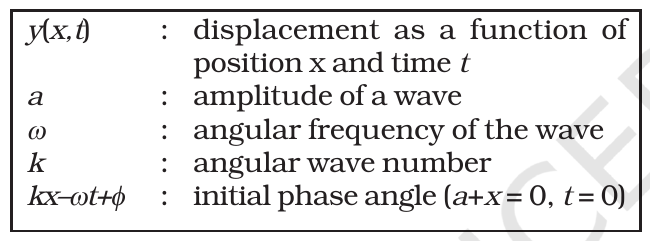
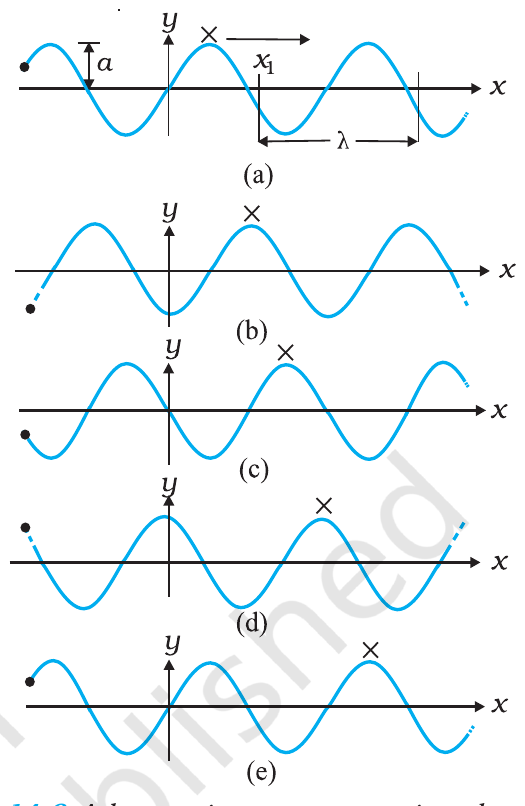
- For mathematical description of a travelling wave, we need a function of both position x and time t. Such a function at every instant should give the shape of the wave at that instant. Also, at every given location, it should describe the motion of the constituent of the medium at that location. If we wish to describe a sinusoidal travelling wave (such as the one shown in Fig. 14.3) the corresponding function must also be sinusoidal. For convenience, we shall take the wave to be transverse so that if the position of the constituents of the medium is denoted by x, the displacement from the equilibrium position may be denoted by y. A sinusoidal travelling wave is then described by: $y(x, t) = a \sin(kx - ωt + φ)$ (14.2)
- The term φ in the argument of sine function means equivalently that we are considering a linear combination of sine and cosine functions: $y(x, t) = A \sin(kx - ωt) + B \cos(kx - ωt)$ (14.3). From Equations (14.2) and (14.3), $a = (A^2 + B^2)^{1/2}$ and $φ = tan-1(B/A)$.
- To understand why Equation (14.2) represents a sinusoidal travelling wave, take a fixed instant, $say t = t_0$. Then, the argument of the sine function in Equation (14.2) is simply kx + constant. Thus, the shape of the wave (at any fixed instant) as a function of x is a sine wave. Similarly, take a fixed location, $say x = x_0$. Then, the argument of the sine function in Equation (14.2) is constant - ωt. The displacement y, at a fixed location, thus, varies sinusoidally with time. That is, the constituents of the medium at different positions execute simple harmonic motion. Finally, as t increases, x must increase in the positive direction to keep kx - ωt + φ constant. Thus, Eq. (14.2) represents a sinusoidal (harmonic) wave travelling along the positive direction of the x-axis. On the other hand, a function $y(x, t) = a \sin(kx + ωt + φ) (14.4) represents a wave travelling$ in the negative direction of x-axis. Fig. (14.5) gives the names of the various physical quantities appearing in Eq. (14.2) that we now interpret.
- Fig. 14.5, the meaning of standard symbols in Eq. (14.2):
| Symbol | Meaning |
|---|---|
| y(x, t) | displacement as a function of position x and time t |
| a | amplitude of a wave |
| ω | angular frequency of the wave |
| k | angular wave number |
| kx - ωt + φ | phase; φ is the initial phase angle (at x = 0, t = 0) |
Amplitude and Phase
- In Eq. (14.2), since the sine function varies between 1 and -1, the displacement y(x, t) varies between a and -a. We can take a to be a positive constant, without any loss of generality. Then, a represents the maximum displacement of the constituents of the medium from their equilibrium position. Note that the displacement y may be positive or negative, but a is positive. It is called the amplitude of the wave.
- The quantity (kx - ωt + φ) appearing as the argument of the sine function in Eq. (14.2) is called the phase of the wave. Given the amplitude a, the phase determines the displacement of the wave at any position and at any instant. Clearly φ is the phase at $x = 0$ and $t = 0$. Hence, φ is called the initial phase angle. By suitable choice of origin on the x-axis and the initial time, it is possible to have $φ = 0$. Thus there is no loss of generality in dropping φ, i.e., in taking Eq. (14.2) with $φ = 0$.
- Fig. 14.6 shows the plots of Eq. (14.2) for different values of time differing by equal intervals of time. In a wave, the crest is the point of maximum positive displacement, the trough is the point of maximum negative displacement. To see how a wave travels, we can fix attention on a crest and see how it progresses with time. In the figure, this is shown by a cross (x) on the crest. In the same manner, we can see the motion of a particular constituent of the medium at a fixed location, say at the origin of the x-axis. This is shown by a solid dot. The plots of Fig. 14.6 show that with time, the solid dot at the origin moves periodically, i.e., the particle at the origin oscillates about its mean position as the wave progresses. This is true for any other location also. We also see that during the time the solid dot has completed one full oscillation, the crest has moved further by a certain distance.
Wavelength and Angular Wave Number
- The minimum distance between two points having the same phase is called the wavelength of the wave, usually denoted by λ. For simplicity, we can choose points of the same phase to be crests or troughs. The wavelength is then the distance between two consecutive crests or troughs in a wave. $Taking φ = 0$ in Eq. (14.2), the displacement at $t = 0$ is given by y(x, 0) = a sin kx (14.5).
- Since the sine function repeats its value after every 2π change in angle, the displacements at points x and at x + (2nπ/k) are the same, where $n = 1, 2, 3$, ... The least distance between points with the same displacement (at any given instant of time) is obtained by taking $n = 1$. λ is then given by $λ = 2π/k$ or $k = 2π/λ$ (14.6).
- k is the angular wave number or propagation constant; its SI unit is radian per metre or rad m-1. Here again, 'radian' could be dropped and the units could be written merely as m-1. Thus, k represents 2π times the number of waves (or the total phase difference) that can be accommodated per unit length, with SI units m-1.
Period, Angular Frequency and Frequency
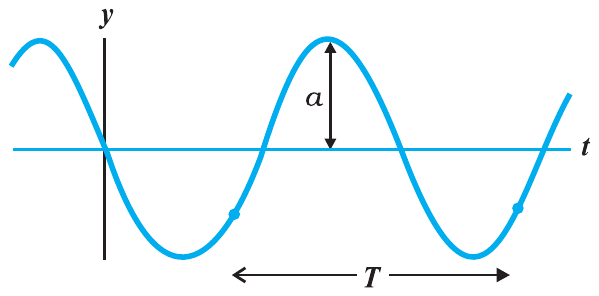
- Fig. 14.7 shows again a sinusoidal plot. It describes not the shape of the wave at a certain instant but the displacement of an element (at any fixed location) of the medium as a function of time. We may for, simplicity, take Eq. (14.2) with $φ = 0$ and monitor the motion of the element say at $x = 0$. We then get y(0, t) = a $\sin(-ωt)$ = -a sin ωt.
- Now, the period of oscillation of the wave is the time it takes for an element to complete one full oscillation. That is -$a \sin ωt = -a \sin ω(t + T) = -a \sin(ωt + ωT)$. Since sine function repeats after every 2π, $ωT = 2π$ or $ω = 2π/T$ (14.7).
- ω is called the angular frequency of the wave. Its SI unit is rad s-1. The frequency ν is the number of oscillations per second. Therefore, $ν = 1/T = ω/(2π)$ (14.8). ν is usually measured in hertz.
- In the discussion above, reference has always been made to a wave travelling along a string or a transverse wave. In a longitudinal wave, the displacement of an element of the medium is parallel to the direction of propagation of the wave. In Eq. (14.2), the displacement function for a longitudinal wave is written as, $s(x, t) = a \sin(kx - ωt + φ)$ (14.9) where s(x, t) is the displacement of an element of the medium in the direction of propagation of the wave at position x and time t. In Eq. (14.9), a is the displacement amplitude; other quantities have the same meaning as in case of a transverse wave except that the displacement function y(x, t) is to be replaced by the function s(x, t).
- Example 14.2 (NCERT): A wave travelling along a string is described by $y(x, t) = 0.005 \sin(80.0x - 3.0t)$, in which the numerical constants are in SI units (0.005 m, 80.0 rad m-1, and 3.0 rad s-1). (a) The amplitude of the wave is $0.005 m = 5 mm$. (b) The angular wave number $k = 80.0 m-1$ and angular frequency $ω = 3.0 s-1$. The wavelength $λ = 2π/k = 2π/(80.0 m-1) = 7.85 cm$. (c) The period $T = 2π/ω = 2π/(3.0 s-1) = 2.09 s$, and frequency $ν = 1/T = 0.48 Hz$. The displacement y at $x = 30.0 cm$ and time $t = 20 s$ is $y = (0.005 m) \sin(80.0 \times 0.3 - 3.0 \times 20) = (0.005 m) \sin(-36 + 12π) = (0.005 m) \sin(1.699) = (0.005 m) \sin(97°) ≈ 5 mm$.
Practice1 question
Try it now. A wrong answer costs nothing here, try again until you get it.
A wave on a string is described by $y(x, t) = 0.005 \sin(80.0x - 3.0t)$, with SI units. The wavelength of the wave is
NCERT 14.3 and Example 14.2: $k = 80.0 m-1$, so $λ = 2π/k = 2π/80.0 = 7.85 cm$. 5 mm is the amplitude, 2.09 s the period, 0.48 Hz the frequency.
Table: Progressive-Wave Quantities
- All the quantities of the progressive wave $y(x, t) = a \sin(kx - ωt + φ)$ in one place. NCERT prints frequency with the same letter v as speed; here frequency is written ν and speed is written v.
| Symbol | Meaning |
|---|---|
| y(x, t) | displacement as a function of position x and time t |
| a | amplitude of a wave |
| ω | angular frequency of the wave |
| k | angular wave number |
| kx - ωt + φ | phase; φ is the initial phase angle (at x = 0, $t = 0$) |
| Quantity | Relation | SI unit |
|---|---|---|
| Wavelength λ | $λ = 2π/k$ | m |
| Angular wave number k | $k = 2π/λ$ | rad m-1 (or m-1) |
| Period T | $T = 2π/ω$ | s |
| Frequency ν | $ν = 1/T = ω/(2π)$ | Hz (s-1) |
| Angular frequency ω | $ω = 2π/T = 2πν$ | rad s-1 |
| Wave speed v | $v = ω/k = λ/T$ = λν | m s-1 |
- Reading the relations: at a fixed instant the wave repeats every λ in x; at a fixed place an element repeats every T in t; in one period the wave pattern travels one wavelength, so $v = λ/T$.
The Speed of a Travelling Wave
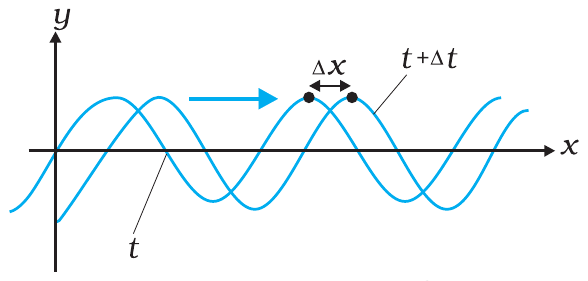
- To determine the speed of propagation of a travelling wave, we can fix our attention on any particular point on the wave (characterised by some value of the phase) and see how that point moves in time. It is convenient to look at the motion of the crest of the wave. Fig. 14.8 gives the shape of the wave at two instants of time, which differ by a small time interval $\Delta t$. The entire wave pattern is seen to shift to the right (positive direction of x-axis) by a distance $\Delta x$. In particular, the crest shown by a dot moves a distance $\Delta x$ in time $\Delta t$. The speed of the wave is then $\Delta x$/$\Delta t$. We can put the dot on a point with any other phase. It will move with the same speed v (otherwise the wave pattern will not remain fixed). The motion of a fixed phase point on the wave is given by kx - ωt = constant (14.10).
- Thus, as time t changes, the position x of the fixed phase point must change so that the phase remains constant. Thus, $kx - ωt = k(x + \delta x) - ω(t + \delta t)$ or k $\Delta x$ - ω $\Delta t$ = 0. Taking $\Delta x$, $\Delta t$ vanishingly small, this gives $dx/dt = ω/k = v$ (14.11).
- Relating ω to T and k to λ, we get $v = 2πν/(2π/λ) = λν = λ/T$ (14.12).
- Eq. (14.12), a general relation for all progressive waves, shows that in the time required for one full oscillation by any constituent of the medium, the wave pattern travels a distance equal to the wavelength of the wave. It should be noted that the speed of a mechanical wave is determined by the inertial (linear mass density for strings, mass density in general) and elastic properties (Young's modulus for linear media / shear modulus, bulk modulus) of the medium. The medium determines the speed; Eq. (14.12) then relates wavelength to frequency for the given speed. Of course, as remarked earlier, the medium can support both transverse and longitudinal waves, which will have different speeds in the same medium.
- Of the two parameters λ and ν the source of disturbance determines the frequency of the wave generated. Given the speed of the wave in the medium and the frequency Eq. (14.12) then fixes the wavelength $λ = v/ν$ (14.15).
Speed of a Transverse Wave on a Stretched String
- The speed of a mechanical wave is determined by the restoring force setup in the medium when it is disturbed and the inertial properties (mass density) of the medium. The speed is expected to be directly related to the former and inversely to the latter. For waves on a string, the restoring force is provided by the tension T in the string. The inertial property will in this case be linear mass density µ, which is mass m of the string divided by its length L. Using Newton's Laws of Motion, an exact formula for the wave speed on a string can be derived, but this derivation is outside the scope of this book. We shall, therefore, use dimensional analysis. We already know that dimensional analysis alone can never yield the exact formula. The overall dimensionless constant is always left undetermined by dimensional analysis.
- The dimension of µ is $[M L^{-1}]$ and that of T is like force, namely $[M L T^{-2}]$. We need to combine these dimensions to get the dimension of speed v $[L T^{-1}]$. Simple inspection shows that the quantity T/µ has the relevant dimension $[M L T^{-2}]$/$[M L^{-1}]$ = $[L^2 T^{-2}]$. Thus if T and µ are assumed to be the only relevant physical quantities, $v = C (T/µ)^{1/2}$ (14.13) where C is the undetermined constant of dimensional analysis. In the exact formula, it turms out, $C = 1$. The speed of transverse waves on a stretched string is given by $v = (T/µ)^{1/2}$ (14.14).
- Note the important point that the speed v depends only on the properties of the medium T and µ (T is a property of the stretched string arising due to an external force). It does not depend on wavelength or frequency of the wave itself. In higher studies, you will come across waves whose speed is not independent of frequency of the wave.
- Example 14.3 (NCERT): A steel wire 0.72 m long has a mass of 5.0 x $10^{-3}$ kg. If the wire is under a tension of 60 N, what is the speed of transverse waves on the wire? Mass per unit length of the wire, µ = (5.0 x $10^{-3}$ kg)/(0.72 m) = 6.9 x $10^{-3}$ kg m-1. Tension, $T = 60 N$. The speed of wave on the wire is given by $v = (T/µ)^{1/2} = (60 N/(6.9 x 10^{-3} kg m-1))^{1/2}$ = 93 m s-1.
Practice1 question
Try it now. A wrong answer costs nothing here, try again until you get it.
A steel wire 0.72 m long has mass 5.0 x $10^{-3}$ kg and is under tension 60 N. The speed of transverse waves on the wire is
NCERT 14.4.1 and Example 14.3: µ = 6.9 x $10^{-3}$ kg m-1, $v = (T/µ)^{1/2} = (60/(6.9 x 10^{-3}))^{1/2}$ = 93 m s-1.
Speed of Sound
- In a longitudinal wave, the constituents of the medium oscillate forward and backward in the direction of propagation of the wave. We have already seen that the sound waves travel in the form of compressions and rarefactions of small volume elements of air. The elastic property that determines the stress under compressional strain is the bulk modulus of the medium defined by (see Chapter 8) $B = -\delta P/(\delta V/V)$ (14.16). Here, the change in pressure $\Delta P$ produces a volumetric strain $\Delta V$/V. B has the same dimension as pressure and given in SI units in terms of pascal (Pa). The inertial property relevant for the propagation of wave is the mass density ρ, with dimensions $[M L^{-3}]$. Simple inspection reveals that quantity B/ρ has the relevant dimension: $[M L^{-2} T^{-2}]$/$[M L^{-3}]$ = $[L^2 T^{-2}]$ (14.17).
- Thus, if B and ρ are considered to be the only relevant physical quantities, $v = C (B/ρ)^{1/2}$ (14.18) where, as before, C is the undetermined constant from dimensional analysis. The exact derivation shows that $C = 1$. Thus, the general formula for longitudinal waves in a medium is: $v = (B/ρ)^{1/2}$ (14.19).
- For a linear medium, like a solid bar, the lateral expansion of the bar is negligible and we may consider it to be only under longitudinal strain. In that case, the relevant modulus of elasticity is Young's modulus, which has the same dimension as the Bulk modulus. Dimensional analysis for this case is the same as before and yields a relation like Eq. (14.18), with an undetermined C, which the exact derivation shows to be unity. Thus, the speed of longitudinal waves in a solid bar is given by $v = (Y/ρ)^{1/2}$ (14.20) where Y is the Young's modulus of the material of the bar. Table 14.1 gives the speed of sound in some media.
- Liquids and solids generally have higher speed of sound than gases. [Note for solids, the speed being referred to is the speed of longitudinal waves in the solid]. This happens because they are much more difficult to compress than gases and so have much higher values of bulk modulus. Now, see Eq. (14.19). Solids and liquids have higher mass densities (ρ) than gases. But the corresponding increase in both the modulus (B) of solids and liquids is much higher. This is the reason why the sound waves travel faster in solids and liquids.
- We can estimate the speed of sound in a gas in the ideal gas approximation. For an ideal gas, the pressure P, volume V and temperature T are related by (see Chapter 10). PV = NkBT (14.21) where N is the number of molecules in volume V, kB is the Boltzmann constant and T the temperature of the gas (in Kelvin). Therefore, for an isothermal change it follows from Eq. (14.21) that $V\delta P + P\delta V = 0$ or -$\Delta P$/($\Delta V$/V) = P. Hence, substituting in Eq. (14.16), we have B = P. Therefore, from Eq. (14.19) the speed of a longitudinal wave in an ideal gas is given by, $v = (P/ρ)^{1/2}$ (14.22). This relation was first given by Newton and is known as Newton's formula.
- Example 14.4 (NCERT): Estimate the speed of sound in air at standard temperature and pressure. The mass of 1 mole of air is 29.0 x $10^{-3}$ kg. We know that 1 mole of any gas occupies 22.4 litres at STP. Therefore, density of air at STP is: ρ0 = (mass of one mole of air)/(volume of one mole of air at $STP) = (29.0 \times 10^{-3} kg)/(22.4 \times 10^{-3} m3$) = 1.29 kg m-3. According to Newton's formula for the speed of sound in a medium, we get for the speed of sound in air at STP, $v = (1.01 \times 10^5 N m-2/(1.29 kg m-3))^{1/2}$ = 280 m s-1 (14.23).
- The result shown in Eq. (14.23) is about 15% smaller as compared to the experimental value of 331 m s-1 as given in Table 14.1. Where did we go wrong? If we examine the basic assumption made by Newton that the pressure variations in a medium during propagation of sound are isothermal, we find that this is not correct. It was pointed out by Laplace that the pressure variations in the propagation of sound waves are so fast that there is little time for the heat flow to maintain constant temperature. These variations, therefore, are adiabatic and not isothermal. For adiabatic processes the ideal gas satisfies the relation (see Section 11.8), $PV^\gamma$ = constant, i.e. $Δ(PV^\gamma) = 0$ or Pγ$V^{\gamma-1}$ $\Delta V$ + $V^\gamma$ $\Delta P$ = 0, where γ is the ratio of two specific heats, Cp/Cv.
- Thus, for an ideal gas the adiabatic bulk modulus is given by, $Bad = -\delta P/(\delta V/V)$ = γP. The speed of sound is, therefore, from Eq. (14.19), given by, $v = (\gamma P/ρ)^{1/2}$ (14.24). This modification of Newton's formula is referred to as the Laplace correction. For $air γ = 7/5$. Now using Eq. (14.24) to estimate the speed of sound in air at STP, we get a value 331.3 m s-1, which agrees with the measured speed.
- Exercise 14.4 (NCERT): use the formula $v = (\gamma P/ρ)^{1/2}$ to explain why the speed of sound in air (a) is independent of pressure, (b) increases with temperature, (c) increases with humidity. (a) At fixed temperature, P/ρ stays constant because ρ rises with P, so v does not change with pressure. (b) At fixed pressure, ρ falls as T rises, so v rises with temperature. (c) Water vapour is lighter than dry air, so humid air has lower density ρ at the same pressure, and v rises.
Table: Speed of Sound in Some Media
- Table 14.1 of NCERT, reproduced exactly, and the two gas formulae beside it.
| Medium | Speed (m s-1) |
|---|---|
| Gases | |
| Air (0 °C) | 331 |
| Air (20 °C) | 343 |
| Helium | 965 |
| Hydrogen | 1284 |
| Liquids | |
| Water (0 °C) | 1402 |
| Water (20 °C) | 1482 |
| Seawater | 1522 |
| Solids | |
| Aluminium | 6420 |
| Copper | 3560 |
| Steel | 5941 |
| Granite | 6000 |
| Vulcanised Rubber | 54 |
- Reading the table: sound is slowest in gases (331 m s-1 in air at 0 °C), faster in liquids (1482 m s-1 in water at 20 °C) and fastest in solids (5941 m s-1 in steel). The two gas formulae are: Newton (isothermal), B = P, $v = (P/ρ)^{1/2} = 280 m s-1$ in air at STP; Laplace (adiabatic)$, Bad = γP$, $v = (\gamma P/ρ)^{1/2} = 331.3 m s-1$ in air at STP, with $γ = 7/5$ for air. Newton assumed isothermal pressure changes; Laplace pointed out the changes are so fast that there is little time for heat flow, so they are adiabatic.
Practice1 question
Try it now. A wrong answer costs nothing here, try again until you get it.
Newton's formula gives the speed of sound in air at STP as 280 m s-1, but the measured value is 331 m s-1. The correction is that the pressure changes are
NCERT 14.4.2: Laplace pointed out the changes are so fast there is little time for heat flow, so they are adiabatic; $v = (\gamma P/ρ)^{1/2} = 331.3 m s-1$.
The Principle of Superposition of Waves
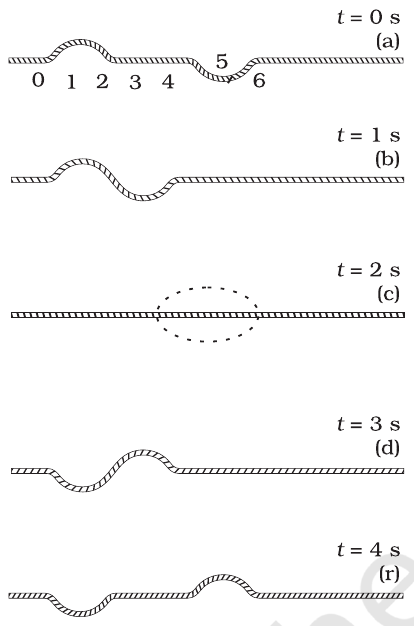
- What happens when two wave pulses travelling in opposite directions cross each other (Fig. 14.9)? It turns out that wave pulses continue to retain their identities after they have crossed. However, during the time they overlap, the wave pattern is different from either of the pulses. Figure 14.9 shows the situation when two pulses of equal and opposite shapes move towards each other. When the pulses overlap, the resultant displacement is the algebraic sum of the displacement due to each pulse. This is known as the principle of superposition of waves. According to this principle, each pulse moves as if others are not present. The constituents of the medium, therefore, suffer displacements due to both and since the displacements can be positive and negative, the net displacement is an algebraic sum of the two. Fig. 14.9 gives graphs of the wave shape at different times. Note the dramatic effect in the graph (c); the displacements due to the two pulses have exactly cancelled each other and there is zero displacement throughout.
- To put the principle of superposition mathematically, let y1(x, t) and y2(x, t) be the displacements due to two wave disturbances in the medium. If the waves arrive in a region simultaneously, and therefore, overlap, the net displacement y(x, t) is given by $y(x, t) = y1(x, t) + y2(x, t)$ (14.25).
- If we have two or more waves moving in the medium the resultant waveform is the sum of wave functions of individual waves. That is, if the wave functions of the moving waves are $y1 = f_1(x - vt)$, $y2 = f_2(x - vt)$, ..., $yn = fn(x - vt)$, then the wave function describing the disturbance in the medium is y = $f_1$(x - vt) + $f_2$(x - vt) + ... + fn(x - vt) = sum (i = 1 to n) fi(x - vt) (14.26). The principle of superposition is basic to the phenomenon of interference.
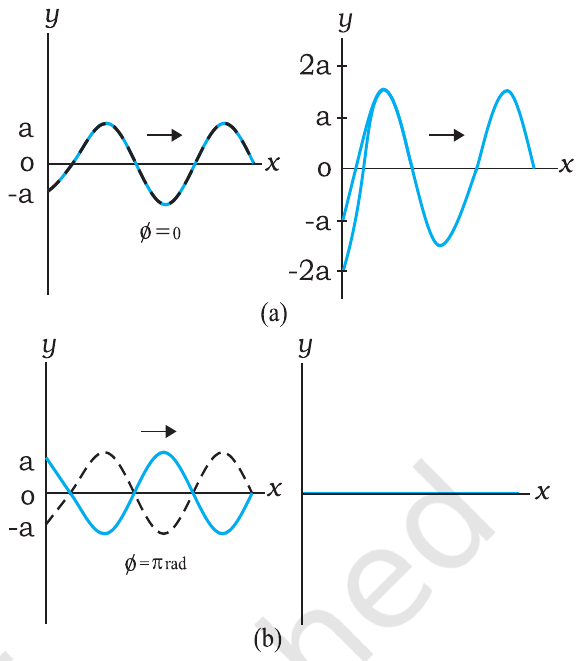
- For simplicity, consider two harmonic travelling waves on a stretched string, both with the same ω (angular frequency) and k (wave number), and, therefore, the same wavelength λ. Their wave speed will be identical. Let us further assume that their amplitudes are equal and they are both travelling in the positive direction of x-axis. The waves only differ in their initial phase. According to Eq. (14.2), the two waves are described by the functions: $y1(x, t) = a \sin(kx - ωt)$ (14.27) and y2(x, $t) = a sin(kx - ωt + φ$) (14.28).
- The net displacement is then, by the principle of superposition, given by $y(x, t) = a \sin(kx - ωt) + a \sin(kx - ωt + φ)$ (14.29) = a [2 $\sin(((kx - ωt) + (kx - ωt + φ))/2)$ $\cos(φ/2)$] (14.30) where we have used the familiar trigonometric identity for sin A + sin B. We then have $y(x, t) = 2a \cos(φ/2) \sin(kx - ωt + φ/2)$ (14.31).
- Eq. (14.31) is also a harmonic travelling wave in the positive direction of x-axis, with the same frequency and wavelength. However, its initial phase angle is φ/2. The significant thing is that its amplitude is a function of the phase difference φ between the constituent two waves: $A(φ) = 2a \cos(φ/2)$ (14.32).
- For $φ = 0$, when the waves are in phase, y(x, $t) = 2a sin(kx - ωt$) (14.33), i.e., the resultant wave has amplitude 2a, the largest possible value for A. For φ = π, the waves are completely out of phase and the resultant wave has zero displacement everywhere at all times $y(x, t) = 0$ (14.34).
- Eq. (14.33) refers to the so-called constructive interference of the two waves where the amplitudes add up in the resultant wave. Eq. (14.34) is the case of destructive intereference where the amplitudes subtract out in the resultant wave. Fig. 14.10 shows these two cases of interference of waves arising from the principle of superposition.
Table: Interference of Two Harmonic Waves
- Two equal-amplitude harmonic waves, same ω and k, phase difference φ, from Eqs. (14.27)-(14.34).
| Phase difference φ | Resultant amplitude $A(φ) = 2a \cos(φ/2)$ | Resultant wave | Name |
|---|---|---|---|
| 0 (or an integral multiple of 2π) | 2a (largest possible) | $y(x, t) = 2a \sin(kx - ωt)$ | Constructive interference |
| π | 0 | $y(x, t) = 0 every$where at all times | Destructive interference |
| Any φ | 2a $\cos(φ/2)$ | $y(x, t) = 2a \cos(φ/2) \sin(kx - ωt + φ/2)$ | General case |
- The resultant keeps the same frequency and wavelength; only its amplitude and its initial phase angle φ/2 change with φ.
Reflection of Waves
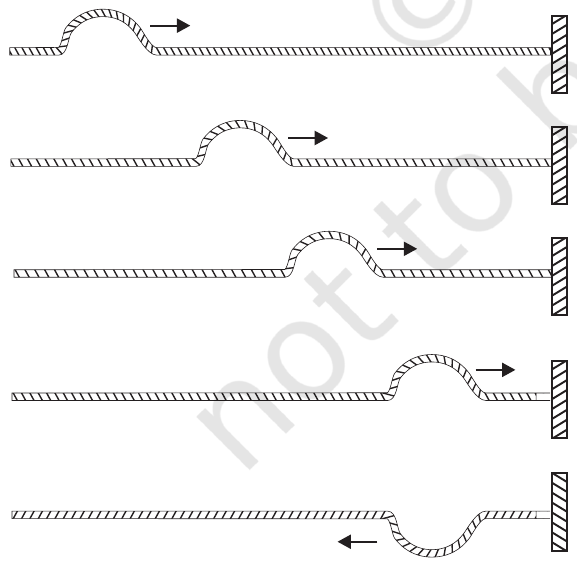
- So far we considered waves propagating in an unbounded medium. What happens if a pulse or a wave meets a boundary? If the boundary is rigid, the pulse or wave gets reflected. The phenomenon of echo is an example of reflection by a rigid boundary. If the boundary is not completely rigid or is an interface between two different elastic media, the situation is somewhat complicated. A part of the incident wave is reflected and a part is transmitted into the second medium. If a wave is incident obliquely on the boundary between two different media the transmitted wave is called the refracted wave. The incident and refracted waves obey Snell's law of refraction, and the incident and reflected waves obey the usual laws of reflection.
- Fig. 14.11 shows a pulse travelling along a stretched string and being reflected by the boundary. Assuming there is no absorption of energy by the boundary, the reflected wave has the same shape as the incident pulse but it suffers a phase change of π or 180° on reflection. This is because the boundary is rigid and the disturbance must have zero displacement at all times at the boundary. By the principle of superposition, this is possible only if the reflected and incident waves differ by a phase of π, so that the resultant displacement is zero. This reasoning is based on boundary condition on a rigid wall. We can arrive at the same conclusion dynamically also. As the pulse arrives at the wall, it exerts a force on the wall. By Newton's Third Law, the wall exerts an equal and opposite force on the string generating a reflected pulse that differs by a phase of π.
- If on the other hand, the boundary point is not rigid but completely free to move (such as in the case of a string tied to a freely moving ring on a rod), the reflected pulse has the same phase and amplitude (assuming no energy dissipation) as the incident pulse. The net maximum displacement at the boundary is then twice the amplitude of each pulse. An example of non-rigid boundary is the open end of an organ pipe.
- To summarise, a travelling wave or pulse suffers a phase change of π on reflection at a rigid boundary and no phase change on reflection at an open boundary. To put this mathematically, let the incident travelling wave be $yi(x, t) = a \sin(kx - ωt)$. At a rigid boundary, the reflected wave is given by $yr(x, t) = a \sin(kx + ωt + π) = -a \sin(kx + ωt)$ (14.35). At an open boundary, the reflected wave is given by $yr(x, t) = a \sin(kx + ωt + 0) = a \sin(kx + ωt)$ (14.36). Clearly, at the rigid boundary, $y = yi + yr = 0$ at all times.
Standing Waves and Normal Modes
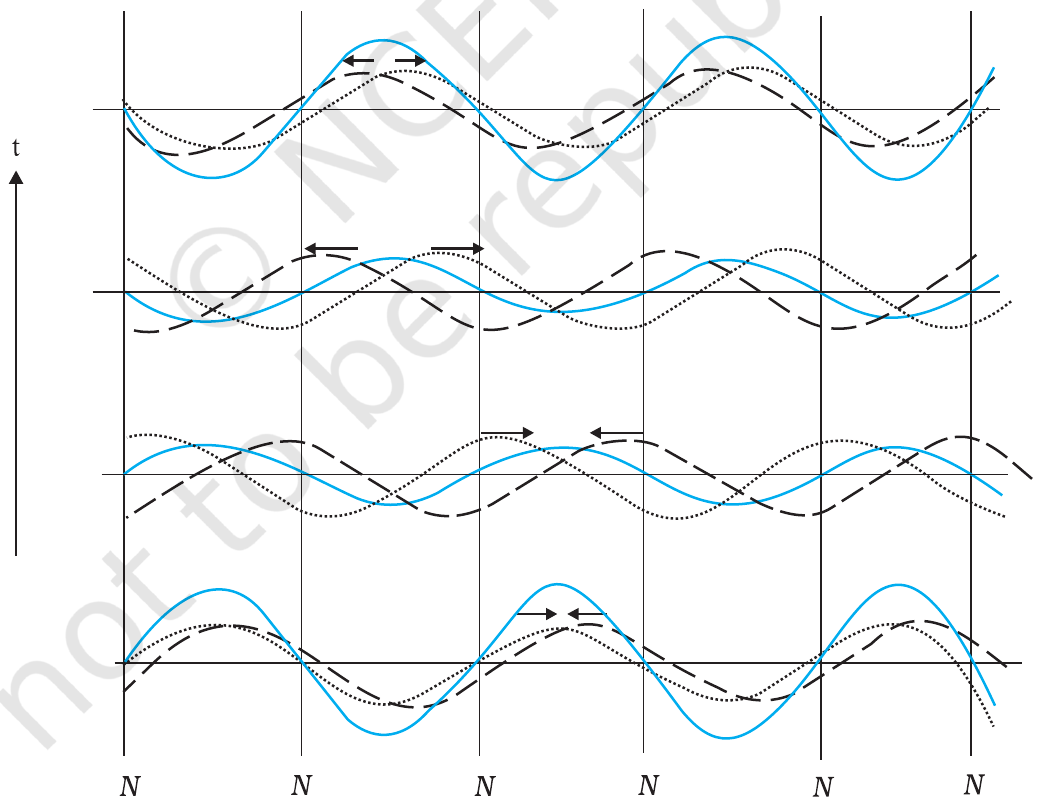
- We considered above reflection at one boundary. But there are familiar situations (a string fixed at either end or an air column in a pipe with either end closed) in which reflection takes place at two or more boundaries. In a string, for example, a wave travelling in one direction will get reflected at one end, which in turn will travel and get reflected from the other end. This will go on until there is a steady wave pattern set up on the string. Such wave patterns are called standing waves or stationary waves. To see this mathematically, consider a wave travelling along the positive direction of x-axis and a reflected wave of the same amplitude and wavelength in the negative direction of x-axis. From Eqs. (14.2) and (14.4), with $φ = 0$, we get: y1(x, $t) = a \sin(kx - ωt), y2(x, t) = a sin(kx + ωt$). The resultant wave on the string is, according to the principle of superposition: $y(x, t) = y1(x, t) + y2(x, t) = a [\sin(kx - ωt) + \sin(kx + ωt)]$. Using the familiar trigonometric identity Sin(A+B) + Sin(A-B) = 2 sin A cos B we get, y(x, t) = 2a sin kx cos ωt (14.37).
- Note the important difference in the wave pattern described by Eq. (14.37) from that described by Eq. (14.2) or Eq. (14.4). The terms kx and ωt appear separately, not in the combination kx - ωt. The amplitude of this wave is 2a sin kx. Thus, in this wave pattern, the amplitude varies from point-to-point, but each element of the string oscillates with the same angular frequency ω or time period. There is no phase difference between oscillations of different elements of the wave. The string as a whole vibrates in phase with differing amplitudes at different points. The wave pattern is neither moving to the right nor to the left. Hence, they are called standing or stationary waves. The amplitude is fixed at a given location but, as remarked earlier, it is different at different locations. The points at which the amplitude is zero (i.e., where there is no motion at all) are called nodes; the points at which the amplitude is the largest are called antinodes. Fig. 14.12 shows a stationary wave pattern resulting from superposition of two travelling waves in opposite directions.
- The most significant feature of stationary waves is that the boundary conditions constrain the possible wavelengths or frequencies of vibration of the system. The system cannot oscillate with any arbitrary frequency (contrast this with a harmonic travelling wave), but is characterised by a set of natural frequencies or normal modes of oscillation. Let us determine these normal modes for a stretched string fixed at both ends.
- First, from Eq. (14.37), the positions of nodes (where the amplitude is zero) are given by $sin kx = 0$, which implies $kx = nπ$; $n = 0, 1, 2, 3$, ... Since, $k = 2π/λ$, we get $x = nλ/2$; $n = 0, 1, 2, 3$, ... (14.38). Clearly, the distance between any two successive nodes is λ/2. In the same way, the positions of antinodes (where the amplitude is the largest) are given by the largest value of sin kx: $|sin kx| = 1$, which implies $kx = (n + 1/2)π$; $n = 0, 1, 2, 3$, ... With $k = 2π/λ$, we get $x = (n + 1/2)λ/2$; $n = 0, 1, 2, 3$, ... (14.39). Again the distance between any two consecutive antinodes is λ/2.
Normal Modes of a String and an Air Column
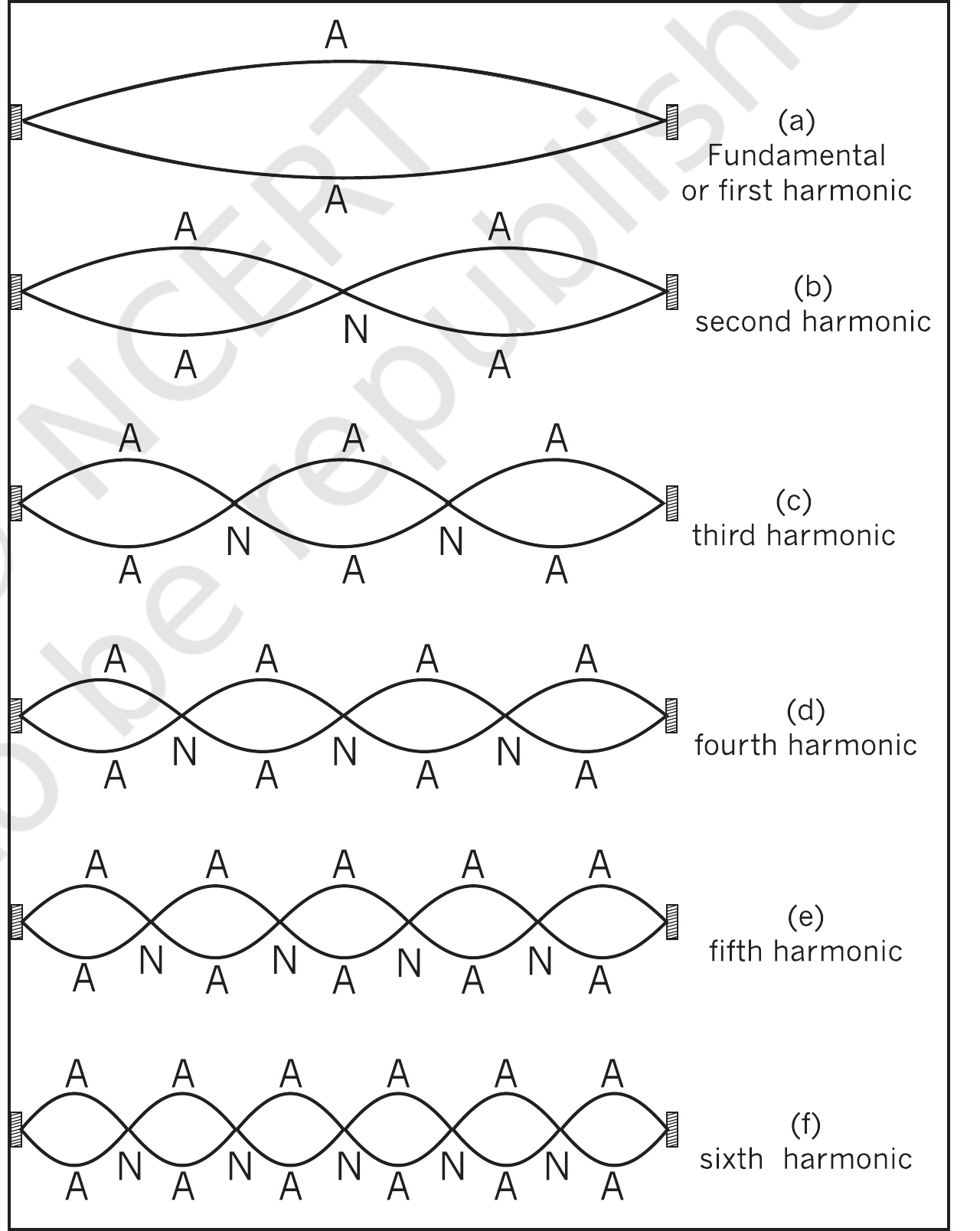
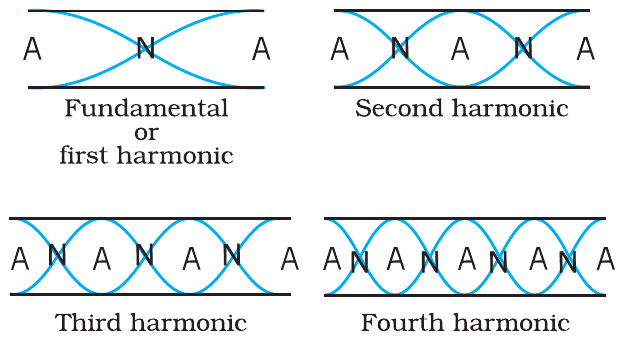
- Eq. (14.38) can be applied to the case of a stretched string of length L fixed at both ends. Taking one end to be at $x = 0$, the boundary conditions are that $x = 0$ and $x = L$ are positions of nodes. The $x = 0 condit$ion is already satisfied. The $x = L node condit$ion requires that the length L is related to λ by $L = nλ/2$; $n = 1, 2, 3$, ... (14.40). Thus, the possible wavelengths of stationary waves are constrained by the relation $λ = 2L/n$; $n = 1, 2, 3$, ... (14.41) with corresponding frequencies ν = nv/(2L), for $n = 1, 2, 3$, ... (14.42).
- We have thus obtained the natural frequencies - the normal modes of oscillation of the system. The lowest possible natural frequency of a system is called its fundamental mode or the first harmonic. For the stretched string fixed at either end it is given by $ν = v/(2L)$, corresponding to $n = 1$ of Eq. (14.42). Here v is the speed of wave determined by the properties of the medium. The $n = 2$ frequency is called the second harmonic; $n = 3$ is the third harmonic and so on. We can label the various harmonics by the symbol νn (n = 1, 2, ...).
- Fig. 14.13 shows the first six harmonics of a stretched string fixed at either end. A string need not vibrate in one of these modes only. Generally, the vibration of a string will be a superposition of different modes; some modes may be more strongly excited and some less. Musical instruments like sitar or violin are based on this principle. Where the string is plucked or bowed, determines which modes are more prominent than others.
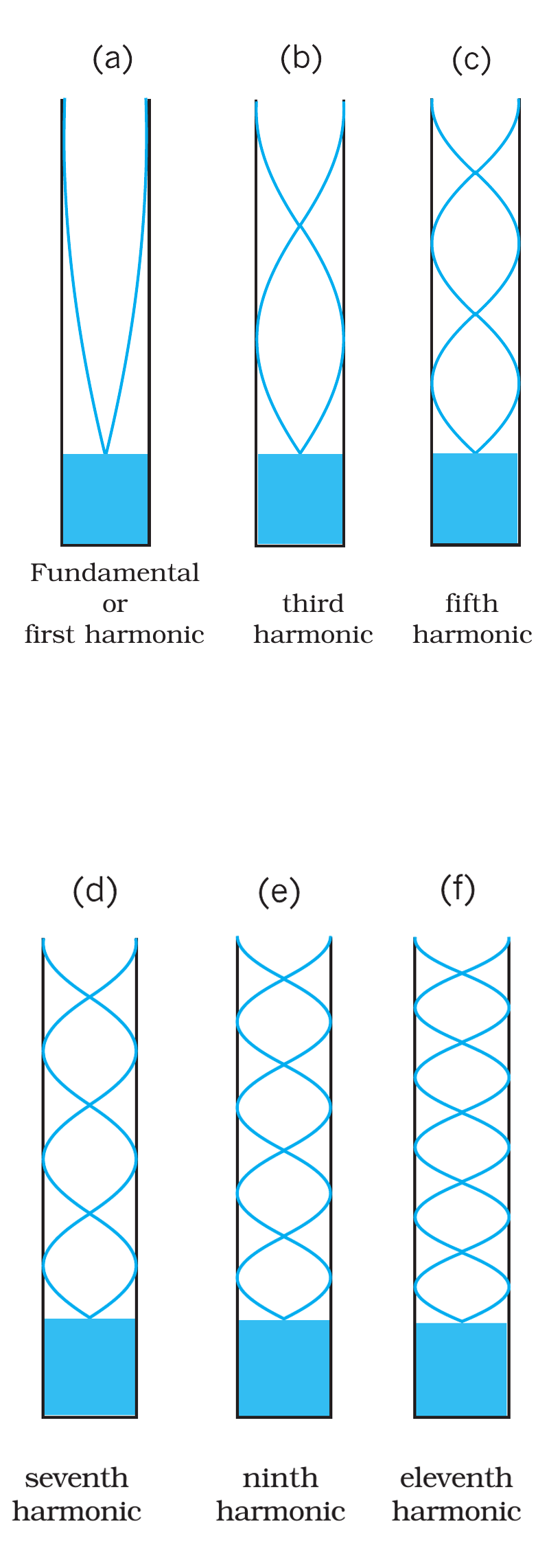
- Let us next consider normal modes of oscillation of an air column with one end closed and the other open. A glass tube partially filled with water illustrates this system. The end in contact with water is a node, while the open end is an antinode. At the node the pressure changes are the largest, while the displacement is minimum (zero). At the open end - the antinode, it is just the other way - least pressure change and maximum amplitude of displacement. Taking the end in contact with water to be $x = 0$, the node condition (Eq. 14.38) is already satisfied. If the other end $x = L$ is an antinode, Eq. (14.39) gives $L = (n + 1/2)λ/2$, for $n = 0, 1, 2, 3$, ... The possible wavelengths are then restricted by the relation: $λ = 2L/(n + 1/2)$, for $n = 0, 1, 2, 3$, ... (14.43).
- The normal modes - the natural frequencies - of the system are $ν = (n + 1/2)v/(2L)$; $n = 0, 1, 2, 3$, ... (14.44). The fundamental frequency corresponds to $n = 0$, and is given by v/(4L). The higher frequencies are odd harmonics, i.e., odd multiples of the fundamental frequency: 3v/(4L), 5v/(4L), etc. Fig. 14.14 shows the first six odd harmonics of air column with one end closed and the other open. For a pipe open at both ends, each end is an antinode. It is then easily seen that an open air column at both ends generates all harmonics (See Fig. 14.15).
- The systems above, strings and air columns, can also undergo forced oscillations (Chapter 13). If the external frequency is close to one of the natural frequencies, the system shows resonance.
- Normal modes of a circular membrane rigidly clamped to the circumference as in a tabla are determined by the boundary condition that no point on the circumference of the membrane vibrates. Estimation of the frequencies of normal modes of this system is more complex. This problem involves wave propagation in two dimensions. However, the underlying physics is the same.
- For a pipe open at both ends, each end is an antinode, so the same node condition as the string applies: $νn = nv/(2L)$, for $n = 1, 2, 3$, ... (open pipe), with $fundamental ν1 = v/(2L)$. If one end of the pipe is closed, it follows from Eq. (14.15) that the fundamental frequency is ν1 = v/λ1 = v/(4L) (pipe closed at one end) and only the odd numbered harmonics are present: $ν3 = 3v/(4L)$, $ν5 = 5v/(4L)$, and so on.
- Example 14.5 (NCERT): A pipe, 30.0 cm long, is open at both ends. Which harmonic mode of the pipe resonates a 1.1 kHz source? Will resonance with the same source be observed if one end of the pipe is closed? Take the speed of sound in air as 330 m s-1. The first harmonic frequency is given by $ν1 = v/λ1 = v/(2L) (open pipe)$, where L is the length of the pipe. The frequency of its nth harmonic is: $νn = nv/(2L)$, for $n = 1, 2, 3$, ... (open pipe). First few modes of an open pipe are shown in Fig. 14.15. For $L = 30.0 cm$, $v = 330 m s-1$, $νn = n 330 (m s-1)/(0.6 (m)) = 550n s-1$. Clearly, a source of frequency 1.1 kHz will resonate at ν2, i.e. the second harmonic. Now if one end of the pipe is closed, it follows that the fundamental frequency is ν1 = v/(4L) (pipe closed at one end) and only the odd numbered harmonics are present: $ν3 = 3v/(4L)$, $ν5 = 5v/(4L)$, and so on. For $L = 30 cm$ and $v = 330 m s-1$, the fundamental frequency of the pipe closed at one end is 275 Hz and the source frequency corresponds to its fourth harmonic. Since this harmonic is not a possible mode, no resonance will be observed with the source, the moment one end is closed.
Practice1 question
Try it now. A wrong answer costs nothing here, try again until you get it.
A pipe 30.0 cm long is open at both ends and the speed of sound is 330 m s-1. A 1.1 kHz source resonates with the pipe in its
NCERT 14.6.1 and Example 14.5: open-pipe modes are $νn = 550n Hz$, so 1100 Hz is ν2, the second harmonic. If one end is closed the fundamental is 275 Hz and 1.1 kHz would be the fourth harmonic, which is not a possible mode.
Table: Normal Modes
- String, closed pipe and open pipe side by side. L is the length, v the wave speed, νn the frequency of the nth harmonic.
| System | Ends | Allowed wavelengths | Frequencies | Harmonics present |
|---|---|---|---|---|
| Stretched string, length L | Fixed at both ends (nodes) | $λ = 2L/n$, $n = 1, 2, 3$, ... | $νn = nv/(2L)$ | All: $n = 1, 2, 3$, ... |
| Air column, length L | One end closed (node), one open (antinode) | $λ = 2L/(n + 1/2)$, $n = 0, 1, 2$, ... | $ν = (n + 1/2)v/(2L)$ | Odd only: $ν1 = v/(4L), 3v/(4L), 5v/(4L)$, ... |
| Air column, length L | Open at both ends (antinodes) | $λ = 2L/n$, $n = 1, 2, 3$, ... | $νn = nv/(2L)$ | All: $n = 1, 2, 3$, ... |
- Node spacing is λ/2 in every case: successive nodes are λ/2 apart, and successive antinodes are λ/2 apart. In a sound wave, a displacement node is a pressure antinode and vice versa (Exercise 14.19(a)).
- Resonance: if the external frequency is close to one of the natural frequencies, the system shows resonance. A pipe 30.0 cm long with $v = 330 m s-1$ has open-pipe modes 550n Hz and closed-pipe fundamental 275 Hz (Example 14.5).
Beats

- 'Beats' is an interesting phenomenon arising from interference of waves. When two harmonic sound waves of close (but not equal) frequencies are heard at the same time, we hear a sound of similar frequency (the average of two close frequencies), but we hear something else also. We hear audibly distinct waxing and waning of the intensity of the sound, with a frequency equal to the difference in the two close frequencies. Artists use this phenomenon often while tuning their instruments with each other. They go on tuning until their sensitive ears do not detect any beats.
- To see this mathematically, let us consider two harmonic sound waves of nearly equal angular frequency ω1 and ω2 and fix the location to be $x = 0$ for convenience. Eq. (14.2) with a suitable choice of phase (φ = π/2 for each) and, assuming equal amplitudes, gives $s1 = a \cos ω1t$ and $s2 = a \cos ω2t$ (14.45). Here we have replaced the symbol y by s, since we are referring to longitudinal not transverse displacement. Let ω1 be the (slightly) greater of the two frequencies. The resultant displacement is, by the principle of superposition, $s = s1 + s2 = a (\cos ω1t + \cos ω2t)$. Using the familiar trigonometric identity for cos A + cos B, we get $s = 2a \cos(((ω1 - ω2)t)/2) \cos(((ω1 + ω2)t)/2)$ (14.46) which may be written as: $s = [2a \cos ωbt] \cos ωat$ (14.47), where $ωb = (ω1 - ω2)/2$ and $ωa = (ω1 + ω2)/2$.
- Now if we assume |ω1 - ω2| << ω1, which means ωa >> ωb, we can interpret Eq. (14.47) as follows. The resultant wave is oscillating with the average angular frequency ωa; however its amplitude is not constant in time, unlike a pure harmonic wave. The amplitude is the largest when the term cos ωbt takes its limit +1 or -1. In other words, the intensity of the resultant wave waxes and wanes with a frequency which is $2ωb = ω1 - ω2$. Since $ω = 2πν$, the beat frequency νbeat, is given by $νbeat = ν1 - ν2$ (14.48).
- Fig. 14.16 illustrates the phenomenon of beats for two harmonic waves of frequencies 11 Hz and 9 Hz. The amplitude of the resultant wave shows beats at a frequency of 2 Hz.
- Example 14.6 (NCERT): Two sitar strings A and B playing the note 'Dha' are slightly out of tune and produce beats of frequency 5 Hz. The tension of the string B is slightly increased and the beat frequency is found to decrease to 3 Hz. What is the original frequency of B if the frequency of A is 427 Hz? Increase in the tension of a string increases its frequency. If the original frequency of B (νB) were greater than that of A (νA), further increase in νB should have resulted in an increase in the beat frequency. But the beat frequency is found to decrease. This shows that νB < νA. Since $νA - νB = 5 Hz$, and $νA = 427 Hz$, we $get νB = 422 Hz$.
Practice1 question
Try it now. A wrong answer costs nothing here, try again until you get it.
Two sitar strings A and B play 'Dha' slightly out of tune and produce beats of 5 Hz. The tension of B is increased slightly and the beat frequency falls to 3 Hz. If the frequency of A is 427 Hz, the original frequency of B is
NCERT 14.7 and Example 14.6: raising the tension raises νB, and the beat frequency fell, so νB was below $νA: νB = 427 - 5 = 422 Hz$.
Trap Pairs
- Trap: the wave carries the medium with it. Correct: only the disturbance travels; each part of the medium oscillates about its own mean position. Cork pieces bob up and down without moving away from the centre, and sound is a moving pattern of compressions and rarefactions, not a flow of air.
- Trap: transverse waves travel through air. Correct: air sustains only compressive strain, so only longitudinal waves travel in air; transverse waves need a medium that sustains shearing stress, such as a solid.
- Trap: doubling the frequency doubles the wave speed. Correct: the medium fixes v (T and µ for a string; B and ρ for sound). The source fixes ν; $λ = v/ν follows$. Doubling ν halves λ, v stays put.
- Trap: a displacement node is a quiet spot in every sense. Correct: in a sound wave a displacement node is a pressure antinode: displacement is zero there but pressure changes are largest. At the open end (displacement antinode) the pressure change is least.
- Trap: a closed pipe gives all harmonics like an open pipe. Correct: a closed pipe gives only odd harmonics (v/(4L), 3v/(4L), 5v/(4L), ...). An open pipe gives all harmonics (nv/(2L)). NEET 2023 asked the 2:1 fundamental ratio; NEET 2025 dipped an open pipe to half length and the two changes cancelled to f.
- Trap: beat frequency is the average of the two frequencies. Correct: the heard pitch is near the average, but the beat frequency is the difference: $νbeat = ν1 - ν2$. Two sitar strings at 427 Hz and 422 Hz beat at 5 Hz.
Points to Ponder
- A wave is not motion of matter as a whole in a medium. A wind is different from the sound wave in air. The former involves motion of air from one place to the other. The latter involves compressions and rarefactions of layers of air.
- In a wave, energy and not the matter is transferred from one point to the other.
- In a mechanical wave, energy transfer takes place because of the coupling through elastic forces between neighbouring oscillating parts of the medium.
- Transverse waves can propagate only in medium with shear modulus of elasticity. Longitudinal waves need bulk modulus of elasticity and are therefore, possible in all media, solids, liquids and gases.
- In a harmonic progressive wave of a given frequency, all particles have the same amplitude but different phases at a given instant of time. In a stationary wave, all particles between two nodes have the same phase at a given instant but have different amplitudes.
- Relative to an observer at rest in a medium the speed of a mechanical wave in that medium (v) depends only on elastic and other properties (such as mass density) of the medium. It does not depend on the velocity of the source.
Trap Boxes
A wave carries the medium along with it
Wrong idea: The water in a pond flows outward with the ripples, and air flows from the speaker to the listener.
Only the disturbance travels. Each part of the medium oscillates about its own mean position: cork pieces bob up and down without moving away, and sound is a moving pattern of compressions and rarefactions, not a flow of air. NCERT 14.1.
NCERT XI, Ch 14, 14.1
Transverse waves can travel through air
Wrong idea: Sound in air is transverse, like a wave on a string, so it can be polarised.
Air sustains only compressive strain, so only longitudinal waves travel in air. Transverse waves need a medium that sustains shearing stress, such as a solid. NCERT 14.2.
NCERT XI, Ch 14, 14.2
Wave speed depends on the frequency
Wrong idea: Doubling the frequency of a wave on a string doubles its speed.
The medium fixes the speed: $v = (T/µ)^{1/2}$ on a string, $v = (B/ρ)^{1/2}$ for sound. The source fixes the frequency; the wavelength follows as $λ = v/ν$. NCERT 14.4.
NCERT XI, Ch 14, 14.4
A displacement node is a pressure node too
Wrong idea: At a node of a standing sound wave both the displacement and the pressure change are zero.
In a sound wave a displacement node is a pressure antinode: displacement is zero but pressure changes are largest. At the open end (displacement antinode) the pressure change is least. NCERT 14.6.1 and Exercise 14.19(a).
NCERT XI, Ch 14, 14.6.1
A closed pipe has all harmonics
Wrong idea: A pipe closed at one end vibrates at nv/(2L) for $n = 1, 2, 3$, ..., just like an open pipe.
A closed pipe gives only odd harmonics: $ν = (n + 1/2)v/(2L), fundamental v/(4L)$, then 3v/(4L), 5v/(4L). An open pipe gives all harmonics nv/(2L). NCERT 14.6.1.
NCERT XI, Ch 14, 14.6.1
Chapter test
5 NEET PYQs. +4 for a correct answer, -1 for a wrong answer, exactly like NEET. Finish the test to earn a medal.
Q1: NEET (UG) 2025, Code 45, Q45
A pipe open at both ends has a fundamental frequency f in air. The pipe is now dipped vertically in a water drum to half of its length. The fundamental frequency of the air column is now equal to :
Open pipe: $f = v/(2L)$. Dipped to half its length, the air column has length L/2 with one end closed by water, so it is a closed pipe: $ν = v/(4 x (L/2)) = v/(2L) = f$.
Q2: NEET (UG) 2023, Code F1, Q34
The ratio of frequencies of fundamental harmonic produced by an open pipe to that of closed pipe having the same length is
$Open pipe fundamental ν = v/(2L)$; closed pipe $fundamental ν = v/(4L)$; the ratio is 2 : 1.
Q3: NEET (UG) 2022, Code R1, Q35
If the initial tension on a stretched string is doubled, then the ratio of the initial and final speeds of a transverse wave along the string is
$v = (T/µ)^{1/2}$, so doubling T multiplies v by $√2: v1 : v_2 = 1 : √2$.
Q4: NEET (UG) 2020, Code G5, Q161
In a guitar, two strings A and B made of same material are slightly out of tune and produce beats of frequency 6 Hz. When tension in B is slightly decreased, the beat frequency increases to 7 Hz. If the frequency of A is 530 Hz, the original frequency of B will be:
The beat frequency is $|νA - νB| = 6 Hz$, so νB is 524 Hz or 536 Hz. Decreasing the tension lowers νB; the beat frequency rises to 7 Hz, so νB was below $νA: νB = 530 - 6 = 524 Hz$.
Q5: NEET (UG) 2016, Phase I, Code B-Q-X, Q15
An air column, closed at one end and open at the other, resonates with a tuning fork when the smallest length of the column is 50 cm. The next larger length of the column resonating with the same tuning fork is:
The smallest resonating length of a closed pipe is λ/4 = 50 cm, so λ = 200 cm. The next resonating length is 3λ/4 = 150 cm.
Score: 0 · Answered 0 of 5
Flashcards
Tap a card to flip it over and see the answer. Tap it again to flip it back.
Write the displacement relation for a progressive (harmonic) wave and name each symbol.
Tap to flip$y(x, t) = a \sin(kx - ωt + φ)$. y(x, t) is displacement at position x and time t; a is amplitude; ω is angular frequency; k is angular wave number; kx - ωt + φ is phase; φ is the initial phase angle (at x = 0, $t = 0$).
Tap to flip backHow is wave speed related to angular frequency, wave number, wavelength, period and frequency?
Tap to flip$v = ω/k = λ/T$ = λν. In one period the wave pattern travels one wavelength.
Tap to flip backWhat is the speed of a transverse wave on a stretched string?
Tap to flip$v = (T/µ)^{1/2}$, where T is the tension and µ is the linear mass density (mass per unit length) of the string. The speed depends only on T and µ, not on wavelength or frequency.
Tap to flip backGive the speed of a longitudinal wave in a medium, in a solid bar, and in a gas (Newton and Laplace).
Tap to flipGeneral: $v = (B/ρ)^{1/2}$. Solid bar: $v = (Y/ρ)^{1/2}$. Gas, Newton (isothermal)$: v = (P/ρ)^{1/2} = 280 m s-1$ in air at STP. Gas, Laplace (adiabatic)$: v = (\gamma P/ρ)^{1/2} = 331.3 m s-1$ in air at STP, $γ = 7/5$ for air.
Tap to flip backGive the normal-mode frequencies of a stretched string, a closed pipe and an open pipe of length L.
Tap to flipString fixed at both ends: $νn = nv/(2L)$, $n = 1, 2, 3$, ... Closed pipe: $ν = (n + 1/2)v/(2L)$, $n = 0, 1, 2$, ..., odd harmonics only. Open pipe: $νn = nv/(2L)$, $n = 1, 2, 3$, ...
Tap to flip backState the principle of superposition, the resultant of two equal harmonic waves, and the beat frequency.
Tap to flipSuperposition: $y(x, t) = y1(x, t) + y2(x, t)$. Two equal harmonic waves: $y = 2a \cos(φ/2) \sin(kx - ωt + φ/2)$, amplitude $A(φ) = 2a \cos(φ/2)$. Beats: $νbeat = ν1 - ν2$.
Tap to flip backWhat is the speed of light in vacuum, and the speed of sound in air at 0 °C and at 20 °C?
Tap to flipAll electromagnetic waves travel at $c = 299,792,458 m s-1$ in vacuum. Sound in air: 331 m s-1 at 0 °C, 343 m s-1 at 20 °C (Table 14.1).
Tap to flip backNewton's formula gives 280 m s-1 for sound in air at STP but the measured value is 331 m s-1. What fixes it?
Tap to flipNewton (isothermal) gives 280 m s-1 in air at STP, about 15% below the measured 331 m s-1. Laplace (adiabatic, $γ = 7/5$ for air) gives 331.3 m s-1, which agrees with the measured value.
Tap to flip backWhere are the nodes and antinodes of a standing wave, and how far apart are successive ones?
Tap to flipNodes at $x = nλ/2$; antinodes at $x = (n + 1/2)λ/2$; $n = 0, 1, 2, 3$, .... Successive nodes are λ/2 apart and successive antinodes are λ/2 apart.
Tap to flip backWhich media carry transverse waves, and which carry longitudinal waves?
Tap to flipTransverse waves need a medium that sustains shearing stress (solids only); fluids cannot. Longitudinal waves need only compressive strain and travel in all elastic media. Water surface waves are a combination of both.
Tap to flip backWhat happens on reflection at a rigid boundary and at an open boundary? What is a displacement node in a sound wave?
Tap to flipRigid boundary: phase change π (reflected wave inverted, yr = -a $\sin(kx + ωt)$). Open boundary: no phase change $(yr = a \sin(kx + ωt))$. In a sound wave a displacement node is a pressure antinode and vice versa.
Tap to flip backExample 14.2: for $y(x, t) = 0.005 \sin(80.0x - 3.0t)$, what are a, k, ω, λ, T and ν?
Tap to flip$y(x, t) = 0.005 \sin(80.0x - 3.0t)$: amplitude $a = 5 mm$, $k = 80.0 m-1$, $ω = 3.0 s-1$, $λ = 7.85 cm$, $T = 2.09 s$, $ν = 0.48 Hz$; y at $x = 30.0 cm$, $t = 20 s$ is about 5 mm.
Tap to flip backFrequently asked questions
Is it true that a wave carries the medium along with it?
Only the disturbance travels. Each part of the medium oscillates about its own mean position: cork pieces bob up and down without moving away, and sound is a moving pattern of compressions and rarefactions, not a flow of air.
Is it true that transverse waves can travel through air?
Air sustains only compressive strain, so only longitudinal waves travel in air. Transverse waves need a medium that sustains shearing stress, such as a solid.
Is it true that wave speed depends on the frequency?
The medium fixes the speed: $v = (T/µ)^{1/2}$ on a string, $v = (B/ρ)^{1/2}$ for sound. The source fixes the frequency; the wavelength follows as $λ = v/ν$.
Is it true that a displacement node is a pressure node too?
In a sound wave a displacement node is a pressure antinode: displacement is zero but pressure changes are largest. At the open end (displacement antinode) the pressure change is least.
Is it true that a closed pipe has all harmonics?
A closed pipe gives only odd harmonics: $ν = (n + 1/2)v/(2L), fundamental v/(4L)$, then 3v/(4L), 5v/(4L). An open pipe gives all harmonics nv/(2L).