 NEET Notes
Home > Physics > Mechanics > Motion in a Straight Line
Motion in a Straight Line
On this page · 19 sections
- 01Syllabus map
- 02Motion and the point object
- 03Position and direction
- 04Instantaneous velocity and speed
- 05Table: Limiting value of $\Delta x$/$\Delta t$ at t = 4 s
- 06Worked example: position as a function of time
- 07Acceleration
- 08Area under the v-t graph
- 09Kinematic equations for uniformly accelerated motion
- 10Table: Kinematic equations at a glance
- 11Worked example: ball thrown up from a building
- 12Free fall
- 13Galileo's law of odd numbers
- 14Stopping distance
- 15Reaction time
- 16Relative velocity
- 17Table: Reading the graphs
- 18Trap pairs: the confusions NEET tests
- 19Points to ponder
Position, velocity and acceleration in a straight line, x-t and v-t graphs, the three kinematic equations, free fall, stopping distance and reaction time, from NCERT Chapter 2, with 5 NEET PYQs.
Syllabus map
- NMC Unit: PHYS-U02, Kinematics. NCERT Chapter 2, Motion in a Straight Line (Class XI, rationalised NCERT). Numbering note: the chapter seed lists this chapter as Ch 3 in the pre-rationalisation numbering; the book students hold numbers it Ch 2, so every reference here uses Ch 2, 2.x and Figure 2.x.
- Subtopics in this chapter (NCERT XI, Ch 2): 2.1 Introduction; 2.2 Instantaneous velocity and speed; 2.3 Acceleration; 2.4 Kinematic equations for uniformly accelerated motion; Summary; Points to ponder; Exercises. Relative velocity is in NMC Unit 2 and is covered in one short section.
- Subtopic checklist: (1) motion as change in position with time, point object, kinematics; (2) origin choice, position to the right positive and to the left negative; (3) average velocity vs instantaneous velocity; (4) Table 2.1 limiting value, 3.84 m/s at t = 4 s; (5) Example 2.1, x = a + b$t^2$; (6) average and instantaneous acceleration; (7) x-t and v-t graph shapes in NCERT Figures 2.2 and 2.3; (8) area under the v-t curve is displacement, NCERT Figures 2.4 and 2.5; (9) the three kinematic equations and their x0 forms; (10) Example 2.3, ball thrown up from 25.0 m; (11) free fall, Example 2.4 and NCERT Figure 2.7; (12) Galileo's law of odd numbers, Example 2.5 and Table 2.2; (13) stopping distance, Example 2.6; (14) reaction time, Example 2.7 and NCERT Figure 2.8; (15) relative velocity; (16) the six points to ponder.
- Extra information (beyond NCERT): relative velocity. NMC Unit 2 lists it, but the rationalised NCERT Chapter 2 carries no body text for section 2.5 (it appears only in the contents list and the introduction), so it is covered in one short section from the NMC syllabus.
- Excluded topics: vectors, projectile motion and uniform circular motion belong to the next chapter, Motion in a Plane. Do not import their facts into this chapter.
- Estimated revision time: 10 minutes. Jump links: Syllabus Map, Motion and the Point Object, Position and Direction, Instantaneous Velocity and Speed, Table: Limiting Value of $\Delta x$/$\Delta t$, Worked Example: Position Function, Acceleration, Area Under the v-t Graph, Kinematic Equations, Table: Kinematic Equations, Worked Example: Ball Thrown Up, Free Fall, Galileo's Law of Odd Numbers, Stopping Distance, Reaction Time, Relative Velocity, Table: Reading the Graphs, Trap Pairs, Points to Ponder.
Suggest an edit
Motion and the point object
Motion is change in position of an object with time. We walk, run and ride a bicycle. Even when we are sleeping, air moves into and out of our lungs and blood flows in arteries and veins. The earth rotates once every twenty-four hours and revolves round the sun once in a year.
In this chapter we learn how to describe motion. For this, we develop the concepts of velocity and acceleration. We confine ourselves to the study of motion of objects along a straight line, also known as rectilinear motion. For the case of rectilinear motion with uniform acceleration, a set of simple equations can be obtained. Finally, to understand the relative nature of motion, we introduce the concept of relative velocity.
In our discussions, we treat the objects in motion as point objects. This approximation is valid so far as the size of the object is much smaller than the distance it moves in a reasonable duration of time. In a good number of situations in real-life, the size of objects can be neglected and they can be considered as point-like objects without much error.
In Kinematics, we study ways to describe motion without going into the causes of motion. What causes motion described in this chapter and the next chapter forms the subject matter of the following chapter.
Suggest an edit
Position and direction
An object is said to be in motion if its position changes with time. The position of the object can be specified with reference to a conveniently chosen origin. For motion in a straight line, position to the right of the origin is taken as positive and to the left as negative.
The origin and the positive direction of an axis are a matter of choice. You should first specify this choice before you assign signs to quantities like displacement, velocity and acceleration.
The average speed of an object is greater or equal to the magnitude of the average velocity over a given time interval. Average speed is the total path length divided by the time interval, while the magnitude of average velocity uses the displacement, which can be smaller than the path length when the direction of motion changes.
Suggest an edit
Instantaneous velocity and speed
The average velocity tells us how fast an object has been moving over a given time interval but does not tell us how fast it moves at different instants of time during that interval. For this, we define instantaneous velocity or simply velocity v at an instant t.
The velocity at an instant is defined as the limit of the average velocity as the time interval $\Delta t$ becomes infinitesimally small. In other words, v = lim $\Delta t$→0 $\Delta x$/$\Delta t$ = dx/dt. It is the rate of change of position with respect to time, at that instant.
We can obtain the value of velocity at an instant either graphically or numerically. Graphically, the velocity at time t = 4 s is the slope of the tangent to the position-time curve at that point, as shown in NCERT Figure 2.1. For the graph shown there, x = 0.08 $t^3$. Numerically, Table 2.1 shows $\Delta x$/$\Delta t$ approaching 3.84 m/s as $\Delta t$ shrinks from 2.0 s to 0.01 s, and that is the velocity at t = 4.0 s.
Note that for uniform motion, velocity is the same as the average velocity at all instants.
Instantaneous speed or simply speed is the magnitude of velocity. For example, a velocity of +24.0 m/s and a velocity of -24.0 m/s both have an associated speed of 24.0 m/s. Though average speed over a finite interval of time is greater or equal to the magnitude of the average velocity, instantaneous speed at an instant is equal to the magnitude of the instantaneous velocity at that instant.
Suggest an edit
Practice1 question
Try it now. A wrong answer costs nothing here, try again until you get it.
The position of a car is given by x = 0.08 $t^3$, with x in metres and t in seconds. What is its velocity at t = 4 s?
NCERT 2.2, Table 2.1: for x = 0.08 $t^3$, $\Delta x$/$\Delta t$ approaches 3.84 m/s as $\Delta t$ shrinks from 2.0 s to 0.01 s, so the velocity at t = 4 s is 3.84 m/s.
Table: Limiting value of $\Delta x$/$\Delta t$ at t = 4 s
For the position-time graph in NCERT Figure 2.1, x = 0.08 $t^3$. Table 2.1 gives $\Delta x$/$\Delta t$ calculated for $\Delta t$ equal to 2.0 s, 1.0 s, 0.5 s, 0.1 s and 0.01 s centred at t = 4.0 s, with t1 = t - $\Delta t$/2 and t2 = t + $\Delta t$/2.
| $\Delta t$ (s) | t1 (s) | t2 (s) | x(t1) (m) | x(t2) (m) | $\Delta x$ (m) | $\Delta x$/$\Delta t$ (m/s) |
|---|---|---|---|---|---|---|
| 2.0 | 3.0 | 5.0 | 2.16 | 10.0 | 7.84 | 3.92 |
| 1.0 | 3.5 | 4.5 | 3.43 | 7.29 | 3.86 | 3.86 |
| 0.5 | 3.75 | 4.25 | 4.21875 | 6.14125 | 1.9225 | 3.845 |
| 0.1 | 3.95 | 4.05 | 4.93039 | 5.31441 | 0.38402 | 3.8402 |
| 0.01 | 3.995 | 4.005 | 5.100824 | 5.139224 | 0.0384 | 3.8400 |
As $\Delta t$ decreases from 2.0 s to 0.01 s, the average velocity approaches the limiting value 3.84 m/s, which is the velocity at t = 4.0 s.
Source: NCERT XI, Ch 2, Table 2.1.
Suggest an edit
Worked example: position as a function of time
Example 2.1: The position of an object moving along x-axis is given by x = a + b$t^2$ where a = 8.5 m, b = 2.5 m/$s^2$ and t is measured in seconds. What is its velocity at t = 0 s and t = 2.0 s? What is the average velocity between t = 2.0 s and t = 4.0 s?
In notation of differential calculus, the velocity is v = dx/dt = d/dt (a + b$t^2$) = 2bt = 5.0t m/s. At t = 0 s, v = 0 m/s and at t = 2.0 s, v = 10 m/s.
Average velocity between t = 2.0 s and t = 4.0 s is [x(4.0) - x(2.0)] / (4.0 - 2.0) = [(a + 16b) - (a + 4b)] / 2.0 = 6.0 x b = 6.0 x 2.5 = 15 m/s.
The method works whenever the position is known as a function of time: calculate $\Delta x$/$\Delta t$ for decreasing $\Delta t$ and find the limiting value, or use differential calculus for the given expression and calculate dx/dt at different instants.
Suggest an edit
Acceleration
The velocity of an object, in general, changes during its course of motion. Galileo concluded that the rate of change of velocity with time is a constant of motion for all objects in free fall, while the change in velocity with distance is not constant. This led to the concept of acceleration as the rate of change of velocity with time.
The average acceleration a over a time interval is defined as the change of velocity divided by the time interval: a = (v2 - v1)/(t2 - t1) = $\Delta v$/$\Delta t$, where v2 and v1 are the velocities at time t2 and t1. The SI unit of acceleration is m/$s^2$. On a plot of velocity versus time, the average acceleration is the slope of the straight line connecting the points corresponding to (v2, t2) and (v1, t1).
Instantaneous acceleration is defined in the same way as the instantaneous velocity: a = lim $\Delta t$→0 $\Delta v$/$\Delta t$ = dv/dt. The acceleration at an instant is the slope of the tangent to the v-t curve at that instant.
Since velocity has both magnitude and direction, a change in velocity may involve either or both of these factors. Acceleration, therefore, may result from a change in speed (magnitude), a change in direction or changes in both. Like velocity, acceleration can also be positive, negative or zero. Position-time graphs for motion with positive, negative and zero acceleration are shown in NCERT Figure 2.2: the graph curves upward for positive acceleration, downward for negative acceleration and it is a straight line for zero acceleration.
NCERT Figure 2.3 shows velocity-time graphs for motion with constant acceleration: (a) motion in positive direction with positive acceleration, (b) motion in positive direction with negative acceleration, (c) motion in negative direction with negative acceleration, (d) motion of an object with negative acceleration that changes direction at time t1. Between times 0 to t1, it moves in positive x-direction and between t1 and t2 it moves in the opposite direction.
Although acceleration can vary with time, our study in this chapter is restricted to motion with constant acceleration. In this case, the average acceleration equals the constant value of acceleration during the interval. If the velocity of an object is v0 at t = 0 and v at time t, we have a = (v - v0)/t, or v = v0 + at.
Suggest an edit
Practice1 question
Try it now. A wrong answer costs nothing here, try again until you get it.
The slope of the tangent to a velocity-time graph at an instant gives the
NCERT 2.3: the acceleration at an instant is the slope of the tangent to the v-t curve at that instant.
Area under the v-t graph
An interesting feature of a velocity-time graph for any moving object is that the area under the curve represents the displacement over a given time interval.
For the simple case of an object moving with constant velocity u, its velocity-time graph is a straight line parallel to the time axis, as shown in NCERT Figure 2.4. The area under it between t = 0 and t = T is the area of the rectangle of height u and base T. Therefore, area = u x T = uT, which is the displacement in this time interval. The dimensions work out because the two axes carry velocity and time, and their product is distance.
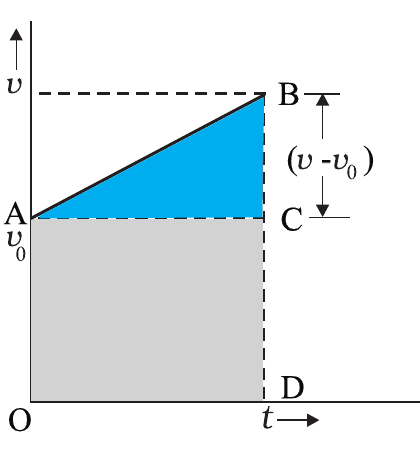
For an object with uniform acceleration, the v-t graph is a straight line inclined to the time axis, as shown in NCERT Figure 2.5, the chapter diagram. The area between instants 0 and t is the area of triangle ABC plus the area of rectangle OACD, which is (1/2)(v - v0)t + v0t. This area is the displacement, and it is how the second kinematic equation is obtained.
Note that the x-t, v-t, and a-t graphs shown in several figures in this chapter have sharp kinks at some points implying that the functions are not differentiable at these points. In any realistic situation, the functions will be differentiable at all points and the graphs will be smooth. What this means physically is that acceleration and velocity cannot change values abruptly at an instant. Changes are always continuous.
Suggest an edit
Kinematic equations for uniformly accelerated motion
For uniformly accelerated motion, we can derive some simple equations that relate displacement (x), time taken (t), initial velocity (v0), final velocity (v) and acceleration (a). Equation v = v0 + at is already obtained in section 2.3, and it is graphically represented in NCERT Figure 2.5.
The area under the v-t curve between instants 0 and t is the area of triangle ABC plus the area of rectangle OACD: x = (1/2)(v - v0)t + v0t. But v - v0 = at, so x = (1/2)a$t^2$ + v0t, or x = v0t + (1/2)a$t^2$.
The same relation can be written as x = [(v + v0)/2]t = v-bar t, where v-bar = (v + v0)/2, the arithmetic average of the initial and final velocities. This holds for constant acceleration only. The object has undergone displacement x with an average velocity equal to the arithmetic average of the initial and final velocities.
From v = v0 + at, t = (v - v0)/a. Substituting this in x = v-bar t gives x = [(v + v0)/2][(v - v0)/a] = ($v^2$ - $v_0^2$)/(2a), or $v^2$ = $v_0^2$ + 2ax.
Thus we have obtained three equations connecting five quantities v0, v, a, t and x. These are kinematic equations of rectilinear motion for constant acceleration. Example 2.2 derives the same equations by the method of calculus, starting from a = dv/dt and v = dx/dt, and notes the advantage of the calculus method is that it can be used for motion with non-uniform acceleration also.
Suggest an edit
Practice1 question
Try it now. A wrong answer costs nothing here, try again until you get it.
A car starts from rest and moves with uniform acceleration 2 m/$s^2$. What distance does it cover in 5 s?
NCERT 2.4: x = v0t + (1/2)a$t^2$ with v0 = 0, a = 2 m/$s^2$ and t = 5 s gives x = (1/2) x 2 x 25 = 25 m.
Table: Kinematic equations at a glance
The set of equations was obtained by assuming that at t = 0, the position of the particle, x, is 0. If the position coordinate at t = 0 is non-zero, say x0, the equations are modified by replacing x with (x - x0).
| Equation | Form (x0 = 0) | Form (general x0) |
|---|---|---|
| First | v = v0 + at | v = v0 + at |
| Second | x = v0t + (1/2)a$t^2$ | x = x0 + v0t + (1/2)a$t^2$ |
| Third | $v^2$ = $v_0^2$ + 2ax | $v^2$ = $v_0^2$ + 2a(x - x0) |
- The five quantities connected are: displacement x, time taken t, initial velocity v0, final velocity v and acceleration a.
- Average velocity for constant acceleration only: v-bar = (v + v0)/2, and x = v-bar t.
- The definitions v = dx/dt and a = dv/dt are exact and are always correct, while the kinematic equations are true only for motion in which the magnitude and the direction of acceleration are constant during the course of motion.
- In the kinematic equations the various quantities are algebraic, that is, they may be positive or negative. The equations are applicable in all situations for one dimensional motion with constant acceleration, provided the values of different quantities are substituted in the equations with proper signs.
Source: NCERT XI, Ch 2, 2.4 and Points to ponder.
Suggest an edit
Worked example: ball thrown up from a building
Example 2.3: A ball is thrown vertically upwards with a velocity of 20 m/s from the top of a multistorey building. The height of the point from where the ball is thrown is 25.0 m from the ground. (a) How high will the ball rise? and (b) how long will it be before the ball hits the ground? Take g = 10 m/$s^2$.
Take the y-axis in the vertically upward direction with zero at the ground. Now v0 = +20 m/s, a = -g = -10 m/$s^2$, v = 0 m/s at the top. If the ball rises to height y from the point of launch, then using $v^2$ = $v_0^2$ + 2a(y - y0) we get 0 = (20)^2 + 2(-10)(y - y0). Solving, we get (y - y0) = 20 m. The ball rises 20 m above the point of launch, to 45 m above the ground.
First method: split the path in two parts. The time in going from the launch point to the top is t1 = 2 s, since 0 = 20 - 10t1. From the top, the ball falls freely; with y0 = 45 m, y = 0, v0 = 0 and a = -10 m/$s^2$, we get 0 = 45 + (1/2)(-10)$t_2^2$, so t2 = 3 s. The total time taken by the ball before it hits the ground is t1 + t2 = 2 s + 3 s = 5 s.
Second method: use y = y0 + v0t + (1/2)a$t^2$ with y0 = 25 m, y = 0 m, v0 = 20 m/s and a = -10 m/$s^2$. Then 0 = 25 + 20t + (1/2)(-10)$t^2$, or 5$t^2$ - 20t - 25 = 0. Solving this quadratic equation for t, we get t = 5 s. The second method is better since we do not have to worry about the path of the motion as the motion is under constant acceleration.
Suggest an edit
Free fall
Example 2.4, free-fall: an object released near the surface of the Earth is accelerated downward under the influence of the force of gravity. The magnitude of acceleration due to gravity is represented by g. If air resistance is neglected, the object is said to be in free fall. If the height through which the object falls is small compared to the earth's radius, g can be taken to be constant, equal to 9.8 m/$s^2$. Free fall is thus a case of motion with uniform acceleration.
We assume that the motion is in y-direction, more correctly in -y-direction because we choose upward direction as positive. Since the acceleration due to gravity is always downward, it is in the negative direction and we have a = -g = -9.8 m/$s^2$. The object is released from rest at y = 0. Therefore, v0 = 0 and the equations of motion become: v = 0 - gt = -9.8t m/s; y = 0 - (1/2)g$t^2$ = -4.9$t^2$ m; $v^2$ = 0 - 2gy = -19.6y $m^2$/$s^2$.
These equations give the velocity and the distance travelled as a function of time and also the variation of velocity with distance. The variation of acceleration, velocity, and distance, with time have been plotted in NCERT Figure 2.7 (a), (b) and (c): (a) variation of acceleration with time, a horizontal line at -g; (b) variation of velocity with time, a straight line with negative slope; (c) variation of distance with time, a curve bending downward.
Suggest an edit
Galileo's law of odd numbers
Example 2.5, Galileo's law of odd numbers: 'The distances traversed, during equal intervals of time, by a body falling from rest, stand to one another in the same ratio as the odd numbers beginning with unity [namely, 1: 3: 5: 7...].' Prove it.
Divide the time interval of motion of an object under free fall into many equal intervals τ and find out the distances traversed during successive intervals of time. Since initial velocity is zero, we have y = -(1/2)g$t^2$. Using this equation, we can calculate the position of the object after different time intervals, 0, τ, 2τ, 3τ... If we take (-1/2)gτ^2 as y0, the position coordinate after first time interval τ, then the positions in the unit of y0 are 0, y0, 4y0, 9y0, 16y0, 25y0, 36y0, and the distances traversed in successive τs are y0, 3y0, 5y0, 7y0, 9y0, 11y0. We find that the distances are in the simple ratio 1: 3: 5: 7: 9: 11... This law was established by Galileo Galilei (1564-1642) who was the first to make quantitative studies of free fall.
Table 2.2 (from NCERT): t = 0 gives y = 0; t = τ gives y = -(1/2)gτ^2 = y0, distance y0, ratio 1; t = 2τ gives y = -4(1/2)gτ^2 = 4y0, distance 3y0, ratio 3; t = 3τ gives y = -9(1/2)gτ^2 = 9y0, distance 5y0, ratio 5; t = 4τ gives 16y0, distance 7y0, ratio 7; t = 5τ gives 25y0, distance 9y0, ratio 9; t = 6τ gives 36y0, distance 11y0, ratio 11.
Suggest an edit
Practice1 question
Try it now. A wrong answer costs nothing here, try again until you get it.
An object is dropped from rest (g = 9.8 m/$s^2$). What distance does it fall during the 3rd second of its fall?
NCERT 2.4, Example 2.5: the distance fallen in the nth second is (2n - 1) times (1/2)g, so in the 3rd second it is 5 x 4.9 m = 24.5 m.
Stopping distance
Example 2.6, stopping distance of vehicles: When brakes are applied to a moving vehicle, the distance it travels before stopping is called stopping distance. It is an important factor for road safety and depends on the initial velocity (v0) and the braking capacity, or deceleration, -a that is caused by the braking. Derive an expression for stopping distance of a vehicle in terms of v0 and a.
Let the distance travelled by the vehicle before it stops be ds. Then, using equation of motion $v^2$ = $v_0^2$ + 2ax, and noting that v = 0, we have the stopping distance ds = -$v_0^2$/(2a). Thus, the stopping distance is proportional to the square of the initial velocity. Doubling the initial velocity increases the stopping distance by a factor of 4 (for the same deceleration).
For the car of a particular make, the braking distance was found to be 10 m, 20 m, 34 m and 50 m corresponding to velocities of 11, 15, 20 and 25 m/s which are nearly consistent with the above formula.
Stopping distance is an important factor considered in setting speed limits, for example, in school zones.
Suggest an edit
Practice1 question
Try it now. A wrong answer costs nothing here, try again until you get it.
If the initial velocity of a vehicle is doubled, with the same braking deceleration, what happens to its stopping distance?
NCERT 2.4, Example 2.6: stopping distance ds = -$v_0^2$/(2a) is proportional to the square of the initial velocity, so doubling v0 increases it by a factor of 4.
Reaction time
Example 2.7, reaction time: When a situation demands our immediate action, it takes some time before we really respond. Reaction time is the time a person takes to observe, think and act. For example, if a person is driving and suddenly a boy appears on the road, then the time elapsed before he slams the brakes of the car is the reaction time. Reaction time depends on complexity of the situation and on an individual.
You can measure your reaction time by a simple experiment. Take a ruler and ask your friend to drop it vertically through the gap between your thumb and forefinger (NCERT Figure 2.8). After you catch it, find the distance d travelled by the ruler. In a particular case, d was found to be 21.0 cm. Estimate reaction time.
The ruler drops under free fall. Therefore, v0 = 0, and a = -g = -9.8 m/$s^2$. The distance travelled d and the reaction time tr are related by d = (1/2)g t$r^2$, or tr = sqrt(2d/g) s. Given d = 21.0 cm and g = 9.8 m/$s^2$ the reaction time is tr = sqrt(2 x 0.21/9.8) s, about 0.2 s.
Suggest an edit
Relative velocity
This section follows the NMC Unit 2 syllabus. The rationalised NCERT Chapter 2 lists 2.5 Relative velocity in its contents list and in the introduction, but it carries no body text for it, so the definition below is the standard one the syllabus asks for.
Motion is relative: the velocity of an object depends on the observer. The velocity of object B relative to object A is the difference of their velocities measured from the same frame: v_BA = v_B - v_A. The velocity of A relative to B is the opposite: v_AB = v_A - v_B = -v_BA.
In one dimension, take the positive direction and give each velocity its sign. If two objects move in the same direction, the magnitude of their relative velocity is the difference of their speeds. If they move in opposite directions, the magnitude of their relative velocity is the sum of their speeds. Two objects moving together with the same velocity have zero relative velocity: each sees the other at rest.
Worked use: a bullet fired from a moving van at a car ahead is judged by the speed of the bullet relative to the car, that is, the muzzle speed plus the van's speed minus the car's speed, all measured in the ground frame. The same subtraction rule is used in every relative-motion question: write each velocity with its sign in one frame, then subtract.
Suggest an edit
Table: Reading the graphs
The three graphs of this chapter are read by three rules: slope of x-t is velocity, slope of v-t is acceleration, area under v-t is displacement.
| Graph | What to read | How |
|---|---|---|
| x-t graph | Velocity at an instant | Slope of the tangent to the curve at that instant |
| x-t graph | Average velocity over an interval | Slope of the line joining the two points (chord) |
| v-t graph | Acceleration at an instant | Slope of the tangent to the curve at that instant |
| v-t graph | Average acceleration over an interval | Slope of the line joining the two points |
| v-t graph | Displacement over an interval | Area under the curve between the two times |
| a-t graph | Change in velocity | Area under the curve between the two times |
- For uniform motion, acceleration is zero and the x-t graph is a straight line inclined to the time axis and the v-t graph is a straight line parallel to the time axis.
- For motion with uniform acceleration, x-t graph is a parabola while the v-t graph is a straight line inclined to the time axis.
- In NCERT Figure 2.2, the x-t graph curves upward for positive acceleration, downward for negative acceleration and is a straight line for zero acceleration.
- In NCERT Figure 2.3, the four v-t graphs are: (a) positive direction with positive acceleration, rising line above the axis; (b) positive direction with negative acceleration, falling line above the axis; (c) negative direction with negative acceleration, falling line below the axis; (d) negative acceleration with direction reversal at t1, a straight line falling from positive velocity through zero at t1 to negative velocity.
Source: NCERT XI, Ch 2, 2.2, 2.3 and Summary.
Suggest an edit
Trap pairs: the confusions NEET tests
- Average speed vs magnitude of average velocity: average speed over a finite interval is greater or equal to the magnitude of the average velocity; they are equal only when the motion is along a straight line in one direction without turning back. Instantaneous speed always equals the magnitude of instantaneous velocity.
- Zero velocity vs zero acceleration: a particle thrown up has zero velocity at its highest point, but its acceleration there is still g. Zero velocity at an instant does not imply zero acceleration.
- Sign of acceleration vs speeding up: the sign depends on the choice of the positive direction. A particle speeds up when acceleration is in the direction of velocity and slows down when it is opposite, whatever the sign. Falling under gravity with upward positive, acceleration is negative and speed still increases.
- Which slope is which: the slope of the tangent to the x-t graph is velocity; the slope of the tangent to the v-t graph is acceleration; the area under the v-t curve is displacement. Do not read acceleration off an x-t slope or displacement off a v-t slope.
- Stopping distance vs speed: stopping distance is proportional to the square of the initial velocity, not to the velocity itself. Doubling v0 increases the stopping distance by a factor of 4.
- Kinematic equations vs definitions: v = dx/dt and a = dv/dt are exact and always correct; v = v0 + at, x = v0t + (1/2)a$t^2$ and $v^2$ = $v_0^2$ + 2ax hold only for constant acceleration.
- Average velocity shortcut: x = [(v + v0)/2]t uses the arithmetic average of initial and final velocities and holds for constant acceleration only; do not use it when acceleration varies.
Suggest an edit
Points to ponder
- The origin and the positive direction of an axis are a matter of choice. First specify this choice before you assign signs to displacement, velocity and acceleration.
- If a particle is speeding up, acceleration is in the direction of velocity; if its speed is decreasing, acceleration is in the direction opposite to that of the velocity. This is independent of the choice of the origin and the axis.
- The sign of acceleration does not tell us whether the particle's speed is increasing or decreasing. With upward as positive, g is negative, yet a falling particle speeds up and a rising particle slows down under the same acceleration.
- The zero velocity of a particle at any instant does not necessarily imply zero acceleration at that instant. A particle thrown up has zero velocity at its uppermost point but the acceleration at that instant continues to be the acceleration due to gravity.
- In the kinematic equations of motion, the various quantities are algebraic, that is, they may be positive or negative. The equations are applicable in all situations for one dimensional motion with constant acceleration, provided the values are substituted with proper signs.
- The definitions of instantaneous velocity and acceleration are exact and are always correct while the kinematic equations are true only for motion in which the magnitude and the direction of acceleration are constant during the course of motion.
Source: NCERT XI, Ch 2, Points to ponder.
Suggest an edit
Trap Boxes
Average speed always equals the magnitude of average velocity?
Wrong idea: Average speed and the magnitude of average velocity are the same thing.
Average speed over a finite interval is greater than or equal to the magnitude of the average velocity; they are equal only when the motion is along a straight line in one direction without turning back. Instantaneous speed always equals the magnitude of instantaneous velocity.
NCERT XI, Ch 2, 2.2
Zero velocity at an instant means zero acceleration?
Wrong idea: If a particle is momentarily at rest, its acceleration must be zero.
A particle thrown up has zero velocity at its highest point, but its acceleration there is still g. Zero velocity at an instant does not imply zero acceleration.
NCERT XI, Ch 2, 2.4
The sign of acceleration tells you if the particle is speeding up?
Wrong idea: Positive acceleration means speeding up and negative acceleration means slowing down.
The sign of acceleration depends on the choice of the positive direction. A particle speeds up when acceleration is in the direction of velocity and slows down when it is opposite, whatever the sign.
NCERT XI, Ch 2, 2.4
The slope of the x-t graph gives acceleration?
Wrong idea: Acceleration is the slope of the position-time graph.
The slope of the tangent to the x-t graph is velocity; the slope of the tangent to the v-t graph is acceleration; the area under the v-t curve is displacement.
NCERT XI, Ch 2, 2.2 and 2.3
Doubling the speed doubles the stopping distance?
Wrong idea: Stopping distance is proportional to the initial velocity.
Stopping distance ds = -$v_0^2$/(2a) is proportional to the square of the initial velocity, so doubling v0 increases the stopping distance by a factor of 4.
NCERT XI, Ch 2, 2.4
Chapter test
5 NEET PYQs. +4 for a correct answer, -1 for a wrong answer, exactly like NEET. Finish the test to earn a medal.
Q1: NEET (UG) 2025, Code 45, Q15
In some appropriate units, time (t) and position (x) relation of a moving particle is given by t = $x^2$ + x. The acceleration of the particle is
dt/dx = 2x + 1, so v = dx/dt = 1/(2x + 1). Then a = dv/dt = dv/dx times v = -2/(2x + 1)^2 times 1/(2x + 1) = -2/(2x + 1)^3.
Q2: NEET (UG) 2024, Code R3, Q45
The velocity (v) - time (t) plot of the motion of a body is shown below. [v-t graph: velocity rises linearly from zero, stays constant, then falls linearly back to zero, forming a trapezium.] The acceleration (a) - time (t) graph that best suits this motion is:
Acceleration is the slope of the v-t graph: positive and constant while v rises, zero while v is flat, negative and constant while v falls. Only option (2) shows a positive block followed by a negative block.
Q3: NEET (UG) 2023, Code F1, Q40
A horizontal bridge is built across a river. A student standing on the bridge throws a small ball vertically upwards with a velocity 4 m s-1. The ball strikes the water surface after 4 s. The height of bridge above water surface is (Take g = 10 m s-2)
Take upward as positive: s = ut + (1/2)a$t^2$ = 4 x 4 + (1/2) x (-10) x 16 = 16 - 80 = -64 m, so the bridge is 64 m above the water.
Q4: NEET (UG) 2022, Code R1, Q26
The displacement-time graphs of two moving particles make angles of 30° and 45° with the x-axis as shown in the figure. The ratio of their respective velocity is
Velocity is the slope of the displacement-time graph, so the ratio is tan 30° / tan 45° = (1/sqrt(3))/1 = 1/sqrt(3).
Q5: NEET (UG) 2020, Code G5, Q149
A ball is thrown vertically downward with a velocity of 20 m/s from the top of a tower. It hits the ground after some time with a velocity of 80 m/s. The height of the tower is : (g = 10 m/s2)
$v^2$ = $u^2$ + 2gh with u = 20 m/s, v = 80 m/s and g = 10 m/$s^2$ gives h = (6400 - 400)/(2 x 10) = 300 m.
Score: 0 · Answered 0 of 5
Flashcards
Tap a card to flip it over and see the answer. Tap it again to flip it back.
Give the definition of instantaneous velocity.
Tap to flipv = lim $\Delta t$→0 $\Delta x$/$\Delta t$ = dx/dt, the rate of change of position with respect to time at that instant.
Tap to flip backGive the definition of instantaneous acceleration.
Tap to flipa = lim $\Delta t$→0 $\Delta v$/$\Delta t$ = dv/dt.
Tap to flip backState the three kinematic equations for uniformly accelerated motion.
Tap to flipv = v0 + at; x = v0t + (1/2)a$t^2$; $v^2$ = $v_0^2$ + 2ax. They connect v0, v, a, t and x, and hold only for constant acceleration.
Tap to flip backGive the stopping distance formula and what it is proportional to.
Tap to flipds = -$v_0^2$/(2a). Stopping distance is proportional to the square of the initial velocity, so doubling v0 increases it by a factor of 4.
Tap to flip backFor x = 0.08 $t^3$, what is the velocity at t = 4 s?
Tap to flip3.84 m/s, the limiting value of $\Delta x$/$\Delta t$ as $\Delta t$ goes from 2.0 s to 0.01 s.
Tap to flip backFor x = a + b$t^2$ with a = 8.5 m and b = 2.5 m/$s^2$, what is the velocity at t = 0 s and t = 2.0 s, and the average velocity between t = 2.0 s and t = 4.0 s?
Tap to flipv = 5.0t m/s, so 0 m/s at t = 0 s and 10 m/s at t = 2.0 s. Average velocity between 2.0 s and 4.0 s is 15 m/s.
Tap to flip backA ball is thrown up at 20 m/s from a point 25.0 m above the ground (g = 10 m/$s^2$). How high does it rise above the point of launch, and when does it hit the ground?
Tap to flipIt rises 20 m above the launch point and hits the ground after 5 s (2 s up, 3 s down).
Tap to flip backGive the free-fall equations for an object released from rest at y = 0 with upward positive (g = 9.8 m/$s^2$).
Tap to flipv = -9.8t m/s; y = -4.9$t^2$ m; $v^2$ = -19.6y $m^2$/$s^2$.
Tap to flip backA ruler falls 21.0 cm before being caught. What is the reaction time (g = 9.8 m/$s^2$)?
Tap to fliptr = sqrt(2d/g) = sqrt(2 x 0.21/9.8) s, about 0.2 s.
Tap to flip backGive Galileo's law of odd numbers.
Tap to flipThe distances traversed during equal intervals of time by a body falling from rest stand in the ratio 1:3:5:7:9:11.
Tap to flip backHow do average speed and the magnitude of average velocity compare, and how do instantaneous speed and velocity compare?
Tap to flipAverage speed over a finite interval is greater than or equal to the magnitude of the average velocity. Instantaneous speed at an instant is equal to the magnitude of the instantaneous velocity at that instant.
Tap to flip backA particle thrown up has zero velocity at its highest point. Is its acceleration zero there?
Tap to flipNo. The acceleration at that instant continues to be the acceleration due to gravity. Zero velocity at an instant does not imply zero acceleration.
Tap to flip back