 NEET Notes
Home > Physics > General > Units and Measurements
Units and Measurements
On this page · 21 sections
- 01Syllabus map
- 02What is a unit
- 03Systems of units and SI
- 04Table 1: Seven SI base quantities and units
- 05Plane angle and solid angle
- 06Table 2: Units retained for general use
- 07Significant figures
- 08Rules for counting significant figures
- 09Scientific notation and order of magnitude
- 10Table 3: Significant figures at a glance
- 11Arithmetic with significant figures
- 12Rounding off the uncertain digits
- 13Uncertainty in the results of arithmetic calculations
- 14Dimensions of physical quantities
- 15Table 4: Dimensional formulae
- 16Dimensional equations
- 17Checking the dimensional consistency of equations
- 18Deducing relation among the physical quantities
- 19Least count and errors: beyond the current book
- 20What dimensional analysis cannot do
- 21Trap pairs: the confusions NEET tests
Units, SI base units, significant figures, uncertainty and dimensions from NCERT Class 11 Chapter 1, with the PYQs NEET keeps repeating on dimensions, least count and percentage error.
Syllabus map
- NMC Unit: PHYS-U01, Physics and Measurement. NCERT Chapter 1, Units and Measurement (Class XI, rationalised book, keph101.pdf, Reprint 2026-27). Note on numbering: the seed lists this chapter as Chapter 2, which was its number in the pre-rationalisation book; in the current rationalised NCERT book it is Chapter 1, with sections 1.1 to 1.6, Tables 1.1 and 1.2, and Figure 1.1. All section, table and figure references in this chapter use the current book numbering so they can be traced to the PDF.
- Subtopics in this chapter (NCERT XI, Ch 1): what a unit is (1.1); the international system of units (1.2); significant figures (1.3); rules for arithmetic operations with significant figures (1.3.1); rounding off the uncertain digits (1.3.2); rules for determining the uncertainty in results of arithmetic calculations (1.3.3); dimensions of physical quantities (1.4); dimensional formulae and dimensional equations (1.5); dimensional analysis and its applications (1.6).
- Subtopic checklist: (1) base units vs derived units; (2) CGS, FPS and MKS systems and SI; (3) seven SI base quantities, names and symbols; (4) plane angle and solid angle, radian and steradian; (5) units retained for general use (Table 1.2); (6) what significant figures are; (7) rules for counting significant figures; (8) scientific notation and order of magnitude; (9) multiplication, division, addition and subtraction with significant figures; (10) rounding off rules; (11) uncertainty in products and in subtraction; (12) dimensions $[L]$, $[M]$, $[T]$, [A], [K], [cd], [mol]; (13) dimensional formulae of volume, speed, force and mass density; (14) principle of homogeneity; (15) checking dimensional consistency; (16) deducing relations by dimensions, simple pendulum.
- Extra information (beyond NCERT): one short section only, plainly labelled: least count and error types. The current NCERT chapter mentions least count once (in 1.3) and gives screw gauge pitch and divisions in Exercises 1.6 and 1.8, but the old section on accuracy, precision and errors was removed in rationalisation. NEET still asks least count, vernier constant and error types under NMC Unit 1, so that short section is kept and labelled as beyond the current book.
- Excluded topics: motion in a straight line (Chapter 2 of the current book, keph102.pdf) is a separate chapter and none of its facts are used here.
- Estimated revision time: 10 minutes. Jump links: Syllabus Map, What Is a Unit, Systems of Units and SI, Table 1: SI Base Units, Plane Angle and Solid Angle, Table 2: Units Retained for General Use, Significant Figures, Counting Significant Figures, Scientific Notation and Order of Magnitude, Table 3: Significant Figures at a Glance, Arithmetic with Significant Figures, Rounding Off, Uncertainty in Results, Dimensions, Table 4: Dimensional Formulae, Dimensional Equations, Checking Dimensional Consistency, Deducing Relations by Dimensions, Least Count and Errors (Beyond the Current Book), What Dimensional Analysis Cannot Do, Trap Pairs, PYQs, Chapter Test.
Suggest an edit
What is a unit
Measurement of any physical quantity involves comparison with a certain basic, arbitrarily chosen, internationally accepted reference standard called unit. The result of a measurement of a physical quantity is expressed by a number (or numerical measure) accompanied by a unit.
Although the number of physical quantities appears to be very large, we need only a limited number of units for expressing all the physical quantities, since they are inter-related with one another. The units for the fundamental or base quantities are called fundamental or base units. The units of all other physical quantities can be expressed as combinations of the base units. Such units obtained for the derived quantities are called derived units. A complete set of these units, both the base units and derived units, is known as the system of units.
Suggest an edit
Systems of units and SI
In earlier times scientists of different countries were using different systems of units for measurement. Three such systems, the CGS, the FPS (or British) system and the MKS system were in use extensively till recently. The base units for length, mass and time in these systems were as follows:
- In CGS system they were centimetre, gram and second respectively.
- In FPS system they were foot, pound and second respectively.
- In MKS system they were metre, kilogram and second respectively.
The system of units which is at present internationally accepted for measurement is the Systeme International d'Unites (French for International System of Units), abbreviated as SI. The SI, with standard scheme of symbols, units and abbreviations, was developed by the Bureau International des poids et mesures (The International Bureau of Weights and Measures, BIPM) in 1971 and was recently revised by the General Conference on Weights and Measures in November 2018. The scheme is now for international usage in scientific, technical, industrial and commercial work. Because SI units use the decimal system, conversions within the system are quite simple and convenient. We shall follow the SI units in this book.
Suggest an edit
Table 1: Seven SI base quantities and units
In SI, there are seven base units as given in Table 1.1.
| Base quantity | Name | Symbol | Defined by (fixed value) |
|---|---|---|---|
| Length | metre | m | Speed of light in vacuum c = 299792458 m s-1 |
| Mass | kilogram | kg | Planck constant h = 6.62607015 x $10^{-34}$ J s |
| Time | second | s | Caesium frequency, the unperturbed ground-state hyperfine transition frequency of the caesium-133 atom, = 9192631770 Hz |
| Electric current | ampere | A | Elementary charge e = 1.602176634 x $10^{-19}$ C |
| Thermodynamic temperature | kelvin | K | Boltzmann constant k = 1.380649 x $10^{-23}$ J K-1 |
| Amount of substance | mole | mol | Avogadro constant NA = 6.02214076 x $10^{23}$ mol-1; one mole contains exactly 6.02214076 x $10^{23}$ elementary entities |
| Luminous intensity | candela | cd | Luminous efficacy of monochromatic radiation of frequency 540 x $10^{12}$ Hz, Kcd = 683 lm W-1 |
Notes from NCERT Table 1.1: the values mentioned here need not be remembered or asked in a test. They are given here only to indicate the extent of accuracy to which they are measured. When mole is used, the elementary entities must be specified. These entities may be atoms, molecules, ions, electrons, other particles or specified groups of such particles. The candela is the SI unit of luminous intensity in a given direction.
Source: NCERT XI, Ch 1, Table 1.1.
Suggest an edit
Practice1 question
Try it now. A wrong answer costs nothing here, try again until you get it.
Which of the following is NOT one of the seven SI base quantities?
NCERT Table 1.1: the seven base quantities are length, mass, time, electric current, thermodynamic temperature, amount of substance and luminous intensity. Plane angle is a supplementary quantity with unit radian, not a base quantity.
Plane angle and solid angle
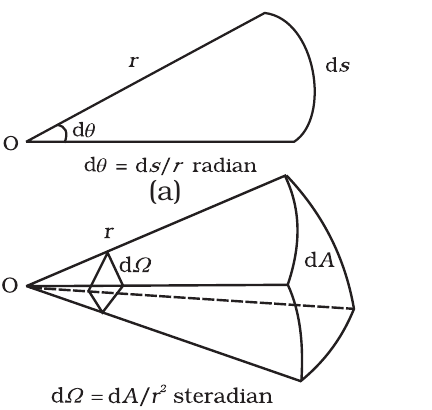
Besides the seven base units, there are two more units that are defined for (a) plane angle dθ as the ratio of length of arc ds to the radius r and (b) solid angle dΩ as the ratio of the intercepted area dA of the spherical surface, described about the apex O as the centre, to the square of its radius r, as shown in NCERT Figure 1.1(a) and (b) respectively.
- Plane angle: dθ = ds/r, unit radian with the symbol rad.
- Solid angle: dΩ = dA/$r^2$, unit steradian with the symbol sr.
- Both these are dimensionless quantities.
This is the chapter diagram: NCERT Figure 1.1 shows (a) the plane angle with arc ds, radius r and angle dθ at apex O, and (b) the solid angle with intercepted area dA, radius r and angle dΩ at apex O.
Suggest an edit
Table 2: Units retained for general use
Some units are retained for general use, though outside SI. They are given in Table 1.2.
| Name | Symbol | Value in SI unit |
|---|---|---|
| minute | min | 60 s |
| hour | h | 60 min = 3600 s |
| day | d | 24 h = 86400 s |
| year | y | 365.25 d = 3.156 x $10^{7}$ s |
| degree | ° | 1° = (pi/180) rad |
| litre | L | 1 dm3 = $10^{-3}$ m3 |
| tonne | t | $10^{3}$ kg |
| carat | c | 200 mg |
| bar | bar | 0.1 MPa = $10^{5}$ Pa |
| curie | Ci | 3.7 x $10^{10}$ s-1 |
| roentgen | R | 2.58 x $10^{-4}$ C/kg |
| quintal | q | 100 kg |
| barn | b | 100 fm2 = $10^{-28}$ m2 |
| are | a | 1 dam2 = $10^{2}$ m2 |
| hectare | ha | 1 hm2 = $10^{4}$ m2 |
| standard atmospheric pressure | atm | 101325 Pa = 1.013 x $10^{5}$ Pa |
Source: NCERT XI, Ch 1, Table 1.2.
Suggest an edit
Significant figures
Every measurement involves errors. Thus, the result of measurement should be reported in a way that indicates the precision of measurement. Normally, the reported result of measurement is a number that includes all digits in the number that are known reliably plus the first digit that is uncertain. The reliable digits plus the first uncertain digit are known as significant digits or significant figures.
- If we say the period of oscillation of a simple pendulum is 1.62 s, the digits 1 and 6 are reliable and certain, while the digit 2 is uncertain. Thus, the measured value has three significant figures.
- The length of an object reported after measurement to be 287.5 cm has four significant figures, the digits 2, 8, 7 are certain while the digit 5 is uncertain.
- Reporting the result of measurement that includes more digits than the significant digits is superfluous and also misleading since it would give a wrong idea about the precision of measurement.
- Significant figures indicate the precision of measurement which depends on the least count of the measuring instrument.
Suggest an edit
Rules for counting significant figures
The rules for determining the number of significant figures can be understood from the following examples.
- All the non-zero digits are significant.
- All the zeros between two non-zero digits are significant, no matter where the decimal point is, if at all.
- If the number is less than 1, the zero(s) on the right of decimal point but to the left of the first non-zero digit are not significant. In 0.002308, the two zeros after the decimal point and before 2 are not significant; the zero between 3 and 8 is significant.
- The terminal or trailing zero(s) in a number without a decimal point are not significant. Thus 123 m = 12300 cm = 123000 mm has three significant figures, the trailing zero(s) being not significant.
- The trailing zero(s) in a number with a decimal point are significant. The numbers 3.500 or 0.06900 have four significant figures each.
- A choice of change of different units does not change the number of significant digits or figures in a measurement. For example, the length 2.308 cm has four significant figures. But in different units, the same value can be written as 0.02308 m or 23.08 mm or 23080 micrometre. All these numbers have the same number of significant figures (digits 2, 3, 0, 8), namely four. This shows that the location of decimal point is of no consequence in determining the number of significant figures.
- Suppose a length is reported to be 4.700 m. It is evident that the zeroes here are meant to convey the precision of measurement and are, therefore, significant. If these were not, it would be superfluous to write them explicitly, the reported measurement would have been simply 4.7 m. Now suppose we change units, then 4.700 m = 470.0 cm = 4700 mm = 0.004700 km. Since 4700 mm has trailing zeros with no decimal point, we would conclude erroneously that the number has two significant figures, while in fact, it has four significant figures and a mere change of units cannot change the number of significant figures.
- The digit 0 conventionally put on the left of a decimal for a number less than 1 (like 0.1250) is never significant. However, the zeroes at the end of such number are significant in a measurement.
- The multiplying or dividing factors which are neither rounded numbers nor numbers representing measured values are exact and have infinite number of significant digits. For example in r = d/2 or s = 2 pi r, the factor 2 is an exact number and it can be written as 2.0, 2.00 or 2.0000 as required. Similarly, in T = t/n, n is an exact number.
Suggest an edit
Practice1 question
Try it now. A wrong answer costs nothing here, try again until you get it.
How many significant figures are in 0.002308?
NCERT 1.3: zeros on the right of the decimal point but to the left of the first non-zero digit are not significant, while the zero between 3 and 8 is significant. The significant digits are 2, 3, 0, 8: four in all.
Scientific notation and order of magnitude
To remove ambiguities in determining the number of significant figures, the best way is to report every measurement in scientific notation (in the power of 10). In this notation, every number is expressed as a x 10^b, where a is a number between 1 and 10, and b is any positive or negative exponent (or power) of 10.
- It is often customary to write the decimal after the first digit. Now the confusion about trailing zeros disappears: 4.700 m = 4.700 x $10^{2}$ cm = 4.700 x $10^{3}$ mm = 4.700 x $10^{-3}$ km. The power of 10 is irrelevant to the determination of significant figures. However, all zeroes appearing in the base number in the scientific notation are significant. Each number in this case has four significant figures.
- Order of magnitude: to get an approximate idea of the number, we may round off the number a to 1 (for a less than or equal to 5) and to 10 (for 5 < a less than or equal to 10). Then the number can be expressed approximately as 10^b in which the exponent (or power) b of 10 is called order of magnitude of the physical quantity. When only an estimate is required, the quantity is of the order of 10^b.
- For example, the diameter of the earth (1.28 x $10^{7}$ m) is of the order of $10^{7}$ m with the order of magnitude 7. The diameter of hydrogen atom (1.06 x $10^{-10}$ m) is of the order of $10^{-10}$ m, with the order of magnitude -10. Thus, the diameter of the earth is 17 orders of magnitude larger than the hydrogen atom.
Suggest an edit
Table 3: Significant figures at a glance
| Case | Significant figures | Example |
|---|---|---|
| Non-zero digits | All significant | 2.308 has 4 |
| Zeros between two non-zero digits | Significant | 2.308, the 0 counts; 6.032 has 4 |
| Zeros right of decimal but left of first non-zero digit | Not significant | 0.002308 has 4 (2, 3, 0, 8) |
| Trailing zeros, no decimal point | Not significant | 123 m = 12300 cm = 123000 mm has 3 |
| Trailing zeros, with decimal point | Significant | 3.500 has 4; 0.06900 has 4 |
| Zero on the left of a decimal for a number less than 1 | Never significant | 0.1250, the 0 before the decimal does not count |
| Change of units | Does not change the count | 2.308 cm = 0.02308 m = 23.08 mm = 23080 micrometre, all 4 |
| Scientific notation | Power of 10 irrelevant; zeros in the base number significant | 4.700 x $10^{2}$ cm has 4 |
| Exact factors | Infinite significant figures | 2 in r = d/2 and s = 2 pi r; n in T = t/n |
Source: NCERT XI, Ch 1, 1.3.
Suggest an edit
Arithmetic with significant figures
The result of a calculation involving approximate measured values of quantities (values with limited number of significant figures) must reflect the uncertainties in the original measured values. It cannot be more accurate than the original measured values themselves on which the result is based. In general, the final result should not have more significant figures than the original data from which it was obtained.
- (1) In multiplication or division, the final result should retain as many significant figures as are there in the original number with the least significant figures. If mass of an object is measured to be 4.237 g (four significant figures) and its volume is measured to be 2.51 cm3, then its density, by mere arithmetic division, is 1.68804780876 g/cm3 up to 11 decimal places. It would be clearly absurd and irrelevant to record the calculated value of density to such a precision when the measurements on which the value is based have much less precision. Density should be reported to three significant figures: 4.237 g / 2.51 cm3 = 1.69 g cm-3.
- Similarly, if the speed of light is given as 3.00 x $10^{8}$ m s-1 (three significant figures) and one year (1 y = 365.25 d) has 3.1557 x $10^{7}$ s (five significant figures), the light year is 9.47 x $10^{15}$ m (three significant figures).
- (2) In addition or subtraction, the final result should retain as many decimal places as are there in the number with the least decimal places. For example, the sum of the numbers 436.32 g, 227.2 g and 0.301 g by mere arithmetic addition is 663.821 g. But the least precise measurement (227.2 g) is correct to only one decimal place. The final result should, therefore, be rounded off to 663.8 g. Similarly, the difference in length can be expressed as: 0.307 m - 0.304 m = 0.003 m = 3 x $10^{-3}$ m.
- Note that we should not use the rule (1) applicable for multiplication and division and write 664 g as the result in the example of addition and 3.00 x $10^{-3}$ m in the example of subtraction. They do not convey the precision of measurement properly. For addition and subtraction, the rule is in terms of decimal places.
- Worked examples: Example 1.1, each side of a cube is measured to be 7.203 m. Surface area of the cube = 6 x (7.203)^2 m2 = 311.299254 m2 = 311.3 m2. Volume of the cube = (7.203)^3 m3 = 373.714754 m3 = 373.7 m3. The measured length has 4 significant figures, so area and volume are rounded off to 4 significant figures. Example 1.2, 5.74 g of a substance occupies 1.2 cm3. Density = 5.74 / 1.2 g cm-3 = 4.8 g cm-3, to only 2 significant figures, since the volume has only 2 significant figures.
Suggest an edit
Practice1 question
Try it now. A wrong answer costs nothing here, try again until you get it.
A mass of 4.237 g has volume 2.51 cm3. What is its density to the correct number of significant figures?
NCERT 1.3.1: in division the result keeps as many significant figures as the number with the least significant figures. 2.51 has 3, so density = 4.237 / 2.51 = 1.69 g cm-3.
Rounding off the uncertain digits
The result of computation with approximate numbers, which contain more than one uncertain digit, should be rounded off. The rules for rounding off numbers to the appropriate significant figures are obvious in most cases.
- A number 2.746 rounded off to three significant figures is 2.75, while the number 1.743 would be 1.74. The rule by convention is that the preceding digit is raised by 1 if the insignificant digit to be dropped is more than 5, and is left unchanged if the latter is less than 5.
- But what if the number is 2.745 in which the insignificant digit is 5. Here, the convention is that if the preceding digit is even, the insignificant digit is simply dropped and, if it is odd, the preceding digit is raised by 1. Then, the number 2.745 rounded off to three significant figures becomes 2.74. On the other hand, the number 2.735 rounded off to three significant figures becomes 2.74 since the preceding digit is odd.
- In any involved or complex multi-step calculation, you should retain, in intermediate steps, one digit more than the significant digits and round off to proper significant figures at the end of the calculation.
- A number known to be within many significant figures, such as 2.99792458 x $10^{8}$ m/s for the speed of light in vacuum, is rounded off to an approximate value 3 x $10^{8}$ m/s, which is often employed in computations.
- The value of pi = 3.1415926... is known to a large number of significant figures. You may take the value as 3.142 or 3.14 for pi, with limited number of significant figures as required in specific cases.
Suggest an edit
Uncertainty in the results of arithmetic calculations
The rules for determining the uncertainty or error in the number or measured quantity in arithmetic operations can be understood from the following examples.
- (1) If the length and breadth of a thin rectangular sheet are measured, using a metre scale as 16.2 cm and 10.1 cm respectively, there are three significant figures in each measurement. The length l may be written as l = 16.2 plus or minus 0.1 cm = 16.2 cm plus or minus 0.6 percent. Similarly, the breadth b may be written as b = 10.1 plus or minus 0.1 cm = 10.1 cm plus or minus 1 percent. Then, the error of the product of two (or more) experimental values, using the combination of errors rule, will be l b = 163.62 cm2 ± 1.6 percent = 163.62 ± 2.6 cm2. This leads us to quote the final result as l b = 164 ± 3 cm2. Here 3 cm2 is the uncertainty or error in the estimation of area of rectangular sheet.
- (2) If a set of experimental data is specified to n significant figures, a result obtained by combining the data will also be valid to n significant figures. However, if data are subtracted, the number of significant figures can be reduced. For example, 12.9 g - 7.06 g, both specified to three significant figures, cannot properly be evaluated as 5.84 g but only as 5.8 g, as uncertainties in subtraction or addition combine in a different fashion (smallest number of decimal places rather than the number of significant figures in any of the numbers added or subtracted).
- (3) The relative error of a value of number specified to significant figures depends not only on n but also on the number itself. For example, the accuracy in measurement of mass 1.02 g is plus or minus 0.01 g whereas another measurement 9.89 g is also accurate to plus or minus 0.01 g. The relative error in 1.02 g is (plus or minus 0.01/1.02) x 100 percent = plus or minus 1 percent. Similarly, the relative error in 9.89 g is (plus or minus 0.01/9.89) x 100 percent = plus or minus 0.1 percent.
- Remember that intermediate results in a multi-step computation should be calculated to one more significant figure in every measurement than the number of digits in the least precise measurement. For example, the reciprocal of 9.58, calculated (after rounding off) to the same number of significant figures (three) is 0.104, but the reciprocal of 0.104 calculated to three significant figures is 9.62. However, if we had written 1/9.58 = 0.1044 and then taken the reciprocal to three significant figures, we would have retrieved the original value of 9.58.
Suggest an edit
Dimensions of physical quantities
The nature of a physical quantity is described by its dimensions. All the physical quantities represented by derived units can be expressed in terms of some combination of seven fundamental or base quantities. We shall call these base quantities as the seven dimensions of the physical world, which are denoted with square brackets [ ]. Thus, length has the dimension $[L]$, mass $[M]$, time $[T]$, electric current [A], thermodynamic temperature [K], luminous intensity [cd], and amount of substance [mol]. The dimensions of a physical quantity are the powers (or exponents) to which the base quantities are raised to represent that quantity. Note that using the square brackets [ ] round a quantity means that we are dealing with 'the dimensions of' the quantity.
- In mechanics, all the physical quantities can be written in terms of the dimensions $[L]$, $[M]$ and $[T]$. For example, the volume occupied by an object is expressed as the product of length, breadth and height, or three lengths. Hence the dimensions of volume are $[L]$ x $[L]$ x $[L]$ = $[L]^3$ = $[L^3]$. As the volume is independent of mass and time, it is said to possess zero dimension in mass $[M^0]$, zero dimension in time $[T^0]$ and three dimensions in length.
- Similarly, force, as the product of mass and acceleration, can be expressed as Force = mass x acceleration = mass x (length)/(time)^2. The dimensions of force are $[M]$ $[L]$/$[T]^2$ = $[M L T^{-2}]$. Thus, the force has one dimension in mass, one dimension in length, and -2 dimensions in time.
- Note that in this type of representation, the magnitudes are not considered. It is the quality of the type of the physical quantity that enters. Thus, a change in velocity, initial velocity, average velocity, final velocity, and speed are all equivalent in this context. Since all these quantities can be expressed as length/time, their dimensions are $[L]$/$[T]$ or $[L T^{-1}]$.
Suggest an edit
Table 4: Dimensional formulae
The expression which shows how and which of the base quantities represent the dimensions of a physical quantity is called the dimensional formula of the given physical quantity.
| Physical quantity | Dimensional formula |
|---|---|
| Volume [V] | $[M^0 L^3 T^0]$ |
| Speed or velocity [v] | $[M^0 L^1 T^{-1}]$ |
| Acceleration | $[M^0 L^1 T^{-2}]$ |
| Force [F] | $[M^1 L^1 T^{-2}]$ |
| Mass density [rho] | $[M^1 L^{-3} T^0]$ |
| Energy (work) | $[M^1 L^2 T^{-2}]$ |
| Pressure, stress | $[M^1 L^{-1} T^{-2}]$ |
The energy and pressure rows follow from the NCERT formulae: energy has the dimensions of force x length, $[M L T^{-2}]$ x $[L]$ = $[M L^2 T^{-2}]$; pressure and stress are force per unit area, $[M L T^{-2}]$ / $[L^2]$ = $[M L^{-1} T^{-2}]$.
Source: NCERT XI, Ch 1, 1.5.
Suggest an edit
Practice1 question
Try it now. A wrong answer costs nothing here, try again until you get it.
What are the dimensions of energy?
NCERT 1.5 and Example 1.3: energy has the dimensions of force x length, $[M L T^{-2}]$ x $[L]$ = $[M L^2 T^{-2}]$, as in (1/2) m $v^2$ = m g h.
Dimensional equations
An equation obtained by equating a physical quantity with its dimensional formula is called the dimensional equation of the physical quantity. Thus, the dimensional equations are the equations which represent the dimensions of a physical quantity in terms of the base quantities.
- [V] = $[M^0 L^3 T^0]$
- [v] = $[M^0 L^1 T^{-1}]$
- [F] = $[M^1 L^1 T^{-2}]$
- [rho] = $[M^1 L^{-3} T^0]$
The dimensional equation can be obtained from the equation representing the relations between the physical quantities. The dimensional formulae of a large number and wide variety of physical quantities, derived from the equations representing the relationships among other physical quantities and expressed in terms of base quantities are given in Appendix 9 for your guidance and ready reference.
Suggest an edit
Checking the dimensional consistency of equations
The recognition of concepts of dimensions, which guide the description of physical behaviour is of basic importance as only those physical quantities can be added or subtracted which have the same dimensions. A thorough understanding of dimensional analysis helps us in deducing certain relations among different physical quantities and checking the derivation, accuracy and dimensional consistency or homogeneity of various mathematical expressions. When magnitudes of two or more physical quantities are multiplied, their units should be treated in the same manner as ordinary algebraic symbols. We can cancel identical units in the numerator and denominator. The same is true for dimensions of a physical quantity. Similarly, physical quantities represented by symbols on both sides of a mathematical equation must have the same dimensions.
- The magnitudes of physical quantities may be added together or subtracted from one another only if they have the same dimensions. In other words, we can add or subtract similar physical quantities. Thus, velocity cannot be added to force, or an electric current cannot be subtracted from the thermodynamic temperature. This simple principle called the principle of homogeneity of dimensions in an equation is extremely useful in checking the correctness of an equation. If the dimensions of all the terms are not same, the equation is wrong.
- Dimensions are customarily used as a preliminary test of the consistency of an equation, when there is some doubt about the correctness of the equation. However, the dimensional consistency does not guarantee correct equations. It is uncertain to the extent of dimensionless quantities or functions. The arguments of special functions, such as the trigonometric, logarithmic and exponential functions must be dimensionless. A pure number, ratio of similar physical quantities, such as angle as the ratio (length/length), refractive index as the ratio (speed of light in vacuum/speed of light in medium) etc., has no dimensions.
- Worked check: test the dimensional consistency of the equation x = x0 + v0 t + (1/2) a $t^2$ for the distance x travelled by a particle in time t which starts from the position x0 with an initial velocity v0 at time t = 0 and has uniform acceleration a. The dimensions of each term: [x] = $[L]$; [x0] = $[L]$; [v0 t] = $[L T^{-1}]$ $[T]$ = $[L]$; [(1/2) a $t^2$] = $[L T^{-2}]$ $[T^2]$ = $[L]$. As each term on the right hand side of this equation has the same dimension, namely that of length, which is same as the dimension of left hand side of the equation, hence this equation is a dimensionally correct equation.
- It may be noted that a test of consistency of dimensions tells us no more and no less than a test of consistency of units, but has the advantage that we need not commit ourselves to a particular choice of units, and we need not worry about conversions among multiples and sub-multiples of the units. It may be borne in mind that if an equation fails this consistency test, it is proved wrong, but if it passes, it is not proved right. Thus, a dimensionally correct equation need not be actually an exact (correct) equation, but a dimensionally wrong (incorrect) or inconsistent equation must be wrong.
- Example 1.3: consider the equation (1/2) m $v^2$ = m g h, where m is the mass of the body, v its velocity, g is the acceleration due to gravity and h is the height. The dimensions of LHS are $[M]$ $[L T^{-1}]^2$ = $[M L^2 T^{-2}]$. The dimensions of RHS are $[M]$ $[L T^{-2}]$ $[L]$ = $[M L^2 T^{-2}]$. The dimensions of LHS and RHS are the same and hence the equation is dimensionally correct.
- Example 1.4: the SI unit of energy is J = kg m2 s-2; that of speed v is m s-1 and of acceleration a is m s-2. Which of the formulae for kinetic energy (K) can you rule out on the basis of dimensional arguments (m stands for the mass of the body): (a) K = $m^2$ $v^3$ (b) K = (1/2) m $v^2$ (c) K = m a (d) K = (3/16) m $v^2$ (e) K = (1/2) m $v^2$ + m a. The dimensions of the quantity on the right side are $[M^2 L^3 T^{-3}]$ for (a); $[M L^2 T^{-2}]$ for (b) and (d); $[M L T^{-2}]$ for (c). The quantity on the right side of (e) has no proper dimensions since two quantities of different dimensions have been added. Since the kinetic energy K has the dimensions of $[M L^2 T^{-2}]$, formulas (a), (c) and (e) are ruled out. Note that dimensional arguments cannot tell which of the two, (b) or (d), is the correct formula. The correct formula for kinetic energy is given by (b).
Suggest an edit
Deducing relation among the physical quantities
The method of dimensions can sometimes be used to deduce relation among the physical quantities. For this we should know the dependence of the physical quantity on other quantities (up to three physical quantities or linearly independent variables) and consider it as a product type of the dependence.
- Example 1.5: consider a simple pendulum, having a bob attached to a string, that oscillates under the action of the force of gravity. Suppose that the period of oscillation of the simple pendulum depends on its length (l), mass of the bob (m) and acceleration due to gravity (g). Derive the expression for its time period using method of dimensions.
- The dependence of time period T on the quantities l, g and m as a product may be written as: T = k l^x g^y m^z, where k is dimensionless constant and x, y and z are the exponents.
- By considering dimensions on both sides: $[L^0 M^0 T^1]$ = $[L^1]$^x $[L^1 T^{-2}]$^y $[M^1]$^z = L^(x+y) T^(-2y) M^z. On equating the dimensions on both sides: x + y = 0; -2y = 1; and z = 0. So x = 1/2, y = -1/2, z = 0. Then T = k l^(1/2) g^(-1/2), or T = k sqrt(l/g).
- Note that value of constant k can not be obtained by the method of dimensions. Here it does not matter if some number multiplies the right side of this formula, because that does not affect its dimensions. Actually, k = 2 pi so that T = 2 pi sqrt(l/g).
- Dimensional analysis is very useful in deducing relations among the interdependent physical quantities. However, dimensionless constants cannot be obtained by this method. The method of dimensions can only test the dimensional validity, but not the exact relationship between physical quantities in any equation. It does not distinguish between the physical quantities having same dimensions.
Suggest an edit
Practice1 question
Try it now. A wrong answer costs nothing here, try again until you get it.
The time period of a simple pendulum depends on its length l, the acceleration due to gravity g and the mass m of the bob. Which dependence is correct?
NCERT Example 1.5: dimensions give x = 1/2, y = -1/2, z = 0, so T = k sqrt(l/g) with k = 2 pi. The mass exponent is zero, so the period does not depend on the mass of the bob.
Least count and errors: beyond the current book
This section is beyond the current NCERT chapter and is kept short because NEET still asks it under NMC Unit 1. The current NCERT chapter mentions least count once, in 1.3 (precision depends on the least count of the measuring instrument), and Exercises 1.6 and 1.8 give a screw gauge pitch and divisions, but the old section on accuracy, precision and errors was removed in rationalisation. What follows comes from NMC Unit 1 and the NEET papers cited, not from the current chapter text.
- Least count is the smallest value of a physical quantity that an instrument can measure. For a screw gauge, least count = pitch / number of divisions on the circular scale. With pitch 1 mm and 100 divisions, least count = 1/100 = 0.01 mm = 0.001 cm. With least count 0.01 mm and 50 divisions, pitch = 0.01 x 50 = 0.5 mm (NEET 2020 G5, question 176).
- For a vernier calipers, if (N + 1) divisions of the vernier scale coincide with N divisions of the main scale, the vernier constant = 1 MSD - 1 VSD = 1 MSD / (N + 1). With 1 MSD = 0.1 mm, the vernier constant = 0.1 mm / (N + 1) = 1 / [100(N + 1)] cm (NEET 2024 R3, question 23).
- Error types named in NEET 2023 F1, question 8: the errors which arise due to unpredictable fluctuations in temperature and voltage supply are random errors. The other options in that question were personal errors, least count errors and instrumental errors.
- Most precise device (NCERT Exercise 1.6): of (a) a vernier callipers with 20 divisions on the sliding scale, (b) a screw gauge of pitch 1 mm and 100 divisions on the circular scale, (c) an optical instrument that can measure length to within a wavelength of light, the optical instrument is the most precise, since a wavelength of light is far smaller than the least counts of the other two. Exercise 1.8 uses a screw gauge of pitch 1.0 mm and 200 divisions, giving least count 1.0/200 = 0.005 mm.
- Combination of relative errors (NMC Unit 1): for a physical quantity Z = A^a B^b / C^c, the maximum fractional error is $\Delta Z$/Z = a($\Delta A$/A) + b($\Delta B$/B) + c($\Delta C$/C), so percentage errors add with each quantity weighted by the magnitude of its exponent (for density = m / (pi $r^2$ l), the radius error counts twice, NEET 2023 F1 Q15).
Suggest an edit
What dimensional analysis cannot do
- It cannot give the value of a dimensionless constant: in T = k sqrt(l/g) for the simple pendulum, k = 2 pi comes from experiment and theory, not from dimensions.
- It cannot pick between two formulae with the same dimensions: (1/2) m $v^2$ and (3/16) m $v^2$ are both dimensionally correct, but only (1/2) m $v^2$ is the kinetic energy.
- It cannot prove an equation right: a dimensionally correct equation need not be an exact equation. It can only prove an equation wrong when the dimensions do not match.
- It cannot distinguish physical quantities that have the same dimensions: work, energy, torque and heat all have $[M L^2 T^{-2}]$ in mechanics, and strain, angle and refractive index are all dimensionless.
- It cannot check an equation that adds quantities of different dimensions: (1/2) m $v^2$ + m a has no proper dimensions, so it is ruled out at once.
- It cannot be used when the equation has more than three unknown exponents to solve for, or when the dependence is not a product of powers.
Suggest an edit
Trap pairs: the confusions NEET tests
- Plane angle and solid angle have units but no dimensions: radian and steradian are units of dimensionless ratios (length/length and area/area). Do not say they have dimensions.
- Trailing zeros: 123 m = 12300 cm = 123000 mm has only 3 significant figures, but 3.500 has 4 significant figures. The decimal point decides, not the number of zeros.
- Subtraction uses decimal places, not significant figures: 9.99 m - 0.0099 m = 9.98 m, not 9.9801 m and not 9.980 m.
- Dimensionally correct does not mean correct: (1/2) m $v^2$ and (3/16) m $v^2$ both pass the dimension test; only the definition of kinetic energy picks (1/2) m $v^2$. But (1/2) m $v^2$ + m a is dimensionally wrong and is ruled out.
- In a percentage error of density, the radius counts twice: density = mass / (pi $r^2$ l), so the percentage error in radius is doubled. Forgetting the factor 2 gives 1.2 percent instead of 1.6 percent.
- The vernier constant is 1 MSD / (N + 1), not 1 MSD: with 1 MSD = 0.1 mm it is 1 / [100(N + 1)] cm, not 0.1 mm and not 1 / (10N) cm.
- Order of magnitude is the power of 10 after rounding the base number to 1 or 10: the diameter of the earth (1.28 x $10^{7}$ m) has order 7, and the hydrogen atom diameter (1.06 x $10^{-10}$ m) has order -10, a gap of 17 orders.
Suggest an edit
Trap Boxes
Plane angle and solid angle have dimensions?
Wrong idea: Plane angle and solid angle have both units and dimensions.
They have units (radian and steradian) but no dimensions. Plane angle is arc/radius and solid angle is area/(radius)^2, both ratios of similar quantities, so both are dimensionless.
NCERT XI, Ch 1, 1.2
9.99 m - 0.0099 m = 9.9801 m?
Wrong idea: 9.99 m - 0.0099 m = 9.9801 m, keeping all the digits.
In addition and subtraction the result keeps as many decimal places as the number with the least decimal places. 9.99 has 2 decimal places, so 9.99 m - 0.0099 m = 9.98 m.
NCERT XI, Ch 1, 1.3.1
Dimensionally correct means the formula is right?
Wrong idea: If a formula passes the dimension test, it must be the correct formula.
A dimensionally correct equation need not be an exact equation. (1/2) m $v^2$ and (3/16) m $v^2$ are both dimensionally correct, but only (1/2) m $v^2$ is kinetic energy. A dimensionally wrong equation must be wrong.
NCERT XI, Ch 1, 1.6.1 and Example 1.4
Percentage error in density counts the radius once?
Wrong idea: The percentage error in density is the sum of the percentage errors in mass, radius and length, each counted once.
Density = mass / (pi $r^2$ l), so the radius enters squared and its percentage error is doubled: 0.5 percent (mass) + 2 x 0.33 percent (radius, giving 0.67 percent) + 0.4 percent (length) = 1.57 percent, nearly 1.6 percent.
NCERT XI, Ch 1, 1.3.3
Vernier constant equals 1 MSD?
Wrong idea: The vernier constant is 1 MSD, which is 0.1 mm here.
Vernier constant = 1 MSD - 1 VSD = 1 MSD / (N + 1). With 1 MSD = 0.1 mm it is 0.1 mm / (N + 1) = 1 / [100(N + 1)] cm.
NCERT XI, Ch 1, 1.3 and Exercises 1.6, 1.8
12300 cm has 5 significant figures?
Wrong idea: 12300 cm has 5 significant figures because it has 5 digits.
Trailing zeros in a number without a decimal point are not significant: 123 m = 12300 cm = 123000 mm has 3 significant figures. But 3.500 has 4, since trailing zeros with a decimal point are significant.
NCERT XI, Ch 1, 1.3
Chapter test
5 NEET PYQs. +4 for a correct answer, -1 for a wrong answer, exactly like NEET. Finish the test to earn a medal.
Q1: NEET (UG) 2024, Code R3, Q23
In a vernier calipers, (N + 1) divisions of vernier scale coincide with N divisions of main scale. If 1 MSD represents 0.1 mm, the vernier constant (in cm) is:
Vernier constant = 1 MSD - 1 VSD = 1 MSD/(N+1) = 0.1 mm/(N+1) = 0.01 cm/(N+1) = 1/[100(N+1)] cm.
Q2: NEET (UG) 2023, Code F1, Q15
A metal wire has mass (0.4 +/- 0.002) g, radius (0.3 +/- 0.001) mm and length (5 +/- 0.02) cm. The maximum possible percentage error in the measurement of density will nearly be
Density = mass / (pi $r^2$ l), so percentage error = (0.002/0.4) x 100 + 2 x (0.001/0.3) x 100 + (0.02/5) x 100 = 0.5 + 0.67 + 0.4 = 1.57 percent, nearly 1.6 percent.
Q3: NEET (UG) 2022, Code R1, Q8
Plane angle and solid angle have
Plane angle (radian) is arc/radius and solid angle (steradian) is area/(radius)^2. Both are ratios of similar quantities, so they have units but no dimensions.
Q4: NEET (UG) 2021, Code P3, Q7
If E and G respectively denote energy and gravitational constant, then E/G has the dimensions of:
[E] = $[M L^2 T^{-2}]$ and [G] = $[M^{-1} L^3 T^{-2}]$, so [E]/[G] = $[M^2 L^{-1} T^0]$.
Q5: NEET (UG) 2020, Code G5, Q176
A screw gauge has least count of 0.01 mm and there are 50 divisions in its circular scale. The pitch of the screw gauge is :
Least count = pitch / number of divisions on the circular scale, so pitch = least count x divisions = 0.01 mm x 50 = 0.5 mm.
Score: 0 · Answered 0 of 5
Flashcards
Tap a card to flip it over and see the answer. Tap it again to flip it back.
Name the seven SI base quantities with their units and symbols.
Tap to flipLength metre m; mass kilogram kg; time second s; electric current ampere A; thermodynamic temperature kelvin K; amount of substance mole mol; luminous intensity candela cd.
Tap to flip backGive the definitions of plane angle and solid angle, their units, and whether they have dimensions.
Tap to flipPlane angle dθ = ds/r, unit radian (rad). Solid angle dΩ = dA/$r^2$, unit steradian (sr). Both are dimensionless.
Tap to flip backConvert: 1 year, 1 litre, 1 bar and 1 standard atmosphere into SI units.
Tap to flip1 year = 365.25 d = 3.156 x $10^{7}$ s; 1 litre = 1 dm3 = $10^{-3}$ m3; 1 bar = 0.1 MPa = $10^{5}$ Pa; 1 atm = 101325 Pa = 1.013 x $10^{5}$ Pa.
Tap to flip backWhat are significant figures? How many are in 1.62 s and in 287.5 cm?
Tap to flipThe reliable digits plus the first uncertain digit. 1.62 s has 3 significant figures (1 and 6 certain, 2 uncertain). 287.5 cm has 4 (2, 8, 7 certain, 5 uncertain).
Tap to flip backWhich zeros count as significant figures and which do not?
Tap to flipZeros between two non-zero digits count. Zeros right of the decimal but left of the first non-zero digit do not count (0.002308 has 4). Trailing zeros without a decimal point do not count (12300 cm has 3). Trailing zeros with a decimal point count (3.500 has 4). A zero left of the decimal in a number less than 1 never
Tap to flip backWhat is the order of magnitude of the diameter of the earth and of the hydrogen atom, and how many orders apart are they?
Tap to flipEarth diameter 1.28 x $10^{7}$ m, order 7. Hydrogen atom diameter 1.06 x $10^{-10}$ m, order -10. The earth is 17 orders of magnitude larger.
Tap to flip backState the rule for significant figures in multiplication and division, with the NCERT density example.
Tap to flipThe final result keeps as many significant figures as the number with the least significant figures. 4.237 g / 2.51 cm3 = 1.69 g cm-3 (3 significant figures). The light year is 9.47 x $10^{15}$ m (3 significant figures).
Tap to flip backState the rule for significant figures in addition and subtraction, with the NCERT sum example.
Tap to flipThe final result keeps as many decimal places as the number with the least decimal places. 436.32 g + 227.2 g + 0.301 g = 663.8 g (one decimal place). 0.307 m - 0.304 m = 0.003 m.
Tap to flip backRound 2.745 and 2.735 to three significant figures, and state the rule used.
Tap to flip2.745 becomes 2.74 (preceding digit even, so the 5 is dropped). 2.735 becomes 2.74 (preceding digit odd, so it is raised by 1). If the digit to drop is more than 5, raise the preceding digit; if less than 5, leave it unchanged.
Tap to flip backA sheet measures 16.2 cm by 10.1 cm. What is its area with uncertainty, and what is 12.9 g - 7.06 g to correct significant figures?
Tap to flipArea = 163.62 cm2 ± 1.6 percent = 164 ± 3 cm2. 12.9 g - 7.06 g = 5.8 g, not 5.84 g, since subtraction follows the decimal places rule.
Tap to flip backGive the dimensional formulae of volume, speed, force and mass density.
Tap to flip[V] = $[M^0 L^3 T^0]$; [v] = $[M^0 L^1 T^{-1}]$; [F] = $[M^1 L^1 T^{-2}]$; [rho] = $[M^1 L^{-3} T^0]$. Energy is $[M^1 L^2 T^{-2}]$ and pressure is $[M^1 L^{-1} T^{-2}]$.
Tap to flip backDerive the time period of a simple pendulum by dimensions, and state what the method cannot give.
Tap to flipT = k l^x g^y m^z gives x = 1/2, y = -1/2, z = 0, so T = k sqrt(l/g) with k = 2 pi, hence T = 2 pi sqrt(l/g). The method cannot give the dimensionless constant k, cannot pick between formulae with the same dimensions, and cannot prove an equation right.
Tap to flip back