 NEET Notes
Oscillations
Any motion that repeats itself at regular intervals of time is called periodic motion.
On this page · 21 sections
- 01Syllabus Map
- 02Introduction
- 03Periodic and Oscillatory Motions
- 04Period and Frequency
- 05Displacement and Periodic Functions
- 06Simple Harmonic Motion
- 07Table: SHM Symbols and Forms
- 08SHM and Uniform Circular Motion
- 09Velocity and Acceleration in SHM
- 10Table: Velocity, Acceleration and Phase
- 11Force Law for Simple Harmonic Motion
- 12Table: Force Law and Spring Systems
- 13Energy in Simple Harmonic Motion
- 14Table: Energy in SHM
- 15The Simple Pendulum
- 16Table: Pendulum Formulae
- 17Damped Oscillations: What NCERT Actually Says
- 18Exercises and Their Figures
- 19Points to Ponder
- 20Trap Pairs
- 21Table: Periodic vs Simple Harmonic
Periodic and oscillatory motion, SHM and its equation, velocity, acceleration, force law, energy, and the simple pendulum, from NCERT Ch 13, with 5 NEET PYQs.
Syllabus Map
NMC Unit 10: Oscillations and Waves. This chapter covers the oscillations half of the unit: oscillations and periodic motion, time period, frequency and displacement as a function of time, periodic functions, simple harmonic motion (S.H.M.) and its equation, phase, oscillations of a spring (restoring force and force constant), energy in S.H.M. (kinetic and potential energies), and the simple pendulum with the derivation of its time period.
Out of scope here, covered in the next chapter (waves): wave motion, longitudinal and transverse waves, speed of a travelling wave, displacement relation for a progressive wave, principle of superposition, reflection of waves, standing waves in strings and organ pipes, fundamental mode and harmonics, and beats. Those items are in the same NMC unit but belong to NCERT Ch 14.
Extra information (beyond NCERT): none. Every item above is in rationalised NCERT Ch 13. Damped and forced oscillations are named in NCERT 13.2 but are not developed in the chapter; they are not listed in NMC Unit 10, so they get only the short note in section 17, from Points to Ponder point 9.
Introduction
In daily life we come across various kinds of motions: rectilinear motion and motion of a projectile, both non-repetitive; uniform circular motion and orbital motion of planets, both repeated after a certain interval of time, that is, periodic. Rocking in a cradle or swinging on a swing is repetitive but different from the periodic motion of a planet: here the object moves to and fro about a mean position. The pendulum of a wall clock executes a similar motion. A boat tossing up and down in a river and the piston in a steam engine going back and forth are more examples. Such a motion is termed oscillatory motion, and this chapter studies it.
The study of oscillatory motion is basic to physics. In musical instruments like the sitar, the guitar or the violin, vibrating strings produce pleasing sounds. The membranes in drums and diaphragms in telephone and speaker systems vibrate to and fro about their mean positions. The vibrations of air molecules make the propagation of sound possible. In a solid, the atoms vibrate about their equilibrium positions, the average energy of vibrations being proportional to temperature. AC power supply give voltage that oscillates alternately going positive and negative about the mean value (zero).
The description of a periodic motion, in general, and oscillatory motion, in particular, requires some fundamental concepts, like period, frequency, displacement, amplitude and phase. These concepts are developed in the next section.
Periodic and Oscillatory Motions

Fig. 13.1 shows some periodic motions. Suppose an insect climbs up a ramp and falls down, it comes back to the initial point and repeats the process identically. If you draw a graph of its height above the ground versus time, it would look something like Fig. 13.1 (a). If a child climbs up a step, comes down, and repeats the process identically, its height above the ground would look like that in Fig. 13.1 (b). When you play the game of bouncing a ball off the ground, between your palm and the ground, its height versus time graph would look like the one in Fig. 13.1 (c). Note that both the curved parts in Fig. 13.1 (c) are sections of a parabola given by $h = ut + (1/2)g(t^2)$ for downward motion, and $h = ut - (1/2)g(t^2)$ for upward motion, with different values of u in each case.
A motion that repeats itself at regular intervals of time is called periodic motion. Very often, the body undergoing periodic motion has an equilibrium position somewhere inside its path. When the body is at this position no net external force acts on it. Therefore, if it is left there at rest, it remains there forever. If the body is given a small displacement from the position, a force comes into play which tries to bring the body back to the equilibrium point, giving rise to oscillations or vibrations. For example, a ball placed in a bowl will be in equilibrium at the bottom. If displaced a little from the point, it will perform oscillations in the bowl. Every oscillatory motion is periodic, but every periodic motion need not be oscillatory. Circular motion is a periodic motion, but it is not oscillatory.
There is no significant difference between oscillations and vibrations. It seems that when the frequency is small, we call it oscillation (like, the oscillation of a branch of a tree), while when the frequency is high, we call it vibration (like, the vibration of a string of a musical instrument). Simple harmonic motion is the simplest form of oscillatory motion. This motion arises when the force on the oscillating body is directly proportional to its displacement from the mean position, which is also the equilibrium position. Further, at any point in its oscillation, this force is directed towards the mean position.
In practice, oscillating bodies eventually come to rest at their equilibrium positions because of the damping due to friction and other dissipative causes. However, they can be forced to remain oscillating by means of some external periodic agency. We discuss the phenomena of damped and forced oscillations later in the chapter. Any material medium can be pictured as a collection of a large number of coupled oscillators. The collective oscillations of the constituents of a medium manifest themselves as waves. Examples of waves include water waves, seismic waves, electromagnetic waves. We shall study the wave phenomenon in the next chapter.
Period and Frequency
Any motion that repeats itself at regular intervals of time is called periodic motion. The smallest interval of time after which the motion is repeated is called its period. Let us denote the period by the symbol T. Its SI unit is second. For periodic motions, which are either too fast or too slow on the scale of seconds, other convenient units of time are used. The period of vibrations of a quartz crystal is expressed in units of microseconds ($10^{-6}$ s) abbreviated as µs. On the other hand, the orbital period of the planet Mercury is 88 earth days. The Halley's comet appears after every 76 years.
The reciprocal of T gives the number of repetitions that occur per unit time. This quantity is called the frequency of the periodic motion. It is represented by the symbol ν. The relation between ν and T is $ν = 1/T$ (13.1). The unit of ν is thus s-1. After the discoverer of radio waves, Heinrich Rudolph Hertz (1857-1894), a special name has been given to the unit of frequency. It is called hertz (abbreviated as Hz). Thus, $1 \text{hertz} = 1 Hz = 1 oscillat$ion per second = 1 s-1 (13.2). Note, that the frequency, ν, is not necessarily an integer.
Example 13.1 On an average, a human heart is found to beat 75 times in a minute. Calculate its frequency and period. Answer: the beat frequency of $\text{heart} = 75/(1 min) = 75/(60 s) = 1.25 s-1 = 1.25 Hz$. The time period $T = 1/(1.25 s-1) = 0.8 s$.
Practice1 question
Try it now. A wrong answer costs nothing here, try again until you get it.
On an average, a human heart beats 75 times in a minute. Its frequency is
NCERT 13.2.1, Example 13.1: frequency = $75/(60 s) = 1.25 Hz$, $period = 0.8 s$.
Displacement and Periodic Functions
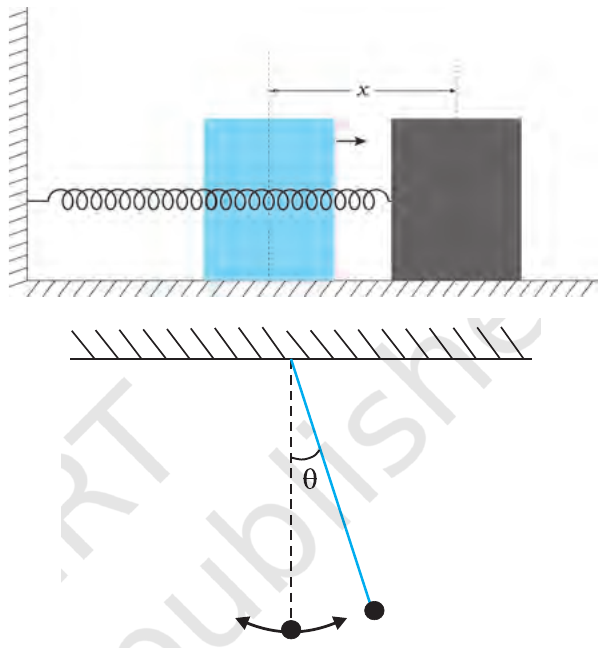
In this chapter, we use the term displacement in a more general sense. It refers to change with time of any physical property under consideration. For example, in case of rectilinear motion of a steel ball on a surface, the distance from the starting point as a function of time is its position displacement. The choice of origin is a matter of convenience. Consider a block attached to a spring, the other end of the spring is fixed to a rigid wall [see Fig. 13.2(a)]. Generally, it is convenient to measure displacement of the body from its equilibrium position. For an oscillating simple pendulum, the angle from the vertical as a function of time may be regarded as a displacement variable [see Fig. 13.2(b)].
The term displacement is not always to be referred in the context of position only. There can be many other kinds of displacement variables. The voltage across a capacitor, changing with time in an AC circuit, is also a displacement variable. In the same way, pressure variations in time in the propagation of sound wave, the changing electric and magnetic fields in a light wave are examples of displacement in different contexts. The displacement variable may take both positive and negative values.
The displacement can be represented by a mathematical function of time. In case of periodic motion, this function is periodic in time. One of the simplest periodic functions is given by $f(t) = A \cos \omega t$ (13.3a). If the argument of this function, $\omega t$, is increased by an integral multiple of $2\pi$ radians, the value of the function remains the same. The function f(t) is then periodic and its period, T, is given by $T = 2\pi/\omega$ (13.3b). Thus, the function f(t) is periodic with period T, $f(t) = f(t+T)$. The same result is obviously correct if we consider a sine function, $f(t) = A \sin \omega t$. Further, a linear combination of sine and cosine functions like $f(t) = A \sin \omega t + B \cos \omega t$ (13.3c) is also a periodic function with the same period T. $Taking A = D \cos φ$ and $B = D \sin φ$, Eq. (13.3c) can be written as $f(t) = D \sin(\omega t + \phi)$ (13.3d). Here D and φ are constants given by $D = \sqrt{(A^2) + (B^2)}$ and $φ = tan-1(B/A)$.
The great importance of periodic sine and cosine functions is due to a remarkable result proved by the French mathematician, Jean Baptiste Joseph Fourier (1768-1830): any periodic function can be expressed as a superposition of sine and cosine functions of different time periods with suitable coefficients.
Example 13.2 Which of the following functions of time represent (a) periodic and (b) non-periodic motion? Give the period for each case of periodic motion ($\omega$ is any positive constant). (i) $\sin \omega t + \cos \omega t$ (ii) $\sin \omega t + \cos 2\omega t + \sin 4\omega t$ (iii) $e^{-\omega t}$ (iv) $\log(\omega t)$. Answer: (i) $\sin \omega t + \cos \omega t$ is a periodic function, it can also be written as $\sqrt{2} \sin(\omega t + \pi/4)$. The periodic time of the function is $2\pi/\omega$. (ii) This is an example of a periodic motion. Each term represents a periodic function with a different angular frequency. Since period is the least interval of time after which a function repeats its value, $\sin \omega t$ has a period $T0 = 2\pi/\omega$; $\cos 2\omega t$ has a period $\pi/\omega = T0/2$; and $\sin 4\omega t$ has a period $2\pi/4\omega = T0/4$. The period of the first term is a multiple of the periods of the last two terms. Therefore, the smallest interval of time after which the sum of the three terms repeats is $T_0$, and thus, the sum is a periodic function with a period $2\pi/\omega$. (iii) The function $e^{-\omega t}$ is not periodic, it decreases monotonically with increasing time and tends to zero as t tends to infinity and thus, never repeats its value. (iv) The function $\log(\omega t)$ increases monotonically with time t. It, therefore, never repeats its value and is a non-periodic function. It may be noted that as t tends to infinity, $\log(\omega t)$ diverges to infinity. It, therefore, cannot represent any kind of physical displacement.
Simple Harmonic Motion
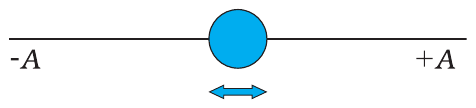
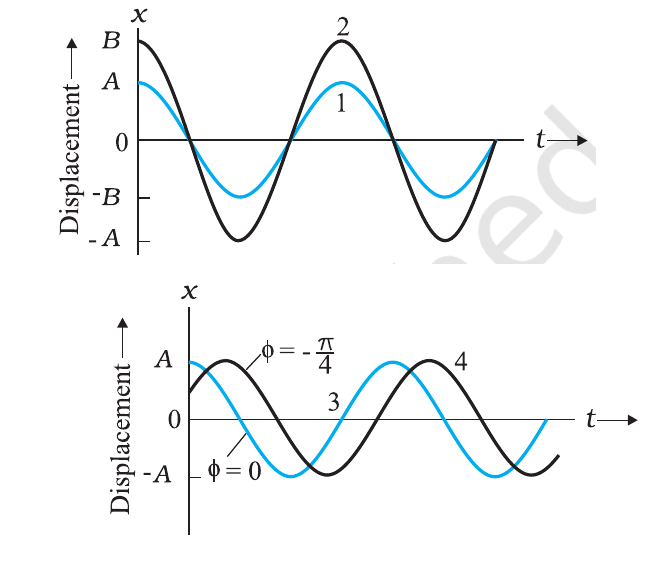

Consider a particle oscillating back and forth about the origin of an x-axis between the limits +A and -A as shown in Fig. 13.3. This oscillatory motion is said to be simple harmonic if the displacement x of the particle from the origin varies with time as $x(t) = A \cos(\omega t + \phi)$ (13.4), where A, $\omega$ and φ are constants. Thus, simple harmonic motion (SHM) is not any periodic motion but one in which displacement is a sinusoidal function of time.
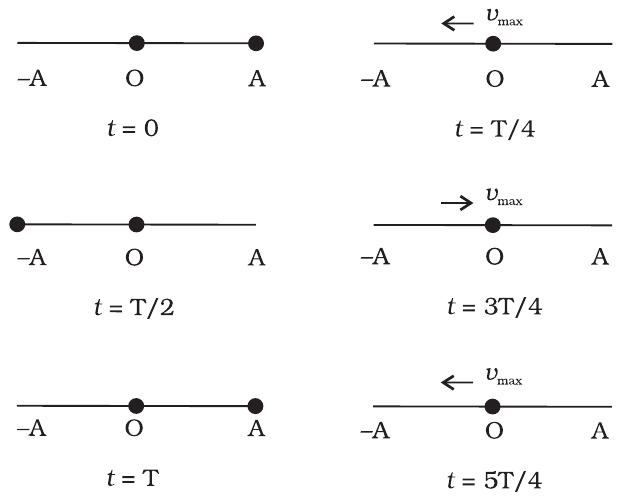
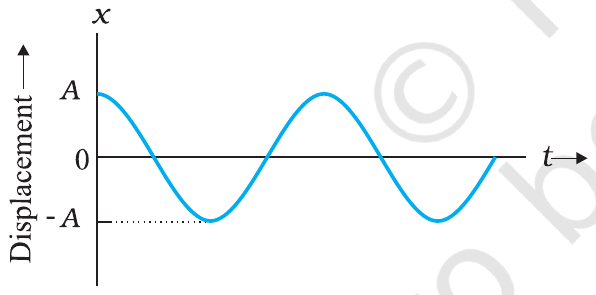
Fig. 13.4 shows the positions of a particle executing SHM at discrete values of time, each interval of time being T/4, where T is the period of motion. Fig. 13.5 plots the graph of x versus t, which gives the values of displacement as a continuous function of time. The quantities A, $\omega$ and φ which characterize a given SHM have standard names, as summarised in Fig. 13.6.
The amplitutde A of SHM is the magnitude of maximum displacement of the particle. Note, A can be taken to be positive without any loss of generality. As the cosine function of time varies from +1 to -1, the displacement varies between the extremes A and -A. Two simple harmonic motions may have same $\omega$ and φ but different amplitudes A and B, as shown in Fig. 13.7 (a).
While the amplitude A is fixed for a given SHM, the state of motion (position and velocity) of the particle at any time t is determined by the argument $(\omega t + \phi)$ in the cosine function. This time-dependent quantity, $(\omega t + \phi)$ is called the phase of the motion. The value of plase at $t = 0$ is φ and is called the phase constant (or phase angle). If the amplitude is known, φ can be determined from the displacement at $t = 0$. Two simple harmonic motions may have the same A and $\omega$ but different phase angle φ, as shown in Fig. 13.7 (b).
Finally, the quantity $\omega$ can be seen to be related to the period of motion T. Taking, for simplicity, $φ = 0$ in Eq. (13.4), we have $x(t) = A \cos \omega t$ (13.5). Since the motion has a period T, x(t) is equal to x(t + T). That is, $A \cos \omega t = A \cos \omega(t + T)$ (13.6). Now the cosine function is periodic with period $2\pi$, i.e., it first repeats itself when the argument changes by $2\pi$. Therefore, $\omega(t + T) = \omega t + 2\pi$, that is $\omega = 2\pi/T$ (13.7). $\omega$ is called the angular frequency of SHM. Its S.I. unit is radians per second. Since the frequency of oscillations is simply 1/T, $\omega$ is $2\pi$ times the frequency of oscillation. Two simple harmonic motions may have the same A and φ, but different $\omega$, as seen in Fig. 13.8. In this plot the curve (b) has half the period and twice the frequency of the curve (a).
Example 13.3 Which of the following functions of time represent (a) simple harmonic motion and (b) periodic but not simple harmonic? Give the period for each case. (1) $\sin \omega t - \cos \omega t$ (2) $\sin^2$ $\omega t$. Answer: $(a) \sin \omega t - \cos \omega t = \sin \omega t - \sin(\pi/2 - \omega t) = 2 \cos(\pi/4) \sin(\omega t - \pi/4) = \sqrt{2} \sin(\omega t - \pi/4)$. This function represents a simple harmonic motion having a period $T = 2\pi/\omega$ and a phase angle (-π/4) or $(7\pi/4)$. (b) $\sin^2$ $\omega t = 1/2 - (1/2) \cos 2\omega t$. The function is periodic having a period $T = \pi/\omega$. It also represents a harmonic motion with the point of equilibrium occurring at 1/2 instead of zero.
Practice1 question
Try it now. A wrong answer costs nothing here, try again until you get it.
A body oscillates with SHM as $x = 5 \cos(2\pi t + \pi/4)$ in SI units. Its displacement at $t = 1.5 s$ is
NCERT 13.5, Example 13.5: $x = 5 \cos(2\pi x 1.5 + \pi/4) = 5 \cos(3\pi + \pi/4)$ = -$5 \times 0.707 = -3.535 m$.
Table: SHM Symbols and Forms

| Symbol | Meaning |
|---|---|
| x(t) | displacement x as a function of time t |
| A | amplitude |
| $\omega$ | angular frequency |
| $\omega t + \phi$ | phase (time-dependent) |
| φ | phase constant |
| Form | Equation | Note |
|---|---|---|
| Displacement | $x(t) = A \cos(\omega t + \phi)$ | Eq. (13.4), defining equation of SHM |
| Sine form | $x(t) = A \sin(\omega t + \phi)$ | Same motion, phase shifted by π/2 |
| Linear combination | $x = A \cos \omega t + B \sin \omega t$ | Equivalent form (Points to Ponder point 9) |
| Two constants | $x = A \cos(\omega t + \alpha)$, $x = B \sin(\omega t + \beta)$ | All three forms are completely equivalent |
| Angular frequency | $\omega = 2\pi/T = 2\pi \nu$ | Eq. (13.7), $\omega$ in rad s-1 |
| Frequency | $ν = 1/T$ | Eq. (13.1), ν in Hz |
Exercise 13.7 worked check: the motion of a particle in linear SHM is described by $x(t) = A \cos(\omega t + \phi)$. If the initial $(t = 0) posit$ion is 1 cm and its initial velocity is $\omega$ cm/s, with angular frequency π s-1, the amplitude is sqrt(2) cm and the initial phase angle is -π/4. With the sine form $x = B \sin(\omega t + \alpha)$, the amplitude is sqrt(2) cm and the initial phase is π/4.
SHM and Uniform Circular Motion
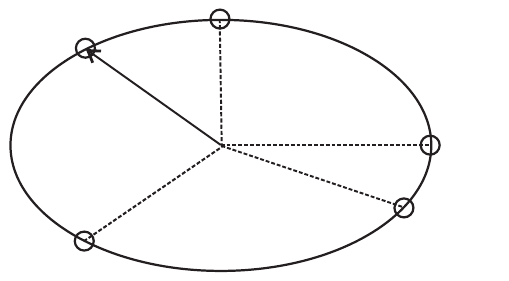


In this section, we show that the projection of uniform circular motion on a diameter of the circle follows simple harmonic motion. A simple experiment (Fig. 13.9) helps us visualise this connection. Tie a ball to the end of a string and make it move in a horizontal plane about a fixed point with a constant angular speed. The ball would then perform a uniform circular motion in the horizontal plane. Observe the ball sideways or from the front, fixing your attention in the plane of motion. The ball will appear to execute to and fro motion along a horizontal line with the point of rotation as the midpoint. You could alternatively observe the shadow of the ball on a wall which is perpendicular to the plane of the circle. In this process what we are observing is the motion of the ball on a diameter of the circle normal to the direction of viewing.
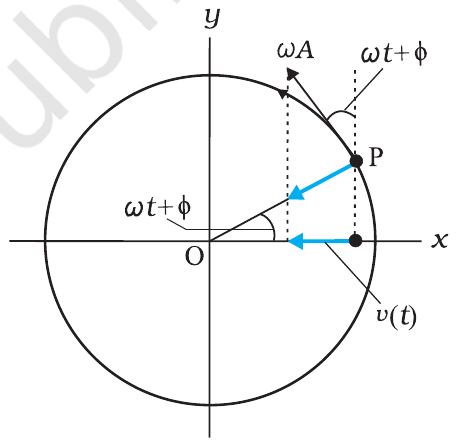
Fig. 13.10 describes the same situation mathematically. Suppose a particle P is moving uniformly on a circle of radius A with angular speed $\omega$. The sense of rotation is anticlockwise. The initial position vector of the particle, i.e., the vector OP at $t = 0 makes$ an angle of φ with the positive direction of x-axis. In time t, it will cover a further angle $\omega t$ and its position vector will make an angle of $\omega t + \phi$ with the +ve x-axis. Next, consider the projection of the position vector OP on the x-axis. This will be OP'. The position of P' on the x-axis, as the particle P moves on the circle, is given by $x(t) = A \cos(\omega t + \phi)$, which is the defining equation of SHM. This shows that if P moves uniformly on a circle, its projection P' on a diameter of the circle executes SHM. The particle P and the circle on which it moves are sometimes referred to as the reference particle and the reference circle, respectively.
We can take projection of the motion of P on any diameter, say the y-axis. In that case, the displacement y(t) of P' on the y-axis is given by $y = A \sin(\omega t + \phi)$, which is also an SHM of the same amplitude as that of the projection on x-axis, but differing by a phase of π/2.
In spite of this connection between circular motion and SHM, the force acting on a particle in linear simple harmonic motion is very different from the centripetal force needed to keep a particle in uniform circular motion.
Example 13.4 The figure given below depicts two circular motions. The radius of the circle, the period of revolution, the initial position and the sense of revolution are indicated in the figures. Obtain the simple harmonic motions of the x-projection of the radius vector of the rotating particle P in each case. Answer: (a) At $t = 0, OP makes$ an angle of 45 $\text{degrees} = π/4 rad$ with the (positive direction of) x-axis. After time t, it covers an angle $(2\pi/T)$t in the anticlockwise sense, and makes an angle of $(2\pi/T)$t + π/4 with the x-axis. The projection of OP on the x-axis at time t is given by $x(t) = A \cos((2\pi/T)t + \pi/4)$. For $T = 4 s, x(t) = A \cos((2\pi/4)t + \pi/4)$, which is a SHM of amplitude A, period 4 s, and an initial phase = π/4. (b) In this case at $t = 0, OP makes$ an angle of 90 $\text{degrees} = π/2$ with the x-axis. After a time t, it covers an angle of $(2\pi/T)$t in the clockwise sense and makes an angle of $(-(2\pi/T)t + \pi/2)$ with the x-axis. The projection of OP on the x-axis at time t is given by $x(t) = B \cos((-(2\pi/T))t + \pi/2) = B \sin((2\pi/T)t)$. For $T = 30 s, x(t) = B \sin((π/15)t)$. Writing this as $x(t) = B \cos((π/15)t - π/2)$, and comparing with Eq. (13.4), we find that this represents a SHM of amplitude B, period 30 s, and an initial phase of -π/2.
Note on angles: the natural unit of angle is radian, defined through the ratio of arc to radius. Angle is a dimensionless quantity. Therefore it is not always necessary to mention the unit 'radian' when we use π, its multiples or submultiples. If the argument of a trigonometric function is stated without units, it is understood that the unit is radian. On the other hand, if degree is to be used as the unit of angle, then it must be shown explicitly. For example, $\sin(15 \text{degrees})$ means sine of 15 degree, but $\sin(15)$ means sine of 15 radians.
Velocity and Acceleration in SHM
The speed of a particle v in uniform circular motion is its angular speed $\omega$ times the radius of the circle A. $v = \omega A$ (13.8). The direction of velocity v at a time t is along the tangent to the circle at the point where the particle is located at that instant. From the geometry of Fig. 13.11, it is clear that the velocity of the projection particle P' at time t is $v(t) = -\omega A \sin(\omega t + \phi)$ (13.9), where the negative sign shows that v(t) has a direction opposite to the positive direction of x-axis. Eq. (13.9) gives the instantaneous velocity of a particle executing SHM, where displacement is given by Eq. (13.4). We can, of course, obtain this equation without using geometrical argument, directly by differentiating (Eq. 13.4) with respect to $t: v(t) = d/dt x(t)$ (13.10).
The method of reference circle can be similarly used for obtaining instantaneous acceleration of a particle undergoing SHM. We know that the centripetal acceleration of a particle P in uniform circular motion has a magnitude ($v^2$)/A or ($\omega^2$)A, and it is directed towards the centre i.e., the direction is along PO. The instantaneous acceleration of the projection particle P' is then (see Fig. 13.12) $a(t) = -(\omega^2)A \cos(\omega t + \phi)$ = -($\omega^2$)x(t) (13.11). Eq. (13.11) gives the acceleration of a particle in SHM. The same equation can again be obtained directly by differentiating velocity v(t) given by Eq. (13.9) with respect to time: $a(t) = d/dt v(t)$ (13.12).
We note from Eq. (13.11) the important property that acceleration of a particle in SHM is proportional to displacement. For x(t) > 0, a(t) < 0 and for x(t) < 0, a(t) > 0. Thus, whatever the value of x between -A and A, the acceleration a(t) is always directed towards the centre.
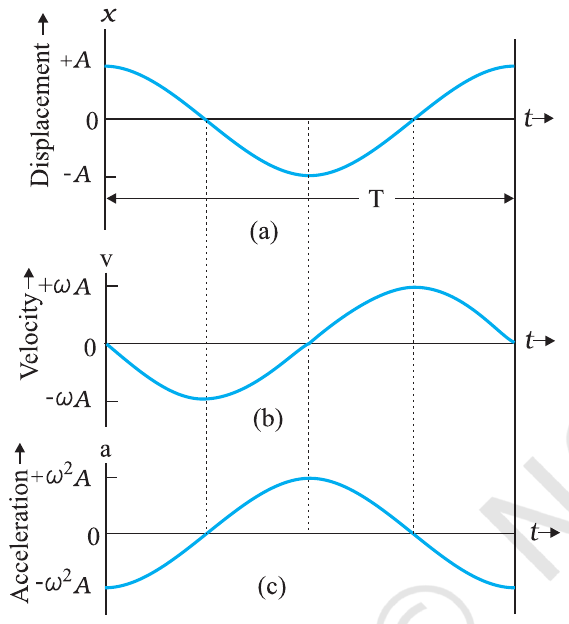
For simplicity, let us $put φ = 0$ and write the expression for x(t), v(t) and a(t): $x(t) = A \cos \omega t$, $v(t) = -\omega A \sin \omega t$, a(t) = -($\omega^2$)$A \cos \omega t$. The corresponding plots are shown in Fig. 13.13. All quantities vary sinusoidally with time; only their maxima differ and the different plots differ in phase. x varies between -A to A; v(t) varies from -$\omega A$ to $\omega A$ and a(t) from -($\omega^2$)A to ($\omega^2$)A. With respect to displacement plot, velocity plot has a phase difference of π/2 and acceleration plot has a phase difference of π.
Example 13.5 A body oscillates with SHM according to the equation (in SI units), $x = 5 \cos(2\pi t + \pi/4)$. At $t = 1.5 s$, calculate the (a) displacement, (b) speed and (c) acceleration of the body. Answer: the angular frequency $\omega$ of the body = $2\pi$ s-1 and its time period $T = 1 s$. At $t = 1.5 s (a) displacement = (5.0 m) \cos((2\pi s-1) x 1.5 s + π/4)$ = (5.0 m) $\cos(3\pi + \pi/4)$ = -$5.0 \times 0.707 m = -3.535 m$. (b) Using Eq. (13.9), the speed of the body = -(5.0 m)($2\pi$ s-$1) \sin((2\pi$ s-1) x 1.5 s + π/4) = -(5.0 m)($2\pi$ s-$1) \sin(3\pi + \pi/4) = 10\pi x 0.707$ m s-1 = 22 m s-1. (c) Using Eq. (13.10), the acceleration of the body = -$(2\pi$ s-1)² x displacement = -$(2\pi$ s-1)² x (-3.535 m) = 140 m s-2.
Practice1 question
Try it now. A wrong answer costs nothing here, try again until you get it.
For the body in the previous question, the speed at $t = 1.5 s$ is
NCERT 13.5, Example 13.5: $speed = (5.0 m)(2\pi s-1) \sin(3\pi + \pi/4)$ in $magnitude = 10\pi x 0.707 = 22 m s-1$.
Table: Velocity, Acceleration and Phase
| Quantity | Formula | Amplitude | Phase relative to x(t) |
|---|---|---|---|
| Displacement | $x(t) = A \cos(\omega t + \phi)$ | A | 0 |
| Velocity | $v(t) = -\omega A \sin(\omega t + \phi)$ | vm = $\omega A$ | π/2 ahead |
| Acceleration | $a(t) = -(\omega^2)A \cos(\omega t + \phi)$ = -($\omega^2$)x(t) | $am = (\omega^2)A$ | π ahead |
| Position | Velocity | Acceleration |
|---|---|---|
| x = 0 (mean position) | Maximum, $\omega A$ | Zero |
| $x = +A$ or -A (extremes) | Zero | Maximum, ($\omega^2$)A, directed towards the centre |
| x > 0 | - | a(t) < 0, towards the centre |
| x < 0 | - | a(t) > 0, towards the centre |
Worked values (Example 13.5): $x = 5 \cos(2\pi t + \pi/4)$, $\omega = 2\pi$ s-1, T = 1 s. At $t = 1.5 s: displacement -3.535 m, speed 22 m s-1$, acceleration 140 m s-2.
Force Law for Simple Harmonic Motion

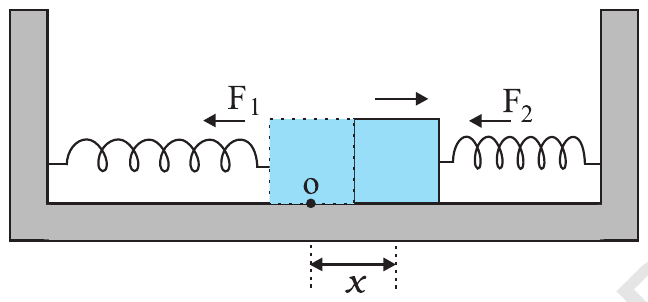
Using Newton's second law of motion, and the expression for acceleration of a particle undergoing SHM (Eq. 13.11), the force acting on a particle of mass m in SHM is $F(t) = ma = -m(\omega^2)x(t)$, i.e., $F(t) = -k x(t)$ (13.13), where $k = m(\omega^2)$ (13.14a) or $\omega = \sqrt{k/m}$ (13.14b). Like acceleration, force is always directed towards the mean position, hence it is sometimes called the restoring force in SHM. To summarise the discussion so far, simple harmonic motion can be defined in two equivalent ways, either by Eq. (13.4) for displacement or by Eq. (13.13) that gives its force law. Going from Eq. (13.4) to Eq. (13.13) required us to differentiate two times. Likewise, by integrating the force law Eq. (13.13) two times, we can get back Eq. (13.4).
Note that the force in Eq. (13.13) is linearly proportional to x(t). A particle oscillating under such a force is, therefore, calling a linear harmonic oscillator. In the real world, the force may contain small additional terms proportional to $x^2$, $x^3$, etc. These then are called non-linear oscillators.
Example 13.6 Two identical springs of spring constant k are attached to a block of mass m and to fixed supports as shown in Fig. 13.14. Show that when the mass is displaced from its equilibrium position on either side, it executes a simple harmonic motion. Find the period of oscillations. Answer: let the mass be displaced by a small distance x to the right side of the equilibrium position, as shown in Fig. 13.15. Under this situation the spring on the left side gets elongated by a length equal to x and that on the right side gets compressed by the same length. The forces acting on the mass are then F1 = -k x (force exerted by the spring on the left side, trying to pull the mass towards the mean position) and $F_2$ = -k x (force exerted by the spring on the right side, trying to push the mass towards the mean position). The net force, F, acting on the mass is then given by $F = -2k x$. Hence the force acting on the mass is proportional to the displacement and is directed towards the mean position; therefore, the motion executed by the mass is simple harmonic. The time period of oscillations is $T = 2\pi \sqrt{m/(2k)}$.
Table: Force Law and Spring Systems
| System | Force law | Angular frequency | Period |
|---|---|---|---|
| General SHM | $F = -k x$ | $\omega = \sqrt{k/m}$ | $T = 2\pi \sqrt{m/k}$ |
| One spring, mass m | $F = -k x$ | $\omega = \sqrt{k/m}$ | $T = 2\pi \sqrt{m/k}$ |
| Two identical springs, mass m (Example 13.6) | $F = -2k x$ | $\omega = \sqrt{2k/m}$ | $T = 2\pi \sqrt{m/(2k)}$ |
| Relation | Form | Note |
|---|---|---|
| Force constant | $k = m(\omega^2)$ | Eq. (13.14a) |
| Angular frequency | $\omega = \sqrt{k/m}$ | Eq. (13.14b) |
| Stiffer spring (larger k) | Larger $\omega$, shorter T | For the same mass |
| Heavier mass (larger m) | Smaller $\omega$, longer T | For the same spring |
How to find k: a spring stretched by 5 cm by a force of 10 N has k = F/x = 10/(0.05) = 200 N m-1 (see NEET 2021 P3 Q31, where a 2 kg mass on such a spring has $T = 0.628 s$).
Energy in Simple Harmonic Motion

Both kinetic and potential energies of a particle in SHM vary between zero and their maximum values. In section 13.5 we have seen that the velocity of a particle executing SHM, is a periodic function of time. It is zero at the extreme positions of displacement. Therefore, the kinetic energy (K) of such a particle, which is defined as $K = (1/2)m(v^2) = (1/2)m(\omega^2)(A^2)\sin^2(\omega t + \phi)$ = (1/2)k($A^2$)$\sin^2(\omega t + \phi)$ (13.15), is also a periodic function of time, being zero when the displacement is maximum and maximum when the particle is at the mean position. Note, since the sign of v is immaterial in K, the period of K is T/2.
What is the potential energy (U) of a particle executing simple harmonic motion? In Chapter 6, we have seen that the concept of potential energy is possible only for conservative forces. The spring force $F = -k x$ is a conservative force, with associated potential energy $U = (1/2)k(x^2)$ (13.16). Hence the potential energy of a particle executing simple harmonic motion is $U(x) = (1/2)k(x^2) = (1/2)k(A^2)\cos^2(\omega t + \phi)$ (13.17). Thus, the potential energy of a particle executing simple harmonic motion is also periodic, with period T/2, being zero at the mean position and maximum at the extreme displacements.
It follows from Eqs. (13.15) and (13.17) that the total energy, E, of the system is $E = U + K$ = (1/2)k($A^2$)$\cos^2(\omega t + \phi)$ + (1/2)k($A^2$)$\sin^2(\omega t + \phi)$ = (1/2)k($A^2$) (13.18). The total mechanical energy of a harmonic oscillator is thus independent of time as expected for motion under any conservative force. The time and displacement dependence of the potential and kinetic energies of a linear simple harmonic oscillator are shown in Fig. 13.16.
Observe that both kinetic energy and potential energy in SHM are seen to be always positive in Fig. 13.16. Kinetic energy can, of course, be never negative, since it is proportional to the square of speed. Potential energy is positive by choice of the undermined constant in potential energy. Both kinetic energy and potential energy peak twice during each period of SHM. For $x = 0$, the energy is kinetic; at the extremes $x = +A$ and -A, it is all potential energy. In the course of motion between these limits, kinetic energy increases at the expense of potential energy or vice-versa.
Example 13.7 A block whose mass is 1 kg is fastened to a spring. The spring has a spring constant of 50 N m-1. The block is pulled to $a dis\tan ce x = 10 cm$ from its equilibrium position at $x = 0$ on a frictionless surface from rest at $t = 0$. Calculate the kinetic, potential and total energies of the block when it is 5 cm away from the mean position. Answer: the block executes SHM, its angular frequency, as given by Eq. (13.14b), is $\omega = \sqrt{k/m} = \sqrt{50/1} = 7.07 rad s-1$. Its displacement at any time t is then given by $x(t) = 0.1 cos$(7.07t). Therefore, when the particle is 5 cm away from the mean position, we have 0.05 = 0.1 $\cos(7.07t)$, so $\cos(7.07t) = 0.5$ and hence $\sin(7.07t) = \sqrt{3}/2 = 0.866$. Then, the velocity of the block at $x = 5 cm$ is $0.1 \times 7.07 \times 0.866 m s-1 = 0.61 m s-1$. Hence the K.E. of the $block = (1/2)m(v^2) = (1/2)(1 kg x (0.6123 m s-1)²)$ = 0.19 J. The P.E. of the $block = (1/2)k(x^2) = (1/2)(50 N m-1 x 0.05 m x 0.05 m)$ = 0.0625 J. The total energy of the block at $x = 5 cm = K$.E. + P.E. = 0.25 J. We also know that at maximum displacement, K.E. is zero and hence the total energy of the system is equal to the P.E. Therefore, the total energy of the system = (1/2)(50 N m-1 x 0.1 m x 0.1 m) = 0.25 J, which is same as the sum of the two energies at a displacement of 5 cm. This is in conformity with the principle of conservation of energy.
Practice1 question
Try it now. A wrong answer costs nothing here, try again until you get it.
A 1 kg block on a spring of $k = 50 N m-1$ is pulled 10 cm from equilibrium and released. When it is 5 cm from the mean position, its kinetic energy is
NCERT 13.7, Example 13.7: at $x = 5 cm$, $v = 0.61 m s-1$, so $K = (1/2) x 1 x (0.61)² = 0.19 J$.
Table: Energy in SHM
| Energy | Formula | At mean position $(x = 0)$ | At extremes $(x = +A, -A)$ | Period |
|---|---|---|---|---|
| Kinetic | $K = (1/2)m(v^2) = (1/2)k(A^2)\sin^2(\omega t + \phi)$ | Maximum, (1/2)k($A^2$) | Zero | T/2 |
| Potential | $U = (1/2)k(x^2) = (1/2)k(A^2)\cos^2(\omega t + \phi)$ | Zero | Maximum, (1/2)k($A^2$) | T/2 |
| Total | $E = K + U = (1/2)k(A^2)$ | (1/2)k($A^2$) | (1/2)k($A^2$) | Constant |
| Worked values (Example 13.7) | Value |
|---|---|
| $m = 1 kg$, $k = 50 N m-1$, $A = 10 cm$ | $\omega = 7.07$ rad s-1 |
| At $x = 5 cm$ | $v = 0.61 m s-1$ |
| Kinetic energy at $x = 5 cm$ | 0.19 J |
| Potential energy at $x = 5 cm$ | 0.0625 J |
| Total energy | 0.25 J |
The Simple Pendulum

It is said that Galileo measured the periods of a swinging chandelier in a church by his pulse beats. He observed that the motion of the chandelier was periodic. The system is a kind of pendulum. You can also make your own pendulum by tying a piece of stone to a long unstretchable thread, approximately 100 cm long. Suspend your pendulum from a suitable support so that it is free to oscillate. Displace the stone to one side by a small distance and let it go. The stone executes a to and fro motion, it is periodic with a period of about two seconds. We shall show that this periodic motion is simple harmonic for small displacements from the mean position.
Consider simple pendulum, a small bob of mass m tied to an inextensible massless string of length L. The other end of the string is fixed to a rigid support. The bob oscillates in a plane about the vertical line through the support. Fig. 13.17(a) shows this system. Fig. 13.17(b) is a kind of 'free-body' diagram of the simple pendulum showing the forces acting on the bob.
Let θ be the angle made by the string with the vertical. When the bob is at the mean position, $θ = 0$. There are only two forces acting on the bob; the tension T along the string and the vertical force due to gravity $(= mg)$. The force mg can be resolved into the component mg cos θ along the string and mg sin θ perpendicular to it. Since the motion of the bob is along a circle of length L and centre at the support point, the bob has a radial acceleration (($\omega^2$)L) and also a tangential acceleration; the latter arises since motion along the arc of the circle is not uniform. The radial acceleration is provided by the net radial force T - mg cos θ, while the tangential acceleration is provided by mg sin θ. It is more convenient to work with torque about the support since the radial force gives zero torque. Torque τ about the support is entirely provided by the tangential component of force: $τ = -L(mg \sin θ)$ (13.19). This is the restoring torque that tends to reduce angular displacement, hence the negative sign. By Newton's law of rotational motion, $τ = I α$ (13.20), where I is the moment of inertia of the system about the support and α is the angular acceleration. Thus, $I α = -mg \sin θ L$ (13.21). Or, $α = -(mgL/I) \sin θ$ (13.22).
We can simplify Eq. (13.22) if we assume that the displacement θ is small. We know that sin θ can be expressed as sin θ = θ - ($\theta^3$)/3! + ($\theta^5$)/5! - ... (13.23), where θ is in radians. Now if θ is small, sin θ can be approximated by θ and Eq. (13.22) can then be written as $α = -(mgL/I) θ$ (13.24).
| θ (degrees) | θ (radians) | sin θ |
|---|---|---|
| 0 | 0 | 0 |
| 5 | 0.087 | 0.087 |
| 10 | 0.174 | 0.174 |
| 15 | 0.262 | 0.259 |
| 20 | 0.349 | 0.342 |
Table 13.1: sin θ as ma function of angle θ. In Table 13.1, we have listed the angle θ in degrees, its equivalent in radians, and the value of the function sin θ. From this table it can be seen that for θ as large as 20 degrees, sin θ is nearly the same as θ expressed in radians.
Equation (13.24) is mathematically, identical to Eq. (13.11) except that the variable is angular displacement. Hence we have proved that for small θ, the motion of the bob is simple harmonic. From Eqs. (13.24) and (13.11), $\omega = \sqrt{mgL/I}$ and $T = 2\pi \sqrt{I/(mgL)}$ (13.25). Now since the string of the simple pendulum is massless, the moment of inertia I is simply m($L^2$). Eq. (13.25) then gives the well-known formula for time period of a simple pendulum: $T = 2\pi \sqrt{L/g}$ (13.26).
Example 13.8 What is the length of a simple pendulum, which ticks seconds? Answer: from Eq. (13.26), the time period of a simple pendulum is given by $T = 2\pi \sqrt{L/g}$. From this relation one gets $L = g(T^2)/(4(\pi^2))$. The time period of a simple pendulum, which ticks seconds, is 2 s. Therefore, for $g = 9.8 m s-2$ and $T = 2 s$, L is (9.8(m s-2) x 4($s^2$))/(4($\pi^2$)) = 1 m.
Practice1 question
Try it now. A wrong answer costs nothing here, try again until you get it.
The length of a simple pendulum which ticks seconds (time period 2 s) is about
NCERT 13.8, Example 13.8: a seconds pendulum has $T = 2 s$, so $L = g(T^2)/(4(\pi^2)) = 1 m$ for $g = 9.8 m s-2$.
Table: Pendulum Formulae
| Quantity | Formula | Note |
|---|---|---|
| Restoring torque | $τ = -L(mg \sin θ)$ | Eq. (13.19), negative sign: torque reduces θ |
| Angular acceleration | $α = -(mgL/I) \sin θ$ | Eq. (13.22) |
| Small-angle form | $α = -(mgL/I) θ$ | Eq. (13.24), sin θ approx θ |
| Angular frequency | $\omega = \sqrt{mgL/I}$ | From Eqs. (13.24) and (13.11) |
| Period, general | $T = 2\pi \sqrt{I/(mgL)}$ | Eq. (13.25) |
| Period, simple pendulum | $T = 2\pi \sqrt{L/g}$ | Eq. (13.26), $I = m(L^2)$ |
| Length from period | $L = g(T^2)/(4(\pi^2))$ | Example 13.8 |
| Seconds pendulum | Value |
|---|---|
| Time period T | 2 s |
| Length $L (g = 9.8 m s-2)$ | 1 m |
Small-angle condition: the derivation needs sin θ approx θ, good to about 20 degrees by Table 13.1. The period does not depend on the mass of the bob or on the amplitude, for small angles.
Damped Oscillations: What NCERT Actually Says
NCERT 13.2 says: in practice, oscillating bodies eventually come to rest at their equilibrium positions because of the damping due to friction and other dissipative causes, and that they can be forced to remain oscillating by means of some external periodic agency, adding 'We discuss the phenomena of damped and forced oscillations later in the chapter.' No later section of the rationalised chapter develops damped or forced oscillations, and NMC Unit 10 does not list them.
The only statement the chapter makes about damping is in Points to Ponder point 9: damped simple harmonic motion is not strictly simple harmonic. It is approximately so only for time intervals much less than 2m/b where b is the damping constant. That is the whole of what NCERT gives on damping here, and no formula for damped or forced oscillations is asked in this chapter. Do not treat a damped oscillation as SHM over long times.
Exercises and Their Figures



The exercises use Figs. 13.18 to 13.21. Exercise 13.3: Fig. 13.18 depicts four x-t plots for linear motion of a particle. Which of the plots represent periodic motion? What is the period of motion (in case of periodic motion)? Plots (b) and (d) represent periodic motion; each has a period of 2 s. Plots (a) and (c) do not repeat and are non-periodic. Note the exercise text cites 'Fig. 18.18' where the figure is labelled Fig. 13.18.
Exercise 13.9 (Fig. 13.19): a spring with spring constant 1200 N m-1 is mounted on a horizontal table. A mass of 3 kg is attached to the free end, pulled sideways to 2.0 cm and released. (i) Frequency of $oscillations = (1/(2\pi)) \sqrt{1200/3} = 3.18 Hz$. (ii) Maximum acceleration = $(\omega^2)A = 400 \times 0.02 = 8 m s-2$. (iii) Maximum $speed = \omega A = 20 \times 0.02 = 0.4 m s-1$. Exercise 13.10: with $x = 0$ at the unstreched position and left to right positive, the three starting positions (mean, maximum stretched, maximum compressed) give SHM functions that differ from each other only in the initial phase, not in frequency or amplitude.
Exercise 13.11 (Fig. 13.20): obtain the x-projection SHM for each of the two circular motions from the radius, the period of revolution, the initial position and the sense of revolution shown in the figure. Exercise 13.13 (Fig. 13.21): (a) a spring of force constant k clamped at one end with mass m at the free end, stretched by force F: maximum extension F/k, period $2\pi \sqrt{m/k}$. (b) The same spring with both ends free and a mass m at either end, each end stretched by the same force F: maximum extension F/k, period $2\pi \sqrt{m/(2k)}$.
Exercise 13.14: the piston in the cylinder head of a locomotive has a stroke (twice the amplitude) of 1.0 m. With SHM of angular frequency 200 rad/min, the amplitude is 0.5 m and the maximum speed is $\omega A = (200/60)$ x 0.5 = 1.67 m s-1. Exercise 13.15: with g on the moon 1.7 m s-2 and 9.8 m s-2 on earth, a pendulum of period 3.5 s on earth has period 3.5 x $\sqrt{9.8/1.7}$ = 8.4 s on the moon. Exercise 13.16: a pendulum in a car moving on a circular track of radius R with uniform speed v has effective gravity $\sqrt{(g^2) + ((v^2)/R)^2}$, so $T = 2\pi sqrt(l/sqrt$(($g^2$) + (($v^4$)/($R^2$)))). Exercise 13.17: a cork of density ρ, base area A and height h floating in liquid of density ρ-l oscillates with $T = 2\pi \sqrt{(h \rho)/(\rho-l g)}$. Exercise 13.18: the mercury column in a U-tube executes SHM when the suction pump is removed.
Points to Ponder
- The period T is the least time after which motion repeats itself. Thus, motion repeats itself after nT where n is an integer.
- Every periodic motion is not simple harmonic motion. Only that periodic motion governed by the force law $F = -k x$ is simple harmonic.
- Circular motion can arise due to an inverse-square law force (as in planetary motion) as well as due to simple harmonic force in two dimensions equal to: -m($\omega^2$)r. In the latter case, the phases of motion, in two perpendicular directions (x and y) must differ by π/2. Thus, for example, a particle subject to a force -m($\omega^2$)r with initial position (0, A) and velocity ($\omega A$, 0) will move uniformly in a circle of radius A.
- For linear simple harmonic motion with a given $\omega$, two initial conditions are necessary and sufficient to determine the motion completely. The initial conditions may be (i) initial position and initial velocity or (ii) amplitude and phase or (iii) energy and phase.
- From point 4 above, given amplitude or energy, phase of motion is determined by the initial position or initial velocity.
- A combination of two simple harmonic motions with arbitrary amplitudes and phases is not necessarily periodic. It is periodic only if frequency of one motion is an integral multiple of the other's frequency. However, a periodic motion can always be expressed as a sum of infinite number of harmonic motions with appropriate amplitudes.
- The period of SHM does not depend on amplitude or energy or the phase constant. Contrast this with the periods of planetary orbits under gravitation (Kepler's third law).
- The motion of a simple pendulum is simple harmonic for small angular displacement.
Trap Pairs
- Periodic means SHM? No. A motion that repeats after T is periodic; it is SHM only if its displacement is a sinusoidal function of time, governed by $F = -k x$. Circular motion is periodic but not oscillatory.
- Energy frequency equals motion frequency? No. K and U each repeat with period T/2, so their frequency is twice the frequency of the motion (NEET 2021 P3 Q1).
- Heavier bob, longer period? No. $T = 2\pi \sqrt{L/g}$ has no mass in it; the mass cancels. Only L and g set the period, for small angles (NEET 2022 R1 Q36).
- Fastest at the extremes? No. Speed is zero at $x = +A$ and -A and maximum $\omega A$ at the mean position; acceleration is the other way round, maximum at the extremes and zero at the mean position.
- $\omega$ and ν are the same? No. $\omega = 2\pi \nu = 2\pi/T$. $\omega$ is in rad s-1; ν is in Hz. Mixing them up by $2\pi$ is the most common slip in SHM sums.
Table: Periodic vs Simple Harmonic
| Motion | Repeats after T? | Displacement sinusoidal? | Force law | Example |
|---|---|---|---|---|
| Periodic, not oscillatory | Yes | Not always | - | Uniform circular motion; insect on a ramp (Fig. 13.1a) |
| Oscillatory, not SHM | Yes | No | Not -k x | $\sin^2$ $\omega t$ (Example 13.3b); damped oscillation |
| Simple harmonic | Yes | Yes, $x = A \cos(\omega t + \phi)$ | $F = -k x$ | Spring-mass, simple pendulum (small angles) |
| Non-periodic | No | No | - | $e^{-\omega t}$; $\log(\omega t)$ (Example 13.2) |
| SHM test | Check |
|---|---|
| $a = -(\omega^2) x$? | If yes, SHM (Exercise 13.6: only a = -10x is SHM; $a = 0.7x$, $a = -200(x^2)$ and $a = 100(x^3)$ are not) |
| T depends on A? | No, for SHM the period does not depend on amplitude or energy or phase |
| Two conditions fix it? | Yes: initial position and velocity, or amplitude and phase, or energy and phase |
Trap Boxes
Every periodic motion is simple harmonic motion
Wrong idea: Any motion that repeats itself after a fixed time is simple harmonic motion.
Only motion governed by $F = -k x$ is SHM, with displacement a sinusoidal function of time. Circular motion is periodic but not oscillatory; an insect climbing a ramp repeats but is not SHM. NCERT 13.2 and 13.3.
NCERT XI, Ch 13, 13.2 and 13.3
Potential energy oscillates with the same frequency as the motion
Wrong idea: If a body executes SHM with frequency n, its potential energy also oscillates with frequency n.
$U = (1/2)k(A^2)\cos^2(\omega t + \phi)$ and $K = (1/2)k(A^2)\sin^2(\omega t + \phi) both repeat twice$ per period, so their frequency is 2n when the motion has frequency n. NCERT 13.7.
NCERT XI, Ch 13, 13.7
The period of a simple pendulum depends on the mass of the bob
Wrong idea: A heavier bob swings with a longer (or shorter) period than a lighter bob on the same string.
$T = 2\pi \sqrt{L/g}$ contains no mass; the bob mass cancels in the derivation. The period depends only on L and g, for small angles. NCERT 13.8.
NCERT XI, Ch 13, 13.8
Speed is greatest at the extremes of SHM
Wrong idea: A particle in SHM moves fastest at the ends of its swing, where it turns around.
$v = 0$ at $x = +A$ and -A and maximum $\omega A$ at $x = 0$; $a = 0$ at $x = 0$ and maximum ($\omega^2$)A at the extremes, always directed towards the centre. NCERT 13.5.
NCERT XI, Ch 13, 13.5
Angular frequency is the same as frequency
Wrong idea: $\omega$ and ν are the same quantity, so $T = 1/\omega$.
$\omega = 2\pi \nu = 2\pi/T$, with $\omega$ in rad s-1 and ν in Hz (s-1). They differ by a factor $2\pi$. NCERT 13.2.1 and 13.3.
NCERT XI, Ch 13, 13.2.1 and 13.3
Chapter test
5 NEET PYQs. +4 for a correct answer, -1 for a wrong answer, exactly like NEET. Finish the test to earn a medal.
Q1: NEET (UG) 2025, Code 45, Q23
In an oscillating spring mass system, a spring is connected to a box filled with sand. As the box oscillates, sand leaks slowly out of the box vertically so that the average frequency $\omega(t)$ and average amplitude A(t) of the system change with time t. Which one of the following options schematically depicts these changes correctly? [Figure options: each option shows a pair of graphs, $\omega(t)$ against t above A(t) against t.]
Sand leaking out lowers the mass, so $\omega = \sqrt{k/m}$ rises with time. The leaking sand carries energy away, so the amplitude falls with time. Only option (2) shows $\omega(t)$ rising and A(t) falling.
Q2: NEET (UG) 2024, Code R3, Q30
If 5 $\sin((π/3)x + π t)$ represents the motion of a particle executing simple harmonic motion, the amplitude and time period of motion, respectively, are:
Compare with $A \sin(\omega t + \phi)$: amplitude is 5 m and $\omega = \pi$, so $T = 2\pi/\omega = 2$ s.
Q3: NEET (UG) 2023, Code F1, Q50
[Figure: x-t graph, x in m against t in s. Amplitude 1 m, $peak x = 1 m$ at $t = 2 s$, zero at $t = 4 s, trough x = -1 m$ at $t = 6 s$, back to zero at $t = 8 s$.] The x-t graph of a particle performing simple harmonic motion is shown in the figure. The acceleration of the particle at $t = 2 s$ is
From the graph, amplitude is 1 m and period $T = 8 s$, so $\omega = 2\pi/T = \pi/4$. At $t = 2 s$, $x = 1 m$, so $a = -(\omega^2)x = -(\pi^2/16) m s-2$.
Q4: NEET (UG) 2022, Code R1, Q36
Two pendulums of length 121 cm and 100 cm start vibrating in phase. At some instant, the two are at their mean position in the same phase. The minimum number of vibrations of the shorter pendulum after which the two are again in phase at the mean position is:
T is proportional to $\sqrt{L}$, so $T(121 cm)/T(100 cm) = 11/10$. The shorter pendulum does 11 vibrations while the longer does 10, so they are in phase again at the mean position after 11 vibrations of the shorter one.
Q5: NEET (UG) 2021, Code P3, Q1
A body is executing simple harmonic motion with frequency 'n', the frequency of its potential energy is
$U = (1/2)k(A^2)\cos^2(\omega t + \phi)$, and $\cos^2$ repeats twice in one period, so the frequency of potential energy is 2n.
Score: 0 · Answered 0 of 5
Flashcards
Tap a card to flip it over and see the answer. Tap it again to flip it back.
Write the displacement of a particle in simple harmonic motion.
Tap to flip$x(t) = A \cos(\omega t + \phi)$, where A is the amplitude, $(\omega t + \phi)$ is the phase and φ is the phase constant.
Tap to flip backRelate angular frequency $\omega$, period T and frequency ν.
Tap to flip$\omega = 2\pi/T = 2\pi \nu$, and $ν = 1/T$. The SI unit of $\omega$ is rad s-1 and of ν is s-1, called hertz (Hz).
Tap to flip backWrite the velocity of a particle in SHM and its maximum value.
Tap to flip$v(t) = -\omega A \sin(\omega t + \phi)$. Its amplitude is vm = $\omega A$, reached at the mean position $x = 0$.
Tap to flip backWrite the acceleration of a particle in SHM and its maximum value.
Tap to flip$a(t) = -(\omega^2)A \cos(\omega t + \phi)$ = -($\omega^2$)x(t). Its amplitude is $am = (\omega^2)A$, reached at the extremes $x = +A$ and -A.
Tap to flip backState the force law for SHM and the period of a spring-mass system.
Tap to flip$F(t) = -k x(t)$, with $k = m(\omega^2)$, so $\omega = \sqrt{k/m}$ and $T = 2\pi \sqrt{m/k}$. The force is always directed towards the mean position.
Tap to flip backWrite the kinetic, potential and total energy of a particle in SHM.
Tap to flip$K = (1/2)k(A^2)\sin^2(\omega t + \phi)$ and $U = (1/2)k(A^2)\cos^2(\omega t + \phi)$. Total energy $E = K + U = (1/2)k(A^2)$, constant in time.
Tap to flip backWrite the time period of a simple pendulum.
Tap to flip$T = 2\pi \sqrt{L/g}$, for small angular displacement. It does not depend on the mass of the bob or on the amplitude.
Tap to flip backWhat is the length of a simple pendulum which ticks seconds?
Tap to flip$T = 2 s$, so $L = g(T^2)/(4(\pi^2)) = 1 m$ for $g = 9.8 m s-2$.
Tap to flip backA human heart beats 75 times in a minute. What are its frequency and period?
Tap to flipBeat frequency = $75/(60 s) = 1.25 s-1 = 1.25 Hz$, and $T = 1/1.25 = 0.8 s$.
Tap to flip backUp to what angle is sin θ nearly equal to θ in radians, and what are the values at 20 degrees?
Tap to flipsin θ is nearly the same as θ in radians even for θ as large as 20 degrees: sin 20 degrees = 0.342, $θ = 0.349 rad$.
Tap to flip backWhat are the phase differences of velocity and acceleration with respect to displacement in SHM?
Tap to flipVelocity leads displacement by π/2 and acceleration leads displacement by π. All three have the same period T.
Tap to flip backWith what period do the kinetic and potential energies repeat in SHM?
Tap to flipK and U are zero and maximum in turn, and both repeat after a period T/2, while x, v and a repeat after T.
Tap to flip backFrequently asked questions
Is it true that every periodic motion is simple harmonic motion?
Only motion governed by $F = -k x$ is SHM, with displacement a sinusoidal function of time. Circular motion is periodic but not oscillatory; an insect climbing a ramp repeats but is not SHM.
Is it true that potential energy oscillates with the same frequency as the motion?
$U = (1/2)k(A^2)\cos^2(\omega t + \phi)$ and $K = (1/2)k(A^2)\sin^2(\omega t + \phi) both repeat twice$ per period, so their frequency is 2n when the motion has frequency n.
Is it true that the period of a simple pendulum depends on the mass of the bob?
$T = 2\pi \sqrt{L/g}$ contains no mass; the bob mass cancels in the derivation. The period depends only on L and g, for small angles.
Is it true that speed is greatest at the extremes of SHM?
$v = 0$ at $x = +A$ and -A and maximum $\omega A$ at $x = 0$; $a = 0$ at $x = 0$ and maximum ($\omega^2$)A at the extremes, always directed towards the centre.
Is it true that angular frequency is the same as frequency?
$\omega = 2\pi \nu = 2\pi/T$, with $\omega$ in rad s-1 and ν in Hz (s-1). They differ by a factor $2\pi$.