 NEET Notes
Home > Physics > Kinetic Theory
Kinetic Theory
Kinetic theory explains the behaviour of gases based on the idea that the gas consists of rapidly moving atoms or molecules.
On this page · 20 sections
- 01Syllabus Map
- 02Introduction
- 03Molecular Nature of Matter
- 04Behaviour of Gases
- 05Molecular Size Estimates
- 06Table: Gas Laws and Mixtures
- 07Kinetic Theory of an Ideal Gas
- 08Pressure of an Ideal Gas
- 09Kinetic Interpretation of Temperature
- 10Table: Pressure, Temperature and RMS Speed
- 11Law of Equipartition of Energy
- 12Specific Heat Capacity of Gases
- 13Table: Specific Heats
- 14Specific Heat Capacity of Solids
- 15Mean Free Path
- 16Table: Mean Free Path
- 17Degrees-of-Freedom Ladder
- 18Trap Pairs
- 19Points to Ponder
- 20Exercise Figure 12.8
Ideal gas laws, pressure from molecular collisions, temperature as average kinetic energy, equipartition, specific heats and mean free path, from NCERT Ch 12, with 5 NEET PYQs.
Syllabus Map
- NMC Unit: PHYS-U09, Kinetic Theory of Gases. NCERT Chapter 12, Kinetic Theory (Class XI, rationalised book, keph205.pdf, Reprint 2026-27). The PDF title page reads CHAPTER TWELVE - KINETIC THEORY, with sections 12.1 to 12.7, three tables (12.1, 12.2, 12.3) and Figures 12.1 to 12.8. All section and figure references in this chapter use the current book numbering so they can be traced to the PDF.
- Subtopics in this chapter (NCERT XI, Ch 12): introduction (12.1); molecular nature of matter (12.2); behaviour of gases (12.3); kinetic theory of an ideal gas (12.4); law of equipartition of energy (12.5); specific heat capacity (12.6); mean free path (12.7).
- Subtopic checklist: (1) Boyle, Newton and the atomic idea; Maxwell and Boltzmann; (2) Atomic Hypothesis, Kanada and Democritus, Dalton, Gay Lussac and Avogadro; (3) ideal gas equation PV = µRT, Boltzmann constant, Avogadro number, Boyle's law, Charles' law, Dalton's law of partial pressures, Examples 12.1 to 12.4; (4) pressure $P = (1/3) n m (v^2)$; (5) kinetic interpretation of temperature, rms speed, Examples 12.5 to 12.7; (6) degrees of freedom, law of equipartition of energy, vibrational modes; (7) specific heats of monatomic, diatomic and polyatomic gases, Tables 12.1 and 12.2, Example 12.8; (8) specific heat of solids, $C = 3R$, Table 12.3, carbon exception; (9) mean free path, collision time, Example 12.9; (10) points to ponder; (11) Exercise 12.3 and Figure 12.8.
- Extra information (beyond NCERT): the work done on compressing a gas, named in NMC Unit 9, is covered in NCERT Ch 11 (thermodynamics) and is not repeated here; the kinetic theory sections of this chapter cover the rest of Unit 9 in full. No other extra section was added.
- Estimated revision time: 12 minutes. Jump links: Syllabus Map, Introduction, Molecular Nature of Matter, Behaviour of Gases, Molecular Size Estimates, Table: Gas Laws and Mixtures, Kinetic Theory of an Ideal Gas, Pressure of an Ideal Gas, Kinetic Interpretation of Temperature, Table: Pressure, Temperature and RMS Speed, Law of Equipartition of Energy, Specific Heat Capacity of Gases, Table: Specific Heats, Specific Heat Capacity of Solids, Mean Free Path, Table: Mean Free Path, Degrees-of-Freedom Ladder, Trap Pairs, Points to Ponder, Exercise Figure 12.8
Introduction
- Boyle discovered the law named after him in 1661. Boyle, Newton and several others tried to explain the behaviour of gases by considering that gases are made up of tiny atomic particles. The actual atomic theory got established more than 150 years later.
- Kinetic theory explains the behaviour of gases based on the idea that the gas consists of rapidly moving atoms or molecules. This is possible as the inter-atomic forces, which are short range forces that are important for solids and liquids, can be neglected for gases.
- The kinetic theory was developed in the nineteenth century by Maxwell, Boltzmann and others. It has been remarkably successful. It gives a molecular interpretation of pressure and temperature of a gas, and is consistent with gas laws and Avogadro's hypothesis.
- It correctly explains specific heat capacities of many gases. It also relates measurable properties of gases such as viscosity, conduction and diffusion with molecular parameters, yielding estimates of molecular sizes and masses.
Molecular Nature of Matter
- Richard Feynman, one of the great physicists of 20th century, considers the discovery that 'Matter is made up of atoms' to be a very significant one. Atomic Hypothesis: All things are made of atoms - little particles that move around in perpetual motion, attracting each other when they are a little distance apart, but repelling upon being squeezed into one another.
- Speculation that matter may not be continuous existed in many places and cultures. Kanada in India and Democritus in Greece had suggested that matter may consist of indivisible constituents. The scientific Atomic Theory is usually credited to John Dalton. He proposed the atomic theory to explain the laws of definite and multiple proportions obeyed by elements when they combine into compounds.
- In the Vaiseshika school of thought in India founded by Kanada (Sixth century B.C.) the atomic picture was developed in considerable detail. Atoms were thought to be eternal, indivisible, infinitesimal and ultimate parts of matter. The four kinds of atoms (Paramanu - Sanskrit word for the smallest particle) postulated were Bhoomi (Earth), Ap (water), Tejas (fire) and Vayu (air). Akasa (space) was thought to have no atomic structure and was continuous and inert.
- In ancient Greece, Democritus (Fourth century B.C.) is best known for his atomic hypothesis. The word 'atom' means 'indivisible' in Greek. According to him, atoms differ from each other physically, in shape, size and other properties.
- Gay Lussac's law, also given in early 19th century, states: When gases combine chemically to yield another gas, their volumes are in the ratios of small integers. Avogadro's law (or hypothesis) says: Equal volumes of all gases at equal temperature and pressure have the same number of molecules. Avogadro's law, when combined with Dalton's theory, explains Gay Lussac's law.
- The size of an atom is about an angstrom ($10^{-10}$ m). In solids, atoms are spaced about a few angstroms (2 angstrom) apart. In liquids the separation between atoms is also about the same. In gases the interatomic distances are in tens of angstroms. The average distance a molecule can travel without colliding is called the mean free path. The mean free path, in gases, is of the order of thousands of angstroms.
- In solids and liquids the closeness makes the interatomic force important. The force has a long range attraction and a short range repulsion. The atoms attract when they are at a few angstroms but repel when they come closer.
- The gas is full of activity and the equilibrium is a dynamic one. In dynamic equilibrium, molecules collide and change their speeds during the collision. Only the average properties are constant.
- Atoms are not indivisible or elementary. They consist of a nucleus and electrons. The nucleus itself is made up of protons and neutrons. The protons and neutrons are again made up of quarks.
Behaviour of Gases
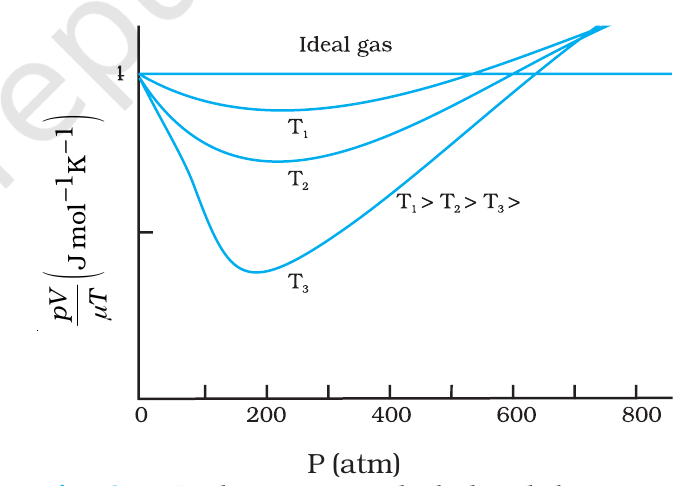
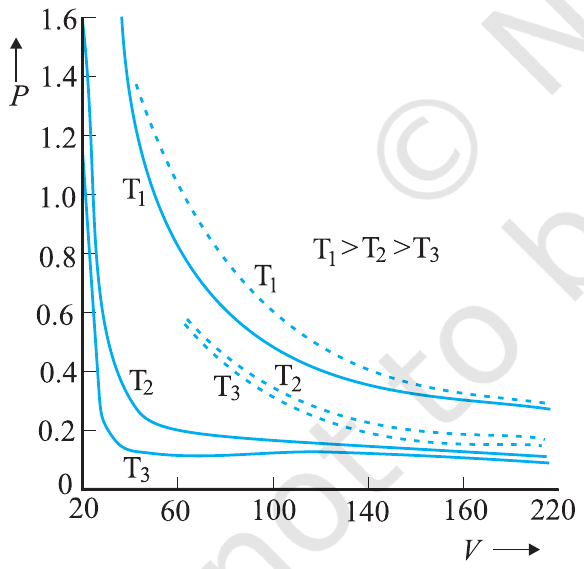
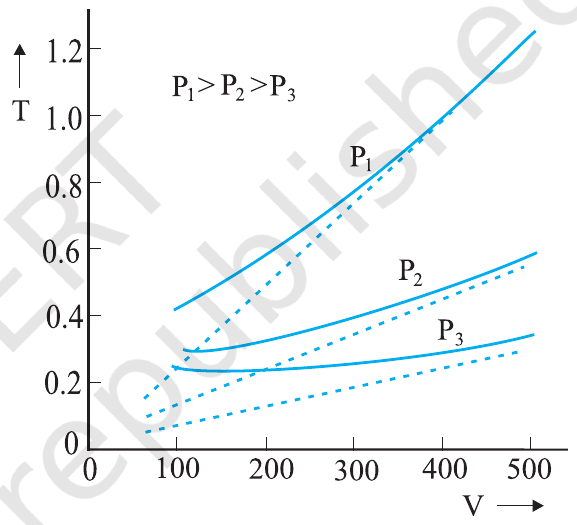
- Properties of gases are easier to understand than those of solids and liquids. This is mainly because in a gas, molecules are far from each other and their mutual interactions are negligible except when two molecules collide.
- Gases at low pressures and high temperatures much above that at which they liquefy (or solidify) approximately satisfy a simple relation between their pressure, temperature and volume given by PV = KT (12.1) for a given sample of the gas. Here T is the temperature in kelvin or (absolute) scale. K is a constant for the given sample but varies with the volume of the gas.
- If we now bring in the idea of atoms or molecules, then K is proportional to the number of molecules, (say) N in the sample. We can write K = N k. Observation tells us that this k is same for all gases. It is called Boltzmann constant and is denoted by kB.
- $(P_1 V_1)/(N1 T_1) = (P_2 V_2)/(N_2 T_2)$ = constant = kB (12.2). If P, V and T are same, then N is also same for all gases. This is Avogadro's hypothesis, that the number of molecules per unit volume is the same for all gases at a fixed temperature and pressure.
- The number in 22.4 litres of any gas is 6.02 x $10^{23}$. This is known as Avogadro number and is denoted by NA. The mass of 22.4 litres of any gas is equal to its molecular weight in grams at S.T.P (standard temperature 273 K and pressure 1 atm). This amount of substance is called a mole.
- The perfect gas equation can be written as PV = µRT (12.3), where µ is the number of moles and R = NA kB is a universal constant. The temperature T is absolute temperature. Choosing kelvin scale for absolute temperature, $R = 8.314 J mol^{-1} K^{-1}$.
- µ = $M/M0 = N/NA$ (12.4), where M is the mass of the gas containing N molecules, M0 is the molar mass and NA the Avogadro's number. Using Eqs. (12.4) and (12.3), $PV = kB NT$ or P = kB nT, where n is the number density, i.e. number of molecules per unit volume. kB is the Boltzmann constant introduced above. Its value in SI units is 1.38 x $10^{-23}$ J K^-1.
- Another useful form of Eq. (12.3) is $P = (ρRT)/M0$ (12.5), where ρ is the mass density of the gas.
- A gas that satisfies Eq. (12.3) exactly at all pressures and temperatures is defined to be an ideal gas. An ideal gas is a simple theoretical model of a gas. No real gas is truly ideal. Fig. 12.1 shows departures from ideal gas behaviour for a real gas at three different temperatures. Notice that all curves approach the ideal gas behaviour for low pressures and high temperatures.
- At low pressures or high temperatures the molecules are far apart and molecular interactions are negligible. Without interactions the gas behaves like an ideal one.
- If we fix µ and T in Eq. (12.3), we get PV = constant (12.6), i.e., keeping temperature constant, pressure of a given mass of gas varies inversely with volume. This is the famous Boyle's law. Fig. 12.2 shows comparison between experimental P-V curves and the theoretical curves predicted by Boyle's law. Once again you see that the agreement is good at high temperatures and low pressures.
- Next, if you fix P, Eq. (12.1) shows that V is proportional to T, i.e., for a fixed pressure, the volume of a gas is proportional to its absolute temperature T (Charles' law). See Fig. 12.3.
- Finally, consider a mixture of non-interacting ideal gases: µ1 moles of gas 1, µ2 moles of gas 2, etc. in a vessel of volume V at temperature T and pressure P. It is then found that the equation of state of the mixture is PV = (µ1 + µ2 + ...) RT (12.7), i.e. P = µ1 (RT/V) + µ2 (RT/V) + ... (12.8) = $P_1$ + $P_2$ + ... (12.9).
- Clearly $P_1$ = µ1 R T/V is the pressure that gas 1 would exert at the same conditions of volume and temperature if no other gases were present. This is called the partial pressure of the gas. Thus, the total pressure of a mixture of ideal gases is the sum of partial pressures. This is Dalton's law of partial pressures.
Molecular Size Estimates
- Example 12.1: The density of water is 1000 kg m^-3. The density of water vapour at 100 °C and 1 atm pressure is 0.6 kg m^-3. The volume of a molecule multiplied by the total number gives, what is called, molecular volume. Estimate the ratio (or fraction) of the molecular volume to the total volume occupied by the water vapour under the above conditions of temperature and pressure.
- Answer: For a given mass of water molecules, the density is less if volume is large. So the volume of the vapour is $1000/0.6 = 1/(6 \times 10^{-4}) times larger$. If densities of bulk water and water molecules are same, then the fraction of molecular volume to the total volume in liquid state is 1. As volume in vapour state has increased, the fractional volume is less by the same amount, i.e. 6 x $10^{-4}$.
- Example 12.2: Estimate the volume of a water molecule using the data in Example 12.1. Answer: In the liquid (or solid) phase, the molecules of water are quite closely packed. The density of water molecule may therefore be regarded as roughly equal to the density of bulk $water = 1000 kg m^{-3}$. 1 mole of water has a mass approximately equal to (2 + 16) g = 18 g = 0.018 kg. Since 1 mole contains about 6 x $10^{23}$ molecules (Avogadro's number), the mass of a molecule of water is (0.018)/(6 x $10^{23}$) kg = 3 x $10^{-26}$ kg. Volume of a water molecule = (3 x $10^{-26}$ kg)/(1000 kg m^-3) = 3 x $10^{-29}$ $m^3$ = (4/3) π (Radius)³. Hence, Radius is about $2 \times 10^{-10} m = 2 angstrom$.
- Example 12.3: What is the average distance between atoms (interatomic distance) in water? Use the data given in Examples 12.1 and 12.2. Answer: A given mass of water in vapour state has 1.67 x $10^{3}$ times the volume of the same mass of water in liquid state (Ex. 12.1). When volume increases by $10^{3}$ times the radius increases by $V^{1/3}$ or 10 times, i.e., $10 \times 2 angstrom = 20 angstrom$. So the average distance is 2 $x 20 = 40 angstrom$.
- Example 12.4: A vessel contains two non-reactive gases: neon (monatomic) and oxygen (diatomic). The ratio of their partial pressures is 3:2. Estimate the ratio of (i) number of molecules and (ii) mass density of neon and oxygen in the vessel. Atomic mass of $Ne = 20.2 u$, molecular mass of $O_2 = 32.0 u$.
- Answer: Partial pressure of a gas in a mixture is the pressure it would have for the same volume and temperature if it alone occupied the vessel. Since V and T are common to the two gases, we have $P_1$ V = µ1 RT and $P_2$ V = µ2 RT, i.e. ($P_1$/$P_2$) = (µ1/µ2). Here 1 and 2 refer to neon and oxygen respectively. Since ($P_1$/$P_2$) = (3/2) (given), (µ1/µ2) = 3/2. (i) By definition µ1 = (N1/NA) and µ2 = ($N_2$/NA), where N1 and $N_2$ are the number of molecules of 1 and 2, and NA is the Avogadro's number. Therefore, (N1/$N_2$) = (µ1/µ2) = 3/2. $(ii) ρ1/ρ2 = (m_1/V)/(m_2/V) = (m_1/m_2)$ = (µ1/µ2) $x (M_1/M_2) = (3/2) x (20.2/32.0) = 0.947$.
Table: Gas Laws and Mixtures
- The gas laws and the mixture law, all from NCERT 12.3, in one table. T is absolute temperature in kelvin; µ is the number of moles; n is the number density.
| Law or form | Equation | Condition |
|---|---|---|
| Ideal gas equation | PV = µRT | All pressures and temperatures (ideal gas) |
| Ideal gas equation, molecules | $PV = kB NT$, $P = kB nT$ | All pressures and temperatures (ideal gas) |
| Ideal gas equation, density | $P = (ρRT)/M0$ | All pressures and temperatures (ideal gas) |
| Boyle's law | PV = constant | Fixed µ and T |
| Charles' law | V is proportional to T | Fixed P |
| Dalton's law of partial pressures | P = $P_1$ + $P_2$ + ... | Mixture of non-interacting ideal gases |
| Moles | µ = $M/M0 = N/NA$ | Any gas |
| Boltzmann constant | $kB = 1.38 \times 10^{-23} J K^{-1}$ | Universal constant |
| Universal gas constant | R = $NA kB = 8.314 J mol^{-1} K^{-1}$ | Universal constant |
| Molar volume at STP | 22.4 litres per mole | 273 K, 1 atm |
- Avogadro's hypothesis: the number of molecules per unit volume is the same for all gases at a fixed temperature and pressure. The number in 22.4 litres of any gas is 6.02 x $10^{23}$, the Avogadro number NA.
Practice1 question
Try it now. A wrong answer costs nothing here, try again until you get it.
A fixed mass of ideal gas is kept at constant temperature and its volume is halved. Its pressure
NCERT 12.3, Boyle's law: at fixed T, PV = constant, so halving V doubles P. Charles' law gives V proportional to T at fixed P.
Kinetic Theory of an Ideal Gas
- Kinetic theory of gases is based on the molecular picture of matter. A given amount of gas is a collection of a large number of molecules (typically of the order of Avogadro's number) that are in incessant random motion.
- At ordinary pressure and temperature, the average distance between molecules is a factor of 10 or more than the typical size of a molecule (2 angstrom). Thus, interaction between molecules is negligible and we can assume that they move freely in straight lines according to Newton's first law.
- However, occasionally, they come close to each other, experience intermolecular forces and their velocities change. These interactions are called collisions. The molecules collide incessantly against each other or with the walls and change their velocities. The collisions are considered to be elastic.
- We begin with the idea that molecules of a gas are in incessant random motion, colliding against one another and with the walls of the container. All collisions between molecules among themselves or between molecules and the walls are elastic. This implies that total kinetic energy is conserved. The total momentum is conserved as usual.
Pressure of an Ideal Gas
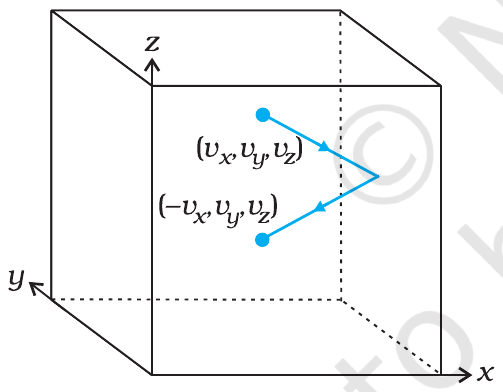
- Consider a gas enclosed in a cube of side l. Take the axes to be parallel to the sides of the cube, as shown in Fig. 12.4. A molecule with velocity (vx, vy, vz) hits the planar wall parallel to yz-plane of area A (= $l^2$). Since the collision is elastic, the molecule rebounds with the same velocity; its y and z components of velocity do not change in the collision but the x-component reverses sign. That is, the velocity after collision is (-vx, vy, vz). The change in momentum of the molecule is: -$mvx - (mvx) = -2mvx$. By the principle of conservation of momentum, the momentum imparted to the wall in the collision = 2mvx.
- To calculate the force (and pressure) on the wall, we need to calculate momentum imparted to the wall per unit time. In a small time interval $\Delta t$, a molecule with x-component of velocity vx will hit the wall if it is within the distance vx $\Delta t$ from the wall. That is, all molecules within the volume A vx $\Delta t$ only can hit the wall in time $\Delta t$. But, on the average, half of these are moving towards the wall and the other half away from the wall. Thus, the number of molecules with velocity (vx, vy, vz) hitting the wall in time $\Delta t$ is (1/2) A vx $\Delta t$ n, where n is the number of molecules per unit volume.
- The total momentum transferred to the wall by these molecules in time $\Delta t$ is: $Q = (2mvx) ((1/2) n A vx \delta t)$ (12.10). The force on the wall is the rate of momentum transfer Q/$\Delta t$ and pressure is force per unit area: $P = Q/(A \Delta t) = n m v_x^2$ (12.11).
- Actually, all molecules in a gas do not have the same velocity; there is a distribution in velocities. The above equation, therefore, stands for pressure due to the group of molecules with speed vx in the x-direction and n stands for the number density of that group of molecules. The total pressure is obtained by summing over the contribution due to all groups: $P = n m (v_x^2)$ (12.12), where ($v_x^2$) is the average of $v_x^2$.
- Now the gas is isotropic, i.e. there is no preferred direction of velocity of the molecules in the vessel. Therefore, by symmetry, $(v_x^2) = (v_y^2) = (v_z^2) = (1/3) [(v_x^2) + (v_y^2) + (v_z^2)]$ = (1/3) ($v^2$) (12.13), where v is the speed and ($v^2$) denotes the mean of the squared speed. $Thus P = (1/3) n m (v^2)$ (12.14).
- Some remarks on this derivation. First, though we choose the container to be a cube, the shape of the vessel really is immaterial. For a vessel of arbitrary shape, we can always choose a small infinitesimal (planar) area and carry through the steps above. Notice that both A and $\Delta t$ do not appear in the final result. By Pascal's law, given in Ch. 9, pressure in one portion of the gas in equilibrium is the same as anywhere else.
- Second, we have ignored any collisions in the derivation. Though this assumption is difficult to justify rigorously, we can qualitatively see that it will not lead to erroneous results. The number of molecules hitting the wall in time $\Delta t$ was found to be (1/2) n A vx $\Delta t$. Now the collisions are random and the gas is in a steady state. Thus, if a molecule with velocity (vx, vy, vz) acquires a different velocity due to collision with some molecule, there will always be some other molecule with a different initial velocity which after a collision acquires the velocity (vx, vy, vz). If this were not so, the distribution of velocities would not remain steady. In any case we are finding ($v_x^2$). Thus, on the whole, molecular collisions (if they are not too frequent and the time spent in a collision is negligible compared to time between collisions) will not affect the calculation above.
Kinetic Interpretation of Temperature
- Equation (12.14) can be written as $PV = (1/3) nV m (v^2)$ (12.15a) and $PV = (2/3) N x (1/2) m (v^2)$ (12.15b), where $N (= nV)$ is the number of molecules in the sample. (NCERT prints 'Equation (13.14)' here; the equation referred to is Eq. (12.14).)
- The quantity in the bracket is the average translational kinetic energy of the molecules in the gas. Since the internal energy E of an ideal gas is purely kinetic, E = N x (1/2) m ($v^2$) (12.16). Equation (12.15) then gives: $PV = (2/3) E$ (12.17).
- We are now ready for a kinetic interpretation of temperature. Combining Eq. (12.17) with the ideal gas Eq. (12.3), we get $E = (3/2) kB NT$ (12.18) or $E/N = (1/2) m (v^2) = (3/2) kB T$ (12.19), i.e., the average kinetic energy of a molecule is proportional to the absolute temperature of the gas; it is independent of pressure, volume or the nature of the ideal gas.
- This is a fundamental result relating temperature, a macroscopic measurable parameter of a gas (a thermodynamic variable as it is called) to a molecular quantity, namely the average kinetic energy of a molecule. The two domains are connected by the Boltzmann constant. We note in passing that Eq. (12.18) tells us that internal energy of an ideal gas depends only on temperature, not on pressure or volume.
- For a mixture of non-reactive ideal gases, the total pressure gets contribution from each gas in the mixture. Equation (12.14) becomes $P = (1/3)$ [$n_1$ $m_1$ (v_$1^2$) + $n_2$ $m_2$ (v_$2^2$) + ...] (12.20). In equilibrium, the average kinetic energy of the molecules of different gases will be equal. That is, $(1/2) m_1 (v_1^2) = (1/2) m_2 (v_2^2) = (3/2) kB T$, so that P = ($n_1$ + $n_2$ + ...) kB T (12.21), which is Dalton's law of partial pressures.
- From Eq. (12.19), we can get an idea of the typical speed of molecules in a gas. At a temperature $T = 300 K$, the mean square speed of a molecule in nitrogen gas is: $m = M(N_2)/NA = 28/(6.02 x 10^{23}) = 4.65 x 10^{-26} kg$. $(v^2) = 3 kB T/m = (516)² m^2 s^{-2}$. The square root of ($v^2$) is known as root mean square (rms) speed and is denoted by vrms. (We can also write ($v^2$) as <$v^2$>.)$vrms = 516 m s^{-1}$. The speed is of the order of the speed of sound in air. It follows from Eq. (12.19) that at the same temperature, lighter molecules have greater rms speed.
- Example 12.5: A flask contains argon and chlorine in the ratio of 2:1 by mass. The temperature of the mixture is 27 °C. Obtain the ratio of (i) average kinetic energy per molecule, and (ii) root mean square speed vrms of the molecules of the two gases. Atomic mass of $argon = 39.9 u$; Molecular mass of $chlorine = 70.9 u$. Answer: the average kinetic energy (per molecule) of any (ideal) gas (be it monatomic like argon, diatomic like chlorine or polyatomic) is always equal to (3/2) kB T. It depends only on temperature, and is independent of the nature of the gas. (i) Since argon and chlorine both have the same temperature in the flask, the ratio of average kinetic energy (per molecule) of the two gases is 1:1. (ii) Now (1/2) m $v_{rms}^2$ = average kinetic energy per molecule = (3/2) kB T, where m is the mass of a molecule of the gas. Therefore, ($v_{rms}^2$)Ar/($v_{rms}^2$)Cl = $(m)Cl/(m)Ar = (M)Cl/(M)Ar = 70.9/39.9 = 1.77$, where M denotes the molecular mass of the gas. Taking square root of both sides, (vrms)Ar/(vrms)Cl = 1.33. You should note that the composition of the mixture by mass is quite irrelevant to the above calculation.
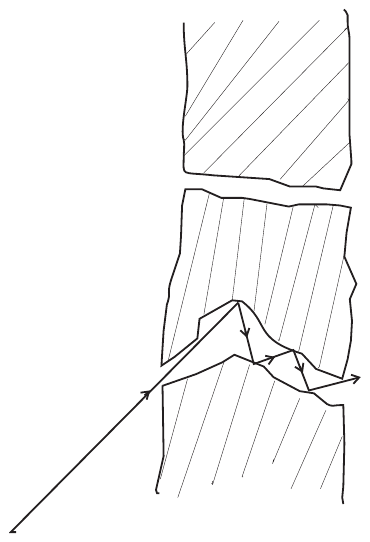
- Example 12.6: Uranium has two isotopes of masses 235 and 238 units. If both are present in Uranium hexafluoride gas which would have the larger average speed? If atomic mass of fluorine is 19 units, estimate the percentage difference in speeds at any temperature. Answer: At a fixed temperature the average energy = (1/2) m ($v^2$) is constant. So smaller the mass of the molecule, faster will be the speed. The ratio of speeds is inversely proportional to the square root of the ratio of the masses. The masses are 349 and 352 units. So $v349/v352 = (352/349)^{1/2} = 1.0044$. Hence difference (change in v)/v = 0.44%. 235U is the isotope needed for nuclear fission. To separate it from the more abundant isotope 238U, the mixture is surrounded by a porous cylinder. The porous cylinder must be thick and narrow, so that the molecule wanders through individually, colliding with the walls of the long pore. The faster molecule will leak out more than the slower one and so there is more of the lighter molecule (enrichment) outside the porous cylinder (Fig. 12.5). The method is not very efficient and has to be repeated several times for sufficient enrichment. When gases diffuse, their rate of diffusion is inversely proportional to square root of the masses (see Exercise 12.12). Can you guess the explanation from the above answer?
- Example 12.7: (a) When a molecule (or an elastic ball) hits a (massive) wall, it rebounds with the same speed. When a ball hits a massive bat held firmly, the same thing happens. However, when the bat is moving towards the ball, the ball rebounds with a different speed. Does the ball move faster or slower? (b) When gas in a cylinder is compressed by pushing in a piston, its temperature rises. Guess at an explanation of this in terms of kinetic theory using (a) above. (c) What happens when a compressed gas pushes a piston out and expands. What would you observe? (d) Sachin Tendulkar used a heavy cricket bat while playing. Did it help him in anyway? Answer (a): Let the speed of the ball be u relative to the wicket behind the bat. If the bat is moving towards the ball with a speed V relative to the wicket, then the relative speed of the ball to bat is V + u towards the bat. When the ball rebounds (after hitting the massive bat) its speed, relative to bat, is V + u moving away from the bat. So relative to the wicket the speed of the rebounding ball is $V + (V + u) = 2V + u, moving away$ from the wicket. So the ball speeds up after the collision with the bat. The rebound speed will be less than u if the bat is not massive. For a molecule this would imply an increase in temperature. You should be able to answer (b) (c) and (d) based on the answer to (a). (Hint: Note the correspondence, piston goes to bat, cylinder goes to wicket, molecule goes to ball.)
Practice1 question
Try it now. A wrong answer costs nothing here, try again until you get it.
The root mean square speed of a nitrogen molecule at 300 K is about
NCERT 12.4.2: for nitrogen at 300 K, $(v^2) = 3kBT/m = (516)² m^2 s^{-2}$, so $vrms = 516 m s^{-1}$, of the order of the speed of sound in air.
Table: Pressure, Temperature and RMS Speed
- The pressure, energy and speed results of NCERT 12.4, in one table. ($v^2$) is the mean of the squared speed; vrms is its square root.
| Result | Equation | NCERT ref |
|---|---|---|
| Pressure from collisions | $P = (1/3) n m (v^2)$ | Eq. (12.14) |
| Pressure, volume and energy | $PV = (2/3) E$ | Eq. (12.17) |
| Total translational energy | $E = (3/2) kB NT$ | Eq. (12.18) |
| Average KE per molecule | $(1/2) m (v^2) = (3/2) kB T$ | Eq. (12.19) |
| RMS speed | $vrms = (3kBT/m)^{1/2} = (3RT/M0)^{1/2}$ | Eq. (12.19) |
| Mixture pressure | P = ($n_1$ + $n_2$ + ...) kB T | Eq. (12.21) |
| vrms of $N_2$ at 300 K | 516 m s^-1 | 12.4.2 |
| vrms ratio, Ar to $Cl_2$ | $(vrms)Ar/(vrms)Cl = 1.33$ | Example 12.5 |
| vrms ratio, 235UF6 to 238UF6 | $v349/v352 = 1.0044, difference 0.44%$ | Example 12.6 |
- E denotes the translational part of the internal energy U that may include energies due to other degrees of freedom also. See section 12.5.
Law of Equipartition of Energy
- The kinetic energy of a single molecule is $Et = (1/2) mv_x^2 + (1/2) mv_y^2 + (1/2) mv_z^2$ (12.22). For a gas in thermal equilibrium at temperature T the average value of energy denoted by (Et) is $(Et) = ((1/2) mv_x^2) + ((1/2) mv_y^2) + ((1/2) mv_z^2)$ = (3/2) kB T (12.23).
- Since there is no preferred direction, Eq. (12.23) implies ((1/2) $mv_x^2$) = (1/2) kB T, $((1/2) mv_y^2) = (1/2) kB T, ((1/2) mv_z^2) = (1/2) kB T$ (12.24).
- A molecule free to move in space needs three coordinates to specify its location. If it is constrained to move in a plane it needs two; and if constrained to move along a line, it needs just one coordinate to locate it. This can also be expressed in another way. We say that it has one degree of freedom for motion in a line, two for motion in a plane and three for motion in space. Motion of a body as a whole from one point to another is called translation. Thus, a molecule free to move in space has three translational degrees of freedom.
- Each translational degree of freedom contributes a term that contains square of some variable of motion, e.g., (1/2) $mv_x^2$ and similar terms in vy and vz. In Eq. (12.24) we see that in thermal equilibrium, the average of each such term is (1/2) kB T.
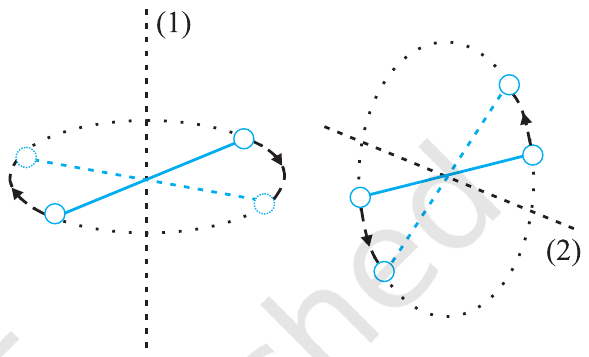
- Molecules of a monatomic gas like argon have only translational degrees of freedom. But what about a diatomic gas such as $O_2$ or $N_2$? A molecule of $O_2$ has three translational degrees of freedom. But in addition it can also rotate about its centre of mass. Figure 12.6 shows the two independent axes of rotation 1 and 2, normal to the axis joining the two oxygen atoms about which the molecule can rotate. The molecule thus has two rotational degrees of freedom, each of which contributes a term to the total energy consisting of translational energy Et and rotational energy Er: Et + Er = (1/2) $mv_x^2$ + (1/2) $mv_y^2$ + (1/2) $mv_z^2$ + (1/2) $I_1$ $\omega_1^2$ + (1/2) $I_2$ $\omega_2^2$ (12.25), where w1 and w2 are the angular speeds about the axes 1 and 2 and $I_1$, $I_2$ are the corresponding moments of inertia. Note that each rotational degree of freedom contributes a term to the energy that contains square of a rotational variable of motion.
- We have assumed above that the $O_2$ molecule is a 'rigid rotator', i.e., the molecule does not vibrate. This assumption, though found to be true (at moderate temperatures) for $O_2$, is not always valid. Molecules, like $CO$, even at moderate temperatures have a mode of vibration, i.e., its atoms oscillate along the interatomic axis like a one-dimensional oscillator, and contribute a vibrational energy term Ev to the total energy: $Ev = (1/2) m (dy/dt)² + (1/2) k y^2$; $E = Et + Er + Ev$ (12.26), where k is the force constant of the oscillator and y the vibrational co-ordinate.
- At this point, notice an important feature in Eq. (12.26). While each translational and rotational degree of freedom has contributed only one 'squared term' in Eq. (12.26), one vibrational mode contributes two 'squared terms': kinetic and potential energies.
- Each quadratic term occurring in the expression for energy is a mode of absorption of energy by the molecule. We have seen that in thermal equilibrium at absolute temperature T, for each translational mode of motion, the average energy is (1/2) kB T. The most elegant principle of classical statistical mechanics (first proved by Maxwell) states that this is so for each mode of energy: translational, rotational and vibrational. That is, in equilibrium, the total energy is equally distributed in all possible energy modes, with each mode having an average energy equal to (1/2) kB T. This is known as the law of equipartition of energy. Accordingly, each translational and rotational degree of freedom of a molecule contributes (1/2) kB T to the energy, while each vibrational frequency contributes 2 x (1/2) kB T = kB T, since a vibrational mode has both kinetic and potential energy modes.
- The proof of the law of equipartition of energy is beyond the scope of this book. Here, we shall apply the law to predict the specific heats of gases theoretically. Later, we shall also discuss briefly, the application to specific heat of solids.
- Rotation along the line joining the atoms has very small moment of inertia and does not come into play for quantum mechanical reasons. See end of section 12.6.
Specific Heat Capacity of Gases
- 12.6.1 Monatomic Gases: The molecule of a monatomic gas has only three translational degrees of freedom. Thus, the average energy of a molecule at temperature T is (3/2) kB T. The total internal energy of a mole of such a gas is $U = (3/2) kB T x NA = (3/2) RT$ (12.27). The molar specific heat at constant volume, Cv, is Cv (monatomic gas) = $dU/dT = (3/2) R$ (12.28). For an ideal gas, Cp - Cv = R (12.29), where Cp is the molar specific heat at constant pressure. Thus, $Cp = (5/2) R$ (12.30). The ratio of specific $heats γ = Cp/Cv = 5/3$ (12.31).
- 12.6.2 Diatomic Gases: As explained earlier, a diatomic molecule treated as a rigid rotator, like a dumbbell, has 5 degrees of freedom: 3 translational and 2 rotational. Using the law of equipartition of energy, the total internal energy of a mole of such a gas is $U = (5/2) kB T x NA = (5/2) RT$ (12.32). The molar specific heats are then given by Cv (rigid diatomic) = (5/2) R, $Cp = (7/2) R$ (12.33). γ (rigid diatomic) = 7/5 (12.34).
- If the diatomic molecule is not rigid but has in addition a vibrational mode, $U = ((5/2) kB T + kB T) NA = (7/2) RT$; $Cv = (7/2) R$, $Cp = (9/2) R$, $γ = 9/7$ (12.35).
- 12.6.3 Polyatomic Gases: In general a polyatomic molecule has 3 translational, 3 rotational degrees of freedom and a certain number (f) of vibrational modes. According to the law of equipartition of energy, it is easily seen that one mole of such a gas has $U = ((3/2) kB T + (3/2) kB T + f kB T) NA$ = (3 + f) RT, i.e., $Cv = (3 + f) R$, $Cp = (4 + f) R$, $γ = (4 + f)/(3 + f)$ (12.36). Note that Cp - Cv = R is true for any ideal gas, whether mono, di or polyatomic.
- Table 12.1 summarises the theoretical predictions for specific heats of gases ignoring any vibrational modes of motion. The values are in good agreement with experimental values of specific heats of several gases given in Table 12.2. Of course, there are discrepancies between predicted and actual values of specific heats of several other gases (not shown in the table), such as $Cl_2$, $C_2H_6$ and many other polyatomic gases. Usually, the experimental values for specific heats of these gases are greater than the predicted values as given in Table 12.1, suggesting that the agreement can be improved by including vibrational modes of motion in the calculation. The law of equipartition of energy is, thus, well verified experimentally at ordinary temperatures.
- Example 12.8: A cylinder of fixed capacity 44.8 litres contains helium gas at standard temperature and pressure. What is the amount of heat needed to raise the temperature of the gas in the cylinder by 15.0 °C? $(R = 8.31 J mol^{-1} K^{-1})$. Answer: Using the gas law PV = µRT, you can easily show that 1 mol of any (ideal) gas at standard temperature (273 K) and pressure (1 atm = 1.01 x $10^{5}$ Pa) occupies a volume of 22.4 litres. This universal volume is called molar volume. Thus the cylinder in this example contains 2 mol of helium. Further, since helium is monatomic, its predicted (and observed) molar specific heat at constant volume, $Cv = (3/2) R$, and molar specific heat at constant pressure, $Cp = (3/2) R + R = (5/2) R$. Since the volume of the cylinder is fixed, the heat required is determined by Cv. Therefore, Heat $required = no$. of moles x molar specific heat x rise in temperature = 2 $x 1.5 R x 15.0 = 45 R = 45 \times 8.31 = 374 J$.
Table: Specific Heats
- Table 12.1: Predicted values of specific heat capacities of gases (ignoring vibrational modes). Units are J $mol^{-1}$ K^-1.
| Nature of Gas | Cv (J $mol^{-1}$ K^-1) | Cp (J $mol^{-1}$ K^-1) | Cp - Cv (J $mol^{-1}$ K^-1) | γ |
|---|---|---|---|---|
| Monatomic | 12.5 | 20.8 | 8.31 | 1.67 |
| Diatomic | 20.8 | 29.1 | 8.31 | 1.40 |
| Triatomic | 24.93 | 33.24 | 8.31 | 1.33 |
- Table 12.2: Measured values of specific heat capacities of some gases. Units are J $mol^{-1}$ K^-1.
| Nature of gas | Gas | Cv (J $mol^{-1}$ K^-1) | Cp (J $mol^{-1}$ K^-1) | Cp - Cv (J $mol^{-1}$ K^-1) | γ |
|---|---|---|---|---|---|
| Monatomic | He | 12.5 | 20.8 | 8.30 | 1.66 |
| Monatomic | Ne | 12.7 | 20.8 | 8.12 | 1.64 |
| Monatomic | Ar | 12.5 | 20.8 | 8.30 | 1.67 |
| Diatomic | $H_2$ | 20.4 | 28.8 | 8.45 | 1.41 |
| Diatomic | $O_2$ | 21.0 | 29.3 | 8.32 | 1.40 |
| Diatomic | $N_2$ | 20.8 | 29.1 | 8.32 | 1.40 |
| Triatomic | $H_2O$ | 27.0 | 35.4 | 8.35 | 1.31 |
| Polyatomic | $CH_4$ | 27.1 | 35.4 | 8.36 | 1.31 |
- Read the tables together: the predicted values of Table 12.1 agree well with the measured values of Table 12.2 for He, Ar, $O_2$ and $N_2$. The measured values for polyatomic gases such as $Cl_2$, $C_2H_6$ and $CH_4$ are greater than the predicted values, because vibrational modes add to the specific heat.
Practice1 question
Try it now. A wrong answer costs nothing here, try again until you get it.
The ratio of specific $heats γ = Cp/Cv$ for a rigid diatomic ideal gas is
NCERT 12.6.2: a rigid diatomic gas has $Cv = (5/2) R$ and $Cp = (7/2) R$, so $γ = Cp/Cv = 7/5 = 1.40$, matching Table 12.2 values for $O_2$ and $N_2$.
Specific Heat Capacity of Solids
- 12.6.4 Specific Heat Capacity of Solids: We can use the law of equipartition of energy to determine specific heats of solids. Consider a solid of N atoms, each vibrating about its mean position. An oscillation in one dimension has average energy of 2 $x (1/2) kB T = kB T$. In three dimensions, the average energy is 3 kB T. For a mole of solid, N = NA, and the total energy is $U = 3 kB T x NA = 3 RT$.
- Now at constant pressure $\delta Q = \delta U + P\delta V$ = $\Delta U$, since for a solid $\Delta V$ is negligible. Hence, $C = \Delta Q/\Delta T = \Delta U/\Delta T = 3R$ (12.37).
- Table 12.3: Specific Heat Capacity of some solids at room temperature and atmospheric pressure.
| Substance | Specific heat (J kg^-1 K^-1) | Molar specific heat (J $mol^{-1}$ K^-1) |
|---|---|---|
| Aluminium | 900.0 | 24.4 |
| Carbon | 506.5 | 6.1 |
| Copper | 386.4 | 24.5 |
| Lead | 127.7 | 26.5 |
| Silver | 236.1 | 25.5 |
| Tungsten | 134.4 | 24.9 |
- As Table 12.3 shows the prediction generally agrees with experimental values at ordinary temperature (Carbon is an exception). The predicted molar specific heat is $3R = 3 \times 8.31 = 24.93 J mol^{-1} K^{-1}$.
Mean Free Path
- Molecules in a gas have rather large speeds of the order of the speed of sound. Yet a gas leaking from a cylinder in a kitchen takes considerable time to diffuse to the other corners of the room. The top of a cloud of smoke holds together for hours. This happens because molecules in a gas have a finite though small size, so they are bound to undergo collisions. As a result, they cannot move straight unhindered; their paths keep getting incessantly deflected.
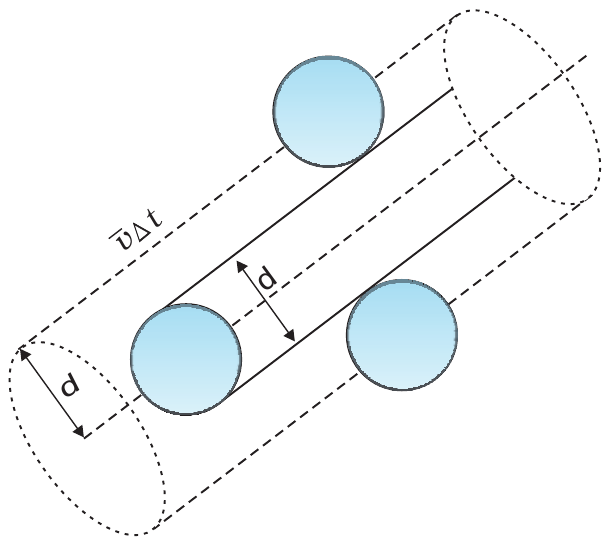
- Suppose the molecules of a gas are spheres of diameter d. Focus on a single molecule with the average speed (v). It will suffer collision with any molecule that comes within a distance d between the centres. In time $\Delta t$, it sweeps a volume π $d^2$ (v) $\Delta t$ wherein any other molecule will collide with it (see Fig. 12.7). If n is the number of molecules per unit volume, the molecule suffers n π $d^2$ (v) $\Delta t$ collisions in time $\Delta t$. Thus the rate of collisions is n π $d^2$ (v) or the time between two successive collisions is on the average, $τ = 1/(n π (v) d^2)$ (12.38).
- The average distance between two successive collisions, called the mean free path l, is: $l = (v) τ = 1/(n π d^2)$ (12.39).
- In this derivation, we imagined the other molecules to be at rest. But actually all molecules are moving and the collision rate is determined by the average relative velocity of the molecules. Thus we need to replace (v) by (vr) in Eq. (12.38). A more exact treatment gives $l = 1/(sqrt(2) n π d^2)$ (12.40).
- Let us estimate l and τ for air molecules with average speeds $(v) = 485 m/s$. At STP, $n = (0.02 \times 10^{23})/(22.4 \times 10^{-3})$ = 2.7 x $10^{25}$ m^-3. $Taking d = 2 \times 10^{-10} m$, $τ = 6.1 \times 10^{-10} s$ and $l = 2.9 \times 10^{-7} m$, about 1500 d (12.41).
- As expected, the mean free path given by Eq. (12.40) depends inversely on the number density and the size of the molecules. In a highly evacuated tube n is rather small and the mean free path can be as large as the length of the tube.
- Example 12.9: Estimate the mean free path for a water molecule in water vapour at 373 K. Use information from Exercises 12.1 and Eq. (12.41) above. Answer: The d for water vapour is same as that of air. The number density is inversely proportional to absolute temperature. So $n = 2.7 \times 10^{25} x (273/373)$ = 2 x $10^{25}$ m^-3. Hence, mean free path $l = 4 \times 10^{-7} m$.
- Note that the mean free path is 100 times the interatomic distance, about 40 angstrom = 4 x $10^{-9}$ m, calculated earlier. It is this large value of mean free path that leads to the typical gaseous behaviour. Gases can not be confined without a container.
- Using the kinetic theory of gases, the bulk measurable properties like viscosity, heat conductivity and diffusion can be related to the microscopic parameters like molecular size. It is through such relations that the molecular sizes were first estimated.
Practice1 question
Try it now. A wrong answer costs nothing here, try again until you get it.
If the number density of a gas is doubled at fixed molecular size, its mean free path
NCERT 12.7, Eq. (12.40): $l = 1/(sqrt(2) n π d^2)$, so doubling the number density n halves the mean free path.
Table: Mean Free Path
- The collision and mean free path results of NCERT 12.7, in one table. (v) is the average speed; (vr) is the average relative speed.
| Result | Equation | NCERT ref |
|---|---|---|
| Collisions in time $\Delta t$ | n π $d^2$ (v) $\Delta t$ | 12.7 |
| Collision time | $τ = 1/(n π (v) d^2)$ | Eq. (12.38) |
| Mean free path, rough form | $l = (v) τ = 1/(n π d^2)$ | Eq. (12.39) |
| Mean free path, exact form | $l = 1/(sqrt(2) n π d^2)$ | Eq. (12.40) |
| Air at STP, number density | $n = 2.7 \times 10^{25} m^{-3}$ | Eq. (12.41) |
| Air at STP, collision time | $τ = 6.1 \times 10^{-10} s$ | Eq. (12.41) |
| Air at STP, mean free path | $l = 2.9 \times 10^{-7} m$, about 1500 d | Eq. (12.41) |
| Water vapour at 373 K | $l = 4 \times 10^{-7} m$ | Example 12.9 |
- The mean free path depends inversely on the number density and the size of the molecules: more molecules per unit volume, or bigger molecules, means a shorter free path.
Degrees-of-Freedom Ladder
- Monatomic gas (argon, helium, neon): 3 translational degrees of freedom, 0 rotational, 0 vibrational. Energy per molecule (3/2) kB T. $U = (3/2) RT$ per mole. $Cv = (3/2) R$, $Cp = (5/2) R$, $γ = 5/3 = 1.67$.
- Rigid diatomic gas ($O_2$, $N_2$ at moderate temperatures): 3 translational + 2 rotational = 5 degrees of freedom. Rotation about the line joining the atoms does not count: its moment of inertia is very small and it does not come into play for quantum mechanical reasons. Energy per molecule (5/2) kB T. $U = (5/2) RT$ per mole. $Cv = (5/2) R$, $Cp = (7/2) R$, $γ = 7/5 = 1.40$.
- Diatomic gas with vibration ($CO$ at moderate temperatures, and others at high temperatures): 5 + 2 = 7 degrees of freedom, since one vibrational mode has both a kinetic and a potential squared term. Energy per molecule (7/2) kB T. $U = (7/2) RT$ per mole. $Cv = (7/2) R$, $Cp = (9/2) R$, $γ = 9/7 = 1.29$.
- Triatomic gas, no vibration (predicted): 3 translational + 3 rotational = 6 degrees of freedom. Energy per molecule 3 kB T. $U = 3 RT$ per mole. $Cv = 3 R = 24.93 J mol^{-1} K^{-1}$, $Cp = 4 R = 33.24 J mol^{-1} K^{-1}$, $γ = 4/3 = 1.33$.
- Polyatomic gas with f vibrational modes: 3 translational + 3 rotational + 2f vibrational = 6 + 2f degrees of freedom. Energy per molecule (3 + f) kB T. $U = (3 + f) RT$ per mole. $Cv = (3 + f) R$, $Cp = (4 + f) R$, $γ = (4 + f)/(3 + f)$.
- Solid (N atoms, each vibrating about its mean position): 3 dimensions x 2 squared terms = 6 squared terms per atom, energy 3 kB T per atom. $U = 3 RT$ per mole. $C = 3R = 24.93 J mol^{-1} K^{-1}$. Carbon is the exception: 6.1 J $mol^{-1}$ K^-1.
- Cp - Cv = R holds at every rung of the ladder, for any ideal gas, whether mono, di or polyatomic.
Trap Pairs
- Trap 1: Mean free path grows when the gas is compressed. Wrong: compressing a gas raises its number density n, and $l = 1/(sqrt(2) n π d^2) falls$. A highly evacuated tube has a long mean free path, as large as the length of the tube.
- Trap 2: The average kinetic energy of a molecule depends on which gas it is. Wrong: $(1/2) m (v^2) = (3/2) kB T$ for every ideal gas, monatomic, diatomic or polyatomic. Only the speed changes with mass: lighter molecules have greater rms speed at the same temperature.
- Trap 3: The rms speed is the average speed of the molecules. Wrong: $vrms = \sqrt{(v^2)}$, and ($v^2$) is not always equal to ((v)$)^2$. The average of a squared quantity is not necessarily the square of the average (Points to Ponder 5).
- Trap 4: Cp - Cv = R holds only for monatomic gases. Wrong: NCERT 12.6.3 states it is true for any ideal gas, whether mono, di or polyatomic. Table 12.2 shows Cp - Cv about 8.3 J $mol^{-1}$ K^-1 for every gas listed.
- Trap 5: The internal energy of an ideal gas depends on its pressure and volume. Wrong: $E = (3/2) kB NT$ depends only on temperature. Pressure and volume change the energy only by changing the temperature.
Practice1 question
Try it now. A wrong answer costs nothing here, try again until you get it.
The average kinetic energy of a molecule of an ideal gas at 300 K is about $(kB = 1.38 \times 10^{-23} J K^{-1})$
NCERT 12.4.2: average kinetic energy per molecule = $(3/2) kB T = (3/2) x (1.38 \times 10^{-23}) x 300$ = 6.21 x $10^{-21}$ J.
Points to Ponder
- 1. Pressure of a fluid is not only exerted on the wall. Pressure exists everywhere in a fluid. Any layer of gas inside the volume of a container is in equilibrium because the pressure is the same on both sides of the layer.
- 2. We should not have an exaggerated idea of the intermolecular distance in a gas. At ordinary pressures and temperatures, this is only 10 times or so the interatomic distance in solids and liquids. What is different is the mean free path which in a gas is 100 times the interatomic distance and 1000 times the size of the molecule.
- 3. The law of equipartition of energy is stated thus: the energy for each degree of freedom in thermal equilibrium is (1/2) kB T. Each quadratic term in the total energy expression of a molecule is to be counted as a degree of freedom. Thus, each vibrational mode gives 2 (not 1) degrees of freedom (kinetic and potential energy modes), corresponding to the energy 2 $x (1/2) kB T = kB T$.
- 4. Molecules of air in a room do not all fall and settle on the ground (due to gravity) because of their high speeds and incessant collisions. In equilibrium, there is a very slight increase in density at lower heights (like in the atmosphere). The effect is small since the potential energy (mgh) for ordinary heights is much less than the average kinetic energy (1/2) m $v^2$ of the molecules.
- 5. ($v^2$) is not always equal to ((v)$)^2$. The average of a squared quantity is not necessarily the square of the average. Can you find examples for this statement.
Exercise Figure 12.8
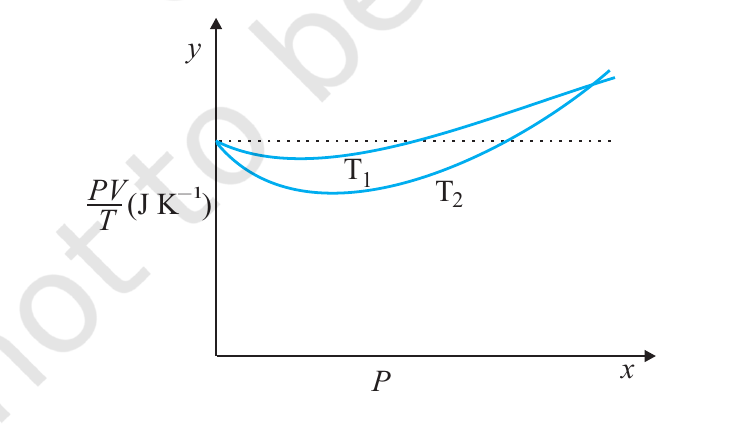
- Exercise 12.3: Figure 12.8 shows plot of PV/T versus P for 1.00 x $10^{-3}$ kg of oxygen gas at two different temperatures. (a) What does the dotted plot signify? (b) Which is true: $T_1$ > $T_2$ or $T_1$ < $T_2$? (c) What is the value of PV/T where the curves meet on the y-axis? (d) If we obtained similar plots for 1.00 x $10^{-3}$ kg of hydrogen, would we get the same value of PV/T at the point where the curves meet on the y-axis? If not, what mass of hydrogen yields the same value of PV/T (for low pressure high temperature region of the plot)? (Molecular mass of $H_2 = 2.02 u$, of $O_2 = 32.0 u$, $R = 8.31 J mol^{-1} K^{-1}$.)
- Worked answers: (a) The dotted plot is the ideal gas value: for an ideal gas PV/T = µR, constant at fixed µ. (b) $T_1$ > $T_2$: at a given P, the higher-temperature curve lies higher, and PV/T = µR is approached from below as T rises; the curve that dips less is the hotter one. (c) Where the curves meet the y-axis, P goes to 0 and the gas behaves ideally, so PV/T = µR. For 1.00 x $10^{-3}$ kg of $O_2$, µ = (1.00 x $10^{-3}$)/(32.0 x $10^{-3}$) = 0.03125 mol, so $PV/T = 0.03125 \times 8.31 = 0.26 J K^{-1}$. (d) No: for the same mass of $H_2$, µ is larger, so PV/T at the y-axis is larger. The same value needs the same µ = 0.03125 mol, i.e. mass = 0.03125 x 2.02 x $10^{-3}$ kg = $6.31 \times 10^{-5} kg = 0.0631 g$ of hydrogen.
- Other exercises in the chapter: 12.1 (fraction of molecular volume in oxygen gas at STP, diameter 3 angstrom); 12.2 (show the molar volume is 22.4 litres); 12.4 (mass of oxygen taken out of a 30 litre cylinder, gauge pressure 15 atm to 11 atm, 27 °C to 17 °C); 12.5 (air bubble rising from 40 m depth, 12 °C to 35 °C); 12.6 (number of air molecules in a 25.0 $m^3$ room at 27 °C and 1 atm); 12.7 (average thermal energy of a helium atom at room temperature, at 6000 K, and at 10 million kelvin); 12.8 (equal-capacity vessels of neon, chlorine and uranium hexafluoride at the same T and P: equal numbers of molecules, different rms speeds, largest for neon); 12.9 (temperature at which argon rms speed equals helium rms speed at -20 °C); 12.10 (mean free path and collision frequency of nitrogen at 2.0 atm and 17 °C, radius about 1.0 angstrom).
Trap Boxes
Mean free path grows when a gas is compressed
Wrong idea: Compressing a gas gives its molecules more room, so the mean free path gets longer.
$Mean free path l = 1/(sqrt(2) n π d^2)$: it falls when the number density n rises. Compressing a gas shortens the free path; a highly evacuated tube has a long mean free path, as large as the length of the tube. NCERT 12.7.
NCERT XI, Ch 12, 12.7
Average kinetic energy depends on which gas it is
Wrong idea: A heavier gas has more kinetic energy per molecule than a lighter gas at the same temperature.
The average kinetic energy of a molecule is (3/2) kB T for every ideal gas, monatomic, diatomic or polyatomic. Only the speed changes with mass: at the same temperature lighter molecules have greater rms speed. NCERT 12.4.2, Example 12.5.
NCERT XI, Ch 12, 12.4.2
RMS speed is the average speed of the molecules
Wrong idea: The root mean square speed is just the average speed of the gas molecules.
$vrms = \sqrt{(v^2)}$, the square root of the mean of the squared speed. ($v^2$) is not always equal to ((v)$)^2$: the average of a squared quantity is not necessarily the square of the average. NCERT 12.4.2, Points to Ponder 5.
NCERT XI, Ch 12, 12.4.2
Cp minus Cv equals R only for monatomic gases
Wrong idea: Cp - Cv = R works for monatomic gases only; diatomic and polyatomic gases have a different difference.
Cp - Cv = R is true for any ideal gas, whether mono, di or polyatomic (NCERT 12.6.3). Table 12.2 shows Cp - Cv about 8.3 J $mol^{-1}$ K^-1 for every gas listed, from He to $CH_4$.
NCERT XI, Ch 12, 12.6.3
Internal energy of an ideal gas depends on pressure and volume
Wrong idea: An ideal gas at higher pressure has more internal energy even at the same temperature.
$E = (3/2) kB NT$: the internal energy of an ideal gas depends only on temperature, not on pressure or volume. NCERT 12.4.2.
NCERT XI, Ch 12, 12.4.2
Chapter test
5 NEET PYQs. +4 for a correct answer, -1 for a wrong answer, exactly like NEET. Finish the test to earn a medal.
Q1: NEET (UG) 2025, Code 45, Q29
A container has two chambers of volumes $V_1 = 2 litres$ and $V_2 = 3 litres separated$ by a partition made of a thermal insulator. The chambers contains $n_1 = 5$ and $n_2 = 4 moles$ of ideal gas at pressures $p1 = 1 atm$ and $p2 = 2 atm$, respectively. When the partition is removed, the mixture attains an equilibrium pressure of:
By Dalton's law the total pressure is the sum of the partial pressures: $p = (p1 V_1 + p2 V_2)/(V_1 + V_2) = (1 \times 2 + 2 \times 3)/(2 + 3) = 8/5 = 1.6 atm$.
Q2: NEET (UG) 2024, Code R3, Q49
The following graph represents the T-V curves of an ideal gas (where T is the temperature and V the volume) at three pressures $P_1$, $P_2$ and P3 compared with those of Charles's law represented as dotted lines. [Figure: T-V curves for $CO_2$ at three pressures, solid experimental lines and dotted Charles's law lines, as in NCERT Figure 12.3.] Then the correct relation is:
This is NCERT Figure 12.3. From Charles's law, $V = (μ R/P) T$, so on a T-V plot the slope is P/(μ R): the steepest curve has the highest pressure, giving $P_1$ > $P_2$ > P3.
Q3: NEET (UG) 2023, Code F1, Q28
The temperature of a gas is -50 °C. To what temperature the gas should be heated so that the rms speed is increased by 3 times?
-$50 °C = 223 K$. 'Increased by 3 times' means the rms speed becomes 4 times the old value, so T becomes 16 times: $16 \times 223 K = 3568 K = 3295 °C$. vrms is proportional to $\sqrt{T}$.
Q4: NEET (UG) 2021, Code P3, Q9
Match Column - I and Column - II and choose the correct match from the given choices. Column - I: (A) Root mean square speed of gas molecules, (B) Pressure exerted by ideal gas, (C) Average kinetic energy of a molecule, (D) Total internal energy of 1 mole of a diatomic gas. Column - II: (P) (1/3) n m ($v^2$), (Q) $\sqrt{3RT/M}$, (R) (5/2) RT, (S) (3/2) kB T.
$RMS speed = \sqrt{3RT/M}$; pressure = (1/3) n m ($v^2$); average kinetic energy of a molecule = (3/2) kB T; total internal energy of 1 mole of a rigid diatomic gas = (5/2) RT. So (A)-(Q), (B)-(P), (C)-(S), (D)-(R).
Q5: NEET (UG) 2020, Code G5, Q157
The mean free path for a gas, with molecular diameter d and number density n can be expressed as:
NCERT 12.7, Eq. (12.40): $l = 1/(sqrt(2) n π d^2)$. The sqrt(2) comes from the average relative velocity of the molecules; the rough form without it is 1/(n π $d^2$).
Score: 0 · Answered 0 of 5
Flashcards
Tap a card to flip it over and see the answer. Tap it again to flip it back.
State the ideal gas equation in its mole form, its molecule form and its density form, with the value of R.
Tap to flipPV = µRT, where µ is the number of moles and R = $NA kB = 8.314 J mol^{-1} K^{-1}$. Also $PV = kB NT$ and P = kB nT, where n is the number density, and $P = (ρRT)/M0$, where ρ is the mass density and M0 the molar mass.
Tap to flip backState the kinetic theory result for the pressure of an ideal gas and say what ($v^2$) means.
Tap to flip$P = (1/3) n m (v^2)$, where n is the number density, m the mass of a molecule and ($v^2$) the mean of the squared speed. It follows from a molecule of velocity (vx, vy, vz) hitting a wall and giving up momentum 2mvx at each elastic collision.
Tap to flip backState the kinetic interpretation of temperature and the rms speed formula.
Tap to flip$(1/2) m (v^2) = (3/2) kB T$, so $vrms = (3kBT/m)^{1/2} = (3RT/M0)^{1/2}$. At the same temperature lighter molecules have greater rms speed. For nitrogen at 300 K, $vrms = 516 m s^{-1}$.
Tap to flip backState the total translational internal energy of an ideal gas and its relation to PV.
Tap to flip$E = (3/2) kB NT$, where E is the (translational) internal energy of an ideal gas. Then $PV = (2/3) E$. The internal energy of an ideal gas depends only on temperature, not on pressure or volume.
Tap to flip backState the law of equipartition of energy, including the vibrational case.
Tap to flipIn equilibrium at absolute temperature T, each quadratic energy mode has average energy (1/2) kB T. Each translational and rotational degree of freedom gives (1/2) kB T; each vibrational mode gives kB T, since it has both kinetic and potential energy modes.
Tap to flip backGive Cv, Cp and γ for monatomic, rigid diatomic and polyatomic ideal gases.
Tap to flipMonatomic: $Cv = (3/2) R$, $Cp = (5/2) R$, $γ = 5/3 = 1.67$. Rigid diatomic: $Cv = (5/2) R$, $Cp = (7/2) R$, $γ = 7/5 = 1.40$. Polyatomic with f vibrational modes: $Cv = (3 + f) R$, $Cp = (4 + f) R$, $γ = (4 + f)/(3 + f)$. Cp - Cv = R for any ideal gas.
Tap to flip backState the mean free path formula and the collision time formula.
Tap to flip$l = 1/(sqrt(2) n π d^2)$, where n is the number density and d the molecular diameter. The collision time is $τ = 1/(n π (v) d^2)$ and $l = (v) τ$, where (v) is the average speed. The sqrt(2) comes from the average relative velocity of the molecules.
Tap to flip backGive the values of kB, R and NA, and the volume of one mole of gas at STP.
Tap to flip$kB = 1.38 \times 10^{-23} J K^{-1}$. $R = 8.314 J mol^{-1} K^{-1}$. $NA = 6.02 \times 10^{23}$. The number in 22.4 litres of any gas at STP (273 K, 1 atm) is NA, and the mass of 22.4 litres is its molecular weight in grams.
Tap to flip backGive the number density, collision time and mean free path of air molecules at STP.
Tap to flipFor air at STP with average speed $(v) = 485 m/s$ and $d = 2 x 10^{-10} m: n = 2.7 x 10^{25} m^{-3}$, $τ = 6.1 \times 10^{-10} s$ and $l = 2.9 \times 10^{-7} m$, about 1500 d. For water vapour at 373 K, $l = 4 \times 10^{-7} m$.
Tap to flip backWhich solid in Table 12.3 breaks the 3R prediction, and by how much?
Tap to flipCarbon is the exception in Table 12.3: its molar specific heat is 6.1 J $mol^{-1}$ K^-1, far below the predicted $3R = 24.9 J mol^{-1} K^{-1}$, while aluminium (24.4), copper (24.5), lead (26.5), silver (25.5) and tungsten (24.9) agree with 3R at ordinary temperature.
Tap to flip backCount the degrees of freedom of a monatomic gas, a rigid diatomic gas and a triatomic gas.
Tap to flipMonatomic gas: 3 translational degrees of freedom. Rigid diatomic: 3 translational + 2 rotational = 5. Triatomic (predicted, no vibration): 3 translational + 3 rotational = 6, so $Cv = 3R$. Each vibrational mode adds 2 degrees of freedom (kinetic + potential).
Tap to flip backGive the estimated size of a water molecule, its molecular volume fraction in vapour, and the average spacing.
Tap to flipA water molecule has volume about 3 x $10^{-29}$ $m^3$ and radius about $2 \times 10^{-10} m = 2 angstrom$. The fraction of molecular volume to total volume in water vapour at 100 °C and 1 atm is 6 x $10^{-4}$. The average distance between water molecules in the vapour is about 40 angstrom.
Tap to flip backFrequently asked questions
Is it true that mean free path grows when a gas is compressed?
$Mean free path l = 1/(sqrt(2) n π d^2)$: it falls when the number density n rises. Compressing a gas shortens the free path; a highly evacuated tube has a long mean free path, as large as the length of the tube.
Is it true that average kinetic energy depends on which gas it is?
The average kinetic energy of a molecule is (3/2) kB T for every ideal gas, monatomic, diatomic or polyatomic. Only the speed changes with mass: at the same temperature lighter molecules have greater rms speed.
Is it true that rMS speed is the average speed of the molecules?
$vrms = \sqrt{(v^2)}$, the square root of the mean of the squared speed. ($v^2$) is not always equal to ((v)$)^2$: the average of a squared quantity is not necessarily the square of the average.
Is it true that cp minus Cv equals R only for monatomic gases?
Cp - Cv = R is true for any ideal gas, whether mono, di or polyatomic (NCERT 12.6.3). Table 12.2 shows Cp - Cv about 8.3 J $mol^{-1}$ K^-1 for every gas listed, from He to $CH_4$.
Is it true that internal energy of an ideal gas depends on pressure and volume?
$E = (3/2) kB NT$: the internal energy of an ideal gas depends only on temperature, not on pressure or volume.