 NEET Notes
Home > Physics > Laws of Motion
Laws of Motion
Every body continues to be in its state of rest or of uniform motion in a straight line unless compelled by some external force to act otherwise.
On this page · 21 sections
- 01Syllabus map
- 02Introduction: what governs motion
- 03Aristotle's fallacy
- 04The law of inertia
- 05Newton's first law of motion
- 06Momentum
- 07Newton's second law of motion
- 08Impulse
- 09Newton's third law of motion
- 10Conservation of momentum
- 11Equilibrium of a particle
- 12Common forces in mechanics
- 13Friction
- 14Rolling friction
- 15Circular motion and centripetal force
- 16Car on a level road and on a banked road
- 17Solving problems in mechanics
- 18Table: Summary of quantities
- 19Table: Key equations at a glance
- 20Trap pairs: the confusions NEET tests
- 21Points to ponder
Force, inertia and Newton's three laws, momentum, impulse, friction and circular motion, from NCERT Class 11 Chapter 4, with worked examples and 5 NEET PYQs.
Syllabus map
- NMC Unit: PHYS-U03, Laws of Motion. NCERT Chapter 4, Laws of Motion (Class XI, rationalised NCERT).
- Subtopics in this chapter (NCERT XI, Ch 4): 4.1 Introduction; 4.2 Aristotle's fallacy; 4.3 The law of inertia; 4.4 Newton's first law of motion; 4.5 Newton's second law of motion; 4.6 Newton's third law of motion; 4.7 Conservation of momentum; 4.8 Equilibrium of a particle; 4.9 Common forces in mechanics; 4.10 Circular motion; 4.11 Solving problems in mechanics; Summary; Points to ponder; Exercises.
- Subtopic checklist: (1) force puts a stationary body in motion or stops a moving body; (2) Aristotle's law and its flaw, friction; (3) Galileo's inclined planes and the law of inertia; (4) Newton's first law, inertia as resistance to change; (5) momentum $p = m v$; (6) Newton's second law $F = dp/dt = m a, 1 N = 1 kg m s-2$; (7) impulse, Examples 4.2, 4.3, 4.4; (8) Newton's third law, action-reaction pairs; (9) conservation of momentum, Eq. (4.9); (10) equilibrium of a particle, concurrent forces; (11) common forces, tension, spring force $F = -k x$; (12) friction laws, $(f_s)max = \mu_s N$, $f_k = \mu_k N$; (13) rolling friction; (14) centripetal force $f_c = m v^2/R$; (15) level road $v_max = \sqrt{μs R g}$ and banked road $v_0 = \sqrt{R g \tan θ}$; (16) free-body diagrams and the five problem-solving steps; (17) the Summary table of quantities; (18) the 11 points to ponder.
Introduction: what governs motion
In the preceding chapter the concern was to describe the motion of a particle in space. Uniform motion needs the concept of velocity alone, while non-uniform motion requires the concept of acceleration. So far the question of what governs the motion of bodies was not asked. This chapter turns to that basic question.
- To move a football at rest, someone must kick it. To throw a stone upwards, one has to give it an upward push. A breeze causes the branches of a tree to swing; a strong wind can even move heavy objects. A boat moves in a flowing river without anyone rowing it. Some external agency is needed to provide force to move a body from rest.
- An external force is needed also to retard or stop motion. You can stop a ball rolling down an inclined plane by applying a force against the direction of its motion.
- In these examples the external agency of force (hands, wind, stream, etc) is in contact with the object. This is not always necessary. A stone released from the top of a building accelerates downward due to the gravitational pull of the earth. A bar magnet can attract an iron nail from a distance.
- This shows that external agencies (e.g. gravitational and magnetic forces ) can exert force on a body even from a distance.
- In short, a force is required to put a stationary body in motion or stop a moving body, and some external agency is needed to provide this force. The external agency may or may not be in contact with the body.
- But what if a body is moving uniformly, for example a skater moving straight with constant speed on a horizontal ice slab? Is an external force required to keep a body in uniform motion?
Aristotle's fallacy
The question posed above appears simple. However, it took ages to answer it. The correct answer, given by Galileo in the seventeenth century, was the foundation of Newtonian mechanics, which signalled the birth of modern science.
- The Greek thinker, Aristotle (384 B.C.-322 B.C.), held the view that if a body is moving, something external is required to keep it moving. According to this view, for example, an arrow shot from a bow keeps flying since the air behind the arrow keeps pushing it.
- Most of the Aristotelian ideas on motion are now known to be wrong. For our purpose here, the Aristotelian law of motion may be phrased thus: An external force is required to keep a body in motion.
- Aristotle's law is flawed, as we shall see. Yet it is a natural view that anyone would hold from common experience. Even a small child playing with a simple (non-electric) toy-car on a floor knows intuitively that it needs to constantly drag the string attached to the toy-car with some force to keep it going. If it releases the string, it comes to rest.
- What is the flaw in Aristotle's argument? A moving toy car comes to rest because the external force of friction on the car by the floor opposes its motion. To counter this force, the child has to apply an external force on the car in the direction of motion. When the car is in uniform motion, there is no net external force acting on it: the force by the child cancels the force (friction) by the floor.
- The corollary is: if there were no friction, the child would not be required to apply any force to keep the toy car in uniform motion.
- The opposing forces such as friction (solids) and viscous forces (for fluids) are always present in the natural world. This explains why forces by external agencies are necessary to overcome the frictional forces to keep bodies in uniform motion. Aristotle coded this practical experience in the form of a basic argument. To get at the true law of nature for forces and motion, one has to imagine a world in which uniform motion is possible with no frictional forces opposing. This is what Galileo did.
The law of inertia
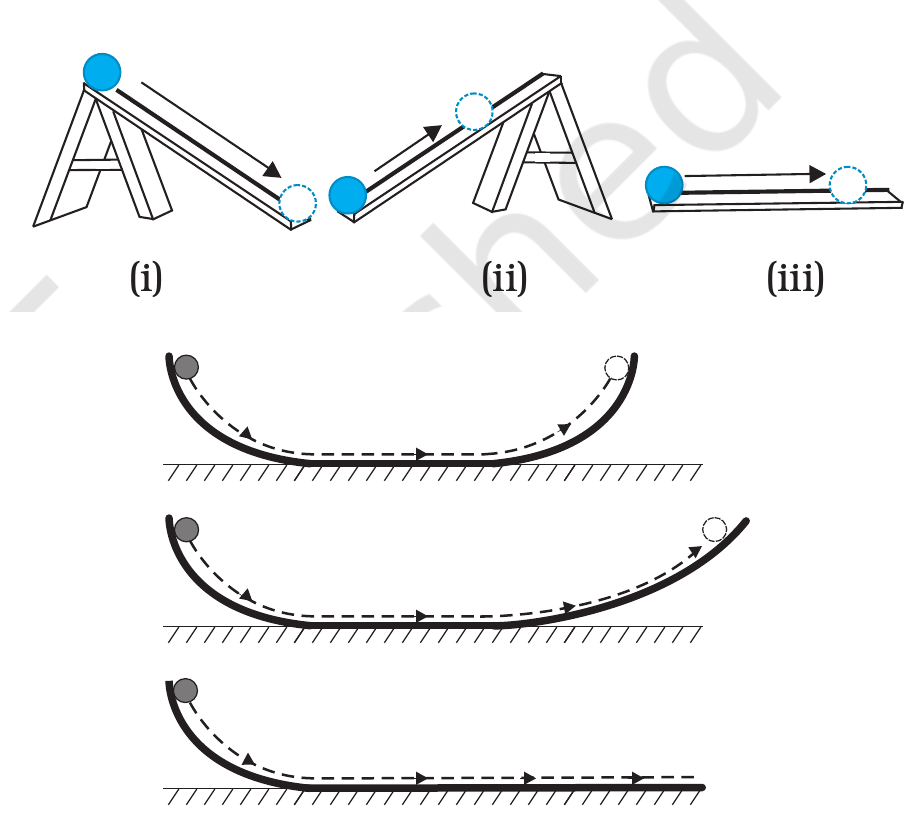
Galileo studied motion of objects on an inclined plane. Objects (i) moving down an inclined plane accelerate, while those (ii) moving up retard. (iii) Motion on a horizontal plane is an intermediate situation. Galileo concluded that an object moving on a frictionless horizontal plane must neither have acceleration nor retardation, i.e. it should move with constant velocity (Fig. 4.1(a)).
- Another experiment by Galileo leading to the same conclusion involves a double inclined plane. A ball released from rest on one of the planes rolls down and climbs up the other. If the planes are smooth, the final height of the ball is nearly the same as the initial height (a little less but never greater). In the ideal situation, when friction is absent, the final height of the ball is the same as its initial height (Fig. 4.1(b)).
- If the slope of the second plane is decreased and the experiment repeated, the ball will still reach the same height, but in doing so, it will travel a longer distance. In the limiting case, when the slope of the second plane is zero (i.e. is a horizontal) the ball travels an infinite distance. In other words, its motion never ceases. This is, of course, an idealised situation.
- In practice, the ball does come to a stop after moving a finite distance on the horizontal plane, because of the opposing force of friction which can never be totally eliminated. However, if there were no friction, the ball would continue to move with a constant velocity on the horizontal plane.
- Galileo thus arrived at a new insight on motion that had eluded Aristotle and those who followed him. The state of rest and the state of uniform linear motion (motion with constant velocity) are equivalent. In both cases, there is no net force acting on the body. It is incorrect to assume that a net force is needed to keep a body in uniform motion.
- To maintain a body in uniform motion, we need to apply an external force to counter the frictional force, so that the two forces sum up to zero net external force.
- To summarise, if the net external force is zero, a body at rest continues to remain at rest and a body in motion continues to move with a uniform velocity. This property of the body is called inertia. Inertia means 'resistance to change'. A body does not change its state of rest or uniform motion, unless an external force compels it to change that state.
Ideas on Motion in Ancient Indian Science (NCERT box, p. 51): Ancient Indian thinkers had arrived at an elaborate system of ideas on motion. Force, the cause of motion, was thought to be of different kinds: force due to continuous pressure (nodan), as the force of wind on a sailing vessel; impact (abhighat), as when a potter's rod strikes the wheel; persistent tendency (sanskara) to move in a straight line (vega) or restoration of shape in an elastic body; transmitted force by a string, rod, etc. The notion of (vega) in the Vaisesika theory of motion perhaps comes closest to the concept of inertia. Vega, the tendency to move in a straight line, was thought to be opposed by contact with objects including atmosphere, a parallel to the ideas of friction and air resistance. It was correctly summarised that the different kinds of motion (translational, rotational and vibrational) of an extended body arise from only the translational motion of its constituent particles. A falling leaf in the wind may have downward motion as a whole (patan) and also rotational and vibrational motion (bhraman, spandan), but each particle of the leaf at an instant only has a definite (small) displacement. Bhaskara (1150 A.D.) had introduced the concept of 'instantaneous motion' (tatkaliki gati), which anticipated the modern notion of instantaneous velocity using Differential Calculus.
Newton's first law of motion
Galileo's simple, but revolutionary ideas dethroned Aristotelian mechanics. A new mechanics had to be developed. This task was accomplished almost single-handedly by Isaac Newton, one of the greatest scientists of all times. Newton built on Galileo's ideas and laid the foundation of mechanics in terms of three laws of motion that go by his name. Galileo's law of inertia was his starting point which he formulated as the first law of motion:
- Every body continues to be in its state of rest or of uniform motion in a straight line unless compelled by some external force to act otherwise.
- The state of rest or uniform linear motion both imply zero acceleration. The first law of motion can, therefore, be simply expressed as: If the net external force on a body is zero, its acceleration is zero. Acceleration can be non zero only if there is a net external force on the body.
- Two kinds of situations are encountered in the application of this law in practice. In some examples, we know that the net external force on the object is zero. In that case we can conclude that the acceleration of the object is zero. For example, a spaceship out in interstellar space, far from all other objects and with all its rockets turned off, has no net external force acting on it. Its acceleration, according to the first law, must be zero. If it is in motion, it must continue to move with a uniform velocity.
- More often, however, we do not know all the forces to begin with. In that case, if we know that an object is unaccelerated (i.e. it is either at rest or in uniform linear motion), we can infer from the first law that the net external force on the object must be zero. Gravity is everywhere. For terrestrial phenomena, in particular, every object experiences gravitational force due to the earth. Also objects in motion generally experience friction, viscous drag, etc. If then, on earth, an object is at rest or in uniform linear motion, it is not because there are no forces acting on it, but because the various external forces cancel out i.e. add up to zero net external force.
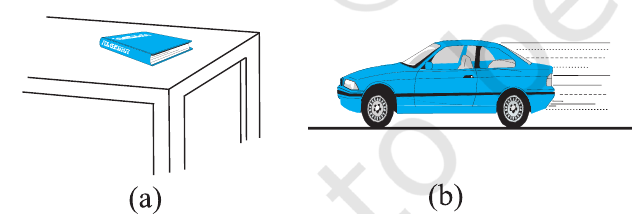
- Consider a book at rest on a horizontal surface (Fig. 4.2(a)). It is subject to two external forces: the force due to gravity (i.e. its weight W) acting downward and the upward force on the book by the table, the normal force R. R is a self-adjusting force. We observe the book to be at rest. Therefore, we conclude from the first law that the magnitude of R equals that of W. A statement often encountered is: "Since W = R, forces cancel and, therefore, the book is at rest". This is incorrect reasoning. The correct statement is: "Since the book is observed to be at rest, the net external force on it must be zero, according to the first law. This implies that the normal force R must be equal and opposite to the weight W".
- Consider the motion of a car starting from rest, picking up speed and then moving on a smooth straight road with uniform speed (Fig. 4.2(b)). When the car is stationary, there is no net force acting on it. During pick-up, it accelerates. This must happen due to a net external force. Note, it has to be an external force. The acceleration of the car cannot be accounted for by any internal force. The only conceivable external force along the road is the force of friction. It is the frictional force that accelerates the car as a whole. When the car moves with constant velocity, there is no net external force.
- The property of inertia contained in the First law is evident in many situations. Suppose we are standing in a stationary bus and the driver starts the bus suddenly. We get thrown backward with a jerk. Our feet are in touch with the floor. If there were no friction, we would remain where we were, while the floor of the bus would simply slip forward under our feet and the back of the bus would hit us. However, there is some friction between the feet and the floor. If the start is not too sudden, the frictional force would be enough to accelerate our feet along with the bus. But our body is not strictly a rigid body. It is deformable. While our feet go with the bus, the rest of the body remains where it is due to inertia. Relative to the bus, therefore, we are thrown backward. As soon as that happens, the muscular forces on the rest of the body (by the feet) come into play to move the body along with the bus. A similar thing happens when the bus suddenly stops. Our feet stop due to the friction which does not allow relative motion between the feet and the floor of the bus. But the rest of the body continues to move forward due to inertia. We are thrown forward.
Example 4.1: An astronaut accidentally gets separated out of his small spaceship accelerating in interstellar space at a constant rate of 100 m s-2. What is the acceleration of the astronaut the instant after he is outside the spaceship? (Assume that there are no nearby stars to exert gravitational force on him.) Since there are no nearby stars to exert gravitational force on him and the small spaceship exerts negligible gravitational attraction on him, the net force acting on the astronaut, once he is out of the spaceship, is zero. By the first law of motion the acceleration of the astronaut is zero.
Practice1 question
Try it now. A wrong answer costs nothing here, try again until you get it.
An astronaut floating in deep space (no gravity, no air resistance) moves with a constant velocity. What external force must be applied to keep him moving at that constant velocity?
NCERT Example 4.1: with $a = 0$ in deep space, $F = m a = 0$. The astronaut needs no force to keep moving at constant velocity.
Momentum
The first law refers to the simple case when the net external force on a body is zero. The second law of motion refers to the general situation when there is a net external force acting on the body. It relates the net external force to the acceleration of the body.
Momentum: Momentum of a body is defined to be the product of its mass m and velocity v, and is denoted by p:
- $p = m v$ (4.1)
- Momentum is clearly a vector quantity. The following common experiences indicate the importance of this quantity for considering the effect of force on motion.
- Suppose a light-weight vehicle (say a small car) and a heavy weight vehicle (say a loaded truck) are parked on a horizontal road. We all know that a much greater force is needed to push the truck than the car to bring them to the same speed in same time. Similarly, a greater opposing force is needed to stop a heavy body than a light body in the same time, if they are moving with the same speed.
- If two stones, one light and the other heavy, are dropped from the top of a building, a person on the ground will find it easier to catch the light stone than the heavy stone. The mass of a body is thus an important parameter that determines the effect of force on its motion.
- Speed is another important parameter to consider. A bullet fired by a gun can easily pierce human tissue before it stops, resulting in casualty. The same bullet fired with moderate speed will not cause much damage. Thus for a given mass, the greater the speed, the greater is the opposing force needed to stop the body in a certain time. Taken together, the product of mass and velocity, that is momentum, is evidently a relevant variable of motion. The greater the change in the momentum in a given time, the greater is the force that needs to be applied.
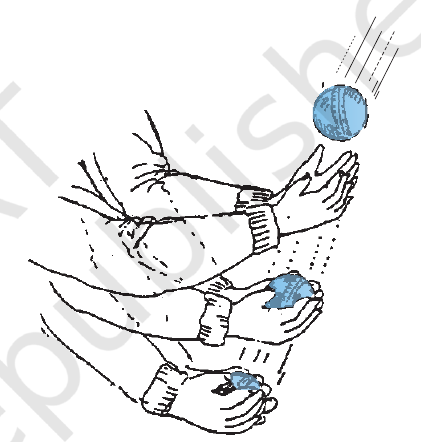
- A seasoned cricketer catches a cricket ball coming in with great speed far more easily than a novice, who can hurt his hands in the act. One reason is that the cricketer allows a longer time for his hands to stop the ball. He draws in the hands backward in the act of catching the ball (Fig. 4.3). The novice, on the other hand, keeps his hands fixed and tries to catch the ball almost instantly. He needs to provide a much greater force to stop the ball instantly, and this hurts. The conclusion is clear: force not only depends on the change in momentum, but also on how fast the change is brought about. The same change in momentum brought about in a shorter time needs a greater applied force. In short, the greater the rate of change of momentum, the greater is the force.
Newton's second law of motion
Observations confirm that the product of mass and velocity (i.e. momentum) is basic to the effect of force on motion. Suppose a fixed force is applied for a certain interval of time on two bodies of different masses, initially at rest, the lighter body picks up a greater speed than the heavier body. However, at the end of the time interval, observations show that each body acquires the same momentum. Thus the same force for the same time causes the same change in momentum for different bodies. This points to the second law of motion.
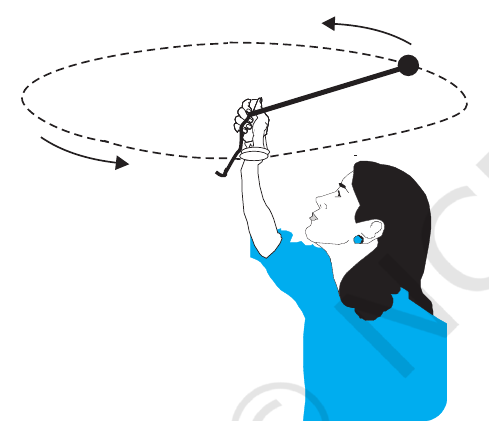
- In the preceding observations, the vector character of momentum has not been evident. In the examples so far, momentum and change in momentum both have the same direction. But this is not always the case. Suppose a stone is rotated with uniform speed in a horizontal plane by means of a string, the magnitude of momentum is fixed, but its direction changes (Fig. 4.4). A force is needed to cause this change in momentum vector. This force is provided by our hand through the string. Our hand needs to exert a greater force if the stone is rotated at greater speed or in a circle of smaller radius, or both. This corresponds to greater acceleration or equivalently a greater rate of change in momentum vector.
- These qualitative observations lead to the second law of motion expressed by Newton as follows: The rate of change of momentum of a body is directly proportional to the applied force and takes place in the direction in which the force acts.
- Thus, if under the action of a force F for time interval $\Delta t$, the velocity of a body of mass m changes from v to v + $\Delta v$ i.e. its initial momentum $p = m v$ changes by $\Delta p$ = m $\Delta v$. According to the Second Law, F is proportional to $\Delta p$/$\Delta t$, or $F = k (\Delta p/\Delta t)$, where k is a constant of proportionality. Taking the limit $\Delta t$ → 0, the term ($\Delta p$/$\Delta t$) becomes the derivative of p with respect to t, denoted by dp/dt. Thus $F = k (dp/dt)$ (4.2).
- For a body of fixed mass m, $dp/dt = d(m v)/dt = m (dv/dt) = m a$ (4.3), i.e. the Second Law can also be written as $F = k m a$ (4.4), which shows that force is proportional to the product of mass m and acceleration a.
- The unit of force has not been defined so far. In fact, we use Eq. (4.4) to define the unit of force. We, therefore, have the liberty to choose any constant value for k. For simplicity, we choose $k = 1$. The second law then is $F = dp/dt = m a$ (4.5). In SI unit force is one that causes an acceleration of 1 m s-2 to a mass of 1 kg. This unit is known as $\mathbf{newton}: 1 N = 1 kg m s-2$.
- Important points about the second law:
- 1. In the second law, $F = 0$ implies $a = 0$. The second law is obviously consistent with the first law.
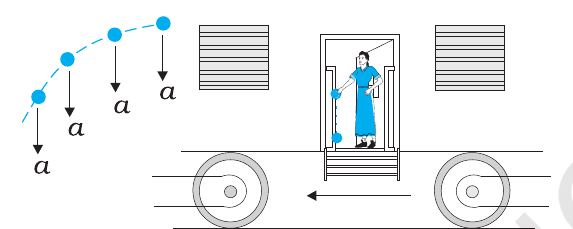
- 2. The second law of motion is a vector law. It is equivalent to three equations, one for each component of the vectors: $F_x = dp_x/dt = m a_x$; $F_y = dp_y/dt = m a_y$; $F_z = dp_z/dt = m a_z$ (4.6). This means that if a force is not parallel to the velocity of the body, but makes some angle with it, it changes only the component of velocity along the direction of force. The component of velocity normal to the force remains unchanged. For example, in the motion of a projectile under the vertical gravitational force, the horizontal component of velocity remains unchanged (Fig. 4.5).
- 3. The second law of motion given by Eq. (4.5) is applicable to a single point particle. The force F in the law stands for the net external force on the particle and a stands for acceleration of the particle. It turns out, however, that the law in the same form applies to a rigid body or, even more generally, to a system of particles. In that case, F refers to the total external force on the system and a refers to the acceleration of the system as a whole. More precisely, a is the acceleration of the centre of mass of the system about which we shall study in detail in Chapter 6. Any internal forces in the system are not to be included in F.
- 4. The second law of motion is a local relation which means that force F at a point in space (location of the particle) at a certain instant of time is related to a at that point at that instant. Acceleration here and now is determined by the force here and now, not by any history of the motion of the particle (See Fig. 4.5).
Impulse
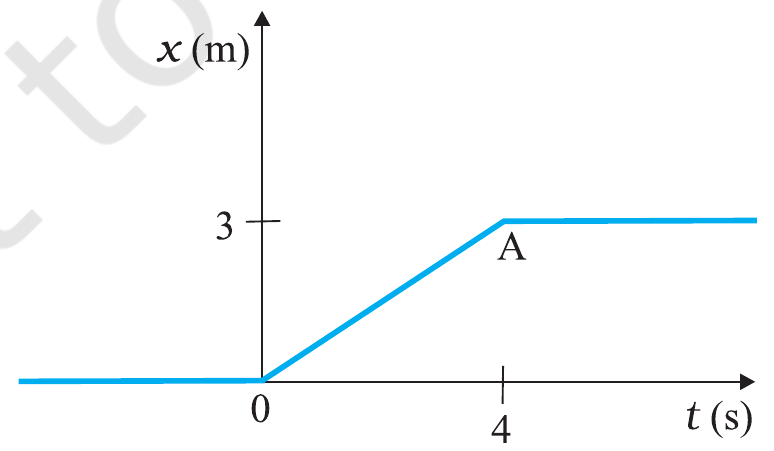
We sometimes encounter examples where a large force acts for a very short duration producing a finite change in momentum of the body. For example, when a ball hits a wall and bounces back, the force on the ball by the wall acts for a very short time when the two are in contact, yet the force is large enough to reverse the momentum of the ball. Often, in these situations, the force and the time duration are difficult to ascertain separately. However, the product of force and time, which is the change in momentum of the body, remains a measurable quantity. This product is called impulse:
- Impulse = Force x time duration = Change in momentum (4.7)
- A large force acting for a short time to produce a finite change in momentum is called an impulsive force. In the history of science, impulsive forces were put in a conceptually different category from ordinary forces. Newtonian mechanics has no such distinction. Impulsive force is like any other force - except that it is large and acts for a short time.
Example 4.2: A bullet of mass 0.04 kg moving with a speed of 90 m s-1 enters a heavy wooden block and is stopped after a distance of 60 cm. What is the average resistive force exerted by the block on the bullet? The retardation 'a' of the bullet (assumed constant) is given by $a = -u^2/(2s) = -(90 \times 90)/(2 \times 0.6) m s-2$ = -6750 m s-2. The retarding force, by the second law of motion, is $0.04 kg x 6750 m s-2 = 270 N$. The actual resistive force, and therefore, retardation of the bullet may not be uniform. The answer therefore, only indicates the average resistive force.
Example 4.3: The motion of a particle of mass m is described by $y = ut + (1/2) g t^2$. Find the force acting on the particle. We know $y = ut + (1/2) g t^2$. Now, $v = dy/dt = u + g t$; acceleration, $a = dv/dt = g$. Then the force is given by Eq. (4.5): $F = m a = m g$. Thus the given equation describes the motion of a particle under acceleration due to gravity and y is the position coordinate in the direction of g.
Example 4.4: A batsman hits back a ball straight in the direction of the bowler without changing its initial speed of 12 m s-1. If the mass of the ball is 0.15 kg, determine the impulse imparted to the ball. (Assume linear motion of the ball.) Change in momentum = $0.15 \times 12 - (-0.15 \times 12) = 3.6 N s$. $Impulse = 3.6 N s$, in the direction from the batsman to the bowler. This is an example where the force on the ball by the batsman and the time of contact of the ball and the bat are difficult to know, but the impulse is readily calculated.
Practice1 question
Try it now. A wrong answer costs nothing here, try again until you get it.
A force-time graph is triangular, rising from 0 to 18000 N and back to 0 over 0.4 s. What is the impulse imparted to the body?
NCERT Example 4.4: the impulse is the area under the F-t graph, (1/2) x 0.4 x 18000 N s = 3600 $N s = 3.6 kN s$.
Newton's third law of motion
The second law relates the external force on a body to its acceleration. What is the origin of the external force on the body? What agency provides the external force? The simple answer in Newtonian mechanics is that the external force on a body always arises due to some other body. Consider a pair of bodies A and B. B gives rise to an external force on A. A natural question is: Does A in turn give rise to an external force on B? In some examples, the answer seems clear. If you press a coiled spring, the spring is compressed by the force of your hand. The compressed spring in turn exerts a force on your hand and you can feel it. But what if the bodies are not in contact? The earth pulls a stone downwards due to gravity. Does the stone exert a force on the Earth? The answer is not obvious since we hardly see the effect of the stone on the earth. The answer according to Newton is: Yes, the stone does exert an equal and opposite force on the Earth. We do not notice it since the earth is very massive and the effect of a small force on its motion is negligible.
- Thus, according to Newtonian mechanics, force never occurs singly in nature. Force is the mutual interaction between two bodies. Forces always occur in pairs. Further, the mutual forces between two bodies are always equal and opposite. This idea was expressed by Newton in the form of the third law of motion.
- To every action, there is always an equal and opposite reaction.
- Newton's wording of the third law is so crisp and beautiful that it has become a part of common language. For the same reason perhaps, misconceptions about the third law abound. Note some important points about the third law, particularly in regard to the usage of the terms: action and reaction.
- 1. The terms action and reaction in the third law mean nothing else but 'force'. Using different terms for the same physical concept can sometimes be confusing. A simple and clear way of stating the third law is as follows: Forces always occur in pairs. Force on a body A by B is equal and opposite to the force on the body B by A.
- 2. The terms action and reaction in the third law may give a wrong impression that action comes before reaction i.e. action is the cause and reaction the effect. There is no cause-effect relation implied in the third law. The force on A by B and the force on B by A act at the same instant. By the same reasoning, any one of them may be called action and the other reaction.
- 3. Action and reaction forces act on different bodies, not on the same body. Consider a pair of bodies A and B. According to the third law, $F_AB = -F_BA$ (4.8); (force on A by B) = - (force on B by A). Thus if we are considering the motion of any one body (A or B), only one of the two forces is relevant. It is an error to add up the two forces and claim that the net force is zero.
- However, if you are considering the system of two bodies as a whole, F_AB and F_BA are internal forces of the system (A + B). They add up to give a null force. Internal forces in a body or a system of particles thus cancel away in pairs. This is an important fact that enables the second law to be applicable to a body or a system of particles (See Chapter 6).
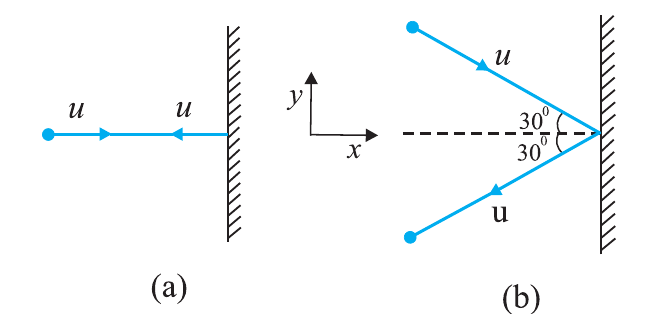
Example 4.5: Two identical billiard balls strike a rigid wall with the same speed but at different angles, and get reflected without any change in speed, as shown in Fig. 4.6. What is (i) the direction of the force on the wall due to each ball? (ii) the ratio of the magnitudes of impulses imparted to the balls by the wall? An instinctive answer to (i) might be that the force on the wall in case (a) is normal to the wall, while that in case (b) is inclined at 30 deg to the normal. This answer is wrong. The force on the wall is normal to the wall in both cases. The trick is to consider the force (or impulse) on the ball due to the wall using the second law, and then use the third law to answer (i). Let u be the speed of each ball before and after collision with the wall, and m the mass of each ball. Case (a): (px)initial = m u, (py)initial = 0; (px)final = -m u, (py)final = 0. Impulse is the change in momentum vector. Therefore, x-component of $impulse = -2 m u, y-component$ of $impulse = 0$. Impulse and force are in the same direction. Clearly, the force on the ball due to the wall is normal to the wall, along the negative x-direction. Using Newton's third law of motion, the force on the wall due to the ball is normal to the wall along the positive x-direction. The magnitude of force cannot be ascertained since the small time taken for the collision has not been specified in the problem. Case (b): (px)initial = m u cos 30 deg, (py)initial = -m u sin 30 deg; (px)final = -m u cos 30 deg, (py)final = -m u sin 30 deg. Note, while px changes sign after collision, py does not. Therefore, x-component of $impulse = -2 m u \cos 30 deg, y-component$ of $impulse = 0$. The direction of impulse (and force) is the same as in (a) and is normal to the wall along the negative x direction. As before, using Newton's third law, the force on the wall due to the ball is normal to the wall along the positive x direction. The ratio of the magnitudes of the impulses imparted to the balls in (a) and (b) is 2 m u / (2 m u cos 30 deg) = 2/$\sqrt{3}$, about 1.2.
Conservation of momentum
The second and third laws of motion lead to an important consequence: the law of conservation of momentum. Take a familiar example. A bullet is fired from a gun. If the force on the bullet by the gun is F, the force on the gun by the bullet is -F, according to the third law. The two forces act for a common interval of time $\Delta t$. According to the second law, F $\Delta t$ is the change in momentum of the bullet and -F $\Delta t$ is the change in momentum of the gun. Since initially, both are at rest, the change in momentum equals the final momentum for each. Thus if pb is the momentum of the bullet after firing and pg is the recoil momentum of the gun, $pg = -pb i$.e. $pb + pg = 0$. That is, the total momentum of the (bullet + gun) system is conserved.
- Thus in an isolated system (i.e. a system with no external force), mutual forces between pairs of particles in the system can cause momentum change in individual particles, but since the mutual forces for each pair are equal and opposite, the momentum changes cancel in pairs and the total momentum remains unchanged. This fact is known as the law of conservation of momentum: The total momentum of an isolated system of interacting particles is conserved.
- An important example of the application of the law of conservation of momentum is the collision of two bodies. Consider two bodies A and B, with initial momenta pA and pB. The bodies collide, get apart, with final momenta p'A and p'B respectively. By the Second Law, $F_AB \Delta t = p'A - pA$ and F_BA $\Delta t$ = p'B - pB (where we have taken a common interval of time for both forces i.e. the time for which the two bodies are in contact). Since $F_AB = -F_BA$ by the third law, $p'A - pA = -(p'B - pB)$, i.e. $p'A + p'B = pA + pB$ (4.9), which shows that the total final momentum of the isolated system equals its initial momentum.
- Notice that this is true whether the collision is elastic or inelastic. In elastic collisions, there is a second condition that the total initial kinetic energy of the system equals the total final kinetic energy (See Chapter 5).
Equilibrium of a particle
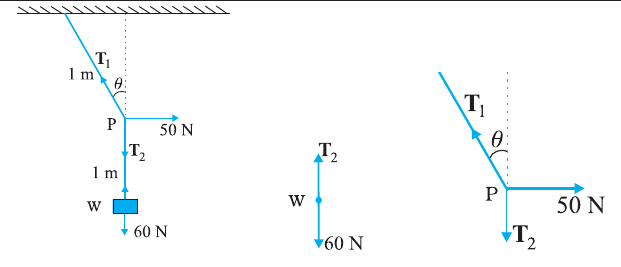
Equilibrium of a particle in mechanics refers to the situation when the net external force on the particle is zero. According to the first law, this means that, the particle is either at rest or in uniform motion.
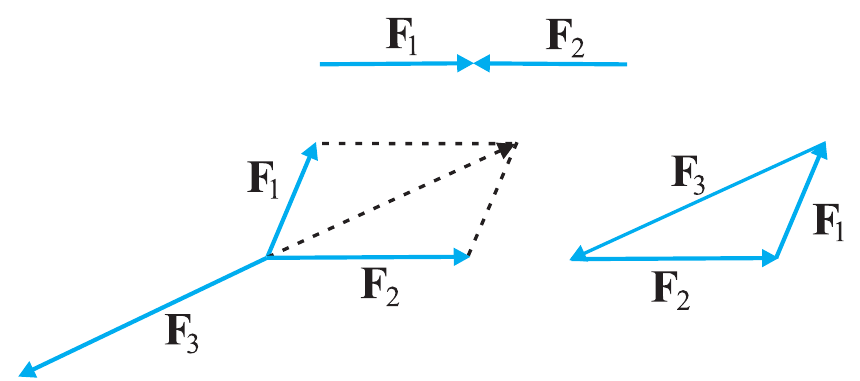
- If two forces F1 and $F_2$, act on a particle, equilibrium requires $F_1 = -F_2$ (4.10), i.e. the two forces on the particle must be equal and opposite. Equilibrium under three concurrent forces F1, $F_2$ and F3 requires that the vector sum of the three forces is zero: $F_1 + F_2 + F_3 = 0$ (4.11).
- In other words, the resultant of any two forces say F1 and $F_2$, obtained by the parallelogram law of forces must be equal and opposite to the third force, F3. As seen in Fig. 4.7, the three forces in equilibrium can be represented by the sides of a triangle with the vector arrows taken in the same sense. The result can be generalised to any number of forces. A particle is in equilibrium under the action of forces F1, $F_2$, ... Fn if they can be represented by the sides of a closed n-sided polygon with arrows directed in the same sense.
- Equation (4.11) implies that $F_{1x} + F_{2x} + F_{3x} = 0$; $F_{1y} + F_{2y} + F_{3y} = 0$; $F_{1z} + F_{2z} + F_{3z} = 0$ (4.12), where F1x, F1y and F1z are the components of F1 along x, y and z directions respectively.
- Equilibrium of a body requires not only translational equilibrium (zero net external force) but also rotational equilibrium (zero net external torque), as we shall see in Chapter 6.
Example 4.6: See Fig. 4.8. A mass of 6 kg is suspended by a rope of length 2 m from the ceiling. A force of 50 N in the horizontal direction is applied at the mid-point P of the rope, as shown. What is the angle the rope makes with the vertical in equilibrium? (Take $g = 10 m s-2$). Neglect the mass of the rope. Figures 4.8(b) and 4.8(c) are known as free-body diagrams. Figure 4.8(b) is the free-body diagram of W and Fig. 4.8(c) is the free-body diagram of point P. Consider the equilibrium of the weight W. Clearly, $T_2 = 6 \times 10 = 60 N$. Consider the equilibrium of the point P under the action of three forces - the tensions $T_1$ and $T_2$, and the horizontal force 50 N. The horizontal and vertical components of the resultant force must vanish separately: $T_1$ cos θ = $T_2 = 60 N$; $T_1 \sin θ = 50 N$, which gives that $\tan θ = 5/6$ or $θ = \tan^{-1} (5/6) = 40 deg$. Note the answer does not depend on the length of the rope (assumed massless) nor on the point at which the horizontal force is applied.
Common forces in mechanics
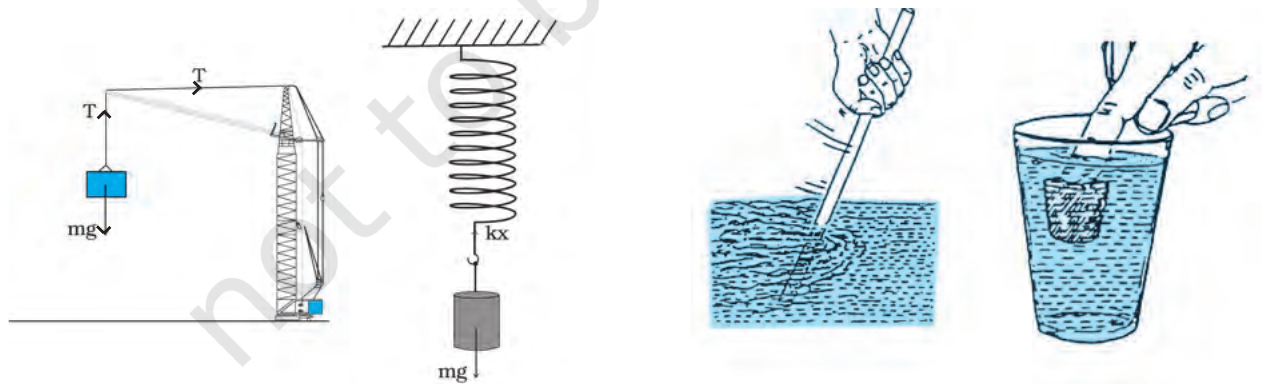
In mechanics, we encounter several kinds of forces. The gravitational force is, of course, pervasive. Every object on the earth experiences the force of gravity due to the earth. Gravity also governs the motion of celestial bodies. The gravitational force can act at a distance without the need of any intervening medium.
- All the other forces common in mechanics are contact forces. As the name suggests, a contact force on an object arises due to contact with some other object: solid or fluid. When bodies are in contact (e.g. a book resting on a table, a system of rigid bodies connected by rods, hinges and other types of supports), there are mutual contact forces (for each pair of bodies) satisfying the third law. The component of contact force normal to the surfaces in contact is called normal reaction. The component parallel to the surfaces in contact is called friction. Contact forces arise also when solids are in contact with fluids. For example, for a solid immersed in a fluid, there is an upward buoyant force equal to the weight of the fluid displaced. The viscous force, air resistance, etc are also examples of contact forces (Fig. 4.9).
- Two other common forces are tension in a string and the force due to spring. When a spring is compressed or extended by an external force, a restoring force is generated. This force is usually proportional to the compression or elongation (for small displacements). The spring force F is written as $F = -k x$ where x is the displacement and k is the force constant. The negative sign denotes that the force is opposite to the displacement from the unstretched state. For an inextensible string, the force constant is very high. The restoring force in a string is called tension. It is customary to use a constant tension T throughout the string. This assumption is true for a string of negligible mass.
- We learnt that there are four fundamental forces in nature. Of these, the weak and strong forces appear in domains that do not concern us here. Only the gravitational and electrical forces are relevant in the context of mechanics. The different contact forces of mechanics mentioned above fundamentally arise from electrical forces. This may seem surprising since we are talking of uncharged and non-magnetic bodies in mechanics. At the microscopic level, all bodies are made of charged constituents (nuclei and electrons) and the various contact forces arising due to elasticity of bodies, molecular collisions and impacts, etc. can ultimately be traced to the electrical forces between the charged constituents of different bodies. The detailed microscopic origin of these forces is, however, complex and not useful for handling problems in mechanics at the macroscopic scale. This is why they are treated as different types of forces with their characteristic properties determined empirically.
- Note: for simplicity, charged and magnetic bodies are not considered here. For these, besides gravity, there are electrical and magnetic non-contact forces.
Friction
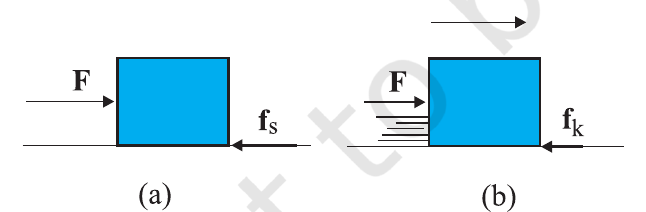
Let us return to the example of a body of mass m at rest on a horizontal table. The force of gravity (m g) is cancelled by the normal reaction force (N) of the table. Now suppose a force F is applied horizontally to the body. We know from experience that a small applied force may not be enough to move the body. But if the applied force F were the only external force on the body, it must move with acceleration F/m, however small. Clearly, the body remains at rest because some other force comes into play in the horizontal direction and opposes the applied force F, resulting in zero net force on the body. This force fs parallel to the surface of the body in contact with the table is known as frictional force, or simply friction (Fig. 4.10(a)). The subscript stands for static friction to distinguish it from kinetic friction fk that we consider later (Fig. 4.10(b)).
- Note that static friction does not exist by itself. When there is no applied force, there is no static friction. It comes into play the moment there is an applied force. As the applied force F increases, fs also increases, remaining equal and opposite to the applied force (up to a certain limit), keeping the body at rest. Hence, it is called static friction. Static friction opposes impending motion. The term impending motion means motion that would take place (but does not actually take place) under the applied force, if friction were absent.
- We know from experience that as the applied force exceeds a certain limit, the body begins to move. It is found experimentally that the limiting value of static friction (fs)max is independent of the area of contact and varies with the normal force (N) approximately as: $(f_s)max = \mu_s N$ (4.13), where μs is a constant of proportionality depending only on the nature of the surfaces in contact. The constant μs is called the coefficient of static friction. The law of static friction may thus be written as fs <= μs N (4.14).
- If the applied force F exceeds (fs)max the body begins to slide on the surface. It is found experimentally that when relative motion has started, the frictional force decreases from the static maximum value (fs)max. Frictional force that opposes relative motion between surfaces in contact is called kinetic or sliding friction and is denoted by fk. Kinetic friction, like static friction, is found to be independent of the area of contact. Further, it is nearly independent of the velocity. It satisfies a law similar to that for static friction: $f_k = \mu_k N$ (4.15), where μk, the coefficient of kinetic friction, depends only on the surfaces in contact. As mentioned above, experiments show that μk is less than μs. When relative motion has begun, the acceleration of the body according to the second law is (F - fk)/m. For a body moving with constant velocity, $F = f_k$. If the applied force on the body is removed, its acceleration is -fk/m and it eventually comes to a stop.
- The laws of friction given above do not have the status of fundamental laws like those for gravitational, electric and magnetic forces. They are empirical relations that are only approximately true. Yet they are very useful in practical calculations in mechanics.
- Thus, when two bodies are in contact, each experiences a contact force by the other. Friction, by definition, is the component of the contact force parallel to the surfaces in contact, which opposes impending or actual relative motion between the two surfaces. Note that it is not motion, but relative motion that the frictional force opposes. Consider a box lying in the compartment of a train that is accelerating. If the box is stationary relative to the train, it is in fact accelerating along with the train. What forces cause the acceleration of the box? Clearly, the only conceivable force in the horizontal direction is the force of friction. If there were no friction, the floor of the train would slip by and the box would remain at its initial position due to inertia (and hit the back side of the train). This impending relative motion is opposed by the static friction fs. Static friction provides the same acceleration to the box as that of the train, keeping it stationary relative to the train.
Example 4.7: Determine the maximum acceleration of the train in which a box lying on its floor will remain stationary, given that the co-efficient of static friction between the box and the train's floor is 0.15. Since the acceleration of the box is due to the static friction, $m a = f_s$ <= $\mu_s N = \mu_s m g$, i.e. a <= μs g. So $a_max = \mu_s g = 0.15 \times 10 m s-2 = 1.5 m s-2$.
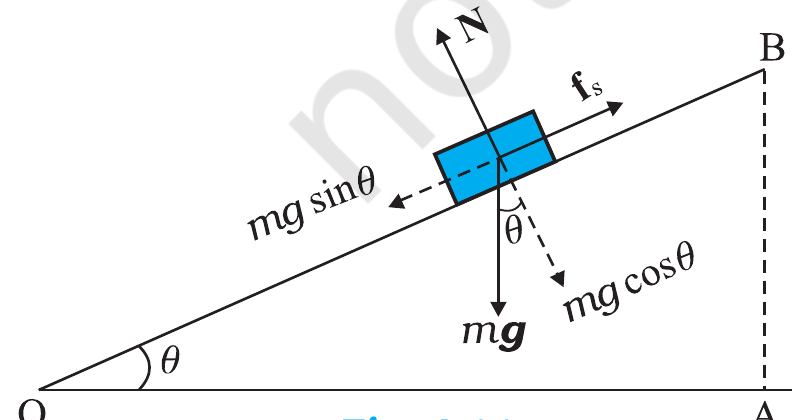
Example 4.8: See Fig. 4.11. A mass of 4 kg rests on a horizontal plane. The plane is gradually inclined until at an angle $θ = 15 deg$ with the horizontal, the mass just begins to slide. What is the coefficient of static friction between the block and the surface? The forces acting on a block of mass m at rest on an inclined plane are (i) the weight m g acting vertically downwards (ii) the normal force N of the plane on the block, and (iii) the static frictional force fs opposing the impending motion. In equilibrium, the resultant of these forces must be zero. Resolving the weight m g along the two directions shown, we have $m g \sin θ = f_s, m g \cos θ = N$. As θ increases, the self-adjusting frictional force fs increases until at $θ = θ_{max}, f_s$ achieves its maximum value, $(f_s)max = \mu_s N$. Therefore, $\tan θ_{max} = \mu_s$ or $θ_{max} = \tan^{-1} \mu_s$. When θ becomes just a little more than θmax, there is a small net force on the block and it begins to slide. Note that θmax depends only on μs and is independent of the mass of the block. For $θ_{max} = 15 deg$, $\mu_s = \tan 15 deg = 0.27$.
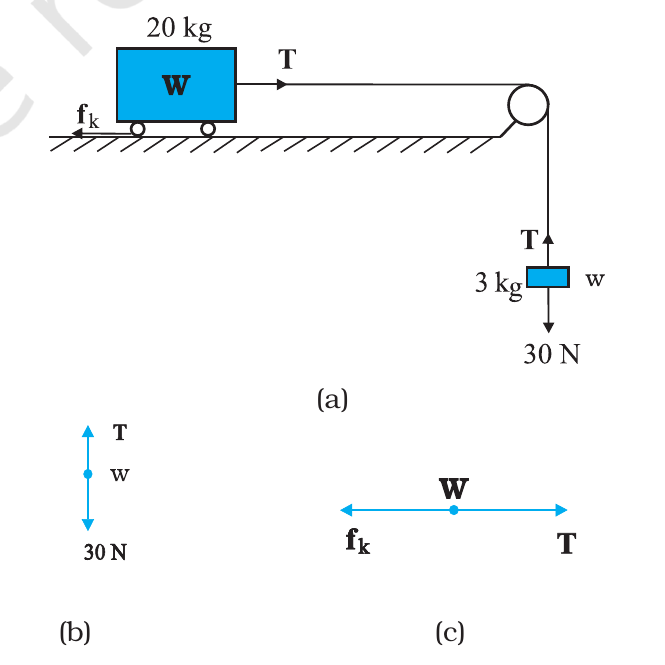
Example 4.9: What is the acceleration of the block and trolley system shown in Fig. 4.12(a), if the coefficient of kinetic friction between the trolley and the surface is 0.04? What is the tension in the string? (Take $g = 10 m s-2$). Neglect the mass of the string. As the string is inextensible, and the pulley is smooth, the 3 kg block and the 20 kg trolley both have same magnitude of acceleration. Applying second law to motion of the block (Fig. 4.12(b)), 30 - T = 3a. Apply the second law to motion of the trolley (Fig. 4.12(c)), T - fk = 20 a. Now $f_k = \mu_k N$. Here $\mu_k = 0.04$, $N = 20 \times 10 = 200 N$. Thus the equation for the motion of the trolley is $T - 0.04 \times 200 = 20 a$, or $T - 8 = 20a$. These equations give $a = 22/23 m s-2 = 0.96 m s-2$ and $T = 27.1 N$.
Practice1 question
Try it now. A wrong answer costs nothing here, try again until you get it.
A block rests on a plane that is gradually inclined. It just begins to slide when the plane makes an angle of 15 deg with the horizontal. What is the coefficient of static friction between the block and the surface?
NCERT Example 4.8: at the angle where the block just begins to slide, $\tan θ_{max} = \mu_s$, so $\mu_s = \tan 15 deg = 0.27$.
Rolling friction
A body like a ring or a sphere rolling without slipping over a horizontal plane will suffer no friction, in principle. At every instant, there is just one point of contact between the body and the plane and this point has no motion relative to the plane. In this ideal situation, kinetic or static friction is zero and the body should continue to roll with constant velocity. We know, in practice, this will not happen and some resistance to motion (rolling friction) does occur, i.e. to keep the body rolling, some applied force is needed. For the same weight, rolling friction is much smaller (even by 2 or 3 orders of magnitude) than static or sliding friction. This is the reason why discovery of the wheel has been a major milestone in human history.
- Rolling friction again has a complex origin, though somewhat different from that of static and sliding friction. During rolling, the surfaces in contact get momentarily deformed a little, and this results in a finite area (not a point) of the body being in contact with the surface. The net effect is that the component of the contact force parallel to the surface opposes motion.
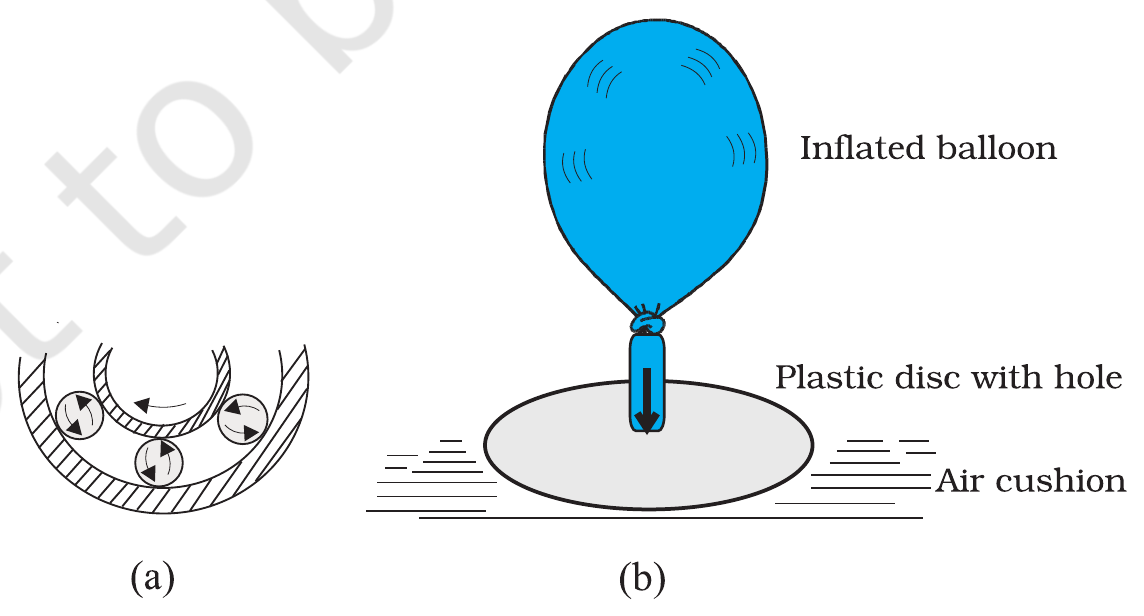
- We often regard friction as something undesirable. In many situations, like in a machine with different moving parts, friction does have a negative role. It opposes relative motion and thereby dissipates power in the form of heat, etc. Lubricants are a way of reducing kinetic friction in a machine. Another way is to use ball bearings between two moving parts of a machine [Fig. 4.13(a)]. Since the rolling friction between ball bearings and the surfaces in contact is very small, power dissipation is reduced. A thin cushion of air maintained between solid surfaces in relative motion is another effective way of reducing friction [Fig. 4.13(b)].
- In many practical situations, however, friction is critically needed. Kinetic friction that dissipates power is nevertheless important for quickly stopping relative motion. It is made use of by brakes in machines and automobiles. Similarly, static friction is important in daily life. We are able to walk because of friction. It is impossible for a car to move on a very slippery road. On an ordinary road, the friction between the tyres and the road provides the necessary external force to accelerate the car.
Circular motion and centripetal force
We have seen in the chapter on motion in a plane that acceleration of a body moving in a circle of radius R with uniform speed v is $v^2$/R directed towards the centre. According to the second law, the force fc providing this acceleration is:
- $f_c = m v^2/R$ (4.16), where m is the mass of the body. This force directed towards the centre is called the centripetal force. For a stone rotated in a circle by a string, the centripetal force is provided by the tension in the string. The centripetal force for motion of a planet around the sun is the gravitational force on the planet due to the sun. For a car taking a circular turn on a horizontal road, the centripetal force is the force of friction.
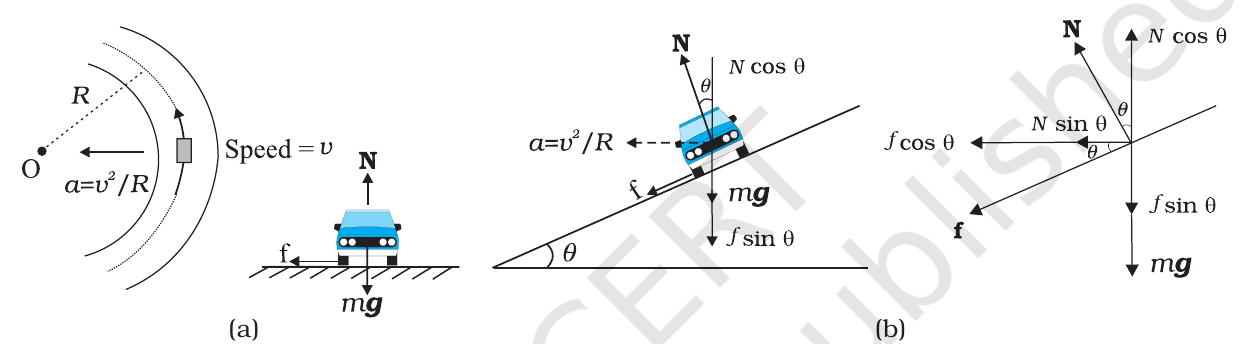
- The circular motion of a car on a flat and banked road give interesting application of the laws of motion (Fig. 4.14).
Car on a level road and on a banked road
Motion of a car on a level road: Three forces act on the car (Fig. 4.14(a)): (i) The weight of the car, m g; (ii) Normal reaction, N; (iii) Frictional force, f. As there is no acceleration in the vertical direction, $N - m g = 0$, so $N = m g$ (4.17). The centripetal force required for circular motion is along the surface of the road, and is provided by the component of the contact force between road and the car tyres along the surface. This by definition is the frictional force. Note that it is the static friction that provides the centripetal acceleration. Static friction opposes the impending motion of the car moving away from the circle. Using equation (4.14) and (4.16) we get the result $f = m v^2/R$ <= μs N, so $v^2$ <= (μs R N)/m = μs R g (since $N = m g$), which is independent of the mass of the car. This shows that for a given value of μs and R, there is a maximum speed of circular motion of the car possible, namely v_max = $\sqrt{μs R g}$ (4.18).
Motion of a car on a banked road: We can reduce the contribution of friction to the circular motion of the car if the road is banked (Fig. 4.14(b)). Since there is no acceleration along the vertical direction, the net force along this direction must be zero. Hence, $N \cos θ = m g + f \sin θ$ (4.19a). The centripetal force is provided by the horizontal components of N and $f: N \sin θ + f \cos θ = m v^2/R$ (4.19b). But f <= μs N. Thus to obtain v_max we put $f = \mu_s N$. Then Eqs. (4.19a) and (4.19b) become $N \cos θ = m g + \mu_s N \sin θ$ (4.20a) and $N \sin θ + \mu_s N \cos θ = m v^2/R$ (4.20b). From Eq. (4.20a), we obtain $N = (m g)/(\cos θ - \mu_s \sin θ)$. Substituting value of N in Eq. (4.20b), we get (m g (sin θ + μs cos θ))/(cos θ - μs sin θ) = (m $v_{max}^2$)/R, or $v_max = \sqrt{R g (\mu_s + \tan θ)/(1 - \mu_s \tan θ)}$ (4.21). Comparing this with Eq. (4.18) we see that maximum possible speed of a car on a banked road is greater than that on a flat road.
- For $\mu_s = 0$ in Eq. (4.21), $v_0 = \sqrt{R g \tan θ}$ (4.22). At this speed, frictional force is not needed at all to provide the necessary centripetal force. Driving at this speed on a banked road will cause little wear and tear of the tyres. The same equation also tells you that for v < v_o, frictional force will be up the slope and that a car can be parked only if tan θ <= μs.
Example 4.10: A cyclist speeding at 18 km/h on a level road takes a sharp circular turn of radius 3 m without reducing the speed. The co-efficient of static friction between the tyres and the road is 0.1. Will the cyclist slip while taking the turn? On an unbanked road, frictional force alone can provide the centripetal force needed to keep the cyclist moving on a circular turn without slipping. If the speed is too large, or if the turn is too sharp (i.e. of too small a radius) or both, the frictional force is not sufficient to provide the necessary centripetal force, and the cyclist slips. The condition for the cyclist not to slip is given by Eq. (4.18): $v^2$ <= μs R g. Now, $R = 3 m$, $g = 9.8 m s-2$, $\mu_s = 0.1$. That is, $\mu_s R g = 2.94 m^2 s-2$. $v = 18 km/h = 5 m s-1$; i.e., $v^2 = 25 m^2 s-2$. The condition is not obeyed. The cyclist will slip while taking the circular turn.
Example 4.11: A circular racetrack of radius 300 m is banked at an angle of 15 deg. If the coefficient of friction between the wheels of a race-car and the road is 0.2, what is the (a) optimum speed of the race-car to avoid wear and tear on its tyres, and (b) maximum permissible speed to avoid slipping? On a banked road, the horizontal component of the normal force and the frictional force contribute to provide centripetal force to keep the car moving on a circular turn without slipping. At the optimum speed, the normal reaction's component is enough to provide the needed centripetal force, and the frictional force is not needed. The optimum speed v_o is given by Eq. (4.22): $v_0 = \sqrt{R g \tan θ}$. Here $R = 300 m$, $θ = 15 deg$, $g = 9.8 m s-2$; we have $v_0 = 28.1 m s-1$. The maximum permissible speed v_max is given by Eq. (4.21): $v_max = \sqrt{R g (\mu_s + \tan θ)/(1 - \mu_s \tan θ)}$ = 38.1 m s-1.
Practice1 question
Try it now. A wrong answer costs nothing here, try again until you get it.
A cyclist speeding at 18 km/h on a level road takes a sharp circular turn of radius 3 m without reducing speed. The coefficient of static friction between the tyres and the road is 0.1. Will the cyclist slip while taking the turn?
NCERT Example 4.10: $v = 18 km/h = 5 m/s$, so $v^2 = 25 m^2 s-2$, while $\mu_s R g = 0.1 \times 3 x 9.8 = 2.94 m^2 s-2$. Since $v^2$ > μs R g, friction cannot provide the needed centripetal force and the cyclist slips.
Solving problems in mechanics
The three laws of motion that you have learnt in this chapter are the foundation of mechanics. You should now be able to handle a large variety of problems in mechanics. A typical problem in mechanics usually does not merely involve a single body under the action of given forces. More often, we will need to consider an assembly of different bodies exerting forces on each other. Besides, each body in the assembly experiences the force of gravity. When trying to solve a problem of this type, it is useful to remember the fact that we can choose any part of the assembly and apply the laws of motion to that part provided we include all forces on the chosen part due to the remaining parts of the assembly. We may call the chosen part of the assembly as the system and the remaining part of the assembly (plus any other agencies of forces) as the environment. We have followed the same method in solved examples. To handle a typical problem in mechanics systematically, one should use the following steps:
- (i) Draw a diagram showing schematically the various parts of the assembly of bodies, the links, supports, etc.
- (ii) Choose a convenient part of the assembly as one system.
- (iii) Draw a separate diagram which shows this system and all the forces on the system by the remaining part of the assembly. Include also the forces on the system by other agencies. Do not include the forces on the environment by the system. A diagram of this type is known as 'a free-body diagram'. (Note this does not imply that the system under consideration is without a net force).
- (iv) In a free-body diagram, include information about forces (their magnitudes and directions) that are either given or you are sure of (e.g., the direction of tension in a string along its length). The rest should be treated as unknowns to be determined using laws of motion.
- (v) If necessary, follow the same procedure for another choice of the system. In doing so, employ Newton's third law. That is, if in the free-body diagram of A, the force on A due to B is shown as F, then in the free-body diagram of B, the force on B due to A should be shown as -F.
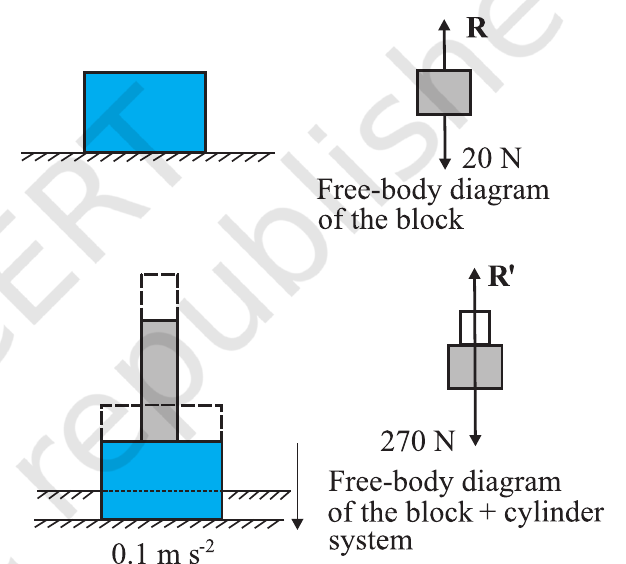
Example 4.12: See Fig. 4.15. A wooden block of mass 2 kg rests on a soft horizontal floor. When an iron cylinder of mass 25 kg is placed on top of the block, the floor yields steadily and the block and the cylinder together go down with an acceleration of 0.1 m s-2. What is the action of the block on the floor (a) before and (b) after the floor yields? Take $g = 10 m s-2$. Identify the action-reaction pairs in the problem. (a) The block is at rest on the floor. Its free-body diagram shows two forces on the block, the force of gravitational attraction by the earth equal to 2 $x 10 = 20 N$; and the normal force R of the floor on the block. By the First Law, the net force on the block must be zero i.e., $R = 20 N$. Using third law the action of the block (i.e. the force exerted on the floor by the block) is equal to 20 N and directed vertically downwards. (b) The system (block + cylinder) accelerates downwards with 0.1 m s-2. The free-body diagram of the system shows two forces on the system: the force of gravity due to the earth (270 N); and the normal force R' by the floor. Note, the free-body diagram of the system does not show the internal forces between the block and the cylinder. Applying the second law to the system, $270 - R' = 27 \times 0.1 N$, i.e. $R' = 267.3 N$. By the third law, the action of the system on the floor is equal to 267.3 N vertically downward.
Action-reaction pairs: For (a): (i) the force of gravity (20 N) on the block by the earth (say, action); the force of gravity on the earth by the block (reaction) equal to 20 N directed upwards (not shown in the figure). (ii) the force on the floor by the block (action); the force on the block by the floor (reaction). For (b): (i) the force of gravity (270 N) on the system by the earth (say, action); the force of gravity on the earth by the system (reaction), equal to 270 N, directed upwards (not shown in the figure). (ii) the force on the floor by the system (action); the force on the system by the floor (reaction). In addition, for (b), the force on the block by the cylinder and the force on the cylinder by the block also constitute an action-reaction pair.
- The important thing to remember is that an action-reaction pair consists of mutual forces which are always equal and opposite between two bodies. Two forces on the same body which happen to be equal and opposite can never constitute an action-reaction pair. The force of gravity on the mass in (a) or (b) and the normal force on the mass by the floor are not action-reaction pairs. These forces happen to be equal and opposite for (a) since the mass is at rest. They are not so for case (b), as seen already. The weight of the system is 270 N, while the normal force R' is 267.3 N.
- The practice of drawing free-body diagrams is of great help in solving problems in mechanics. It allows you to clearly define your system and consider all forces on the system due to objects that are not part of the system itself.
Practice1 question
Try it now. A wrong answer costs nothing here, try again until you get it.
A 2 kg wooden block rests on a soft horizontal floor. A 25 kg iron cylinder is placed on top, the floor yields, and the block and cylinder together go down with an acceleration of 0.1 m s-2. What is the action of the block on the floor after the floor yields? $(g = 10 m s-2)$
NCERT Example 4.12: the system (block + cylinder) has mass 27 kg and accelerates down at 0.1 m s-2, so 270 - $R' = 27 \times 0.1$, giving $R' = 267.3 N$. By the third law the action of the system on the floor is 267.3 N downward.
Table: Summary of quantities
NCERT prints this table at the end of the Summary (p. 67). Note the table writes the normal force as N, while the Summary text (item 8) writes the friction laws with R; both are transcribed as printed.
| Quantity | Symbol | Units | Dimensions | Remarks |
|---|---|---|---|---|
| Momentum | p | kg m s-1 or N s | $[M L T^{-1}]$ | Vector |
| Force | F | N | $[M L T^{-2}]$ | F = m a, Second Law |
| Impulse | - | kg m s-1 or N s | $[M L T^{-1}]$ | Impulse = force x time = change in momentum |
| Static friction | fs | N | $[M L T^{-2}]$ | fs <= μs N |
| Kinetic friction | fk | N | $[M L T^{-2}]$ | fk = μk N |
Table: Key equations at a glance
The key equations of the chapter, with their NCERT equation numbers.
| Relation | Formula | NCERT |
|---|---|---|
| Momentum | $p = m v$ | (4.1) |
| Second law, general | F = dp/dt = m a (k = 1 in SI) | (4.2), (4.5) |
| Second law, components | $F_x = dp_x/dt = m a_x$; $F_y = dp_y/dt = m a_y$; $F_z = dp_z/dt = m a_z$ | (4.6) |
| Impulse | Impulse = Force x time duration = Change in momentum | (4.7) |
| Third law | $F_AB = -F_BA$ | (4.8) |
| Conservation of momentum | $p'A + p'B = pA + pB$ | (4.9) |
| Equilibrium, two forces | $F_1 = -F_2$ | (4.10) |
| Equilibrium, three forces | $F_1 + F_2 + F_3 = 0$ | (4.11) |
| Static friction | $(f_s)max = \mu_s N$; fs <= μs N | (4.13), (4.14) |
| Kinetic friction | $f_k = \mu_k N$; μk < μs | (4.15) |
| Centripetal force | $f_c = m v^2/R$ | (4.16) |
| Level road | $N = m g$; $v_max = \sqrt{μs R g}$ | (4.17), (4.18) |
| Banked road | $N \cos θ = m g + f \sin θ$; $N \sin θ + f \cos θ = m v^2/R$ | (4.19a), (4.19b) |
| Banked road, maximum speed | $v_max = \sqrt{R g (\mu_s + \tan θ)/(1 - \mu_s \tan θ)}$ | (4.21) |
| Banked road, optimum speed | $v_0 = \sqrt{R g \tan θ}$ | (4.22) |
| Spring force | $F = -k x$ | 4.9 |
| Unit of force | 1 $N = 1 kg m s-2$ | 4.5 |
| Inclined plane, just sliding | $\tan θ_{max} = \mu_s$ | Example 4.8 |
Trap pairs: the confusions NEET tests
The confusions NEET tests in this chapter, each paired with the NCERT rule.
- Uniform motion needs a force vs no net force is needed: Aristotle said an external force is required to keep a body in motion. The flaw is friction: in uniform motion the applied force only cancels friction, and the net external force is zero. With no friction, no force at all is needed to keep a body moving uniformly (4.2, 4.3).
- W = R proves rest vs rest proves W = R: "Since W = R, forces cancel and the book is at rest" is incorrect reasoning. The correct order is: the book is observed at rest, so by the first law the net external force is zero, which implies R equals W (4.4).
- Action-reaction cancel vs they act on different bodies: action and reaction are equal and opposite but act on different bodies, so they never cancel for one body. Only the internal forces of a whole system add to zero (4.6).
- $f_s = \mu_s N$ always vs $f_s \le \mu_s N$: static friction is self-adjusting up to its limit. Put $f_s = \mu_s N$ only when the maximum value of static friction is coming into play (4.9.1, points to ponder 6).
- Centripetal force is a new force vs it is only a name: centripetal force is simply the name given to the force that provides inward radial acceleration. Always look for a material force like tension, gravitational force, electrical force or friction (points to ponder 5).
- $mg = R$ always vs only in equilibrium: the familiar equation $mg = R$ for a body on a table is true only if the body is in equilibrium. In an accelerated lift mg and R differ, and the equality has no connection with the third law (points to ponder 7).
Points to ponder
NCERT's own Points to ponder (pp. 67-68), all 11, in NCERT's words.
- 1. Force is not always in the direction of motion. Depending on the situation, F may be along v, opposite to v, normal to v or may make some other angle with v. In every case, it is parallel to acceleration.
- 2. If $v = 0$ at an instant, i.e. if a body is momentarily at rest, it does not mean that force or acceleration are necessarily zero at that instant. For example, when a ball thrown upward reaches its maximum height, $v = 0$ but the force continues to be its weight m g and the acceleration is not zero but g.
- 3. Force on a body at a given time is determined by the situation at the location of the body at that time. Force is not 'carried' by the body from its earlier history of motion. The moment after a stone is released out of an accelerated train, there is no horizontal force (or acceleration) on the stone, if the effects of the surrounding air are neglected. The stone then has only the vertical force of gravity.
- 4. In the second law of motion F = m a, F stands for the net force due to all material agencies external to the body. a is the effect of the force. m a should not be regarded as yet another force, besides F.
- 5. The centripetal force should not be regarded as yet another kind of force. It is simply a name given to the force that provides inward radial acceleration to a body in circular motion. We should always look for some material force like tension, gravitational force, electrical force, friction, etc as the centripetal force in any circular motion.
- 6. Static friction is a self-adjusting force up to its limit μs N (fs <= μs N). Do not put $f_s = \mu_s N$ without being sure that the maximum value of static friction is coming into play.
- 7. The familiar equation $m g = R$ for a body on a table is true only if the body is in equilibrium. The two forces m g and R can be different (e.g. a body in an accelerated lift). The equality of m g and R has no connection with the third law.
- 8. The terms 'action' and 'reaction' in the third Law of Motion simply stand for simultaneous mutual forces between a pair of bodies. Unlike their meaning in ordinary language, action does not precede or cause reaction. Action and reaction act on different bodies.
- 9. The different terms like 'friction', 'normal reaction', 'tension', 'air resistance', 'viscous drag', 'thrust', 'buoyancy', 'weight', 'centripetal force' all stand for 'force' in different contexts. For clarity, every force and its equivalent terms encountered in mechanics should be reduced to the phrase 'force on A by B'.
- 10. For applying the second law of motion, there is no conceptual distinction between inanimate and animate objects. An animate object such as a human also requires an external force to accelerate. For example, without the external force of friction, we cannot walk on the ground.
- 11. The objective concept of force in physics should not be confused with the subjective concept of the 'feeling of force'. On a merry-go-round, all parts of our body are subject to an inward force, but we have a feeling of being pushed outward - the direction of impending motion.
Trap Boxes
An external force is needed to keep a body in uniform motion?
Wrong idea: Aristotle's law: if a body is moving, something external is required to keep it moving.
No net external force is needed to keep a body in uniform motion. The applied force in daily life only cancels friction; when the car is in uniform motion the force by the child cancels the force (friction) by the floor, so the net external force is zero. With no friction, no force at all is needed.
NCERT XI, Ch 4, 4.2 and 4.3
Since W = R, the forces cancel and the book is at rest?
Wrong idea: "Since W = R, forces cancel and, therefore, the book is at rest."
The book is observed to be at rest, so by the first law the net external force on it must be zero, which implies the normal force R must be equal and opposite to the weight W. The observation of rest comes first; W = R follows from it.
NCERT XI, Ch 4, 4.4
Action and reaction cancel because they are equal and opposite?
Wrong idea: Action and reaction are equal and opposite, so they add up and the net force is zero.
Action and reaction act on different bodies, so they never cancel for one body. When considering the motion of one body, only one of the two forces is relevant. The two internal forces add to zero only when the two bodies are taken as one system.
NCERT XI, Ch 4, 4.6
Static friction is always $f_s = \mu_s N$?
Wrong idea: Static friction always equals μs N, so the friction force is fixed once μs and N are known.
Static friction is self-adjusting up to its limit: fs <= μs N. Put $f_s = \mu_s N$ only when the maximum value of static friction is coming into play, for example when the body is just about to slide or when the limiting acceleration is asked for.
NCERT XI, Ch 4, 4.9.1
Centripetal force is a separate kind of force?
Wrong idea: Tension, gravity, friction and centripetal force are four separate forces acting on a body in circular motion.
Centripetal force is only a name given to the force that provides inward radial acceleration. Always look for a material force like tension, gravitational force, electrical force or friction as the centripetal force in any circular motion.
NCERT XI, Ch 4, 4.10
$mg = R$ always holds for a body on a table?
Wrong idea: The weight mg and the normal reaction R are an action-reaction pair, so they are always equal.
$mg = R$ holds only when the body is in equilibrium. In an accelerated lift mg and R differ. The equality of mg and R has no connection with the third law, and weight and normal force on the same body are never an action-reaction pair.
NCERT XI, Ch 4, 4.4 and 4.11
Chapter test
5 NEET PYQs. +4 for a correct answer, -1 for a wrong answer, exactly like NEET. Finish the test to earn a medal.
Q1: NEET (UG) 2024, Code R3, Q25
A horizontal force 10 N is applied to a block A as shown in the figure. The mass of blocks A and B are 2 kg and 3 kg respectively. The blocks slide over a frictionless surface. The force exerted by block A on block B is:
Both blocks move together with acceleration $a = F/(mA + mB) = 10/(2 + 3) = 2 m s-2$. The only horizontal force on B is the force exerted by A, so it equals $mB a = 3 \times 2 = 6 N$.
Q2: NEET (UG) 2023, Code F1, Q38
Calculate the maximum acceleration of a moving car so that a body lying on the floor of the car remains stationary. The coefficient of static friction between the body and the floor is $0.15 (g = 10 m s-2)$.
The body stays stationary only if static friction provides its acceleration: $m a = f_s$ <= $\mu_s N = \mu_s m g$, so a <= $\mu_s g = 0.15 \times 10 = 1.5 m s-2$. This is the same calculation as NCERT Example 4.7.
Q3: NEET (UG) 2023, Code F1, Q20
A football player is moving southward and suddenly turns eastward with the same speed to avoid an opponent. The force that acts on the player while turning is
Force is in the direction of the change in momentum. Initial momentum is southward, final momentum is eastward with the same speed, so the change in momentum (final minus initial) points north-east.
Q4: NEET (UG) 2022, Code R1, Q28
A shell of mass m is at rest initially. It explodes into three fragments having mass in the ratio 2 : 2 : 1. If the fragments having equal mass fly off along mutually perpendicular directions with speed v, the speed of the third (lighter) fragment is
The shell is at rest, so total momentum is zero and stays zero. The two equal fragments have mass 2m/5 each and momenta (2m/5) v along two perpendicular directions, so their resultant momentum has magnitude (2m/5) v sqrt(2). The lighter fragment has mass m/5, so its speed is (2m/5) v sqrt(2) divided by $m/5 = 2 sqrt(2) v$.
Q5: NEET (UG) 2021, Code P3, Q46
A ball of mass 0.15 kg is dropped from a height 10 m, strikes the ground and rebounds to the same height. The magnitude of impulse imparted to the ball is $(g = 10 m/s2)$ nearly
Speed just before impact $v = \sqrt{2 g h} = \sqrt{2 \times 10 \times 10} = 14.14 m/s downward$; it rebounds with the same speed upward. $Impulse =$ change in momentum = $m(v - (-v)) = 2 \times 0.15 \times 14.14 = 4.24 kg m/s$, about 4.2 kg m/s.
Score: 0 · Answered 0 of 5
Flashcards
Tap a card to flip it over and see the answer. Tap it again to flip it back.
State Newton's first law of motion.
Tap to flipA body does not change its state of rest or uniform motion in a straight line unless an external force compels it to change that state.
Tap to flip backDefine momentum and give its SI unit and dimensions.
Tap to flip$p = m v$. Momentum is a vector in the same direction as velocity, with SI unit kg m s-1 (or N s) and dimensions $[M L T^{-1}]$.
Tap to flip backState Newton's second law in its general form.
Tap to flip$F = dp/dt = m a$ for a body of constant mass. The SI unit of force is the newton: $1 N = 1 kg m s-2$.
Tap to flip backWhat is impulse, and what is its SI unit?
Tap to flipImpulse = Force x time duration = Change in momentum. Its SI unit is N s (or kg m s-1).
Tap to flip backState Newton's third law of motion.
Tap to flipTo every action, there is always an equal and opposite reaction. Forces always occur in pairs: force on A by B is equal and opposite to force on B by A.
Tap to flip backState the law of conservation of momentum.
Tap to flipThe total momentum of an isolated system of interacting particles is conserved.
Tap to flip backGive the law of static friction.
Tap to flip$(f_s)max = \mu_s N$ and fs <= μs N. Static friction is self-adjusting up to this limit.
Tap to flip backGive the law of kinetic friction.
Tap to flip$f_k = \mu_k N$, with μk < μs. Kinetic friction is nearly independent of velocity and of the area of contact.
Tap to flip backGive the centripetal force for uniform circular motion of radius R at speed v.
Tap to flip$f_c = m v^2/R$, directed towards the centre of the circle.
Tap to flip backGive the maximum speed of a car on a level circular road and the optimum speed on a banked road.
Tap to flip$v_max = \sqrt{μs R g}$ on a level road. For a banked road, $v_0 = \sqrt{R g \tan θ}$ needs no friction at all, and $v_max = \sqrt{R g (\mu_s + \tan θ)/(1 - \mu_s \tan θ)}$.
Tap to flip backIs static friction always equal to μs N?
Tap to flipNo: static friction is self-adjusting up to its limit, so $f_s = \mu_s N$ only when the maximum value of static friction is coming into play.
Tap to flip backList the five steps for solving a problem in mechanics.
Tap to flip(i) Draw a schematic diagram. (ii) Choose a convenient part of the assembly as one system. (iii) Draw its free-body diagram. (iv) Include given forces and treat the rest as unknowns. (v) Repeat for another choice of system, using Newton's third law.
Tap to flip backFrequently asked questions
An external force is needed to keep a body in uniform motion?
No net external force is needed to keep a body in uniform motion. The applied force in daily life only cancels friction; when the car is in uniform motion the force by the child cancels the force (friction) by the floor, so the net external force is zero.
Since W = R, the forces cancel and the book is at rest?
The book is observed to be at rest, so by the first law the net external force on it must be zero, which implies the normal force R must be equal and opposite to the weight W. The observation of rest comes first; W = R follows from it.
Action and reaction cancel because they are equal and opposite?
Action and reaction act on different bodies, so they never cancel for one body. When considering the motion of one body, only one of the two forces is relevant.
Static friction is always $f_s = \mu_s N$?
Static friction is self-adjusting up to its limit: fs <= μs N. Put $f_s = \mu_s N$ only when the maximum value of static friction is coming into play, for example when the body is just about to slide or when the limiting acceleration is asked for.
Centripetal force is a separate kind of force?
Centripetal force is only a name given to the force that provides inward radial acceleration. Always look for a material force like tension, gravitational force, electrical force or friction as the centripetal force in any circular motion.