 NEET Notes
Home > Physics > Motion in a Plane
Motion in a Plane
A vector quantity is a quantity that has both a magnitude and a direction and obeys the triangle law of addition or equivalently the parallelogram law of addition.
On this page · 20 sections
- 01Syllabus Map
- 02Introduction: Why Vectors
- 03Scalars and Vectors
- 04Position and Displacement Vectors
- 05Equality of Vectors
- 06Multiplication of Vectors by Real Numbers
- 07Addition and Subtraction: Graphical Method
- 08Table: Laws of Vector Addition
- 09Resolution of Vectors
- 10Unit Vectors and Components
- 11Table: Components at a Glance
- 12Vector Addition: Analytical Method
- 13Motion in a Plane: Position, Velocity and Acceleration
- 14Table: Plane Motion Formulae
- 15Motion with Constant Acceleration
- 16Projectile Motion
- 17Table: Projectile Formulae
- 18Uniform Circular Motion
- 19Trap Pairs
- 20Points to Ponder
Vectors, their addition and resolution, position, velocity and acceleration in a plane, projectile motion and uniform circular motion, from NCERT Chapter 3, with 5 NEET PYQs.
Syllabus Map
- NMC Unit: PHYS-U02, Kinematics. NCERT Chapter 3, Motion in a Plane (Class XI, rationalised book, keph103.pdf, Reprint 2026-27). Note on numbering: keph103.pdf is Chapter 3 in the current rationalised NCERT book, with sections 3.1 to 3.10, no tables, and Figures 3.1 to 3.20. All section and figure references in this chapter use the current book numbering so they can be traced to the PDF.
- Subtopics in this chapter (NCERT XI, Ch 3): introduction (3.1); scalars and vectors (3.2); multiplication of vectors by real numbers (3.3); addition and subtraction of vectors, graphical method (3.4); resolution of vectors (3.5); vector addition, analytical method (3.6); motion in a plane (3.7); motion in a plane with constant acceleration (3.8); projectile motion (3.9); uniform circular motion (3.10).
- Subtopic checklist: (1) scalar vs vector and the triangle and parallelogram laws; (2) position and displacement vectors; (3) equality of vectors and free vectors; (4) multiplying a vector by a real number and the null vector; (5) head-to-tail and parallelogram methods; (6) commutative and associative laws; (7) subtraction of vectors; (8) resolution into components and unit vectors i, j, k; (9) analytical addition by components; (10) law of cosines and law of sines for the resultant; (11) position, velocity and acceleration vectors in a plane; (12) constant-acceleration equations in components; (13) projectile path, time of flight, maximum height and range; (14) uniform circular motion, angular speed and centripetal acceleration.
- Note on relative velocity: NMC Unit 2 also covers relative velocity, which is covered in the motion-in-a-straight-line chapter (its section on relative velocity); this chapter notes only the Points to ponder rule $v12 = v1 - v_2$ and does not repeat that section.
- Extra information (beyond NCERT): none. Every section in this chapter comes from the current NCERT chapter text.
- Estimated revision time: 10 minutes. Jump links: Syllabus Map, Introduction: Why Vectors, Scalars and Vectors, Position and Displacement Vectors, Equality of Vectors, Multiplication of Vectors by Real Numbers, Addition and Subtraction: Graphical Method, Table: Laws of Vector Addition, Resolution of Vectors, Unit Vectors and Components, Table: Components at a Glance, Vector Addition: Analytical Method, Motion in a Plane: Position, Velocity and Acceleration, Table: Plane Motion Formulae, Motion with Constant Acceleration, Projectile Motion, Table: Projectile Formulae, Uniform Circular Motion, Trap Pairs, Points to Ponder, PYQs, Chapter Test.
Introduction: Why Vectors
In the last chapter we developed the concepts of position, displacement, velocity and acceleration that are needed to describe the motion of an object along a straight line. We found that the directional aspect of these quantities can be taken care of by + and - signs, as in one dimension only two directions are possible. But in order to describe motion of an object in two dimensions (a plane) or three dimensions (space), we need to use vectors to describe the above-mentioned physical quantities.
Therefore, it is first necessary to learn the language of vectors. What is a vector? How to add, subtract and multiply vectors? What is the result of multiplying a vector by a real number? We shall learn this to enable us to use vectors for defining velocity and acceleration in a plane. We then discuss motion of an object in a plane. As a simple case of motion in a plane, we shall discuss motion with constant acceleration and treat in detail the projectile motion. Circular motion is a familiar class of motion that has a special significance in daily-life situations. We shall discuss uniform circular motion in some detail.
The equations developed in this chapter for motion in a plane can be easily extended to the case of three dimensions.
Scalars and Vectors
In physics, we can classify quantities as scalars or vectors. Basically, the difference is that a direction is associated with a vector but not with a scalar. A scalar quantity is a quantity with magnitude only. It is specified completely by a single number, along with the proper unit. Examples are: the distance between two points, mass of an object, the temperature of a body and the time at which a certain event happened. The rules for combining scalars are the rules of ordinary algebra. Scalars can be added, subtracted, multiplied and divided just as the ordinary numbers.
- If the length and breadth of a rectangle are 1.0 m and 0.5 m respectively, then its perimeter is the sum of the lengths of the four sides, 1.0 m + 0.5 m + 1.0 m + 0.5 m = 3.0 m. The length of each side is a scalar and the perimeter is also a scalar.
- If the maximum and minimum temperatures on a particular day are 35.6 °C and 24.2 °C respectively, then the difference between the two temperatures is 11.4 °C.
- If a uniform solid cube of aluminium of side 10 cm has a mass of 2.7 kg, then its volume is $10^{-3}$ $m^3$ (a scalar) and its density is 2.7 x $10^{3}$ kg m^-3 (a scalar).
A vector quantity is a quantity that has both a magnitude and a direction and obeys the triangle law of addition or equivalently the parallelogram law of addition. So, a vector is specified by giving its magnitude by a number and its direction. Some physical quantities that are represented by vectors are displacement, velocity, acceleration and force.
To represent a vector, we use a bold face type in this book. Thus, a velocity vector can be represented by a symbol v. Since bold face is difficult to produce, when written by hand, a vector is often represented by an arrow placed over a letter, say v with an arrow over it. Thus, both v and v with an arrow represent the velocity vector. The magnitude of a vector is often called its absolute value, indicated by $|\mathbf{v}| = v$. Thus, a vector is represented by a bold face, e.g. by A, a, p, q, r, ... x, y, with respective magnitudes denoted by light face A, a, p, q, r, ... x, y.
Position and Displacement Vectors
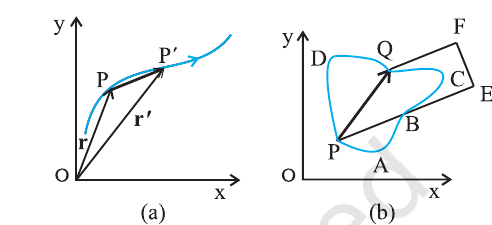
To describe the position of an object moving in a plane, we need to choose a convenient point, say O as origin. Let P and P' be the positions of the object at time t and t', respectively [Fig. 3.1(a)]. We join O and P by a straight line. Then, OP is the position vector of the object at time t. An arrow is marked at the head of this line. It is represented by a symbol r, i.e. $OP = \mathbf{r}$. Point P' is represented by another position vector, OP' denoted by r'. The length of the vector r represents the magnitude of the vector and its direction is the direction in which P lies as seen from O. If the object moves from P to P', the vector PP' (with tail at P and tip at P') is called the displacement vector corresponding to motion from point P (at time t) to point P' (at time t').
It is important to note that displacement vector is the straight line joining the initial and final positions and does not depend on the actual path undertaken by the object between the two positions. For example, in Fig. 3.1(b), given the initial and final positions as P and Q, the displacement vector is the same PQ for different paths of journey, say PABCQ, PDQ, and PBEFQ. Therefore, the magnitude of displacement is either less or equal to the path length of an object between two points. This fact was emphasised in the previous chapter also while discussing motion along a straight line.
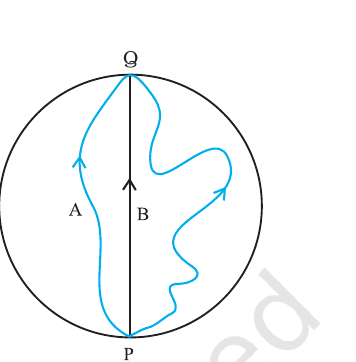
This is the chapter diagram: NCERT Figure 3.1 shows (a) the position vectors r and r' with the curved path from P to P', and (b) the displacement vector PQ with different courses of motion PABCQ, PDQ and PBEFQ. Figure 3.19 also belongs here: three girls skating on a circular ice ground of radius 200 m start from a point P on the edge and reach the diametrically opposite point Q following different paths, so their displacement is the same diameter PQ even though their paths differ.
Practice1 question
Try it now. A wrong answer costs nothing here, try again until you get it.
A particle moves from P to Q along a curved path of length 500 m. The straight-line distance PQ is 400 m. What is the magnitude of its displacement?
NCERT 3.2.1: displacement is the straight line joining the initial and final positions, so its magnitude is 400 m; the 500 m is the path length.
Equality of Vectors
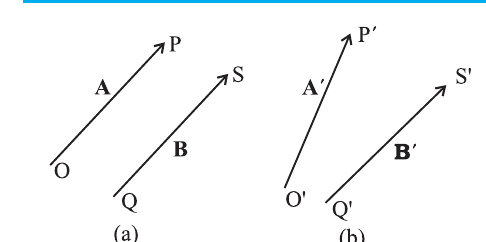
Two vectors A and B are said to be equal if, and only if, they have the same magnitude and the same direction.
Figure 3.2(a) shows two equal vectors A and B. We can easily check their equality. Shift B parallel to itself until its tail Q coincides with that of A, i.e. Q coincides with O. Then, since their tips S and P also coincide, the two vectors are said to be equal. In general, equality is indicated as $\mathbf{A} = \mathbf{B}$. Note that in Fig. 3.2(b), vectors A' and B' have the same magnitude but they are not equal because they have different directions. Even if we shift B' parallel to itself so that its tail Q' coincides with the tail O' of A', the tip S' of B' does not coincide with the tip P' of A'.
In our study, vectors do not have fixed locations. So displacing a vector parallel to itself leaves the vector unchanged. Such vectors are called free vectors. However, in some physical applications, location or line of application of a vector is important. Such vectors are called localised vectors.
This is the chapter diagram: NCERT Figure 3.2 shows (a) two equal vectors A and B, and (b) two vectors A' and B' of the same length but different directions.
Multiplication of Vectors by Real Numbers
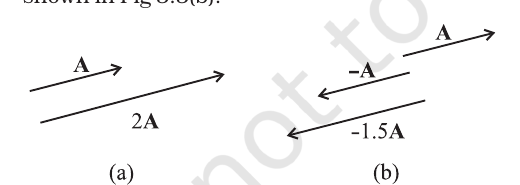
Multiplying a vector A with a positive number λ gives a vector whose magnitude is changed by the factor λ but the direction is the same as that of $\mathbf{A}: |λ\mathbf{A}| = λ|\mathbf{A}|$ if λ > 0. For example, if A is multiplied by 2, the resultant vector 2A is in the same direction as A and has a magnitude twice of |A| as shown in Fig. 3.3(a).
Multiplying a vector A by a negative number -λ gives another vector whose direction is opposite to the direction of A and whose magnitude is λ times |A|. Multiplying a given vector A by negative numbers, say -1 and -1.5, gives vectors as shown in Fig 3.3(b).
The factor λ by which a vector A is multiplied could be a scalar having its own physical dimension. Then, the dimension of λA is the product of the dimensions of λ and A. For example, if we multiply a constant velocity vector by duration (of time), we get a displacement vector.
What is the result of adding two equal and opposite vectors? Consider two vectors A and -A shown in Fig. 3.3(b). Their sum is A + (-A). Since the magnitudes of the two vectors are the same, but the directions are opposite, the resultant vector has zero magnitude and is represented by 0 called a null vector or a zero vector: A - A = 0, $|\mathbf{0}| = 0$ (3.3). Since the magnitude of a null vector is zero, its direction cannot be specified.
The null vector also results when we multiply a vector A by the number zero. The main properties of 0 are: $\mathbf{A} + \mathbf{0} = \mathbf{A}$; $λ\mathbf{0} = \mathbf{0}$; $0\mathbf{A} = \mathbf{0}$ (3.4).
What is the physical meaning of a zero vector? Consider the position and displacement vectors in a plane as shown in Fig. 3.1(a). Now suppose that an object which is at P at time t, moves to P' and then comes back to P. Then, what is its displacement? Since the initial and final positions coincide, the displacement is a null vector.
This is the chapter diagram: NCERT Figure 3.3 shows (a) vector A and 2A in the same direction, and (b) vector A with -A and -1.5A in the opposite direction.
Addition and Subtraction: Graphical Method
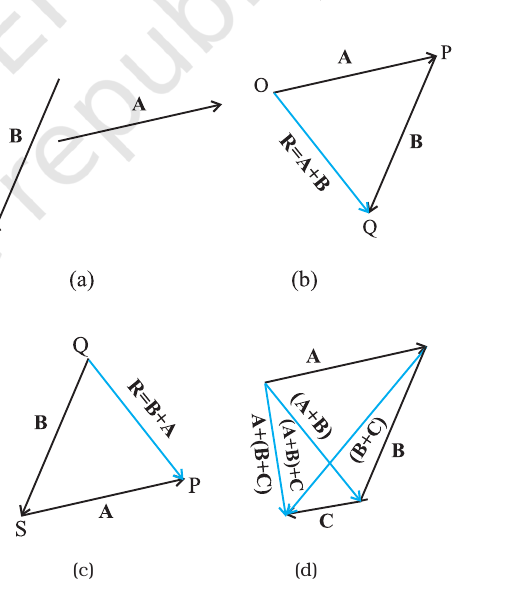
As mentioned in section 4.2, vectors, by definition, obey the triangle law or equivalently, the parallelogram law of addition. We shall now describe this law of addition using the graphical method. Let us consider two vectors A and B that lie in a plane as shown in Fig. 3.4(a). The lengths of the line segments representing these vectors are proportional to the magnitude of the vectors. To find the sum A + B, we place vector B so that its tail is at the head of the vector A, as in Fig. 3.4(b). Then, we join the tail of A to the head of B. This line OQ represents a vector R, that is, the sum of the vectors A and B. Since, in this procedure of vector addition, vectors are arranged head to tail, this graphical method is called the head-to-tail method. The two vectors and their resultant form three sides of a triangle, so this method is also known as triangle method of vector addition. If we find the resultant of B + A as in Fig. 3.4(c), the same vector R is obtained. Thus, vector addition is commutative: A + B = B + A (3.1).
The addition of vectors also obeys the associative law as illustrated in Fig. 3.4(d). The result of adding vectors A and B first and then adding vector C is the same as the result of adding B and C first and then adding vector A: (A + B) + C = A + (B + C) (3.2).
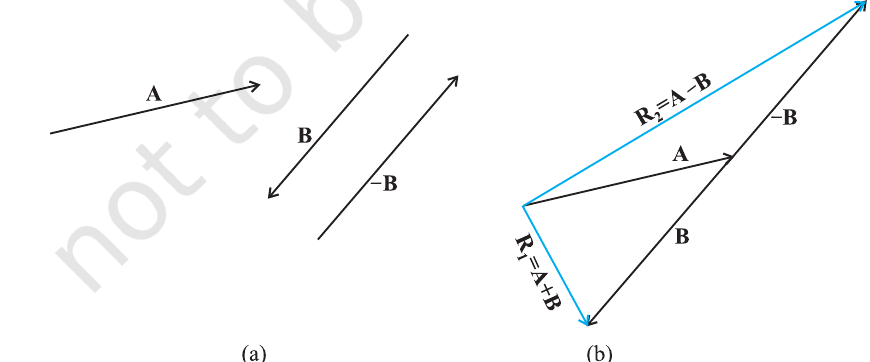
Subtraction of vectors can be defined in terms of addition of vectors. We define the difference of two vectors A and B as the sum of two vectors A and -B: A $- \mathbf{B} = \mathbf{A} + (-\mathbf{B})$ (3.5). It is shown in Fig 3.5. The vector -B is added to vector A to $get \mathbf{R2} = (\mathbf{A} - \mathbf{B})$. The $vector \mathbf{R1} = \mathbf{A} + \mathbf{B}$ is also shown in the same figure for comparison.
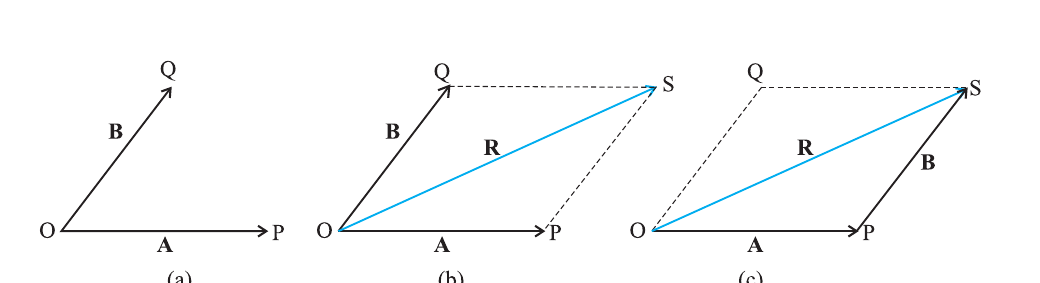
We can also use the parallelogram method to find the sum of two vectors. Suppose we have two vectors A and B. To add these vectors, we bring their tails to a common origin O as shown in Fig. 3.6(a). Then we draw a line from the head of A parallel to B and another line from the head of B parallel to A to complete a parallelogram OQSP. Now we join the point of the intersection of these two lines to the origin O. The resultant vector R is directed from the common origin O along the diagonal (OS) of the parallelogram [Fig. 3.6(b)]. In Fig. 3.6(c), the triangle law is used to obtain the resultant of A and B and we see that the two methods yield the same result. Thus, the two methods are equivalent.
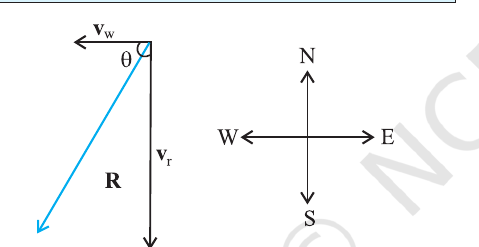
Worked example 3.1 (rain and umbrella): Rain is falling vertically with a speed of 35 m/s. Wind starts blowing after sometime with a speed of 12 m/s in east to west direction. In which direction should a boy waiting at a bus stop hold his umbrella? The velocity of the rain and the wind are represented by the vectors vr and vw in Fig. 3.7. The magnitude of the resultant R is $R = sqrt(v_r^2 + v_w^2) = \sqrt{35² + 12²} = 37 m/s$. The direction θ that R makes with the vertical is given by $\tan θ = vw/vr = 12/35 = 0.343$, so $θ = \tan^{-1}(0.343) = 19 \text{degrees}$. Therefore, the boy should hold his umbrella in the vertical plane at an angle of about 19 degrees with the vertical towards the east.
Practice1 question
Try it now. A wrong answer costs nothing here, try again until you get it.
Two vectors A and B are added by the head-to-tail method. Which statement is true?
NCERT 3.4: vector addition is commutative, $A + B = B + A$, and the same resultant R is obtained whether A + B or B + A is formed.
Table: Laws of Vector Addition
| Law or rule | Statement |
|---|---|
| Commutative law | $A + B = B + A$ |
| Associative law | $(A + B) + C = A + (B + C)$ |
| Null vector | $A - A = 0$; $\lvert 0 \rvert = 0$; $A + 0 = A$; $λ0 = 0$; $0A = 0$ |
| Subtraction | $A - B = A + (-B)$ |
| Triangle method | Place B tail at head of A; join tail of A to head of B to get $R = A + B$ |
| Parallelogram method | Bring tails to common origin O; resultant R is along the diagonal OS |
Source: NCERT XI, Ch 3, 3.4.
Resolution of Vectors
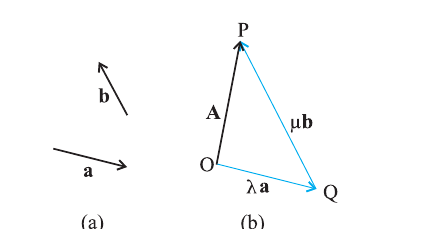
Let a and b be any two non-zero vectors in a plane with different directions and let A be another vector in the same plane (Fig. 3.8). A can be expressed as a sum of two vectors - one obtained by multiplying a by a real number and the other obtained by multiplying b by another real number. To see this, let O and P be the tail and head of the vector A. Then, through O, draw a straight line parallel to a, and through P, a straight line parallel to b. Let them intersect at Q. Then, we have $\mathbf{A} = OP = OQ + QP$ (3.6). But since OQ is parallel to a, and QP is parallel to b, we can write: $OQ = λ\mathbf{a}$, and $QP = μ\mathbf{b}$ (3.7), where λ and μ are real numbers. Therefore, $\mathbf{A} = λ\mathbf{a} + μ\mathbf{b}$ (3.8).
We say that A has been resolved into two component vectors λa and μb along a and b respectively. Using this method one can resolve a given vector into two component vectors along a set of two vectors - all the three lie in the same plane.
This is the chapter diagram: NCERT Figure 3.8 shows (a) two non-colinear vectors a and b, and (b) a vector A resolved into λa and μb.
Unit Vectors and Components
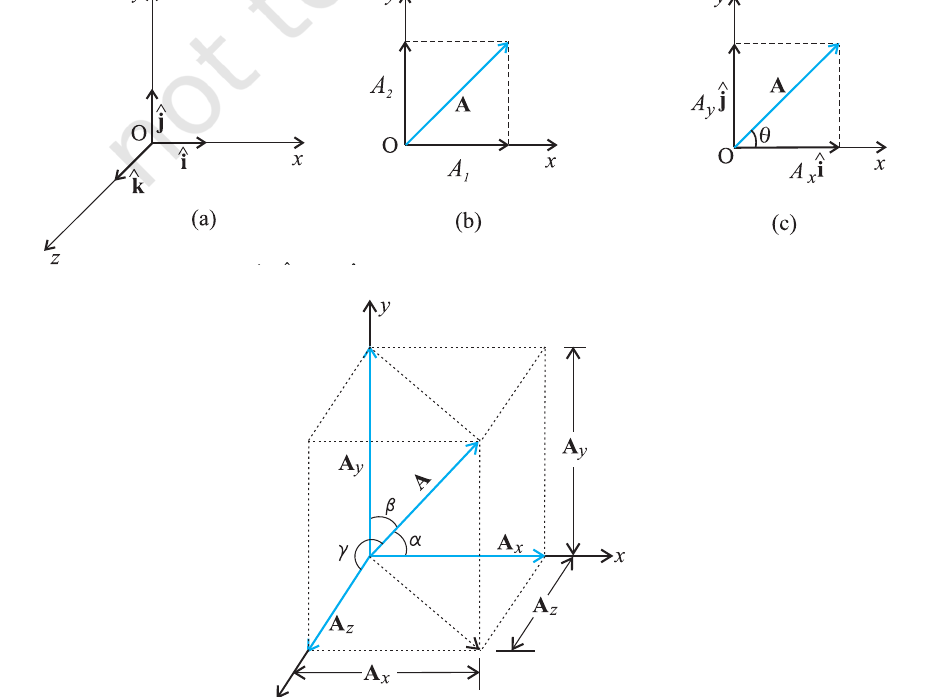
It is convenient to resolve a general vector along the axes of a rectangular coordinate system using vectors of unit magnitude. These are called unit vectors that we discuss now. A unit vector is a vector of unit magnitude and points in a particular direction. It has no dimension and unit. It is used to specify a direction only. Unit vectors along the x-, y- and z-axes of a rectangular coordinate system are denoted by i, j and k with caps, respectively, as shown in Fig. 3.9(a). Since these are unit vectors, we have $|\mathbf{i}| = |\mathbf{j}| = |\mathbf{k}| = 1$ (3.9).
These unit vectors are perpendicular to each other. In this text, they are printed in bold face with a cap (^) to distinguish them from other vectors. Since we are dealing with motion in two dimensions in this chapter, we require use of only two unit vectors. If we multiply a unit vector, say n with a cap by a scalar, the result is a vector λn. In general, a vector A can be written as $\mathbf{A} = |\mathbf{A}|\mathbf{n}$ (3.10), where n is a unit vector along A.
We can now resolve a vector A in terms of component vectors that lie along unit vectors i and j. Consider a vector A that lies in x-y plane as shown in Fig. 3.9(b). We draw lines from the head of A perpendicular to the coordinate axes as in Fig. 3.9(b), and get vectors A1 and A2 such that $\mathbf{A1} + \mathbf{A2} = \mathbf{A}$. Since A1 is parallel to i and A2 is parallel to j, we have: $\mathbf{A1} = Ax\mathbf{i}, \mathbf{A2} = Ay\mathbf{j}$ (3.11), where Ax and Ay are real numbers. Thus, $\mathbf{A} = Ax\mathbf{i} + Ay\mathbf{j}$ (3.12). This is represented in Fig. 3.9(c). The quantities Ax and Ay are called x-, and y- components of the vector A. Note that Ax is itself not a vector, but Axi is a vector, and so is Ayj. Using simple trigonometry, we can express Ax and Ay in terms of the magnitude of A and the angle θ it makes with the x-axis: $Ax = A \cos θ$, $Ay = A \sin θ$ (3.13). As is clear from Eq. (3.13), a component of a vector can be positive, negative or zero depending on the value of θ.
Now, we have two ways to specify a vector A in a plane. It can be specified by: (i) its magnitude A and the direction θ it makes with the x-axis; or (ii) its components Ax and Ay. If A and θ are given, Ax and Ay can be obtained using Eq. (3.13). If Ax and Ay are given, A and θ can be obtained as follows: $A_x^2$ + $A_y^2$ = $A^2$ $\cos^2$ θ + $A^2$ $\sin^2$ θ = $A^2$. Or, $A = \sqrt{A_x^2 + A_y^2}$ (3.14). And $\tan θ = Ay/Ax$, $θ = \tan^{-1}(Ay/Ax)$ (3.15).
So far we have considered a vector lying in an x-y plane. The same procedure can be used to resolve a general vector A into three components along x-, y-, and z-axes in three dimensions. If α, β, and γ are the angles between A and the x-, y-, and z-axes, respectively [Fig. 3.9(d)], we have $Ax = A \cos α$, $Ay = A \cos β$, $Az = A \cos γ$ (3.16a). In general, we have $\mathbf{A} = Ax\mathbf{i} + Ay\mathbf{j} + Az\mathbf{k}$ (3.16b). The magnitude of vector A is $A = \sqrt{A_x^2 + A_y^2 + A_z^2}$ (3.16c). A position vector r can be expressed as $\mathbf{r} = x\mathbf{i} + y\mathbf{j} + z\mathbf{k}$ (3.17), where x, y, and z are the components of r along x-, y-, z-axes, respectively.
This is the chapter diagram: NCERT Figure 3.9 shows (a) unit vectors i, j and k along the x-, y- and z-axes, (b) a vector A resolved into Ax and Ay, (c) A1 and A2 in terms of i and j, and (d) a vector A resolved into components along x-, y- and z-axes.
Table: Components at a Glance
| Quantity | Formula |
|---|---|
| Unit vector magnitudes | $\lvert i \rvert = \lvert j \rvert = \lvert k \rvert = 1$ |
| Vector from unit vector | $A = \lvert A \rvert n$, where n is a unit vector along A |
| Components from magnitude and angle | $Ax = A \cos θ$; $Ay = A \sin θ$ |
| Magnitude from components | $A = \sqrt{A_x^2 + A_y^2}$ |
| Direction from components | $\tan θ = Ay/Ax$; $θ = \tan^{-1}(Ay/Ax)$ |
| Vector in components | A = Ax i + Ay j |
| Three dimensions | A = Ax i + Ay j + Az k; $A = \sqrt{A_x^2 + A_y^2 + A_z^2}$ |
| Position vector | $r = x i + y j + z k$ |
Source: NCERT XI, Ch 3, 3.5.
Practice1 question
Try it now. A wrong answer costs nothing here, try again until you get it.
A vector A of magnitude 10 units makes an angle of 60 degrees with the x-axis. What are its components Ax and Ay?
$NCERT 3.5: Ax = A \cos θ = 10 \cos 60 = 5$, $Ay = A \sin θ = 10 \sin 60 = 5 sqrt$(3).
Vector Addition: Analytical Method
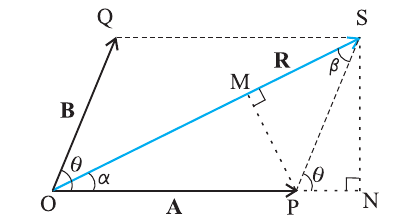
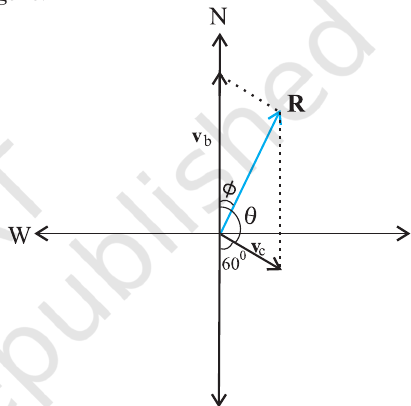
Although the graphical method of adding vectors helps us in visualising the vectors and the resultant vector, it is sometimes tedious and has limited accuracy. It is much easier to add vectors by combining their respective components. Consider two vectors A and B in x-y plane with components Ax, Ay and Bx, By: $\mathbf{A} = Ax\mathbf{i} + Ay\mathbf{j} (3.18), \mathbf{B} = Bx\mathbf{i} + By\mathbf{j}$. Let R be their sum. We have $\mathbf{R} = \mathbf{A} + \mathbf{B} = (Ax\mathbf{i} + Ay\mathbf{j}) + (Bx\mathbf{i} + By\mathbf{j})$ (3.19a). Since vectors obey the commutative and associative laws, we can arrange and regroup the vectors in Eq. (3.19a) as convenient to us: $\mathbf{R} = (Ax + Bx)\mathbf{i} + (Ay + By)\mathbf{j}$ (3.19b). Since $\mathbf{R} = Rx\mathbf{i} + Ry\mathbf{j}$ (3.20), we have $Rx = Ax + Bx$, $Ry = Ay + By$ (3.21). Thus, each component of the resultant vector R is the sum of the corresponding components of A and B.
In three dimensions, we have $\mathbf{A} = Ax\mathbf{i} + Ay\mathbf{j} + Az\mathbf{k}, \mathbf{B} = Bx\mathbf{i} + By\mathbf{j} + Bz\mathbf{k}, \mathbf{R} = \mathbf{A} + \mathbf{B} = Rx\mathbf{i} + Ry\mathbf{j} + Rz\mathbf{k}$, with $Rx = Ax + Bx$, $Ry = Ay + By$, $Rz = Az + Bz$ (3.22). This method can be extended to addition and subtraction of any number of vectors. For example, if vectors a, b and c are given as $\mathbf{a} = ax\mathbf{i} + ay\mathbf{j} + az\mathbf{k}, \mathbf{b} = bx\mathbf{i} + by\mathbf{j} + bz\mathbf{k}, \mathbf{c} = cx\mathbf{i} + cy\mathbf{j} + cz\mathbf{k}$ (3.23a), then, $a vector \mathbf{T} = \mathbf{a} + \mathbf{b} - \mathbf{c}$ has components: $Tx = ax + bx - cx$, $Ty = ay + by - cy$, $Tz = az + bz - cz$ (3.23b).
Worked example 3.2 (law of cosines and law of sines): Find the magnitude and direction of the resultant of two vectors A and B in terms of their magnitudes and angle θ between them. Let OP and OQ represent the two vectors A and B making an angle θ (Fig. 3.10). Then, using the parallelogram method of vector addition, OS represents the resultant vector R: R = A + B. SN is normal to OP and PM is normal to OS. From the geometry of the figure, $OS^2 = ON^2 + SN^2$, but ON = $OP + PN = A + B \cos θ$, $SN = B \sin θ$, so $OS^2 = (A + B \cos θ)² + (B \sin θ)²$, or $R^2 = A^2 + B^2 + 2AB \cos θ$. So $R = \sqrt{A^2 + B^2 + 2AB \cos θ}$ (3.24a). In triangle OSN, $SN = OS \sin α = R \sin α$, and in triangle PSN, $SN = PS \sin θ = B \sin θ$. Therefore, $R \sin α = B \sin θ$, or $R/\sin θ = B/\sin α$ (3.24b). Similarly, $PM = A \sin α = B \sin β$, or $A/\sin β = B/\sin α$ (3.24c). Combining Eqs. (3.24b) and (3.24c), we get $R/\sin θ = A/\sin β = B/\sin α$ (3.24d). Using Eq. (3.24d), we get $\sin α = (B/R) \sin θ$ (3.24e), where R is given by Eq. (3.24a). Or, $\tan α = SN/(OP + PN) = (B \sin θ)/(A + B \cos θ)$ (3.24f). Equation (3.24a) gives the magnitude of the resultant and Eqs. (3.24e) and (3.24f) its direction. Equation (3.24a) is known as the Law of cosines and Eq. (3.24d) as the Law of sines.
Worked example 3.3 (motorboat): A motorboat is racing towards north at 25 km/h and the water current in that region is 10 km/h in the direction of 60 degrees east of south. Find the resultant velocity of the boat. The vector vb representing the velocity of the motorboat and the vector vc representing the water current are shown in Fig. 3.11 in directions specified by the problem. Using the parallelogram method of addition, the resultant R is obtained in the direction shown in the figure. We can obtain the magnitude of R using the Law of cosine: $R = \sqrt{v_b^2 + v_c^2 + 2 vb vc \cos 120 \text{\text{degrees}}}$ = $\sqrt{25² + 10^{2} + 2 \times 25 x 10 x (-1/2)}$ = about 22 km/h. To obtain the direction, we apply the Law of sines: $R/\sin θ = vc/\sin φ$, or $\sin φ = (vc/R) \sin θ = (10 x \sin 120 \text{degrees})/21.8$ = (10 $\sqrt{3}$)/(2 x 21.8) = about 0.397, so φ = about 23.4 degrees.
Motion in a Plane: Position, Velocity and Acceleration
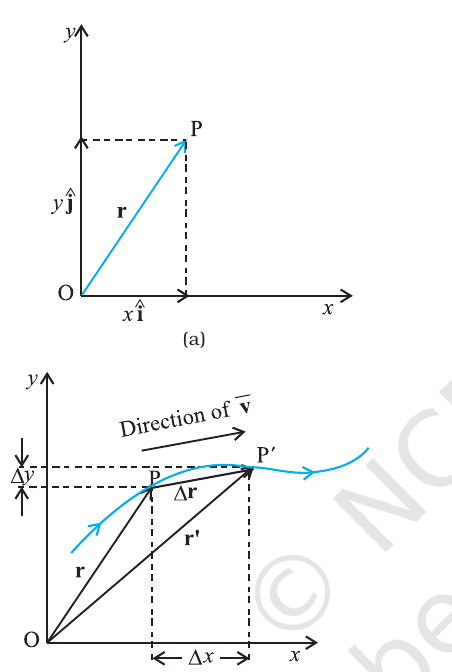

In this section we shall see how to describe motion in two dimensions using vectors.
The position vector r of a particle P located in a plane with reference to the origin of an x-y reference frame (Fig. 3.12) is given by $\mathbf{r} = x\mathbf{i} + y\mathbf{j}$, where x and y are components of r along x-, and y- axes or simply they are the coordinates of the object.
Suppose a particle moves along the curve shown by the thick line and is at P at time t and P' at time t' [Fig. 3.12(b)]. Then, the displacement is: $Δ\mathbf{r} = \mathbf{r'} - \mathbf{r}$ (3.25), and is directed from P to P'. We can write Eq. (3.25) in a component form: $Δ\mathbf{r} = (x'\mathbf{i} + y'\mathbf{j}) - (x\mathbf{i} + y\mathbf{j})$ = i$\Delta x$ + j$\Delta y$, where $\Delta x = x' - x, \Delta y = y' - y$ (3.26).
The average velocity (v with a bar) of an object is the ratio of the displacement and the corresponding time interval: average $v = \Delta r/\Delta t = (\Delta x i + \Delta y j)/\Delta t$ = i ($\Delta x$/$\Delta t$) + j ($\Delta y$/$\Delta t$) (3.27). Or, average $v = vx(bar) i + vy(bar) j$. Since average $v = \delta r/\delta t$, the direction of the average velocity is the same as that of $\Delta r$ (Fig. 3.12). The velocity (instantaneous velocity) is given by the limiting value of the average velocity as the time interval approaches zero: v = lim ($\Delta t$ → 0) $\Delta r$/$\Delta t$ = dr/dt (3.28).
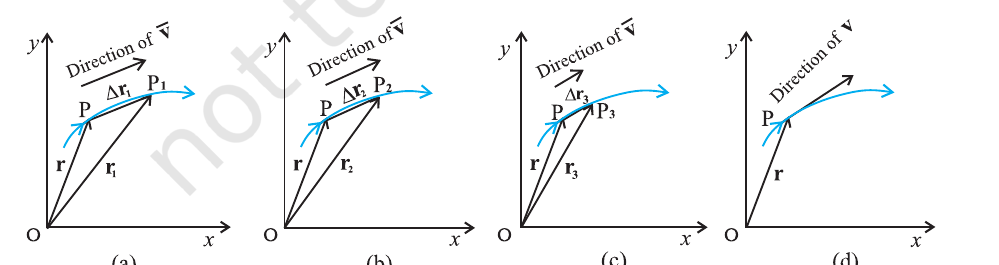
The meaning of the limiting process can be easily understood with the help of Fig 3.13(a) to (d). In these figures, the thick line represents the path of an object, which is at P at time t. $P_1$, $P_2$ and P3 represent the positions of the object after times $\Delta t$1, $\Delta t$2, and $\Delta t$3. $\Delta r$1, $\Delta r$2, and $\Delta r$3 are the displacements of the object in times $\Delta t$1, $\Delta t$2, and $\Delta t$3, respectively. The direction of the average velocity v (bar) is shown in figures (a), (b) and (c) for three decreasing values of $\Delta t$, i.e. $\Delta t$1, $\Delta t$2, and $\Delta t$3 ($\Delta t$1 > $\Delta t$2 > $\Delta t$3). As $\Delta t$ → 0, $\Delta r$ → 0 and is along the tangent to the path [Fig. 3.13(d)]. Therefore, the direction of velocity at any point on the path of an object is tangential to the path at that point and is in the direction of motion.
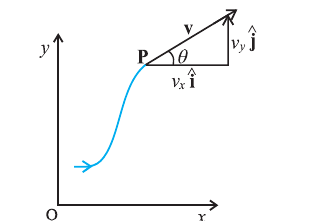
We can express v in a component form: $\mathbf{v} = dr/dt$ = lim ($\Delta t$ → 0) (($\Delta x$/$\Delta t$) i + ($\Delta y$/$\Delta t$) j) (3.29) = i lim ($\Delta t$ → 0) $\Delta x$/$\Delta t$ + j lim ($\Delta t$ → 0) $\Delta y$/$\Delta t$. Or, $\mathbf{v} = i (dx/dt) + j (dy/dt) = vx i + vy j$, where $vx = dx/dt$, $vy = dy/dt$ (3.30a). So, if the expressions for the coordinates x and y are known as functions of time, we can use these equations to find vx and vy. The magnitude of v is then $v = \sqrt{v_x^2 + v_y^2}$ (3.30b), and the direction of v is given by the angle $θ: \tan θ = vy/vx$, $θ = \tan^{-1}(vy/vx)$ (3.30c). vx, vy and angle θ are shown in Fig. 3.14 for a velocity vector v at point P.
The average acceleration a (bar) of an object for a time interval $\Delta t$ moving in x-y plane is the change in velocity divided by the time interval: average $a = \Delta v/\Delta t = (Δ(vx i + vy j))/\Delta t$ = ($\Delta v$x/$\Delta t$) i + ($\Delta v$y/$\Delta t$) j (3.31a). Or, average $a = ax(bar) i + ay(bar) j$ (3.31b).
The acceleration (instantaneous acceleration) is the limiting value of the average acceleration as the time interval approaches zero: a = lim ($\Delta t$ → 0) $\Delta v$/$\Delta t$ (3.32a). Since $\delta v = \delta vx i + \delta vy j$, we have a = i lim ($\Delta t$ → 0) $\Delta v$x/$\Delta t$ + j lim ($\Delta t$ → 0) $\Delta v$y/$\Delta t$. Or, $\mathbf{a} = ax i + ay j$ (3.32b), where $ax = dvx/dt$, $ay = dvy/dt$ (3.32c). In terms of x and y, ax and ay can be expressed as $ax = d_{2x}/dt2$, $ay = d_{2y}/dt2$.
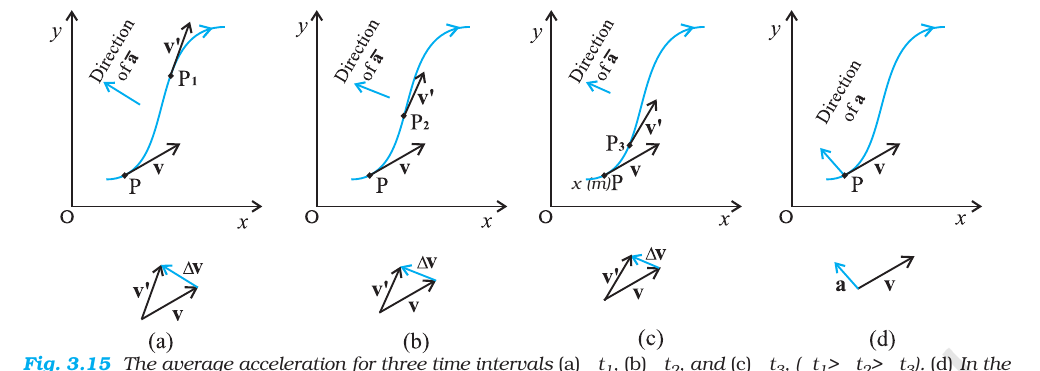
As in the case of velocity, we can understand graphically the limiting process used in defining acceleration on a graph showing the path of the object's motion. This is shown in Figs. 3.15(a) to (d). P represents the position of the object at time t and $P_1$, $P_2$, P3 positions after time $\Delta t$1, $\Delta t$2, $\Delta t$3, respectively ($\Delta t$1 > $\Delta t$2 > $\Delta t$3). The velocity vectors at points P, $P_1$, $P_2$, P3 are also shown in Figs. 3.15 (a), (b) and (c). In each case of $\Delta t$, $\Delta v$ is obtained using the triangle law of vector addition. By definition, the direction of average acceleration is the same as that of $\Delta v$. We see that as $\Delta t$ decreases, the direction of $\Delta v$ changes and consequently, the direction of the acceleration changes. Finally, in the limit $\Delta t$ → 0 [Fig. 3.15(d)], the average acceleration becomes the instantaneous acceleration and has the direction as shown.
Note that in one dimension, the velocity and the acceleration of an object are always along the same straight line (either in the same direction or in the opposite direction). However, for motion in two or three dimensions, velocity and acceleration vectors may have any angle between 0 degrees and 180 degrees between them.
Worked example 3.4: The position of a particle is given by $r = 3.0t i + 2.0t^2 j + 5.0 k$, where t is in seconds and the coefficients have the proper units for r to be in metres. (a) Find v(t) and a(t) of the particle. (b) Find the magnitude and direction of v(t) at $t = 1.0 s$. Answer: $v(t) = dr/dt = 3.0 i + 4.0t j$; $a(t) = dv/dt = 4.0 j$, so $a = 4.0 m/s^2$ along y-direction. At $t = 1.0 s$, $v = 3.0 i + 4.0 j$. Its magnitude is $v = \sqrt{3² + 4²} = 5.0 m/s$ and direction is $θ = \tan^{-1}(vy/vx) = \tan^{-1}(4/3)$ = about 53 degrees with x-axis.
Figure 3.20 also belongs here: a cyclist starts from the centre O of a circular park of radius 1 km, reaches the edge P, cycles along the circumference, and returns to the centre along QO, which is the exercise on average velocity and average speed in a plane.
Table: Plane Motion Formulae
| Quantity | Formula |
|---|---|
| Position vector | $r = x i + y j$ |
| Displacement | $\Delta r = r' - r = \Delta x i + \Delta y j$ |
| Average velocity | average $v = \Delta r/\Delta t = (\Delta x/\Delta t) i + (\Delta y/\Delta t) j$ |
| Instantaneous velocity | $v = dr/dt = vx i + vy j$; $vx = dx/dt$, $vy = dy/dt$ |
| Speed | $v = \sqrt{v_x^2 + v_y^2}$ |
| Direction of velocity | $\tan θ = vy/vx$; $θ = \tan^{-1}(vy/vx)$ |
| Average acceleration | average $a = \Delta v/\Delta t = (\Delta vx/\Delta t) i + (\Delta vy/\Delta t) j$ |
| Instantaneous acceleration | $a = dv/dt = ax i + ay j$; $ax = dvx/dt$, $ay = dvy/dt$ |
Source: NCERT XI, Ch 3, 3.7.1.
Motion with Constant Acceleration
Suppose that an object is moving in x-y plane and its acceleration a is constant. Over an interval of time, the average acceleration will equal this constant value. Now, let the velocity of the object be $v_0$ at time $t = 0$ and v at time t. Then, by definition $\mathbf{a} = (\mathbf{v} - \mathbf{v_0})/(t - 0) = (\mathbf{v} - \mathbf{v_0})/t$. Or, $\mathbf{v} = \mathbf{v_0} + \mathbf{a}t$ (3.33a). In terms of components: $vx = vox + ax t$, $vy = voy + ay t$ (3.33b).
Let us now find how the position r changes with time. We follow the method used in the one-dimensional case. Let $r_0$ and r be the position vectors of the particle at time 0 and t and let the velocities at these instants be $v_0$ and v. Then, over this time interval t, the average velocity is ($v_0$ + v)/2. The displacement is the average velocity multiplied by the time interval: $\mathbf{r} - \mathbf{r_0} = ((\mathbf{v} + \mathbf{v_0})/2) t = (((\mathbf{v_0} + \mathbf{a}t) + \mathbf{v_0})/2) t$ = $v_0$t + (1/2)a$t^2$. Or, $\mathbf{r} = \mathbf{r_0} + \mathbf{v_0}t + (1/2)\mathbf{a}t^2$ (3.34a). It can be easily verified that the derivative of Eq. (3.34a), i.e. dr/dt gives Eq. (3.33a) and it also satisfies the condition that at $t = 0, \mathbf{r} = \mathbf{r_0}$. Equation (3.34a) can be written in component form as $x = x_0 + vox t + (1/2) ax t^2$, $y = y_0 + voy t + (1/2) ay t^2$ (3.34b).
One immediate interpretation of Eq. (3.34b) is that the motions in x- and y-directions can be treated independently of each other. That is, motion in a plane (two-dimensions) can be treated as two separate simultaneous one-dimensional motions with constant acceleration along two perpendicular directions. This is an important result and is useful in analysing motion of objects in two dimensions. A similar result holds for three dimensions. The choice of perpendicular directions is convenient in many physical situations, as we shall see in section 3.9 for projectile motion.
Worked example 3.5: A particle starts from origin at $t = 0$ with a velocity 5.0 i m/s and moves in x-y plane under action of a force which produces a constant acceleration of (3.0 i + 2.0 j) m/$s^2$. (a) What is the y-coordinate of the particle at the instant its x-coordinate is 84 m? (b) What is the speed of the particle at this time? Answer: From Eq. (3.34a) for $r_0 = 0$, the position of the particle is given by $r(t) = v_0 t + (1/2) a t^2 = 5.0 i t + (1/2)(3.0 i + 2.0 j) t^2$ = (5.0t + 1.5$t^2$) i + 1.0$t^2$ j. Therefore, $x(t) = 5.0t + 1.5t^2, y(t) = 1.0t^2$. Given $x(t) = 84 m, 5.0t + 1.5t^2 = 84$, so $t = 6 s$. At $t = 6 s$, $y = 1.0(6)² = 36.0 m$. Now, the velocity $v = dr/dt = (5.0 + 3.0t) i + 2.0t j$. At $t = 6 s$, $v = 23.0 i + 12.0 j$, so $speed = |v| = \sqrt{23² + 12²}$ = about 26 m/s.
Projectile Motion


As an application of the ideas developed in the previous sections, we consider the motion of a projectile. An object that is in flight after being thrown or projected is called a projectile. Such a projectile might be a football, a cricket ball, a baseball or any other object. The motion of a projectile may be thought of as the result of two separate, simultaneously occurring components of motions. One component is along a horizontal direction without any acceleration and the other along the vertical direction with constant acceleration due to the force of gravity. It was Galileo who first stated this independency of the horizontal and the vertical components of projectile motion in his Dialogue on the great world systems (1632).
In our discussion, we shall assume that the air resistance has negligible effect on the motion of the projectile. Suppose that the projectile is launched with velocity vo that makes an angle θo with the x-axis as shown in Fig. 3.16. After the object has been projected, the acceleration acting on it is that due to gravity which is directed vertically downward: a = -gj. Or, $ax = 0$, $ay = -g$ (3.35). The components of initial velocity vo are: $vox = vo \cos θo$, $voy = vo \sin θo$ (3.36).
If we take the initial position to be the origin of the reference frame as shown in Fig. 3.16, we have: $xo = 0$, $yo = 0$. Then, Eq. (3.34b) becomes: $x = vox t = (vo \cos θo) t$ and $y = (vo \sin θo) t - (1/2) g t^2$ (3.37). The components of velocity at time t can be obtained using Eq. (3.33b): $vx = vox = vo \cos θo$, $vy = vo \sin θo - g t$ (3.38). Equation (3.37) gives the x-, and y-coordinates of the position of a projectile at time t in terms of two parameters - initial speed vo and projection angle θo. Notice that the choice of mutually perpendicular x-, and y-directions for the analysis of the projectile motion has resulted in a simplification. One of the components of velocity, i.e. x-component remains constant throughout the motion and only the y-component changes, like an object in free fall in vertical direction. This is shown graphically at few instants in Fig. 3.17. Note that at the point of maximum height, $vy = 0$ and therefore, $θ = \tan^{-1}(vy/vx) = 0$.
Equation of path of a projectile: What is the shape of the path followed by the projectile? This can be seen by eliminating the time between the expressions for x and y as given in Eq. (3.37). We obtain: $y = (\tan θo) x - (g/(2 (vo \cos θo)²)) x^2$ (3.39). Now, since g, θo and vo are constants, Eq. (3.39) is of the form $y = a x + b x^2$, in which a and b are constants. This is the equation of a parabola, i.e. the path of the projectile is a parabola (Fig. 3.17).
Time of maximum height: How much time does the projectile take to reach the maximum height? Let this time be denoted by tm. Since at this point, $vy = 0$, we have from Eq. (3.38): $vy = vo \sin θo - g tm = 0$. Or, $tm = (vo \sin θo)/g$ (3.40a). The total time Tf during which the projectile is in flight can be obtained by putting $y = 0$ in Eq. (3.37). We get: $Tf = 2 (vo \sin θo)/g$ (3.40b). Tf is known as the time of flight of the projectile. We note that $Tf = 2 tm$, which is expected because of the symmetry of the parabolic path.
Maximum height of a projectile: The maximum height hm reached by the projectile can be calculated by substituting $t = tm$ in Eq. (3.37): $hm = ((vo \sin θo)²)/(2g)$ (3.41).
Horizontal range of a projectile: The horizontal distance travelled by a projectile from its initial position $(x = y = 0)$ to the position where it passes $y = 0$ during its fall is called the horizontal range, R. It is the distance travelled during the time of flight Tf. Therefore, the range R is $R = (vo \cos θo) (Tf) = (vo \cos θo) (2 vo \sin θo)/g$. Or, $R = (v_o^2 \sin 2θo)/g$ (3.42a). Equation (3.42a) shows that for a given projection velocity vo, R is maximum when sin 2θo is maximum, i.e., when $θo = 45 \text{degrees}$. The maximum horizontal range is, $therefore, Rm = v_o^2/g$ (3.42b).
Worked example 3.6 (Galileo): Galileo, in his book Two new sciences, stated that 'for elevations which exceed or fall short of 45 degrees by equal amounts, the ranges are equal'. Prove this statement. Answer: For a projectile launched with velocity vo at an angle θo, the range is given by $R = (v_o^2 \sin 2θo)/g$. Now, for angles, (45 degrees + α) and (45 degrees - α), 2θo is (90 degrees + 2α) and (90 degrees - 2α), respectively. The values of $\sin(90 \text{degrees} + 2α)$ and $\sin(90 \text{degrees} - 2α)$ are the same, equal to that of cos 2α. Therefore, ranges are equal for elevations which exceed or fall short of 45 degrees by equal amounts α.
Worked example 3.7 (cliff stone): A hiker stands on the edge of a cliff 490 m above the ground and throws a stone horizontally with an initial speed of 15 m/s. Neglecting air resistance, find the time taken by the stone to reach the ground, and the speed with which it hits the ground. (Take $g = 9.8 m/s^2$.) Answer: We choose the origin of the x-, and y-axis at the edge of the cliff and $t = 0 s$ at the instant the stone is thrown. Choose the positive direction of x-axis to be along the initial velocity and the positive direction of y-axis to be the vertically upward direction. The x-, and y-components of the motion can be treated independently. The equations of motion are: $x(t) = xo + vox t, y(t) = yo + voy t + (1/2) ay t^2$. Here, $xo = yo = 0$, $voy = 0$, $ay = -g = -9.8 m/s^2$, $vox = 15 m/s$. The stone hits the ground when $y(t) = -490 m$. -$490 m = -(1/2)(9.8) t^2$. This gives $t = 10 s$. The velocity components are $vx = vox$ and $vy = voy - g t$, so that when the stone hits the ground: $vx = 15 m/s$, $vy = 0 - 9.8 \times 10 = -98 m/s$. Therefore, the speed of the stone is $sqrt(v_x^2 + v_y^2) = \sqrt{15² + 98²} = 99 m/s$.
Worked example 3.8 (cricket ball): A cricket ball is thrown at a speed of 28 m/s in a direction 30 degrees above the horizontal. Calculate (a) the maximum height, (b) the time taken by the ball to return to the same level, and (c) the distance from the thrower to the point where the ball returns to the same level. Answer: (a) The maximum height is given by $hm = ((v_0 \sin θo)²)/(2g) = ((28 \sin 30 \text{degrees})²)/(2 \times 9.8) = (14 \times 14)/(2 \times 9.8) = 10.0 m$. (b) The time taken to return to the same level is $Tf = (2 v_0 \sin θo)/g = (2 \times 28 x \sin 30 \text{degrees})/9.8 = 28/9.8 s = 2.9 s$. (c) The distance from the thrower to the point where the ball returns to the same level is $R = (v_0^2 \sin 2θo)/g = (28 \times 28 x \sin 60 \text{degrees})/9.8$ = 69 m.
Practice1 question
Try it now. A wrong answer costs nothing here, try again until you get it.
A projectile is launched with speed 20 m/s at 30 degrees to the horizontal $(g = 10 m/s^2)$. What is its maximum height?
$NCERT 3.9: hm = ((vo \sin θo)²)/(2g) = ((20 \times 0.5)²)/(2 \times 10) = 100/20 = 5 m$.
Table: Projectile Formulae
| Quantity | Formula |
|---|---|
| Acceleration | $a = -g j$; $ax = 0$, $ay = -g$ |
| Initial velocity components | $vox = vo \cos θo$; $voy = vo \sin θo$ |
| Position at time t | $x = (vo \cos θo) t$; $y = (vo \sin θo) t - (1/2) g t^2$ |
| Velocity at time t | $vx = vo \cos θo$; $vy = vo \sin θo - g t$ |
| Equation of path | $y = (\tan θo) x - (g/(2 (vo \cos θo)²)) x^2 (parabola)$ |
| Time to maximum height | $tm = (vo \sin θo)/g$ |
| Time of flight | $Tf = 2 (vo \sin θo)/g = 2 tm$ |
| Maximum height | $hm = ((vo \sin θo)²)/(2g)$ |
| Horizontal range | $R = (v_o^2 \sin 2θo)/g$ |
| Maximum range | $Rm = v_o^2/g$, at $θo = 45 \text{degrees}$ |
Source: NCERT XI, Ch 3, 3.9.
Uniform Circular Motion

When an object follows a circular path at a constant speed, the motion of the object is called uniform circular motion. The word 'uniform' refers to the speed, which is uniform (constant) throughout the motion. Suppose an object is moving with uniform speed v in a circle of radius R as shown in Fig. 3.18. Since the velocity of the object is changing continuously in direction, the object undergoes acceleration. Let us find the magnitude and the direction of this acceleration.
Let r and r' be the position vectors and v and v' the velocities of the object when it is at point P and P' as shown in Fig. 3.18(a). By definition, velocity at a point is along the tangent at that point in the direction of motion. The velocity vectors v and v' are as shown in Fig. 3.18(a1). Δv is obtained in Fig. 3.18 (a2) using the triangle law of vector addition. Since the path is circular, v is perpendicular to r and so is v' to r'. Therefore, Δv is perpendicular to Δr. Since average acceleration is along Δv, the average acceleration is perpendicular to Δr. If we place Δv on the line that bisects the angle between r and r', we see that it is directed towards the centre of the circle. Figure 3.18(b) shows the same quantities for smaller time interval. Δv and hence average a is again directed towards the centre. In Fig. 3.18(c), $\Delta t$ → 0 and the average acceleration becomes the instantaneous acceleration. It is directed towards the centre. Thus, we find that the acceleration of an object in uniform circular motion is always directed towards the centre of the circle.
Let us now find the magnitude of the acceleration. The magnitude of a is, by definition, given by $|\mathbf{a}| = lim (\delta t → 0) |Δ\mathbf{v}|/\delta t$. Let the angle between position vectors r and r' be Δθ. Since the velocity vectors v and v' are always perpendicular to the position vectors, the angle between them is also Δθ. Therefore, the triangle CPP' formed by the position vectors and the triangle GHI formed by the velocity vectors v, v' and Δv are similar (Fig. 3.18a). Therefore, the ratio of the base-length to side-length for one of the triangles is equal to that of the other triangle. That is: $|Δ\mathbf{v}|/v = |Δ\mathbf{r}|/R$. Or, $|Δ\mathbf{v}| = v (|Δ\mathbf{r}|/R)$. Therefore, $|\mathbf{a}| = lim (\delta t → 0) |Δ\mathbf{v}|/\delta t$ = lim ($\Delta t$ → 0) (v |Δr|)/(R $\Delta t$) = (v/R) lim ($\Delta t$ → 0) |Δr|/$\Delta t$. If $\Delta t$ is small, Δθ will also be small and then arc PP' can be approximately taken to be |Δr|: |Δr| = v $\Delta t$, so |Δr|/$\Delta t$ = v, or lim ($\Delta t$ → 0) |Δr|/$\Delta t$ = v. Therefore, the centripetal acceleration ac is: $ac = (v/R) v = v^2/R$ (3.43). Thus, the acceleration of an object moving with speed v in a circle of radius R has a magnitude $v^2$/R and is always directed towards the centre. This is why this acceleration is called centripetal acceleration (a term proposed by Newton). A thorough analysis of centripetal acceleration was first published in 1673 by the Dutch scientist Christiaan Huygens (1629-1695) but it was probably known to Newton also some years earlier. 'Centripetal' comes from a Greek term which means 'centre-seeking'. Since v and R are constant, the magnitude of the centripetal acceleration is also constant. However, the direction changes - pointing always towards the centre. Therefore, a centripetal acceleration is not a constant vector.
We have another way of describing the velocity and the acceleration of an object in uniform circular motion. As the object moves from P to P' in time $\delta t (= t' - t)$, the line CP (Fig. 3.18) turns through an angle Δθ as shown in the figure. Δθ is called angular distance. We define the angular speed ω (Greek letter ω) as the time rate of change of angular displacement: $ω = Δθ/\delta t$ (3.44). Now, if the distance travelled by the object during the time $\Delta t$ is $\Delta s$, i.e. PP' is $\Delta s$, then: $v = \delta s/\delta t$, but $\delta s = R Δθ$. Therefore: $v = R (Δθ/\Delta t) = Rω$, so $v = Rω$ (3.45). We can express centripetal acceleration ac in terms of angular speed: $ac = v^2/R = (ω^2 R^2)/R = ω^2 R$, so $ac = ω^2 R$ (3.46).
The time taken by an object to make one revolution is known as its time period T and the number of revolutions made in one second is called its frequency $ν (= 1/T)$. However, during this time the distance moved by the object is $s = 2πR$. Therefore, $v = 2πR/T = 2πRν$ (3.47). In terms of frequency ν, we have $ω = 2πν$, $v = 2πRν$, $ac = 4π^2 ν^2 R$ (3.48).
Worked example 3.9 (insect in groove): An insect trapped in a circular groove of radius 12 cm moves along the groove steadily and completes 7 revolutions in 100 s. (a) What is the angular speed, and the linear speed of the motion? (b) Is the acceleration vector a constant vector? What is its magnitude? Answer: This is an example of uniform circular motion. $Here R = 12 cm$. The angular speed ω is given by $ω = 2π/T = 2π x 7/100 = 0.44 rad/s$. The linear speed v is: $v = ωR = 0.44 s^{-1} x 12 cm = 5.3 cm/s$. The direction of velocity v is along the tangent to the circle at every point. The acceleration is directed towards the centre of the circle. Since this direction changes continuously, acceleration here is not a constant vector. However, the magnitude of acceleration is constant: $a = ω^2 R = (0.44 s^{-1})² (12 cm) = 2.3 cm/s^2$.
Practice1 question
Try it now. A wrong answer costs nothing here, try again until you get it.
A particle moves in a circle of radius 2 m with speed 4 m/s. What is the magnitude of its centripetal acceleration?
$NCERT 3.10: ac = v^2/R = 16/2 = 8 m/s^2, directed towards$ the centre.
Trap Pairs
- A quantity with magnitude and direction is always a vector. Wrong: a vector must also obey the triangle law (or parallelogram law) of addition. NCERT 3.2 defines a vector by magnitude, direction AND the addition law.
- Displacement equals path length. Wrong: the magnitude of displacement is either less or equal to the path length; it equals the path length only when the object does not change direction. NCERT 3.2.1, Fig. 3.1(b).
- Velocity and acceleration always point the same way. Wrong: in one dimension they share a straight line, but in two or three dimensions they may have any angle between 0 degrees and 180 degrees between them. NCERT 3.7.1.
- At the top of a projectile path the acceleration is zero. Wrong: at maximum height $vy = 0$, but $ax = 0$ and $ay = -g$, so the acceleration is g downward throughout the flight. NCERT 3.9.
- In uniform circular motion the acceleration is constant because its magnitude is constant. Wrong: the magnitude $v^2$/R is constant, but the direction changes continuously, always pointing towards the centre, so the acceleration is not a constant vector. NCERT 3.10.
- Range is greatest at the steepest launch angle. $Wrong: R = (v_o^2 \sin 2θo)/g$ is maximum when $\sin 2θo = 1$, i.e. $θo = 45 \text{degrees}$; angles equally above and below 45 degrees give equal ranges. NCERT 3.9, Example 3.6.
Points to Ponder
- The path length traversed by an object between two points is, in general, not the same as the magnitude of displacement. The displacement depends only on the end points; the path length depends on the actual path. The two quantities are equal only if the object does not change its direction during the course of motion. In all other cases, the path length is greater than the magnitude of displacement.
- In view of point 1 above, the average speed of an object is greater than or equal to the magnitude of the average velocity over a given time interval. The two are equal only if the path length is equal to the magnitude of displacement.
- The vector equations (3.33a) and (3.34a) do not involve any choice of axes. Of course, you can always resolve them along any two independent axes.
- The kinematic equations for uniform acceleration do not apply to the case of uniform circular motion since in this case the magnitude of acceleration is constant but its direction is changing.
- An object subjected to two velocities v1 and $v_2$ has a resultant velocity $v = v1 + v_2$. Take care to distinguish it from velocity of object 1 relative to velocity of object $2: v12 = v1 - v_2$. Here v1 and $v_2$ are velocities with reference to some common reference frame.
- The resultant acceleration of an object in circular motion is towards the centre only if the speed is constant.
- The shape of the trajectory of the motion of an object is not determined by the acceleration alone but also depends on the initial conditions of motion (initial position and initial velocity). For example, the trajectory of an object moving under the same acceleration due to gravity can be a straight line or a parabola depending on the initial conditions.
Source: NCERT XI, Ch 3, Points to ponder.
Trap Boxes
Any quantity with magnitude and direction is a vector?
Wrong idea: If it has a size and a direction, it must be a vector.
A vector must also obey the triangle law or the parallelogram law of addition. NCERT 3.2 defines a vector by magnitude, direction and the addition law.
NCERT XI, Ch 3, 3.2
Displacement always equals the distance travelled?
Wrong idea: The displacement of a moving object is the same as the path length it covers.
The magnitude of displacement is either less or equal to the path length; the two are equal only when the object does not change direction. Fig. 3.1(b) shows the same displacement PQ for three different paths.
NCERT XI, Ch 3, 3.2.1
Velocity and acceleration always point the same way?
Wrong idea: Acceleration always acts along the velocity of the object.
In one dimension they share a straight line, but in two or three dimensions velocity and acceleration may have any angle between 0 degrees and 180 degrees between them.
NCERT XI, Ch 3, 3.7.1
Zero velocity at the top of a projectile path means zero acceleration?
Wrong idea: At maximum height the projectile stops for an instant, so its acceleration is zero there.
At maximum height $vy = 0$, but $ay = -g throughout$ the flight, so the acceleration is g downward at every point, including the top.
NCERT XI, Ch 3, 3.9
Uniform circular motion has constant acceleration?
Wrong idea: Speed is constant in uniform circular motion, so velocity and acceleration are constant too.
Velocity changes direction continuously and the centripetal acceleration $v^2$/R always points towards the centre, so neither is a constant vector even though the speed and the magnitude of acceleration stay constant.
NCERT XI, Ch 3, 3.10
Chapter test
5 NEET PYQs. +4 for a correct answer, -1 for a wrong answer, exactly like NEET. Finish the test to earn a medal.
Q1: NEET (UG) 2024, Code R3, Q14
A particle moving with uniform speed in a circular path maintains:
Speed is constant but velocity changes direction continuously, and the centripetal acceleration $v^2$/R always points towards the centre, so both velocity and acceleration vary.
Q2: NEET (UG) 2023, Code F1, Q23
A bullet is fired from a gun at the speed of 280 m s-1 in the direction 30° above the horizontal. The maximum height attained by the bullet is $(g = 9.8 m s-2, \sin 30° = 0.5)$
$hm = ((vo \sin θo)²)/(2g) = ((280 \times 0.5)²)/(2 \times 9.8) = (140²)/19.6 = 1000 m$.
Q3: NEET (UG) 2023, Code F1, Q22
The angular acceleration of a body, moving along the circumference of a circle, is
Angular acceleration is the rate of change of angular velocity, and angular velocity points along the axis of rotation, so the angular acceleration is also along the axis of rotation.
Q4: NEET (UG) 2022, Code R1, Q46
A ball is projected with a velocity, 10 ms-1, at an angle of 60° with the vertical direction. Its speed at the highest point of its trajectory will be
Angle with the vertical is 60 degrees, so the angle with the horizontal is 30 degrees. $Horizontal speed vx = 10 \cos 30 \text{degrees} = 5 \sqrt{3} m/s stays$ constant, and $vy = 0$ at the top, so the speed there is 5 $\sqrt{3}$ m/s.
Q5: NEET (UG) 2021, Code P3, Q49
A particle moving in a circle of radius R with a uniform speed takes a time T to complete one revolution. If this particle were projected with the same speed at an angle 'θ' to the horizontal, the maximum height attained by it equals 4R. The angle of projection, θ, is then given by :
$Speed U = 2 π R/T$. Maximum height $H = (U^2 \sin^2 θ)/(2g) = 4R$, so $\sin^2 θ = 8gR/U^2 = (2 g T^2)/(\pi^2 R)$.
Score: 0 · Answered 0 of 5
Flashcards
Tap a card to flip it over and see the answer. Tap it again to flip it back.
What is the difference between a scalar and a vector, and what extra rule must a vector obey?
Tap to flipA scalar has magnitude only; a vector has magnitude and direction and obeys the triangle law of addition or equivalently the parallelogram law of addition. Examples of vectors: displacement, velocity, acceleration, force.
Tap to flip backWhat are the position vector and the displacement vector of an object moving in a plane?
Tap to flipPosition vector $OP = r$ from origin O to P at time t. If the object moves from P to P', the displacement vector is $PP' = r' - r$, the straight line joining the initial and final positions, independent of the path taken.
Tap to flip backWhen are two vectors A and B equal?
Tap to flipIf, and only if, they have the same magnitude and the same direction. Vectors with the same magnitude but different directions are not equal. Shifting a vector parallel to itself leaves it unchanged; such vectors are free vectors.
Tap to flip backWhat happens when a vector A is multiplied by a positive number λ, a negative number -λ, and by zero?
Tap to flipBy λ > 0: magnitude becomes λ|A|, direction unchanged. By -λ: direction reverses, magnitude becomes λ|A|. By 0: the null vector 0, whose direction cannot be specified.
Tap to flip backState the commutative and associative laws of vector addition and the null-vector properties.
Tap to flipCommutative: $A + B = B + A$. Associative: $(A + B) + C = A + (B + C)$. Null vector: $A - A = 0, |0| = 0, A + 0 = A$, $λ0 = 0, 0A = 0$.
Tap to flip backHow is subtraction of vectors defined, and what are R1 and R2 in Fig. 3.5?
Tap to flip$A - B = A + (-B)$. In Fig. 3.5, R2 = A - B and $R1 = A + B$ is shown for comparison.
Tap to flip backHow is a vector A resolved into components along two non-colinear vectors a and b?
Tap to flip$A = λa + μb$, where λ and μ are real numbers. Along axes: A = Ax i + Ay j, with $Ax = A \cos θ$ and $Ay = A \sin θ$, where θ is the angle A makes with the x-axis.
Tap to flip backWhat are unit vectors, and what are the magnitudes of i, j and k?
Tap to flipA unit vector has unit magnitude, no dimension and no unit, and specifies direction only. Unit vectors along x-, y- and z-axes are i, j and k (bold with caps), with $|i| = |j| = |k| = 1$.
Tap to flip backHow are vectors added by the analytical method?
Tap to flipAdd corresponding components: if $R = A + B$, then $Rx = Ax + Bx$, $Ry = Ay + By$, and in three dimensions $Rz = Az + Bz$.
Tap to flip backState the law of cosines and the law of sines for the resultant of two vectors A and B at angle θ.
Tap to flipLaw of cosines: $R = \sqrt{A^2 + B^2 + 2AB \cos θ}$. Law of sines: $R/\sin θ = A/\sin β = B/\sin α$, with $\sin α = (B/R) \sin θ$ and $\tan α = (B \sin θ)/(A + B \cos θ)$.
Tap to flip backGive the position, velocity and acceleration of a particle in a plane in component form.
Tap to flip$r = x i + y j$; $v = dr/dt = vx i + vy j$ with $vx = dx/dt$, $vy = dy/dt$; $v = \sqrt{v_x^2 + v_y^2}$; $\tan θ = vy/vx$. $a = dv/dt = ax i + ay j$ with $ax = dvx/dt$, $ay = dvy/dt$. Velocity is tangential to the path.
Tap to flip backGive the projectile formulae and the uniform circular motion formulae.
Tap to flipProjectile: $tm = (vo \sin θo)/g$, $Tf = 2 (vo \sin θo)/g$, $hm = ((vo \sin θo)²)/(2g)$, $R = (v_o^2 \sin 2θo)/g$, $Rm = v_o^2/g$ at 45 degrees. Circular motion: $v = Rω$, $ac = v^2/R = ω^2 R$, $ω = 2πν$, $v = 2πRν$, $ac = 4π^2 ν^2 R$.
Tap to flip backFrequently asked questions
Any quantity with magnitude and direction is a vector?
A vector must also obey the triangle law or the parallelogram law of addition. NCERT 3.2 defines a vector by magnitude, direction and the addition law.
Displacement always equals the distance travelled?
The magnitude of displacement is either less or equal to the path length; the two are equal only when the object does not change direction. Fig. 3.1(b) shows the same displacement PQ for three different paths.
Velocity and acceleration always point the same way?
In one dimension they share a straight line, but in two or three dimensions velocity and acceleration may have any angle between 0 degrees and 180 degrees between them.
Zero velocity at the top of a projectile path means zero acceleration?
At maximum height $vy = 0$, but $ay = -g throughout$ the flight, so the acceleration is g downward at every point, including the top.
Uniform circular motion has constant acceleration?
Velocity changes direction continuously and the centripetal acceleration $v^2$/R always points towards the centre, so neither is a constant vector even though the speed and the magnitude of acceleration stay constant.