 NEET Notes
Home > Physics > Work, Energy and Power
Work, Energy and Power
This quantity is called work and is denoted by W.
On this page · 20 sections
- 01Syllabus map
- 02Introduction and the scalar product
- 03Notions of work and kinetic energy
- 04Work
- 05Kinetic energy
- 06Work done by a variable force
- 07The work-energy theorem for a variable force
- 08The concept of potential energy
- 09The conservation of mechanical energy
- 10The potential energy of a spring
- 11Power
- 12Collisions
- 13Collisions in one dimension
- 14Collisions in two dimensions
- 15Summary: the chapter in seven points
- 16Table: Physical quantities, dimensions and units
- 17Points to ponder
- 18Exercises 5.1 to 5.23: what NCERT asks
- 19Table: Work, energy and power at a glance
- 20Trap pairs: the confusions NEET tests
Work, energy and power from NCERT Chapter 5: scalar product, the work-energy theorem, variable force, potential energy, springs, power and collisions, with 5 NEET PYQs.
Syllabus map
- NMC Unit: PHYS-U04, Work, Energy, and Power. NCERT Chapter 5, Work, Energy and Power (Class XI, rationalised NCERT, keph105.pdf, Reprint 2026-27). Every reference here uses Ch 5, 5.x and Figure 5.x, matching the book students hold.
- Subtopics in this chapter (NCERT XI, Ch 5): 5.1 Introduction (5.1.1 The Scalar Product); 5.2 Notions of work and kinetic energy: the work-energy theorem; 5.3 Work; 5.4 Kinetic energy; 5.5 Work done by a variable force; 5.6 The work-energy theorem for a variable force; 5.7 The concept of potential energy; 5.8 The conservation of mechanical energy; 5.9 The potential energy of a spring; 5.10 Power; 5.11 Collisions (5.11.1 Elastic and inelastic collisions, 5.11.2 Collisions in one dimension, 5.11.3 Collisions in two dimensions); Summary; Points to ponder; Exercises 5.1-5.23.
- Subtopic checklist: (1) scalar product A.$B = AB \cos θ, projections$, commutative and distributive laws, Example 5.1; (2) $v^2 - u^2 = 2as leading$ to Kf - Ki = W, Example 5.2; (3) $W = (F \cos θ)d = F$.d, when work is zero, positive and negative work, Table 5.1, Example 5.3; (4) $K = (1/2)mv^2$, Table 5.2, Example 5.4; (5) W = area under the F(x) curve, Example 5.5; (6) WE theorem for a variable force, Example 5.6; (7) $V(h) = mgh, F(x) = -dV/dx$, conservative and non-conservative forces; (8) conservation of mechanical energy, Example 5.7 and Fig. 5.6; (9) spring $Fs = -kx$, $Ws = -(k x_m^2)/2, V(x) = (k x^2)/2, Examples 5.8$ and 5.9, Fig. 5.7-5.9; (10) power $P = dW/dt = F$.v, 1 $hp = 746 W, 1 kWh = 3.6 x 10^{6} J$, Example 5.10; (11) collisions, momentum always conserved, kinetic energy only in elastic collisions, Examples 5.11 and 5.12, Fig. 5.10; (12) the seven summary points and the nine points to ponder; (13) Exercises 5.1-5.23 with Figures 5.11-5.15.
- Syllabus coverage: the rationalised chapter covers the whole of NMC Unit 4, including motion in a vertical circle (Example 5.7, Fig. 5.6) and elastic and inelastic collisions in one and two dimensions (5.11, Fig. 5.10). Nothing NMC Unit 4 lists is missing from the rationalised chapter.
- Excluded topics: the vector product is taken up in a later chapter (see 5.1.1). Do not import its facts into this chapter.
- Estimated revision time: 10 minutes. Jump links: Syllabus Map, Introduction and the Scalar Product, Notions of Work and Kinetic Energy, Work, Kinetic Energy, Work Done by a Variable Force, The Work-Energy Theorem for a Variable Force, The Concept of Potential Energy, The Conservation of Mechanical Energy, The Potential Energy of a Spring, Power, Collisions, Collisions in One Dimension, Collisions in Two Dimensions, Summary, Table: Physical Quantities, Points to Ponder, Exercises, Table: Work, Energy and Power at a Glance, Trap Pairs.
Introduction and the scalar product
In everyday language the terms work, energy and power are used loosely: a farmer ploughing a field, a construction worker carrying bricks and a student studying for an examination are all said to be working. In physics, however, the word Work covers a definite and precise meaning. Somebody who has the capacity to work for 14-16 hours a day is said to have a large stamina or energy. In physics too, the term energy is related to work in this sense, but the term work itself is defined much more precisely. We shall find that there is at best a loose correlation between the physical definitions and the physiological pictures these terms generate in our minds.
Before the definitions, NCERT builds one mathematical prerequisite: the scalar product of two vectors.
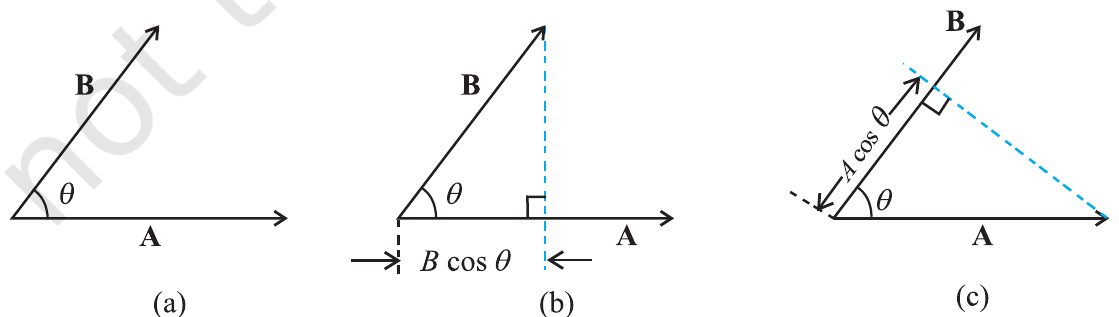
5.1.1 The scalar product: Physical quantities like displacement, velocity, acceleration and force are vectors. There are two ways of multiplying vectors: the scalar product gives a scalar from two vectors, and the vector product produces a new vector from two vectors. Here we take up the scalar product. The scalar product or dot product of two vectors A and B, denoted as A.B (read A dot B), is defined as A.$B = AB \cos θ$ (5.1a), where θ is the angle between the two vectors. Since A, B and cos θ are scalars, the dot product is a scalar quantity: each vector has a direction, but their scalar product does not.
Geometrically, B cos θ is the projection of B onto A (Fig. 5.1(b)) and A cos θ is the projection of A onto B (Fig. 5.1(c)). So A.B is the product of the magnitude of A and the component of B along A; or the product of the magnitude of B and the component of A along B.
The scalar product follows the commutative law: A.B = B.A. Scalar product obeys the distributive law: A.$(B + C) = A$.B + A.C. Also, A.(λ B) = λ (A.B), where λ is a real number. The proofs of these are left as an exercise in NCERT.
For unit vectors i, j, k: i.$i = j$.$j = k$.$k = 1$ and i.$j = j$.$k = k$.$i = 0$.
In components: A = Ax i + Ay j + Az k and B = Bx i + By j + Bz k, so A.$B = AxBx + AyBy + AzBz$ (5.1b). Hence A.$A = A_x^2 + A_y^2 + A_z^2$, or $A^2 = A_x^2 + A_y^2 + A_z^2$ (5.1c), since A.$A = |A||A| \cos 0 = A^2$. Also, A.$B = 0$ if A and B are perpendicular.
Worked example 5.1: $F = (3i + 4j - 5k)$ unit and $d = (5i + 4j + 3k)$ unit. F.$d = Fx dx + Fy dy + Fz dz = 3(5) + 4(4) + (-5)(3) = 16$ unit. F.$F = 50$ unit and d.$d = 50$ unit, so $\cos θ = 16/50 = 0.32$ and $θ = \cos^{-1} 0.32$. The projection of F on d is (F.d)/d = 16/$\sqrt{50}$ unit.
Notions of work and kinetic energy
For rectilinear motion under constant acceleration a, $v^2 - u^2 = 2as$ (5.2), where u and v are the initial and final speeds and s is the distance traversed. Multiplying both sides by m/2 gives $(1/2)mv^2 - (1/2)mu^2 = mas = Fs$ (5.2a), using Newton's Second Law. In three dimensions, $v^2 - u^2 = 2 a$.d, and multiplying by m/2 gives $(1/2)mv^2 - (1/2)mu^2 = m a$.$d = F$.d (5.2b).
The left side is the difference in the quantity 'half the mass times the square of the speed' from its initial value to its final value. We call each of these quantities the kinetic energy, denoted by K. The right side is the product of the displacement and the component of the force along the displacement. This quantity is called work and is denoted by W. So Kf - Ki = W (5.3), where Ki and Kf are the initial and final kinetic energies.
Work is done by a force on the body over a certain displacement.
Equation (5.3) is a special case of the work-energy (WE) theorem: The change in kinetic energy of a particle is equal to the work done on it by the net force. The theorem is generalised to a varying force in 5.6.
Worked example 5.2: a raindrop of mass 1.00 g falls from 1.00 km and hits the ground at 50.0 m/s. The change in kinetic energy is $\Delta K = (1/2)mv^2 = (1/2) x 10^{-3} x 50 \times 50$ = 1.25 J. With $g = 10 m/s^2$, the work done by gravity is $Wg = mgh = 10^{-3} x 10 x 10^{3} = 10.0 J$. From the WE theorem, $\delta K = Wg + Wr$, so the work done by the resistive force is $Wr = \Delta K - Wg = 1.25 - 10 = -8.75 J$. The negative sign shows the resistive force opposes the motion.
Work
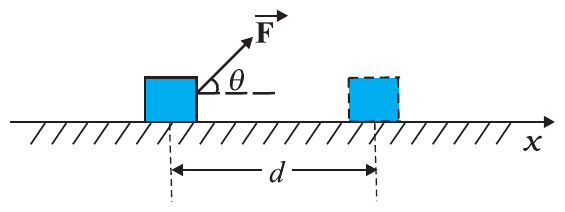
The work done by the force is defined to be the product of component of the force in the direction of the displacement and the magnitude of this displacement. For a constant force F acting on an object of mass m that undergoes a displacement d in the positive x-direction (Fig. 5.2): $W = (F \cos θ)d = F$.d (5.4).
If there is no displacement, there is no work done even if the force is large. When you push hard against a rigid brick wall, the force you exert does no work, yet your muscles are alternately contracting and relaxing, internal energy is used up and you get tired. The meaning of work in physics is different from its everyday usage.
No work is done if: (i) the displacement is zero, so a weightlifter holding a 150 kg mass steadily on his shoulder for 30 s does no work on the load; (ii) the force is zero: a block moving on a smooth horizontal table undergoes a large displacement with no horizontal force; (iii) the force and displacement are mutually perpendicular: for $θ = 90° (π/2 rad), \cos θ = 0$. The gravitational force mg does no work on the block on the table, and if the moon's orbit were perfectly circular, the earth's gravitational force would do no work on it.
Work can be both positive and negative. If θ is between 0° and 90°, cos θ is positive; if θ is between 90° and 180°, cos θ is negative. Friction usually opposes displacement (θ = 180°), so the work done by friction is negative $(\cos 180° = -1)$.
Work and energy have the same dimensions, $[M L^2 T^{-2}]$. The SI unit is the joule (J), named after James Prescott Joule (1811-1869). Alternative units are listed in Table 5.1.
| Unit | Value in J |
|---|---|
| erg | $10^{-7}$ J |
| electron volt (eV) | 1.6 x $10^{-19}$ J |
| calorie (cal) | 4.186 J |
| kilowatt hour (kWh) | 3.6 x $10^{6}$ J |
Source: NCERT XI, Ch 5, Table 5.1.
Worked example 5.3: a cyclist comes to a skidding stop in 10 m; the force on the cycle due to the road is 200 N, directly opposed to the motion. (a) The stopping force and the displacement make an angle of 180°, so the work done by the road is $Wr = Fd \cos θ = 200 \times 10 x \cos π = -2000 J$. This negative work brings the cycle to a halt. (b) By Newton's Third Law an equal and opposite force acts on the road, but the road undergoes no displacement, so the work done by the cycle on the road is zero. The lesson: though the force on A by B is always equal and opposite to that on B by A, the work done on A by B is not necessarily equal and opposite to the work done on B by A.
Practice1 question
Try it now. A wrong answer costs nothing here, try again until you get it.
A force of 200 N acts on a cycle over 10 m, directly opposed to its motion (Example 5.3). How much work does the road do on the cycle?
NCERT 5.3, Example 5.3: $W = Fd \cos θ$ with $θ = 180°, \cos 180° = -1$, so $W = 200 \times 10 x (-1) = -2000 J$.
Kinetic energy
If an object of mass m has velocity v, its kinetic energy K is $K = (1/2) m v$.$v = (1/2)mv^2$ (5.5). Kinetic energy is a scalar quantity. It is a measure of the work an object can do by virtue of its motion: the kinetic energy of a fast flowing stream has been used to grind corn, and sailing ships employ the kinetic energy of the wind.
| Object | Mass (kg) | Speed (m s^-1) | K (J) |
|---|---|---|---|
| Car | 2000 | 25 | 6.3 x $10^{5}$ |
| Running athlete | 70 | 10 | 3.5 x $10^{3}$ |
| Bullet | 5 x $10^{-2}$ | 200 | $10^{3}$ |
| Stone dropped from 10 m | 1 | 14 | $10^{2}$ |
| Rain drop at terminal speed | 3.5 x $10^{-5}$ | 9 | 1.4 x $10^{-3}$ |
| Air molecule | ~$10^{-26}$ | 500 | ~$10^{-21}$ |
Source: NCERT XI, Ch 5, Table 5.2.
Worked example 5.4: a police officer fires a bullet of mass 50.0 g at 200 m/s into soft plywood 2.00 cm thick. The bullet emerges with only 10% of its initial kinetic energy. The initial kinetic energy is $(1/2)mv^2 = 1000 J$, so the final kinetic energy is $0.1 \times 1000 = 100 J$. With $(1/2)mv_f^2 = 100 J$, $vf = \sqrt{(2 \times 100)/0.05} = 63.2 m/s$. The speed is reduced by approximately 68% (not 90%).
Practice1 question
Try it now. A wrong answer costs nothing here, try again until you get it.
A bullet of mass 50.0 g is fired at 200 m/s and emerges with only 10% of its initial kinetic energy. What is its emergent speed?
NCERT 5.4, Example 5.4: initial $KE = 1000 J$, final $KE = 100 J$, so $(1/2)mv_f^2 = 100 J$ gives $vf = 63.2 m/s$.
Work done by a variable force
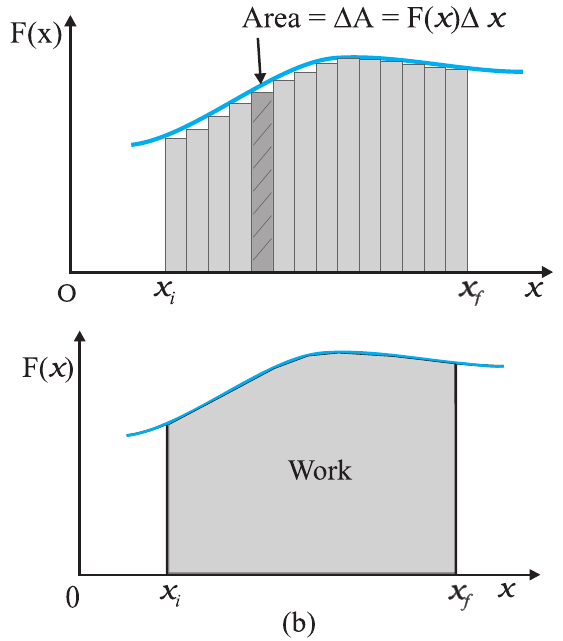
A constant force is rare; the variable force is more commonly encountered. Fig. 5.3 is a plot of a varying force in one dimension. If the displacement $\Delta x$ is small, the force F(x) can be taken as approximately constant, and the work done is $\delta W = F(x) \delta x$. This is the shaded rectangle in Fig. 5.3(a).
Adding successive rectangular areas gives the total work: W is approximately the sum of F(x) $\Delta x$ from xi to xf (5.6). If the displacements approach zero, the number of terms increases without limit, but the sum approaches a definite value equal to the area under the curve in Fig. 5.3(b). Then $W = integral$ of F(x) dx from xi to xf (5.7), where 'lim' stands for the limit of the sum when $\Delta x$ tends to zero. For a varying force, the work done can be expressed as a definite integral of force over displacement.
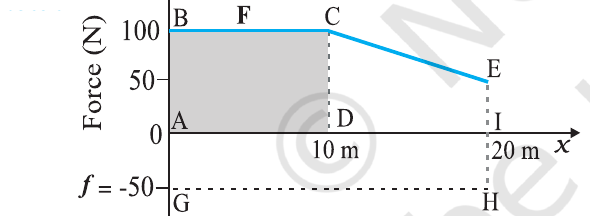
Worked example 5.5: a woman pushes a trunk on a railway platform with a rough surface. She applies 100 N over 10 m; then, getting tired, her force reduces linearly to 50 N over the next 10 m (total 20 m). The frictional force is 50 N. The plot is Fig. 5.4. At $x = 20 m$, F = 50 N (not zero). Friction opposes motion, so it is shown on the negative side of the force axis.
The work done by the woman is the area of rectangle ABCD plus the area of trapezium CEID: $WF = 100 \times 10 + (1/2)(100 + 50) x 10 = 1000 + 750 = 1750 J$. The work done by friction is the area of rectangle AGHI: $Wf = (-50) x 20 = -1000 J$. The area on the negative side of the force axis has a negative sign.
The work-energy theorem for a variable force
The time rate of change of kinetic energy is dK/dt = d((1/2)m$v^2$)/dt = m v dv/dt = F v (from Newton's Second Law) = F dx/dt. $Thus dK = F dx$. Integrating from xi to xf: $Kf - Ki = integral$ of F dx from xi to xf (5.8a). From Eq. (5.7) it follows that Kf - Ki = W (5.8b). The WE theorem is proved for a variable force.
The WE theorem does not, in general, incorporate the complete dynamical information of Newton's Second Law. It is an integral form of Newton's Second Law: Newton's Second Law relates acceleration and force at any instant, while the WE theorem involves an integral over an interval of time, so the temporal (time) information is 'integrated over' and is not available explicitly. Also, Newton's Second Law in two or three dimensions is in vector form, whereas the WE theorem is in scalar form, so information about directions is not present.
Worked example 5.6: a block of mass $m = 1 kg moving$ on a horizontal surface with speed $vi = 2 m/s enters a rough patch$ from $x = 0.10 m$ to $x = 2.01 m$. The retarding force is $Fr = -k/x$ for 0.1 < x < 2.01 m and 0 outside, with $k = 0.5 J$. From Eq. (5.8a): $Kf = Ki + integral$ of (-k/x) dx from 0.1 to 2.01 = (1/2)m$v_i^2$ - k $\ln(2.01/0.1)$ = 2 - $0.5 \ln(20.1) = 2 - 1.5 = 0.5 J$. Then $vf = \sqrt{2Kf/m} = 1 m/s$. Note that ln is the natural logarithm to the base e, not the logarithm to base 10 $(\ln X = \log e X = 2.303 \log 10 X)$.
The concept of potential energy
The word potential suggests possibility or capacity for action. Potential energy brings to mind 'stored' energy. A stretched bow-string possesses potential energy; when released, the arrow flies off at a great speed. The earth's crust has fault lines that are like compressed springs. They possess a large amount of potential energy, and an earthquake results when these fault lines readjust. Potential energy is the stored energy by virtue of the position or configuration of a body. The body left to itself releases this stored energy in the form of kinetic energy.
The gravitational force on a ball of mass m is mg. Near the earth's surface, g may be treated as constant: by near we imply that the height h of the ball is very small compared to the earth's radius RE (h << RE), so the variation of g near the earth's surface can be ignored. Raising the ball to a height h, the work done by the external agency against gravity is mgh, and this work gets stored as potential energy. The gravitational potential energy as a function of height h is V(h) = mgh, the negative of the work done by gravity in raising the object to that height.
The gravitational force F equals the negative of the derivative of V(h) with respect to $h: F = -dV(h)/dh = -mg$. The negative sign shows the force is downward. When released, the ball comes down with increasing speed; just before it hits the ground its speed follows $v^2$ = 2gh, or (1/2)m$v^2$ = mgh: the gravitational potential energy at height h manifests itself as kinetic energy on reaching the ground.
Physically, potential energy applies only to forces where work done against the force gets stored up as energy and manifests as kinetic energy when external constraints are removed. Mathematically, in one dimension, the potential energy V(x) is defined if the force F(x) can be written as $F(x) = -dV/dx$. Then the integral of F(x) dx from xi to xf equals Vi - Vf: the work done by a conservative force such as gravity depends on the initial and final positions only. If the work done or the kinetic energy depended on other factors such as the velocity or the particular path taken, the force would be called non-conservative.
The dimensions of potential energy are $[M L^2 T^{-2}]$ and the unit is joule (J), the same as kinetic energy or work. The change in potential energy, for a conservative force, $\Delta V$ is equal to the negative of the work done by the force: $\delta V = -F(x) \delta x$ (5.9).
The conservation of mechanical energy
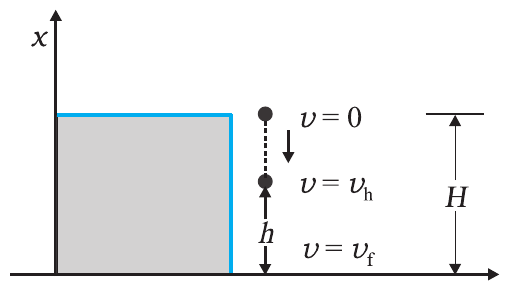
For one-dimensional motion, suppose a body undergoes displacement $\Delta x$ under a conservative force F. From the WE theorem, $\delta K = F(x) \delta x$. If the force is conservative, the potential energy function V(x) can be defined such that -$\delta V = F(x) \delta x$. Together these give $\delta K + \delta V = 0$, or $Δ(K + V) = 0$ (5.10). Over the whole path from xi to xf: $Ki + V(xi) = Kf + V(xf)$ (5.11). The quantity K + V(x) is called the total mechanical energy of the system. Individually K and V(x) may vary from point to point, but the sum is constant.
A force F(x) is conservative if: (i) it can be derived from a scalar quantity $V(x) by F(x) = -dV/dx$; (ii) the work done by it depends only on the end points, W = $Kf - Ki = V(xi) - V(xf)$; (iii) the work done by it in a closed path is zero (since $xi = xf$). The total mechanical energy of a system is conserved if the forces, doing work on it, are conservative.
Fig. 5.5 shows a ball of mass m dropped from a cliff of height H. The total mechanical energies at ground level (0), height h and height H are: $EH = mgH$ (5.11a); $Eh = mgh + (1/2)mv_h^2$ (5.11b); $E_0 = (1/2)mv_f^2$ (5.11c). Conservation gives EH = $E_0$, so $mgH = (1/2)mv_f^2$ and $vf = \sqrt{2gH}$. Also EH = Eh gives $v_h^2 = 2g(H - h)$ (5.11d). At height H the energy is purely potential; it is partly converted to kinetic at height h and fully kinetic at ground level.
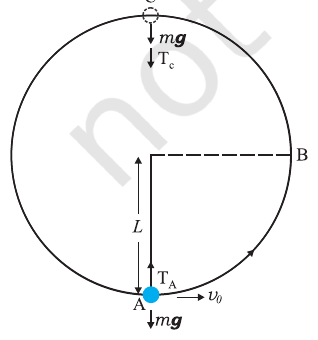
Worked example 5.7: a bob of mass m on a light string of length L is given a horizontal velocity $v_0$ at the lowest point A so that it completes a semi-circular trajectory in the vertical plane, the string becoming slack only at the topmost point C (Fig. 5.6). The tension does no work (the displacement is always normal to the string), so the total mechanical energy is conserved. Taking potential energy zero at A: at A, $E = (1/2)mv_0^2$ (5.12). At C the tension TC becomes zero, so $mg = mv_C^2/L$ (5.14) and $E = (1/2)mv_C^2 + 2mgL$ (5.13). Together these give $E = (5/2)mgL$, and equating with the energy at A gives $v_0 = \sqrt{5gL}$. At C, $vC = \sqrt{gL}$. At B, $E = (1/2)mv_B^2 + mgL, giving vB = \sqrt{3gL}$. The ratio of kinetic energies is $KB/KC = 3/1$. At C the string becomes slack and the bob's velocity is horizontal; if the string is cut at this instant the bob executes projectile motion, otherwise it continues on its circular path and completes the revolution.
The potential energy of a spring
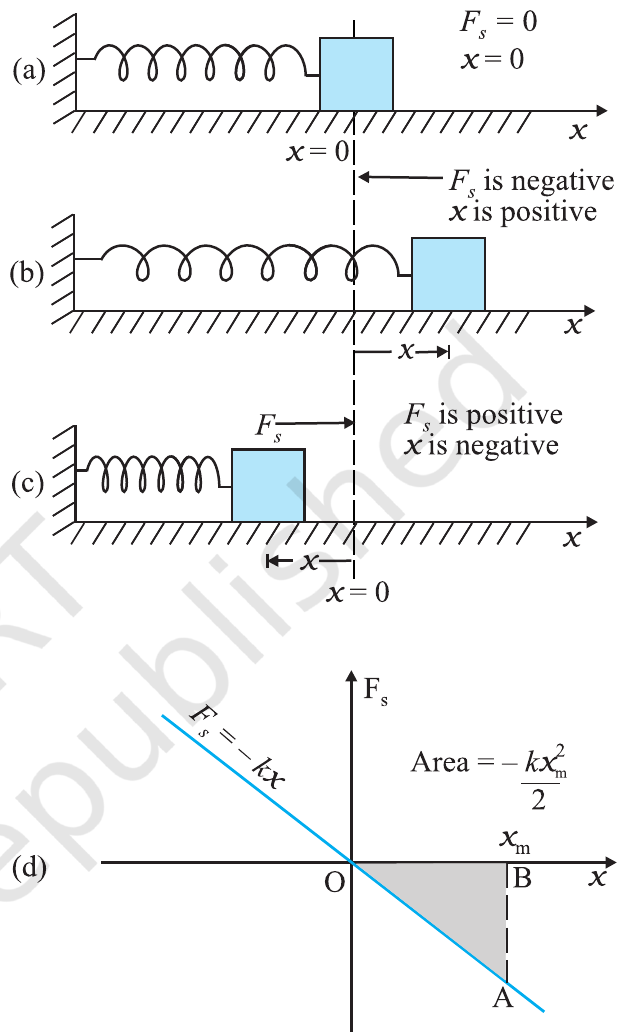
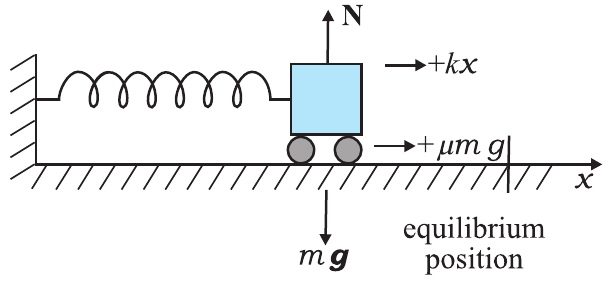
The spring force is a variable force which is conservative. Fig. 5.7 shows a block attached to a spring on a smooth horizontal surface, the other end fixed to a rigid wall. In an ideal spring, the spring force Fs is proportional to x, the displacement from the equilibrium position. This force law is called Hooke's law: $Fs = -kx$. The constant k is the spring constant, unit N m^-1. The spring is stiff if k is large and soft if k is small.
Pulling the block out to extension xm, the work done by the spring force is $Ws = integral$ of Fs dx from 0 to $xm = -integral$ of kx dx from 0 to $xm = -(k x_m^2)/2$ (5.15). The same result follows from the area of the triangle in Fig. 5.7(d). The work done by the external pulling force F is positive, since it overcomes the spring force: $W = +(k x_m^2)/2$ (5.16). The same holds for a compression xc (< 0): the spring does $Ws = -(k x_c^2)/2$ while the external force does +(k $x_c^2$)/2.
Moving the block from xi to xf, the work done by the spring force is $Ws = (k x_i^2)/2 - (k x_f^2)/2$ (5.17). It depends only on the end points. For a closed path (xi back to xi), Ws = 0 (5.18): the work done by the spring force in a cyclic process is zero. The spring force is conservative: it depends only on position $(Fs = -kx)$ and its work depends only on the initial and final positions.
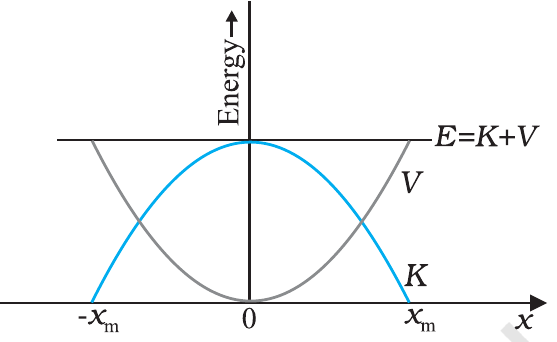
The potential energy V(x) of the spring is defined to be zero at the equilibrium position. For extension (or compression)$x: V(x) = (k x^2)/2$ (5.19). You may check that -$dV/dx = -kx$, the spring force. If the block of mass m is extended to xm and released from rest, conservation of mechanical energy gives $(1/2)k x_m^2 = (1/2)k x^2 + (1/2)mv^2$, so the speed and kinetic energy are maximum at the equilibrium position $x = 0: (1/2)m v_m^2 = (1/2)k x_m^2$, or $vm = \sqrt{k/m} xm$. Note that k/m has dimensions $[T^{-2}]$, so the equation is dimensionally correct. The kinetic energy gets converted to potential energy and vice versa, but the total mechanical energy remains constant (Fig. 5.8).
Worked example 5.8: a car of mass 1000 kg moving at 18.0 km/h on a smooth road collides with a horizontally mounted spring of spring constant 5.25 x $10^{3}$ N/m. Converting 18 km/h to 5 m/s, the kinetic energy is $K = (1/2)mv^2 = (1/2) x 10^{3} x 5 \times 5 = 1.25 x 10^{4} J$. At maximum compression xm, all of it becomes spring potential energy: $V = (1/2)k x_m^2 = 1.25 x 10^{4} J, giving xm = 2.00 m$. [It is useful to remember that 36 $km h-1 = 10 m s-1$]. The spring is taken as massless and the surface as frictionless.
Worked example 5.9: the same car with coefficient of friction μ = 0.5 (Fig. 5.9). Both the spring force and friction oppose the compression. By the WE theorem, $\Delta K = Kf - Ki = 0 - (1/2)mv^2$, and the work done by the net force is $W = -(1/2)k x_m^2 - μmg xm$. Equating gives $(1/2)mv^2 = (1/2)k x_m^2 + μmg xm$. With $μmg = 0.5 x 10^{3} x 10 = 5 x 10^{3} N$, the quadratic k $x_m^2$ + 2μmg xm - m$v^2$ = 0 gives $xm = 1.35 m, less than$ in Example 5.8, as expected.
Remarks on conservative forces: (i) Information on time is absent: the compression can be calculated, but not the time over which it occurs; a solution of Newton's Second Law is needed for temporal information. (ii) Not all forces are conservative. Friction is a non-conservative force, and the conservation of mechanical energy must be modified, as in Example 5.9: if the forces are a conservative force Fc and a non-conservative force Fnc, then Δ(K + V) = Fnc $\Delta x$, or $\Delta E$ = Fnc $\Delta x$, and over the path Ef - Ei = Wnc, where Wnc is the total work done by the non-conservative forces. Unlike a conservative force, Wnc depends on the particular path. (iii) The zero of potential energy is arbitrary and is set by convenience: for the spring, $V(x) = 0$ at $x = 0$; for constant gravity, $V = 0$ on the earth's surface; for universal gravitation, the zero is best defined at an infinite distance. Once fixed, the zero must be consistently adhered to throughout the discussion.
Practice1 question
Try it now. A wrong answer costs nothing here, try again until you get it.
A car of mass 1000 kg moving at 18 km/h hits a spring of spring constant 5.25 x $10^{3}$ N/m. What is the maximum compression of the spring?
NCERT 5.9, Example 5.8: $(1/2)mv^2 = (1/2)k x_m^2$ with $v = 5 m/s$ gives $xm = 2.00 m$.
Power
Often it is interesting to know not only the work done on an object, but also the rate at which this work is done. A person is physically fit if he not only climbs four floors of a building but climbs them fast. Power is defined as the time rate at which work is done or energy is transferred.
The average power is $Pav = W/t$. The instantaneous power is the limiting value of the average power as the time interval approaches zero: P = dW/dt (5.20). The work dW done by a force F for a displacement dr is $dW = F$.dr, so P = F.$(dr/dt) = F$.v (5.21), where v is the instantaneous velocity when the force is F.
Power, like work and energy, is a scalar quantity. Its dimensions are $[M L^2 T^{-3}]$. In the SI, its unit is the watt $(W): 1 W = 1 J/s$. The unit is named after James Watt, one of the innovators of the steam engine in the eighteenth century. Another unit is the horse-power: $1 hp = 746 W$, still used for the output of automobiles and motorbikes.
A 100 watt bulb on for 10 hours uses 1 kilowatt hour (kWh) of energy: $100 W x 10 h = 1000 Wh = 1 kWh = 10^{3} W x 3600 s = 3.6 x 10^{6} J$. Our electricity bills carry energy consumption in units of kWh. Note that kWh is a unit of energy, not of power.
Worked example 5.10: an elevator carrying a maximum load of 1800 kg (elevator + passengers) moves up at a constant speed of 2 m/s; the frictional force opposing the motion is 4000 N. The downward force is $F = mg + Ff = (1800 \times 10) + 4000 = 22000 N$. The motor must supply enough power to balance this force: P = F.$v = 22000 \times 2 = 44000 W = 59 hp$.
Practice1 question
Try it now. A wrong answer costs nothing here, try again until you get it.
An elevator of mass 1800 kg moves up at a constant speed of 2 m/s against a frictional force of 4000 N. What is the minimum power delivered by the motor?
NCERT 5.10, Example 5.10: $F = mg + Ff = 18000 + 4000 = 22000 N$, P = $Fv = 22000 \times 2 = 44000 W$.
Collisions
In physics we study motion, and at the same time we try to discover physical quantities that do not change in a physical process. The laws of momentum and energy conservation are typical examples. Here they are applied to collisions: billiards, marbles and carrom all involve collisions.
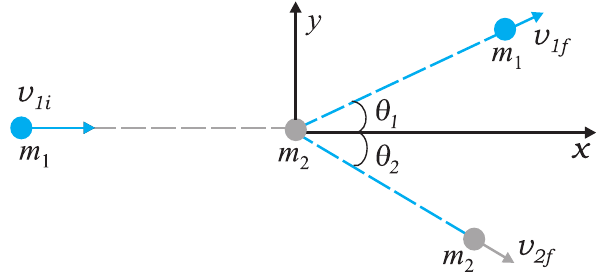
Consider two masses $m_1$ and $m_2$. The particle $m_1$ moves with speed $v_{1i}$ (the subscript 'i' means initial); $m_2$ can be taken to be at rest. The mass $m_1$ collides with the stationary mass m2 (Fig. 5.10), and the two fly off in different directions.
5.11.1 Elastic and inelastic collisions: In all collisions the total linear momentum is conserved: the initial momentum of the system equals the final momentum. When two objects collide, the mutual impulsive forces over the collision time $\Delta t$ change their momenta: $\Delta p$1 = F12 $\Delta t$ and $\delta p2 = F21 \delta t$. By Newton's Third Law, $F12 = -F21$, so $\delta p1 + \delta p2 = 0$. This holds even though the forces vary in a complex fashion during $\Delta t$, since the third law is true at every instant.
The total kinetic energy is not necessarily conserved. Impact and deformation during collision may generate heat and sound, and part of the initial kinetic energy is transformed into other forms. A useful way to visualise the deformation is a compressed spring: if the 'spring' regains its original shape without loss in energy, the initial kinetic energy equals the final kinetic energy, but the kinetic energy during the collision time is not constant. Such a collision is called an elastic collision. If the deformation is not relieved and the two bodies move together after the collision, it is a completely inelastic collision. The intermediate case, where the deformation is partly relieved and some kinetic energy is lost, is more common and is called an inelastic collision.
Collisions in one dimension
If the initial and final velocities of both bodies are along the same straight line, it is a one-dimensional collision, or head-on collision. For small spherical bodies this is possible if the direction of travel of body 1 passes through the centre of body 2 at rest.
For a completely inelastic collision in one dimension, θ₁ = $θ₂ = 0$ in Fig. 5.10. Momentum conservation gives $m1v1i = (m_1 + m_2)vf$, so $vf = (m_1/(m_1 + m_2)) v_{1i}$ (5.22). The loss in kinetic energy is $\delta K = (1/2)m1v_{1i}^2 - (1/2)(m_1 + m_2)v_f^2$ = (1/2)((m1m2)/($m_1$ + $m_2$))$v_{1i}^2$, a positive quantity, as expected.
For an elastic collision, with θ₁ = $θ₂ = 0$, momentum and kinetic energy conservation give $m1v1i = m1v1f + m2v2f$ (5.23) and $m1v_{1i}^2 = m1v_{1f}^2 + m2v_{2f}^2$ (5.24). From these, $v_{2f} = v_{1i} + v_{1f}$ (5.25), and substituting in (5.23): $v_{1f} = ((m_1 - m_2)/(m_1 + m_2)) v_{1i}$ (5.26) and $v_{2f} = (2m1/(m_1 + m_2)) v_{1i}$ (5.27). The unknowns {$v_{1f}$, $v_{2f}$} are obtained from the knowns {$m_1$, $m_2$, $v_{1i}$}.
Special cases: (i) equal masses $(m_1 = m_2): v_{1f} = 0$ and $v_{2f} = v_{1i}$: the first mass comes to rest and pushes off the second mass with its initial speed. (ii) one mass dominates ($m_2$ >> $m_1$): $v_{1f}$ is approximately -$v_{1i}$ and $v_{2f}$ is approximately 0: the heavier mass is undisturbed while the lighter mass reverses its velocity.
Worked example 5.11 (slowing down of neutrons): in a nuclear reactor a neutron of high speed (typically $10^{7}$ m/s) must be slowed to $10^{3}$ m/s to interact with uranium-235 and cause fission. A neutron loses most of its kinetic energy in an elastic collision with light nuclei like deuterium or carbon. The fractional kinetic energy retained is $f_1 = K_{1f}/K_{1i} = ((m_1 - m_2)/(m_1 + m_2))^2$, and the fraction gained by the moderating nuclei is $f_2 = 1 - f_1 = (4m1m2)/((m_1 + m_2)²)$. For deuterium $(m_2 = 2m1)$, $f_1 = 1/9$ and $f_2 = 8/9$: almost 90% of the neutron's energy is transferred. For carbon, $f_1 = 71.6%$ and $f_2 = 28.4%$. In practice the transfer is smaller, since head-on collisions are rare.
Practice1 question
Try it now. A wrong answer costs nothing here, try again until you get it.
In a completely inelastic one-dimensional collision, a mass of 2 kg moving at 3 m/s hits a mass of 1 kg at rest. What is the common speed after the collision?
NCERT 5.11.2, Eq. (5.22): $vf = (m_1/(m_1 + m_2)) v_{1i} = (2/3) x 3 = 2 m/s$.
Collisions in two dimensions
In general the collision is two-dimensional, where the initial and final velocities lie in a plane. Fig. 5.10 also depicts the collision of a moving mass $m_1$ with the stationary mass $m_2$. Linear momentum is conserved; since momentum is a vector this implies three equations, for x, y and z. Taking the plane of the final velocities as the x-y plane, the z-component conservation implies the entire collision is in the x-y plane. The x- and y-component equations are: $m1v1i = m1v1f \cos θ₁ + m2v2f \cos θ₂$ (5.28) and 0 = m1v1f sin θ₁ - m2v2f sin θ₂ (5.29).
The knowns are usually {$m_1$, $m_2$, $v_{1i}$}; there are four unknowns {$v_{1f}$, $v_{2f}$, θ₁, θ₂} and only two equations. If θ₁ = $θ₂ = 0$, Eq. (5.23) for one-dimensional collision is regained. If the collision is also elastic, (1/2)$m_1v_{1i}^2$ = (1/2)$m_1v_{1f}^2$ + (1/2)$m_2v_{2f}^2$ (5.30) gives an additional equation, still leaving one equation short. At least one unknown, say θ₁, must be known for the problem to be solvable: θ₁ can be determined by moving a detector in an angular fashion from the x to the y axis. Given {$m_1$, $m_2$, $v_{1i}$, θ₁}, the values {$v_{1f}$, $v_{2f}$, θ₂} follow from Eqs. (5.28)-(5.30).
Worked example 5.12: two billiard balls of equal masses $m_1 = m_2 collide$; the first (cue) ball hits the second (target) ball, which the player wants to sink in a corner pocket at an angle $θ₂ = 37°$. The collision is elastic, and friction and rotational motion are ignored. From momentum conservation with equal masses, $v_{1i} = v_{1f} + v_{2f} (vector sum)$, so $v_{1i}^2 = v_{1f}^2 + v_{2f}^2 + 2 v_{1f}$.$v_{2f} = v_{1f}^2 + v_{2f}^2 + 2v1f v_{2f} \cos(θ₁ + 37°)$ (5.31). Since the collision is elastic and $m_1 = m_2$, kinetic energy conservation gives $v_{1i}^2 = v_{1f}^2 + v_{2f}^2$ (5.32). Comparing (5.31) and (5.32) gives $\cos(θ₁ + 37°) = 0$, so $θ₁ + 37° = 90°$ and $θ₁ = 53°$. So when two equal masses undergo a glancing elastic collision with one of them at rest, after the collision they move at right angles to each other.
In our everyday world, collisions take place only when two bodies touch each other. But a comet coming from far away to the sun, or an α particle approaching a nucleus and going away in some direction, involves forces acting at a distance: such an event is called scattering. The velocities and directions in which the two particles go away depend on their initial velocities, the type of interaction, their masses, shapes and sizes.
Summary: the chapter in seven points
- The work-energy theorem states that the change in kinetic energy of a body is the work done by the net force on the body. $Kf - Ki = Wnet$.
- A force is conservative if (i) work done by it on an object is path independent and depends only on the end points {xi, xf}, or (ii) the work done by the force is zero for an arbitrary closed path taken by the object such that it returns to its initial position.
- For a conservative force in one dimension, we may define a potential energy function V(x) such that $F(x) = -dV(x)/dx$, or $Vi - Vf = integral$ of F(x) dx from xi to xf.
- The principle of conservation of mechanical energy states that the total mechanical energy of a body remains constant if the only forces that act on the body are conservative.
- The gravitational potential energy of a particle of mass m at a height x about the earth's surface is V(x) = mgx, where the variation of g with height is ignored.
- The elastic potential energy of a spring of force constant k and extension x is $V(x) = (1/2)kx^2$.
- The scalar or dot product of two vectors A and B is written as A.B and is a scalar quantity given by A.$B = AB \cos θ$, where θ is the angle between A and B. It can be positive, negative or zero depending on the value of θ. The scalar product can be interpreted as the product of the magnitude of one vector and the component of the other vector along the first vector. For unit vectors: i.$i = j$.$j = k$.$k = 1$ and i.$j = j$.$k = k$.$i = 0$. Scalar products obey the commutative and the distributive laws.
Table: Physical quantities, dimensions and units
The chapter's quantities, dimensions and units are collected in the table below (NCERT XI, Ch 5, printed p87).
| Physical Quantity | Symbol | Dimensions | Units | Remarks |
|---|---|---|---|---|
| Work | W | $[M L^2 T^{-2}]$ | J | W = F.d |
| Kinetic energy | K | $[M L^2 T^{-2}]$ | J | $K = (1/2)mv^2$ |
| Potential energy | V(x) | $[M L^2 T^{-2}]$ | J | $F(x) = -dV(x)/dx$ |
| Mechanical energy | E | $[M L^2 T^{-2}]$ | J | $E = K + V$ |
| Spring constant | k | $[M T^{-2}]$ | N m^-1 | $F = -kx, V(x) = (1/2)kx^2$ |
| Power | P | $[M L^2 T^{-3}]$ | W | P = F.v, $P = dW/dt$ |
Source: NCERT XI, Ch 5, printed p87.
Points to ponder
- The phrase 'calculate the work done' is incomplete. We should refer (or imply clearly by context) to the work done by a specific force or a group of forces on a given body over a certain displacement.
- Work done is a scalar quantity. It can be positive or negative unlike mass and kinetic energy which are positive scalar quantities. The work done by the friction or viscous force on a moving body is negative.
- For two bodies, the sum of the mutual forces exerted between them is zero from Newton's Third Law, $F12 + F21 = 0$. But the sum of the work done by the two forces need not always cancel, i.e. W12 + W21 is not 0. However, it may sometimes be true.
- The work done by a force can be calculated sometimes even if the exact nature of the force is not known. This is clear from Example 5.2 where the WE theorem is used in such a situation.
- The WE theorem is not independent of Newton's Second Law. The WE theorem may be viewed as a scalar form of the Second Law. The principle of conservation of mechanical energy may be viewed as a consequence of the WE theorem for conservative forces.
- The WE theorem holds in all inertial frames. It can also be extended to non-inertial frames provided we include the pseudoforces in the calculation of the net force acting on the body under consideration.
- The potential energy of a body subjected to a conservative force is always undetermined up to a constant. For example, the point where the potential energy is zero is a matter of choice. For the gravitational potential energy mgh, the zero is chosen to be the ground. For the spring potential energy (1/2)k$x^2$, the zero is the equilibrium position of the oscillating mass.
- Every force encountered in mechanics does not have an associated potential energy. For example, work done by friction over a closed path is not zero and no potential energy can be associated with friction.
- During a collision: (a) the total linear momentum is conserved at each instant of the collision; (b) the kinetic energy conservation (even if the collision is elastic) applies after the collision is over and does not hold at every instant of the collision. In fact the two colliding objects are deformed and may be momentarily at rest with respect to each other.
Exercises 5.1 to 5.23: what NCERT asks
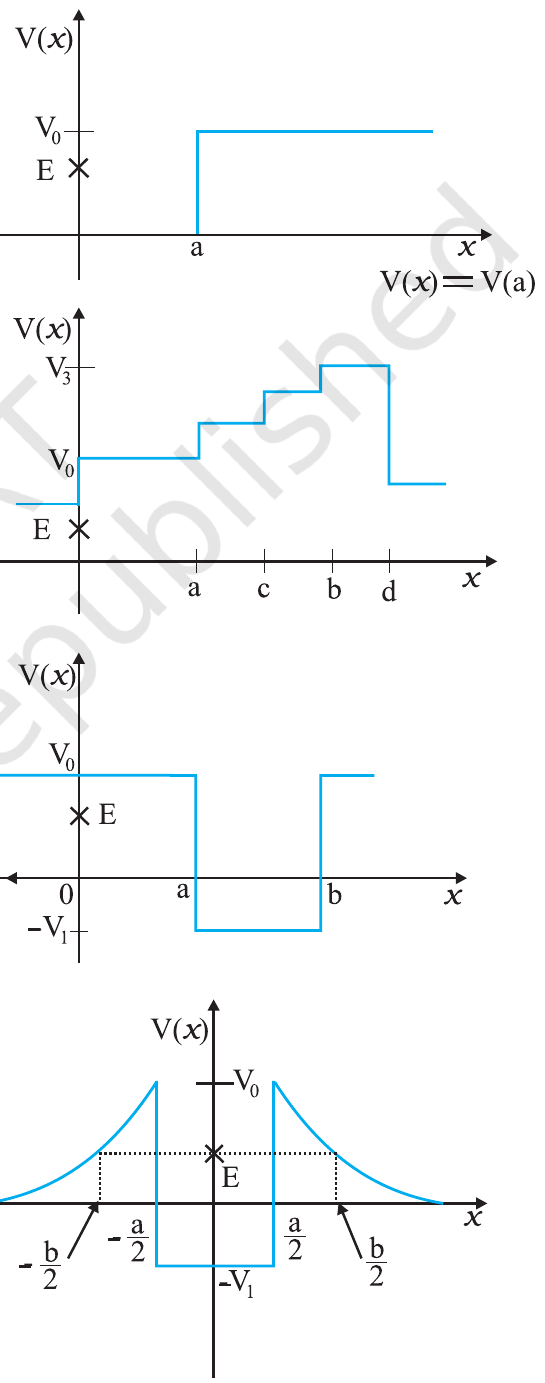
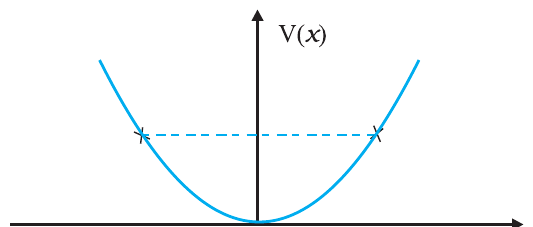
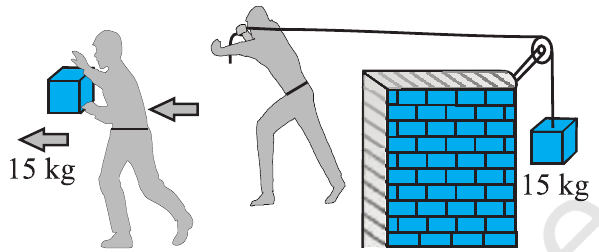
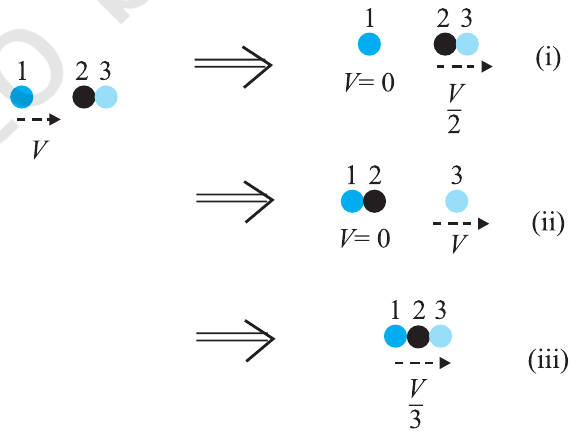
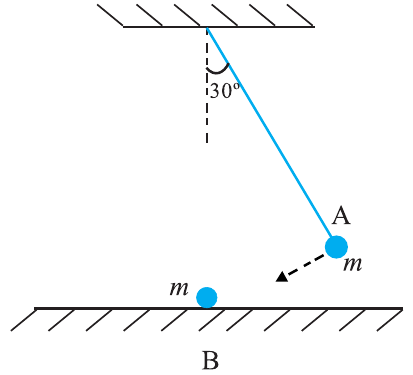
The chapter ends with 23 exercises (5.1-5.23). They test the chapter's core skills: the sign of work (5.1); work and change in kinetic energy under an applied force and friction (5.2); forbidden regions and minimum total energy from potential-energy graphs (5.3, Fig. 5.11); turning points of a particle in a spring potential (5.4, Fig. 5.12); work in everyday situations (5.5, Fig. 5.13); true/false statements about conservative forces and collisions (5.6, 5.7); elastic and inelastic collisions (5.8); power as a function of time (5.9, 5.10); work done by a constant force along the z-axis (5.11); electron vs proton speeds (5.12); work done by gravity and air resistance on a raindrop (5.13); momentum conservation in a rebound (5.14); pump power and efficiency (5.15); which result of an elastic ball-bearing collision is possible (5.16, Fig. 5.14); how high pendulum bob A rises after an elastic collision (5.17, Fig. 5.15); a pendulum bob losing 5% of its energy to air resistance (5.18); a leaking sandbag trolley (5.19); work done for $v = a x^{3/2}$ (5.20); windmill power (5.21); a dieter lifting a mass (5.22); solar power for a family (5.23).
Two exercise answers worth remembering: in Exercise 5.4, a particle of total energy 1 J in the potential $V(x) = (k x^2)/2$ with $k = 0.5 N/m$ must turn back when it reaches x = ±2 m. In Exercise 5.17, bob A does not rise at all after the collision: in an elastic collision of two equal masses, the moving bob comes to rest and the stationary bob moves off with its velocity (see 5.11.2, Case I).
Table: Work, energy and power at a glance
Every key equation of the chapter, collected in one place. Each one appears with its derivation in the section noted.
| Quantity | Formula |
|---|---|
| Scalar product | A.$B = AB \cos θ$ |
| Work (constant force) | $W = (F \cos θ)d = F$.d |
| Kinetic energy | $K = (1/2)mv^2$ |
| Work-energy theorem | Kf - Ki = W |
| Work (variable force) | W = area under the F(x) curve between xi and xf |
| Potential energy change | $\Delta V = -F(x) \Delta x$ |
| Conservation of mechanical energy | $Ki + V(xi) = Kf + V(xf)$ |
| Spring force | $Fs = -kx$ |
| Spring potential energy | $V(x) = (k x^2)/2$ |
| Work by spring force | $Ws = -(k x_m^2)/2$ |
| Average power | $Pav = W/t$ |
| Instantaneous power | $P = dW/dt = F$.v |
| Completely inelastic (1-D) | $vf = (m_1/(m_1 + m_2)) v_{1i}$ |
| Elastic (1-D) | $v_{1f} = ((m_1 - m_2)/(m_1 + m_2)) v_{1i}$, $v_{2f} = (2m1/(m_1 + m_2)) v_{1i}$ |
| Units | work and energy: J; power: W; 1 $hp = 746 W$; 1 $kWh = 3.6 \times 10^6 J$ |
Trap pairs: the confusions NEET tests
- Work needs a force, so any force does work: no. No work is done if the displacement is zero, the force is zero, or the force is perpendicular to the displacement $(θ = 90°)$. A weightlifter holding 150 kg still does no work on the load.
- Newton's Third Law means the works are equal and opposite: no. The forces are equal and opposite, but the works need not be: in Example 5.3 the road does -2000 J on the cycle while the cycle does 0 J on the road.
- Kinetic energy can be negative when the velocity is negative: no. $K = (1/2)mv^2$ is always positive or zero; only work can be negative (Points to ponder 2).
- Every force has a potential energy: no. Potential energy is defined only for conservative forces. Friction has none, because the work done by friction over a closed path is not zero (Points to ponder 8).
- In an elastic collision, kinetic energy is conserved at every instant: no. It is conserved only after the collision is over; during contact the bodies deform and part of the kinetic energy is stored as potential energy (Points to ponder 9).
- Climbing stairs fast does more work than climbing slowly: no. The work against gravity is the same; climbing fast means more power, since power is the time rate of doing work (5.10).
Trap Boxes
Any force acting on a body does work?
Wrong idea: If a force acts on a body, work is done.
No work is done if the displacement is zero, the force is zero, or the force is perpendicular to the displacement $(θ = 90°)$.
NCERT XI, Ch 5, 5.3
Newton's Third Law makes the two works equal and opposite?
Wrong idea: The work done on A by B is equal and opposite to the work done on B by A.
The forces are equal and opposite, but the works need not be: in Example 5.3 the road does -2000 J on the cycle while the cycle does 0 J on the road.
NCERT XI, Ch 5, 5.3
Kinetic energy can be negative?
Wrong idea: Kinetic energy is negative when the velocity is negative.
$K = (1/2)mv^2$ is always positive or zero; only work can be positive or negative.
NCERT XI, Ch 5, 5.4
Every force has a potential energy?
Wrong idea: A potential energy can be defined for every force.
Potential energy is defined only for conservative forces; friction has none, because the work done by friction over a closed path is not zero.
NCERT XI, Ch 5, 5.7
Kinetic energy is conserved at every instant of an elastic collision?
Wrong idea: In an elastic collision, kinetic energy stays constant throughout the collision.
Kinetic energy is conserved only after the collision is over; during contact the bodies deform and part of the kinetic energy is stored as potential energy.
NCERT XI, Ch 5, 5.11.1
Climbing fast does more work than climbing slowly?
Wrong idea: Climbing stairs fast does more work against gravity than climbing slowly.
The work against gravity is the same; climbing fast means more power, since power is the time rate of doing work.
NCERT XI, Ch 5, 5.10
Chapter test
5 NEET PYQs. +4 for a correct answer, -1 for a wrong answer, exactly like NEET. Finish the test to earn a medal.
Q1: NEET (UG) 2025, Code 45, Q7
A bob of heavy mass m is suspended by a light string of length l. The bob is given a horizontal velocity $v_0$ as shown in figure. If the string gets slack at some point P making an angle θ from the horizontal, the ratio of the speed v of the bob at point P to its initial speed $v_0$ is:
At P the tension is zero, so $mg \sin θ = mv^2/l$, giving $v^2 = gl \sin θ$. Energy conservation from the lowest point gives $(1/2)mv_0^2 = (1/2)mv^2 + mg(l + l \sin θ)$, so $v_0^2 = gl(2 + 3 \sin θ)$ and $v/v_0 = (\sin θ/(2 + 3 \sin θ))^{1/2}$.
Q2: NEET (UG) 2024, Code R3, Q11
Two bodies A and B of same mass undergo completely inelastic one-dimensional collision. The body A moves with velocity v1 while body B is at rest before collision. The velocity of the system after collision is $v_2$. The ratio v1: $v_2$ is:
Momentum conservation: $m v1 = 2m v_2$, so $v1/v_2 = 2, ratio 2:1$.
Q3: NEET (UG) 2024, Code R3, Q1
At any instant of time t, the displacement of any particle is given by 2t - 1 (SI unit) under the influence of force of 5 N. The value of instantaneous power is (in SI unit):
$v = dx/dt = 2 m/s$, P = $Fv = 5 \times 2 = 10 W$.
Q4: NEET (UG) 2023, Code F1, Q17
The potential energy of a long spring when stretched by 2 cm is U. If the spring is stretched by 8 cm, potential energy stored in it will be
$V = (k x^2)/2$, so V scales as $x^2: (8/2)² = 16$, so the stored energy is 16U.
Q5: NEET (UG) 2022, Code R1, Q18
An electric lift with a maximum load of 2000 kg (lift + passengers) is moving up with a constant speed of 1.5 ms-1. The frictional force opposing the motion is 3000 N. The minimum power delivered by the motor to the lift in watts is: $(g = 10 m s-2)$
$F = mg + Ff = 20000 + 3000 = 23000 N$, P = $Fv = 23000 \times 1.5 = 34500 W$.
Score: 0 · Answered 0 of 5
Flashcards
Tap a card to flip it over and see the answer. Tap it again to flip it back.
Give the work-energy theorem.
Tap to flipKf - Ki = W: the change in kinetic energy of a particle is equal to the work done on it by the net force.
Tap to flip backGive the definition of work for a constant force.
Tap to flip$W = (F \cos θ) d = F$.d, where θ is the angle between the force and the displacement.
Tap to flip backGive the kinetic energy of a mass m moving with speed v.
Tap to flip$K = (1/2)mv^2$.
Tap to flip backGive the work done by a variable force F(x) from xi to xf.
Tap to flipW = area under the F(x) curve between xi and xf, the definite integral of F(x) dx from xi to xf.
Tap to flip backGive the spring force and the potential energy of a spring.
Tap to flip$Fs = -kx$; $V(x) = (k x^2)/2$.
Tap to flip backGive the instantaneous power in terms of force and velocity.
Tap to flipP = F.$v = dW/dt$.
Tap to flip backWhat is 1 horsepower in watts?
Tap to flip1 $hp = 746 W$.
Tap to flip backWhat is 1 kilowatt hour in joules?
Tap to flip1 $kWh = 3.6 \times 10^6 J$.
Tap to flip backWhat is the speed of the bob at the top of the vertical circle in Example 5.7?
Tap to flip$vC = \sqrt{gL}$, with $v_0 = \sqrt{5gL}$ at the bottom.
Tap to flip backOrder the speeds of the bob in Example 5.7 from largest to smallest.
Tap to flip$v_0 = \sqrt{5gL}$ at A, then $vB = \sqrt{3gL}$ at B, then $vC = \sqrt{gL}$ at C.
Tap to flip backWhen is the work done by a force zero?
Tap to flipWhen the displacement is zero, the force is zero, or the force is perpendicular to the displacement.
Tap to flip backName the three kinds of collision by kinetic energy.
Tap to flipElastic (kinetic energy conserved), completely inelastic (the two bodies move together after), inelastic (part of the kinetic energy is lost).
Tap to flip backFrequently asked questions
Any force acting on a body does work?
No work is done if the displacement is zero, the force is zero, or the force is perpendicular to the displacement $(θ = 90°)$.
Newton's Third Law makes the two works equal and opposite?
The forces are equal and opposite, but the works need not be: in Example 5.3 the road does -2000 J on the cycle while the cycle does 0 J on the road.
Kinetic energy can be negative?
$K = (1/2)mv^2$ is always positive or zero; only work can be positive or negative.
Every force has a potential energy?
Potential energy is defined only for conservative forces; friction has none, because the work done by friction over a closed path is not zero.
Kinetic energy is conserved at every instant of an elastic collision?
Kinetic energy is conserved only after the collision is over; during contact the bodies deform and part of the kinetic energy is stored as potential energy.