 NEET Notes
Home > Physics > Electric Charges and Fields
Electric Charges and Fields
Electrostatics deals with the study of forces, fields and potentials arising from static charges.
On this page · 22 sections
- 01Syllabus Map - Electric Charges and Fields
- 021.1 Introduction
- 031.2 Electric Charge
- 041.3 Conductors and Insulators
- 051.4 Basic Properties of Electric Charge
- 061.4.3 Quantisation of Charge
- 071.5 Coulomb's Law
- 081.6 Forces Between Multiple Charges
- 091.7 Electric Field
- 101.7.1 Electric Field Due to a System of Charges
- 111.7.2 Physical Significance of Electric Field
- 121.8 Electric Field Lines
- 131.9 Electric Flux
- 141.10 Electric Dipole
- 151.11 Dipole in a Uniform External Field
- 161.12 Continuous Charge Distribution
- 171.13 Gauss's Law
- 181.14 Applications of Gauss's Law
- 19Physical Quantities and Their Symbols
- 20Trap Pairs - What Goes Wrong
- 21Points to Ponder
- 22Exercises (Figures 1.30 and 1.31)
Two kinds of charge, Coulomb's law, the electric field and its lines, flux, dipoles and Gauss's law, from NCERT Ch 1, with 5 NEET PYQs.
Syllabus Map - Electric Charges and Fields
- NMC Unit: PHYS-U11, Electrostatics. NCERT Chapter 1, Electric Charges and Fields (Class XII, rationalised book, leph101.pdf, Reprint 2026-27). The PDF title page reads CHAPTER ONE - ELECTRIC CHARGES AND FIELDS, with sections 1.1 to 1.14, one unnumbered physical-quantity table and Figures 1.1 to 1.31. All section and figure references in this chapter use the current book numbering so they can be traced to the PDF.
- Subtopics in this chapter (NCERT XII, Ch 1): introduction (1.1); electric charge (1.2); conductors and insulators (1.3); basic properties of electric charge (1.4); Coulomb's law (1.5); forces between multiple charges (1.6); electric field (1.7); electric field lines (1.8); electric flux (1.9); electric dipole (1.10); dipole in a uniform external field (1.11); continuous charge distribution (1.12); Gauss's law (1.13); applications of Gauss's law (1.14).
- Subtopic checklist: (1) two kinds of charge, like charges repel and unlike charges attract, polarity, electrification by rubbing, gold-leaf electroscope; (2) conductors, insulators, semiconductors; (3) additivity, conservation, quantisation, $q = ne$, $e = 1.602192 \times 10^{-19} C$; (4) Coulomb's law, $F = (1/(4πε0)) (q_1 q_2)/(r^2), vector form$, superposition; (5) electric field, $E = F/q$, field of a point charge and of a system of charges, physical significance; (6) field lines and their four properties; (7) electric flux, $Δφ = E$ . $\Delta S$; (8) dipole, dipole moment $p = q x 2a p-hat$, axial and equatorial fields, torque $τ = p x E$; (9) linear, surface and volume charge densities; (10) Gauss's law, $φ = q/ε0$, Gaussian surface; (11) field of a wire, a plane sheet and a spherical shell.
- Out of scope (named here, not covered): electrostatic potential, potential energy and capacitance (NCERT Ch 2, the same NMC Unit 11); electric field of a dipole at a general point (NCERT gives the axis and the equatorial plane only); magnetism and electromagnetic waves (later chapters).
- Note on symbols: NCERT writes the permittivity of free space as ε0 (ε-naught), 8.854 x $10^{-12}$ $C^2$ N^-1 m^-2, and the Coulomb constant as $k = 1/(4πε0) = 9 \times 10⁹ N m^2 C^{-2}$. Charge densities are λ (line), σ (surface) and ρ (volume); $\Delta S$ is an area element and n̂ its outward normal.
1.1 Introduction
- Sparks and crackles when we take off synthetic clothes or sweaters in dry weather, lightning in thunderstorms, and the shock felt on opening a car door or holding the iron bar of a bus are all discharge of electric charges through our body, accumulated by rubbing of insulating surfaces. This is generation of static electricity.
- Static means anything that does not move or change with time. Electrostatics deals with the study of forces, fields and potentials arising from static charges.
- This is precisely the topic we are going to discuss in this and the next chapter.
1.2 Electric Charge
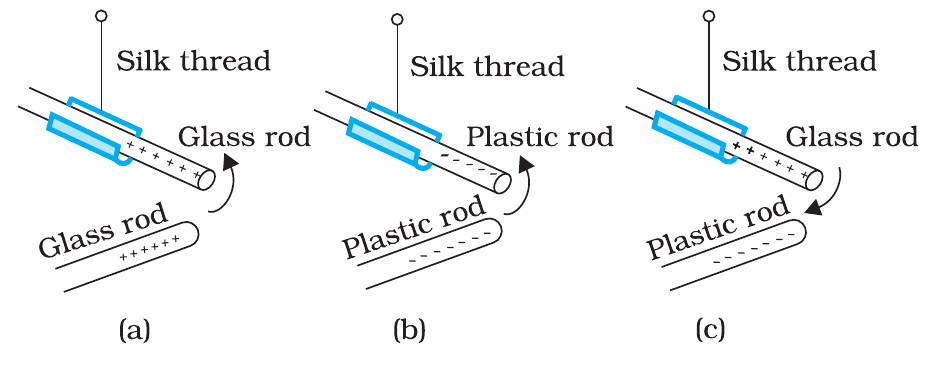
- The credit of discovering that amber rubbed with wool or silk attracts light objects goes to Thales of Miletus, Greece, around 600 BC. The name electricity is coined from the Greek word elektron meaning amber.
- Two glass rods rubbed with wool or silk repel each other [Fig. 1.1(a)]; the two strands of wool or pieces of silk also repel each other; but the glass rod and wool attract each other. Two plastic rods rubbed with cat's fur repel each other [Fig. 1.1(b)] but attract the fur. The plastic rod attracts the glass rod [Fig. 1.1(c)] and repels the silk or wool; the glass rod repels the fur.
- There are only two kinds of an entry called the electric charge. Bodies like glass or plastic rods, silk, fur and pith balls are electrified: they acquire an electric charge on rubbing. (i) like charges repel and (ii) unlike charges attract each other. The property which differentiates the two kinds of charges is called the polarity of charge.
- When a glass rod is rubbed with silk, the rod acquires one kind of charge and the silk the second kind. If the electrified glass rod is brought in contact with the silk, they no longer attract each other: unlike charges neutralise or nullify each other's effect. The charges were named as positive and negative by Benjamin Franklin. By convention, the charge on glass rod or cat's fur is called positive and that on plastic rod or silk is termed negative. A body with no charge is electrically neutral.
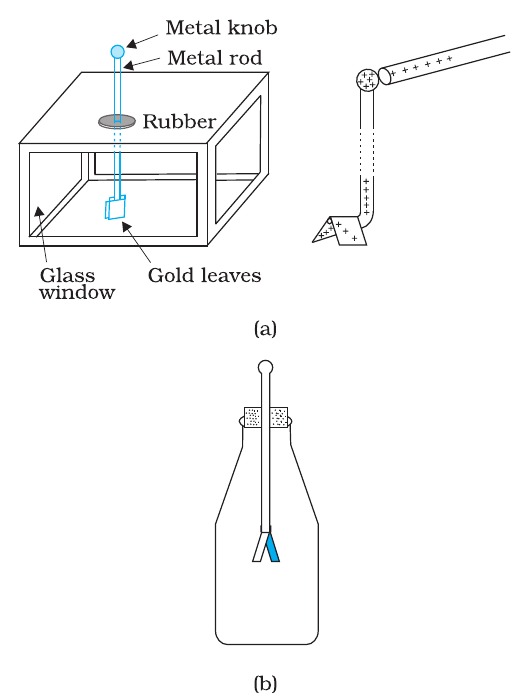
- A simple apparatus to detect charge is the gold-leaf electroscope [Fig. 1.2(a)]: a vertical metal rod in a box, with two thin gold leaves at its bottom end. When a charged object touches the metal knob, charge flows on to the leaves and they diverge. The degree of divergance is an indicator of the amount of charge. [NCERT prints "divergance".]
- All matter is made of atoms and molecules. Materials are normally electrically neutral, but their charges are exactly balanced. Forces that hold molecules together, forces that hold atoms together in a solid, the adhesive force of glue and forces of surface tension are all basically electrical in nature, arising from forces between charged particles. The electric force is all pervasive.
- To electrify a neutral body, add or remove one kind of charge. A charged body has an excess charge or deficit of charge. In solids, some electrons, being less tightly bound in the atom, are transferred from one body to the other. A body is charged positively by losing some of its electrons and negatively by gaining electrons. Rubbing a glass rod with silk transfers some electrons from the rod to the silk: the rod gets positively charged and the silk negatively charged. No new charge is created in rubbing, and the number of electrons transferred is a very small fraction of the total number in the body.
1.3 Conductors and Insulators
- Substances which allow electricity to pass through them easily are called conductors: they have electric charges (electrons) comparatively free to move inside the material. Metals, human and animal bodies and earth are conductors.
- Most non-metals like glass, porcelain, plastic, nylon and wood offer high resistance to the passage of electricity: they are called insulators.
- There is a third category called semiconductors, which offer resistance to the movement of charges which is intermediate between the conductors and insulators.
- Charge transferred to a conductor readily gets distributed over the entire surface of the conductor. Charge put on an insulator stays at the same place.
- A nylon or plastic comb gets electrified on combing dry hair or on rubbing, but a metal article like a spoon does not: the charges on metal leak through our body to the ground, as both are conductors. A metal rod with a wooden or plastic handle, rubbed without touching its metal part, shows signs of charging.
1.4 Basic Properties of Electric Charge
- There are two types of charges, positive and negative, and their effects tend to cancel each other.
- If the sizes of charged bodies are very small compared to the distances between them, they are treated as point charges: all the charge content of the body is assumed to be concentrated at one point in space.
- Additivity of charges (1.4.1): if a system contains two point charges $q_1$ and $q_2$, the total charge is $q_1$ + $q_2$: charges add up like real numbers, they are scalars like the mass of a body. For n charges $q_1$, $q_2$, q3, ..., qn, the total charge is $q_1$ + $q_2$ + q3 + ... + qn. Charge has magnitude but no direction, similar to mass. But mass is always positive, while a charge can be either positive or negative, so proper signs must be used. Example: (+1) + (+2) + (-3) + (+4) + (-5) = -1 in the same unit.
- Conservation of charge (1.4.2): when bodies are charged by rubbing, there is transfer of electrons from one body to the other; no new charges are created or destroyed. Within an isolated system, charges may get redistributed, but the total charge of the isolated system is always conserved. Conservation of charge has been established experimentally.
- It is not possible to create or destroy net charge carried by any isolated system, although the charge carrying particles may be created or destroyed in a process. A neutron turns into a proton and an electron: the proton and electron have equal and opposite charges, and the total charge is zero before and after the creation.
1.4.3 Quantisation of Charge
- All free charges are integral multiples of a basic unit of charge denoted by e: q = ne, where n is any integer, positive or negative. The basic unit of charge is the charge that an electron or proton carries. By convention, the charge on an electron is taken to be negative, so the charge on an electron is -e and that on a proton is +e.
- The fact that electric charge is always an integral multiple of e is termed as quantisation of charge. There are many situations in physics where certain physical quantities are quantised. Quantisation of charge was first suggested by the experimental laws of electrolysis discovered by Faraday, and was experimentally demonstrated by Millikan in 1912.
- In SI units, a unit of charge is called a coulomb, denoted by C. One coulomb is the charge flowing through a wire in 1 s if the current is 1 A (ampere). In this system, $e = 1.602192 \times 10^{-19} C$. There are about 6 x 10¹⁸ electrons in a charge of -1 C. In electrostatics, charges of this large magnitude are seldom met, so smaller units are used: $1 μC (micro coulomb) = 10^{-6} C$ or 1 $mC (milli coulomb) = 10^{-3} C$.
- If a body contains $n_1$ electrons and $n_2$ protons, the total charge is $n_2 x e + n_1 x (-e) = (n_2 - n_1) e$. Since $n_1$ and $n_2$ are integers, the charge on any body is always an integral multiple of e and can be increased or decreased only in steps of e.
- The step size e is very small: at the macroscopic level, with charges of a few μC, the grainy nature of charge is lost and it appears continuous. A charge of magnituOde, say 1 μC, contains something like 10¹³ times the electronic charge. [NCERT prints "magnituOde".] At the microscopic level, where the charges are of the order of a few tens or hundreds of e, they appear in discrete lumps and quantisation of charge cannot be ignored. It is the magnitude of scale involved that is very important.
- Example 1.1: if 10⁹ electrons move out of a body every second, the charge given out in one second is 1.6 x $10^{-10}$ C, and the time to accumulate 1 C is $6.25 \times 10⁹ s = 198 \text{years}$, about 200 years. One coulomb is a very large unit for many practical purposes. A cubic piece of copper of side 1 cm contains about 2.5 x 10²⁴ electrons.
- Example 1.2: a cup of water (250 g) contains (250/18) x 6.02 x 10²³ molecules; each molecule has 10 electrons and 10 protons, so the total positive and total negative charge are each (250/18) x 6.02 x 10²³ x 10 x 1.6 x $10^{-19}$ C = 1.34 x 10⁷ C.
Practice1 question
Try it now. A wrong answer costs nothing here, try again until you get it.
A body has a charge of -3.2 x $10^{-19}$ C. The number of excess electrons on it is
q = ne, so $n = (3.2 \times 10^{-19})/(1.6 \times 10^{-19})$ = 2. NCERT 1.4.3.
1.5 Coulomb's Law
- Coulomb's law is a quantitative statement about the force between two point charges. When the linear size of charged bodies is much smaller than the distance separating them, the size may be ignored and the charged bodies are treated as point charges.
- Coulomb measured the force between two point charges and found that it varied inversely as the square of the distance between the charges and was directly proportional to the product of the magnitude of the two charges and acted along the line joining the two charges.
- If two point charges $q_1$ and $q_2$ are separated by a distance r in vacuum, the magnitude of the force F between them is $F = k |q_1 q_2|/(r^2)$ (1.1).
- Coulomb used a torsion balance for measuring the force between two charged metallic spheres. When the separation between two spheres is much larger than the radius of each sphere, the charged spheres may be regarded as point charges. By putting a charged sphere in contact with an identical uncharged sphere, the charge spreads over the two spheres, giving q/2 on each; repeating gives q/2, q/4, and so on. Varying the distance for a fixed pair of charges, and then varying the charges in pairs at fixed distance, Coulomb arrived at Eq. (1.1).
- Coulomb's law was initially arrived at experimentally at a macroscopic scale; it has also been established down to subatomic level (r ~ $10^{-10}$ m).
- Coulomb discovered his law without knowing the explicit magnitude of the charge. In fact, it is the other way round: Coulomb's law can now be employed to furnish a definition for a unit of charge. In Eq. (1.1), k is so far arbitrary; any positive value of k may be chosen, and the choice of k determines the size of the unit of charge. In SI units, k is about 9 x 10⁹ N $m^2$ C^-2. The unit of charge from this choice is the coulomb. For $q_1 = q_2 = 1 C$ and $r = 1 m$, $F = 9 \times 10⁹ N: 1 C$ is the charge that, placed 1 m from another charge of the same magnitude in vacuum, experiences an electrical force of repulsion of magnitude 9 x 10⁹ N. One coulomb is too big a unit to be used; in practice, smaller units like 1 mC or 1 μC are used.
- The constant k is usually put as $k = 1/(4πε0)$, so Coulomb's law is written as $F = (1/(4πε0)) |q_1 q_2|/(r^2)$ (1.2). ε0 is called the permittivity of free space, $ε0 = 8.854 \times 10^{-12} C^2 N^{-1} m^{-2}$.
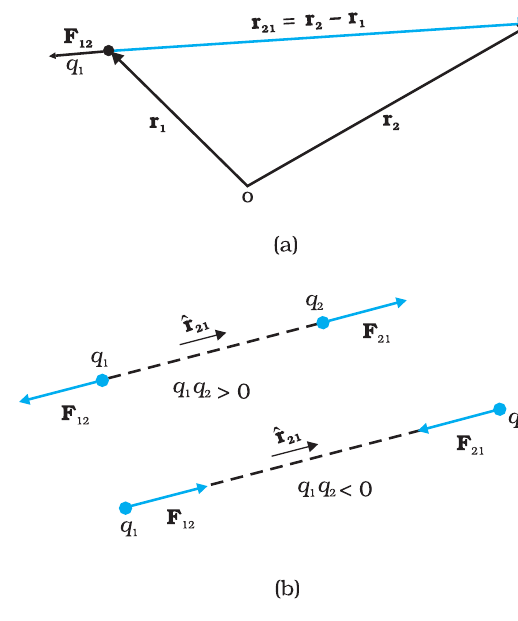
- Vector form: let the position vectors of $q_1$ and $q_2$ be r1 and r2 [Fig. 1.3(a)]. Force on $q_1$ due to $q_2$ is F12 and force on $q_2$ due to $q_1$ is F21. The vector from 1 to 2 is $r21 = r2 - r1$; from 2 to 1, $r12 = r1 - r2 = -r21$. The unit vectors are $r-hat21 = r21/(r21)$ and $r-hat12 = r12/(r12)$, with $r-hat21 = -r-hat12$. Coulomb's law is $F21 = (1/(4πε0)) (q_1 q_2)/(r21²) r-hat21$ (1.3).
- Remarks on Eq. (1.3): it is valid for any sign of $q_1$ and $q_2$. If $q_1$ and $q_2$ are of the same sign, F21 is along r-hat21, which denotes repulsion; if of opposite signs, F21 is along -$r-hat21 (= r-hat12)$, which denotes attraction [Fig. 1.3(b)]. One equation takes care of both cases.
- The force F12 on $q_1$ due to $q_2$ is obtained by interchanging 1 and 2: $F12 = (1/(4πε0)) (q_1 q_2)/(r12²) r-hat12$ = -F21. Coulomb's law agrees with Newton's third law.
- Coulomb's law gives the force between two charges in vacuum. If the charges are placed in matter, the situation gets complicated due to the presence of charged constituents of matter; electrostatics in matter is covered in the next chapter.
- Charles Augustin de Coulomb (1736 - 1806): Coulomb, a French physicist, began his career as a military engineer in the West Indies. In 1776, he returned to Paris and retired to a small estate to do his scientific research. He invented a torsion balance to measure the quantity of a force and used it for determination of forces of electric attraction or repulsion between small charged spheres. He thus arrived in 1785 at the inverse square law relation, now known as Coulomb's law. The law had been anticipated by Priestley and also by Cavendish earlier, though Cavendish never published his results. Coulomb also found the inverse square law of force between unlike and like magnetic poles.
- Footnotes: a torsion balance is a sensitive device to measure force; it was also used later by Cavendish to measure the very feeble gravitational force between two objects, to verify Newton's Law of Gravitation. Implicit in the q/2 argument is the assumption of additivity of charges and conservation: two charges (q/2 each) add up to make a total charge q.
- Example 1.3: $(a) |Fe/FG| = e^2/(4πε0 G mp me) = 2.4 \times 10³⁹$ for an electron and a proton, and $e^2/(4πε0 G mp mp) = 1.3 \times 10³⁶$ for two protons. Between two protons inside a nucleus (~$10^{-15}$ m apart), Fe ~ 230 N and FG ~ 1.9 x $10^{-34}$ N. Electrical forces are enormously stronger than gravitational forces. (b) At 1 $A (= 10^{-10} m) apart, |F| = 2.3 x 10^{-8} N$; the electron's acceleration is 2.5 x 10²² m/$s^2$ and the proton's is 1.4 x 10¹⁹ m/$s^2$, so the effect of gravity is negligible.
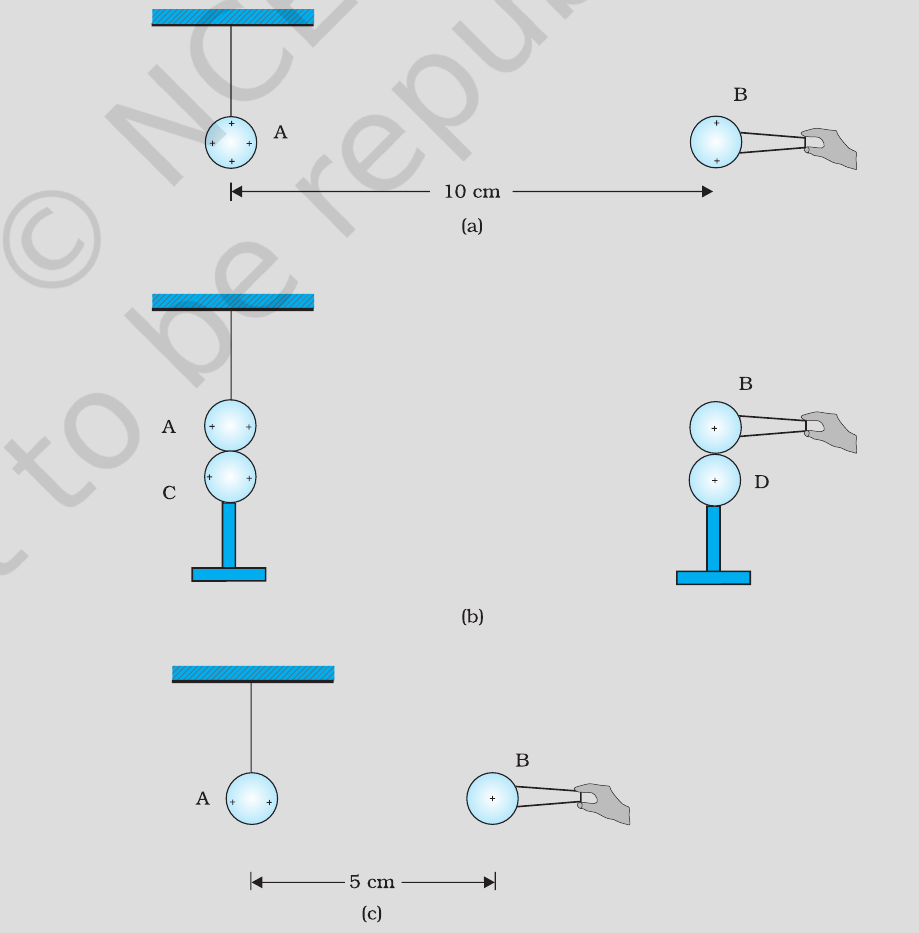
- Example 1.4: spheres A and B carry q and q'. Touching A with identical uncharged C leaves q/2 on each; touching B with D leaves q'/2 on each. Halving the separation to r/2 gives $F' = (1/(4πε0)) ((q/2)(q'/2))/((r/2)²)$ = (1/(4πε0)) (q q')/($r^2$) = F: the electrostatic force on A due to B remains unaltered.
Practice1 question
Try it now. A wrong answer costs nothing here, try again until you get it.
Two point charges $q_1$ and $q_2$ are 1 m apart in vacuum. If the distance between them is doubled, the force between them becomes
F is proportional to 1/($r^2$); doubling r divides F by 4. NCERT 1.5.
1.6 Forces Between Multiple Charges


- The mutual electric force between two charges is given by Coulomb's law. For a system of n stationary charges $q_1$, $q_2$, ..., qn in vacuum, the force on $q_1$ due to the others is not given by Coulomb's law alone.
- Experimentally, it is verified that force on any charge due to a number of other charges is the vector sum of all the forces on that charge due to the other charges, taken one at a time. The individual forces are unaffected due to the presence of other charges. This is termed as the principle of superposition.
- For three charges [Fig. 1.5(a)], the force on $q_1$ due to $q_2$ is $F12 = (1/(4πε0)) (q_1 q_2)/(r12²) r-hat12$, and due to q3 is $F13 = (1/(4πε0)) (q_1 q3)/(r13²) r-hat13$, each as if the other charge were absent. The total force is $F1 = F12 + F13$ = (1/(4πε0)) ($q_1$ $q_2$)/(r12²) r-hat12 + (1/(4πε0)) ($q_1$ q3)/(r13²) r-hat13 (1.4).
- For n charges [Fig. 1.5(b)], F1 = F12 + F13 + ... + F1n = ($q_1$/(4πε0)) sum (from $i=2$ to n) (qi/($r_{1i}^2$)) r-hat1i (1.5). The vector sum is obtained by the parallelogram law of addition of vectors. All of electrostatics is basically a consequence of Coulomb's law and the superposition principle.
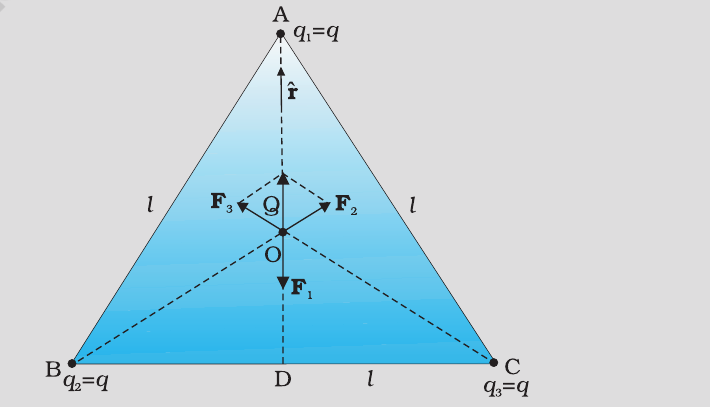
- Example 1.5: three charges $q_1$, $q_2$, q3 each equal to q at the vertices of an equilateral triangle of side l, charge Q (same sign as q) at the centroid O [Fig. 1.6]. $AD = AC \cos 30 \text{degrees} = (\sqrt{3}/2) l$, and $AO = (2/3) AD = (1/\sqrt{3}) l$. By symmatry AO = BO = $CO$. [NCERT prints "symmatry".] The forces on Q are each (3 Qq)/(4πε0 $l^2$) along AO, BO and $CO$. The resultant of $F_2$ and F3 is (3 Qq)/(4πε0 $l^2$) along OA, so the total force on $Q = (3 Qq)/(4πε0 l^2) (r-hat - r-hat)$ = 0, where r-hat is the unit vector along OA. By symmetry the three forces sum to zero.
- Example 1.6: charges q, q and -q at the vertices of an equilateral triangle [Fig. 1.7]. Each pair has the same magnitude $F = q^2/(4πε0 l^2)$. The total force on q at A is F1 = F r-hat1, where r-hat1 is a unit vector along BC. On q at B, $F_2 = F r-hat2$, where r-hat2 is a unit vector along AC. On -q at C, $F3 = \sqrt{3} F n-hat$, where n-hat is the unit vector along the direction bisecting the angle BCA. The sum of the forces on the three charges is zero: $F1 + F_2 + F3 = 0$, which follows from Coulomb's law being consistent with Newton's third law.
1.7 Electric Field

- A point charge Q at the origin O exerts a force on a charge q at $P (OP = r) by Coulomb's$ law. If q is removed, what is left at P? The early scientists introduced the concept of field: the charge Q produces an electric field everywhere in the surrounding, and when another charge q is brought to P, the field there acts on it and produces a force.
- The electric field produced by Q at a point r is $E(r) = (1/(4πε0)) (Q/(r^2)) r-hat$ (1.6), where $r-hat = r/r$ is a unit vector from the origin to the point r. The word "field" signifies how some distributed quantity (scalar or vector) varies with position.
- The force F exerted by Q on q is $F = (1/(4πε0)) (Qq/(r^2)) r-hat$ (1.7). The charge q also exerts an equal and opposite force on Q. The force on q is the charge q multiplied by the electric field E at the location of $q: F(r) = q E(r)$ (1.8). Eq. (1.8) defines the SI unit of electric field as N/C. An alternate unit V/m will be introduced in the next chapter.
- Remarks: (i) If q is unity, the electric field due to Q is numerically equal to the force exerted by it. The electric field due to a charge Q at a point in space may be defined as the force that a unit positive charge would experience if placed at that point. The charge Q producing the field is called a source charge and the charge q testing it is called a test charge. The source charge Q must remain at its original location; making q negligibly small keeps Q undisturbed, and the ratio F/q is finite: E = lim (q$\rightarrow$0) (F/q) (1.9). In practice Q is held to its location by unspecified forces.
- (ii) The electric field E due to Q, though defined using a test charge q, is independent of q, because F is proportional to q. E depends on the space coordinate r: the field exists at every point in three-dimensional space.
- (iii) For a positive charge, the electric field is directed radially outwards; for a negative charge, radially inwards [Fig. 1.8].
- (iv) The magnitude of E depends only on the distance r, so at equal distances from Q the magnitude of E is the same: the field has spherical symmetry, the same on a sphere with the point charge at its centre.
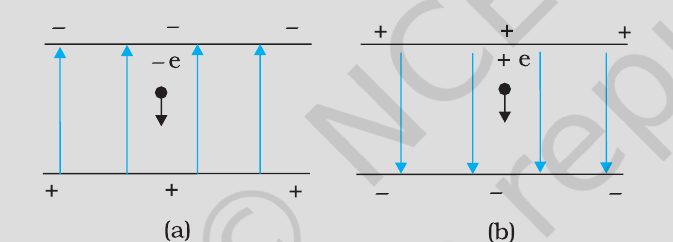
- Example 1.7: an electron falls 1.5 cm in a uniform field of 2.0 x 10⁴ N C^-1 [Fig. 1.10(a)]; with the field reversed, a proton falls the same distance [Fig. 1.10(b)]. $ae = eE/me$, $te = \sqrt{(2h)/(ae)} = \sqrt{(2h me)/(eE)} = 2.9 x 10^{-9} s$. $ap = eE/mp$, $tp = \sqrt{(2h)/(ap)} = \sqrt{(2h mp)/(eE)} = 1.3 x 10^{-7} s$. The heavier particle takes a greater time, in basic contrast to free fall under gravity, where the time of fall is independent of mass. Gravity is ignored: $ap = eE/mp = 1.9 \times 10¹² m/s^2, enormous compared$ to $g = 9.8 m/s^2$.
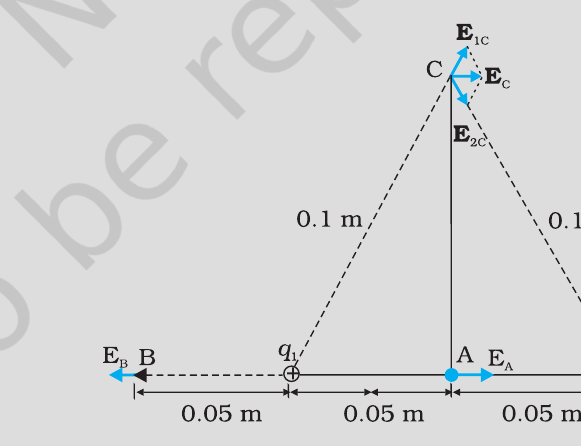
- Example 1.8: $q_1 = +10^{-8} C$ and $q_2 = -10^{-8} C, 0.1 m apart$ [Fig. 1.11]. At A: E1A = $E_{2A} = 3.6 \times 10⁴ N C^{-1}$, both to the right, so $EA = 7.2 \times 10⁴ N C^{-1}$ to the right. At $B: E_{1B} = 3.6 \times 10⁴ N C^{-1}$ to the left, $E_{2B} = 4 \times 10³ N C^{-1}$ to the right, so $EB = 3.2 \times 10⁴ N C^{-1}$ to the left. At C: E1C = $E_{2C} = 9 \times 10³ N C^{-1}$, and $EC = E_{1C} \cos(π/3) + E_{2C} \cos(π/3)$ = 9 x 10³ N C^-1 to the right.
Practice1 question
Try it now. A wrong answer costs nothing here, try again until you get it.
The electric field at a point 0.2 m from a point charge of +4 μC in vacuum is about
$E = (1/(4πε0)) (Q/(r^2)) = (9 \times 10⁹)(4 x 10^{-6})/(0.2²)$ = 9 x 10⁵ N/C. NCERT 1.7.
1.7.1 Electric Field Due to a System of Charges
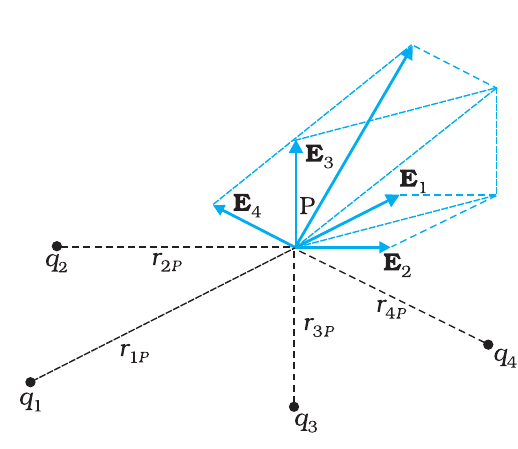
- For charges $q_1$, $q_2$, ..., qn with position vectors r1, r2, ..., rn, the field at a point P (position vector r) is the force on a unit test charge placed there, without disturbing the original positions. $E_1$ at r due to $q_1$ is $E_1 = (1/(4πε0)) (q_1/(r_{1P}^2)) r-hat1P$, where r-hat1P points from $q_1$ to P and r1P is the distance $q_1$ to P; similarly for $E_2$, ..., En. By superposition, E(r) = $E_1$(r) + $E_2$(r) + ... + En(r) = (1/(4πε0)) sum (from $i=1$ to n) (qi/($r_{iP}^2$)) r-hat_iP (1.10) [Fig. 1.9]. E is a vector quantity that varies from point to point in space and is determined from the positions of the source charges.
1.7.2 Physical Significance of Electric Field
- For electrostatics, the electric field is convenient but not really necessary: it is an elegant way of characterising the electrical environment of a system of charges. The field at a point tells you the force a unit positive test charge would experience there, and it is a characteristic of the system of charges, independent of the test charge. The term field in physics generally refers to a quantity defined at every point in space that may vary from point to point. Electric field is a vector field, since force is a vector quantity.
- The true physical significance of the field emerges with time-dependent phenomena. The greatest speed with which a signal can go from one point to another is c, the speed of light, so the effect of any motion of $q_1$ on $q_2$ cannot arise instantaneously: there is a time delay between the effect (force on $q_2$) and the cause (motion of $q_1$). The field picture is this: the accelerated motion of charge $q_1$ produces electromagnetic waves, which then propagate with the speed c, reach $q_2$ and cause a force on $q_2$. The field accounts for the time delay. Electric and magnetic fields are regarded as physical entities, not merely mathematical constructs: they have an independent dynamics of their own, they evolve by laws of their own, and they can transport energy. The concept of field was first introduced by Faraday and is now among the central concepts in physics.
1.8 Electric Field Lines
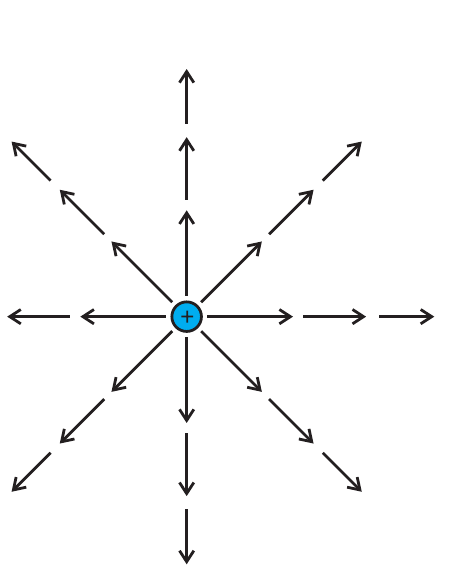
- E is a vector quantity; draw vectors along the field with lengths proportional to the field strength at each point. For a point charge, the magnitude falls as 1/($r^2$), so the vectors get shorter away from the origin, always pointing radially outward [Fig. 1.12]. Connecting the arrows pointing in one direction gives a field line.
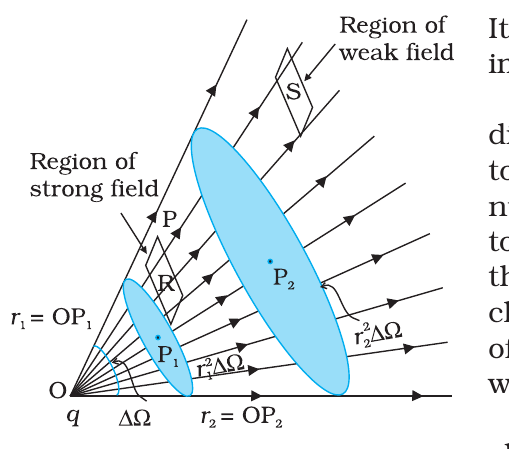
- The magnitude of the field is then represented by the density of field lines: E is strong near the charge, so the lines are closer there; away from the charge the field is weaker and the lines are well separated. The number of lines is not important; it is the relative density of lines in different regions which is important. Density means the number of lines per unit cross-sectional area, perpendicular to the lines. Since E falls as 1/($r^2$) and the area enclosing the charge grows as $r^2$, the number of field lines crossing the enclosing area remains constant.
- The solid angle generalises angle to three dimensions: a small transverse line element $\Delta l$ at distance $r subtends Δθ = \delta l/r$; a small perpendicular plane area $\Delta S$ at distance $r subtends ΔΩ = \delta S/(r^2)$. In a given solid angle the number of radial field lines is the same. For points $P_1$ and $P_2$ at distances r1 and r2, the area subtending ΔΩ is r1² ΔΩ at $P_1$ and r2² ΔΩ at $P_2$; the number of lines n cutting these areas is the same, so the lines per unit area are n/(r1² ΔΩ) and n/(r2² ΔΩ): the field strength has a 1/($r^2$) dependence [Fig. 1.13].
- The picture of field lines was invented by Faraday to develop an intuitive non-mathematical way of visualising electric fields. Faraday called them lines of force. This term is somewhat misleading, especially in case of magnetic fields. The more appropriate term is field lines (electric or magnetic) that we have adopted in this book.
- An electric field line is a curve drawn so that the tangent to it at each point is in the direction of the net field at that point; an arrow on the curve specifies the direction. A field line is a space curve, a curve in three dimensions.
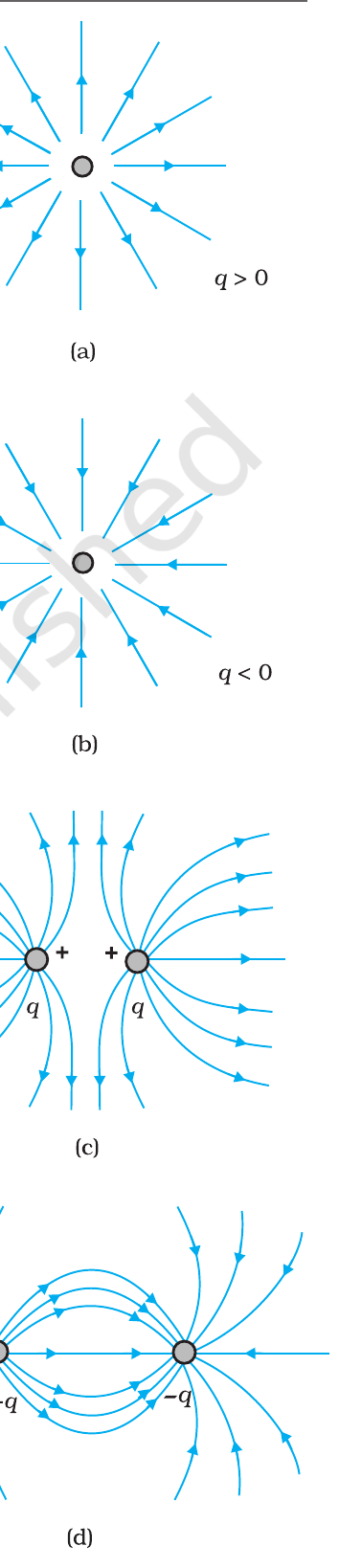
- Figure 1.14 shows the field lines around simple charge configurations: a single positive charge has radially outward lines, a single negative charge radially inward lines; two positive charges (q, q) show mutual repulsion, and two equal and opposite charges (q, -q), a dipole, show mutual attraction.
- Properties: (i) Field lines start from positive charges and end at negative charges. If there is a single charge, they may start or end at infinity. (ii) In a charge-free region, electric field lines can be taken to be continuous curves without any breaks. (iii) Two field lines can never cross each other: if they did, the field at the point of intersection would not have a unique direction, which is absurd. (iv) Electrostatic field lines do not form any closed loops: this follows from the conservative nature of electric field (Chapter 2).
1.9 Electric Flux
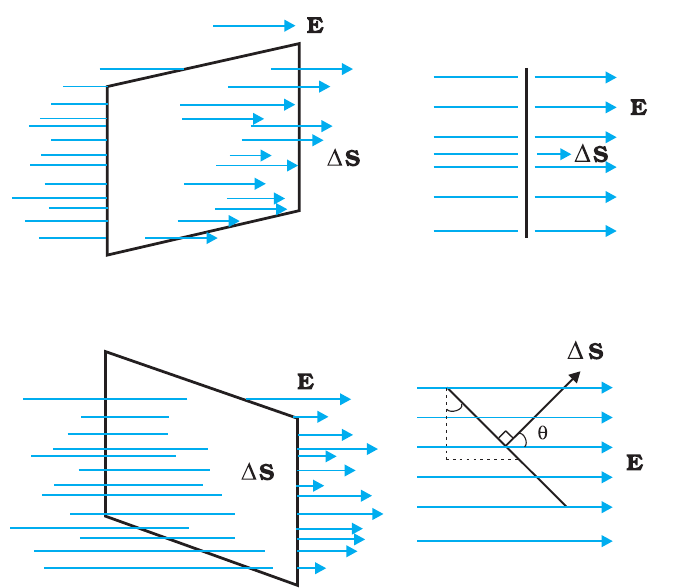
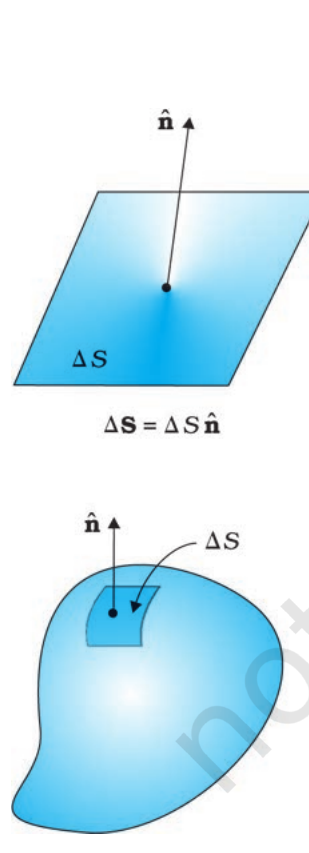
- Consider flow of a liquid with velocity v through a small flat surface dS normal to the surface: the rate of flow is v dS, the flux of liquid across the plane. If the normal makes an angle θ with v, the projected area perpendicular to v is dS cosθ, so the flux out of the surface dS is v . n̂ dS. For the electric field, an analogous quantity is defined and called electric flux. Note there is no flow of a physically observable quantity, unlike liquid flow.
- The number of field lines crossing a unit area placed normal to E at a point measures the strength of E. Tilt the area element by angle θ: the number of field lines crossing it is proportional to E $\Delta S$ cosθ. When $θ = 90 \text{degrees}$, field lines are parallel to $\Delta S$ and do not cross it at all [Fig. 1.15].
- An area element is treated as a vector: its direction is along its normal. For a curved surface, divide it into many small area elements, each treated as planar. For a closed surface, the vector of every area element is taken in the direction of the outward normal [Fig. 1.16]. The area element vector $\Delta S$ at a point on a closed surface equals $\Delta S$ n̂, where n̂ is a unit vector in the direction of outward normal at that point.
- Electric flux Δφ through an area element $\Delta S$ is $Δφ = E$ . $\delta S = E \delta S \cos θ$ (1.11), proportional to the number of field lines cutting the area element. θ is the angle between E and $\Delta S$. The unit of electric flux is N C^-1 $m^2$.
- The total flux φ through a surface S is φ ~ sum E . $\Delta S$ (1.12). The approximation sign is there because E is taken constant over the small area element; it becomes exact in the limit $\Delta S$ $\rightarrow$ 0, when the sum becomes an integral.
1.10 Electric Dipole
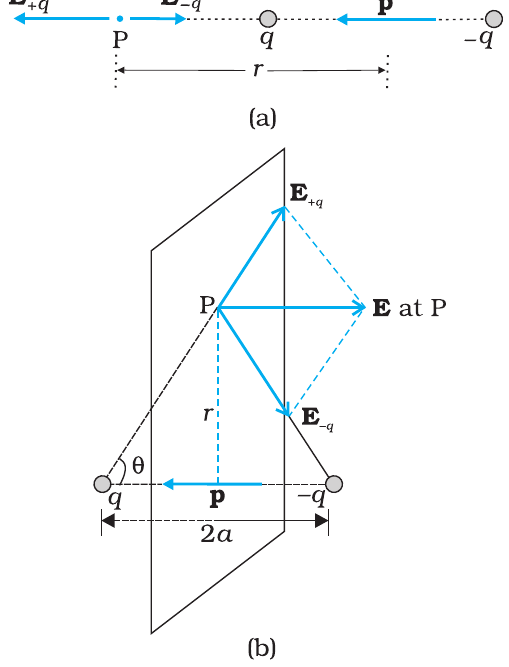
- An electric dipole is a pair of equal and opposite point charges q and -q, separated by a distance 2a. The line connecting the two charges defines a direction in space. By convention, the direction from -q to q is the direction of the dipole. The mid-point of -q and q is the centre of the dipole.
- The total charge of the dipole is zero, but the field is not zero: the fields due to q and -q do not exactly cancel. At distances much larger than the separation (r >> 2a), the fields nearly cancel, and the dipole field falls off faster than 1/($r^2$).
- (i) For points on the axis: let P be at distance r from the centre on the side of q [Fig. 1.17(a)]. $E_-q = -(q/(4πε0 (r + a)²)) p-hat [1.13(a)]$ and $E_+q = (q/(4πε0 (r - a)²)) p-hat [1.13(b)]$, where p-hat is the unit vector along the dipole axis (from -q to q). The total field is $E = (q/(4πε0)) ((1/((r - a)²)) - (1/((r + a)²))) p-hat$ = (q/(4πε0)) (4 a r)/(($r^2$ - $a^2$)²) p-hat (1.14). For r >> a, $E = (4 q a)/(4πε0 r^3) p-hat$ (1.15).
- (ii) For points on the equatorial plane: the magnitudes are $E_+q = (q/(4πε0)) (1/(r^2 + a^2)) [1.16(a)]$ and $E_-q = (q/(4πε0)) (1/(r^2 + a^2)) [1.16(b)]$, and are equal. The components normal to the dipole axis cancel; the components along the axis add up, and the total field is opposite to p-hat: $E = -(E_+q + E_-q) \cos θ p-hat = -(2 q a)/(4πε0 (r^2 + a^2)^{3/2}) p-hat$ (1.17). For r >> a, $E = -(2 q a)/(4πε0 r^3) p-hat$ (1.18).
- The dipole field at large distances depends on the product qa, not on q and a separately. This suggests the definition of dipole moment: the dipole moment vector p of an electric dipole is $p = q x 2a p-hat (1.19): magnitude$ charge q times separation 2a, direction along the line from -q to q. In terms of p: on the axis, E = (2p)/(4πε0 $r^3$) (r >> a) (1.20); on the equatorial plane, E = -(p)/(4πε0 $r^3$) (r >> a) (1.21).
- The dipole field at large distances falls off as 1/($r^3$), not 1/($r^2$). Its magnitude and direction depend not only on r but also on the angle between the position vector r and the dipole moment p.
- In the limit where 2a approaches zero and q approaches infinity so that $p = q x 2a stays finite$, the dipole is a point dipole: Eqs. (1.20) and (1.21) are exact, true for any r.
- In most molecules, the centres of positive and negative charges lie at the same place, so their dipole moment is zero. $CO_2$ and $CH_4$ are of this type, but they develop a dipole moment when an electric field is applied. In some molecules the centres do not coincide, so they have a permanent electric dipole moment even without a field: such molecules are called polar molecules. Water molecules, $H_2O$, are an example of this type.
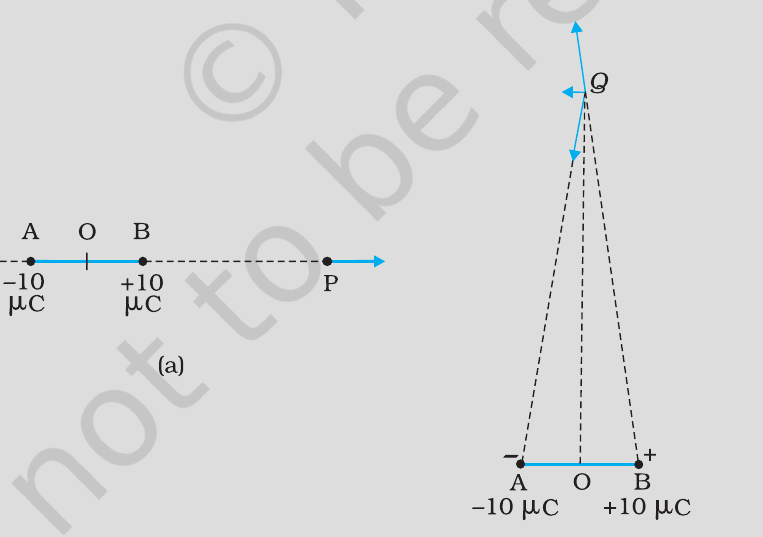
- Example 1.9: two charges ±10 μC placed 5.0 mm apart [Fig. 1.18]. (a) At P on the axis, 15 cm from the centre: field due to +10 μC is 4.13 x 10⁶ N C^-1 along BP; due to -10 μC is 3.86 x 10⁶ N C^-1 along PA; the resultant is 2.7 x 10⁵ N C^-1 along BP. By the far-field formula with $p = 10^{-5} C x 5 \times 10^{-3} m$ = 5 x $10^{-8}$ C m, $E = 2.6 \times 10⁵ N C^{-1}$ along AB. (b) At Q, 15 cm from O on the normal to the axis: each charge gives 3.99 x 10⁶ N C^-1; the components along OQ cancel and add along BA, giving 1.33 x 10⁵ N C^-1 along BA, $matching E = p/(4πε0 r^3) = 1.33 \times 10⁵ N C^{-1} opposite$ to the dipole moment direction.
Practice1 question
Try it now. A wrong answer costs nothing here, try again until you get it.
The electric field of a dipole at a large distance r on its axis varies as
$E = (2p)/(4πε0 r^3)$ on the axis for r >> a. NCERT 1.10.1.
1.11 Dipole in a Uniform External Field
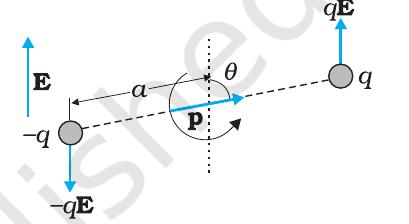
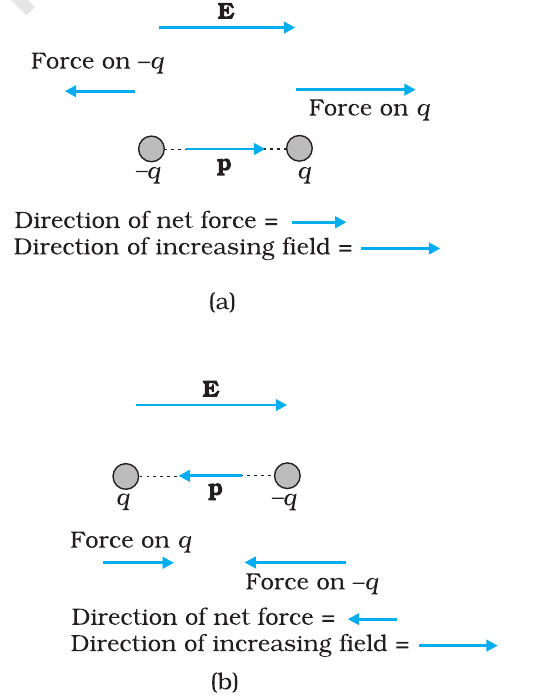
- A permanent dipole of dipole moment p in a uniform external field E [Fig. 1.19]: permanent means p exists irrespective of E; it has not been induced by E. There is a force qE on q and -qE on -q, so the net force on the dipole is zero, since E is uniform. But the charges are separated, so the forces act at different points, giving a torque. When the net force is zero, the torque (couple) is independent of the origin: magnitude of torque = $q E x 2a \sin θ = 2 q a E \sin θ$, direction normal to the plane of the paper, coming out of it. The magnitude of p x E is also p E sinθ in the same direction, so $τ = p x E$ (1.22). This torque tends to align the dipole with the field E. When p is aligned with E, the torque is zero.
- If the field is not uniform, the net force is non-zero, and there is in general a torque as well. When p is parallel to E or antiparallel to E, the net torque is zero but there is a net force. When p is parallel to E, the dipole has a net force in the direction of increasing field; when p is antiparallel to E, the net force is in the direction of decreasing field [Fig. 1.20]. In general, the force depends on the orientation of p with respect to E.
- A comb run through dry hair attracts pieces of paper. The comb acquires charge through friction, but the paper is not charged. The charged comb polarises the piece of paper, inducing a net dipole moment in the direction of field; the field due to the comb is not uniform, and this non-uniformity makes the dipole experience a net force, so the paper moves in the direction of the comb.
1.12 Continuous Charge Distribution
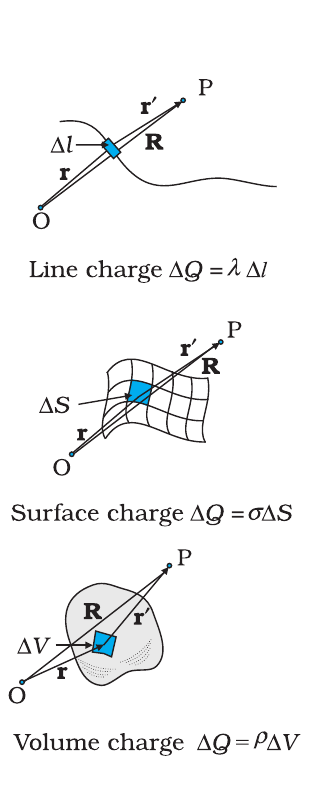
- So far the charges were discrete, $q_1$, $q_2$, ..., qn. For many purposes it is impractical to work with discrete charges: on the surface of a charged conductor, specify the charge $\Delta Q$ on a small area element $\Delta S$ (Fig. 1.21) and define a surface charge density σ at the area element by $σ = \delta Q/\delta S$ (1.23). The units for σ are C/$m^2$. σ ignores the quantisation of charge and the discontinuity at the microscopic level: it is a smoothed-out average over $\Delta S$, which is large microscopically but small macroscopically.
- The linear charge density λ of a wire is $λ = \delta Q/\delta l$ (1.24), where $\Delta l$ is a small line element including a large number of microscopic charged constituents; units C/m. The volume charge density (sometimes simply called charge density) is $ρ = \delta Q/\delta V$ (1.25); units C/$m^3$.
- The notion of continuous charge distribution is similar to continuous mass distribution in mechanics: the density of a liquid is its macroscopic density, ignoring its discrete molecular constitution.
- The field due to a continuous charge distribution follows from Coulomb's law and superposition. For a volume charge density ρ, divide the distribution into small volume elements $\Delta V$, each with charge ρ$\Delta V$. At a general point P with position vector R, the field due to ρ$\Delta V$ is $\delta E = (1/(4πε0)) (ρ\delta V/(r'^2)) r-hat'$ (1.26), where r' is the distance from the charge element to P. Summing, E ≈ (1/(4πε0)) sum (over all $\Delta V$) (ρ$\Delta V$/(r'^2)) r-hat' (1.27). In the strict method, $\Delta V$ $\rightarrow$ 0 and the sum becomes an integral; that discussion is omitted here.
1.13 Gauss's Law
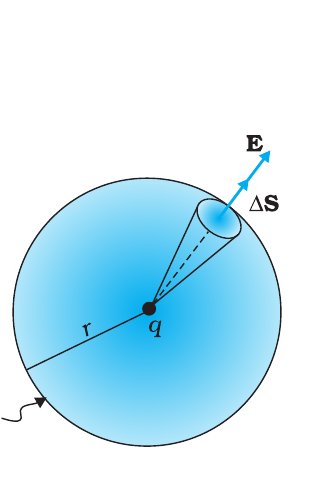
- As an application of flux, consider the total flux through a sphere of radius r enclosing a point charge q at its centre [Fig. 1.22]. The flux through an area element $\Delta S$ is $Δφ = E$ . $\delta S = (q/(4πε0 r^2)) r-hat$ . $\Delta S$ (1.28). The normal to a sphere at every point is along the radius vector, so $\Delta S$ and r-hat have the same direction: $Δφ = (q/(4πε0 r^2)) \delta S$ (1.29). Adding over all elements, $φ = (q/(4πε0 r^2)) S$, and $S = 4πr^2$, so $φ = q/ε0$ (1.30).
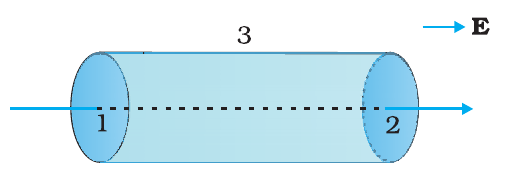
- Gauss's law is stated without proof: Electric flux through a closed surface $S = q/ε0$ (1.31), where q = total charge enclosed by S.* The total electric flux through a closed surface is zero if no charge is enclosed by the surface. This is seen in Fig. 1.23: a closed cylindrical surface in a uniform field E, axis parallel to E. The flux through the curved part is zero (normal perpendicular to E); the outward normal to face 2 is along E and to face 1 is opposite to E, so $φ1 = -E S1$, $φ2 = +E S2$, S1 = S2 = S, and the total flux is zero.
- Points on Gauss's law: (i) It is true for any closed surface, no matter what its shape or size. (ii) The term q includes the sum of all charges enclosed by the surface, located anywhere inside. (iii) When some charges are inside and some outside, the electric field (whose flux appears on the left) is due to all the charges, both inside and outside S; the term q on the right represents only the total charge inside S. (iv) The surface chosen is called the Gaussian surface. Any Gaussian surface may be chosen, but take care not to let it pass through any discrete charge, because the field due to discrete charges is not well defined at the location of a charge; the Gaussian surface can pass through a continuous charge distribution. (v) Gauss's law is often useful towards a much easier calculation of the electrostatic field when the system has some symmetry, helped by a suitable Gaussian surface. (vi) Gauss's law is based on the inverse square dependence in Coulomb's law: any violation of Gauss's law will indicate departure from the inverse square law.
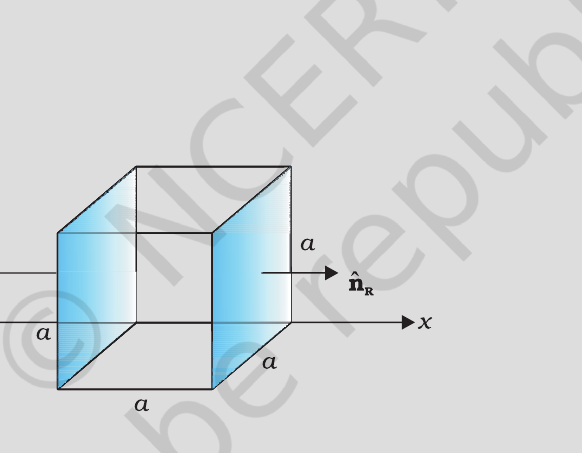
- Example 1.10: $Ex = αx^{1/2}$, Ey = $Ez = 0$, $α = 800 N/C m^{1/2}, cube side a = 0.1 m$ [Fig. 1.24]. For faces perpendicular to x, the flux is zero except the two shaded faces. $EL = αa^{1/2}$ at the left face $(x = a)$, $ER = α(2a)¹/2$ at the right face $(x = 2a)$. $φL = -EL a^2$, $φR = ER a^2$. Net flux = $αa^{5/2} (sqrt(2) - 1) = 800 (0.1)^{5/2} (sqrt(2) - 1)$ = 1.05 N $m^2$ C^-1. By Gauss's law, $q = φε0 = 1.05 \times 8.854 x 10^{-12} C$ = 9.27 x $10^{-12}$ C.
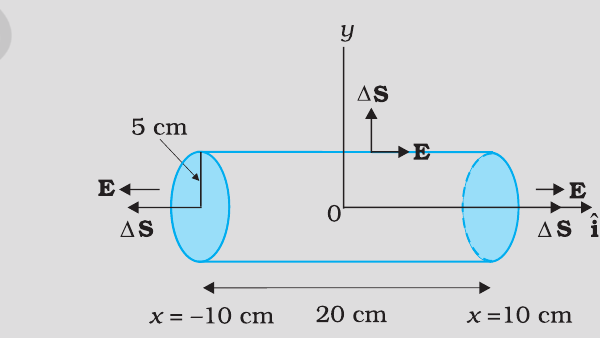
- Example 1.11: $E = 200$ î N/C for x > 0 and $E = -200$ î N/C for x < 0; a right circular cylinder of length 20 cm and radius 5 cm, centre at the origin, axis along x, faces at $x = +10 cm$ and $x = -10 cm$ [Fig. 1.25]. (a) On the left face, E and $\Delta S$ are parallel in the outward sense: $φL = +200 \Delta S = +200 x π (0.05)² = +1.57 N m^2 C^{-1}$. On the right face, $φR = +1.57 N m^2 C^{-1}$. (b) On the side, E is perpendicular to $\Delta S$, so the flux is zero. (c) Net outward flux $φ = 1.57 + 1.57 + 0 = 3.14 N m^2 C^{-1}$. (d) Net charge inside: $q = ε0φ = 3.14 \times 8.854 x 10^{-12} C$ = 2.78 x $10^{-11}$ C.
Practice1 question
Try it now. A wrong answer costs nothing here, try again until you get it.
A thin spherical shell of radius R carries total charge q. The electric field at a point inside the shell (r < R) is
The Gaussian surface inside the shell encloses no charge, so $E = 0$. NCERT 1.14.3.
1.14 Applications of Gauss's Law

- The field due to a general charge distribution is given by Eq. (1.27), but except for some special cases the summation cannot be carried out. For symmetric charge configurations, Gauss's law gives the field simply.
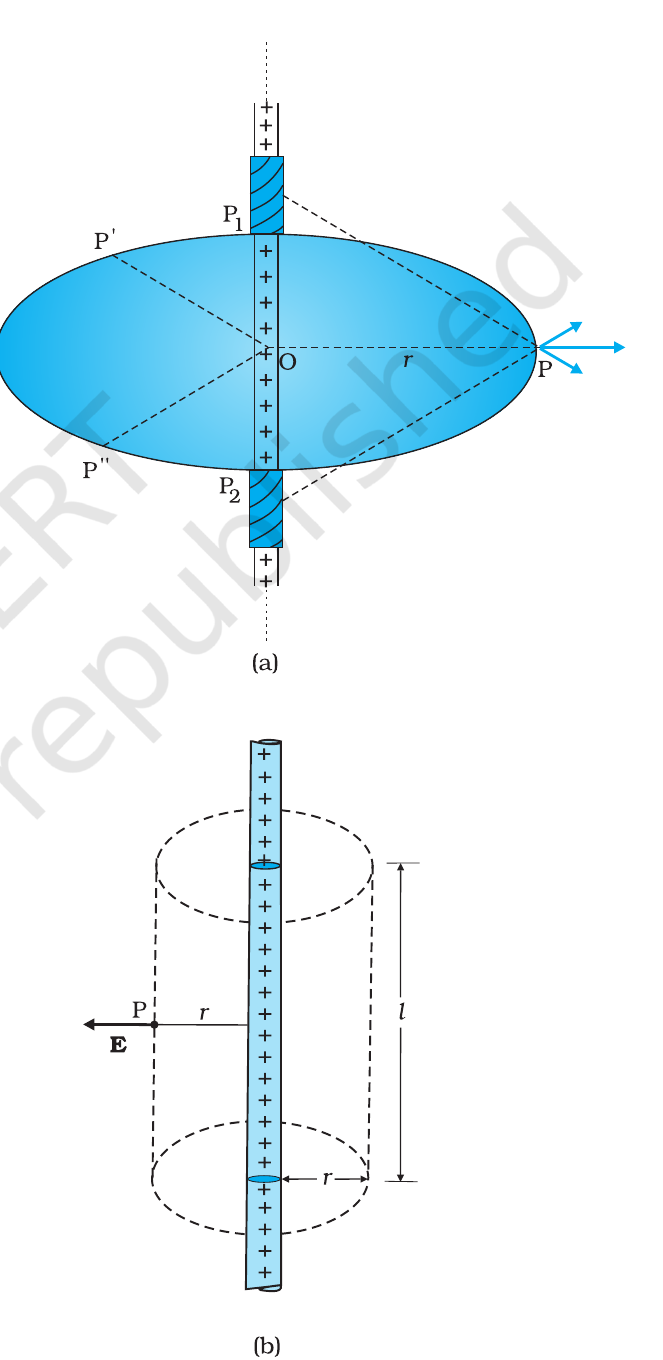
- 1.14.1 Field due to an infinitely long straight uniformly charged wire: let λ be the uniform linear charge density. The wire is an axis of symmetry: the field must have the same magnitude at equivalent points P, P', P'' and must be radial (outward if λ > 0, inward if λ < 0) [Fig. 1.26(a)]. A pair of line elements $P_1$ and $P_2$ gives a resultant field that is radial (components normal to the radial vector cancel). Since the wire is infinite, the field does not depend on position along the wire: it is everywhere radial in the plane cutting the wire normally, and its magnitude depends only on the radial distance r.
- Take a cylindrical Gaussian surface [Fig. 1.26(b)]: flux through the two ends is zero; at the curved part, E is normal to the surface and constant, with area 2πrl, where l is the length of the cylinder. Flux = E x 2πrl. The surface encloses charge λl, so $E x 2πrl = λl/ε0$, i.e. $E = λ/(2πε0 r)$. Vectorially, $E = (λ/(2πε0 r)) n$̂ (1.32), where n̂ is the radial unit vector in the plane normal to the wire through the point. E is directed outward if λ is positive and inward if λ is negative.
- Note: when a vector A is written as a scalar multiplied by a unit vector, A = A â, the scalar A is an algebraic number: it can be negative or positive. The direction of A is the same as â if A > 0 and opposite if A < 0. To restrict to non-negative values, use |A|, called the modulus of A: |A| >= 0.
- Only the charge enclosed by the surface (λl) was included above, but the electric field E is due to the charge on the entire wire. The assumption that the wire is infinitely long is essential: without it, E cannot be taken normal to the curved part. Eq. (1.32) is approximately true around the central portions of a long wire, where the end effects may be ignored.
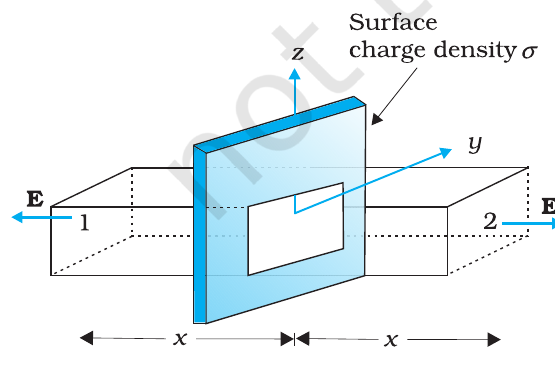
- 1.14.2 Field due to a uniformly charged infinite plane sheet: let σ be the uniform surface charge density (Fig. 1.27). Take the x-axis normal to the plane: by symmetry, the field does not depend on y and z, and its direction must be parallel to the x-direction. Take the Gaussian surface as a rectangular parallelepiped of cross-sectional area A (a cylindrical surface will also do). Only faces 1 and 2 contribute to the flux; the field lines are parallel to the other faces. The unit normal to surface 1 is in -x direction and to surface 2 in +x direction, so the flux E . $\Delta S$ through both surfaces are equal and add up: net flux = 2 E A. The charge enclosed is σA, so 2 $E A = σA/ε0$, or $E = σ/(2ε0)$. Vectorially, $E = (σ/(2ε0)) n$̂ (1.33), where n̂ is a unit vector normal to the plane and going away from it. E is directed away from the plate if σ is positive and toward the plate if σ is negative. E is independent of x also. For a finite large planar sheet, Eq. (1.33) is approximately true in the middle regions, away from the ends.
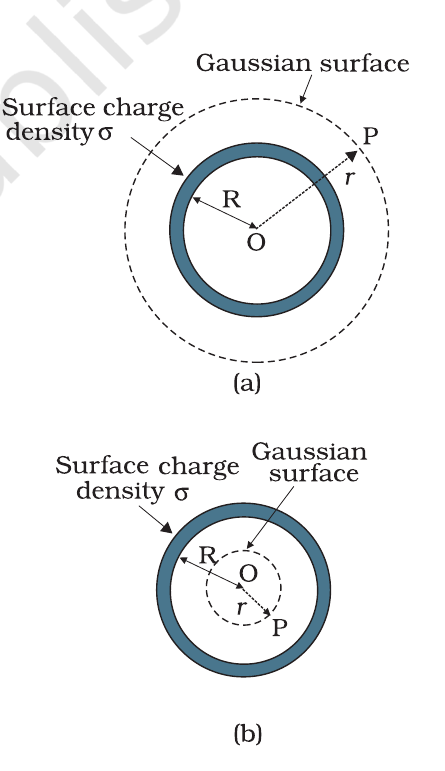
- 1.14.3 Field due to a uniformly charged thin spherical shell: let σ be the uniform surface charge density of a thin spherical shell of radius R (Fig. 1.28). The field at any point P can depend only on r (radial distance from the centre) and must be radial.
- (i) Field outside the shell: Take a Gaussian sphere of radius r through P, centred at O. The field has the same magnitude E at each point of the Gaussian surface and is along the radius vector, so the flux is E x 4π$r^2$. The charge enclosed is σ x 4π$R^2$. By Gauss's law, $E x 4πr^2 = (σ/ε0) 4πR^2$, so $E = (σR^2)/(ε0 r^2) = q/(4πε0 r^2)$, where $q = 4πR^2 σ$ is the total charge on the shell. Vectorially, $E = (q/(4πε0 r^2)) r-hat$ (1.34). The field is directed outward if q > 0 and inward if q < 0. For points outside the shell, the field is as if the entire charge of the shell were concentrated at its centre.
- (ii) Field inside the shell: The Gaussian surface is again a sphere through P centred at O. The flux is E x 4π$r^2$, but the Gaussian surface encloses no charge: $E x 4πr^2 = 0$, i.e. E = 0 (r < R) (1.35). The field due to a uniformly charged thin shell is zero at all points inside the shell. This important result is a direct consequence of Gauss's law, which follows from Coulomb's law; its experimental verification confirms the 1/($r^2$) dependence in Coulomb's law.
- Example 1.12: an early model of the atom has a positively charged point nucleus of charge Ze, surrounded by a uniform density of negative charge up to radius R; the atom as a whole is neutral [Fig. 1.29]. The total negative charge must be -Ze, so $(4πR^{3/3}) ρ = -Ze$, or $ρ = -(3Ze)/(4πR^3)$. By Gauss's law with a spherical Gaussian surface centred at the nucleus: (i) r < R: the enclosed charge is $q = Ze - Ze (r^3/(R^3))$, so $E(r) = (Ze/(4πε0)) ((1/(r^2)) - (r/(R^3))), directed radially outward$. (ii) r > R: the total enclosed charge is zero, so $E(r) = 0$. At r = R, both cases give $E = 0$.
Physical Quantities and Their Symbols
- NCERT prints one unnumbered table (p. 40) of the physical quantities of this chapter, with their symbols, dimensions, units and remarks. It is reproduced here as printed.
| Physical quantity | Symbol | Dimensions | Unit | Remarks |
|---|---|---|---|---|
| Vector area element | $\Delta S$ | $[L^2]$ | $m^2$ | $\Delta S$ = $\Delta S$ n̂ |
| Electric field | E | $[M L T^{-3} A^{-1}]$ | V m^-1 | |
| Electric flux | φ | $[M L^3 T^{-3} A^{-1}]$ | V m | Δφ = E. $\Delta S$ |
| Dipole moment | p | $[L T A]$ | C m | Vector directed from negative to positive charge |
| Charge density: linear | λ | $[L^{-1} T A]$ | C m^-1 | Charge/length |
| Charge density: surface | σ | $[L^{-2} T A]$ | C m^-2 | Charge/area |
| Charge density: volume | ρ | $[L^{-3} T A]$ | C m^-3 | Charge/volume |
Trap Pairs - What Goes Wrong
- Trap 1: rubbing creates charge. Wrong: rubbing a glass rod with silk creates fresh positive charge on the rod and fresh negative charge on the silk. Right: rubbing only transfers electrons: the rod loses electrons and the silk gains them, so the two charges are equal and opposite and the total charge stays zero. NCERT 1.2, 1.4.2.
- Trap 2: zero total charge means zero field. Wrong: an electric dipole has total charge zero, so it produces no electric field anywhere. Right: the fields of q and -q do not cancel exactly, and at large distances the dipole field falls as 1/($r^3$), not 1/($r^2$). NCERT 1.10.
- Trap 3: field lines can cross. Wrong: two electric field lines can cross each other at a point where the field is strong. Right: two field lines can never cross: at the crossing point the field would have two directions at once, which is absurd. NCERT 1.8.
- Trap 4: Gauss's law counts every charge. Wrong: in Gauss's law, q is the total charge anywhere in space, inside and outside the Gaussian surface. Right: the q in $φ = q/ε0$ is only the charge enclosed by the surface; the field itself is due to all charges, inside and outside. NCERT 1.13 (iii).
- Trap 5: zero flux means no charge inside. Wrong: if the net outward flux through a closed surface is zero, there are no charges inside it. Right: zero net flux means the total enclosed charge is zero: equal positive and negative charges inside still give zero flux. NCERT 1.13; see also Exercise 1.16.
- Trap 6: a dipole in a uniform field is pushed. Wrong: a dipole in a uniform electric field is pushed along the field. Right: the net force is zero in a uniform field; only a torque τ = p x E acts, aligning p with E. A net force needs a non-uniform field. NCERT 1.11.
Points to Ponder
- NCERT ends the chapter with 11 points to ponder. They are reproduced here in condensed form, without changing their content.
- 1. Protons stay compact in the nucleus because of a third fundamental force, the strong force, effective over ~$10^{-14}$ m, the size of the nucleus. Electrons cannot sit on top of the protons, inside the nucleus, due to the laws of quantum mechanics.
- 2. Coulomb force and gravitational force follow the same inverse-square law, but gravity has only one sign (always attractive), while Coulomb force can be of both signs, allowing cancellation. That is how gravity, despite being much weaker, can dominate in nature.
- 3. The constant k in Coulomb's law is a matter of choice if the unit of charge is defined using Coulomb's law. In SI units, the unit of current (A) is defined via its magnetic effect (Ampere's law) and the coulomb is defined by 1 $C = 1 A s$, so k is no longer arbitrary: about 9 x 10⁹ N $m^2$ C^-2.
- 4. The large value of k, the large size of 1 C for electric effects, arises because the unit of charge is defined in terms of magnetic forces, which are generally much weaker than electric forces. 1 ampere is a reasonable size for magnetic effects, but 1 $C = 1 A s$ is too big a unit for electric effects.
- 5. Additivity of charge is not an obvious property: it is related to the fact that electric charge has no direction; charge is a scalar.
- 6. Charge is not only a scalar (invariant) under rotation; it is also invariant for frames of reference in relative motion. This is not true for every scalar: kinetic energy is a scalar under rotation but is not invariant for frames in relative motion.
- 7. Conservation of total charge of an isolated system is a property independent of the scalar nature of charge. Conservation refers to invariance in time in a given frame. A quantity may be scalar but not conserved (kinetic energy in an inelastic collision); a conserved vector quantity also exists (angular momentum of an isolated system).
- 8. Quantisation of electric charge is a basic (unexplained) law of nature; there is no analogous law on quantisation of mass.
- 9. The superposition principle should not be regarded as obvious, or equated with the law of addition of vectors. It says two things: the force on one charge due to another is unaffected by the presence of other charges, and there are no additional three-body, four-body, etc., forces which arise only when there are more than two charges.
- 10. The electric field due to a discrete charge configuration is not defined at the locations of the discrete charges. For a continuous volume charge distribution, it is defined at any point in the distribution. For a surface charge distribution, the electric field is discontinuous across the surface.
- 11. The electric field due to a charge configuration with total charge zero is not zero; but for distances large compared to the size of the configuration, its field falls off faster than 1/($r^2$), typical of the field due to a single charge. An electric dipole is the simplest example.
Exercises (Figures 1.30 and 1.31)
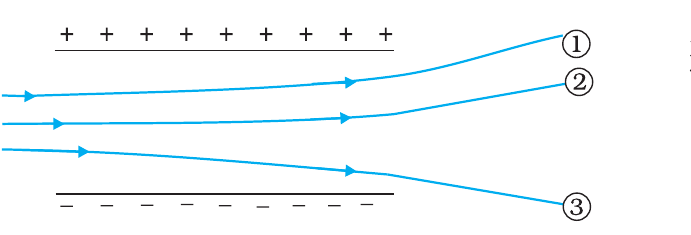
- Exercise 1.13: Figure 1.30 shows tracks of three charged particles in a uniform electrostatic field. Give the signs of the three charges. Which particle has the highest charge to mass ratio?
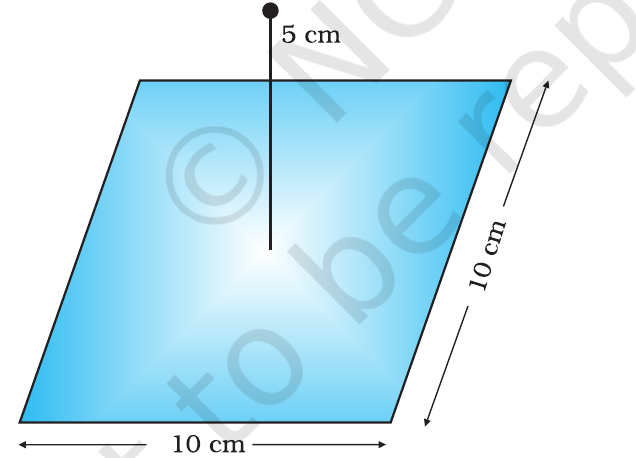
- Exercise 1.17: A point charge +10 μC is a distance 5 cm directly above the centre of a square of side 10 cm, as shown in Fig. 1.31. What is the magnitude of the electric flux through the square? (Hint: Think of the square as one face of a cube with edge 10 cm.)
Trap Boxes
Rubbing creates charge
Wrong idea: Rubbing a glass rod with silk creates fresh positive charge on the rod and fresh negative charge on the silk.
Rubbing only transfers electrons: the rod loses electrons and the silk gains them, so the two charges are equal and opposite and the total charge stays zero. No new charge is created.
NCERT XII, Ch 1, 1.2, 1.4.2
Zero total charge means zero field
Wrong idea: An electric dipole has total charge zero, so it produces no electric field anywhere.
The fields of q and -q do not cancel exactly, and at large distances the dipole field falls as 1/($r^3$), not 1/($r^2$).
NCERT XII, Ch 1, 1.10
Field lines can cross
Wrong idea: Two electric field lines can cross each other at a point where the field is strong.
Two field lines can never cross: at the crossing point the field would have two directions at once, which is absurd.
NCERT XII, Ch 1, 1.8
Gauss's law counts every charge
Wrong idea: In Gauss's law, q is the total charge anywhere in space, inside and outside the Gaussian surface.
The q in $φ = q/ε0$ is only the charge enclosed by the surface; the field itself is due to all charges, inside and outside.
NCERT XII, Ch 1, 1.13 (iii)
Zero flux means no charge inside
Wrong idea: If the net outward flux through a closed surface is zero, there are no charges inside it.
Zero net flux means the total enclosed charge is zero: equal positive and negative charges inside still give zero flux.
NCERT XII, Ch 1, 1.13; Ex. 1.16
A dipole in a uniform field is pushed
Wrong idea: A dipole in a uniform electric field is pushed along the field.
The net force is zero in a uniform field; only a torque τ = p x E acts, aligning p with E. A net force needs a non-uniform field.
NCERT XII, Ch 1, 1.11
Chapter test
5 NEET PYQs. +4 for a correct answer, -1 for a wrong answer, exactly like NEET. Finish the test to earn a medal.
Q1: NEET (UG) 2023, Code F1, Q32
An electric dipole is placed at an angle of 30° with an electric field of intensity 2 × 10⁵ N C^-1. It experiences a torque equal to 4 N m. Calculate the magnitude of charge on the dipole, if the dipole length is 2 cm.
$τ = p E \sin θ = q (2a) E \sin θ$, so $q = τ/((2a) E \sin θ) = 4/((0.02)(2 \times 10⁵)(0.5)) = 2 x 10^{-3} C = 2 mC$. NCERT 1.11.
Q2: NEET (UG) 2023, Code F1, Q9
If ∮ E . $dS = 0$ over a surface, then
Gauss's law: the flux is q/ε0, so zero flux means zero net enclosed charge. Flux lines entering must balance those leaving; the field need not be constant or uniform, and charges need not be inside. NCERT 1.13.
Q3: NEET (UG) 2022, Code R1, Q39
Two point charges -q and +q are placed at a distance of L, as shown in the figure. The magnitude of electric field intensity at a distance R (R >> L) varies as:
-q and +q a distance L apart form a dipole, whose field at large distance falls as 1/($R^3$). NCERT 1.10.1.
Q4: NEET (UG) 2021, Code P3, Q2
Polar molecules are the molecules
In polar molecules the centres of positive and negative charges do not coincide, so they have a permanent dipole moment of their own. NCERT 1.10.2.
Q5: NEET (UG) 2020, Code G5, Q158
A short electric dipole has a dipole moment of 16 × $10^{-9}$ C m. The electric potential due to the dipole at a point at a distance of 0.6 m from the centre of the dipole, situated on a line making an angle of 60° with the dipole axis is: $(1/(4πε0) = 9 \times 10⁹ N m^2/C^2)$
$V = (1/(4πε0)) (p \cos θ)/(r^2)$ = (9 x 10⁹)(16 x $10^{-9}$)(0.5)/(0.36) = 200 V. NCERT 1.10 (dipole moment).
Score: 0 · Answered 0 of 5
Flashcards
Tap a card to flip it over and see the answer. Tap it again to flip it back.
State the quantisation of charge and the value of the elementary charge.
Tap to flip$q = ne$, $n = 0$, ±1, ±2, ...; $e = 1.602192 \times 10^{-19} C$; electron -e, proton +e.
Tap to flip backWrite Coulomb's law and the values of k and ε0 in SI units.
Tap to flip$F = (1/(4πε0)) (q_1 q_2)/(r^2)$; $k = 1/(4πε0) = 9 \times 10⁹ N m^2 C^{-2}$; $ε0 = 8.854 \times 10^{-12} C^2 N^{-1} m^{-2}$.
Tap to flip backWrite the electric field of a point charge Q and the force on a charge q in a field E.
Tap to flip$E(r) = (1/(4πε0)) (Q/(r^2)) r-hat$; $F = q E$. E = lim (q$\rightarrow$0) (F/q).
Tap to flip backWrite the dipole moment and the dipole field on the axis and the equatorial plane at large r.
Tap to flip$p = q x 2a p-hat$; axial $E = (2p)/(4πε0 r^3)$; equatorial E = -(p)/(4πε0 $r^3$) (r >> a).
Tap to flip backWrite the torque on a dipole in a uniform field and the net force.
Tap to flip$τ = p x E, magnitude p E \sin θ$; net force is zero in a uniform field.
Tap to flip backWrite Gauss's law and the flux through an area element.
Tap to flipφ = q/ε0 (q = total charge enclosed); $Δφ = E$ . $\delta S = E \delta S \cos θ$.
Tap to flip backWrite the field of an infinite wire, an infinite plane sheet and a spherical shell.
Tap to flipWire: $E = λ/(2πε0 r)$; plane: $E = σ/(2ε0)$; shell: $E = q/(4πε0 r^2)$ outside, $E = 0$ inside.
Tap to flip backHow much stronger is the electric force than the gravitational force for an electron and a proton?
Tap to flip$Fe/FG = 2.4 \times 10³⁹$ for electron-proton; 1.3 x 10³⁶ for two protons.
Tap to flip backGive the values of 1 μC, 1 mC and the number of electrons in -1 C.
Tap to flip1 $μC = 10^{-6} C$; 1 $mC = 10^{-3} C$; about 6 x 10¹⁸ electrons in -1 C.
Tap to flip backState the four properties of electric field lines.
Tap to flipStart on positive charges, end on negative charges (or infinity); continuous in charge-free regions; never cross; never form closed loops.
Tap to flip backHow does the field fall with distance for a point charge and for a dipole at large distances?
Tap to flipPoint charge: 1/($r^2$). Dipole: 1/($r^3$) on the axis and on the equatorial plane.
Tap to flip backWhich molecules have a permanent dipole moment and which have none?
Tap to flipPolar molecules have a permanent dipole moment: $H_2O$. Non-polar molecules have none: $CO_2$, $CH_4$ (they develop one only when a field is applied).
Tap to flip backFrequently asked questions
Is it true that rubbing creates charge?
Rubbing only transfers electrons: the rod loses electrons and the silk gains them, so the two charges are equal and opposite and the total charge stays zero. No new charge is created.
Is it true that zero total charge means zero field?
The fields of q and -q do not cancel exactly, and at large distances the dipole field falls as 1/($r^3$), not 1/($r^2$).
Is it true that field lines can cross?
Two field lines can never cross: at the crossing point the field would have two directions at once, which is absurd.
Is it true that Gauss's law counts every charge?
The q in $φ = q/ε0$ is only the charge enclosed by the surface; the field itself is due to all charges, inside and outside.
Is it true that zero flux means no charge inside?
Zero net flux means the total enclosed charge is zero: equal positive and negative charges inside still give zero flux.