 NEET Notes
Home > Physics > Mechanical Properties of Fluids
Mechanical Properties of Fluids
Liquids and gases can flow and are therefore, called fluids.
On this page · 21 sections
- 01Syllabus Map
- 02Introduction
- 03Pressure and Density
- 04Pascal's Law
- 05Variation of Pressure with Depth
- 06Atmospheric Pressure and Gauge Pressure
- 07Hydraulic Machines
- 08Streamline Flow
- 09Equation of Continuity
- 10Bernoulli's Principle
- 11Torricelli's Law and Dynamic Lift
- 12Viscosity
- 13Coefficient of Viscosity
- 14Stokes' Law and Terminal Velocity
- 15Surface Energy
- 16Surface Tension
- 17Angle of Contact
- 18Drops and Bubbles
- 19Capillary Rise
- 20When Bernoulli Does Not Apply
- 21Summary and Points to Ponder
Pressure, Pascal's law, hydraulic machines, streamline flow, Bernoulli's principle, Torricelli's law, viscosity, Stokes' law, surface tension, drops, bubbles and capillary rise, from NCERT Ch 9, with 5 NEET PYQs.
Syllabus Map
- NMC Unit: PHYS-U07, Properties of Solids and Liquids (fluids part). NCERT Chapter 9, Mechanical Properties of Fluids (Class XI, rationalised book, keph202.pdf, Reprint 2026-27). Note on numbering: keph202.pdf is Chapter 9 in the current rationalised NCERT book, with sections 9.1 to 9.6, three tables and Figures 9.1 to 9.21. All section and figure references in this chapter use the current book numbering so they can be traced to the PDF.
- Subtopics in this chapter (NCERT XI, Ch 9): introduction (9.1); pressure (9.2); streamline flow (9.3); Bernoulli's principle (9.4); viscosity (9.5); surface tension (9.6).
- Subtopic checklist: (1) fluids, pressure and density; (2) Pascal's law and pressure with depth; (3) atmospheric and gauge pressure; (4) hydraulic machines; (5) steady, streamline and turbulent flow; (6) equation of continuity; (7) Bernoulli's equation, Torricelli's law and dynamic lift; (8) viscosity, Stokes' law and terminal velocity; (9) surface energy and surface tension; (10) angle of contact; (11) drops, bubbles and capillary rise.
- NMC Unit 7 also names elastic behaviour, stress-strain, Hooke's law and Young's, bulk and rigidity moduli: those belong to NCERT Ch 8, Mechanical Properties of Solids, not to this chapter. The heat items at the end of NMC Unit 7 (heat, temperature, thermal expansion, calorimetry, heat transfer) belong to NCERT Ch 10 and 11, not to this chapter.
- Extra information (beyond NCERT): none. Reynolds number is named in neither NCERT Ch 9 nor NMC Unit 7; NCERT 9.3 speaks only of a critical speed above which steady flow becomes turbulent.
Introduction
In this chapter, we shall study some common physical properties of liquids and gases. Liquids and gases can flow and are therefore, called fluids. It is this property that distinguishes liquids and gases from solids in a basic way. Fluids are everywhere around us. Earth has an envelop of air and two-thirds of its surface is covered with water. Water is not only necessary for our existence; every mammalian body constitutes mostly of water. All the processes occurring in living beings including plants are mediated by fluids.
- How are fluids different from solids? What is common in liquids and gases? Unlike a solid, a fluid has no definite shape of its own. Solids and liquids have a fixed volume, whereas a gas fills the entire volume of its container.
- The volume of solid, liquid or gas depends on the stress or pressure acting on it. When we talk about fixed volume of solid or liquid, we mean its volume under atmospheric pressure. For solids or liquids the change in volume due to change of external pressure is rather small: solids and liquids have much lower compressibility as compared to gases.
- Shear stress can change the shape of a solid keeping its volume fixed. The key property of fluids is that they offer very little resistance to shear stress; their shape changes by application of very small shear stress. The shearing stress of fluids is about million times smaller than that of solids.
Pressure and Density
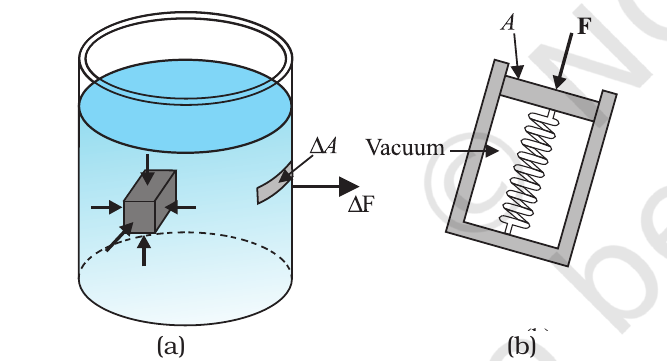
A sharp needle when pressed against our skin pierces it. Our skin, however, remains intact when a blunt object with a wider contact area (say the back of a spoon) is pressed against it with the same force. If an elephant were to step on a man's chest, his ribs would crack. A circus performer across whose chest a large, light but strong wooden plank is placed first, is saved from this accident. Such everyday experiences convince us that both the force and its coverage area are important. Smaller the area on which the force acts, greater is the impact. This impact is known as pressure.
- When an object is submerged in a fluid at rest, the fluid exerts a force on its surface. This force is always normal to the object's surface. If there were a component of force parallel to the surface, the object will also exert a force on the fluid parallel to it; as a consequence of Newton's third law, this force will cause the fluid to flow parallel to the surface. Since the fluid is at rest, this cannot happen. Hence, the force exerted by the fluid at rest has to be perpendicular to the surface in contact with it.
- The normal force exerted by the fluid at a point may be measured. An idealised form of one such pressure-measuring device is shown in Fig. 9.1(b). It consists of an evacuated chamber with a spring that is calibrated to measure the force acting on the piston.
- If F is the magnitude of this normal force on the piston of area A then the average pressure Pav is defined as the normal force acting per unit area: $P_{av} = F/A$ (9.1). In principle, the piston area can be made arbitrarily small. The pressure is then defined in a limiting sense as $P = lim (\Delta F/\Delta A)$ as $\Delta A$ → 0 (9.2).
- Pressure is a scalar quantity. It is the component of the force normal to the area under consideration and not the (vector) force that appears in the numerator in Eqs. (9.1) and (9.2). Its dimensions are $[M L^{-1} T^{-2}]$. The SI unit of pressure is N m^-2. It has been named as pascal (Pa) in honour of the French scientist Blaise Pascal (1623-1662). A common unit of pressure is the atmosphere (atm), the pressure exerted by the atmosphere at sea level (1 $atm = 1.013 \times 10^5 Pa$).
- Another quantity, that is indispensable in describing fluids, is the density ρ. For a fluid of mass m occupying volume V, $ρ = m/V$ (9.3). The dimensions of density are $[M L^{-3}]$. Its SI unit is kg m^-3. It is a positive scalar quantity. A liquid is largely incompressible and its density is therefore, nearly constant at all pressures. Gases, on the other hand, exhibit a large variation in densities with pressure.
- The density of water at 4°C (277 K) is 1.0 x $10^{3}$ kg m^-3. The relative density of a substance is the ratio of its density to the density of water at 4°C. It is a dimensionless positive scalar quantity. For example the relative density of aluminium is 2.7. Its density is 2.7 x $10^{3}$ kg m^-3.
- Table 9.1, densities of some common fluids at STP (kg m^-3):
| Fluid | Density |
|---|---|
| Water | 1.00 x $10^{3}$ |
| Sea water | 1.03 x $10^{3}$ |
| Mercury | 13.6 x $10^{3}$ |
| Ethyl alcohol | 0.806 x $10^{3}$ |
| Whole blood | 1.06 x $10^{3}$ |
| Air | 1.29 |
| Oxygen | 1.43 |
| Hydrogen | 9.0 x $10^{-2}$ |
| Interstellar space | ~$10^{-20}$ |
* STP means standard temperature (0°C) and 1 atm pressure.
- Worked example 9.1: the two thigh bones (femurs), each of cross-sectional area 10 $\mathrm{cm}^2$, support the upper part of a human body of mass 40 kg. Total area $A = 2 \times 10 \mathrm{cm}^2 = 20 x 10^{-4} m^2$. Force $F = 40 kg wt = 400 N (taking g = 10 m s^{-2})$. Average pressure $P_{av} = F/A = 2 x 10^{5} N m^{-2}$.
Practice1 question
Try it now. A wrong answer costs nothing here, try again until you get it.
From Table 9.1, the density of mercury at STP is
NCERT 9.2, Table 9.1: mercury at STP has density 13.6 x $10^{3}$ kg m^-3, the largest in the table.
Pascal's Law
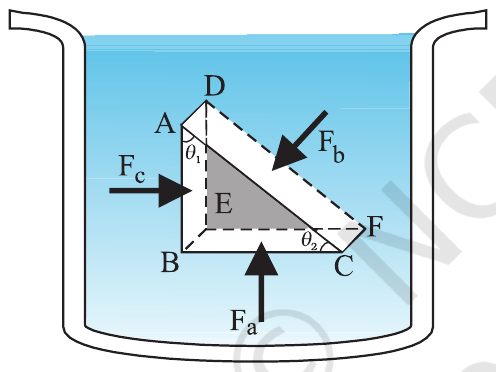
Pascal's law: the pressure in a fluid at rest is the same at all points if they are at the same height. The French scientist Blaise Pascal observed this fact.
- Fig. 9.2 shows an element in the interior of a fluid at rest. This element ABC-DEF is in the form of a right-angled prism. In principle, this prismatic element is very small so that every part of it can be considered at the same depth from the liquid surface and therefore, the effect of gravity is the same at all these points. But for clarity we have enlarged this element. The forces on this element are those exerted by the rest of the fluid and they must be normal to the surfaces of the element as discussed above. Thus, the fluid exerts pressures Pa, Pb and Pc on the faces BEFC, ADFC and ADEB, denoted by Aa, Ab and Ac respectively. Then Fb sin θ = Fc, Fb cos θ = Fa (by equilibrium); $Ab \sin θ = Ac, Ab \cos θ = Aa (b_y geometry)$. Thus, $Fb/Ab = Fc/Ac = Fa/Aa$, so Pb = Pc = Pa (9.4). Hence, pressure exerted is the same in all directions in a fluid at rest. It again reminds us that like other types of stress, pressure is not a vector quantity. No direction can be assigned to it. The force against any area within (or bounding) a fluid at rest and under pressure is normal to the area, regardless of the orientation of the area.
- Now consider a fluid element in the form of a horizontal bar of uniform cross-section. The bar is in equilibrium. The horizontal forces exerted at its two ends must be balanced or the pressure at the two ends should be equal. This proves that for a liquid in equilibrium the pressure is the same at all points in a horizontal plane. Suppose the pressure were not equal in different parts of the fluid, then there would be a flow as the fluid will have some net force acting on it. Hence in the absence of flow the pressure in the fluid must be the same everywhere in a horizontal plane.
Variation of Pressure with Depth
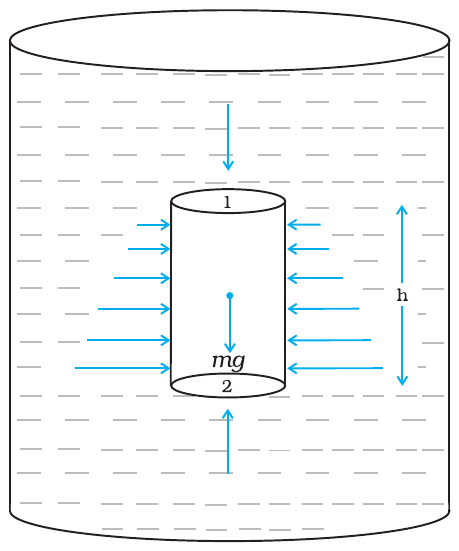
Consider a fluid at rest in a container. In Fig. 9.3 point 1 is at height h above a point 2. The pressures at points 1 and 2 are $P_1$ and $P_2$ respectively. Consider a cylindrical element of fluid having area of base A and height h. As the fluid is at rest the resultant horizontal forces should be zero and the resultant vertical forces should balance the weight of the element. The forces acting in the vertical direction are due to the fluid pressure at the top (P1A) acting downward, at the bottom (P2A) acting upward. If mg is weight of the fluid in the cylinder we have $(P_2 - P_1)A = mg$ (9.5). Now, if ρ is the mass density of the fluid, we have the mass of fluid to be $m = ρV = ρhA$ so that $P_2 - P_1 = ρgh$ (9.6).
- Pressure difference depends on the vertical distance h between the points (1 and 2), mass density of the fluid ρ and acceleration due to gravity g. If the point 1 under discussion is shifted to the top of the fluid (say, water), which is open to the atmosphere, $P_1$ may be replaced by atmospheric pressure (Pa) and we replace $P_2$ by P. Then Eq. (9.6) gives $P = Pa + ρgh$ (9.7).
- Thus, the pressure P, at depth below the surface of a liquid open to the atmosphere is greater than atmospheric pressure by an amount ρgh. The excess of pressure, P - Pa, at depth h is called a gauge pressure at that point.
- The area of the cylinder does not appear in the expression of absolute pressure in Eq. (9.7). Thus, the height of the fluid column is important and not cross-sectional or base area or the shape of the container. The liquid pressure is the same at all points at the same horizontal level (same depth).
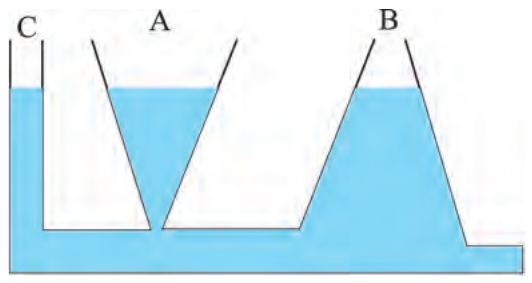
- Hydrostatic paradox: consider three vessels A, B and C [Fig. 9.4] of different shapes. They are connected at the bottom by a horizontal pipe. On filling with water, the level in the three vessels is the same, though they hold different amounts of water. This is so because water at the bottom has the same pressure below each section of the vessel.
- Worked example 9.2: what is the pressure on a swimmer 10 m below the surface of a lake? $h = 10 m$ and $ρ = 1000 kg m^{-3}$. Take $g = 10 m s^{-2}$. From Eq. (9.7), $P = Pa + ρgh = 1.01 x 10^{5} Pa + 1000 kg m^{-3} x 10 m s^{-2} x 10 m$ = 2.01 x $10^{5}$ Pa, about 2 atm. This is a 100% increase in pressure from surface level. At a depth of 1 km, the increase in pressure is 100 atm. Submarines are designed to withstand such enormous pressures.
Atmospheric Pressure and Gauge Pressure
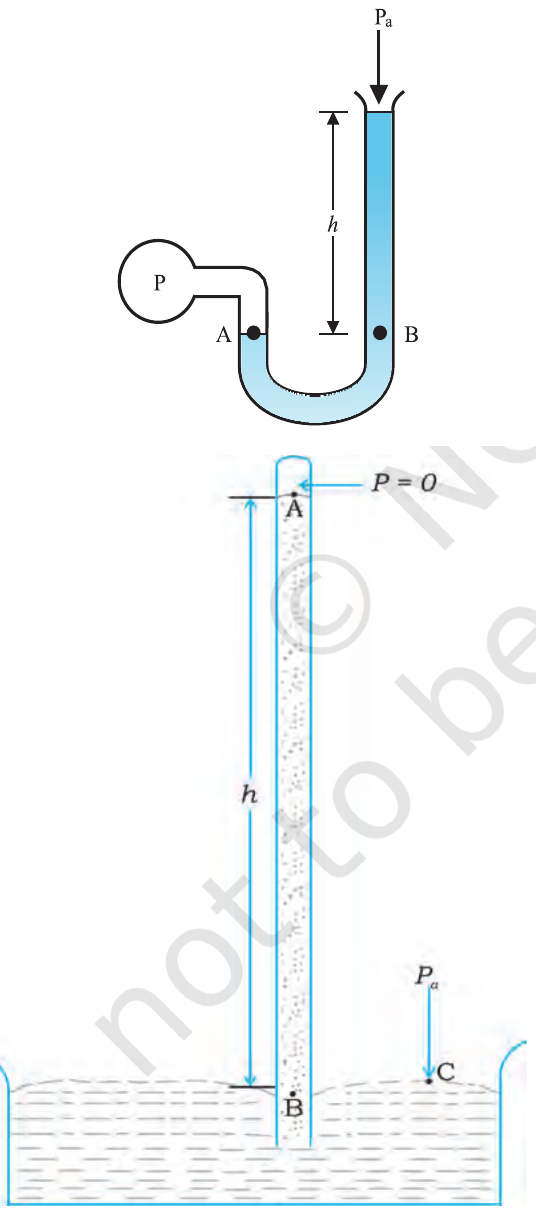
The pressure of the atmosphere at any point is equal to the weight of a column of air of unit cross-sectional area extending from that point to the top of the atmosphere. At sea level, it is 1.013 x $10^{5}$ Pa (1 atm). Italian scientist Evangelista Torricelli (1608-1647) devised for the first time a method for measuring atmospheric pressure. A long glass tube closed at one end and filled with mercury is inverted into a trough of mercury as shown in Fig. 9.5 (a). This device is known as mercury barometer. The space above the mercury column in the tube contains only mercury vapour whose pressure P is so small that it may be neglected. Thus, the pressure at $Point A = 0$. The pressure inside the coloumn at Point B must be the same as the pressure at Point C, which is atmospheric pressure, Pa. (NCERT prints 'coloumn'.)$Pa = ρgh$ (9.8), where ρ is the density of mercury and h is the height of the mercury column in the tube.
- In the experiment it is found that the mercury column in the barometer has a height of about 76 cm at sea level equivalent to one atmosphere (1 atm). This can also be obtained using the value of ρ in Eq. (9.8). A common way of stating pressure is in terms of cm or mm of mercury (Hg). A pressure equivalent of 1 mm is called a torr (after Torricelli). 1 $torr = 133 Pa$. The mm of Hg and torr are used in medicine and physiology. In meteorology, a common unit is the bar and millibar. 1 $bar = 10^5 Pa$.
- An open tube manometer is a useful instrument for measuring pressure differences. It consists of a U-tube containing a suitable liquid, a low density liquid (such as oil) for measuring small pressure differences and a high density liquid (such as mercury) for large pressure differences. One end of the tube is open to the atmosphere and the other end is connected to the system whose pressure we want to measure [see Fig. 9.5 (b)]. The pressure P at A is equal to pressure at point B. What we normally measure is the gauge pressure, which is P - Pa, given by Eq. (9.8) and is proportional to manometer height h.
- Pressure is the same at the same level on both sides of the U-tube containing a fluid. For liquids, the density varies very little over wide ranges in pressure and temperature and we can treat it safely as a constant for our present purposes. Gases on the other hand, exhibit large variations of densities with changes in pressure and temperature. Unlike gases, liquids are, therefore, largely treated as incompressible.
- Worked example 9.3: the density of the atmosphere at sea level is 1.29 kg/$m^3$. Assume that it does not change with altitude. Then how high would the atmosphere extend? We use Eq. (9.7): $ρgh = 1.29 kg m^{-3} x 9.8 m s^{-2} x h m$ = 1.01 x $10^{5}$ Pa, so $h = 7989 m$, about 8 km. In reality the density of air decreases with height. So does the value of g. The atmospheric cover extends with decreasing pressure over 100 km. We should also note that the sea level atmospheric pressure is not always 760 mm of Hg. A drop in the Hg level by 10 mm or more is a sign of an approaching storm.
- Worked example 9.4: at a depth of 1000 m in an ocean (a) what is the absolute pressure? (b) What is the gauge pressure? (c) Find the force acting on the window of area 20 cm x 20 cm of a submarine at this depth, the interior of which is maintained at sea-level atmospheric pressure. The density of sea water is 1.03 x $10^{3}$ kg m^-3, g = 10 m s^-2. (a) From Eq. (9.6), absolute pressure $P = Pa + ρgh = 1.01 x 10^{5} Pa + 1.03 x 10^{3} kg m^{-3} x 10 m s^{-2} x 1000 m$ = 104.01 x $10^{5}$ Pa, about 104 atm. (b) Gauge pressure is $P - Pa = ρgh = 103 x 10^{5} Pa$, about 103 atm. (c) The pressure outside the submarine is $P = Pa + ρgh$ and the pressure inside it is Pa. Hence, the net pressure acting on the window is gauge pressure, $Pg = ρgh$. Since the area of the window is $A = 0.04 m^2$, the force acting on it is $F = Pg A = 103 x 10^{5} Pa x 0.04 m^2$ = 4.12 x $10^{5}$ N.
Hydraulic Machines
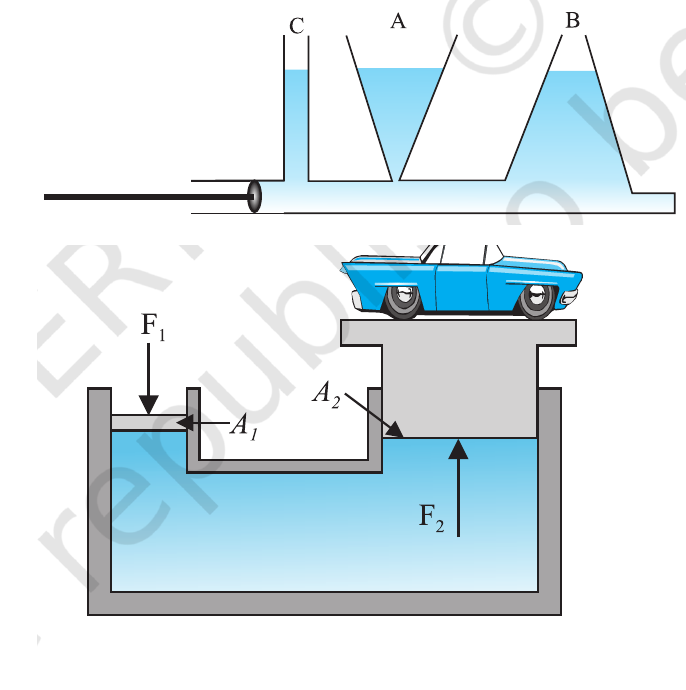
Let us now consider what happens when we change the pressure on a fluid contained in a vessel. Consider a horizontal cylinder with a piston and three vertical tubes at different points [Fig. 9.6 (a)]. The pressure in the horizontal cylinder is indicated by the height of liquid column in the vertical tubes. It is necessarily the same in all. If we push the piston, the fluid level rises in all the tubes, again reaching the same level in each one of them.
- This indicates that when the pressure on the cylinder was increased, it was distributed uniformly throughout. Whenever external pressure is applied on any part of a fluid contained in a vessel, it is transmitted undiminished and equally in all directions. This is another form of Pascal's law and it has many applications in daily life.
- A number of devices, such as hydraulic lift and hydraulic brakes, are based on Pascal's law. In these devices, fluids are used for transmitting pressure. In a hydraulic lift, as shown in Fig. 9.6 (b), two pistons are separated by the space filled with a liquid. A piston of small cross-section A1 is used to exert a force F1 directly on the liquid. The pressure $P = F_1/A_1$ is transmitted throughout the liquid to the larger cylinder attached with a larger piston of area A2, which results in an upward force of P x A2. Therefore, the piston is capable of supporting a large force (large weight of, say a car, or a truck, placed on the platform) $F_2$ = P A2 = F1 (A2/A1). By changing the force at A1, the platform can be moved up or down. Thus, the applied force has been increased by a factor of A2/A1 and this factor is the mechanical advantage of the device.
- Formula table:
| Quantity | Formula |
|---|---|
| Pressure transmitted | $P = F_1/A_1 = F_2/A_2$ |
| Force on the large piston | $F_2 = F_1 (A_2/A_1)$ |
| Mechanical advantage | A2/A1 |
| Volume moved (incompressible liquid) | $L_1 A_1 = L_2 A_2$ |
- Worked example 9.5: two syringes of different cross-sections (without needles) filled with water are connected with a tightly fitted rubber tube filled with water. Diameters of the smaller piston and larger piston are 1.0 cm and 3.0 cm respectively. (a) Find the force exerted on the larger piston when a force of 10 N is applied to the smaller piston. (b) If the smaller piston is pushed in through 6.0 cm, how much does the larger piston move out? (a) Since pressure is transmitted undiminished throughout the fluid, $F_2 = (A_2/A_1) F_1 = 90 N$. (b) Water is considered to be perfectly incompressible. Volume covered by the movement of smaller piston inwards is equal to volume moved outwards due to the larger piston: $L_1 A_1 = L_2 A_2$, so $L_2 = 0.67 cm$. Note, atmospheric pressure is common to both pistons and has been ignored.
- Worked example 9.6: in a car lift compressed air exerts a force F1 on a small piston having a radius of 5.0 cm. This pressure is transmitted to a second piston of radius 15 cm (Fig. 9.7). If the mass of the car to be lifted is 1350 kg, calculate F1. What is the pressure necessary to accomplish this task? $(g = 9.8 m s^{-2})$. Since pressure is transmitted undiminished throughout the fluid, $F_1 = 1470 N$, about 1.5 x $10^{3}$ N. The air pressure that will produce this force is almost double the atmospheric pressure.
- Hydraulic brakes in automobiles also work on the same principle. When we apply a little force on the pedal with our foot the master piston moves inside the master cylinder, and the pressure caused is transmitted through the brake oil to act on a piston of larger area. A large force acts on the piston and is pushed down expanding the brake shoes against brake lining. In this way, a small force on the pedal produces a large retarding force on the wheel. An important advantage of the system is that the pressure set up by pressing the pedal is transmitted equally to all cylinders attached to the four wheels so that the braking effort is equal on all wheels.
Practice1 question
Try it now. A wrong answer costs nothing here, try again until you get it.
In Example 9.5, a force of 10 N on the smaller piston (diameter 1.0 cm) gives what force on the larger piston (diameter 3.0 cm)?
NCERT 9.2.4, Example 9.5: $F_2 = (A_2/A_1) F_1$. The diameters are 1.0 cm and 3.0 cm, so $A_2/A_1 = 9$ and $F_2 = 90 N$.
Streamline Flow
So far we have studied fluids at rest. The study of the fluids in motion is known as fluid dynamics. When a water tap is turned on slowly, the water flow is smooth initially, but loses its smoothness when the speed of the outflow is increased.
- In studying the motion of fluids, we focus our attention on what is happening to various fluid particles at a particular point in space at a particular time. The flow of the fluid is said to be steady if at any given point, the velocity of each passing fluid particle remains constant in time. This does not mean that the velocity at different points in space is the same. The velocity of a particular particle may change as it moves from one point to another. That is, at some other point the particle may have a different velocity, but every other particle which passes the second point behaves exactly as the previous particle that has just passed that point. Each particle follows a smooth path, and the paths of the particles do not cross each other.
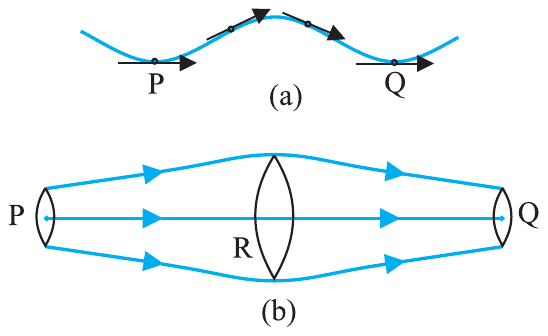
- The path taken by a fluid particle under a steady flow is a streamline. It is defined as a curve whose tangent at any point is in the direction of the fluid velocity at that point. Consider the path of a particle as shown in Fig. 9.7 (a): the curve describes how a fluid particle moves with time. The curve PQ is like a permanent map of fluid flow, indicating how the fluid streams. No two streamlines can cross, for if they do, an oncoming fluid particle can go either one way or the other and the flow would not be steady. Hence, in steady flow, the map of flow is stationary in time.
- Steady flow is achieved at low flow speeds. Beyond a limiting value, called critical speed, this flow loses steadiness and becomes turbulent. One sees this when a fast flowing stream encounters rocks: small foamy whirlpool-like regions called 'white water rapids' are formed.
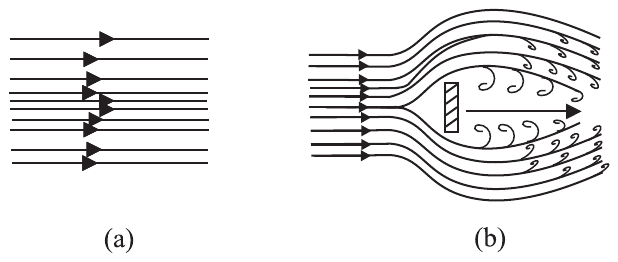
- Figure 9.8 displays streamlines for some typical flows. For example, Fig. 9.8(a) describes a laminar flow where the velocities at different points in the fluid may have different magnitudes but their directions are parallel. Figure 9.8 (b) gives a sketch of turbulent flow: a jet of air striking a flat plate placed perpendicular to it.
Equation of Continuity
Consider planes perpendicular to the direction of fluid flow at three points P, R and Q in Fig. 9.7 (b). The plane pieces are so chosen that their boundaries are determined by the same set of streamlines. This means that the number of fluid particles crossing the surfaces as indicated at P, R and Q is the same. If the areas of cross-section at these points are AP, AR and AQ and speeds of fluid particles are vP, vR and vQ, then the mass of fluid $\Delta m_P$ crossing at AP in a small interval of time $\Delta t$ is ρP AP vP $\Delta t$. Similarly the mass of fluid $\Delta m_R$ flowing or crossing at AR in a small interval of time $\Delta t$ is ρR AR vR $\Delta t$ and the mass of fluid $\Delta m_Q$ is ρQ AQ vQ $\Delta t$ crossing at AQ. The mass of liquid flowing out equals the mass flowing in, in all cases. Therefore, ρP AP vP $\Delta t$ = $ρ_R A_R v_R \Delta t = ρ_Q A_Q v_Q \Delta t$ (9.9).
- For flow of incompressible $fluids ρ_P = ρ_R = ρ_Q$. Equation (9.9) reduces to $A_P v_P = A_R v_R = A_Q v_Q$ (9.10), which is called the equation of continuity and it is a statement of conservation of mass in flow of incompressible fluids. In general Av = constant (9.11).
- Av gives the volume flux or flow rate and remains constant throughout the pipe of flow. Thus, at narrower portions where the streamlines are closely spaced, velocity increases and vice versa. From Fig. 9.7(b) it is clear that AR > AQ or vR < vQ: the fluid is accelerated while passing from R to Q. This is associated with a change in pressure in fluid flow in horizontal pipes.
Bernoulli's Principle
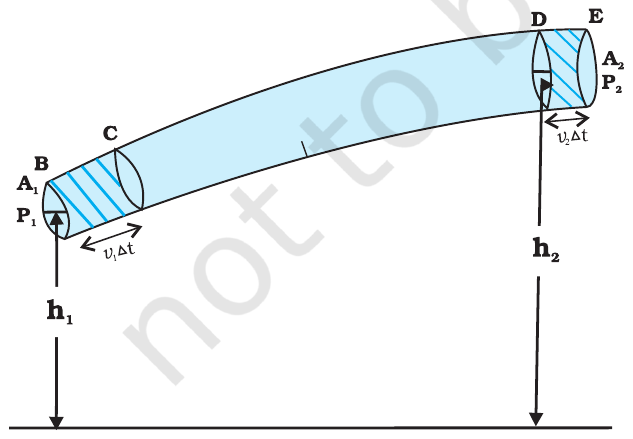
Fluid flow is a complex phenomenon. But we can obtain some useful properties for steady or streamline flows using the conservation of energy. Consider a fluid moving in a pipe of varying cross-sectional area. Let the pipe be at varying heights as shown in Fig. 9.9. We now suppose that an incompressible fluid is flowing through the pipe in a steady flow. Its velocity must change as a consequence of the equation of continuity. A force is required to produce this acceleration, which is caused by the fluid surrounding it; the pressure must be different in different regions. Bernoulli's equation is a general expression that relates the pressure difference between two points in a pipe to both velocity changes (kinetic energy change) and elevation (height) changes (potential energy change). The Swiss Physicist Daniel Bernoulli developed this relationship in 1738.
- Consider the flow at two regions 1 (that is, BC) and 2 (that is, DE). Consider the fluid initially lying between B and D. In an infinitesimal time interval $\Delta t$, this fluid would have moved. Suppose v1 is the speed at B and $v_2$ at D, then fluid initially at B has moved a distance v1$\Delta t$ to C (v1$\Delta t$ is small enough to assume constant cross-section along BC). In the same interval $\Delta t$ the fluid initially at D moves to E, a distance equal to $v_2\Delta t$. Pressures $P_1$ and $P_2$ act as shown on the plane faces of areas A1 and A2 binding the two regions. The work done on the fluid at the left end (BC) is $W_1 = P_1A_1(v_1\Delta t) = P_1\Delta V$. Since the same volume $\Delta V$ passes through both the regions (from the equation of continuity) the work done by the fluid at the other end (DE) is $W_2 = P_2A_2(v_2\Delta t) = P_2\Delta V$, or the work done on the fluid is -$P_2\Delta V$. So the total work done on the fluid is $W_1 - W_2 = (P_1 - P_2)\Delta V$.
- Part of this work goes into changing the kinetic energy of the fluid, and part goes into changing the gravitational potential energy. If the density of the fluid is ρ and $\Delta m = ρA_1v_1\Delta t = ρ\Delta V$ is the mass passing through the pipe in time $\Delta t$, then the change in gravitational potential energy is $\Delta U = ρg\Delta V(h_2 - h_1)$. The change in its kinetic energy is $\Delta K = (1/2)ρ\Delta V(v_2^2 - v_1^2)$. We can employ the work-energy theorem (Chapter 6) to this volume of the fluid and this yields ($P_1$ - $P_2$)$\Delta V$ = (1/2)ρ$\Delta V$($v_2^2$ - $v_1^2$) + ρg$\Delta V$(h2 - h1). We now divide each term by $\Delta V$ to obtain $(P_1 - P_2) = (1/2)ρ(v_2^2 - v_1^2) + ρg(h_2 - h_1)$. We can rearrange the above terms to obtain $P_1$ + (1/2)ρ$v_1^2$ + ρgh1 = $P_2$ + (1/2)ρ$v_2^2$ + ρgh2 (9.12). This is Bernoulli's equation. Since 1 and 2 refer to any two locations along the pipeline, we may write the expression in general as P + (1/2)ρ$v^2$ + ρgh = constant (9.13).
- In words, the Bernoulli relation may be stated as follows: as we move along a streamline the sum of the pressure (P), the kinetic energy per unit volume ((ρ$v^2$)/2) and the potential energy per unit volume (ρgh) remains a constant.
- Note that in applying the energy conservation principle, there is an assumption that no energy is lost due to friction. But in fact, when fluids flow, some energy does get lost due to internal friction. This arises due to the fact that in a fluid flow, the different layers of the fluid flow with different velocities. These layers exert frictional forces on each other resulting in a loss of energy. This property of the fluid is called viscosity and is discussed in more detail in a later section. The lost kinetic energy of the fluid gets converted into heat energy. Thus, Bernoulli's equation ideally applies to fluids with zero viscosity or non-viscous fluids. Another restriction on application of Bernoulli theorem is that the fluids must be incompressible, as the elastic energy of the fluid is also not taken into consideration. In practice, it has a large number of useful applications and can help explain a wide variety of phenomena for low viscosity incompressible fluids.
- Bernoulli's equation also does not hold for non-steady or turbulent flows, because in that situation velocity and pressure are constantly fluctuating in time.
- When a fluid is at rest, that is, its velocity is zero everywhere, Bernoulli's equation becomes $P_1 + ρgh_1 = P_2 + ρgh_2$, that is $(P_1 - P_2) = ρg(h_2 - h_1)$, which is the same as Eq. (9.6).
Torricelli's Law and Dynamic Lift
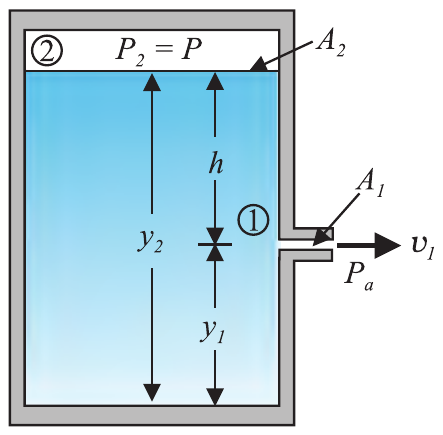
9.4.1 Speed of efflux: Torricelli's law. The word efflux means fluid outflow. Torricelli discovered that the speed of efflux from an open tank is given by a formula identical to that of a freely falling body. Consider a tank containing a liquid of density ρ with a small hole in its side at a height y1 from the bottom (see Fig. 9.10). The air above the liquid, whose surface is at height y2, is at pressure P. From the equation of continuity [Eq. (9.10)] we have $v_1 A_1 = v_2 A_2$, so $v_2 = (A_1/A_2) v_1$.
- If the cross-sectional area of the tank A2 is much larger than that of the hole (A2 >> A1), then we may take the fluid to be approximately at rest at the top, that is, $v_2 = 0$. Now, applying the Bernoulli equation at points 1 and 2 and noting that at the hole $P_1$ = Pa, the atmospheric pressure, we have $Pa + (1/2)ρv_1^2 + ρgy_1 = P + ρgy_2$. Taking $y_2 - y_1 = h$ we have $v_1 = \sqrt{2gh + (2(P - Pa))/ρ}$ (9.14). When P >> Pa and 2gh may be ignored, the speed of efflux is determined by the container pressure. Such a situation occurs in rocket propulsion. On the other hand, if the tank is open to the atmosphere, then P = Pa and $v_1 = \sqrt{2gh}$ (9.15). This is also the speed of a freely falling body. Equation (9.15) represents Torricelli's law.
- 9.4.2 Dynamic lift. Dynamic lift is the force that acts on a body, such as an airplane wing, a hydrofoil or a spinning ball, by virtue of its motion through a fluid. In many games such as cricket, tennis, baseball, or golf, we notice that a spinning ball deviates from its parabolic trajectory as it moves through air. This deviation can be partly explained on the basis of Bernoulli's principle.
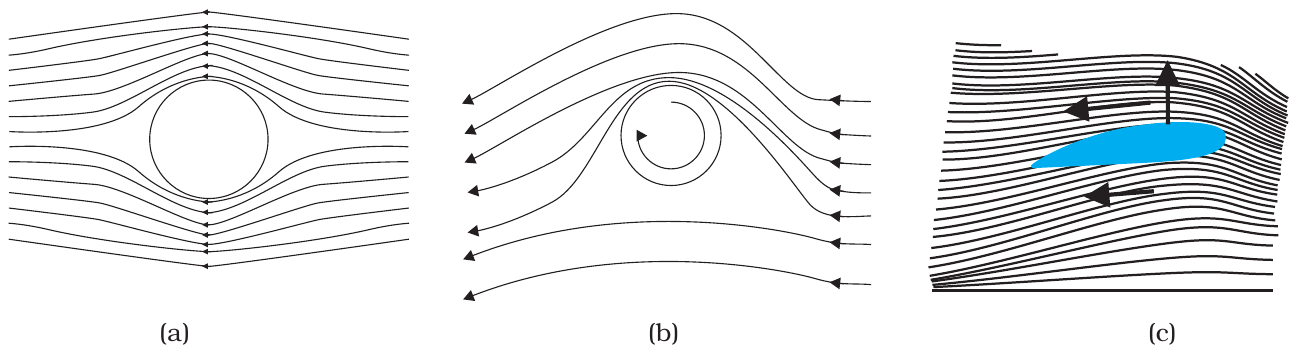
- (i) Ball moving without spin: Fig. 9.11(a) shows the streamlines around a non-spinning ball moving relative to a fluid. From the symmetry of streamlines it is clear that the velocity of fluid (air) above and below the ball at corresponding points is the same resulting in zero pressure difference. The air therefore, exerts no upward or downward force on the ball.
- (ii) Ball moving with spin: a ball which is spinning drags air along with it. If the surface is rough more air will be dragged. Fig. 9.11(b) shows the streamlines of air for a ball which is moving and spinning at the same time. The ball is moving forward and relative to it the air is moving backwards. Therefore, the velocity of air above the ball relative to the ball is larger and below it is smaller (see Section 9.3). The stream lines, thus, get crowded above and rarified below. This difference in the velocities of air results in the pressure difference between the lower and upper faces and there is a net upward force on the ball. This dynamic lift due to spining is called Magnus effect. (NCERT prints 'spining'.)
- Aerofoil or lift on aircraft wing: Figure 9.11 (c) shows an aerofoil, which is a solid piece shaped to provide an upward dynamic lift when it moves horizontally through air. The cross-section of the wings of an aeroplane looks somewhat like the aerofoil shown in Fig. 9.11 (c) with streamlines around it. When the aerofoil moves against the wind, the orientation of the wing relative to flow direction causes the streamlines to crowd together above the wing more than those below it. The flow speed on top is higher than that below it. There is an upward force resulting in a dynamic lift of the wings and this balances the weight of the plane.
- Worked example 9.7: a fully loaded Boeing aircraft has a mass of 3.3 x $10^{5}$ kg. Its total wing area is 500 $m^2$. It is in level flight with a speed of 960 km/h. (a) Estimate the pressure difference between the lower and upper surfaces of the wings. (b) Estimate the fractional increase in the speed of the air on the upper surface of the wing relative to the lower surface. [The density of air is $ρ = 1.2 kg m^{-3}$.] (a) The weight of the Boeing aircraft is balanced by the upward force due to the pressure difference: $\Delta P$ x A = 3.3 x $10^{5}$ kg x 9.8 m s^-2, so $\Delta P = (3.3 \times 10^5 kg x 9.8 m s^{-2})/(500 m^2)$ = 6.5 x $10^{3}$ N m^-2. (b) We ignore the small height difference between the top and bottom sides in Eq. (9.12). The pressure difference between them is then $\Delta P = (ρ/2)(v_2^2 - v_1^2)$, where $v_2$ is the speed of air over the upper surface and v1 is the speed under the bottom surface. $(v_2 - v_1) = (2\Delta P)/(ρ(v_2 + v_1))$. Taking the average speed $vav = (v_2 + v_1)/2 = 960 km/h = 267 m s^{-1}: (v_2 - v_1)/vav = \Delta P/(ρ v_{av}^2) ≈ 0.08$. The speed above the wing needs to be only 8% higher than that below.
Practice1 question
Try it now. A wrong answer costs nothing here, try again until you get it.
Torricelli's law: the speed of efflux from an open tank with the hole at depth h below the surface is
NCERT 9.4.1, Eq. (9.15): $v_1 = \sqrt{2gh}$, the speed of a freely falling body from height h.
Viscosity
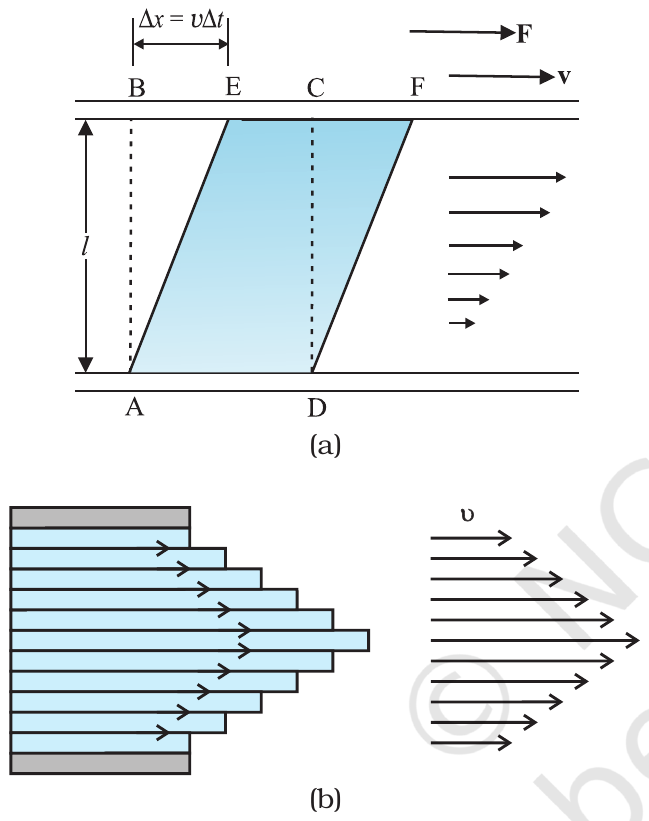
Most of the fluids are not ideal ones and offer some resistance to motion. This resistance to fluid motion is like an internal friction analogous to friction when a solid moves on a surface. It is called viscosity. This force exists when there is relative motion between layers of the liquid.
- Suppose we consider a fluid like oil enclosed between two glass plates as shown in Fig. 9.12 (a). The bottom plate is fixed while the top plate is moved with a constant velocity v relative to the fixed plate. If oil is replaced by honey, a greater force is required to move the plate with the same velocity. Hence we say that honey is more viscous than oil. The fluid in contact with a surface has the same velocity as that of the surfaces. Hence, the layer of the liquid in contact with top surface moves with a velocity v and the layer of the liquid in contact with the fixed surface is stationary. The velocities of layers increase uniformly from bottom (zero velocity) to the top layer (velocity v). For any layer of liquid, its upper layer pulls it forward while lower layer pulls it backward. This results in force between the layers. This type of flow is known as laminar. The layers of liquid slide over one another as the pages of a book do when it is placed flat on a table and a horizontal force is applied to the top cover.
- When a fluid is flowing in a pipe or a tube, then velocity of the liquid layer along the axis of the tube is maximum and decreases gradually as we move towards the walls where it becomes zero, Fig. 9.12 (b). The velocity on a cylindrical surface in a tube is constant.
Coefficient of Viscosity
On account of this motion, a portion of liquid, which at some instant has the shape ABCD, takes the shape of AEFD after a short interval of time ($\Delta t$). During this time interval the liquid has undergone a shear strain of $\Delta x$/l. Since the strain in a flowing fluid increases with time continuously, unlike a solid, here the stress is found experimentally to depend on 'rate of change of strain' or 'strain rate', that is, ($\Delta x$/l)/$\Delta t$ or v/l, instead of strain itself. The coefficient of viscosity (pronounced 'η') for a fluid is defined as the ratio of shearing stress to the strain rate: $η = (F/A)/(v/l)$ (9.16). The SI unit of viscosity is poiseiulle (Pl). (NCERT prints 'poiseiulle'.) Its other units are N s m^-2 or Pa s. The dimensions of viscosity are $[M L^{-1} T^{-1}]$. Generally, thin liquids, like water, alcohol, etc., are less viscous than thick liquids, like coal tar, blood, glycerine, etc.
- Table 9.2, the viscosities of some fluids:
| Fluid | T (°C) | Viscosity (mPl) |
|---|---|---|
| Water | 20 | 1.0 |
| Water | 100 | 0.3 |
| Blood | 37 | 2.7 |
| Machine Oil | 16 | 113 |
| Machine Oil | 38 | 34 |
| Glycerine | 20 | 830 |
| Honey | - | 200 |
| Air | 0 | 0.017 |
| Air | 40 | 0.019 |
- As Table 9.2 indicates, blood is 'thicker' (more viscous) than water. Further, the relative viscosity (η/ηwater) of blood remains constant between 0°C and 37°C.
- The viscosity of liquids decreases with temperature, while it increases in the case of gases.
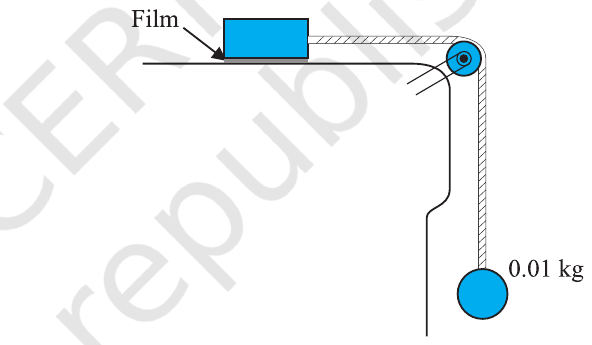
- Worked example 9.8: a metal block of area 0.10 $m^2$ is connected to a 0.010 kg mass via a string that passes over an ideal pulley (considered massless and frictionless), as in Fig. 9.13. A liquid with a film thickness of 0.30 mm is placed between the block and the table. When released the block moves to the right with a constant speed of 0.085 m s^-1. Find the coefficient of viscosity of the liquid. The metal block moves to the right because of the tension in the string. The tension T is equal in magnitude to the weight of the suspended mass m. Thus, the shear force F is F = $T = mg = 0.010 kg x 9.8 m s^{-2} = 9.8 x 10^{-2} N$. Shear stress on the $fluid = F/A = 0.98 N/m^2$. $Strain rate = v/l = (0.085 m s^{-1})/(0.30 x 10^{-3} m)$ = 283 s^-1. $η = (0.98)/(283) = 3.46 x 10^{-3} Pa s$.
Stokes' Law and Terminal Velocity
When a body falls through a fluid it drags the layer of the fluid in contact with it. A relative motion between the different layers of the fluid is set and, as a result, the body experiences a retarding force. Falling of a raindrop and swinging of a pendulum bob are some common examples of such motion. It is seen that the viscous force is proportional to the velocity of the object and is opposite to the direction of motion. The other quantities on which the force F depends are viscosity η of the fluid and radius a of the sphere. Sir George G. Stokes (1819-1903), an English scientist, enunciated clearly the viscous drag force F as $F = 6πηav$ (9.17). This is known as Stokes' law. We shall not derive Stokes' law.
- This law is an interesting example of retarding force, which is proportional to velocity. We can study its consequences on an object falling through a viscous medium. We consider a raindrop in air. It accelerates initially due to gravity. As the velocity increases, the retarding force also increases. Finally, when viscous force plus buoyant force becomes equal to the force due to gravity, the net force becomes zero and so does the acceleration. The sphere (raindrop) then descends with a constant velocity. Thus, in equilibrium, this terminal velocity vt is given by $6πηavt = (4π/3) a^3 (ρ - σ)g$, where ρ and σ are mass densities of sphere and the fluid, respectively. We obtain $v_t = (2a^2 (ρ - σ)g)/(9η)$ (9.18). So the terminal velocity vt depends on the square of the radius of the sphere and inversely on the viscosity of the medium.
- Worked example 9.9: the terminal velocity of a copper ball of radius 2.0 mm falling through a tank of oil at 20°C is 6.5 cm s^-1. Compute the viscosity of the oil at 20°C. Density of oil is 1.5 x $10^{3}$ kg m^-3, density of copper is 8.9 x $10^{3}$ kg m^-3. We have $v_t = 6.5 \times 10^{-2} m s^{-1}$, $a = 2 \times 10^{-3} m$, $g = 9.8 m s^{-2}$, $ρ = 8.9 \times 10^3 kg m^{-3}$, $σ = 1.5 \times 10^3 kg m^{-3}$. From Eq. (9.18), $η = (2a^2 (ρ - σ)g)/(9vt) = 9.9 x 10^{-1} kg m^{-1} s^{-1}$.
Practice1 question
Try it now. A wrong answer costs nothing here, try again until you get it.
The terminal velocity of a sphere falling through a viscous fluid is proportional to
NCERT 9.5.1, Eq. (9.18): $v_t = (2a^2 (ρ - σ)g)/(9η)$, so vt depends on the square of the radius and inversely on the viscosity.
Surface Energy
You must have noticed that, oil and water do not mix; water wets you and me but not ducks; mercury does not wet glass but water sticks to it, oil rises up a cotton wick, inspite of gravity, sap and water rise up to the top of the leaves of the tree, hair of a paint brush do not cling together when dry and even when dipped in water but form a fine tip when taken out of it. All these and many more such experiences are related with the free surfaces of liquids. As liquids have no definite shape but have a definite volume, they acquire a free surface when poured in a container. These surfaces possess some additional energy. This phenomenon is known as surface tension and it is concerned with only liquid as gases do not have free surfaces.
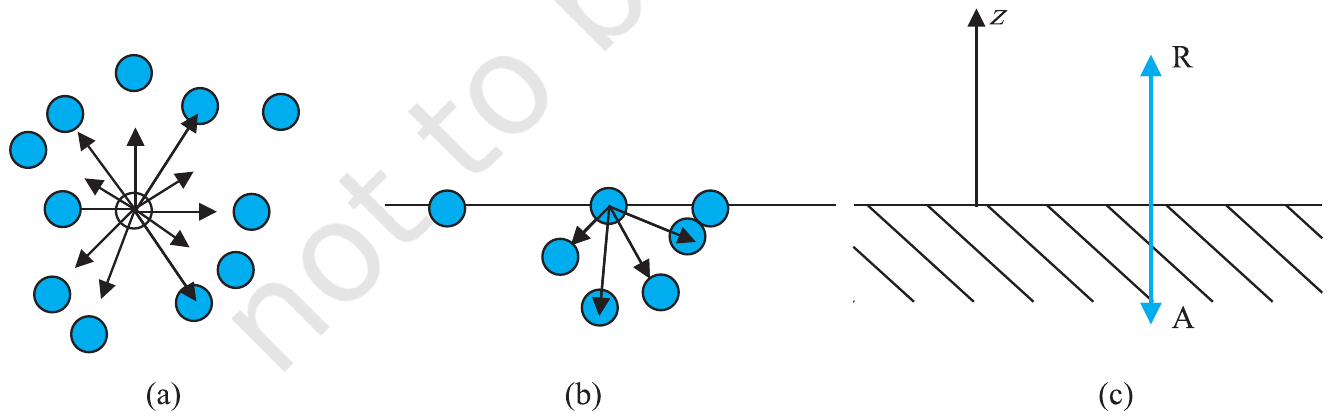
- 9.6.1 Surface energy. A liquid stays together because of attraction between molecules. Consider a molecule well inside a liquid. The intermolecular distances are such that it is attracted to all the surrounding molecules [Fig. 9.14(a)]. This attraction results in a negative potential energy for the molecule, which depends on the number and distribution of molecules around the chosen one. But the average potential energy of all the molecules is the same. This is supported by the fact that to take a collection of such molecules (the liquid) and to disperse them far away from each other in order to evaporate or vaporise, the heat of evaporation required is quite large. For water it is of the order of 40 kJ/mol.
- Let us consider a molecule near the surface, Fig. 9.14(b). Only lower half side of it is surrounded by liquid molecules. There is some negative potential energy due to these, but obviously it is less than that of a molecule in bulk, that is, the one fully inside. Approximately it is half of the latter. Thus, molecules on a liquid surface have some extra energy in comparison to molecules in the interior. A liquid, thus, tends to have the least surface area which external conditions permit. Increasing surface area requires energy. Most surface phenomena can be understood in terms of this fact. What is the energy required for having a molecule at the surface? As mentioned above, roughly it is half the energy required to remove it entirely from the liquid, that is, half the heat of evaporation.
- Finally, what is a surface? Since a liquid consists of molecules moving about, there cannot be a perfectly sharp surface. The density of the liquid molecules drops rapidly to zero around $z = 0$ as we move along the direction indicated in Fig. 9.14 (c), in a distance of the order of a few molecular sizes.
Surface Tension
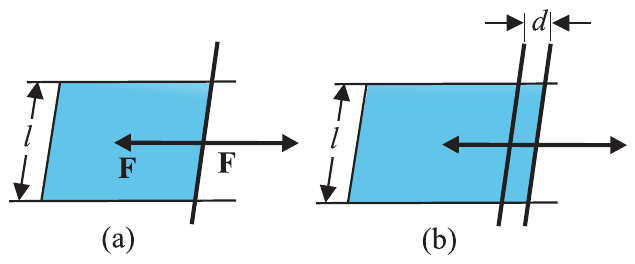
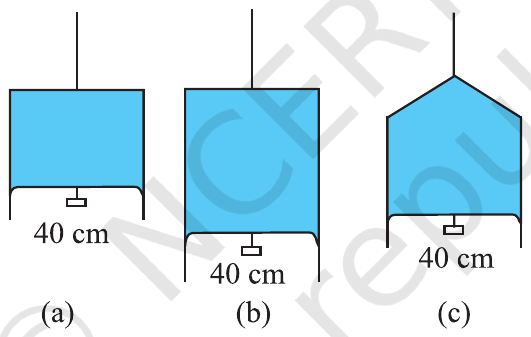
As we have discussed, an extra energy is associated with the surface of liquids; the creation of more surface (spreading of surface), keeping other things like volume fixed, requires a horizontal liquid film ending in a bar free to slide over parallel guides, Fig. 9.15.
- Suppose that we move the bar by a small distance d as shown. Since the area of the surface increases, the system now has more energy; this means that some work has been done against an internal force. Let this internal force be F: the work done by the applied force is F.$d = Fd$. From conservation of energy, this is stored as additional energy in the film. If the surface energy of the film is S per unit area, the extra area is 2dl. A film has two sides and the liquid in between, so there are two surfaces and the extra energy is $S(2dl) = Fd$ (9.19). Or, $S = Fd/(2dl) = F/(2l)$ (9.20). This quantity S is the magnitude of surface tension. It is equal to the surface energy per unit area of the liquid interface and is also equal to the force per unit length exerted by the fluid on the movable bar.
- So far we have talked about the surface of one liquid. More generally, we need to consider fluid surface in contact with other fluids or solid surfaces. The surface energy in that case depends on the materials on both sides of the surface. For example, if the molecules of the materials attract each other, surface energy is reduced while if they repel each other the surface energy is increased. Thus, more appropriately, the surface energy is the energy of the interface between two materials and depends on both of them.
- We make the following observations from above: (i) Surface tension is a force per unit length (or surface energy per unit area) acting in the plane of the interface between the plane of the liquid and any other substance; it also is the extra energy that the molecules at the interface have as compared to molecules in the interior. (ii) At any point on the interface besides the boundary, we can draw a line and imagine equal and opposite surface tension forces S per unit length of the line acting perpendicular to the line, in the plane of the interface. The line is in equilibrium. To be more specific, imagine a line of atoms or molecules at the surface. The atoms to the left pull the line towards them; those to the right pull it towards them. This line of atoms is in equilibrium under tension. If the line really marks the end of the interface, as in Figure 9.14 (a) and (b), there is only the force S per unit length acting inwards.
- Table 9.3, surface tension of some liquids at the temperatures indicated, with the heats of vaporisation:
| Liquid | Temp (°C) | Surface Tension (N/m) | Heat of vaporisation (kJ/mol) |
|---|---|---|---|
| Helium | -270 | 0.000239 | 0.115 |
| Oxygen | -183 | 0.0132 | 7.1 |
| Ethanol | 20 | 0.0227 | 40.6 |
| Water | 20 | 0.0727 | 44.16 |
| Mercury | 20 | 0.4355 | 63.2 |
- The value of surface tension depends on temperature. Like viscosity, the surface tension of a liquid usually falls with temperature.
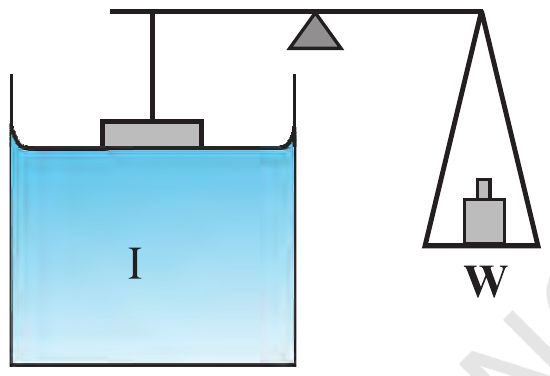
- A fluid will stick to a solid surface if the surface energy between fluid and the solid is smaller than the sum of surface energies between solid-air, and fluid-air. Now there is attraction between the solid surface and the liquid. It can be directly measured experimentally as schematically shown in Fig. 9.16. A flat vertical glass plate, below which a vessel of some liquid is kept, forms one arm of the balance. The plate is balanced by weights on the other side, with its horizontal edge just over water. The vessel is raised slightly till the liquid just touches the glass plate and pulls it down a little because of surface tension. Weights are added till the plate just clears water.
- Suppose the additional weight required is W. Then from Eq. 9.20 and the discussion given there, the surface tension of the liquid-air interface is $S_{la} = (W/(2l)) = ((mg)/(2l))$ (9.21), where m is the extra mass and l is the length of the plate edge. The subscript (la) emphasises the fact that the liquid-air interface tension is involved.
Angle of Contact
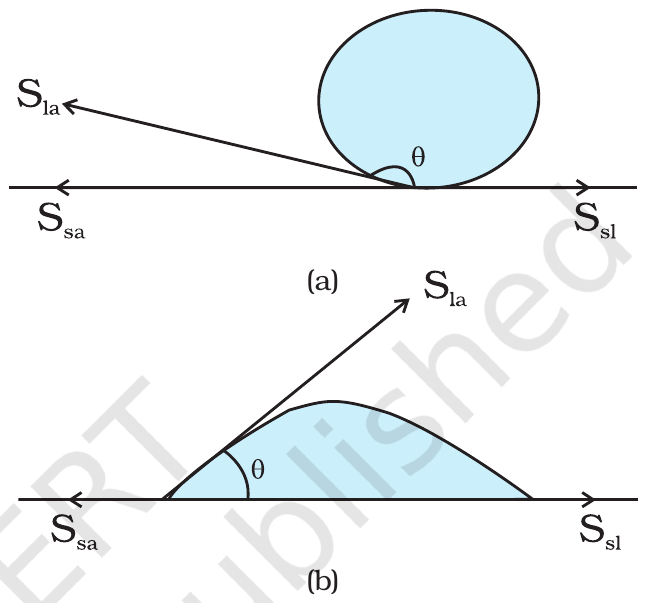
The surface of liquid near the plane of contact, with another medium, is in general curved. The angle between the tangent to the liquid surface at the point of contact and the solid surface inside the liquid is termed as angle of contact. It is denoted by θ. It is different at interfaces of different pairs of liquids and solids. The value of θ determines whether a liquid will spread on the surface of a solid or it will form droplets on it. For example, water forms droplets on a lotus leaf as shown in Fig. 9.17 (a) while it spreads over a clean plastic plate as shown in Fig. 9.17(b).
- We consider the three interfacial tensions at all the three interfaces, liquid-air, solid-air and solid-liquid, denoted by Sla, Ssa and Ssl, respectively, as given in Fig. 9.17 (a) and (b). At the line of contact, the surface forces between the three media must be in equilibrium. From Fig. 9.17(b) the following relation is easily derived: $S_{la} \cos θ + S_{sl} = S_{sa}$ (9.22).
- The angle of contact is an obtuse angle if Ssl > Sla, as in the case of the water-leaf interface, while it is an acute angle if Ssl < Sla, as in the case of the water-plastic interface. When θ is an obtuse angle then molecules of liquids are attracted strongly to themselves and weakly to those of solid, it costs a lot of energy to create a liquid-solid surface, and liquid then does not wet the solid. This is what happens with water on a waxy or oily surface, and with mercury on any surface. On the other hand, if the molecules of the liquid are strongly attracted to those of the solid, this will reduce Ssl and therefore, cos θ may increase or θ may decrease. In this case θ is an acute angle. This is what happens for water on glass or on plastic and for kerosene oil on virtually anything (it just spreads). Soaps, detergents and dyeing substances are wetting agents. When they are added the angle of contact becomes small so that these may penetrate well and become effective. Water proofing agents on the other hand are added to create a large angle of contact between the water and fibres.
Drops and Bubbles
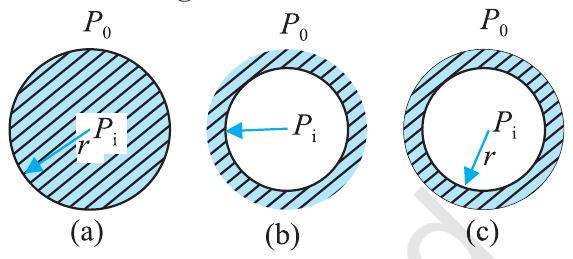
One consequence of surface tension is that free liquid drops and bubbles are spherical if effects of gravity can be neglected. You must have seen this especially clearly in small drops just formed in a high-speed spray or jet, and in soap bubbles blown by most of us in childhood. Why are drops and bubbles spherical? What keeps soap bubbles stable?
- As we have been saying repeatedly, a liquid-air interface has energy, so for a given volume the surface with minimum energy is the one with the least area. The sphere has this property. Though it is out of the scope of this book, you can check that a sphere is better than at least a cube in this respect. So, if gravity and other forces (e.g. air resistance) were ineffective, liquid drops would be spherical.
- Another interesting consequence of surface tension is that the pressure inside a spherical drop, Fig. 9.18(a), is more than the pressure outside. Suppose a spherical drop of radius r is in equilibrium. If its radius increases by $\Delta r$, the extra surface energy is [4π$(r + \Delta r)^2$ - 4π$r^2$] Sla = 8πr $\Delta r$ Sla (9.23). If the drop is in equilibrium this energy cost is balanced by the energy gain due to expansion under the pressure difference (Π - Po) between the inside of the drop and the outside. The work done is W = (Π - Po) 4π$r^2$ $\Delta r$ (9.24), so that (Π - Po) = (2 Sla)/r (9.25).
- In general, for a liquid-gas interface, the concave side (inside) has a higher pressure than the convex side (outside). For example, an air bubble in a liquid would have higher pressure inside it. See Fig. 9.18 (b).
- A bubble, Fig. 9.18 (c), differs from a drop and a cavity in that it has two interfaces. Applying the above argument we have for a bubble (Π - Po) = (4 Sla)/r (9.26). This is probably why you have to blow hard, but not too hard, to form a soap bubble. A little extra air pressure is needed inside.
- Formula table:
| Object | Number of liquid surfaces | Excess pressure (Π - Po) |
|---|---|---|
| Liquid drop | 1 | (2S)/r |
| Cavity / air bubble in a liquid | 1 | (2S)/r |
| Soap bubble | 2 | (4S)/r |
Capillary Rise
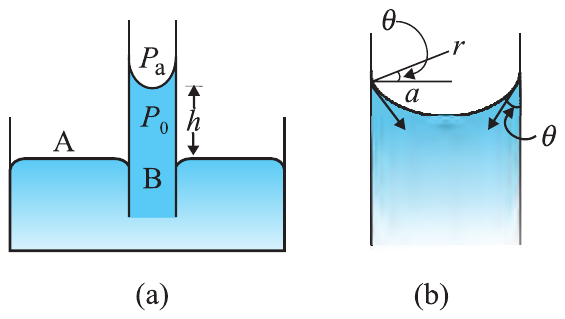
One consequence of the pressure difference across a curved liquid-air interface is the well-known effect that water rises up in a narrow tube in spite of gravity. The word capilla means hair in Latin; if the tube were hair thin, the rise would be very large. (NCERT prints 'capilla'.) To see this, consider a vertical capillary tube of circular cross section (radius a) inserted into an open vessel of water (Fig. 9.19). The contact angle between water and glass is acute. Thus the surface of water in the capillary is concave. This means that there is a pressure difference between the two sides of the top surface. This is given by (Π - Po) = (2S/r) = (2S)/(a sec θ) = ((2S)/a) cos θ (9.27).
- Thus the pressure of the water inside the tube, just at the meniscus (air-water interface), is less than the atmospheric pressure. Consider the two points A and B in Fig. 9.19(a). They must be at the same pressure, namely P0 + hρg = Π = PA (9.28), where ρ is the density of water and h is called the capillary rise [Fig. 9.19(a)]. Using Eq. (9.27) and (9.28) we have hρg = (Π - $P_0) = ((2S \cos θ)/a$) (9.29).
- The discussion here, and the Eqs. (9.24) and (9.25), make it clear that the capillary rise is due to surface tension. It is larger for a smaller a. Typically it is of the order of a few cm for fine capillaries. For example, if $a = 0.05 cm$, using the value of surface tension for water (Table 9.3), we find that $h = (2S)/(ρga) = (2 x (0.073 N m^{-1}))/((10^{3} kg m^{-3})(9.8 m s^{-2})(5 x 10^{-4} m)) = 2.98 x 10^{-2} m = 2.98 cm$.
- Notice that if the liquid meniscus is convex, as for mercury, that is, if cos θ is negative, then from Eq. (9.28) it is clear that the liquid will be lower in the capillary.
- Worked example 9.10: the lower end of a capillary tube of diameter 2.00 mm is dipped 8.00 cm below the surface of water in a beaker. What is the pressure required in the tube in order to blow a hemispherical bubble at its end in water? The surface tension of water at the temperature of the experiment is 7.30 x $10^{-2}$ N m^-1. 1 atmospheric pressure = 1.01 x $10^{5}$ Pa, density of $water = 1000 kg/m^3$, $g = 9.80 m s^{-2}$. Also calculate the excess pressure. The excess pressure in a bubble of gas in a liquid is given by 2S/r, where S is the surface tension of the liquid-gas interface. You should note there is only one liquid surface in this case. (For a bubble of liquid in a gas, there are two liquid surfaces, so the formula for excess pressure in that case is 4S/r.) The radius of the bubble is $r = 1.00 mm$. The pressure outside the bubble Po equals atmospheric pressure plus the pressure due to 8.00 cm of water column: $Po = 1.01 \times 10^5 Pa + 0.08 m x 1000 kg m^{-3} x 9.80 m s^{-2}$ = 1.01784 x $10^{5}$ Pa. Therefore, the pressure inside the bubble is Π = $Po + 2S/r = 1.01784 \times 10^5 Pa + (2 \times 7.3 \times 10^{-2} N m^{-1})/(10^{-3} m)$ = (1.01784 + 0.00146) x $10^{5}$ Pa = 1.02 x $10^{5}$ Pa, where the radius of the bubble is taken to be equal to the radius of the capillary tube, since the bubble is hemispherical. (The answer has been rounded off to three significant figures.) The excess pressure in the bubble is 146 Pa.
Practice1 question
Try it now. A wrong answer costs nothing here, try again until you get it.
For a capillary of radius 0.05 cm dipped in water, NCERT finds the capillary rise h to be
NCERT 9.6.5: for $a = 0.05 cm$, $h = (2S)/(ρga) = 2.98 x 10^{-2} m = 2.98 cm$.
When Bernoulli Does Not Apply
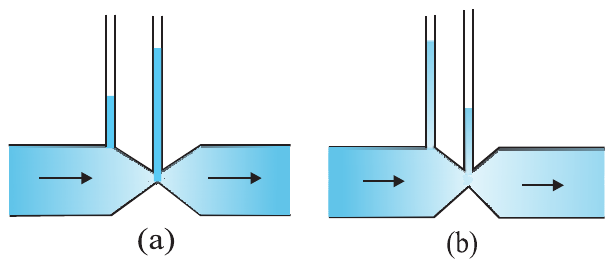
Bernoulli's equation is a statement of conservation of energy for a non-viscous, incompressible fluid in steady flow along a streamline. Each word in that sentence is a condition. Break one, and the equation stops giving the right answer.
- Viscous drag: Bernoulli's principle does not hold in the presence of viscous drag on the fluid. The work done by this dissipative viscous force must be taken into account in this case, and P2 [Fig. 9.9] will be lower than the value given by Eq. (9.12). (Points to Ponder 6.)
- Turbulent or non-steady flow: Bernoulli's equation does not hold for non-steady or turbulent flows, because in that situation velocity and pressure are constantly fluctuating in time. A rapid in a river is turbulent: Bernoulli's equation cannot be used to describe the flow of water through a rapid. (Exercises 9.11.) Fig. 9.20 shows the steady flow of a non-viscous liquid through a constriction: the liquid level in the vertical tube is lower at the constriction, where the speed is higher and the pressure is lower.
- Compressible fluid: Bernoulli's equation also assumes the fluid is incompressible, as the elastic energy of the fluid is not taken into consideration. For gases at high speeds this fails.
- Flow at rest is not a failure: when a fluid is at rest, Bernoulli's equation reduces to $P_1 + ρgh_1 = P_2 + ρgh_2$, the same as Eq. (9.6). Using gauge pressure instead of absolute pressure in Bernoulli's equation is also allowed: the atmospheric pressure cancels on both sides, so the pressure difference is the same. (Exercises 9.12.)
- The pressure that enters Bernoulli's equation is the pressure at a point in the fluid, the same scalar pressure of section 9.2. It exists at all points in a fluid, not only on walls or immersed solids. (Points to Ponder 2.)
Summary and Points to Ponder
NCERT Summary (11 points), in short:
- 1. The basic property of a fluid is that it can flow. The fluid does not have any resistance to change of its shape. Thus, the shape of a fluid is governed by the shape of its container.
- 2. A liquid is incompressible and has a free surface of its own. A gas is compressible and it expands to occupy all the space available to it.
- 3. If F is the normal force exerted by a fluid on an area A then the average pressure Pav is defined as the ratio of the force to area: $P_{av} = F/A$.
- 4. The unit of pressure is the pascal (Pa). It is the same as N m^-2. Other common units: $1 atm = 1.01 \times 10^5 Pa$; 1 $bar = 10^5 Pa$; 1 $torr = 133 Pa = 0.133 kPa$; 1 mm of $Hg = 1 torr = 133 Pa$. (Note: section 9.2 gives 1 $atm = 1.013 \times 10^5 Pa$; the Summary rounds it to 1.01 x $10^{5}$ Pa.)
- 5. Pascal's law states that pressure in a fluid at rest is the same at all points which are at the same height. A change in pressure applied to an enclosed fluid is transmitted undiminished to every point of the fluid and the walls of the containing vessel.
- 6. The pressure in a fluid varies with depth h according to $P = Pa + ρgh$, where ρ is the density of the fluid, assumed uniform.
- 7. The volume of an incompressible fluid passing any point every second in a pipe of non uniform crossection is the same in the steady flow: vA = constant (v is the velocity and A is the area of crossection). The equation is due to mass conservation in incompressible fluid flow. (NCERT prints 'crossection'.)
- 8. Bernoulli's principle states that as we move along a streamline, the sum of the pressure (P), the kinetic energy per unit volume (ρ$v^2$/2) and the potential energy per unit volume (ρgy) remains a constant: P + (ρ$v^2$)/2 + ρgy = constant. The equation is basically the conservation of energy applied to non viscous fluid motion in steady state. There is no fluid which has zero viscosity, so the above statement is true only approximately. The viscosity is like friction and converts the kinetic energy to heat energy.
- 9. Though shear strain in a fluid does not require shear stress, when a shear stress is applied to a fluid, the motion is generated which causes a shear strain growing with time. The ratio of the shear stress to the time rate of shearing strain is known as coefficient of viscosity, η, where symbols have their usual meaning and are defined in the text.
- 10. Stokes' law states that the viscous drag force F on a sphere of radius a moving with velocity v through a fluid of viscosity η is $F = 6πηav$.
- 11. Surface tension is a force per unit length (or surface energy per unit area) acting in the plane of interface between the liquid and the bounding surface. It is the extra energy that the molecules at the interface have as compared to the interior.
- Points to Ponder: (1) Pressure is a scalar quantity; the 'force' in the definition is the component of the force normal to the area. Describing fluids needs a shift from particle and rigid body mechanics: we are concerned with properties that vary from point to point in the fluid. (2) Pressure exists at all points in a fluid, not only on solids. An element of a fluid (such as the one shown in Fig. 9.4) is in equilibrium because the pressures exerted on the various faces are equal. (3) $P = Pa + ρgh$ holds true if the fluid is incompressible; it holds for liquids, which are largely incompressible and hence ρ is a constant with height. (4) The gauge pressure is the difference of the actual pressure and the atmospheric pressure: P - Pa = Pg. Many pressure-measuring devices measure the gauge pressure, including the tyre pressure gauge and the blood pressure gauge (sphygmomanometer). (5) A streamline is a map of fluid flow. In a steady flow two streamlines do not intersect, as it means that the fluid particle will have two possible velocities at the point. (6) Bernoulli's principle does not hold in the presence of viscous drag; see section 20. (7) As the temperature rises the atoms of the liquid become more mobile and the coefficient of viscosity η falls. In a gas the temperature rise increases the random motion of atoms and η increases. (8) Surface tension arises due to excess potential energy of the molecules on the surface in comparison to their potential energy in the interior. Such a surface energy is present at the interface separating two substances, at least one of which is a fluid. It is not the property of a single fluid alone.
Trap Boxes
Pressure is a vector because it is force divided by area
Wrong idea: Pressure is force per unit area, so it has the direction of the force.
Pressure is a scalar: the 'force' in $P_{av} = F/A$ is only the component normal to the area. Like other types of stress, pressure is not a vector quantity and no direction can be assigned to it. NCERT 9.2.
NCERT XI, Ch 9, 9.2
Gauge pressure and absolute pressure are interchangeable
Wrong idea: A manometer reading of 2 atm means the absolute pressure is 2 atm.
What a manometer measures is normally the gauge pressure, P - Pa. Absolute pressure is $P = Pa + ρgh$; gauge pressure is ρgh. At 10 m depth in a lake the absolute pressure is about 2 atm but the gauge pressure is about 1 atm. NCERT 9.2.2, 9.2.3.
NCERT XI, Ch 9, 9.2.2, 9.2.3
Bernoulli's equation works for any flowing fluid
Wrong idea: Bernoulli's equation gives the pressure in a rapid, in a viscous oil pipe, or in a compressible gas at any speed.
Bernoulli's equation needs steady flow of a non-viscous, incompressible fluid. It fails with viscous drag, in turbulent or non-steady flow, and where elastic energy matters. NCERT 9.4.
NCERT XI, Ch 9, 9.4
A bigger drop has a bigger excess pressure inside
Wrong idea: Excess pressure grows with radius, so a big drop has more pressure inside than a small one.
For a drop (Π - Po) = (2S)/r: excess pressure falls as r grows. A soap bubble has two surfaces, so (Π - Po) = (4S)/r, double the drop value at the same r. NCERT 9.6.4.
NCERT XI, Ch 9, 9.6.4
A falling ball keeps accelerating until it hits the ground
Wrong idea: A ball dropped in glycerine accelerates all the way down.
Viscous drag grows with speed; when viscous force plus buoyant force equals weight, acceleration becomes zero and the ball falls at a constant terminal velocity $v_t = (2a^2 (ρ - σ)g)/(9η)$. NCERT 9.5.1.
NCERT XI, Ch 9, 9.5.1
Chapter test
5 NEET PYQs. +4 for a correct answer, -1 for a wrong answer, exactly like NEET. Finish the test to earn a medal.
Q1: NEET (UG) 2024, Code R3, Q20
A thin flat circular disc of radius 4.5 cm is placed gently over the surface of water. If the surface tension of water is 0.07 N/m, then the excess force required to take it away from the surface is:
F = $S x 2πr = 0.07 \times 2π x 0.045 = 0.0198 N = 19.8 mN$.
Q2: NEET (UG) 2023, Code F1, Q13
The venturi-meter works on
A venturi-meter measures flow speed from the pressure drop at a constriction, which is Bernoulli's principle.
Q3: NEET (UG) 2022, Code R1, Q4
If a soap bubble expands, the pressure inside the bubble
Excess pressure inside a soap bubble is (4S)/r. As the bubble expands r grows, the excess pressure falls, so the inside pressure decreases towards atmospheric pressure.
Q4: NEET (UG) 2021, Code P3, Q26
The velocity of a small ball of mass M and density d, when dropped in a container filled with glycerine becomes constant after some time. If the density of glycerine is d/2, then the viscous force acting on the ball will be
At constant velocity $Mg = FB + Fv$. Buoyant force $FB = (d/2)Vg = Mg/2$, so the viscous force Fv = $Mg - Mg/2 = Mg/2$.
Q5: NEET (UG) 2020, Code G5, Q175
A capillary tube of radius r is immersed in water and water rises in it to a height h. The mass of the water in the capillary is 5 g. Another capillary tube of radius 2r is immersed in water. The mass of water that will rise in this tube is :
Force of surface tension balances the weight: 2πrT cos θ = mg, so m is proportional to r. Radius 2r gives $m = 10.0 g$.
Score: 0 · Answered 0 of 5
Flashcards
Tap a card to flip it over and see the answer. Tap it again to flip it back.
State the definition of average pressure and the pressure at a depth h in a liquid open to the atmosphere.
Tap to flip$P_{av} = F/A$ (9.1). At a depth h below the surface of a liquid open to the atmosphere: $P = Pa + ρgh$ (9.7). The excess over atmospheric pressure, $P - Pa = ρgh$, is the gauge pressure.
Tap to flip backState Bernoulli's equation and the conditions under which it holds.
Tap to flipP + (1/2)ρ$v^2$ + ρgh = constant (9.13) along a streamline, for steady flow of a non-viscous, incompressible fluid. The three terms are pressure, kinetic energy per unit volume and potential energy per unit volume.
Tap to flip backState the equation of continuity for an incompressible fluid.
Tap to flipAv = constant (9.11). Volume flux (flow rate) stays constant along a pipe; where the cross-section is narrower, the speed is higher.
Tap to flip backState Torricelli's law for the speed of efflux from an open tank.
Tap to flip$v_1 = \sqrt{2gh}$ (9.15), the same as the speed of a freely falling body from height h. In general $v_1 = \sqrt{2gh + (2(P - Pa))/ρ}$ (9.14).
Tap to flip backState Stokes' law for the viscous drag on a sphere.
Tap to flip$F = 6πηav$ (9.17), where η is the viscosity, a the radius of the sphere and v its velocity. The drag is proportional to velocity and opposite to the direction of motion.
Tap to flip backGive the terminal velocity of a sphere falling through a viscous fluid.
Tap to flip$v_t = (2a^2 (ρ - σ)g)/(9η)$ (9.18), where a is the radius, ρ the density of the sphere and σ the density of the fluid. Terminal velocity depends on the square of the radius and inversely on the viscosity.
Tap to flip backGive the excess pressure inside a liquid drop and inside a soap bubble of radius r.
Tap to flipDrop or cavity (one liquid surface): (Π - Po) = (2S)/r (9.25). Soap bubble (two liquid surfaces): (Π - Po) = (4S)/r (9.26).
Tap to flip backGive the capillary rise formula and say what happens for mercury.
Tap to flip$hρg = (2S \cos θ)/a$ (9.29), so $h = (2S \cos θ)/(ρga)$. For water on glass θ is acute, so h is positive; for mercury cos θ is negative, so the liquid level falls in the capillary.
Tap to flip backGive the common units of pressure and their values in pascal.
Tap to flip1 $atm = 1.013 \times 10^5 Pa$. 1 $bar = 10^5 Pa$. 1 $torr = 1 mm$ of $Hg = 133 Pa$. The mercury column in a barometer is about 76 cm high at sea level.
Tap to flip backWhat is the surface tension of water at 20°C?
Tap to flipSurface tension of water at 20°C is 0.0727 N/m (Table 9.3). Mercury at 20°C is 0.4355 N/m. Surface tension usually falls with temperature.
Tap to flip backCompare the viscosities of water, blood, glycerine, honey and air from Table 9.2.
Tap to flipWater at 20°C: 1.0 mPl. Blood at 37°C: 2.7 mPl. Glycerine at 20°C: 830 mPl. Honey: 200 mPl. Air at 0°C: 0.017 mPl. Viscosity of liquids falls with temperature; of gases it rises.
Tap to flip backArrange in increasing viscosity: glycerine, air, blood, honey, water.
Tap to flipAir (0.017 mPl) < water (1.0 mPl) < blood (2.7 mPl) < honey (200 mPl) < glycerine (830 mPl).
Tap to flip backPressure is a vector because it is force divided by area. True or false?
Tap to flipPressure is a scalar quantity: the force in $P_{av} = F/A$ is only the component normal to the area. It has dimensions $[M L^{-1} T^{-2}]$ and SI unit pascal (Pa).
Tap to flip backBernoulli's equation applies to every flowing fluid. True or false?
Tap to flipBernoulli's equation needs steady flow of a non-viscous, incompressible fluid. It does not hold with viscous drag, in turbulent or non-steady flow, or where elastic energy matters.
Tap to flip backFrequently asked questions
Is it true that pressure is a vector because it is force divided by area?
Pressure is a scalar: the 'force' in $P_{av} = F/A$ is only the component normal to the area. Like other types of stress, pressure is not a vector quantity and no direction can be assigned to it.
Is it true that gauge pressure and absolute pressure are interchangeable?
What a manometer measures is normally the gauge pressure, P - Pa. Absolute pressure is $P = Pa + ρgh$; gauge pressure is ρgh.
Is it true that Bernoulli's equation works for any flowing fluid?
Bernoulli's equation needs steady flow of a non-viscous, incompressible fluid. It fails with viscous drag, in turbulent or non-steady flow, and where elastic energy matters.
Is it true that a bigger drop has a bigger excess pressure inside?
For a drop (Π - Po) = (2S)/r: excess pressure falls as r grows. A soap bubble has two surfaces, so (Π - Po) = (4S)/r, double the drop value at the same r.
Is it true that a falling ball keeps accelerating until it hits the ground?
Viscous drag grows with speed; when viscous force plus buoyant force equals weight, acceleration becomes zero and the ball falls at a constant terminal velocity $v_t = (2a^2 (ρ - σ)g)/(9η)$.