 NEET Notes
Home > Physics > Thermal Properties of Matter
Thermal Properties of Matter
Temperature is a measure of 'hotness' of a body. Heat is the form of energy transferred between two (or more) systems or a system and its surroundings by virtue of temperature difference.
On this page · 21 sections
- 01Syllabus Map
- 02Introduction
- 03Measurement of Temperature
- 04Ideal-Gas Equation and Absolute Temperature
- 05Table: Temperature Scales
- 06Thermal Expansion
- 07Table: Expansion Coefficients
- 08Anomalous Expansion of Water
- 09Area Expansion and Thermal Stress
- 10Specific Heat Capacity
- 11Table: Specific Heats
- 12Calorimetry
- 13Change of State
- 14Triple Point and Phase Diagram
- 15Latent Heat
- 16Table: Latent Heats
- 17Heat Transfer: Conduction
- 18Heat Transfer: Convection and Radiation
- 19Newton's Law of Cooling
- 20Trap Pairs
- 21Points to Ponder
Heat, temperature scales, ideal-gas law, thermal expansion, specific and latent heat, calorimetry, conduction, convection, radiation, blackbody laws and Newton's cooling, from NCERT Ch 10, with NEET PYQs.
Syllabus Map
- NMC Unit: PHYS-U07, Properties of Solids and Liquids (thermal part). NCERT Chapter 10, Thermal Properties of Matter (Class XI, rationalised book, keph203.pdf, Reprint 2026-27). Note on numbering: keph203.pdf is Chapter 10 in the current rationalised NCERT book, with sections 10.1 to 10.10, six tables and Figures 10.1 to 10.20, plus the unnumbered phase diagram in the Triple Point box on p. 211. All section and figure references in this chapter use the current book numbering so they can be traced to the PDF.
- Subtopics in this chapter (NCERT XI, Ch 10): introduction (10.1); temperature and heat (10.2); measurement of temperature (10.3); ideal-gas equation and absolute temperature (10.4); thermal expansion (10.5); specific heat capacity (10.6); calorimetry (10.7); change of state (10.8, with latent heat 10.8.1); heat transfer (10.9, with conduction 10.9.1, convection 10.9.2, radiation 10.9.3, blackbody radiation 10.9.4); Newton's law of cooling (10.10).
- Subtopic checklist: (1) heat as energy transferred by virtue of temperature difference; (2) ice and steam points, Fahrenheit and Celsius scales; (3) Boyle's and Charles' laws, $PV = μRT, absolute zero -273.15 °C$; (4) linear, area and volume expansion, Tables 10.1 and 10.2; (5) anomalous expansion of water, maximum density at 4 °C; (6) thermal stress from prevented expansion; (7) heat capacity, specific and molar specific heat, Tables 10.3 and 10.4; (8) calorimetry, heat lost = heat gained; (9) melting, boiling, vaporisation, sublimation, regelation; (10) triple point and phase diagrams; (11) latent heat, Table 10.5; (12) conduction, $H = K A (TC - TD)/L$, Table 10.6; (13) convection, sea breeze and trade winds; (14) radiation, blackbody curves, Wien's law, Stefan-Boltzmann law; (15) Newton's law of cooling.
- Extra information (beyond NCERT): none. Every section in this chapter comes from the current NCERT chapter text. The NMC Unit 7 thermal items are fully covered: heat, temperature, thermal expansion, specific heat capacity, calorimetry, change of state, latent heat, and heat transfer by conduction, convection and radiation. Two cross-notes: the ideal-gas equation (10.4) also serves NMC Unit 9 (Kinetic Theory of Gases), and the temperature dependence of electrical resistance (NEET 2022 R1 Q2, 2023 F1 Q46) belongs to Current Electricity, not to this chapter, so it is not covered.
- Estimated revision time: 12 minutes. Jump links: Syllabus Map, Introduction, Measurement of Temperature, Ideal-Gas Equation and Absolute Temperature, Table: Temperature Scales, Thermal Expansion, Table: Expansion Coefficients, Anomalous Expansion of Water, Area Expansion and Thermal Stress, Specific Heat Capacity, Table: Specific Heats, Calorimetry, Change of State, Triple Point and Phase Diagram, Latent Heat, Table: Latent Heats, Heat Transfer: Conduction, Heat Transfer: Convection and Radiation, Newton's Law of Cooling, Trap Pairs, Points to Ponder
Introduction
We all have common sense notions of heat and temperature. Temperature is a measure of 'hotness' of a body. A kettle with boiling water is hotter than a box containing ice. In physics, we need to define the notion of heat, temperature, etc., more carefully.
Heat is the form of energy transferred between two (or more) systems or a system and its surroundings by virtue of temperature difference. When the temperature of a body and its surrounding medium are different, heat transfer takes place between the system and the surrounding medium, until the body and the surrounding medium are at the same temperature. A glass of ice-cold water left on a table on a hot summer day eventually warms up, whereas a cup of hot tea on the same table cools down: in the first case heat flows from the environment to the glass, in the second from the cup to the environment.
The SI unit of heat energy transferred is the joule (J), and the SI unit of temperature is the kelvin (K); degree Celsius (°C) is a commonly used unit of temperature. When an object is heated, many changes may take place: its temperature may rise, it may expand, or it may change state.
In this chapter you will learn what heat is and how it is measured, and study the various processes by which heat flows from one body to another. Along the way, you will find out why blacksmiths heat the iron ring before fitting it on the rim of a wooden wheel of a horse cart and why the wind at the beach often reverses direction after the sun goes down. You will also learn what happens when water boils or freezes, and its temperature does not change during these processes even though a great deal of heat is flowing into or out of it. NCERT prints 'proceses' in this introduction.
Measurement of Temperature
Temperature is a relative measure, or indication of hotness or coldness. A hot utensil is said to have a high temperature, and an ice cube to have a low temperature. An object that has a higher temperature than another object is said to be hotter. Hot and cold are relative terms, like tall and short. We can perceive temperature by touch, but this temperature sense is somewhat unreliable and its range is too limited to be useful for scientific purposes.
A measure of temperature is obtained using a thermometer. Many physical properties of materials change sufficiently with temperature, and some such properties are used as the basis for constructing thermometers. The commonly used property is variation of the volume of a liquid with temperature: in common liquid-in-glass thermometers, mercury, alcohol, etc., are used, whose volume varies linearly with temperature over a wide range.
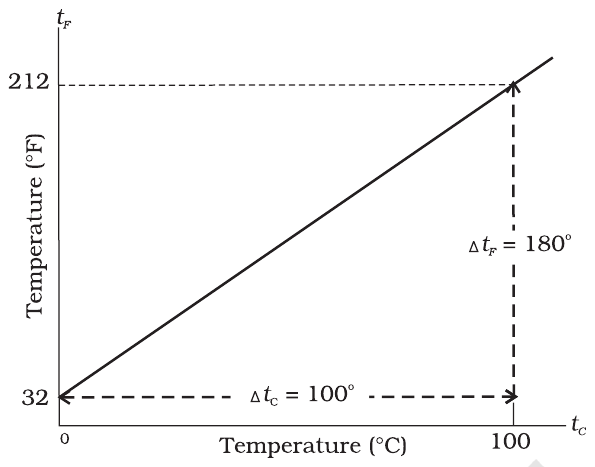
Thermometers are calibrated so that a numerical value may be assigned to a given temperature in an appropriate scale. For the definition of any standard scale, two fixed reference points are needed. The ice point and the steam point of water are two convenient fixed points: the temperatures at which pure water freezes and boils under standard pressure. They have values 32 °F and 212 °F on the Fahrenheit scale and 0 °C and 100 °C on the Celsius scale. On the Fahrenheit scale there are 180 equal intervals between the two reference points, and on the Celsius scale there are 100.
A relationship for converting between the two scales may be obtained from a graph of Fahrenheit temperature (tF) versus Celsius temperature (tC) in a straight line (Fig. 10.1), whose equation is $(t_F - 32)/180 = t_C/100$ (10.1). So $t_F = (9/5)t_C + 32$.
Ideal-Gas Equation and Absolute Temperature


Liquid-in-glass thermometers show different readings for temperatures other than the fixed points because of differing expansion properties. A thermometer that uses a gas, however, gives the same readings regardless of which gas is used. Experiments show that all gases at low densities exhibit the same expansion behaviour.
The variables that describe the behaviour of a given quantity (mass) of gas are pressure, volume, and temperature (P, V, and T), where $T = t + 273.15$ and t is the temperature in °C. When temperature is held constant, the pressure and volume of a quantity of gas are related as PV = constant. This relationship is known as Boyle's law, after Robert Boyle (1627-1691). When the pressure is held constant, the volume of a quantity of the gas is related to the temperature as V/T = constant. This relationship is known as Charles' law, after Jacques Charles (1747-1823). Low-density gases obey these laws, which may be combined into a single relationship: since PV = constant and V/T = constant for a given quantity of gas, PV/T should also be a constant. This relationship is known as the ideal gas law.
It can be written in a more general form that applies not just to a given quantity of a single gas but to any quantity of any low-density gas, known as the ideal-gas equation: $PV = μRT$ (10.2), where μ is the number of moles in the sample of gas and R is called the universal gas constant: $R = 8.31 J mol^{-1} K^{-1}$.
In Eq. (10.2), pressure and volume are directly proportional to temperature: PV is proportional to T. This allows a gas to be used to measure temperature in a constant-volume gas thermometer. Holding the volume of a gas constant gives P proportional to T, so temperature is read in terms of pressure. A plot of pressure versus temperature gives a straight line in this case, as shown in Fig. 10.2.
Measurements on real gases deviate from the ideal gas law at low temperature, but the relationship is linear over a large temperature range, and it looks as though the pressure might reach zero with decreasing temperature if the gas continued to be a gas. The absolute minimum temperature for an ideal gas, inferred by extrapolating the straight line to the axis, as in Fig. 10.3, is found to be -273.15 °C and is designated as absolute zero. Absolute zero is the foundation of the Kelvin temperature scale or absolute scale of temperature, named after the British scientist Lord Kelvin. On this scale, -273.15 °C is taken as the zero point, that is 0 K (Fig. 10.4).
The size of unit in Kelvin and Celsius temperature scales is the same. So, temperatures on these scales are related by $T = t_C + 273.15$ (10.3).
Table: Temperature Scales
| Scale point | Celsius (°C) | Fahrenheit (°F) | Kelvin (K) |
|---|---|---|---|
| Absolute zero | -273.15 | -459.67 | 0 |
| Ice point (freezing point of water) | 0 | 32 | 273.15 |
| Steam point (boiling point of water) | 100 | 212 | 373.15 |
| Triple point of water | 0.01 | 32.02 | 273.16 |
| Conversion | Formula |
|---|---|
| Celsius to Fahrenheit | $t_F = (9/5)t_C + 32$ |
| Fahrenheit to Celsius | $t_C = (5/9)(t_F - 32)$ |
| Celsius to Kelvin | $T = t_C + 273.15$ |
| Fahrenheit intervals vs Celsius intervals | $(t_F - 32)/180 = t_C/100$ |
The triple point of water, 273.16 K, is the fixed point of the modern Kelvin scale; the melting and boiling points of water at 1 atm are very close to, but not exactly, 0 °C and 100 °C (Points to ponder, item 1).
Practice1 question
Try it now. A wrong answer costs nothing here, try again until you get it.
A temperature of 77 °F is equal to how many degrees Celsius?
NCERT 10.3: $t_F = (9/5)t_C + 32$, so $t_C = (5/9)(77 - 32) = 25 °C$.
Thermal Expansion

Sealed bottles with metallic lids are sometimes so tightly screwed that one has to put the lid in hot water for some time to open it: the metallic lid expands, loosening it. Mercury in a thermometer rises when the thermometer is put in slightly warm water, and falls again when it is taken out. A balloon partially inflated in a cool room may expand to full size when placed in warm water, and a fully inflated balloon immersed in cold water starts shrinking due to contraction of the air inside.
Most substances expand on heating and contract on cooling. A change in the temperature of a body causes change in its dimensions. The increase in the dimensions of a body due to the increase in its temperature is called thermal expansion. The expansion in length is called linear expansion, the expansion in area is called area expansion, and the expansion in volume is called volume expansion (Fig. 10.5).
If the substance is in the form of a long rod, then for small change in temperature, $\Delta T$, the fractional change in length, $\Delta l$/l, is directly proportional to $\Delta T$: ($\Delta l$/l) = αl $\Delta T$ (10.4), where αl is known as the coefficient of linear expansion (or linear expansivity) and is characteristic of the material of the rod. Table 10.1 gives typical average values in the temperature range 0 °C to 100 °C. Copper expands about five times more than glass for the same rise in temperature. Normally, metals expand more and have relatively high values of αl.
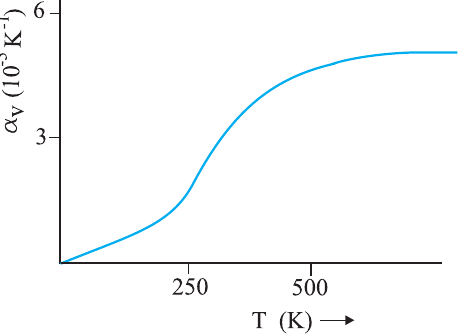
Similarly, the fractional change in volume, $\Delta V$/V, for temperature change $\Delta T$ defines the coefficient of volume expansion (or volume expansivity), αv: ($\Delta V$/V) = αv $\Delta T$ (10.5). Here αv is also a characteristic of the substance but is not strictly a constant: it depends in general on temperature (Fig. 10.6). It is seen that αv becomes constant only at a high temperature. Table 10.2 gives values of coefficient of volume expansion of some common substances in the temperature range 0-100 °C. Thermal expansion of these substances (solids and liquids) is rather small, with materials like pyrex glass and invar (a special iron-nickel alloy) having particularly low values of αv. The value of αv for alcohol (ethanol) is more than mercury, and it expands more than mercury for the same rise in temperature.
Table: Expansion Coefficients
Table 10.1: values of coefficient of linear expansion for some materials (temperature range 0 °C to 100 °C). NCERT prints 0.29 for lead; the usual value is about 2.9 x $10^{-5}$ K^-1, so the printed 0.29 is flagged as a likely misprint and reproduced here as printed.
| Material | αl ($10^{-5}$ K^-1) |
|---|---|
| Aluminium | 2.5 |
| Brass | 1.8 |
| Iron | 1.2 |
| Copper | 1.7 |
| Silver | 1.9 |
| Gold | 1.4 |
| Glass (pyrex) | 0.32 |
| Lead | 0.29 |
Table 10.2: values of coefficient of volume expansion for some substances (temperature range 0-100 °C).
| Material | αv (K^-1) |
|---|---|
| Aluminium | 7 x $10^{-5}$ |
| Brass | 6 x $10^{-5}$ |
| Iron | 3.55 x $10^{-5}$ |
| Paraffin | 58.8 x $10^{-5}$ |
| Glass (ordinary) | 2.5 x $10^{-5}$ |
| Glass (pyrex) | 1 x $10^{-5}$ |
| Hard rubber | 2.4 x $10^{-4}$ |
| Invar | 2 x $10^{-6}$ |
| Mercury | 18.2 x $10^{-5}$ |
| Water | 20.7 x $10^{-5}$ |
| Alcohol (ethanol) | 110 x $10^{-5}$ |
There is a simple relation between the coefficient of volume expansion (αv) and the coefficient of linear expansion (αl). For a cube of length l expanding equally in all directions when its temperature increases by $\Delta T: \Delta l = α_l l \Delta T$, so $\Delta V = (l + \Delta l)^3 - l^3$, about 3 $l^2$ $\Delta l$ (10.7), neglecting terms in $(\Delta l)^2$ and $(\Delta l)^3$ since $\Delta l$ is small compared with l. So $\Delta V = (3V \Delta l)/l = 3V α_l \Delta T$ (10.8), which gives $α_v = 3 α_l$ (10.9). Check: for iron, 3 $x 1.2 \times 10^{-5} = 3.6 \times 10^{-5} K^{-1}$, against the Table 10.2 value 3.55 x $10^{-5}$ K^-1.
Anomalous Expansion of Water

Water exhibits an anomalous behaviour: it contracts on heating between 0 °C and 4 °C. The volume of a given amount of water decreases as it is cooled from room temperature, until its temperature reaches 4 °C [Fig. 10.7(a)]. Below 4 °C, the volume increases, and therefore the density decreases [Fig. 10.7(b)]. This means that water has the maximum density at 4 °C.
This property has an important environmental effect: bodies of water, such as lakes and ponds, freeze at the top first. As a lake cools toward 4 °C, water near the surface loses energy to the atmosphere, becomes denser, and sinks; the warmer, less dense water near the bottom rises. However, once the colder water on top reaches temperature below 4 °C, it becomes less dense and remains at the surface, where it freezes. If water did not have this property, lakes and ponds would freeze from the bottom up, which would destroy much of their animal and plant life.
Gases, at ordinary temperature, expand more than solids and liquids. For liquids, the coefficient of volume expansion is relatively independent of the temperature. However, for gases it is dependent on temperature. For an ideal gas, the coefficient of volume expansion at constant pressure can be found from the ideal gas equation: $PV = μRT$, so at constant pressure $P \Delta V = μR \Delta T$, and $(\Delta V/V) = (\Delta T/T)$, i.e. $α_v = 1/T$ for ideal gas (10.6). At 0 °C, $α_v = 3.7 \times 10^{-3} K^{-1}$, which is much larger than that for solids and liquids. Equation (10.6) shows the temperature dependence of αv: it decreases with increasing temperature. For a gas at room temperature and constant pressure, αv is about 3300 x $10^{-6}$ K^-1, as much as order(s) of magnitude larger than the coefficient of volume expansion of typical liquids.
Area Expansion and Thermal Stress
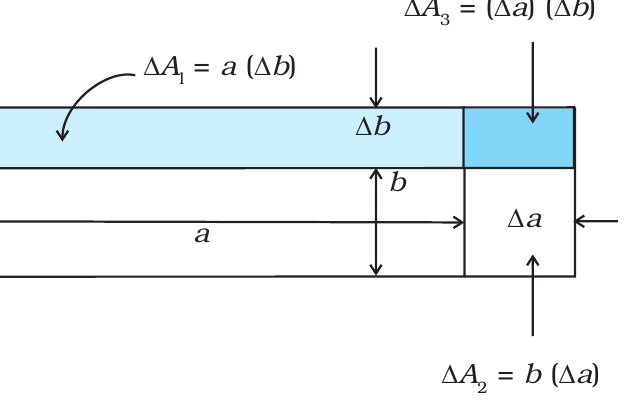
Example 10.1: Show that the coefficient of area expansion, ($\Delta A$/A)/$\Delta T$, of a rectangular sheet of the solid is twice its linear expansivity, αl. Consider a rectangular sheet of the solid material of length a and breadth b (Fig. 10.8). When the temperature increases by $\Delta T$, a increases by $\Delta a = α_l a \Delta T$ and b increases by $\Delta b = α_l b \Delta T$. From Fig. 10.8, the increase in area $\Delta A = \Delta A_1 + \Delta A_2 + \Delta A_3$ = a $\Delta b$ + b $\Delta a$ + ($\Delta a$)($\Delta b$) = a αl b $\Delta T$ + b αl a $\Delta T$ + $(\alpha l)^2$ ab $(\Delta T)^2$ = αl ab $\Delta T$ (2 + αl $\Delta T$) = αl A $\Delta T$ (2 + αl $\Delta T$). Since αl is about $10^{-5}$ K^-1, from Table 10.1, the product αl $\Delta T$ is small in comparison with 2 and may be neglected. Hence $(\Delta A/A) = 2 α_l \Delta T$, so the coefficient of area expansion is twice the linear expansivity.
Example 10.2: A blacksmith fixes an iron ring on the rim of the wooden wheel of a horse cart. The diameter of the rim and the iron ring are 5.243 m and 5.231 m, respectively, at 27 °C. To what temperature should the ring be heated so as to fit the rim of the wheel? Using LT2 = LT1 [1 + αl ($T_2$ - $T_1$)] with $α_l = 1.20 \times 10^{-5} K^{-1}: 5.243 m$ = 5.231 m [1 + 1.20 x $10^{-5}$ K^-1 ($T_2$ - 27 °C)], giving $T_2$ = 218 °C.
Thermal stress: what happens by preventing the thermal expansion of a rod by fixing its ends rigidly? The rod acquires a compressive strain due to the external forces provided by the rigid support at the ends. The corresponding stress set up in the rod is called thermal stress. For example, consider a steel rail of length 5 m and area of cross-section 40 $\mathrm{cm}^2$ that is prevented from expanding while the temperature rises by 10 °C. The coefficient of linear expansion of steel is $α_l(steel) = 1.2 \times 10^{-5} K^{-1}$. Thus, the compressive strain is $(\Delta l/l) = α_l(steel) \Delta T = 1.2 x 10^{-5} x 10 = 1.2 x 10^{-4}$. Young's modulus of steel is $Y(steel) = 2 \times 10^{11} N m^{-2}$. Therefore, the thermal stress developed is $(\Delta F/A) = Y(steel) (\Delta l/l) = 2.4 x 10^{7} N m^{-2}$, which corresponds to an external force of about $10^{5}$ N. If two such steel rails, fixed at their outer ends, are in contact at their inner ends, a force of this magnitude can easily bend the rails.
Practice1 question
Try it now. A wrong answer costs nothing here, try again until you get it.
A steel rail prevented from expanding while its temperature rises by 10 °C develops a thermal stress of about
NCERT 10.5: the steel rail example gives strain 1.2 x $10^{-4}$ and $Y = 2 \times 10^{11} N m^{-2}$, so the thermal stress is 2.4 x $10^{7}$ N m^-2.
Specific Heat Capacity
Take some water in a vessel and start heating it on a burner. Soon you will notice that bubbles begin to move upward. As the temperature is raised the motion of water particles increases till it becomes turbulent as water starts boiling. What are the factors on which the quantity of heat required to raise the temperature of a substance depend? Heat a given quantity of water to raise its temperature by 20 °C and note the time taken. Raise the same amount by 40 °C: it takes about twice the time, and therefore double the quantity of heat. Take double the amount of water and raise it by 20 °C: the time taken is again twice. Heat the same quantity of mustard oil and raise it by 20 °C: the time taken is shorter, so the quantity of heat required is less than for the same amount of water.
The quantity of heat required to warm a given substance depends on its mass, m, the change in temperature, $\Delta T$, and the nature of the substance. The change in temperature of a substance, when a given quantity of heat is absorbed or rejected by it, is characterised by a quantity called the heat capacity of that substance. We define heat capacity, S, of a substance as $S = \Delta Q/\Delta T$ (10.10), where $\Delta Q$ is the amount of heat supplied to the substance to change its temperature from T to T + $\Delta T$.
If equal amounts of heat are added to equal masses of different substances, the resulting temperature changes will not be the same: every substance has a unique value for the amount of heat absorbed or given off to change the temperature of unit mass of it by one unit. This quantity is the specific heat capacity of the substance: $s = (1/m)(\Delta Q/\Delta T)$ (10.11). It is the amount of heat per unit mass absorbed or given off by the substance to change its temperature by one unit. It depends on the nature of the substance and its temperature. The SI unit of specific heat capacity is J kg^-1 K^-1.
If the amount of substance is specified in terms of moles μ, instead of mass m in kg, we can define heat capacity per mole by $C = (1/μ)(\Delta Q/\Delta T)$ (10.12), where C is the molar specific heat capacity of the substance. Its SI unit is J $mol^{-1}$ K^-1. For gases, additional conditions may be needed to define C: if the gas is held under constant pressure during the heat transfer, it is the molar specific heat capacity at constant pressure, Cp; if the volume is maintained, it is the molar specific heat capacity at constant volume, Cv. For details see Chapter 11.
From Table 10.3 you can note that water has the highest specific heat capacity compared to other substances. For this reason water is also used as a coolant in automobile radiators, as well as a heater in hot water bags. Owing to its high specific heat capacity, water warms up more slowly than land during summer, and consequently wind from the sea has a cooling effect. In desert areas, the earth surface warms up quickly during the day and cools quickly at night.
Table: Specific Heats
Table 10.3: specific heat capacity of some substances at room temperature and atmospheric pressure. NCERT prints 'Tungesten' for tungsten; reproduced as printed.
| Substance | Specific heat capacity (J kg^-1 K^-1) | Substance | Specific heat capacity (J kg^-1 K^-1) |
|---|---|---|---|
| Aluminium | 900.0 | Ice | 2060 |
| Carbon | 506.5 | Glass | 840 |
| Copper | 386.4 | Iron | 450 |
| Lead | 127.7 | Kerosene | 2118 |
| Silver | 236.1 | Edible oil | 1965 |
| Tungesten | 134.4 | Mercury | 140 |
| Water | 4186.0 |
Table 10.4: molar specific heat capacities of some gases.
| Gas | Cp (J $mol^{-1}$ K^-1) | Cv (J $mol^{-1}$ K^-1) |
|---|---|---|
| He | 20.8 | 12.5 |
| $H_2$ | 28.8 | 20.4 |
| $N_2$ | 29.1 | 20.8 |
| $O_2$ | 29.4 | 21.1 |
| $CO_2$ | 37.0 | 28.5 |
Calorimetry
A system is said to be isolated if no exchange or transfer of heat occurs between the system and its surroundings. When different parts of an isolated system are at different temperature, a quantity of heat transfers from the part at higher temperature to the part at lower temperature. The heat lost by the part at higher temperature is equal to the heat gained by the part at lower temperature.
Calorimetry means measurement of heat. When a body at higher temperature is brought in contact with another body at lower temperature, the heat lost by the hot body is equal to the heat gained by the colder body, provided no heat is allowed to escape to the surroundings. A device in which heat measurement can be done is called a calorimeter. It consists of a metallic vessel and stirrer of the same material, like copper or aluminium. The vessel is kept inside a wooden jacket, which contains heat insulating material, like glass wool etc. The outer jacket acts as a heat shield and reduces the heat loss from the inner vessel. There is an opening in the outer jacket through which a mercury thermometer can be inserted into the calorimeter (Fig. 10.20). Note: NCERT cites Fig. 10.20 here, but the book prints no calorimeter figure; the only figure numbered 10.20 in the book is the Newton's law of cooling set-up in section 10.10.
Example 10.3: A sphere of 0.047 kg aluminium is placed for sufficient time in a vessel containing boiling water, so that the sphere is at 100 °C. It is then immediately transfered to 0.14 kg copper calorimeter containing 0.25 kg water at 20 °C. The temperature of water rises and attains a steady state at 23 °C. Calculate the specific heat capacity of aluminium. NCERT prints 'transfered'.
At steady state, heat given by the aluminium sphere equals heat absorbed by the water and calorimeter. Heat lost by the aluminium $sphere = m_1 s_{Al} \Delta T = 0.047 kg x s_{Al} x 77 °C$. Heat gained by water and $calorimeter = m_2 s_w \Delta T_2 + m_3 s_{cu} \Delta T_2$ = (0.25 kg x 4.18 x $10^{3}$ J kg^-1 K^-1 + 0.14 kg x 0.386 x $10^{3}$ J kg^-1 K^-1)(3 °C). So 0.047 kg x sAl x 77 °C = (0.25 kg x 4.18 x $10^{3}$ J kg^-1 K^-1 + 0.14 kg x 0.386 x $10^{3}$ J kg^-1 K^-1)(3 °C), giving sAl = 0.911 kJ kg^-1 K^-1.
Practice1 question
Try it now. A wrong answer costs nothing here, try again until you get it.
In Example 10.3, the specific heat capacity of aluminium found by calorimetry is
NCERT 10.7, Example 10.3: heat lost by the aluminium sphere equals heat gained by water and calorimeter, giving $s_{Al} = 0.911 kJ kg^{-1} K^{-1}$.
Change of State
Matter normally exists in three states: solid, liquid and gas. A transition from one of these states to another is called a change of state. Two common changes of state are solid to liquid and liquid to gas (and vice versa). These changes can occur when the exchange of heat takes place between the substance and its surroundings.
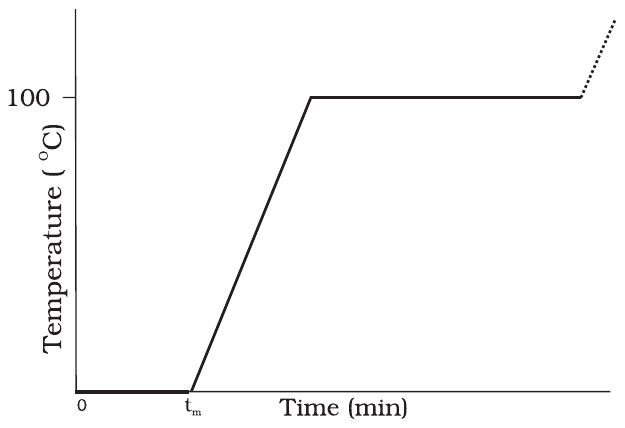
Take some cubes of ice in a beaker, start heating it slowly on a constant heat source, and draw a graph between temperature and time (Fig. 10.9). You will observe no change in the temperature as long as there is ice in the beaker: the temperature of the system does not change even though heat is being continuously supplied. The heat supplied is being utilised in changing the state from solid (ice) to liquid (water).
The change of state from solid to liquid is called melting or fusion and from liquid to solid is called freezing. The temperature remains constant until the entire amount of the solid substance melts: both the solid and the liquid states of the substance coexist in thermal equilibrium during the change of state. The temperature at which the solid and the liquid states of the substance are in thermal equilibrium with each other is called its melting point. It is characteristic of the substance and also depends on pressure. The melting point of a substance at standard atmospheric pressure is called its normal melting point. NCERT prints 'standard atomspheric pressure'.
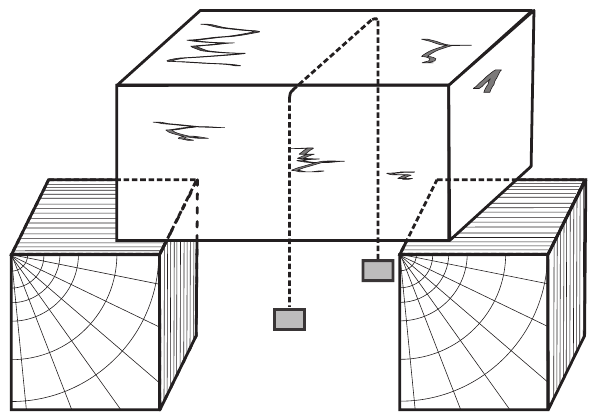
Regelation: take a slab of ice, take a metallic wire and fix two blocks, say 5 kg each, at its ends. Put the wire over the slab as shown in Fig. 10.10. The wire passes through the ice slab: just below the wire, ice melts at lower temperature due to increase in pressure, and when the wire has passed, water above the wire freezes again. Thus, the wire passes through the slab and the slab does not split. This phenomenon of refreezing is called regelation. Skating is possible on snow due to the formation of water under the skates: water is formed due to the increase of pressure and it acts as a lubricant.
After the whole of ice gets converted into water and we continue further heating, the temperature begins to rise (Fig. 10.9) till it reaches nearly 100 °C, when it again becomes steady. The heat supplied is now being utilised to change water from liquid state to vapour or gaseous state. The change of state from liquid to vapour (or gas) is called vaporisation. The temperature remains constant until the entire amount of the liquid is converted into vapour: both the liquid and vapour states coexist in thermal equilibrium. The temperature at which the liquid and the vapour states coexist is called its boiling point.
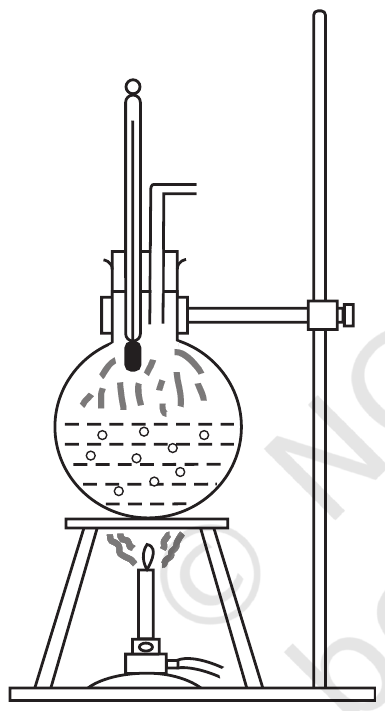
Boiling and pressure: take a round-bottom flask, more than half filled with water, over a burner with a thermometer and steam outlet through the cork (Fig. 10.11). As water gets heated, air dissolved in the water comes out as small bubbles; later, bubbles of steam form at the bottom but condense as they rise to cooler water. Finally, as the temperature of the entire mass reaches 100 °C, bubbles of steam reach the surface and boiling is said to occur. If the steam outlet is closed for a few seconds to increase the pressure, boiling stops: more heat is required to raise the temperature before boiling begins again. So boiling point increases with increase in pressure. If the burner is removed, the water cools to about 80 °C, the flask is closed airtight and turned upside down, and ice-cold water is poured on it, the vapours condense, reducing the pressure, and water begins to boil again at a lower temperature. So boiling point decreases with decrease in pressure. This explains why cooking is difficult on hills, where atmospheric pressure is lower, and why the boiling point is increased inside a pressure cooker, so cooking is faster. The boiling point of a substance at standard atmospheric pressure is called its normal boiling point.
Sublimation: all substances do not pass through the three states: solid-liquid-gas. Certain substances normally pass from the solid to the vapour state directly and vice versa. The change from solid state to vapour state without passing through the liquid state is called sublimation, and the substance is said to sublime. Dry ice (solid $CO_2$) sublimes, so also iodine. During the sublimation process both the solid and vapour states of a substance coexist in thermal equilibrium.
Triple Point and Phase Diagram
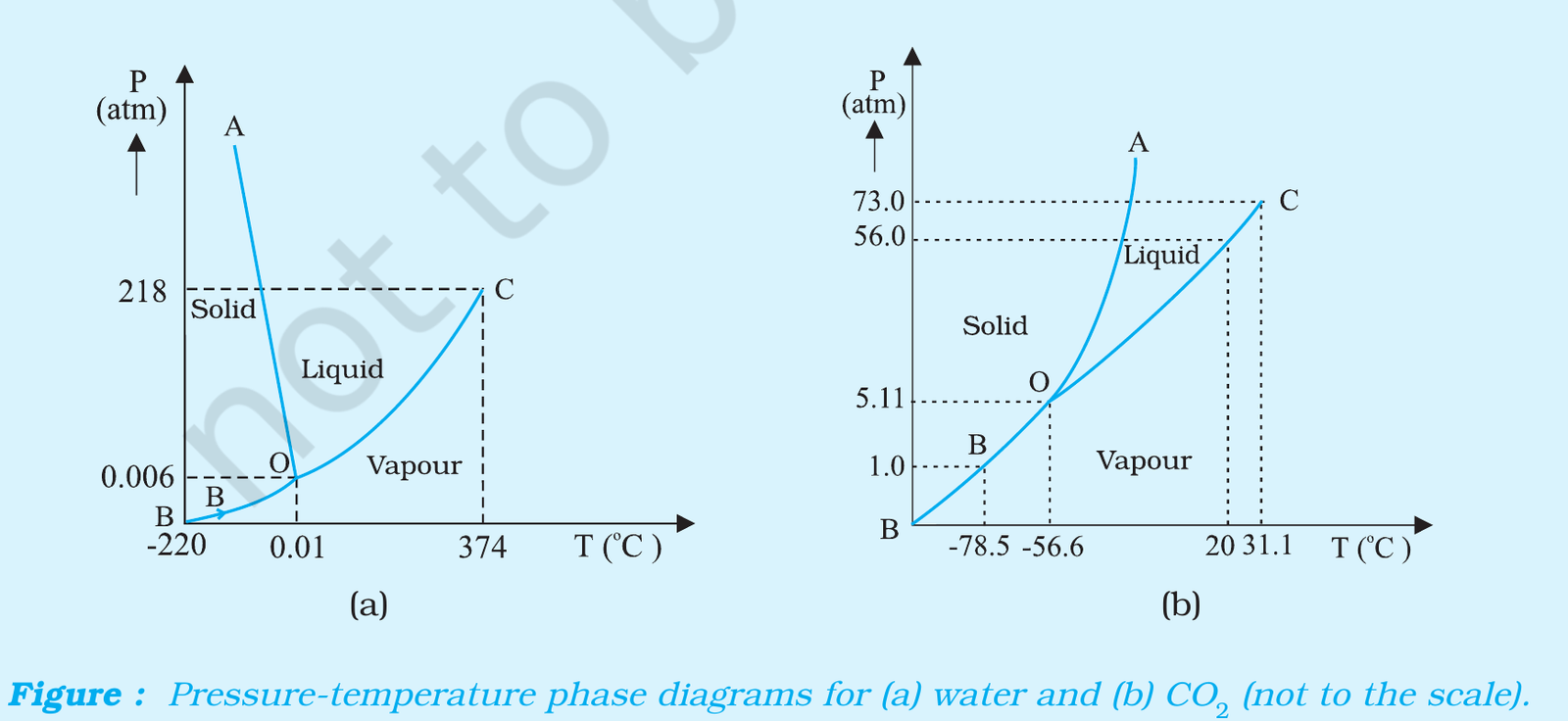
The temperature of a substance remains constant during its change of state (phase change). A graph between the temperature T and the Pressure P of the substance is called a phase diagram or P-T diagram. The figure in the Triple Point box shows the phase diagram of water and $CO_2$. Such a phase diagram divides the P-T plane into a solid-region, the vapour-region and the liquid-region. The regions are separated by the curves such as sublimation curve (BO), fusion curve (AO) and vaporisation curve ($CO$). The points on sublimation curve represent states in which solid and vapour phases coexist. Points on the fusion curve AO represent states in which solid and liquid phases coexist. Points on the vaporisation curve $CO$ represent states in which the liquid and vapour phases coexist.
The temperature and pressure at which the fusion curve, the vaporisation curve and the sublimation curve meet and all the three phases of a substance coexist is called the triple point of the substance. For water, the triple point is 273.16 K and 0.006 atm (Fig. (a), point O at 0.01 °C). Note: NCERT's box text prints the pressure as 6.11 x $10^{-3}$ Pa, but its own figure gives 0.006 atm, which is 611 Pa; the printed exponent is wrong and the figure value is used here. For $CO_2$, the triple point is -56.6 °C and 5.11 atm (Fig. (b), point O).
From the figures: for water, the critical point C is at 374 °C and 218 atm, and the sublimation curve runs down to -220 °C; for $CO_2$, the critical point C is at 31.1 °C and 73.0 atm, the sublimation point B at -78.5 °C and 1.0 atm is where dry ice sublimes at atmospheric pressure, and at 20 °C the vapour pressure is 56.0 atm.
Latent Heat
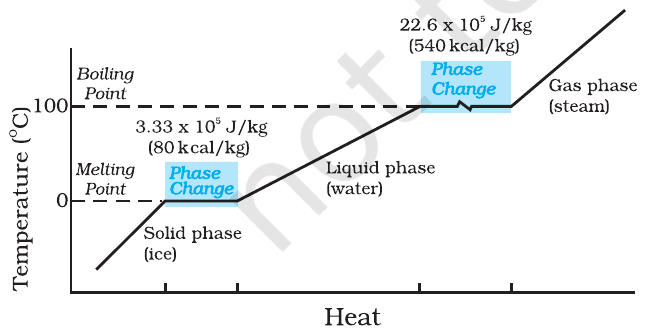
In Section 10.8, we have learnt that a certain amount of heat energy is transferred between a substance and its surroundings when it undergoes a change of state. The amount of heat per unit mass transferred during change of state of the substance is called latent heat of the substance for the process. For example, if heat is added to a given quantity of ice at -10 °C, the temperature of ice increases until it reaches its melting point (0 °C). At this temperature, the addition of more heat does not increase the temperature but causes the ice to melt. Once the entire ice melts, adding more heat will cause the temperature of the water to rise. A similar situation occurs during liquid-gas change of state at the boiling point.
The heat required during a change of state depends upon the heat of transformation and the mass of the substance undergoing a change of state. If mass m of a substance undergoes a change from one state to the other, then the quantity of heat required is given by Q = mL, or $L = Q/m$ (10.13), where L is known as latent heat and is a characteristic of the substance. Its SI unit is J kg^-1. The value of L also depends on the pressure; its value is usually quoted at standard atmospheric pressure. The latent heat for a solid-liquid state change is called the latent heat of fusion (Lf), and that for a liquid-gas state change is called the latent heat of vaporisation (Lv). These are often referred to as the heat of fusion and the heat of vaporisation. A plot of temperature versus heat for a quantity of water is shown in Fig. 10.12.
Note that when heat is added (or removed) during a change of state, the temperature remains constant. Note in Fig. 10.12 that the slopes of the phase lines are not all the same, which indicates that specific heats of the various states are not equal. For water, the latent heat of fusion and vaporisation are $L_f = 3.33 \times 10^5 J kg^{-1}$ and $Lv = 22.6 \times 10^5 J kg^{-1}$, respectively. That is, 3.33 x $10^{5}$ J of heat is needed to melt 1 kg ice at 0 °C, and 22.6 x $10^{5}$ J of heat is needed to convert 1 kg water into steam at 100 °C. So, steam at 100 °C carries 22.6 x $10^{5}$ J kg^-1 more heat than water at 100 °C. This is why burns from steam are usually more serious than those from boiling water.
Example 10.4: When 0.15 kg of ice at 0 °C is mixed with 0.30 kg of water at 50 °C in a container, the resulting temperature is 6.7 °C. Calculate the heat of fusion of ice $(swater = 4186 J kg^{-1} K^{-1})$. Heat lost by $water = (0.30 kg)(4186 J kg^{-1} K^{-1})(50.0 °C - 6.7 °C)$ = 54376.14 J. Heat required to melt $ice = (0.15 kg) L_f$. Heat required to raise the temperature of the melted ice water to the final temperature = (0.15 kg)(4186 J kg^-1 K^-1)(6.7 °C - 0 °C) = 4206.93 J. Heat lost = heat gained, so $54376.14 J = (0.15 kg) L_f + 4206.93 J$, giving $L_f = 3.34 x 10^{5} J kg^{-1}$.
Example 10.5: Calculate the heat required to convert 3 kg of ice at -12 °C kept in a calorimeter to steam at 100 °C at atmospheric pressure. Given specific heat capacity of $ice = 2100 J kg^{-1} K^{-1}$, specific heat capacity of $water = 4186 J kg^{-1} K^{-1}$, latent heat of fusion of $ice = 3.35 \times 10^5 J kg^{-1}$ and latent heat of $steam = 2.256 \times 10^6 J kg^{-1}$. Q1, ice -12 °C to 0 $°C = (3 kg)(2100 J kg^{-1} K^{-1})(12 °C)$ = 75600 J. Q2, melt ice at 0 $°C = (3 kg)(3.35 \times 10^5 J kg^{-1})$ = 1005000 J. Q3, water 0 °C to 100 $°C = (3 kg)(4186 J kg^{-1} K^{-1})(100 °C)$ = 1255800 J. Q4, water to steam at 100 $°C = (3 kg)(2.256 \times 10^6 J kg^{-1})$ = 6768000 J. So $Q = Q_1 + Q_2 + Q_3 + Q_4 = 75600 J + 1005000 J + 1255800 J + 6768000 J$ = 9.1 x $10^{6}$ J.
Practice1 question
Try it now. A wrong answer costs nothing here, try again until you get it.
In Example 10.4, the heat of fusion of ice calculated from the mixture is
NCERT 10.8.1, Example 10.4: heat lost by water 54376.14 J equals heat to melt the ice plus heat to warm it to 6.7 °C, giving $L_f = 3.34 \times 10^5 J kg^{-1}$.
Table: Latent Heats
Table 10.5: temperatures of the change of state and latent heats for various substances at 1 atm pressure.
| Substance | Melting Point (°C) | Lf ($10^{5}$ J kg^-1) | Boiling Point (°C) | Lv ($10^{5}$ J kg^-1) |
|---|---|---|---|---|
| Ethanol | -114 | 1.0 | 78 | 8.5 |
| Gold | 1063 | 0.645 | 2660 | 15.8 |
| Lead | 328 | 0.25 | 1744 | 8.67 |
| Mercury | -39 | 0.12 | 357 | 2.7 |
| Nitrogen | -210 | 0.26 | -196 | 2.0 |
| Oxygen | -219 | 0.14 | -183 | 2.1 |
| Water | 0 | 3.33 | 100 | 22.6 |
Note the small differences between the table and the worked examples: Example 10.5 uses Lf of ice 3.35 x $10^{5}$ J kg^-1 (table: 3.33) and latent heat of steam 2.256 x $10^{6}$ J kg^-1 (table: $22.6 \times 10^5 = 2.26 \times 10^6$), and Example 10.4 finds $L_f = 3.34 \times 10^5 J kg^{-1}$. All three values are kept as NCERT prints them in their own places.
Heat Transfer: Conduction
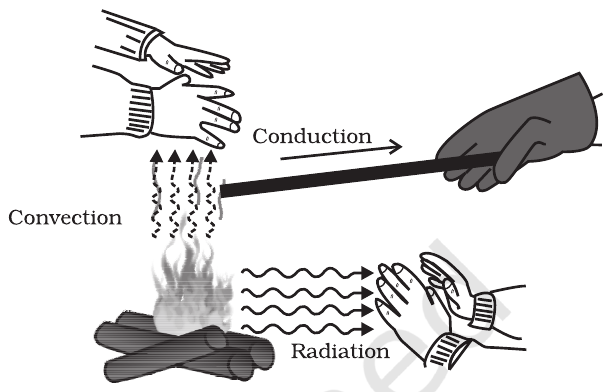
Heat is energy transfer from one system to another or from one part of a system to another part, arising due to temperature difference. There are three distinct modes of heat transfer: conduction, convection and radiation (Fig. 10.13).
Conduction is the mechanism of transfer of heat between two adjacent parts of a body because of their temperature difference. Suppose one end of a metallic rod is put in a flame: the other end of the rod will soon be so hot that you cannot hold it by your bare hands. Here, heat transfer takes place by conduction from the hot end of the rod through its different parts to the other end. Gases are poor thermal conductors, while liquids have conductivities intermediate between solids and gases.
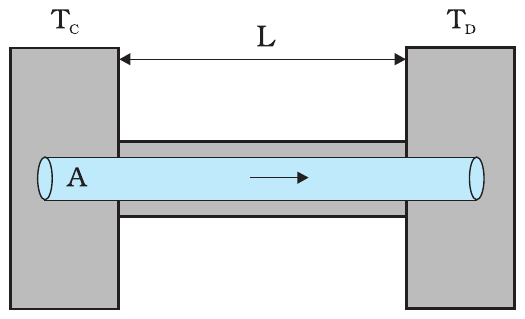
Heat conduction may be described quantitatively as the time rate of heat flow in a material for a given temperature difference. Consider a metallic bar of length L and uniform cross-section A with its two ends maintained at different temperatures, say TC and TD (Fig. 10.14), with the sides fully insulated so that no heat is exchanged between the sides and the surroundings. After some time, a steady state is reached: the temperature of the bar decreases uniformly with distance from TC to TD (TC > TD). The reservoir at C supplies heat at a constant rate, which transfers through the bar and is given out at the same rate to the reservoir at D. In this steady state, the rate of flow of heat (or heat current) H is proportional to the temperature difference (TC - TD) and the area of cross-section A and is inversely proportional to the length $L: H = K A (TC - TD)/L$ (10.14). The constant of proportionality K is called the thermal conductivity of the material. The greater the value of K for a material, the more rapidly will it conduct heat. The SI unit of K is J s^-1 m^-1 K^-1 or W m^-1 K^-1.
Table 10.6: thermal conductivities of some materials.
| Material | Thermal conductivity (J s^-1 m^-1 K^-1) |
|---|---|
| Silver | 406 |
| Copper | 385 |
| Aluminium | 205 |
| Brass | 109 |
| Steel | 50.2 |
| Lead | 34.7 |
| Mercury | 8.3 |
| Insulating brick | 0.15 |
| Concrete | 0.8 |
| Body fat | 0.20 |
| Felt | 0.04 |
| Glass | 0.8 |
| Ice | 1.6 |
| Glass wool | 0.04 |
| Wood | 0.12 |
| Water | 0.8 |
| Air | 0.024 |
| Argon | 0.016 |
| Hydrogen | 0.14 |
Compare the relatively large thermal conductivities of good thermal conductors, metals, with the relatively small thermal conductivities of good thermal insulators, such as wood and glass wool. Some cooking pots have copper coating on the bottom: being a good conductor of heat, copper promotes the distribution of heat over the bottom of a pot for uniform cooking. Plastic foams are good insulators, mainly because they contain pockets of air. Recall that gases are poor conductors, and note the low thermal conductivity of air in the table. Note: NCERT's text says 'in the Table 10.5' here, but the conductivities are in Table 10.6. Houses made of concrete roofs get very hot during summer days because thermal conductivity of concrete (though much smaller than that of a metal) is still not small enough, so people usually prefer to give a layer of earth or foam insulation on the ceiling so that heat transfer is prohibited and keeps the room cooler. In a nuclear reactor, elaborate heat transfer systems need to be installed so that the enormous energy produced by nuclear fission in the core transits out sufficiently fast, preventing the core from overheating.
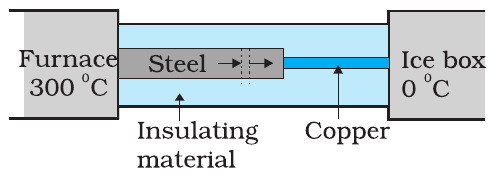
Example 10.6: What is the temperature of the steel-copper junction in the steady state of the system shown in Fig. 10.15? Length of the steel $rod = 15.0 cm$, length of the copper $rod = 10.0 cm$, temperature of the $furnace = 300 °C$, temperature of the other $end = 0 °C$. The area of cross section of the steel rod is twice that of the copper rod. Thermal conductivity of $steel = 50.2 J s^{-1} m^{-1} K^{-1}$; of copper = 385 J s^-1 m^-1 K^-1. In the steady state, the rate of heat flowing across a cross section of the rod is the same at every point along the length of the combined rod. Let T be the junction temperature: $(K_1 A_1 (300 - T))/L_1 = (K_2 A_2 (T - 0))/L_2$. With $A_1 = 2 A_2$, $L_1 = 15.0 cm$, $L_2 = 10.0 cm: (50.2 \times 2 (300 - T))/15$ = (385 T)/10, giving $T = 44.4 °C$.
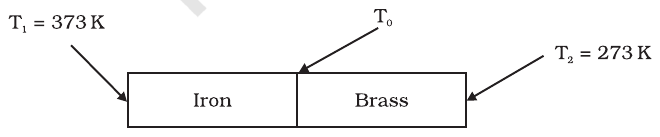
Example 10.7: An iron bar (L1 = 0.1 m, $A_1 = 0.02 m^2$, $K_1 = 79 W m^{-1} K^{-1}$) and a brass bar (L2 = 0.1 m, $A_2 = 0.02 m^2$, $K_2 = 109 W m^{-1} K^{-1}$) are soldered end to end as shown in Fig. 10.16. The free ends are maintained at 373 K and 273 K. Under steady state, the heat current H1 through the iron bar equals $H_2$ through the brass bar, so $K_1 (T_1 - T_0) = K_2 (T_0 - T_2)$ for equal A and L, giving $T_0 = (K_1 T_1 + K_2 T_2)/(K_1 + K_2) = 315 K$. The equivalent thermal conductivity of the compound bar is $K' = (2 K_1 K_2)/(K_1 + K_2) = 91.6 W m^{-1} K^{-1}$, and the heat current is $H' = (K' A (T_1 - T_2))/(2L) = 916.1 W$.
Heat Transfer: Convection and Radiation
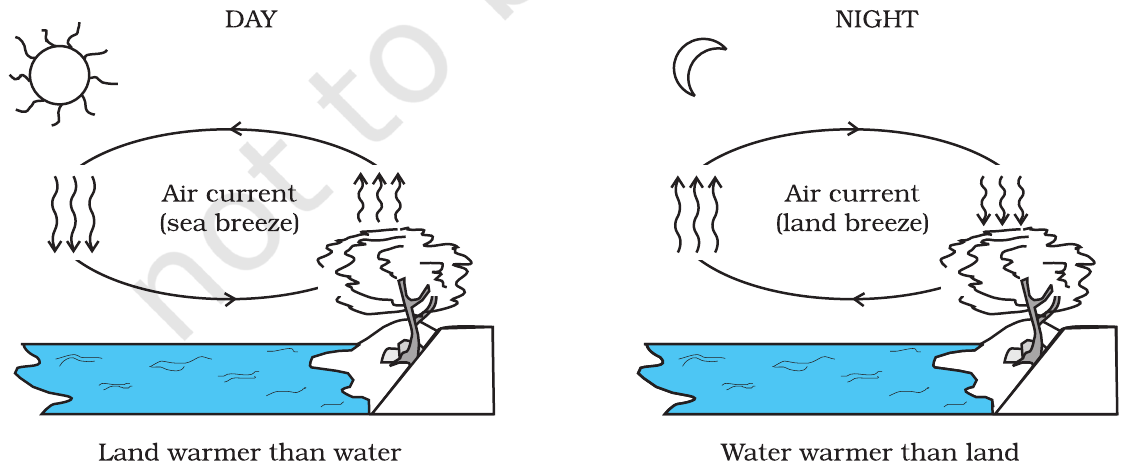
Convection is a mode of heat transfer by actual motion of matter. It is possible only in fluids. Convection can be natural or forced. In natural convection, gravity plays an important part: when a fluid is heated from below, the hot part expands and becomes less dense, rises by buoyancy, and the upper colder part replaces it, gets heated, rises, and is replaced in turn. In forced convection, material is forced to move by a pump or by some other physical means. Common examples are forced-air heating systems in homes, the human circulatory system, and the cooling system of an automobile engine. In the human body, the heart acts as the pump that circulates blood through different parts of the body, transferring heat by forced convection and maintaining it at a uniform temperature.
Natural convection is responsible for many familiar phenomena. During the day, the ground heats up more quickly than large bodies of water. The air in contact with the warm ground is heated by conduction, expands, becomes less dense than the surrounding cooler air, and rises; other air moves in to fill the space, creating a sea breeze near a large body of water. Cooler air descends, and a thermal convection cycle is set up, which transfers heat away from the land. At night, the ground loses its heat more quickly, and the water surface is warmer than the land. As a result, the cycle is reversed (Fig. 10.17). NCERT prints 'reveresed'.
The other example of natural convection is the steady surface wind on the earth blowing in from north-east towards the equator, the so-called trade wind. The equatorial and polar regions receive unequal solar heat. Air at the equatorial surface rises and moves out towards the poles, descending and streaming in towards the equator. The rotation of the earth modifies this convection current: air close to the equator has an eastward speed of 1600 km/h, while it is zero close to the poles. As a result, the air descends not at the poles but at 30° N (North) latitude and returns to the equator.
Radiation: conduction and convection require some material as a transport medium, and cannot operate between bodies separated by a distance in vacuum. But the earth does receive heat from the Sun across a huge distance. The third mechanism for heat transfer needs no medium; it is called radiation, and the energy so transferred by electromagnetic waves is called radiant energy. In an electromagnetic wave, electric and magnetic fields oscillate in space and time. Electromagnetic waves can have different wavelengths and can travel in vacuum with the same speed, the speed of light, 3 x $10^{8}$ m s^-1. This is how heat is transferred to the earth from the Sun through empty space. All bodies emit radiant energy, whether they are solid, liquid or gas. The electromagnetic radiation emitted by a body by virtue of its temperature, like radiation by a red hot iron or light from a filament lamp, is called thermal radiation.
When thermal radiation falls on other bodies, it is partly reflected and partly absorbed. The amount of heat that a body can absorb by radiation depends on the colour of the body. Black bodies absorb and emit radiant energy better than bodies of lighter colours. We wear white or light coloured clothes in summer, so that they absorb the least heat from the Sun; during winter, we use dark coloured clothes, which absorb heat from the sun and keep our body warm. The bottoms of utensils for cooking food are blackened so that they absorb maximum heat from fire and transfer it to the vegetables to be cooked.
A Dewar flask or thermos bottle is a device to minimise heat transfer between the contents of the bottle and outside. It consists of a double-walled glass vessel with the inner and outer walls coated with silver. Radiation from the inner wall is reflected back to the contents of the bottle. The outer wall similarly reflects back any incoming radiation. The space between the walls is evacuated to reduce conduction and convection losses, and the flask is supported on an insulator, like cork. The device is therefore useful for preventing hot contents (like milk) from getting cold, or alternatively, to store cold contents (like ice).
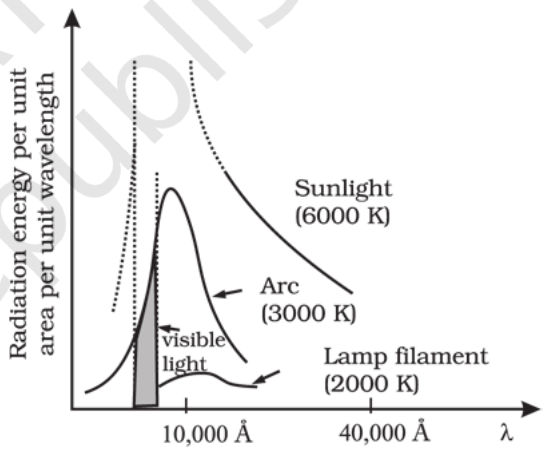
Blackbody radiation (10.9.4): thermal radiation at any temperature is not of one (or a few) wavelength(s) but has a continuous spectrum from the small to the long wavelengths. The energy content of radiation varies for different wavelengths. Figure 10.18 gives the experimental curves for radiation energy per unit area per unit wavelength emitted by a blackbody versus wavelength for different temperatures. The wavelength λm for which energy is the maximum decreases with increasing temperature. The relation between λm and T is given by Wien's displacement law: λm T = constant (10.15). The value of the constant (Wien's constant) is 2.9 x $10^{-3}$ m K. This law explains why the colour of a piece of iron heated in a hot flame first becomes dull red, then reddish yellow, and finally white hot. Wien's law is useful for estimating the surface temperatures of celestial bodies like the moon, Sun and other stars. Light from the moon is found to have a maximum near the wavelength 14 μm; by Wien's law, the surface of the moon is estimated to have a temperature of 200 K. Solar radiation has a maximum at $λm = 4753$ Å, which corresponds to $T = 6060 K$. Remember, this is the temperature of the surface of the sun, not its interior.
The most significant feature of the blackbody radiation curves in Fig. 10.18 is that they are universal: they depend only on the temperature and not on the size, shape or material of the blackbody. Attempts to explain blackbody radiation theoretically, at the beginning of the twentieth century, spurred the quantum revolution in physics.
Energy can be transferred by radiation over large distances, without a medium (in vacuum). The total electromagnetic energy radiated by a body at absolute temperature T is proportional to its size, its ability to radiate (called emissivity) and most importantly to its temperature. For a body which is a perfect radiator, the energy emitted per unit time (H) is given by H = A σ $T^4$ (10.16), where A is the area and T is the absolute temperature of the body. This relation, obtained experimentally by Stefan and later proved theoretically by Boltzmann, is known as the Stefan-Boltzmann law, and σ is called the Stefan-Boltzmann constant. Its value in SI units is 5.67 x $10^{-8}$ W m^-2 K^-4. Most bodies emit only a fraction of the rate given by Eq. (10.16); a substance like lamp black comes close to the limit. One therefore defines a dimensionless fraction e called emissivity and writes H = A e σ $T^4$ (10.17). Here, $e = 1$ for a perfect radiator. For a tungsten lamp, e is about 0.4: a tungsten lamp at a temperature of 3000 K and a surface area of 0.3 $\mathrm{cm}^2$ radiates at the rate $H = 0.3 \times 10^{-4} x 0.4 \times 5.67 \times 10^{-8} x (3000)⁴$ = 60 W.
A body at temperature T, with surroundings at temperature Ts, emits as well as receives energy. For a perfect radiator, the net rate of loss of radiant energy is $H = σ A (T^4 - T_s^4)$. For a body with emissivity e, the relation modifies to $H = e σ A (T^4 - T_s^4)$ (10.18). As an example, estimate the heat radiated by our bodies: the surface area of a person's body is about 1.9 $m^2$, the room temperature is 22 °C, the internal body temperature is about 37 °C, and the skin temperature may be 28 °C. The emissivity of the skin is about 0.97. The rate of heat loss is $H = 5.67 \times 10^{-8} x 1.9 \times 0.97 x ((301)⁴ - (295)⁴)$ = 66.4 W, which is more than half the rate of energy production by the body at rest (120 W). To prevent this heat loss effectively, modern arctic clothing has an additional thin shiny metallic layer next to the skin, which reflects the body's radiation. NCERT prints '37°°C' and '28°°C' with doubled degree signs in this example.
Practice1 question
Try it now. A wrong answer costs nothing here, try again until you get it.
Light from the moon has maximum intensity near wavelength 14 μm. By Wien's law its surface temperature is about
NCERT 10.9.4: by Wien's law $λm T = 2.9 \times 10^{-3} m K$, so for $λm = 14 μm$ the moon's surface temperature is about 200 K.
Newton's Law of Cooling
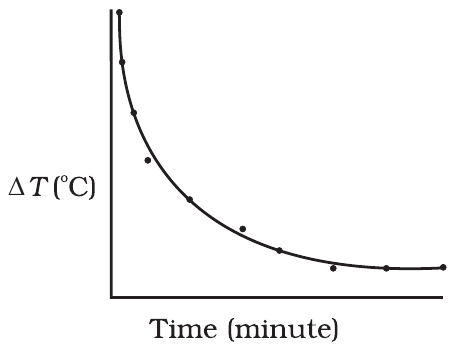
We all know that hot water or milk when left on a table begins to cool, gradually, and ultimately attains the temperature of the surroundings. Take 300 mL of water in a calorimeter with a stirrer, cover it with a two-holed lid, fix a thermometer through one hole, and note the reading: this reading $T_1$ is the temperature of the surroundings. Heat the water till it attains a temperature about 40 °C above room temperature, stop heating, start the stop-watch, and note the thermometer reading after every one minute of stirring, till it attains a temperature about 5 °C above that of the surroundings. Then plot a graph by taking each value of temperature $\Delta T = T_2 - T_1$ along y-axis and the corresponding value of t along x-axis (Fig. 10.19). From the graph you can infer how the cooling of hot water depends on the difference of its temperature from that of the surroundings. You will also notice that initially the rate of cooling is higher and decreases as the temperature of the body falls. NCERT prints 'coresponding' in this activity.
Newton's law of cooling: the rate of loss of heat, -dQ/dt, of the body is directly proportional to the difference of temperature $\Delta T = (T_2 - T_1)$ of the body and the surroundings. The law holds good only for small difference of temperature. Also, the loss of heat by radiation depends upon the nature of the surface of the body and the area of the exposed surface. We can write $-dQ/dt = k (T_2 - T_1)$ (10.19), where k is a positive constant depending upon the area and nature of the surface of the body.
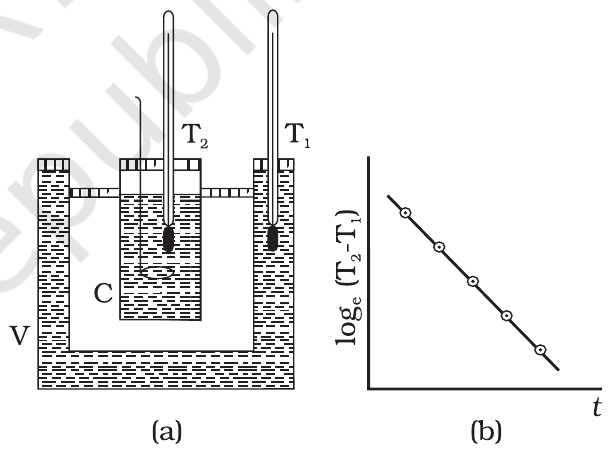
Suppose a body of mass m and specific heat capacity s is at temperature $T_2$, and $T_1$ is the temperature of the surroundings. If the temperature falls by a small amount dT2 in time dt, then the amount of heat lost is $dQ = m s dT_2$, so the rate of loss of heat is $dQ/dt = m s (dT_2/dt)$ (10.20). From Eqs. (10.19) and (10.20): -$m s (dT2/dt) = k (T_2 - T_1)$, so $(dT2)/(T_2 - T_1) = -(k/(m s)) dt = -K dt$ (10.21), where $K = k/(m s)$. On integrating, $log_e (T_2 - T_1) = -K t + c$ (10.22), or $T_2 = T_1 + C' e^{-Kt}$, where $C' = e^c$ (10.23). Equation (10.23) enables you to calculate the time of cooling of a body through a particular range of temperature. For small temperature differences, the rate of cooling, due to conduction, convection, and radiation combined, is proportional to the difference in temperature. It is a valid approximation in the transfer of heat from a radiator to a room, the loss of heat through the wall of a room, or the cooling of a cup of tea on the table.
Verification: Newton's law of cooling can be verified with the set-up shown in Fig. 10.20(a). The set-up consists of a double-walled vessel (V) containing water between the two walls. A copper calorimeter (C) containing hot water is placed inside the double-walled vessel. Two thermometers through the corks are used to note the temperatures $T_2$ of water in the calorimeter and $T_1$ of hot water in between the double walls. Temperature of hot water in the calorimeter is noted after equal intervals of time. A graph is plotted between log_e ($T_2$ - $T_1$) and time (t). The nature of the graph is observed to be a straight line having a negative slope as shown in Fig. 10.20(b). This is in support of Eq. (10.22).
Example 10.8: A pan filled with hot food cools from 94 °C to 86 °C in 2 minutes when the room temperature is at 20 °C. How long will it take to cool from 71 °C to 69 °C? The average temperature of 94 °C and 86 °C is 90 °C, which is 70 °C above the room temperature. Under these conditions the pan cools 8 °C in 2 minutes. Using Eq. (10.21): (change in temperature)/(time) = K $\Delta T$, so (8 $°C)/(2 min) = K (70 °C$). The average of 69 °C and 71 °C is 70 °C, which is 50 °C above room temperature, so (2 °C)/(time) = K (50 °C). Dividing: time = $0.7 min = 42 s$.
Trap Pairs
- Heat and temperature are the same thing? No. Heat is energy transferred by virtue of temperature difference; temperature is the measure of hotness. A body at 0 °C still has internal energy, and heat flows only while a temperature difference exists.
- Equal heat raises equal masses by the same temperature? No. $\Delta Q$ = m s $\Delta T$, and s differs: water 4186 J kg^-1 K^-1 against copper 386.4 J kg^-1 K^-1, so the same heat raises copper about 11 times more than water.
- A hole in a heated metal plate shrinks? No. The hole expands as the plate expands: area expansion gives $(\Delta A/A) = 2 α_l \Delta T$ for the sheet, and the hole grows with it.
- Temperature rises while ice melts or water boils? No. The temperature stays constant during a change of state: the heat supplied is used as latent heat $(Q = mL), melting ice$ at 0 °C and boiling water at 100 °C with no temperature change.
- Cooling from 90 °C to 80 °C takes the same time as from 80 °C to 60 °C? No. By Newton's law of cooling the rate depends on the excess over the surroundings: the 80 °C to 60 °C fall takes 13t/5, longer than t, even though the drop is bigger (NEET 2021 P3 Q33).
- A black body is a poor emitter because it absorbs everything? No. Black bodies absorb and emit radiant energy better than bodies of lighter colours: emissivity e = 1 for a perfect radiator, and H = A σ $T^4$ is the maximum rate.
Points to Ponder
- The relation connecting Kelvin temperature (T) and the Celsius temperature tC, $T = t_C + 273.15$, and the assignment $T = 273.16 K$ for the triple point of water are exact relations (by choice). With this choice, the Celsius temperature of the melting point of water and boiling point of water (both at 1 atm pressure) are very close to, but not exactly equal to 0 °C and 100 °C respectively. In the original Celsius scale, these latter fixed points were exactly at 0 °C and 100 °C (by choice), but now the triple point of water is the preferred choice for the fixed point, because it has a unique temperature.
- A liquid in equilibrium with vapour has the same pressure and temperature throughout the system; the two phases in equilibrium differ in their molar volume (i.e. density). This is true for a system with any number of phases in equilibrium.
- Heat transfer always involves temperature difference between two systems or two parts of the same system. Any energy transfer that does not involve temperature difference in some way is not heat.
- Convection involves flow of matter within a fluid due to unequal temperatures of its parts. A hot bar placed under a running tap loses heat by conduction between the surface of the bar and water and not by convection within water.
Trap Boxes
Heat and temperature are the same thing
Wrong idea: Temperature and heat mean the same thing, so a hotter body always contains more heat.
Heat is energy transferred by virtue of temperature difference; temperature is the measure of hotness. Heat flows only while a temperature difference exists. NCERT 10.2.
NCERT XI, Ch 10, 10.2
Equal heat raises equal masses by the same temperature
Wrong idea: The same quantity of heat raises any two equal masses through the same temperature rise.
$\Delta Q$ = m s $\Delta T$. Water has $s = 4186 J kg^{-1} K^{-1}$ and copper 386.4 J kg^-1 K^-1, so the same heat raises equal masses by very different amounts. NCERT 10.6.
NCERT XI, Ch 10, 10.6
A hole in a heated metal plate shrinks
Wrong idea: Heating a metal plate makes a hole drilled in it smaller.
The hole expands with the plate: area expansion gives $(\Delta A/A) = 2 α_l \Delta T$, so a hole grows on heating, exactly like the material around it. NCERT 10.5, Example 10.1.
NCERT XI, Ch 10, 10.5
Equal temperature drops take equal cooling times
Wrong idea: A 20 °C fall takes twice as long as a 10 °C fall, whatever the temperatures.
By Newton's law the rate of cooling is proportional to the excess over the surroundings. Cooling 90 °C to 80 °C takes t minutes, but 80 °C to 60 °C takes 13t/5. NCERT 10.10.
NCERT XI, Ch 10, 10.10
Junction temperatures are equal in a series of conducting rods
Wrong idea: In steady state the temperature is the same at every junction of rods in series.
In steady state the heat current is the same through each rod, so each rod takes its own temperature drop. For 2K, K, 2K rods between 3T and T, $T_1 = (5/2)T$ and $T_2 = (3/2)T$. NCERT 10.9.1.
NCERT XI, Ch 10, 10.9.1
Chapter test
5 NEET PYQs. +4 for a correct answer, -1 for a wrong answer, exactly like NEET. Finish the test to earn a medal.
Q1: NEET (UG) 2025, Code 45, Q19
Three identical heat conducting rods are connected in series as shown in the figure. The rods on the sides have thermal conductivity 2K while that in the middle has thermal conductivity K. The left end of the combination is maintained at temperature 3T and the right end at T. The rods are thermally insulated from outside. In steady state, temperature at the left junction is $T_1$ and that at the right junction is $T_2$. The ratio $T_1$/$T_2$ is :
In steady state the heat current is the same through all three rods: $2K(3T - T_1) = K(T_1 - T_2) = 2K(T_2 - T)$, giving $T_1 = (5/2)T$ and $T_2 = (3/2)T$, so $T_1/T_2 = 5/3$.
Q2: NEET (UG) 2024, Code R3, Q36
A metallic bar of Young's modulus, 0.5 x $10^{11}$ N m^-2 and coefficient of linear thermal expansion $10^{-5}$ °C^-1, length 1 m and area of cross-section $10^{-3}$ $m^2$ is heated from 0°C to 100°C without expansion or bending. The compressive force developed in it is:
Prevented expansion gives thermal stress Y α $\Delta T$, so force $F = Y A α \Delta T = (0.5 x 10^{11})(10^{-3})(10^{-5})$(100) = 50 x $10^{3}$ N.
Q3: NEET (UG) 2021, Code P3, Q33
A cup of coffee cools from 90°C to 80°C in t minutes, when the room temperature is 20°C. The time taken by a similar cup of coffee to cool from 80°C to 60°C at a room temperature same at 20°C is :
Average form of Newton's law: ($T_1$ + $T_2$)/2 - Ts over time. First case: $(85 - 20) = 65$ for 10 °C in t minutes; second: $(70 - 20) = 50$ for 20 °C, so time = $(20/10) x (65/50) x t = 13t/5$.
Q4: NEET (UG) 2020, Code G5, Q155
The quantities of heat required to raise the temperature of two solid copper spheres of radii r1 and $r_2 (r_1 = 1.5 r_2)$ through 1 K are in the ratio :
$\Delta Q$ = m s $\Delta T$, and m is proportional to $r^3$ for solid spheres, so $\Delta Q_1/\Delta Q_2 = (r_1/r_2)^3 = (1.5)³ = 27/8$.
Q5: NEET (UG) 2019, Code Q2, Q152
A copper rod of 88 cm and an aluminium rod of unknown length have their increase in length independent of increase in temperature. The length of aluminium rod is : (αCu = 1.7 x $10^{-5}$ K^-1 and $αAl = 2.2 \times 10^{-5} K^{-1}$)
Equal length increase $needs αCu x LCu = αAl x LAl$, so $LAl = (1.7/2.2) x 88 cm = 68 cm$.
Score: 0 · Answered 0 of 5
Flashcards
Tap a card to flip it over and see the answer. Tap it again to flip it back.
Give the Fahrenheit-Celsius conversion and the Kelvin-Celsius relation, with the ice and steam points.
Tap to flip$t_F = (9/5)t_C + 32$, and $t_C = (5/9)(t_F - 32)$. The ice point is 0 $°C = 32 °F$ and the steam point is 100 $°C = 212 °F$. Absolute temperature $T = t_C + 273.15$, so 0 $K = -273.15 °C$.
Tap to flip backWrite the ideal-gas equation and the value of R.
Tap to flip$PV = μRT$, where μ is the number of moles and $R = 8.31 J mol^{-1} K^{-1}$ is the universal gas constant. At constant temperature PV = constant (Boyle's law); at constant pressure V/T = constant (Charles' law).
Tap to flip backGive the linear, area and volume expansion relations and the link between αv and αl.
Tap to flip$(\Delta l/l) = α_l \Delta T, (\Delta A/A) = 2 α_l \Delta T, (\Delta V/V) = α_v \Delta T$, and $α_v = 3 α_l$. Table 10.1: aluminium 2.5, brass 1.8, iron 1.2, copper 1.7 (all x $10^{-5}$ K^-1). Copper expands about five times more than pyrex glass (0.32).
Tap to flip backWhat is the coefficient of volume expansion of an ideal gas, and its value at 0 °C?
Tap to flipFor an ideal gas at constant pressure, $α_v = 1/T$. At 0 °C, $α_v = 3.7 \times 10^{-3} K^{-1}$, and at room temperature about 3300 x $10^{-6}$ K^-1, orders of magnitude larger than for solids and liquids.
Tap to flip backState the anomalous expansion of water and the temperature of maximum density.
Tap to flipWater contracts on heating between 0 °C and 4 °C, so it has maximum density at 4 °C. Below 4 °C the volume increases and the density falls. Lakes freeze at the top first because the colder water stays at the surface.
Tap to flip backDefine heat capacity, specific heat capacity and molar specific heat capacity, and give the value for water.
Tap to flip$S = \Delta Q/\Delta T$; $s = (1/m)(\Delta Q/\Delta T)$; $C = (1/μ)(\Delta Q/\Delta T)$. SI units: s in J kg^-1 K^-1, C in J $mol^{-1}$ K^-1. Water has the highest specific heat capacity, 4186 J kg^-1 K^-1, so it is used as a coolant in radiators and a heater in hot water bags.
Tap to flip backGive Cp and Cv for He, $H_2$, $N_2$, $O_2$ and $CO_2$ from Table 10.4.
Tap to flipHe Cp 20.8, Cv 12.5; $H_2$ 28.8, 20.4; $N_2$ 29.1, 20.8; $O_2$ 29.4, 21.1; $CO_2$ 37.0, 28.5 (all J $mol^{-1}$ K^-1). Cp is at constant pressure, Cv at constant volume.
Tap to flip backDefine latent heat and give Lf and Lv for water.
Tap to flipQ = mL, or $L = Q/m$, in J kg^-1. For water $L_f = 3.33 \times 10^5 J kg^{-1}$ and $Lv = 22.6 \times 10^5 J kg^{-1}$. Steam at 100 °C carries 22.6 x $10^{5}$ J kg^-1 more heat than water at 100 °C, so steam burns are more serious.
Tap to flip backGive the melting and boiling points of water, ethanol, mercury, nitrogen and oxygen from Table 10.5.
Tap to flipWater melts at 0 °C and boils at 100 °C; ethanol -114 °C and 78 °C; mercury -39 °C and 357 °C; nitrogen -210 °C and -196 °C; oxygen -219 °C and -183 °C; gold 1063 °C and 2660 °C; lead 328 °C and 1744 °C (Table 10.5, at 1 atm).
Tap to flip backWrite the steady-state conduction law and give K for silver, copper, steel, glass and air.
Tap to flip$H = K A (TC - TD)/L$, with K the thermal conductivity in J s^-1 m^-1 K^-1 (or W m^-1 K^-1). Silver 406, copper 385, aluminium 205, steel 50.2, glass 0.8, wood 0.12, air 0.024. Gases are poor conductors; metals are good conductors.
Tap to flip backState Wien's displacement law and the Stefan-Boltzmann law with constants, and the moon and sun examples.
Tap to flipλm T = constant = 2.9 x $10^{-3}$ m K (Wien's displacement law). H = A σ $T^4$ with σ = 5.67 x $10^{-8}$ W m^-2 K^-4 (Stefan-Boltzmann law); with emissivity e, H = A e σ $T^4$, and net loss $H = e σ A (T^4 - T_s^4)$. Moon: λm 14 μm gives $T = 200 K$; sun: λm 4753 Å gives $T = 6060 K$.
Tap to flip backState Newton's law of cooling and its integrated form, and its condition.
Tap to flip-$dQ/dt = k(T_2 - T_1)$, where $T_2$ is the body temperature and $T_1$ the surroundings. With mass m and specific heat s, $log_e(T_2 - T_1) = -Kt + c$, where $K = k/(m s)$, so $T_2 = T_1 + C' e^{-Kt}$. The law holds good only for small differences of temperature.
Tap to flip backFrequently asked questions
Is it true that heat and temperature are the same thing?
Heat is energy transferred by virtue of temperature difference; temperature is the measure of hotness. Heat flows only while a temperature difference exists.
Is it true that equal heat raises equal masses by the same temperature?
$\Delta Q$ = m s $\Delta T$. Water has $s = 4186 J kg^{-1} K^{-1}$ and copper 386.4 J kg^-1 K^-1, so the same heat raises equal masses by very different amounts.
Is it true that a hole in a heated metal plate shrinks?
The hole expands with the plate: area expansion gives $(\Delta A/A) = 2 α_l \Delta T$, so a hole grows on heating, exactly like the material around it. NCERT 10.5, Example 10.1.
Is it true that equal temperature drops take equal cooling times?
By Newton's law the rate of cooling is proportional to the excess over the surroundings. Cooling 90 °C to 80 °C takes t minutes, but 80 °C to 60 °C takes 13t/5.
Is it true that junction temperatures are equal in a series of conducting rods?
In steady state the heat current is the same through each rod, so each rod takes its own temperature drop. For 2K, K, 2K rods between 3T and T, $T_1 = (5/2)T$ and $T_2 = (3/2)T$.