 NEET Notes
Home > Physics > Mechanical Properties of Solids
Mechanical Properties of Solids
The property of a body, by virtue of which it tends to regain its original size and shape when the applied force is removed, is known as elasticity and the deformation caused is known as elastic deformation.
On this page · 19 sections
- 01Syllabus Map
- 02Introduction: Elasticity and Plasticity
- 03Stress and Strain
- 04Table: Three Kinds of Stress and Strain
- 05Hooke's Law
- 06Stress-Strain Curve
- 07Stress-Strain Curve of Elastomers
- 08Young's Modulus
- 09Table: Young's Moduli and Yield Strengths
- 10Shear Modulus
- 11Table: Shear Moduli
- 12Bulk Modulus and Compressibility
- 13Table: Bulk Moduli
- 14Table: Stress, Strain and Elastic Moduli
- 15Poisson's Ratio
- 16Elastic Potential Energy in a Stretched Wire
- 17Applications of Elastic Behaviour
- 18Trap Pairs
- 19Points to Ponder
Stress, strain, Hooke's law, the stress-strain curve, Young's, shear and bulk moduli, Poisson's ratio, elastic potential energy and applications, from NCERT Chapter 8, with 5 NEET PYQs.
Syllabus Map
- NMC Unit: PHYS-U07, Properties of Solids and Liquids (solids part). NCERT Chapter 8, Mechanical Properties of Solids (Class XI, rationalised book, keph201.pdf, Reprint 2026-27). Note on numbering: keph201.pdf is Chapter 8 in the current rationalised NCERT book, with sections 8.1 to 8.6, Tables 8.1 to 8.4, and Figures 8.1 to 8.11. All section, table and figure references in this chapter use the current book numbering so they can be traced to the PDF.
- Subtopics in this chapter (NCERT XI, Ch 8): introduction (8.1); stress and strain (8.2); Hooke's law (8.3); stress-strain curve (8.4); elastic moduli (8.5), with Young's modulus (8.5.1), shear modulus (8.5.2), bulk modulus (8.5.3), Poisson's ratio (8.5.4) and elastic potential energy in a stretched wire (8.5.5); applications of elastic behaviour of materials (8.6).
- Subtopic checklist: (1) elasticity, elastic deformation, plasticity and plastic deformation; (2) stress, tensile, compressive, longitudinal, shearing, tangential and hydraulic stress; (3) longitudinal, shearing and volume strain; (4) Hooke's law and modulus of elasticity; (5) stress-strain curve points O, A, B, C, D, E, yield point, yield strength, ultimate tensile strength, permanent set, brittle and ductile; (6) elastomers; (7) Young's modulus and Table 8.1 values; (8) shear modulus, modulus of rigidity and Table 8.2 values; (9) bulk modulus, compressibility and Table 8.3 values; (10) Table 8.4 at a glance; (11) Poisson's ratio; (12) elastic potential energy in a stretched wire; (13) crane rope, beam bending and I-section, pillars, maximum height of a mountain.
- NMC Unit 7 also covers fluids (pressure, Pascal's law, viscosity, Bernoulli's principle, surface tension) and heat (thermal expansion, calorimetry, heat transfer); those are covered in the mechanical-properties-of-fluids chapter and the thermal-properties chapter, not here. This chapter covers the solids part of Unit 7 in full.
- Extra information (beyond NCERT): none. Every section in this chapter comes from the current NCERT chapter text, including Poisson's ratio and elastic potential energy, which are in the current book.
- Estimated revision time: 10 minutes. Jump links: Syllabus Map, Introduction: Elasticity and Plasticity, Stress and Strain, Table: Three Kinds of Stress and Strain, Hooke's Law, Stress-Strain Curve, Stress-Strain Curve of Elastomers, Young's Modulus, Table: Young's Moduli and Yield Strengths, Shear Modulus, Table: Shear Moduli, Bulk Modulus and Compressibility, Table: Bulk Moduli, Table: Stress, Strain and Elastic Moduli, Poisson's Ratio, Elastic Potential Energy in a Stretched Wire, Applications of Elastic Behaviour, Trap Pairs, Points to Ponder, PYQs, Chapter Test.
Introduction: Elasticity and Plasticity
In Chapter 6, we studied the rotation of the bodies and then realised that the motion of a body depends on how mass is distributed within the body. We restricted ourselves to simpler situations of rigid bodies. A rigid body generally means a hard solid object having a definite shape and size. But in reality, bodies can be stretched, compressed and bent. Even the appreciably rigid steel bar can be deformed when a sufficiently large external force is applied on it. This means that solid bodies are not perfectly rigid.
A solid has definite shape and size. In order to change (or deform) the shape or size of a body, a force is required. If you stretch a helical spring by gently pulling its ends, the length of the spring increases slightly. When you leave the ends of the spring, it regains its original size and shape. The property of a body, by virtue of which it tends to regain its original size and shape when the applied force is removed, is known as elasticity and the deformation caused is known as elastic deformation. However, if you apply force to a lump of putty or mud, they have no gross tendency to regain their previous shape, and they get permanently deformed. Such substances are called plastic and this property is called plasticity. Putty and mud are close to ideal plastics.
The elastic behaviour of materials plays an important role in engineering design. For example, while designing a building, knowledge of elastic properties of materials like steel, concrete etc. is essential. The same is true in the design of bridges, automobiles, ropeways etc. One could also ask - Can we design an aeroplane which is very light but sufficiently strong? Can we design an artificial limb which is lighter but stronger? Why does a railway track have a particular shape like I? Why is glass brittle while brass is not? Answers to such questions begin with the study of how relatively simple kinds of loads or forces act to deform different solids bodies. In this chapter, we shall study the elastic behaviour and mechanical properties of solids which would answer many such questions.
Stress and Strain

When forces are applied on a body in such a manner that the body is still in static equilibrium, it is deformed to a small or large extent depending upon the nature of the material of the body and the magnitude of the deforming force. The deformation may not be noticeable visually in many materials but it is there. When a body is subjected to a deforming force, a restoring force is developed in the body. This restoring force is equal in magnitude but opposite in direction to the applied force. The restoring force per unit area is known as stress. If F is the force applied normal to the cross-section and A is the area of cross section of the body, Magnitude of the $stress = F/A$ (8.1). The SI unit of stress is N m-2 or pascal (Pa) and its dimensional formula is $[M L^{-1} T^{-2}]$.
There are three ways in which a solid may change its dimensions when an external force acts on it. These are shown in Fig. 8.1. In Fig. 8.1(a), a cylinder is stretched by two equal forces applied normal to its cross-sectional area. The restoring force per unit area in this case is called tensile stress. If the cylinder is compressed under the action of applied forces, the restoring force per unit area is known as compressive stress. Tensile or compressive stress can also be termed as longitudinal stress. In both the cases, there is a change in the length of the cylinder. The change in the length $\Delta L$ to the original length L of the body (cylinder in this case) is known as longitudinal strain. $Longitudinal strain = \Delta L/L$ (8.2).
However, if two equal and opposite deforming forces are applied parallel to the cross-sectional area of the cylinder, as shown in Fig. 8.1(b), there is relative displacement between the opposite faces of the cylinder. The restoring force per unit area developed due to the applied tangential force is known as tangential or shearing stress. As a result of applied tangential force, there is a relative displacement $\Delta x$ between opposite faces of the cylinder as shown in the Fig. 8.1(b). The strain so produced is known as shearing strain and it is defined as the ratio of relative displacement of the faces $\Delta x$ to the length of the cylinder L. $Shearing strain = \Delta x/L = \tan θ$ (8.3), where θ is the angular displacement of the cylinder from the vertical (original position of the cylinder). Usually θ is very small, tan θ is nearly equal to angle θ, (if θ = 10 degrees, for example, there is only 1% difference between θ and tan θ). It can also be visualised, when a book is pressed with the hand and pushed horizontally, as shown in Fig. 8.2 (c). Thus, $shearing strain = \tan θ$, and for small θ, tan θ is nearly equal to θ (8.4). Note that NCERT prints this book example as Fig. 8.2 (c) in the text, while the figure itself is Fig. 8.1(c).
In Fig. 8.1 (d), a solid sphere placed in the fluid under high pressure is compressed uniformly on all sides. The force applied by the fluid acts in perpendicular direction at each point of the surface and the body is said to be under hydraulic compression. This leads to decrease in its volume without any change of its geometrical shape. The body develops internal restoring forces that are equal and opposite to the forces applied by the fluid (the body restores its original shape and size when taken out from the fluid). The internal restoring force per unit area in this case is known as hydraulic stress and in magnitude is equal to the hydraulic pressure (applied force per unit area). The strain produced by a hydraulic pressure is called volume strain and is defined as the ratio of change in volume ($\Delta V$) to the original volume (V). Volume $strain = \Delta V/V$ (8.5). Since the strain is a ratio of change in dimension to the original dimension, it has no units or dimensional formula.
This is the chapter diagram: NCERT Figure 8.1 shows (a) a cylindrical body under tensile stress elongating by $\Delta L$, (b) shearing stress on a cylinder deforming it by an angle θ, (c) a body subjected to shearing stress, and (d) a solid body under a stress normal to the surface at every point (hydraulic stress).
Practice1 question
Try it now. A wrong answer costs nothing here, try again until you get it.
A force of 100 N is applied normal to the cross-section of a wire of area 2 x $10^{-6}$ $m_2$. What is the stress developed in the wire?
NCERT 8.2: $stress = F/A = 100/(2 x 10^{-6}) = 5 x 10^{7} N m-2$.
Table: Three Kinds of Stress and Strain
| Quantity | Formula | Notes |
|---|---|---|
| Stress | Stress = F/A | Restoring force per unit area; SI unit N m-2 or Pa; dimensional formula $[M L^{-1} T^{-2}]$ |
| Tensile stress | F/A, force normal to cross-section, pulling | Cylinder elongates by $\Delta L$; also called longitudinal stress |
| Compressive stress | F/A, force normal to cross-section, pushing | Cylinder shortens; also called longitudinal stress |
| Longitudinal strain | $\Delta L$/L | Change in length over original length |
| Shearing (tangential) stress | F/A, force parallel to cross-section | Restoring force per unit area for a tangential force |
| Shearing strain | $\Delta x/L = \tan θ$, about equal to θ for small θ | Relative displacement of faces over length L |
| Hydraulic stress | Equal to hydraulic pressure | Force per unit area, normal at every point of the surface |
| Volume strain | $\Delta V$/V | Change in volume over original volume; no change in shape |
Source: NCERT XI, Ch 8, 8.2.
Hooke's Law
Stress and strain take different forms in the situations depicted in the Fig. (8.1). For small deformations the stress and strain are proportional to each other. This is known as Hooke's law. Thus, stress is proportional to strain, and $stress = k x strain$ (8.6), where k is the proportionality constant and is known as modulus of elasticity.
Hooke's law is an empirical law and is found to be valid for most materials. However, there are some materials which do not exhibit this linear relationship. Hooke's law is valid only in the linear part of stress-strain curve.
Stress-Strain Curve
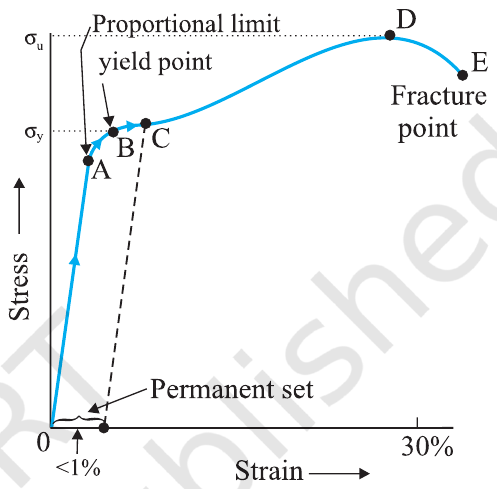

The relation between the stress and the strain for a given material under tensile stress can be found experimentally. In a standard test of tensile properties, a test cylinder or a wire is stretched by an applied force. The fractional change in length (the strain) and the applied force needed to cause the strain are recorded. The applied force is gradually increased in steps and the change in length is noted. A graph is plotted between the stress (which is equal in magnitude to the applied force per unit area) and the strain produced. A typical graph for a metal is shown in Fig. 8.2. Analogous graphs for compression and shear stress may also be obtained. The stress-strain curves vary from material to material. These curves help us to understand how a given material deforms with increasing loads. From the graph, we can see that in the region between O to A, the curve is linear. In this region, Hooke's law is obeyed. The body regains its original dimensions when the applied force is removed. In this region, the solid behaves as an elastic body.
In the region from A to B, stress and strain are not proportional. Nevertheless, the body still returns to its original dimension when the load is removed. The point B in the curve is known as yield point (also known as elastic limit) and the corresponding stress is known as yield strength (σy) of the material. If the load is increased further, the stress developed exceeds the yield strength and strain increases rapidly even for a small change in the stress. The portion of the curve between B and D shows this. When the load is removed, say at some point C between B and D, the body does not regain its original dimension. In this case, even when the stress is zero, the strain is not zero. The material is said to have a permanent set. The deformation is said to be plastic deformation. The point D on the graph is the ultimate tensile strength (σu) of the material. Beyond this point, additional strain is produced even by a reduced applied force and fracture occurs at point E. If the ultimate strength and fracture points D and E are close, the material is said to be brittle. If they are far apart, the material is said to be ductile.
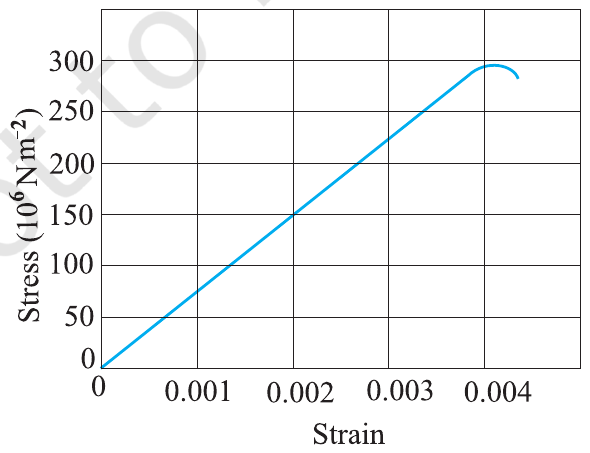
Two exercise figures belong here. Figure 8.9 shows the strain-stress curve for a given material (Exercise 8.2): the stress rises linearly with strain to about 300 x $10^{6}$ N m-2 at a strain of 0.004, and the slope of the linear part gives Young's modulus while the point where the curve bends gives the approximate yield strength. Figure 8.10 shows the stress-strain graphs for materials A and B drawn to the same scale (Exercise 8.3): the material with the steeper initial slope has the greater Young's modulus, and the material with the higher ultimate strength is the stronger material.
Practice1 question
Try it now. A wrong answer costs nothing here, try again until you get it.
On the stress-strain curve of a metal, which point marks the end of the region where the body returns to its original dimensions on removing the load?
NCERT 8.4: point B is the yield point, also known as the elastic limit, and the corresponding stress is the yield strength.
Stress-Strain Curve of Elastomers
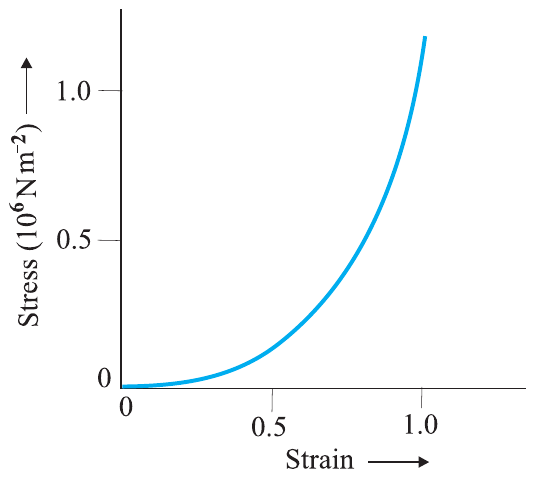
As stated earlier, the stress-strain behaviour varies from material to material. For example, rubber can be pulled to several times its original length and still returns to its original shape. Fig. 8.3 shows stress-strain curve for the elastic tissue of aorta, present in the heart. Note that although elastic region is very large, the material does not obey Hooke's law over most of the region. Secondly, there is no well defined plastic region. Substances like tissue of aorta, rubber etc. which can be stretched to cause large strains are called elastomers.
Young's Modulus
The proportional region within the elastic limit of the stress-strain curve (region OA in Fig. 8.2) is of great importance for structural and manufacturing engineering designs. The ratio of stress and strain, called modulus of elasticity, is found to be a characteristic of the material.
Experimental observation show that for a given material, the magnitude of the strain produced is same whether the stress is tensile or compressive. The ratio of tensile (or compressive) stress (σ) to the longitudinal strain (ε) is defined as Young's modulus and is denoted by the symbol Y. $Y = σ/ε$ (8.7). From Eqs. (8.1) and (8.2), we have $Y = (F/A)/(\Delta L/L) = (F x L)/(A x \Delta L)$ (8.8). Since strain is a dimensionless quantity, the unit of Young's modulus is the same as that of stress i.e., N m-2 or Pascal (Pa). Table 8.1 gives the values of Young's moduli and yield strengths of some material. From the data given in Table 8.1, it is noticed that for metals Young's moduli are large. Therefore, these materials require a large force to produce small change in length. To increase the length of a thin steel wire of 0.1 cm2 cross-sectional area by 0.1%, a force of 2000 N is required. The force required to produce the same strain in aluminium, brass and copper wires having the same cross-sectional area are 690 N, 900 N and 1100 N respectively. It means that steel is more elastic than copper, brass and aluminium. It is for this reason that steel is preferred in heavy-duty machines and in structural designs. Wood, bone, concrete and glass have rather small Young's moduli.
Worked example 8.1: A structural steel rod has a radius of 10 mm and a length of 1.0 m. A 100 kN force stretches it along its length. Calculate (a) stress, (b) elongation, and (c) strain on the rod. Young's modulus of structural steel is 2.0 x $10^{11}$ N m-2. Answer: $Stress = F/A = F/(π r^2) = (100 x 10^{3} N)/(3.14 x (10^{-2} m)^2)$ = 3.18 x $10^{8}$ N m-2. The elongation $\Delta L = ((F/A) x L)/Y = ((3.18 x 10^{8} N m-2) x (1 m))/(2 x 10^{11} N m-2) = 1.59 x 10^{-3} m = 1.59 mm$. The $strain = \Delta L/L = (1.59 x 10^{-3} m)/(1 m) = 1.59 x 10^{-3} = 0.16%$.
Worked example 8.2: A copper wire of length 2.2 m and a steel wire of length 1.6 m, both of diameter 3.0 mm, are connected end to end. When stretched by a load, the net elongation is found to be 0.70 mm. Obtain the load applied. Answer: The copper and steel wires are under a tensile stress because they have the same tension (equal to the load W) and the same area of cross-section A. From Eq. (8.7) we have stress = strain x Young's modulus. Therefore W/A = $Yc x (\Delta L_{c}/Lc) = Ys x (\Delta L_{s}/Ls)$, where the subscripts c and s refer to copper and stainless steel respectively. Or, $\Delta L_{c}$/$\Delta L_{s}$ = (Ys/Yc) x (Lc/Ls). Given $Lc = 2.2 m$, $Ls = 1.6 m$. From Table 9.1 (as printed in NCERT) Yc = 1.1 x $10^{11}$ N m-2, and $Ys = 2.0 \times 10^{11} N m-2$. $\Delta L_{c}$/$\Delta L_{s}$ = (2.0 x $10^{11}$/1.1 x $10^{11}$) x (2.2/1.6) = 2.5. The total elongation is given to be $\Delta L_{c}$ + $\Delta L_{s}$ = 7.0 x $10^{-4}$ m. Solving the above equations, $\Delta L_{c} = 5.0 \times 10^{-4} m$, and $\Delta L_{s} = 2.0 \times 10^{-4} m$. Therefore $W = (A x Yc x \Delta L_{c})/Lc$ = π (1.5 x $10^{-3})^2$ x [(5.0 x $10^{-4}$ x 1.1 x $10^{11}$)/2.2] = 1.8 x $10^{2}$ N.
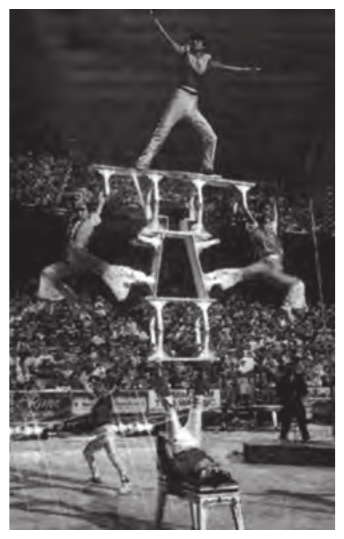
Worked example 8.3: In a human pyramid in a circus, the entire weight of the balanced group is supported by the legs of a performer who is lying on his back (as shown in Fig. 8.4). The combined mass of all the persons performing the act, and the tables, plaques etc. involved is 280 kg. The mass of the performer lying on his back at the bottom of the pyramid is 60 kg. Each thighbone (femur) of this performer has a length of 50 cm and an effective radius of 2.0 cm. Determine the amount by which each thighbone gets compressed under the extra load. Answer: Total mass of all the performers, tables, plaques etc. = 280 kg. Mass of the $performer = 60 kg$. Mass supported by the legs of the performer at the bottom of the $pyramid = 280 - 60 = 220 kg$. Weight of this supported mass = 220 kg wt. = 220 $x 9.8 N = 2156 N$. Weight supported by each thighbone of the $performer = 1/2 (2156) N = 1078 N$. From Table 9.1 (as printed in NCERT), the Young's modulus for bone is given by $Y = 9.4 \times 10^9 N m-2$. Length of each thighbone $L = 0.5 m$, the radius of thighbone = 2.0 cm. Thus the cross-sectional area of the thighbone $A = π x (2 x 10^{-2})^2 m^2 = 1.26 x 10^{-3} m^2$. Using Eq. (9.8) (as printed in NCERT), the compression in each thighbone ($\Delta L$) can be computed as $\Delta L = [(F x L)/(Y x A)] = [(1078 \times 0.5)/(9.4 x 10^{9} x 1.26 x 10^{-3})]$ = 4.55 x $10^{-5}$ m or 4.55 x $10^{-3}$ cm. This is a very small change! The fractional decrease in the thighbone is $\Delta L/L = 0.000091$ or 0.0091%.
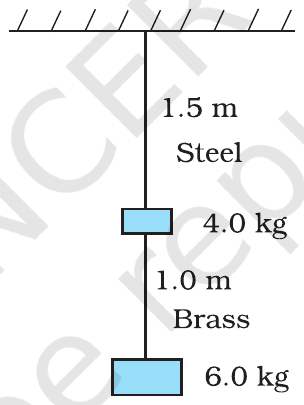
Figure 8.11 also belongs here: two wires of diameter 0.25 cm, one made of steel and the other made of brass, are loaded as shown in Fig. 8.11 (Exercise 8.5). The unloaded length of steel wire is 1.5 m and that of brass wire is 1.0 m, with a 4.0 kg load between them and a 6.0 kg load at the bottom.
Practice1 question
Try it now. A wrong answer costs nothing here, try again until you get it.
A steel wire of cross-sectional area 0.1 cm2 and length 1 m is stretched by 0.1% of its length by a force of 2000 N. What is the Young's modulus of steel?
NCERT 8.5.1: $Y = (F/A)/(\Delta L/L) = (2000/(1 x 10^{-5}))/(1 x 10^{-3})$ = (2 x $10^{8}$)/(1 x $10^{-3}$) = 2 x $10^{11}$ N m-2.
Table: Young's Moduli and Yield Strengths
| Substance | Density ρ (kg m-3) | Young's modulus Y ($10^{9}$ N m-2) | Ultimate strength σu ($10^{6}$ N m-2) | Yield strength σy ($10^{6}$ N m-2) |
|---|---|---|---|---|
| Aluminium | 2710 | 70 | 110 | 95 |
| Copper | 8890 | 110 | 400 | 200 |
| Iron (wrought) | 7800-7900 | 190 | 330 | 170 |
| Steel | 7860 | 200 | 400 | 250 |
| Glass# | 2190 | 65 | 50 | - |
| Concrete | 2320 | 30 | 40 | - |
| Wood# | 525 | 13 | 50 | - |
| Bone# | 1900 | 9.4 | 170 | - |
| Polystyrene | 1050 | 3 | 48 | - |
# Substance tested under compression. Source: NCERT XI, Ch 8, Table 8.1.
Shear Modulus
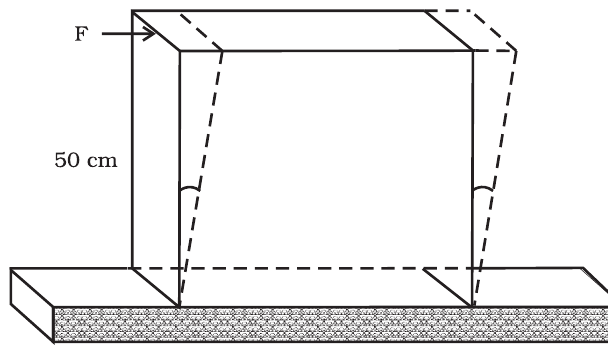
The ratio of shearing stress to the corresponding shearing strain is called the shear modulus of the material and is represented by G. It is also called the modulus of rigidity. $G = shearing stress (σ_s)/shearing strain = (F/A)/(\Delta x/L) = (F x L)/(A x \Delta x)$ (8.10). Similarly, from Eq. (9.4) (as printed in $NCERT), G = (F/A)/θ = F/(A x θ$) (8.11). The shearing stress σs can also be expressed as $σ_s = G x θ$ (8.12). SI unit of shear modulus is N m-2 or Pa. The shear moduli of a few common materials are given in Table 9.2 (as printed in NCERT). It can be seen that shear modulus (or modulus of rigidity) is generally less than Young's modulus (from Table 9.1, as printed in NCERT). For most materials G is about Y/3.
Worked example 8.4: A square lead slab of side 50 cm and thickness 10 cm is subject to a shearing force (on its narrow face) of 9.0 x $10^{4}$ N. The lower edge is riveted to the floor. How much will the upper edge be displaced? Answer: The lead slab is fixed and the force is applied parallel to the narrow face as shown in Fig. 8.6 (as printed in NCERT; the figure itself is labelled Fig. 8.5). The area of the face parallel to which this force is applied is $A = 50 cm x 10 cm = 0.5 m x 0.1 m = 0.05 m^2$. Therefore, the stress applied is = (9.4 x $10^{4}$ N/0.05 $m_2$) = 1.80 x $10^{6}$ N m-2, as printed in NCERT (the problem states 9.0 x $10^{4}$ N). We know that shearing $strain = (\Delta x/L) = Stress/G$. Therefore the displacement $\Delta x = (Stress x L)/G = (1.8 x 10^{6} N m-2 x 0.5 m)/(5.6 x 10^{9} N m-2) = 1.6 x 10^{-4} m = 0.16 mm$.
Table: Shear Moduli
| Material | G ($10^{9}$ N m-2 or GPa) |
|---|---|
| Aluminium | 25 |
| Brass | 36 |
| Copper | 42 |
| Glass | 23 |
| Iron | 70 |
| Lead | 5.6 |
| Nickel | 77 |
| Steel | 84 |
| Tungsten | 150 |
| Wood | 10 |
Source: NCERT XI, Ch 8, Table 8.2.
Bulk Modulus and Compressibility
In Section (8.3) (as printed in NCERT), we have seen that when a body is submerged in a fluid, it undergoes a hydraulic stress (equal in magnitude to the hydraulic pressure). This leads to the decrease in the volume of the body thus producing a strain called volume strain [Eq. (8.5)]. The ratio of hydraulic stress to the corresponding hydraulic strain is called bulk modulus. It is denoted by symbol B. $B = -p/(\Delta V/V)$ (8.12). The negative sign indicates the fact that with an increase in pressure, a decrease in volume occurs. That is, if p is positive, $\Delta V$ is negative. Thus for a system in equilibrium, the value of bulk modulus B is always positive. SI unit of bulk modulus is the same as that of pressure i.e., N m-2 or Pa. The bulk moduli of a few common materials are given in Table 8.3.
The reciprocal of the bulk modulus is called compressibility and is denoted by k. It is defined as the fractional change in volume per unit increase in pressure. $k = (1/B) = -(1/\Delta p) x (\Delta V/V)$ (8.13). It can be seen from the data given in Table 8.3 that the bulk moduli for solids are much larger than for liquids, which are again much larger than the bulk modulus for gases (air). Thus, solids are the least compressible, whereas, gases are the most compressible. Gases are about a million times more compressible than solids! Gases have large compressibilities, which vary with pressure and temperature. The incompressibility of the solids is primarily due to the tight coupling between the neighbouring atoms. The molecules in liquids are also bound with their neighbours but not as strong as in solids. Molecules in gases are very poorly coupled to their neighbours. Table 8.4 shows the various types of stress, strain, elastic moduli, and the applicable state of matter at a glance.
Worked example 8.5: The average depth of Indian Ocean is about 3000 m. Calculate the fractional compression, $\Delta V$/V, of water at the bottom of the ocean, given that the bulk modulus of water is 2.2 x $10^{9}$ N m-2. (Take $g = 10 m s-2$). Answer: The pressure exerted by a 3000 m column of water on the bottom layer $p = hρg = 3000 m x 1000 kg m-3 x 10 m s-2 = 3 x 10^{7} kg m-1 s-2 = 3 x 10^{7} N m-2$. Fractional compression $\Delta V$/V is $\Delta V/V = stress/B = (3 x 10^{7} N m-2)/(2.2 x 10^{9} N m-2)$ = 1.36 x $10^{-2}$ or 1.36%.
Practice1 question
Try it now. A wrong answer costs nothing here, try again until you get it.
The pressure at the bottom of the Indian Ocean (3000 m deep) is 3 x $10^{7}$ N m-2. If the bulk modulus of water is 2.2 x $10^{9}$ N m-2, what is the fractional compression of water there?
NCERT 8.5.3, Example 8.5: $\Delta V/V = stress/B = (3 x 10^{7})/(2.2 x 10^{9})$ = 1.36 x $10^{-2}$, or 1.36%.
Table: Bulk Moduli
| Material | B ($10^{9}$ N m-2 or GPa) |
|---|---|
| Solids | |
| Aluminium | 72 |
| Brass | 61 |
| Copper | 140 |
| Glass | 37 |
| Iron | 100 |
| Nickel | 260 |
| Steel | 160 |
| Liquids | |
| Water | 2.2 |
| Ethanol | 0.9 |
| Carbon disulphide | 1.56 |
| Glycerine | 4.76 |
| Mercury | 25 |
| Gases | |
| Air (at STP) | 1.0 x $10^{-4}$ |
Source: NCERT XI, Ch 8, Table 8.3.
Table: Stress, Strain and Elastic Moduli
| Type of stress | Stress | Strain | Change in shape | Change in volume | Elastic modulus | Name of modulus | State of matter |
|---|---|---|---|---|---|---|---|
| Tensile or compressive $(σ = F/A)$ | Two equal and opposite forces perpendicular to opposite faces | Elongation or compression parallel to force direction ($\Delta L$/L) (longitudinal strain) | Yes | No | $Y = (F x L)/(A x \Delta L)$ | Young's modulus | Solid |
| Shearing (σs = F/A) | Two equal and opposite forces parallel to oppoiste surfaces forces in each case such that total force and total torque on the body vanishes | Pure shear, θ | Yes | No | $G = F/(A x θ)$ | Shear modulus or modulus of rigidity | Solid |
| Hydraulic | Forces perpendicular everywhere to the surface, force per unit area (pressure) same everywhere. | Volume change (compression or elongation) ($\Delta V$/V) | No | Yes | $B = -p/(\Delta V/V)$ | Bulk modulus | Solid, liquid and gas |
Note: NCERT prints "oppoiste" in the shearing row; the spelling above keeps the printed word. Source: NCERT XI, Ch 8, Table 8.4.
Poisson's Ratio
The strain perpendicular to the applied force is called lateral strain. Simon Poisson pointed out that within the elastic limit, lateral strain is directly proportional to the longitudinal strain. The ratio of the lateral strain to the longitudinal strain in a stretched wire is called Poisson's ratio. If the original diameter of the wire is d and the contraction of the diameter under stress is $\Delta d$, the lateral strain is $\Delta d$/d. If the original length of the wire is L and the elongation under stress is $\Delta L$, the longitudinal strain is $\Delta L$/L. Poisson's ratio is then ($\Delta d$/d)/($\Delta L$/L) or ($\Delta d$/$\Delta L$) x (L/d). Poisson's ratio is a ratio of two strains; it is a pure number and has no dimensions or units. Its value depends only on the nature of material. For steels the value is between 0.28 and 0.30, and for aluminium alloys it is about 0.33.
Elastic Potential Energy in a Stretched Wire
When a wire is put under a tensile stress, work is done against the inter-atomic forces. This work is stored in the wire in the form of elastic potential energy. When a wire of original length L and area of cross-section A is subjected to a deforming force F along the length of the wire, let the length of the wire be elongated by l. Then from Eq. (8.8), we have F = YA x (l/L). Here Y is the Young's modulus of the material of the wire. Now for a further elongation of infinitesimal small length dl, work done dW is F x dl or YAl dl/L. Therefore, the amount of work done (W) in increasing the length of the wire from L to L + l, that is from $l = 0$ to $l = l$ is $W = (YA/2) x (l^2/L) = (1/2) x Y x (l/L)² x AL = (1/2) x Young's modulus x \mathrm{strain}^2 x$ volume of the $wire = (1/2) x stress x strain x$ volume of the wire. This work is stored in the wire in the form of elastic potential energy (U). Therefore the elastic potential energy per unit volume of the wire (u) is $u = (1/2) x σ x ε$ (8.14).
Practice1 question
Try it now. A wrong answer costs nothing here, try again until you get it.
A wire is under a tensile stress of 2 x $10^{8}$ N m-2 with a strain of 1 x $10^{-3}$. What is the elastic potential energy stored per unit volume?
NCERT 8.5.5: $u = (1/2) x σ x ε = (1/2) x (2 x 10^{8}) x (1 x 10^{-3})$ = 1 x $10^{5}$ J m-3.
Applications of Elastic Behaviour


The elastic behaviour of materials plays an important role in everyday life. All engineering designs require precise knowledge of the elastic behaviour of materials. For example while designing a building, the structural design of the columns, beams and supports require knowledge of strength of materials used. Have you ever thought why the beams used in construction of bridges, as supports etc. have a cross-section of the type I? Why does a heap of sand or a hill have a pyramidal shape? Answers to these questions can be obtained from the study of structural engineering which is based on concepts developed here.
Cranes used for lifting and moving heavy loads from one place to another have a thick metal rope to which the load is attached. The rope is pulled up using pulleys and motors. Suppose we want to make a crane, which has a lifting capacity of 10 tonnes or metric tons $(1 metric ton = 1000 kg)$. How thick should the steel rope be? We obviously want that the load does not deform the rope permanently. Therefore, the extension should not exceed the elastic limit. From Table 8.1, we find that mild steel has a yield strength (σy) of about 300 x $10^{6}$ N m-2. Thus, the area of cross-section (A) of the rope should at least be $A ≥ W/σy = Mg/σy (8.15) = (10^{4} kg x 9.8 m s-2)/(300 x 10^{6} N m-2)$ = 3.3 x $10^{-4}$ $m_2$, corresponding to a radius of about 1 cm for a rope of circular cross-section. Generally a large margin of safety (of about a factor of ten in the load) is provided. Thus a thicker rope of radius about 3 cm is recommended. A single wire of this radius would practically be a rigid rod. So the ropes are always made of a number of thin wires braided together, like in pigtails, for ease in manufacture, flexibility and strength.
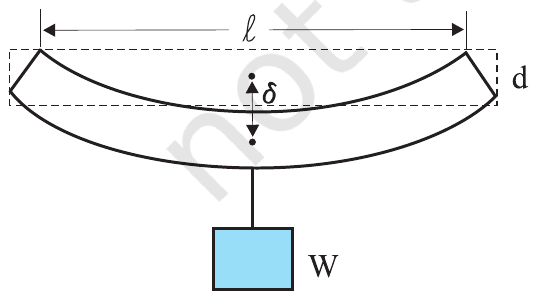
A bridge has to be designed such that it can withstand the load of the flowing traffic, the force of winds and its own weight. Similarly, in the design of buildings the use of beams and columns is very common. In both the cases, the overcoming of the problem of bending of beam under a load is of prime importance. The beam should not bend too much or break. Let us consider the case of a beam loaded at the centre and supported near its ends as shown in Fig. 8.6. A bar of length l, breadth b, and depth d when loaded at the centre by a load W sags by an amount given by $δ = W l^3/(4 b d^3 Y)$ (8.16). This relation can be derived using what you have already learnt and a little calculus. From Eq. (8.16), we see that to reduce the bending for a given load, one should use a material with a large Young's modulus Y. For a given material, increasing the depth d rather than the breadth b is more effective in reducing the bending, since δ is proportional to $d^{-3}$ and only to $b^{-1}$ (of course the length l of the span should be as small as possible). But on increasing the depth, unless the load is exactly at the right place (difficult to arrange in a bridge with moving traffic), the deep bar may bend as shown in Fig. 8.7(b). This is called buckling. To avoid this, a common compromise is the cross-sectional shape shown in Fig. 8.7(c). This section provides a large load-bearing surface and enough depth to prevent bending. This shape reduces the weight of the beam without sacrificing the strength and hence reduces the cost.
The use of pillars or columns is also very common in buildings and bridges. A pillar with rounded ends as shown in Fig. 8.9(a) (as printed in NCERT; the figure itself is labelled Fig. 8.8) supports less load than that with a distributed shape at the ends [Fig. 8.9(b), as printed in NCERT; the figure itself is labelled Fig. 8.8]. The precise design of a bridge or a building has to take into account the conditions under which it will function, the cost and long period, reliability of usable material, etc.
The answer to the question why the maximum height of a mountain on earth is about 10 km can also be provided by considering the elastic properties of rocks. A mountain base is not under uniform compression and this provides some shearing stress to the rocks under which they can flow. The stress due to all the material on the top should be less than the critical shearing stress at which the rocks flow. At the bottom of a mountain of height h, the force per unit area due to the weight of the mountain is hρg where ρ is the density of the material of the mountain and g is the acceleration due to gravity. The material at the bottom experiences this force in the vertical direction, and the sides of the mountain are free. Therefore, this is not a case of pressure or bulk compression. There is a shear component, approximately hρg itself. Now the elastic limit for a typical rock is 30 x $10^{7}$ N m-2. Equating this to hρg, with $ρ = 3 \times 10^3 kg m-3$ gives $hρg = 30 \times 10^7 N m-2$, $h = 30 \times 10^7 N m-2/(3 \times 10^3 kg m-3 x 10 m s-2)$ = 10 km, which is more than the height of Mt. Everest!
Trap Pairs
- A material that stretches more is more elastic. Wrong: a material which stretches to a lesser extent for a given load is considered to be more elastic. Steel is more elastic than copper, brass and aluminium. NCERT 8.5.1 and Points to ponder 6.
- Stress is a vector like force. Wrong: stress is not a vector quantity since, unlike a force, the stress cannot be assigned a specific direction. NCERT Points to ponder 8.
- Hooke's law holds for every deformation. Wrong: Hooke's law is valid only in the linear part of stress-strain curve, and elastomers like rubber and aorta tissue do not obey it over most of their range. NCERT 8.3, 8.4 and Points to ponder 2.
- Yield point, ultimate strength and fracture are the same point. Wrong: B is the yield point, D is the ultimate tensile strength and E is fracture. If D and E are close the material is brittle; if far apart it is ductile. NCERT 8.4.
- The tension at any cross-section of a hanging wire is twice the weight. Wrong: the force exerted by the ceiling is equal and opposite to the weight, but the tension at any cross-section A of the wire is just F and not 2F, so the tensile stress is F/A. NCERT Points to ponder 1.
- Shear modulus applies only to liquids. Wrong: the Young's modulus and shear modulus are relevant only for solids since only solids have lengths and shapes, while bulk modulus is relevant for solids, liquid and gases. NCERT Points to ponder 3 and 4.
Points to Ponder
- In the case of a wire, suspended from celing and stretched under the action of a weight (F) suspended from its other end, the force exerted by the ceiling on it is equal and opposite to the weight. However, the tension at any cross-section A of the wire is just F and not 2F. Hence, tensile stress which is equal to the tension per unit area is equal to F/A.
- Hooke's law is valid only in the linear part of stress-strain curve.
- The Young's modulus and shear modulus are relevant only for solids since only solids have lengths and shapes.
- Bulk modulus is relevant for solids, liquid and gases. It refers to the change in volume when every part of the body is under the uniform stress so that the shape of the body remains unchanged.
- Metals have larger values of Young's modulus than alloys and elastomers. A material with large value of Young's modulus requires a large force to produce small changes in its length.
- In daily life, we feel that a material which stretches more is more elastic, but it a is misnomer. In fact material which stretches to a lesser extent for a given load is considered to be more elastic.
- In general, a deforming force in one direction can produce strains in other directions also. The proportionality between stress and strain in such situations cannot be described by just one elastic constant. For example, for a wire under longitudinal strain, the lateral dimensions (radius of cross section) will undergo a small change, which is described by another elastic constant of the material (called Poisson ratio).
- Stress is not a vector quantity since, unlike a force, the stress cannot be assigned a specific direction. Force acting on the portion of a body on a specified side of a section has a definite direction.
Note: NCERT prints "celing" and "it a is misnomer" in items 1 and 6; the spellings above keep the printed words. Source: NCERT XI, Ch 8, Points to ponder.
Trap Boxes
A material that stretches more is more elastic?
Wrong idea: Rubber stretches a lot, so rubber is more elastic than steel.
A material which stretches to a lesser extent for a given load is more elastic. Steel needs 2000 N for a 0.1% strain while copper needs only 1100 N, so steel is more elastic than copper.
NCERT XI, Ch 8, 8.5.1 and Points to ponder 6
Stress is a vector like force?
Wrong idea: Stress has a magnitude and acts in a direction, so it is a vector.
Stress is not a vector quantity since, unlike a force, the stress cannot be assigned a specific direction. Force acting on a portion of a body on a specified side of a section has a definite direction.
NCERT XI, Ch 8, Points to ponder 8
Hooke's law holds for every deformation?
Wrong idea: Stress is always proportional to strain, for every material and every load.
Hooke's law is valid only in the linear part of the stress-strain curve (region OA). Elastomers like rubber and aorta tissue do not obey it over most of their range, and there is no well defined plastic region.
NCERT XI, Ch 8, 8.3, 8.4 and Points to ponder 2
Yield point, ultimate strength and fracture are the same point?
Wrong idea: A metal breaks as soon as it passes its yield point.
B is the yield point (elastic limit), D is the ultimate tensile strength and E is the fracture point. If D and E are close the material is brittle; if they are far apart the material is ductile.
NCERT XI, Ch 8, 8.4
The tension in a hanging wire is twice the weight?
Wrong idea: A wire holding a weight W has tension 2W at every cross-section, so the stress is 2W/A.
The tension at any cross-section A of the wire is just F and not 2F, so the tensile stress is F/A. The ceiling pulls up with F and the weight pulls down with F, but the tension inside the wire is F.
NCERT XI, Ch 8, Points to ponder 1
Chapter test
5 NEET PYQs. +4 for a correct answer, -1 for a wrong answer, exactly like NEET. Finish the test to earn a medal.
Q1: NEET (UG) 2024, Code R3, Q21
The maximum elongation of a steel wire of 1 m length if the elastic limit of steel and its Young's modulus, respectively, are 8 x $10^{8}$ N/$m_2$ and 2 x $10^{11}$ N/$m_2$ , is:
Maximum $strain = elastic limit/Y = (8 x 10^{8})/(2 x 10^{11})$ = 4 x $10^{-3}$, so the maximum elongation of a 1 m wire is 4 $x 10^{-3} m = 4 mm$.
Q2: NEET (UG) 2023, Code F1, Q31
Let a wire be suspended from the ceiling (rigid support) and stretched by a weight W attached at its free end. The longitudinal stress at any point of cross-sectional area A of the wire is
The tension at any cross-section of the wire is just W, not 2W, so the longitudinal stress is W/A.
Q3: NEET (UG) 2022, Code R1, Q48
Given below are two statements : One is labelled as Assertion (A) and the other is labelled as Reason (R). Assertion (A): The stretching of a spring is determined by the shear modulus of the material of the spring. Reason (R): A coil spring of copper has more tensile strength than a steel spring of same dimensions. In the light of the above statements, choose the most appropriate answer from the options given below
Assertion is true: the stretching of a coil spring is governed by the shear modulus, since the wire twists. Reason is false: steel has greater tensile strength than copper, not less.
Q4: NEET (UG) 2020, Code G5, Q137
A wire of length L, area of cross section A is hanging from a fixed support. The length of the wire changes to L1 when mass M is suspended from its free end. The expression for Young's modulus is :
$Stress = Mg/A$ and $strain = (L_1 - L)/L$, so $Y = stress/strain = MgL/(A(L_1 - L))$.
Q5: NEET (UG) 2019, Code Q2, Q168
When a block of mass M is suspended by a long wire of length L, the length of the wire becomes (L + l). The elastic potential energy stored in the extended wire is :
$U = (1/2) x stress x strain x$ volume = (1/2) x (Mg/A) x (l/L) x (AL) = (1/2)Mgl.
Score: 0 · Answered 0 of 5
Flashcards
Tap a card to flip it over and see the answer. Tap it again to flip it back.
What is stress, what is its unit and dimensional formula, and is it a vector?
Tap to flip$Stress = restoring$ force per unit area = F/A. SI unit N m-2 or pascal (Pa). Dimensional formula $[M L^{-1} T^{-2}]$. Stress is not a vector quantity since it cannot be assigned a specific direction.
Tap to flip backGive the three kinds of strain and their formulae. Does strain have units?
Tap to flip$Longitudinal strain = \Delta L/L$. $Shearing strain = \Delta x/L = \tan θ$, and for small θ, tan θ is nearly equal to θ. Volume $strain = \Delta V/V$. Strain is a ratio of change in dimension to the original dimension, so it has no units or dimensional formula.
Tap to flip backState Hooke's law and say where it is valid.
Tap to flipFor small deformations the stress and strain are proportional to each other. $stress = k x strain$ (8.6), where k is the proportionality constant and is known as modulus of elasticity. Hooke's law is an empirical law, valid only in the linear part of the stress-strain curve.
Tap to flip backDefine Young's modulus Y and give its formula in terms of F, A, L and $\Delta L$.
Tap to flip$Y = σ/ε$ (8.7), where σ is the tensile (or compressive) stress and ε is the longitudinal strain. $Y = (F/A)/(\Delta L/L) = (F x L)/(A x \Delta L)$ (8.8). Unit N m-2 or Pa, the same as stress, since strain is dimensionless.
Tap to flip backWhich is more elastic, steel or copper, and what forces produce a 0.1% strain in steel, copper, brass and aluminium wires of 0.1 cm2 area?
Tap to flipSteel is more elastic than copper, brass and aluminium. To stretch a thin wire of 0.1 cm2 cross-sectional area by 0.1%, the forces needed are: steel 2000 N, copper 1100 N, brass 900 N, aluminium 690 N. A material which stretches to a lesser extent for a given load is more elastic.
Tap to flip backDefine the shear modulus G and give its formulae. How does G compare with Y?
Tap to flip$G = shearing stress (σ_s)/shearing strain = (F/A)/(\Delta x/L) = (F x L)/(A x \Delta x)$ (8.10). Also $G = F/(A x θ)$ (8.11) and $σ_s = G x θ$ (8.12). SI unit N m-2 or Pa. For most materials G is about Y/3, and the shear modulus is generally less than Young's modulus.
Tap to flip backDefine the bulk modulus B and the compressibility k. Why does B carry a negative sign?
Tap to flip$B = -p/(\Delta V/V)$ (8.12), where p is the hydraulic pressure. The negative sign means that with an increase in pressure, a decrease in volume occurs, so B is always positive for a system in equilibrium. $Compressibility k = (1/B) = -(1/\Delta p) x (\Delta V/V)$ (8.13).
Tap to flip backWhat is Poisson's ratio, what are its units, and what are its values for steels and aluminium alloys?
Tap to flipPoisson's ratio is the ratio of the lateral strain to the longitudinal strain in a stretched wire: ($\Delta d$/d)/($\Delta L$/L) or ($\Delta d$/$\Delta L$) x (L/d). It is a pure number with no dimensions or units. For steels the value is between 0.28 and 0.30, and for aluminium alloys it is about 0.33.
Tap to flip backGive the elastic potential energy stored per unit volume of a stretched wire.
Tap to flipElastic potential energy per unit volume $u = (1/2) x σ x ε (8.14) = (1/2) x Young's modulus x \mathrm{strain}^2$ = (1/2) x stress x strain. The work done in stretching a wire is $W = (1/2) x Y x (l/L)² x AL$.
Tap to flip backName the points O, A, B, C, D and E on the stress-strain curve of a metal and say when a material is brittle or ductile.
Tap to flipO to A: linear, Hooke's law obeyed, elastic body. B: yield point (also known as elastic limit), stress is the yield strength (σy). B to D: plastic deformation, permanent set on unloading at C. D: ultimate tensile strength (σu). E: fracture. D and E close means brittle; far apart means ductile.
Tap to flip backWhat are elastomers, and how does their stress-strain curve differ from a metal's?
Tap to flipSubstances like tissue of aorta and rubber which can be stretched to cause large strains are called elastomers. Their elastic region is very large, but they do not obey Hooke's law over most of the region, and there is no well defined plastic region.
Tap to flip backHow much does a loaded beam sag, why is the I-section used, and how does elasticity limit the height of a mountain?
Tap to flipA bar of length l, breadth b and depth d loaded at the centre by a load W sags by $δ = W l^3/(4 b d^3 Y)$ (8.16). Increasing depth d is more effective than breadth b, since δ is proportional to $d^{-3}$ and only to $b^{-1}$. A deep bar can buckle, so the I-section is the common compromise. A mountain of height h has hρg at its base; equating 30 x $10^{7}$ N m-2 to hρg with $ρ = 3 \times 10^3 kg m-3$ gives $h = 10 km$.
Tap to flip backFrequently asked questions
A material that stretches more is more elastic?
A material which stretches to a lesser extent for a given load is more elastic. Steel needs 2000 N for a 0.1% strain while copper needs only 1100 N, so steel is more elastic than copper.
Stress is a vector like force?
Stress is not a vector quantity since, unlike a force, the stress cannot be assigned a specific direction. Force acting on a portion of a body on a specified side of a section has a definite direction.
Hooke's law holds for every deformation?
Hooke's law is valid only in the linear part of the stress-strain curve (region OA). Elastomers like rubber and aorta tissue do not obey it over most of their range, and there is no well defined plastic region.
Yield point, ultimate strength and fracture are the same point?
B is the yield point (elastic limit), D is the ultimate tensile strength and E is the fracture point. If D and E are close the material is brittle; if they are far apart the material is ductile.
The tension in a hanging wire is twice the weight?
The tension at any cross-section A of the wire is just F and not 2F, so the tensile stress is F/A. The ceiling pulls up with F and the weight pulls down with F, but the tension inside the wire is F.