 NEET Notes
Gravitation
Every body attracts every other body with a force whose magnitude is F = G ($m_1$ $m_2$)/($r^2$), where $m_1$ and $m_2$ are the masses of the two bodies, r is the distance between them and G is the universal gravitational constant.
On this page · 18 sections
- 01Syllabus Map
- 02Introduction
- 03Kepler's Laws
- 04Table: Kepler's Third Law
- 05Universal Law of Gravitation
- 06The Gravitational Constant
- 07Acceleration Due to Gravity of the Earth
- 08Acceleration Below and Above the Surface
- 09Table: g Variation
- 10Gravitational Potential Energy
- 11Escape Speed
- 12Earth Satellites
- 13Table: Satellite Formulae
- 14Energy of an Orbiting Satellite
- 15Table: Gravitational Quantities
- 16Gravitational Potential and Intensity
- 17Trap Pairs
- 18Points to Ponder
Kepler's laws, universal gravitation, the Cavendish value of G, g and its variation with height and depth, potential energy and potential, escape speed, satellites and their energy, from NCERT Ch 7, with 5 NEET PYQs.
Syllabus Map
- NMC Unit: PHYS-U06, Gravitation. NCERT Chapter 7, Gravitation (Class XI, rationalised book, keph107.pdf, Reprint 2026-27). Note on numbering: keph107.pdf is Chapter 7 in the current rationalised NCERT book, with sections 7.1 to 7.10, two tables and Figures 7.1 to 7.11. All section and figure references in this chapter use the current book numbering so they can be traced to the PDF.
- Subtopics in this chapter (NCERT XI, Ch 7): introduction (7.1); Kepler's laws (7.2); universal law of gravitation (7.3); the gravitational constant (7.4); acceleration due to gravity of the earth (7.5); acceleration due to gravity below and above the surface of earth (7.6); gravitational potential energy (7.7); escape speed (7.8); earth satellites (7.9); energy of an orbiting satellite (7.10).
- Subtopic checklist: (1) Ptolemy and Copernicus, Tycho Brahe and Kepler; (2) law of orbits, law of areas and law of periods; (3) Table 7.1 and the constant $T^2$/$a^3$; (4) Newton's law of gravitation, the moon test and the inverse square law; (5) superposition of forces and the shell results; (6) the Cavendish experiment and the value of G; (7) $g = GM_E/R_E^2$ and weighing the earth; (8) g at height h and at depth d; (9) gravitational potential energy and potential; (10) escape speed 11.2 km/s; (11) orbital speed, period and the 85 minute low orbit; (12) energy of an orbiting satellite; (13) the summary table of gravitational quantities; (14) points to ponder.
- Extra information (beyond NCERT): none. Every section in this chapter comes from the current NCERT chapter text. NMC Unit 6 is fully covered by the chapter: the universal law, g variation with altitude and depth, Kepler's laws, gravitational potential energy and potential, escape velocity, and satellite motion, orbital velocity, time period and energy. Topics taught with this chapter elsewhere but in neither the rationalised chapter nor NMC Unit 6, such as geostationary and polar satellites by name and the variation of g with latitude and the Earth's rotation, are not covered.
- Estimated revision time: 10 minutes. Jump links: Syllabus Map, Introduction, Kepler's Laws, Table: Kepler's Third Law, Universal Law of Gravitation, The Gravitational Constant, Acceleration Due to Gravity of the Earth, Acceleration Below and Above the Surface, Table: g Variation, Gravitational Potential Energy, Escape Speed, Earth Satellites, Table: Satellite Formulae, Energy of an Orbiting Satellite, Table: Gravitational Quantities, Gravitational Potential and Intensity, Trap Pairs, Points to Ponder
Introduction
Early in our history, humans looked at the sky and wondered about the origin of the earth, sun, moon and stars. Ptolemy (2nd century A.D.) gave the first systematic account: a geocentric model, the earth at the centre of the universe, with the sun, moon, planets and stars moving in circular orbits around it. The Greek philosopher Aristotle had also held a geocentric view. The Indian astronomer Aryabhatta (5th century A.D.) proposed that the earth was spinning on its axis and the planets moved in epicycles around the earth. Nicolaus Copernicus (1473-1543) put forward the heliocentric model, the sun at the centre, the earth and the planets moving in circular orbits around it. In the sixteenth century Tycho Brahe recorded observations of planets and stars with great accuracy. Tycho's observations of Mars formed the basis of Kepler's laws, which were given by Johannes Kepler (1571-1630). Newton's law of gravitation is a much more general law than Kepler's laws, and it accounts for the motion of planets around the sun and the moon around the earth.
Kepler's Laws


1. Law of orbits : All planets move in elliptical orbits with the Sun situated at one of the foci of the ellipse. An ellipse is traced out by a point moving in such a way that the sum of its distances from two fixed points, called the foci, is constant. Fig. 7.1(b) shows how an ellipse is drawn: a string has its ends fixed at F1 and $F_2$, and the tip of a pencil holds the string taut and is moved around. In Fig. 7.1(a), the closest point to the sun is P and the farthest point is A. P is called the perihelion and A the aphelion. The semimajor axis is half the distance AP. For a circle, the two focii merge into one and the semi-major axis becomes the radius of the circle. NCERT prints 'focii'.
2. Law of areas : The line that joins any planet to the sun sweeps out equal areas in equal intervals of time. This law comes from the law of conservation of angular momentum. The angular momentum L of a planet about the sun stays constant along the orbit because the gravitational force acts along the line joining the planet to the sun, so the force produces no torque about the sun. The area swept out in a small time interval $\Delta t$ is $\delta A = (1/2)(r x v \delta t)$, and the rate at which area is swept out is $\delta A/\delta t = L/(2m)$, a constant. So the planet moves faster near perihelion and slower near aphelion.
Example 7.1: for a planet at perihelion (rp, vp) and aphelion (rA, vA), the angular momentum is the same at both points, so $vp/vA = rA/rp$. Since rA is greater than rp, vp is greater than vA. The area SBAC bounded by the ellipse and the radius vectors SB and SC is larger than SBPC in Fig. 7.1, so the planet takes a longer time to traverse BAC than CPB.
3. Law of periods : The square of the time period of revolution of a planet is proportional to the cube of the semi-major axis of the ellipse traced out by the planet. $T^2 = (4π^2/(G Ms)) a^3$, where Ms is the mass of the sun and a is the semi-major axis. The constant of proportionality is the same for all planets.
Table 7.1 gives data from measurement of planetary motions that confirm Kepler's law of periods. Here a is the semi-major axis in units of $10^{10}$ m, T is the time period of revolution of the planet in years (y), and Q is the quotient ($T^2$/$a^3$) in units of $10^{-34}$ $y^2$ m^-3.
| Planet | a ($10^{10}$ m) | T (y) | Q ($10^{-34}$ $y^2$ m^-3) |
|---|---|---|---|
| Mercury | 5.79 | 0.24 | 2.95 |
| Venus | 10.8 | 0.615 | 3.00 |
| Earth | 15.0 | 1 | 2.96 |
| Mars | 22.8 | 1.88 | 2.98 |
| Jupiter | 77.8 | 11.9 | 3.01 |
| Saturn | 143 | 29.5 | 2.98 |
| Uranus | 287 | 84 | 2.98 |
| Neptune | 450 | 165 | 2.99 |
Table: Kepler's Third Law
| Quantity | Formula | Value or note |
|---|---|---|
| Law of periods | $T^2 = (4π^2/(G Ms)) a^3$ | a is the semi-major axis; the same constant for all planets |
| Quotient Q | $Q = T^2/a^3$ | About 3.0 x $10^{-34}$ $y^2$ m^-3; Table 7.1 gives 2.95 to 3.01 |
| Earth orbit | $b/a = 0.99986$ | The Earth's orbit is almost circular |
| Mass of Mars (Ex 7.5) | $Mm = 6.48 \times 10^{23} kg$ | From Phobos: period 7 h 39 min, orbital radius 9.4 x $10^{3}$ km |
| Martian year (Ex 7.5) | $TM = 684 \text{days}$ | The Martian orbit is 1.52 times the Earth's orbit |
Practice1 question
Try it now. A wrong answer costs nothing here, try again until you get it.
From Table 7.1, the quotient $Q = T^2/a^3$ is nearly the same for all planets. Its value is about
NCERT 7.2, Table 7.1: Q is 2.95 to 3.01 x $10^{-34}$ $y^2$ m^-3 for the eight planets.
Universal Law of Gravitation
Legend has it that observing an apple fall from a tree, Newton conjectured that the same force of gravity which was responsible for the fall of an apple was also responsible for the motion of the moon around the earth and the motion of planets around the sun. The moon's centripetal acceleration towards the centre of the earth is $a_m = V^2/R_m = (4π^2 R_m)/(T^2)$, where V is the moon's orbital speed, R_m its distance from the centre of the earth and T its time period. With $T = 27.3 \text{days}$ and $R_m = 3.84 \times 10^8 m$, $a_m = 2.72 \times 10^{-3} m/s^2$. This is much smaller than g, and the ratio $g/a_m = (R_m^2)/(R_E^2)$ is about 3600. So the gravitational force falls off as the inverse square of the distance.
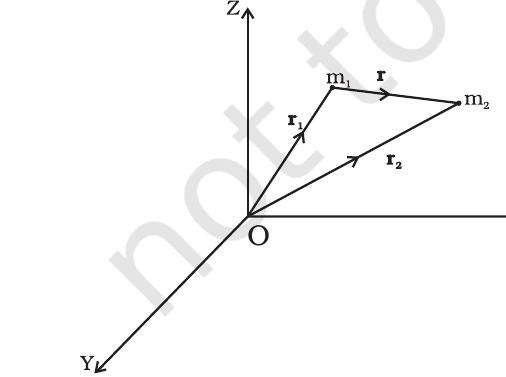
Universal law of gravitation: Every body attracts every other body with a force whose magnitude is F = G ($m_1$ $m_2$)/($r^2$), where $m_1$ and $m_2$ are the masses of the two bodies, r is the distance between them and G is the universal gravitational constant. In vector form, $F = -G (m_1 m_2)/(r^2) r-hat = -G (m_1 m_2)/(|r|^3) r$, where r is the vector from $m_1$ to $m_2$ and r-hat is the unit vector along r. The minus sign shows that the force is attractive. The gravitational force between two bodies is equal in magnitude and opposite in direction for the two bodies: $F12 = -F21$.
The law applies to point masses, and also to bodies that can be treated as point masses. For extended bodies it is still true if the distance between them is large compared with their sizes. The gravitational force is a central force: it acts along the line joining the two bodies.
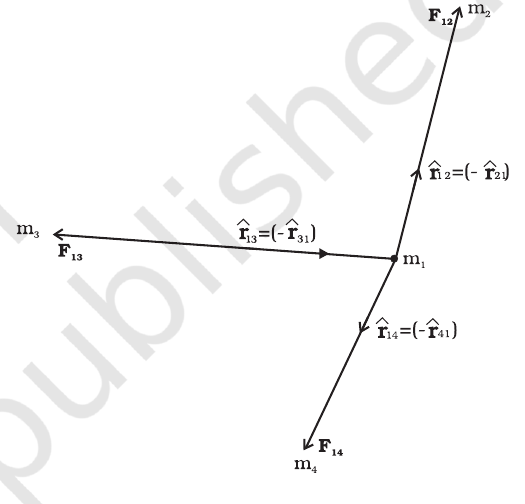
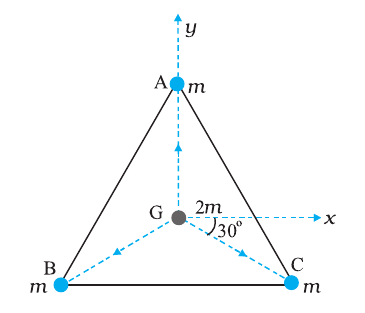
Superposition: the gravitational force on a point mass due to several other masses is the vector sum of the forces due to each mass, taken one at a time. Fig. 7.4 shows the force on $m_1$ as the sum of the forces from $m_2$, m3 and m4. Example 7.2: three equal masses m at the vertices of an equilateral triangle of side 1 m, with a mass 2m at the centroid G (Fig. 7.5). (a) The resultant force on the mass at G is zero, $FR = 0$, by vector addition and by symmetry. (b) If the mass at A is doubled, the resultant force becomes $F'R = 2 G m^2 j-hat$, where j-hat is the unit vector along GA.
Shell results: (1) The force of attraction between a hollow spherical shell of uniform density and a point mass situated outside is just as if the entire mass of the shell is concentrated at the centre of the shell. (2) The force of attraction due to a hollow spherical shell of uniform density, on a point mass situated inside it is zero. The same results hold for a solid sphere of uniform density, because it can be thought of as made of many thin shells.
The Gravitational Constant
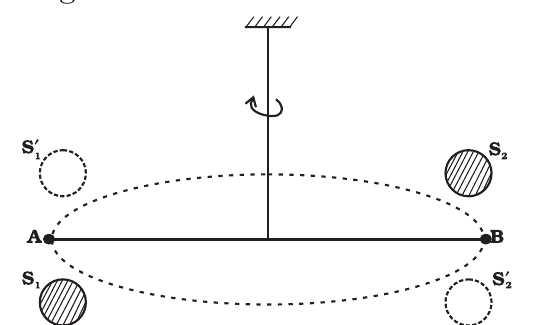
The law of gravitation is a universal law, but the value of G was not known to Newton. G was first measured by Henry Cavendish in 1798, using the apparatus shown in Fig. 7.6. Two large spheres S1 and S2 are kept on either side of the small masses at A and B of a bar AB suspended by a wire. The gravitational attraction between the big spheres and the small masses twists the wire. When the big spheres are taken to the other side of the masses (shown by dotted circles), the bar rotates a little since the torque reverses direction. The angle of rotation is measured, and from it the torque is found. If the length of the bar is L, the force on each mass is F = G (M m)/($d^2$), where M is the mass of a big sphere, m the mass of a small sphere and d the distance between them. The gravitational torque is G (M m)/($d^2$) L, and it equals τθ, where τ is the restoring couple per unit angle of twist and θ is the angle of twist. So G (M m)/($d^2$) L = τθ, and G is found from the measured quantities. The value so obtained is $G = 6.67 \times 10^{-11} N m^2/\mathrm{kg}^2$. Since G is very small, the gravitational force between two ordinary bodies is very small; it becomes significant only when at least one of the bodies has a very large mass, such as the earth, the moon and the sun.
Acceleration Due to Gravity of the Earth
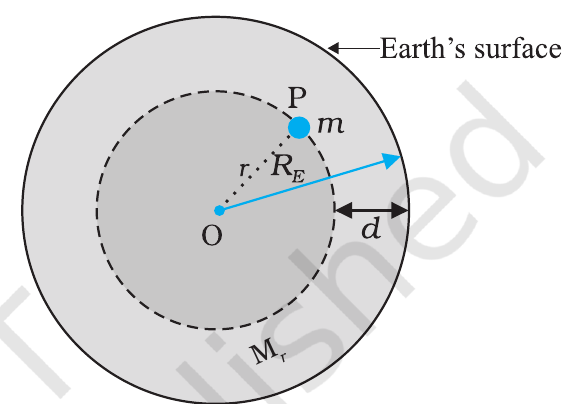
Consider the earth to be a sphere of radius RE and mass ME. A point mass m at a distance r from the centre of the earth feels a force $F = (G m Mr)/(r^2)$, where Mr is the mass of the earth within the sphere of radius r. For a point outside the earth, r is greater than RE, so Mr = ME and $F = (G ME m)/(r^2)$. At the surface, $r = RE$ and F = G (ME m)/($R_E^2$). This force is the weight of the body, so $g = F/m = (G ME)/(R_E^2)$. Since the earth is not a perfect sphere and its density is not uniform, g varies from place to place on the surface, but the value at the surface is about 9.8 m/$s^2$.
For a point inside the earth, at a distance r from the centre, only the mass within the sphere of radius r contributes, so $Mr = (4π/3) r^3 ρ$, where ρ is the mean density of the earth. Then $F = (G m Mr)/(r^2) = (G m ME)/(R_E^3) r$, so the force inside the earth grows in proportion to the distance from the centre.
Weighing the earth: once G is measured, the mass of the earth follows from $g = (G ME)/(R_E^2)$ and the known values of g and RE. This is what is meant by the saying 'Cavendish weighed the earth'. Example 7.6 gives $ME = 5.97 \times 10^{24} kg$ from $g = 9.81 m/s^2$ and $RE = 6.37 \times 10^6 m$, and $ME = 6.02 \times 10^{24} kg$ from the moon's orbit (distance 3.84 x $10^{8}$ m, period 27.3 days). The two values differ by less than 1%.
Acceleration Below and Above the Surface
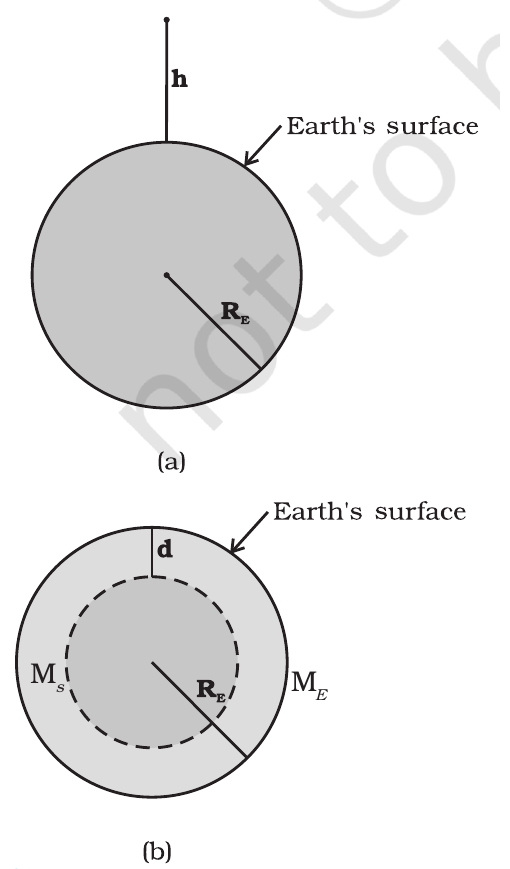
At a height h above the surface: Fig. 7.8(a). The force at a distance (RE + h) from the centre is $F(h) = (G ME m)/((RE + h)²)$, so $g(h) = (G ME)/((RE + h)²) = g (R_E^2)/((RE + h)²)$. For h much smaller than RE, this becomes $g(h) = g(1 - (2h)/(RE))$. So g falls with height, and the fall is fastest near the surface: at $h = RE, g(h) = g/4$.
At a depth d below the surface: Fig. 7.8(b) and Fig. 7.7. Only the smaller sphere of radius (RE - d) contributes to g. Since mass of a sphere is proportional to be cube of its radius $(NCERT wording), Ms/ME = ((RE - d)³)/(R_E^3)$. The force at depth d is $F(d) = (G Ms m)/((RE - d)²) = (G ME m (RE - d))/(R_E^3)$, so $g(d) = g(1 - d/RE)$. So g also falls with depth, linearly, and becomes zero at the centre. The value of g is maximum on the surface of the earth.
Practice1 question
Try it now. A wrong answer costs nothing here, try again until you get it.
A body weighs 80 N on the surface of the earth. What is its weight at a height equal to the radius of the earth?
NCERT 7.6: at $h = RE, g(h) = g (R_E^2)/((RE + RE)²) = g/4$, so the weight is $80/4 = 20 N$.
Table: g Variation
| Case | Formula | Value |
|---|---|---|
| At the surface | $g = (G ME)/(R_E^2)$ | About 9.8 m/$s^2$ |
| At height h | $g(h) = g (R_E^2)/((RE + h)²)$ | At $h = RE, g(h) = g/4$ |
| At height h, h much smaller than RE | $g(h) = g(1 - (2h)/(RE))$ | Falls by about (2h/RE) times g |
| At depth d | $g(d) = g(1 - d/RE)$ | At $d = RE/2, g(d) = g/2$ |
| At the centre | $g(d) = 0$ | From $g(d) = g(1 - d/RE)$ with $d = RE$ |
Gravitational Potential Energy
Near the surface of the earth, the work done by gravity when a body moves from height h1 to height h2 is $W12 = mg(h2 - h1)$. The work done depends only on the initial and final heights, not on the path taken. This is a property of a conservative force. The gravitational potential energy at height h is $W(h) = mgh + Wo$, where Wo is a constant. The work done is the difference W(h2) - W(h1), and the constant Wo drops out.
For larger distances, the force is $F = (G ME m)/(r^2)$, where r is the distance from the centre of the earth. The work done in taking a body from r1 to r2 is $W12 = -G ME m ((1/r2) - (1/r1))$, so the potential energy at distance r is $W(r) = -(G ME m)/r + W1$. The constant W1 is the potential energy at r = infinity, and it is chosen to be zero. So the gravitational potential energy is $W(r) = -(G ME m)/r$, and it is zero at infinity.
Gravitational potential energy of two masses: the gravitational potential energy of two masses $m_1$ and $m_2$ separated by distance by a distance r is given by $V = -(G m_1 m_2)/r$. NCERT prints 'separated by distance by a distance r'. The potential energy of a system of particles is the sum of the potential energies of all pairs of particles, each pair counted once.
Gravitational potential: the gravitational potential at a point is the potential energy of a particle of unit mass at that point, $U(r) = -(G M)/r$ for a mass M. It is a scalar, with unit J kg^-1.
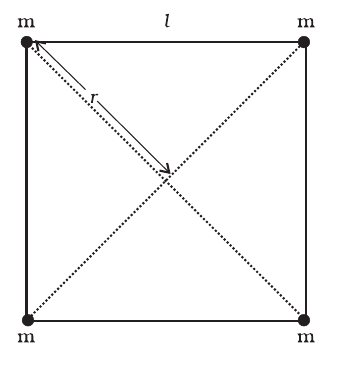
Example 7.3: four masses m at the corners of a square of side l (Fig. 7.9). The work done in assembling the square by bringing the masses one by one from infinity is $W = -5.41 (G m^2)/l$. The potential at the centre of the square is $U(r) = -4 sqrt(2) (G m)/l$, where $r = sqrt(2) l/2$ is the distance from a corner to the centre.
Practice1 question
Try it now. A wrong answer costs nothing here, try again until you get it.
The gravitational potential energy of two masses $m_1$ and $m_2$ separated by a distance r is
$NCERT 7.7: V = -(G m_1 m_2)/r$, negative and zero at infinity.
Escape Speed

A body thrown up from the earth with a speed less than the escape speed falls back. The escape speed is the minimum speed with which a body must be projected so that it reaches infinity with zero speed. At infinity the gravitational potential energy is zero and the kinetic energy is zero, so the total energy at infinity is zero. At the surface, the total energy is (1/2) m $v^2$ - (G m ME)/(RE), and for the body just to reach infinity this must be at least zero. So $(1/2) m (V_i)_{\min}^2 = (G m ME)/(RE)$, giving $(V_i)_{\min} = \sqrt{(2 G ME)/(RE)} = \sqrt{2 g RE}$. The escape speed is independent of the mass of the body. For the earth, $(V_i)_{\min} = 11.2 km/s$. For the moon, the escape speed is 2.3 km/s, which is why the moon has no atmosphere: gas molecules escape from the moon.
Example 7.4: a projectile of mass m is projected from the surface of a sphere of mass M and radius R towards a sphere of mass 4M at a centre to centre distance 6R (Fig. 7.10). The gravitational field is zero at the neutral point N, at ON = 2R from the centre of M (the other root, $r = -6R$, is rejected). The speed needed to just reach N is $v = \sqrt{(3 G M)/(5 R)}$. The speed is zero at N, but the projectile is then pulled by 4M and strikes it with a nonzero speed.
Earth Satellites
The moon is the only natural satellite of the earth, with a period of about 27.3 days. Artificial satellites are put into orbit around the earth for communication, remote sensing and navigation. A satellite in a circular orbit of radius (RE + h) has centripetal acceleration $V^2$/(RE + h), and the gravitational force provides it: $(m V^2)/(RE + h) = (G m ME)/((RE + h)²)$, so $V^2 = (G ME)/(RE + h)$. For a satellite just above the surface $(h = 0), V^2 = (G ME)/(RE) = g RE$. The time period is $T = (2π(RE + h))/V = (2π (RE + h)^{3/2})/(\sqrt{G ME})$, so $T^2 = k (RE + h)³$, where $k = (4π^2)/(G ME)$. This is Kepler's law of periods for a satellite. The period is independent of the mass of the satellite. The smallest possible period is for a satellite just above the surface: $T_0 = 2π \sqrt{RE/g}$, about 85 minutes.
Example 7.5: the planet Mars has two moons, phobos and delmos (NCERT spelling). Phobos has a period of 7 h 39 min and an orbital radius of 9.4 x $10^{3}$ km, giving a mass of Mars of 6.48 x $10^{23}$ kg. The Martian orbit is 1.52 times the Earth's orbit, so the Martian year is 684 days. The Earth's orbit is almost circular: the ratio of its semi-minor axis to its semi-major axis is $b/a = 0.99986$.
Example 7.6: weighing the earth from the moon's orbit gives $ME = 6.02 \times 10^{24} kg$, against 5.97 x $10^{24}$ kg from g at the surface.
Example 7.7: the constant k in $T^2 = k a^3$ is $10^{-13}$ $s^2$ m^-3, which is 1.33 x $10^{-14}$ $d^2$ km^-3 in days and kilometres. With $a = 3.84 \times 10^5 km$ for the moon, $T = 27.3 \text{days}$.
Practice1 question
Try it now. A wrong answer costs nothing here, try again until you get it.
The smallest possible time period of an earth satellite, for an orbit just above the surface, is about
$NCERT 7.9: T_0 = 2π \sqrt{RE/g}$, about 85 minutes.
Table: Satellite Formulae
| Quantity | Formula | Value or note |
|---|---|---|
| Orbital speed | $V^2 = (G ME)/(RE + h)$ | At $h = 0, V^2 = g RE$ |
| Time period | $T^2 = k (RE + h)³$, $k = (4π^2)/(G ME)$ | Kepler's law for satellites |
| Minimum period | $T_0 = 2π \sqrt{RE/g}$ | About 85 min for a low orbit |
| Moon period | $T = 27.3 \text{days}$ | Natural satellite, $a = 3.84 \times 10^8 m$ |
| Mass of Mars (Ex 7.5) | $Mm = 6.48 \times 10^{23} kg$ | From Phobos, period 7 h 39 min |
| Martian year (Ex 7.5) | $TM = 684 \text{days}$ | Mars orbit 1.52 times Earth's |
Energy of an Orbiting Satellite
For a satellite of mass m in a circular orbit of radius (RE + h), the orbital speed is $V^2 = (G ME)/(RE + h)$. The kinetic energy is K.E. = $(1/2) m v^2 = (G m ME)/(2(RE + h))$. The potential energy is P.E. = -(G m ME)/(RE + h). The total energy is E = K.E. + P.E. = -(G m ME)/(2(RE + h)). The total energy of an circularly orbiting satellite is thus negative, with the kinetic energy equal to half the magnitude of the potential energy. NCERT prints 'an circularly orbiting satellite'.
A satellite in an elliptical orbit has a varying kinetic and potential energy, but its total energy is constant and negative. The negative total energy means the satellite is bound to the earth: energy must be supplied to it to take it to infinity, where its total energy is zero.
Example 7.8: a 400 kg satellite is moved from a distance 2RE from the centre of the earth to 4RE. The total energy changes $by \delta E = 3.13 \times 10^9 J$, the kinetic energy falls $by \delta K = -3.13 \times 10^9 J$, and the potential energy rises $by \delta V = +6.25 \times 10^9 J$. Note: NCERT prints $\Delta V$ as -6.25 x $10^{9}$ J, but from its own values $Vi = -(G ME m)/(2 RE)$ and $Vf = -(G ME m)/(4 RE)$, the change Vf - Vi is +6.25 x $10^{9}$ J. See the audit note.
Practice1 question
Try it now. A wrong answer costs nothing here, try again until you get it.
The total energy of a satellite in a circular orbit around the earth is
$NCERT 7.10: E = -(G m ME)/(2(RE + h))$, so it is negative. Kinetic energy is half the magnitude of the potential energy.
Table: Gravitational Quantities
NCERT ends the chapter with this table of gravitational quantities (printed p. 140). Note that NCERT uses V(r) for gravitational potential energy and U(r) for gravitational potential in this table. The value of G here is 6.67 x $10^{-11}$ N $m^2$/$\mathrm{kg}^2$; Summary point 1 prints 6.672 x $10^{-11}$ (see the audit note).
| Physical Quantity | Symbol | Dimensions | Unit | Remarks |
|---|---|---|---|---|
| Gravitational Constant | G | $[M^{-1} L^3 T^{-2}]$ | N $m^2$ kg^-2 | 6.67 x $10^{-11}$ |
| Gravitational Potential Energy | V(r) | $[M L^2 T^{-2}]$ | J | -GMm/r (scalar) |
| Gravitational Potential | U(r) | $[L^2 T^{-2}]$ | J kg^-1 | -GM/r (scalar) |
| Gravitational Intensity | E or g | $[L T^{-2}]$ | m s^-2 | -(GM/$r^2$) r-hat (vector) |
Gravitational Potential and Intensity
Gravitational potential: the potential at a point is the potential energy of a particle of unit mass at that point. For a mass M, $U(r) = -(G M)/r$. It is a scalar, measured in J kg^-1, and it is zero at infinity. The potential at a point due to several masses is the sum of the potentials due to each mass.
Gravitational intensity: the gravitational field strength at a point, $E = -(G M)/(r^2) r-hat$, is a vector measured in m s^-2. Its magnitude is the same as g at that point. The minus sign shows that the field points towards the mass.
Example 7.4 (Fig. 7.10) uses the neutral point: on the line joining M and 4M, at a distance 2R from M, the two intensities are equal in magnitude and opposite in direction, so the net field is zero there.
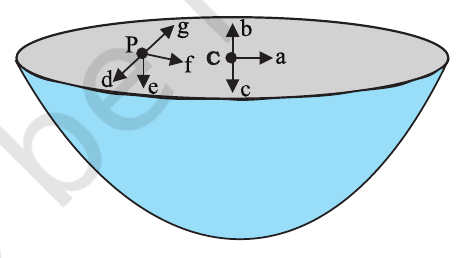
Exercises 7.10 and 7.11 (Fig. 7.11) ask for the direction of the gravitational intensity at the centre C and at an arbitrary point P of a hemispherical shell. There is no gravitational shielding (Points to ponder, item 9).
Trap Pairs
- g is maximum at the centre? No. g is maximum on the surface of the earth. It falls with height as $g(h) = g (R_E^2)/((RE + h)²)$ and falls with depth as $g(d) = g(1 - d/RE), reaching zero$ at the centre.
- g falls the same way with height and with depth? No. Near the surface, g(h) is about g(1 - (2h)/(RE)) with height but $g(d) = g(1 - d/RE)$ with depth. At h = RE, g falls to g/4; at $d = RE/2, g falls only$ to g/2.
- Escape speed depends on the mass of the escaping body? No. $(V_i)_{\min} = \sqrt{(2 G ME)/(RE)} = \sqrt{2 g RE}$ has no m in it. A heavier body needs more energy, not more speed.
- A satellite's total energy is positive? No. $E = -(G m ME)/(2(RE + h))$ is negative. Kinetic energy is half the magnitude of the potential energy: K.E. = (1/2) |P.E.|.
- Gravitational potential energy is always positive, like mgh? No. $V = -(G m_1 m_2)/r$ is negative and zero only at infinity. mgh is only the difference of potential energies near the surface, with the constant chosen at the surface.
- Kepler's third law says $T^2$ is proportional to $R^2$? No. $T^2$ is proportional to the cube of the semi-major axis: $T^2 = (4π^2/(G Ms)) a^3$. The quotient $Q = T^2/a^3$ is nearly the same for all planets (Table 7.1).
- A hollow shell shields gravity like a conductor shields charge? No. The force inside a uniform hollow shell is zero, but there is no gravitational shielding: the shell does not block the field of a mass outside it (Points to ponder, item 9).
Points to Ponder
- Both the angular momentum of the planet and the total mechanical energy of the planet are conserved. Linear momentum is not conserved.
- Kepler's second law is a consequence of the conservation of angular momentum. The law of areas holds for any central force, not only for the inverse square law.
- Kepler's third law $T^2 = KS R^3 holds$ with the same KS for all planets. For the moon or a satellite around the earth, the constant is different.
- The acceleration due to gravity on the moon is about one sixth of that on the earth. An astronaut in orbit is weightless because he is in free fall, not because gravity is small there.
- The gravitational potential energy $V = -(G m_1 m_2)/r$ is defined with zero at infinity, but any constant could be added: V = -(G $m_1$ $m_2$)/r + constant. The constant is chosen to be zero so that the potential energy is zero at infinity.
- The total energy of a satellite is negative, so it is bound to the earth. Energy must be supplied to take it to infinity.
- The potential energy mgh is an approximation, valid only near the surface of the earth, where the change in height is small compared with RE.
- The gravitational force between two finite rigid bodies is not necessarily central: it acts along the line joining the centres only for spheres.
- Gravitational shielding is not possible: there is no material that blocks the gravitational field.
Trap Boxes
g is the same at every height above the earth
Wrong idea: g is a constant 9.8 m/$s^2$ everywhere, so a body at height RE/2 weighs the same as on the surface.
g falls with height: $g(h) = g (R_E^2)/((RE + h)²)$. At $h = RE/2$ the weight is (4/9) of the surface weight, 32 N for a 72 N body. NCERT 7.6.
NCERT XI, Ch 7, 7.6
Escape speed depends on the mass of the body
Wrong idea: A heavier rocket needs a higher escape speed to leave the earth.
Escape speed $(V_i)_{\min}$ = $\sqrt{(2 G ME)/(RE)} = \sqrt{2 g RE} = 11.2 km/s$ for the earth, and it has no m in it. Mass changes the energy needed, not the speed. NCERT 7.8.
NCERT XI, Ch 7, 7.8
A satellite's total energy is positive
Wrong idea: A satellite in orbit has positive total energy because it is moving fast.
E = K.E. + P.E. = -(G m ME)/(2(RE + h)) is negative. Kinetic energy is half the magnitude of the potential energy. NCERT 7.10.
NCERT XI, Ch 7, 7.10
Gravitational potential energy is positive
Wrong idea: Potential energy is always positive, so $V = +(G m_1 m_2)/r$.
$V = -(G m_1 m_2)/r$ is negative and zero only at infinity. The potential at a point, $U(r) = -(G M)/r$, is also negative. NCERT 7.7.
NCERT XI, Ch 7, 7.7
Kepler's third law: $T^2$ is proportional to $R^2$
Wrong idea: $T^2$ is proportional to $R^2$, so doubling the orbital radius multiplies the period by 2.
$T^2$ is proportional to the cube of the semi-major axis: $T^2 = (4π^2/(G Ms)) a^3$. Doubling the radius multiplies the period by 2 sqrt(2). Table 7.1 shows $T^2$/$a^3$ is constant. NCERT 7.2.
NCERT XI, Ch 7, 7.2
Chapter test
5 NEET PYQs. +4 for a correct answer, -1 for a wrong answer, exactly like NEET. Finish the test to earn a medal.
Q1: NEET (UG) 2025, Code 45, Q31
The radius of Martian orbit around the Sun is about 4 times the radius of the orbit of Mercury. The Martian year is 687 Earth days. Then which of the following is the length of 1 year on Mercury?
$T^2$ is proportional to $a^3$, so $T_Mercury = 687 / (4^{3/2}) = 687/8 = 86 \text{days}$, closest to 88 earth days.
Q2: NEET (UG) 2024, Code R3, Q50
The minimum energy required to launch a satellite of mass m from the surface of the Earth (of mass M and radius R) into a circular orbit at an altitude of 2R from the surface of the Earth is:
Initial energy is -(GmM)/R. Final energy at orbit radius 3R is -$(GmM)/(2 \times 3R) = -(GmM)/(6R)$. Energy needed is (5GmM)/(6R).
Q3: NEET (UG) 2023, Code F1, Q35
Two bodies of mass m and 9m are placed at a distance R. The gravitational potential on the line joining the bodies where the gravitational field equals zero, will be (G = gravitational constant)
The field is zero at distance R/4 from m (and 3R/4 from 9m). Potential there is -(Gm)/(R/4) - (G(9m))/(3R/4) = -$(4Gm)/R - (12Gm)/R = -(16Gm)/R$.
Q4: NEET (UG) 2022, Code R1, Q49
Match List-I with List-II:
List-I
(a) Gravitational constant (G)
(b) Gravitational potential energy
(c) Gravitational potential
(d) Gravitational intensity
List-II
(i) $[L^2 T^{-2}]$
(ii) $[M^{-1} L^3 T^{-2}]$
(iii) $[L T^{-2}]$
(iv) $[M L^2 T^{-2}]$
G: $[M^{-1} L^3 T^{-2}]$ (ii); gravitational potential energy: $[M L^2 T^{-2}]$ (iv); gravitational potential: $[L^2 T^{-2}]$ (i); gravitational intensity: $[L T^{-2}]$ (iii). So (a)-(ii), (b)-(iv), (c)-(i), (d)-(iii).
Q5: NEET (UG) 2020, Code G5, Q144
A body weighs 72 N on the surface of the earth. What is the gravitational force on it, at a height equal to half the radius of the earth?
$g(h) = g (R_E^2)/((RE + h)²)$. At $h = RE/2, g(h) = (4/9)g$, so the force is $(4/9) x 72 = 32 N$.
Score: 0 · Answered 0 of 5
Flashcards
Tap a card to flip it over and see the answer. Tap it again to flip it back.
State Kepler's three laws of planetary motion.
Tap to flipLaw of orbits: all planets move in elliptical orbits with the Sun at one of the foci. Law of areas: the line joining a planet to the sun sweeps out equal areas in equal intervals of time. Law of periods: the square of the time period is proportional to the cube of the semi-major axis.
Tap to flip backWrite Kepler's law of periods and the value of $Q = T^2/a^3$ for the planets.
Tap to flip$T^2 = (4π^2/(G Ms)) a^3$, where a is the semi-major axis and Ms is the mass of the sun. $Q = T^2/a^3$ is nearly the same for all planets, about 3.0 x $10^{-34}$ $y^2$ m^-3 (Table 7.1: 2.95 to 3.01).
Tap to flip backState Newton's law of gravitation in scalar and vector form.
Tap to flipF = G ($m_1$ $m_2$)/($r^2$). In vector form, $F = -G (m_1 m_2)/(r^2) r-hat = -G (m_1 m_2)/(|r|^3) r$. The minus sign shows the force is attractive, and $F12 = -F21$.
Tap to flip backWhat is G, how was it first measured, and what is its value?
Tap to flipG is the universal gravitational constant, first measured by Cavendish in 1798 with a torsion balance (Fig. 7.6). $G = 6.67 \times 10^{-11} N m^2/\mathrm{kg}^2$.
Tap to flip backGive g at the surface of the earth and the two shell results.
Tap to flip$g = (G ME)/(R_E^2)$, about 9.8 m/$s^2$. A hollow shell attracts an outside mass as if all its mass were at its centre, and exerts no force on a mass inside it.
Tap to flip backHow does g change with height h above the surface and depth d below it?
Tap to flip$g(h) = g (R_E^2)/((RE + h)²)$, and for h much smaller than RE, g(h) is about g(1 - (2h)/(RE)). $g(d) = g(1 - d/RE)$, so g is zero at the centre and maximum on the surface.
Tap to flip backWrite the gravitational potential energy of two masses and state its value at infinity.
Tap to flip$V = -(G m_1 m_2)/r$. It is negative and zero at infinity. The potential energy of a system is the sum over all pairs of masses, each pair counted once.
Tap to flip backWhat is the escape speed from the earth and from the moon, and does it depend on the mass of the body?
Tap to flip$(V_i)_{\min} = \sqrt{(2 G ME)/(RE)} = \sqrt{2 g RE}$. For the earth it is 11.2 km/s, for the moon 2.3 km/s. It does not depend on the mass of the escaping body.
Tap to flip backGive the orbital speed, period and minimum period of an earth satellite.
Tap to flip$V^2 = (G ME)/(RE + h)$. $T^2 = k (RE + h)³$ with $k = (4π^2)/(G ME)$. The minimum period, for a satellite just above the surface, is $T_0 = 2π \sqrt{RE/g}$, about 85 minutes.
Tap to flip backGive the kinetic, potential and total energy of a satellite in a circular orbit.
Tap to flipK.E. = (G m ME)/(2(RE + h)), P.E. = -(G m ME)/(RE + h), $E = -(G m ME)/(2(RE + h))$. Total energy is negative, and K.E. is half the magnitude of P.E.
Tap to flip backWrite the gravitational potential U(r) and the gravitational intensity E for a mass M.
Tap to flip$U(r) = -(G M)/r, a scalar$ in J kg^-1. $E = -(G M)/(r^2) r-hat, a vector$ in m s^-2. Both are zero at infinity.
Tap to flip backWhich quantities are conserved for a planet in orbit, and which is not?
Tap to flipAngular momentum and total mechanical energy are conserved. Linear momentum is not conserved. Kepler's second law holds for any central force, not only for the inverse square law.
Tap to flip backFrequently asked questions
Is it true that g is the same at every height above the earth?
g falls with height: $g(h) = g (R_E^2)/((RE + h)²)$. At $h = RE/2$ the weight is (4/9) of the surface weight, 32 N for a 72 N body.
Is it true that escape speed depends on the mass of the body?
Escape speed $(V_i)_{\min}$ = $\sqrt{(2 G ME)/(RE)} = \sqrt{2 g RE} = 11.2 km/s$ for the earth, and it has no m in it. Mass changes the energy needed, not the speed.
Is it true that a satellite's total energy is positive?
E = K.E. + P.E. = -(G m ME)/(2(RE + h)) is negative. Kinetic energy is half the magnitude of the potential energy.
Is it true that gravitational potential energy is positive?
$V = -(G m_1 m_2)/r$ is negative and zero only at infinity. The potential at a point, $U(r) = -(G M)/r$, is also negative.
Is it true that Kepler's third law: $T^2$ is proportional to $R^2$?
$T^2$ is proportional to the cube of the semi-major axis: $T^2 = (4π^2/(G Ms)) a^3$. Doubling the radius multiplies the period by 2 sqrt(2).