 NEET Notes
Home > PYQ Bank
PYQ Bank
9,226 questions from NEET and AIPMT papers, 1988 to 2026, across 96 chapters. 8,227 of them are in the current syllabus. Pick a year and a chapter, then browse with answers or take a quiz.
32 questions match.
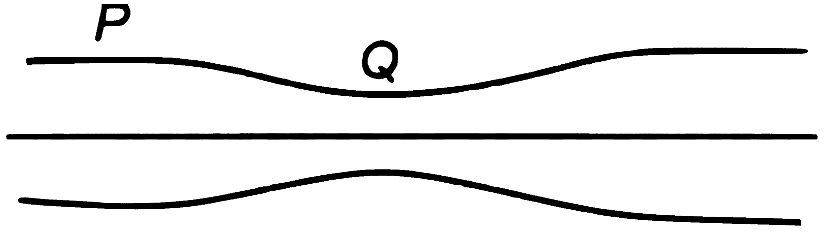
Water flows in a streamline motion through a horizontal pipe of circular cross-section as shown in the figure. The pressure difference of water between and is . The area of cross-section at and are and , respectively. The rate of flow of water through the pipe, in , is: [Take density of water ]
In the measurement of viscosity of liquids using terminal velocity experiment, spherical balls of same radius but having different densities are used. The variation of the terminal velocity ( ) with the ratio of density of spherical ball ( ) to density of the liquid ( ), is best represented by:
A submarine is designed to withstand an absolute pressure of 100 atm . How deep can it go below the water surface? (Consider the density of water , and gravitational acceleration )

Consider a water tank shown in the figure. It has one wall at and can be taken to be very wide in the direction. When filled with a liquid of surface tension and density , the liquid surface makes angle with the -axis at . If is the height of the surface then the equation for is: (take is the acceleration due to gravity)

An ideal fluid is flowing in a non-uniform cross-sectional tube (as shown in the figure) from end to end . If and are the kinetic energy per unit volume of the fluid at and respectively, then the correct option is :
A thin flat circular disc of radius is placed gently over the surface of water. If surface tension of water is , then the excess force required to take it away from the surface is
Which of the following statements is not true?
The viscous drag acting on a metal sphere of diameter , falling through a fluid of viscosity s with a velocity of is equal to :
The amount of energy required to form a soap bubble of radius from a soap solution is nearly: (surface tension of soap solution )
The venturi-meter works on :
Two copper vessels A and B have the same base area but of different shapes. A takes twice the volume of water as that B requires to fill upto a particular common height. Then the correct statement among the following is :
The terminal velocity of a copper ball of radius 5 mm falling through a tank of oil at room temperature is 10 cm s 1. If the viscosity of oil at room temperature is 0.9 kg m 1 s 1, the viscous drag force is :
A spherical ball is dropped in a long column of a highly viscous liquid. The curve in the graph shown, which represents the speed of the ball (v) as a function of time (t) is
If a soap bubble expands, the pressure inside the bubble
The velocity of a small ball of mass M and density d, when dropped in a container filled with glycerin becomes constant after some time. If the density of glycerin is , then the viscous force acting on the ball will be :
A barometer is constructed using a liquid (density = ). What would be the height of the liquid column, when a mercury barometer reads 76 cm? (density of mercury = )
A capillary tube of radius r is immersed in water and water rises in it to a height h. The mass of the water in the capillary is 5 g. Another capillary tube of radius 2r is immersed in water. The mass of water that will rise in this tube is :
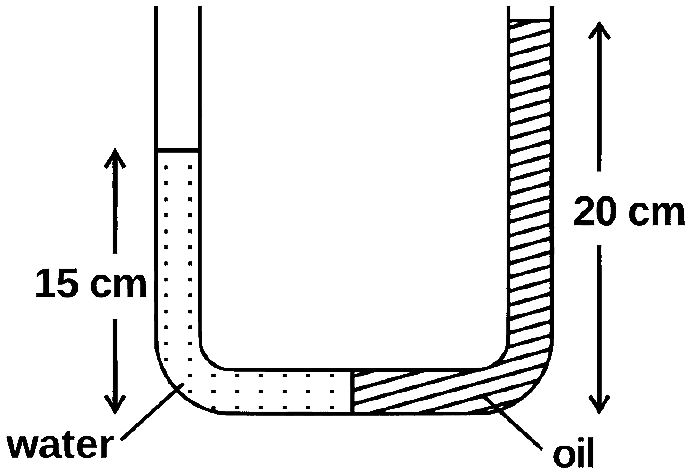
In a u-tube as shown in the fig. water and oil are in the left side and right side of the tube respectively. The heights from the bottom for water and oil columns are 15 cm and 20 cm respectively. The density of the oil is [take ]
Two small spherical metal balls, having equal masses, are made from materials of densities and ( ) and have radii of 1 mm and 2 mm, respectively. They are made to fall vertically (from rest) in a viscous medium whose coefficient of viscosity equals and whose density is . The ratio of their terminal velocities would be,
A small hole of area of cross-section 2 mm2 present near the bottom of a fully filled open tank of height 2 m. Taking g = 10 m/s2, the rate of flow of water through the open hole would be nearly :