 NEET Notes
Atoms
On this page · 19 sections
- 01Syllabus Map
- 02Introduction
- 03Alpha-Particle Scattering and Rutherford's Nuclear Model of Atom
- 04Alpha-Particle Trajectory
- 05Electron Orbits
- 06Atomic Spectra
- 07Table - Hydrogen Series in Fig. 12.5
- 08Bohr Model of the Hydrogen Atom
- 09Bohr's Postulates and the Energy of the Electron
- 10Table - Energy Levels of the Hydrogen Atom
- 11The Line Spectra of the Hydrogen Atom
- 12Extra Information (Beyond NCERT) - Rydberg Formula and Hydrogen Series
- 13De Broglie's Explanation of Bohr's Second Postulate of Quantisation
- 14Table - Key Formulas of the Chapter
- 15Worked Examples
- 16Trap Pairs
- 17Points to Ponder
- 18Summary
- 19Exercises
Thomson and Rutherford models, Bohr postulates, energy levels and hydrogen spectra from NCERT Class 12 Ch 12, with 5 NEET PYQs.
Syllabus Map
- NMC Unit: PHYS-U18, Atoms and Nuclei (the atoms half of the unit belongs to NCERT Ch 12; the nuclei half belongs to NCERT Ch 13, not this chapter). NCERT Chapter 12, Atoms (Class XII, printed pp. 290-305, Reprint 2026-27).
- NMC atoms items covered here: α-particle scattering experiment; Rutherford's model of atom; Bohr model, energy levels, hydrogen spectrum.
- NMC Unit 18 items NOT in this chapter: composition and size of nucleus, atomic masses, mass-energy relation, mass defect, binding energy per nucleon and its variation with mass number, nuclear fission, and fusion. Those belong to NCERT Ch 13, Nuclei, and are not covered here.
- One section of this chapter is labelled "Extra information (beyond NCERT)": the Rydberg formula, the Brackett and Pfund series names, and the hydrogenic Z-scaling. The rationalised NCERT Ch 12 names only the Lyman, Balmer and Paschen series in Fig. 12.5 and gives no Rydberg formula, but the NMC item "hydrogen spectrum" is examined with them every year (NEET 2016 Q146, 2023 F1 Q33), so they are kept in one compact labelled section.
- How to use this chapter: learn the scattering experiment first (sections 3-4), then the Rutherford orbit energies (section 5), then the spectra (sections 6-7), then Bohr's postulates and the energy levels (sections 9-10), then the line spectra and the de Broglie explanation (sections 11 and 13). The worked examples (section 15) and the NCERT exercises (section 19) use the same numbers NCERT prints.
Introduction
- By the nineteenth century, enough evidence had accumulated in favour of atomic hypothesis of matter. In 1897, the experiments on electric discharge through gases by the English physicist J. J. Thomson (1856-1940) revealed that atoms contain negatively charged constituents (electrons) that are identical for all atoms. Atoms as a whole are electrically neutral, so an atom must also contain some positive charge to neutralise the negative charge of the electrons.
- The first model of atom was proposed by J. J. Thomson in 1898. According to this model, the positive charge of the atom is uniformly distributed throughout the volume of the atom and the negatively charged electrons are embedded in it like seeds in a watermelon. This model was picturesquely called the plum pudding model of the atom.
- Condensed matter (solids and liquids) and dense gases at all temperatures emit electromagnetic radiation with a continuous distribution of several wavelengths. In contrast, light emitted from rarefied gases heated in a flame, or excited electrically in a glow tube such as the familiar neon sign or mercury vapour light, has only certain discrete wavelengths. The spectrum appears as a series of bright lines.
- In the early nineteenth century it was also established that each element is associated with a characteristic spectrum of radiation; for example, hydrogen always gives a set of lines with fixed relative position between the lines. This fact suggested an intimate relationship between the internal structure of an atom and the spectrum of radiation emitted by it. In 1885, Johann Jakob Balmer (1825-1898) obtained a simple empirical formula which gave the wavelengths of a group of lines emitted by atomic hydrogen.
- Ernst Rutherford (1871-1937), a former research student of J. J. Thomson, was engaged in experiments on α-particles emitted by some radioactive elements. In 1906, he proposed a classic experiment of scattering of these α-particles by atoms to investigate the atomic structure. This experiment was later performed around 1911 by Hans Geiger (1882-1945) and Ernst Marsden (1889-1970, who was 20 year-old student and had not yet earned his bachelor's degree). The details are discussed in Section 12.2.
- The explanation of the results led to the birth of Rutherford's planetary model of atom (also called the nuclear model of the atom). According to this the entire positive charge and most of the mass of the atom is concentrated in a small volume called the nucleus with electrons revolving around the nucleus just as planets revolve around the sun. NCERT's Rutherford box says he created the modern theory of radioactivity along with Federick Soddy; NCERT prints the name as "Federick Soddy".
- Rutherford's nuclear model was a major step towards how we see the atom today. However, it could not explain why atoms emit light of only discrete wavelengths. How could an atom as simple as hydrogen, consisting of a single electron and a single proton, emit a complex spectrum of specific wavelengths?
Alpha-Particle Scattering and Rutherford's Nuclear Model of Atom
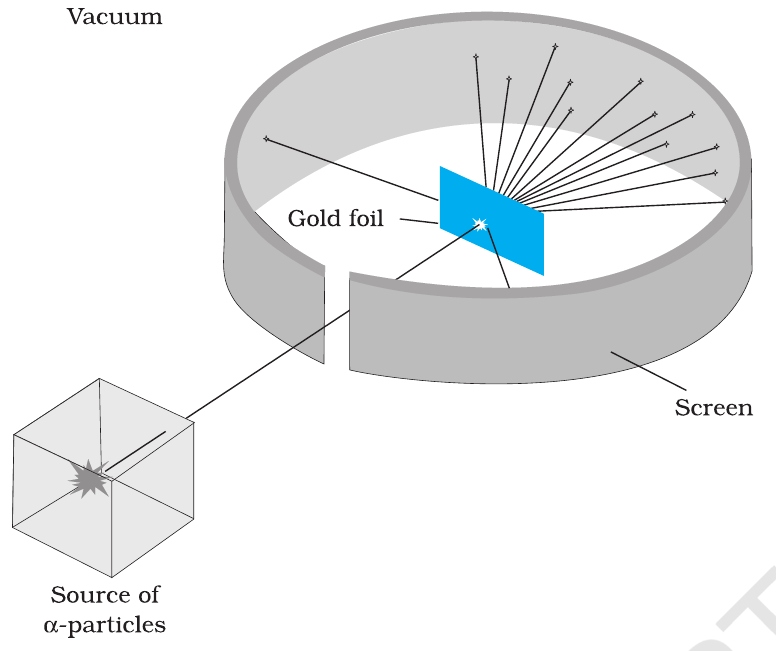
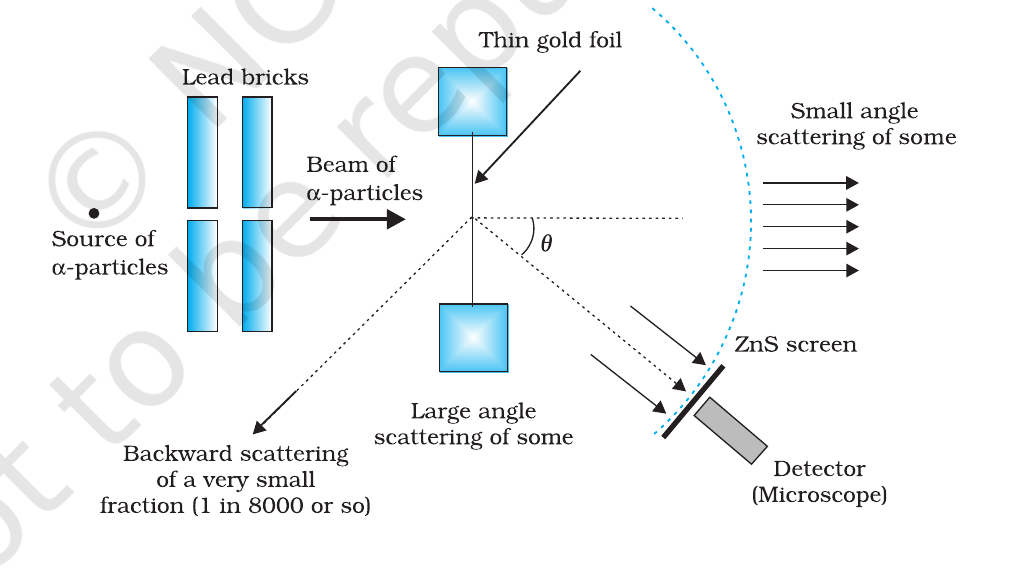
- At the suggestion of Ernst Rutherford, in 1911, H. Geiger and E. Marsden performed some experiments. In one of their experiments, as shown in Fig. 12.1, they directed a beam of 5.5 MeV α-particles emitted from a 214/83 Bi radioactive source at a thin metal foil made of gold. Figure 12.2 shows a schematic diagram of this experiment.
- α-particles emitted by a 214/83 Bi radioactive source were collimated into a narrow beam by their passage through lead bricks. The beam was allowed to fall on a thin foil of gold of thickness 2.1 × $10^{-7}$ m. The scattered α-particles were observed through a rotatable detector consisting of zinc sulphide screen and a microscope. The scattered α-particles on striking the screen produced brief light flashes or scintillations. These flashes may be viewed through a microscope and the distribution of the number of scattered particles may be studied as a function of angle of scattering.
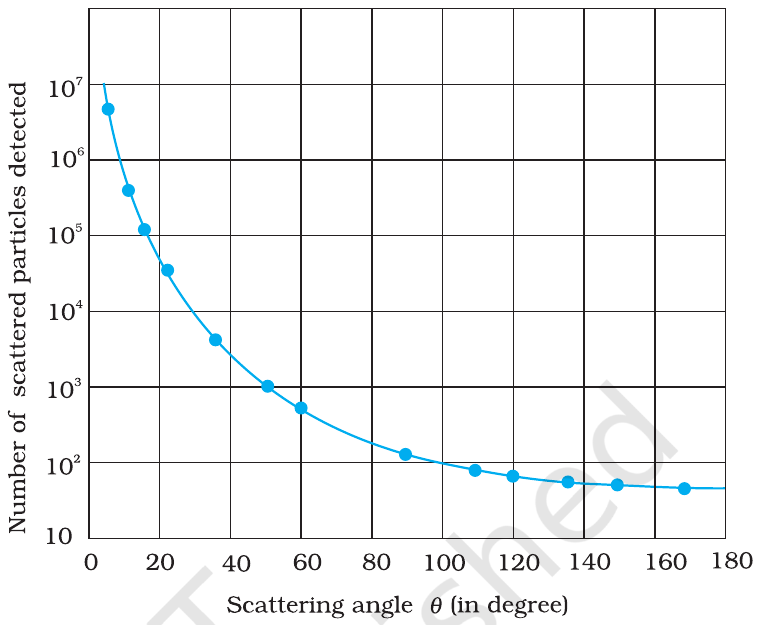
- A typical graph of the total number of α-particles scattered at different angles, in a given interval of time, is shown in Fig. 12.3. The dots in this figure represent the data points and the solid curve is the theoretical prediction based on the assumption that the target atom has a small, dense, positively charged nucleus. Many of the α-particles pass through the foil. It means that they do not suffer any collisions. Only about 0.14% of the incident α-particles scatter by more than 1°; and about 1 in 8000 deflect by more than 90°.
- Rutherford argued that, to deflect the α-particle backwards, it must experience a large repulsive force. This force could be provided if the greater part of the mass of the atom and its positive charge were concentrated tightly at its centre. Then the incoming α-particle could get very close to the positive charge without penetrating it, and such a close encounter would result in a large deflection. This agreement supported the hypothesis of the nuclear atom. This is why Rutherford is credited with the discovery of the nucleus.
- In Rutherford's nuclear model of the atom, the entire positive charge and most of the mass of the atom are concentrated in the nucleus with the electrons some distance away. The electrons would be moving in orbits about the nucleus just as the planets do around the sun. Rutherford's experiments suggested the size of the nucleus to be about $10^{-15}$ m to $10^{-14}$ m. From kinetic theory, the size of an atom was known to be $10^{-10}$ m, about 10,000 to 100,000 times larger than the size of the nucleus. Thus, the electrons would seem to be at a distance from the nucleus of about 10,000 to 100,000 times the size of the nucleus itself. Thus, most of an atom is empty space.
- With the atom being largely empty space, it is easy to see why most α-particles go right through a thin metal foil. However, when an α-particle happens to come near a nucleus, the intense electric field there scatters it through a large angle. The atomic electrons, being so light, do not appreciably affect the α-particles.
- The scattering data shown in Fig. 12.3 can be analysed by employing Rutherford's nuclear model of the atom. As the gold foil is very thin, it can be assumed that α-particles will suffer not more than one scattering during their passage through it. Therefore, computation of the trajectory of an α-particle scattered by a single nucleus is enough. α-particles are nuclei of helium atoms and, therefore, carry two units, 2e, of positive charge and have the mass of the helium atom. The charge of the gold nucleus is Ze, where Z is the atomic number of the atom; for gold $Z = 79$. Since the nucleus of gold is about 50 times heavier than an α-particle, it is reasonable to assume that it remains stationary throughout the scattering process.
Alpha-Particle Trajectory
- Under the assumptions of Section 12.2, the trajectory of an α-particle can be computed employing Newton's second law of motion and the Coulomb's law for electrostatic force of repulsion between the α-particle and the positively charged nucleus. The magnitude of this force is $F = (1/(4πε₀))(2e)(Ze)/r^2$ (12.1), where r is the distance between the α-particle and the nucleus. The force is directed along the line joining the α-particle and the nucleus.
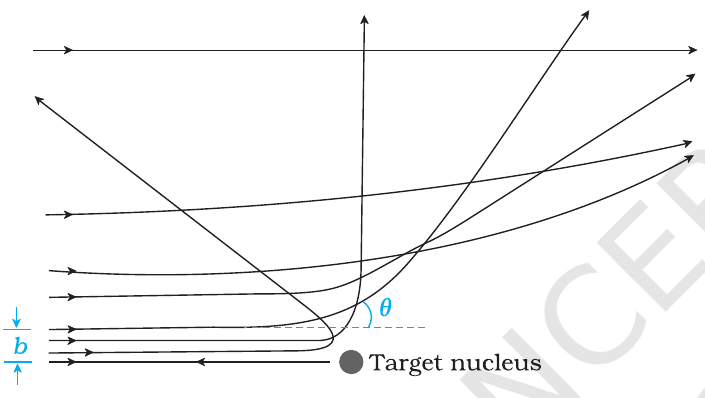
- Impact parameter: the trajectory traced by an α-particle depends on the impact parameter, b of collision. The impact parameter is the perpendicular distance of the initial velocity vector of the α-particle from the centre of the nucleus (Fig. 12.4). A given beam of α-particles has a distribution of impact parameters b, so that the beam is scattered in various directions with different probabilities (Fig. 12.4). In a beam, all particles have nearly same kinetic energy.
- It is seen that an α-particle close to the nucleus (small impact parameter) suffers large scattering. In case of head-on collision, the impact parameter is minimum and the α-particle rebounds back (θ ≅ π). For a large impact parameter, the α-particle goes nearly undeviated and has a small deflection (θ ≅ 0).
- The fact that only a small fraction of the number of incident particles rebound back indicates that the number of α-particles undergoing head on collision is small. This, in turn, implies that the mass and positive charge of the atom is concentrated in a small volume. Rutherford scattering therefore, is a powerful way to determine an upper limit to the size of the nucleus.
- Distance of closest approach: in a Geiger-Marsden experiment, the distance of closest approach to the nucleus of a 7.7 MeV α-particle before it comes momentarily to rest and reverses its direction is found from conservation of energy, $K = (1/(4πε₀))(2e)(Ze)/d = 2Ze^2/(4πε₀d)$, so $d = 2Ze^2/(4πε₀K)$. With $1/(4πε₀) = 9.0 \times 10^9 N m^2/C^2$ and $e = 1.6 \times 10^{-19} C$, $d = 3.84 \times 10^{-16} Z m$. For gold Z = 79, d(Au) = 3.0 × $10^{-14}$ m = 30 fm (1 fm, i.e. fermi, = $10^{-15}$ m). The radius of gold nucleus is, therefore, less than 3.0 × $10^{-14}$ m. This is not in very good agreement with the observed result as the actual radius of gold nucleus is 6 fm. The cause of discrepancy is that the distance of closest approach is considerably larger than the sum of the radii of the gold nucleus and the α-particle. Thus, the α-particle reverses its motion without ever actually touching the gold nucleus (Example 12.2).
- Example 12.1: in the Rutherford's nuclear model of the atom, the nucleus (radius about $10^{-15}$ m) is analogous to the sun about which the electron move in orbit (radius ≈ $10^{-10}$ m) like the earth orbits around the sun. The ratio of the radius of electron's orbit to the radius of nucleus is ($10^{-10}$ m)/($10^{-15}$ m) = $10^{5}$. If the radius of the earth's orbit around the sun were $10^{5}$ times larger than the radius of the sun, the radius of the earth's orbit would be $10^5 \times 7 \times 10^8 m = 7 \times 10^{13} m$. This is more than 100 times greater than the actual orbital radius of earth (1.5 × $10^{11}$ m). Thus, the earth would be much farther away from the sun. It implies that an atom contains a much greater fraction of empty space than our solar system does.
Practice1 question
Try it now. A wrong answer costs nothing here, try again until you get it.
A 5.5 MeV α-particle is scattered by a gold nucleus $(Z = 79)$. Using the result of Example 12.2 for a 7.7 MeV α-particle, what is its distance of closest approach?
NCERT 12.2.1, Example 12.2: $d = 2Ze^2/(4πε₀K)$, so d is inversely proportional to K. $d(5.5 MeV) = 3.0 \times 10^{-14} m \times (7.7/5.5)$ = 4.2 × $10^{-14}$ m.
Electron Orbits
- The Rutherford nuclear model of the atom which involves classical concepts, pictures the atom as an electrically neutral sphere consisting of a very small, massive and positively charged nucleus at the centre surrounded by the revolving electrons in their respective dynamically stable orbits. The electrostatic force of attraction, F_e between the revolving electrons and the nucleus provides the requisite centripetal force (F_c) to keep them in their orbits. Thus, for a dynamically stable orbit in a hydrogen atom, F_e = F_c, so $(1/(4πε₀))(e^2/r^2) = mv^2/r$ (12.2).
- Thus the relation between the orbit radius and the electron velocity is $r = e^2/(4πε₀mv^2)$ (12.3).
- The kinetic energy (K) and electrostatic potential energy (U) of the electron in hydrogen atom are $K = (1/2)mv^2 = e^2/(8πε₀r)$ and $U = -e^2/(4πε₀r)$. The negative sign in U signifies that the electrostatic force is in the -r direction. Thus the total energy E of the electron in a hydrogen atom is $E = K + U = e^2/(8πε₀r) - e^2/(4πε₀r)$ = -$e^2$/(8πε₀r) (12.4).
- The total energy of the electron is negative. This implies the fact that the electron is bound to the nucleus. If E were positive, an electron will not follow a closed orbit around the nucleus.
- Example 12.3: it is found experimentally that 13.6 eV energy is required to separate a hydrogen atom into a proton and an electron. Total energy of the electron in hydrogen atom is -$13.6 eV = -13.6 \times 1.6 \times 10^{-19} J$ = -2.2 × $10^{-18}$ J. From Eq. (12.4), the orbital radius is $r = -e^2/(8πε₀E) = 5.3 \times 10^{-11} m$. The velocity of the revolving electron can be computed from Eq. (12.3) with $m = 9.1 \times 10^{-31} kg: v = e/\sqrt{4πε₀mr} = 2.2 \times 10^{6} m/s$.
Atomic Spectra
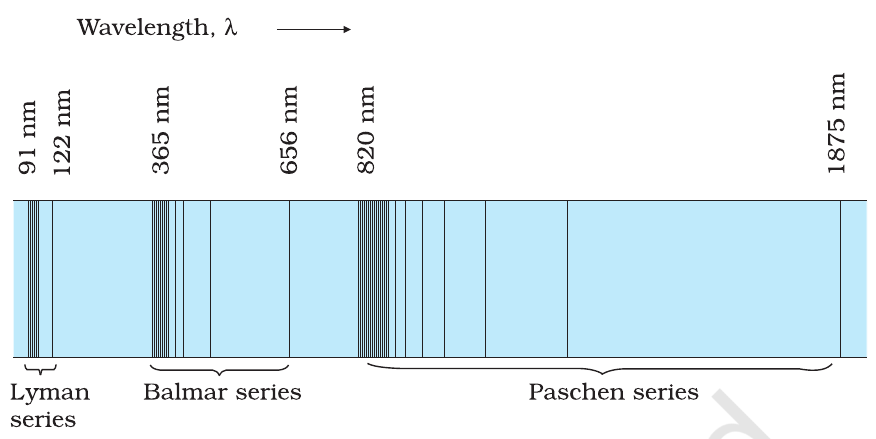
- As mentioned in Section 12.1, each element has a characteristic spectrum of radiation, which it emits. When an atomic gas or vapour is excited at low pressure, usually by passing an electric current through it, the emitted radiation has a spectrum which contains certain specific wavelengths only. A spectrum of this kind is termed as emission line spectrum and it consists of bright lines on a dark background. The spectrum emitted by atomic hydrogen is shown in Fig. 12.5.
- Study of emission line spectra of a material can therefore serve as a type of "fingerprint" for identification of the gas. When white light passes through a gas and we analyse the transmitted light using a spectrometer we find some dark lines in the spectrum. These dark lines correspond precisely to those wavelengths which were found in the emission line spectrum of the gas. This is called the absorption spectrum of the material of the gas.
- Fig. 12.5 shows the emission lines in the spectrum of hydrogen, grouped into three series: the Lyman series (91 nm, 122 nm), the Balmer series (365 nm, 656 nm) and the Paschen series (820 nm, 1875 nm). The Balmer lines fall in the visible region (light of wavelength about 400 nm to 750 nm, NCERT Ch 9, 9.1); the Lyman lines are ultraviolet and the Paschen lines are infrared.
Practice1 question
Try it now. A wrong answer costs nothing here, try again until you get it.
When white light passes through a gas, dark lines appear in the transmitted light at the wavelengths the gas can emit. What is this spectrum called?
NCERT 12.3: the dark lines in the transmitted light correspond precisely to the wavelengths found in the emission line spectrum of the gas. This is called the absorption spectrum of the material of the gas.
Table - Hydrogen Series in Fig. 12.5
- The three hydrogen series NCERT names in Fig. 12.5, with the wavelengths NCERT prints on the figure. The regions follow from the wavelengths: visible light is about 400 nm to 750 nm (NCERT Ch 9, 9.1), so the Balmer lines at 365 nm to 656 nm are the visible ones, the Lyman lines are ultraviolet and the Paschen lines are infrared.
| Series | Wavelengths shown in Fig. 12.5 | Region |
|---|---|---|
| Lyman series | 91 nm, 122 nm | Ultraviolet |
| Balmer series | 365 nm, 656 nm | Visible |
| Paschen series | 820 nm, 1875 nm | Infrared |
Bohr Model of the Hydrogen Atom
- The model of the atom proposed by Rutherford assumes that the atom, consisting of a central nucleus and revolving electron is stable much like sun-planet system which the model imitates. However, there are some fundamental differences between the two situations. While the planetary system is held by gravitational force, the nucleus-electron system being charged objects, interact by Coulomb's Law of force.
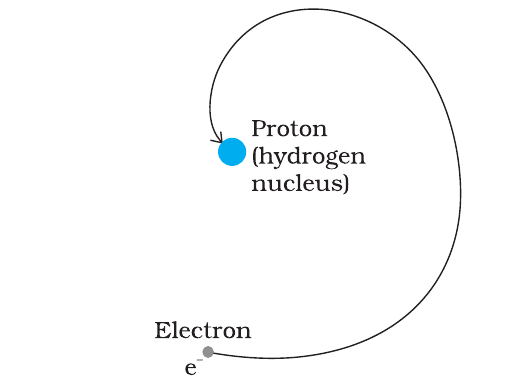
- We know that an object which moves in a circle is being constantly accelerated, the acceleration being centripetal in nature. According to classical electromagnetic theory, an accelerating charged particle emits radiation in the form of electromagnetic waves. The energy of an accelerating electron should therefore, continuously decrease. The electron would spiral inward and eventually fall into the nucleus (Fig. 12.6). Thus, such an atom can not be stable.
- Further, according to the classical electromagnetic theory, the frequency of the electromagnetic waves emitted by the revolving electrons is equal to the frequency of revolution. As the electrons spiral inwards, their angular velocities and hence their frequencies would change continuously, and so will the frequency of the light emitted. Thus, they would emit a continuous spectrum, in contradiction to the line spectrum actually observed. Clearly Rutherford model tells only a part of the story implying that the classical ideas are not sufficient to explain the atomic structure.
- Example 12.4: according to the classical electromagnetic theory, the initial frequency of the light emitted by the electron revolving around a proton in hydrogen atom is found from Example 12.3 (v = 2.2 × $10^{6}$ m/s, $r = 5.3 \times 10^{-11} m$) as $ν = v/(2πr) = 2.2 \times 10^{6}/(2π(5.3 \times 10^{-11} m)) ≈ 6.6 \times 10^{15} Hz$. The frequency of the electromagnetic waves emitted by the revolving electrons is equal to the frequency of its revolution around the nucleus, so the initial frequency of the light emitted is 6.6 × $10^{15}$ Hz.
- It was Niels Bohr (1885-1962) who made certain modifications in this model by adding the ideas of the newly developing quantum hypothesis. Niels Bohr studied in Rutherford's laboratory for several months in 1912 and he was convinced about the validity of Rutherford nuclear model. Bohr, in 1913, concluded that in spite of the success of electromagnetic theory in explaining large-scale phenomena, it could not be applied to the processes at the atomic scale. NCERT's Bohr box says he explained the spectrum of hydrogen atom based on quantum ideas, gave a theory of nuclear fission based on the liquid-drop model of nucleus, and proposed the complementary principle.
Bohr's Postulates and the Energy of the Electron
- Bohr combined classical and early quantum concepts and gave his theory in the form of three postulates. These are:
- (i) Bohr's first postulate was that an electron in an atom could revolve in certain stable orbits without the emission of radiant energy, contrary to the predictions of electromagnetic theory. According to this postulate, each atom has certain definite stable states in which it can exist, and each possible state has definite total energy. These are called the stationary states of the atom.
- (ii) Bohr's second postulate defines these stable orbits. This postulate states that the electron revolves around the nucleus only in those orbits for which the angular momentum is some integral multiple of h/2π where h is the Planck's constant (= 6.6 × $10^{-34}$ J s). Thus the angular momentum (L) of the orbiting electron is quantised. That is $L = nh/2π$ (12.5).
- (iii) Bohr's third postulate incorporated into atomic theory the early quantum concepts that had been developed by Planck and Einstein. It states that an electron might make a transition from one of its specified non-radiating orbits to another of lower energy. When it does so, a photon is emitted having energy equal to the energy difference between the initial and final states. The frequency of the emitted photon is then given by $hν = E_i - E_f$ (12.6), where E_i and E_f are the energies of the initial and final states and E_i > E_f.
- For a hydrogen atom, Eq. (12.4) gives the expression to determine the energies of different energy states. But then this equation requires the radius r of the electron orbit. To calculate r, Bohr's second postulate about the angular momentum of the electron, the quantisation condition, is used. The radius of nth possible orbit thus found is $r_n = (n^2/m)(h/2\pi)^2(4πε₀/e^2)$ (12.7).
- The total energy of the electron in the stationary states of the hydrogen atom can be obtained by substituting the value of orbital radius in Eq. (12.4) as $E_n = -(e^2/(8πε₀))(m/n^2)(2\pi/h)^2(e^2/(4πε₀))$, or $E_n = -me^4/(8n^2ε₀^2h^2)$ (12.8). Substituting values, Eq. (12.8) yields $E_n = -2.18 \times 10^{-18}/n^2 J$ (12.9). Atomic energies are often expressed in electron volts (eV) rather than joules. Since 1 $eV = 1.6 \times 10^{-19} J$, Eq. (12.9) can be rewritten as $E_n = -13.6/n^2 eV$ (12.10).
- The negative sign of the total energy of an electron moving in an orbit means that the electron is bound with the nucleus. Energy will thus be required to remove the electron from the hydrogen atom to a distance infinitely far away from its nucleus (or proton in hydrogen atom).
Practice1 question
Try it now. A wrong answer costs nothing here, try again until you get it.
How much energy is needed to excite a hydrogen atom from its ground state to its first excited state?
$NCERT 12.4.1: E₂ - E₁ = -3.40 eV - (-13.6 eV) = 10.2 eV$ to excite the electron to its first excited state.
Table - Energy Levels of the Hydrogen Atom
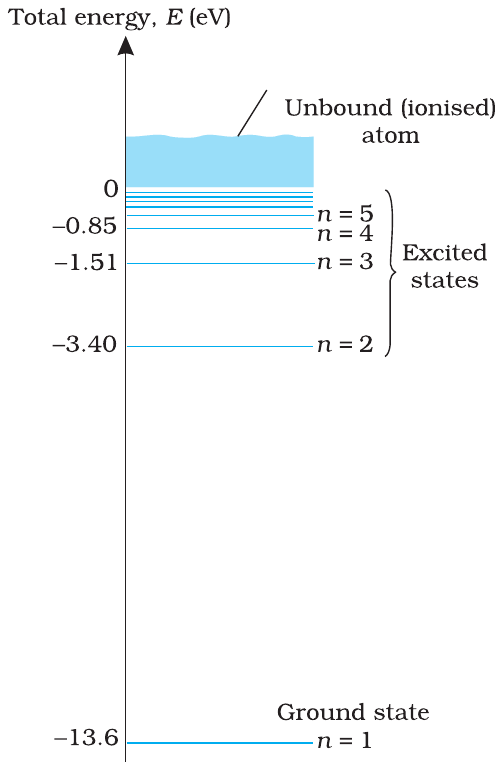
- The energy of an atom is the least (largest negative value) when its electron is revolving in an orbit closest to the nucleus i.e., the one for which $n = 1$. For $n = 2, 3$, ... the absolute value of the energy E is smaller, hence the energy is progressively larger in the outer orbits. The lowest state of the atom, called the ground state, is that of the lowest energy, with the electron revolving in the orbit of smallest radius, the Bohr radius, a₀. The energy of this state $(n = 1)$, E₁ is -13.6 eV. Therefore, the minimum energy required to free the electron from the ground state of the hydrogen atom is 13.6 eV. It is called the ionisation energy of the hydrogen atom. This prediction of the Bohr's model is in excellent agreement with the experimental value of ionisation energy.
- At room temperature, most of the hydrogen atoms are in ground state. When a hydrogen atom receives energy by processes such as electron collisions, the atom may acquire sufficient energy to raise the electron to higher energy states. The atom is then said to be in an excited state. From Eq. (12.10), for $n = 2$, the energy E₂ is -3.40 eV. It means that the energy required to excite an electron in hydrogen atom to its first excited state, is an energy equal to $E₂ - E₁ = -3.40 eV - (-13.6) eV = 10.2 eV$. Similarly, $E₃ = -1.51 eV$ and $E₃ - E₁ = 12.09 eV$, or to excite the hydrogen atom from its ground state $(n = 1)$ to second excited state $(n = 3), 12.09 eV$ energy is required, and so on. From these excited states the electron can then fall back to a state of lower energy, emitting a photon in the process. Thus, as the excitation of hydrogen atom increases (that is as n increases) the value of minimum energy required to free the electron from the excited atom decreases.
- The energy level diagram for the stationary states of a hydrogen atom, computed from Eq. (12.10), is given in Fig. 12.7. The principal quantum number n labels the stationary states in the ascending order of energy. In this diagram, the highest energy state corresponds to n = ∞ in Eq. (12.10) and has an energy of 0 eV. This is the energy of the atom when the electron is completely removed (r = ∞) from the nucleus and is at rest. Observe how the energies of the excited states come closer and closer together as n increases. An electron can have any total energy above $E = 0 eV$. In such situations the electron is free. Thus there is a continuum of energy states above $E = 0 eV$, as shown in Fig. 12.7.
| n | E_n (eV) | State |
|---|---|---|
| 1 | -13.6 | Ground state |
| 2 | -3.40 | First excited state |
| 3 | -1.51 | Second excited state |
| 4 | -0.85 | Third excited state |
| 5 | -0.54 | Fourth excited state |
| ∞ | 0 | Unbound (ionised) atom |
- Energy differences from Eq. (12.10): E₂ - E₁ = 10.2 eV (first excitation), E₃ - E₁ = 12.09 eV (second excitation), and the ionisation energy from the ground state is 13.6 eV. The E₄ and E₅ values follow from $E_n = -13.6/n^2 eV$.
The Line Spectra of the Hydrogen Atom
- According to the third postulate of Bohr's model, when an atom makes a transition from the higher energy state with quantum number n_i to the lower energy state with quantum number n_f (n_f < n_i), the difference of energy is carried away by a photon of frequency ν_if such that $hν_if = E_ni - E_nf$ (12.11). Since both n_f and n_i are integers, this immediately shows that in transitions between different atomic levels, light is radiated in various discrete frequencies.
- The various lines in the atomic spectra are produced when electrons jump from higher energy state to a lower energy state and photons are emitted. These spectral lines are called emission lines. But when an atom absorbs a photon that has precisely the same energy needed by the electron in a lower energy state to make transitions to a higher energy state, the process is called absorption. Thus if photons with a continuous range of frequencies pass through a rarefied gas and then are analysed with a spectrometer, a series of dark spectral absorption lines appear in the continuous spectrum. The dark lines indicate the frequencies that have been absorbed by the atoms of the gas.
- The explanation of the hydrogen atom spectrum provided by Bohr's model was a brilliant achievement, which greatly stimulated progress towards the modern quantum theory. In 1922, Bohr was awarded Nobel Prize in Physics.
Practice1 question
Try it now. A wrong answer costs nothing here, try again until you get it.
A hydrogen atom falls from the $n = 3$ state to the $n = 2$ state. What is the energy of the photon emitted?
NCERT 12.4.1 and 12.5: the photon energy is $E₃ - E₂ = -1.51 eV - (-3.40 eV) = 1.89 eV$.
Extra Information (Beyond NCERT) - Rydberg Formula and Hydrogen Series
- Extra information (beyond NCERT): this section is not in the rationalised NCERT Ch 12. The chapter names only the Lyman, Balmer and Paschen series in Fig. 12.5 and gives no formula for the wavelengths. The formula and the two further series below are in the NMC "hydrogen spectrum" item and are asked in NEET (NEET 2016 Q146, 2023 F1 Q33).
- The Rydberg formula for the wavelength λ of a line in the hydrogen spectrum is $1/λ = R(1/n_f^2 - 1/n_i^2)$, where $R = 1.097 \times 10^7 m^{-1}$ is the Rydberg constant, n_f is the quantum number of the lower level and n_i is the quantum number of the upper level (n_i > n_f). The shortest wavelength of a series is its series limit, where n_i goes to infinity: $1/λ = R/n_f^2$.
- The five series, by their lower level n_f: Lyman, $n_f = 1$, ultraviolet; Balmer, $n_f = 2$, visible; Paschen, $n_f = 3$, infrared; Brackett, $n_f = 4$, infrared; Pfund, $n_f = 5$, infrared.
- For hydrogenic atoms (a nucleus with positive charge +Ze and a single electron, NCERT 12.6 footnote: hydrogen atom, singly ionised helium, doubly ionised lithium), the Bohr radius and energy scale with Z as $r_n = n^2 a₀/Z$ and $E_n = -13.6 Z^2/n^2 eV$, where $a₀ = 5.3 \times 10^{-11} m$ is the Bohr radius of hydrogen.
De Broglie's Explanation of Bohr's Second Postulate of Quantisation
- Of all the postulates, Bohr made in his model of the atom, perhaps the most puzzling is his second postulate. It states that the angular momentum of the electron orbiting around the nucleus is quantised (that is, $L_n = nh/2π$; $n = 1, 2, 3$ ...). Why should the angular momentum have only those values that are integral multiples of h/2π? The French physicist Louis de Broglie explained this puzzle in 1923, ten years after Bohr proposed his model.
- We studied, in Chapter 11, about the de Broglie's hypothesis that material particles, such as electrons, also have a wave nature. C. J. Davisson and L. H. Germer later experimentally verified the wave nature of electrons in 1927. Louis de Broglie argued that the electron in its circular orbit, as proposed by Bohr, must be seen as a particle wave. In analogy to waves travelling on a string, particle waves too can lead to standing waves under resonant conditions. From Chapter 14 of Class XI Physics textbook, we know that when a string is plucked, a vast number of wavelengths are excited. However only those wavelengths survive which have nodes at the ends and form the standing wave in the string.
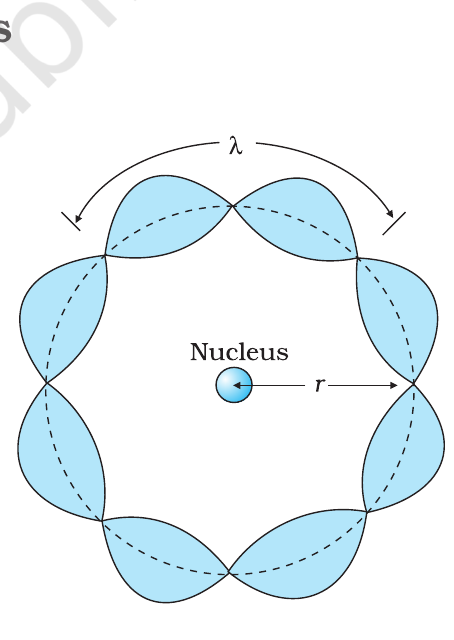
- It means that in a string, standing waves are formed when the total distance travelled by a wave down the string and back is one wavelength, two wavelengths, or any integral number of wavelengths. Waves with other wavelengths interfere with themselves upon reflection and their amplitudes quickly drop to zero. For an electron moving in nth circular orbit of radius r_n, the total distance is the circumference of the orbit, 2πr_n. $Thus 2πr_n = nλ$, $n = 1, 2, 3$... (12.12). Figure 12.8 illustrates a standing particle wave on a circular orbit for $n = 4$, i.e., $2πr_n = 4λ$, where λ is the de Broglie wavelength of the electron moving in nth orbit.
- From Chapter 11, we have $λ = h/p$, where p is the magnitude of the electron's momentum. If the speed of the electron is much less than the speed of light, the momentum is mv_n. Thus, $λ = h/mv_n$. From Eq. (12.12), we have $2πr_n = nh/mv_n$ or $mv_n r_n = nh/2π$. This is the quantum condition proposed by Bohr for the angular momentum of the electron. In Section 12.5, we saw that this equation is the basis of explaining the discrete orbits and energy levels in hydrogen atom. Thus de Broglie hypothesis provided an explanation for Bohr's second postulate for the quantisation of angular momentum of the orbiting electron. The quantised electron orbits and energy states are due to the wave nature of the electron and only resonant standing waves can persist.
- Note: NCERT 12.6 cites the quantum condition as [Eq. (12.15)]; the quantisation condition is Eq. (12.5) in this chapter, and Eq. (12.15) does not exist in Ch 12.
- Bohr's model, involving classical trajectory picture (planet-like electron orbiting the nucleus), correctly predicts the gross features of the hydrogenic atoms, in particular, the frequencies of the radiation emitted or selectively absorbed. This model however has many limitations. Some are: (i) The Bohr model is applicable to hydrogenic atoms. It cannot be extended even to mere two electron atoms such as helium. The analysis of atoms with more than one electron was attempted on the lines of Bohr's model for hydrogenic atoms but did not meet with any success. Difficulty lies in the fact that each electron interacts not only with the positively charged nucleus but also with all other electrons. The formulation of Bohr model involves electrical force between positively charged nucleus and electron. It does not include the electrical forces between electrons which necessarily appear in multi-electron atoms. (ii) While the Bohr's model correctly predicts the frequencies of the light emitted by hydrogenic atoms, the model is unable to explain the relative intensities of the frequencies in the spectrum. In emission spectrum of hydrogen, some of the visible frequencies have weak intensity, others strong. Why? Experimental observations depict that some transitions are more favoured than others. Bohr's model is unable to account for the intensity variations.
- Bohr's model presents an elegant picture of an atom and cannot be generalised to complex atoms. For complex atoms we have to use a new and radical theory based on Quantum Mechanics, which provides a more complete picture of the atomic structure. Hydrogenic atoms are the atoms consisting of a nucleus with positive charge +Ze and a single electron, where Z is the proton number. Examples are hydrogen atom, singly ionised helium, doubly ionised lithium, and so forth. In these atoms more complex electron-electron interactions are nonexistent.
Practice1 question
Try it now. A wrong answer costs nothing here, try again until you get it.
In Fig. 12.8, how many de Broglie wavelengths fit into the circumference of the circular orbit shown?
NCERT 12.6, Fig. 12.8: for $n = 4, 2πr_n = 4λ$, so four de Broglie wavelengths fit into the circumference of the orbit.
Table - Key Formulas of the Chapter
- All the formulas of sections 12.2 to 12.6 in one place. Symbols: m mass of the electron, e charge of the electron, Z atomic number, K kinetic energy of the α-particle, d distance of closest approach, r orbit radius, v electron speed, L angular momentum, n principal quantum number, h Planck's constant, ν frequency, λ de Broglie wavelength, p momentum, E total energy, U potential energy, ε₀ permittivity of free space, a₀ Bohr radius.
| Relation | Formula | Where |
|---|---|---|
| Coulomb force on an α-particle | $F = (1/(4πε₀))(2e)(Ze)/r^2$ | 12.2, Eq. (12.1) |
| Distance of closest approach | $d = 2Ze^2/(4πε₀K)$ | 12.2, Example 12.2 |
| Stable orbit, hydrogen | $(1/(4πε₀))(e^2/r^2) = mv^2/r$ | 12.2.2, Eq. (12.2) |
| Orbit radius and velocity | $r = e^2/(4πε₀mv^2)$ | 12.2.2, Eq. (12.3) |
| Kinetic and potential energy | $K = (1/2)mv^2 = e^2/(8πε₀r)$; $U = -e^2/(4πε₀r)$ | 12.2.2 |
| Total energy of the electron | $E = -e^2/(8πε₀r)$ | 12.2.2, Eq. (12.4) |
| Bohr quantisation | $L = nh/2π$ | 12.4, Eq. (12.5) |
| Photon on transition | $hν = E_i - E_f$ | 12.4, Eq. (12.6) |
| Radius of nth orbit | $r_n = (n^2/m)(h/2\pi)^2(4πε₀/e^2)$ | 12.4, Eq. (12.7) |
| Energy of nth state | $E_n = -me^4/(8n^2ε₀^2h^2)$ | 12.4, Eq. (12.8) |
| Energy in joules and eV | $E_n = -2.18 \times 10^{-18}/n^2 J$ = -13.6/$n^2$ eV | 12.4, Eqs. (12.9), (12.10) |
| Line frequency | $hν_if = E_ni - E_nf$ | 12.5, Eq. (12.11) |
| Standing wave condition | $2πr_n = nλ$ | 12.6, Eq. (12.12) |
| de Broglie wavelength | $λ = h/p = h/mv_n$ | 12.6 |
| Bohr radius | $a₀ = 5.3 \times 10^{-11} m$ | 12.4.1, Example 12.3 |
Worked Examples
- Example 12.1 In the Rutherford's nuclear model of the atom, the nucleus (radius about $10^{-15}$ m) is analogous to the sun about which the electron move in orbit (radius ≈ $10^{-10}$ m) like the earth orbits around the sun. If the dimensions of the solar system had the same proportions as those of the atom, would the earth be closer to or farther away from the sun than actually it is? The radius of earth's orbit is about 1.5 × $10^{11}$ m. The radius of sun is taken as 7 × $10^{8}$ m. The ratio of the radius of electron's orbit to the radius of nucleus is ($10^{-10}$ m)/($10^{-15}$ m) = $10^{5}$, so the radius of the earth's orbit would be $10^5 \times 7 \times 10^8 m = 7 \times 10^{13} m$. This is more than 100 times greater than the actual orbital radius of earth. Thus, the earth would be much farther away from the sun. It implies that an atom contains a much greater fraction of empty space than our solar system does.
- Example 12.2 In a Geiger-Marsden experiment, what is the distance of closest approach to the nucleus of a 7.7 MeV α-particle before it comes momentarily to rest and reverses its direction? From conservation of energy, $d = 2Ze^2/(4πε₀K) = 3.84 \times 10^{-16} Z m$. The atomic number of foil material gold is $Z = 79$, so that $d(Au) = 3.0 \times 10^{-14} m = 30 fm$. (1 fm, i.e. fermi, = $10^{-15}$ m.) The radius of gold nucleus is, therefore, less than 3.0 × $10^{-14}$ m. This is not in very good agreement with the observed result as the actual radius of gold nucleus is 6 fm. The cause of discrepancy is that the distance of closest approach is considerably larger than the sum of the radii of the gold nucleus and the α-particle. Thus, the α-particle reverses its motion without ever actually touching the gold nucleus.
- Example 12.3 It is found experimentally that 13.6 eV energy is required to separate a hydrogen atom into a proton and an electron. Compute the orbital radius and the velocity of the electron in a hydrogen atom. Total energy of the electron in hydrogen atom is -$13.6 eV = -2.2 \times 10^{-18} J$. From Eq. (12.4), the orbital radius is $r = 5.3 \times 10^{-11} m$. The velocity of the revolving electron from Eq. (12.3) with $m = 9.1 \times 10^{-31} kg$ is $v = 2.2 \times 10^6 m/s$.
- Example 12.4 According to the classical electromagnetic theory, calculate the initial frequency of the light emitted by the electron revolving around a proton in hydrogen atom. From Example 12.3 the velocity of electron moving around a proton in hydrogen atom in an orbit of radius 5.3 × $10^{-11}$ m is 2.2 × $10^{6}$ m/s. Thus, the frequency of the electron moving around the proton is $ν = v/(2πr) = 2.2 \times 10^{6}/(2π(5.3 \times 10^{-11} m)) ≈ 6.6 \times 10^{15} Hz$. The frequency of the electromagnetic waves emitted by the revolving electrons is equal to the frequency of its revolution around the nucleus. Thus the initial frequency of the light emitted is 6.6 × $10^{15}$ Hz.
Trap Pairs
- Thomson or Rutherford? If the positive charge is spread through the whole atom, that is Thomson's model. In Rutherford's model all the positive charge and most of the mass sit in the tiny nucleus, and the atom is mostly empty space.
- Most α-particles scatter widely? No. Most α-particles pass straight through the gold foil without any collision; only about 0.14% scatter by more than 1°, and only about 1 in 8000 deflect by more than 90°.
- The orbiting electron radiates and spirals in? Not in Bohr's model. An electron in a stationary state revolves without emitting radiant energy; the spiral into the nucleus is what classical theory predicts for Rutherford's atom (Fig. 12.6), and it is the failure Bohr's postulates fix.
- A bound electron has positive energy? No. The total energy of a bound electron is negative, $E_n = -13.6/n^2 eV$. Positive total energy means the electron is free, with a continuum of states above $E = 0 eV$.
- Bohr's model works for helium? No. Bohr's model applies only to hydrogenic (single electron) atoms. It cannot be extended even to a two electron atom such as helium, because the electron-electron force is left out.
- The light frequency equals the electron's revolution frequency? No. The frequency of the emitted photon is the difference of two orbital energies divided by h, $hν = E_i - E_f$. The revolution frequency and the spectral-line frequency are not connected, except for transitions between large quantum numbers.
Points to Ponder
- 1. Both the Thomson's as well as the Rutherford's models constitute an unstable system. Thomson's model is unstable electrostatically, while Rutherford's model is unstable because of electromagnetic radiation of orbiting electrons.
- 2. What made Bohr quantise angular momentum (second postulate) and not some other quantity? Note, h has dimensions of angular momentum, and for circular orbits, angular momentum is a very relevant quantity. The second postulate is then so natural!
- 3. The orbital picture in Bohr's model of the hydrogen atom was inconsistent with the uncertainty principle. It was replaced by modern quantum mechanics in which Bohr's orbits are regions where the electron may be found with large probability.
- 4. Unlike the situation in the solar system, where planet-planet gravitational forces are very small as compared to the gravitational force of the sun on each planet (because the mass of the sun is so much greater than the mass of any of the planets), the electron-electron electric force interaction is comparable in magnitude to the electron-nucleus electrical force, because the charges and distances are of the same order of magnitude. This is the reason why the Bohr's model with its planet-like electron is not applicable to many electron atoms.
- 5. Bohr laid the foundation of the quantum theory by postulating specific orbits in which electrons do not radiate. Bohr's model include only one quantum number n. The new theory called quantum mechanics supports Bohr's postulate. However in quantum mechanics (more generally accepted), a given energy level may not correspond to just one quantum state. For example, a state is characterised by four quantum numbers (n, l, m, and s), but for a pure Coulomb potential (as in hydrogen atom) the energy depends only on n.
- 6. In Bohr model, contrary to ordinary classical expectation, the frequency of revolution of an electron in its orbit is not connected to the frequency of spectral line. The later is the difference between two orbital energies divided by h. For transitions between large quantum numbers (n to n - 1, n very large), however, the two coincide as expected.
- 7. Bohr's semiclassical model based on some aspects of classical physics and some aspects of modern physics also does not provide a true picture of the simplest hydrogenic atoms. The true picture is quantum mechanical affair which differs from Bohr model in a number of fundamental ways. But then if the Bohr model is not strictly correct, why do we bother about it? The reasons which make Bohr's model still useful are: (i) The model is based on just three postulates but accounts for almost all the general features of the hydrogen spectrum. (ii) The model incorporates many of the concepts we have learnt in classical physics. (iii) The model demonstrates how a theoretical physicist occasionally must quite literally ignore certain problems of approach in hopes of being able to make some predictions. If the predictions of the theory or model agree with experiment, a theoretician then must somehow hope to explain away or rationalise the problems that were ignored along the way.
Summary
- 1. Atom, as a whole, is electrically neutral and therefore contains equal amount of positive and negative charges.
- 2. In Thomson's model, an atom is a spherical cloud of positive charges with electrons embedded in it.
- 3. In Rutherford's model, most of the mass of the atom and all its positive charge are concentrated in a tiny nucleus (typically one by ten thousand the size of an atom), and the electrons revolve around it.
- 4. Rutherford nuclear model has two main difficulties in explaining the structure of atom: (a) It predicts that atoms are unstable because the accelerated electrons revolving around the nucleus must spiral into the nucleus. This contradicts the stability of matter. (b) It cannot explain the characteristic line spectra of atoms of different elements.
- 5. Atoms of most of the elements are stable and emit characteristic spectrum. The spectrum consists of a set of isolated parallel lines termed as line spectrum. It provides useful information about the atomic structure.
- 6. To explain the line spectra emitted by atoms, as well as the stability of atoms, Niel's Bohr proposed a model for hydrogenic (single elctron) atoms. He introduced three postulates and laid the foundations of quantum mechanics: (a) In a hydrogen atom, an electron revolves in certain stable orbits (called stationary orbits) without the emission of radiant energy. (b) The stationary orbits are those for which the angular momentum is some integral multiple of h/2π. (Bohr's quantisation condition.) That is $L = nh/2π$, where n is an integer called the principal quantum number. (c) The third postulate states that an electron might make a transition from one of its specified non-radiating orbits to another of lower energy. When it does so, a photon is emitted having energy equal to the energy difference between the initial and final states. The frequency (ν) of the emitted photon is then given by $hν = E_i - E_f$. An atom absorbs radiation of the same frequency the atom emits, in which case the electron is transferred to an orbit with a higher value of n. $E_i + hν = E_f$.
- 7. As a result of the quantisation condition of angular momentum, the electron orbits the nucleus at only specific radii. For a hydrogen atom it is given by $r_n = (n^2/m)(h/2\pi)^2(4πε₀/e^2)$. The total energy is also quantised: $E_n = -me^4/(8n^2ε₀^2h^2) = -13.6 eV/n^2$. The $n = 1$ state is called ground state. In hydrogen atom the ground state energy is -13.6 eV. Higher values of n correspond to excited states (n > 1). Atoms are excited to these higher states by collisions with other atoms or electrons or by absorption of a photon of right frequency.
- 8. de Broglie's hypothesis that electrons have a wavelength $λ = h/mv gave$ an explanation for Bohr's quantised orbits by bringing in the wave-particle duality. The orbits correspond to circular standing waves in which the circumference of the orbit equals a whole number of wavelengths.
- 9. Bohr's model is applicable only to hydrogenic (single electron) atoms. It cannot be extended to even two electron atoms such as helium. This model is also unable to explain for the relative intensities of the frequencies emitted even by hydrogenic atoms.
- Print note: NCERT Summary point 6 prints "Niel's Bohr" and "(single elctron)"; both spellings are reproduced above exactly as printed. NCERT Summary point 9 prints "unable to explain for the relative intensities".
Exercises
- NCERT Exercises 12.1 to 12.9 (printed p. 305). Answers are not printed in NCERT; the answers below follow from the sections above.
- 12.1 Choose the correct alternative from the clues given at the end of the each statement: (a) The size of the atom in Thomson's model is no different from the atomic size in Rutherford's model. (b) In the ground state of Thomson's model electrons are in stable equilibrium, while in Rutherford's model electrons always experience a net force. (c) A classical atom based on Rutherford's model is doomed to collapse. (d) An atom has a nearly continuous mass distribution in a Thomson's model but has a highly non-uniform mass distribution in Rutherford's model. (e) The positively charged part of the atom possesses most of the mass in Rutherford's model.
- 12.2 Suppose you are given a chance to repeat the α-particle scattering experiment using a thin sheet of solid hydrogen in place of the gold foil. (Hydrogen is a solid at temperatures below 14 K.) What results do you expect? The hydrogen nucleus is a single proton, lighter than the α-particle, so it recoils and is knocked forward; there is no heavy fixed nucleus to throw the α-particle back, so the large-angle back-scattering seen with gold (about 1 in 8000 beyond 90°) would not appear.
- 12.3 A difference of 2.3 eV separates two energy levels in an atom. What is the frequency of radiation emitted when the atom make a transition from the upper level to the lower level? $ν = \Delta E/h = (2.3 \times 1.6 \times 10^{-19} J)/(6.6 \times 10^{-34} J s)$ = 5.6 × $10^{14}$ Hz.
- 12.4 The ground state energy of hydrogen atom is -13.6 eV. What are the kinetic and potential energies of the electron in this state? $K = -E = 13.6 eV$ and $U = 2E = -27.2 eV$.
- 12.5 A hydrogen atom initially in the ground level absorbs a photon, which excites it to the $n = 4$ level. Determine the wavelength and frequency of photon. The photon energy is $E₄ - E₁ = -0.85 eV - (-13.6 eV) = 12.75 eV$, so $λ = hc/E = 97 nm$ and $ν = c/λ = 3.1 \times 10^{15} Hz$.
- 12.6 (a) Using the Bohr's model calculate the speed of the electron in a hydrogen atom in the $n = 1, 2$, and 3 levels. (b) Calculate the orbital period in each of these levels. $v_n = 2.2 \times 10^6/n m/s$, so 2.2 × $10^{6}$ m/s, 1.1 × $10^{6}$ m/s and 0.73 × $10^{6}$ m/s. $T_n = 2πr_n/v_n$, so 1.5 × $10^{-16}$ s, 1.2 × $10^{-15}$ s and 4.1 × $10^{-15}$ s.
- 12.7 The radius of the innermost electron orbit of a hydrogen atom is 5.3 × $10^{-11}$ m. What are the radii of the $n = 2$ and $n = 3 orbits$? $r_n = n^2 r₁$, so $r₂ = 2.12 \times 10^{-10} m$ and $r₃ = 4.77 \times 10^{-10} m$.
- 12.8 A 12.5 eV electron beam is used to bombard gaseous hydrogen at room temperature. What series of wavelengths will be emitted? 12.5 eV can raise the atom to $n = 3 (12.09 eV needed)$ but not to $n = 4 (12.75 eV needed)$ and cannot ionise it. The emitted lines are Lyman 102.6 nm (3 to 1) and 121.5 nm (2 to 1), and Balmer 656 nm (3 to 2).
- 12.9 In accordance with the Bohr's model, find the quantum number that characterises the earth's revolution around the sun in an orbit of radius 1.5 × $10^{11}$ m with orbital speed 3 × $10^{4}$ m/s. (Mass of $\text{earth} = 6.0 \times 10^{24} kg$.)$L = mvr = 2.7 \times 10^{40} kg m^2/s$, so $n = L/(h/2π) = 2.7 \times 10^{40}/(1.05 \times 10^{-34}) ≈ 2.6 \times 10^{74}$.
Trap Boxes
Positive charge is spread through the whole atom
Wrong idea: In Rutherford's model the positive charge of the atom is spread uniformly through the whole volume of the atom.
In Rutherford's model all the positive charge and most of the mass sit in the tiny nucleus, and the atom is mostly empty space. The spread-out positive charge is Thomson's plum pudding model. NCERT 12.1, 12.2.
NCERT XII, Ch 12, 12.1, 12.2
Most α-particles scatter through large angles
Wrong idea: In the Geiger-Marsden experiment most of the α-particles are scattered through large angles by the gold foil.
Most α-particles pass straight through the gold foil without any collision. Only about 0.14% scatter by more than 1°, and only about 1 in 8000 deflect by more than 90°. NCERT 12.2, Fig. 12.3.
NCERT XII, Ch 12, 12.2, Fig. 12.3
The orbiting electron always radiates and spirals in
Wrong idea: An electron revolving around the nucleus must keep radiating energy and spiral into the nucleus.
An electron in a Bohr stationary state revolves without emitting radiant energy. The spiral into the nucleus is what classical theory predicts for Rutherford's atom (Fig. 12.6), and Bohr's first postulate is what stops it. NCERT 12.4.
NCERT XII, Ch 12, 12.4
A bound electron has positive total energy
Wrong idea: The total energy of the electron in a hydrogen atom is positive, since kinetic energy is positive.
The total energy of a bound electron is negative: $E_n = -13.6/n^2 eV$. Positive total energy means the electron is free, with a continuum of states above $E = 0 eV$. NCERT 12.4.1, Fig. 12.7.
NCERT XII, Ch 12, 12.4.1
Bohr's model works for helium
Wrong idea: Bohr's model works for helium just as it works for hydrogen.
Bohr's model applies only to hydrogenic (single electron) atoms. It cannot be extended even to a two electron atom such as helium, because it leaves out the electrical forces between electrons. NCERT 12.6.
NCERT XII, Ch 12, 12.6
Light frequency equals the electron's revolution frequency
Wrong idea: The frequency of the light an atom emits equals the frequency at which its electron revolves around the nucleus.
The frequency of the emitted photon is the difference of two orbital energies divided by h, $hν = E_i - E_f$. The revolution frequency and the spectral-line frequency are not connected, except for transitions between large quantum numbers. NCERT 12.4, Points to Ponder 6.
NCERT XII, Ch 12, 12.4, Points to Ponder 6
Chapter test
5 NEET PYQs. +4 for a correct answer, -1 for a wrong answer, exactly like NEET. Finish the test to earn a medal.
Q1: NEET (UG) 2023, Code F1, Q37
The radius of inner most orbit of hydrogen atom is 5.3 × $10^{-11}$ m. What is the radius of third allowed orbit of hydrogen atom?
$r_n = n^2 r_1$, so $r_3 = 9 \times 0.53$ Å = 4.77 Å. NCERT 12.4, Eq. (12.7).
Q2: NEET (UG) 2019, Code Q2, Q163
The total energy of an electron in an atom in an orbit is -3.4 eV. Its kinetic and potential energies are, respectively:
$K = -E = 3.4 eV$ and $U = 2E = -6.8 eV$, from $K = e^2/(8πε₀r)$ and $U = -e^2/(4πε₀r)$. NCERT 12.2.2, Eq. (12.4).
Q3: NEET (UG) 2019, Code Q2, Q154
α-particle consists of :
An α-particle is the nucleus of a helium atom: 2 protons and 2 neutrons, charge 2e, with no electrons. NCERT 12.2.
Q4: NEET (UG) 2019, Code Q2, Q111
Which of the following series of transitions in the spectrum of hydrogen atom fall in visible region?
$Balmer transitions (to n = 2) fall$ in the visible region. Lyman is ultraviolet and Paschen and Brackett are infrared. NCERT Fig. 12.5.
Q5: NEET (UG) 2016 (Phase I), Code B-Q-X, Q1
Given the value of Rydberg constant is $10^{7}$ m^-1, the wave number of the last line of the Balmer series in hydrogen spectrum will be:
The last line of the Balmer series has n_i going to infinity and n_f = 2, so 1/λ = R(1/4 - 0) = R/4 = ($10^{7}$)/4 = 0.25 × $10^{7}$ m^-1.
Score: 0 · Answered 0 of 5
Flashcards
Tap a card to flip it over and see the answer. Tap it again to flip it back.
What is the Coulomb force on an α-particle at distance r from a nucleus of charge Ze?
Tap to flip$F = (1/(4πε₀))(2e)(Ze)/r^2$ (12.1), where r is the distance between the α-particle and the nucleus and Z is the atomic number of the target atom.
Tap to flip backWhat is the distance of closest approach of an α-particle of kinetic energy K to a nucleus of charge Ze?
Tap to flip$d = 2Ze^2/(4πε₀K)$. For a 7.7 MeV α-particle on gold $(Z = 79), d(Au) = 3.0 \times 10^{-14} m = 30 fm$.
Tap to flip backWhat are the sizes of the nucleus and the atom in Rutherford's model?
Tap to flipNucleus about $10^{-15}$ m to $10^{-14}$ m; atom about $10^{-10}$ m, so the atom is 10,000 to 100,000 times larger than its nucleus and mostly empty space.
Tap to flip backIn the Geiger-Marsden experiment, what fraction of α-particles scatter by more than 1°, and what fraction deflect by more than 90°?
Tap to flipOnly about 0.14% of the incident α-particles scatter by more than 1°, and about 1 in 8000 deflect by more than 90°.
Tap to flip backGive the kinetic, potential and total energy of the electron in a hydrogen atom in terms of its orbit radius r.
Tap to flip$K = (1/2)mv^2 = e^2/(8πε₀r)$, $U = -e^2/(4πε₀r)$, $E = K + U = -e^2/(8πε₀r)$ (12.4). Negative E means the electron is bound to the nucleus.
Tap to flip backWhat is the Bohr radius, and what is the electron speed in the innermost orbit of hydrogen?
Tap to flip$a₀ = 5.3 \times 10^{-11} m$, the radius of the $n = 1$ orbit. The electron speed there is $v = 2.2 \times 10^6 m/s$.
Tap to flip backState Bohr's quantisation condition for the angular momentum of the electron.
Tap to flip$L = nh/2π$ (12.5), where $n = 1, 2, 3$, ... is the principal quantum number and $h = 6.6 \times 10^{-34} J s$ is Planck's constant.
Tap to flip backWhat is the radius of the nth Bohr orbit, and how does it scale with n?
Tap to flip$r_n = (n^2/m)(h/2\pi)^2(4πε₀/e^2)$ (12.7), so $r_n = n^2 a₀$. For hydrogen, $r_3 = 9 \times 5.3 \times 10^{-11} m = 4.77 \times 10^{-10} m$.
Tap to flip backWhat is the total energy of the electron in the nth stationary state of hydrogen?
Tap to flip$E_n = -2.18 \times 10^{-18}/n^2 J$ = -13.6/$n^2$ eV (12.9, 12.10). $E₁ = -13.6 eV, E₂ = -3.40 eV, E₃ = -1.51 eV, E₄ = -0.85 eV$.
Tap to flip backWhat is the ionisation energy of hydrogen, and what energy excites it to the first and second excited states?
Tap to flipIonisation energy from the ground state is 13.6 eV. The energy to excite hydrogen from $n = 1$ to $n = 2$ is $E₂ - E₁ = 10.2 eV$; to $n = 3$ it is 12.09 eV.
Tap to flip backWhat is the frequency of the photon emitted when an electron falls from a higher to a lower stationary state?
Tap to flip$hν = E_i - E_f$ (12.6); for a transition n_i to n_f, $hν_if = E_ni - E_nf$ (12.11). Absorption is the reverse: $E_i + hν = E_f$.
Tap to flip backWhat is de Broglie's standing-wave condition for the nth Bohr orbit?
Tap to flip$2πr_n = nλ$ (12.12), with $λ = h/p = h/mv_n$. For $n = 4$, four de Broglie wavelengths fit into the circumference (Fig. 12.8).
Tap to flip backFor which atoms is Bohr's model valid, and why does it fail for helium?
Tap to flipBohr's model applies only to hydrogenic (single electron) atoms: hydrogen, singly ionised helium, doubly ionised lithium. It cannot be extended even to helium, which has two electrons.
Tap to flip backWhat can Bohr's model not explain about the hydrogen spectrum, even for hydrogen itself?
Tap to flipBohr's model correctly predicts the frequencies of the light emitted by hydrogenic atoms, but it cannot explain the relative intensities of the frequencies in the spectrum.
Tap to flip backFrequently asked questions
Is it true that positive charge is spread through the whole atom?
In Rutherford's model all the positive charge and most of the mass sit in the tiny nucleus, and the atom is mostly empty space. The spread-out positive charge is Thomson's plum pudding model.
Is it true that most α-particles scatter through large angles?
Most α-particles pass straight through the gold foil without any collision. Only about 0.14% scatter by more than 1°, and only about 1 in 8000 deflect by more than 90°.
Is it true that the orbiting electron always radiates and spirals in?
An electron in a Bohr stationary state revolves without emitting radiant energy. The spiral into the nucleus is what classical theory predicts for Rutherford's atom (Fig. 12.6), and Bohr's first postulate is what stops it.
Is it true that a bound electron has positive total energy?
The total energy of a bound electron is negative: $E_n = -13.6/n^2 eV$. Positive total energy means the electron is free, with a continuum of states above $E = 0 eV$.
Is it true that Bohr's model works for helium?
Bohr's model applies only to hydrogenic (single electron) atoms. It cannot be extended even to a two electron atom such as helium, because it leaves out the electrical forces between electrons.