 NEET Notes
Nuclei
In every atom, the positive charge and mass are densely concentrated at the centre of the atom forming its nucleus.
On this page · 22 sections
- 01Syllabus Map
- 02Introduction
- 03Atomic Masses and the Atomic Mass Unit
- 04Composition of the Nucleus
- 05Isotopes, Isobars and Isotones
- 06Size of the Nucleus
- 07Mass-Energy Equivalence
- 08Mass Defect and Nuclear Binding Energy
- 09Binding Energy per Nucleon
- 10Table - Binding Energy per Nucleon (Fig. 13.1)
- 11Nuclear Force
- 12Radioactivity
- 13Extra Information (Beyond NCERT) - Law of Radioactive Decay, Half-Life and Activity
- 14Table - Physical Quantities of the Chapter
- 15Nuclear Energy and Fission
- 16Fusion and the Proton-Proton Cycle
- 17Table - Key Formulas of the Chapter
- 18Worked Examples
- 19Trap Pairs
- 20Points to Ponder
- 21Summary
- 22Exercises
Nuclear size, mass defect, binding energy, radioactivity, fission and fusion from NCERT Class 12 Ch 13, with 5 NEET PYQs.
Syllabus Map
- NMC Unit: PHYS-U18, Atoms and Nuclei (the nuclei half of the unit belongs to NCERT Ch 13; the atoms half belongs to NCERT Ch 12, not this chapter). NCERT Chapter 13, Nuclei (Class XII, printed pp. 305-322, Reprint 2026-27).
- NMC nuclei items covered here: composition and size of nucleus, atomic masses, mass-energy relation, mass defect, binding energy per nucleon and its variation with mass number, nuclear fission, and fusion. All of them are in this chapter.
- Radioactivity (section 13.6) is in NCERT Ch 13 but is not named in NMC Unit 18. It stays because it is NCERT content and NEET asks it (NEET 2024 R3 Q3, 2021 P3 Q14).
- One section of this chapter is labelled "Extra information (beyond NCERT)": the law of radioactive decay, half-life, mean life and activity. The rationalised NCERT Ch 13 names the quantities (disintegration constant, half-life, mean life, activity) in its Physical Quantity table on printed p. 319 but gives no decay-law formula, and NMC Unit 18 does not list radioactivity; the formulas are kept in one compact labelled section because NEET asks half-life questions (NEET 2023 F1 Q27, 2021 P3 Q19).
- How to use this chapter: learn the composition and the size law first (sections 3-6), then mass-energy and binding energy (sections 7-10), then the nuclear force and radioactivity (sections 11-13), then fission and fusion (sections 15-16). The worked examples (section 18) and the NCERT exercises (section 22) use the same numbers NCERT prints.
Introduction
- In the previous chapter we learnt that in every atom, the positive charge and mass are densely concentrated at the centre of the atom forming its nucleus. The overall dimensions of a nucleus are much smaller than those of an atom. Experiments on scattering of α-particles demonstrated that the radius of a nucleus was smaller than the radius of an atom by a factor of about $10^{4}$. This means the volume of a nucleus is about $10^{-12}$ times the volume of the atom. In other words, an atom is almost empty. If an atom is enlarged to the size of a classroom, the nucleus would be of the size of pinhead. Nevertheless, the nucleus contains most (more than 99.9%) of the mass of an atom.
- Does the nucleus have a structure, just as the atom does? If so, what are the constituents of the nucleus? How are these held together? In this chapter we shall look for answers to such questions. We shall discuss various properties of nuclei such as their size, mass and stability, and also associated nuclear phenomena such as radioactivity, fission and fusion.
Atomic Masses and the Atomic Mass Unit
- The mass of an atom is very small, compared to a kilogram; for example, the mass of a carbon atom, 12C, is 1.992647 × $10^{-26}$ kg. Kilogram is not a very convenient unit to measure such small quantities. Therefore, a different mass unit is used for expressing atomic masses. This unit is the atomic mass unit (u), defined as 1/12th of the mass of the carbon (12C) atom. According to this definition 1u = (mass of one 12C atom)$/12 = (1.992647 \times 10^{-26} kg)/12$ = 1.660539 × $10^{-27}$ kg (13.1). NCERT's Summary prints the same constant as 1.660563 × $10^{-27}$ kg.
- The atomic masses of various elements expressed in atomic mass unit (u) are close to being integral multiples of the mass of a hydrogen atom. There are, however, many striking exceptions to this rule. For example, the atomic mass of chlorine atom is 35.46 u.
- Accurate measurement of atomic masses is carried out with a mass spectrometer. The measurement of atomic masses reveals the existence of different types of atoms of the same element, which exhibit the same chemical properties, but differ in mass. Such atomic species of the same element differing in mass are called isotopes. (In Greek, isotope means the same place, i.e. they occur in the same place in the periodic table of elements.) It was found that practically every element consists of a mixture of several isotopes.
- Chlorine, for example, has two isotopes having masses 34.98 u and 36.98 u, which are nearly integral multiples of the mass of a hydrogen atom. The relative abundances of these isotopes are 75.4 and 24.6 per cent, respectively. Thus, the average mass of a chlorine atom is obtained by the weighted average of the masses of the two isotopes, which works out to be (75.4 × 34.98 + 24.6 × 36.98)/100 = 35.47 u, which agrees with the atomic mass of chlorine.
Composition of the Nucleus
- Even the lightest element, hydrogen has three isotopes having masses 1.0078 u, 2.0141 u, and 3.0160 u. The nucleus of the lightest atom of hydrogen, which has a relative abundance of 99.985%, is called the proton. The mass of a proton is $m_p = 1.00727 u = 1.67262 \times 10^{-27} kg$ (13.2). This is equal to the mass of the hydrogen atom (= 1.00783 u), minus the mass of a single electron $(m_e = 0.00055 u)$. The other two isotopes of hydrogen are called deuterium and tritium. Tritium nuclei, being unstable, do not occur naturally and are produced artificially in laboratories.
- The positive charge in the nucleus is that of the protons. A proton carries one unit of fundamental charge and is stable. It was earlier thought that the nucleus may contain electrons, but this was ruled out later using arguments based on quantum theory. All the electrons of an atom are outside the nucleus. We know that the number of these electrons outside the nucleus of the atom is Z, the atomic number. The total charge of the atomic electrons is thus (-Ze), and since the atom is neutral, the charge of the nucleus is (+Ze). The number of protons in the nucleus of the atom is, therefore, exactly Z, the atomic number.
- Discovery of Neutron: since the nuclei of deuterium and tritium are isotopes of hydrogen, they must contain only one proton each. But the masses of the nuclei of hydrogen, deuterium and tritium are in the ratio of 1:2:3. Therefore, the nuclei of deuterium and tritium must contain, in addition to a proton, some neutral matter. This hypothesis was verified in 1932 by James Chadwick who observed emission of neutral radiation when beryllium nuclei were bombarded with alpha-particles (α-particles are helium nuclei, to be discussed in a later section). The clue to this puzzle, which Chadwick satisfactorily solved, was to assume that the neutral radiation consists of a new type of neutral particles called neutrons. From conservation of energy and momentum, he was able to determine the mass of new particle 'as very nearly the same as mass of proton'.
- The mass of a neutron is now known to a high degree of accuracy. It is $m_n = 1.00866 u = 1.6749 \times 10^{-27} kg$ (13.3). Chadwick was awarded the 1935 Nobel Prize in Physics for his discovery of the neutron.
- A free neutron, unlike a free proton, is unstable. It decays into a proton, an electron and a antineutrino (another elementary particle), and has a mean life of about 1000 s. It is, however, stable inside the nucleus. NCERT prints "a antineutrino".
- The composition of a nucleus can now be described using the following terms and symbols: Z - atomic $number = number$ of protons [13.4(a)]; N - neutron $number = number$ of neutrons [13.4(b)]; A - *mass $number = Z + N$ = total number of protons and neutrons [13.4(c)]. One also uses the term nucleon for a proton or a neutron. Thus the number of nucleons in an atom is its mass number A.
- Nuclear species or nuclides are shown by the notation A/Z X where X is the chemical symbol of the species. For example, the nucleus of gold is denoted by 197/79 Au. It contains 197 nucleons, of which 79 are protons and the rest 118 are neutrons.
Isotopes, Isobars and Isotones
- The composition of isotopes of an element can now be readily explained. The nuclei of isotopes of a given element contain the same number of protons, but differ from each other in their number of neutrons. Deuterium, 2/1 H, which is an isotope of hydrogen, contains one proton and one neutron. Its other isotope tritium, 3/1 H, contains one proton and two neutrons. The element gold has 32 isotopes, ranging from $A = 173$ to $A = 204$. We have already mentioned that chemical properties of elements depend on their electronic structure. As the atoms of isotopes have identical electronic structure they have identical chemical behaviour and are placed in the same location in the periodic table.
- All nuclides with same mass number A are called isobars. For example, the nuclides 3/1 H and 3/2 He are isobars. Nuclides with same neutron number N but different atomic number Z, for example 198/80 Hg and 197/79 Au, are called isotones.
Size of the Nucleus
- As we have seen in Chapter 12, Rutherford was the pioneer who postulated and established the existence of the atomic nucleus. At Rutherford's suggestion, Geiger and Marsden performed their classic experiment: on the scattering of α-particles from thin gold foils. Their experiments revealed that the distance of closest approach to a gold nucleus of an α-particle of kinetic energy 5.5 MeV is about 4.0 × $10^{-14}$ m. Since the positive charge is confined to the nucleus, the actual size of the nucleus has to be less than 4.0 × $10^{-14}$ m.
- If we use α-particles of higher energies than 5.5 MeV, the distance of closest approach to the gold nucleus will be smaller and at some point the scattering will begin to be affected by the short range nuclear forces, and differ from Rutherford's calculations. From the distance at which deviations set in, nuclear sizes can be inferred.
- By performing scattering experiments in which fast electrons, instead of α-particles, are projectiles that bombard targets made up of various elements, the sizes of nuclei of various elements have been accurately measured.
- It has been found that a nucleus of mass number A has a radius $R = R_0 A^{1/3}$ (13.5), where R_0 = 1.2 × $10^{-15}$ m (= 1.2 fm; 1 $fm = 10^{-15} m$). This means the volume of the nucleus, which is proportional to $R^3$, is proportional to A. Thus the density of nucleus is a constant, independent of A, for all nuclei. Different nuclei are like a drop of liquid of constant density. The density of nuclear matter is approximately 2.3 × $10^{17}$ kg m^-3. This density is very large compared to ordinary matter, say water, which is $10^{3}$ kg m^-3. This is understandable, as we have already seen that most of the atom is empty. Ordinary matter consisting of atoms has a large amount of empty space.
- Example 13.1: given the mass of iron nucleus as 55.85 u and $A = 56$, find the nuclear density. $m_Fe = 55.85 u = 9.27 \times 10^{-26} kg$. Nuclear density = mass/volume = (9.27 × $10^{-26}$)/((4π/3)$(1.2 \times 10^{-15})^3$ × 56) = 2.29 × $10^{17}$ kg m^-3. The density of matter in neutron stars (an astrophysical object) is comparable to this density. This shows that matter in these objects has been compressed to such an extent that they resemble a big nucleus.
Practice1 question
Try it now. A wrong answer costs nothing here, try again until you get it.
What is the approximate ratio of the nuclear radii of the gold isotope 197/79 Au and the silver isotope 107/47 Ag?
$NCERT 13.3: R = R_0 A^{1/3}$, so the ratio is $(197/107)^{1/3} = 1.23$.
Mass-Energy Equivalence
- Einstein showed from his theory of special relativity that it is necessary to treat mass as another form of energy. Before the advent of this theory of special relativity it was presumed that mass and energy were conserved separately in a reaction. However, Einstein showed that mass is another form of energy and one can convert mass-energy into other forms of energy, say kinetic energy and vice-versa.
- Einstein gave the famous mass-energy equivalence relation $E = mc^2$ (13.6). Here the energy equivalent of mass m is related by the above equation and c is the velocity of light in vacuum and is approximately equal to 3 × $10^{8}$ m s^-1.
- Example 13.2: calculate the energy equivalent of 1 g of substance. Energy, $E = 10^{-3} \times (3 \times 10^8)^2 J = 10^{-3} \times 9 \times 10^{16} = 9 \times 10^{13} J$. Thus, if one gram of matter is converted to energy, there is a release of enormous amount of energy.
- Experimental verification of the Einstein's mass-energy relation has been achieved in the study of nuclear reactions amongst nucleons, nuclei, electrons and other more recently discovered particles. In a reaction the conservation law of energy states that the initial energy and the final energy are equal provided the energy associated with mass is also included. This concept is important in understanding nuclear masses and the interaction of nuclei with one another.
Mass Defect and Nuclear Binding Energy
- In Section 13.2 we have seen that the nucleus is made up of neutrons and protons. Therefore it may be expected that the mass of the nucleus is equal to the total mass of its individual protons and neutrons. However, the nuclear mass M is found to be always less than this. For example, let us consider 16/8 O; a nucleus which has 8 neutrons and 8 protons. We have: mass of 8 $neutrons = 8 \times 1.00866 u$; mass of 8 $protons = 8 \times 1.00727 u$; mass of 8 $electrons = 8 \times 0.00055 u$. Therefore the expected mass of 16/8 O nucleus = 8 $\times 2.01593 u = 16.12744 u$. The atomic mass of 16/8 O found from mass spectroscopy experiments is seen to be 15.99493 u. Substracting the mass of 8 electrons (8 × 0.00055 u) from this, we get the experimental mass of 16/8 O nucleus to be 15.99053 u. NCERT prints "Substracting".
- Thus, we find that the mass of the 16/8 O nucleus is less than the total mass of its constituents by 0.13691 u. The difference in mass of a nucleus and its constituents, $\Delta M$, is called the mass defect, and is given $by \delta M = [Zm_p + (A - Z)m_n] - M$ (13.7).
- What is the meaning of the mass defect? It is here that Einstein's equivalence of mass and energy plays a role. Since the mass of the oxygen nucleus is less that the sum of the masses of its constituents (8 protons and 8 neutrons, in the unbound state), the equivalent energy of the oxygen nucleus is less than that of the sum of the equivalent energies of its constituents. If one wants to break the oxygen nucleus into 8 protons and 8 neutrons, this extra energy $\Delta M$ $c^2$ has to be supplied. This energy required E_b is related to the mass defect by $E_b = \delta M c^2$ (13.8). NCERT prints "less that the sum".
- Example 13.3: find the energy equivalent of one atomic mass unit, first in Joules and then in MeV. Using this, express the mass defect of 16/8 O in MeV/$c^2$. $1u = 1.6605 \times 10^{-27} kg$. To convert it into energy units, we multiply it by $c^2$ and find that energy $equivalent = 1.6605 \times 10^{-27} \times (2.9979 \times 10^8)^2 kg m^2/s^2 = 1.4924 \times 10^{-10} J = (1.4924 \times 10^{-10})/(1.602 \times 10^{-19}) eV = 0.9315 \times 10^{9} eV = 931.5 MeV$, or, $1u = 931.5 MeV/c^2$. For 16/8 O, $\Delta M = 0.13691 u = 0.13691 \times 931.5 MeV/c^2 = 127.5 MeV/c^2$. The energy needed to separate 16/8 O into its constituents is thus 127.5 MeV/$c^2$, as NCERT prints it.
- If a certain number of neutrons and protons are brought together to form a nucleus of a certain charge and mass, an energy E_b will be released in the process. The energy E_b is called the binding energy of the nucleus. If we separate a nucleus into its nucleons, we would have to supply a total energy equal to E_b, to those particles. Although we cannot tear apart a nucleus in this way, the nuclear binding energy is still a convenient measure of how well a nucleus is held together. A more useful measure of the binding between the constituents of the nucleus is the binding energy per nucleon, E_bn, which is the ratio of the binding energy E_b of a nucleus to the number of the nucleons, A, in that nucleus: $E_bn = E_b/A$ (13.9). We can think of binding energy per nucleon as the average energy per nucleon needed to separate a nucleus into its individual nucleons.
Practice1 question
Try it now. A wrong answer costs nothing here, try again until you get it.
What is the binding energy of a nitrogen nucleus (14/7 N), given $m(14/7 N) = 14.00307 u$?
NCERT 13.4.2, Exercise 13.1: $\Delta M$ = 7 × 1.00727 + 7 × 1.00866 - 14.00307 = 0.10844 u. $E_b = 0.10844 \times 931.5$ = 101.0 MeV.
Binding Energy per Nucleon

- Figure 13.1 is a plot of the binding energy per nucleon E_bn versus the mass number A for a large number of nuclei. We notice the following main features of the plot: (i) the binding energy per nucleon, E_bn, is practically constant, i.e. practically independent of the atomic number for nuclei of middle mass number (30 < A < 170). The curve has a maximum of about 8.75 MeV for $A = 56$ and has a value of 7.6 MeV for $A = 238$. (ii) E_bn is lower for both light nuclei (A < 30) and heavy nuclei (A > 170).
- We can draw some conclusions from these two observations: (i) The force is attractive and sufficiently strong to produce a binding energy of a few MeV per nucleon. (ii) The constancy of the binding energy in the range 30 < A < 170 is a consequence of the fact that the nuclear force is short-ranged. Consider a particular nucleon inside a sufficiently large nucleus. It will be under the influence of only some of its neighbours, which come within the range of the nuclear force. If any other nucleon is at a distance more than the range of the nuclear force from the particular nucleon it will have no influence on the binding energy of the nucleon under consideration. If a nucleon can have a maximum of p neighbours within the range of nuclear force, its binding energy would be proportional to p. Let the binding energy of the nucleus be pk, where k is a constant having the dimensions of energy. If we increase A by adding nucleons they will not change the binding energy of a nucleon inside. Since most of the nucleons in a large nucleus reside inside it and not on the surface, the change in binding energy per nucleon would be small. The binding energy per nucleon is a constant and is approximately equal to pk. The property that a given nucleon influences only nucleons close to it is also referred to as saturation property of the nuclear force.
- (iii) A very heavy nucleus, $say A = 240$, has lower binding energy per nucleon compared to that of a nucleus with $A = 120$. Thus if a nucleus $A = 240 breaks$ into two $A = 120$ nuclei, nucleons get more tightly bound. This implies energy would be released in the process. It has very important implications for energy production through fission, to be discussed later in Section 13.7.1. (iv) Consider two very light nuclei (A ≤ 10) joining to form a heavier nucleus. The binding energy per nucleon of the fused heavier nuclei is more than the binding energy per nucleon of the lighter nuclei. This means that the final system is more tightly bound than the initial system. Again energy would be released in such a process of fusion. This is the energy source of sun, to be discussed later in Section 13.7.2.
- NCERT's Fig. 13.1 labels the plotted nuclides 2H, 3H, 4He, 6Li, 12C, 14N, 16O, 18O, 32S, 56Fe, 100Mo, 127I, 184W, 197An and 238U. NCERT prints the gold-197 label as "197An", not Au.
Table - Binding Energy per Nucleon (Fig. 13.1)
- The binding energy per nucleon read off Fig. 13.1 and the text of Section 13.4.2. The middle of the curve is nearly flat, and the curve falls away at both ends.
| Mass number A | Binding energy per nucleon E_bn | What it means |
|---|---|---|
| A < 30 (light nuclei) | Lower than the middle, rising steeply from about 1.1 MeV for 2H | Light nuclei gain binding energy by fusing |
| 30 < A < 170 (middle nuclei) | Practically constant, about 8 MeV | Most tightly bound region, nearly flat |
| $A = 56 (56Fe)$ | Maximum, about 8.75 MeV | The most tightly bound nucleus on the curve |
| $A = 238 (238U)$ | 7.6 MeV | Heavy nuclei sit below the maximum |
| A > 170 (heavy nuclei) | Lower than the middle, falling slowly | Heavy nuclei gain binding energy by splitting |
- The same numbers drive the energy estimates of Section 13.7: a nucleus with $A = 240$ has E_bn about 7.6 MeV and its $A = 120 fragments$ have E_bn about 8.5 MeV, so the gain is about 0.9 MeV per nucleon, or 240 × 0.9 = 216 MeV in total.
Nuclear Force
- The force that determines the motion of atomic electrons is the familiar Coulomb force. In Section 13.4, we have seen that for average mass nuclei the binding energy per nucleon is approximately 8 MeV, which is much larger than the binding energy in atoms. Therefore, to bind a nucleus together there must be a strong attractive force of a totally different kind. It must be strong enough to overcome the repulsion between the (positively charged) protons and to bind both protons and neutrons into the tiny nuclear volume. We have already seen that the constancy of binding energy per nucleon can be understood in terms of its short-range. Many features of the nuclear binding force are summarised below. These are obtained from a variety of experiments carried out during 1930 to 1950.
- (i) The nuclear force is much stronger than the Coulomb force acting between charges or the gravitational forces between masses. The nuclear binding force has to dominate over the Coulomb repulsive force between protons inside the nucleus. This happens only because the nuclear force is much stronger than the coulomb force. The gravitational force is much weaker than even Coulomb force.
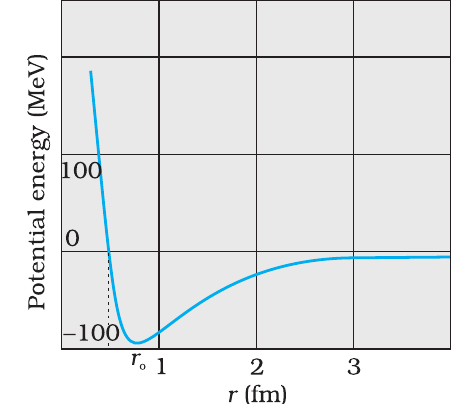
- (ii) The nuclear force between two nucleons falls rapidly to zero as their distance is more than a few femtometres. This leads to saturation of forces in a medium or a large-sized nucleus, which is the reason for the constancy of the binding energy per nucleon. A rough plot of the potential energy between two nucleons as a function of distance is shown in the Fig. 13.2. The potential energy is a minimum at a distance r_0 of about 0.8 fm. This means that the force is attractive for distances larger than 0.8 fm and repulsive if they are separated by distances less than 0.8 fm.
- (iii) The nuclear force between neutron-neutron, proton-neutron and proton-proton is approximately the same. The nuclear force does not depend on the electric charge. Unlike Coulomb's law or the Newton's law of gravitation there is no simple mathematical form of the nuclear force.
Radioactivity
- A. H. Becquerel discovered radioactivity in 1896 purely by accident. While studying the fluorescence and phosphorescence of compounds irradiated with visible light, Becquerel observed an interesting phenomenon. After illuminating some pieces of uranium-potassium sulphate with visible light, he wrapped them in black paper and separated the package from a photographic plate by a piece of silver. When, after several hours of exposure, the photographic plate was developed, it showed blackening due to something that must have been emitted by the compound and was able to penetrate both black paper and the silver.
- Experiments performed subsequently showed that radioactivity was a nuclear phenomenon in which an unstable nucleus undergoes a decay. This is referred to as radioactive decay. Three types of radioactive decay occur in nature: (i) α-decay in which a helium nucleus 4/2 He is emitted; (ii) β-decay in which electrons or positrons (particles with the same mass as electrons, but with a charge exactly opposite to that of electron) are emitted; (iii) γ-decay in which high energy (hundreds of keV or more) photons are emitted.
- NCERT's Summary (point 10) adds: radioactivity is the phenomenon in which nuclei of a given species transform by giving out α or β or γ rays; α-rays are helium nuclei; β-rays are electrons. γ-rays are electromagnetic radiation of wavelengths shorter than X-rays.
Extra Information (Beyond NCERT) - Law of Radioactive Decay, Half-Life and Activity
- Extra information (beyond NCERT): this section is not in the rationalised NCERT Ch 13. The chapter names the quantities in its Physical Quantity table on printed p. 319 (disintegration constant λ, half-life T_1/2, mean life τ, activity R) but gives no formula for how a sample decays. The formulas below are the ones NEET uses (NEET 2023 F1 Q27, 2021 P3 Q19).
- The number N of undecayed nuclei falls exponentially with time: $N = N_0 e^(-λt)$, where N_0 is the number at $t = 0$ and λ is the disintegration or decay constant. The activity R, the rate of decay, follows the same fall: $R = λN = R_0 e^(-λt)$, where $R_0 = λN_0$ is the initial activity.
- The half-life T_1/2 is the time in which half the nuclei decay: $T_1/2 = (\ln 2)/λ = 0.693/λ$. After n half-lives the fraction left is (1/2$)^n$. The mean life τ is the average life of a nucleus: $τ = 1/λ = T_1/2/(\ln 2) = 1.44 \times T_1/2$. At t = τ the number has fallen to $e^{-1}$, about 0.37, of its initial value.
- Worked check with $NEET 2023 F1 Q27: T_1/2 = 20 \text{minutes}$ and the activity must fall to (1/16) of its value. $(1/16) = (1/2)^4$, so 4 half-lives pass, and 4 × 20 = 80 minutes.
Practice1 question
Try it now. A wrong answer costs nothing here, try again until you get it.
The half-life of a radioactive substance is 20 minutes. In how much time will its activity drop to (1/8)th of its initial value?
Extra information, section 13: $(1/8) = (1/2)^3$, so 3 half-lives pass. 3 × 20 = 60 minutes.
Table - Physical Quantities of the Chapter
- The Physical Quantity table printed on p. 319 of NCERT Ch 13, reproduced as it stands. NCERT leaves the Symbol cell of the atomic mass unit row blank.
| Physical Quantity | Symbol | Dimensions | Units | Remarks |
|---|---|---|---|---|
| Atomic mass unit | $[M]$ | u | Unit of mass for expressing atomic or nuclear masses. One atomic mass unit equals 1/12th of the mass of 12C atom. | |
| Disintegration or decay constant | λ | $[T^{-1}]$ | s^-1 | |
| Half-life | T_1/2 | $[T]$ | s | Time taken for the decay of one-half of the initial number of nuclei present in a radioactive sample. |
| Mean life | τ | $[T]$ | s | Time at which number of nuclei has been reduced to $e^{-1}$ of its initial value |
| Activity of a radioactive sample | R | $[T^{-1}]$ | Bq | Measure of the activity of a radioactive source. |
Nuclear Energy and Fission
- The curve of binding energy per nucleon E_bn, given in Fig. 13.1, has a long flat middle region between $A = 30$ and $A = 170$. In this region the binding energy per nucleon is nearly constant (8.0 MeV). For the lighter nuclei region, A < 30, and for the heavier nuclei region, A > 170, the binding energy per nucleon is less than 8.0 MeV, as we have noted earlier. Now, the greater the binding energy, the less is the total mass of a bound system, such as a nucleus. Consequently, if nuclei with less total binding energy transform to nuclei with greater binding energy, there will be a net energy release. This is what happens when a heavy nucleus decays into two or more intermediate mass fragments (fission) or when light nuclei fuse into a havier nucleus (fusion). NCERT prints "havier".
- Exothermic chemical reactions underlie conventional energy sources such as coal or petroleum. Here the energies involved are in the range of electron volts. On the other hand, in a nuclear reaction, the energy release is of the order of MeV. Thus for the same quantity of matter, nuclear sources produce a million times more energy than a chemical source. Fission of 1 kg of uranium, for example, generates $10^{14}$ J of energy; compare it with burning of 1 kg of coal that gives $10^{7}$ J.
- Fission (13.7.1): new possibilities emerge when we go beyond natural radioactive decays and study nuclear reactions by bombarding nuclei with other nuclear particles such as proton, neutron, α-particle, etc. A most important neutron-induced nuclear reaction is fission. An example of fission is when a uranium isotope 235/92 U bombarded with a neutron breaks into two intermediate mass nuclear fragments: 1/0 n + 235/92 U → 236/92 U → 144/56 Ba + 89/36 Kr + 3 1/0 n (13.10). The same reaction can produce other pairs of intermediate mass fragments: 1/0 n + 235/92 U → 236/92 U → 133/51 Sb + 99/41 Nb + 4 1/0 n (13.11). Or, as another example, 1/0 n + 235/92 U → 140/54 Xe + 94/38 Sr + 2 1/0 n (13.12). The fragment products are radioactive nuclei; they emit β particles in succession to achieve stable end products.
- The energy released (the Q value) in the fission reaction of nuclei like uranium is of the order of 200 MeV per fissioning nucleus. This is estimated as follows: let us take a nucleus with $A = 240 breaking$ into two fragments each of $A = 120$. Then E_bn for $A = 240$ nucleus is about 7.6 MeV, E_bn for the two $A = 120 fragment$ nuclei is about 8.5 MeV. Gain in binding energy for nucleon is about 0.9 MeV. Hence the total gain in binding energy is 240 × 0.9 or 216 MeV.
- The disintegration energy in fission events first appears as the kinetic energy of the fragments and neutrons. Eventually it is transferred to the surrounding matter appearing as heat. The source of energy in nuclear reactors, which produce electricity, is nuclear fission. The enormous energy released in an atom bomb comes from uncontrolled nuclear fission.
Practice1 question
Try it now. A wrong answer costs nothing here, try again until you get it.
A nucleus with mass number 200 breaks into two fragments each of mass number 100. The binding energy per nucleon of the unfragmented nucleus is 7.8 MeV and that of the fragments is 8.4 MeV. What is the total gain in binding energy?
NCERT 13.7.1 method: gain per nucleon is $8.4 - 7.8 = 0.6 MeV$. Total gain is 200 × 0.6 = 120 MeV.
Fusion and the Proton-Proton Cycle
- Nuclear fusion - energy generation in stars (13.7.2): when two light nuclei fuse to form a larger nucleus, energy is released, since the larger nucleus is more tightly bound, as seen from the binding energy curve in Fig. 13.1. Some examples of such energy liberating nuclear fusion reactions are: 1/1 H + 1/1 H → 2/1 H + e+ + ν + 0.42 MeV [13.13(a)]; 2/1 H + 2/1 H → 3/2 He + n + 3.27 MeV [13.13(b)]; 2/1 H + 2/1 H → 3/1 H + 1/1 H + 4.03 MeV [13.13(c)]. In the first reaction, two protons combine to form a deuteron and a positron with a release of 0.42 MeV energy. In reaction [13.13(b)], two deuterons combine to form the light isotope of helium. In reaction (13.13c), two deuterons combine to form a triton and a proton.
- For fusion to take place, the two nuclei must come close enough so that attractive short-range nuclear force is able to affect them. However, since they are both positively charged particles, they experience coulomb repulsion. They, therefore, must have enough energy to overcome this coulomb barrier. The height of the barrier depends on the charges and radii of the two interacting nuclei. It can be shown, for example, that the barrier height for two protons is ~ 400 keV, and is higher for nuclei with higher charges. We can estimate the temperature at which two protons in a proton gas would (averagely) have enough energy to overcome the coulomb barrier: $(3/2)kT = K$ ≃ 400 keV, which gives T ~ 3 × $10^{9}$ K.
- When fusion is achieved by raising the temperature of the system so that particles have enough kinetic energy to overcome the coulomb repulsive behaviour, it is called thermonuclear fusion. Thermonuclear fusion is the source of energy output in the interior of stars. The interior of the sun has a temperature of 1.5 × $10^{7}$ K, which is considerably less than the estimated temperature required for fusion of particles of average energy. Clearly, fusion in the sun involves protons whose energies are much above the average energy.
- The fusion reaction in the sun is a multi-step process in which the hydrogen is burned into helium. Thus, the fuel in the sun is the hydrogen in its core. The proton-proton (p, p) cycle by which this occurs is represented by the following sets of reactions: 1/1 H + 1/1 H → 2/1 H + e+ + ν + 0.42 MeV (i); e+ + e- → γ + γ + 1.02 MeV (ii); 2/1 H + 1/1 H → 3/2 He + γ + 5.49 MeV (iii); 3/2 He + 3/2 He → 4/2 He + 1/1 H + 1/1 H + 12.86 MeV (iv) (13.14). For the fourth reaction to occur, the first three reactions must occur twice, in which case two light helium nuclei unite to form ordinary helium nucleus. If we consider the combination 2(i) + 2(ii) + 2(iii) + (iv), the net effect is 4 1/1 H + 2e- → 4/2 He + 2ν + 6γ + 26.7 MeV, or (4 1/1 H + 4e-) → (4/2 He + 2e-) + 2ν + 6γ + 26.7 MeV (13.15). Thus, four hydrogen atoms combine to form an 4/2 He atom with a release of 26.7 MeV of energy. NCERT prints "an 4/2 He atom".
- Helium is not the only element that can be synthesized in the interior of a star. As the hydrogen in the core gets depleted and becomes helium, the core starts to cool. The star begins to collapse under its own gravity which increases the temperature of the core. If this temperature increases to about $10^{8}$ K, fusion takes place again, this time of helium nuclei into carbon. This kind of process can generate through fusion higher and higher mass number elements. But elements more massive than those near the peak of the binding energy curve in Fig. 13.1 cannot be so produced.
- The age of the sun is about 5 × $10^{9}$ y and it is estimated that there is enough hydrogen in the sun to keep it going for another 5 billion years. After that, the hydrogen burning will stop and the sun will begin to cool and will start to collapse under gravity, which will raise the core temperature. The outer envelope of the sun will expand, turning it into the so called red giant.
- Controlled thermonuclear fusion (13.7.3): the natural thermonuclear fusion process in a star is replicated in a thermonuclear fusion device. In controlled fusion reactors, the aim is to generate steady power by heating the nuclear fuel to a temperature in the range of $10^{8}$ K. At these temperatures, the fuel is a mixture of positive ions and electrons (plasma). The challenge is to confine this plasma, since no container can stand such a high temperature. Several countries around the world including India are developing techniques in this connection. If successful, fusion reactors will hopefully supply almost unlimited power to humanity.
Practice1 question
Try it now. A wrong answer costs nothing here, try again until you get it.
The Coulomb barrier for two protons is about 400 keV. At about what temperature would protons in a proton gas have this much average kinetic energy?
$NCERT 13.7.2: (3/2)kT = K$ ≃ 400 keV gives T ~ 3 × $10^{9}$ K for two protons.
Table - Key Formulas of the Chapter
- The formulas of the chapter, with their NCERT equation numbers. The decay-law row is the labelled extra information of section 13.
| Formula | Meaning | NCERT ref |
|---|---|---|
| $R = R_0 A^{1/3}$, $R_0 = 1.2 fm$ | Radius of a nucleus of mass number A | (13.5) |
| $E = mc^2$ | Mass-energy equivalence | (13.6) |
| $\Delta M = [Zm_p + (A - Z)m_n] - M$ | Mass defect | (13.7) |
| $E_b = \Delta M c^2$ | Binding energy | (13.8) |
| $E_bn = E_b/A$ | Binding energy per nucleon | (13.9) |
| $1u = 931.5 MeV/c^2$ | Energy equivalent of one atomic mass unit | Example 13.3 |
| Q = (sum of initial masses - sum of final masses)$c^2$ | Q-value of a nuclear process | Summary 9 |
| $N = N_0 e^(-λt), T_1/2 = (\ln 2)/λ$, $τ = 1/λ$, $R = λN$ | Radioactive decay law (extra information) | Section 13 |
| $(3/2)kT = K$ ≃ 400 keV, T ~ 3 × $10^{9}$ K | Temperature to cross the two-proton Coulomb barrier | 13.7.2 |
Worked Examples
- Example 13.1: given the mass of iron nucleus as 55.85 u and $A = 56$, find the nuclear density. $m_Fe = 55.85 u = 9.27 \times 10^{-26} kg$. Nuclear density = 2.29 × $10^{17}$ kg m^-3. The density of matter in neutron stars is comparable to this density.
- Example 13.2: calculate the energy equivalent of 1 g of substance. $E = 10^{-3} \times (3 \times 10^8)^2 J$ = 9 × $10^{13}$ J.
- Example 13.3: find the energy equivalent of one atomic mass unit, first in Joules and then in MeV. Using this, express the mass defect of 16/8 O in MeV/$c^2$. $1u = 931.5 MeV/c^2$. For 16/8 O, $\Delta M = 0.13691 u = 127.5 MeV/c^2$.
- Example 13.4: (a) Are the equations of nuclear reactions (such as those given in Section 13.7) 'balanced' in the sense a chemical equation (e.g., 2H2 + $O_2$ → 2H2O) is? If not, in what sense are they balanced on both sides? A chemical equation is balanced in the sense that the number of atoms of each element is the same on both sides of the equation. In a nuclear reaction, elements may be transmuted. Thus, the number of atoms of each element is not necessarily conserved in a nuclear reaction. However, the number of protons and the number of neutrons are both separately conserved in a nuclear reaction. [Actually, even this is not strictly true in the realm of very high energies - what is strictly conserved is the total charge and total 'baryon number'. We need not pursue this matter here.] In nuclear reactions (e.g., Eq. 13.10), the number of protons and the number of neutrons are the same on the two sides of the equation. (b) If both the number of protons and the number of neutrons are conserved in each nuclear reaction, in what way is mass converted into energy (or vice-versa) in a nuclear reaction? We know that the binding energy of a nucleus gives a negative contribution to the mass of the nucleus (mass defect). Now, since proton number and neutron number are conserved in a nuclear reaction, the total rest mass of neutrons and protons is the same on either side of a reaction. But the total binding energy of nuclei on the left side need not be the same as that on the right hand side. The difference in these binding energies appears as energy released or absorbed in a nuclear reaction. Since binding energy contributes to mass, we say that the difference in the total mass of nuclei on the two sides get converted into energy or vice-versa. It is in these sense that a nuclear reaction is an example of mass-energy interconversion. NCERT prints "It is in these sense". (c) A general impression exists that mass-energy interconversion takes place only in nuclear reaction and never in chemical reaction. This is strictly speaking, incorrect. Explain. From the point of view of mass-energy interconversion, a chemical reaction is similar to a nuclear reaction in principle. The energy released or absorbed in a chemical reaction can be traced to the difference in chemical (not nuclear) binding energies of atoms and molecules on the two sides of a reaction. Since, strictly speaking, chemical binding energy also gives a negative contribution (mass defect) to the total mass of an atom or molecule, we can equally well say that the difference in the total mass of atoms or molecules, on the two sides of the chemical reaction gets converted into energy or vice-versa. However, the mass defects involved in a chemical reaction are almost a million times smaller than those in a nuclear reaction. This is the reason for the general impression, (which is incorrect) that mass-energy interconversion does not take place in a chemical reaction. NCERT prints "reaction.This is the reason" with no space after the full stop.
Trap Pairs
- Most of the mass of an atom sits outside the nucleus, in its electrons.
- Isotopes of an element have different chemical properties.
- Nuclear density grows with the mass number of the nucleus.
- A nucleus weighs the same as its separate protons and neutrons added together.
- Binding energy per nucleon is highest for the heaviest nuclei.
- Two light nuclei fuse as soon as they touch each other.
Points to Ponder
- 1. The density of nuclear matter is independent of the size of the nucleus. The mass density of the atom does not follow this rule.
- 2. The radius of a nucleus determined by electron scattering is found to be slightly different from that determined by alpha-particle scattering. This is because electron scattering senses the charge distribution of the nucleus, whereas alpha and similar particles sense the nuclear matter.
- 3. After Einstein showed the equivalence of mass and energy, $E = mc^2$, we cannot any longer speak of separate laws of conservation of mass and conservation of energy, but we have to speak of a unified law of conservation of mass and energy. The most convincing evidence that this principle operates in nature comes from nuclear physics. It is central to our understanding of nuclear energy and harnessing it as a source of power. Using the principle, Q of a nuclear process (decay or reaction) can be expressed also in terms of initial and final masses.
- 4. The nature of the binding energy (per nucleon) curve shows that exothermic nuclear reactions are possible, when two light nuclei fuse or when a heavy nucleus undergoes fission into nuclei with intermediate mass.
- 5. For fusion, the light nuclei must have sufficient initial energy to overcome the coulomb potential barrier. That is why fusion requires very high temperatures.
- 6. Although the binding energy (per nucleon) curve is smooth and slowly varying, it shows peaks at nuclides like 4He, 16O etc. This is considered as evidence of atom-like shell structure in nuclei.
- 7. Electron and positron are a particle-antiparticle pair. They are identical in mass; their charges are equal in magnitude and opposite. (It is found that when an electron and a positron come together, they annihilate each other giving energy in the form of gamma-ray photons.)
- 8. Radioactivity is an indication of the instability of nuclei. Stability requires the ratio of neutron to proton to be around 1:1 for light nuclei. This ratio increases to about 3:2 for heavy nuclei. (More neutrons are required to overcome the effect of repulsion among the protons.) Nuclei which are away from the stability ratio, i.e., nuclei which have an excess of neutrons or protons are unstable. In fact, only about 10% of knon isotopes (of all elements), are stable. Others have been either artificially produced in the laboratory by bombarding α, p, d, n or other particles on targets of stable nuclear species or identified in astronomical observations of matter in the universe. NCERT prints "knon isotopes".
Summary
- 1. An atom has a nucleus. The nucleus is positively charged. The radius of the nucleus is smaller than the radius of an atom by a factor of $10^{4}$. More than 99.9% mass of the atom is concentrated in the nucleus.
- 2. On the atomic scale, mass is measured in atomic mass units (u). By definition, 1 atomic mass unit (1u) is 1/12th mass of one atom of 12C; $1u = 1.660563 \times 10^{-27} kg$.
- 3. A nucleus contains a neutral particle called neutron. Its mass is almost the same as that of proton.
- 4. The atomic number Z is the number of protons in the atomic nucleus of an element. The mass number A is the total number of protons and neutrons in the atomic nucleus; $A = Z + N$; Here N denotes the number of neutrons in the nucleus. A nuclear species or a nuclide is represented as A/Z X, where X is the chemical symbol of the species. Nuclides with the same atomic number Z, but different neutron number N are called isotopes. Nuclides with the same A are isobars and those with the same N are isotones. Most elements are mixtures of two or more isotopes. The atomic mass of an element is a weighted average of the masses of its isotopes and calculated in accordance to the relative abundances of the isotopes.
- 5. A nucleus can be considered to be spherical in shape and assigned a radius. Electron scattering experiments allow determination of the nuclear radius; it is found that radii of nuclei fit the formula $R = R_0 A^{1/3}$, where $R_0 = a$ constant = 1.2 fm. This implies that the nuclear density is independent of A. It is of the order of $10^{17}$ kg/$m^3$.
- 6. Neutrons and protons are bound in a nucleus by the short-range strong nuclear force. The nuclear force does not distinguish between neutron and proton.
- 7. The nuclear mass M is always less than the total mass, Σm, of its constituents. The difference in mass of a nucleus and its constituents is called the mass defect, $\delta M = (Zm_p + (A - Z)m_n) - M$. Using Einstein's mass energy relation, we express this mass difference in terms of energy as $\delta E_b = \delta M c^2$. The energy $\Delta E$_b represents the binding energy of the nucleus. In the mass number range $A = 30$ to 170, the binding energy per nucleon is nearly constant, about 8 MeV/nucleon.
- 8. Energies associated with nuclear processes are about a million times larger than chemical process.
- 9. The Q-value of a nuclear process is Q = final kinetic energy - initial kinetic energy. Due to conservation of mass-energy, this is also, Q = (sum of initial masses - sum of final masses)$c^2$.
- 10. Radioactivity is the phenomenon in which nuclei of a given species transform by giving out α or β or γ rays; α-rays are helium nuclei; β-rays are electrons. γ-rays are electromagnetic radiation of wavelengths shorter than X-rays.
- 11. Energy is released when less tightly bound nuclei are transmuted into more tightly bound nuclei. In fission, a heavy nucleus like 235/92 U breaks into two smaller fragments, e.g., 235/92 U + 1/0 n → 133/51 Sb + 99/41 Nb + 4 1/0 n.
- 12. In fusion, lighter nuclei combine to form a larger nucleus. Fusion of hydrogen nuclei into helium nuclei is the source of energy of all stars including our sun.
Exercises
- You may find the following data useful in solving the exercises: $e = 1.6 \times 10^{-19} C$; $N = 6.023 \times 10^{23}$ per mole; $1/(4πε_0) = 9 \times 10^9 N m^2/C^2$; $k = 1.381 \times 10^{-23} J K^{-1}$; 1 $MeV = 1.6 \times 10^{-13} J$; 1 $u = 931.5 MeV/c^2$; 1 $\text{year} = 3.154 \times 10^7 s$; $m_H = 1.007825 u$; $m_n = 1.008665 u$; $m(4/2 He) = 4.002603 u$; $m_e = 0.000548 u$.
- 13.1 Obtain the binding energy (in MeV) of a nitrogen nucleus (14/7 N), given $m(14/7 N) = 14.00307 u$.
- 13.2 Obtain the binding energy of the nuclei 56/26 Fe and 209/83 Bi in units of MeV from the following data: m(56/26 Fe) = 55.934939 u; $m(209/83 Bi) = 208.980388 u$.
- 13.3 A given coin has a mass of 3.0 g. Calculate the nuclear energy that would be required to separate all the neutrons and protons from each other. For simplicity assume that the coin is entirely made of 63/29 Cu atoms (of mass 62.92960 u).
- 13.4 Obtain approximately the ratio of the nuclear radii of the gold isotope 197/79 Au and the silver isotope 107/47 Ag.
- 13.5 The Q value of a nuclear reaction A + b → C + d is defined by $Q = [m_A + m_b - m_C - m_d]c^2$, where the masses refer to the respective nuclei. Determine from the given data the Q-value of the following reactions and state whether the reactions are exothermic or endothermic. (i) 1/1 H + 3/1 H → 2/1 H + 2/1 H; (ii) 12/6 C + 12/6 C → 20/10 Ne + 4/2 He. Atomic masses are given to be $m(2/1 H) = 2.014102 u$; $m(3/1 H) = 3.016049 u$; $m(12/6 C) = 12.000000 u$; $m(20/10 Ne) = 19.992439 u$.
- 13.6 Suppose, we think of fission of a 56/26 Fe nucleus into two equal fragments, 28/13 Al. Is the fission energetically possible? Argue by working out Q of the process. Given $m(56/26 Fe) = 55.93494 u$ and $m(28/13 Al) = 27.98191 u$.
- 13.7 The fission properties of 239/94 Pu are very similar to those of 235/92 U. The average energy released per fission is 180 MeV. How much energy, in MeV, is released if all the atoms in 1 kg of pure 239/94 Pu undergo fission?
- 13.8 How long can an electric lamp of 100 W be kept glowing by fusion of 2.0 kg of deuterium? Take the fusion reaction as 2/1 H + 2/1 H → 3/2 He + n + 3.27 MeV.
- 13.9 Calculate the height of the potential barrier for a head on collision of two deuterons. (Hint: The height of the potential barrier is given by the Coulomb repulsion between the two deuterons when they just touch each other. Assume that they can be taken as hard spheres of radius 2.0 fm.)
- 13.10 From the relation $R = R_0 A^{1/3}$, where R_0 is a constant and A is the mass number of a nucleus, show that the nuclear matter density is nearly constant (i.e. independent of A).
Trap Boxes
Most of the atom's mass sits outside the nucleus
Wrong idea: Most of the mass of an atom is in its electrons, spread through the whole volume of the atom.
The nucleus contains most (more than 99.9%) of the mass of an atom, in a volume about $10^{-12}$ times the volume of the atom. The electrons are light and orbit far away; the atom is almost empty. NCERT 13.1.
NCERT XII, Ch 13, 13.1
Isotopes have different chemical properties
Wrong idea: Isotopes of an element have different chemical properties because their masses are different.
Isotopes of an element have the same number of protons and identical electronic structure, so they have identical chemical behaviour and sit in the same location in the periodic table. They differ only in neutron number and mass. NCERT 13.2.
NCERT XII, Ch 13, 13.2
Nuclear density grows with mass number
Wrong idea: Heavier nuclei are denser than lighter nuclei because they pack more nucleons into the nucleus.
$R = R_0 A^{1/3}$, so volume is proportional to A and the density of nuclear matter is a constant, independent of A, about 2.3 × $10^{17}$ kg m^-3 for all nuclei. NCERT 13.3.
NCERT XII, Ch 13, 13.3
A nucleus weighs the same as its separate nucleons
Wrong idea: The mass of a nucleus is exactly the sum of the masses of its protons and neutrons.
The nuclear mass M is always less than the total mass of its separate protons and neutrons. The difference is the mass defect $\delta M = [Zm_p + (A - Z)m_n] - M$, and the binding energy is $E_b = \delta M c^2$. For 16/8 O the defect is 0.13691 u. NCERT 13.4.2.
NCERT XII, Ch 13, 13.4.2
Binding energy per nucleon is highest for the heaviest nuclei
Wrong idea: Binding energy per nucleon keeps rising with mass number, so the heaviest nuclei are the most tightly bound.
E_bn is practically constant at about 8 MeV for 30 < A < 170, peaks at about 8.75 MeV for $A = 56$, and falls to 7.6 MeV for $A = 238$ and lower for light nuclei. That is why heavy nuclei release energy by fission and light nuclei by fusion. NCERT 13.4.2, Fig. 13.1.
NCERT XII, Ch 13, 13.4.2, Fig. 13.1
Two light nuclei fuse as soon as they touch
Wrong idea: Two light nuclei fuse whenever they come together, with no energy barrier to cross.
Two positively charged nuclei repel each other, and fusion needs enough energy to cross the Coulomb barrier, about 400 keV for two protons, which needs temperatures of about 3 × $10^{9}$ K for average energies. That is why fusion is thermonuclear. NCERT 13.7.2.
NCERT XII, Ch 13, 13.7.2
Chapter test
5 NEET PYQs. +4 for a correct answer, -1 for a wrong answer, exactly like NEET. Finish the test to earn a medal.
Q1: NEET (UG) 2024, Code R3, Q3
The nuclear reaction given below: $^{290}_{82}$X →(α) Y →(e+) Z →(β-) P →(e-) Q. The mass number and atomic number of the product Q respectively, are:
α decay: A 290 to 286, Z 82 to 80. e+ emission: Z 80 to 79. β- decay: Z 79 to 80. e- emission: Z 80 to 81. Q has $A = 286$ and $Z = 81$.
Q2: NEET (UG) 2023, Code F1, Q27
The half life of a radioactive substance is 20 minutes. In how much time, the activity of substance drops to (1/16)th of its initial value?
$(1/16) = (1/2)^4$, so 4 half-lives pass. 4 $\times 20 \text{minutes} = 80 \text{minutes}$.
Q3: NEET (UG) 2021, Code P3, Q22
A nucleus with mass number 240 breaks into two fragments each of mass number 120, the binding energy per nucleon of unfragmented nuclei is 7.6 MeV while that of fragments is 8.5 MeV. The total gain in the Binding Energy in the process is:
Gain per nucleon is $8.5 - 7.6 = 0.9 MeV$. Total gain is 240 × 0.9 = 216 MeV.
Q4: NEET (UG) 2021, Code P3, Q14
A radioactive nucleus $^A_Z$X undergoes spontaneous decay in the sequence $^A_Z$X → $_{Z-1}$B → $_{Z-3}$C → $_{Z-2}$D, where Z is the atomic number of element X. The possible decay particles in the sequence are:
Z to Z - 1 is β+ emission; Z - 1 to Z - 3 is α decay; Z - 3 to Z - 2 is β- decay. The sequence is β+, α, β-.
Q5: NEET (UG) 2020, Code G5, Q151
When a uranium isotope $^{235}_{92}$U is bombarded with a neutron, it generates $^{89}_{36}$Kr, three neutrons and:
Mass number: $235 + 1 - 89 - 3 = 144$. Atomic number: $92 - 36 = 56$. The fragment is $^{144}_{56}$Ba.
Score: 0 · Answered 0 of 5
Flashcards
Tap a card to flip it over and see the answer. Tap it again to flip it back.
What is one atomic mass unit in kilograms?
Tap to flip$1u = 1.660539 \times 10^{-27} kg, 1/12th$ of the mass of a 12C atom (13.1). NCERT's Summary prints 1.660563 × $10^{-27}$ kg.
Tap to flip backWhat are the masses of the proton, neutron and electron in atomic mass units?
Tap to flip$m_p = 1.00727 u = 1.67262 \times 10^{-27} kg$; $m_n = 1.00866 u = 1.6749 \times 10^{-27} kg$; m_e = 0.00055 u (0.000548 u in the Exercises data).
Tap to flip backHow does the radius of a nucleus depend on its mass number A?
Tap to flip$R = R_0 A^{1/3}$, where $R_0 = 1.2 \times 10^{-15} m = 1.2 fm$ (13.5).
Tap to flip backWhat is the density of nuclear matter, and does it change with mass number?
Tap to flipAbout 2.3 × $10^{17}$ kg m^-3, a constant independent of A for all nuclei; nuclei are like drops of liquid of constant density.
Tap to flip backWhat is Einstein's mass-energy relation, and what is the energy equivalent of 1 g of matter?
Tap to flip$E = mc^2$ (13.6). 1 g of matter is 9 × $10^{13}$ J (Example 13.2).
Tap to flip backWhat are the mass defect and the binding energy of a nucleus?
Tap to flip$\delta M = [Zm_p + (A - Z)m_n] - M$ (13.7); $E_b = \delta M c^2$ (13.8).
Tap to flip backWhat is the energy equivalent of one atomic mass unit, and what is the mass defect of oxygen-16?
Tap to flip1u = 931.5 MeV/$c^2$ (Example 13.3). For 16/8 O, $\Delta M = 0.13691 u = 127.5 MeV/c^2$.
Tap to flip backWhere does binding energy per nucleon peak, and what is its value there?
Tap to flipMaximum about 8.75 MeV for $A = 56$; 7.6 MeV for $A = 238$; about 8 MeV and practically constant for 30 < A < 170.
Tap to flip backWhat are the three main features of the nuclear force?
Tap to flipMuch stronger than the Coulomb force, short-ranged (a few fm), and the same for neutron-neutron, proton-neutron and proton-proton. The potential energy is a minimum at r_0 of about 0.8 fm: attractive beyond r_0, repulsive inside it.
Tap to flip backWhat is emitted in α, β and γ decay?
Tap to flipα-decay: a helium nucleus 4/2 He. β-decay: electrons or positrons. γ-decay: high energy photons of hundreds of keV or more.
Tap to flip backWhat are the decay law, half-life and mean life of a radioactive sample?
Tap to flip$N = N_0 e^(-λt)$; $R = λN$; $T_1/2 = (\ln 2)/λ = 0.693/λ$; $τ = 1/λ = 1.44 \times T_1/2$. (Extra information, beyond NCERT.)
Tap to flip backHow much energy is released in one uranium fission, and in the $A = 240$ example?
Tap to flipAbout 200 MeV per fissioning nucleus. For $A = 240 breaking$ into two $A = 120 fragments$ the gain is 240 × 0.9 = 216 MeV.
Tap to flip backWhat is the net proton-proton cycle reaction and its energy release?
Tap to flip4 1/1 H + 2e- → 4/2 He + 2ν + 6γ + 26.7 MeV (13.15). The sun's core is at 1.5 × $10^{7}$ K.
Tap to flip backWhat is the Q-value of a nuclear process?
Tap to flipQ = (sum of initial masses - sum of final masses)$c^2$ = final kinetic energy - initial kinetic energy. Q > 0 means exothermic.
Tap to flip backFrequently asked questions
Is it true that most of the atom's mass sits outside the nucleus?
The nucleus contains most (more than 99.9%) of the mass of an atom, in a volume about $10^{-12}$ times the volume of the atom. The electrons are light and orbit far away; the atom is almost empty.
Is it true that isotopes have different chemical properties?
Isotopes of an element have the same number of protons and identical electronic structure, so they have identical chemical behaviour and sit in the same location in the periodic table. They differ only in neutron number and mass.
Is it true that nuclear density grows with mass number?
$R = R_0 A^{1/3}$, so volume is proportional to A and the density of nuclear matter is a constant, independent of A, about 2.3 × $10^{17}$ kg m^-3 for all nuclei.
Is it true that a nucleus weighs the same as its separate nucleons?
The nuclear mass M is always less than the total mass of its separate protons and neutrons. The difference is the mass defect $\delta M = [Zm_p + (A - Z)m_n] - M$, and the binding energy is $E_b = \delta M c^2$.
Is it true that binding energy per nucleon is highest for the heaviest nuclei?
E_bn is practically constant at about 8 MeV for 30 < A < 170, peaks at about 8.75 MeV for $A = 56$, and falls to 7.6 MeV for $A = 238$ and lower for light nuclei. That is why heavy nuclei release energy by fission and light nuclei by fusion.