 NEET Notes
Home > Physics > Dual Nature of Radiation and Matter
Dual Nature of Radiation and Matter
Radiation has dual nature: wave and particle.
On this page · 19 sections
- 01Syllabus Map
- 02Introduction
- 03Electron Emission
- 04Hertz's, Hallwachs' and Lenard's Observations
- 05Experimental Study of Photoelectric Effect
- 06Effect of Intensity of Light on Photocurrent
- 07Effect of Potential on Photoelectric Current
- 08Effect of Frequency on Stopping Potential
- 09Photoelectric Effect and Wave Theory of Light
- 10Table - Physical Quantities of the Chapter
- 11Einstein's Photoelectric Equation
- 12Particle Nature of Light: The Photon
- 13Key Formulas of the Chapter
- 14Wave Nature of Matter
- 15Worked Examples 11.1-11.3
- 16Trap Pairs
- 17NCERT Summary
- 18Points to Ponder
- 19Exercises 11.1-11.11
Photoelectric effect, Einstein's photoelectric equation, the photon picture and de Broglie matter waves from NCERT Class 12 Ch 11, with 5 NEET PYQs.
Syllabus Map
- NMC Unit: PHYS-U17, Dual Nature of Matter and Radiation (NMC NEET UG 2025 syllabus compendium, Unit 17: "Dual nature of radiation. Photoelectric effect. Hertz and Lenard's observations; Einstein's photoelectric equation: particle nature of light. Matter waves-wave nature of particle, de Broglie relation."). NCERT Chapter 11, Dual Nature of Radiation and Matter (Class XII, printed pp. 273-289, Reprint 2026-27).
- NMC items covered here: dual nature of radiation; photoelectric effect; Hertz's and Lenard's observations; Einstein's photoelectric equation and the particle nature of light; matter waves and the de Broglie relation.
- Every NMC Unit 17 item is in NCERT Ch 11, so this chapter has no "Extra information (beyond NCERT)" section.
- Davisson-Germer experiment: it is in neither the rationalised NCERT chapter nor the NMC syllabus, and no standalone Davisson-Germer question was found in the NEET papers on disk for 2020, 2021, 2022 or 2023, so it has no section here (Bucket B, dropped).
- Compton effect: NCERT names it in one sentence in 11.7 (A. H. Compton's 1924 experiment on scattering of X-rays from electrons) and in Summary point 8; no detail is given, so it has no section of its own.
- How to use this chapter: learn the experimental facts first (sections 5-8), then see why the wave picture fails (section 9), then Einstein's equation (section 11), then the photon picture (section 12) and de Broglie waves (section 14). The worked examples (section 15) and the NCERT exercises (section 19) use the same numbers NCERT prints.
Introduction
- Maxwell's equations of electromagnetism and Hertz's experiments on the generation and detection of electromagnetic waves in 1887 strongly established the wave nature of light. Towards the same period, at the end of the 19th century, experimental work on conduction of electricity through gases at low pressure in a discharge tube led to many historic discoveries.
- At a low pressure of about 0.001 mm of mercury column, a discharge took place between the two electrodes on applying the electric field to the gas in the discharge tube. A fluorescent glow appeared on the glass opposite to the cathode; its colour depended on the type of glass, yellowish-green for soda glass. The cause of this fluorescence was attributed to radiation coming from the cathode: the cathode rays, discovered in 1870 by William Crookes, who suggested in 1879 that they consisted of streams of fast moving negatively charged particles.
- J. J. Thomson (1856-1940) confirmed this hypothesis. By applying mutually perpendicular electric and magnetic fields across the discharge tube, he was the first to determine experimentally the speed and the specific charge [charge to mass ratio (e/m)] of the cathode ray particles. They travelled with speeds from about 0.1 to 0.2 times the speed of light (3 × $10^{8}$ m/s). The presently accepted value of e/m is 1.76 × $10^{11}$ C/kg. The value of e/m was found to be independent of the nature of the material used as the cathode, or of the gas in the discharge tube, which suggested the universality of the cathode ray particles.
- In 1887 it was found that certain metals, when irradiated by ultraviolet light, emitted negatively charged particles having small speeds, and certain metals when heated to a high temperature also emitted negatively charged particles. The value of e/m of these particles was the same as that for cathode ray particles. J. J. Thomson, in 1897, named these particles electrons, and suggested that they were fundamental, universal constituents of matter. He was awarded the Nobel Prize in Physics in 1906. The discovery of X-rays by Roentgen in 1895 was another milestone in the understanding of atomic structure.
- In 1913, R. A. Millikan (1868-1953) performed the pioneering oil-drop experiment for the precise measurement of the charge on an electron. He found that the charge on an oil droplet was always an integral multiple of an elementary charge, 1.602 × $10^{-19}$ C. Millikan's experiment established that electric charge is quantised. From the values of charge (e) and specific charge (e/m), the mass (m) of the electron could be determined.
Electron Emission
- Metals have free electrons (negatively charged particles) that are responsible for their conductivity. The free electrons cannot normally escape out of the metal surface: if an electron attempts to come out, the metal surface acquires a positive charge and pulls the electron back. The free electron is thus held inside the metal surface by the attractive forces of the ions.
- The electron can come out of the metal surface only if it has got sufficient energy to overcome the attractive pull. A certain minimum amount of energy is required to be given to an electron to pull it out from the surface of the metal. This minimum energy required by an electron to escape from the metal surface is called the work function of the metal. It is generally denoted by φ₀ and measured in eV (electron volt).
- One electron volt is the energy gained by an electron when it has been accelerated by a potential difference of 1 volt, so that 1 $eV = 1.602 \times 10^{-19} J$. This unit of energy is commonly used in atomic and nuclear physics. The work function (φ₀) depends on the properties of the metal and the nature of its surface.
- The minimum energy required for electron emission from the metal surface can be supplied by any one of the following physical processes: (i) Thermionic emission: by suitably heating, sufficient thermal energy can be imparted to the free electrons to enable them to come out of the metal. (ii) Field emission: by applying a very strong electric field (of the order of $10^{8}$ V m^-1) to a metal, electrons can be pulled out of the metal, as in a spark plug. (iii) Photoelectric emission: when light of suitable frequency illuminates a metal surface, electrons are emitted from the metal surface. These photo(light)-generated electrons are called photoelectrons.
Practice1 question
Try it now. A wrong answer costs nothing here, try again until you get it.
Light of frequency 6.0 × $10^{14}$ Hz falls on caesium, whose work function is 2.14 eV. What is the maximum kinetic energy of the emitted photoelectrons?
NCERT 11.6, Eq. (11.2): $hν = (6.63 \times 10^{-34} J s)(6.0 \times 10^{14} Hz) = 3.98 \times 10^{-19} J = 2.48 eV$, so $K_max = 2.48 - 2.14 = 0.34 eV$.
Hertz's, Hallwachs' and Lenard's Observations
- 11.3.1 Hertz's observations: the phenomenon of photoelectric emission was discovered in 1887 by Heinrich Hertz (1857-1894), during his electromagnetic wave experiments. In his work on the production of electromagnetic waves by means of a spark discharge, Hertz observed that high voltage sparks across the detector loop were enhanced when the emitter plate was illuminated by ultraviolet light from an arc lamp. Light shining on the metal surface somehow facilitated the escape of free, charged particles which we now know as electrons.
- When light falls on a metal surface, some electrons near the surface absorb enough energy from the incident radiation to overcome the attraction of the positive ions in the material of the surface. After gaining sufficient energy from the incident light, the electrons escape from the surface of the metal into the surrounding space.
- 11.3.2 Hallwachs' and Lenard's observations: Wilhelm Hallwachs and Philipp Lenard investigated the phenomenon of photoelectric emission in detail during 1886-1902. Lenard (1862-1947) observed that when ultraviolet radiations were allowed to fall on the emitter plate of an evacuated glass tube enclosing two electrodes (metal plates), current flows in the circuit (Fig. 11.1). As soon as the ultraviolet radiations were stopped, the current flow also stopped. When ultraviolet radiations fall on the emitter plate C, electrons are ejected from it and are attracted towards the positive, collector plate A by the electric field. The electrons flow through the evacuated glass tube, resulting in the current flow. Thus, light falling on the surface of the emitter causes current in the external circuit.
- Hallwachs and Lenard studied how this photo current varied with collector plate potential, and with frequency and intensity of incident light. Hallwachs, in 1888, connected a negatively charged zinc plate to an electroscope and observed that the zinc plate lost its charge when illuminated by ultraviolet light. The uncharged zinc plate became positively charged when irradiated by ultraviolet light, and the positive charge on a positively charged zinc plate was further enhanced by ultraviolet light. He concluded that negatively charged particles were emitted from the zinc plate under the action of ultraviolet light.
- Hallwachs and Lenard also observed that when ultraviolet light fell on the emitter plate, no electrons were emitted at all when the frequency of the incident light was smaller than a certain minimum value, called the threshold frequency. This minimum frequency depends on the nature of the material of the emitter plate.
- Certain metals like zinc, cadmium, magnesium, etc., responded only to ultraviolet light, having short wavelength, to cause electron emission from the surface. Some alkali metals such as lithium, sodium, potassium, caesium and rubidium were sensitive even to visible light. All these photosensitive substances emit electrons when they are illuminated by light. After the discovery of electrons, these electrons were termed as photoelectrons. The phenomenon is called photoelectric effect.
Experimental Study of Photoelectric Effect
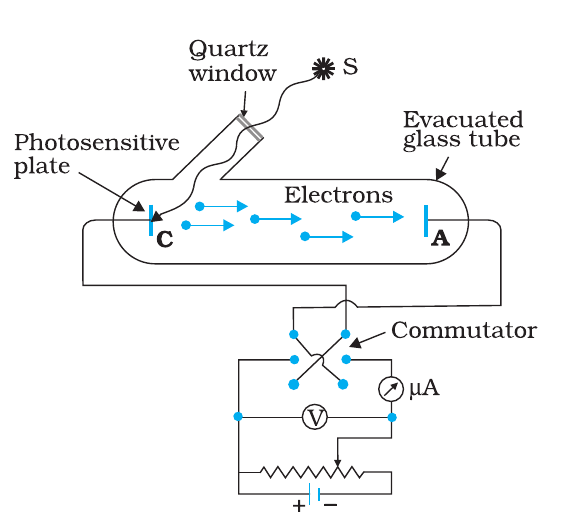
- Figure 11.1 depicts a schematic view of the arrangement used for the experimental study of the photoelectric effect. It consists of an evacuated glass/quartz tube having a thin photosensitive plate C and another metal plate A. Monochromatic light from the source S of sufficiently short wavelength passes through the window W and falls on the photosensitive plate C (emitter). A transparent quartz window is sealed on to the glass tube, which permits ultraviolet radiation to pass through it and irradiate the photosensitive plate C.
- The electrons are emitted by the plate C and are collected by the plate A (collector), by the electric field created by the battery. The battery maintains the potential difference between the plates C and A, that can be varied. The polarity of the plates C and A can be reversed by a commutator. Thus, the plate A can be maintained at a desired positive or negative potential with respect to emitter C.
- When the collector plate A is positive with respect to the emitter plate C, the electrons are attracted to it. The emission of electrons causes flow of electric current in the circuit. The potential difference between the emitter and collector plates is measured by a voltmeter (V) whereas the resulting photo current flowing in the circuit is measured by a microammeter (μA).
- The photoelectric current can be increased or decreased by varying the potential of collector plate A with respect to the emitter plate C. The intensity and frequency of the incident light can be varied, as can the potential difference V between the emitter C and the collector A.
- We can use the experimental arrangement of Fig. 11.1 to study the variation of photocurrent with (a) intensity of radiation, (b) frequency of incident radiation, (c) the potential difference between the plates A and C, and (d) the nature of the material of plate C. Light of different frequencies can be used by putting appropriate coloured filter or coloured glass in the path of light falling on the emitter C. The intensity of light is varied by changing the distance of the light source from the emitter.
Effect of Intensity of Light on Photocurrent
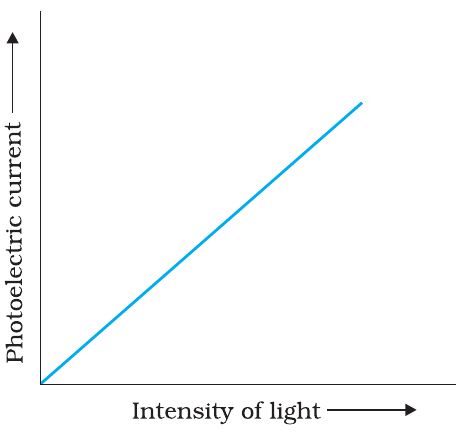
- 11.4.1 Effect of intensity of light on photocurrent: the collector A is maintained at a positive potential with respect to emitter C so that electrons ejected from C are attracted towards collector A. Keeping the frequency of the incident radiation and the potential fixed, the intensity of light is varied and the resulting photoelectric current is measured each time.
- It is found that the photocurrent increases linearly with intensity of incident light as shown graphically in Fig. 11.2. The photocurrent is directly proportional to the number of photoelectrons emitted per second. This implies that the number of photoelectrons emitted per second is directly proportional to the intensity of incident radiation.
- Note the logic NCERT uses: at fixed frequency, more intense light means more photons per second, so more electrons are ejected per second, so the current is larger. Intensity changes the number of photoelectrons, not the energy of each one (see sections 7, 8 and 11).
Effect of Potential on Photoelectric Current
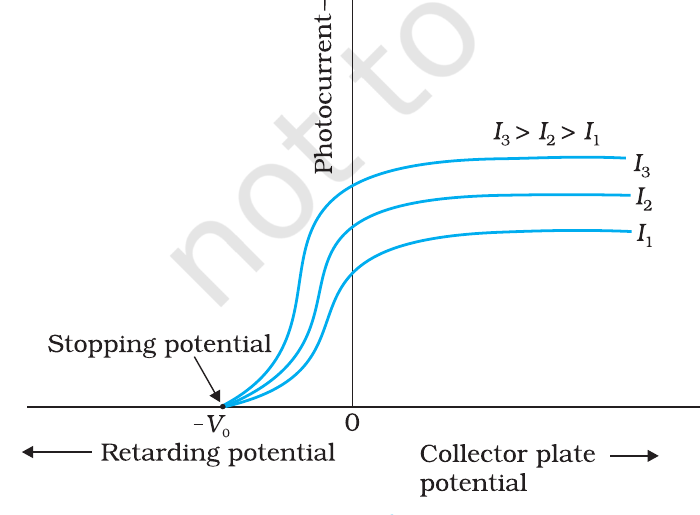
- 11.4.2 Effect of potential on photoelectric current: keep the plate A at some positive potential with respect to the plate C and illuminate the plate C with light of fixed frequency ν and fixed intensity I₁. Vary the positive potential of plate A gradually and measure the resulting photocurrent each time. The photoelectric current increases with increase in positive (accelerating) potential.
- At some stage, for a certain positive potential of plate A, all the emitted electrons are collected by the plate A and the photoelectric current becomes maximum or saturates. If we increase the accelerating potential of plate A further, the photocurrent does not increase. This maximum value of the photoelectric current is called saturation current. Saturation current corresponds to the case when all the photoelectrons emitted by the emitter plate C reach the collector plate A.
- Now apply a negative (retarding) potential to the plate A with respect to the plate C and make it increasingly negative gradually. When the polarity is reversed, the electrons are repelled and only the sufficiently energetic electrons are able to reach the collector A. The photocurrent is found to decrease rapidly until it drops to zero at a certain sharply defined, critical value of the negative potential V₀ on the plate A.
- For a particular frequency of incident radiation, the minimum negative (retarding) potential V₀ given to the plate A for which the photocurrent stops or becomes zero is called the cut-off or stopping potential.
- The interpretation in terms of photoelectrons is straightforward. All the photoelectrons emitted from the metal do not have the same energy. Photoelectric current is zero when the stopping potential is sufficient to repel even the most energetic photoelectrons, with the maximum kinetic energy (K_max), so that $K_max = e V₀$ (11.1).
- Repeat this experiment with incident radiation of the same frequency but of higher intensity I₂ and I₃ (I₃ > I₂ > I₁). The saturation currents are now found to be at higher values, which shows that more electrons are being emitted per second, proportional to the intensity of incident radiation. But the stopping potential remains the same as that for the incident radiation of intensity I₁, as shown graphically in Fig. 11.3.
- Thus, for a given frequency of the incident radiation, the stopping potential is independent of its intensity. In other words, the maximum kinetic energy of photoelectrons depends on the light source and the emitter plate material, but is independent of intensity of incident radiation.
Practice1 question
Try it now. A wrong answer costs nothing here, try again until you get it.
In a photoelectric experiment the maximum kinetic energy of the emitted photoelectrons is 1.5 eV. What is the stopping potential?
NCERT 11.4.2, Eq. (11.1): K_max = e V₀, so $V₀ = K_max/e = 1.5 V$. The unit of stopping potential is the volt, not the electron volt.
Effect of Frequency on Stopping Potential
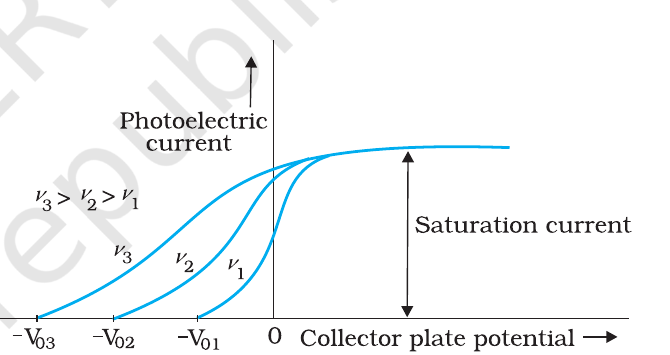
- 11.4.3 Effect of frequency of incident radiation on stopping potential: study the relation between the frequency ν of the incident radiation and the stopping potential V₀. Suitably adjust the same intensity of light radiation at various frequencies and study the variation of photocurrent with collector plate potential. The resulting variation is shown in Fig. 11.4.
- We obtain different values of stopping potential but the same value of the saturation current for incident radiation of different frequencies. The energy of the emitted electrons depends on the frequency of the incident radiations. The stopping potential is more negative for higher frequencies of incident radiation. Note from Fig. 11.4 that the stopping potentials are in the order V₀₃ > V₀₂ > V₀₁ if the frequencies are in the order ν₃ > ν₂ > ν₁. This implies that greater the frequency of incident light, greater is the maximum kinetic energy of the photoelectrons. Consequently, we need greater retarding potential to stop them completely.
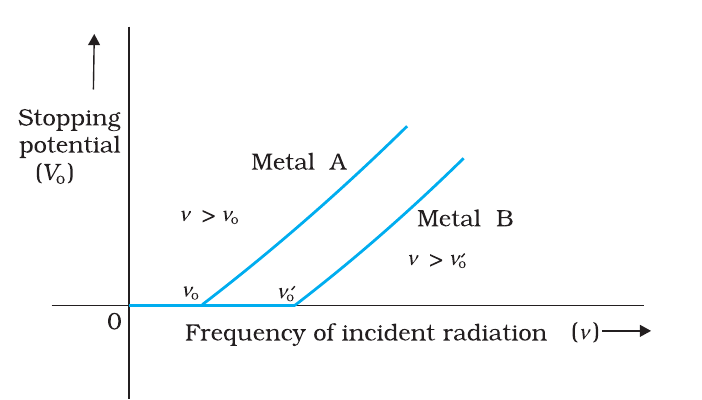
- If we plot a graph between the frequency of incident radiation and the corresponding stopping potential for different metals we get a straight line, as shown in Fig. 11.5. The graph shows that (i) the stopping potential V₀ varies linearly with the frequency of incident radiation for a given photosensitive material, and (ii) there exists a certain minimum cut-off frequency ν₀ for which the stopping potential is zero.
- These observations have two implications: (i) the maximum kinetic energy of the photoelectrons varies linearly with the frequency of incident radiation, but is independent of its intensity; (ii) for a frequency ν of incident radiation, lower than the cut-off frequency ν₀, no photoelectric emission is possible even if the intensity is large. This minimum, cut-off frequency ν₀, is called the threshold frequency. It is different for different metals.
- Different photosensitive materials respond differently to light. Selenium is more sensitive than zinc or copper. The same photosensitive substance gives different response to light of different wavelengths. For example, ultraviolet light gives rise to photoelectric effect in copper while green or red light does not.
- Note that in all the above experiments, it is found that, if frequency of the incident radiation exceeds the threshold frequency, the photoelectric emission starts instantaneously without any apparent time lag, even if the incident radiation is very dim. It is now known that emission starts in a time of the order of $10^{-9}$ s or less.
- Summary of the experimental features (NCERT 11.4.3): (i) for a given photosensitive material and frequency of incident radiation (above the threshold frequency), the photoelectric current is directly proportional to the intensity of incident light (Fig. 11.2). (ii) For a given photosensitive material and frequency of incident radiation, saturation current is found to be proportional to the intensity of incident radiation whereas the stopping potential is independent of its intensity (Fig. 11.3). (iii) For a given photosensitive material, there exists a certain minimum cut-off frequency of the incident radiation, called the threshold frequency, below which no emission of photoelectrons takes place, no matter how intense the incident light is. Above the threshold frequency, the stopping potential or equivalently the maximum kinetic energy of the emitted photoelectrons increases linearly with the frequency of the incident radiation, but is independent of its intensity (Fig. 11.5). (iv) The photoelectric emission is an instantaneous process without any apparent time lag (~$10^{-9}$ s or less), even when the incident radiation is made exceedingly dim.
Photoelectric Effect and Wave Theory of Light
- 11.5 Photoelectric effect and wave theory of light: the wave nature of light was well established by the end of the nineteenth century. The phenomena of interference, diffraction and polarisation were explained in a natural and satisfactory way by the wave picture of light. According to this picture, light is an electromagnetic wave consisting of electric and magnetic fields with continuous distribution of energy over the region of space over which the wave is extended.
- According to the wave picture, the free electrons at the surface of the metal absorb the radiant energy continuously. The greater the intensity of radiation, the greater are the amplitude of electric and magnetic fields. Consequently, the greater the intensity, the greater should be the energy absorbed by each electron. In this picture, the maximum kinetic energy of the photoelectrons on the surface is then expected to increase with increase in intensity.
- Also, no matter what the frequency of radiation is, a sufficiently intense beam of radiation (over sufficient time) should be able to impart enough energy to the electrons, so that they exceed the minimum energy needed to escape from the metal surface. A threshold frequency, therefore, should not exist. These expectations of the wave theory directly contradict observations (i), (ii) and (iii) given at the end of sub-section 11.4.3.
- Further, in the wave picture, the absorption of energy by electron takes place continuously over the entire wavefront of the radiation. Since a large number of electrons absorb energy, the energy absorbed per electron per unit time turns out to be small. Explicit calculations estimate that it can take hours or more for a single electron to pick up sufficient energy to overcome the work function and come out of the metal. This conclusion is again in striking contrast to observation (iv) that the photoelectric emission is instantaneous.
- In short, the wave picture is unable to explain the most basic features of photoelectric emission: K_max does not rise with intensity, a threshold frequency exists, and emission is instantaneous.
Table - Physical Quantities of the Chapter
- NCERT's Physical Quantities table, reproduced cell by cell (printed p. 288, after the Summary). It is the chapter's only table.
| Physical Quantity | Symbol | Dimensions | Unit | Remarks |
|---|---|---|---|---|
| Planck's constant | h | $[M L^2 T^{-1}]$ | J s | $E = hν$ |
| Stopping potential | V₀ | $[M L^2 T^{-3} A^{-1}]$ | V | $e V₀ = K_max$ |
| Work function | φ₀ | $[M L^2 T^{-2}]$ | J; eV | $K_max = E - φ₀$ |
| Threshold frequency | ν₀ | $[T^{-1}]$ | Hz | $ν₀ = φ₀/h$ |
| de Broglie wavelength | λ | $[L]$ | m | $λ = h/p$ |
- Read the table: the stopping potential has the dimensions of electric potential ($[M L^2 T^{-3} A^{-1}]$); the work function is an energy ($[M L^2 T^{-2}]$) and may be quoted in joules or in eV; the threshold frequency is the work function divided by Planck's constant.
Einstein's Photoelectric Equation
- 11.6 Einstein's photoelectric equation: energy quantum of radiation: in 1905, Albert Einstein (1879-1955) proposed a radically new picture of electromagnetic radiation to explain photoelectric effect. In this picture, photoelectric emission does not take place by continuous absorption of energy from radiation. Radiation energy is built up of discrete units - the so called quanta of energy of radiation. Each quantum of radiant energy has energy hν, where h is Planck's constant and ν the frequency of light.
- In photoelectric effect, an electron absorbs a quantum of energy (hν) of radiation. If this quantum of energy absorbed exceeds the minimum energy needed for the electron to escape from the metal surface (work function φ₀), the electron is emitted with maximum kinetic energy $K_max = hν - φ₀$ (11.2). More tightly bound electrons will emerge with kinetic energies less than the maximum value. Note that the intensity of light of a given frequency is determined by the number of photons incident per second. Increasing the intensity will increase the number of emitted electrons per second. However, the maximum kinetic energy of the emitted photoelectrons is determined by the energy of each photon.
- Equation (11.2) is known as Einstein's photoelectric equation. It accounts for all the observations on photoelectric effect given at the end of sub-section 11.4.3: K_max depends linearly on ν, and is independent of intensity of radiation, because photoelectric effect arises from the absorption of a single quantum of radiation by a single electron.
- Since K_max must be non-negative, Eq. (11.2) implies that photoelectric emission is possible only if hν > φ₀ or ν > ν₀, where $ν₀ = φ₀/h$ (11.3). Equation (11.3) shows that the greater the work function φ₀, the higher the minimum or threshold frequency ν₀ needed to emit photoelectrons. Thus, there exists a threshold frequency $ν₀ (= φ₀/h)$ for the metal surface, below which no photoelectric emission is possible, no matter how intense the incident radiation may be or how long it falls on the surface.
- Intensity of radiation is proportional to the number of energy quanta per unit area per unit time. The greater the number of energy quanta available, the greater is the number of electrons absorbing the energy quanta and greater, therefore, is the number of electrons coming out of the metal (for ν > ν₀). This explains why, for ν > ν₀, photoelectric current is proportional to intensity.
- The basic elementary process involved in photoelectric effect is the absorption of a light quantum by an electron. This process is instantaneous. Thus, whatever may be the intensity, photoelectric emission is instantaneous. Low intensity does not mean delay in emission, since the basic elementary process is the same. Intensity only determines how many electrons are able to participate in the elementary process and, therefore, the photoelectric current.
- Using Eq. (11.1), the photoelectric equation, Eq. (11.2), can be written as $e V₀ = hν - φ₀$; for ν ≥ ν₀, or $V₀ = (h/e)ν - φ₀/e$ (11.4). This is an important result. It predicts that the V₀ versus ν curve is a straight line with $slope = (h/e)$, independent of the nature of the material.
- During 1906-1916, Millikan performed a series of experiments on photoelectric effect, aimed at disproving Einstein's photoelectric equation. He measured the slope of the straight line obtained for sodium, similar to that shown in Fig. 11.5. Using the known value of e, he determined the value of Planck's constant h. This value was close to the value of Planck's constant (= 6.626 × $10^{-34}$ J s) determined in an entirely different context. In this way, in 1916, Millikan proved the validity of Einstein's photoelectric equation, instead of disproving it.
- NCERT print detail (p. 283, reproduced verbatim): the book prints "$Planck's constant (= 6.626 \times 10^{-34} J s)$" in this paragraph, with "contant" for "constant"; the value is correct and the spelling is reproduced here as printed.
- The successful explanation of photoelectric effect using the hypothesis of light quanta and the experimental determination of values of h and φ₀, in agreement with values obtained from other experiments, led to the acceptance of Einstein's picture of photoelectric effect. Millikan verified the photoelectric equation with great precision, for a number of alkali metals over a wide range of radiation frequencies.
Practice1 question
Try it now. A wrong answer costs nothing here, try again until you get it.
In an experiment on photoelectric effect, the slope of the cut-off voltage versus frequency of incident light is 4.12 × $10^{-15}$ V s. What is the value of Planck's constant?
NCERT 11.6, Eq. (11.4): the slope of the V₀ versus ν graph is h/e, so h = $slope \times e = (4.12 \times 10^{-15} V s)(1.602 \times 10^{-19} C)$ = 6.60 × $10^{-34}$ J s.
Particle Nature of Light: The Photon
- 11.7 Particle nature of light: the photon: photoelectric effect thus gave evidence to the strange fact that light in interaction with matter behaved as if it was made of quanta or packets of energy, each of energy hν.
- Is the light quantum of energy to be associated with a particle? Einstein arrived at the important result, that the light quantum can also be associated with momentum (hν/c). A definite value of energy as well as momentum is a strong sign that the light quantum can be associated with a particle. This particle was later named photon. The particle-like behaviour of light was further confirmed, in 1924, by the experiment of A. H. Compton (1892-1962) on scattering of X-rays from electrons.
- In 1921, Einstein was awarded the Nobel Prize in Physics for his contribution to theoretical physics and the photoelectric effect. In 1923, Millikan was awarded the Nobel Prize in physics for his work on the elementary charge of electricity and on the photoelectric effect.
- We can summarise the photon picture of electromagnetic radiation as follows: (i) In interaction of radiation with matter, radiation behaves as if it is made up of particles called photons. (ii) Each photon has energy $E (= hν)$ and momentum $p (= hν/c)$, and speed c, the speed of light. (iii) All photons of light of a particular frequency ν, or wavelength λ, have the same energy $E (= hν = hc/λ)$ and momentum $p (= hν/c = h/λ)$, whatever the intensity of radiation may be. By increasing the intensity of light of given wavelength, there is only an increase in the number of photons per second crossing a given area, with each photon having the same energy. Thus, photon energy is independent of intensity of radiation. (iv) Photons are electrically neutral and are not deflected by electric and magnetic fields. (v) In a photon-particle collision (such as photon-electron collision), the total energy and total momentum are conserved. However, the number of photons may not be conserved in a collision. The photon may be absorbed or a new photon may be created.
Key Formulas of the Chapter
- All the numbered equations of the chapter in one place. Symbols: e elementary charge, V₀ stopping potential, K_max maximum kinetic energy of photoelectrons, ν frequency, ν₀ threshold frequency, φ₀ work function, h Planck's constant, E photon energy, p momentum, m mass, v speed, λ wavelength, c speed of light.
| Relation | Formula | Where |
|---|---|---|
| Stopping potential and K_max | $K_max = e V₀$ | 11.4.2, Eq. (11.1) |
| Einstein's photoelectric equation | $K_max = hν - φ₀$ | 11.6, Eq. (11.2) |
| Threshold frequency | $ν₀ = φ₀/h$ | 11.6, Eq. (11.3) |
| Stopping potential vs frequency | $V₀ = (h/e)ν - φ₀/e$ | 11.6, Eq. (11.4) |
| K_max in terms of speed | $e V₀ = (1/2) m v_{max}^2 = K_max$ | Summary point 4 |
| Photon energy and momentum | $E = hν = hc/λ$; $p = hν/c = h/λ$ | 11.7 |
| de Broglie relation | $λ = h/p = h/(mv)$ | 11.8, Eq. (11.5) |
| Photon momentum | $p = hν/c$ | 11.8, Eq. (11.6) |
| de Broglie wavelength of a photon | $λ = h/p = c/ν$ | 11.8, Eq. (11.7) |
- The V₀ versus ν graph (Fig. 11.5) is a straight line of slope h/e, independent of the material; its intercept on the ν axis is ν₀ and its intercept on the V₀ axis is -φ₀/e.
Wave Nature of Matter
- 11.8 Wave nature of matter: the dual (wave-particle) nature of light (electromagnetic radiation, in general) comes out clearly from what we have learnt in this and the preceding chapters. The wave nature of light shows up in the phenomena of interference, diffraction and polarisation. On the other hand, in photoelectric effect and Compton effect which involve energy and momentum transfer, radiation behaves as if it is made up of a bunch of particles - the photons.
- Whether a particle or wave description is best suited for understanding an experiment depends on the nature of the experiment. For example, in the familiar phenomenon of seeing an object by our eye, both descriptions are important. The gathering and focussing mechanism of light by the eye-lens is well described in the wave picture. But its absorption by the rods and cones (of the retina) requires the photon picture of light.
- A natural question arises: if radiation has a dual (wave-particle) nature, might not the particles of nature (the electrons, protons, etc.) also exhibit wave-like character? In 1924, the French physicist Louis Victor de Broglie (pronounced as de Broy) (1892-1987) put forward the bold hypothesis that moving particles of matter should display wave-like properties under suitable conditions.
- He reasoned that nature was symmetrical and that the two basic physical entities - matter and energy, must have symmetrical character. If radiation shows dual aspects, so should matter. De Broglie proposed that the wavelength λ associated with a particle of momentum p is given as $λ = h/p = h/(mv)$ (11.5), where m is the mass of the particle and v its speed. Equation (11.5) is known as the de Broglie relation and the wavelength λ of the matter wave is called de Broglie wavelength.
- The dual aspect of matter is evident in the de Broglie relation. On the left hand side of Eq. (11.5), λ is the attribute of a wave while on the right hand side the momentum p is a typical attribute of a particle. Planck's constant h relates the two attributes.
- Equation (11.5) for a material particle is basically a hypothesis whose validity can be tested only by experiment. However, it is interesting to see that it is satisfied also by a photon. For a photon, as we have seen, $p = hν/c$ (11.6). Therefore, $λ = h/p = c/ν$ (11.7). That is, the de Broglie wavelength of a photon given by Eq. (11.5) equals the wavelength of electromagnetic radiation of which the photon is a quantum of energy and momentum.
- Clearly, from Eq. (11.5), λ is smaller for a heavier particle (large m) or more energetic particle (large v). For example, the de Broglie wavelength of a ball of mass 0.12 kg moving with a speed of 20 m s^-1 is easily calculated: $p = mv = 0.12 kg \times 20 m s^{-1} = 2.40 kg m s^{-1}$, and $λ = h/p = (6.63 \times 10^{-34} J s)/(2.40 kg m s^{-1})$ = 2.76 × $10^{-34}$ m. This wavelength is so small that it is beyond any measurement. This is the reason why macroscopic objects in our daily life do not show wave-like properties. On the other hand, in the sub-atomic domain, the wave character of particles is significant and measurable.
- NCERT box note (p. 285): Louis Victor de Broglie (1892-1987), French physicist who put forth the revolutionary idea of wave nature of matter. This idea was developed by Erwin Schródinger into a full-fledged theory of quantum mechanics commonly known as wave mechanics. In 1929, he was awarded the Nobel Prize in Physics for his discovery of the wave nature of electrons. The name is reproduced here as NCERT prints it ("Schródinger").
Practice1 question
Try it now. A wrong answer costs nothing here, try again until you get it.
What is the de Broglie wavelength of an electron accelerated from rest through a potential difference of 100 V?
NCERT 11.8, Eq. (11.5): $λ = h/p$ with $p = √(2meV)$. For $V = 100 V$, $p = 5.40 \times 10^{-24} kg m/s$ and $λ = (6.63 \times 10^{-34})/(5.40 \times 10^{-24}) = 1.227 \times 10^{-10} m = 1.227$ Å.
Worked Examples 11.1-11.3
- Example 11.1: monochromatic light of frequency 6.0 × $10^{14}$ Hz is produced by a laser. The power emitted is 2.0 × $10^{-3}$ W. (a) What is the energy of a photon in the light beam? (b) How many photons per second, on an average, are emitted by the source? Solution: (a) each photon has energy $E = hν = (6.63 \times 10^{-34} J s)(6.0 \times 10^{14} Hz)$ = 3.98 × $10^{-19}$ J. (b) If N is the number of photons emitted by the source per second, the power P transmitted in the beam equals N times the energy per photon E, so that $P = N E$. Then $N = P/E = (2.0 \times 10^{-3} W)/(3.98 \times 10^{-19} J)$ = 5.0 × $10^{15}$ photons per second.
- Example 11.2: the work function of caesium is 2.14 eV. Find (a) the threshold frequency for caesium, and (b) the wavelength of the incident light if the photocurrent is brought to zero by a stopping potential of 0.60 V. Solution: (a) for the cut-off or threshold frequency, the energy hν₀ of the incident radiation must be equal to work function φ₀, so that $ν₀ = φ₀/h = (2.14 \times 1.6 \times 10^{-19} J)/(6.63 \times 10^{-34} J s)$ = 5.16 × $10^{14}$ Hz. Thus, for frequencies less than this threshold frequency, no photoelectrons are ejected. (b) Photocurrent reduces to zero, when maximum kinetic energy of the emitted photoelectrons equals the potential energy eV₀ by the retarding potential V₀. Einstein's photoelectric equation is $eV₀ = hν - φ₀ = hc/λ - φ₀$, or $λ = hc/(eV₀ + φ₀) = (19.89 \times 10^{-26} J m)/(2.74 eV)$ = 454 nm.
- Example 11.3: what is the de Broglie wavelength associated with (a) an electron moving with a speed of 5.4 × $10^{6}$ m/s, and (b) a ball of mass 150 g travelling at 30.0 m/s? Solution: (a) for the electron: mass $m = 9.11 \times 10^{-31} kg, speed v = 5.4 \times 10^{6} m/s$. Then, momentum $p = mv = 4.92 \times 10^{-24} kg m/s$. De Broglie wavelength, $λ = h/p = (6.63 \times 10^{-34} J s)/(4.92 \times 10^{-24} kg m/s)$ = 0.135 nm. (b) For the ball: mass $m' = 0.150 kg, speed v' = 30.0 m/s$. Then momentum p' = $m'v' = 4.50 kg m/s$. De Broglie wavelength $λ' = h/p' = 1.47 \times 10^{-34} m$. The de Broglie wavelength of electron is comparable with X-ray wavelengths. However, for the ball it is about $10^{-19}$ times the size of the proton, quite beyond experimental measurement.
Practice1 question
Try it now. A wrong answer costs nothing here, try again until you get it.
A laser produces monochromatic light of frequency 6.0 × $10^{14}$ Hz with power emitted 2.0 × $10^{-3}$ W. How many photons per second, on an average, are emitted by the source?
NCERT Example 11.1: each photon has energy $E = hν = 3.98 \times 10^{-19} J$, and $N = P/E = (2.0 \times 10^{-3} W)/(3.98 \times 10^{-19} J)$ = 5.0 × $10^{15}$ photons per second.
Trap Pairs
- Trap: brighter light gives more energetic photoelectrons. Correct: intensity changes only the number of photoelectrons per second; the maximum kinetic energy depends on the frequency of the light and the metal, not on the intensity (11.4.2, 11.6).
- Trap: light below the threshold frequency can still eject electrons if it is bright enough or shines for long enough. Correct: below ν₀ no emission takes place at all, no matter how intense the light is or how long it falls on the surface (11.4.3, 11.6).
- Trap: the stopping potential rises when the light is made brighter. Correct: for a given frequency, the stopping potential is independent of intensity; only the saturation current rises with intensity (11.4.2, Fig. 11.3).
- Trap: the work function and the threshold frequency are the same for every metal. Correct: φ₀ depends on the metal, and $ν₀ = φ₀/h$ is different for different metals; caesium (2.14 eV) answers to visible light while zinc, cadmium and magnesium answer only to ultraviolet light (11.2, 11.3.2, 11.6).
- Trap: a brighter beam has more energetic photons. Correct: every photon of frequency ν has the same energy $E = hν whatever$ the intensity; raising the intensity only raises the number of photons per second (11.7, point (iii)).
- Trap: de Broglie waves are measurable for ordinary objects like a ball. Correct: for a ball λ is of the order of $10^{-34}$ m, beyond any measurement; matter waves are measurable only for sub-atomic particles like electrons and protons (11.8, Example 11.3).
NCERT Summary
- NCERT's Summary (9 points, printed p. 287), condensed: 1. The minimum energy needed by an electron to come out from a metal surface is called the work function of the metal. Energy (greater than the work function φ₀) required for electron emission from the metal surface can be supplied by suitably heating or applying strong electric field or irradiating it by light of suitable frequency. 2. Photoelectric effect is the phenomenon of emission of electrons by metals when illuminated by light of suitable frequency. Certain metals respond to ultraviolet light while others are sensitive even to the visible light. Photoelectric effect involves conversion of light energy into electrical energy. It follows the law of conservation of energy. The photoelectric emission is an instantaneous process and possesses certain special features. 3. Photoelectric current depends on (i) the intensity of incident light, (ii) the potential difference applied between the two electrodes, and (iii) the nature of the emitter material. 4. The stopping potential (V₀) depends on (i) the frequency of incident light, and (ii) the nature of the emitter material. For a given frequency of incident light, it is independent of its intensity. The stopping potential is directly related to the maximum kinetic energy of electrons emitted: $e V₀ = (1/2) m v_{max}^2 = K_max$. 5. Below a certain frequency (threshold frequency) ν₀, characteristic of the metal, no photoelectric emission takes place, no matter how large the intensity may be. 6. The classical wave theory could not explain the main features of photoelectric effect. Its picture of continuous absorption of energy from radiation could not explain the independence of K_max on intensity, the existence of ν₀ and the instantaneous nature of the process. Einstein explained these features on the basis of photon picture of light. According to this, light is composed of discrete packets of energy called quanta or photons. Each photon carries an energy $E (= hν)$ and momentum $p (= h/λ)$, which depend on the frequency (ν) of incident light and not on its intensity. Photoelectric emission from the metal surface occurs due to absorption of a photon by an electron. 7. Einstein's photoelectric equation is in accordance with the energy conservation law as applied to the photon absorption by an electron in the metal. The maximum kinetic energy (1/2) m $v_{max}^2$ is equal to the photon energy (hν) minus the work function $φ₀ (= hν₀)$ of the target metal: (1/2) m $v_{max}^2$ = $V₀ e = hν - φ₀ = h(ν - ν₀)$. This photoelectric equation explains all the features of the photoelectric effect. Millikan's first precise measurements confirmed the Einstein's photoelectric equation and obtained an accurate value of Planck's constant h. This led to the acceptance of particle or photon description (nature) of electromagnetic radiation, introduced by Einstein. 8. Radiation has dual nature: wave and particle. The nature of experiment determines whether a wave or particle description is best suited for understanding the experimental result. Reasoning that radiation and matter should be symmetrical in nature, Louis Victor de Broglie attributed a wave-like character to matter (material particles). The waves associated with the moving material particles are called matter waves or de Broglie waves. 9. The de Broglie wavelength (λ) associated with a moving particle is related to its momentum p as: $λ = h/p$. The dualism of matter is inherent in the de Broglie relation which contains a wave concept (λ) and a particle concept (p). The de Broglie wavelength is independent of the charge and nature of the material particle. It is significantly measurable (of the order of the atomic-planes spacing in crystals) only in case of sub-atomic particles like electrons, protons, etc. (due to smallness of their masses and hence, momenta). However, it is indeed very small, quite beyond measurement, in case of macroscopic objects, commonly encountered in everyday life.
Points to Ponder
- 1. Free electrons in a metal are free in the sense that they move inside the metal in a constant potential (this is only an approximation). They are not free to move out of the metal. They need additional energy to get out of the metal.
- 2. Free electrons in a metal do not all have the same energy. Like molecules in a gas jar, the electrons have a certain energy distribution at a given temperature. This distribution is different from the usual Maxwell's distribution that you have learnt in the study of kinetic theory of gases. You will learn about it in later courses, but the difference has to do with the fact that electrons obey Pauli's exclusion principle.
- 3. Because of the energy distribution of free electrons in a metal, the energy required by an electron to come out of the metal is different for different electrons. Electrons with higher energy require less additional energy to come out of the metal than those with lower energies. Work function is the least energy required by an electron to come out of the metal.
- 4. Observations on photoelectric effect imply that in the event of matter-light interaction, absorption of energy takes place in discrete units of hν. This is not quite the same as saying that light consists of particles, each of energy hν.
- 5. Observations on the stopping potential (its independence of intensity and dependence on frequency) are the sharp test that separates the wave picture from the photon picture of photoelectric effect. (NCERT's own word here is paraphrased in this point; see the audit note.)
- 6. The wavelength of a matter wave given by $λ = h/p$ has physical significance; its phase velocity v_p has no physical significance. However, the group velocity of the matter wave is physically meaningful and equals the velocity of the particle.
Exercises 11.1-11.11
- NCERT Exercises 11.1-11.11 (printed pp. 288-289), with NCERT's own numbers. 11.1 Find the (a) maximum frequency, and (b) minimum wavelength of X-rays produced by 30 kV electrons. 11.2 The work function of caesium metal is 2.14 eV. When light of frequency 6 × $10^{14}$ Hz is incident on the metal surface, photoemission of electrons occurs. What is the (a) maximum kinetic energy of the emitted electrons, (b) stopping potential, and (c) maximum speed of the emitted photoelectrons? 11.3 The photoelectric cut-off voltage in a certain experiment is 1.5 V. What is the maximum kinetic energy of photoelectrons emitted? 11.4 Monochromatic light of wavelength 632.8 nm is produced by a helium-neon laser. The power emitted is 9.42 mW. (a) Find the energy and momentum of each photon in the light beam, (b) how many photons per second, on the average, arrive at a target irradiated by this beam? (Assume the beam to have uniform cross-section which is less than the target area), and (c) how fast does a hydrogen atom have to travel in order to have the same momentum as that of the photon? 11.5 In an experiment on photoelectric effect, the slope of the cut-off voltage versus frequency of incident light is found to be 4.12 × $10^{-15}$ V s. Calculate the value of Planck's constant. 11.6 The threshold frequency for a certain metal is 3.3 × $10^{14}$ Hz. If light of frequency 8.2 × $10^{14}$ Hz is incident on the metal, predict the cut-off voltage for the photoelectric emission. 11.7 The work function for a certain metal is 4.2 eV. Will this metal give hotoelectric emission for incident radiation of wavelength 330 nm? 11.8 Light of frequency 7.21 × $10^{14}$ Hz is incident on a metal surface. Electrons with a maximum speed of 6.0 × $10^{5}$ m/s are ejected from the surface. What is the threshold frequency for photoemission of electrons? 11.9 Light of wavelength 488 nm is produced by an argon laser which is used in the photoelectric effect. When light from this spectral line is incident on the emitter, the stopping (cut-off) potential of photoelectrons is 0.38 V. Find the work function of the material from which the emitter is made. 11.10 What is the de Broglie wavelength of (a) a bullet of mass 0.040 kg travelling at the speed of 1.0 km/s, (b) a ball of mass 0.060 kg moving at a speed of 1.0 m/s, and (c) a dust particle of mass 1.0 × $10^{-9}$ kg drifting with a speed of 2.2 m/s? 11.11 Show that the wavelength of electromagnetic radiation is equal to the de Broglie wavelength of its quantum (photon).
- NCERT print detail (p. 289, reproduced verbatim): Exercise 11.7 prints "hotoelectric emission" (the letter p is missing); it is reproduced here as printed.
Trap Boxes
Brighter light gives more energetic photoelectrons
Wrong idea: Increasing the intensity of the incident light increases the maximum kinetic energy of the photoelectrons.
Intensity changes only the number of photoelectrons emitted per second, so only the saturation current rises. The maximum kinetic energy depends on the frequency of the light and the metal, not on the intensity. NCERT 11.4.2 and 11.6.
NCERT XII, Ch 11, 11.4.2 and 11.6
Bright or long light below threshold still emits
Wrong idea: Light below the threshold frequency can still eject electrons if it is bright enough or shines for long enough.
Below the threshold frequency ν₀ no photoelectric emission takes place at all, no matter how intense the incident light is or how long it falls on the surface. NCERT 11.4.3 and 11.6.
NCERT XII, Ch 11, 11.4.3 and 11.6
Stopping potential rises with brighter light
Wrong idea: The stopping potential rises when the light is made brighter.
For a given frequency, the stopping potential is independent of intensity; only the saturation current rises with intensity, as Fig. 11.3 shows. NCERT 11.4.2.
NCERT XII, Ch 11, 11.4.2
Work function and threshold frequency are the same for all metals
Wrong idea: The work function and the threshold frequency are the same for every metal.
The work function depends on the metal, and $ν₀ = φ₀/h$ is different for different metals. Caesium (2.14 eV) answers to visible light, while zinc, cadmium and magnesium answer only to ultraviolet light. NCERT 11.2, 11.3.2 and 11.6.
NCERT XII, Ch 11, 11.2, 11.3.2 and 11.6
A brighter beam has more energetic photons
Wrong idea: A brighter beam of light has photons of higher energy.
Every photon of frequency ν has the same energy $E = hν whatever$ the intensity; raising the intensity only raises the number of photons per second. NCERT 11.7, point (iii).
NCERT XII, Ch 11, 11.7
De Broglie waves are measurable for ordinary objects
Wrong idea: The de Broglie wavelength of an ordinary object like a ball is large enough to measure.
For a ball, λ is of the order of $10^{-34}$ m, beyond any measurement. Matter waves are measurable only for sub-atomic particles like electrons and protons, whose masses and momenta are small. NCERT 11.8 and Example 11.3.
NCERT XII, Ch 11, 11.8 and Example 11.3
Chapter test
5 NEET PYQs. +4 for a correct answer, -1 for a wrong answer, exactly like NEET. Finish the test to earn a medal.
Q1: NEET (UG) 2023, Code F1, Q2
The work functions of Caesium (Cs), Potassium (K) and Sodium (Na) are 2.14 eV, 2.30 eV and 2.75 eV respectively. If incident electromagnetic radiation has an incident energy of 2.20 eV, which of these photosensitive surfaces may emit photoelectrons?
Emission needs photon energy above the work function; only caesium has $φ₀ = 2.14 eV$ below the incident 2.20 eV.
Q2: NEET (UG) 2022, Code R1, Q31
When two monochromatic lights of frequency, ν and ν/2 are incident on a photoelectric metal, their stopping potential becomes V_s/2 and V_s respectively. The threshold frequency for this metal is
From $eV_s/2 = hν - hν₀$ and $eV_s = h(ν/2) - hν₀$, solving the two Einstein equations together gives $ν₀ = 3ν/2$.
Q3: NEET (UG) 2021, Code P3, Q34
An electromagnetic wave of wavelength 'λ' is incident on a photosensitive surface of negligible work function. If 'm' mass is of photoelectron emitted from the surface has de-Broglie wavelength λ_d, then :
With negligible work function, $hc/λ = p^2/(2m)$ and $p = h/λ_d$, so $λ = (2mc/h) \lambda_d^2$.
Q4: NEET (UG) 2020, Code G5, Q146
Light of frequency 1.5 times the threshold frequency is incident on a photosensitive material. What will be the photoelectric current if the frequency is halved and intensity is doubled?
Halving the frequency gives 0.75 times the threshold frequency, which is below ν₀, so no photoelectric emission takes place at all, whatever the intensity.
Q5: NEET (UG) 2020, Code G5, Q143
An electron is accelerated from rest through a potential difference of V volt. If the de Broglie wavelength of the electron is 1.227 × $10^{-2}$ nm, the potential difference is :
From $λ = h/p$ with $p = √(2meV)$, $V = h^2/(2me\lambda^2) = 10^{4} V$ for $λ = 1.227 \times 10^{-2} nm$.
Score: 0 · Answered 0 of 5
Flashcards
Tap a card to flip it over and see the answer. Tap it again to flip it back.
What is the work function of a metal, what symbol is used for it, and what is 1 eV in joules?
Tap to flipφ₀ is the minimum energy needed by an electron to escape from the metal surface. 1 $eV = 1.602 \times 10^{-19} J$.
Tap to flip backHow is the maximum kinetic energy of photoelectrons related to the stopping potential?
Tap to flip$K_max = e V₀$ (11.1), where V₀ is the stopping (cut-off) potential and e is the elementary charge.
Tap to flip backState Einstein's photoelectric equation.
Tap to flip$K_max = hν - φ₀$ (11.2). K_max rises linearly with frequency ν and does not depend on intensity.
Tap to flip backDefine the threshold frequency and give its formula.
Tap to flip$ν₀ = φ₀/h$ (11.3). Below ν₀ no photoelectric emission takes place, no matter how intense the light is.
Tap to flip backGive the stopping potential as a function of frequency, and the slope of the V₀ versus ν graph.
Tap to flip$V₀ = (h/e)ν - φ₀/e$ (11.4). The V₀ versus ν graph is a straight line of slope h/e, independent of the material.
Tap to flip backGive the energy and momentum of a photon of frequency ν and wavelength λ.
Tap to flip$E = hν = hc/λ$ and $p = hν/c = h/λ$. Every photon of frequency ν has the same energy, whatever the intensity.
Tap to flip backState the de Broglie relation and the de Broglie wavelength of a photon.
Tap to flip$λ = h/p = h/(mv)$ (11.5). For a photon, $p = hν/c$, so $λ = h/p = c/ν$ (11.7).
Tap to flip backHow is the stopping potential related to the maximum speed of the photoelectrons?
Tap to flip$e V₀ = (1/2) m v_{max}^2 = K_max (Summary point 4)$. Also $(1/2) m v_{max}^2 = hν - φ₀ = h(ν - ν₀) (Summary point 7)$.
Tap to flip backGive the specific charge of the electron and the value of the elementary charge.
Tap to flip$e/m = 1.76 \times 10^{11} C/kg$ for the electron; the elementary charge is $e = 1.602 \times 10^{-19} C (Millikan oil-drop experiment, 1913)$.
Tap to flip backWhat is the value of Planck's constant?
Tap to flip$h = 6.626 \times 10^{-34} J s$. In the worked examples NCERT uses $h = 6.63 \times 10^{-34} J s$.
Tap to flip backWhat are the work function and threshold frequency of caesium?
Tap to flip$φ₀ = 2.14 eV$ for caesium; its threshold frequency is ν₀ = 5.16 × $10^{14}$ Hz (Example 11.2).
Tap to flip backFor three frequencies in the order ν₃ > ν₂ > ν₁, what is the order of their stopping potentials?
Tap to flipFor ν₃ > ν₂ > ν₁, the stopping potentials are in the order V₀₃ > V₀₂ > V₀₁ (Fig. 11.4).
Tap to flip backWhich metals respond only to ultraviolet light, and which alkali metals respond even to visible light?
Tap to flipZinc, cadmium and magnesium respond only to ultraviolet light. Lithium, sodium, potassium, caesium and rubidium are sensitive even to visible light. Selenium is more sensitive than zinc or copper.
Tap to flip backHow quickly does photoelectric emission start after light falls on the metal?
Tap to flipEmission starts in a time of the order of $10^{-9}$ s or less, even when the incident radiation is exceedingly dim. The wave picture, by contrast, predicts hours of delay.
Tap to flip backFrequently asked questions
Is it true that brighter light gives more energetic photoelectrons?
Intensity changes only the number of photoelectrons emitted per second, so only the saturation current rises. The maximum kinetic energy depends on the frequency of the light and the metal, not on the intensity.
Is it true that bright or long light below threshold still emits?
Below the threshold frequency ν₀ no photoelectric emission takes place at all, no matter how intense the incident light is or how long it falls on the surface. NCERT 11.4.3 and 11.6.
Is it true that stopping potential rises with brighter light?
For a given frequency, the stopping potential is independent of intensity; only the saturation current rises with intensity, as Fig. 11.3 shows.
What is the de Broglie wavelength of an electron accelerated from rest through a potential difference of 100 V?
NCERT 11.8, Eq. (11.5): $λ = h/p$ with $p = √(2meV)$. For $V = 100 V$, $p = 5.40 \times 10^{-24} kg m/s$ and $λ = (6.63 \times 10^{-34})/(5.40 \times 10^{-24}) = 1.227 \times 10^{-10} m = 1.227$ Å.
Is it true that work function and threshold frequency are the same for all metals?
The work function depends on the metal, and $ν₀ = φ₀/h$ is different for different metals. Caesium (2.14 eV) answers to visible light, while zinc, cadmium and magnesium answer only to ultraviolet light.