 NEET Notes
Home > PYQ Bank
PYQ Bank
9,226 questions from NEET and AIPMT papers, 1988 to 2026, across 96 chapters. 8,227 of them are in the current syllabus. Pick a year and a chapter, then browse with answers or take a quiz.
110 questions match.
A photon and an electron, each of 20 eV energy, move in free space. The ratio of linear momentum of electron to that of photon is: [Take speed of light , charge of electron and mass of electron ]
A beam of light falls on a metal surface such that photo-electrons are generated. If power of the light source starts to decrease linearly with time , then variation of the photocurrent and magnitude of the stopping potential with time is best represented by:
A ray of light with wavelength is incident on three different photoelectric cells namely 1,2 and 3 . The threshold wavelength of these photoelectric cells are , and , respectively and the magnitude of stopping potentials of these cells are and , respectively. The relation between and threshold wavelengths are and . The correct option is:
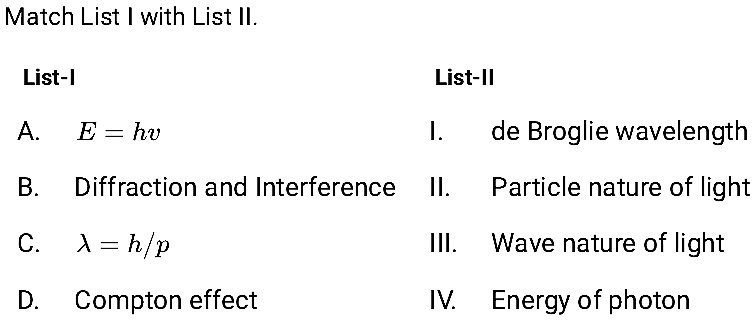
Match List I with List II. List-I List-II A. I. de Broglie wavelength B. Diffraction and Interference II. Particle nature of light C. III. Wave nature of light D. Compton effect IV. Energy of photon
For a metal of work function 6.6 eV , which of the following wavelengths of incident radiation does not give rise to the photoelectric effect? (Take Planck's constant as )
De-Broglie wavelength of an electron orbiting in the state of hydrogen atom is close to (Given Bohr radius )
Which of the following options represent the variation of photoelectric current with property of light shown on the x-axis?
A photon and an electron (mass ) have the same energy . The ratio ( photon electron ) of their de Broglie wavelengths is: ( is the speed of light)
An electron and an alpha particle are accelerated by the same potential difference. Let and denote the de-Broglie wavelengths of the electron and the alpha particle, respectively, then:
If is the work function of photosensitive material in and light of wavelength of numerical value metre, is incident on it with energy above its threshold value at an instant then the maximum kinetic energy of the photo-electron ejected by it at that instant (Take -Plank's constant, -velocity of light in free space) is (in SI units):
The graph which shows the variation of and its kinetic energy, is (where is de Broglie wavelength of a free particle):
If is the velocity of light in free space, the correct statements about photon among the following are: A. The energy of a photon is . B. The velocity of a photon is . C. The momentum of a photon, . D. In a photon-electron collision, both total energy and total momentum are conserved. E. Photon possesses positive charge. Choose the correct answer from the options given below:
The de Broglie wavelength associated with an electron, accelerated by a potential difference of 81 V is given by:
The maximum kinetic energy of the emitted photoelectrons in photoelectric effect is independent of:
The work functions of Caesium , potassium and Sodium (Na) are and respectively. If incident electromagnetic radiation has an incident energy of , which of these photosensitive surfaces may emit photoelectrons?
The minimum wavelength of -rays produced by an electron accelerated through a potential difference of volts is proportional to :
The light rays having photons of energy 4.2 eV are falling on a metal surface having a work function of 2.2 eV. The stopping potential of the surface is
The threshold frequency of a photoelectric metal is v0. If light of frequency 4v0 is incident on this metal, then the maximum kinetic energy of emitted electrons will be :
The number of photons per second on an average emitted by the source of monochromatic light of wavelength 600nm, when it delivers the power of 3.3 10 3 watt will be : (h = 6.6 10 34 Js)
An electromagnetic wave of wavelength ' ' is incident on a photosensitive surface of negligible work function. If 'm' mass is of photoelectron emitted from the surface has de-Broglie wavelength d, then :