 NEET Notes
Home > Biology > Botany > Photosynthesis in Higher Plants
Photosynthesis in Higher Plants
On this page · 13 sections
- 01Syllabus map
- 02What do we know? Early experiments
- 03Where does photosynthesis take place? Pigments
- 04The light reaction and the Z-scheme
- 05Chemiosmosis: how ATP is made
- 06The Calvin cycle: where ATP and NADPH are used
- 07The $C_4$ pathway: Hatch and Slack
- 08Photorespiration
- 09Factors affecting photosynthesis
- 10Table 1: The Z-scheme at a glance
- 11Table 2: Calvin cycle: cost and counting
- 12Table 3: $C_3$ vs $C_4$ plants
- 13Table 4: Cyclic vs non-cyclic photophosphorylation
Light reaction, Calvin cycle, C4, and photorespiration.
Syllabus map
- NMC Unit: BIO-U04, Plant Physiology. NCERT Chapter 11, Photosynthesis in Higher Plants.
- Subtopics in this chapter (NCERT XI, Ch 11): What do we know? Early experiments. Where does photosynthesis take place? Pigments involved in photosynthesis. The light reaction. The electron transport. Chemiosmosis. Where are the ATP and NADPH used? The $C_4$ pathway. Photorespiration. Factors affecting photosynthesis.
- Subtopic checklist: (1) the early experiments and the scientists behind them; (2) chloroplast structure and the four leaf pigments; (3) PS I and PS II and the Z-scheme; (4) cyclic vs non-cyclic photophosphorylation; (5) chemiosmosis and ATP synthase; (6) the Calvin cycle, its three stages and its ATP/NADPH cost; (7) the $C_4$ pathway and Kranz anatomy; (8) photorespiration; (9) Blackman's law of limiting factors.
- This chapter follows NCERT Class 11 Biology, Chapter 11 closely. Every NCERT fact, number and example is kept as NCERT states it. A few details that students meet in NEET but that NCERT does not name (the Z-scheme carrier names, G3P, some crop examples) are kept and clearly labelled 'Extra information (beyond NCERT)' where they appear.
- Estimated revision time: 12 minutes. Jump links: Syllabus Map, Early Experiments, Pigments, Light Reaction, Calvin Cycle, $C_4$ Pathway, Photorespiration, Factors, Trap Boxes, PYQs, Chapter Test.
Suggest an edit
What do we know? Early experiments
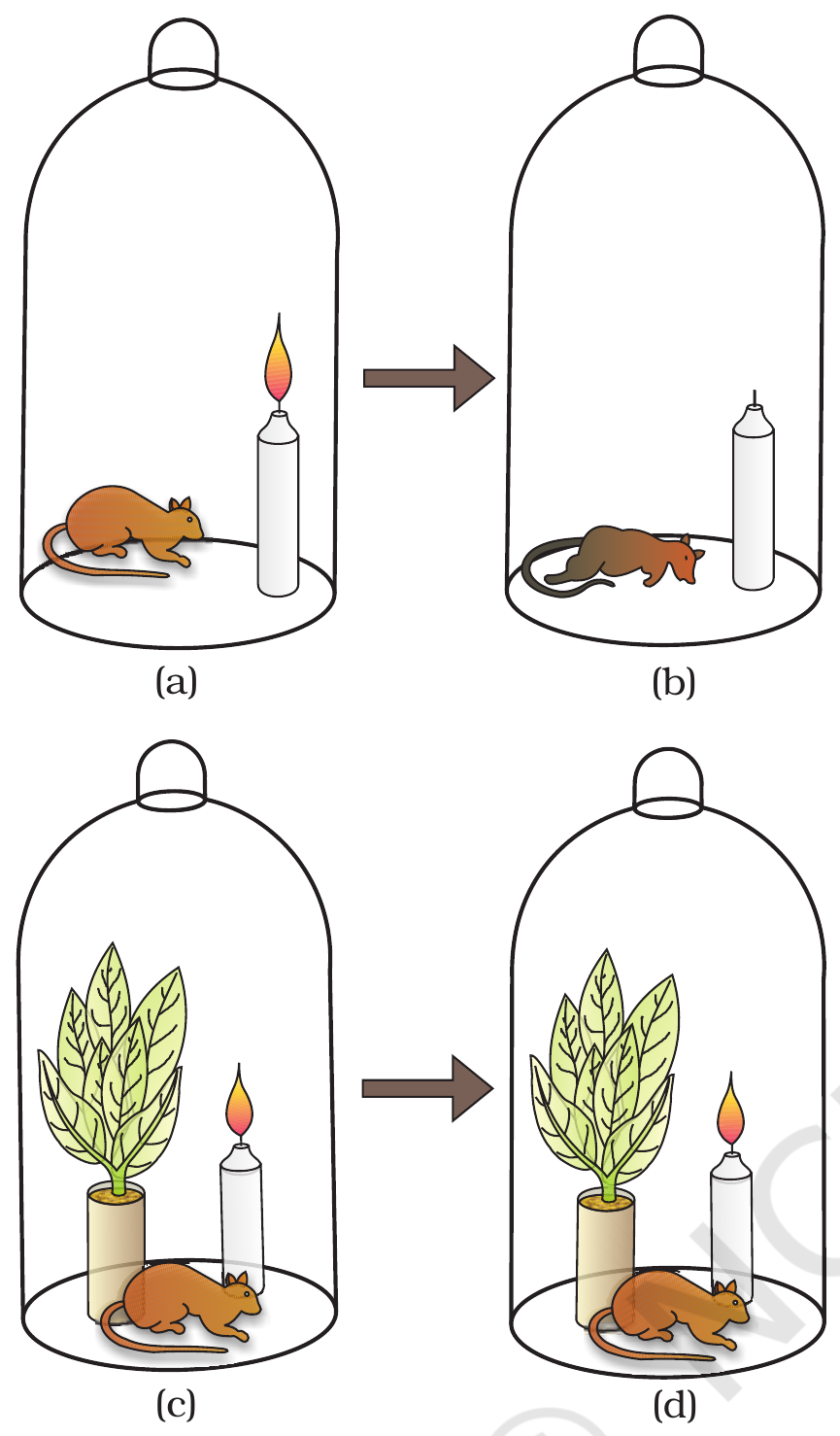
Photosynthesis is a physico-chemical process by which green plants use light energy to drive the synthesis of organic compounds. Two classic experiments show what it needs.
A variegated leaf is partly covered with black paper and exposed to light. On testing for starch, only the exposed green part turns blue-black; the covered part does not. This shows light is essential for photosynthesis. In the half-leaf experiment, a part of a leaf is enclosed in a test tube containing $KOH$-soaked cotton, which absorbs $CO_2$. The part inside the tube shows no starch, while the part outside does. This shows $CO_2$ is essential.
- Joseph Priestley (1770): a burning candle in a closed bell jar goes out, and a mouse kept in the jar suffocates. But when a mint plant is placed in the jar, the candle keeps burning and the mouse stays alive. Priestley hypothesised that plants restore the air that breathing animals and burning candles foul.
- Jan Ingenhousz (1730-1799): showed that sunlight is essential. An aquatic plant in bright sunlight gives off small bubbles of oxygen around its green parts; in the dark, no bubbles appear.
- Julius von Sachs (1854): showed that glucose is produced during photosynthesis and is usually stored as starch; the green parts of the plant are the site of photosynthesis, and chlorophyll is located inside chloroplasts.
- T.W. Engelmann: split light with a prism and let it fall on the green alga Cladophora placed in a suspension of aerobic bacteria. The bacteria gathered mainly in the blue and red regions, where photosynthesis was most active. This was the first action spectrum of photosynthesis.
- Cornelius van Niel: working on purple and green sulphur bacteria, proposed that the oxygen released in photosynthesis comes from water, not from carbon dioxide.
- Melvin Calvin: used radioactive carbon (14C) in algal photosynthesis to trace the path of carbon fixation. He received the Nobel Prize in 1961.
The overall equation of photosynthesis is: 6CO2 + 12H2O → $C_6H_{12}O_6$ + 6H2O + 6O2, in the presence of light and chlorophyll.
Suggest an edit
Practice1 question
Try it now. A wrong answer costs nothing here, try again until you get it.
A variegated leaf is partly covered with black paper and exposed to light. When tested for starch, which part turns blue-black?
Light is essential for photosynthesis. On testing for starch, only the exposed green part of the variegated leaf turns blue-black; the part covered with black paper shows no starch.
Where does photosynthesis take place? Pigments
Photosynthesis takes place in chloroplasts, found in the mesophyll cells of leaves. A chloroplast has a membrane system and a fluid stroma.
- The membrane system consists of grana (stacks of thylakoids) and stroma lamellae. It traps light energy and synthesises ATP and NADPH: the light reactions.
- The stroma is the fluid in which enzymatic reactions synthesise sugar, which in turn forms starch: the biosynthetic (dark) reactions.
Paper chromatography separates the four leaf pigments:
- Chlorophyll a: bright or blue green. It is the chief pigment and the most abundant; it absorbs blue and red light.
- Chlorophyll b: yellow green.
- Xanthophylls: yellow.
- Carotenoids: yellow to yellow-orange.
Chlorophyll b, xanthophylls and carotenoids are accessory pigments. They absorb light at wavelengths chlorophyll a cannot, and they transfer the energy to chlorophyll a. They also protect chlorophyll a from photo-oxidation.
The action spectrum (the rate of photosynthesis at different wavelengths of light) does not overlap exactly with the absorption spectrum of chlorophyll a alone. That is the proof that accessory pigments also contribute to photosynthesis.
Suggest an edit
Practice1 question
Try it now. A wrong answer costs nothing here, try again until you get it.
Which pigment is the chief pigment of photosynthesis, and which colour does it appear in a chromatogram?
Chlorophyll a is the chief pigment and the most abundant; in a paper chromatogram it appears bright or blue green. Chlorophyll b is yellow green, xanthophylls are yellow, and carotenoids are yellow to yellow-orange.
The light reaction and the Z-scheme
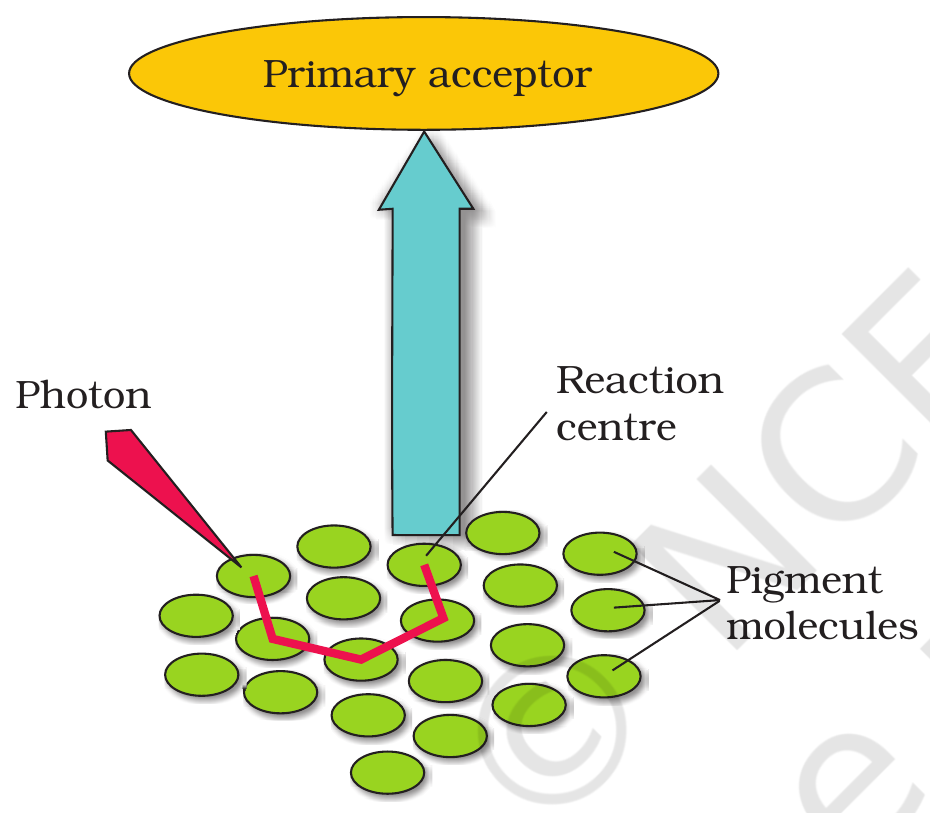
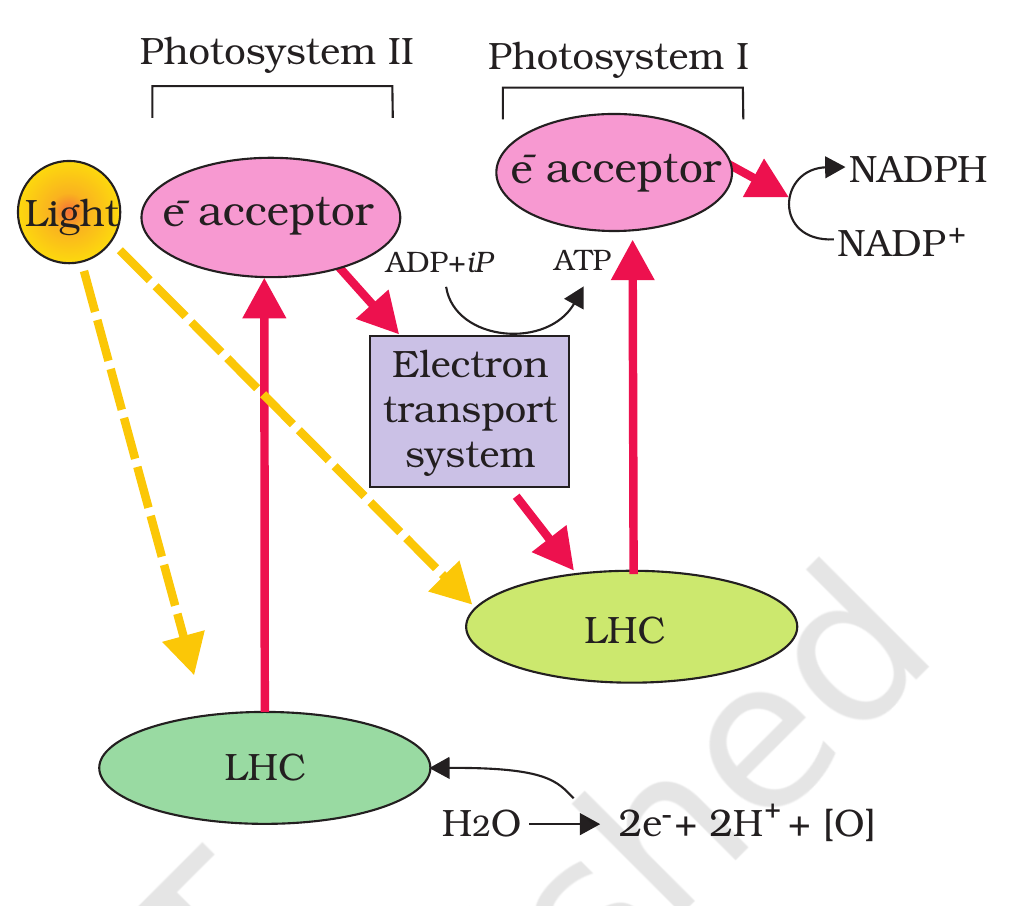
Light is harvested by light harvesting complexes (LHC): pigment molecules bound to proteins. The antenna pigments absorb light of different wavelengths and funnel the energy to a single chlorophyll a molecule called the reaction centre.
There are two photosystems, named in the sequence of their discovery:
- PS I: reaction centre P700 (absorbs light of 700 nm).
- PS II: reaction centre P680 (absorbs light of 680 nm).
In the Z-scheme, electrons flow from water to $\mathrm{NADP}^{+}$ through both photosystems:
Water → PS II (P680) → primary acceptor → plastoquinone → cytochrome b6f → plastocyanin → PS I (P700) → ferredoxin → $\mathrm{NADP}^{+}$ (NADPH).
Extra information (beyond NCERT XI Ch 11): the carrier names plastoquinone, plastocyanin and ferredoxin are not in NCERT XI Ch 11, which describes the electron transport system and cytochromes without naming these carriers.
Splitting of water: 2H2O → 4H+ + $O_2$ + 4e−. The water-splitting complex sits on the inner side of the thylakoid membrane, and the protons and oxygen are released into the lumen.
- Non-cyclic photophosphorylation uses both PS I and PS II. It produces ATP and NADPH, and releases $O_2$.
- Cyclic photophosphorylation uses only PS I. It produces ATP only: no NADPH and no $O_2$. It takes place when only light of wavelengths beyond 680 nm is available. The stroma lamellae lack PS II and the NADP reductase enzyme, so only cyclic photophosphorylation occurs there.
Suggest an edit
Practice1 question
Try it now. A wrong answer costs nothing here, try again until you get it.
In the Z-scheme, electrons from water first reach which photosystem, and what is its reaction centre?
In the Z-scheme, electrons from water first reach PS II, whose reaction centre is P680. PS I (P700) comes later in the chain, after plastocyanin. (Plastocyanin is a carrier name used here as extra information beyond NCERT XI Ch 11.)
Chemiosmosis: how ATP is made
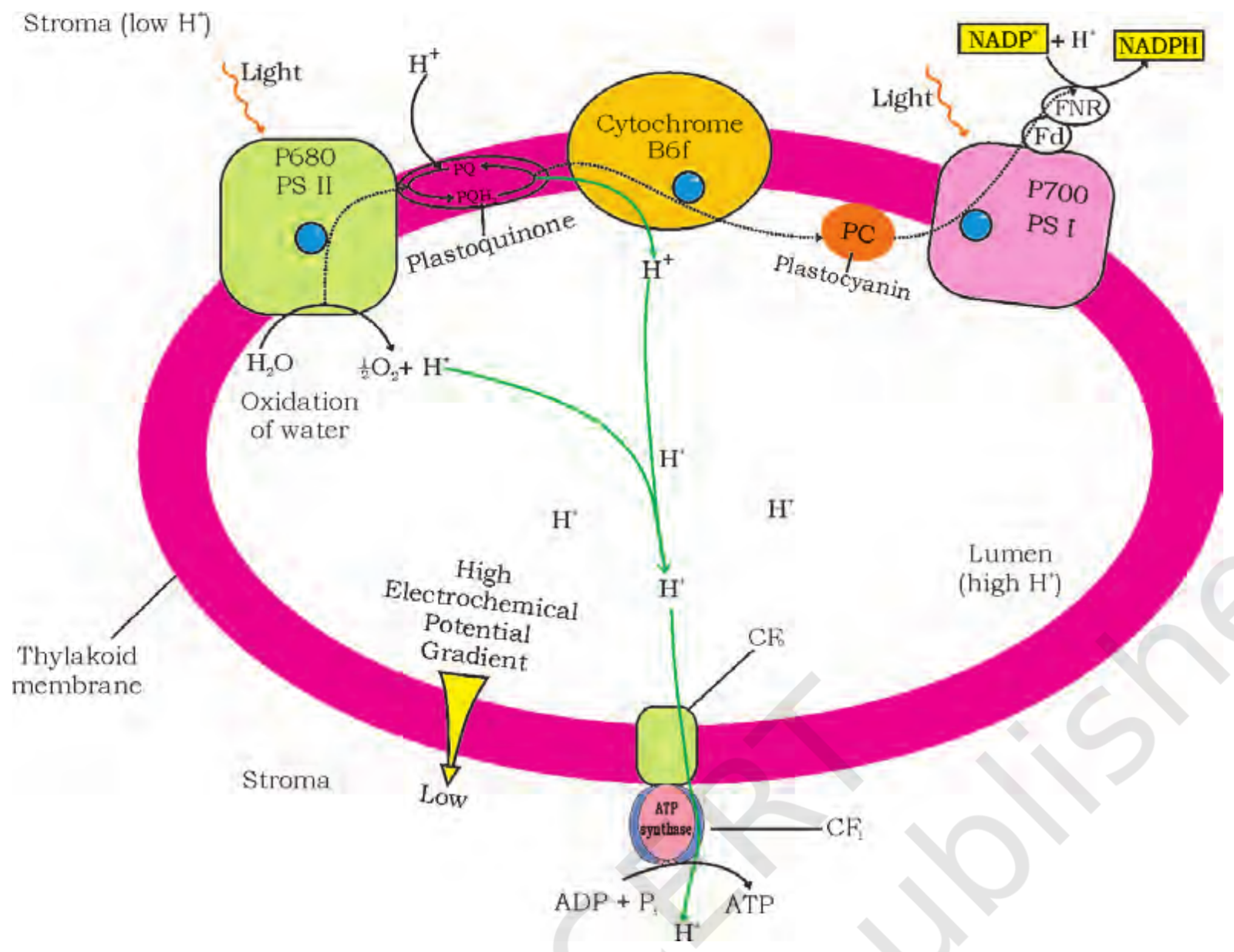
ATP synthesis in the chloroplast is linked to the development of a proton gradient across the thylakoid membrane. This is the chemiosmotic hypothesis.
Within the chloroplast, protons in the stroma decrease in number, while in the lumen there is accumulation of protons. This happens in three ways. First, the splitting of the water molecule takes place on the inner side of the membrane, so the protons produced by the splitting of water accumulate within the lumen of the thylakoids. Second, as electrons move through the photosystems, protons are transported across the membrane: the primary acceptor of electrons, located towards the outer side of the membrane, transfers its electrons not to an electron carrier but to an H carrier, which removes a proton from the stroma while transporting an electron, and releases the proton into the lumen when it passes the electron on. Third, the NADP reductase enzyme is located on the stroma side of the membrane, and along with the electrons that come from the acceptor of electrons of PS I, protons are necessary for the reduction of $\mathrm{NADP}^{+}$ to NADPH + $H^+$, so these protons are also removed from the stroma.
ATP synthase is the enzyme that uses this gradient. It has two parts: $CF_0$, a channel embedded in the thylakoid membrane, and $CF_1$, which sticks out on the stroma side. The gradient is broken down due to the movement of protons across the membrane to the stroma through the transmembrane channel of the $CF_0$ of the ATP synthase. The breakdown of the gradient provides enough energy to cause a conformational change in the F1 particle of the ATP synthase, which makes the enzyme synthesise ATP.
Four things are needed for chemiosmosis to work: a membrane, a proton pump, a proton gradient, and ATP synthase. Without the gradient there is no ATP synthesis. The light reactions make ATP only because the thylakoid membrane holds the two sides apart.
Suggest an edit
The Calvin cycle: where ATP and NADPH are used
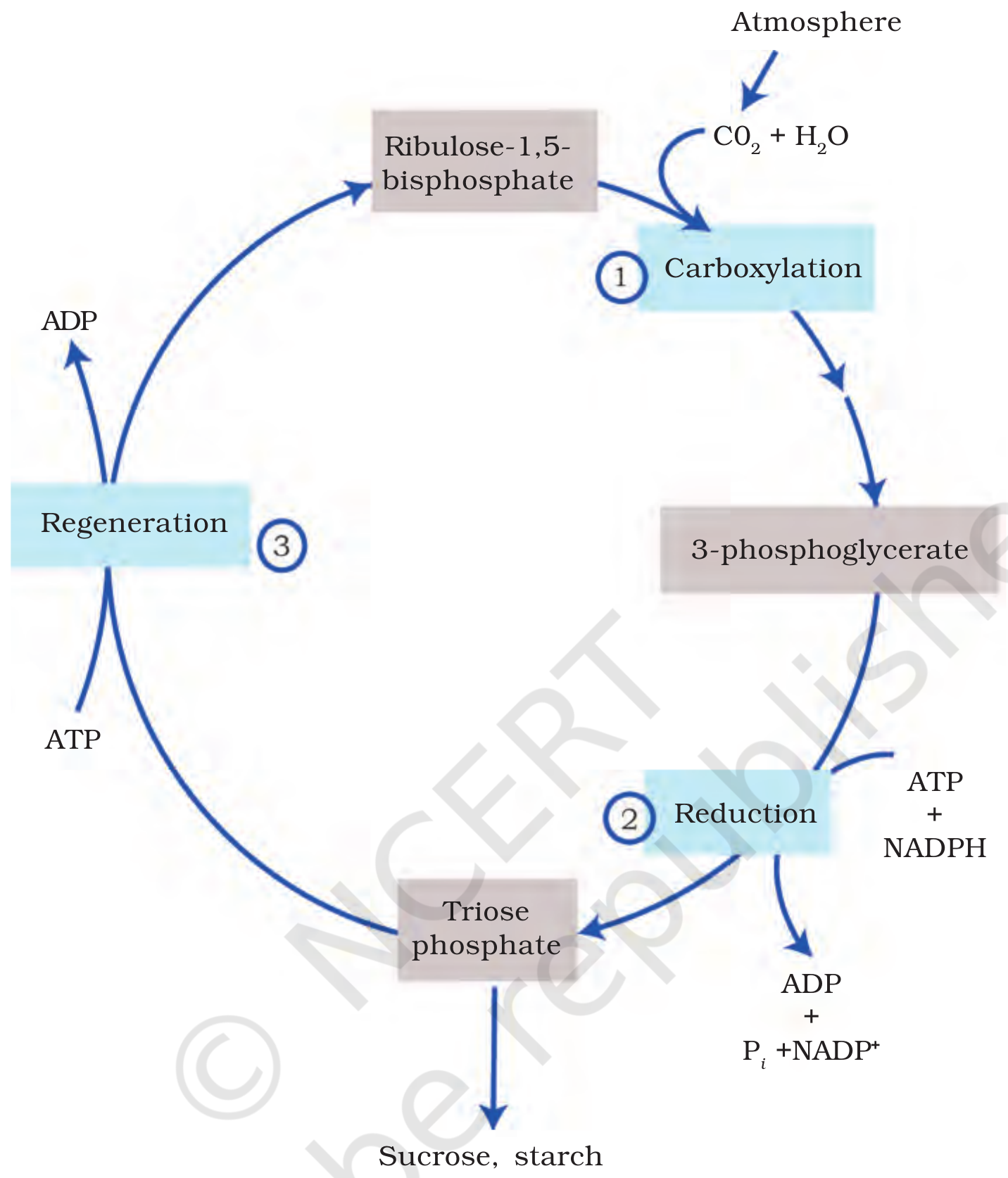
The ATP and NADPH made in the light reactions are used in the biosynthetic phase, in the stroma, to fix $CO_2$ into sugar. This phase is often called the dark reaction, but that is a misnomer: it does not depend directly on light, yet it depends on the products of the light reactions, so it usually runs in the light.
The first $CO_2$ fixation product is 3-phosphoglyceric acid (3-PGA, 3-carbon) in $C_3$ plants, and oxaloacetic acid (OAA, 4-carbon) in $C_4$ plants. The primary $CO_2$ acceptor is ribulose bisphosphate (RuBP), a 5-carbon ketose sugar.
The Calvin cycle ($C_3$ pathway) has three stages:
- Carboxylation: RuBP combines with $CO_2$ to form two molecules of 3-PGA. The enzyme is RuBP carboxylase-oxygenase (RuBisCO), the most abundant enzyme in the world.
- Reduction: 3-PGA is reduced to a triose phosphate using ATP and NADPH: 2 ATP and 2 NADPH for each $CO_2$ fixed. Extra information (beyond NCERT XI Ch 11): the triose phosphate is commonly called glyceraldehyde-3-phosphate (G3P); NCERT Ch 11 does not name G3P.
- Regeneration: RuBP is regenerated from the triose phosphate (G3P, as extra information beyond NCERT Ch 11) so the cycle can turn again: 1 ATP for each $CO_2$ fixed.
For every $CO_2$ molecule entering the Calvin cycle, 3 molecules of ATP and 2 of NADPH are required. Six turns of the cycle fix six $CO_2$ into one molecule of glucose, so one glucose costs 18 ATP and 12 NADPH.
The Calvin pathway occurs in all photosynthetic plants, $C_3$ and $C_4$ alike. In $C_4$ plants it runs in the bundle sheath cells; in $C_3$ plants it runs in the mesophyll cells.
Suggest an edit
Practice1 question
Try it now. A wrong answer costs nothing here, try again until you get it.
How many ATP and NADPH are required to fix one $CO_2$ molecule in the Calvin cycle?
For every $CO_2$ fixed, the Calvin cycle uses 2 ATP and 2 NADPH in reduction and 1 ATP in regeneration: 3 ATP and 2 NADPH in total. For one glucose (6 $CO_2$) that is 18 ATP and 12 NADPH.
The $C_4$ pathway: Hatch and Slack
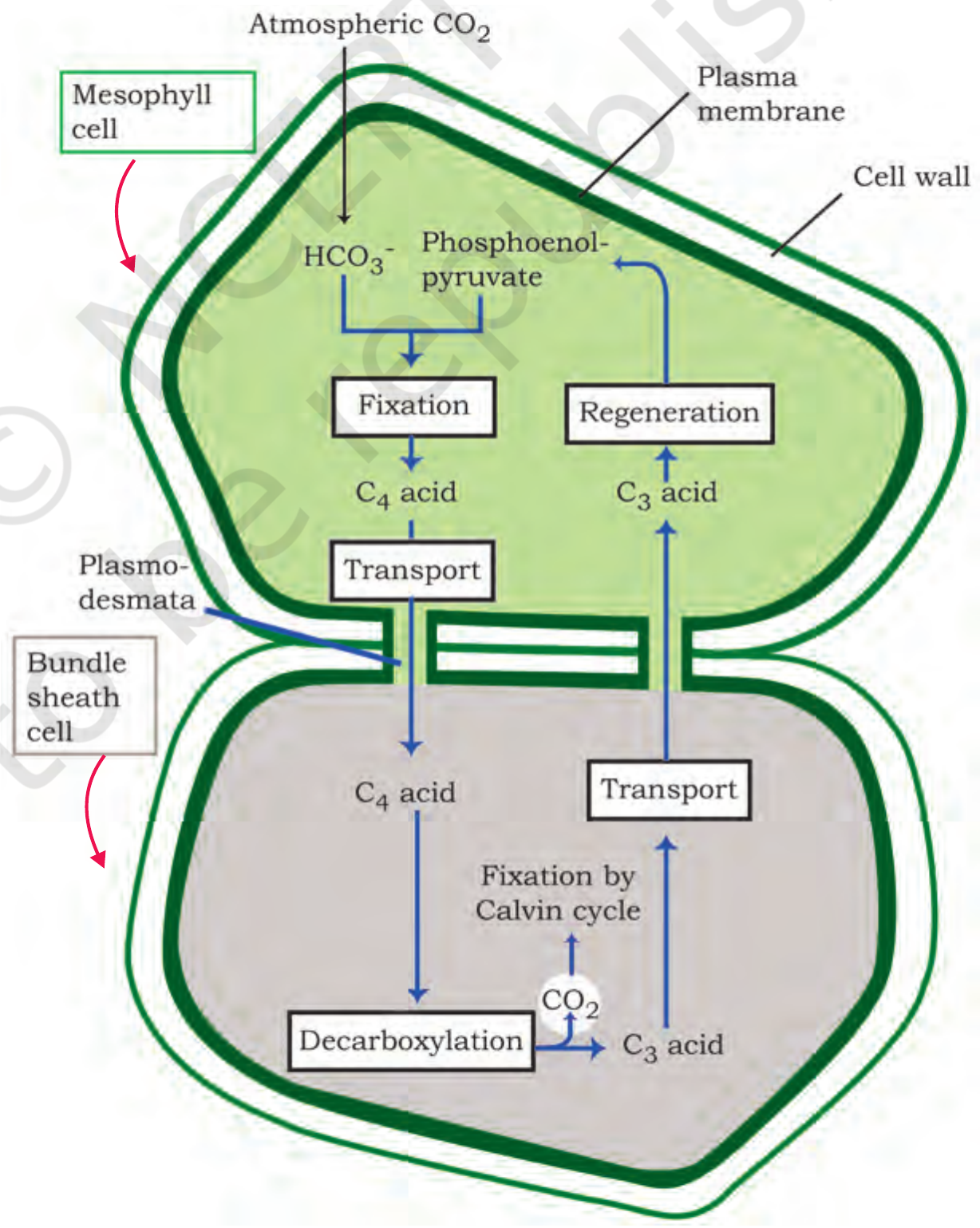
$C_4$ plants grow in dry tropical regions. NCERT XI Ch 11 names maize and sorghum as $C_4$ plants. Extra information (beyond NCERT XI Ch 11): sugarcane is another $C_4$ plant. They have a special leaf anatomy and a different first step of $CO_2$ fixation.
Kranz anatomy: the leaves have large bundle sheath cells in layers around the vascular bundles. These cells have many chloroplasts, thick walls that are impervious to gaseous exchange, and no intercellular spaces.
- First fixation, in the mesophyll cells: phosphoenolpyruvate (PEP, 3-carbon) accepts $CO_2$ to form oxaloacetic acid (OAA, 4-carbon). The enzyme is PEP carboxylase (PEPcase).
- OAA is converted to malic acid or aspartic acid and transported into the bundle sheath cells.
- In the bundle sheath cells the $C_4$ acid is broken down to release $CO_2$, which enters the Calvin cycle. The 3-carbon molecule left behind is transported back to the mesophyll cells and converted to PEP again.
The two cell types divide the work: mesophyll cells lack RuBisCO, and bundle sheath cells lack PEPcase. Because $CO_2$ is concentrated around RuBisCO in the bundle sheath, $C_4$ plants lack photorespiration and show greater productivity of biomass than $C_3$ plants.
Suggest an edit
Practice1 question
Try it now. A wrong answer costs nothing here, try again until you get it.
In $C_4$ plants, the first $CO_2$ fixation takes place in the mesophyll cells. Which enzyme catalyses it, and what is the product?
In $C_4$ plants the first $CO_2$ fixation happens in the mesophyll cells: PEP (3-carbon) accepts $CO_2$ to form oxaloacetic acid (4-carbon), catalysed by PEP carboxylase. RuBisCO acts later, in the bundle sheath cells, on the $CO_2$ released from the $C_4$ acid.
Photorespiration
RuBisCO is both a carboxylase and an oxygenase: its active site can bind $CO_2$ or $O_2$, and the two compete. When $O_2$ is high and $CO_2$ is low, oxygenation wins.
In photorespiration, RuBP combines with $O_2$ to form one molecule of phosphoglycerate (3-carbon) and one molecule of phosphoglycolate (2-carbon). This is a wasteful process: there is no synthesis of sugars, ATP or NADPH, and $CO_2$ is released with the utilisation of ATP. The biological function of photorespiration is not known.
Photorespiration is a $C_3$ problem. $C_4$ plants avoid it because the $C_4$ pathway concentrates $CO_2$ in the bundle sheath cells around RuBisCO, so oxygenation is suppressed.
- $C_3$ plants: NCERT XI Ch 11 names tomatoes and bell pepper as the greenhouse crops grown at higher $CO_2$. Extra information (beyond NCERT XI Ch 11): wheat, rice, potato, soybean and sunflower are also $C_3$ plants.
- $C_4$ plants: maize and sorghum (named in NCERT XI Ch 11). Extra information (beyond NCERT XI Ch 11): sugarcane is also a $C_4$ plant.
Temperature optimum: $C_3$ plants 20-25°C, $C_4$ plants 30-40°C. (Paired from the 'Choose from' column of NCERT Table 11.1 using Sec. 11.10.3.)
Suggest an edit
Factors affecting photosynthesis
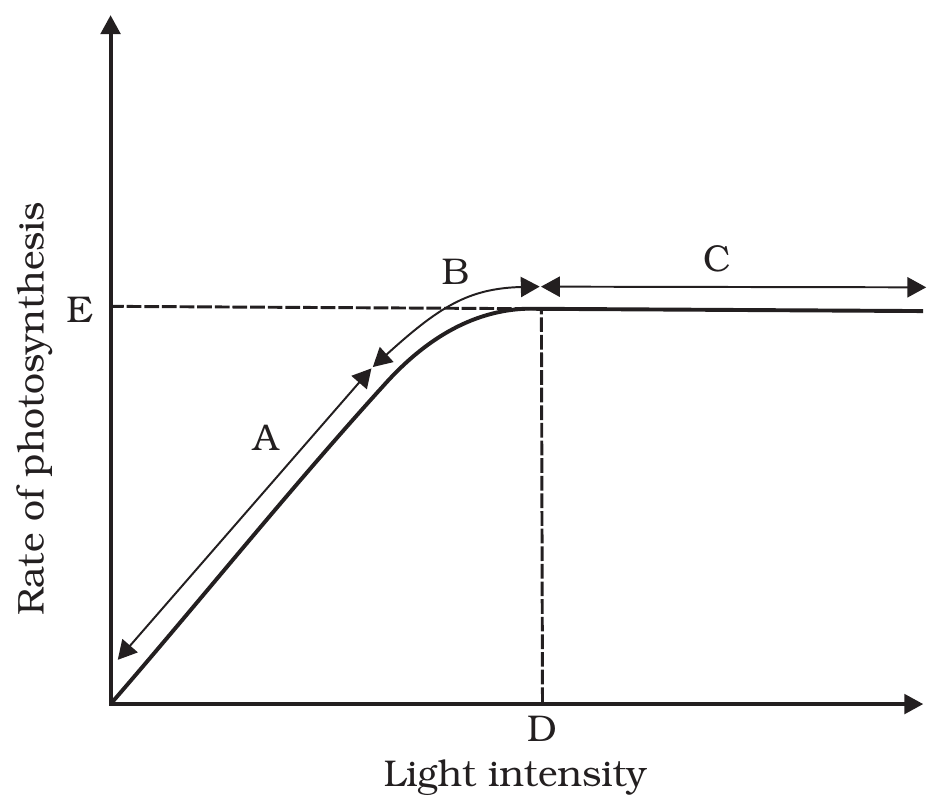
Blackman's Law of Limiting Factors (1905): when a process is conditioned by several factors, its rate is limited by the factor that is in shortest supply: the slowest factor.
- Light: the rate of photosynthesis rises with light intensity and saturates at about 10% of full sunlight. Very high light breaks down chlorophyll and reduces the rate.
- Carbon dioxide: $CO_2$ is 0.03-0.04% of air and is the major limiting factor for photosynthesis. Raising $CO_2$ to 0.05% increases the rate of fixation. $C_4$ plants saturate at about 360 microlitres per litre, while $C_3$ plants respond beyond 450 microlitres per litre. This is why greenhouse crops like tomatoes and bell pepper are grown at higher $CO_2$.
- Temperature: the dark reactions are enzymatic, so they are temperature-sensitive. $C_4$ plants and tropical plants have a higher temperature optimum than $C_3$ plants.
- Water: water stress closes the stomata, so less $CO_2$ enters the leaf; water stress also makes leaves wilt, thus reducing the surface area of the leaves and their metabolic activity as well. Both effects cut photosynthesis.
For NEET, remember the limiting factor rule as a trap: a factor only limits the rate when it is in shortest supply. Raising any other factor changes nothing.
Suggest an edit
Table 1: The Z-scheme at a glance
| Step | What happens | Where |
|---|---|---|
| Splitting of water | 2H2O → 4H+ + $O_2$ + 4e− | Water-splitting complex, inner side of the thylakoid membrane |
| PS II | Light lifts electrons; reaction centre P680 | Grana thylakoids |
| PQ → Cyt b6f → PC | Electrons flow downhill; $H^+$ pumped into the lumen | Thylakoid membrane |
| PS I | Light lifts electrons again; reaction centre P700 | Grana thylakoids |
| Fd → $\mathrm{NADP}^{+}$ | $\mathrm{NADP}^{+}$ reduced to NADPH | Stroma side of the membrane |
Net result of non-cyclic flow: ATP + NADPH + $O_2$. Source: NCERT XI, Ch 11, Fig. 11.5.
Extra information (beyond NCERT XI Ch 11): the carrier names plastoquinone (PQ), plastocyanin (PC) and ferredoxin (Fd) are not in NCERT XI Ch 11.
Suggest an edit
Table 2: Calvin cycle: cost and counting
| For | ATP | NADPH |
|---|---|---|
| 1 $CO_2$ fixed | 3 | 2 |
| 3 $CO_2$ → 1 G3P (net) | 9 | 6 |
| 6 $CO_2$ → 1 glucose | 18 | 12 |
Stages in order: carboxylation → reduction → regeneration. Primary acceptor: RuBP (5-carbon ketose sugar). First stable product: 3-PGA (3-carbon) in $C_3$ plants, OAA (4-carbon) in $C_4$ plants. Source: NCERT XI, Ch 11, 11.7.
Extra information (beyond NCERT XI Ch 11): glyceraldehyde-3-phosphate (G3P) is the name used here for the triose phosphate formed in the reduction stage; NCERT Ch 11 does not name G3P.
Suggest an edit
Table 3: $C_3$ vs $C_4$ plants
| Feature | $C_3$ plants | $C_4$ plants |
|---|---|---|
| Primary $CO_2$ acceptor | RuBP (5C) | PEP (3C) |
| First stable product | 3-PGA (3C) | OAA (4C) |
| Cell where the Calvin cycle runs | Mesophyll | Bundle sheath |
| Cell of first $CO_2$ fixation | Mesophyll | Mesophyll |
| Photorespiration | Present | Absent |
| Temperature optimum | 20-25°C | 30-40°C |
| Examples | Wheat, rice, potato, soybean, sunflower | Maize, sorghum, sugarcane |
Temperature-optimum row: paired from the 'Choose from' column of NCERT Table 11.1 using Sec. 11.10.3. All other rows are stated in NCERT XI, Ch 11, 11.7-11.9.
Extra information (beyond NCERT XI Ch 11): the crop examples wheat, rice, potato, soybean, sunflower ($C_3$) and sugarcane ($C_4$) are not named in NCERT XI Ch 11, which names only maize and sorghum ($C_4$) and tomatoes and bell pepper ($C_3$ greenhouse crops).
Suggest an edit
Table 4: Cyclic vs non-cyclic photophosphorylation
| Feature | Non-cyclic photophosphorylation | Cyclic photophosphorylation |
|---|---|---|
| Photosystems used | PS I and PS II | PS I only |
| Products | ATP + NADPH + $O_2$ | ATP only |
| Water splitting | Yes | No |
| Where it happens | Grana thylakoids | Stroma lamellae (and whenever only light beyond 680 nm is available) |
| When it dominates | Normal light | Only light beyond 680 nm |
The stroma lamellae lack PS II and NADP reductase, so only cyclic flow is possible there. Source: NCERT XI, Ch 11, 11.6.
Suggest an edit
Trap Boxes
The dark reaction happens in the dark?
Wrong idea: The biosynthetic phase is called the dark reaction, so it runs at night in darkness.
The biosynthetic phase does not depend directly on light, but it depends on ATP and NADPH from the light reactions, so it usually runs in the light. NCERT calls 'dark reaction' a misnomer.
NCERT XI, Ch 11, 11.7
Only chlorophyll a absorbs light?
Wrong idea: Chlorophyll a is the only pigment that matters; the others are just colour.
Chlorophyll b, xanthophylls and carotenoids are accessory pigments: they absorb light at other wavelengths and pass the energy to chlorophyll a, and they protect chlorophyll a from photo-oxidation. The action spectrum does not match chlorophyll a absorption alone.
NCERT XI, Ch 11, 11.4
Cyclic photophosphorylation also makes NADPH?
Wrong idea: Cyclic photophosphorylation makes both ATP and NADPH, like the non-cyclic route.
Cyclic photophosphorylation uses only PS I, so it makes ATP only: no NADPH and no $O_2$. It happens when only light beyond 680 nm is available. Stroma lamellae, which lack PS II and NADP reductase, can only do cyclic flow.
NCERT XI, Ch 11, 11.6
$C_4$ plants do photorespiration too?
Wrong idea: Photorespiration happens in all plants, $C_3$ and $C_4$ alike.
$C_4$ plants lack photorespiration. Their Kranz anatomy concentrates $CO_2$ in the bundle sheath cells around RuBisCO, so oxygenation is suppressed and the Calvin cycle runs without the wasteful photorespiratory loss.
NCERT XI, Ch 11, 11.8, 11.9
The oxygen released comes from carbon dioxide?
Wrong idea: Photosynthesis splits $CO_2$, so the $O_2$ released comes from carbon dioxide.
The $O_2$ comes from water. Van Niel showed this from purple and green sulphur bacteria, and the light reaction splits water: 2H2O → 4H+ + $O_2$ + 4e−. The oxygen of $CO_2$ ends up in carbohydrate.
NCERT XI, Ch 11, 11.2, 11.6
Chapter test
5 NEET PYQs. +4 for a correct answer, -1 for a wrong answer, exactly like NEET. Finish the test to earn a medal.
Q1: NEET (UG) 2024, Code R3, Q137
Given below are two statements:
Statement I: In $C_3$ plants, some $O_2$ binds to RuBisCO, hence $CO_2$ fixation is decreased.
Statement II: In $C_4$ plants, mesophyll cells show very little photorespiration while bundle sheath cells do not show photorespiration.
In the light of the above statements, choose the correct answer from the options given below:
Statement I is true: $O_2$ competes with $CO_2$ at RuBisCO's active site, so oxygenation cuts $CO_2$ fixation in $C_3$ plants. Statement II is false: $C_4$ plants lack photorespiration altogether. Mesophyll cells have no RuBisCO, and in bundle sheath cells $CO_2$ is concentrated around RuBisCO.
Q2: NEET (UG) 2024, Code R3, Q120
Which of the following are required for the dark reaction of photosynthesis?
A. Light
B. Chlorophyll
C. $CO_2$
D. ATP
E. NADPH
Choose the correct answer from the options given below :
The dark (biosynthetic) reaction needs $CO_2$ as the substrate plus the ATP and NADPH made in the light reaction. It does not directly need light or chlorophyll.
Q3: NEET (UG) 2022, Code R1, Q121
Given below are two statements :
Statement I : The primary $CO_2$ acceptor in $C_4$ plants is phosphoenolpyruvate and is found in the mesophyll cells.
Statement II : Mesophyll cells of $C_4$ plants lack RuBisCo enzyme.
In the light of the above statements, choose the correct answer from the options given below :
In $C_4$ plants PEP (3C) in the mesophyll cells is the primary $CO_2$ acceptor, and RuBisCO is absent from mesophyll cells. It is present only in the bundle sheath cells, where the Calvin cycle runs.
Q4: NEET (UG) 2021, Code P3, Q103
The first stable product of $CO_2$ fixation in sorghum is
Sorghum is a $C_4$ plant. Its first $CO_2$ fixation in the mesophyll cells gives oxaloacetic acid (OAA), a 4-carbon acid. Phosphoglyceric acid (3-PGA) is the first stable product of $C_3$ plants.
Q5: NEET (UG) 2020, Code G5, Q41
The oxygenation activity of RuBisCo enzyme in photorespiration leads to the formation of
Oxygenation of RuBP gives one 3-C phosphoglycerate and one 2-C phosphoglycolate; the 3-C product is the one named in option (1).
Score: 0 · Answered 0 of 5
Flashcards
Tap a card to flip it over and see the answer. Tap it again to flip it back.
How many ATP and NADPH are needed to fix one $CO_2$ molecule in the Calvin cycle? How many for one glucose?
Tap to flip3 ATP and 2 NADPH per $CO_2$. For one glucose (6 $CO_2$): 18 ATP and 12 NADPH.
Tap to flip backName the three stages of the Calvin cycle in order.
Tap to flipCarboxylation → Reduction → Regeneration.
Tap to flip backWhat is the primary $CO_2$ acceptor in the Calvin cycle, and how many carbons does it have?
Tap to flipRuBP (ribulose bisphosphate), a 5-carbon ketose sugar.
Tap to flip backWhich photosystem is missing from the stroma lamellae, and what else is absent there?
Tap to flipPS II is missing, and so is the NADP reductase enzyme. Only PS I is present, so only cyclic photophosphorylation can occur in the stroma lamellae.
Tap to flip backWrite the overall equation of photosynthesis.
Tap to flip6CO2 + 12H2O → $C_6H_{12}O_6$ + 6H2O + 6O2, in the presence of light and chlorophyll.
Tap to flip backWrite the water-splitting reaction of the light reaction, and say where it happens.
Tap to flip2H2O → 4H+ + $O_2$ + 4e−. It happens at the water-splitting complex on the inner side of the thylakoid membrane; the protons and oxygen are released into the lumen.
Tap to flip backIn the Z-scheme, in what order do electrons flow from water to $\mathrm{NADP}^{+}$?
Tap to flipWater → PS II (P680) → plastoquinone → cytochrome b6f → plastocyanin → PS I (P700) → ferredoxin → $\mathrm{NADP}^{+}$. (Carrier names plastoquinone, plastocyanin and ferredoxin: extra information beyond NCERT XI Ch 11.)
Tap to flip backWhat is the first stable product of $CO_2$ fixation in a $C_4$ plant, and in which cells is it formed?
Tap to flipOxaloacetic acid (OAA), a 4-carbon acid, formed in the mesophyll cells by PEP carboxylase.
Tap to flip backWhat is the temperature optimum for photosynthesis in $C_3$ plants and in $C_4$ plants?
Tap to flip$C_3$ plants: 20-25°C. $C_4$ plants: 30-40°C. (Paired from the 'Choose from' column of NCERT Table 11.1 using Sec. 11.10.3.)
Tap to flip backRuBisCO is a carboxylase, but what else can it do, and what decides which reaction it carries out?
Tap to flipIt is also an oxygenase. Its active site binds $CO_2$ and $O_2$ competitively, so the relative concentration of $CO_2$ and $O_2$ decides whether carboxylation or oxygenation happens.
Tap to flip back