 NEET Notes
Home > Biology > Botany > Biological Classification
Biological Classification
On this page · 12 sections
- 01Syllabus map
- 02Classification and the five kingdoms
- 03Kingdom Monera
- 04Kingdom Protista
- 05Kingdom Fungi
- 06Classes of fungi
- 07Kingdom Plantae and Kingdom Animalia
- 08Viruses, viroids, prions and lichens
- 09Table 1 - Five kingdoms compared
- 10Table 2 - Protista: five groups
- 11Table 3 - Fungi: four classes
- 12Table 4 - Viruses, viroids and prions
Five kingdoms, Monera, Protista, Fungi, Plantae and Animalia, plus viruses, viroids, prions and lichens.
Syllabus map
- NMC Unit: BIO-U01, Diversity in Living World. NCERT Chapter 2, Biological Classification.
- Subtopics in this chapter (NCERT XI, Ch 2): Five kingdom classification. Kingdom Monera. Kingdom Protista. Kingdom Fungi. Kingdom Plantae. Kingdom Animalia. Viruses, viroids, prions and lichens.
- Subtopic checklist: (1) basis of five kingdom classification; (2) archaebacteria and eubacteria; (3) the five protist groups; (4) fungal structure, reproduction and classes; (5) viruses, viroids, prions and lichens.
- Excluded topics: detail of plant groups (Chapter 3, Plant Kingdom) and animal groups (Chapter 4, Animal Kingdom). Only the kingdom-level characters are covered here. Do not import their facts into this chapter.
- Estimated revision time: 12 minutes. Jump links: Syllabus Map, Five Kingdoms, Monera, Protista, Fungi, Viruses, Trap Boxes, PYQs, Chapter Test.
Classification and the five kingdoms
Aristotle classified plants and animals on the basis of simple morphological characters. Linnaeus proposed the Two Kingdom classification, Plantae and Animalia. It did not distinguish between eukaryotes and prokaryotes, unicellular and multicellular organisms, and photosynthetic and non-photosynthetic organisms.
R.H. Whittaker proposed the Five Kingdom Classification in 1969: Monera, Protista, Fungi, Plantae and Animalia.
The main criteria for this classification are cell structure, body organisation, mode of nutrition, reproduction, and phylogenetic relationships. Kingdom Protista has brought together Chlamydomonas and Chlorella (earlier placed in Algae within Plants and both having cell walls) with Paramoecium and Amoeba (earlier placed in the animal kingdom, which lack cell wall).
The three-domain system has also been proposed that divides the Kingdom Monera into two domains, leaving the remaining eukaryotic kingdoms in the third domain and thereby a six kingdom classification.
Kingdom Monera
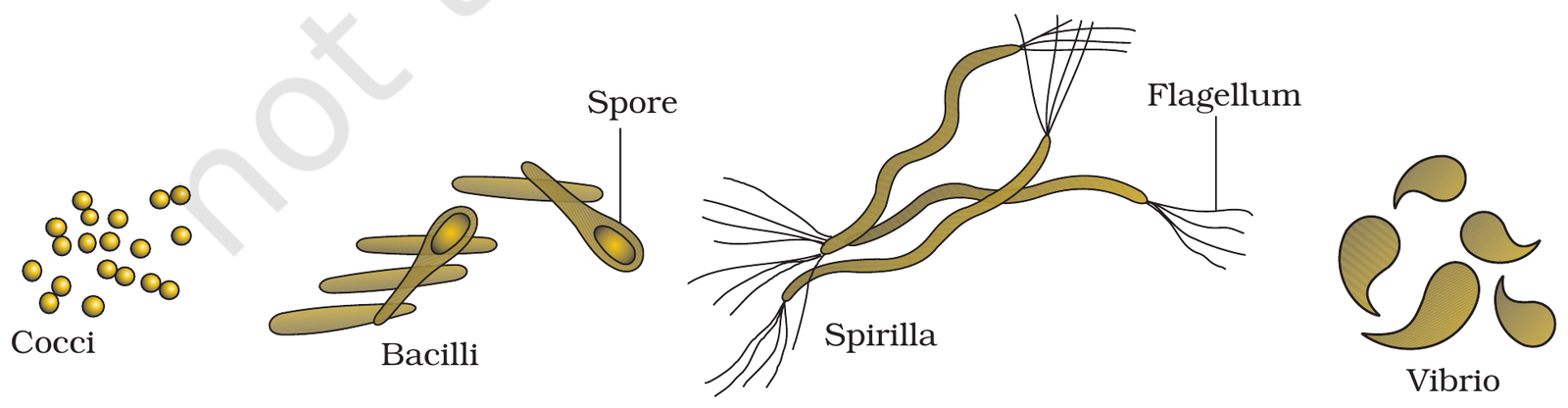
Bacteria are the sole members of the Kingdom Monera. They are the most abundant micro-organisms. They occur almost everywhere: in air, water and soil, inside other organisms, and in extreme habitats like hot springs, deserts, snow and deep oceans. Though the bacterial structure is very simple, they are very complex in behaviour. Compared to many other organisms, bacteria as a group show the most extensive metabolic diversity.
Bacteria occur in four shapes: spherical coccus (pl. cocci), rod-shaped bacillus (pl. bacilli), comma-shaped vibrium (pl. vibrio) and spiral spirillum (pl. spirilla).
- Archaebacteria: they live in harsh habitats. Halophiles live in salty areas. Thermoacidophiles live in hot springs. Archaebacteria differ from other bacteria in having a different cell wall structure, and this feature is responsible for their survival in extreme conditions. Methanogens live in marshy areas. They are present in the gut of several ruminant animals such as cows and buffaloes, and they are responsible for the production of methane (biogas) from the dung of these animals.
- Eubacteria: true bacteria, with a rigid cell wall and, if motile, a flagellum. Cyanobacteria (blue-green algae) have chlorophyll a similar to green plants and are photosynthetic autotrophs, for example Nostoc and Anabaena. The colonies are generally surrounded by gelatinous sheath. They can fix atmospheric nitrogen in specialised cells called heterocysts, and they form blooms in polluted water. Heterotrophic bacteria are the most abundant in nature; they are decomposers, and they are helpful (curd, antibiotics) and harmful (cholera, typhoid, tetanus, citrus canker). Chemosynthetic autotrophic bacteria oxidise various inorganic substances such as nitrates, nitrites and ammonia and use the released energy for their ATP production. They play a great role in recycling nutrients like nitrogen, phosphorous, iron and sulphur.
- Mycoplasma: they completely lack a cell wall. They are the smallest living cells known, and they can survive without oxygen. They are pathogenic in animals and plants.
Reproduction in bacteria is primarily by fission. Under unfavourable conditions they produce spores. They also show a primitive type of sexual reproduction by DNA transfer from one bacterium to the other.
Practice1 question
Try it now. A wrong answer costs nothing here, try again until you get it.
Which group of archaebacteria is present in the gut of ruminant animals such as cows and buffaloes, and is responsible for the production of methane (biogas) from their dung?
Methanogens are present in the gut of several ruminant animals such as cows and buffaloes and are responsible for the production of methane (biogas) from the dung of these animals. Halophiles live in salty areas and thermoacidophiles in hot springs.
Kingdom Protista
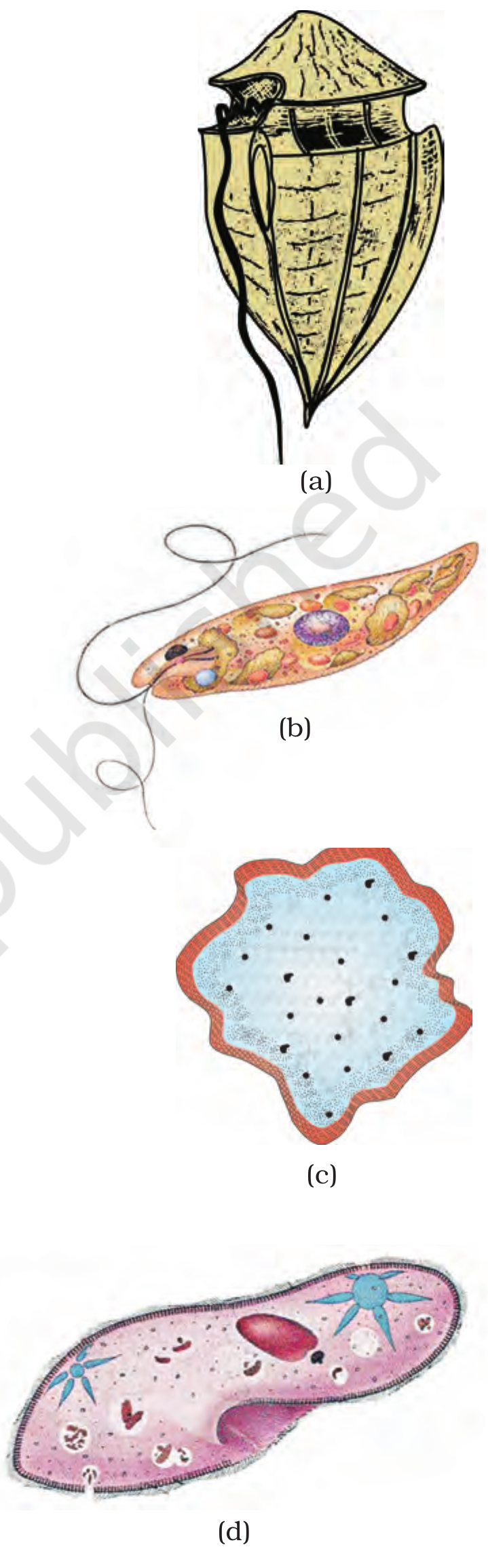
All single-celled eukaryotes are placed under Protista. They have a well-defined nucleus and membrane-bound organelles. Some have flagella or cilia. They reproduce asexually and sexually.
- Chrysophytes: diatoms and golden algae (desmids). They are found in fresh water and marine water. They are microscopic and float passively in water currents (plankton). Most of them are photosynthetic. The cell walls of diatoms form two thin overlapping shells, which fit together as in a soap box. The walls are embedded with silica and are indestructible. Their deposits over billions of years form diatomaceous earth, used in polishing and in filtration of oils and syrups. Diatoms are the chief producers in the oceans.
- Dinoflagellates: mostly marine and photosynthetic. The cell wall has stiff cellulose plates on the outer surface. Most of them have two flagella; one lies longitudinally and the other transversely in a furrow between the wall plates. Red dinoflagellates such as Gonyaulax multiply rapidly and make the sea appear red (red tides), and they release toxins.
- Euglenoids: found in fresh stagnant water. Instead of a cell wall they have a protein-rich layer called pellicle which makes their body flexible. They have two flagella, a short and a long one. Though they are photosynthetic in the presence of sunlight, when deprived of sunlight they behave like heterotrophs by predating on other smaller organisms, for example Euglena. The pigments of euglenoids are identical to those present in higher plants.
- Slime moulds: saprophytic protists. The body moves along decaying twigs and leaves engulfing organic material. Under favourable conditions they form an aggregation called plasmodium. Under unfavourable conditions the plasmodium differentiates and forms fruiting bodies bearing spores at their tips. The spores have true walls and are dispersed by air currents.
- Protozoans: heterotrophs that live as predators or parasites. They are believed to be primitive relatives of animals. Four major groups: Amoeboid (Amoeba, with pseudopodia; Entamoeba, parasitic; marine forms have silica shells on their surface), Flagellated (Trypanosoma, which causes sleeping sickness), Ciliated (Paramecium, with cilia and a gullet), Sporozoans (Plasmodium, which causes malaria, with a spore-like infective stage).
Practice1 question
Try it now. A wrong answer costs nothing here, try again until you get it.
The cell walls of diatoms are embedded with silica and form two thin overlapping shells. What is the gritty soil formed by their accumulation over billions of years called?
Diatom walls are indestructible because they are embedded with silica. Their deposits form diatomaceous earth, used in polishing and filtration of oils and syrups.
Kingdom Fungi
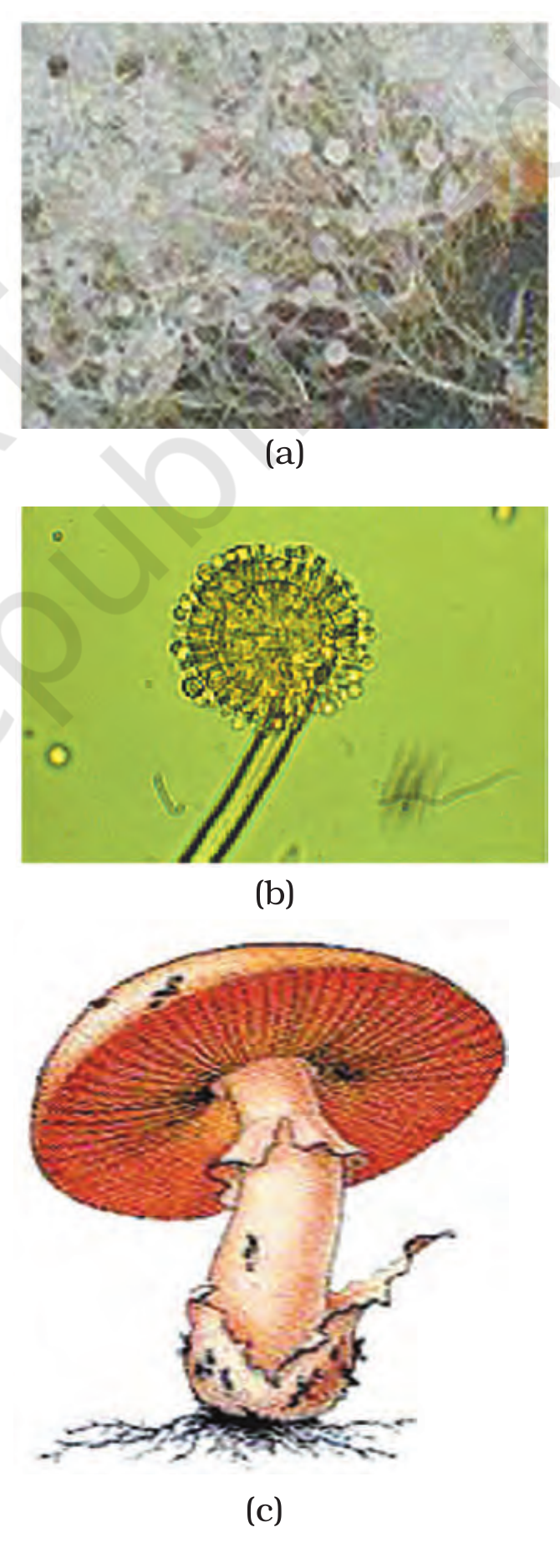
Fungi are heterotrophic eukaryotes. They absorb soluble organic matter from dead substrates (saprophytic), from living plants and animals (parasitic), or live in symbiosis, as in lichens and mycorrhiza.
The body of a fungus is a mycelium made of long, slender thread-like hyphae. The cell wall is made of chitin and polysaccharides.
Reproduction is vegetative (fragmentation, fission, budding), asexual (zoospores, which are motile, conidia, sporangiospores) and sexual (oospores, ascospores, basidiospores).
The sexual cycle has three steps. First, plasmogamy: fusion of the protoplasm of two motile or non-motile gametes. In ascomycetes and basidiomycetes this gives a dikaryon, a cell with two nuclei (n + n). Second, karyogamy: fusion of the two nuclei, giving a diploid zygote. Third, meiosis in the zygote, giving haploid spores.
The sexual stage produces fruiting bodies: the ascocarp in ascomycetes and the basidiocarp in basidiomycetes.
Practice1 question
Try it now. A wrong answer costs nothing here, try again until you get it.
In the sexual cycle of fungi, the fusion of two nuclei is called:
Plasmogamy is the fusion of protoplasm. Karyogamy is the fusion of the two nuclei, giving a diploid zygote. The dikaryon is the two-nucleus (n + n) stage before karyogamy.
Classes of fungi
- Phycomycetes: the mycelium is aseptate and coenocytic. Asexual reproduction takes place by zoospores (motile) or by aplanospores (non-motile). These spores are endogenously produced in sporangium. A zygospore is formed by fusion of gametes. These gametes are similar in morphology (isogamous) or dissimilar (anisogamous or oogamous). Examples: Rhizopus (bread mould), Mucor, Albugo (parasitic fungi on mustard).
- Ascomycetes: sac fungi. They are mostly multicellular, e.g., Penicillium, or rarely unicellular, e.g., yeast (Saccharomyces). They are saprophytic, decomposers, parasitic or coprophilous (growing on dung). The mycelium is branched and septate. Asexual spores are conidia, produced exogenously on the special mycelium called conidiophores. Sexual spores are ascospores, produced endogenously in asci. The fruiting body is the ascocarp. Examples: Aspergillus, Claviceps, Saccharomyces (yeast, used in baking and brewing), Neurospora (used extensively in biochemical and genetic work), Penicillium. Morels and truffles are edible delicacies.
- Basidiomycetes: mushrooms, bracket fungi and puffballs. The mycelium is branched and septate. The asexual spores are generally not found, but vegetative reproduction by fragmentation is common. The sex organs are absent, but plasmogamy is brought about by fusion of two vegetative or somatic cells of different strains or genotypes, giving a dikaryon. Basidiospores are produced exogenously on the basidium. The fruiting body is the basidiocarp. Examples: Agaricus (mushroom), Ustilago (smut), Puccinia (rust).
- Deuteromycetes: imperfect fungi. Only the asexual or vegetative stage is known. The mycelium is septate and branched. They reproduce only by conidia. When their sexual forms are discovered they are moved to ascomycetes or basidiomycetes. Examples: Alternaria, Colletotrichum, Trichoderma. They are decomposers of litter and help in mineral cycling. Some are parasitic.
Practice1 question
Try it now. A wrong answer costs nothing here, try again until you get it.
In which class of fungi are the sexual spores (ascospores) produced endogenously inside a sac-like ascus?
Ascomycetes are the sac fungi: ascospores are produced endogenously in asci. Basidiospores are produced exogenously on the basidium, and deuteromycetes have no known sexual stage.
Kingdom Plantae and Kingdom Animalia
Kingdom Plantae includes all eukaryotic, chlorophyll-containing organisms, commonly called plants. A few members are partially heterotrophic such as the insectivorous plants or parasites. Bladderwort and Venus fly trap are examples of insectivorous plants and Cuscuta is a parasite. They have a cellulosic cell wall and are autotrophic. Their life cycle shows alternation of generations. Algae, bryophytes, pteridophytes, gymnosperms and angiosperms are covered in detail in Chapter 3, Plant Kingdom.
Kingdom Animalia includes heterotrophic eukaryotes that lack a cell wall and ingest food. They store food as glycogen or fat. Higher forms show elaborate sensory and neuromotor mechanism. Most of them are capable of locomotion. The sexual reproduction is by copulation of male and female followed by embryological development. Animal groups are covered in detail in Chapter 4, Animal Kingdom.
Viruses, viroids, prions and lichens
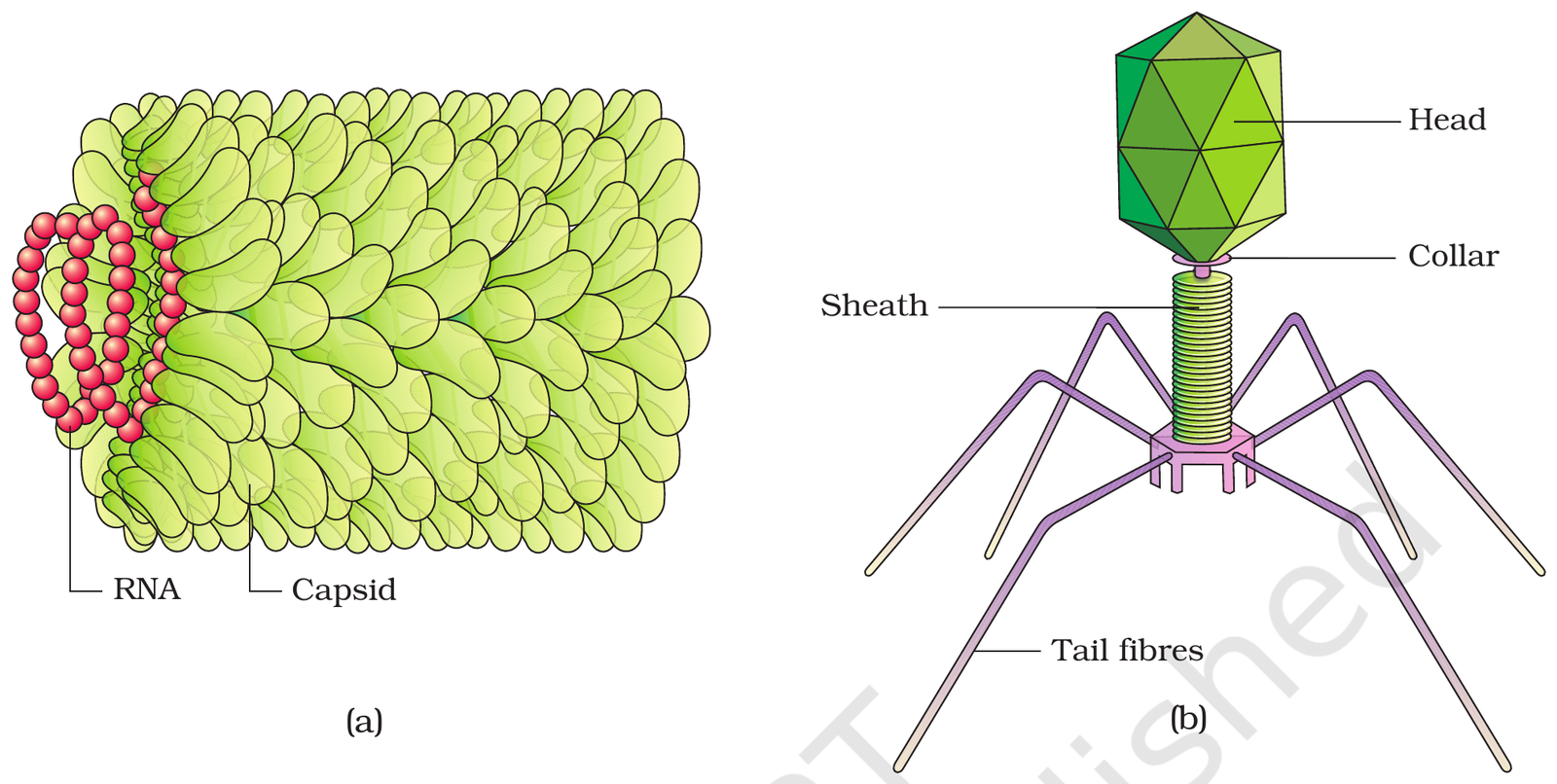
Viruses are non-cellular organisms. They are inert outside the host cell and are obligate parasites. A virus has a protein coat called capsid and genetic material that is either RNA or DNA, never both. In humans they cause mumps, small pox, herpes, influenza and AIDS. In plants they cause mosaics, leaf rolling and curling, yellowing and vein clearing, dwarfing and stunted growth. The tobacco mosaic virus is rod-shaped. The bacteriophage infects bacteria.
Dmitri Ivanowsky (1892) recognised certain microbes as the causal organism of the mosaic disease of tobacco. These were found to be smaller than bacteria because they passed through bacteria-proof filters. M.W. Beijerinck (1898) demonstrated that the extract of the infected plants of tobacco could cause infection in healthy plants and named the new pathogen "virus" and called the fluid Contagium vivum fluidum (infectious living fluid). W.M. Stanley (1935) showed that viruses could be crystallised and crystals consist largely of proteins.
In general, viruses that infect plants have single stranded RNA and viruses that infect animals have either single or double stranded RNA or double stranded DNA. Bacterial viruses or bacteriophages are usually double stranded DNA viruses. The protein coat called capsid is made of small subunits called capsomeres, arranged in helical or polyhedral geometric forms.
Viroids were discovered by T.O. Diener in 1971. They are smaller than viruses and are free RNA without a protein coat. The RNA of the viroid is of low molecular weight. They cause potato spindle tuber disease.
Prions are abnormally folded proteins, similar in size to viruses. They cause bovine spongiform encephalopathy (BSE, mad cow disease) in cattle and its analogous variant Cr-Jacob disease (CJD) in humans.
Lichens are a symbiotic association between algae (the phycobiont) and fungi (the mycobiont). The algae prepares food for the fungi, and the fungi provides shelter and absorbs mineral nutrients and water for its partner. Lichens are very good pollution indicators: they do not grow in polluted areas.
Practice1 question
Try it now. A wrong answer costs nothing here, try again until you get it.
Lichens are very good pollution indicators because they:
Lichens do not grow in polluted areas. In a lichen the algae prepares food for the fungi, and the fungi provides shelter and absorbs mineral nutrients and water.
Table 1 - Five kingdoms compared
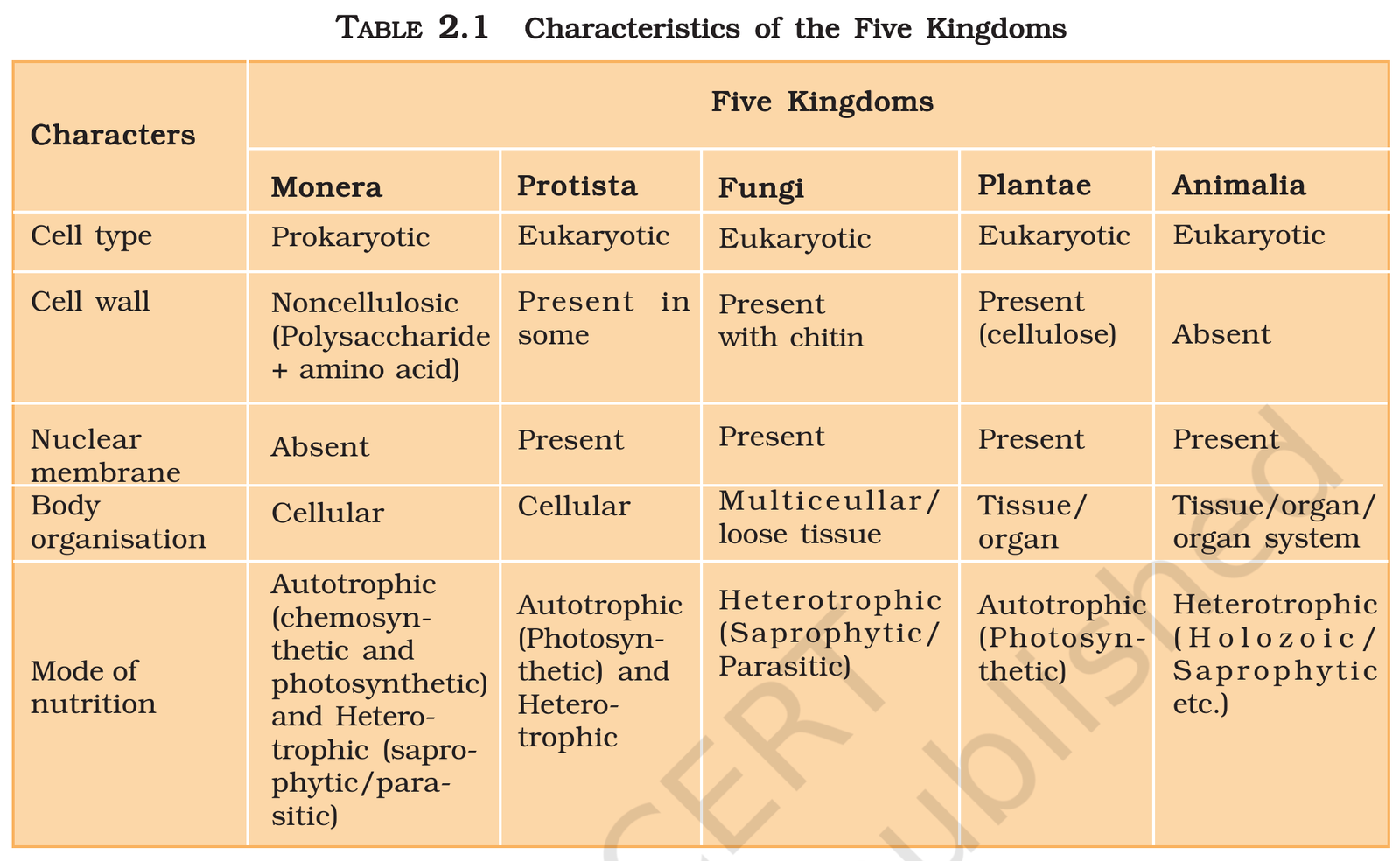
| Kingdom | Cell type | Cell wall | Nuclear membrane | Body organisation | Mode of nutrition |
|---|---|---|---|---|---|
| Monera | Prokaryotic | Noncellulosic (polysaccharide + amino acid) | Absent | Cellular | Autotrophic (chemosynthetic and photosynthetic) and heterotrophic (saprophytic/parasitic) |
| Protista | Eukaryotic | Present in some | Present | Cellular | Autotrophic (photosynthetic) and heterotrophic |
| Fungi | Eukaryotic | Present (with chitin) | Present | Multicellular/loose tissue | Heterotrophic (saprophytic/parasitic) |
| Plantae | Eukaryotic | Present (cellulose) | Present | Tissue/organ | Autotrophic (photosynthetic) |
| Animalia | Eukaryotic | Absent | Present | Tissue/organ/organ system | Heterotrophic (holozoic/saprophytic etc.) |
Source: NCERT XI, Ch 2, Table 2.1.
Table 2 - Protista: five groups
| Group | Habitat | Key feature | Example |
|---|---|---|---|
| Chrysophytes | Fresh water and marine water | Silica shells in two overlapping halves; chief producers in the oceans | Diatoms, desmids |
| Dinoflagellates | Mostly marine | Stiff cellulose plates; two flagella; red tides | Gonyaulax |
| Euglenoids | Fresh stagnant water | Pellicle, no cell wall; photosynthetic in light, heterotrophic in dark | Euglena |
| Slime moulds | Decaying twigs and leaves | Saprophytic; plasmodium; spores in fruiting bodies | No genus named in NCERT |
| Protozoans | Water, soil, hosts | Heterotrophic predators or parasites; four groups | Amoeba, Paramecium, Plasmodium, Trypanosoma |
Table 3 - Fungi: four classes
| Class | Mycelium | Asexual spores | Sexual spores | Examples |
|---|---|---|---|---|
| Phycomycetes | Aseptate, coenocytic | Zoospores (motile) or aplanospores | Zygospores | Rhizopus, Mucor, Albugo |
| Ascomycetes | Branched, septate | Conidia (exogenous) | Ascospores (endogenous, in asci) | Aspergillus, Claviceps, Saccharomyces, Neurospora, Penicillium |
| Basidiomycetes | Branched, septate | Generally not found | Basidiospores (exogenous, on basidium) | Agaricus, Ustilago, Puccinia |
| Deuteromycetes | Septate, branched | Conidia only | Not known | Alternaria, Colletotrichum, Trichoderma |
Table 4 - Viruses, viroids and prions
| Agent | What it is | Protein coat | Genetic material | Disease |
|---|---|---|---|---|
| Virus | Non-cellular, obligate parasite | Present (capsid) | RNA or DNA, never both | Mumps, small pox, herpes, influenza, AIDS |
| Viroid | Free infectious RNA | Absent | RNA only | Potato spindle tuber disease |
| Prion | Abnormally folded protein | The agent itself is protein | None | BSE (mad cow) in cattle; CJD in humans |
Trap Boxes
Archaebacteria are just old eubacteria?
Wrong idea: Archaebacteria are ordinary bacteria that happen to be ancient.
Archaebacteria are a distinct group with a different cell wall structure from eubacteria. They live in harsh habitats: halophiles in salty areas, thermoacidophiles in hot springs, methanogens in marshy areas and the gut of ruminants.
NCERT XI, Ch 2
Dinoflagellates are the chief producers?
Wrong idea: Dinoflagellates are the chief producers in the oceans because they are marine and photosynthetic.
Diatoms are the chief producers in the oceans. Dinoflagellates are mostly marine and photosynthetic, but the red dinoflagellates such as Gonyaulax are known for red tides, not for being chief producers.
NCERT XI, Ch 2
Yeast has hyphae like other fungi?
Wrong idea: Every fungus has a filamentous body made of long thread-like hyphae.
Yeast (Saccharomyces) is unicellular and has no filamentous body. Most fungi are filamentous, but yeast is the exception in Ascomycetes.
NCERT XI, Ch 2
All fungi reproduce sexually?
Wrong idea: Every fungus has a sexual stage with oospores, ascospores or basidiospores.
Deuteromycetes, the imperfect fungi, reproduce only asexually or vegetatively, by conidia. Their sexual stage is not known. When it is discovered they are moved to ascomycetes or basidiomycetes.
NCERT XI, Ch 2
A virus has both DNA and RNA?
Wrong idea: A virus carries both DNA and RNA, and its protein coat is the infective part.
A virus has either RNA or DNA, never both. The genetic material is the infective constituent, not the protein coat. Viroids have free RNA without a protein coat, and prions are only abnormally folded protein.
NCERT XI, Ch 2
Ascomycetes are mostly unicellular?
Wrong idea: Ascomycetes are mostly unicellular fungi like yeast.
Ascomycetes are mostly multicellular, e.g., Penicillium, and only rarely unicellular, e.g., yeast (Saccharomyces).
NCERT XI, Ch 2
Chapter test
5 NEET PYQs. +4 for a correct answer, -1 for a wrong answer, exactly like NEET. Finish the test to earn a medal.
Q1: NEET (UG) 2024, Code R3, Q106
Match List I with List II.
| List I | List II |
|---|---|
| A. Rhizopus | I. Mushroom |
| B. Ustilago | II. Smut fungus |
| C. Puccinia | III. Bread mould |
| D. Agaricus | IV. Rust fungus |
Rhizopus is the bread mould (III), Ustilago the smut fungus (II), Puccinia the rust fungus (IV) and Agaricus the mushroom (I).
Q2: NEET (UG) 2022, Code R3, Q172
Given below are two statements :
Statement I : Mycoplasma can pass through less than 1 micron filter size.
Statement II : Mycoplasma are bacteria with cell wall.
In the light of the above statements, choose the most appropriate answer from the options given below :
Mycoplasma are the smallest living cells (about 0.3 micron, NCERT XI, Ch 8) and can pass through a less than 1 micron filter. They completely lack a cell wall.
Q3: NEET (UG) 2019, Code S2, Q21
Which of the following statements is incorrect ?
The infective constituent in viruses is the genetic material (DNA or RNA), not the protein coat. Prions are abnormally folded proteins, viroids lack a protein coat, and viruses are obligate parasites.
Q4: NEET (UG) 2018, Code CC, Q80
Which of the following organisms are known as chief producers in the oceans?
Diatoms are the chief producers in the oceans. Their silica shells form diatomaceous earth.
Q5: NEET (UG) 2017, Code P, Q53
Viroids differ from viruses in having :
Viroids are free RNA without a protein coat. They are smaller than viruses and cause potato spindle tuber disease.
Score: 0 · Answered 0 of 5
Flashcards
Tap a card to flip it over and see the answer. Tap it again to flip it back.
Who proposed the five kingdom classification, and when?
Tap to flipR.H. Whittaker, in 1969. The five kingdoms are Monera, Protista, Fungi, Plantae and Animalia.
Tap to flip backWhat are the main criteria for Whittaker's five kingdom classification?
Tap to flipCell structure, body organisation, mode of nutrition, reproduction, and phylogenetic relationships.
Tap to flip backName the three groups of archaebacteria and one habitat each.
Tap to flipHalophiles in salty areas, thermoacidophiles in hot springs, methanogens in marshy areas and the gut of ruminants.
Tap to flip backWhat are heterocysts, and which organisms have them?
Tap to flipSpecialised cells in cyanobacteria such as Nostoc and Anabaena that fix atmospheric nitrogen.
Tap to flip backWhich organisms are the chief producers in the oceans?
Tap to flipDiatoms, which belong to Chrysophytes. Their silica walls form diatomaceous earth.
Tap to flip backWhat is a red tide?
Tap to flipRapid multiplication of red dinoflagellates such as Gonyaulax, which makes the sea appear red and releases toxins.
Tap to flip backWhat is the dikaryon stage in fungi?
Tap to flipAfter plasmogamy in ascomycetes and basidiomycetes, the cell has two nuclei (n + n). Karyogamy fuses them into a diploid zygote.
Tap to flip backWhat are the asexual spores of deuteromycetes?
Tap to flipConidia. Deuteromycetes reproduce only asexually or vegetatively; their sexual stage is not known.
Tap to flip backWhat are viroids?
Tap to flipFree RNA without a protein coat, smaller than viruses. Discovered by T.O. Diener (1971). They cause potato spindle tuber disease.
Tap to flip backWhat is a lichen, and why is it a pollution indicator?
Tap to flipA symbiotic association between algae (phycobiont) and fungi (mycobiont). Lichens do not grow in polluted areas.
Tap to flip backWho recognised the causal organism of tobacco mosaic disease, and when? Who showed viruses could be crystallised?
Tap to flipDmitri Ivanowsky, in 1892: the microbes were smaller than bacteria because they passed through bacteria-proof filters. W.M. Stanley, in 1935, showed viruses could be crystallised; crystals consist largely of proteins.
Tap to flip backWhich viruses have single-stranded RNA, and which have double-stranded DNA?
Tap to flipPlant viruses generally have single-stranded RNA; animal viruses have single or double-stranded RNA or double-stranded DNA; bacteriophages are usually double-stranded DNA viruses.
Tap to flip back