 NEET Notes
Home > Biology > Botany > The Living World
The Living World
On this page · 10 sections
- 01Syllabus map
- 02What is living?
- 03Diversity in the living world
- 04Binomial nomenclature
- 05Taxonomic categories
- 06Taxonomical aids
- 07Table 1: Characteristics of life: defining or not?
- 08Table 2: Taxonomic hierarchy: four NCERT examples
- 09Table 3: Taxonomical aids
- 10Table 4: Binomial nomenclature: rules ladder
What is living, biodiversity, taxonomy, and aids. WAVE 1.
Syllabus map
- NMC Unit: BIO-U01, Diversity in Living World. NCERT Chapter 1, The Living World.
- Subtopics in this chapter (NCERT XI, Ch 1): What is living? Diversity in the
living world. Taxonomic categories. Taxonomical aids.
- Subtopic checklist: (1) characteristics of living organisms: growth,
reproduction, metabolism, cellular organisation, consciousness; (2) biodiversity: number and range of described species; (3) taxonomy and systematics; (4) binomial nomenclature and its rules; (5) taxonomic hierarchy: species to kingdom; (6) taxonomical aids: herbarium, botanical gardens, museum, zoological parks, key.
- Excluded topics: no full treatment here of the five-kingdom system itself
(that is Chapter 2, Biological Classification), and no plant/animal kingdom detail (Chapters 3 and 4). Do not import their facts into this chapter.
- Estimated revision time: 10 minutes. Jump links: Syllabus Map · Characteristics
· Taxonomy · Hierarchy · Aids · Trap Boxes · PYQs · 5-Q Recall.
What is living?
Every living organism shows growth, reproduction, metabolism, cellular organisation, and consciousness. Growth and reproduction alone do not define life. Metabolism and cellular organisation do.
Growth: an increase in mass and in number of individuals. Living organisms grow by cell division. Plants grow throughout their life (indeterminate growth, from meristems). Animals grow only up to a certain age (determinate growth). Non-living objects also grow, by accumulation of material, for example mountains, sand mounds, and crystals, so growth by itself is not a defining property of life. (NCERT XI, Ch 1.)
Reproduction: production of progeny with features similar to the parents. It is asexual in many lower organisms and sexual in higher organisms. Reproduction is not a defining property: mules, worker bees, and infertile human couples cannot reproduce, yet they are living. (NCERT XI, Ch 1.)
Metabolism: the sum total of all chemical reactions in a living organism. There is no non-living object that shows metabolism. Metabolism is a defining feature of life. Isolated metabolic reactions outside the body (for example in a test tube) are not living; they are reactions, not an organism. (NCERT XI, Ch 1.)
Cellular organisation: all living organisms are made of cells. The cell is the basic unit of life.
Consciousness: the ability to sense the environment and respond to environmental stimuli. It is the most obvious and technically complicated feature of living organisms. Plants respond to light, water, temperature, and other factors. Humans alone show self-consciousness. (NCERT XI, Ch 1.)
Practice2 questions
Try it now. A wrong answer costs nothing here, try again until you get it.
Which two characteristics are defining properties of life?
NCERT says growth and reproduction do not define life. Metabolism and cellular organisation do.
Plants grow throughout their life, while animals grow only up to a certain age. Why?
Plants grow throughout life from meristems (indeterminate growth). Animals grow only to a certain age.
Diversity in the living world
Biodiversity is the number and types of organisms present on earth. About 1.7-1.8 million species are known to have been described so far, and many more remain to be discovered.
Taxonomy is identification, nomenclature, and classification of organisms. Systematics is taxonomy plus the study of evolutionary relationships between organisms. Taxonomy and systematics are not the same word. (NCERT XI, Ch 1.)
Binomial nomenclature
Biologists follow the binomial nomenclature given by Carolus Linnaeus. Each scientific name has two components: the generic name (genus) and the specific epithet (species). Example: Mangifera indica (mango), Homo sapiens (human). (NCERT XI, Ch 1.)
Rules, in order:
- The name is in Latin, or Latinised.
- The generic name starts with a capital letter; the specific epithet
starts with a small letter. Example: Mangifera indica, not mangifera Indica.
- In print, the name is written in italics. When handwritten, the genus
and the species are underlined separately.
- The name of the author who first described the species is written after
the specific epithet, in abbreviated form.
- The scientific name is the same everywhere in the world. It is
universal, unlike common names.
Practice1 question
Try it now. A wrong answer costs nothing here, try again until you get it.
Which is the correctly written scientific name of mango?
Genus starts with a capital letter, species with a small letter: Mangifera indica. In print it is written in italics.
Taxonomic categories
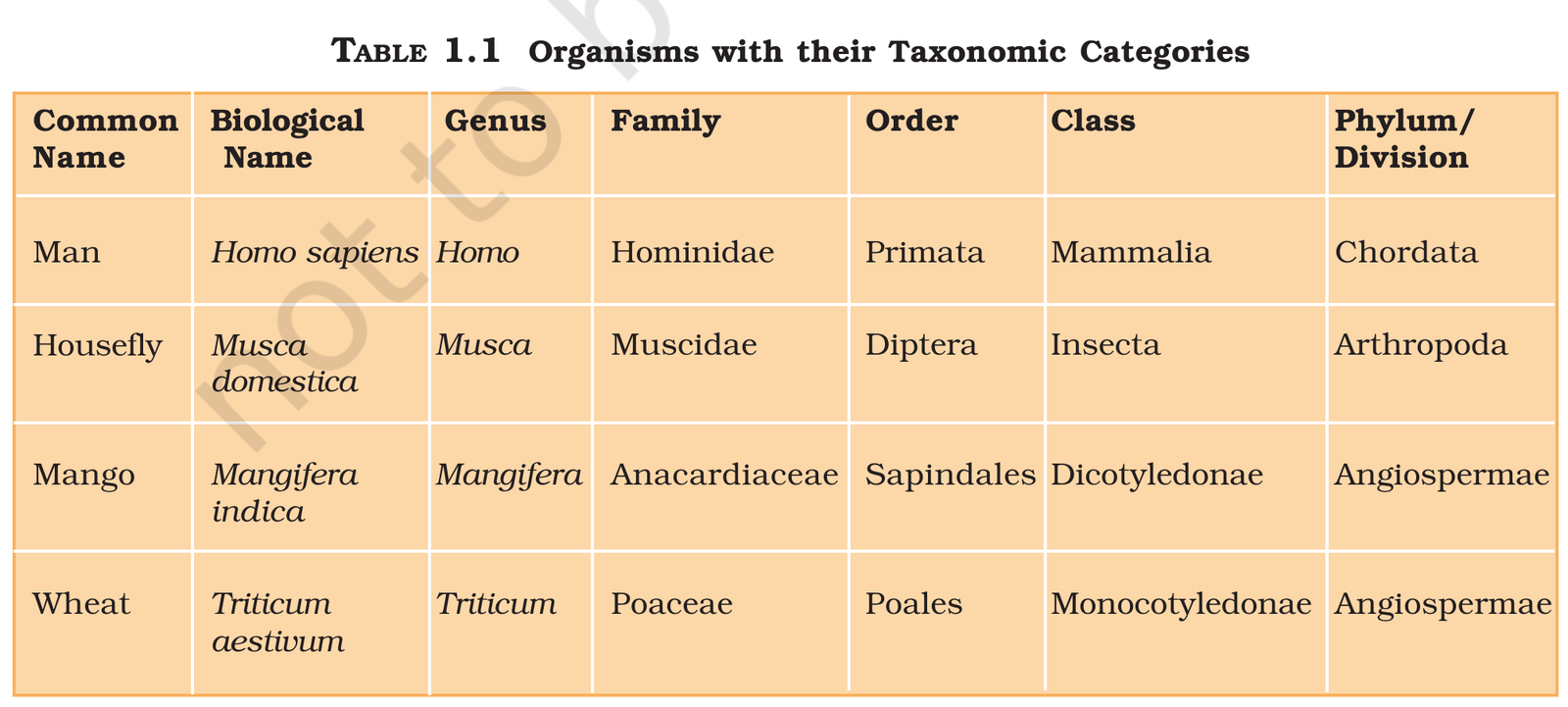
Taxonomic categories, from lowest to highest: Species, Genus, Family, Order, Class, Phylum (for animals) / Division (for plants), Kingdom. Species is the lowest category; Kingdom is the highest. Each higher category contains more organisms and shows fewer common characters. (NCERT XI, Ch 1.)
- Species: a group of organisms that can interbreed and produce fertile
offspring. It is the basic unit of classification.
- Genus: a group of related species. Example: Panthera (lion, tiger,
leopard), Solanum (potato, brinjal, tomato).
- Family: a group of related genera. Example: Felidae (cats), Canidae (dogs).
- Order: a group of related families. Example: Primata, Carnivora.
- Class: a group of related orders. Example: Mammalia, Dicotyledonae.
- Phylum / Division: a group of related classes. Phylum is used for
animals; Division is used for plants. Example: Chordata, Angiospermae.
- Kingdom: the highest category. Example: Animalia, Plantae.
Practice1 question
Try it now. A wrong answer costs nothing here, try again until you get it.
Which is the correct order of taxonomic categories from lowest to highest?
Lowest to highest: Species, Genus, Family, Order, Class, Phylum (animals) or Division (plants), Kingdom.
Taxonomical aids
Removed from NCERT and the NEET syllabus. Kept as a short summary because older NEET papers asked about these aids.
Taxonomical aids are the tools and institutions that store, study, and identify organisms: herbarium, botanical gardens, museum, zoological parks, and key. (NCERT XI, Ch 1.)
- Herbarium: a storehouse of collected plant specimens, dried, pressed,
and preserved on sheets. The sheets carry the date, place, and collector.
- Botanical gardens: collections of living plants, for reference and study.
Example: Royal Botanic Gardens, Kew (England); Indian Botanical Garden, Howrah.
- Museum: a storehouse of preserved plant and animal specimens, in jars
of preservative, or as dry specimens, skeletons, and insects in boxes.
- Zoological parks: places where wild animals are kept alive in protected
environments, for study and conservation.
- Key: a taxonomic aid used to identify organisms. It is based on a pair
of contrasting characters (a lead). Each statement in the key is a lead; choosing one of each pair leads to the name of the organism. Keys are analytical in nature.
Practice1 question
Try it now. A wrong answer costs nothing here, try again until you get it.
Which taxonomical aid is a storehouse of dried, pressed plant specimens on sheets?
A herbarium stores dried, pressed plant specimens on sheets, with the date, place and collector noted.
Table 1: Characteristics of life: defining or not?
| Characteristic | Seen in living organisms | Defining property of life? | Why |
|---|---|---|---|
| Growth (increase in mass and number) | Yes (by cell division) | No | Non-living objects also grow, by accumulation |
| Reproduction (progeny like the parents) | Yes (asexual and sexual) | No | Mules, worker bees, infertile couples cannot reproduce, yet are living |
| Metabolism (all chemical reactions) | Yes | Yes | No non-living object shows metabolism |
| Cellular organisation | Yes (all organisms are made of cells) | Yes | The cell is the basic unit of life |
| Consciousness (sense and respond to stimuli) | Yes | Yes (most obvious) | Plants respond to light, water, temperature; humans alone show self-consciousness |
Source: NCERT XI, Ch 1.
Table 2: Taxonomic hierarchy: four NCERT examples
| Category | Man | Housefly | Mango | Wheat |
|---|---|---|---|---|
| Species | sapiens | domestica | indica | aestivum |
| Genus | Homo | Musca | Mangifera | Triticum |
| Family | Hominidae | Muscidae | Anacardiaceae | Poaceae |
| Order | Primata | Diptera | Sapindales | Poales |
| Class | Mammalia | Insecta | Dicotyledonae | Monocotyledonae |
| Phylum / Division | Chordata (Phylum) | Arthropoda (Phylum) | Angiospermae (Division) | Angiospermae (Division) |
| Kingdom | Animalia | Animalia | Plantae | Plantae |
Scientific names: Homo sapiens, Musca domestica, Mangifera indica, Triticum aestivum. (NCERT XI, Ch 1, Table 1.1.)
Table 3: Taxonomical aids
| Aid | What it stores | Living or preserved? |
|---|---|---|
| Herbarium | Dried, pressed plant specimens on sheets | Preserved |
| Botanical gardens | Living plants, for reference | Living |
| Museum | Preserved plant and animal specimens, skeletons, insects | Preserved |
| Zoological parks | Wild animals in protected environments | Living |
| Key | Contrasting characters in pairs (leads) to identify an organism | Tool, not a storehouse |
Source: pre-rationalisation NCERT XI, Ch 1. Removed from the current NCERT and NEET syllabus.
Table 4: Binomial nomenclature: rules ladder
| Rule | Correct | Wrong |
|---|---|---|
| Latin / Latinised | Mangifera indica | Common name only |
| Genus capital, species small | Homo sapiens | homo Sapiens |
| Italics in print | Mangifera indica | Mangifera indica in plain roman type |
| Underline separately when handwritten | Mangifera_ _indica | One underline under both words |
| Author after the species, abbreviated | As given in NCERT | Author before the name |
Trap Boxes
Growth means living?
Wrong idea: anything that grows must be alive, so growth defines life.
non-living objects grow by accumulation of material (mountains, sand mounds). Living organisms grow by cell division. Plants grow throughout life; animals grow only to a certain age. Growth alone is not a defining property.
NCERT XI, Ch 1
Reproduction means living?
Wrong idea: every living organism must reproduce, so reproduction defines life.
mules, worker bees, and infertile human couples cannot reproduce, yet they are living. Reproduction is not a defining property.
NCERT XI, Ch 1
Metabolism in a test tube is life?
Wrong idea: a chemical reaction in a test tube is metabolism, so it is living.
metabolism is the sum of all chemical reactions in a living organism. Isolated reactions outside a body are not life, and no non-living object shows metabolism. Metabolism is a defining feature.
NCERT XI, Ch 1
Genus small, species capital?
Wrong idea: the species name takes the capital letter.
the generic name (genus) starts with a capital letter; the specific epithet (species) starts with a small letter: Mangifera indica, Homo sapiens. In print both are italicised; handwritten, each is underlined separately.
NCERT XI, Ch 1
Phylum for plants?
Wrong idea: plants are also divided into phyla.
Phylum is used for animals; Division is used for plants. Mango and wheat are in Division Angiospermae, not Phylum Angiospermae. The hierarchy order is Species, Genus, Family, Order, Class, Phylum/Division, Kingdom, lowest to highest.
NCERT XI, Ch 1, Table 1.1
Chapter test
5 NEET PYQs. +4 for a correct answer, -1 for a wrong answer, exactly like NEET. Finish the test to earn a medal.
Q1: NEET (UG) 2023 (Manipur), Q179
'X' and 'Y' are the components of Binomial nomenclature. This naming system was proposed by 'Z' :
Binomial nomenclature: X is the generic name, Y is the specific epithet; the system was proposed by Carolus Linnaeus.
Q2: NEET (UG) 2023 (Manipur), Q155
House fly belongs to _____ family.
House fly belongs to family Muscidae (NCERT XI, Ch 1, Table 1.1).
Q3: NEET (UG) 2022, Code R3, Q168
In the Taxonomic categories which hierarchial arrangement in ascending order is correct in case of animals ?
The correct hierarchy with Kingdom first is Kingdom, Phylum, Class, Order, Family, Genus, Species. The paper stem says ascending order, but every option lists Kingdom first.
Q4: NEET (UG) 2021, Code M1, Q161
Which one of the following belongs to the family Muscidae ?
House fly (Musca domestica) belongs to family Muscidae (NCERT XI, Ch 1, Table 1.1).
Q5: NEET (UG) 2019, Code Q2, Q69
Select the correctly written scientific name of Mango which was first described by Carolus Linnaeus
Correctly written: Mangifera indica Linn., genus capital, species small, italics in print, author abbreviated after the species.
Score: 0 · Answered 0 of 5
Flashcards
Tap a card to flip it over and see the answer. Tap it again to flip it back.
What is taxonomy?
Tap to flipIdentification, nomenclature, and classification of organisms. (NCERT XI, Ch 1.)
Tap to flip backWhat is systematics?
Tap to flipTaxonomy plus the study of evolutionary relationships between organisms.
Tap to flip backWhich two characteristics define life?
Tap to flipMetabolism and cellular organisation. Growth and reproduction do not.
Tap to flip backWhy is growth not a defining property?
Tap to flipNon-living objects also grow, by accumulation of material.
Tap to flip backWhy is reproduction not a defining property?
Tap to flipMules, worker bees, and infertile couples cannot reproduce, yet are living.
Tap to flip backGive the binomial name of mango, with correct capitals.
Tap to flipMangifera indica: genus capital, species small, italics in print.
Tap to flip backName the taxonomic categories from lowest to highest.
Tap to flipSpecies, Genus, Family, Order, Class, Phylum/Division, Kingdom.
Tap to flip backPhylum or Division: which one is used for plants?
Tap to flipDivision. Phylum is used for animals.
Tap to flip backWhat is a herbarium?
Tap to flipA storehouse of dried, pressed plant specimens on sheets, with date, place, and collector.
Tap to flip backWhat is a taxonomic key?
Tap to flipA tool based on a pair of contrasting characters (leads); choosing one lead at each step identifies the organism.
Tap to flip back