 NEET Notes
Home > Biology > Botany > Plant Kingdom
Plant Kingdom
On this page · 15 sections
- 01Syllabus map
- 02Systems of classification
- 03Algae: Chlorophyceae (green algae)
- 04Algae: Phaeophyceae (brown algae)
- 05Algae: Rhodophyceae (red algae)
- 06Table 1: The three classes of algae
- 07Bryophyta: liverworts
- 08Bryophyta: mosses and the moss life cycle
- 09Pteridophyta: the first vascular plants
- 10Gymnosperms: naked seeds
- 11Angiosperms: flowering plants
- 12Table 2: Dicots vs monocots
- 13Table 3: Five groups at a glance
- 14Table 4: Economic importance (what NCERT states)
- 15Table 5: Who is different? (NEET exceptions ladder)
Algae to angiosperms: the five plant groups, their life cycles, and what NEET asks. NCERT XI, Ch 3.
Syllabus map
- NMC Unit: BIO-U01, Diversity in Living World. NCERT Chapter 3, Plant Kingdom.
- Subtopics in this chapter (NCERT XI, Ch 3): Algae (Chlorophyceae, Phaeophyceae, Rhodophyceae). Bryophyta (liverworts and mosses). Pteridophyta. Gymnosperms. Angiosperms.
- Also covered (pre-rationalisation NCERT, Sec. 3.0): systems of classification: artificial, natural, phylogenetic, numerical taxonomy, cytotaxonomy, chemotaxonomy.
- Subtopic checklist: (1) the three classes of algae: pigments, stored food, cell wall, flagella, examples; (2) bryophytes: why they are the amphibians of the plant kingdom, liverworts vs mosses, protonema and leafy stage; (3) pteridophytes: first vascular plants, four classes, heterospory and the seed habit; (4) gymnosperms: naked seeds, coralloid roots, mycorrhiza, cones; (5) angiosperms: flower, dicots vs monocots (double fertilisation and the embryo sac moved to NCERT XII, Ch 1 in the rationalised edition).
- Excluded topics: the five-kingdom classification itself (Chapter 2, Biological Classification) and animal groups (Chapter 4, Animal Kingdom). Do not import their facts into this chapter.
- Estimated revision time: 12 minutes. Jump links: Syllabus Map · Systems of Classification · Algae · Bryophyta · Pteridophyta · Gymnosperms · Angiosperms · Trap Boxes · PYQs · Chapter Test.
Systems of classification
Extra information (beyond rationalised NCERT XI Ch 3): this section is from the pre-rationalisation NCERT chapter (Sec. 3.0), deleted in the rationalised edition. NEET still asks it.
- Artificial system of classification: proposed by Linnaeus. It is based on gross superficial morphological characters, such as the structure of the androecium. It gives equal weightage to vegetative and sexual characters. It is flawed because vegetative characters are more easily affected by the environment, so closely related species can be separated and unrelated species grouped together.
- Natural system of classification: proposed by George Bentham and Joseph Dalton Hooker. It is based on natural affinities among organisms and considers external as well as internal features: ultrastructure, anatomy, embryology and phytochemistry.
- Phylogenetic system of classification: based on evolutionary relationships between organisms, grouping them by common ancestry.
- Numerical Taxonomy: all observable characters are assigned numbers and codes and given equal importance; computers process hundreds of characters at the same time.
- Cytotaxonomy: based on cytological information: chromosome number, structure and behaviour.
- Chemotaxonomy: based on the chemical constituents of the plant.
Algae: Chlorophyceae (green algae)
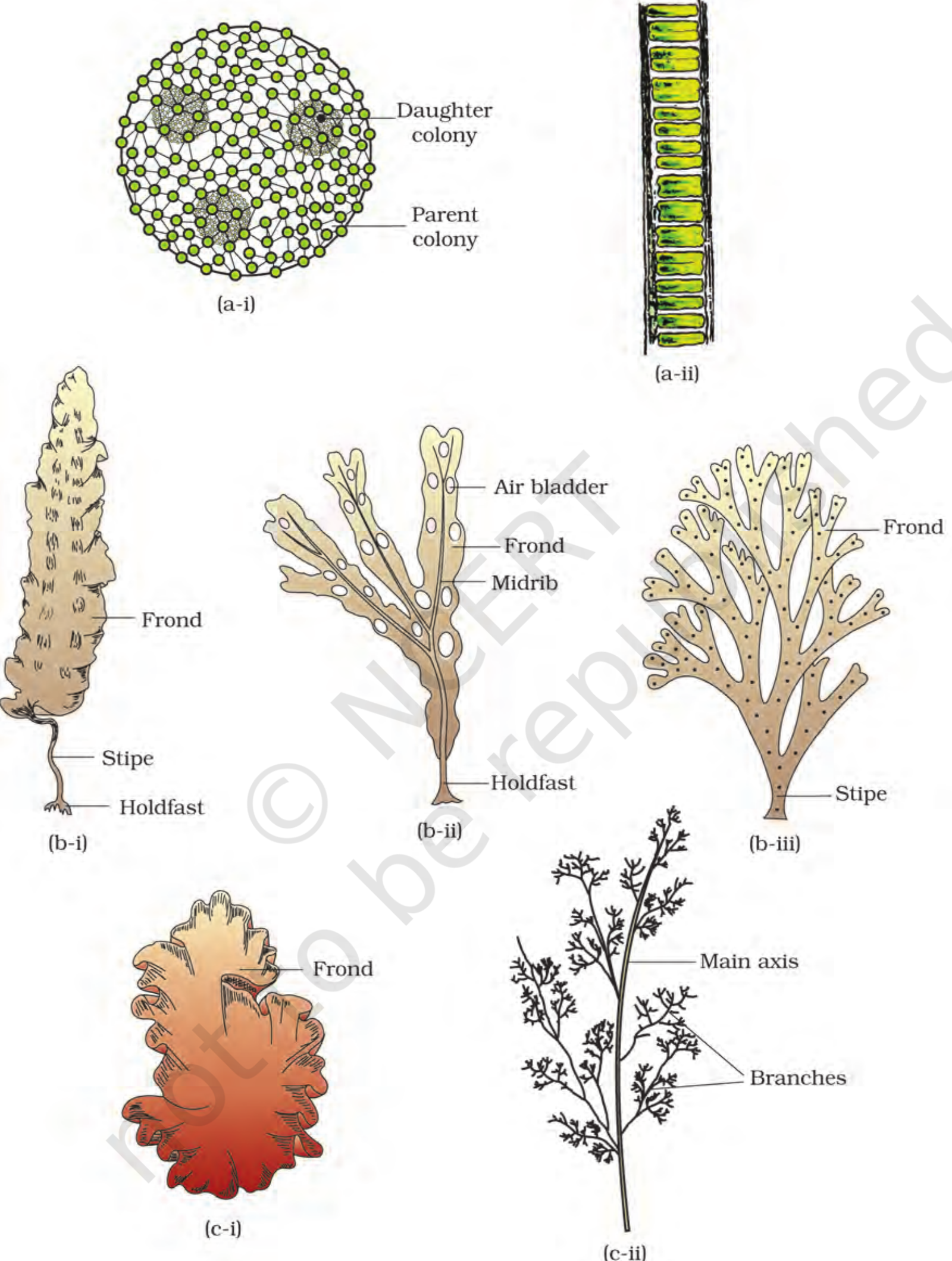
Algae are chlorophyll-bearing, simple, thalloid, autotrophic organisms, largely aquatic, in fresh water and sea water. Some occur in moist stones, soils and wood, and some in association with fungi (lichen) and animals (e.g., on sloth bear). They reproduce vegetatively by fragmentation, asexually by zoospores, and sexually by isogamous, anisogamous or oogamous methods.
Green algae are usually grass green because chlorophyll a and b dominate. Their pigments sit in definite chloroplasts. The cell wall is cellulose inside and pectose outside. Food is stored as starch. Pyrenoids contain protein besides starch. Some algae may store food in the form of oil droplets.
- Examples: Chlamydomonas, Volvox, Ulothrix, Spirogyra, Chara.
- Extra information (beyond NCERT Ch 3): Chara is monoecious: it bears male antheridia and female oogonia on the same plant. The terms monoecious and dioecious are defined in the pre-rationalisation NCERT XII, Ch 1 (Reproduction in Organisms), a chapter deleted in the rationalised edition. 2027 students will not find it in the current XII Ch 1.
- Extra information (beyond rationalised NCERT XI Ch 3, from the pre-rationalisation chapter): sexual reproduction by fusion of gametes takes four forms: isogamous, with flagellated gametes of similar size, e.g., Ulothrix; isogamous, with non-flagellated gametes of similar size, e.g., Spirogyra; anisogamous, with gametes of dissimilar size, e.g., Eudorina; oogamous, with a large, non-motile female gamete and a small, motile male gamete, e.g., Volvox, Fucus.
- Extra information (beyond rationalised NCERT XI Ch 3, from the pre-rationalisation chapter): the chloroplasts may be discoid, plate-like, reticulate, cup-shaped, spiral or ribbon-shaped in different species. Algae carry out about half of the total carbon dioxide fixation on earth. About 70 species of marine algae are used as food. Chlorella, a unicellular alga rich in proteins, is used as a food supplement by space travellers.
Algae: Phaeophyceae (brown algae)
Brown algae live mainly in the sea, from simple branched filaments like Ectocarpus to profusely branched kelps that reach 100 metres. They carry chlorophyll a and c, carotenoids and xanthophylls; their colour runs from olive green to many shades of brown depending on how much of the xanthophyll fucoxanthin they hold.
- Food is stored as complex carbohydrates, laminarin or mannitol.
- Cell wall: cellulose, with a gelatinous coating of algin on the outside.
- The plant body is differentiated into a holdfast, a stipe and a frond.
- Reproduction: vegetative by fragmentation; asexual by pear-shaped biflagellate zoospores with two unequal, laterally attached flagella; sexual by isogamous, anisogamous or oogamous union, in water, or within the oogonium (in oogamous species). Both zoospores and gametes are pyriform (pear-shaped) and bear two unequal, laterally attached flagella.
- Examples: Ectocarpus, Dictyota, Laminaria, Sargassum, Fucus. Laminaria and Sargassum are used as food.
Practice1 question
Try it now. A wrong answer costs nothing here, try again until you get it.
Which pigment gives brown algae their olive-green to brown colour?
Fucoxanthin, a xanthophyll, masks the green of chlorophyll in Phaeophyceae. Phycoerythrin is the red pigment of red algae; chlorophyll b and d belong to green and red algae respectively.
Algae: Rhodophyceae (red algae)
Red algae are red because the pigment r-phycoerythrin predominates in their body. Food is stored as floridean starch, which is very similar to amylopectin and glycogen in structure. The cell wall is cellulose, pectin and poly-sulphate esters.
- There is no flagellated stage anywhere in the life cycle: reproduction is vegetative by fragmentation, asexual by non-motile spores, and sexual by non-motile gametes (oogamous, with complex post-fertilisation developments).
- Examples: Polysiphonia, Porphyra, Gracilaria, Gelidium.
- Porphyra, Laminaria and Sargassum are used as food. Agar, obtained from Gelidium and Gracilaria, is used to grow microbes and in ice-creams and jellies.
- Hydrocolloids: certain marine brown and red algae produce large amounts of hydrocolloids (water-holding substances), algin from brown algae, carrageen from red algae, which are used commercially.
- They occur in both well-lighted regions close to the surface of water and also at great depths in oceans where relatively little light penetrates. They are found in greater concentrations in warmer areas.
Table 1: The three classes of algae
NCERT XI, Ch 3, Table 3.1: the whole table is a NEET favourite. Learn it column by column, not genus by genus.
| Class | Common name | Major pigments | Stored food | Cell wall | Flagellar Number and Position of Insertions | Habitat |
|---|---|---|---|---|---|---|
| Chlorophyceae | Green algae | Chlorophyll a, b | Starch | Cellulose (text: inner cellulose, outer pectose) | 2-8, equal, apical | Fresh water, brackish water, salt water |
| Phaeophyceae | Brown algae | Chlorophyll a, c, fucoxanthin | Mannitol, laminarin | Cellulose + algin | 2, unequal, lateral | Fresh water (rare), brackish water, salt water |
| Rhodophyceae | Red algae | Chlorophyll a, d, phycoerythrin | Floridean starch | Cellulose, pectin, poly-sulphate esters | Absent | Fresh water (some), brackish water, salt water (most) |
Practice1 question
Try it now. A wrong answer costs nothing here, try again until you get it.
Which class of algae stores food as floridean starch?
Red algae (Rhodophyceae) store floridean starch, which is very similar to amylopectin and glycogen in structure. Green algae store starch; brown algae store laminarin or mannitol.
Bryophyta: liverworts
Bryophytes are called the amphibians of the plant kingdom: they live in soil but need water for sexual reproduction. They grow in moist, shady places.
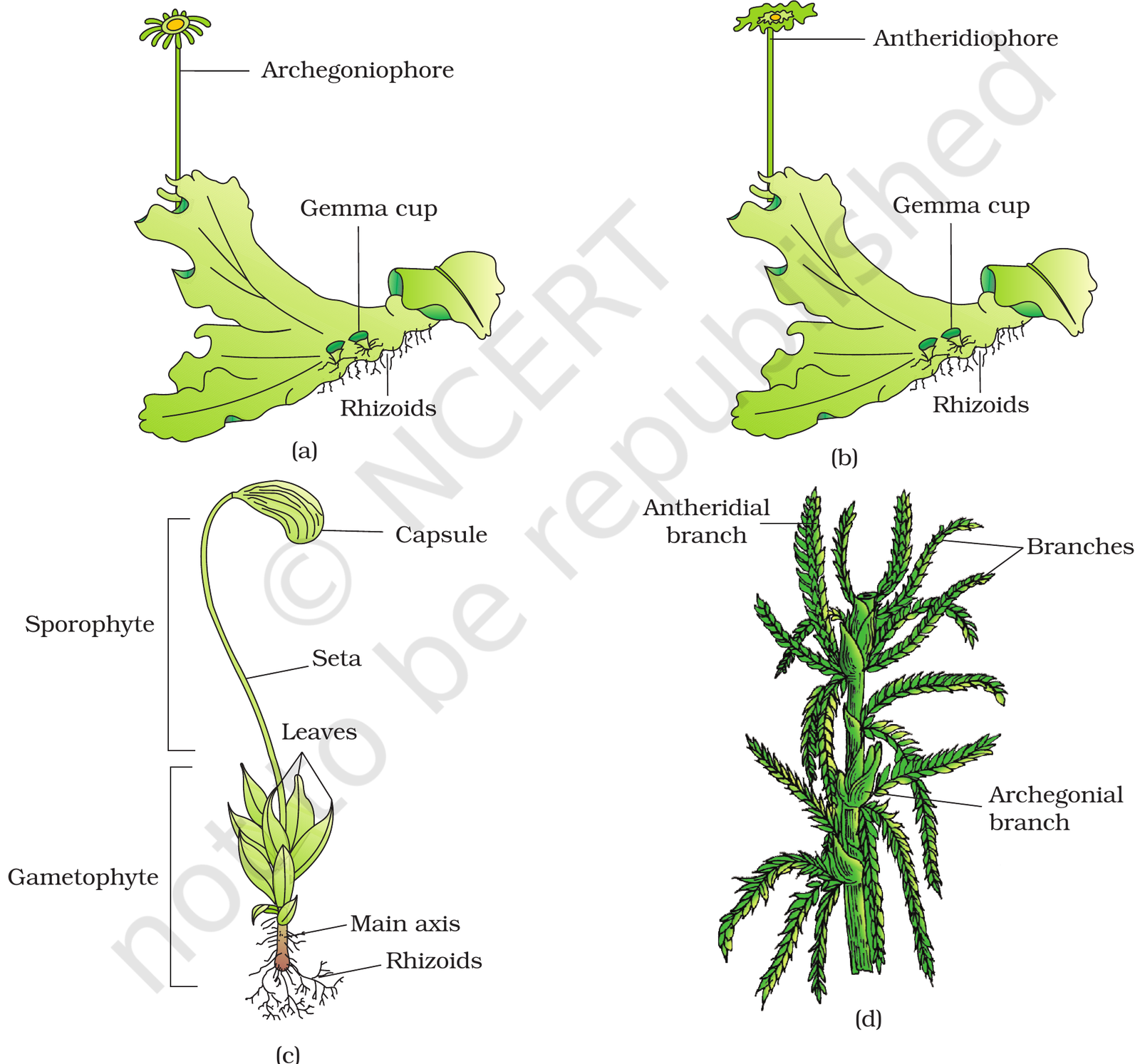
- The plant body is thallus-like, prostrate or erect, and attached to the substratum by unicellular or multicellular rhizoids. True roots, stem and leaves are absent; the plant may have root-like, leaf-like or stem-like structures.
- The main plant body is the gametophyte (haploid). It is dominant and photosynthetic. The sporophyte is not free-living: it stays attached to the gametophyte and derives nourishment from it.
- Liverworts: the thallus is dorsiventral and closely appressed to the substrate. In Marchantia the thallus bears gemma cups; asexual reproduction is by gemmae: green, multicellular, asexual buds that detach and germinate into new plants. Sexual reproduction: male and female sex organs are produced either on the same or on different thalli. In Marchantia the sex organs are borne on antheridiophores and archegoniophores (Fig. 3.2).
- Example of liverworts: Marchantia.
Practice1 question
Try it now. A wrong answer costs nothing here, try again until you get it.
Why are bryophytes called the amphibians of the plant kingdom?
Bryophytes live in moist soil, but water is needed for the male gametes to swim to the archegonia, so they are tied to water for reproduction, like amphibians.
Bryophyta: mosses and the moss life cycle
In mosses the gametophyte has two stages. The first is the protonema: creeping, green, branched and frequently filamentous. It develops into the second stage, the leafy stage: upright, slender axes bearing spirally arranged leaves, attached to the soil by multicellular, branched rhizoids. The leafy stage bears the sex organs at its apex.
- Vegetative reproduction is by fragmentation and by budding in the secondary protonema.
- After fertilisation the zygote develops into a sporophyte with a foot, a seta and a capsule. The capsule contains spores, formed by meiosis; the spores germinate to form the protonema.
- Examples: Funaria, Polytrichum, Sphagnum.
- Economic importance: mosses provide food for herbaceous mammals and birds. Sphagnum (peat moss) forms peat, used as fuel; it holds water well and is used as packing material for trans-shipment of living material. Mosses and lichens are the first organisms to colonise rocks; they decompose rocks and make the substrate suitable for higher plants. Dense moss mats reduce the impact of falling rain and prevent soil erosion.
- The sex organs are multicellular: the antheridium produces biflagellate antherozoids, and the flask-shaped archegonium produces a single egg. The zygote does not undergo meiosis immediately; it produces a multicellular sporophyte.
- The protonema develops directly from a spore. The leafy stage develops from the secondary protonema as a lateral bud. Mosses have a more elaborate mechanism of spore dispersal than liverworts.
Pteridophyta: the first vascular plants
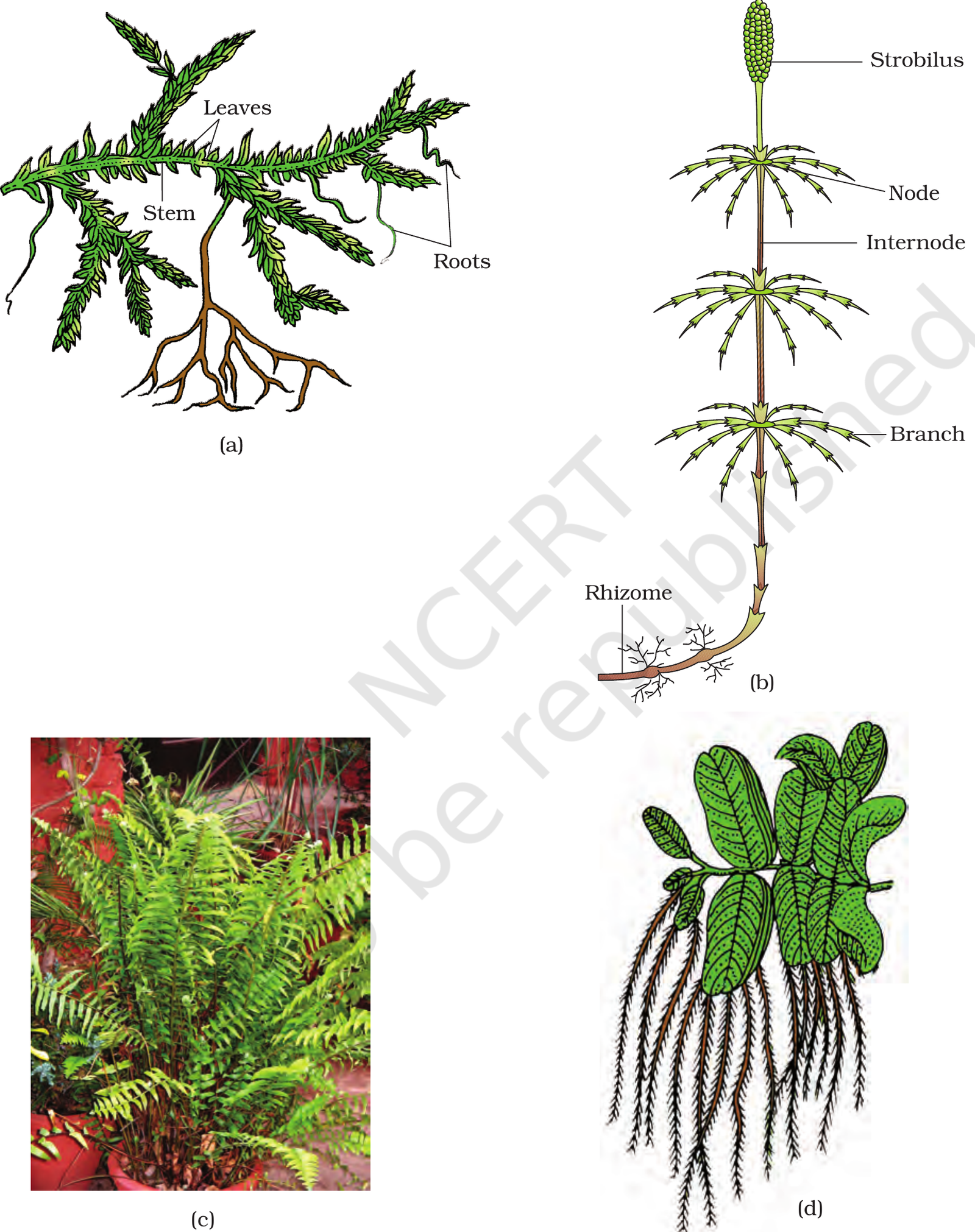
Pteridophytes are the first terrestrial plants to possess vascular tissues: xylem and phloem. The main plant body is the sporophyte, differentiated into true root, stem and leaves.
- Leaves are small (microphylls, as in Selaginella) or large (macrophylls, as in ferns).
- Sporangia are borne on sporophylls; in Selaginella and Equisetum the sporophylls are compacted into strobili (cones).
- Spores germinate into the prothallus, the gametophyte, which is small, inconspicuous, multicellular, free-living, photosynthetic and thalloid. It bears antheridia and archegonia, and water is needed for fertilisation. The zygote develops into an embryo and then a sporophyte.
- Four classes: Psilopsida (Psilotum), Lycopsida (Selaginella, Lycopodium), Sphenopsida (Equisetum), Pteropsida (Pteris, Adiantum, Dryopteris).
- Heterospory: Selaginella and Salvinia produce two kinds of spores: macro (large) and micro (small), and are called heterosporous. The megaspores and microspores germinate into female and male gametophytes. The female gametophyte is retained on the parent sporophyte for variable periods, and the zygote develops into the young embryo inside the female gametophyte. This is the precursor to the seed habit, an important step in evolution.
- Economic importance: used for medicinal purposes, as soil-binders, and as ornamental plants.
- Pteridophytes are restricted to narrow geographical regions because their gametophytes need cool, damp and shady places to grow, and water is required for fertilisation. Most pteridophytes are homosporous: they produce only one kind of spore.
Practice1 question
Try it now. A wrong answer costs nothing here, try again until you get it.
Which of these pteridophytes are heterosporous, producing both macrospores and microspores?
Selaginella and Salvinia produce two kinds of spores. The female gametophyte is retained on the parent sporophyte, the first step towards the seed habit.
Gymnosperms: naked seeds
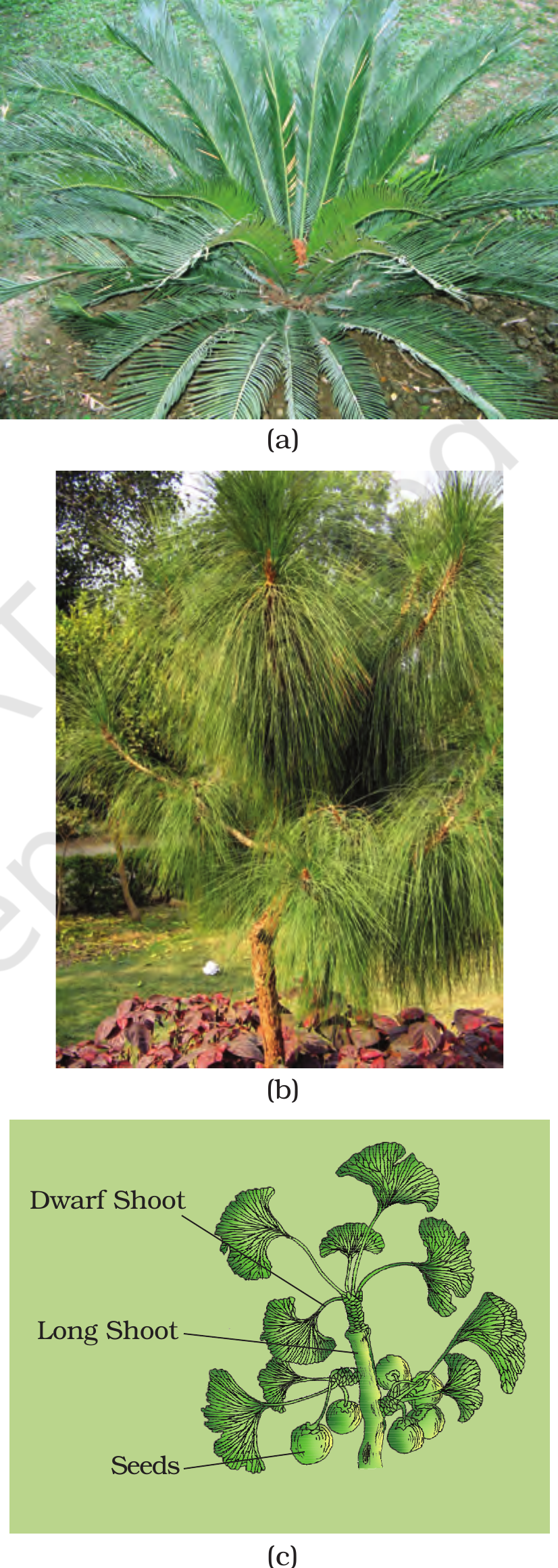
In gymnosperms the ovules are not enclosed by any ovary wall and remain exposed, both before and after fertilisation. The seeds that develop are not covered. They are naked.
- They include medium-sized trees, tall trees and shrubs. The giant redwood tree Sequoia is one of the tallest tree species.
- Roots are generally tap roots. Pinus has roots in fungal association as mycorrhiza; Cycas has small specialised coralloid roots associated with nitrogen-fixing cyanobacteria.
- Stems are unbranched (Cycas) or branched (Pinus, Cedrus). Leaves may be simple or compound; in Cycas the pinnate leaves persist for a few years. Gymnosperm leaves withstand extremes of temperature, humidity and wind: in conifers the leaves are needle-like, which reduces surface area, and a thick cuticle and sunken stomata reduce water loss.
- Gymnosperms are heterosporous and produce haploid microspores and megaspores. Male and female strobili bear the sporangia: microsporangia in the male cones, megasporangia in the female cones. They may be on the same tree (Pinus) or on different trees (Cycas).
- In the male cone, microsporophylls bear microsporangia with microspores (pollen grains) that develop into a highly reduced male gametophyte of only a few cells. In Cycas, the male cones and the megasporophylls are borne on different trees; in Pinus, the male and female cones are borne on the same tree. The megasporophylls bear ovules; the megaspore mother cell divides meiotically to form four megaspores, one of which develops into a multicellular female gametophyte bearing two or more archegonia. Pollen grains are carried by air currents to the ovule; the pollen tube grows towards the archegonia and discharges its contents near the mouth of the archegonia. The zygote develops into an embryo and the ovules into seeds.
- Unlike bryophytes and pteridophytes, the male and female gametophytes of gymnosperms do not have an independent free-living existence, they remain within the sporangia retained on the sporophyte. The megasporangium is the nucellus, protected by envelopes; the composite structure is called an ovule.
Practice1 question
Try it now. A wrong answer costs nothing here, try again until you get it.
Why are the seeds of gymnosperms called naked?
In gymnosperms the ovules are not enclosed by an ovary wall, before or after fertilisation, so the seeds that develop are not covered.
Angiosperms: flowering plants
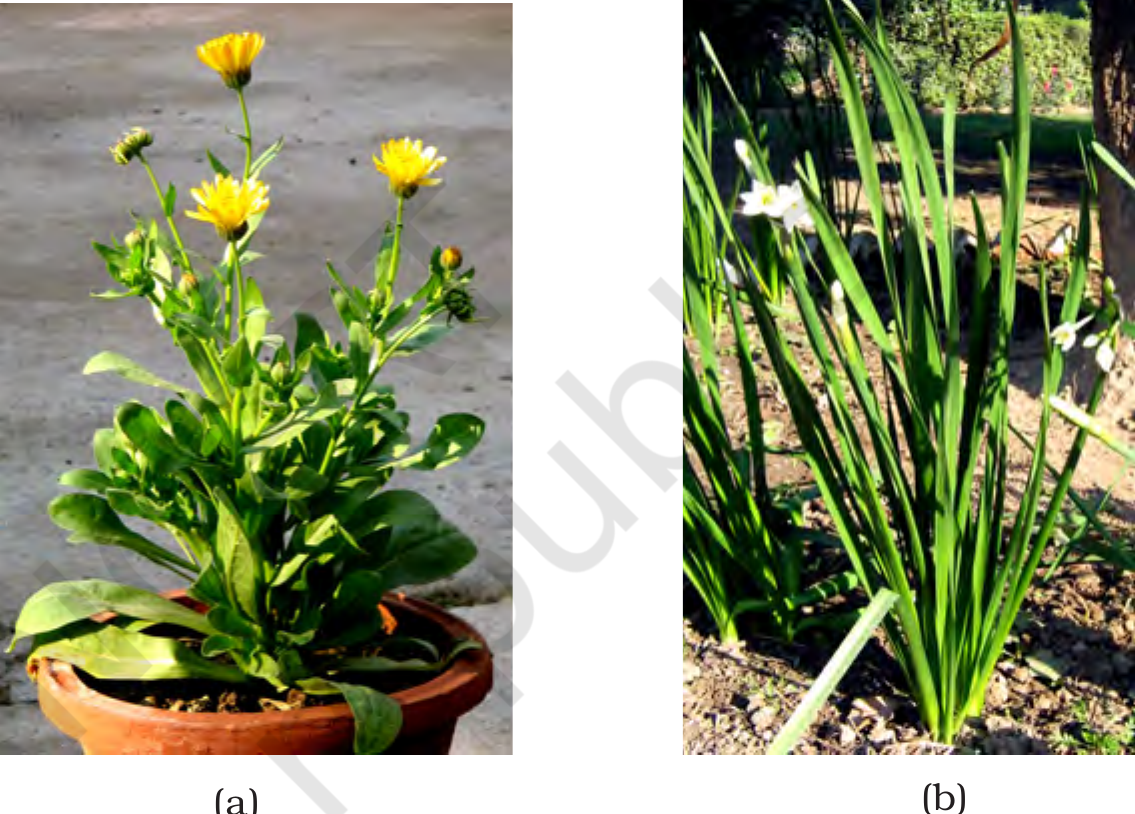
Angiosperms are flowering plants. They range from the tiny, almost microscopic Wolffia to tall trees of Eucalyptus (over 100 metres).
- The flower carries the reproductive structures: stamens (microsporophylls) and carpels (megasporophylls).
- Angiosperms are divided into two classes, Dicotyledonae and Monocotyledonae, compared in Table 2 below.
- Extra information (beyond rationalised NCERT XI Ch 3, this material is now in NCERT XII, Ch 1): the pollen grain is the male gametophyte; the embryo sac is the female gametophyte, 7-celled and 8-nucleate. Double fertilisation: one male gamete fuses with the egg (syngamy) to form the diploid zygote, and the other fuses with the two polar nuclei (triple fusion) to form the triploid primary endosperm nucleus. The zygote develops into the embryo and the ovules into seeds; the ovary develops into the fruit.
Table 2: Dicots vs monocots
Extra information (beyond NCERT XI Ch 3): this comparison draws on NCERT XI Ch 5 (Morphology) and Ch 6 (Anatomy). Rationalised Ch 3, Sec. 3.5 only names the two classes, Dicotyledonae and Monocotyledonae. NEET asks it as match-the-column and one-liner questions.
| Feature | Dicotyledonae | Monocotyledonae |
|---|---|---|
| Cotyledons | Two | One |
| Root | Tap root | Fibrous (adventitious) root |
| Leaf venation | Reticulate | Parallel |
| Flower parts | Tetramerous or pentamerous | Trimerous (in threes) |
| Vascular bundles in stem | In a ring | Scattered |
Table 3: Five groups at a glance
One row per group. If you can fill this table from memory, the chapter is done.
| Group | Main plant body (dominant phase) | Vascular tissue | Seeds | Examples |
|---|---|---|---|---|
| Algae | Gametophyte (most algae) | Absent | Absent | Chlamydomonas, Volvox, Spirogyra, Chara |
| Bryophyta | Gametophyte | Absent | Absent | Marchantia, Funaria, Sphagnum |
| Pteridophyta | Sporophyte | Present (xylem + phloem) | Absent | Selaginella, Equisetum, Pteris, Adiantum |
| Gymnosperms | Sporophyte | Present | Naked | Cycas, Pinus, Cedrus, Ginkgo |
| Angiosperms | Sporophyte | Present | Enclosed in fruit | Wolffia, Eucalyptus |
Caveat: Fucus is diplontic and Ectocarpus, Polysiphonia and kelps are haplo-diplontic. The life-cycle patterns (old Sec. 3.6) were deleted from rationalised NCERT.
Table 4: Economic importance (what NCERT states)
NCERT XI, Ch 3 states economic importance for algae, bryophytes, pteridophytes and angiosperms.
| Group | Used for |
|---|---|
| Algae | Food (Porphyra, Laminaria, Sargassum); agar from Gelidium and Gracilaria to grow microbes and in ice-creams and jellies; algin (brown algae) and carrageen (red algae) as hydrocolloids; Chlorella, a unicellular alga rich in proteins, is used as a food supplement by space travellers; algae carry out about half of the total carbon dioxide fixation on earth |
| Bryophyta | Food for herbaceous mammals and birds; peat from Sphagnum as fuel; Sphagnum as packing material for trans-shipment of living material; first colonisers of rocks; prevent soil erosion |
| Pteridophyta | Medicinal purposes; soil-binders; ornamental plants |
| Angiosperms | Food, fodder, fuel, medicines and several other commercially important products |
Table 5: Who is different? (NEET exceptions ladder)
The one-line facts NEET turns into wrong-statement questions.
| The odd one | Why it is different |
|---|---|
| Chara | A green alga that is monoecious: male and female sex organs on the same plant. Extra information (beyond NCERT Ch 3): the terms monoecious and dioecious are defined in the pre-rationalisation NCERT XII, Ch 1 (Reproduction in Organisms), deleted in the rationalised edition. |
| Rhodophyceae | The only algal class with no flagellated stage at all |
| Marchantia | A liverwort that reproduces asexually with gemmae in gemma cups |
| Selaginella and Salvinia | Heterosporous pteridophytes, the first step towards the seed habit |
| Sequoia | A gymnosperm and one of the tallest tree species |
| Wolffia | The smallest angiosperm, tiny, almost microscopic |
| Cycas | A gymnosperm with an unbranched stem and coralloid roots |
Trap Boxes
Algin comes from red algae?
Wrong idea: Algin and carrageen are both red-algae products.
Algin comes from brown algae (Phaeophyceae); carrageen comes from red algae (Rhodophyceae). NEET asked carrageen in 2021 and again in 2022. The swap is the trap.
NCERT XI, Ch 3
The bryophyte sporophyte is the main plant?
Wrong idea: The big leafy moss plant is the sporophyte.
In bryophytes the main plant body is the haploid gametophyte. The sporophyte is not free-living; it stays attached to the gametophyte and takes nourishment from it.
NCERT XI, Ch 3
Pteridophytes make seeds?
Wrong idea: Ferns make seeds, so they are like gymnosperms.
Pteridophytes never make seeds. Heterosporous Selaginella and Salvinia only show the first step towards the seed habit: the female gametophyte is retained on the parent sporophyte.
NCERT XI, Ch 3
Gymnosperm ovules sit inside an ovary?
Wrong idea: Gymnosperm seeds develop inside a fruit, like angiosperms.
Gymnosperm ovules are not enclosed by any ovary wall and remain exposed before and after fertilisation, so the seeds are naked.
NCERT XI, Ch 3
Every alga has swimming stages?
Wrong idea: All algae reproduce with flagellated zoospores or gametes.
Red algae (Rhodophyceae) have no flagellated stage anywhere in the life cycle; their spores and gametes are non-motile.
NCERT XI, Ch 3
Chapter test
5 NEET PYQs. +4 for a correct answer, -1 for a wrong answer, exactly like NEET. Finish the test to earn a medal.
Q1: NEET (UG) 2024, Code T1, Q146
Read the following statements and choose the set of correct statements: In the members of Phaeophyceae, A. Asexual reproduction occurs usually by biflagellate zoospores. B. Sexual reproduction is by oogamous method only. C. Stored food is in the form of carbohydrates which is either mannitol or laminarin. D. The major pigments found are chlorophyll a, c and carotenoids and xanthophyll. E. Vegetative cells have a cellulosic wall, usually covered on the outside by gelatinous coating of algin. Choose the correct answer from the options given below:
Statement B is wrong: sexual reproduction in Phaeophyceae is isogamous, anisogamous or oogamous, not oogamous only. A, C, D and E match NCERT exactly.
Q2: NEET (UG) 2023 (Manipur), Code C4, Q132
Which classes of algae possess pigment fucoxanthin and pigment phycoerythrin, respectively?
Fucoxanthin is the brown xanthophyll of Phaeophyceae; r-phycoerythrin is the red pigment of Rhodophyceae.
Q3: NEET (UG) 2022, Code R3, Q111
Hydrocolloid carrageen is obtained from:
Carrageen is a hydrocolloid (water-holding substance) obtained from red algae (Rhodophyceae). Brown algae give algin instead.
Q4: NEET (UG) 2021, Code M1, Q103
Gemmae are present in:
Gemmae are green, multicellular asexual buds produced by some liverworts like Marchantia, in gemma cups on the thallus.
Q5: NEET (UG) 2021, Code M1, Q101
Which of the following plants is monoecious?
Chara bears male antheridia and female oogonia on the same plant, so it is monoecious. Marchantia, Cycas and Carica papaya are dioecious. Extra information (beyond NCERT Ch 3): the terms monoecious and dioecious are defined in the pre-rationalisation NCERT XII, Ch 1 (Reproduction in Organisms), deleted in the rationalised edition; NCERT XI, Ch 3 names Chara, Marchantia and Cycas as examples of their groups.
Score: 0 · Answered 0 of 5
Flashcards
Tap a card to flip it over and see the answer. Tap it again to flip it back.
Name the three classes of algae and one example of each.
Tap to flipChlorophyceae: Chlamydomonas, Volvox, Ulothrix, Spirogyra, Chara. Phaeophyceae: Ectocarpus, Dictyota, Laminaria, Sargassum, Fucus. Rhodophyceae: Polysiphonia, Porphyra, Gracilaria, Gelidium.
Tap to flip backWhat is the stored food in each class of algae?
Tap to flipGreen algae: starch. Brown algae: laminarin or mannitol. Red algae: floridean starch, similar to amylopectin and glycogen.
Tap to flip backWhy are bryophytes called the amphibians of the plant kingdom?
Tap to flipThey live in soil but need water for sexual reproduction: water carries the male gametes to the archegonia.
Tap to flip backWhat are the two stages of the moss gametophyte?
Tap to flipProtonema (creeping, green, branched, filamentous) and the leafy stage (upright axes with spirally arranged leaves, bearing sex organs at the apex).
Tap to flip backWhat are gemmae, and where are they found?
Tap to flipGreen, multicellular asexual buds in gemma cups on the thallus of some liverworts like Marchantia. They detach and germinate into new plants.
Tap to flip backName the four classes of pteridophytes with one example each.
Tap to flipPsilopsida: Psilotum. Lycopsida: Selaginella, Lycopodium. Sphenopsida: Equisetum. Pteropsida: Pteris, Adiantum, Dryopteris.
Tap to flip backWhich pteridophytes are heterosporous, and why does it matter?
Tap to flipSelaginella and Salvinia produce macrospores and microspores. The female gametophyte is retained on the parent sporophyte, the precursor to the seed habit.
Tap to flip backWhat are coralloid roots and mycorrhiza in gymnosperms?
Tap to flipCycas has small specialised coralloid roots associated with nitrogen-fixing cyanobacteria. Pinus has roots in fungal association as mycorrhiza.
Tap to flip backWhy are gymnosperm seeds called naked?
Tap to flipThe ovules are not enclosed by any ovary wall and remain exposed before and after fertilisation, so the seeds that develop are not covered.
Tap to flip backHow do dicots and monocots differ?
Tap to flipDicots: two cotyledons, tap root, reticulate venation, tetramerous or pentamerous flowers, vascular bundles in a ring. Monocots: one cotyledon, fibrous root, parallel venation, trimerous flowers, scattered bundles.
Tap to flip backName the three systems of classification and who proposed the first two.
Tap to flipArtificial system: Linnaeus, based on gross superficial characters. Natural system: Bentham and Hooker, based on natural affinities. Phylogenetic system: based on evolutionary relationships. (Pre-rationalisation NCERT XI, Ch 3, Sec. 3.0.)
Tap to flip backMatch the gamete-fusion type to its example: isogamous flagellated / isogamous non-flagellated / anisogamous / oogamous.
Tap to flipIsogamous flagellated: Ulothrix. Isogamous non-flagellated: Spirogyra. Anisogamous: Eudorina. Oogamous: Volvox, Fucus.
Tap to flip back