 NEET Notes
Home > Biology > Botany > Respiration in Plants
Respiration in Plants
On this page · 13 sections
- 01Syllabus map
- 02Do plants breathe?
- 03Glycolysis
- 04Fermentation
- 05Aerobic respiration: link reaction and the TCA cycle
- 06Electron transport system and oxidative phosphorylation
- 07Respiratory balance sheet
- 08Amphibolic pathway
- 09Respiratory quotient
- 10Table 1 - Glycolysis: ATP and NADH at each step
- 11Table 2 - One turn of the TCA cycle
- 12Table 3 - Respiratory balance sheet: ATP per glucose
- 13Table 4 - Respiratory quotient of common substrates
Glycolysis, fermentation, the Krebs cycle, the electron transport system and the respiratory quotient.
Syllabus map
- NMC Unit: BIO-U04, Plant Physiology. NCERT Chapter 12, Respiration in Plants.
- Subtopics in this chapter (NCERT XI, Ch 12): 12.1 Do plants breathe? 12.2 Glycolysis. 12.3 Fermentation. 12.4 Aerobic respiration. 12.5 Respiratory balance sheet. 12.6 Amphibolic pathway. 12.7 Respiratory quotient.
- Subtopic checklist: (1) gas exchange in plants; (2) glycolysis steps and net gain; (3) fermentation in yeast and muscle cells; (4) the link reaction and the TCA cycle; (5) ETS complexes I to V and oxidative phosphorylation; (6) the 38 ATP balance sheet and its four assumptions; (7) the amphibolic pathway; (8) the respiratory quotient.
- Excluded topics: photosynthesis (Chapter 11) and breathing in animals (Chapter 14). Do not import their facts into this chapter.
- Extra information (beyond NCERT): the respiratory quotient of organic acids, labelled where it appears in the RQ section and table.
- Estimated revision time: 10 minutes. Jump links: Syllabus Map, Do Plants Breathe?, Glycolysis, Fermentation, Aerobic Respiration, ETS, Balance Sheet, Amphibolic Pathway, RQ, Tables, Trap Boxes, PYQs, Chapter Test.
Suggest an edit
Do plants breathe?
Plants require oxygen for respiration and give out carbon dioxide. But plants do not have specialised organs for breathing. Each plant part takes care of its own gas-exchange needs.
The demand for gas exchange is small: roots, stems and leaves respire at rates far lower than animals. The distance that gases must diffuse is not great, because most living cells of a plant are located close to the surface. In the loose packing of parenchyma cells, the cells are surrounded by air spaces, so gases reach them easily.
In stems, the living cells are organised in thin layers below the bark, and the bark has openings called lenticels through which gases diffuse. In leaves, stomata allow the exchange of oxygen and carbon dioxide with the air.
So a plant breathes through its surfaces: stomata in leaves, lenticels in stems, and the general surface of roots. No lungs, no blood, no transport system for gases is needed.
Suggest an edit
Glycolysis
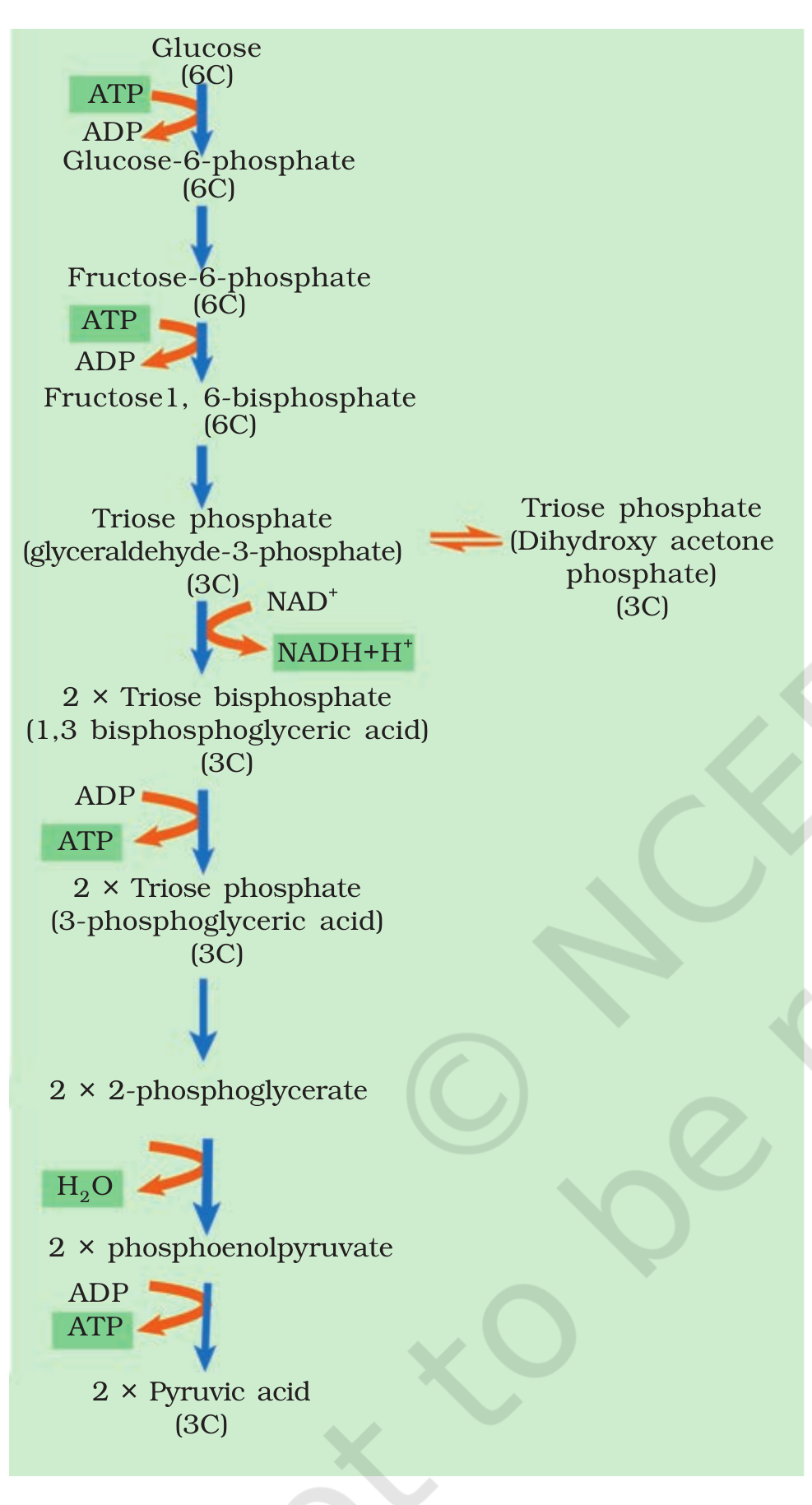
Glycolysis is the partial oxidation of one molecule of glucose to two molecules of pyruvic acid. It takes place in the cytoplasm, it occurs in all living organisms, and it does not use oxygen directly. The scheme is also called the EMP pathway, after Embden, Meyerhof and Parnas.
The steps, from NCERT Figure 12.1, are:
- Glucose is phosphorylated to glucose-6-phosphate by hexokinase, using 1 ATP.
- Glucose-6-phosphate is converted to fructose-6-phosphate.
- Fructose-6-phosphate is phosphorylated to fructose-1,6-bisphosphate, using 1 ATP.
- Fructose-1,6-bisphosphate splits into two 3-carbon molecules: 3-phosphoglyceraldehyde (PGAL) and dihydroxyacetone phosphate (DHAP). DHAP is converted to PGAL, so two molecules of PGAL continue.
- Each PGAL is oxidised to 1,3-bisphosphoglycerate, and $\mathrm{NAD}^{+}$ is reduced to NADH + $H^+$.
- Each 1,3-bisphosphoglycerate gives 3-phosphoglycerate, and 1 ATP is formed.
- 3-Phosphoglycerate is converted to 2-phosphoglycerate and then to phosphoenolpyruvate (PEP).
- Each PEP gives pyruvic acid, and 1 ATP is formed.
Count the energy: 4 ATP are made and 2 ATP are used, so the net gain is 2 ATP, plus 2 NADH + $H^+$ per glucose.
Pyruvic acid is the key product of glycolysis. What happens to it next depends on the availability of oxygen: without oxygen it is fermented, and with oxygen it is transported into the mitochondria for aerobic respiration.
Suggest an edit
Practice1 question
Try it now. A wrong answer costs nothing here, try again until you get it.
In glycolysis, ATP is used in which two steps?
ATP is spent twice in glycolysis: glucose to glucose-6-phosphate by hexokinase, and fructose-6-phosphate to fructose-1,6-bisphosphate. ATP is made later, at 1,3-bisphosphoglycerate to 3-phosphoglycerate and at PEP to pyruvic acid.
Fermentation
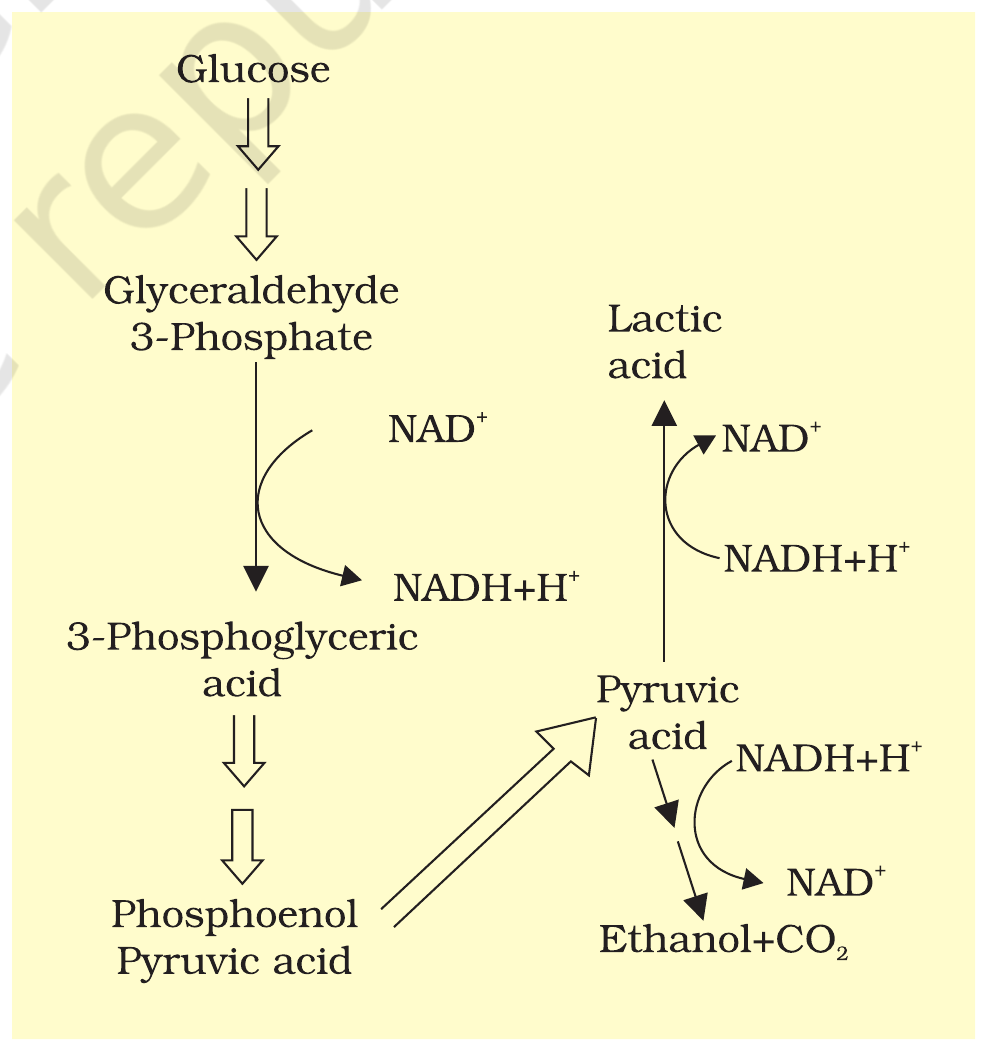
When oxygen is not available, pyruvic acid is fermented. Two kinds of fermentation are in NCERT.
In yeast, pyruvic acid is converted to carbon dioxide and ethanol. The enzymes are pyruvic acid decarboxylase and alcohol dehydrogenase. Less than 7 per cent of the energy in glucose is released during fermentation, and not all of it is stored as ATP. Yeasts poison themselves to death when the alcohol concentration reaches about 13 per cent.
In animal muscle cells during exercise, when oxygen is inadequate for cellular respiration, pyruvic acid is reduced to lactic acid by the enzyme lactate dehydrogenase. Some bacteria also produce lactic acid from pyruvic acid.
In both processes, the reducing agent NADH + $H^+$ is reoxidised to $\mathrm{NAD}^{+}$, so that glycolysis can keep running. The net gain of fermentation is only 2 ATP per glucose, the same as glycolysis alone.
Suggest an edit
Practice1 question
Try it now. A wrong answer costs nothing here, try again until you get it.
Yeast cells die when the alcohol concentration in the medium reaches about how much?
Yeast converts pyruvic acid to $CO_2$ and ethanol. Less than 7 per cent of the energy in glucose is released, and yeasts poison themselves to death when the alcohol concentration reaches about 13 per cent.
Aerobic respiration: link reaction and the TCA cycle
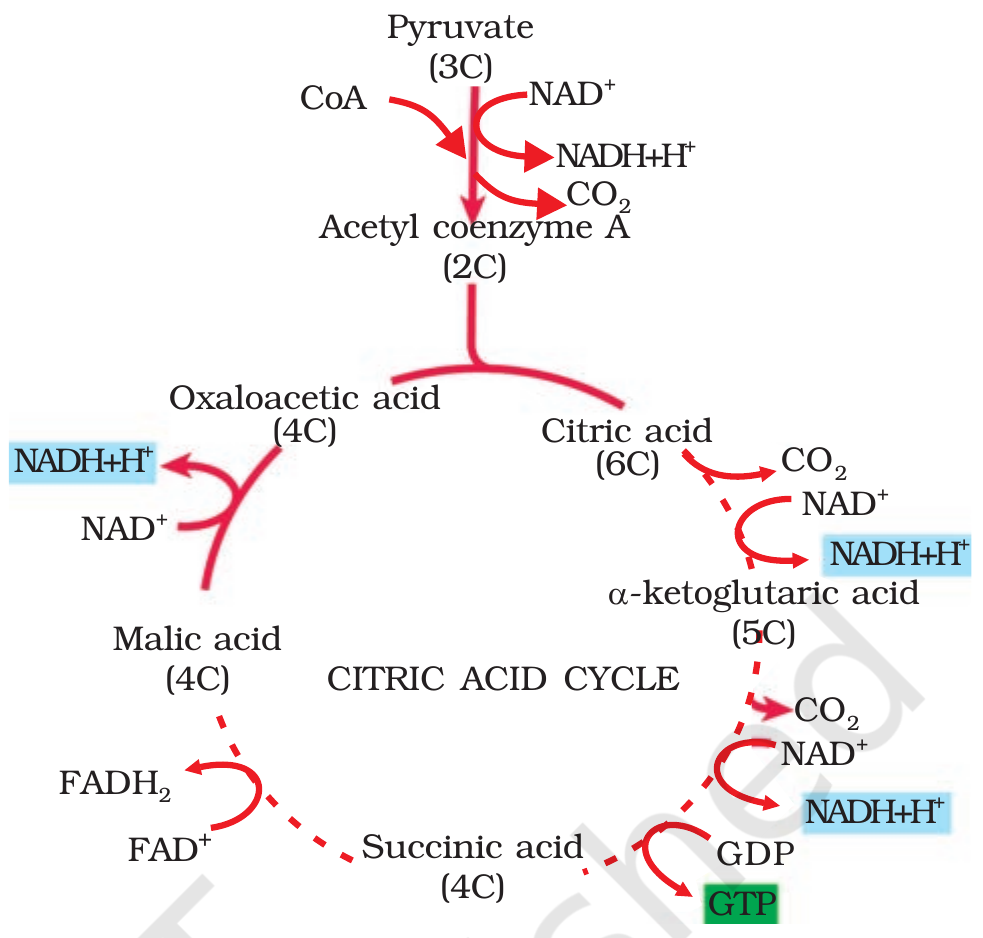
When oxygen is available, pyruvic acid is transported from the cytoplasm into the mitochondria. Three things then happen: pyruvate is completely oxidised by the stepwise removal of all its hydrogen atoms, leaving three molecules of $CO_2$; the electrons removed are passed to oxygen; and ATP is synthesised.
The link reaction takes place in the mitochondrial matrix: pyruvic acid + CoA + $\mathrm{NAD}^{+}$ gives acetyl CoA + $CO_2$ + NADH + $H^+$. It is catalysed by pyruvate dehydrogenase and requires $Mg^{2+}$.
The TCA cycle, also called the Krebs cycle after Hans Krebs, runs as follows:
- The acetyl group of acetyl CoA condenses with oxaloacetic acid (OAA) and water to form citric acid, catalysed by citrate synthase.
- Citrate is isomerised to isocitrate.
- Two successive decarboxylations follow: isocitrate gives alpha-ketoglutaric acid and then succinyl-CoA, with $CO_2$ released at both steps.
- Succinyl-CoA gives succinic acid, and GTP is formed by substrate-level phosphorylation.
- Succinic acid gives malic acid, and FADH2 is formed.
- Malic acid gives oxaloacetic acid, and NADH is formed. OAA is regenerated, so the cycle continues.
Per turn of the cycle the yield is 3 NADH, 1 FADH2, 1 GTP and 2 $CO_2$. Per glucose molecule, two turns run, giving 4 $CO_2$, 6 NADH, 2 FADH2 and 2 GTP.
The continued oxidation of acetyl CoA through the TCA cycle needs two things: the continued replenishment of oxaloacetic acid, the first member of the cycle, and the regeneration of $\mathrm{NAD}^{+}$ and FAD from NADH and FADH2. That regeneration happens in the electron transport system.
Suggest an edit
Practice1 question
Try it now. A wrong answer costs nothing here, try again until you get it.
How many molecules of $CO_2$ are released per glucose molecule in the TCA cycle (two turns)?
Each turn of the TCA cycle releases 2 $CO_2$ molecules, so two turns per glucose release 4 $CO_2$. The decarboxylations happen at isocitrate to alpha-ketoglutarate and at alpha-ketoglutarate to succinyl-CoA.
Electron transport system and oxidative phosphorylation
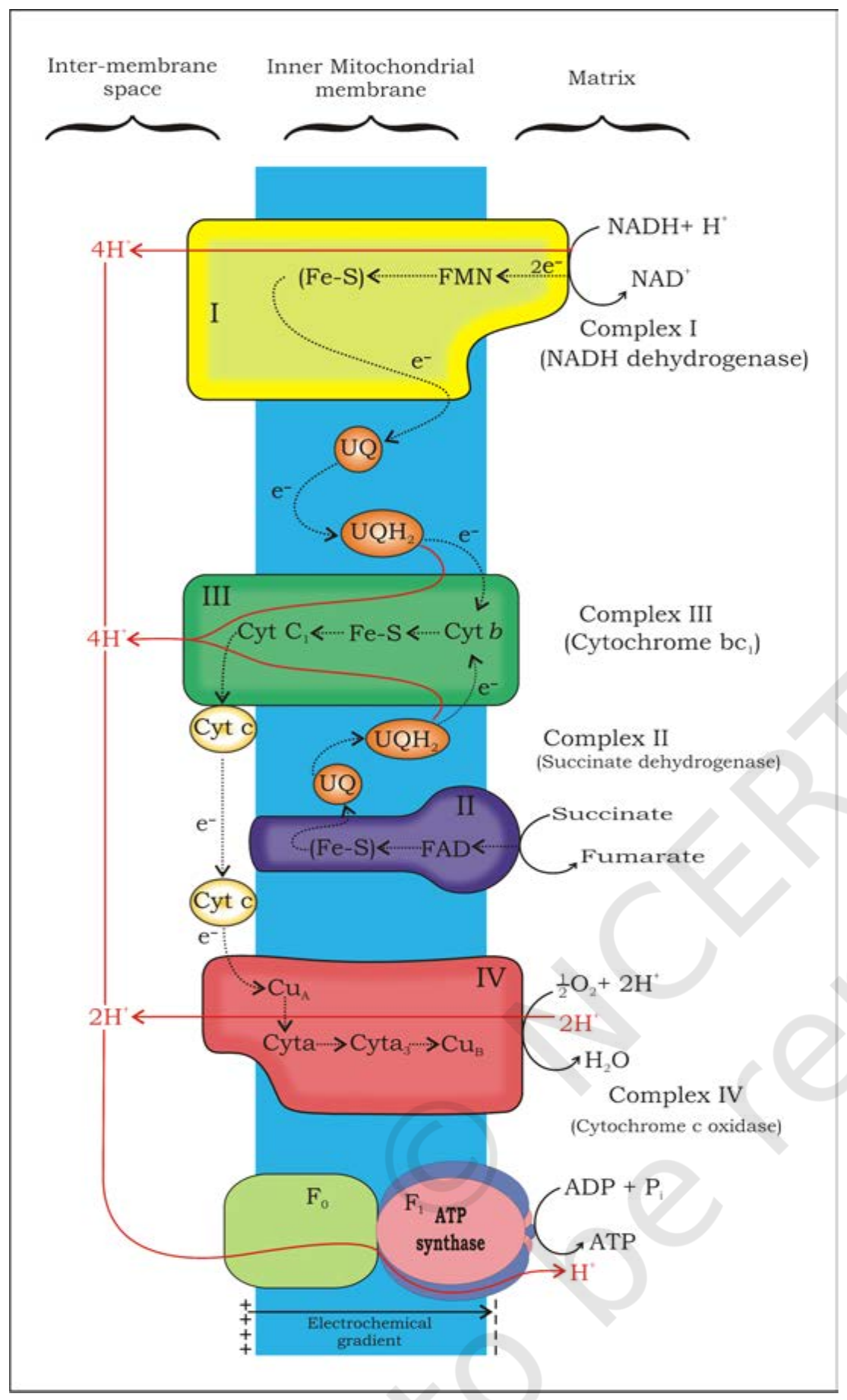
NADH and FADH2 made in glycolysis, the link reaction and the TCA cycle are oxidised through the electron transport system (ETS), which is present in the inner mitochondrial membrane. Electrons pass from one carrier to another and are finally passed to $O_2$, forming water.
- Complex I is NADH dehydrogenase. It oxidises NADH, and the electrons are transferred to ubiquinone, located within the inner membrane.
- Complex II is succinate dehydrogenase. FADH2 generated during the oxidation of succinate in the TCA cycle also passes its electrons to ubiquinone.
- The reduced ubiquinone (ubiquinol) is oxidised with the transfer of electrons to cytochrome c through complex III, the cytochrome bc1 complex.
- Cytochrome c is a small protein attached to the outer surface of the inner membrane. It acts as a mobile carrier for the transfer of electrons between complex III and complex IV.
- Complex IV is the cytochrome c oxidase complex, containing cytochromes a and a3 and two copper centres. Electrons pass from complex IV to oxygen.
ATP synthase is complex V. It has two major components: F1 and F0. The F1 headpiece is a peripheral membrane protein complex and contains the site for the synthesis of ATP from ADP and inorganic phosphate. F0 is an integral membrane protein complex that forms the channel through which protons cross the inner membrane. The passage of protons through F0 is coupled to the catalytic site of F1 for the production of ATP. For each ATP produced, 4H+ pass through F0 down the electrochemical proton gradient.
The number of ATP molecules synthesised depends on the nature of the electron donor: oxidation of one molecule of NADH gives rise to 3 molecules of ATP, while that of one molecule of FADH2 produces 2 molecules of ATP.
Although aerobic respiration takes place only in the presence of oxygen, the role of oxygen is limited to the terminal stage of the process. Oxygen acts as the final hydrogen acceptor: it drives the whole process by removing hydrogen from the system. The energy of oxidation-reduction is used to build the proton gradient, so the process is called oxidative phosphorylation.
Suggest an edit
Practice1 question
Try it now. A wrong answer costs nothing here, try again until you get it.
Which complex of the electron transport system is called ATP synthase?
ATP synthase is complex V. Its F1 headpiece contains the site for ATP synthesis from ADP and inorganic phosphate, and its F0 part forms the proton channel. For each ATP produced, 4H+ pass through F0.
Respiratory balance sheet
Counting every ATP, the theoretical net gain from one molecule of glucose in aerobic respiration is 38 ATP: glycolysis gives 8 ATP (2 ATP made directly plus 2 NADH, each worth 3 ATP), the oxidative decarboxylation of pyruvic acid gives 6 ATP (2 NADH), and the Krebs cycle gives 24 ATP (6 NADH worth 18, 2 FADH2 worth 4, and 2 GTP worth 2). 8 + 6 + 24 = 38.
This calculation rests on four assumptions:
- There is an orderly and sequential pathway: glycolysis in the cytoplasm, then the TCA cycle and the ETS in the mitochondria.
- The NADH synthesised in glycolysis is transferred into the mitochondria and undergoes oxidative phosphorylation.
- None of the intermediates in the pathway is utilised to synthesise any other compound.
- Only glucose is being respired, and no alternative substrate enters the pathway at an intermediate stage.
In a living system these assumptions are not really valid: all pathways work simultaneously and do not take place one after another; substrates are withdrawn from the pathway as and when necessary; ATP is utilised as and when needed; and enzymatic rates are controlled by various means.
So 38 ATP is the theoretical maximum, not the real yield in a living cell. Fermentation, by comparison, gives a net gain of only 2 ATP per glucose.
Suggest an edit
Amphibolic pathway
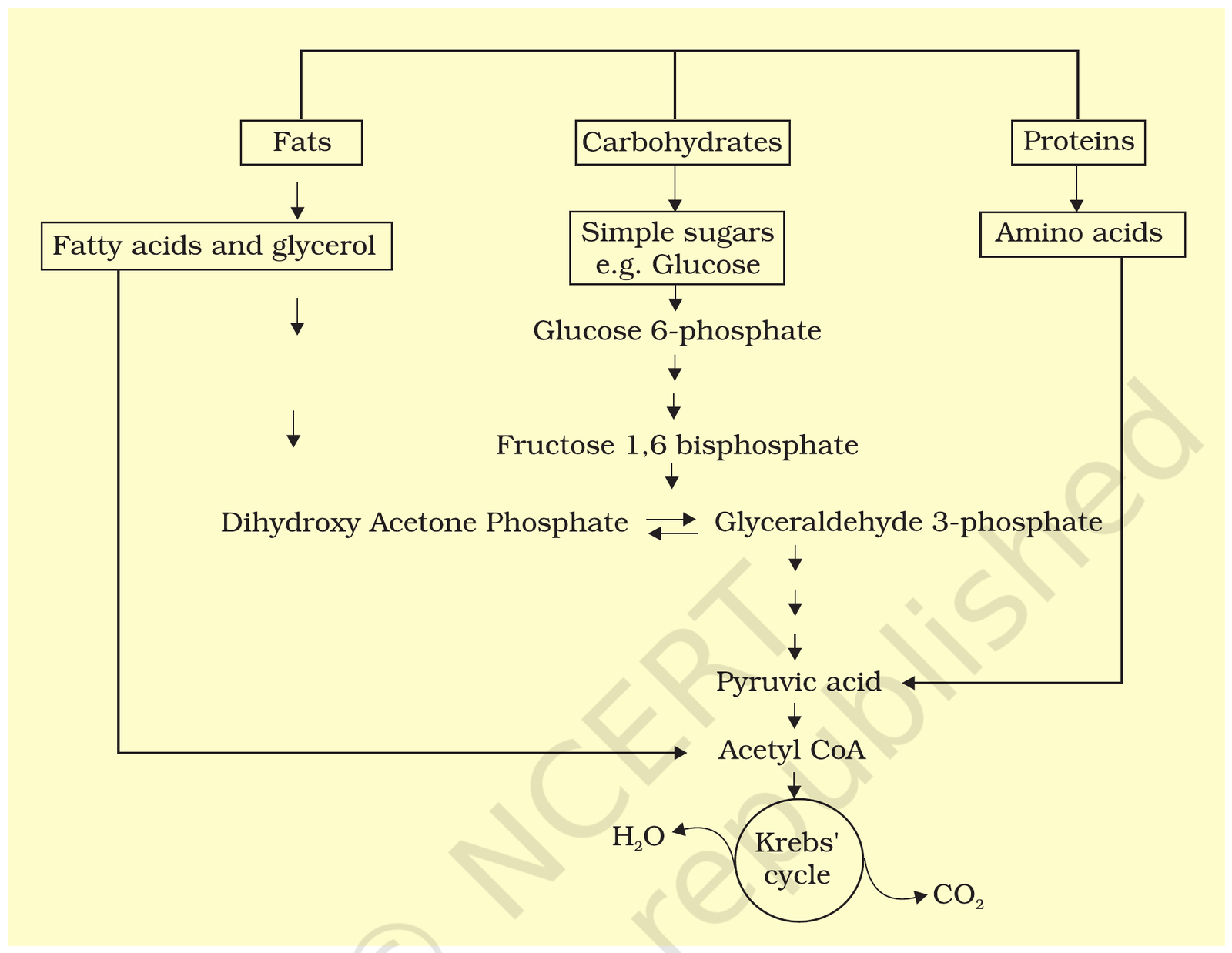
Glucose is the favoured substrate for respiration. All carbohydrates are first converted into glucose before they are used.
Other substrates enter the respiratory pathway at different points:
- Fats are broken down into glycerol and fatty acids. Glycerol is converted to PGAL and enters the pathway. Fatty acids are degraded to acetyl CoA and enter the pathway.
- Proteins are degraded by proteases into amino acids. After deamination, the amino acids enter the Krebs cycle depending on their structure: as pyruvate, as acetyl CoA, or as an intermediate of the cycle.
Because the same pathway breaks glucose down and also supplies intermediates for building other compounds, the respiratory pathway is called an amphibolic pathway: it involves both catabolism and anabolism. Glucose is the favoured substrate, but the pathway is shared by fats and proteins as well.
Suggest an edit
Respiratory quotient
The ratio of the volume of $CO_2$ evolved to the volume of $O_2$ consumed in respiration is called the respiratory quotient (RQ) or respiratory ratio.
RQ = volume of $CO_2$ evolved / volume of $O_2$ consumed.
The RQ depends on the type of respiratory substrate used:
- Carbohydrates, completely oxidised: RQ = 1, because equal amounts of $CO_2$ and $O_2$ are evolved and consumed. $C_6H_{12}O_6$ + 6O2 gives 6CO2 + 6H2O + energy.
- Fats: RQ is less than 1. For the fatty acid tripalmitin: 2($C_{51}H_{98}O_6$) + 145O2 gives 102CO2 + 98H2O + energy, so RQ = 102 / 145 = 0.7.
- Proteins: when proteins are respiratory substrates the ratio would be about 0.9.
What is important to recognise is that in living organisms respiratory substrates are often more than one; pure proteins or fats are never used as respiratory substrates.
Extra information (beyond NCERT): when organic acids are respired, the RQ is more than 1; for oxalic acid it is 4.0. This is not in NCERT Chapter 12.
Suggest an edit
Practice1 question
Try it now. A wrong answer costs nothing here, try again until you get it.
Which respiratory substrate has a respiratory quotient of 1.0?
When carbohydrates are completely oxidised, equal volumes of $CO_2$ and $O_2$ are evolved and consumed, so RQ = 1. Fats give 0.7 and proteins about 0.9.
Table 1 - Glycolysis: ATP and NADH at each step
| Step | ATP used | ATP made | NADH + $H^+$ made |
|---|---|---|---|
| Glucose to glucose-6-phosphate | 1 | 0 | 0 |
| Fructose-6-phosphate to fructose-1,6-bisphosphate | 1 | 0 | 0 |
| PGAL to 1,3-bisphosphoglycerate (x2) | 0 | 0 | 2 |
| 1,3-Bisphosphoglycerate to 3-phosphoglycerate (x2) | 0 | 2 | 0 |
| PEP to pyruvic acid (x2) | 0 | 2 | 0 |
| Total per glucose | 2 | 4 | 2 |
Net gain: 4 ATP made minus 2 ATP used = 2 ATP, plus 2 NADH + $H^+$ per glucose.
Source: NCERT XI, Ch 12, Sec 12.2, Fig 12.1.
Suggest an edit
Table 2 - One turn of the TCA cycle
| Step | What is formed |
|---|---|
| Acetyl CoA + OAA + $H_2O$ to citric acid | Citric acid (6C) |
| Citric acid to isocitrate | Isocitrate (6C) |
| Isocitrate to alpha-ketoglutarate | $CO_2$ + NADH |
| Alpha-ketoglutarate to succinyl-CoA | $CO_2$ + NADH |
| Succinyl-CoA to succinic acid | GTP |
| Succinic acid to malic acid | FADH2 |
| Malic acid to oxaloacetic acid | NADH |
Per turn: 3 NADH, 1 FADH2, 1 GTP, 2 $CO_2$. Per glucose (two turns): 4 $CO_2$, 6 NADH, 2 FADH2, 2 GTP.
Source: NCERT XI, Ch 12, Sec 12.4, Fig 12.3.
Suggest an edit
Table 3 - Respiratory balance sheet: ATP per glucose
| Stage | NADH | FADH2 | ATP or GTP made directly | ATP total |
|---|---|---|---|---|
| Glycolysis | 2 | 0 | 2 (net) | 8 |
| Link reaction, pyruvate to acetyl CoA (x2) | 2 | 0 | 0 | 6 |
| TCA cycle (x2 turns) | 6 | 2 | 2 (GTP) | 24 |
| Total per glucose | 10 | 2 | 4 (2 ATP + 2 GTP) | 38 |
Counting used: 1 NADH = 3 ATP, 1 FADH2 = 2 ATP. This is the theoretical maximum under the four assumptions of Section 12.5, not the real yield in a living cell.
Source: NCERT XI, Ch 12, Sec 12.5.
Suggest an edit
Table 4 - Respiratory quotient of common substrates
| Substrate | RQ | Example |
|---|---|---|
| Carbohydrate | 1.0 | Glucose |
| Fat | 0.7 | Tripalmitin |
| Protein | About 0.9 | - |
| Organic acid | More than 1 | Oxalic acid (4.0) |
The organic acid row is Extra information (beyond NCERT): NCERT Chapter 12 gives only carbohydrates (1), fats (0.7) and proteins (about 0.9).
Source: NCERT XI, Ch 12, Sec 12.7.
Suggest an edit
Trap Boxes
Net gain of glycolysis is 8 ATP?
Wrong idea: Glycolysis gives a net gain of 8 ATP per glucose.
The net gain of glycolysis is 2 ATP. Four ATP are made and two are used. The 2 NADH are counted separately. NEET 2022 asked this directly and the official answer is Two, not Eight.
NCERT XI, Ch 12, Sec 12.2
NADH gives 2 ATP and FADH2 gives 3 ATP?
Wrong idea: In the ETS, one NADH gives 2 ATP and one FADH2 gives 3 ATP.
NCERT is clear: oxidation of one molecule of NADH gives rise to 3 ATP, while one molecule of FADH2 produces 2 ATP. The statement in the question swaps the two numbers. NEET 2021 asked this and the swapped statement is the incorrect one.
NCERT XI, Ch 12, Sec 12.4
Fermentation releases most of glucose's energy?
Wrong idea: Fermentation releases most of the energy stored in glucose.
Less than 7 per cent of the energy in glucose is released during fermentation, and not all of it is stored as ATP. Fermentation is a poor energy harvest compared with aerobic respiration.
NCERT XI, Ch 12, Sec 12.3
Oxygen is used at every step of respiration?
Wrong idea: Oxygen is needed at every step of aerobic respiration.
The role of oxygen is limited to the terminal stage of aerobic respiration. Oxygen acts as the final hydrogen acceptor, removing hydrogen from the system and driving the whole process.
NCERT XI, Ch 12, Sec 12.4
38 ATP is the real yield in a living cell?
Wrong idea: Every glucose molecule always yields exactly 38 ATP in a living cell.
38 ATP is the theoretical maximum under four assumptions: an orderly sequential pathway, glycolytic NADH entering the mitochondria, no intermediate used for anything else, and glucose as the only substrate. In a living cell none of these holds exactly, so the real yield is lower.
NCERT XI, Ch 12, Sec 12.5
Chapter test
5 NEET PYQs. +4 for a correct answer, -1 for a wrong answer, exactly like NEET. Finish the test to earn a medal.
Q1: NEET (UG) 2025, Code 45, Q91
The complex II of mitochondrial electron transport chain is also known as
Complex II is succinate dehydrogenase. It oxidises succinate in the TCA cycle and passes electrons to ubiquinone in the ETS.
Q2: NEET (UG) 2024, Code T1, Q141
Identify the step in tricarboxylic acid cycle, which does not involve oxidation of substrate.
Succinyl-CoA to succinic acid is substrate-level phosphorylation: GTP is formed and no $\mathrm{NAD}^{+}$ or FAD is reduced, so no oxidation of the substrate happens.
Q3: NEET (UG) 2023, Code F1, Q138
Which of the following combinations is required for chemiosmosis?
Chemiosmosis requires a membrane, a proton pump, a proton gradient and ATP synthase. The gradient is broken down as protons pass through ATP synthase, making ATP.
Q4: NEET (UG) 2022, Code Q6, Q131
What is the net gain of ATP when each molecule of glucose is converted to two molecules of pyruvic acid?
Glycolysis makes 4 ATP and uses 2, so the net gain is 2 ATP. The 2 NADH formed are counted separately and are not ATP.
Q5: NEET (UG) 2021, Code O1, Q143
Which of the following statements is incorrect?
One molecule of NADH gives rise to 3 ATP and one molecule of FADH2 gives rise to 2 ATP. The option swaps the two numbers, so it is the incorrect statement.
Score: 0 · Answered 0 of 5
Flashcards
Tap a card to flip it over and see the answer. Tap it again to flip it back.
Put the TCA cycle in order, starting from acetyl CoA.
Tap to flipAcetyl CoA, citric acid, isocitrate, alpha-ketoglutaric acid, succinyl-CoA, succinic acid, malic acid, oxaloacetic acid, and back to citric acid.
Tap to flip backWhat is the theoretical net gain of ATP from the aerobic respiration of one glucose molecule?
Tap to flip38 ATP per molecule of glucose, under the four assumptions of the respiratory balance sheet.
Tap to flip backWhat is the respiratory quotient of tripalmitin, a fat?
Tap to flip0.7. RQ = volume of $CO_2$ evolved / volume of $O_2$ consumed = 102 / 145 for tripalmitin.
Tap to flip backWhat is the net gain of ATP in glycolysis per molecule of glucose?
Tap to flip2 ATP, plus 2 NADH + $H^+$. Four ATP are made and two are used.
Tap to flip backPyruvic acid + CoA + $\mathrm{NAD}^{+}$ gives what, in the link reaction?
Tap to flipAcetyl CoA + $CO_2$ + NADH + $H^+$. It is catalysed by pyruvate dehydrogenase and requires $Mg^{2+}$.
Tap to flip backSuccinyl-CoA to succinic acid: what energy-rich molecule is formed along with succinic acid?
Tap to flipOne molecule of GTP, by substrate-level phosphorylation. No $\mathrm{NAD}^{+}$ or FAD is reduced in this step.
Tap to flip backWhich step of the TCA cycle does NOT involve oxidation of the substrate?
Tap to flipSuccinyl-CoA to succinic acid. It is substrate-level phosphorylation, not an oxidation.
Tap to flip backWhich ETS complex is also an enzyme of the TCA cycle?
Tap to flipComplex II, succinate dehydrogenase. It oxidises succinate in the TCA cycle and feeds electrons to ubiquinone.
Tap to flip backIn which order do electrons pass through the ETS complexes?
Tap to flipComplex I (NADH dehydrogenase) to ubiquinone, then complex III (cytochrome bc1) to cytochrome c, then complex IV (cytochrome c oxidase) to oxygen.
Tap to flip backWhat is the formula for the respiratory quotient?
Tap to flipRQ = volume of $CO_2$ evolved / volume of $O_2$ consumed. Carbohydrates give 1, fats give less than 1, proteins about 0.9.
Tap to flip back