 NEET Notes
Home > Biology > Botany > Plant Growth and Development
Plant Growth and Development
On this page · 18 sections
- 01Syllabus map
- 02What is growth?
- 03Growth rates: arithmetic and geometric growth
- 04Absolute and relative growth rates
- 05Differentiation, dedifferentiation and redifferentiation
- 06Development and plasticity
- 07Plant growth regulators: an introduction
- 08Auxins
- 09Gibberellins
- 10Cytokinins
- 11Ethylene
- 12Abscisic acid
- 13Photoperiodism, vernalisation and seed dormancy (removed topics, for older PYQs only)
- 14Table 1 - Growth phases compared
- 15Table 2 - Arithmetic vs geometric growth
- 16Table 3 - The five plant growth regulators
- 17Table 4 - PGR applications in agriculture
- 18Table 5 - Confusable pairs: do not mix these up
Growth phases and rates, differentiation and plasticity, and the five plant growth regulators, plus a compact note on removed topics (photoperiodism, vernalisation, seed dormancy).
Syllabus map
- NMC Unit: BIO-U04, Plant Physiology. NCERT Chapter 13, Plant Growth and Development.
- Subtopics in this chapter (NCERT XI, Ch 13): Growth. Differentiation, Dedifferentiation and Redifferentiation. Development. Plant Growth Regulators.
- Extra information (removed from both rationalised NCERT Ch 13 and current NMC syllabus, for older PYQs / mock-test reference only): photoperiodism, vernalisation and seed dormancy are covered in one compact summary at the end of the chapter, for older PYQs and mock tests only.
- Subtopic checklist: (1) growth phases and growth rates; (2) differentiation, dedifferentiation and redifferentiation; (3) development and plasticity; (4) the five plant growth regulators and their roles; (5) removed topics in one compact summary (photoperiodism, vernalisation, seed dormancy; older PYQs only).
- Estimated revision time: 12 minutes. Jump links: Syllabus Map, What is Growth?, Growth Rates, Differentiation, Development, Plant Growth Regulators, Removed Topics, Trap Boxes, PYQs, Chapter Test.
What is growth?
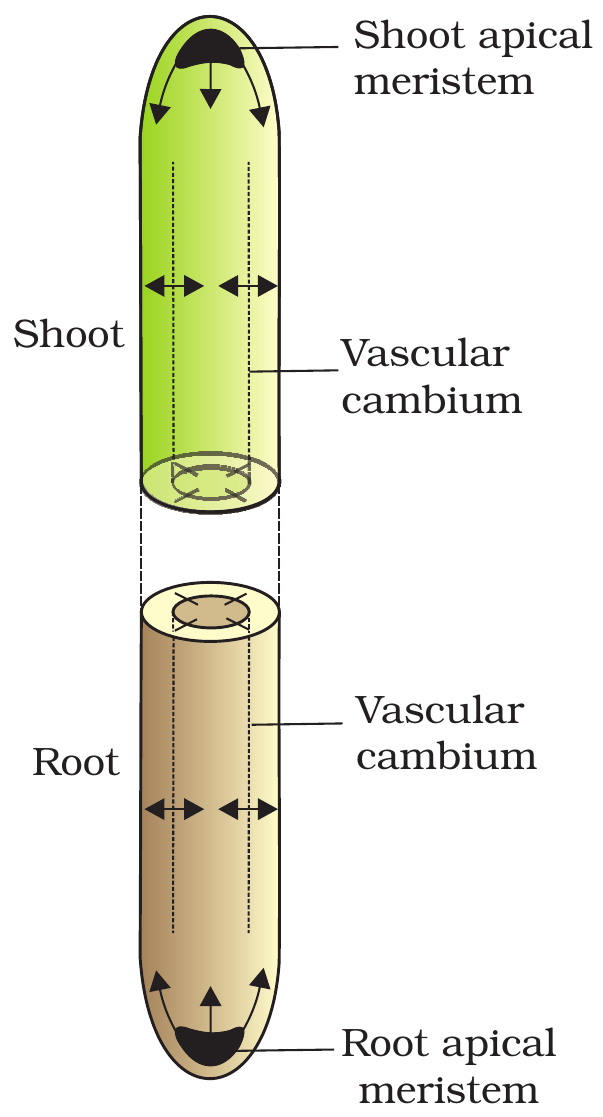
Growth is the most fundamental characteristic of a living being. It is an irreversible permanent increase in size of an organ or its parts, or even of an individual cell. Growth is accompanied by metabolic processes, both anabolic and catabolic, that occur at the expense of energy. The expansion of a leaf is growth, and the expansion of a single cell is also growth.
Growth is measurable. It can be measured as an increase in length, height, surface area, volume, fresh weight or dry weight. The parameter used depends on the organ: a leaf is measured by surface area, a fruit by volume, a seedling by length.
The root apex and the shoot apex are the regions of growth. The cells of meristems divide and add new cells to the plant body.
Three phases of growth can be recognised in a growing organ such as a root:
- Meristematic phase: the cells are rich in protoplasm, possess large conspicuous nuclei, and have thin cellulosic walls with abundant plasmodesmatal connections. They are constantly dividing.
- Elongation phase: the newly formed cells enlarge. There is increased vacuolation, cell enlargement and new cell wall deposition. This is the zone just behind the root apex.
- Maturation phase: the cells attain their maximal size in terms of wall thickening and protoplasmic modifications, and they differentiate into specific cell types.
Growth rates: arithmetic and geometric growth
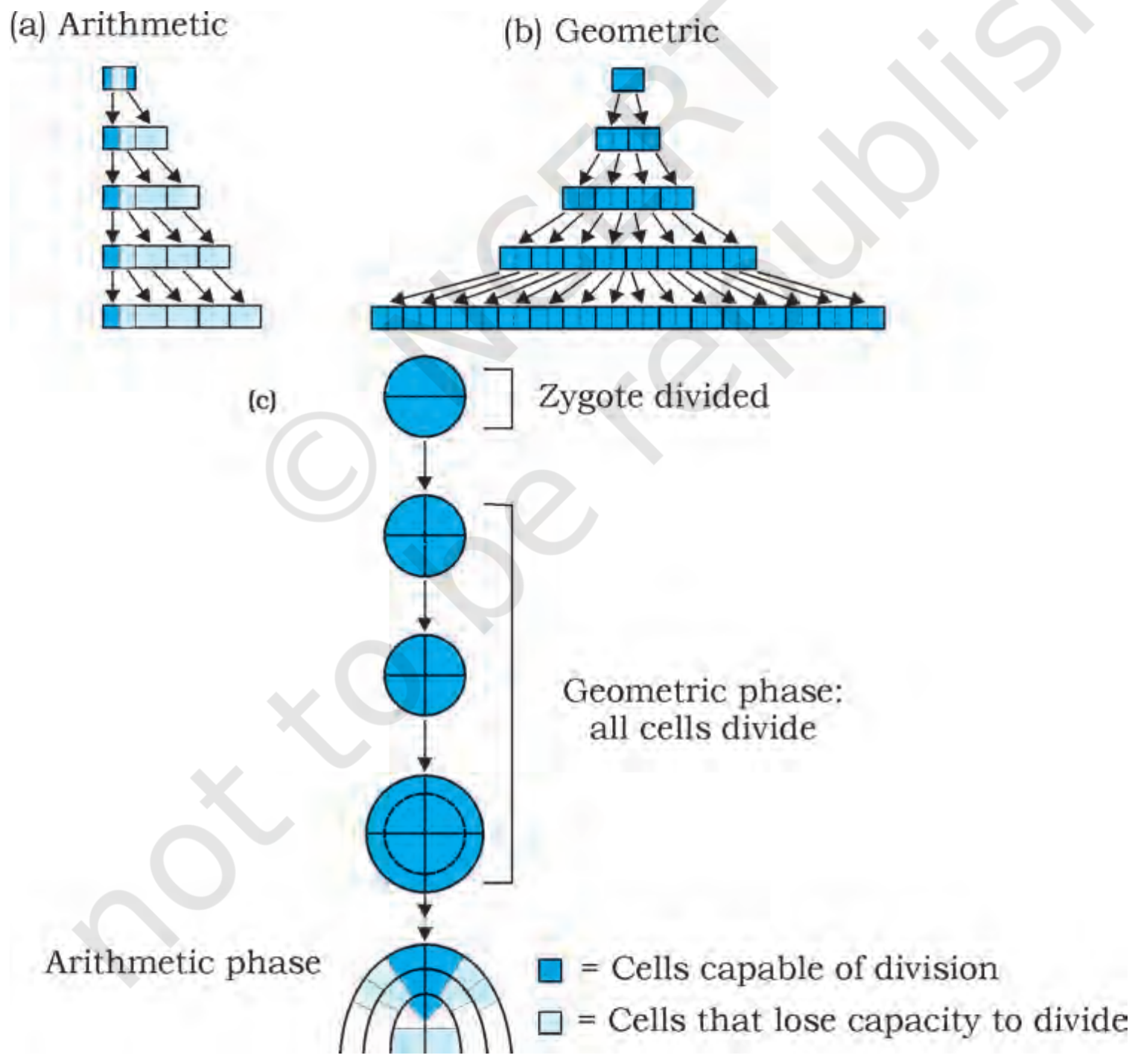
Arithmetic growth: following mitotic division, only one daughter cell continues to divide, and the other differentiates and matures. A root elongating at a constant rate is an example. Arithmetic growth is expressed as Lₜ = L₀ + rt, where Lₜ is the length at time t, L₀ is the length at time zero, and r is the growth rate (elongation per unit time). Plotted against time, arithmetic growth gives a linear curve.
Geometric growth: following mitotic division, both daughter cells retain the ability to divide and continue to do so. The initial growth is slow (lag phase), and thereafter it increases rapidly at an exponential rate (log phase). Geometric growth is expressed as W₁ = W₀e^(rt), where W₁ is the final size (weight, height, number, etc.), W₀ is the initial size, r is the growth rate, t is time, and e is the base of natural logarithms.
When geometric growth is plotted against time, the curve is S-shaped, or sigmoid. It has three phases: the lag phase, the log (exponential) phase and the stationary phase. Exponential growth cannot be sustained indefinitely, because the nutrient supply becomes limited and the curve levels off, leading to the stationary phase. The sigmoid curve is typical of cells, tissues and organs of a plant growing in a natural environment. Growth is maximum during the log phase.
Practice1 question
Try it now. A wrong answer costs nothing here, try again until you get it.
A root is 5 cm long at time zero and elongates arithmetically at 2 cm per day. What will its length be after 4 days?
Arithmetic growth: Lt = L0 + rt = 5 + (2 x 4) = 13 cm.
Absolute and relative growth rates
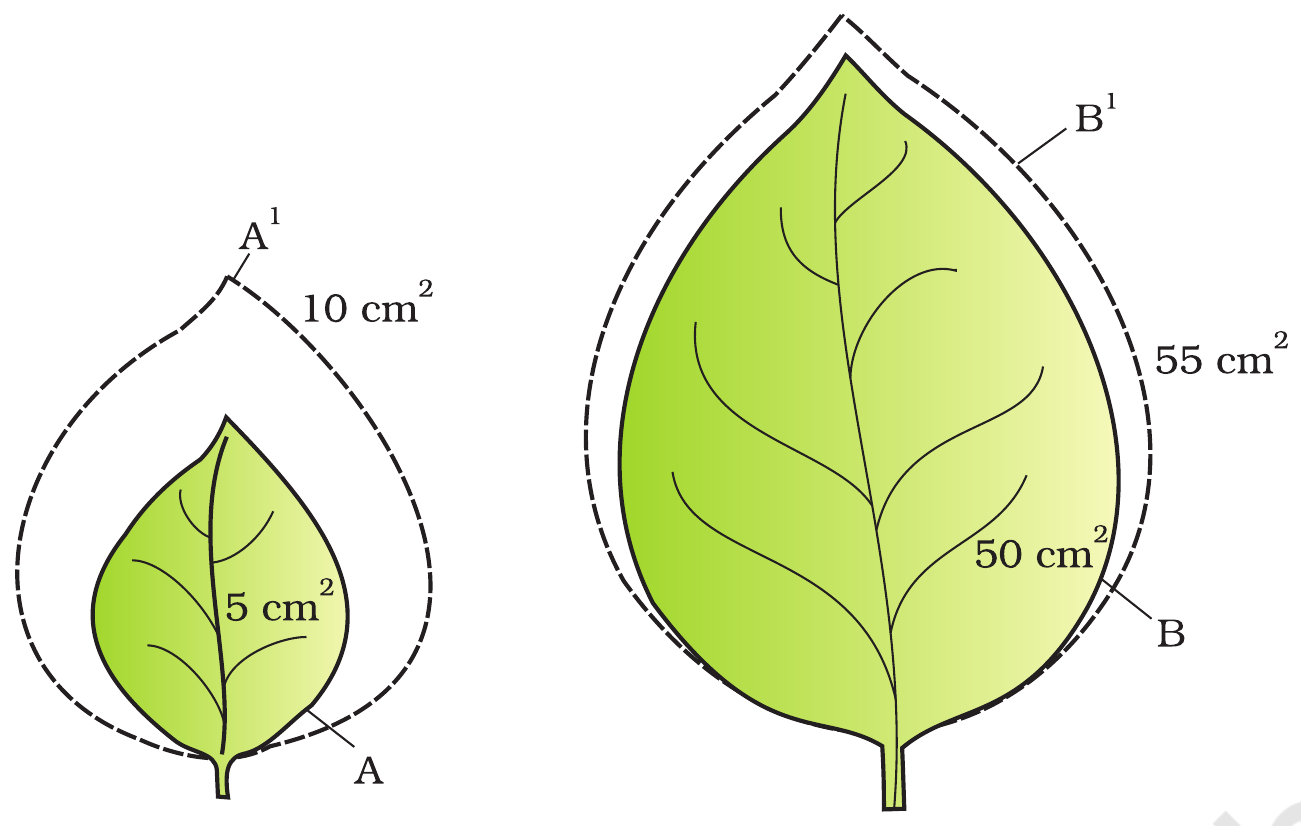
The absolute growth rate is the measurement of total growth per unit time, for example centimetres per day or square centimetres per day. The relative growth rate is the growth per unit time per unit initial parameter, that is, the growth relative to the size at the start.
Worked example: leaf A has an area of 2 cm² and grows to 4 cm² in a day, while leaf B has an area of 10 cm² and grows to 12 cm² in the same day. Both leaves have the same absolute growth rate, 2 cm² per day. But the relative growth rate of A is 100 percent (2 divided by 2), while that of B is only 20 percent (2 divided by 10).
NEET trap: when two organs show the same absolute increase, the smaller organ has the higher relative growth rate. Do not pick the bigger leaf.
Practice1 question
Try it now. A wrong answer costs nothing here, try again until you get it.
Leaf A (2 cm²) grows to 4 cm² and leaf B (10 cm²) grows to 12 cm² in the same day. Which statement is correct?
Both have the same absolute growth rate (2 cm² per day), but A's relative growth rate is 100 percent (2/2) while B's is 20 percent (2/10).
Differentiation, dedifferentiation and redifferentiation
Differentiation: the cells derived from the root apical meristem, the shoot apical meristem and the cambium differentiate and mature to perform specific functions. For example, to form a tracheary element, the cells lose their protoplasm and develop a very strong, elastic, lignified secondary wall. Differentiation is the process by which a cell acquires a definite shape, size and function.
Dedifferentiation: living differentiated cells that have lost the capacity to divide can regain the capacity to divide under certain conditions. The formation of meristems, the interfascicular cambium and the cork cambium, from fully differentiated parenchyma cells is an example.
Redifferentiation: the cells produced by dedifferentiation lose the capacity to divide again and mature to perform specific functions. Secondary xylem, secondary phloem, cork and secondary cortex, which are produced by the cambium, are examples.
One-line memory: differentiation is specialising, dedifferentiation is regaining the power to divide, redifferentiation is specialising again.
Practice1 question
Try it now. A wrong answer costs nothing here, try again until you get it.
The formation of interfascicular cambium from fully differentiated parenchyma cells is an example of:
Dedifferentiation is when living differentiated cells regain the capacity to divide. Interfascicular cambium and cork cambium form this way.
Development and plasticity
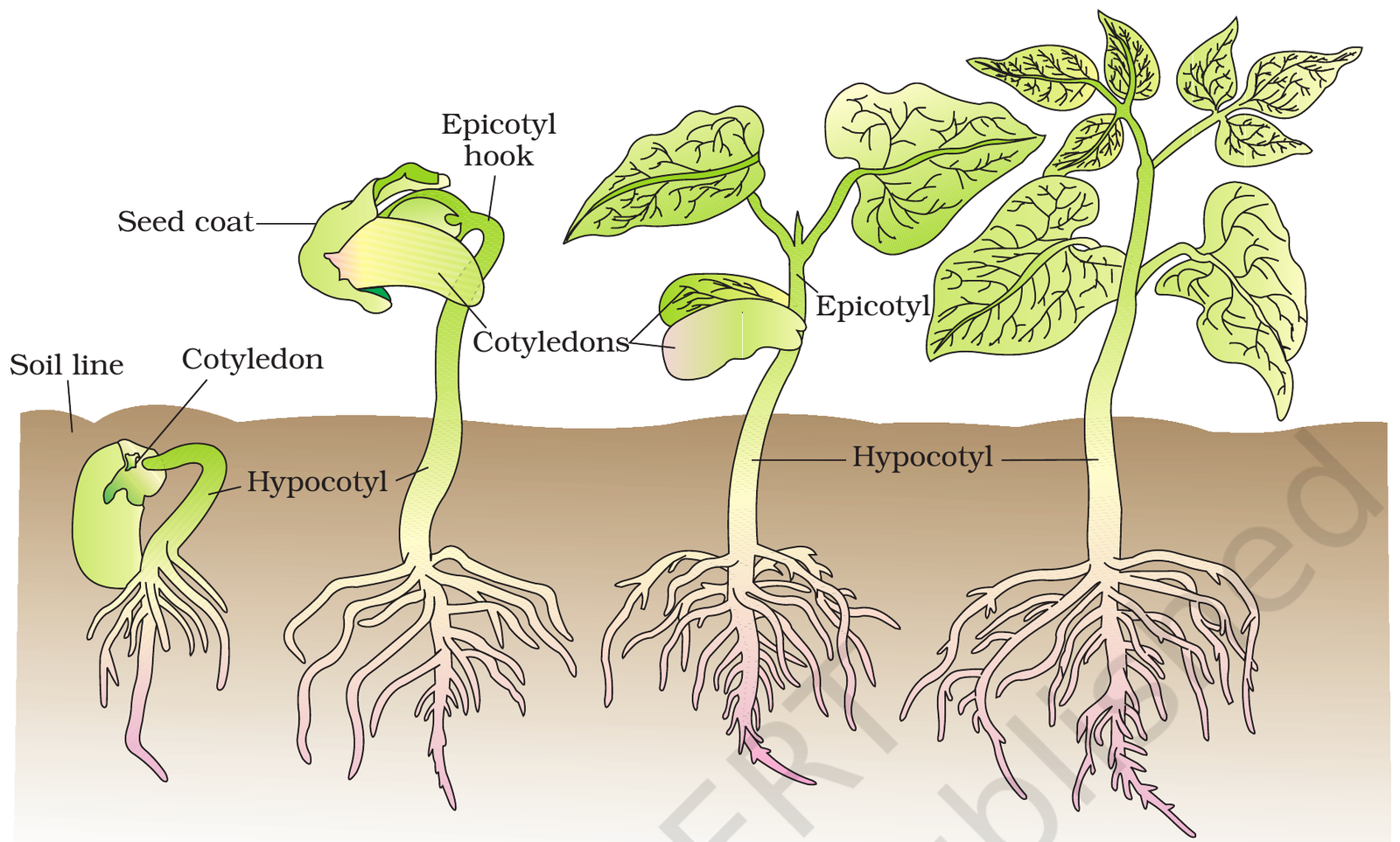
Development is all the changes that an organism goes through during its life cycle, from germination of the seed to senescence. The sequence is germination, growth, differentiation, maturation, flowering, seed formation and senescence. Development is the sum of growth and differentiation. It is controlled by intrinsic factors, intracellular (genetic) and intercellular (chemical, the plant growth regulators), and extrinsic factors (light, temperature, water, oxygen and nutrition).
Plasticity is the ability of plants to follow different pathways in response to the environment or to phases of life, to form different kinds of structures.
Heterophylly is the classic example. The leaves of the juvenile plant are different in shape from those in mature plants, as in cotton, coriander and larkspur. In buttercup, the leaves produced in air are different in shape from those produced in water, and this difference is due to the environment. Cotton, coriander and larkspur show developmental heterophylly (juvenile leaves differ from mature leaves); buttercup shows environmental heterophylly (water leaves differ from air leaves). Cotton, coriander and buttercup show plasticity. Maize does not show plasticity.
Growth and development are not synonyms. Growth is an increase in size. Development includes growth plus differentiation and every change in the life cycle.
Practice1 question
Try it now. A wrong answer costs nothing here, try again until you get it.
In buttercup, the leaves produced in air are different in shape from those produced in water. This is an example of:
Plasticity is the ability of plants to follow different pathways in response to the environment, forming different structures. Here it is heterophylly in buttercup.
Plant growth regulators: an introduction
Plant growth regulators (PGRs) are small, simple molecules of diverse chemical composition: indole compounds (indole-3-acetic acid, IAA, an auxin), adenine derivatives (kinetin and zeatin, cytokinins), derivatives of carotenoids (abscisic acid, ABA), terpenes (gibberellic acid, GA3), and gases (ethylene, $C_2H_4$). They are also called plant growth substances or phytohormones.
Plant growth promoters are auxins, gibberellins and cytokinins. The plant growth inhibitor is abscisic acid (ABA). Ethylene can act as both a promoter and an inhibitor, depending on the process.
Discovery notes, one line each:
- Auxin: Charles Darwin and Francis Darwin showed that the tip of the coleoptile of canary grass perceives light. F.W. Went isolated auxin from the tips of coleoptiles of oat seedlings (Avena sativa). IAA was first isolated from human urine.
- Gibberellin: E. Kurosawa (1926) reported the bakanae (foolish seedling) disease of rice, caused by the fungus Gibberella fujikuroi. The active substance was gibberellic acid (GA3).
- Cytokinin: kinetin was discovered by Skoog and Miller (1955) from autoclaved herring sperm DNA.
- Ethylene: Cousins (1910) confirmed that a volatile substance released from ripened oranges hastened the ripening of unripened bananas.
- Abscisic acid: discovered as a growth inhibitor in the mid-1960s. It was first called inhibitor-B, dormin (it inhibits growth) and abscission II (it promotes abscission); the three were later recognised as the same substance, abscisic acid.
Auxins
Natural auxins isolated from plants include indole-3-acetic acid (IAA) and indole butyric acid (IBA). Synthetic auxins include naphthalene acetic acid (NAA) and 2,4-dichlorophenoxyacetic acid (2,4-D).
Functions of auxins:
- Cell enlargement.
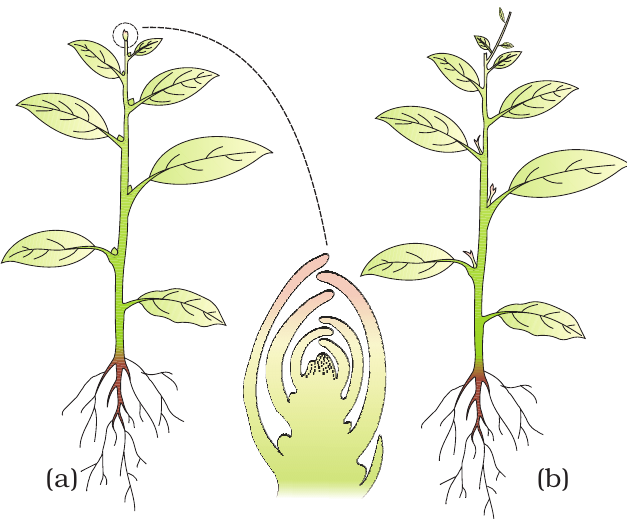
- Apical dominance: auxin from the shoot apex suppresses the growth of lateral buds. Removing the shoot tip removes apical dominance, so lateral buds grow. This is why pruning tea plants increases the yield of tea leaves.
- Root initiation: auxin initiates rooting in stem cuttings.
- Flowering: auxin promotes flowering in pineapple. Auxin and ethylene together induce flowering in pineapple throughout the year.
- Prevention of fruit and leaf drop at early stages, but promotion of the abscission of older mature leaves and fruits.
- Parthenocarpy: auxin induces seedless fruit, for example in tomatoes.
- Xylem differentiation.
- 2,4-D is used as a weedicide. It kills dicotyledonous weeds but does not affect mature monocotyledonous plants.
Gibberellins
More than 100 gibberellins are known (GA1, GA2, GA3 and so on). Gibberellic acid (GA3) is the most studied.
Functions of gibberellins:
- Stem elongation: gibberellins increase the length of the axis. Spraying gibberellin on sugarcane increases the length of the stem and thus the yield of sugarcane.
- Bolting: gibberellins cause bolting, the rapid elongation of the stem, in rosette plants such as cabbage and beet, followed by flowering.
- Delay of fruit senescence (extends market life).
- Spraying juvenile conifers with gibberellins hastens the maturity period, thus leading to early seed production.
- Speeding up of the malting process in the brewing industry.
- Increase in the size of fruits, for example grapes, and in the length of grape stalks.
Gibberellin and abscisic acid are antagonists: gibberellin breaks dormancy, abscisic acid imposes it.
Cytokinins
Kinetin, a modified form of adenine (a purine), was discovered from autoclaved herring sperm DNA. The natural cytokinin zeatin was isolated from corn kernels and coconut milk.
Functions of cytokinins:
- Cell division (cytokinesis), especially in the presence of auxin.
- Overcoming apical dominance: cytokinins promote lateral shoot growth and adventitious shoot formation.
- Production of new leaves, chloroplasts in leaves and lateral shoot growth.
- Delay of leaf senescence by promoting nutrient mobilisation. Cytokinin promotes nutrient mobilisation, which helps delay leaf senescence.
Cytokinin and auxin oppose each other on apical dominance: auxin causes it, cytokinin overcomes it.
Ethylene
Ethylene ($C_2H_4$) is a gaseous plant growth regulator. It is produced in large amounts by tissues undergoing senescence and by ripening fruits.
Functions of ethylene:
- Senescence and abscission of plant organs, especially leaves and flowers.
- Breaking of seed and bud dormancy.
- Initiation of germination in peanut seeds.
- Sprouting of potato tubers.
- Rapid internode and petiole elongation in deep-water rice plants, which keeps the leaves and upper parts of the plant above water.
- Root growth and root hair formation, helping plants increase their absorption surface.
- Hastening the ripening of fruits.
- Female flowers in cucumber: ethylene increases the number of female flowers, increasing yield.
- Flowering in pineapple, together with auxin.
- Effects on dicot seedlings: horizontal growth of seedlings, swelling of the axis and apical hook formation in dicot seedlings.
Ethephon (2-chloroethylphosphonic acid) is the most widely used compound as a source of ethylene. It hastens fruit ripening in tomatoes and apples, accelerates abscission in flowers and fruits (thinning of cotton, cherry and walnut), and promotes female flowering in cucumber.
Practice1 question
Try it now. A wrong answer costs nothing here, try again until you get it.
Which set lists the three effects of ethylene on dicot seedlings, as given in NCERT?
NCERT 13.4.3.4 gives three effects of ethylene on dicot seedlings: horizontal growth of seedlings, swelling of the axis and apical hook formation in dicot seedlings.
Abscisic acid
Abscisic acid (ABA) is a general plant growth inhibitor and an inhibitor of plant metabolism. It was first identified as inhibitor-B, dormin (it inhibits growth) and abscission II (it promotes abscission).
Functions of abscisic acid:
- Inhibition of seed germination.
- Stimulation of the closure of stomata in the epidermis.
- Increasing the tolerance of plants to various kinds of stresses. Because of this, ABA is called the stress hormone.
- Seed development, maturation and dormancy.
- Helping seeds withstand desiccation and other unfavourable growth factors.
ABA and gibberellin are antagonists: ABA imposes dormancy and inhibits germination, while gibberellin breaks dormancy and promotes germination.
Photoperiodism, vernalisation and seed dormancy (removed topics, for older PYQs only)
Extra information (removed from both rationalised NCERT Ch 13 and current NMC syllabus, for older PYQs / mock-test reference only): Photoperiodism, vernalisation and seed dormancy were removed from the rationalised NCERT chapter and from the current NMC syllabus. They appear here only as a compact summary for older PYQs and mock tests.
- Photoperiodism is the response of plants to the relative lengths of day and night (light and dark periods), especially for flowering. The site of perception of the photoperiod is the leaf: the stimulus is perceived by the leaves and travels to the shoot apex, where flowering is induced.
- Vernalisation is the low-temperature (chilling) treatment that promotes flowering in some plants. Winter varieties of wheat, barley and rye sown in spring fail to flower unless their seeds are given a low-temperature treatment. Biennials such as cabbage, sugarbeet and carrot also require a cold treatment to flower.
- Seed dormancy is the internal inhibition of germination of a viable seed, even when conditions are favourable. Causes: a hard seed coat impermeable to water or oxygen, an immature embryo, germination inhibitors (abscisic acid, phenolic acids, para-ascorbic acid), and a requirement for light or chilling. Dormancy is broken by mechanical abrasion (knives, sandpaper), vigorous shaking, chilling, nitrates and gibberellic acid. Gibberellic acid breaks dormancy, while abscisic acid imposes it.
Table 1 - Growth phases compared
| Phase | What happens | Cells |
|---|---|---|
| Meristematic | Constant division | Rich in protoplasm, large conspicuous nuclei, thin cellulosic walls, abundant plasmodesmata |
| Elongation | Cells enlarge | Increased vacuolation, cell enlargement, new cell wall deposition |
| Maturation | Cells attain maximal size and differentiate | Wall thickening, protoplasmic modifications |
Source: NCERT XI, Ch 13, Section 13.1.
Table 2 - Arithmetic vs geometric growth
| Feature | Arithmetic growth | Geometric growth |
|---|---|---|
| After mitosis | Only one daughter keeps dividing; the other differentiates | Both daughters keep dividing |
| Formula | Lₜ = L₀ + rt | W₁ = W₀e^(rt) |
| Curve on a graph | Linear | Sigmoid (S-shaped) |
| Example | A root elongating at a constant rate | A plant growing in a natural environment |
| Growth is maximum during | Steady, constant rate | Log (exponential) phase |
Source: NCERT XI, Ch 13, Section 13.1.
Table 3 - The five plant growth regulators
| PGR | Chemical nature | Promoter or inhibitor | One-line role |
|---|---|---|---|
| Auxin (IAA) | Indole compound | Promoter | Apical dominance, root initiation, parthenocarpy |
| Gibberellin (GA3) | Terpene | Promoter | Stem elongation, bolting, malting |
| Cytokinin (zeatin) | Adenine derivative | Promoter | Cell division, overcomes apical dominance, delays senescence |
| Ethylene ($C_2H_4$) | Gas | Both | Fruit ripening, senescence, abscission; horizontal seedling growth, axis swelling, apical hook formation |
| Abscisic acid (ABA) | Carotenoid derivative | Inhibitor | Stomatal closure, seed dormancy, stress hormone |
Source: NCERT XI, Ch 13, Section 13.4.
Table 4 - PGR applications in agriculture
| Application | PGR used | Why |
|---|---|---|
| Kill dicot weeds | 2,4-D (synthetic auxin) | Kills dicots, spares mature monocots |
| Increase sugarcane yield | Gibberellin | Increases stem length |
| Speed up malting in brewing | Gibberellin (GA3) | Speeds up the malting process |
| Induce flowering in pineapple | Auxin + ethylene | Auxin induces flowering; ethylene synchronises flowering and fruit set |
| More female flowers in cucumber | Ethylene (ethephon) | Increases female flowers and yield |
| Ripen tomatoes and apples | Ethylene (ethephon) | Hastens fruit ripening |
| Rooting of stem cuttings | Auxin (IBA / NAA) | Initiates rooting |
| Delay leaf senescence | Cytokinin | Promotes nutrient mobilisation |
Source: NCERT XI, Ch 13, Section 13.4.
Table 5 - Confusable pairs: do not mix these up
| Do not confuse | Correct pairing |
|---|---|
| Apical dominance | Caused by auxin; overcome by cytokinin |
| Speeds up malting | Gibberellin, not ethylene |
| Delays senescence | Leaf senescence (via nutrient mobilisation): Cytokinin; fruit senescence (extends market life): Gibberellin |
| Promotes senescence and abscission | Ethylene (and ABA) promote it; auxin prevents early drop but promotes abscission of older mature leaves and fruits |
| Breaks seed dormancy | Gibberellin; ABA imposes dormancy (removed topic, for older PYQs only) |
| Perceives photoperiod | Leaves, not the shoot apex (removed topic, for older PYQs only) |
| Kills dicot weeds | Auxin 2,4-D, not cytokinin |
| Shows plasticity | Cotton, coriander, buttercup do; maize does not |
Source: NCERT XI, Ch 13, Section 13.4, and the removed-topics summary.
Trap Boxes
Arithmetic growth gives a sigmoid curve?
Wrong idea: Arithmetic growth plotted against time gives a sigmoid (S-shaped) curve.
Arithmetic growth gives a linear curve (Lt = L0 + rt). The sigmoid curve comes from geometric growth. Growth is maximum during the log phase of geometric growth.
NCERT XI, Ch 13
Cytokinin causes apical dominance?
Wrong idea: Cytokinin causes apical dominance, so it suppresses lateral buds.
Auxin causes apical dominance. Cytokinin helps overcome apical dominance and promotes lateral shoot growth and adventitious shoot formation.
NCERT XI, Ch 13
Ethylene only ripens fruits?
Wrong idea: Ethylene is only the fruit-ripening hormone.
Ethylene also promotes root growth and root hair formation, female flowers in cucumber, internode elongation in deep-water rice, and horizontal growth of seedlings, swelling of the axis and apical hook formation in dicot seedlings. Ripening is only one of its roles.
NCERT XI, Ch 13
IBA is a synthetic auxin?
Wrong idea: Indole butyric acid (IBA) is a synthetic auxin, made in the lab like NAA and 2,4-D.
IBA is a natural auxin. Natural auxins isolated from plants are indole-3-acetic acid (IAA) and indole butyric acid (IBA); the synthetic auxins are NAA and 2,4-D.
NCERT XI, Ch 13, 13.4.3.1
Gibberellin imposes seed dormancy?
Wrong idea: Spraying gibberellin on seeds imposes dormancy, like ABA.
ABA imposes seed dormancy and inhibits germination. Gibberellin breaks dormancy and promotes germination. They are antagonists.
NCERT XI, Ch 13
Chapter test
5 NEET PYQs. +4 for a correct answer, -1 for a wrong answer, exactly like NEET. Finish the test to earn a medal.
Q1: NEET (UG) 2022, Code T6, Q117
Production of Cucumber has increased manifold in recent years. Application of which of the following phytohormones has resulted in this increased yield as the hormone is known to produce female flowers in the plants :
Ethylene (applied as ethephon) increases the number of female flowers in cucumber, increasing yield.
Q2: NEET (UG) 2022, Code T6, Q112
Which one of the following plants does not show plasticity?
Cotton, coriander and buttercup show plasticity (heterophylly). Maize does not show plasticity.
Q3: NEET (UG) 2022, Code T6, Q108
The gaseous plant growth regulator is used in plants to :
The gaseous PGR is ethylene. It promotes root growth and root hair formation, increasing the absorption surface. Overcoming apical dominance is cytokinin's role, killing dicot weeds is auxin (2,4-D), and speeding up malting is gibberellin.
Q4: NEET (UG) 2020, Code G5, Q76
Name the plant growth regulator which upon spraying on sugarcane crop, increases the length of stem, thus increasing the yield of sugarcane crop.
Spraying sugarcane with gibberellins increases the length of the stem, thus increasing the yield by as much as 20 tonnes per acre (NCERT 13.4.3.2).
Q5: NEET (UG) 2019, Code Q2, Q38
It takes very long time for pineapple plants to produce flowers. Which combination of hormones can be applied to artificially induce flowering in pineapple plants throughout the year to increase yield?
Auxin induces flowering in pineapple, and ethylene helps synchronise flowering and fruit set. Together they induce flowering throughout the year.
Score: 0 · Answered 0 of 5
Flashcards
Tap a card to flip it over and see the answer. Tap it again to flip it back.
What is the formula for arithmetic growth?
Tap to flipLt = L0 + rt, where Lt is the length at time t, L0 is the length at time zero, and r is the growth rate (elongation per unit time). It gives a linear curve.
Tap to flip backWhat is the formula for geometric (exponential) growth?
Tap to flipW1 = W0e^(rt), where W1 is the final size, W0 is the initial size, r is the growth rate, t is time, and e is the base of natural logarithms. It gives a sigmoid curve.
Tap to flip backName the three phases of growth in order.
Tap to flipMeristematic phase, elongation phase, maturation phase.
Tap to flip backName the three phases of a sigmoid growth curve in order.
Tap to flipLag phase, log (exponential) phase, stationary phase. Growth is maximum during the log phase.
Tap to flip backWhich PGRs are growth promoters and which are inhibitors?
Tap to flipPromoters: auxins, gibberellins and cytokinins. Inhibitor: abscisic acid (ABA). Ethylene can act as both, depending on the process.
Tap to flip backWhich plant growth regulator is a gas, and what is its formula?
Tap to flipEthylene, $C_2H_4$. It is the only gaseous plant growth regulator.
Tap to flip backWhich of these plants does NOT show plasticity: coriander, buttercup, maize or cotton?
Tap to flipMaize. Cotton, coriander and buttercup show plasticity (heterophylly). NEET 2022.
Tap to flip backWho isolated auxin, and from what? Where was IAA first isolated from?
Tap to flipF.W. Went isolated auxin from the tips of coleoptiles of oat seedlings (Avena sativa). IAA was first isolated from human urine.
Tap to flip backWhich PGR delays leaf senescence, and which promotes senescence?
Tap to flipCytokinin delays leaf senescence by promoting nutrient mobilisation. Ethylene (and ABA) promote senescence and abscission.
Tap to flip backGive the sequence of development from germination to senescence.
Tap to flipGermination, growth, differentiation, maturation, flowering, seed formation, senescence. Development is the sum of growth and differentiation.
Tap to flip back