 NEET Notes
Home > Chemistry > Inorganic > The p-Block Elements
The p-Block Elements
On this page · 19 sections
- 01Syllabus map
- 02Group 15: electronic configuration and physical trends
- 03Anomalous behaviour of nitrogen and hydrides of group 15
- 04Table: hydrides of group 15
- 05Dinitrogen and ammonia
- 06Oxides of nitrogen and nitric acid
- 07Phosphorus, phosphine and phosphorus halides
- 08Table: oxoacids of phosphorus
- 09Group 16: trends and hydrides
- 10Dioxygen, simple oxides and ozone
- 11Sulphur and sulphur dioxide
- 12Oxoacids of sulphur and sulphuric acid
- 13Group 17: trends and anomalous fluorine
- 14Table: hydrogen halides and halogen oxidising power
- 15Chlorine and hydrogen chloride
- 16Oxoacids of halogens and interhalogen compounds
- 17Group 18 and xenon compounds
- 18Ladder: first-element anomalies
- 19Ladder: trap pairs
Group 15 to 18 trends, hydrides, oxides and oxoacids, ammonia, nitric acid, sulphuric acid, halogens, interhalogens and xenon compounds from NCERT Class 12 Chemistry Chapter 7.
Syllabus map
- NMC Unit: CHEM-U10, P-Block Elements (Groups 13 to 18). The printed NMC text covers only the general introduction: electronic configuration and general trends in physical and chemical properties across periods and down groups, and the unique behaviour of the first element in each group.
- Subtopics in this chapter (NCERT XII, Ch 7): group 15 elements (7.1), dinitrogen (7.2), ammonia (7.3), oxides of nitrogen (7.4), nitric acid (7.5), phosphorus allotropic forms (7.6), phosphine (7.7), phosphorus halides (7.8), oxoacids of phosphorus (7.9), group 16 elements (7.10), dioxygen (7.11), simple oxides (7.12), ozone (7.13), sulphur allotropic forms (7.14), sulphur dioxide (7.15), oxoacids of sulphur (7.16), sulphuric acid (7.17), group 17 elements (7.18), chlorine (7.19), hydrogen chloride (7.20), oxoacids of halogens (7.21), interhalogen compounds (7.22), group 18 elements (7.23).
- Subtopic checklist: (1) group trends in radii, ionisation enthalpy, electronegativity and electron gain enthalpy; (2) first-element anomalies of N, O and F; (3) group 15 hydrides, oxides and halides; (4) ammonia, nitric acid and phosphorus compounds; (5) group 16 hydrides and oxides; (6) ozone, sulphur and sulphur dioxide; (7) oxoacids of sulphur and the Contact process; (8) halogen trends, chlorine, hydrogen chloride and oxoacids of halogens; (9) interhalogen compounds; (10) noble gases and xenon fluorides, oxyfluorides and oxides.
- Extra information (beyond NCERT): this entire chapter is Bucket A (removed from rationalised NCERT but still in the NMC NEET syllabus as Unit 10 P-Block Elements). It covers Groups 15-18 in detail (hydrides, oxides, halides, oxoacids, interhalogens and xenon fluorides/oxofluorides) because NEET tests them (e.g. 2020 G5 Q108, 2023 F1 Q100, 2025 Code 45 Q64).
- Excluded topics: group 13 and 14 chemistry, which belongs to Class 11; the synthetic elements moscovium, livermorium, tennessine and oganesson beyond their names, since NCERT says their chemistry is yet to be established; and the full flow charts for ammonia and sulphuric acid manufacture, of which only the key reactions and conditions are kept.; and long industrial/everyday uses lists (Bucket B).
- Estimated revision time: 12 minutes. Jump links: Syllabus map, Group 15 trends, Anomalous nitrogen and group 15 hydrides, Table: hydrides of group 15, Dinitrogen and ammonia, Oxides of nitrogen and nitric acid, Phosphorus, phosphine and phosphorus halides, Table: oxoacids of phosphorus, Group 16 trends and hydrides, Dioxygen, simple oxides and ozone, Sulphur and sulphur dioxide, Oxoacids of sulphur and sulphuric acid, Group 17 trends and anomalous fluorine, Table: hydrogen halides and halogen oxidising power, Chlorine and hydrogen chloride, Oxoacids of halogens and interhalogen compounds, Group 18 and xenon compounds, Ladder: first-element anomalies, Ladder: trap pairs.
Suggest an edit
Group 15: electronic configuration and physical trends
- Group 15 is nitrogen, phosphorus, arsenic, antimony, bismuth and moscovium. Down the group there is a shift from non-metallic to metallic through metalloidic character: nitrogen and phosphorus are non-metals, arsenic and antimony are metalloids, bismuth and moscovium are typical metals.
- Molecular nitrogen is 78% by volume of the atmosphere. Phosphorus occurs in minerals of the apatite family, Ca9($PO_4$)6.CaX2 (X = F, Cl or OH). Arsenic, antimony and bismuth are found mainly as sulphide minerals.
- Valence shell electronic configuration is ns2np3. The s orbital is completely filled and the p orbitals are half-filled, making the configuration extra stable.
- Covalent and ionic radii increase down the group. There is a considerable increase in covalent radius from N (70 pm) to P (110 pm), but only a small increase from As (121 pm) to Bi (148 pm) because of completely filled d and/or f orbitals in the heavier members.
- Ionisation enthalpy decreases down the group with increasing atomic size: N 1402, P 1012, As 947, Sb 834, Bi 703 kJ mol-1 for the first ionisation enthalpy. Because of the extra stable half-filled p orbitals and smaller size, group 15 elements have much higher ionisation enthalpy than group 14 elements in the same periods. Successive values follow ΔiH1 < ΔiH2 < ΔiH3.
- Electronegativity in general decreases down the group with increasing atomic size: N 3.0, P 2.1, As 2.0, Sb 1.9, Bi 1.9. Amongst the heavier elements the difference is not much pronounced.
- All the elements of this group are polyatomic. Dinitrogen is a diatomic gas while all others are solids. Metallic character increases down the group. Boiling points in general increase from top to bottom, but the melting point increases up to arsenic and then decreases up to bismuth. Except nitrogen, all the elements show allotropy.
Suggest an edit
Anomalous behaviour of nitrogen and hydrides of group 15
- Common oxidation states of group 15 are -3, +3 and +5. The tendency to show -3 falls down the group; bismuth hardly forms any compound in the -3 state. Stability of the +5 state falls down the group (the only well characterised Bi(V) compound is $BiF_5$) and that of the +3 state rises due to the inert pair effect. Nitrogen also shows +1, +2 and +4 states with oxygen, but it forms no compound in the +5 state with halogens since it has no d orbitals.
- All oxidation states of nitrogen from +1 to +4 tend to disproportionate in acid solution, for example 3HNO2 -> $HNO_3$ + $H_2O$ + 2NO. In phosphorus nearly all intermediate oxidation states disproportionate into +5 and -3 in both alkali and acid. The +3 state of arsenic, antimony and bismuth becomes increasingly stable with respect to disproportionation.
- Nitrogen is restricted to a maximum covalency of 4 since only four orbitals (one s and three p) are available for bonding. Heavier elements have vacant d orbitals and expand their covalence, as in $PF_6^-$.
- Anomalous behaviour of nitrogen: small size, high electronegativity, high ionisation enthalpy and no d orbitals. Nitrogen alone forms pπ-pπ multiple bonds with itself and with small, highly electronegative elements (C, O). Heavier elements do not form pπ-pπ bonds because their atomic orbitals are large and diffuse and cannot overlap effectively. So nitrogen exists as a diatomic molecule with a triple bond, and its bond enthalpy is very high (941.4 kJ mol-1). Phosphorus, arsenic and antimony form single bonds (P-P, As-As, Sb-Sb) while bismuth forms metallic bonds.
- The single N-N bond is weaker than the single P-P bond because of high interelectronic repulsion of the non-bonding electrons at the small bond length, so catenation tendency is weaker in nitrogen. Nitrogen cannot form dπ-pπ bonds as heavier elements can, for example R3P = O or R3P = $CH_2$.
- Reactivity towards hydrogen: all group 15 elements form hydrides EH3. Stability falls from $NH_3$ to $BiH_3$, seen in the E-H bond dissociation enthalpy, so reducing character rises and $BiH_3$ is the strongest reducing agent. Basicity falls in the order $NH_3$ > $PH_3$ > $AsH_3$ > $SbH_3$ > $BiH_3$. $NH_3$ shows hydrogen bonding in solid and liquid states because of the high electronegativity and small size of nitrogen, so it has higher melting and boiling points than $PH_3$.
- Reactivity towards oxygen: all these elements form oxides E2O3 and E2O5. The oxide in the higher oxidation state is more acidic than the lower one, and acidic character falls down the group. E2O3 oxides of nitrogen and phosphorus are purely acidic, those of arsenic and antimony amphoteric, and those of bismuth predominantly basic.
- Reactivity towards halogens: two series of halides, EX3 and EX5. Nitrogen forms no pentahalide because it has no d orbitals. Pentahalides are more covalent than trihalides because the +5 state has more polarising power than the +3 state. All trihalides except those of nitrogen are stable; for nitrogen only $NF_3$ is known to be stable. Trihalides except $BiF_3$ are predominantly covalent.
- Reactivity towards metals: binary compounds in the -3 state, such as $Ca_3N_2$, $Ca_3P_2$, $Na_3As$, $Zn_3Sb_2$ and $Mg_3Bi_2$.
Suggest an edit
Table: hydrides of group 15
| Property | $NH_3$ | $PH_3$ | $AsH_3$ | $SbH_3$ | $BiH_3$ |
|---|---|---|---|---|---|
| Melting point / K | 195.2 | 139.5 | 156.7 | 185 | - |
| Boiling point / K | 238.5 | 185.5 | 210.6 | 254.6 | 290 |
| E-H distance / pm | 101.7 | 141.9 | 151.9 | 170.7 | - |
| HEH angle / degrees | 107.8 | 93.6 | 91.8 | 91.3 | - |
| ΔfH / kJ mol-1 | -46.1 | 13.4 | 66.4 | 145.1 | 278 |
| ΔdissH (E-H) / kJ mol-1 | 389 | 322 | 297 | 255 | - |
- Read the table across each row: the H-E-H bond angle falls from 107.8 degrees in $NH_3$ to 93.6 degrees in $PH_3$, 91.8 degrees in $AsH_3$ and 91.3 degrees in $SbH_3$ (NCERT Table 7.2).
- Boiling point: $NH_3$ (238.5 K) is higher than $PH_3$ (185.5 K) because $NH_3$ is hydrogen bonded. From $PH_3$ onwards the boiling point rises with size.
- ΔfH rises from -46.1 kJ mol-1 for $NH_3$ to 278 kJ mol-1 for $BiH_3$, matching the fall in stability down the group.
Suggest an edit
Practice1 question
Try it now. A wrong answer costs nothing here, try again until you get it.
Which hydride of group 15 is the strongest reducing agent?
NCERT 7.1.7 and Table 7.2: stability of group 15 hydrides falls from $NH_3$ to $BiH_3$, so reducing character rises in the same order and $BiH_3$ is the strongest reducing agent.
Dinitrogen and ammonia
- Dinitrogen is produced commercially by liquefaction and fractional distillation of air. Liquid dinitrogen (b.p. 77.2 K) distils out first, leaving liquid oxygen (b.p. 90 K).
- In the laboratory, dinitrogen is prepared by treating an aqueous solution of ammonium chloride with sodium nitrite: $NH_4Cl$(aq) + $NaNO_2$(aq) -> $N_2$(g) + 2H2O(l) + $NaCl$(aq). Small amounts of $NO$ and $HNO_3$ formed are removed by passing the gas through aqueous sulphuric acid containing potassium dichromate. It is also obtained by thermal decomposition of ammonium dichromate: ($NH_4$)2Cr2O7 -> $N_2$ + 4H2O + $Cr_2O_3$. Very pure nitrogen comes from thermal decomposition of sodium or barium azide: Ba(N3)2 -> Ba + 3N2, and 2NaN3 -> 2Na + 3N2.
- Dinitrogen is a colourless, odourless, tasteless and non-toxic gas, with very low solubility in water (23.2 cm3 per litre of water at 273 K and 1 bar). It is rather inert at room temperature because of the high bond enthalpy of the N-N bond. At higher temperatures it combines with metals to form ionic nitrides (6Li + $N_2$ -> 2Li3N; 3Mg + $N_2$ -> $Mg_3N_2$), with hydrogen to form ammonia (Haber process), and with dioxygen only at about 2000 K to form nitric oxide, $NO$.
- Ammonia is present in small quantities in air and soil, formed by decay of nitrogenous organic matter such as urea: $NH_2CONH_2$ + 2H2O -> ($NH_4$)2CO3 -> 2NH3 + $H_2O$ + $CO_2$. On a small scale it is obtained from ammonium salts with caustic soda or calcium hydroxide: 2NH4Cl + Ca(OH)2 -> 2NH3 + 2H2O + $CaCl_2$.
- On a large scale ammonia is made by the Haber process: $N_2$(g) + 3H2(g) -> 2NH3(g), ΔfH = -46.1 kJ mol-1. Optimum conditions are a pressure of 200 x $10^{5}$ Pa (about 200 atm), a temperature of about 700 K, and iron oxide catalyst with small amounts of $K_2O$ and $Al_2O_3$.
- Ammonia is a colourless gas with a pungent odour. Its freezing and boiling points are 198.4 K and 239.7 K. The molecule is trigonal pyramidal with three bond pairs and one lone pair on nitrogen. It is highly soluble in water, and its aqueous solution is weakly basic: $NH_3$(g) + $H_2O$(l) -> $NH_4^+$(aq) + $OH^-$(aq). It forms ammonium salts with acids.
- The lone pair on nitrogen makes $NH_3$ a Lewis base: it donates the pair to metal ions, for example $Cu^{2+}$(aq) + 4NH3(aq) -> [Cu($NH_3$)4]2+(aq) (deep blue), and AgCl(s) + 2NH3(aq) -> [Ag($NH_3$)2]Cl(aq). As a weak base it precipitates hydroxides of many metals, for example $ZnSO_4$(aq) + 2NH4OH(aq) -> Zn(OH)2(s) (white ppt) + ($NH_4$)2SO4(aq).
Suggest an edit
Oxides of nitrogen and nitric acid
- Nitrogen forms oxides in many oxidation states: $N_2O$ (+1, colourless gas, neutral), $NO$ (+2, colourless gas, neutral), $N_2O_3$ (+3, blue solid, acidic), $NO_2$ (+4, brown gas, acidic), $N_2O_4$ (+4, colourless solid or liquid, acidic) and $N_2O_5$ (+5, colourless solid, acidic).
- Preparations: $N_2O$ from $NH_4NO_3$ on heating ($NH_4NO_3$ -> $N_2O$ + 2H2O); $NO$ from 2NaNO2 + 2FeSO4 + 3H2SO4 -> Fe2($SO_4$)3 + 2NaHSO4 + 2H2O + 2NO; $N_2O_3$ from 2NO + $N_2O_4$ at 250 K; $NO_2$ from 2Pb($NO_3$)2 at 673 K (2Pb($NO_3$)2 -> 4NO2 + 2PbO + $O_2$); $N_2O_5$ from 4HNO3 + $P_4O_{10}$ -> 4HPO3 + 2N2O5.
- $NO_2$ dimerises because it has an odd number of valence electrons: on dimerisation it forms stable $N_2O_4$ with an even number of electrons. The covalence of nitrogen in $N_2O_5$ is four.
- Nitric acid: nitrogen forms $H_2N_2O_2$ (hyponitrous acid), $HNO_2$ (nitrous acid) and $HNO_3$ (nitric acid), of which $HNO_3$ is the most important. In the laboratory it is made by heating $KNO_3$ or $NaNO_3$ with concentrated $H_2SO_4$: $NaNO_3$ + $H_2SO_4$ -> $NaHSO_4$ + $HNO_3$.
- On a large scale $HNO_3$ is made by the Ostwald process, based on catalytic oxidation of $NH_3$ by atmospheric oxygen: 4NH3(g) + 5O2(g) -> 4NO(g) + 6H2O(g) (Pt/Rh gauze catalyst, 500 K, 9 bar); 2NO(g) + $O_2$(g) -> 2NO2(g); 3NO2(g) + $H_2O$(l) -> 2HNO3(aq) + $NO$(g). $NO$ formed is recycled. Aqueous $HNO_3$ is concentrated by distillation to about 68% by mass, and further to 98% by dehydration with concentrated $H_2SO_4$.
- $HNO_3$ is a colourless liquid (f.p. 231.4 K, b.p. 355.6 K). Laboratory grade acid has about 68% $HNO_3$ by mass and specific gravity 1.504. In the gaseous state it is a planar molecule. In water it is a strong acid: $HNO_3$(aq) + $H_2O$(l) -> $H_3O^+$(aq) + $NO_3^-$(aq).
- Concentrated $HNO_3$ is a strong oxidising agent and attacks most metals except gold and platinum. Products depend on concentration, temperature and the metal: 3Cu + 8HNO3(dilute) -> 3Cu($NO_3$)2 + 2NO + 4H2O; Cu + 4HNO3(conc.) -> Cu($NO_3$)2 + 2NO2 + 2H2O; 4Zn + 10HNO3(dilute) -> 4Zn($NO_3$)2 + 5H2O + $N_2O$; Zn + 4HNO3(conc.) -> Zn($NO_3$)2 + 2H2O + 2NO2. Cr and Al do not dissolve in concentrated $HNO_3$ because a passive film of oxide forms on the surface.
- Concentrated $HNO_3$ oxidises non-metals: $I_2$ + 10HNO3 -> 2HIO3 + 10NO2 + 4H2O; C + 4HNO3 -> $CO_2$ + 2H2O + 4NO2; $S_8$ + 48HNO3 -> 8H2SO4 + 48NO2 + 16H2O; $P_4$ + 20HNO3 -> 4H3PO4 + 20NO2 + 4H2O.
- Brown ring test for nitrates: $Fe^{2+}$ reduces nitrate to $NO$, which reacts with $Fe^{2+}$ to form the brown complex [Fe($H_2O$)5($NO$)]2+. The test is done by adding dilute ferrous sulphate solution to the nitrate solution and then carefully adding concentrated sulphuric acid down the sides of the test tube; a brown ring at the interface shows nitrate ion.
Suggest an edit
Phosphorus, phosphine and phosphorus halides
- Phosphorus is found in many allotropic forms, the important ones being white, red and black. White phosphorus is a translucent white waxy solid. It is poisonous, insoluble in water but soluble in carbon disulphide, and glows in the dark (chemiluminescence). It dissolves in boiling $NaOH$ solution in an inert atmosphere giving $PH_3$: $P_4$ + 3NaOH + 3H2O -> $PH_3$ + 3NaH2PO2 (sodium hypophosphite).
- White phosphorus is less stable and more reactive than the other solid phases because of angular strain in the $P_4$ molecule, where the angles are only 60 degrees. It readily catches fire in air: $P_4$ + 5O2 -> $P_4O_{10}$. It consists of discrete tetrahedral $P_4$ molecules (NCERT Fig. 7.2).
- Red phosphorus is obtained by heating white phosphorus at 573 K in an inert atmosphere for several days. It has an iron grey lustre, is odourless, non-poisonous and insoluble in water and carbon disulphide, and does not glow in the dark. It is polymeric, consisting of chains of $P_4$ tetrahedra linked together (NCERT Fig. 7.3). Black phosphorus has two forms: alpha-black, formed when red phosphorus is heated in a sealed tube at 803 K, and beta-black, prepared by heating white phosphorus at 473 K under high pressure.
- Phosphine is prepared from calcium phosphide with water or dilute $HCl$: $Ca_3P_2$ + 6H2O -> 3Ca(OH)2 + 2PH3. In the laboratory it is made by heating white phosphorus with concentrated $NaOH$ in an inert atmosphere of $CO_2$. When pure it is non-inflammable, but it becomes inflammable from traces of $P_2H_4$ or $P_4$ vapours. It is a colourless gas with a rotten fish smell and is highly poisonous. It explodes in contact with traces of oxidising agents like $HNO_3$, $Cl_2$ and $Br_2$ vapours.
- Phosphine is weakly basic and gives phosphonium compounds with acids: $PH_3$ + $HBr$ -> $PH_4Br$. The bond angle in $PH_4^+$ is higher than in $PH_3$ because both are sp3 hybridised, but in $PH_3$ a lone pair on P causes lone pair-bond pair repulsion that reduces the angle below 109 degrees 28 minutes.
- Phosphorus forms two types of halides, PX3 (X = F, Cl, Br, I) and PX5 (X = F, Cl, Br). $PCl_3$ is obtained by passing dry chlorine over heated white phosphorus: $P_4$ + 6Cl2 -> 4PCl3. It is a colourless oily liquid and hydrolyses in moisture: $PCl_3$ + 3H2O -> $H_3PO_3$ + 3HCl, which is why it fumes in moisture. It converts -OH groups to chloro derivatives: 3CH3COOH + $PCl_3$ -> 3CH3COCl + $H_3PO_3$.
- $PCl_5$ is prepared from white phosphorus with excess dry chlorine: $P_4$ + 10Cl2 -> 4PCl5. It is a yellowish white powder. In moist air it hydrolyses to $POCl_3$ and finally to phosphoric acid: $PCl_5$ + $H_2O$ -> $POCl_3$ + 2HCl; $POCl_3$ + 3H2O -> $H_3PO_4$ + 3HCl. On heating it sublimes but decomposes on stronger heating: $PCl_5$ -> $PCl_3$ + $Cl_2$. It converts -OH groups to chloro derivatives, for example $C_2H_5OH$ + $PCl_5$ -> $C_2H_5Cl$ + $POCl_3$ + $HCl$, and finely divided metals on heating give their chlorides: 2Ag + $PCl_5$ -> 2AgCl + $PCl_3$.
- In the gaseous and liquid phases $PCl_5$ has a trigonal bipyramidal structure with phosphorus sp3d hybridised. The three equatorial P-Cl bonds are equivalent, while the two axial bonds are longer than the equatorial bonds because the axial bond pairs suffer more repulsion than the equatorial bond pairs.
Suggest an edit
Practice1 question
Try it now. A wrong answer costs nothing here, try again until you get it.
In gaseous $PCl_5$, how do the axial and equatorial P-Cl bonds compare?
NCERT 7.8.2 and Example 7.8: $PCl_5$ is trigonal bipyramidal in the gas and liquid phases. The three equatorial P-Cl bonds are equivalent, while the two axial bonds are longer than the equatorial bonds.
Table: oxoacids of phosphorus
| Name | Formula | Oxidation state of P | Characteristic bonds | Basicity |
|---|---|---|---|---|
| Hypophosphorous (phosphinic) | $H_3PO_2$ | +1 | One P-OH, two P-H, one P=O | 1 |
| Orthophosphorous (phosphonic) | $H_3PO_3$ | +3 | Two P-OH, one P-H, one P=O | 2 |
| Pyrophosphorous | $H_4P_2O_5$ | +3 | Two P-OH, two P-H, two P=O, one P-O-P | 2 |
| Hypophosphoric | $H_4P_2O_6$ | +4 | Four P-OH, two P=O, one P-P | 4 |
| Orthophosphoric | $H_3PO_4$ | +5 | Three P-OH, one P=O | 3 |
| Pyrophosphoric | $H_4P_2O_7$ | +5 | Four P-OH, two P=O, one P-O-P | 4 |
| Cyclotrimetaphosphoric (metaphosphoric) | ($HPO_3$)3 (polymer ($HPO_3$)n) | +5 | Three P-OH, three P=O, three P-O-P (in trimer) | 3 (in trimer) |
- In oxoacids phosphorus is tetrahedrally surrounded by other atoms. All these acids contain at least one P=O bond and one P-OH bond. Acids in which phosphorus has a lower oxidation state (less than +5) contain, in addition, either a P-P bond (as in $H_4P_2O_6$) or P-H bonds (as in $H_3PO_2$), but not both.
- Basicity equals the number of P-OH groups, since only those H atoms are ionisable. P-H bonds are not ionisable and do not count towards basicity.
- Acids with P-H bonds have strong reducing properties: hypophosphorous acid reduces $AgNO_3$ to metallic silver: 4AgNO3 + 2H2O + $H_3PO_2$ -> 4Ag + 4HNO3 + $H_3PO_4$.
- Oxoacids in the +3 state of phosphorus tend to disproportionate to higher and lower states: 4H3PO3 -> 3H3PO4 + $PH_3$ on heating.
- Structures of some important oxoacids are shown in NCERT Fig. 7.4: orthophosphoric acid $H_3PO_4$, pyrophosphoric acid $H_4P_2O_7$, orthophosphorous acid $H_3PO_3$, hypophosphorous acid $H_3PO_2$, cyclotrimetaphosphoric acid ($HPO_3$)3 and polymetaphosphoric acid ($HPO_3$)n.
Suggest an edit
Practice1 question
Try it now. A wrong answer costs nothing here, try again until you get it.
What is the basicity of orthophosphorous acid, $H_3PO_3$?
NCERT 7.9, Table 7.5: $H_3PO_3$ has two P-OH bonds, so it is dibasic. Only the H atoms in P-OH groups are ionisable; the P-H bond does not count towards basicity.
Group 16: trends and hydrides
- Group 16 is oxygen, sulphur, selenium, tellurium, polonium and livermorium, sometimes known as the chalcogens. Oxygen is the most abundant element on earth, about 46.6% by mass of the earth's crust, and dry air has 20.946% oxygen by volume. Sulphur is only 0.03-0.1% of the crust, mainly as sulphates (gypsum $CaSO_4$.2H2O, epsom salt $MgSO_4$.7H2O, baryte $BaSO_4$) and sulphides (galena PbS, zinc blende ZnS, copper pyrites $CuFeS_2$).
- General electronic configuration is ns2np4. Atomic and ionic radii increase down the group, but oxygen is exceptionally small (covalent radius 66 pm, against S 104 pm, Se 117 pm, Te 137 pm, Po 146 pm).
- Ionisation enthalpy decreases down the group: O 1314, S 1000, Se 941, Te 869, Po 813 kJ mol-1. Group 16 elements have lower first ionisation enthalpy than group 15 elements in the same periods because group 15 has the extra stable half-filled p orbitals configuration.
- Electron gain enthalpy: oxygen has a less negative value (-141 kJ mol-1) than sulphur (-200 kJ mol-1) because of the compact oxygen atom; from sulphur onwards the value becomes less negative up to polonium (Se -195, Te -190, Po -174 kJ mol-1).
- Electronegativity: next to fluorine, oxygen has the highest value amongst the elements (3.50). It falls down the group (S 2.58, Se 2.55, Te 2.01, Po 1.76), so metallic character rises from oxygen to polonium. Oxygen and sulphur are non-metals, selenium and tellurium metalloids, polonium a metal. Melting and boiling points rise with atomic number. Oxygen exists as diatomic $O_2$ while sulphur exists as polyatomic $S_8$, which explains the large difference between their melting and boiling points.
- Oxidation states: the stability of the -2 state falls down the group, and polonium hardly shows -2. Oxygen shows only -2 except in $OF_2$ (+2) and $O_2F_2$ (+1). Other elements show +2, +4 and +6, with +4 and +6 more common. Sulphur, selenium and tellurium usually show +4 with oxygen and +6 with fluorine. Stability of +6 falls and of +4 rises down the group (inert pair effect).
- Anomalous behaviour of oxygen: small size and high electronegativity cause strong hydrogen bonding in $H_2O$, which is not found in $H_2S$. Absence of d orbitals limits the covalency of oxygen to four, and in practice rarely above two; other members can expand their valence shells and exceed four.
- Hydrides H2E: acidic character rises from $H_2O$ to $H_2Te$ because the H-E bond dissociation enthalpy falls (H-O 463, H-S 347, H-Se 276, H-Te 238 kJ mol-1). Thermal stability falls from $H_2O$ to $H_2Po$ for the same reason. All hydrides except water are reducing, and reducing character rises from $H_2S$ to $H_2Te$. Water is a liquid (b.p. 373 K) while $H_2S$ is a gas (b.p. 213 K) because water is strongly hydrogen bonded.
- Oxides: all these elements form EO2 and EO3 types (E = S, Se, Te, Po). Ozone and $SO_2$ are gases, $SeO_2$ is a solid. Reducing property of the dioxide falls from $SO_2$ to $TeO_2$: $SO_2$ is reducing while $TeO_2$ is an oxidising agent. Both oxide types are acidic.
- Halides: elements of group 16 form EX6, EX4 and EX2. Stability falls in the order $F^-$ > $Cl^-$ > $Br^-$ > $I^-$. Amongst hexahalides, only hexafluorides are stable; all are gaseous with octahedral structure, and $SF_6$ is exceptionally stable for steric reasons. $SF_4$, $SeF_4$ and $TeF_4$ have sp3d hybridisation and trigonal bipyramidal structures with one equatorial lone pair, also called see-saw geometry. Dihalides except those of oxygen have sp3 hybridisation and tetrahedral structure.
Suggest an edit
Dioxygen, simple oxides and ozone
- Dioxygen in the laboratory: heating oxygen-containing salts such as chlorates, nitrates and permanganates (2KClO3 -> 2KCl + 3O2 with $MnO_2$); thermal decomposition of oxides of metals low in the electrochemical series (2Ag2O -> 4Ag + $O_2$; 2HgO -> 2Hg + $O_2$); decomposition of $H_2O_2$ by finely divided metals or $MnO_2$ (2H2O2 -> 2H2O + $O_2$). Industrially it is obtained from air by liquefaction and fractional distillation after removing $CO_2$ and water vapour.
- Dioxygen is a colourless and odourless gas. Its solubility in water is 3.08 cm3 in 100 cm3 of water at 293 K, just enough for marine and aquatic life. It liquefies at 90 K and freezes at 55 K. Molecular oxygen is paramagnetic in spite of having an even number of electrons. It reacts directly with nearly all metals and non-metals except some metals (Au, Pt) and some noble gases; the O-O double bond dissociation enthalpy is high (493.4 kJ mol-1), so some external heating is needed to start the reaction. Examples: 2Ca + $O_2$ -> 2CaO; 4Al + 3O2 -> 2Al2O3; $P_4$ + 5O2 -> $P_4O_{10}$; C + $O_2$ -> $CO_2$; 2ZnS + 3O2 -> 2ZnO + 2SO2.
- Simple oxides: a binary compound of oxygen with another element. Acidic oxides combine with water to give an acid ($SO_2$, $Cl_2O_7$, $CO_2$, $N_2O_5$; $SO_2$ + $H_2O$ -> $H_2SO_3$). Oxides of some metals in high oxidation states are also acidic ($Mn_2O_7$, $CrO_3$, $V_2O_5$). Basic oxides give a base with water ($Na_2O$, $CaO$, BaO; $CaO$ + $H_2O$ -> Ca(OH)2). Amphoteric oxides react with acids and alkalies ($Al_2O_3$). Neutral oxides are neither acidic nor basic ($CO$, $NO$, $N_2O$). Mixed oxides exist, such as $Pb_3O_4$ and $Fe_3O_4$.
- Ozone is an allotropic form of oxygen. At about 20 km height it is formed from atmospheric oxygen in sunlight, and the ozone layer protects the earth's surface from excessive ultraviolet radiation. It is prepared by passing a slow dry stream of oxygen through a silent electrical discharge, giving 10% conversion: 3O2 -> 2O3, $\Delta H$ (298 K) = +142 kJ mol-1. The silent discharge is needed because formation is endothermic. Pure ozone (b.p. 161.2 K; misprinted as 101.1 K in old NCERT 7.13) can be condensed in a vessel surrounded by liquid oxygen.
- Pure ozone is a pale blue gas, dark blue liquid and violet-black solid, with a characteristic smell. Above about 100 parts per million, breathing becomes uncomfortable, causing headache and nausea. Ozone is thermodynamically unstable with respect to oxygen since its decomposition liberates heat ($\Delta H$ negative) and increases entropy ($\Delta S$ positive), giving a large negative Gibbs energy change, so high concentrations can be dangerously explosive.
- Ozone is a powerful oxidising agent because it readily liberates nascent oxygen ($O_3$ -> $O_2$ + O): PbS(s) + 4O3(g) -> $PbSO_4$(s) + 4O2(g); 2I-(aq) + $H_2O$(l) + $O_3$(g) -> 2OH-(aq) + $I_2$(s) + $O_2$(g). With excess KI buffered with borate buffer ($\mathrm{pH}$ 9.2), iodine is liberated and titrated against standard sodium thiosulphate; this is the quantitative method for estimating $O_3$.
- The two O-O bond lengths in ozone are identical (128 pm) and the molecule is angular with a bond angle of about 117 degrees. It is a resonance hybrid of two main forms. Nitrogen oxides, particularly $NO$, combine rapidly with ozone ($NO$ + $O_3$ -> $NO_2$ + $O_2$), and freons from aerosol sprays and refrigerants also threaten the ozone layer.
Suggest an edit
Sulphur and sulphur dioxide
- Sulphur forms numerous allotropes, of which yellow rhombic (alpha-sulphur) and monoclinic (beta-sulphur) are the most important. Rhombic sulphur is stable at room temperature and transforms to monoclinic sulphur when heated above 369 K. Rhombic sulphur is yellow, m.p. 385.8 K, specific gravity 2.06, insoluble in water but readily soluble in $CS_2$. Monoclinic sulphur has m.p. 393 K and specific gravity 1.98, is soluble in $CS_2$, and is stable above 369 K, transforming to alpha-sulphur below it. At 369 K both forms are stable; this is the transition temperature.
- Both rhombic and monoclinic sulphur have $S_8$ molecules packed in different crystal structures. The $S_8$ ring in both forms is puckered and has a crown shape (NCERT Fig. 7.5). Other modifications with 6 to 20 sulphur atoms per ring exist; in cyclo-S6 the ring adopts the chair form. At elevated temperatures (about 1000 K), S2 is the dominant species and is paramagnetic like $O_2$, with two unpaired electrons in the antibonding π* orbitals.
- Sulphur dioxide is formed with a little (6-8%) sulphur trioxide when sulphur is burnt in air or oxygen: S(s) + $O_2$(g) -> $SO_2$(g). In the laboratory it is made by treating a sulphite with dilute sulphuric acid: $SO_3^{2-}$(aq) + 2H+(aq) -> $H_2O$(l) + $SO_2$(g). Industrially it is a by-product of roasting sulphide ores: 4FeS2(s) + 11O2(g) -> 2Fe2O3(s) + 8SO2(g).
- $SO_2$ is a colourless gas with a pungent smell, highly soluble in water, liquefying at room temperature under two atmospheres and boiling at 263 K. With water it forms sulphurous acid: $SO_2$(g) + $H_2O$(l) -> $H_2SO_3$(aq). With $NaOH$ it gives sodium sulphite and then sodium hydrogen sulphite: 2NaOH + $SO_2$ -> $Na_2SO_3$ + $H_2O$; $Na_2SO_3$ + $H_2O$ + $SO_2$ -> 2NaHSO3.
- $SO_2$ reacts with chlorine in the presence of charcoal catalyst to give sulphuryl chloride: $SO_2$(g) + $Cl_2$(g) -> $SO_2Cl_2$(l). It is oxidised to $SO_3$ by oxygen with $V_2O_5$ catalyst: 2SO2(g) + $O_2$(g) -> 2SO3(g).
- When moist, $SO_2$ is a reducing agent: it converts Fe(III) to Fe(II) (2Fe3+ + $SO_2$ + 2H2O -> 2Fe2+ + $SO_4^{2-}$ + 4H+) and decolourises acidified $KMnO_4$ solution (5SO2 + 2MnO4- + 2H2O -> 5$SO_4^{2-}$ + 4H+ + 2Mn2+); the permanganate reaction is a convenient test for the gas. The $SO_2$ molecule is angular and is a resonance hybrid of two canonical forms; the two S-O bonds are covalent and equal in strength.
Suggest an edit
Oxoacids of sulphur and sulphuric acid
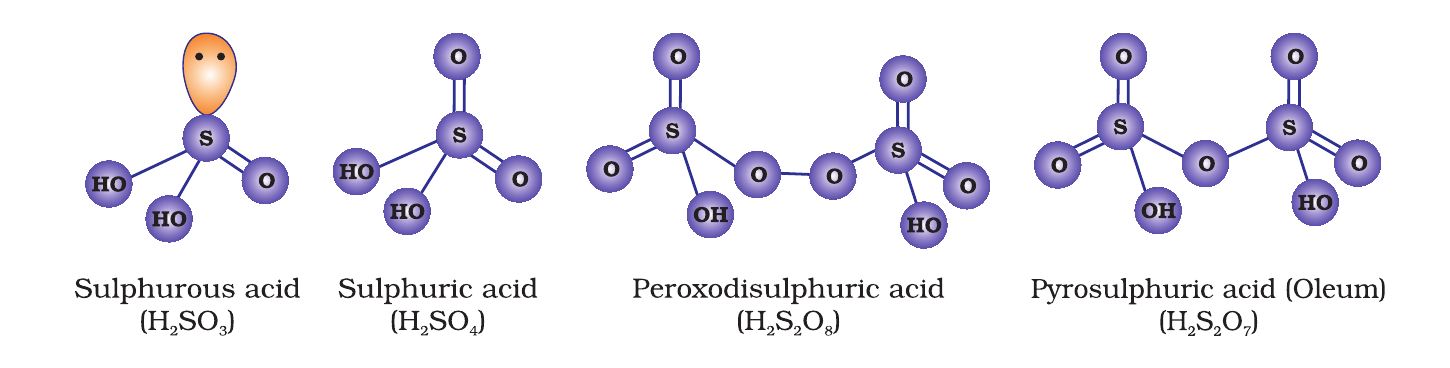
- Sulphur forms a number of oxoacids: $H_2SO_3$, $H_2S_2O_3$, $H_2S_2O_4$, $H_2S_2O_5$, H2SxO6 (x = 2 to 5), $H_2SO_4$, $H_2S_2O_7$, $H_2SO_5$, $H_2S_2O_8$. Some are unstable and cannot be isolated; they are known in aqueous solution or as their salts. Structures of some important oxoacids are shown in Fig. 7.6: sulphurous acid $H_2SO_3$, sulphuric acid $H_2SO_4$, peroxodisulphuric acid $H_2S_2O_8$ and pyrosulphuric acid $H_2S_2O_7$ (oleum).
- Read Fig. 7.6 for the bonds: $H_2SO_3$ has two S-OH and one S=O, with a lone pair on sulphur. $H_2SO_4$ has two S-OH and two S=O. $H_2S_2O_8$ has two S-OH, four S=O and one S-O-O-S link, the peroxo link. $H_2S_2O_7$ has two S-OH, four S=O and one S-O-S link. The -O-O- link is the mark of the peroxo acid, and it is what NEET asked in 2020 and 2023.
- Sulphuric acid is manufactured by the Contact process in three steps: (i) burning of sulphur or sulphide ores in air to give $SO_2$; (ii) conversion of $SO_2$ to $SO_3$ with oxygen in the presence of $V_2O_5$ catalyst; (iii) absorption of $SO_3$ in $H_2SO_4$ to give oleum, $H_2S_2O_7$. The $SO_2$ is purified by removing dust and impurities such as arsenic compounds (NCERT Fig. 7.7).
- The key step is 2SO2(g) + $O_2$(g) -> 2SO3(g), ΔrH = -196.6 kJ mol-1, with $V_2O_5$. The reaction is exothermic, reversible and the forward reaction leads to a decrease in volume, so low temperature and high pressure favour maximum yield, but the temperature must not be very low or the rate becomes slow. In practice the plant runs at 2 bar and 720 K. $SO_3$ is absorbed in concentrated $H_2SO_4$ to give oleum: $SO_3$ + $H_2SO_4$ -> $H_2S_2O_7$. Dilution of oleum with water gives $H_2SO_4$ of the desired concentration. The acid obtained is 96-98% pure.
- $H_2SO_4$ is a colourless, dense, oily liquid with specific gravity 1.84 at 298 K. It freezes at 283 K and boils at 611 K. It dissolves in water with evolution of much heat, so concentrated acid must be added slowly to water with constant stirring, never the reverse.
- In water $H_2SO_4$ ionises in two steps: $H_2SO_4$(aq) + $H_2O$(l) -> $H_3O^+$(aq) + $HSO_4^-$(aq), Ka1 very large (Ka1 > 10); $HSO_4^-$(aq) + $H_2O$(l) -> $H_3O^+$(aq) + $SO_4^{2-}$(aq), Ka2 = 1.2 x $10^{-2}$. So Ka2 is much smaller than Ka1. It forms two series of salts: normal sulphates and acid sulphates.
- Because of its low volatility it is used to make more volatile acids from their salts: 2MX + $H_2SO_4$ -> 2HX + M2SO4 (X = F, Cl, $NO_3$). Concentrated $H_2SO_4$ is a strong dehydrating agent and chars carbohydrates: $C_{12}H_{22}O_{11}$ -> 12C + 11H2O. Hot concentrated $H_2SO_4$ is a moderately strong oxidising agent and is reduced to $SO_2$: Cu + 2H2SO4(conc.) -> $CuSO_4$ + $SO_2$ + 2H2O; S + 2H2SO4(conc.) -> 3SO2 + 2H2O; C + 2H2SO4(conc.) -> $CO_2$ + 2SO2 + 2H2O.
Suggest an edit
Practice1 question
Try it now. A wrong answer costs nothing here, try again until you get it.
Which oxoacid of sulphur has an -O-O- linkage?
NCERT 7.16, Fig. 7.6: peroxodisulphuric acid $H_2S_2O_8$ has an -O-O- link between the two sulphur atoms. Pyrosulphuric acid $H_2S_2O_7$ has a single -O- link instead.
Group 17: trends and anomalous fluorine
- Group 17 is fluorine, chlorine, bromine, iodine, astatine and tennessine, collectively the halogens (salt producers). They are highly reactive non-metallic elements with great similarity amongst themselves and regular gradation in properties. Fluorine and chlorine are fairly abundant; bromine and iodine less so. Sea water is mainly sodium chloride solution (2.5% by mass).
- Electronic configuration is ns2np5, one electron short of the next noble gas. Halogens have the smallest atomic radii in their respective periods because of maximum effective nuclear charge. Atomic and ionic radii rise from fluorine to iodine. Ionisation enthalpy is very high and falls down the group: F 1680, Cl 1256, Br 1142, I 1008 kJ mol-1.
- Halogens have maximum negative electron gain enthalpy in their periods, since they need only one electron to reach a noble gas configuration. The value becomes less negative down the group, but fluorine (-333 kJ mol-1) is less negative than chlorine (-349 kJ mol-1) because the small fluorine atom has strong interelectronic repulsions in its small 2p orbitals, so the incoming electron feels less attraction. Br is -325 and I is -296 kJ mol-1.
- Electronegativity is very high and falls down the group: F 4.0, Cl 3.2, Br 3.0, I 2.7, At 2.2 (Pauling scale). Fluorine is the most electronegative element in the periodic table.
- Physical properties: fluorine and chlorine are gases, bromine is a liquid and iodine is a solid. Melting and boiling points rise steadily with atomic number. All halogens are coloured because they absorb radiation in the visible region and outer electrons are excited to higher levels: $F_2$ yellow, $Cl_2$ greenish yellow, $Br_2$ red, $I_2$ violet. Fluorine and chlorine react with water; bromine and iodine are only sparingly soluble in water but dissolve in organic solvents such as chloroform and carbon tetrachloride to give coloured solutions.
- Bond dissociation anomaly: $F_2$ (158.8 kJ mol-1) has a smaller dissociation enthalpy than $Cl_2$ (242.6 kJ mol-1), while from chlorine onwards the expected trend holds (Cl-Cl > Br-Br 192.8 > I-I 151.1 kJ mol-1). The reason is large electron-electron repulsion among the lone pairs in the $F_2$ molecule, where they are much closer together than in $Cl_2$.
- Oxidation states: all halogens show -1. Chlorine, bromine and iodine also show +1, +3, +5 and +7, realised mainly with small, highly electronegative fluorine and oxygen atoms in interhalogens, oxides and oxoacids. +4 and +6 occur in oxides and oxoacids of chlorine and bromine. Fluorine has no d orbitals, cannot expand its octet and shows only -1.
- Halogens are strong oxidising agents because they readily accept an electron. $F_2$ is the strongest oxidising halogen and oxidises other halide ions: $F_2$ + 2X- -> 2F- + X2 (X = Cl, Br or I); $Cl_2$ + 2X- -> 2Cl- + X2 (X = Br or I); $Br_2$ + 2I- -> 2Br- + $I_2$. In general a halogen oxidises halide ions of higher atomic number. Standard electrode potentials fall down the group: $F_2$ 2.87, $Cl_2$ 1.36, $Br_2$ 1.09, $I_2$ 0.54 V.
- Although the electron gain enthalpy of fluorine is less negative than that of chlorine, fluorine is a stronger oxidising agent than chlorine because of (i) low enthalpy of dissociation of the F-F bond and (ii) high hydration enthalpy of $F^-$ (515 kJ mol-1, against $Cl^-$ 381, $Br^-$ 347, $I^-$ 305 kJ mol-1).
- Reactions with water: fluorine oxidises water to oxygen (2F2 + 2H2O -> 4H+ + 4F- + $O_2$), while chlorine and bromine react with water to form hydrohalic and hypohalous acids (X2 + $H_2O$ -> HX + HOX, X = Cl or Br). The reaction of iodine with water is non-spontaneous; $I^-$ is oxidised by oxygen in acidic medium (4I- + 4H+ + $O_2$ -> 2I2 + 2H2O).
- Anomalous behaviour of fluorine: ionisation enthalpy, electronegativity and electrode potentials are higher than the trend set by other halogens, while ionic and covalent radii, m.p. and b.p., bond dissociation enthalpy and electron gain enthalpy are lower than expected. The causes are its small size, highest electronegativity, low F-F bond dissociation enthalpy and no d orbitals in the valence shell. Fluorine forms only one oxoacid. HF is a liquid (b.p. 293 K) due to strong hydrogen bonding; other hydrogen halides are gases.
- Reactivity towards hydrogen: all halogens react with hydrogen to give hydrogen halides, but affinity for hydrogen falls from fluorine to iodine. The acids vary in strength as HF < $HCl$ < $HBr$ < $HI$, and stability of the halides falls down the group as H-X bond dissociation enthalpy falls (H-F > H-Cl > H-Br > H-I).
- Reactivity towards oxygen: halogens form many oxides, most of them unstable. Fluorine forms $OF_2$ and $O_2F_2$; only $OF_2$ is thermally stable at 298 K. Chlorine, bromine and iodine form oxides with oxidation states from +1 to +7. Stability of the oxides falls in the order I > Cl > Br. Chlorine oxides $Cl_2O$, $ClO_2$, $Cl_2O_6$ and $Cl_2O_7$ are highly reactive oxidising agents and tend to explode. $ClO_2$ is used as a bleaching agent for paper pulp and textiles and in water treatment. $I_2O_5$ is a very good oxidising agent used in the estimation of carbon monoxide.
- Reactivity towards metals: halogens react with metals to form metal halides, for example Mg(s) + $Br_2$(l) -> $MgBr_2$(s). Ionic character of the halides falls in the order MF > MCl > MBr > MI. Halides in a higher oxidation state are more covalent than in a lower one: $SnCl_4$, $PbCl_4$, $SbCl_5$ and $UF_6$ are more covalent than $SnCl_2$, $PbCl_2$, $SbCl_3$ and $UF_4$ respectively.
Suggest an edit
Table: hydrogen halides and halogen oxidising power
| Property | HF | $HCl$ | $HBr$ | $HI$ |
|---|---|---|---|---|
| Melting point / K | 190 | 159 | 185 | 222 |
| Boiling point / K | 293 | 189 | 206 | 238 |
| Bond length (H-X) / pm | 91.7 | 127.4 | 141.4 | 160.9 |
| ΔdissH / kJ mol-1 | 574 | 432 | 363 | 295 |
| $\mathrm{p}K_a$ | 3.2 | -7.0 | -9.5 | -10.0 |
- Acidic strength rises HF < $HCl$ < $HBr$ < $HI$ because the H-X bond gets longer and weaker down the group, so the proton is released more easily. HF is the weakest acid of the four despite fluorine being the most electronegative element.
- Boiling point: HF (293 K) is far higher than $HCl$ (189 K) because HF is strongly hydrogen bonded and is a liquid at room temperature, while $HCl$, $HBr$ and $HI$ are gases.
- Oxidising power of the halogens falls down the group, tracked by standard electrode potentials: $F_2$ 2.87 V, $Cl_2$ 1.36 V, $Br_2$ 1.09 V, $I_2$ 0.54 V. A halogen oxidises halide ions of higher atomic number only.
- Electron gain enthalpy (kJ mol-1): F -333, Cl -349, Br -325, I -296. Chlorine is the most negative, not fluorine, because of interelectronic repulsion in the small 2p orbitals of fluorine.
- Bond dissociation enthalpy of X2 (kJ mol-1): $F_2$ 158.8, $Cl_2$ 242.6, $Br_2$ 192.8, $I_2$ 151.1. Chlorine has the highest value, not fluorine.
Suggest an edit
Chlorine and hydrogen chloride
- Chlorine was discovered in 1774 by Scheele by the action of $HCl$ on $MnO_2$. Davy established its elementary nature in 1810 and named it chlorine from its greenish yellow colour. Preparation: heating $MnO_2$ with concentrated $HCl$ ($MnO_2$ + 4HCl -> $MnCl_2$ + $Cl_2$ + 2H2O); action of $HCl$ on $KMnO_4$ (2KMnO4 + 16HCl -> 2KCl + 2MnCl2 + 8H2O + 5Cl2). Manufacture: Deacon's process, oxidation of $HCl$ gas by atmospheric oxygen with $CuCl_2$ catalyst at 723 K (4HCl + $O_2$ -> 2Cl2 + 2H2O); and electrolysis of brine, with chlorine liberated at the anode.
- Chlorine is a greenish yellow gas with a pungent and suffocating odour, about 2-5 times heavier than air. It liquefies easily to a greenish yellow liquid which boils at 239 K. It is soluble in water.
- Chlorine reacts with metals and non-metals to form chlorides: 2Al + 3Cl2 -> 2AlCl3; 2Na + $Cl_2$ -> 2NaCl; 2Fe + 3Cl2 -> 2FeCl3; $P_4$ + 6Cl2 -> 4PCl3; $S_8$ + 4Cl2 -> 4S2Cl2. It has a great affinity for hydrogen: $H_2$ + $Cl_2$ -> 2HCl; $H_2S$ + $Cl_2$ -> 2HCl + S.
- With cold and dilute alkalies chlorine gives chloride and hypochlorite: 2NaOH + $Cl_2$ -> $NaCl$ + NaOCl + $H_2O$. With hot and concentrated alkalies it gives chloride and chlorate: 6NaOH + 3Cl2 -> 5NaCl + $NaClO_3$ + 3H2O. This is a disproportionation reaction: chlorine goes from 0 to -1 and +5. With dry slaked lime it gives bleaching powder: 2Ca(OH)2 + 2Cl2 -> Ca(OCl)2 + $CaCl_2$ + 2H2O. The composition of bleaching powder is Ca(OCl)2.$CaCl_2$.Ca(OH)2.2H2O.
- Chlorine reacts with hydrocarbons: substitution with saturated hydrocarbons ($CH_4$ + $Cl_2$ -> $CH_3Cl$ + $HCl$ under UV) and addition with unsaturated ones ($C_2H_4$ + $Cl_2$ -> $C_2H_4Cl_2$ at room temperature).
- Chlorine water on standing loses its yellow colour due to formation of $HCl$ and HOCl. Hypochlorous acid gives nascent oxygen, which is responsible for the oxidising and bleaching properties of chlorine: $Cl_2$ + $H_2O$ -> 2HCl + O; coloured substance + O -> colourless substance. Bleaching by chlorine is permanent and works only in the presence of moisture.
- Chlorine oxidises ferrous to ferric and sulphite to sulphate: 2FeSO4 + $H_2SO_4$ + $Cl_2$ -> Fe2($SO_4$)3 + 2HCl; $SO_2$ + 2H2O + $Cl_2$ -> $H_2SO_4$ + 2HCl; $I_2$ + 6H2O + 5Cl2 -> 2HIO3 + 10HCl.
- Hydrogen chloride: Glauber prepared it in 1648 by heating common salt with concentrated sulphuric acid. In the laboratory it is made by heating $NaCl$ with concentrated $H_2SO_4$ at 420 K ($NaCl$ + $H_2SO_4$ -> $NaHSO_4$ + $HCl$) and then $NaHSO_4$ + $NaCl$ at 823 K (-> $Na_2SO_4$ + $HCl$). $HCl$ gas is dried by passing through concentrated sulphuric acid.
- $HCl$ is a colourless, pungent smelling gas, easily liquefied (b.p. 189 K) and freezing to a white crystalline solid (f.p. 159 K). It is extremely soluble in water and ionises: $HCl$(g) + $H_2O$(l) -> $H_3O^+$(aq) + $Cl^-$(aq), Ka = $10^{7}$, so it is a strong acid in water. With $NH_3$ it gives white fumes of $NH_4Cl$.
- Aqua regia is three parts concentrated $HCl$ and one part concentrated $HNO_3$; it dissolves noble metals such as gold and platinum: Au + 4H+ + $NO_3^-$ + 4Cl- -> $AuCl_4^-$ + $NO$ + 2H2O. Hydrochloric acid decomposes salts of weaker acids: $Na_2CO_3$ + 2HCl -> 2NaCl + $H_2O$ + $CO_2$; $Na_2SO_3$ + 2HCl -> 2NaCl + $H_2O$ + $SO_2$.
- $HCl$ with finely powdered iron gives ferrous chloride, not ferric chloride (Fe + 2HCl -> $FeCl_2$ + $H_2$), because the hydrogen liberated prevents formation of ferric chloride.
Suggest an edit
Oxoacids of halogens and interhalogen compounds
- Oxoacids of halogens: fluorine forms only one oxoacid, HOF, known as fluoric(I) acid or hypofluorous acid, because of its high electronegativity and small size. The other halogens form several oxoacids, mostly stable only in aqueous solution or as their salts. Their structures are given in NCERT Fig. 7.8.
- Halic(I) acids (hypohalous acids): HOF, HOCl, HOBr, HOI. Halic(III) acids (halous acids): only HOClO (chlorous acid). Halic(V) acids (halic acids): $HOClO_2$ (chloric acid), $HOBrO_2$ (bromic acid), $HOIO_2$ (iodic acid). Halic(VII) acids (perhalic acids): $HOClO_3$ (perchloric acid), $HOBrO_3$ (perbromic acid), $HOIO_3$ (periodic acid).
- In the structures of these oxoacids, the halogen is the central atom bonded in each case with one OH group as X-OH, and in some cases X=O bonds are also found.
- Interhalogen compounds form when two different halogens react with each other. General compositions are XX', XX'3, XX'5 and XX'7, where X is the larger halogen, X' the smaller, and X is more electropositive than X'. As the ratio between the radii of X and X' rises, the number of atoms per molecule rises: iodine(VII) fluoride has the maximum number of atoms, $IF_7$, because the ratio of radii between I and F is maximum.
- Preparation depends on conditions: $Cl_2$ + $F_2$ (equal volumes, 437 K) -> 2ClF; $Cl_2$ + 3F2 (excess, 573 K) -> 2ClF3; $I_2$ + $Cl_2$ (equimolar) -> 2ICl; $I_2$ + 3Cl2 (excess) -> 2ICl3; $Br_2$ + 3F2 (diluted with water) -> 2BrF3; $Br_2$ + 5F2 (excess) -> 2BrF5.
- Structures (Table 7.11): XX'3 compounds ($ClF_3$, $BrF_3$, $IF_3$, $ICl_3$) are bent T-shaped; XX'5 compounds ($IF_5$, $BrF_5$, $ClF_5$) are square pyramidal; $IF_7$ is pentagonal bipyramidal. ClF is a colourless gas, BrF a pale brown gas, ICl a ruby red solid (alpha-form) or brown red solid (beta-form), IBr a black solid, $BrF_3$ a yellow green liquid, $IF_3$ a yellow powder, $ICl_3$ an orange solid, $IF_5$ a colourless gas (solid below 77 K), $BrF_5$ and $ClF_5$ colourless liquids, $IF_7$ a colourless gas.
- All interhalogens are covalent molecules and diamagnetic. They are volatile solids or liquids at 298 K except ClF, which is a gas. Their physical properties are intermediate between those of the constituent halogens, except that their m.p. and b.p. are a little higher than expected.
- Interhalogen compounds are more reactive than halogens (except fluorine) because the X-X' bond is weaker than the X-X bond in halogens, except the F-F bond. They undergo hydrolysis giving a halide ion from the smaller halogen and a hypohalite (from XX'), halite (from XX'3), halate (from XX'5) or perhalate (from XX'7) anion from the larger halogen: XX' + $H_2O$ -> HX' + HOX. So ICl is more reactive than $I_2$ because the I-Cl bond is weaker than the I-I bond.
- Shapes are explained by VSEPR theory. For $BrF_3$, the central Br has three bond pairs and two lone pairs, which occupy the corners of a trigonal bipyramid; the two lone pairs take equatorial positions to minimise lone pair-lone pair and bond pair-lone pair repulsions, and the axial fluorines bend towards the equatorial fluorine, giving a slightly bent T shape.
Suggest an edit
Group 18 and xenon compounds
- Group 18 is helium, neon, argon, krypton, xenon, radon and oganesson. All are gases and chemically unreactive, forming very few compounds, so they are called noble gases. All except radon and oganesson occur in the atmosphere; their abundance in dry air is about 1% by volume, of which argon is the major constituent. Helium and sometimes neon are found in minerals of radioactive origin such as pitchblende, monazite and cleveite. The main commercial source of helium is natural gas. Radon is obtained as a decay product of radium-226: 226Ra -> 222Rn + 4He.
- General electronic configuration is ns2np6 except helium, which has 1s2. Ionisation enthalpy is very high because of the stable configuration, but it falls down the group with increasing atomic size: He 2372, Ne 2080, Ar 1520, Kr 1351, Xe 1170, Rn 1037 kJ mol-1. Atomic radii rise down the group. Electron gain enthalpies are large and positive (He 48, Ne 116, Ar 96, Kr 96, Xe 77, Rn 68 kJ mol-1) because the stable configuration has no tendency to accept an electron.
- All noble gases are monoatomic, colourless, odourless and tasteless, sparingly soluble in water, with very low melting and boiling points because the only interatomic interaction is weak dispersion forces. Helium has the lowest boiling point (4.2 K) of any known substance and diffuses through rubber, glass and plastics.
- Inertness is due to (i) completely filled ns2np6 valence shells (1s2 for helium) and (ii) high ionisation enthalpy and more positive electron gain enthalpy. In March 1962 Neil Bartlett prepared $O_2$+$PtF_6^-$ and realised the first ionisation enthalpy of molecular oxygen (1175 kJ mol-1) was almost identical with that of xenon (1170 kJ mol-1). He then prepared $Xe^+$$PtF_6^-$ by mixing $PtF_6$ and xenon. After this, many xenon compounds with fluorine and oxygen were synthesised. Only $KrF_2$ of krypton has been studied in detail; radon compounds have only been identified (for example $RnF_2$) by radiotracer technique; no true compounds of Ar, Ne or He are known.
- Xenon fluorides: $XeF_2$, $XeF_4$ and $XeF_6$ form by direct reaction of the elements. Xe(g) + $F_2$(g) -> $XeF_2$(s) at 673 K, 1 bar, xenon in excess. Xe(g) + 2F2(g) -> $XeF_4$(s) at 873 K, 7 bar, 1:5 ratio. Xe(g) + 3F2(g) -> $XeF_6$(s) at 573 K, 60-70 bar, 1:20 ratio. $XeF_6$ is also made from $XeF_4$ + $O_2F_2$ at 143 K: $XeF_4$ + $O_2F_2$ -> $XeF_6$ + $O_2$.
- $XeF_2$, $XeF_4$ and $XeF_6$ are colourless crystalline solids, sublime readily at 298 K, are powerful fluorinating agents and are readily hydrolysed even by traces of water: 2XeF2(s) + 2H2O(l) -> 2Xe(g) + 4HF(aq) + $O_2$(g). Their structures follow VSEPR (NCERT Fig. 7.9): $XeF_2$ is linear, $XeF_4$ is square planar, and $XeF_6$ has seven electron pairs (6 bonding pairs and one lone pair) and a distorted octahedral structure in the gas phase.
- Xenon fluorides react with fluoride ion acceptors to give cationic species and with fluoride ion donors to give fluoroanions: $XeF_2$ + $PF_5$ -> [XeF]+[$PF_6$]-; $XeF_4$ + $SbF_5$ -> [$XeF_3$]+[$SbF_6$]-; $XeF_6$ + MF -> M+[$XeF_7$]- (M = Na, K, Rb or Cs).
- Xenon-oxygen compounds: hydrolysis of $XeF_4$ and $XeF_6$ with water gives $XeO_3$: 6XeF4 + 12H2O -> 4Xe + 2XeO3 + 24HF + 3O2; $XeF_6$ + 3H2O -> $XeO_3$ + 6HF. Partial hydrolysis of $XeF_6$ gives oxyfluorides $XeOF_4$ and $XeO_2F_2$: $XeF_6$ + $H_2O$ -> $XeOF_4$ + 2HF; $XeF_6$ + 2H2O -> $XeO_2F_2$ + 4HF. Hydrolysis of $XeF_6$ is not a redox reaction, since the oxidation states of all elements stay the same. $XeO_3$ is a colourless explosive solid with a pyramidal molecular structure. $XeOF_4$ is a colourless volatile liquid with a square pyramidal structure.
Suggest an edit
Practice1 question
Try it now. A wrong answer costs nothing here, try again until you get it.
What is the molecular shape of $XeF_4$?
NCERT 7.23, Fig. 7.9: $XeF_4$ has a square planar structure. $XeF_2$ is linear and $XeF_6$ is distorted octahedral.
Ladder: first-element anomalies
- Nitrogen vs phosphorus: nitrogen is small, highly electronegative and has no d orbitals, so it forms pπ-pπ multiple bonds and exists as $N_2$ with a triple bond (941.4 kJ mol-1). Phosphorus has large diffuse orbitals, forms only single bonds and exists as $P_4$ tetrahedra with 60 degree angles and angular strain. Nitrogen has a maximum covalency of 4; phosphorus expands to 5 and 6 ($PCl_5$, $PF_6^-$).
- Nitrogen vs phosphorus, catenation: the single N-N bond is weaker than the single P-P bond because of interelectronic repulsion at the small bond length, so nitrogen catenates less than phosphorus. Nitrogen cannot form R3N = O, but R3P = O exists because phosphorus can form dπ-pπ bonds.
- Oxygen vs sulphur: oxygen is small and highly electronegative, so $H_2O$ is strongly hydrogen bonded and a liquid, while $H_2S$ is a gas. Oxygen has a less negative electron gain enthalpy (-141 kJ mol-1) than sulphur (-200 kJ mol-1) because of its compact size. Oxygen is limited to covalency 4 (rarely above 2); sulphur expands beyond 4 ($SF_6$). Oxygen exists as diatomic $O_2$, sulphur as polyatomic $S_8$.
- Fluorine vs chlorine: fluorine is the smallest halogen with the highest electronegativity and no d orbitals. Its electron gain enthalpy (-333 kJ mol-1) is less negative than chlorine (-349 kJ mol-1), and its F-F bond dissociation enthalpy (158.8 kJ mol-1) is lower than Cl-Cl (242.6 kJ mol-1), yet fluorine is the stronger oxidising agent because of the weak F-F bond and the high hydration enthalpy of $F^-$. Fluorine shows only -1 and forms only one oxoacid (HOF); chlorine shows -1, +1, +3, +5 and +7.
- How to use the ladder in a question: first ask whether the property is set by size and d orbital availability. If the element is in the second period (N, O, F), expect small size, no d orbitals, strong multiple bonding or hydrogen bonding, and a covalency cap of 4. If the question names a heavier member, expect expanded covalency, weaker multiple bonding and d orbital chemistry.
Suggest an edit
Ladder: trap pairs
- Pentahalide vs trihalide: nitrogen forms no pentahalide (no d orbitals, covalency at most 4). $PCl_5$ exists and is trigonal bipyramidal with longer axial bonds. Do not give nitrogen five bonds.
- Electron gain enthalpy vs oxidising power: fluorine has a less negative electron gain enthalpy than chlorine, but $F_2$ is still the stronger oxidising agent because of the weak F-F bond and high hydration enthalpy of $F^-$. Do not rank oxidising power by electron gain enthalpy alone.
- Peroxo vs pyro: $H_2S_2O_8$ (peroxodisulphuric acid) has the -O-O- link; $H_2S_2O_7$ (pyrosulphuric acid, oleum) has a single -O- link. Both have two S-OH and four S=O, so only the bridge tells them apart. NEET asked this in 2020 and 2023.
- Basicity of phosphorus oxoacids: count P-OH groups only. $H_3PO_3$ is dibasic and $H_3PO_2$ is monobasic, not tribasic and dibasic. P-H bonds give reducing power, not basicity.
- $PCl_5$ bonds: the three equatorial bonds are equivalent and the two axial bonds are longer. All five bonds are not equivalent.
- Xenon shapes: $XeF_2$ is linear, $XeF_4$ is square planar, $XeF_6$ is distorted octahedral (not regular octahedral, because of the lone pair), $XeOF_4$ is square pyramidal and $XeO_3$ is pyramidal. Do not swap $XeF_6$ and $XeOF_4$.
- Hydride trends: basicity falls $NH_3$ > $PH_3$ > $AsH_3$ > $SbH_3$ > $BiH_3$ while reducing character rises in the same order. $NH_3$ is the strongest base and the weakest reducing agent of the five; $BiH_3$ is the reverse.
- Acid strength of hydrogen halides: HF < $HCl$ < $HBr$ < $HI$, the reverse of electronegativity order. HF is the weakest acid because the H-F bond is the strongest (574 kJ mol-1).
Suggest an edit
Trap Boxes
Nitrogen forms a pentahalide like phosphorus?
Wrong idea: Nitrogen shows the +5 oxidation state, so $NCl_5$ exists just like $PCl_5$.
Nitrogen has only s and p orbitals in its valence shell, so its covalency is at most 4 and it forms no pentahalide. Heavier group 15 elements have vacant d orbitals and expand their covalence, as in $PF_6^-$ and $PCl_5$.
NCERT XII, Ch 7, 7.1.7, Example 7.1
Fluorine has the most negative electron gain enthalpy?
Wrong idea: Fluorine is the strongest oxidiser, so its electron gain enthalpy must be the most negative of the halogens.
Fluorine has a less negative electron gain enthalpy (-333 kJ mol-1) than chlorine (-349 kJ mol-1) because of interelectronic repulsion in its small 2p orbitals. Even so, $F_2$ is the stronger oxidising agent because of the weak F-F bond (158.8 kJ mol-1) and the high hydration enthalpy of $F^-$.
NCERT XII, Ch 7, 7.18.5, Example 7.15
Pyrosulphuric acid has the -O-O- linkage?
Wrong idea: $H_2S_2O_7$ is the peroxo acid, so it is the one with the -O-O- linkage.
Only peroxodisulphuric acid $H_2S_2O_8$ has the -O-O- link. Pyrosulphuric acid $H_2S_2O_7$ (oleum) has a single -O- link. Both have two S-OH and four S=O, so only the bridge tells them apart. NEET 2020 Q108 and NEET 2023 Q100 both test this.
NCERT XII, Ch 7, 7.16, Fig. 7.6
All five bonds in $PCl_5$ are equivalent?
Wrong idea: $PCl_5$ has five identical P-Cl bonds because all five chlorine atoms are the same.
$PCl_5$ is trigonal bipyramidal in the gas and liquid phases. The three equatorial P-Cl bonds are equivalent, while the two axial bonds are longer than the equatorial bonds because axial bond pairs suffer more repulsion.
NCERT XII, Ch 7, 7.8.2, Example 7.8
$XeF_6$ is regular octahedral and $XeOF_4$ is distorted octahedral?
Wrong idea: $XeF_6$ with six fluorines is regular octahedral, and $XeOF_4$ is the distorted octahedral one.
$XeF_2$ is linear (sp3d), $XeF_4$ is square planar (sp3d2), $XeF_6$ is distorted octahedral (sp3d3, 6 bond pairs plus 1 lone pair), $XeOF_4$ is square pyramidal (sp3d2) and $XeO_3$ is pyramidal (sp3). NEET 2025 Q64 tests exactly this set.
NCERT XII, Ch 7, 7.23, Fig. 7.9
Chapter test
5 NEET PYQs. +4 for a correct answer, -1 for a wrong answer, exactly like NEET. Finish the test to earn a medal.
Q1: NEET (UG) 2025, Code 45, Q64
Match List - I with List - II
| List-I | List-II |
|---|---|
| A. $XeO_3$ | I. sp3d; linear |
| B. $XeF_2$ | II. sp3; pyramidal |
| C. $XeOF_4$ | III. sp3d3; distorted octahedral |
| D. $XeF_6$ | IV. sp3d2; square pyramidal |
NCERT 7.23, Fig. 7.9: $XeO_3$ is sp3 pyramidal (II), $XeF_2$ is sp3d linear (I), $XeOF_4$ is sp3d2 square pyramidal (IV) and $XeF_6$ is sp3d3 distorted octahedral (III). That is A-II, B-I, C-IV, D-III.
Q2: NEET (UG) 2023, Code F1, Q100
Match List-I with List - II :
| List-I (Oxoacids of Sulphur) | List-II (Bonds) |
|---|---|
| A. Peroxodisulphuric acid | I. Two S-OH, Four S=O, One S-O-S |
| B. Sulphuric acid | II. Two S-OH, One S=O |
| C. Pyrosulphuric acid | III. Two S-OH, Four S=O, One S-O-O-S |
| D. Sulphurous acid | IV. Two S-OH, Two S=O |
From NCERT 7.16, Fig. 7.6: $H_2S_2O_8$ has two S-OH, four S=O and one S-O-O-S link (III); $H_2SO_4$ has two S-OH and two S=O (IV); $H_2S_2O_7$ has two S-OH, four S=O and one S-O-S link (I); $H_2SO_3$ has two S-OH and one S=O (II).
Q3: NEET (UG) 2022, Code R1, Q82
Amongst the following which one will have maximum 'lone pair - lone pair' electron repulsions?
$XeF_2$ has 3 lone pairs on xenon in a linear molecule, giving the most lone pair - lone pair repulsion. $ClF_3$ has 2 lone pairs, $IF_5$ has 1 and $SF_4$ has 1 (NCERT 7.22, 7.23, Fig. 7.9).
Q4: NEET (UG) 2021, Code P3, Q85
Match List-I with List-II.
| List-I | List-II |
|---|---|
| (a) $PCl_5$ | (i) Square pyramidal |
| (b) $SF_6$ | (ii) Trigonal planar |
| (c) $BrF_5$ | (iii) Octahedral |
| (d) $BF_3$ | (iv) Trigonal bipyramidal |
$PCl_5$ is trigonal bipyramidal (NCERT 7.8.2), $SF_6$ is octahedral (NCERT 7.10.8), $BrF_5$ is square pyramidal (NCERT 7.22, Table 7.11) and $BF_3$ is trigonal planar. That is (a)-(iv), (b)-(iii), (c)-(i), (d)-(ii).
Q5: NEET (UG) 2020, Code G5, Q108
Which of the following oxoacid of sulphur has - O - O - linkage?
NCERT 7.16, Fig. 7.6: peroxodisulphuric acid $H_2S_2O_8$ has an -O-O- link between its two sulphur atoms. $H_2SO_4$ has no S-O-S or S-O-O-S link, $H_2S_2O_7$ has a single -O- link, and $H_2SO_3$ has one sulphur only.
Score: 0 · Answered 0 of 5
Flashcards
Tap a card to flip it over and see the answer. Tap it again to flip it back.
Give the general valence shell electronic configuration of group 15, 16, 17 and 18 elements.
Tap to flipGroup 15: ns2np3. Group 16: ns2np4. Group 17: ns2np5. Group 18: ns2np6, except helium which has 1s2. The p-block covers groups 13 to 18 with valence shell configuration ns2np1-6.
Tap to flip backGive the order of basicity and reducing character of the group 15 hydrides EH3.
Tap to flipBasicity: $NH_3$ > $PH_3$ > $AsH_3$ > $SbH_3$ > $BiH_3$. Stability of hydrides falls from $NH_3$ to $BiH_3$ as the E-H bond dissociation enthalpy falls (389, 322, 297, 255 kJ mol-1 for $NH_3$, $PH_3$, $AsH_3$, $SbH_3$). Reducing character rises in the same order, so $BiH_3$ is the strongest reducing agent.
Tap to flip backGive the order of acidic strength of the hydrogen halides with their $\mathrm{p}K_a$ values.
Tap to flipHF < $HCl$ < $HBr$ < $HI$. $\mathrm{p}K_a$ values: HF 3.2, $HCl$ -7.0, $HBr$ -9.5, $HI$ -10.0. H-X bond dissociation enthalpy falls in the order H-F > H-Cl > H-Br > H-I (574, 432, 363, 295 kJ mol-1), so stability falls down the group.
Tap to flip backWhat is the bond enthalpy of the N-N triple bond in dinitrogen, and what does it explain?
Tap to flip941.4 kJ mol-1. The N-N triple bond comes from strong pπ-pπ overlap, so dinitrogen is rather inert at room temperature. Reactivity rises fast with temperature.
Tap to flip backWrite the Haber process equation with its optimum conditions.
Tap to flip$N_2$(g) + 3H2(g) -> 2NH3(g), ΔfH = -46.1 kJ mol-1. Optimum conditions: pressure 200 x $10^{5}$ Pa (about 200 atm), temperature about 700 K, iron oxide catalyst with small amounts of $K_2O$ and $Al_2O_3$.
Tap to flip backWrite the key step of the Contact process for sulphuric acid with its conditions.
Tap to flip2SO2(g) + $O_2$(g) -> 2SO3(g), ΔrH = -196.6 kJ mol-1, $V_2O_5$ catalyst. The plant runs at 2 bar and 720 K. $SO_3$ is absorbed in concentrated $H_2SO_4$ to give oleum, $H_2S_2O_7$, and dilution of oleum gives $H_2SO_4$ of 96-98% purity.
Tap to flip backWrite the three steps of the Ostwald process for nitric acid.
Tap to flip4NH3(g) + 5O2(g) -> 4NO(g) + 6H2O(g), Pt/Rh gauze catalyst, 500 K, 9 bar. Then 2NO(g) + $O_2$(g) -> 2NO2(g), and 3NO2(g) + $H_2O$(l) -> 2HNO3(aq) + $NO$(g). Aqueous $HNO_3$ is concentrated by distillation to about 68% by mass.
Tap to flip backWhy does nitrogen not form a pentahalide although it shows the +5 oxidation state?
Tap to flipNitrogen has only s and p orbitals in its valence shell, so its covalency is at most 4 and it cannot form a pentahalide. Heavier group 15 elements have vacant d orbitals and expand their covalence, as in $PF_6^-$. $PCl_5$ is trigonal bipyramidal in the gas and liquid phases.
Tap to flip backWhy does fluorine show only the -1 oxidation state and form only one oxoacid?
Tap to flipFluorine has no d orbitals and is the most electronegative element, so it shows only the -1 oxidation state. It forms only one oxoacid, HOF (fluoric(I) acid or hypofluorous acid). Other halogens show +1, +3, +5 and +7 states.
Tap to flip backClassify oxides as acidic, basic, amphoteric and neutral, with one NCERT example of each.
Tap to flipAcidic oxides: $SO_2$, $Cl_2O_7$, $CO_2$, $N_2O_5$ (combine with water to give an acid). Basic oxides: $Na_2O$, $CaO$, BaO (give a base with water). Amphoteric oxides: $Al_2O_3$ (reacts with acids and with alkalies). Neutral oxides: $CO$, $NO$, $N_2O$ (neither acidic nor basic).
Tap to flip backGive the shape and hybridisation of $XeF_2$, $XeF_4$, $XeF_6$, $XeOF_4$ and $XeO_3$.
Tap to flip$XeF_2$: linear, sp3d. $XeF_4$: square planar, sp3d2. $XeF_6$: distorted octahedral, sp3d3 (7 electron pairs: 6 bonding pairs and one lone pair). $XeOF_4$: square pyramidal, sp3d2. $XeO_3$: pyramidal, sp3.
Tap to flip backWhat is the basicity of $H_3PO_2$, $H_3PO_3$ and $H_3PO_4$, and why do P-H bonds not count?
Tap to flip$H_3PO_2$ is monobasic (one P-OH), $H_3PO_3$ is dibasic (two P-OH) and $H_3PO_4$ is tribasic (three P-OH). Only H atoms attached to oxygen in P-OH are ionisable. P-H bonds are not ionisable; they give the lower oxoacids their reducing power, so $H_3PO_2$ is a good reducing agent.
Tap to flip back