 NEET Notes
Home > Chemistry > Physical > Chemical Bonding and Molecular Structure
Chemical Bonding and Molecular Structure
On this page · 12 sections
- 01Syllabus map
- 02Kossel-Lewis approach and the octet rule
- 03Ionic bond, lattice enthalpy, Born-Haber cycle
- 04Covalent bond, Fajans' rules, dipole moment
- 05VSEPR theory
- 06Valence bond theory and hybridisation
- 07Molecular orbital theory
- 08Resonance and hydrogen bonding
- 09Table 1: VSEPR shapes ladder
- 10Table 2: Hybridisation ladder
- 11Table 3: Molecular orbital theory: bond order and magnetism
- 12Table 4: Hydrogen bonding: intermolecular vs intramolecular
VSEPR, hybridisation, MOT, dipole, and H-bonding. WAVE 1.
Syllabus map
- NMC Unit: CHEM-U03, Chemical Bonding and Molecular Structure. NCERT Chapter 4, Chemical Bonding and Molecular Structure.
- Subtopics in this chapter (NCERT XI, Ch 4): Kossel-Lewis approach to chemical bonding. Ionic or electrovalent bond. Bond parameters. Valence shell electron pair repulsion (VSEPR) theory. Valence bond theory. Hybridisation. Molecular orbital theory. Bonding in some homonuclear diatomic molecules. Hydrogen bonding.
- Subtopic checklist: (1) octet rule and its limitations; (2) ionic bond, lattice enthalpy, Born-Haber cycle; (3) covalent bond, Fajans' rules, dipole moment, percentage ionic character; (4) VSEPR shapes from bond pairs and lone pairs; (5) valence bond theory, sigma and pi bonds; (6) hybridisation: sp, sp2, sp3, sp3d, sp3d2; (7) molecular orbital theory: MO energy order, bond order, magnetic behaviour; (8) resonance; (9) hydrogen bonding: intermolecular and intramolecular.
- Excluded topics: no full treatment here of p-block hydride chemistry (that is Chapter 11, p-Block Elements) or of coordination compounds (Class 12, Chapter 9). The Group 16 hydride boiling-point question in the PYQs is included because it tests hydrogen bonding, a Ch. 4 topic. See the flag on Recall Q4. Do not import p-block facts into this chapter beyond that.
- Estimated revision time: 12 minutes. Jump links: Syllabus Map · Ionic Bond · Covalent Bond · VSEPR · Hybridisation · MOT · H-Bonding · Trap Boxes · PYQs · 5-Q Recall.
Kossel-Lewis approach and the octet rule
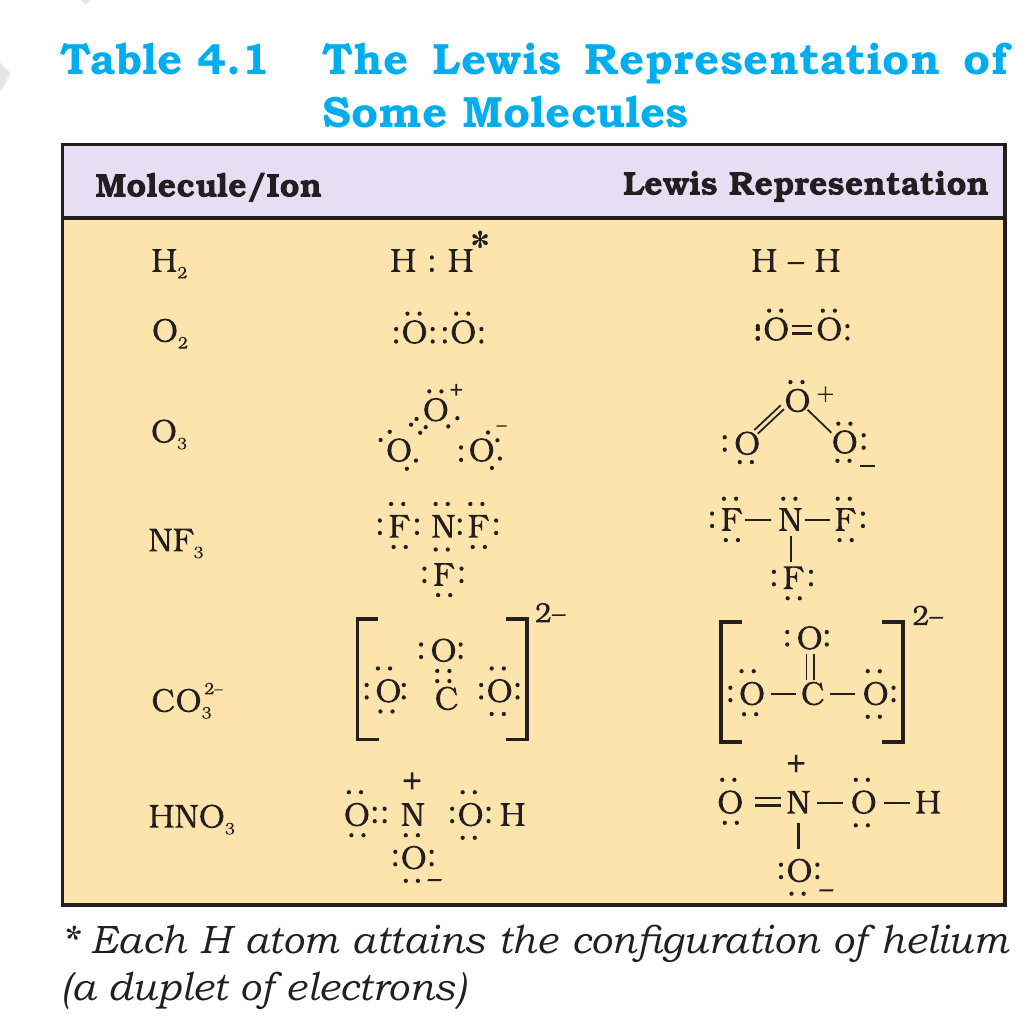
Atoms combine to attain a stable octet (eight electrons in the outermost shell) like the nearest noble gas. This is the octet rule. (NCERT XI, Ch 4.)
- Kossel (ionic): an atom loses or gains electrons to complete its octet, forming ions. Example: Na loses one electron to become $Na^+$, Cl gains one to become $Cl^-$. The electrostatic attraction between the ions is the ionic bond.
- Lewis (covalent): atoms share electron pairs to complete their octets. A shared pair is a covalent bond. Lewis dot structures show valence electrons as dots.
- Limitations of the octet rule. The rule fails for: (a) hydrogen, which attains a duplet (2 electrons, like He); (b) electron-deficient molecules such as $BF_3$, which has only 6 electrons around boron; (c) expanded-octet molecules such as $PCl_5$ (10 electrons around P) and $SF_6$ (12 electrons around S); (d) odd-electron molecules such as $NO$ and $NO_2$. (NCERT XI, Ch 4.)
Practice1 question
Try it now. A wrong answer costs nothing here, try again until you get it.
Which molecule has only 6 electrons around its central atom?
BF₃ is electron-deficient: 6 electrons around boron, sp² hybridisation.
Ionic bond, lattice enthalpy, Born-Haber cycle
An ionic bond is the electrostatic force of attraction between oppositely charged ions. It forms when the electronegativity difference between the two atoms is large. (NCERT XI, Ch 4.)
- Lattice enthalpy: the energy required to separate one mole of an ionic solid into its gaseous ions. A large lattice enthalpy means a strong ionic bond and a stable crystal.
- Born-Haber cycle: a thermochemical cycle that relates lattice enthalpy to ionisation enthalpy, electron gain enthalpy, and the enthalpy of formation. It is used to find a lattice enthalpy that cannot be measured directly. NCERT gives the lattice enthalpy of $NaCl$ as 788 kJ mol-1 (section 4.2.1), worked from ionisation enthalpy 495.8 kJ mol-1, electron gain enthalpy -348.7 kJ mol-1 and lattice formation enthalpy -788 kJ mol-1.
- Ionic compounds are generally hard, brittle, have high melting and boiling points, and conduct electricity in the molten state or in aqueous solution, not in the solid state. (NCERT XI, Ch 4.)
Covalent bond, Fajans' rules, dipole moment
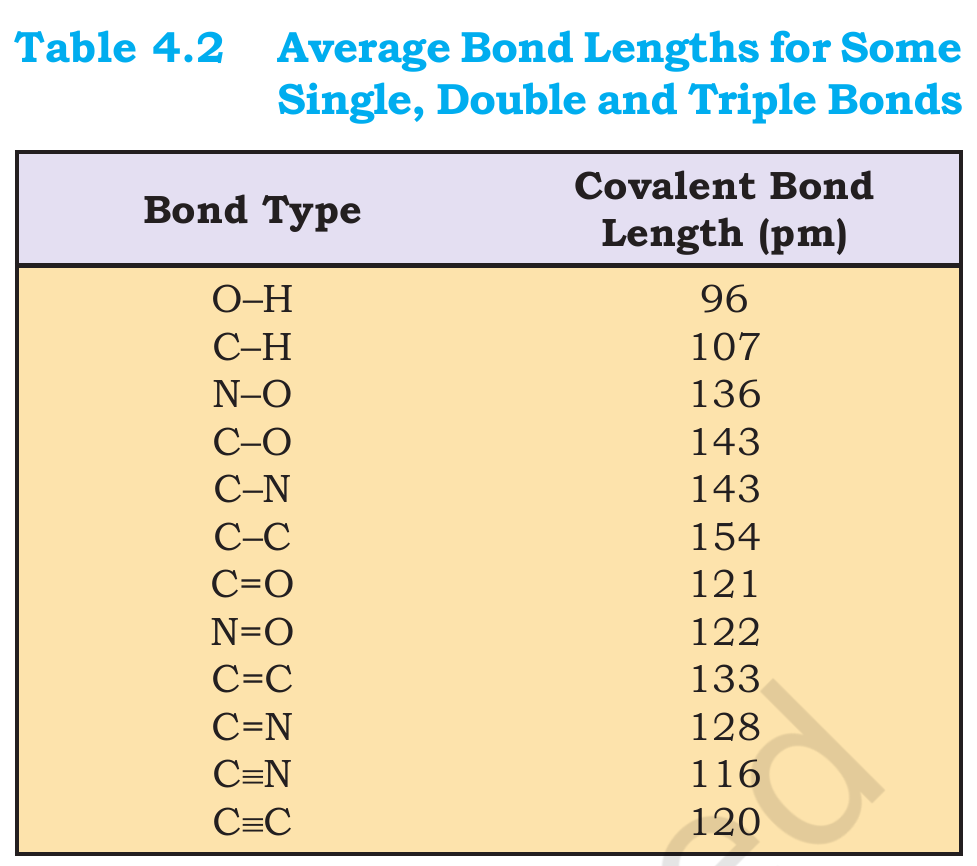
A covalent bond is formed by sharing electron pairs between atoms. A single shared pair is a single bond (one sigma bond); a double bond is one sigma plus one pi bond; a triple bond is one sigma plus two pi bonds. (NCERT XI, Ch 4.)
- Fajans' rules: a covalent character in an ionic bond increases when the cation is small, the anion is large, the charge on the ions is high, and the cation has a pseudo-noble-gas configuration (ns2 np6 nd10). Small, highly charged cations polarise the anion more.
- Dipole moment: the product of the charge and the distance between the centres of positive and negative charge. It is a vector quantity. A molecule with polar bonds can still have zero dipole moment if its shape is symmetrical. $BF_3$ has polar B-F bonds but zero dipole moment because it is trigonal planar and the bond dipoles cancel; $CO_2$ is linear and has zero dipole moment. $NH_3$ and $H_2O$ have non-zero dipole moments. (NCERT XI, Ch 4.)
- Percentage ionic character increases with electronegativity difference. NCERT Table 4.5 gives dipole moments in Debye: $H_2O$ 1.85, $NH_3$ 1.47, $NF_3$ 0.23, $BF_3$ 0, $CO_2$ 0.
Practice1 question
Try it now. A wrong answer costs nothing here, try again until you get it.
Which molecule has polar bonds but zero dipole moment?
BF₃ is trigonal planar, so its three B–F bond dipoles cancel. Shape decides, not just bond polarity.
VSEPR theory
The shape of a molecule is decided by the repulsion between electron pairs in the valence shell of the central atom. Repulsion order: lone pair-lone pair > lone pair-bond pair > bond pair-bond pair. Lone pairs occupy more space, so they push bond pairs closer together and reduce bond angles. (NCERT XI, Ch 4.)
- 2 electron pairs, 0 lone pairs: linear, 180°. Example: $BeCl_2$, $CO_2$.
- 3 electron pairs, 0 lone pairs: trigonal planar, 120°. Example: $BF_3$.
- 4 electron pairs, 0 lone pairs: tetrahedral, 109.5°. Example: $CH_4$, $NH_4^+$.
- 4 electron pairs, 1 lone pair (3 bond pairs): trigonal pyramidal. Example: $NH_3$.
- 4 electron pairs, 2 lone pairs (2 bond pairs): bent (angular). Example: $H_2O$.
- 5 electron pairs, 0 lone pairs: trigonal bipyramidal. Example: $PCl_5$.
- 6 electron pairs, 0 lone pairs: octahedral. Example: $SF_6$.
- Lone-pair counts that NEET tests: $XeF_2$ has 3 lone pairs on Xe (5 electron pairs, 2 bond pairs, linear shape); $SF_4$ has 1 lone pair; $ClF_3$ has 2 lone pairs; $IF_5$ has 1 lone pair. $XeF_2$ has the maximum lone pair-lone pair repulsion of the four. See Recall Q2. (NCERT XI, Ch 4.)
Practice1 question
Try it now. A wrong answer costs nothing here, try again until you get it.
What is the molecular shape of NH₃?
NH₃ has 4 electron pairs with 1 lone pair (3 bond pairs), so it is trigonal pyramidal.
Valence bond theory and hybridisation
Valence bond theory: a covalent bond forms by overlap of atomic orbitals. Overlap along the internuclear axis gives a sigma (σ) bond; sideways overlap of p orbitals gives a pi (π) bond. A sigma bond is stronger than a pi bond, and a pi bond is present only with a sigma bond. (NCERT XI, Ch 4.)
- Hybridisation is the mixing of atomic orbitals of similar energy to form new hybrid orbitals of equal energy, which then overlap to form bonds. The number of hybrid orbitals equals the number of atomic orbitals mixed.
- sp: 2 hybrid orbitals, linear, 180°. Example: $BeCl_2$.
- sp2: 3 hybrid orbitals, trigonal planar, 120°. Example: $BF_3$, planar and electron-deficient, with 6 electrons around boron (see Recall Q3).
- sp3: 4 hybrid orbitals, tetrahedral, 109.5°. Example: $CH_4$, $NH_3$ (pyramidal because of the lone pair).
- sp3d: 5 hybrid orbitals, trigonal bipyramidal. Example: $PCl_5$.
- sp3d2: 6 hybrid orbitals, octahedral. Example: $SF_6$.
Molecular orbital theory
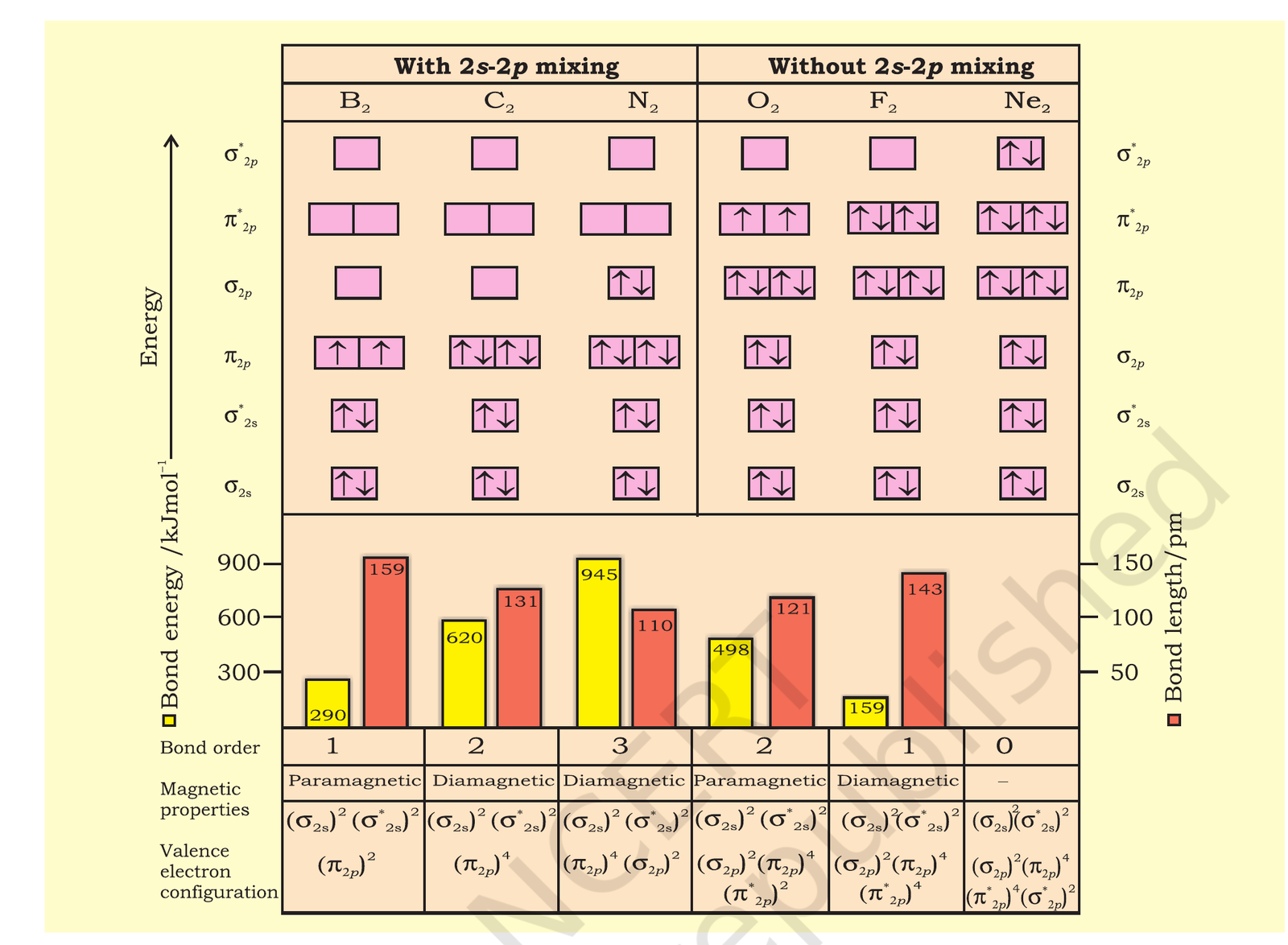
Molecular orbitals are formed by combining atomic orbitals. Bonding MOs are lower in energy than the atomic orbitals; antibonding MOs (marked *) are higher. Electrons fill MOs in order of increasing energy, following the Aufbau principle, Pauli exclusion, and Hund's rule. (NCERT XI, Ch 4.)
- Bond order = (number of electrons in bonding MOs − number of electrons in antibonding MOs) / 2. Higher bond order means a stronger, shorter bond. Bond order 0 means the molecule does not exist.
- Magnetic behaviour: a molecule with one or more unpaired electrons is paramagnetic; a molecule with all electrons paired is diamagnetic.
- MO energy order for B2, C2, $N_2$ (up to 14 electrons): σ1s < σ*1s < σ2s < σ*2s < (π2px = π2py) < σ2pz < (π*2px = π*2py) < σ*2pz. For $O_2$ and $F_2$ the order changes: σ2pz comes before (π2px = π2py). The $N_2$ order is verified by Recall Q1.
- Verified bond orders (see Recall Q5): $O_2^+$ 2.5, $O_2$ 2, $O_2^-$ 1.5, $O_2^{2-}$ 1. $O_2^+$ has one unpaired electron and is paramagnetic, not diamagnetic. C2 has four electrons in its two degenerate π molecular orbitals and a bond order of 2. $H_2^+$ has one electron and a bond order of 0.5.
Practice1 question
Try it now. A wrong answer costs nothing here, try again until you get it.
What is the bond order of O₂⁻?
Bond orders: O₂⁺ 2.5, O₂ 2, O₂⁻ 1.5, O₂²⁻ 1.
Resonance and hydrogen bonding
- Resonance: when a molecule cannot be represented by a single Lewis structure, it is a hybrid of two or more canonical structures. Examples: $O_3$, $CO_3^{2-}$, benzene. Bond lengths in a resonance hybrid are intermediate between single and double bond lengths. (NCERT XI, Ch 4.)
- Hydrogen bonding: an attraction between a hydrogen atom bonded to a highly electronegative atom (F, O, or N) and a lone pair on F, O, or N of another (or the same) molecule.
- Intermolecular H-bonding: between different molecules, e.g. $H_2O$. It raises boiling point. The boiling points of Group 16 hydrides follow $H_2O$ > $H_2Te$ > $H_2Se$ > $H_2S$: on molecular mass alone $H_2O$ should have the lowest boiling point, but extensive H-bonding makes it the highest. See Recall Q4.
- Intramolecular H-bonding: within the same molecule, e.g. o-nitrophenol. It does not raise boiling point the way intermolecular bonding does. (NCERT XI, Ch 4.)
Practice1 question
Try it now. A wrong answer costs nothing here, try again until you get it.
Which type of hydrogen bonding raises the boiling point of water?
Intermolecular hydrogen bonding between water molecules raises its boiling point above H₂Te, H₂Se and H₂S despite its lower mass.
Table 1: VSEPR shapes ladder
| Bond pairs | Lone pairs | Electron-pair geometry | Molecular shape | Bond angle | Example |
|---|---|---|---|---|---|
| 2 | 0 | Linear | Linear | 180° | $BeCl_2$, $CO_2$ |
| 3 | 0 | Trigonal planar | Trigonal planar | 120° | $BF_3$ |
| 4 | 0 | Tetrahedral | Tetrahedral | 109.5° | $CH_4$, $NH_4^+$ |
| 3 | 1 | Tetrahedral | Trigonal pyramidal | 107° | $NH_3$ |
| 2 | 2 | Tetrahedral | Bent (angular) | 104.5° | $H_2O$ |
| 5 | 0 | Trigonal bipyramidal | Trigonal bipyramidal | 90°, 120° | $PCl_5$ |
| 6 | 0 | Octahedral | Octahedral | 90° | $SF_6$ |
Source: NCERT XI, Ch 4, Tables 4.6-4.8.
Table 2: Hybridisation ladder
| Hybridisation | Orbitals mixed | Hybrid orbitals | Shape | Bond angle | Example |
|---|---|---|---|---|---|
| sp | 1 s + 1 p | 2 | Linear | 180° | $BeCl_2$ |
| sp2 | 1 s + 2 p | 3 | Trigonal planar | 120° | $BF_3$ |
| sp3 | 1 s + 3 p | 4 | Tetrahedral | 109.5° | $CH_4$ |
| sp3d | 1 s + 3 p + 1 d | 5 | Trigonal bipyramidal | 90°, 120° | $PCl_5$ |
| sp3d2 | 1 s + 3 p + 2 d | 6 | Octahedral | 90° | $SF_6$ |
Source: NCERT XI, Ch 4, section 4.6.
Table 3: Molecular orbital theory: bond order and magnetism
| Species | Bond order | Unpaired electrons | Magnetic behaviour |
|---|---|---|---|
| $N_2$ | 3 | 0 | Diamagnetic |
| $O_2$ | 2 | 2 | Paramagnetic |
| $O_2^+$ | 2.5 | 1 | Paramagnetic |
| $O_2^-$ | 1.5 | 1 | Paramagnetic |
| $O_2^{2-}$ | 1 | 0 | Diamagnetic |
| C2 | 2 | 0 | Diamagnetic |
| $H_2^+$ | 0.5 | 1 | Paramagnetic |
Bond orders of the $O_2$ species and the C2/$H_2^+$ facts are verified by Recall Q5 (NEET 2022, Code T1, Q61). $N_2$, $O_2$ and C2 are NCERT Fig. 4.21 (p.131); $O_2^+$, $O_2^-$, $O_2$ 2- and $H_2^+$ follow the same MO filling and are set as NCERT Exercises 4.36 and 4.40.
Table 4: Hydrogen bonding: intermolecular vs intramolecular
| Type | Where it forms | Example | Effect on boiling point |
|---|---|---|---|
| Intermolecular | Between different molecules | $H_2O$, HF, $NH_3$ | Raises it: $H_2O$ boils higher than $H_2Te$, $H_2Se$, $H_2S$ despite lower mass |
| Intramolecular | Within the same molecule | o-nitrophenol | No rise from association between molecules |
Source: NCERT XI, Ch 4, section 4.6. The Group 16 hydride boiling-point order $H_2O$ > $H_2Te$ > $H_2Se$ > $H_2S$ is verified by Recall Q4 (NEET 2024, Code T5, Q58).
Trap Boxes
The octet rule always holds?
Wrong idea: every stable molecule follows the octet rule.
$BF_3$ has only 6 electrons around boron (electron-deficient), $PCl_5$ has 10 and $SF_6$ has 12 (expanded octet), $NO$ has an odd electron, and hydrogen attains a duplet. The octet rule is a guide, not a law.
NCERT XI, Ch 4
Polar bonds mean a polar molecule?
Wrong idea: a molecule with polar bonds must have a dipole moment.
$BF_3$ has polar B-F bonds but zero dipole moment. It is trigonal planar, so the three bond dipoles cancel. $CO_2$ is linear and also has zero dipole moment. Shape decides, not just bond polarity.
NCERT XI, Ch 4
$BF_3$ is sp3 with 4 electrons?
Wrong idea: $BF_3$ must be sp3 because boron has three bonds.
$BF_3$ is planar and electron-deficient: sp2 hybridisation, with 6 electrons around boron (3 bond pairs, 0 lone pairs). See Recall Q3.
NCERT XI, Ch 4
$O_2^+$ is diamagnetic?
Wrong idea: $O_2^+$ has lost an electron, so it must be diamagnetic.
$O_2^+$ has one unpaired electron in a π*2p orbital and is paramagnetic. Its bond order is 2.5, higher than $O_2$ (2). Removing an electron from an antibonding orbital raises the bond order. See Recall Q5.
NCERT XI, Ch 4
Heavier hydride, higher boiling point?
Wrong idea: boiling point always rises with molecular mass, so $H_2S$ should boil higher than $H_2O$.
$H_2O$ has extensive intermolecular hydrogen bonding, so its boiling point is the highest of the Group 16 hydrides: $H_2O$ > $H_2Te$ > $H_2Se$ > $H_2S$. Mass alone would predict the opposite for $H_2O$. See Recall Q4.
NCERT XI, Ch 4
Chapter test
5 NEET PYQs. +4 for a correct answer, -1 for a wrong answer, exactly like NEET. Finish the test to earn a medal.
Q1: NEET (UG) 2024, Code T5, Q58
Given below are two statements: Statement I: The boiling point of hydrides of Group 16 elements follow the order $H_2O$ > $H_2Te$ > $H_2Se$ > $H_2S$. Statement II: On the basis of molecular mass, $H_2O$ is expected to have lower boiling point than the other members of the group but due to the presence of extensive H-bonding in $H_2O$, it has higher boiling point. In the light of the above statements, choose the correct answer from the options given below:
Both statements are true: H-bonding makes $H_2O$ boil highest despite its lower molecular mass.
Q2: NEET (UG) 2023, Code G5, Q53
The correct order of energies of molecular orbitals of $N_2$ molecule, is
$N_2$ MO order: sigma1s < sigma*1s < sigma2s < sigma*2s < (pi2px = pi2py) < sigma2pz < (pi*2px = pi*2py) < sigma*2pz.
Q3: NEET (UG) 2022, Code T1, Q61
Which amongst the following is incorrect statement?
$O_2^+$ is paramagnetic (one unpaired electron in a pi*2p orbital), so statement (3) is the incorrect one.
Q4: NEET (UG) 2022, Code S1, Q51
Amongst the following which one will have maximum 'lone pair - lone pair' electron repulsions?
$XeF_2$ has 3 lone pairs on Xe, the most lone pairs, hence the maximum lone pair-lone pair repulsion.
Q5: NEET (UG) 2021, Code P3, Q59
$BF_3$ is planar and electron deficient compound. Hybridization and number of electrons around the central atom, respectively are :
$BF_3$ is planar and electron-deficient: sp2 hybridisation, 6 electrons around boron.
Score: 0 · Answered 0 of 5
Flashcards
Tap a card to flip it over and see the answer. Tap it again to flip it back.
What is the octet rule?
Tap to flipAtoms combine to attain eight electrons in the outermost shell, like the nearest noble gas.
Tap to flip backName one molecule that breaks the octet rule by having fewer than 8 electrons around the central atom.
Tap to flip$BF_3$: 6 electrons around boron.
Tap to flip backWhat is lattice enthalpy?
Tap to flipThe energy required to separate one mole of an ionic solid into its gaseous ions.
Tap to flip backRepulsion order in VSEPR?
Tap to flipLone pair-lone pair > lone pair-bond pair > bond pair-bond pair.
Tap to flip backShape and bond angle of $BF_3$?
Tap to flipTrigonal planar, 120°, sp2 hybridisation, 6 electrons around boron.
Tap to flip backHow many lone pairs does $XeF_2$ have on Xe?
Tap to flip3 lone pairs: 5 electron pairs, 2 bond pairs, linear shape.
Tap to flip backBond order formula?
Tap to flip(bonding electrons − antibonding electrons) / 2.
Tap to flip backBond orders of $O_2^+$, $O_2$, $O_2^-$, $O_2^{2-}$?
Tap to flip2.5, 2, 1.5, 1.
Tap to flip backIs $O_2^+$ diamagnetic or paramagnetic?
Tap to flipParamagnetic: one unpaired electron in a π*2p orbital.
Tap to flip backWhy does $H_2O$ boil higher than $H_2Te$, $H_2Se$, $H_2S$?
Tap to flipExtensive intermolecular hydrogen bonding in $H_2O$.
Tap to flip back