 NEET Notes
Home > Chemistry > Inorganic > The d- and f-Block Elements
The d- and f-Block Elements
On this page · 22 sections
- 01Syllabus map
- 02Position in the periodic table
- 03Electronic configurations of the d-block
- 04Physical properties
- 05Atomic and ionic sizes
- 06Table: first-row transition elements, key data
- 07Ionisation enthalpies
- 08Oxidation states
- 09Table: oxidation states of the first row
- 10Electrode potentials and reactivity
- 11Higher oxidation states
- 12Magnetic properties
- 13Formation of coloured ions
- 14Complexes, catalysis, interstitial compounds and alloys
- 15Potassium dichromate
- 16Potassium permanganate
- 17Table: permanganate half-reactions
- 18Lanthanoids and lanthanoid contraction
- 19Lanthanoid oxidation states and characteristics
- 20Actinoids
- 21Ladder: oxidation state stability rules
- 22Ladder: trap pairs
d- and f-block elements: configurations, trends in size, ionisation enthalpy, oxidation states and electrode potentials, magnetism and colour, $K_2Cr_2O_7$ and $KMnO_4$, lanthanoid contraction and actinoids.
Syllabus map
- NMC Unit: CHEM-U11, d- and f-Block Elements.
- Subtopics in this chapter (NCERT XII, Ch 4): position in the periodic table (4.1); electronic configurations of the d-block elements (4.2); general properties of the transition elements (4.3), physical properties (4.3.1), atomic and ionic sizes (4.3.2), ionisation enthalpies (4.3.3), oxidation states (4.3.4), trends in standard electrode potentials M2+/M (4.3.5) and M3+/M2+ (4.3.6), stability of higher oxidation states (4.3.7), chemical reactivity and E° values (4.3.8), magnetic properties (4.3.9), formation of coloured ions (4.3.10), formation of complex compounds (4.3.11), catalytic properties (4.3.12), formation of interstitial compounds (4.3.13), alloy formation (4.3.14); some important compounds of transition elements (4.4), oxides and oxoanions, potassium dichromate and potassium permanganate (4.4.1); the inner transition elements, f-block (4.5, 4.6); some applications of d- and f-block elements (4.7).
- Subtopic checklist: (1) IUPAC definition of a transition metal; (2) Cr, Cu and Pd configuration exceptions; (3) melting points and enthalpies of atomisation; (4) atomic and ionic radii trends; (5) ionisation enthalpy breaks at d5; (6) oxidation states, maximum at Mn; (7) E° values and their anomalies; (8) halides and oxides in high oxidation states; (9) spin-only magnetic moment; (10) colour and d-d transitions; (11) complexes, catalysis, interstitial compounds and alloys; (12) preparation, properties and uses of $K_2Cr_2O_7$; (13) preparation, properties and uses of $KMnO_4$; (14) lanthanoid contraction; (15) lanthanoid oxidation states; (16) actinoid configurations, contraction and oxidation states.
- Extra information (beyond NCERT): none. Everything in this chapter is NCERT Chapter 4.
- Excluded topics: the chemistry of complex compounds in detail, which belongs to the coordination compounds chapter (Unit 5 in NCERT); do not import its facts into this chapter.
- Estimated revision time: 10 minutes. Jump links: Syllabus map, Position in the periodic table, Electronic configurations of the d-block, Physical properties, Atomic and ionic sizes, Table: first-row data, Ionisation enthalpies, Oxidation states, Table: oxidation states of the first row, Electrode potentials and reactivity, Higher oxidation states, Magnetic properties, Coloured ions, Complexes, catalysis, interstitial compounds and alloys, Potassium dichromate, Potassium permanganate, Table: permanganate half-reactions, Lanthanoids and lanthanoid contraction, Lanthanoid oxidation states and characteristics, Actinoids, Ladder: oxidation state stability rules, Ladder: trap pairs.
Suggest an edit
Position in the periodic table
- The d-block occupies the large middle section of the periodic table, flanked between the s- and p-blocks. The d orbitals of the penultimate energy level receive electrons, giving four rows: 3d (Sc to Zn), 4d (Y to Cd), 5d (La and Hf to Hg) and 6d (Ac and Rf to Cn).
- The f-block consists of elements in which 4f and 5f orbitals are progressively filled. They sit in a separate panel at the bottom of the periodic table. The two inner transition series are 4f (Ce to Lu), the lanthanoids, and 5f (Th to Lr), the actinoids.
- The name transition metals came from their chemical properties being transitional between s- and p-block elements. By the IUPAC definition, transition metals are metals which have an incomplete d subshell either in the neutral atom or in their ions.
- Zn, Cd and Hg of group 12 have a full d configuration in the ground state as well as in their common oxidation states, so they are not regarded as transition metals. They are still studied with the transition metals as the end members of the 3d, 4d and 5d series.
- Example 4.1: Sc (Z = 21) is a transition element because its ground state has incompletely filled 3d orbitals (3d1). Zn (Z = 30) is not, because it has completely filled d orbitals (3d10) in its ground state and in its oxidised state.
- Intext Question 4.1, answered in the book: Ag (Z = 47) has completely filled 4d orbitals (4d10) in its ground state, but it can exhibit the +2 oxidation state, in which it has incompletely filled d orbitals (4d9), so it is a transition element.
- The partly filled d or f orbitals make transition elements different from non-transition elements. Their characteristic properties are a variety of oxidation states, coloured ions, complex formation, catalytic property and paramagnetic behaviour.
Suggest an edit
Electronic configurations of the d-block
- The general outer configuration is (n-1)d1-10 ns1-2, except for Pd, whose configuration is 4d10 5s0. The (n-1)d orbitals may hold one to ten electrons and the outer ns orbital one or two electrons.
- This generalisation has several exceptions because there is very little energy difference between (n-1)d and ns orbitals, and half-filled and completely filled sets are relatively more stable.
- Cr has 3d5 4s1 instead of 3d4 4s2 because the energy gap between the 3d and 4s orbitals is small enough that an electron can enter the 3d orbital (giving the half-filled 3d5 subshell) rather than pairing in the 4s orbital (NCERT Table 4.1). The half-filled 3d subshell (d5) is extra stable (extra stability of half-filled subshells).
- The outer configurations of Zn, Cd, Hg and Cn follow the general formula (n-1)d10 ns2. Their orbitals are completely filled in the ground state and in their common oxidation states, so they are not regarded as transition elements.
- The d orbitals protrude to the periphery of an atom more than the s and p orbitals, so they are more influenced by the surroundings and affect the atoms or molecules around them. Ions of a given dn configuration (n = 1 to 9) have similar magnetic and electronic properties.
- When d-block elements form ions, the ns electrons are lost before the (n-1)d electrons.
Suggest an edit
Practice1 question
Try it now. A wrong answer costs nothing here, try again until you get it.
Silver has completely filled 4d orbitals (4d10) in its ground state. How can it still be called a transition element?
NCERT 4.2 and the answer to Intext Question 4.1: silver can exhibit the +2 oxidation state, in which it has incompletely filled 4d orbitals (4d9), so it is a transition element even though its ground state is 4d10.
Physical properties
- Nearly all transition elements show typical metallic properties: high tensile strength, ductility, malleability, high thermal and electrical conductivity and metallic lustre. Except for Zn, Cd, Hg and Mn, they have one or more typical metallic structures at normal temperatures.
- Except for Zn, Cd and Hg, the transition metals are very hard and have low volatility. Their melting and boiling points are high. NCERT Fig. 4.1 shows the melting points of the 3d, 4d and 5d series.
- The high melting points are attributed to the involvement of a greater number of electrons from (n-1)d in addition to the ns electrons in interatomic metallic bonding.
- In any row the melting points rise to a maximum at d5, except for the anomalous values of Mn and Tc, and fall regularly as the atomic number increases.
- They have high enthalpies of atomisation, shown in NCERT Fig. 4.2. The maxima at about the middle of each series show that one unpaired electron per d orbital is particularly favourable for strong interatomic interaction. In general, the greater the number of valence electrons, the stronger the resultant bonding.
- Example 4.2: transition elements show higher enthalpies of atomisation because the large number of unpaired electrons in their atoms gives stronger interatomic interaction and stronger bonding between atoms.
- The metals of the second and third series have greater enthalpies of atomisation than the corresponding elements of the first series. This accounts for the much more frequent metal-metal bonding in compounds of the heavy transition metals.
- Intext Question 4.2, answered in the book: the enthalpy of atomisation of zinc is the lowest in the Sc to Zn series, 126 kJ mol-1, because in the formation of metallic bonds no electrons from the 3d orbitals are involved in the case of zinc, while in all the other metals of the 3d series electrons from the d orbitals are always involved.
Suggest an edit
Atomic and ionic sizes
- Ions of the same charge in a given series show a progressive decrease in radius with increasing atomic number. Each time the nuclear charge increases by unity, the new electron enters a d orbital. The shielding effect of a d electron is not very effective, so the net attraction between the nuclear charge and the outermost electron increases and the ionic radius decreases. The same trend is seen in atomic radii, but the variation within a series is quite small.
- Comparing one series with another, the curves in NCERT Fig. 4.3 show an increase from the first (3d) to the second (4d) series, but the radii of the third (5d) series are virtually the same as those of the corresponding members of the second series.
- This is associated with the intervention of the 4f orbitals, which must be filled before the 5d series begins. The filling of 4f before 5d results in a regular decrease in atomic radii called lanthanoid contraction, which essentially compensates for the expected increase in atomic size with increasing atomic number.
- The net result is that the second and the third d series show similar radii (for example Zr 160 pm, Hf 159 pm) and have very similar physical and chemical properties, much more than expected from the usual family relationship.
- The decrease in metallic radius together with the increase in atomic mass results in a general increase in the density of these elements. From titanium (Z = 22) to copper (Z = 29) the increase in density is significant (Table 4.2).
Suggest an edit
Table: first-row transition elements, key data
| Element | Enthalpy of atomisation (kJ mol-1) | First ionisation enthalpy (kJ mol-1) | Second ionisation enthalpy (kJ mol-1) | Third ionisation enthalpy (kJ mol-1) | Metallic radius (pm) | E°(M2+/M) (V) | E°(M3+/M2+) (V) |
|---|---|---|---|---|---|---|---|
| Sc | 326 | 631 | 1235 | 2393 | 164 | - | - |
| Ti | 473 | 656 | 1309 | 2657 | 147 | -1.63 | -0.37 |
| V | 515 | 650 | 1414 | 2833 | 135 | -1.18 | -0.26 |
| Cr | 397 | 653 | 1592 | 2990 | 129 | -0.90 | -0.41 |
| Mn | 281 | 717 | 1509 | 3260 | 137 | -1.18 | +1.57 |
| Fe | 416 | 762 | 1561 | 2962 | 126 | -0.44 | +0.77 |
| Co | 425 | 758 | 1644 | 3243 | 125 | -0.28 | +1.97 |
| Ni | 430 | 736 | 1752 | 3402 | 125 | -0.25 | - |
| Cu | 339 | 745 | 1958 | 3556 | 128 | +0.34 | - |
| Zn | 126 | 906 | 1734 | 3837 | 137 | -0.76 | - |
- Read the table for the three anomalies: Cu is the only metal with a positive E°(M2+/M); Mn has the highest E°(M3+/M2+) among the early metals at +1.57 V; Zn has the lowest enthalpy of atomisation at 126 kJ mol-1 and the highest first ionisation enthalpy at 906 kJ mol-1.
- The second ionisation enthalpy of Cr (1592) and Cu (1958) is unusually high because the M+ ions have the d5 and d10 configurations. The third ionisation enthalpies of Cu, Ni and Zn are very high, which is why it is difficult to obtain an oxidation state greater than two for these elements.
Suggest an edit
Ionisation enthalpies
- There is an increase in ionisation enthalpy along each series from left to right, due to the increase in nuclear charge which accompanies the filling of the inner d orbitals. Table 4.2 gives the first three ionisation enthalpies of the first series.
- The successive enthalpies do not increase as steeply as in non-transition elements. The variation in ionisation enthalpy along a series of transition elements is much less than the variation along a period of non-transition elements. The first ionisation enthalpy in general increases, but the magnitude of the increase in the second and third ionisation enthalpies for successive elements is much higher along a series.
- When d-block elements form ions, ns electrons are lost before (n-1)d electrons. As we move along the 3d series, the nuclear charge increases but electrons are added to the inner 3d subshell. These 3d electrons shield the 4s electrons from the increasing nuclear charge somewhat more effectively than the outer shell electrons can shield one another, so atomic radii decrease less rapidly and ionisation energies increase only slightly along the 3d series.
- The trend of steady increase in second and third ionisation enthalpy breaks for the formation of $Mn^{2+}$ and $Fe^{3+}$ respectively. In both cases the ions have the d5 configuration. Similar breaks occur at corresponding elements in the later transition series.
- The three terms behind the value of ionisation enthalpy are attraction of each electron towards the nucleus, repulsion between the electrons and the exchange energy. Exchange energy is responsible for the stabilisation of the energy state and is approximately proportional to the total number of possible pairs of parallel spins in the degenerate orbitals.
- There is no loss of exchange energy at the d6 configuration. $Mn^+$ has the 3d5 4s1 configuration and $Cr^+$ is d5, so the ionisation enthalpy of $Mn^+$ is lower than that of $Cr^+$. In the same way, $Fe^{2+}$ has the d6 configuration and $Mn^{2+}$ has 3d5, so the ionisation enthalpy of $Fe^{2+}$ is lower than that of $Mn^{2+}$. In other words, the third ionisation enthalpy of Fe is lower than that of Mn.
- The lowest common oxidation state of these metals is +2. To form M2+ ions from gaseous atoms, the sum of the first and second ionisation enthalpies is required in addition to the enthalpy of atomisation. The dominant term is the second ionisation enthalpy, which shows unusually high values for Cr and Cu, where the M+ ions have the d5 and d10 configurations. The value for Zn is correspondingly low, as ionisation removes one 4s electron and forms the stable d10 configuration.
- The trend in the third ionisation enthalpies is not complicated by the 4s orbital factor and shows the greater difficulty of removing an electron from the d5 ($Mn^{2+}$) and d10 ($Zn^{2+}$) ions.
Suggest an edit
Oxidation states
- One of the notable features of the transition elements is the great variety of oxidation states they show in their compounds. Table 4.3 lists the common oxidation states of the first row transition elements.
- The elements which give the greatest number of oxidation states occur in or near the middle of the series. Manganese exhibits all the oxidation states from +2 to +7.
- The smaller number of oxidation states at the extreme ends comes from either too few electrons to lose or share (Sc, Ti) or too many d electrons, hence fewer orbitals available in which to share electrons with others, for higher valence (Cu, Zn).
- Early in the series, scandium(II) is virtually unknown and titanium(IV) is more stable than Ti(III) or Ti(II). At the other end, the only oxidation state of zinc is +2, as no d electrons are involved.
- The maximum oxidation states of reasonable stability correspond in value to the sum of the s and d electrons up to manganese ($TiO_2$, $VO_2^+$, $CrO_4^{2-}$, $MnO_4^-$), followed by a rather abrupt decrease in the stability of higher oxidation states, so that the typical species to follow are Fe(II, III), Co(II, III), Ni(II), Cu(I, II) and Zn(II).
- The variability of oxidation states arises from the incomplete filling of d orbitals in such a way that their oxidation states differ from each other by unity, for example V(II), V(III), V(IV), V(V). This is in contrast with the non-transition elements, where oxidation states normally differ by a unit of two.
- Among the groups (groups 4 through 10), the opposite of the p-block holds: in the p-block the lower oxidation states are favoured by the heavier members (inert pair effect), but in the d-block the higher oxidation states are favoured by the heavier members. In group 6, Mo(VI) and W(VI) are more stable than Cr(VI). Cr(VI) in the form of dichromate in acidic medium is a strong oxidising agent, whereas $MoO_3$ and $WO_3$ are not.
- Low oxidation states are found when a complex compound has ligands capable of pi-acceptor character in addition to sigma-bonding. In Ni($CO$)4 and Fe($CO$)5, the oxidation state of nickel and iron is zero.
- Example 4.3: scandium (Z = 21) does not exhibit variable oxidation states. Intext Question 4.3, answered in the book: manganese (Z = 25) exhibits the largest number of oxidation states, as its atom has the maximum number of unpaired electrons.
Suggest an edit
Practice1 question
Try it now. A wrong answer costs nothing here, try again until you get it.
Which first-row transition metal exhibits the largest number of oxidation states?
NCERT 4.3.4 and the answer to Intext Question 4.3: manganese exhibits all the oxidation states from +2 to +7, the largest number in the 3d series, because its atom has the maximum number of unpaired electrons.
Table: oxidation states of the first row
| Element | Oxidation states |
|---|---|
| Sc | +3 |
| Ti | +2, +3, +4 |
| V | +2, +3, +4, +5 |
| Cr | +2, +3, +4, +5, +6 |
| Mn | +2, +3, +4, +5, +6, +7 |
| Fe | +2, +3, +4, +5, +6 |
| Co | +2, +3, +4 |
| Ni | +2, +3, +4 |
| Cu | +1, +2 |
| Zn | +2 |
- The number of oxidation states rises to a maximum at Mn (+2 to +7) and then falls. The most common oxidation states are in bold type in NCERT Table 4.3.
- The highest oxidation state of each element equals the sum of its s and d electrons only up to Mn. Beyond Mn, the higher states fall away: Fe(VI) appears only as ferrate in alkaline media, and Cu and Zn never go above +2 in practice.
Suggest an edit
Electrode potentials and reactivity
- Table 4.4 contains the thermochemical parameters for the transformation of solid metal atoms to M2+ ions in solution and their standard electrode potentials. The observed E° values and those calculated using the data of Table 4.4 are compared in NCERT Fig. 4.4.
- The unique behaviour of Cu, having a positive E° value (+0.34 V), accounts for its inability to liberate $H_2$ from acids. Only oxidising acids (nitric and hot concentrated sulphuric) react with Cu, the acids being reduced. The high energy to transform Cu(s) to $Cu^{2+}$(aq) is not balanced by its hydration enthalpy.
- The general trend towards less negative E° values across the series is related to the general increase in the sum of the first and second ionisation enthalpies. The E° values for Mn, Ni and Zn are more negative than expected from the trend.
- The stability of the half-filled d5 subshell in $Mn^{2+}$ and the completely filled d10 configuration in $Zn^{2+}$ are related to their E° values, whereas the E° value for Ni is related to its highest negative hydration enthalpy.
- Transition metals vary widely in chemical reactivity. Many are sufficiently electropositive to dissolve in mineral acids, although a few are noble, that is, they are unaffected by single acids.
- The metals of the first series, with the exception of copper, are relatively more reactive and are oxidised by 1M $H^+$, though the actual rate at which these metals react with oxidising agents like hydrogen ion ($H^+$) is sometimes slow. Titanium and vanadium, in practice, are passive to dilute non-oxidising acids at room temperature.
- The E° values for M2+/M (Table 4.2) indicate a decreasing tendency to form divalent cations across the series.
- An examination of the E° values for the redox couple M3+/M2+ (Table 4.2) shows that $Mn^{3+}$ and $Co^{3+}$ ions are the strongest oxidising agents in aqueous solutions. The ions $Ti^{2+}$, $V^{2+}$ and $Cr^{2+}$ are strong reducing agents and will liberate hydrogen from a dilute acid, for example 2Cr2+(aq) + 2H+(aq) -> 2Cr3+(aq) + $H_2$(g).
- Example 4.4: $Cr^{2+}$ is reducing as its configuration changes from d4 to d3, the latter having a half-filled t2g level. The change from $Mn^{3+}$ to $Mn^{2+}$ results in the half-filled (d5) configuration, which has extra stability, so $Mn^{3+}$ is oxidising.
- Example 4.6: the irregularity in the E°(M2+/M) values is explained from the irregular variation of ionisation enthalpies (first plus second) and the sublimation enthalpies, which are relatively much less for manganese and vanadium.
- Example 4.7: the E° value for the $Mn^{3+}$/$Mn^{2+}$ couple is much more positive than that for $Cr^{3+}$/$Cr^{2+}$ or $Fe^{3+}$/$Fe^{2+}$ because the third ionisation energy of Mn is much larger, as the required change is d5 to d4. This also explains why the +3 state of Mn is of little importance.
Suggest an edit
Higher oxidation states
- An examination of the E°(M3+/M2+) values (Table 4.2) shows the varying trends. The low value for Sc reflects the stability of $Sc^{3+}$, which has a noble gas configuration. The highest value for Zn is due to the removal of an electron from the stable d10 configuration of $Zn^{2+}$.
- The comparatively high value for Mn shows that $Mn^{2+}$ (d5) is particularly stable, whereas the comparatively low value for Fe shows the extra stability of $Fe^{3+}$ (d5). The comparatively low value for V is related to the stability of $V^{2+}$ (half-filled t2g level).
- Table 4.5 shows the stable halides of the 3d series. The highest oxidation numbers are achieved in TiX4 (tetrahalides), $VF_5$ and $CrF_6$. The +7 state for Mn is not represented in simple halides, but $MnO_3F$ is known, and beyond Mn no metal has a trihalide except FeX3 and $CoF_3$.
- The ability of fluorine to stabilise the highest oxidation state is due to either higher lattice energy, as in $CoF_3$, or higher bond enthalpy terms for the higher covalent compounds, for example $VF_5$ and $CrF_6$.
- Although V(V) is represented only by $VF_5$, the other halides undergo hydrolysis to give oxohalides, VOX3. Fluorides are unstable in the low oxidation states, for example VX2 (X = Cl, Br or I), and the same applies to CuX.
- All copper halides are known except the iodide. In this case, $Cu^{2+}$ oxidises $I^-$ to $I_2$: 2Cu2+ + 4I- -> $Cu_2I_2$(s) + $I_2$.
- Many copper(I) compounds are unstable in aqueous solution and undergo disproportionation: 2Cu+ -> $Cu^{2+}$ + Cu. The stability of $Cu^{2+}$(aq) rather than $Cu^+$(aq) is due to the much more negative hydration enthalpy of $Cu^{2+}$(aq) than $Cu^+$, which more than compensates for the second ionisation enthalpy of Cu.
- The ability of oxygen to stabilise the highest oxidation state is shown in the oxides. The highest oxidation number in the oxides (Table 4.6) coincides with the group number and is attained in $Sc_2O_3$ to $Mn_2O_7$. Beyond group 7, no higher oxides of Fe above $Fe_2O_3$ are known, although ferrates(VI), ($FeO_4$)2-, are formed in alkaline media but they readily decompose to $Fe_2O_3$ and $O_2$.
- Oxocations stabilise V(V) as $VO_2^+$, V(IV) as $VO^{2+}$ and Ti(IV) as $TiO^{2+}$. The ability of oxygen to stabilise these high oxidation states exceeds that of fluorine: the highest Mn fluoride is $MnF_4$, whereas the highest oxide is $Mn_2O_7$. The ability of oxygen to form multiple bonds to metals explains its superiority.
- In the covalent oxide $Mn_2O_7$, each Mn is tetrahedrally surrounded by O atoms, including a Mn-O-Mn bridge. The tetrahedral [MO4]n- ions are known for V(V), Cr(VI), Mn(V), Mn(VI) and Mn(VII).
- Example 4.5: the increasing oxidising power in the series $VO_2^+$ < $Cr_2O_7^{2-}$ < $MnO_4^-$ is due to the increasing stability of the lower species to which they are reduced.
Suggest an edit
Magnetic properties
- When a magnetic field is applied to substances, mainly two types of magnetic behaviour are observed: diamagnetism and paramagnetism. Diamagnetic substances are repelled by the applied field, while paramagnetic substances are attracted. Substances which are attracted very strongly are said to be ferromagnetic. Ferromagnetism is an extreme form of paramagnetism. Many of the transition metal ions are paramagnetic.
- Paramagnetism arises from the presence of unpaired electrons, each such electron having a magnetic moment associated with its spin angular momentum and orbital angular momentum. For the compounds of the first series of transition metals, the contribution of the orbital angular momentum is effectively quenched and hence is of no significance.
- For these, the magnetic moment is determined by the number of unpaired electrons and is calculated by using the spin-only formula: mu = sqrt(n(n+2)), where n is the number of unpaired electrons and mu is the magnetic moment in units of Bohr magneton (BM). A single unpaired electron has a magnetic moment of 1.73 BM.
- The magnetic moment increases with the increasing number of unpaired electrons. The observed magnetic moment gives a useful indication about the number of unpaired electrons present in the atom, molecule or ion.
- The magnetic moments calculated from the spin-only formula and those derived experimentally for some ions of the first row transition elements are given in Table 4.7. The experimental data are mainly for hydrated ions in solution or in the solid state.
- Table 4.7: $Sc^{3+}$ 3d0, 0 unpaired, calculated 0, observed 0; $Ti^{3+}$ 3d1, 1, 1.73, 1.75; $Ti^{2+}$ 3d2, 2, 2.84, 2.76; $V^{2+}$ 3d3, 3, 3.87, 3.86; $Cr^{2+}$ 3d4, 4, 4.90, 4.80; $Mn^{2+}$ 3d5, 5, 5.92, 5.96; $Fe^{2+}$ 3d6, 4, 4.90, 5.3-5.5; $Co^{2+}$ 3d7, 3, 3.87, 4.4-5.2; $Ni^{2+}$ 3d8, 2, 2.84, 2.9-3.4; $Cu^{2+}$ 3d9, 1, 1.73, 1.8-2.2; $Zn^{2+}$ 3d10, 0, 0.
- Example 4.8: the magnetic moment of a divalent ion in aqueous solution with atomic number 25. The ion has the d5 configuration (five unpaired electrons), so mu = sqrt(5 x 7) = 5.92 BM.
- Intext Question 4.8 asks for the spin-only magnetic moment of M2+(aq) with Z = 27. The ion is $Co^{2+}$, 3d7, with 3 unpaired electrons, so mu = sqrt(3 x 5) = 3.87 BM.
Suggest an edit
Practice1 question
Try it now. A wrong answer costs nothing here, try again until you get it.
What is the spin-only magnetic moment of $Mn^{2+}$ in aqueous solution?
NCERT 4.3.9, Example 4.8: $Mn^{2+}$ has the d5 configuration, five unpaired electrons, so mu = sqrt(5 x 7) = 5.92 BM.
Formation of coloured ions
- When an electron from a lower energy d orbital is excited to a higher energy d orbital, the energy of excitation corresponds to the frequency of light absorbed. This frequency generally lies in the visible region. The colour observed corresponds to the complementary colour of the light absorbed.
- The frequency of the light absorbed is determined by the nature of the ligand. In aqueous solutions, where water molecules are the ligands, the colours of the ions are listed in Table 4.8. A few coloured solutions of the first row d-block elements are shown in NCERT Fig. 4.5: from left to right, $V^{4+}$, $V^{3+}$, $Mn^{2+}$, $Fe^{3+}$, $Co^{2+}$, $Ni^{2+}$ and $Cu^{2+}$.
- Table 4.8: $Sc^{3+}$ (3d0) colourless; $Ti^{4+}$ (3d0) colourless; $Ti^{3+}$ (3d1) purple; $V^{4+}$ (3d1) blue; $V^{3+}$ (3d2) green; $V^{2+}$ (3d3) violet; $Cr^{3+}$ (3d3) violet; $Mn^{3+}$ (3d4) violet; $Cr^{2+}$ (3d4) blue; $Mn^{2+}$ (3d5) pink; $Fe^{3+}$ (3d5) yellow; $Fe^{2+}$ (3d6) green; $Co^{3+}$ (3d6) blue; $Co^{2+}$ (3d7) pink; $Ni^{2+}$ (3d8) green; $Cu^{2+}$ (3d9) blue; $Zn^{2+}$ (3d10) colourless.
- Ions with the d0 configuration ($Sc^{3+}$, $Ti^{4+}$) and the d10 configuration ($Zn^{2+}$) are colourless because there is no d-d transition possible: d0 has no d electron to excite, and d10 has no vacant d orbital to excite into.
- Exercise 4.18 asks which of $Ti^{3+}$, $V^{3+}$, $Cu^+$, $Sc^{3+}$, $Mn^{2+}$, $Fe^{3+}$ and $Co^{2+}$ will be coloured in aqueous solution. $Ti^{3+}$ (3d1), $V^{3+}$ (3d2), $Mn^{2+}$ (3d5), $Fe^{3+}$ (3d5) and $Co^{2+}$ (3d7) are coloured, while $Sc^{3+}$ (3d0) and $Cu^+$ (3d10) are colourless.
Suggest an edit
Complexes, catalysis, interstitial compounds and alloys
- Complex compounds are those in which the metal ions bind a number of anions or neutral molecules, giving complex species with characteristic properties. Examples are [Fe(CN)6]3-, [Fe(CN)6]4-, [Cu($NH_3$)4]2+ and [$PtCl_4$]2-.
- The transition metals form a large number of complex compounds because of the comparatively smaller sizes of the metal ions, their high ionic charges and the availability of d orbitals for bond formation.
- The transition metals and their compounds are known for their catalytic activity. This activity is ascribed to their ability to adopt multiple oxidation states and to form complexes. Vanadium(V) oxide (in the Contact Process), finely divided iron (in the Haber Process) and nickel (in catalytic hydrogenation) are examples.
- Catalysts at a solid surface involve the formation of bonds between reactant molecules and atoms of the surface of the catalyst (first row transition metals utilise 3d and 4s electrons for bonding). This increases the concentration of the reactants at the catalyst surface and weakens the bonds in the reacting molecules, lowering the activation energy.
- Because the transition metal ions can change their oxidation states, they become more effective as catalysts. Iron(III) catalyses the reaction between iodide and persulphate ions: 2I- + $S_2O_8^{2-}$ -> $I_2$ + 2$SO_4^{2-}$, through the cycle 2Fe3+ + 2I- -> 2Fe2+ + $I_2$ and 2Fe2+ + $S_2O_8^{2-}$ -> 2Fe3+ + 2$SO_4^{2-}$.
- Interstitial compounds are formed when small atoms like H, C or N are trapped inside the crystal lattices of metals. They are usually non-stoichiometric and are neither typically ionic nor covalent, for example TiC, $Mn_4N$, $Fe_3H$, $VH_0$.56 and $TiH_1$.7.
- Their main properties are: (i) they have high melting points, higher than those of pure metals; (ii) they are very hard, some borides approach diamond in hardness; (iii) they retain metallic conductivity; (iv) they are chemically inert.
- An alloy is a blend of metals prepared by mixing the components. Alloys may be homogeneous solid solutions in which the atoms of one metal are distributed randomly among the atoms of the other. Such alloys are formed by atoms with metallic radii that are within about 15 percent of each other.
- Because of similar radii and other characteristics of transition metals, alloys are readily formed by these metals. The alloys so formed are hard and often have high melting points. The best known are ferrous alloys: chromium, vanadium, tungsten, molybdenum and manganese are used for the production of a variety of steels and stainless steel.
- Alloys of transition metals with non-transition metals such as brass (copper-zinc) and bronze (copper-tin) are also of considerable industrial importance.
Suggest an edit
Potassium dichromate
- Potassium dichromate is a very important chemical used in the leather industry and as an oxidant for the preparation of many azo compounds.
- Dichromates are generally prepared from chromate, which in turn are obtained by the fusion of chromite ore ($FeCr_2O_4$) with sodium or potassium carbonate in free access of air: 4FeCr2O4 + 8Na2CO3 + 7O2 -> 8Na2CrO4 + 2Fe2O3 + 8CO2.
- The yellow solution of sodium chromate is filtered and acidified with sulphuric acid to give a solution from which orange sodium dichromate, $Na_2Cr_2O_7$.2H2O, can be crystallised: 2Na2CrO4 + 2H+ -> $Na_2Cr_2O_7$ + 2Na+ + $H_2O$.
- Sodium dichromate is more soluble than potassium dichromate. Potassium dichromate is therefore prepared by treating the solution of sodium dichromate with potassium chloride: $Na_2Cr_2O_7$ + 2KCl -> $K_2Cr_2O_7$ + 2NaCl. Orange crystals of potassium dichromate crystallise out.
- The chromates and dichromates are interconvertible in aqueous solution depending upon the $\mathrm{pH}$ of the solution. The oxidation state of chromium in chromate and dichromate is the same (+6): 2$CrO_4^{2-}$ + 2H+ -> $Cr_2O_7^{2-}$ + $H_2O$, and $Cr_2O_7^{2-}$ + 2OH- -> 2$CrO_4^{2-}$ + $H_2O$.
- The structures of the chromate ion, $CrO_4^{2-}$, and the dichromate ion, $Cr_2O_7^{2-}$, are shown in NCERT. The chromate ion is tetrahedral, whereas the dichromate ion consists of two tetrahedra sharing one corner, with a Cr-O-Cr bond angle of 126 degrees.
- Sodium and potassium dichromates are strong oxidising agents. The sodium salt has a greater solubility in water and is extensively used as an oxidising agent in organic chemistry. Potassium dichromate is used as a primary standard in volumetric analysis.
- In acidic solution, its oxidising action is: $Cr_2O_7^{2-}$ + 14H+ + 6e- -> 2Cr3+ + 7H2O (E° = 1.33 V).
- Acidified potassium dichromate oxidises iodides to iodine, sulphides to sulphur, tin(II) to tin(IV) and iron(II) salts to iron(III). The half-reactions are: 6I- -> 3I2 + 6e-; 3H2S -> 6H+ + 3S + 6e-; 3Sn2+ -> 3Sn4+ + 6e-; 6Fe2+ -> 6Fe3+ + 6e-.
- The full ionic equation with iron(II) is: $Cr_2O_7^{2-}$ + 14H+ + 6Fe2+ -> 2Cr3+ + 6Fe3+ + 7H2O.
- The oxides show the same acid-base pattern: $Mn_2O_7$ gives $HMnO_4$, and $CrO_3$ gives $H_2CrO_4$ and $H_2Cr_2O_7$. In the higher oxides the acidic character is predominant. $Mn_2O_7$ is a covalent green oil, and $CrO_3$ and $V_2O_5$ have low melting points. $V_2O_5$ is amphoteric, though mainly acidic, and gives $VO_4^{3-}$ as well as $VO_2^+$ salts. The well characterised CrO is basic, but $Cr_2O_3$ is amphoteric.
Suggest an edit
Practice1 question
Try it now. A wrong answer costs nothing here, try again until you get it.
What happens to a solution of potassium dichromate when the $\mathrm{pH}$ is increased?
NCERT 4.4.1: chromate and dichromate are interconvertible with $\mathrm{pH}$. $Cr_2O_7^{2-}$ + 2OH- -> 2$CrO_4^{2-}$ + $H_2O$, so raising the $\mathrm{pH}$ turns orange dichromate into yellow chromate. The oxidation state of Cr stays +6.
Potassium permanganate
- Potassium permanganate is prepared by fusion of $MnO_2$ with an alkali metal hydroxide and an oxidising agent like $KNO_3$. This produces the dark green $K_2MnO_4$, which disproportionates in a neutral or acidic solution to give permanganate: 2MnO2 + 4KOH + $O_2$ -> 2K2MnO4 + 2H2O, and 3$MnO_4^{2-}$ + 4H+ -> 2$MnO_4^-$ + $MnO_2$ + 2H2O.
- Commercially it is prepared by the alkaline oxidative fusion of $MnO_2$ followed by the electrolytic oxidation of manganate(VI) to permanganate.
- In the laboratory, a manganese(II) ion salt is oxidised by peroxodisulphate to permanganate: 2Mn2+ + 5$S_2O_8^{2-}$ + 8H2O -> 2$MnO_4^-$ + 10$SO_4^{2-}$ + 16H+.
- Potassium permanganate forms dark purple (almost black) crystals which are isostructural with those of $KClO_4$. The salt is not very soluble in water (6.4 g/100 g of water at 293 K), but when heated it decomposes at 513 K: 2KMnO4 -> $K_2MnO_4$ + $MnO_2$ + $O_2$.
- The manganate and permanganate ions are tetrahedral; the pi-bonding takes place by overlap of p orbitals of oxygen with d orbitals of manganese. The green manganate is paramagnetic because of one unpaired electron, but the permanganate is diamagnetic due to the absence of unpaired electron.
- Acidified permanganate solution oxidises oxalates to carbon dioxide, iron(II) to iron(III), nitrites to nitrates and iodides to free iodine.
- In acid solution: (a) iodine is liberated from potassium iodide: 10I- + 2$MnO_4^-$ + 16H+ -> 2Mn2+ + 8H2O + 5I2; (b) $Fe^{2+}$ ion (green) is converted to $Fe^{3+}$ (yellow): 5Fe2+ + $MnO_4^-$ + 8H+ -> $Mn^{2+}$ + 4H2O + 5Fe3+; (c) oxalate ion or oxalic acid is oxidised at 333 K: 5$C_2O_4^{2-}$ + 2$MnO_4^-$ + 16H+ -> 2Mn2+ + 8H2O + 10CO2; (d) hydrogen sulphide is oxidised, sulphur being precipitated: 5S2- + 2$MnO_4^-$ + 16H+ -> 2Mn2+ + 8H2O + 5S; (e) sulphurous acid or sulphite is oxidised to a sulphate or sulphuric acid: 5$SO_3^{2-}$ + 2$MnO_4^-$ + 6H+ -> 2Mn2+ + 3H2O + 5$SO_4^{2-}$; (f) nitrite is oxidised to nitrate: 5NO2- + 2$MnO_4^-$ + 6H+ -> 2Mn2+ + 5NO3- + 3H2O.
- In neutral or faintly alkaline solutions: (a) iodide is oxidised to iodate: 2$MnO_4^-$ + $H_2O$ + $I^-$ -> 2MnO2 + 2OH- + $IO_3^-$; (b) thiosulphate is oxidised almost quantitatively to sulphate: 8$MnO_4^-$ + 3$S_2O_3^{2-}$ + $H_2O$ -> 8MnO2 + 6$SO_4^{2-}$ + 2OH-; (c) manganous salt is oxidised to $MnO_2$, and the presence of zinc sulphate or zinc oxide catalyses the oxidation: 2$MnO_4^-$ + 3Mn2+ + 2H2O -> 5MnO2 + 4H+.
- Note: permanganate titrations in the presence of hydrochloric acid are unsatisfactory, since hydrochloric acid is oxidised to chlorine.
- Uses: besides its use in analytical chemistry, potassium permanganate is used as a favourite oxidant in preparative organic chemistry. Its uses for the bleaching of wool, cotton, silk and other textile fibres and for the decolourisation of oils are also dependent on its strong oxidising power.
Suggest an edit
Table: permanganate half-reactions
| Medium | Half-reaction | E° (V) |
|---|---|---|
| Acid | $MnO_4^-$ + 8H+ + 5e- -> $Mn^{2+}$ + 4H2O | +1.52 |
| Neutral or faintly alkaline | $MnO_4^-$ + 4H+ + 3e- -> $MnO_2$ + 2H2O | +1.69 |
| Alkaline (to manganate) | $MnO_4^-$ + e- -> $MnO_4^{2-}$ | +0.56 |
- The hydrogen ion concentration of the solution plays an important part in influencing the reaction. Permanganate at [$H^+$] = 1 should oxidise water, but in practice the reaction is extremely slow unless either manganese(II) ions are present or the temperature is raised.
- Remember the products by medium: acid gives $Mn^{2+}$ (colourless, +2), neutral or faintly alkaline gives $MnO_2$ (brown solid, +4), and alkaline gives green manganate $MnO_4^{2-}$ (+6).
- For dichromate, the matching half-reaction is $Cr_2O_7^{2-}$ + 14H+ + 6e- -> 2Cr3+ + 7H2O, E° = 1.33 V, and Cr ends at +3 in acid solution.
Suggest an edit
Lanthanoids and lanthanoid contraction
- The f-block consists of the two series, lanthanoids (the fourteen elements following lanthanum) and actinoids (the fourteen elements following actinium). Lanthanum closely resembles the lanthanoids and is usually included in their discussion, for which the general symbol Ln is often used.
- The lanthanoids resemble one another more closely than do the members of ordinary transition elements in any series. They have only one stable oxidation state, and their chemistry provides an excellent opportunity to examine the effect of small changes in size and nuclear charge along a series of otherwise similar elements.
- The names, symbols, electronic configurations of atomic and some ionic states, and atomic and ionic radii of lanthanum and the lanthanoids are given in Table 4.9.
- Atoms of these elements have electronic configurations with 6s2 common but with variable occupancy of the 4f level (Table 4.9). The electronic configurations of all the tripositive ions (the most stable oxidation state of all the lanthanoids) are of the form 4fn (n = 1 to 14 with increasing atomic number).
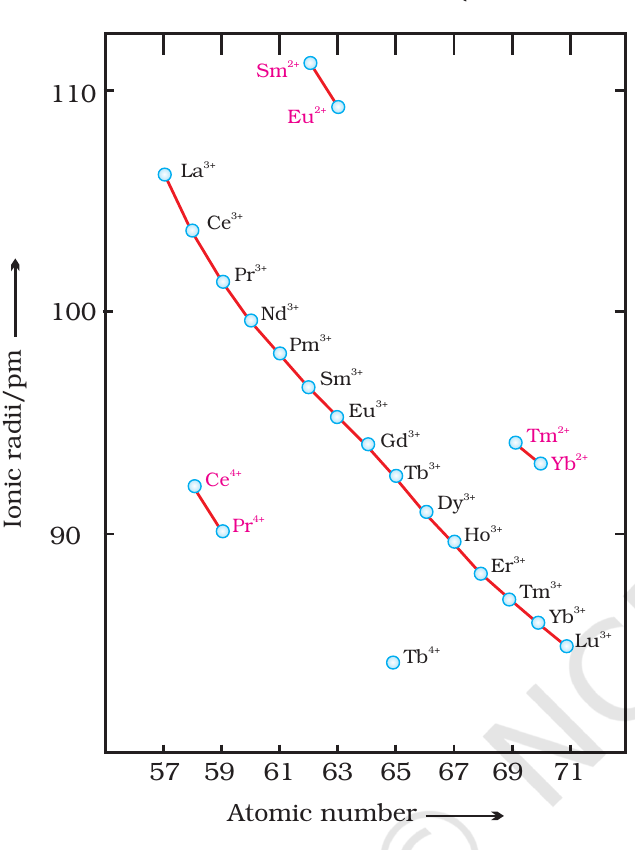
- The overall decrease in atomic and ionic radii from lanthanum to lutetium (the lanthanoid contraction) is a unique feature in the chemistry of the lanthanoids. It has far reaching consequences in the chemistry of the third transition series of the elements.
- The decrease in atomic radii (derived from the structures of metals) is not quite regular, as it is regular in M3+ ions (Fig. 4.6). This contraction is similar to that observed in an ordinary transition series and is attributed to the same cause, the imperfect shielding of one electron by another in the same subshell.
- The shielding of one 4f electron by another is less than that of one d electron by another, and as the nuclear charge increases along the series, there is a fairly regular decrease in the sizes with increasing atomic number.
- The cumulative effect of the contraction of the lanthanoid series causes the radii of the members of the third transition series to be very similar to those of the corresponding members of the second series. The almost identical radii of Zr (160 pm) and Hf (159 pm), a consequence of the lanthanoid contraction, account for their occurrence together in nature and for the difficulty faced in their separation.
- Table 4.9, Ln3+ radii in pm: La 106, Ce 103, Pr 101, Nd 99, Pm 98, Sm 96, Eu 95, Gd 94, Tb 92, Dy 91, Ho 89, Er 88, Tm 87, Yb 86, Lu 85. Atomic radii in pm: La 187, Ce 183, Pr 182, Nd 181, Pm 181, Sm 180, Eu 199, Gd 180, Tb 178, Dy 177, Ho 176, Er 175, Tm 174, Yb 173, Lu 173. Note the jump at Eu (199 pm), which breaks the smooth fall.
Suggest an edit
Practice1 question
Try it now. A wrong answer costs nothing here, try again until you get it.
How does the ionic radius of the Ln3+ ions change from $La^{3+}$ to $Yb^{3+}$?
NCERT 4.5.2 and Table 4.9: the Ln3+ ionic radius falls from 106 pm for $La^{3+}$ to 86 pm for $Yb^{3+}$, a steady decrease across the series, shown in Fig. 4.6.
Lanthanoid oxidation states and characteristics
- In the lanthanoids, La(III) and Ln(III) compounds are the predominant species (NCERT 4.5.3 misprints La(II), but lanthanum's stable state is +3). Occasionally +2 and +4 ions in solution or in solid compounds are also obtained. This irregularity arises mainly from the extra stability of empty, half-filled or filled f subshells.
- The formation of Ce(IV) is favoured by its noble gas configuration, but it is a strong oxidant reverting to the common +3 state. The E° value for $Ce^{4+}$/$Ce^{3+}$ is +1.74 V, which suggests that it can oxidise water. The reaction rate is very slow, so Ce(IV) is a good analytical reagent.
- Pr, Nd, Tb and Dy also exhibit the +4 state, but only in oxides, MO2. $Eu^{2+}$ is formed by losing the two s electrons, and its f7 configuration accounts for the formation of this ion. $Eu^{2+}$ is a strong reducing agent changing to the common +3 state. Similarly, $Yb^{2+}$, which has the f14 configuration, is a reductant. Tb(IV) has half-filled f orbitals and is an oxidant. Samarium behaves very much like europium, exhibiting both +2 and +3 oxidation states.
- Example 4.10: cerium (Z = 58) is the member of the lanthanoid series well known to exhibit the +4 oxidation state.
- All the lanthanoids are silvery white soft metals and tarnish rapidly in air. The hardness increases with increasing atomic number, samarium being steel hard. Their melting points range between 1000 and 1200 K, but samarium melts at 1623 K. They have typical metallic structure and are good conductors of heat and electricity. Density and other properties change smoothly except for Eu and Yb, and occasionally for Sm and Tm.
- Many trivalent lanthanoid ions are coloured both in the solid state and in aqueous solutions. The colour may be attributed to the presence of f electrons. Neither $La^{3+}$ nor $Lu^{3+}$ shows any colour, but the rest do. The absorption bands are narrow, probably because of the excitation within the f level.
- The lanthanoid ions other than the f0 type ($La^{3+}$ and $Ce^{4+}$) and the f14 type ($Yb^{2+}$ and $Lu^{3+}$) are all paramagnetic.
- The first ionisation enthalpies of the lanthanoids are around 600 kJ mol-1, the second about 1200 kJ mol-1, comparable with those of calcium. The abnormally low value of the third ionisation enthalpy of lanthanum, gadolinium and lutetium shows the stability of empty, half-filled and completely filled f levels.
- In their chemical behaviour, the earlier members of the series are quite reactive, similar to calcium, but with increasing atomic number they behave more like aluminium. Values of E° for the half-reaction Ln3+(aq) + 3e- -> Ln(s) are in the range of -2.2 to -2.4 V, except for Eu, for which the value is -2.0 V.
- The metals combine with hydrogen when gently heated in the gas. The carbides, Ln3C, Ln2C3 and LnC2, are formed when the metals are heated with carbon. They liberate hydrogen from dilute acids and burn in halogens to form halides. They form oxides M2O3 and hydroxides M(OH)3. The hydroxides are definite compounds, not just hydrated oxides. They are basic like alkaline earth metal oxides and hydroxides. Their general reactions are depicted in NCERT Fig. 4.7.
- The best single use of the lanthanoids is for the production of alloy steels for plates and pipes. A well known alloy is mischmetall, which consists of a lanthanoid metal (about 95%) and iron (about 5%) and traces of S, C, Ca and Al. A good deal of mischmetall is used in Mg-based alloy to produce bullets, shell and lighter flint. Mixed oxides of lanthanoids are employed as catalysts in petroleum cracking. Some individual Ln oxides are used as phosphors in television screens and similar fluorescing surfaces.
Suggest an edit
Actinoids
- The actinoids include the fourteen elements from Th to Lr. The names, symbols and some properties of these elements are given in Table 4.10.
- The actinoids are radioactive elements. The earlier members have relatively long half-lives; the latter ones have half-life values ranging from a day to 3 minutes for lawrencium (Z = 103). The latter members could be prepared only in nanogram quantities. These facts render their study more difficult.
- All the actinoids are believed to have the electronic configuration of 7s2 and variable occupancy of the 5f and 6d subshells. The fourteen electrons are formally added to 5f, though not in thorium (Z = 90), but from Pa onwards the 5f orbitals are complete at element 103.
- The irregularities in the electronic configurations of the actinoids, like those in the lanthanoids, are related to the stabilities of the f0, f7 and f14 occupancies of the 5f orbitals. The configurations of Am and Cm are [Rn] 5f7 7s2 and [Rn] 5f7 6d1 7s2.
- Although the 5f orbitals resemble the 4f orbitals in their angular part of the wave function, they are not as buried as 4f orbitals, and hence 5f electrons can participate in bonding to a far greater extent.
- There is a gradual decrease in the size of atoms or M3+ ions across the series. This may be referred to as the actinoid contraction (like lanthanoid contraction). The contraction is, however, greater from element to element in this series, resulting from poor shielding by 5f electrons.
- There is a greater range of oxidation states, which is in part attributed to the fact that the 5f, 6d and 7s levels are of comparable energies. The known oxidation states of actinoids are listed in Table 4.11.
- The actinoids show in general the +3 oxidation state. The elements in the first half of the series frequently exhibit higher oxidation states. The maximum oxidation state increases from +4 in Th to +5, +6 and +7 respectively in Pa, U and Np, but decreases in succeeding elements (Table 4.11).
- The actinoids resemble the lanthanoids in having more compounds in the +3 state than in the +4 state. However, +3 and +4 ions tend to hydrolyse. Because the distribution of oxidation states among the actinoids is so uneven and so different for the former and later elements, it is unsatisfactory to review their chemistry in terms of oxidation states.
- Table 4.11: Ac +3; Th +3, +4; Pa +3, +4, +5; U +3, +4, +5, +6; Np +3, +4, +5, +6, +7; Pu +3, +4, +5, +6, +7; Am +3, +4, +5, +6; Cm +3, +4; Bk +3, +4; Cf +3, +4; Es, Fm, Md, No, Lr +3 only.
- The actinoid metals are all silvery in appearance but display a variety of structures. The structural variability is due to irregularities in metallic radii, which are far greater than in lanthanoids.
- The actinoids are highly reactive metals, especially when finely divided. The action of boiling water on them gives a mixture of oxide and hydride, and combination with most non-metals takes place at moderate temperatures. Hydrochloric acid attacks all metals, but most are slightly affected by nitric acid owing to the formation of protective oxide layers; alkalies have no action.
- The magnetic properties of the actinoids are more complex than those of the lanthanoids. Although the variation in the magnetic susceptibility of the actinoids with the number of unpaired 5f electrons is roughly parallel to the corresponding results for the lanthanoids, the latter have higher values.
- The ionisation enthalpies of the early actinoids, though not accurately known, are lower than for the early lanthanoids. When 5f orbitals are beginning to be occupied, they penetrate less into the inner core of electrons. The 5f electrons are therefore more effectively shielded from the nuclear charge than the 4f electrons of the corresponding lanthanoids. Because the outer electrons are less firmly held, they are available for bonding in the actinoids.
- A comparison of the actinoids with the lanthanoids shows that behaviour similar to that of the lanthanoids is not evident until the second half of the actinoid series. Even the early actinoids resemble the lanthanoids in showing close similarities with each other and in gradual variation in properties which do not entail change in oxidation state.
- The lanthanoid and actinoid contractions have extended effects on the sizes, and therefore the properties, of the elements succeeding them in their respective periods. The lanthanoid contraction is more important because the chemistry of the elements succeeding the actinoids is much less known at the present time.
- Intext Question 4.10, answered in the book: actinoid contraction is greater from element to element than lanthanoid contraction because the 5f electrons are more effectively shielded from nuclear charge; in other words, the 5f electrons themselves provide poor shielding from element to element in the series.
Suggest an edit
Ladder: oxidation state stability rules
- Maximum oxidation state equals s plus d electrons only up to Mn: Ti(IV) in $TiO_2$, V(V) in $VO_2^+$, Cr(VI) in $CrO_4^{2-}$, Mn(VII) in $MnO_4^-$. Beyond Mn the higher states collapse: Fe(VI) exists only as ferrate in alkaline media, and Cu and Zn never pass +2.
- The middle of the series gives the most oxidation states: Mn shows +2 to +7. The ends give the fewest: Sc shows only +3, Zn only +2.
- d5 is the stability anchor: $Mn^{2+}$ (d5) resists oxidation to $Mn^{3+}$, so E°($Mn^{3+}$/$Mn^{2+}$) is +1.57 V; $Fe^{3+}$ (d5) is extra stable, so E°($Fe^{3+}$/$Fe^{2+}$) is only +0.77 V; $Cr^{2+}$ (d4) gives up an electron to reach d3 with a half-filled t2g level, so it is a strong reducing agent.
- The second ionisation enthalpy is unusually high for Cr and Cu because M+ is d5 and d10. It is low for Zn because ionisation removes a 4s electron and leaves d10.
- The third ionisation enthalpy is high for Cu, Ni and Zn, so oxidation states above +2 are hard to reach for them. The third ionisation enthalpy of Fe is lower than that of Mn because $Fe^{2+}$ is d6 and loses no exchange energy on going to d5, while $Mn^{2+}$ is d5 and loses exchange energy on going to d4.
- In the groups, heavier d-block members favour higher oxidation states, the opposite of the p-block inert pair effect: Mo(VI) and W(VI) are more stable than Cr(VI).
- Fluorine and oxygen stabilise the highest states: $VF_5$ and $CrF_6$ for fluorine, $Mn_2O_7$ for oxygen. Oxygen goes further than fluorine because it can form multiple bonds: the highest Mn fluoride is $MnF_4$, but the highest oxide is $Mn_2O_7$.
- In the lanthanoids, +3 rules, and +2 or +4 appear only where f0, f7 or f14 is reached: $Ce^{4+}$ (f0), $Eu^{2+}$ (f7), $Yb^{2+}$ (f14), $Tb^{4+}$ (f7). In the actinoids, +3 rules, and the maximum climbs from +4 in Th to +7 in Np and then falls.
- How to use the ladder in a question: first ask whether the state is at the middle or the end of the series, then check for a d5 or d10 or f0, f7 or f14 configuration, then check whether the medium is acid or alkaline for $MnO_4^-$ and $Cr_2O_7^{2-}$.
Suggest an edit
Ladder: trap pairs
- Transition metal vs d-block element: Zn, Cd and Hg are d-block elements but not transition metals, because their d subshell is full in the atom and in their common ions. Sc is a transition metal (3d1); Ag is one too, through its +2 state (4d9).
- Cr oxidation states in chromate and dichromate: the same, +6, in both. Changing the $\mathrm{pH}$ interconverts $CrO_4^{2-}$ and $Cr_2O_7^{2-}$ without changing the oxidation state. NEET 2020 Q111 tests exactly this.
- Zr and Hf radii: almost identical (160 pm and 159 pm) because of the lanthanoid contraction, not because they are in the same group. NEET 2021 Q52 tests exactly this.
- $KMnO_4$ product by medium: acid gives $Mn^{2+}$ (+2), neutral or faintly alkaline gives $MnO_2$ (+4), alkaline gives green manganate $MnO_4^{2-}$ (+6).
- Magnetic moments: $Cr^{2+}$ (d4) is 4.90 BM and $Mn^{2+}$ (d5) is 5.92 BM. Do not swap them. NEET 2020 Q99 tests $Cr^{2+}$.
- $Cu^+$ in water: disproportionates, 2Cu+ -> $Cu^{2+}$ + Cu, so $Cu^{2+}$ is the stable aqueous ion, not $Cu^+$. The driver is the much more negative hydration enthalpy of $Cu^{2+}$.
- Colour: d0 ($Sc^{3+}$, $Ti^{4+}$) and d10 ($Zn^{2+}$, $Cu^+$) ions are colourless because no d-d transition is possible. Every other first-row aquated ion in Table 4.8 is coloured.
- Transition-metal catalysis: catalytic activity of transition metals and their compounds ($V_2O_5$ in the Contact process, Fe in Haber's process, Ni in catalytic hydrogenation) comes from their variable oxidation states and ability to form complexes. This is the catalyst use of the 3d metals (NCERT 4.3.12).
- Lanthanoid colour: most Ln3+ ions are coloured in the solid state and in solution. Only $La^{3+}$ and $Lu^{3+}$ show no colour. NEET 2021 Q63 tests this with the word most.
- Actinoid contraction vs lanthanoid contraction: the actinoid contraction is greater from element to element because 5f electrons shield poorly. Do not reverse them.
Suggest an edit
Trap Boxes
Every d-block element is a transition metal?
Wrong idea: Zn, Cd and Hg are transition metals because they sit in the d-block.
Zn, Cd and Hg have the full d10 configuration in the ground state and in their common oxidation states, so by the IUPAC definition they are not transition metals. Sc (3d1) is one, and Ag is one because it can show the +2 state with incomplete 4d orbitals (4d9).
NCERT XII, Ch 4, 4.1 and 4.2
Cr has different oxidation states in chromate and dichromate?
Wrong idea: The oxidation state of Cr in $CrO_4^{2-}$ is different from that in $Cr_2O_7^{2-}$.
Cr is +6 in both $CrO_4^{2-}$ and $Cr_2O_7^{2-}$. Changing the $\mathrm{pH}$ interconverts chromate and dichromate but does not change the oxidation state of Cr. NEET 2020 Q111: the statement that the oxidation states are not the same is the incorrect one.
NCERT XII, Ch 4, 4.4.1
Zr and Hf have the same radii because they are in the same group?
Wrong idea: Zr and Hf have similar radii simply because they belong to the same group.
Zr (160 pm) and Hf (159 pm) have almost identical radii because the lanthanoid contraction cancels the expected growth from the 4d to the 5d series. NEET 2021 Q52: the answer is lanthanoid contraction, not same group or similar chemical properties.
NCERT XII, Ch 4, 4.3.2 and 4.5.2
$KMnO_4$ always reduces to $Mn^{2+}$?
Wrong idea: $KMnO_4$ always reduces to $Mn^{2+}$, whatever the medium.
The product depends on the medium: acid gives $Mn^{2+}$ (+7 to +2), neutral or faintly alkaline gives $MnO_2$ (+7 to +4), alkaline gives green manganate (+7 to +6).
NCERT XII, Ch 4, 4.4.1
The spin-only moment of $Cr^{2+}$ is 5.92 BM?
Wrong idea: $Cr^{2+}$ has a spin-only magnetic moment of 5.92 BM.
$Cr^{2+}$ is d4 with 4 unpaired electrons, so mu = sqrt(4 x 6) = 4.90 BM. The 5.92 BM value belongs to $Mn^{2+}$, which is d5 with 5 unpaired electrons. NEET 2020 Q99: the answer for $Cr^{2+}$ is 4.90 BM.
NCERT XII, Ch 4, 4.3.9, Table 4.7
Chapter test
5 NEET PYQs. +4 for a correct answer, -1 for a wrong answer, exactly like NEET. Finish the test to earn a medal.
Q1: NEET (UG) 2022, Code R1, Q84
Gadolinium has a low value of third ionisation enthalpy because of
NCERT 4.5.4: the third ionisation enthalpy of Gd is abnormally low because removing the third electron gives $Gd^{3+}$ with the extra-stable half-filled 4f7 configuration, so the high exchange energy stabilises it.
Q2: NEET (UG) 2021, Code P3, Q63
The incorrect statement among the following is :
NCERT 4.5.4: many trivalent lanthanoid ions are coloured both in the solid state and in aqueous solution. Only the f0 type ($La^{3+}$, $Ce^{4+}$) and the f14 type ($Yb^{2+}$, $Lu^{3+}$) are colourless, so statement (3) is incorrect.
Q3: NEET (UG) 2021, Code P3, Q52
Zr (Z = 40) and Hf (Z = 72) have similar atomic and ionic radii because of :
NCERT 4.3.2 and 4.5.2: the almost identical radii of Zr (160 pm) and Hf (159 pm) are a consequence of the lanthanoid contraction.
Q4: NEET (UG) 2020, Code G5, Q111
Identify the incorrect statement.
Cr is +6 in both $CrO_4^{2-}$ and $Cr_2O_7^{2-}$, so statement (3) is the incorrect one. The other three statements are NCERT text: catalytic activity (4.3.12), interstitial compounds (4.3.13) and $Cr^{2+}$ as a stronger reducing agent than $Fe^{2+}$ (4.3.8).
Q5: NEET (UG) 2020, Code G5, Q99
The calculated spin only magnetic moment of $Cr^{2+}$ ion is
$Cr^{2+}$ is 3d4 with 4 unpaired electrons, so mu = sqrt(4 x 6) = 4.90 BM (NCERT Table 4.7).
Score: 0 · Answered 0 of 5
Flashcards
Tap a card to flip it over and see the answer. Tap it again to flip it back.
Give the general outer electronic configuration of the d-block elements and the configurations of Cr, Cu and Pd.
Tap to flipGeneral outer configuration (n-1)d1-10 ns1-2. Exceptions: Cr is 3d5 4s1 (not 3d4 4s2), Cu is 3d10 4s1 (not 3d9 4s2), Pd is 4d10 5s0. Half-filled and completely filled sets are extra stable.
Tap to flip backState the spin-only formula for magnetic moment and the values for $Mn^{2+}$ and $Cr^{2+}$.
Tap to flipmu = sqrt(n(n+2)) BM, where n is the number of unpaired electrons. One unpaired electron gives 1.73 BM. $Mn^{2+}$ (d5, n = 5) gives sqrt(35) = 5.92 BM; $Cr^{2+}$ (d4, n = 4) gives sqrt(24) = 4.90 BM.
Tap to flip backHow do melting points and enthalpies of atomisation vary across a transition series?
Tap to flipMelting points rise to a maximum at d5 in each series (except for anomalous Mn and Tc) and then fall regularly as atomic number increases. Enthalpies of atomisation also peak near the middle of each series, and the metals of the second and third series have greater enthalpies of atomisation than the first series.
Tap to flip backArrange $VO_2^+$, $Cr_2O_7^{2-}$ and $MnO_4^-$ in order of increasing oxidising power and give the reason.
Tap to flip$VO_2^+$ < $Cr_2O_7^{2-}$ < $MnO_4^-$. The oxidising power rises because the lower species to which they are reduced become more stable along the series.
Tap to flip backGive the enthalpy of atomisation of Zn and the E°(M2+/M) value of Cu, with the reason for each.
Tap to flipZn has the lowest enthalpy of atomisation in the 3d series, 126 kJ mol-1, because no 3d electrons take part in metallic bonding. Cu has E°(M2+/M) = +0.34 V, the only positive value in the first series, so it cannot liberate $H_2$ from acids.
Tap to flip backGive E° for $Ce^{4+}$/$Ce^{3+}$ and the range of E°(Ln3+/Ln) for the lanthanoids.
Tap to flipE°($Ce^{4+}$/$Ce^{3+}$) = +1.74 V, so Ce(IV) is a strong oxidant but reacts slowly with water and is a good analytical reagent. E°(Ln3+/Ln) lies between -2.2 V and -2.4 V for the lanthanoids, except Eu at -2.0 V.
Tap to flip backWhy are Zn, Cd and Hg not transition metals, while Ag is one?
Tap to flipZn, Cd and Hg have full d configurations in the ground state and in their common oxidation states, so IUPAC does not count them as transition metals. Ag is a transition metal because it can show the +2 state, in which it has incomplete 4d orbitals (4d9).
Tap to flip backWhy is $Cr^{2+}$ strongly reducing while $Mn^{3+}$ is strongly oxidising, although both are d4?
Tap to flipBoth are d4, but $Cr^{2+}$ is strongly reducing because it changes d4 to d3, a half-filled t2g level, while $Mn^{3+}$ is strongly oxidising because it changes d4 to d5, the extra-stable half-filled configuration.
Tap to flip backWrite the steps for preparing $K_2Cr_2O_7$ from chromite ore.
Tap to flip4FeCr2O4 + 8Na2CO3 + 7O2 -> 8Na2CrO4 + 2Fe2O3 + 8CO2; 2Na2CrO4 + 2H+ -> $Na_2Cr_2O_7$ + 2Na+ + $H_2O$; $Na_2Cr_2O_7$ + 2KCl -> $K_2Cr_2O_7$ + 2NaCl. Chromate and dichromate interconvert with $\mathrm{pH}$: 2$CrO_4^{2-}$ + 2H+ -> $Cr_2O_7^{2-}$ + $H_2O$.
Tap to flip backWrite the preparation of $KMnO_4$ from $MnO_2$, including the disproportionation of manganate.
Tap to flip2MnO2 + 4KOH + $O_2$ -> 2K2MnO4 + 2H2O; then manganate disproportionates in neutral or acidic solution: 3$MnO_4^{2-}$ + 4H+ -> 2$MnO_4^-$ + $MnO_2$ + 2H2O. In the laboratory, $Mn^{2+}$ is oxidised by peroxodisulphate: 2Mn2+ + 5$S_2O_8^{2-}$ + 8H2O -> 2$MnO_4^-$ + 10$SO_4^{2-}$ + 16H+.
Tap to flip backWhat are interstitial compounds? Give examples and their main properties.
Tap to flipSmall atoms H, C or N are trapped inside the crystal lattices of metals, for example TiC, $Mn_4N$, $Fe_3H$, $VH_0$.56 and $TiH_1$.7. They are non-stoichiometric, neither typically ionic nor covalent, have high melting points, are very hard, retain metallic conductivity and are chemically inert.
Tap to flip backName the lanthanoids that show +4 and +2 states and the f configuration behind each.
Tap to flip$Ce^{4+}$ is favoured by its noble gas (f0) configuration; $Eu^{2+}$ by the half-filled f7 configuration; $Yb^{2+}$ by the filled f14 configuration; $Tb^{4+}$ by the half-filled f7 orbitals. The common state is +3; +2 and +4 appear because empty, half-filled and filled f subshells are extra stable.
Tap to flip back