 NEET Notes
Home > Chemistry > Inorganic > Classification of Elements and Periodicity in Properties
Classification of Elements and Periodicity in Properties
On this page · 18 sections
- 01Syllabus map
- 02Why do we need to classify elements?
- 03Genesis of periodic classification
- 04Modern Periodic Law and the long form
- 05IUPAC nomenclature of elements above 100
- 06Table: IUPAC roots and elements above 100
- 07Electronic configurations in periods
- 08s-, p-, d- and f-blocks
- 09Table: the four blocks at a glance
- 10Metals, non-metals and metalloids
- 11Atomic and ionic radii
- 12Ionisation enthalpy
- 13Ladder: ionisation enthalpy exceptions
- 14Electron gain enthalpy
- 15Electronegativity
- 16Table: electron gain enthalpies and electronegativity
- 17Valence, oxidation states and chemical reactivity
- 18Trap pairs: the confusions NEET tests
How Mendeleev and the modern table organise the elements, and how atomic size, ionisation enthalpy, electron gain enthalpy and electronegativity change across periods and down groups.
Syllabus map
- NMC Unit: CHEM-U09, Classification of Elements and Periodicity in Properties.
- Subtopics in this chapter (NCERT XI, Ch 3): need for classification (3.1); genesis of periodic classification, Dobereiner triads, Newlands octaves, Mendeleev Periodic Law (3.2); Modern Periodic Law and the long form of the Periodic Table (3.3); IUPAC nomenclature of elements with Z > 100 (3.4); electronic configurations and the Periodic Table (3.5); s-, p-, d-, f-blocks (3.6); metals, non-metals and metalloids (3.6.5); periodic trends in atomic and ionic radii, ionisation enthalpy, electron gain enthalpy and electronegativity (3.7.1); valence and oxidation states, anomalous properties of second period elements (3.7.2); periodic trends and chemical reactivity, oxides (3.7.3).
- Subtopic checklist: (1) 31 elements in 1800, 63 by 1865; (2) triads and octaves; (3) Mendeleev law and Eka-Aluminium / Eka-Silicon gaps; (4) Moseley and the Modern Periodic Law; (5) 7 periods, 18 groups, period sizes 2, 8, 8, 18, 18, 32; (6) IUPAC roots nil to enn and names above 100; (7) period filling and group ns1 alkali metals; (8) four blocks and the He and H exceptions; (9) metals over 78 per cent, metalloids Si, Ge, As, Sb, Te; (10) atomic radii Table 3.6 values; (11) cation smaller, anion larger, isoelectronic species; (12) ionisation enthalpy trends and the Be/B and N/O exceptions; (13) electron gain enthalpy Table 3.7 values, Cl most negative; (14) electronegativity, F = 4.0 Pauling; (15) valence = outer electrons or 8 minus outer electrons; (16) diagonal relationship, max covalency 4 for second period; (17) basic, amphoteric and acidic oxides.
- Extra information (beyond NCERT): none.
- Excluded topics: the separate s-block elements chapter, hydrogen chapter, solid state, surface chemistry, environmental chemistry, polymers and chemistry in everyday life are deleted from the NMC syllabus. This chapter keeps only the block classification in 3.6.
- Estimated revision time: 10 minutes. Jump links: Syllabus Map, Why Classify, Genesis, Modern Law, IUPAC Names, IUPAC Table, Period Filling, Four Blocks, Blocks Table, Metals and Non-Metals, Radii, Ionisation Enthalpy, IE Exceptions, Electron Gain Enthalpy, Electronegativity, Trends Table, Valence and Reactivity, Trap Pairs.
Suggest an edit
Why do we need to classify elements?
The elements are the basic units of all types of matter. In 1800, only 31 elements were known. By 1865, the number of identified elements had more than doubled to 63. At present 114 elements are noted in NCERT 3.1 (updated to 118 officially named elements in NCERT 3.4), and the recently discovered elements are man-made. Efforts to synthesise new elements are continuing.
With such a large number of elements it is very difficult to study individually the chemistry of all these elements and their innumerable compounds. To ease out this problem, scientists searched for a systematic way to organise their knowledge by classifying the elements. Not only would it rationalize known chemical facts about elements, but it would even predict new ones for undertaking further study.
The Periodic Table is arguably the most important concept in chemistry, both in principle and in practice. It suggests new avenues of research to professionals and provides a succinct organisation of the whole of chemistry. The chemical elements are not a random cluster of entities but instead display trends and lie together in families.
Suggest an edit
Genesis of periodic classification
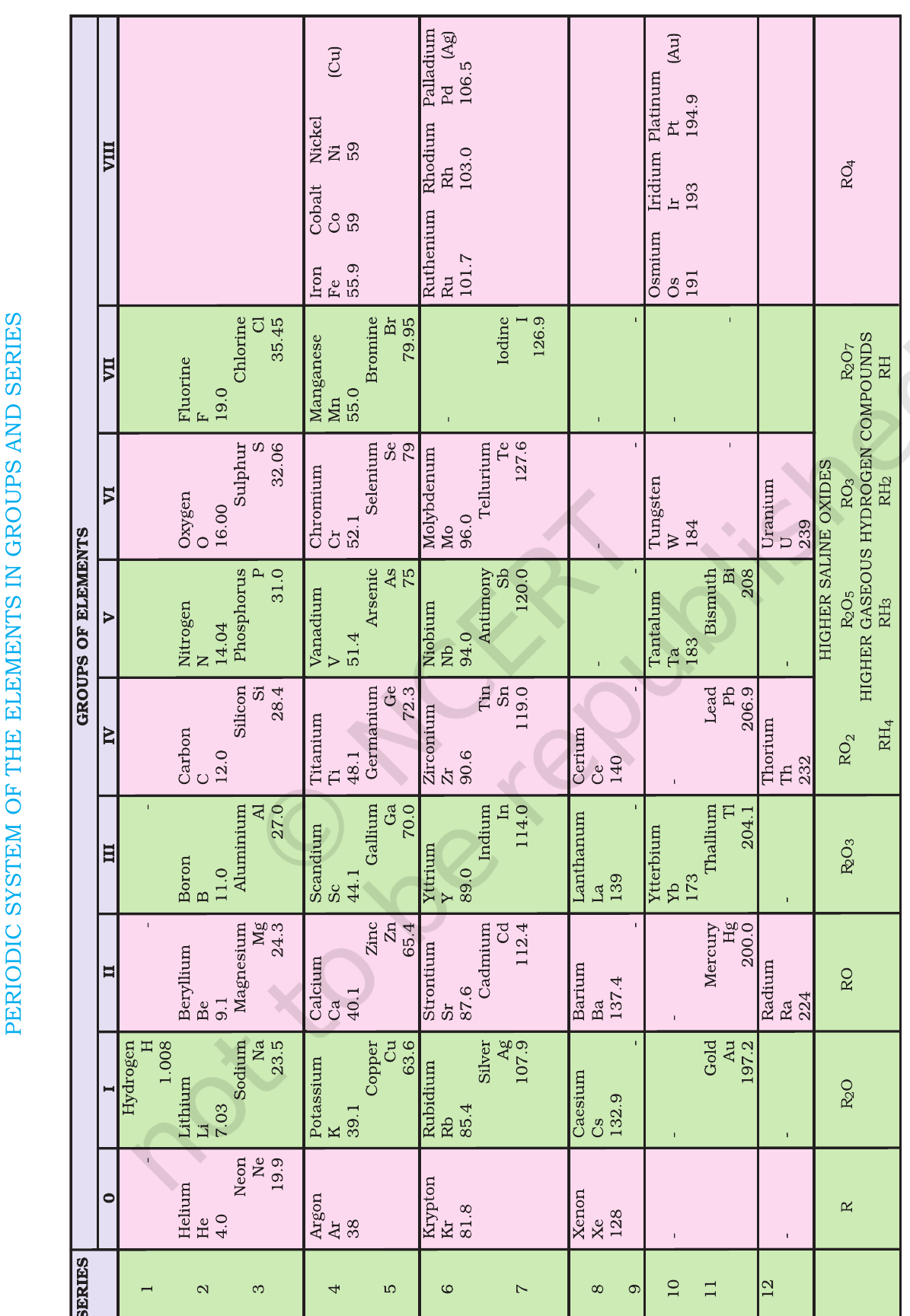
The German chemist Johann Dobereiner in the early 1800s was the first to consider the idea of trends among properties of elements. By 1829 he noted a similarity among the physical and chemical properties of several groups of three elements (Triads). In each case, the middle element of each Triad had an atomic weight about half way between the atomic weights of the other two, and its properties were in between those of the other two members. His triads were Li 7, Na 23, K 39; Ca 40, Sr 88, Ba 137; and Cl 35.5, Br 80, I 127. The Law of Triads seemed to work only for a few elements, so it was dismissed as coincidence.
| Element | Atomic weight | Element | Atomic weight | Element | Atomic weight |
|---|---|---|---|---|---|
| Li | 7 | Ca | 40 | Cl | 35.5 |
| Na | 23 | Sr | 88 | Br | 80 |
| K | 39 | Ba | 137 | I | 127 |
- Table 3.1: Dobereiner's Triads.
The French geologist A.E.B. de Chancourtois in 1862 arranged the then known elements in order of increasing atomic weights and made a cylindrical table of elements to display the periodic recurrence of properties. The English chemist John Alexander Newlands in 1865 propounded the Law of Octaves. He arranged the elements in increasing order of their atomic weights and noted that every eighth element had properties similar to the first element, just like every eighth note that resembles the first in octaves of music. Newlands's Law of Octaves seemed to be true only for elements up to calcium. He was later awarded the Davy Medal in 1887 by the Royal Society, London.
| Element | Li | Be | B | C | N | O | F |
|---|---|---|---|---|---|---|---|
| At. wt. | 7 | 9 | 11 | 12 | 14 | 16 | 19 |
| Element | Na | Mg | Al | Si | P | S | Cl |
| At. wt. | 23 | 24 | 27 | 29 | 31 | 32 | 35.5 |
| Element | K | Ca | - | - | - | - | - |
| At. wt. | 39 | 40 | - | - | - | - | - |
- Table 3.2: Newlands' Octaves.
The Periodic Law as we know it today owes its development to the Russian chemist Dmitri Mendeleev (1834-1907) and the German chemist Lothar Meyer (1830-1895). Working independently, both chemists in 1869 proposed that on arranging elements in increasing order of their atomic weights, similarities appear in physical and chemical properties at regular intervals. Lothar Meyer plotted physical properties such as atomic volume, melting point and boiling point against atomic weight and obtained a periodically repeated pattern. By 1868 he had developed a table of the elements that closely resembles the Modern Periodic Table, but his work was not published until after the work of Mendeleev.
Mendeleev arranged elements in horizontal rows and vertical columns in order of their increasing atomic weights in such a way that elements with similar properties fell in the same vertical column. His Periodic Law states: The properties of the elements are a periodic function of their atomic weights. He ignored the order of atomic weights where it clashed with properties, thinking the atomic measurements might be incorrect, and placed elements with similar properties together. For example, iodine with lower atomic weight than tellurium was placed in Group VII along with fluorine, chlorine and bromine because of similarities in properties. Keeping his aim of arranging elements of similar properties in the same group, he left gaps for elements still undiscovered. He left the gap under aluminium and a gap under silicon, and called these elements Eka-Aluminium and Eka-Silicon. Both gallium and germanium were unknown at the time, and Mendeleev predicted not only their existence but also their properties.
| Property | Eka-aluminium (predicted) | Gallium (found) | Eka-silicon (predicted) | Germanium (found) |
|---|---|---|---|---|
| Atomic weight | 68 | 70 | 72 | 72.6 |
| Density/(g/cm3) | 5.9 | 5.94 | 5.5 | 5.36 |
| Melting point/K | Low | 302.93 | High | 1231 |
| Formula of oxide | E2O3 | $Ga_2O_3$ | EO2 | $GeO_2$ |
| Formula of chloride | ECl3 | $GaCl_3$ | ECl4 | $GeCl_4$ |
- Table 3.3: Mendeleev's Predictions for the Elements Eka-aluminium (Gallium) and Eka-silicon (Germanium).
Suggest an edit
Modern Periodic Law and the long form
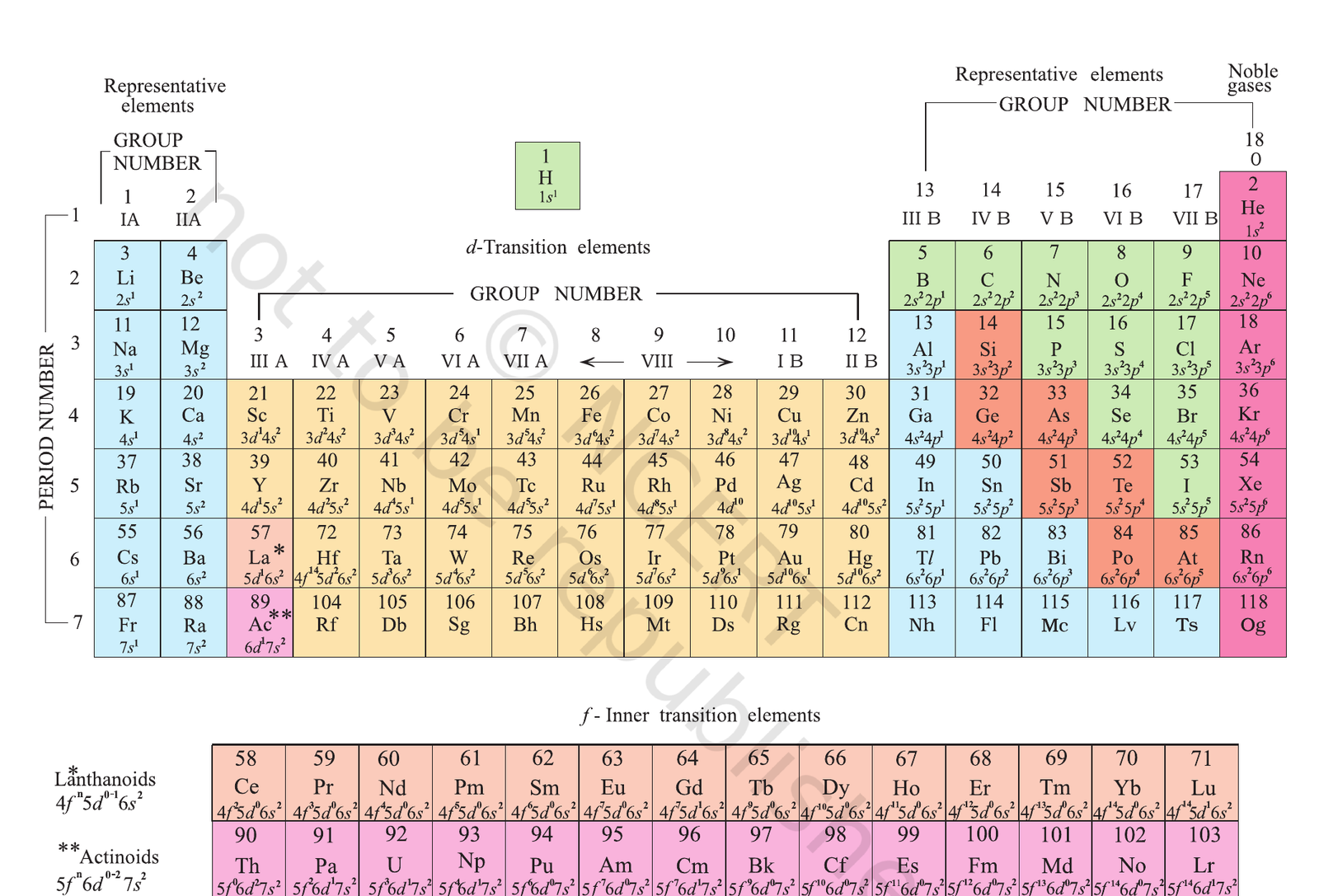
When Mendeleev developed his Periodic Table, chemists knew nothing about the internal structure of the atom. In 1913, the English physicist Henry Moseley observed regularities in the characteristic X-ray spectra of the elements. A plot of √ν (the square root of the frequency of X-rays emitted) against atomic number (Z) gave a straight line, and not the plot against atomic mass. He thereby showed that the atomic number is a more fundamental property of an element than its atomic mass. Mendeleev's Periodic Law was therefore modified into the Modern Periodic Law: The physical and chemical properties of the elements are periodic functions of their atomic numbers.
You may recall that the atomic number is equal to the nuclear charge (i.e., number of protons) or the number of electrons in a neutral atom. The Periodic Law is essentially the consequence of the periodic variation in electronic configurations, which indeed determine the physical and chemical properties of elements and their compounds. The Periodic Law revealed important analogies among the 94 naturally occurring elements (neptunium and plutonium, like actinium and protoactinium, are also found in pitchblende, an ore of uranium).
The modern version, the so-called long form of the Periodic Table (Fig. 3.2), is the most convenient and widely used. The horizontal rows (which Mendeleev called series) are called periods and the vertical columns are called groups. Elements having similar outer electronic configurations in their atoms are arranged in vertical columns, referred to as groups or families. According to IUPAC, the groups are numbered from 1 to 18, replacing the older notation of groups IA to VIIA, VIII, IB to VIIB and 0.
There are altogether seven periods. The period number corresponds to the highest principal quantum number (n) of the elements in the period. The first period contains 2 elements. The subsequent periods consist of 8, 8, 18, 18 and 32 elements, respectively. The seventh period is incomplete and, like the sixth period, would have a theoretical maximum of 32 elements. In this form of the Periodic Table, 14 elements of both sixth and seventh periods (lanthanoids and actinoids, respectively) are placed in separate panels at the bottom.
Footnote: Glenn T. Seaborg's work in the middle of the 20th century, starting with the discovery of plutonium in 1940, followed by those of all the transuranium elements from 94 to 102, led to reconfiguration of the periodic table, placing the actinoids below the lanthanoids. In 1951, Seaborg was awarded the Nobel Prize in chemistry for his work. Element 106 has been named Seaborgium (Sg) in his honour.
Suggest an edit
Practice1 question
Try it now. A wrong answer costs nothing here, try again until you get it.
Moseley studied the characteristic X-ray spectra of the elements in 1913. Which property did he show to be more fundamental than atomic mass?
NCERT 3.3: Moseley plotted √ν (the square root of the X-ray frequency) against atomic number and got a straight line, showing atomic number is more fundamental than atomic mass.
IUPAC nomenclature of elements above 100
The naming of new elements had traditionally been the privilege of the discoverer, and the suggested name was ratified by IUPAC. In recent years this has led to controversy. The new elements with very high atomic numbers are so unstable that only minute quantities, sometimes only a few atoms, are obtained. Both American and Soviet scientists claimed credit for discovering element 104: the Americans named it Rutherfordium whereas the Soviets named it Kurchatovium.
To avoid such problems, IUPAC recommended that until a new element's discovery is proved and its name is officially recognised, a systematic nomenclature be derived directly from the atomic number using the numerical roots for 0 and numbers 1-9. The roots are put together in order of the digits which make up the atomic number and 'ium' is added at the end. The new element first gets a temporary name, with a symbol consisting of three letters. Later a permanent name and symbol are given by a vote of IUPAC representatives from each country. The permanent name might reflect the country in which the element was discovered, or pay tribute to a notable scientist. As of now, elements with atomic numbers up to 118 have been discovered, and official names of all elements have been announced by IUPAC.
Problem 3.1 asks for the IUPAC name and symbol for the element with atomic number 120. From Table 3.4, the roots for 1, 2 and 0 are un, bi and nil, respectively. Hence the symbol and the name are Ubn and unbinilium.
Suggest an edit
Table: IUPAC roots and elements above 100
| Digit | Name | Abbreviation |
|---|---|---|
| 0 | nil | n |
| 1 | un | u |
| 2 | bi | b |
| 3 | tri | t |
| 4 | quad | q |
| 5 | pent | p |
| 6 | hex | h |
| 7 | sept | s |
| 8 | oct | o |
| 9 | enn | e |
| Atomic Number | Name according to IUPAC nomenclature | Symbol | IUPAC Official Name | IUPAC Symbol |
|---|---|---|---|---|
| 101 | Unnilunium | Unu | Mendelevium | Md |
| 102 | Unnilbium | Unb | Nobelium | No |
| 103 | Unniltrium | Unt | Lawrencium | Lr |
| 104 | Unnilquadium | Unq | Rutherfordium | Rf |
| 105 | Unnilpentium | Unp | Dubnium | Db |
| 106 | Unnilhexium | Unh | Seaborgium | Sg |
| 107 | Unnilseptium | Uns | Bohrium | Bh |
| 108 | Unniloctium | Uno | Hassium | Hs |
| 109 | Unnilennium | Une | Meitnerium | Mt |
| 110 | Ununnillium | Uun | Darmstadtium | Ds |
| 111 | Unununnium | Uuu | Rontgenium | Rg |
| 112 | Ununbium | Uub | Copernicium | Cn |
| 113 | Ununtrium | Uut | Nihonium | Nh |
| 114 | Ununquadium | Uuq | Flerovium | Fl |
| 115 | Ununpentium | Uup | Moscovium | Mc |
| 116 | Ununhexium | Uuh | Livermorium | Lv |
| 117 | Ununseptium | Uus | Tennessine | Ts |
| 118 | Ununoctium | Uuo | Oganesson | Og |
Source: NCERT XI, Ch 3, Tables 3.4 and 3.5. Roots are joined in digit order with 'ium' added at the end; the temporary symbol has three letters.
Suggest an edit
Practice1 question
Try it now. A wrong answer costs nothing here, try again until you get it.
What is the IUPAC systematic name for the element with atomic number 120?
NCERT 3.4, Problem 3.1: the roots for 1, 2 and 0 are un, bi and nil, so the name is unbinilium and the symbol is Ubn.
Electronic configurations in periods
In the preceding unit we have learnt that an electron in an atom is characterised by a set of four quantum numbers, and the principal quantum number (n) defines the main energy level known as shell. We have also studied about the filling of electrons into different subshells, also referred to as orbitals (s, p, d, f) in an atom. The distribution of electrons into orbitals of an atom is called its electronic configuration.
An element's location in the Periodic Table reflects the quantum numbers of the last orbital filled. The period indicates the value of n for the outermost or valence shell. A successive period is associated with the filling of the next higher principal energy level. The number of elements in each period is twice the number of atomic orbitals available in the energy level that is being filled.
The first period (n = 1) starts with the filling of the lowest level (1s) and has two elements, hydrogen (1s1) and helium (1s2), when the first shell (K) is completed. The second period (n = 2) starts with lithium and the third electron enters the 2s orbital. Beryllium has the configuration 1s2 2s2. Starting from boron, the 2p orbitals are filled, and the L shell is completed at neon (2s2 2p6). There are 8 elements in the second period. The third period (n = 3) begins at sodium, and successive filling of 3s and 3p orbitals gives 8 elements from sodium to argon.
The fourth period (n = 4) starts at potassium, and the added electrons fill the 4s orbital. Before the 4p orbital is filled, filling up of 3d orbitals becomes energetically favourable, giving the 3d transition series. This starts from scandium (Z = 21) with the configuration 3d1 4s2. The 3d orbitals are filled at zinc (Z = 30) with 3d10 4s2. The fourth period ends at krypton with the filling up of the 4p orbitals, with 18 elements in all. The fifth period (n = 5) beginning with rubidium is similar and contains the 4d transition series starting at yttrium (Z = 39), ending at xenon, with 18 elements.
The sixth period (n = 6) contains 32 elements, with successive electrons entering 6s, 4f, 5d and 6p orbitals. Filling up of the 4f orbitals begins with cerium (Z = 58) and ends at lutetium (Z = 71) to give the 4f-inner transition series called the lanthanoid series. The seventh period (n = 7) is similar, with successive filling of 7s, 5f, 6d and 7p orbitals, and includes most of the man-made radioactive elements. This period will end at the element with atomic number 118, which would belong to the noble gas family. Filling up of the 5f orbitals after actinium (Z = 89) gives the 5f-inner transition series known as the actinoid series.
Problem 3.2 asks how to justify 18 elements in the 5th period. When n = 5, l = 0, 1, 2, 3. The order in which the energy of the available orbitals 4d, 5s and 5p increases is 5s < 4d < 5p. The total number of orbitals available is 9, the maximum number of electrons that can be accommodated is 18, and therefore 18 elements are there in the 5th period.
Elements in the same group have similar valence shell electronic configurations, the same number of electrons in the outer orbitals, and similar properties. The Group 1 elements (alkali metals) all have ns1 valence shell electronic configuration: Li [He]2s1, Na [Ne]3s1, K [Ar]4s1, Rb [Kr]5s1, Cs [Xe]6s1, Fr [Rn]7s1. The properties of an element have periodic dependence upon its atomic number and not on relative atomic mass.
| Atomic number | Symbol | Electronic configuration |
|---|---|---|
| 3 | Li | 1s2 2s1 (or) [He]2s1 |
| 11 | Na | 1s2 2s2 2p6 3s1 (or) [Ne]3s1 |
| 19 | K | 1s2 2s2 2p6 3s2 3p6 4s1 (or) [Ar]4s1 |
| 37 | Rb | 1s2 2s2 2p6 3s2 3p6 3d10 4s2 4p6 5s1 (or) [Kr]5s1 |
| 55 | Cs | 1s2 2s2 2p6 3s2 3p6 3d10 4s2 4p6 4d10 5s2 5p6 6s1 (or) [Xe]6s1 |
| 87 | Fr | [Rn]7s1 |
- Electronic configurations of the Group 1 elements (NCERT XI, Ch 3, 3.5(b)).
Suggest an edit
s-, p-, d- and f-blocks
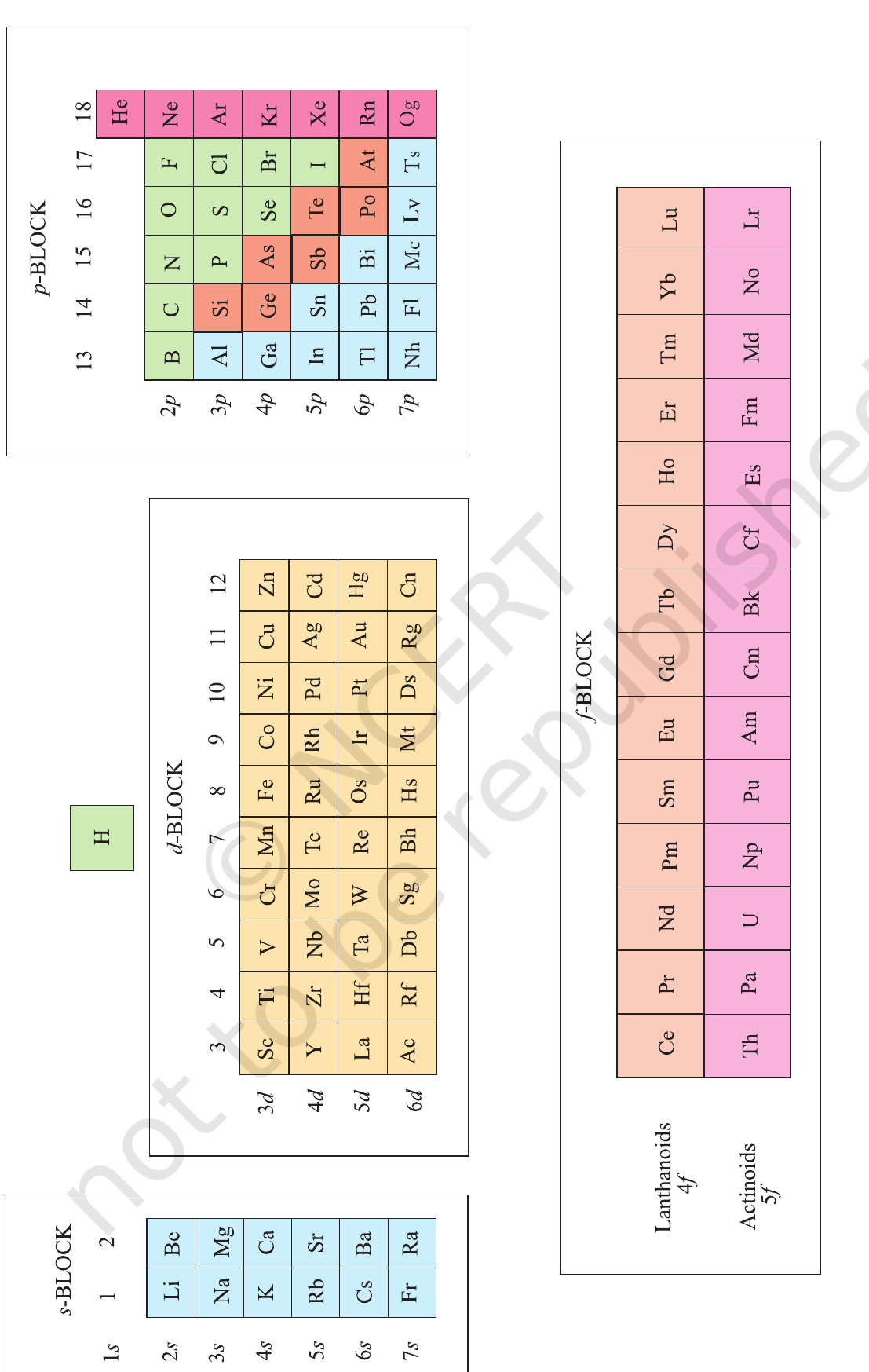
The aufbau principle and the electronic configuration of atoms provide a theoretical foundation for the periodic classification. The elements in a vertical column constitute a group or family and exhibit similar chemical behaviour, because they have the same number and same distribution of electrons in their outermost orbitals. Elements are classified into four blocks, s-block, p-block, d-block and f-block, depending on the type of atomic orbitals being filled with electrons.
The s-Block Elements are Groups 1 (alkali metals) and 2 (alkaline earth metals) with ns1 and ns2 outermost electronic configuration. They are all reactive metals with low ionisation enthalpies. They lose the outermost electron(s) readily to form 1+ ion (alkali metals) or 2+ ion (alkaline earth metals). The metallic character and the reactivity increase as we go down the group. Because of high reactivity they are never found pure in nature. The compounds of the s-block elements, with the exception of those of lithium and beryllium, are predominantly ionic.
The p-Block Elements comprise Groups 13 to 18, and together with the s-Block Elements are called the Representative Elements or Main Group Elements. The outermost electronic configuration varies from ns2np1 to ns2np6 in each period. At the end of each period is a noble gas element with a closed valence shell ns2np6 configuration. All the orbitals in the valence shell of the noble gases are completely filled, and it is very difficult to alter this stable arrangement by the addition or removal of electrons, so the noble gases exhibit very low chemical reactivity. Preceding the noble gas family are two chemically important groups of non-metals: the halogens (Group 17) and the chalcogens (Group 16). These two groups have highly negative electron gain enthalpies and readily add one or two electrons respectively to attain the stable noble gas configuration. The non-metallic character increases as we move from left to right across a period and metallic character increases as we go down the group.
The d-Block Elements (Transition Elements) are Groups 3 to 12 in the centre of the Periodic Table, characterised by the filling of inner d orbitals. They have the general outer electronic configuration (n-1)d1-10ns0-2, except for Pd where it is 4d10 5s0. They are all metals. They mostly form coloured ions, exhibit variable valence (oxidation states), paramagnetism and are often used as catalysts. However, Zn, Cd and Hg, which have the configuration (n-1)d10ns2, do not show most of the properties of transition elements. Transition metals form a bridge between the chemically active metals of s-block elements and the less active elements of Groups 13 and 14 and thus take their familiar name "Transition Elements".
The f-Block Elements (Inner-Transition Elements) are the two rows at the bottom of the Periodic Table: the Lanthanoids, Ce (Z = 58) to Lu (Z = 71), and Actinoids, Th (Z = 90) to Lr (Z = 103), characterised by the outer electronic configuration (n-2)f1-14(n-1)d0-1ns2. The last electron added to each element is filled in an f-orbital. They are all metals. Within each series, the properties of the elements are quite similar. The chemistry of the early actinoids is more complicated than the corresponding lanthanoids, due to the large number of oxidation states possible. Actinoid elements are radioactive. Many have been made only in nanogram quantities or even less by nuclear reactions. The elements after uranium are called Transuranium Elements.
Problem 3.3: the element with Z = 117 would belong to the halogen family (Group 17) with the configuration [Rn] 5f14 6d10 7s2 7p5. The element with Z = 120 will be placed in Group 2 (alkaline earth metals) with the configuration [Uuo]8s2.
Suggest an edit
Table: the four blocks at a glance
| Block | Groups | General outer configuration | Character |
|---|---|---|---|
| s-block | 1 and 2 | ns1 and ns2 | Reactive metals, low ionisation enthalpies, form 1+ and 2+ ions, compounds predominantly ionic except Li and Be |
| p-block | 13 to 18 | ns2np1 to ns2np6 | Representative elements with s-block; noble gas ns2np6 at the end of each period; halogens Group 17, chalcogens Group 16 |
| d-block | 3 to 12 | (n-1)d1-10ns0-2, except Pd 4d10 5s0 | All metals, coloured ions, variable valence, paramagnetism, catalysts; Zn, Cd, Hg do not show most transition properties |
| f-block | Lanthanoids Ce-Lu, Actinoids Th-Lr | (n-2)f1-14(n-1)d0-1ns2 | All metals, similar properties within each series, actinoids radioactive, elements after uranium are transuranium |
Two exceptions to the block placement: helium belongs strictly to the s-block but is placed in the p-block along with other Group 18 elements because it has a completely filled valence shell (1s2) and exhibits properties characteristic of other noble gases. Hydrogen has only one s-electron and can be placed in Group 1 (alkali metals), and it can also gain an electron to achieve a noble gas arrangement and behave similar to Group 17 (halogen family) elements. Because it is a special case, hydrogen is placed separately at the top of the Periodic Table.
Source: NCERT XI, Ch 3, 3.6 and NCERT Fig. 3.3.
Suggest an edit
Metals, non-metals and metalloids
In addition to the s-, p-, d- and f-blocks, NCERT Fig. 3.3 shows another broad classification of elements based on their properties. The elements can be divided into Metals and Non-Metals. Metals comprise more than 78 per cent of all known elements and appear on the left side of the Periodic Table. Metals are usually solids at room temperature (mercury is an exception; gallium and caesium also have very low melting points, 303K and 302K respectively). Metals usually have high melting and boiling points. They are good conductors of heat and electricity. They are malleable (can be flattened into thin sheets by hammering) and ductile (can be drawn into wires).
In contrast, non-metals are located at the top right hand side of the Periodic Table. In a horizontal row, the property of elements changes from metallic on the left to non-metallic on the right. Non-metals are usually solids or gases at room temperature with low melting and boiling points (boron and carbon are exceptions). They are poor conductors of heat and electricity. Most non-metallic solids are brittle and are neither malleable nor ductile. The elements become more metallic as we go down a group; the non-metallic character increases as one goes from left to right across the Periodic Table.
The change from metallic to non-metallic character is not abrupt, as shown by the thick zig-zag line in NCERT Fig. 3.3. The elements (for example, silicon, germanium, arsenic, antimony and tellurium) bordering this line and running diagonally across the Periodic Table show properties characteristic of both metals and non-metals. These elements are called Semi-metals or Metalloids.
Problem 3.4 asks to arrange Si, Be, Mg, Na and P in increasing order of metallic character. Metallic character increases down a group and decreases along a period from left to right. Hence the order of increasing metallic character is: P < Si < Be < Mg < Na.
Suggest an edit
Atomic and ionic radii
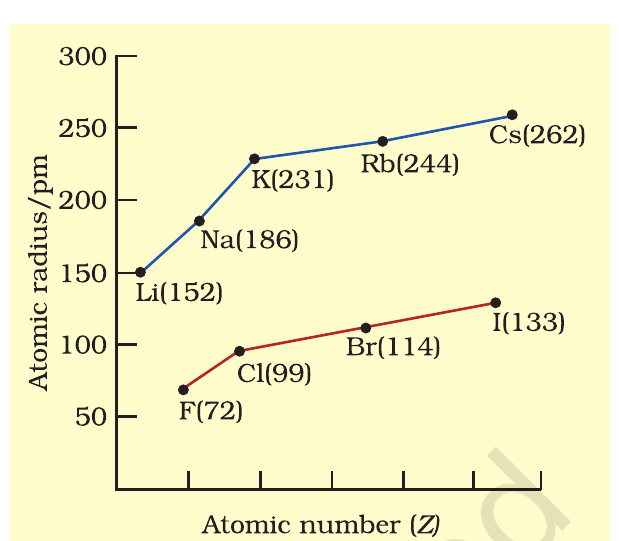
Finding the size of an atom is more complicated than measuring the radius of a ball. The size of an atom (about 1.2 Å, that is, 1.2 x $10^{-10}$ m in radius) is very small, and the electron cloud surrounding the atom does not have a sharp boundary, so the size of an individual atom cannot be measured precisely. An estimate of the atomic size can be made by knowing the distance between the atoms in the combined state.
For a non-metallic element, the distance between two atoms bound together by a single bond in a covalent molecule gives the Covalent Radius. For example, the bond distance in the chlorine molecule ($Cl_2$) is 198 pm and half this distance (99 pm) is taken as the atomic radius of chlorine. For metals, the Metallic Radius is half the internuclear distance separating the metal cores in the metallic crystal. The distance between two adjacent copper atoms in solid copper is 256 pm, so the metallic radius of copper is 128 pm. In this book, the term Atomic Radius refers to both covalent or metallic radius depending on whether the element is a non-metal or a metal. Atomic radii can be measured by X-ray or other spectroscopic methods.
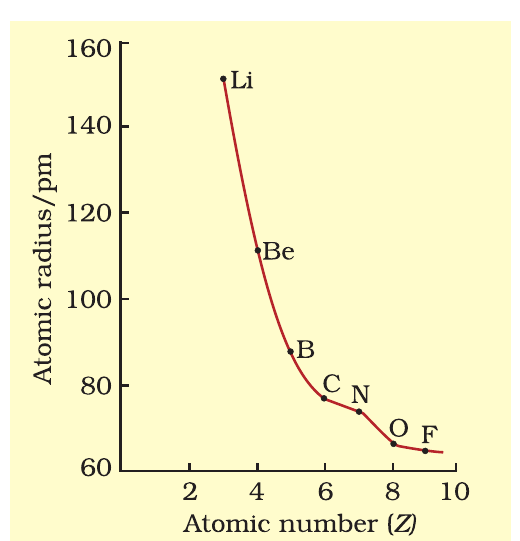
Two trends are obvious from Table 3.6. The atomic size generally decreases across a period, as shown in NCERT Fig. 3.4(a) for the second period. Within the period the outer electrons are in the same valence shell and the effective nuclear charge increases as the atomic number increases, resulting in increased attraction of electrons to the nucleus. Within a family or vertical column of the periodic table, the atomic radius increases regularly with atomic number, as shown in NCERT Fig. 3.4(b). As we descend the groups, the principal quantum number (n) increases and the valence electrons are farther from the nucleus, because the inner energy levels are filled with electrons which serve to shield the outer electrons from the pull of the nucleus.
Note that the atomic radii of noble gases are not considered here. Being monoatomic, their (non-bonded radii) values are very large. In fact radii of noble gases should be compared not with the covalent radii but with the van der Waals radii of other elements.
Removal of an electron from an atom results in a cation, and gain of an electron leads to an anion. The ionic radii can be estimated by measuring the distances between cations and anions in ionic crystals. In general, the ionic radii of elements exhibit the same trend as the atomic radii. A cation is smaller than its parent atom because it has fewer electrons while its nuclear charge remains the same. The size of an anion will be larger than that of the parent atom because the addition of one or more electrons results in increased repulsion among the electrons and a decrease in effective nuclear charge. For example, the ionic radius of fluoride ion ($F^-$) is 136 pm whereas the atomic radius of fluorine is only 64 pm. The atomic radius of sodium is 186 pm compared to the ionic radius of 95 pm for $Na^+$.
When some atoms and ions contain the same number of electrons, they are called isoelectronic species. For example, $O_2^-$, $F^-$, $Na^+$ and $Mg^{2+}$ have the same number of electrons (10). Their radii would be different because of their different nuclear charges. The cation with the greater positive charge will have a smaller radius because of the greater attraction of the electrons to the nucleus. An anion with the greater negative charge will have the larger radius, because the net repulsion of the electrons will outweigh the nuclear charge and the ion will expand in size.
Two or more species with same number of atoms, same number of valence electrons and same structure, regardless of the nature of elements involved.
Problem 3.5 asks which of Mg, $Mg^{2+}$, Al and $Al^{3+}$ will have the largest and the smallest size. Atomic radii decrease across a period, cations are smaller than their parent atoms, and among isoelectronic species the one with the larger positive nuclear charge will have a smaller radius. Hence the largest species is Mg and the smallest one is $Al^{3+}$.
| Atom (Period II) | Li | Be | B | C | N | O | F |
|---|---|---|---|---|---|---|---|
| Atomic radius | 152 | 111 | 88 | 77 | 74 | 66 | 64 |
| Atom (Period III) | Na | Mg | Al | Si | P | S | Cl |
| Atomic radius | 186 | 160 | 143 | 117 | 110 | 104 | 99 |
- Table 3.6(a): Atomic Radii/pm Across the Periods.
| Atom (Group 1) | Atomic Radius | Atom (Group 17) | Atomic Radius |
|---|---|---|---|
| Li | 152 | F | 64 |
| Na | 186 | Cl | 99 |
| K | 231 | Br | 114 |
| Rb | 244 | I | 133 |
| Cs | 262 | At | 140 |
- Table 3.6(b): Atomic Radii/pm Down a Family.
Source: NCERT XI, Ch 3, Tables 3.6(a) and 3.6(b).
Suggest an edit
Ionisation enthalpy
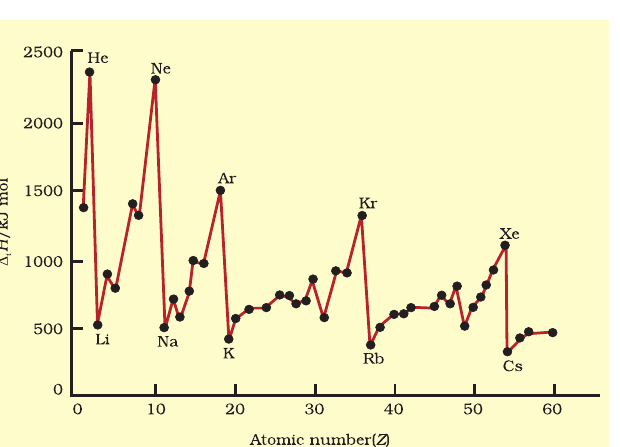


A quantitative measure of the tendency of an element to lose an electron is given by its Ionisation Enthalpy. It represents the energy required to remove an electron from an isolated gaseous atom (X) in its ground state. The first ionisation enthalpy for an element X is the enthalpy change for the reaction X(g) -> X+(g) + e-. It is expressed in units of kJ mol-1. The second ionisation enthalpy is the energy required to remove the second most loosely bound electron: X+(g) -> X2+(g) + e-.
Energy is always required to remove electrons from an atom and hence ionisation enthalpies are always positive. The second ionisation enthalpy will be higher than the first because it is more difficult to remove an electron from a positively charged ion than from a neutral atom. In the same way the third ionisation enthalpy will be higher than the second and so on. The term 'ionisation enthalpy', if not qualified, is taken as the first ionisation enthalpy.
The first ionisation enthalpies of elements having atomic numbers up to 60 are plotted in NCERT Fig. 3.5. The periodicity of the graph is quite striking. Maxima occur at the noble gases, which have closed electron shells and very stable electron configurations. Minima occur at the alkali metals, and their low ionisation enthalpies can be correlated with their high reactivity. The first ionisation enthalpy generally increases as we go across a period and decreases as we descend in a group, as shown in NCERT Figs. 3.6(a) and 3.6(b) for the second period and the alkali metals.
To understand these trends, consider two factors: the attraction of electrons towards the nucleus, and the repulsion of electrons from each other. The effective nuclear charge experienced by a valence electron is less than the actual charge on the nucleus because of "shielding" or "screening" of the valence electron from the nucleus by the intervening core electrons. For example, the 2s electron in lithium is shielded from the nucleus by the inner core of 1s electrons, so the valence electron experiences a net positive charge less than the actual charge of +3. Shielding is effective when the orbitals in the inner shells are completely filled, as in the alkali metals, which have a single outermost ns electron preceded by a noble gas electronic configuration.
When we move from lithium to fluorine across the second period, successive electrons are added to orbitals in the same principal quantum level and the shielding of the nuclear charge by the inner core does not increase very much to compensate for the increased attraction of the electron to the nucleus. Across a period, increasing nuclear charge outweighs the shielding, the outermost electrons are held more and more tightly, and the ionisation enthalpy increases. As we go down a group, the outermost electron is increasingly farther from the nucleus, there is increased shielding of the nuclear charge by the electrons in the inner levels, and the removal of the outermost electron requires less energy down a group.
Problem 3.6: the first ionisation enthalpy values of the third period elements Na, Mg and Si are 496, 737 and 786 kJ mol-1. Predict whether the first value for Al will be more close to 575 or 760 kJ mol-1. It will be more close to 575 kJ mol-1. The value for Al should be lower than that of Mg because of effective shielding of 3p electrons from the nucleus by 3s-electrons.
Suggest an edit
Practice1 question
Try it now. A wrong answer costs nothing here, try again until you get it.
Why is the first ionisation enthalpy of boron lower than that of beryllium?
NCERT 3.7.1: the 2p electron of boron is more shielded from the nucleus than the 2s electron of beryllium, because a 2s electron penetrates closer to the nucleus than a 2p electron.
Ladder: ionisation enthalpy exceptions
- Be > B: the first ionisation enthalpy of boron (Z = 5) is slightly less than that of beryllium (Z = 4), even though boron has the greater nuclear charge. In beryllium the electron removed is an s-electron, while in boron it is a p-electron. Penetration of a 2s-electron to the nucleus is more than that of a 2p-electron, so the 2p electron of boron is more shielded from the nucleus by the inner core of electrons than the 2s electrons of beryllium. It is easier to remove the 2p-electron from boron than a 2s-electron from beryllium.
- N > O: the first ionisation enthalpy of oxygen is smaller than that of nitrogen. In the nitrogen atom, three 2p-electrons reside in different atomic orbitals (Hund's rule), whereas in the oxygen atom, two of the four 2p-electrons must occupy the same 2p-orbital, resulting in increased electron-electron repulsion. It is easier to remove the fourth 2p-electron from oxygen than one of the three 2p-electrons from nitrogen.
- Second period order: the actual ionisation enthalpies of the second period elements are in the order Li < B < Be < C < O < N < F < Ne (NCERT Exercise 3.16). The two dips, B below Be and O below N, are the two exceptions to the rising trend across the period.
- IE2 > IE1 always: the second ionisation enthalpy is higher than the first, and the third is higher than the second, because each later electron is removed from an increasingly positive ion.
- Maxima and minima: in NCERT Fig. 3.5 the maxima are at the noble gases (closed shells, very stable configurations) and the minima are at the alkali metals (low ionisation enthalpies, high reactivity).
- Al below Mg: the first ionisation enthalpy of Al is closer to 575 than 760 kJ mol-1, lower than Mg (737 kJ mol-1), because the 3p electron is shielded from the nucleus by the 3s electrons.
Source: NCERT XI, Ch 3, 3.7.1 and Exercise 3.16.
Suggest an edit
Electron gain enthalpy
When an electron is added to a neutral gaseous atom (X) to convert it into a negative ion, the enthalpy change accompanying the process is defined as the Electron Gain Enthalpy. It provides a measure of the ease with which an atom adds an electron to form an anion: X(g) + e- -> X-(g). Depending on the element, the process of adding an electron to the atom can be either endothermic or exothermic. For many elements energy is released when an electron is added to the atom and the electron gain enthalpy is negative. For example, group 17 elements (the halogens) have very high negative electron gain enthalpies because they can attain stable noble gas electronic configurations by picking up an electron. On the other hand, noble gases have large positive electron gain enthalpies because the electron has to enter the next higher principal quantum level, leading to a very unstable electronic configuration. Electron gain enthalpies have large negative values toward the upper right of the periodic table preceding the noble gases.
As a general rule, electron gain enthalpy becomes more negative with increase in the atomic number across a period. The effective nuclear charge increases from left to right across a period, so it will be easier to add an electron to a smaller atom, since the added electron on an average would be closer to the positively charged nucleus. Electron gain enthalpy should also become less negative as we go down a group, because the size of the atom increases and the added electron would be farther from the nucleus. This is generally the case (Table 3.7). However, the electron gain enthalpy of O or F is less negative than that of the succeeding element. When an electron is added to O or F, the added electron goes to the smaller n = 2 quantum level and suffers significant repulsion from the other electrons present in this level. For the n = 3 quantum level (S or Cl), the added electron occupies a larger region of space and the electron-electron repulsion is much less.
Problem 3.7 asks which of P, S, Cl and F will have the most negative electron gain enthalpy and which the least negative. Electron gain enthalpy generally becomes more negative across a period from left to right, and less negative down a group. However, adding an electron to the 2p-orbital leads to greater repulsion than adding an electron to the larger 3p-orbital. Hence the element with the most negative electron gain enthalpy is chlorine; the one with the least negative electron gain enthalpy is phosphorus.
Note on terms: in many books, the negative of the enthalpy change for the process above is defined as the Electron Affinity of the atom. If energy is released when an electron is added to an atom, the electron affinity is taken as positive, contrary to thermodynamic convention.
Electron affinity is defined at absolute zero: if energy has to be supplied to add an electron to an atom, the electron affinity is assigned a negative sign, and at any other temperature (T) the heat capacities of the reactants and the products have to be taken into account in $\Delta_{eg}H = -A_e - 5/2 RT$.
Suggest an edit
Practice1 question
Try it now. A wrong answer costs nothing here, try again until you get it.
Which of the following has the most negative electron gain enthalpy: F, O, S or Cl?
NCERT 3.7.1, Problem 3.7: chlorine has the most negative electron gain enthalpy because the added electron enters the larger 3p level with less repulsion than in the small 2p level of fluorine.
Electronegativity
A qualitative measure of the ability of an atom in a chemical compound to attract shared electrons to itself is called electronegativity. Unlike ionisation enthalpy and electron gain enthalpy, it is not a measurable quantity. However, a number of numerical scales of electronegativity of elements, viz., the Pauling scale, Mulliken-Jaffe scale and Allred-Rochow scale, have been developed. The one which is the most widely used is the Pauling scale. Linus Pauling, an American scientist, in 1922 assigned arbitrarily a value of 4.0 to fluorine, the element considered to have the greatest ability to attract electrons.
The electronegativity of any given element is not constant; it varies depending on the element to which it is bound. Though it is not a measurable quantity, it does provide a means of predicting the nature of the force that holds a pair of atoms together.
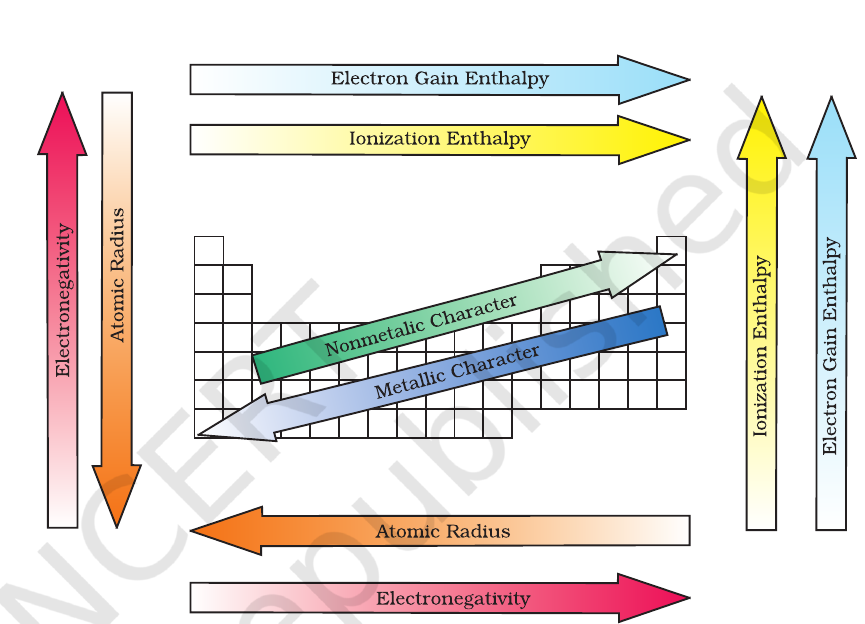
Electronegativity generally increases across a period from left to right (say from lithium to fluorine) and decreases down a group (say from fluorine to astatine) in the periodic table. These trends can be explained through atomic radii, which tend to decrease across each period from left to right, but increase down each group. The attraction between the outer (or valence) electrons and the nucleus increases as the atomic radius decreases in a period, so the electronegativity also increases. On the same account electronegativity values decrease with the increase in atomic radii down a group. The trend is similar to that of ionisation enthalpy.
Electronegativity is directly related to the non-metallic properties of elements: non-metallic elements have a strong tendency to gain electrons. It can be further extended to say that electronegativity is inversely related to the metallic properties of elements. The increase in electronegativities across a period is accompanied by an increase in non-metallic properties (or decrease in metallic properties) of elements. Similarly, the decrease in electronegativity down a group is accompanied by a decrease in non-metallic properties (or increase in metallic properties) of elements. All these periodic trends are summarised in NCERT Figure 3.7.
Suggest an edit
Table: electron gain enthalpies and electronegativity
Table 3.7: Electron Gain Enthalpies* / (kJ mol-1) of Some Main Group Elements.
| Group 1 | $\Delta_{eg}H$ | Group 16 | $\Delta_{eg}H$ | Group 17 | $\Delta_{eg}H$ | Group 0 | $\Delta_{eg}H$ |
|---|---|---|---|---|---|---|---|
| H | -73 | - | - | - | - | He | +48 |
| Li | -60 | O | -141 | F | -328 | Ne | +116 |
| Na | -53 | S | -200 | Cl | -349 | Ar | +96 |
| K | -48 | Se | -195 | Br | -325 | Kr | +96 |
| Rb | -47 | Te | -190 | I | -295 | Xe | +77 |
| Cs | -46 | Po | -174 | At | -270 | Rn | +68 |
Table 3.8(a): Electronegativity Values (on Pauling scale) Across the Periods.
| Atom (Period II) | Li | Be | B | C | N | O | F |
|---|---|---|---|---|---|---|---|
| Electronegativity | 1.0 | 1.5 | 2.0 | 2.5 | 3.0 | 3.5 | 4.0 |
| Atom (Period III) | Na | Mg | Al | Si | P | S | Cl |
| Electronegativity | 0.9 | 1.2 | 1.5 | 1.8 | 2.1 | 2.5 | 3.0 |
Table 3.8(b): Electronegativity Values (on Pauling scale) Down a Family.
| Atom (Group 1) | Electronegativity Value | Atom (Group 17) | Electronegativity Value |
|---|---|---|---|
| Li | 1.0 | F | 4.0 |
| Na | 0.9 | Cl | 3.0 |
| K | 0.8 | Br | 2.8 |
| Rb | 0.8 | I | 2.5 |
| Cs | 0.7 | At | 2.2 |
Key reads: chlorine (-349 kJ mol-1) has the most negative electron gain enthalpy, not fluorine (-328 kJ mol-1). Noble gases have positive electron gain enthalpies. Electronegativity rises across a period and falls down a group, with fluorine at 4.0.
Source: NCERT XI, Ch 3, Tables 3.7 and 3.8(a) and 3.8(b).
Suggest an edit
Valence, oxidation states and chemical reactivity
The valence is the most characteristic property of the elements and can be understood in terms of their electronic configurations. The valence of representative elements is usually (though not necessarily) equal to the number of electrons in the outermost orbitals and/or equal to eight minus the number of outermost electrons. Nowadays the term oxidation state is frequently used for valence.
Consider the two oxygen containing compounds $OF_2$ and $Na_2O$. The order of electronegativity of the three elements involved is F > O > Na. Each atom of fluorine, with outer electronic configuration 2s2 2p5, shares one electron with oxygen in the $OF_2$ molecule. Being the highest electronegative element, fluorine is given oxidation state -1. Since there are two fluorine atoms in this molecule, oxygen with outer electronic configuration 2s2 2p4 shares two electrons with fluorine atoms and thereby exhibits oxidation state +2. In $Na_2O$, oxygen being more electronegative accepts two electrons, one from each of the two sodium atoms, and thus shows oxidation state -2. Sodium with electronic configuration 3s1 loses one electron to oxygen and is given oxidation state +1. The oxidation state of an element in a particular compound can be defined as the charge acquired by its atom on the basis of electronegative consideration from other atoms in the molecule.
Problem 3.8 asks for the formulas of compounds formed by (a) silicon and bromine and (b) aluminium and sulphur. Silicon is a group 14 element with a valence of 4; bromine belongs to the halogen family with a valence of 1, so the compound is $SiBr_4$. Aluminium belongs to group 13 with a valence of 3; sulphur belongs to group 16 elements with a valence of 2, so the compound is $Al_2S_3$.
Some periodic trends observed in the valence of elements (hydrides and oxides) are shown in Table 3.9.
| Group | 1 | 2 | 13 | 14 | 15 | 16 | 17 | 18 |
|---|---|---|---|---|---|---|---|---|
| Number of valence electron | 1 | 2 | 3 | 4 | 5 | 6 | 7 | 8 |
| Valence | 1 | 2 | 3 | 4 | 3,5 | 2,6 | 1,7 | 0,8 |
| Group | 1 | 2 | 13 | 14 | 15 | 16 | 17 | |
|---|---|---|---|---|---|---|---|---|
| Formula of hydride | LiH, NaH, KH | $CaH_2$ | $B_2H_6$, $AlH_3$ | $CH_4$, $SiH_4$, $GeH_4$, $SnH_4$ | $NH_3$, $PH_3$, $AsH_3$ | $H_2O$, $H_2S$, $H_2Se$, $H_2Te$ | HF, $HCl$, $HBr$, $HI$ | |
| Formula of oxide | $Li_2O$, $Na_2O$, $K_2O$ | $MgO$, $CaO$, SrO, BaO | $B_2O_3$, $Al_2O_3$, $Ga_2O_3$, $In_2O_3$ | $CO_2$, $SiO_2$, $GeO_2$, $SnO_2$, $PbO_2$ | $N_2O_3$, $N_2O_5$, $P_4O_6$, $P_4O_{10}$, $As_2O_3$, $As_2O_5$, $Sb_2O_3$, $Sb_2O_5$, $Bi_2O_3$, - | $SO_3$, $SeO_3$, $TeO_3$, - | -, $Cl_2O_7$, -, - | There are many elements which exhibit variable valence, particularly characteristic of transition elements and actinoids. |
The first element of each of the groups 1 (lithium) and 2 (beryllium) and groups 13-17 (boron to fluorine) differs in many respects from the other members of their respective group. Lithium, unlike other alkali metals, and beryllium, unlike other alkaline earth metals, form compounds with pronounced covalent character; the other members of these groups predominantly form ionic compounds. In fact the behaviour of lithium and beryllium is more similar to the second element of the following group, magnesium and aluminium, respectively. This sort of similarity is commonly referred to as diagonal relationship in the periodic properties.
| Property | Li, Be, B | Na, Mg, Al |
|---|---|---|
| Metallic radius M/pm | Li 152, Be 111, B 88 | Na 186, Mg 160, Al 143 |
| Ionic radius M+/pm | Li 76, Be 31 | Na 102, Mg 72 |
- Metallic and ionic radii (NCERT XI, Ch 3, 3.7.2(b)).
The anomalous behaviour is attributed to their small size, large charge/radius ratio and high electronegativity. In addition, the first member of a group has only four valence orbitals (2s and 2p) available for bonding, whereas the second member of the groups has nine valence orbitals (3s, 3p, 3d). As a consequence, the maximum covalency of the first member of each group is 4 (for example, boron can only form [$BF_4$]-, whereas aluminium forms [$AlF_6$]3-). Furthermore, the first member of p-block elements displays greater ability to form pπ-pπ multiple bonds to itself (for example, $C=C$, $C\equiv C$, $N=N$, $N\equiv N$) and to other second period elements (for example, $C=O$, $C=N$, $C\equiv N$, $N=O$) compared to subsequent members of the same group.
Problem 3.9 asks whether the oxidation state and covalency of Al in [AlCl($H_2O$)5]2+ are the same. No. The oxidation state of Al is +3 and the covalency is 6.
Chemical reactivity follows the same periodic pattern. The atomic and ionic radii generally decrease in a period from left to right, so ionisation enthalpies generally increase and electron gain enthalpies become more negative across a period. The ionisation enthalpy of the extreme left element in a period is the least, and the electron gain enthalpy of the element on the extreme right is the highest negative (noble gases have rather positive electron gain enthalpy values). This results in high chemical reactivity at the two extremes and the lowest in the centre. The maximum chemical reactivity at the extreme left (among alkali metals) is exhibited by the loss of an electron leading to the formation of a cation, and at the extreme right (among halogens) by the gain of an electron forming an anion.
In a group, the increase in atomic and ionic radii generally results in a gradual decrease in ionisation enthalpies and a regular decrease in electron gain enthalpies in the case of main group elements. Thus the metallic character increases down a group and non-metallic character decreases. Among transition metals (3d series), the change in atomic radii is much smaller as compared to those of representative elements across the period, and still smaller among inner-transition metals (4f series). Their ionisation enthalpies are intermediate between those of s- and p-blocks, so they are less electropositive than group 1 and 2 metals.
The chemical reactivity of an element can be best shown by its reactions with oxygen and halogens. Elements on two extremes of a period easily combine with oxygen to form oxides. The normal oxide formed by the element on the extreme left is the most basic (for example, $Na_2O$), whereas that formed by the element on the extreme right is the most acidic (for example, $Cl_2O_7$). Oxides of elements in the centre are amphoteric (for example, $Al_2O_3$, $As_2O_3$) or neutral (for example, $CO$, $NO$, $N_2O$). Amphoteric oxides behave as acidic with bases and as basic with acids, whereas neutral oxides have no acidic or basic properties. Problem 3.10: $Na_2O$ with water forms a strong base, whereas $Cl_2O_7$ forms a strong acid. $Na_2O$ + $H_2O$ -> 2NaOH. $Cl_2O_7$ + $H_2O$ -> 2HClO4.
Suggest an edit
Practice1 question
Try it now. A wrong answer costs nothing here, try again until you get it.
Which of the following oxides is amphoteric?
NCERT 3.7.3: the oxide on the extreme left of a period is the most basic ($Na_2O$), the one on the extreme right is the most acidic ($Cl_2O_7$), and oxides in the centre are amphoteric ($Al_2O_3$, $As_2O_3$) or neutral ($CO$, $NO$, $N_2O$).
Trap pairs: the confusions NEET tests
- Ionisation enthalpy across a period vs the Be/B and N/O dips: the general trend rises across a period, but boron falls below beryllium (2p vs 2s removal) and oxygen falls below nitrogen (paired 2p repulsion). The second period order is Li < B < Be < C < O < N < F < Ne.
- Electron gain enthalpy sign: a negative value means energy is released when the electron is added. Halogens are strongly negative; noble gases are positive because the electron must enter the next shell.
- Fluorine vs chlorine: fluorine is the most electronegative (4.0), but chlorine has the most negative electron gain enthalpy (-349 kJ mol-1 against -328 kJ mol-1 for F) because the added electron enters the larger 3p level in chlorine.
- Cation vs anion size: a cation is smaller than its parent atom ($Na^+$ 95 pm vs Na 186 pm) and an anion is larger ($F^-$ 136 pm vs F 64 pm). Among isoelectronic species, the larger the nuclear charge, the smaller the radius.
- Atomic radius vs noble gas radius: noble gas radii are non-bonded radii and are very large; compare them with van der Waals radii, not with covalent radii.
- Helium placement vs its configuration: helium is 1s2, strictly s-block, but sits in Group 18 with the noble gases because of its filled shell and noble gas behaviour. Hydrogen sits separately at the top because it fits both Group 1 and Group 17.
- Metallic character: increases down a group and decreases across a period from left to right. The order P < Si < Be < Mg < Na is the NCERT worked example.
- Oxides across a period: left extreme most basic ($Na_2O$), right extreme most acidic ($Cl_2O_7$), centre amphoteric ($Al_2O_3$, $As_2O_3$) or neutral ($CO$, $NO$, $N_2O$).
Suggest an edit
Trap Boxes
Ionisation enthalpy always rises across a period?
Wrong idea: Ionisation enthalpy rises smoothly from Li to Ne, so boron must have a higher value than beryllium.
Boron loses a 2p electron, beryllium loses a 2s electron. The 2s electron penetrates closer to the nucleus, so the 2p electron of boron is more shielded and comes off more easily. The order is Li < B < Be < C < O < N < F < Ne.
NCERT XI, Ch 3, 3.7.1
Oxygen has a higher ionisation enthalpy than nitrogen?
Wrong idea: Oxygen has more protons than nitrogen, so its first ionisation enthalpy must be higher.
Nitrogen has the higher value. Its three 2p electrons sit in separate orbitals, while oxygen has a paired 2p electron with extra repulsion, so the fourth 2p electron of oxygen comes off more easily.
NCERT XI, Ch 3, 3.7.1
Fluorine has the most negative electron gain enthalpy?
Wrong idea: Fluorine is the most electronegative element, so it must also have the most negative electron gain enthalpy.
Chlorine is more negative at -349 kJ mol-1, against -328 kJ mol-1 for fluorine. The added electron enters the small n = 2 level in fluorine and faces more repulsion than in the larger 3p level of chlorine.
NCERT XI, Ch 3, 3.7.1
A cation is larger than its parent atom?
Wrong idea: Removing an electron does not change the size much, so $Na^+$ is about the same size as Na.
$Na^+$ is 95 pm against 186 pm for Na, and $F^-$ is 136 pm against 64 pm for F. A cation is smaller and an anion is larger than the parent atom. Among isoelectronic species, the larger the nuclear charge, the smaller the radius.
NCERT XI, Ch 3, 3.7.1
Noble gas radii compare directly with covalent radii?
Wrong idea: Argon has a larger atomic radius than chlorine because it sits further right in the period.
Noble gas radii are non-bonded radii and are very large. They should be compared with the van der Waals radii of other elements, not with covalent radii.
NCERT XI, Ch 3, 3.7.1
Chapter test
5 NEET PYQs. +4 for a correct answer, -1 for a wrong answer, exactly like NEET. Finish the test to earn a medal.
Q1: NEET (UG) 2023, Code F1, Q76
The element expected to form largest ion to achieve the nearest noble gas configuration is
N gains three electrons to reach the neon configuration as $N_3^-$, adding electrons with more repulsion, so it forms the largest ion of the four.
Q2: NEET (UG) 2022, Code R1, Q51
The IUPAC name of an element with atomic number 119 is
The number 119 gives the roots un, un and enn, with the suffix ium, so the systematic name is ununennium. NCERT gives this root system for naming elements with atomic number above 100. The other options mix up the digit roots for 119.
Q3: NEET (UG) 2021, Code P3, Q83
Noble gases are named because of their inertness towards reactivity. Identify an incorrect statement about them.
Noble gases have large positive electron gain enthalpies, weak dispersion forces and low solubility in water, but their melting and boiling points are very low, not very high.
Q4: NEET (UG) 2020, Code G5, Q116
Match the following:
| Oxide | Nature |
|---|---|
| (a) $CO$ | (i) Basic |
| (b) BaO | (ii) Neutral |
| (c) $Al_2O_3$ | (iii) Acidic |
| (d) $Cl_2O_7$ | (iv) Amphoteric |
$CO$ is a neutral oxide, BaO is basic, $Al_2O_3$ is amphoteric and $Cl_2O_7$ is acidic. Oxides on the extreme left of a period are the most basic, those on the extreme right the most acidic, and those in the centre amphoteric or neutral.
Q5: NEET (UG) 2020, Code G5, Q114
Identify the incorrect match.
| Name | IUPAC Official Name |
|---|---|
| (a) Unnilunium | (i) Mendelevium |
| (b) Unniltrium | (ii) Lawrencium |
| (c) Unnilhexium | (iii) Seaborgium |
| (d) Unununnium | (iv) Darmstadtium |
Unununnium (111) is Rontgenium in NCERT Table 3.5, not Darmstadtium; Darmstadtium is element 110 (Ununnillium). The other three pairs are correct: Unnilunium (101) is Mendelevium, Unniltrium (103) is Lawrencium and Unnilhexium (106) is Seaborgium.
Score: 0 · Answered 0 of 5
Flashcards
Tap a card to flip it over and see the answer. Tap it again to flip it back.
Write the reaction that defines the first ionisation enthalpy of an element X.
Tap to flipX(g) -> X+(g) + e-. The enthalpy change for this reaction is the first ionisation enthalpy, in kJ mol-1. It is always positive because energy is always needed to remove an electron.
Tap to flip backWrite the reaction that defines the electron gain enthalpy of an element X.
Tap to flipX(g) + e- -> X-(g). The enthalpy change for this reaction is the electron gain enthalpy. It is negative when energy is released, as for the halogens, and positive for the noble gases.
Tap to flip backWhy is the first ionisation enthalpy of boron lower than that of beryllium, even though boron has the larger nuclear charge?
Tap to flipBoron loses a 2p electron, beryllium loses a 2s electron. A 2s electron penetrates closer to the nucleus than a 2p electron, so the 2p electron of boron is more shielded and comes off more easily. The second period order is Li < B < Be < C < O < N < F < Ne.
Tap to flip backWhy is the first ionisation enthalpy of oxygen lower than that of nitrogen?
Tap to flipNitrogen has three 2p electrons in separate orbitals. Oxygen has four 2p electrons, so two share one orbital and repel each other, and the fourth 2p electron comes off more easily. So oxygen has the lower first ionisation enthalpy.
Tap to flip backWhich element has the most negative electron gain enthalpy, and what is its value?
Tap to flipChlorine, -349 kJ mol-1. Fluorine is -328 kJ mol-1. The added electron enters the small n = 2 level in fluorine and faces more electron repulsion than in the larger 3p level of chlorine.
Tap to flip backWhat is the electronegativity of fluorine on the Pauling scale?
Tap to flip4.0 on the Pauling scale. Fluorine is the most electronegative element. Pauling assigned it the value 4.0 in 1922.
Tap to flip backGive the atomic radii of the second period elements in order from Li to F.
Tap to flipLi 152, Be 111, B 88, C 77, N 74, O 66, F 64 pm. Atomic radius decreases across the period because the outer electrons are in the same shell while the effective nuclear charge rises.
Tap to flip backArrange Si, Be, Mg, Na and P in increasing order of metallic character.
Tap to flipP < Si < Be < Mg < Na. Metallic character increases down a group and decreases along a period from left to right.
Tap to flip backGive the groups and the general outer electronic configuration of the s-, p-, d- and f-blocks.
Tap to flips-block: Groups 1 and 2, ns1 and ns2. p-block: Groups 13 to 18, ns2np1 to ns2np6. d-block: Groups 3 to 12, (n-1)d1-10ns0-2. f-block: lanthanoids Ce-Lu and actinoids Th-Lr, (n-2)f1-14(n-1)d0-1ns2.
Tap to flip backWhat is the IUPAC systematic name and symbol for the element with atomic number 120?
Tap to flipUnbinilium, symbol Ubn. The roots for 1, 2 and 0 are un, bi and nil, so the name is un + bi + nil + ium, and the symbol is Ubn.
Tap to flip back