 NEET Notes
Home > Chemistry > Physical > Chemical Kinetics
Chemical Kinetics
On this page · 18 sections
- 01Syllabus map
- 02Average and instantaneous rate
- 03Rate and stoichiometric coefficients
- 04Rate law and rate constant
- 05Table: units of rate constant
- 06Order of a reaction
- 07Molecularity and the rate determining step
- 08Zero order reactions
- 09First order reactions
- 10Table: integrated rate laws for zero and first order reactions
- 11Half-life and pseudo first order reactions
- 12Temperature dependence and the Maxwell Boltzmann distribution
- 13Arrhenius equation and activation energy
- 14Table: Arrhenius equation forms and worked values
- 15Effect of catalyst
- 16Collision theory of chemical reactions
- 17Ladder: order versus molecularity
- 18Ladder: trap pairs
Rate laws, order and molecularity, zero and first order kinetics, half-life, the Arrhenius equation, catalysis and collision theory from NCERT Class 12 Chemistry Chapter 3.
Syllabus map
- NMC Unit: CHEM-U08, Chemical Kinetics.
- Subtopics in this chapter (NCERT XII, Ch 3): rate of a chemical reaction (3.1); factors influencing rate of a reaction (3.2), dependence of rate on concentration (3.2.1), rate expression and rate constant (3.2.2), order of a reaction (3.2.3), molecularity of a reaction (3.2.4); integrated rate equations (3.3), zero order reactions (3.3.1), first order reactions (3.3.2), half-life of a reaction (3.3.3); temperature dependence of the rate of a reaction (3.4), effect of catalyst (3.4.1); collision theory of chemical reactions (3.5).
- Subtopic checklist: (1) average and instantaneous rate; (2) rate and stoichiometric coefficients; (3) rate law and rate constant; (4) order of reaction; (5) molecularity and the rate determining step; (6) zero order integrated rate equation; (7) first order integrated rate equation; (8) half-life of zero and first order reactions; (9) pseudo first order reactions; (10) temperature dependence and the Arrhenius equation; (11) activation energy and the Maxwell Boltzmann distribution; (12) effect of catalyst; (13) collision theory, collision frequency and steric factor.
- Extra information (beyond NCERT): none. Everything in this chapter is NCERT Chapter 3.
- Excluded topics: the feasibility of a reaction from thermodynamics and the extent of a reaction from chemical equilibrium, which belong to earlier chapters; kinetics tells only the speed of a reaction. Do not import their facts into this chapter.
- Estimated revision time: 10 minutes. Jump links: Syllabus map, Average and instantaneous rate, Rate and stoichiometric coefficients, Rate law and rate constant, Table: units of rate constant, Order of a reaction, Molecularity and the rate determining step, Zero order reactions, First order reactions, Table: integrated rate laws for zero and first order reactions, Half-life and pseudo first order reactions, Temperature dependence and the Maxwell Boltzmann distribution, Arrhenius equation and activation energy, Table: Arrhenius equation forms and worked values, Effect of catalyst, Collision theory of chemical reactions, Ladder: order versus molecularity, Ladder: trap pairs.
Suggest an edit
Average and instantaneous rate
- Some reactions are very fast, for example precipitation of silver chloride on mixing aqueous silver nitrate and sodium chloride. Some are very slow, for example rusting of iron in air and moisture. Some proceed at a moderate speed, for example inversion of cane sugar and hydrolysis of starch.
- The rate of a reaction is the change in concentration of a reactant or product in unit time: the rate of decrease in concentration of any one of the reactants, or the rate of increase in concentration of any one of the products.
- For R -> P with volume constant, average rate rav = -Δ[R]/Δt = +Δ[P]/Δt (eq 3.1 and 3.2). Square brackets mean molar concentration. [R] falls, so a minus sign makes the rate a positive quantity.
- Average rate depends on the change in concentration and the time taken (NCERT Fig. 3.1). Units of rate are concentration time-1: mol L-1 s-1 when concentration is in mol L-1 and time in seconds. For gaseous reactions with partial pressures, units are atm s-1.
- Example 3.1, hydrolysis of butyl chloride $C_4H_9Cl$ + $H_2O$ -> $C_4H_9OH$ + $HCl$: [$C_4H_9Cl$] falls from 0.100 mol L-1 at 0 s to 0.017 mol L-1 at 800 s, and the average rate falls from 1.90 x $10^{-4}$ mol L-1 s-1 (0-50 s) to 0.4 x $10^{-4}$ mol L-1 s-1 (700-800 s).
- Average rate cannot predict the rate at a particular instant. Instantaneous rate rinst is the average rate at the smallest time interval dt, rinst = -d[R]/dt = d[P]/dt (eq 3.3). It is the slope of the tangent to the concentration-time curve at time t (NCERT Fig. 3.1, NCERT Fig. 3.2).
- For butyl chloride hydrolysis, rinst = 5.12 x $10^{-5}$ mol L-1 s-1 at 600 s, 1.22 x $10^{-4}$ mol L-1 s-1 at 250 s, 1.0 x $10^{-4}$ mol L-1 s-1 at 350 s and 6.4 x $10^{-5}$ mol L-1 s-1 at 450 s.
Suggest an edit
Rate and stoichiometric coefficients
- When stoichiometric coefficients are all one, rate of disappearance of a reactant equals rate of appearance of a product: Hg(l) + $Cl_2$(g) -> $HgCl_2$(s), Rate = -Δ[Hg]/Δt = -Δ[$Cl_2$]/Δt = Δ[$HgCl_2$]/Δt.
- When coefficients differ, divide each term by its stoichiometric coefficient: 2HI(g) -> $H_2$(g) + $I_2$(g), Rate = -(1/2)Δ[$HI$]/Δt = Δ[$H_2$]/Δt = Δ[$I_2$]/Δt.
- For 5Br-(aq) + $BrO_3^-$(aq) + 6H+(aq) -> 3Br2(aq) + 3H2O(l), Rate = -(1/5)Δ[$Br^-$]/Δt = -Δ[$BrO_3^-$]/Δt = -(1/6)Δ[$H^+$]/Δt = (1/3)Δ[$Br_2$]/Δt = (1/3)Δ[$H_2O$]/Δt.
- For a gaseous reaction at constant temperature, concentration is directly proportional to partial pressure, so rate can be expressed as rate of change in partial pressure of the reactant or the product.
- Example 3.2: decomposition of $N_2O_5$ in $CCl_4$ at 318 K, 2N2O5(g) -> 4NO2(g) + $O_2$(g). [$N_2O_5$] falls from 2.33 to 2.08 mol L-1 in 184 minutes. Average rate = 6.79 x $10^{-4}$ mol L-1 min-1 = 4.07 x $10^{-2}$ mol L-1 h-1 = 1.13 x $10^{-5}$ mol L-1 s-1. Rate of production of $NO_2$ = 2.72 x $10^{-3}$ mol L-1 min-1.
Suggest an edit
Practice1 question
Try it now. A wrong answer costs nothing here, try again until you get it.
For the reaction 2A -> Products, the concentration of A decreases from 0.5 mol L-1 to 0.4 mol L-1 in 10 minutes. What is the rate of the reaction during this interval?
NCERT 3.1, Intext 3.2 with answer 3.2: [A] falls by 0.1 mol L-1 in 10 min, so rate of disappearance of A is 0.01 mol L-1 min-1. For 2A -> Products the rate of reaction is half of that, 0.005 mol L-1 min-1.
Rate law and rate constant
- Rate of reaction depends on concentration of reactants (pressure in case of gases), temperature and catalyst.
- The representation of rate of reaction in terms of concentration of the reactants is the rate law, also called the rate equation or rate expression. For aA + bB -> cC + dD, Rate = k[A]^x[B]^y (eq 3.4a), or -d[R]/dt = k[A]^x[B]^y (eq 3.4b, differential rate equation). k is the rate constant.
- Exponents x and y may or may not equal the stoichiometric coefficients a and b. Rate law is the expression in which reaction rate is given in terms of molar concentration of reactants, each term raised to some power which may or may not be the same as the stoichiometric coefficient of the reacting species in the balanced chemical equation.
- Table 3.2, 2NO(g) + $O_2$(g) -> 2NO2(g): doubling [$NO$] at fixed [$O_2$] raises the initial rate from 0.096 to 0.384 mol L-1 s-1 (4 times), so rate depends on [$NO$]^2. Doubling [$O_2$] at fixed [$NO$] doubles the rate from 0.096 to 0.192 mol L-1 s-1, so rate depends on [$O_2$]^1. Rate = k[$NO$]^2[$O_2$]. Here the exponents happen to match the stoichiometric coefficients.
- Other cases differ: $CHCl_3$ + $Cl_2$ -> $CCl_4$ + $HCl$, Rate = k[$CHCl_3$][$Cl_2$]^1/2. $CH_3COOC_2H_5$ + $H_2O$ -> $CH_3COOH$ + $C_2H_5OH$, Rate = k[$CH_3COOC_2H_5$][$H_2O$]^0.
- Rate law for any reaction cannot be predicted by merely looking at the balanced chemical equation; it must be determined experimentally.
Suggest an edit
Table: units of rate constant
| Order | Units of rate constant |
|---|---|
| 0 | mol L-1 s-1 |
| 1 | s-1 |
| 2 | mol-1 L s-1 |
- k = Rate / ([A]^x[B]^y) = (concentration/time) x 1/(concentration)^n, where n = x + y = order of the reaction.
- Example 3.4: k = 2.3 x $10^{-5}$ L mol-1 s-1 is a second order rate constant. k = 3 x $10^{-4}$ s-1 is a first order rate constant.
- Read the order straight off the units of k: s-1 means first order, L mol-1 s-1 means second order, mol L-1 s-1 means zero order.
Suggest an edit
Order of a reaction
- In Rate = k[A]^x[B]^y, x + y is the overall order of the reaction, and x and y are the orders with respect to A and B. The sum of powers of the concentration of the reactants in the rate law expression is called the order of that chemical reaction.
- Order of a reaction can be 0, 1, 2, 3 and even a fraction. A zero order reaction means that the rate of reaction is independent of the concentration of reactants.
- Example 3.3: (a) Rate = k[A]^1/2[B]^3/2 has order 1/2 + 3/2 = 2, second order. (b) Rate = k[A]^3/2[B]^-1 has order 3/2 + (-1) = 1/2, half order.
- A balanced chemical equation never gives the true picture of how a reaction takes place, since rarely does a reaction get completed in one step. Reactions taking place in one step are elementary reactions. When a sequence of elementary reactions (called mechanism) gives the products, the reactions are complex reactions.
- Complex reactions may be consecutive reactions (oxidation of ethane to $CO_2$ and $H_2O$ passes through alcohol, aldehyde and acid), reverse reactions and side reactions (nitration of phenol yields o-nitrophenol and p-nitrophenol).
Suggest an edit
Practice1 question
Try it now. A wrong answer costs nothing here, try again until you get it.
For a reaction A + B -> Product, the rate law is r = k[A]^1/2[B]^2. What is the order of the reaction?
NCERT 3.2.3, Intext 3.3 with answer 3.3: order = 1/2 + 2 = 2.5.
Molecularity and the rate determining step
- Molecularity is the number of reacting species (atoms, ions or molecules) taking part in an elementary reaction, which must collide simultaneously in order to bring about a chemical reaction.
- Unimolecular: one species, for example decomposition of ammonium nitrite, $NH_4NO_2$ -> $N_2$ + 2H2O. Bimolecular: two species, for example dissociation of hydrogen iodide, 2HI -> $H_2$ + $I_2$. Trimolecular or termolecular: three species, for example 2NO + $O_2$ -> 2NO2.
- The probability that more than three molecules can collide and react simultaneously is very small. Reactions with molecularity three are very rare and slow to proceed. Complex reactions involving more than three molecules in the stoichiometric equation must take place in more than one step.
- $KClO_3$ + 6FeSO4 + 3H2SO4 -> $KCl$ + 3Fe2($SO_4$)3 + 3H2O apparently seems to be of tenth order but is actually a second order reaction, so it takes place in several steps.
- The slowest step controls the overall rate and is called the rate determining step. For 2H2O2 -> 2H2O + $O_2$ catalysed by $I^-$ in alkaline medium, Rate = k[$H_2O_2$][$I^-$]. Step 1, $H_2O_2$ + $I^-$ -> $H_2O$ + $IO^-$, is slow and bimolecular; step 2, $H_2O_2$ + $IO^-$ -> $H_2O$ + $I^-$ + $O_2$, is fast. $IO^-$ is an intermediate, formed during the reaction but absent from the overall balanced equation.
- Order versus molecularity: (i) order is an experimental quantity, it can be zero and even a fraction, but molecularity cannot be zero or a non integer; (ii) order applies to elementary as well as complex reactions, whereas molecularity applies only to elementary reactions, and for a complex reaction molecularity has no meaning; (iii) for a complex reaction, order is given by the slowest step and molecularity of the slowest step is the same as the order of the overall reaction.
Suggest an edit
Zero order reactions
- Zero order means the rate is proportional to zero power of the concentration of reactants. For R -> P, Rate = -d[R]/dt = k[R]^0 = k.
- Integrating, [R] = -kt + I, and at t = 0, [R] = [R]0, so [R] = -kt + [R]0 (eq 3.6). The rate constant is k = ([R]0 - [R])/t (eq 3.7).
- Comparing with y = mx + c, a plot of [R] against t is a straight line (NCERT Fig. 3.3) with slope = -k and intercept = [R]0.
- Zero order reactions are relatively uncommon but occur under special conditions. Some enzyme catalysed reactions and reactions which occur on metal surfaces are examples of zero order reactions.
- Decomposition of gaseous ammonia on a hot platinum surface at 1130 K is a zero order reaction at high pressure: 2NH3(g) -> $N_2$(g) + 3H2(g), Rate = k[$NH_3$]^0 = k. The metal surface gets saturated with gas molecules, so a further change in reaction conditions is unable to alter the amount of ammonia on the surface. The thermal decomposition of $HI$ on a gold surface is another zero order reaction.
Suggest an edit
First order reactions
- First order means the rate is proportional to the first power of the concentration of R. For R -> P, Rate = -d[R]/dt = k[R].
- Integrating, ln[R] = -kt + ln[R]0 (eq 3.9), so ln([R]/[R]0) = -kt, and k = (1/t) ln([R]0/[R]) (eq 3.10). Also [R] = [R]0 e^-kt (eq 3.14).
- With log base 10, k = (2.303/t) log([R]0/[R]) (eq 3.15). Between two times, k = (1/(t2 - t1)) ln([R]1/[R]2) (eq 3.13).
- A plot of ln[R] against t is a straight line (NCERT Fig. 3.4) with slope = -k and intercept = ln[R]0. A plot of log([R]0/[R]) against t (NCERT Fig. 3.5) is a straight line with slope = k/2.303.
- Hydrogenation of ethene is a first order reaction: $C_2H_4$(g) + $H_2$(g) -> $C_2H_6$(g), Rate = k[$C_2H_4$]. All natural and artificial radioactive decay of unstable nuclei takes place by first order kinetics. Decomposition of $N_2O_5$ and $N_2O$ are more examples of first order reactions. Radium-226 decay, 226/88 Ra -> 222/86 Rn + 4/2 He, has Rate = k[Ra].
- For a first order gas phase reaction A(g) -> B(g) + C(g) with initial pressure pi and total pressure pt at time t, k = (2.303/t) log(pi/(2pi - pt)) (eq 3.16).
- Example 3.5: $N_2O_5$, [R]0 = 1.24 x $10^{-2}$ mol L-1, [R] = 0.20 x $10^{-2}$ mol L-1 after 60 minutes at 318 K, k = 0.0304 min-1.
- Example 3.6: first order thermal decomposition of $N_2O_5$ at constant volume, 2N2O5(g) -> 2N2O4(g) + $O_2$(g), total pressure 0.5 atm at 0 s and 0.512 atm at 100 s, k = 4.98 x $10^{-4}$ s-1.
Suggest an edit
Practice1 question
Try it now. A wrong answer costs nothing here, try again until you get it.
A first order reaction has a rate constant 1.15 x $10^{-3}$ s-1. How long will 5 g of this reactant take to reduce to 3 g?
NCERT 3.3.2, Intext 3.5 with answer 3.5: t = (2.303/k) log(5/3) = (2.303/1.15 x $10^{-3}$) x 0.2218 = 444 s.
Table: integrated rate laws for zero and first order reactions
| Order | Reaction type | Differential rate law | Integrated rate law | Straight line plot | Half-life | Units of k |
|---|---|---|---|---|---|---|
| 0 | R -> P | d[R]/dt = -k | kt = [R]0 - [R] | [R] vs t | [R]0/2k | conc time-1 or mol L-1 s-1 |
| 1 | R -> P | d[R]/dt = -k[R] | [R] = [R]0 e^-kt or kt = ln([R]0/[R]) | ln[R] vs t | ln 2/k | time-1 or s-1 |
- For a zero order reaction, t1/2 is directly proportional to the initial concentration of the reactants and inversely proportional to the rate constant. For a first order reaction, t1/2 is independent of [R]0.
Suggest an edit
Half-life and pseudo first order reactions
- The half-life of a reaction is the time in which the concentration of a reactant is reduced to one half of its initial concentration. It is represented as t1/2.
- Zero order: at t = t1/2, [R] = [R]0/2, so t1/2 = [R]0/2k. It is directly proportional to the initial concentration and inversely proportional to the rate constant.
- First order: at t = t1/2, [R] = [R]0/2, so t1/2 = (2.303/k) log 2 = 0.693/k (eq 3.17). It is independent of initial concentration. The half-life of a first order reaction is readily calculated from the rate constant and vice versa.
- Example 3.7: a first order reaction with k = 5.5 x $10^{-14}$ s-1 has t1/2 = 0.693/k = 1.26 x $10^{13}$ s.
- Example 3.8: in a first order reaction, time required for completion of 99.9% is 10 times the half-life. When 99.9% is complete, [R] = [R]0 - 0.999[R]0, t = 6.909/k, and t/t1/2 = 6.909/0.693 = 10.
- Pseudo first order reactions obey first order rate law although they are higher order reactions. Hydrolysis of ethyl acetate is second order, but water is taken in large excess: 0.01 mol ester with 10 mol water leaves 9.99 mol water at completion, so [$H_2O$] barely changes and Rate = k[$CH_3COOC_2H_5$] only.
- Inversion of cane sugar is another pseudo first order reaction: $C_{12}H_{22}O_{11}$ + $H_2O$ -> $C_6H_{12}O_6$ (glucose) + $C_6H_{12}O_6$ (fructose), Rate = k[$C_{12}H_{22}O_{11}$].
Suggest an edit
Practice1 question
Try it now. A wrong answer costs nothing here, try again until you get it.
Time required to decompose $SO_2Cl_2$ to half of its initial amount is 60 minutes. If the decomposition is a first order reaction, what is the rate constant?
NCERT 3.3.3, Intext 3.6 with answer 3.6: t1/2 = 60 min = 3600 s, so k = 0.693/3600 = 1.925 x $10^{-4}$ s-1.
Temperature dependence and the Maxwell Boltzmann distribution
- Most chemical reactions are accelerated by increase in temperature. For decomposition of $N_2O_5$, the time taken for half of the original amount to decompose is 12 min at 50 degrees C, 5 h at 25 degrees C and 10 days at 0 degrees C. Potassium permanganate gets decolourised faster by oxalic acid at a higher temperature than at a lower temperature.
- For a chemical reaction, with rise in temperature by 10 degrees, the rate constant is nearly doubled.
- The temperature dependence of the rate of a chemical reaction can be accurately explained by the Arrhenius equation (3.18). It was first proposed by Dutch chemist J.H. van't Hoff, but Swedish chemist Arrhenius provided its physical justification and interpretation.
- All the molecules in the reacting species do not have the same kinetic energy. Ludwig Boltzmann and James Clark Maxwell used statistics to predict the behaviour of large numbers of molecules: the distribution of kinetic energy may be described by plotting the fraction of molecules (NE/NT) with a given kinetic energy (E) against kinetic energy (NCERT Fig. 3.8). NE is the number of molecules with energy E and NT is the total number of molecules.
- The peak of the curve corresponds to the most probable kinetic energy, the kinetic energy of the maximum fraction of molecules. There are decreasing numbers of molecules with energies higher or lower than this value.
- When the temperature is raised, the maximum of the curve moves to the higher energy value (NCERT Fig. 3.9) and the curve broadens out, spreading to the right, such that there is a greater proportion of molecules with much higher energies. The area under the curve must be constant since total probability must be one at all times.
- The position of Ea can be marked on the Maxwell Boltzmann distribution curve (NCERT Fig. 3.9). In the curve at (t + 10), the area showing the fraction of molecules having energy equal to or greater than activation energy gets doubled, leading to doubling the rate of a reaction.
Suggest an edit
Arrhenius equation and activation energy
- Arrhenius equation: k = A e^(-Ea/RT) (eq 3.18). A is the Arrhenius factor or the frequency factor, also called the pre-exponential factor. It is a constant specific to a particular reaction. R is the gas constant and Ea is activation energy measured in J mol-1.
- For $H_2$(g) + $I_2$(g) -> 2HI(g), the reaction can take place only when a molecule of hydrogen and a molecule of iodine collide to form an unstable intermediate (NCERT Fig. 3.6). It exists for a very short time and then breaks up to form two molecules of hydrogen iodide.
- The energy required to form this intermediate, called the activated complex (C), is the activation energy (Ea). NCERT Fig. 3.7 is obtained by plotting potential energy against reaction coordinate. Reaction coordinate represents the profile of energy change when reactants change into products. Some energy is released when the complex decomposes to form products.
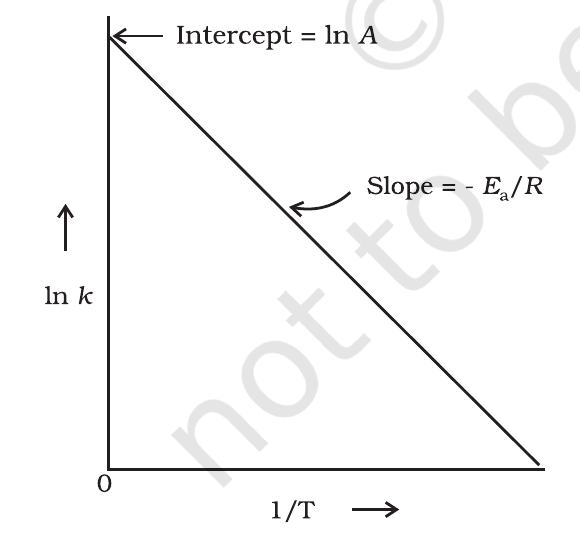
- The factor e^(-Ea/RT) in the Arrhenius equation corresponds to the fraction of molecules that have kinetic energy greater than Ea. Taking natural logarithm of both sides, ln k = -Ea/RT + ln A (eq 3.19).
- The plot of ln k against 1/T gives a straight line according to equation (3.19), as shown in Fig. 3.10. In Fig. 3.10, slope = -Ea/R and intercept = ln A. So Ea and A can be calculated using these values.
- It has been found from the Arrhenius equation that increasing the temperature or decreasing the activation energy will result in an increase in the rate of the reaction and an exponential increase in the rate constant.
- At temperatures T1 and T2, with rate constants k1 and k2, log(k2/k1) = (Ea/2.303R)[(T2 - T1)/T1T2] (eq 3.22), since A is constant for a given reaction.
Suggest an edit
Practice1 question
Try it now. A wrong answer costs nothing here, try again until you get it.
The rate of a chemical reaction doubles for an increase of 10 K in absolute temperature from 298 K. Calculate Ea.
NCERT 3.4, Intext 3.8 with answer 3.8: log 2 = (Ea/2.303R)[10/(298 x 308)], so Ea = 52.897 kJ mol-1.
Table: Arrhenius equation forms and worked values
| Form | Equation | What it gives |
|---|---|---|
| Arrhenius equation (3.18) | k = A e^(-Ea/RT) | k from A, Ea and T |
| Logarithmic form (3.19) | ln k = -Ea/RT + ln A | Straight line of ln k vs 1/T, slope = -Ea/R, intercept = ln A |
| Two-temperature form (3.22) | log(k2/k1) = (Ea/2.303R)[(T2 - T1)/T1T2] | Ea from k at two temperatures |
| Fraction above Ea | e^(-Ea/RT) | Fraction of molecules with kinetic energy greater than Ea |
- Example 3.9: the rate constants of a reaction at 500 K and 700 K are 0.02 s-1 and 0.07 s-1 respectively. Ea = 18230.8 J mol-1 and A = 1.61 s-1.
- Example 3.10: the first order rate constant for the decomposition of ethyl iodide, $C_2H_5I$(g) -> $C_2H_4$(g) + $HI$(g), at 600 K is 1.60 x $10^{-5}$ s-1. Its energy of activation is 209 kJ mol-1. The rate constant at 700 K is k2 = 6.36 x $10^{-3}$ s-1.
Suggest an edit
Effect of catalyst
- A catalyst is a substance which increases the rate of a reaction without itself undergoing any permanent chemical change. For example, $MnO_2$ catalyses 2KClO3 -> 2KCl + 3O2 so as to increase its rate considerably.
- The word catalyst should not be used when the added substance reduces the rate of reaction. The substance is then called an inhibitor.
- By intermediate complex theory, a catalyst participates in a chemical reaction by forming temporary bonds with the reactants, resulting in an intermediate complex. This has a transitory existence and decomposes to yield products and the catalyst.
- The catalyst provides an alternate pathway or reaction mechanism by reducing the activation energy between reactants and products and hence lowering the potential energy barrier, as shown in NCERT Fig. 3.11. From the Arrhenius equation, lower activation energy means a faster rate of reaction.
- A small amount of the catalyst can catalyse a large amount of reactants. A catalyst does not alter Gibbs energy of a reaction. It catalyses the spontaneous reactions but does not catalyse non-spontaneous reactions.
- A catalyst does not change the equilibrium constant of a reaction. It helps in attaining the equilibrium faster: it catalyses the forward as well as the backward reactions to the same extent, so that the equilibrium state remains the same but is reached earlier.
Suggest an edit
Collision theory of chemical reactions
- Collision theory was developed by Max Trautz and William Lewis in 1916-18 and provides a greater insight into the energetic and mechanistic aspects of reactions. It is based on kinetic theory of gases.
- Reactant molecules are assumed to be hard spheres, and reaction is postulated to occur when molecules collide with each other. The number of collisions per second per unit volume of the reaction mixture is known as collision frequency (Z).
- For a bimolecular elementary reaction A + B -> Products, Rate = ZAB e^(-Ea/RT) (eq 3.23), where ZAB represents the collision frequency of reactants A and B and e^(-Ea/RT) represents the fraction of molecules with energies equal to or greater than Ea. Comparing (3.23) with the Arrhenius equation, A is related to collision frequency.
- Equation (3.23) predicts the value of rate constants fairly accurately for reactions that involve atomic species or simple molecules, but for complex molecules significant deviations are observed. All collisions do not lead to the formation of products.
- Collisions in which molecules collide with sufficient kinetic energy (called threshold energy) and proper orientation, so as to facilitate breaking of bonds between reacting species and formation of new bonds to form products, are called effective collisions.
- Formation of methanol from bromomethane depends on the orientation of reactant molecules, as shown in NCERT Fig. 3.12. The proper orientation of reactant molecules leads to bond formation, whereas improper orientation makes them simply bounce back and no products are formed.
- To account for effective collisions, another factor P, called the probability or steric factor, is introduced. It takes into account that in a collision molecules must be properly oriented: Rate = PZAB e^(-Ea/RT). Activation energy and proper orientation of the molecules together determine the criteria for an effective collision and hence the rate of a chemical reaction.
- Threshold energy = activation energy + energy possessed by reacting species.
- Collision theory also has certain drawbacks, as it considers atoms and molecules to be hard spheres and ignores their structural aspect.
Suggest an edit
Ladder: order versus molecularity
- Order is experimental, molecularity is theoretical: order comes from the measured rate law, while molecularity counts the species colliding in one elementary step.
- Order can be zero: a zero order reaction has a rate independent of concentration. Molecularity can never be zero.
- Order can be a fraction: Rate = k[A]^3/2[B]^-1 has order 1/2. Molecularity can never be a fraction; it is 1, 2 or 3 only.
- Order applies to complex reactions too: the $KClO_3$ + 6FeSO4 reaction looks tenth order but is actually second order. Molecularity has no meaning for a complex reaction.
- Order is set by the slowest step: for a complex reaction, order is given by the slowest step. Molecularity of the slowest step is the same as the order of the overall reaction.
- How to use the ladder in a question: first ask whether the number comes from an experiment (order) or from counting colliding species in one step (molecularity). If the value is 0 or a fraction, it must be order. If the reaction is complex, molecularity does not apply at all.
Suggest an edit
Ladder: trap pairs
- Average rate vs instantaneous rate: average rate is constant over the interval it is calculated for and cannot predict the rate at one instant. Instantaneous rate is the tangent slope at one time t. For butyl chloride, the average rate falls from 1.90 x $10^{-4}$ to 0.4 x $10^{-4}$ mol L-1 s-1, while rinst at 600 s is 5.12 x $10^{-5}$ mol L-1 s-1.
- Rate vs rate constant: rate changes as concentration falls, but the rate constant k stays fixed at a given temperature. Do not use rate and k as the same quantity.
- Order vs molecularity: order is experimental and can be 0 or a fraction; molecularity is for elementary steps only and is 1, 2 or 3. The $KClO_3$ + 6FeSO4 reaction looks tenth order from its equation but is second order in fact.
- Half-life of zero vs first order: t1/2 = [R]0/2k for zero order, so it grows with [R]0. t1/2 = 0.693/k for first order, so it does not depend on [R]0 at all. Do not swap them.
- Arrhenius slope: the plot of ln k vs 1/T has slope = -Ea/R, a negative number. Ea = -slope x R is positive. A negative Ea in an answer means the sign was dropped.
- Catalyst vs equilibrium: a catalyst lowers Ea and reaches equilibrium faster, but it does not change the equilibrium constant or the Gibbs energy, and it cannot make a non-spontaneous reaction run.
- Threshold energy vs activation energy: threshold energy is the minimum total energy for effective collision, equal to activation energy plus the energy already possessed by the reacting species. They are not the same number.
- Pseudo first order vs true first order: hydrolysis of ethyl acetate and inversion of cane sugar look first order only because one reactant is in large excess. Their true orders are higher.
Suggest an edit
Trap Boxes
Rate law exponents equal the stoichiometric coefficients?
Wrong idea: The exponents in the rate law are always the stoichiometric coefficients from the balanced chemical equation.
Rate law exponents come from experiment, not from the balanced equation. For 2NO + $O_2$, experiment gives Rate = k[$NO$]^2[$O_2$], but for $CHCl_3$ + $Cl_2$ it gives Rate = k[$CHCl_3$][$Cl_2$]^1/2, where the exponents do not match the coefficients.
NCERT XII, Ch 3, 3.2.2
Order and molecularity are the same thing?
Wrong idea: Order and molecularity are interchangeable, so molecularity can also be zero or a fraction.
Order is an experimental quantity and can be zero or a fraction, as in Rate = k[A]^3/2[B]^-1 with order 1/2. Molecularity counts species colliding in one elementary step, so it is 1, 2 or 3 only, never zero or a fraction, and it has no meaning for a complex reaction.
NCERT XII, Ch 3, 3.2.3 and 3.2.4
Half-life of a first order reaction depends on initial concentration?
Wrong idea: Doubling the starting concentration doubles the half-life of a first order reaction.
For a first order reaction t1/2 = 0.693/k, independent of [R]0. Only the zero order half-life, t1/2 = [R]0/2k, grows with initial concentration. NEET 2025 Q56 uses this: 99.9% completion takes 10 half-lives.
NCERT XII, Ch 3, 3.3.3
A negative Arrhenius slope means a negative activation energy?
Wrong idea: Ea equals slope x R, so a slope of -5 x $10^{3}$ K gives Ea = -41.5 kJ mol-1.
The ln k vs 1/T plot has slope = -Ea/R, so Ea = -slope x R is positive. NEET 2021 Q99: slope -5 x $10^{3}$ K gives Ea = 5 x $10^{3}$ x 8.314 = 41.5 kJ mol-1.
NCERT XII, Ch 3, 3.4
A catalyst shifts the equilibrium and changes the heat of reaction?
Wrong idea: A catalyst changes the equilibrium constant and the heat of reaction, and more reactant also raises the activation energy.
A catalyst provides an alternate pathway with lower Ea and helps attain equilibrium faster, but it does not change the equilibrium constant or the Gibbs energy, and it does not catalyse non-spontaneous reactions. Raising concentration changes collision frequency, not heat of reaction or activation energy (NEET 2020 Q127).
NCERT XII, Ch 3, 3.4.1 and 3.5
Chapter test
5 NEET PYQs. +4 for a correct answer, -1 for a wrong answer, exactly like NEET. Finish the test to earn a medal.
Q1: NEET (UG) 2025, Code 45, Q89
If the rate constant of a reaction is 0.03 s-1, how much time does it take for 7.2 mol L-1 concentration of the reactant to get reduced to 0.9 mol L-1? (Given: log 2 = 0.301)
k = 0.03 s-1 has units s-1, so the reaction is first order. t = (2.303/k) log(7.2/0.9) = (2.303/0.03) x log 8 = 76.77 x 0.903 = 69.3 s.
Q2: NEET (UG) 2025, Code 45, Q56
If the half-life (t1/2) for a first order reaction is 1 minute, then the time required for 99.9% completion of the reaction is closest to :
NCERT Example 3.8 proves that 99.9% completion of a first order reaction takes 10 times the half-life: t = 6.909/k and t1/2 = 0.693/k, so t = 10 x 1 min = 10 minutes.
Q3: NEET (UG) 2022, Code R1, Q92
For a first order reaction A -> Products, initial concentration of A is 0.1 M, which becomes 0.001 M after 5 minutes. Rate constant for the reaction in min-1 is
k = (2.303/t) log([A]0/[A]) = (2.303/5) log(0.1/0.001) = 0.4606 x 2 = 0.9212 min-1 (NCERT 3.3.2, eq 3.15).
Q4: NEET (UG) 2021, Code P3, Q99
The slope of Arrhenius Plot (ln k v/s 1/T) of first order reaction is -5 x $10^{3}$ K. The value of Ea of the reaction is. Choose the correct option for your answer. [Given R = 8.314 JK-1mol-1]
Slope of ln k vs 1/T equals -Ea/R (NCERT 3.4, Fig. 3.10). Ea = -slope x R = 5 x $10^{3}$ x 8.314 = 41570 J mol-1 = 41.5 kJ mol-1.
Q5: NEET (UG) 2020, Code G5, Q127
An increase in the concentration of the reactants of a reaction leads to change in :
More reactant per unit volume means more collisions per second per unit volume, which is the collision frequency Z (NCERT 3.5). Heat of reaction, threshold energy and activation energy do not change with concentration.
Score: 0 · Answered 0 of 5
Flashcards
Tap a card to flip it over and see the answer. Tap it again to flip it back.
Give the expressions for average rate and instantaneous rate for R -> P.
Tap to flipAverage rate rav = -Δ[R]/Δt = +Δ[P]/Δt for R -> P. Instantaneous rate rinst = -d[R]/dt = d[P]/dt, the slope of the tangent to the concentration-time curve at time t.
Tap to flip backWrite the general rate law and the differential rate equation.
Tap to flipRate = k[A]^x[B]^y. k is the rate constant. For aA + bB -> cC + dD the differential form is -d[R]/dt = k[A]^x[B]^y. Exponents x and y may or may not equal the stoichiometric coefficients.
Tap to flip backGive the integrated rate equations and half-lives for zero and first order reactions.
Tap to flipZero order: k = ([R]0 - [R])/t and [R] = -kt + [R]0, so t1/2 = [R]0/2k. First order: k = (2.303/t) log([R]0/[R]) and [R] = [R]0 e^-kt, so t1/2 = 0.693/k.
Tap to flip backWrite the Arrhenius equation, its logarithmic form and its two-temperature form.
Tap to flipk = A e^(-Ea/RT). ln k = -Ea/RT + ln A. A plot of ln k against 1/T is a straight line with slope = -Ea/R and intercept = ln A. log(k2/k1) = (Ea/2.303R)[(T2 - T1)/T1T2].
Tap to flip backWhat are the overall orders of Rate = k[A]^1/2[B]^3/2 and Rate = k[A]^3/2[B]^-1?
Tap to flipRate = k[A]^1/2[B]^3/2 has order 1/2 + 3/2 = 2, second order. Rate = k[A]^3/2[B]^-1 has order 3/2 + (-1) = 1/2, half order. Order is the sum of the powers in the rate law.
Tap to flip backGive the units of the rate constant for zero, first and second order reactions.
Tap to flipZero order: mol L-1 s-1. First order: s-1. Second order: L mol-1 s-1. So k = 2.3 x $10^{-5}$ L mol-1 s-1 is second order and k = 3 x $10^{-4}$ s-1 is first order.
Tap to flip backHow does the half-life of $N_2O_5$ decomposition change with temperature, and what is the 10-degree rule?
Tap to flipFor decomposition of $N_2O_5$, half of the original amount decomposes in 12 min at 50 degrees C, 5 h at 25 degrees C and 10 days at 0 degrees C. For a chemical reaction, with rise in temperature by 10 degrees, the rate constant is nearly doubled.
Tap to flip backFind t1/2 for a first order reaction with k = 5.5 x $10^{-14}$ s-1, and state the 99.9% completion rule.
Tap to flipA first order reaction with k = 5.5 x $10^{-14}$ s-1 has t1/2 = 0.693/k = 1.26 x $10^{13}$ s. Time for 99.9% completion of a first order reaction is 10 times the half-life, since t = 6.909/k and t1/2 = 0.693/k.
Tap to flip backWhat is a pseudo first order reaction? Give two NCERT examples.
Tap to flipHydrolysis of ethyl acetate is really second order, but water is taken in large excess (0.01 mol ester with 10 mol water leaves 9.99 mol water), so Rate = k[$CH_3COOC_2H_5$] only. Inversion of cane sugar, Rate = k[$C_{12}H_{22}O_{11}$], is another pseudo first order reaction.
Tap to flip backState three differences between order and molecularity.
Tap to flipOrder is an experimental quantity: it can be zero and even a fraction. Molecularity cannot be zero or a non integer. Order applies to elementary and complex reactions; molecularity applies only to elementary reactions and has no meaning for a complex reaction.
Tap to flip backGive the mechanism of iodide-catalysed decomposition of $H_2O_2$ and name the rate determining step.
Tap to flip2H2O2 -> 2H2O + $O_2$, catalysed by $I^-$ in alkaline medium, has Rate = k[$H_2O_2$][$I^-$]. Step 1, $H_2O_2$ + $I^-$ -> $H_2O$ + $IO^-$, is slow and bimolecular, so it is the rate determining step. $IO^-$ is the intermediate. Step 2, $H_2O_2$ + $IO^-$ -> $H_2O$ + $I^-$ + $O_2$, is fast.
Tap to flip backClassify elementary and complex reactions, with the NCERT examples of complex reaction types.
Tap to flipElementary reactions take place in one step. Complex reactions take place through a sequence of elementary reactions (a mechanism) and may be consecutive reactions (oxidation of ethane to $CO_2$ and $H_2O$ through alcohol, aldehyde and acid), reverse reactions or side reactions (nitration of phenol gives o-nitrophenol
Tap to flip back