 NEET Notes
Home > Biology > Zoology > Reproductive Health
Reproductive Health
On this page · 16 sections
- 01Syllabus map
- 02Reproductive health: problems and strategies
- 03Amniocentesis and its ban
- 04Population explosion and birth control
- 05Table 1 - Birth control methods at a glance
- 06Natural methods
- 07Barrier methods and IUDs
- 08Oral, injectable, implant and surgical methods
- 09Table 2 - Types of IUDs
- 10Medical termination of pregnancy (MTP)
- 11Sexually transmitted diseases (STDs)
- 12Table 3 - Sexually transmitted diseases: cure and prevention
- 13Infertility and assisted reproductive technologies (ART)
- 14Table 4 - Assisted reproductive technologies
- 15Surrogacy and adoption
- 16Trap pairs: the confusions NEET tests
Reproductive health, population control, birth control methods, MTP, sexually transmitted diseases and infertility treatments: NCERT Chapter 3, with the PYQs NEET keeps repeating.
Syllabus map
- NMC Unit: BIO-U06, Reproduction. NCERT Chapter 3, Reproductive Health.
- Subtopics in this chapter (NCERT XII, Ch 3): Reproductive health, problems and strategies; population explosion and birth control; medical termination of pregnancy (MTP); sexually transmitted diseases (STDs); infertility.
- Subtopic checklist: (1) meaning of reproductive health and RCH programmes; (2) amniocentesis and its ban; (3) population explosion and its reasons; (4) natural methods of birth control; (5) barrier methods; (6) IUDs; (7) oral, injectable, implant and surgical methods; (8) MTP; (9) STDs, their symptoms, cure and prevention; (10) infertility and assisted reproductive technologies (ART).
- Extra information (beyond NCERT): one note in this chapter is labelled 'Extra information (beyond NCERT)': surrogacy, in the Surrogacy and adoption section. Everything else in this chapter is from NCERT Chapter 3. The PYQs are real NEET questions.
- Excluded topics: male and female reproductive systems, gametogenesis, the menstrual cycle, fertilisation and pregnancy (Chapter 2, Human Reproduction). Do not import their facts into this chapter.
- Estimated revision time: 10 minutes. Jump links: Syllabus Map, Reproductive Health, Amniocentesis, Population Explosion, Birth Control, Natural Methods, Barriers and IUDs, Oral and Surgical Methods, MTP, STDs, Infertility and ART, Surrogacy and Adoption, Tables, Trap Boxes, PYQs, Chapter Test.
Suggest an edit
Reproductive health: problems and strategies

Reproductive health means a total well-being in all aspects of reproduction, i.e., physical, emotional, behavioural and social. Therefore, a society with people having physically and functionally normal reproductive organs and normal emotional and behavioural interactions among them in all sex-related aspects might be called reproductively healthy.
India was amongst the first countries in the world to initiate action plans and programmes at a national level to attain total reproductive health as a social goal. These programmes called 'family planning' were initiated in 1951 and were periodically assessed over the past decades.
Improved programmes covering wider reproductive-related areas are currently in operation under the popular name 'Reproductive and Child Health Care (RCH) programmes'.
Creating awareness among people about various reproduction related aspects and providing facilities and support for building up a reproductively healthy society are the major tasks under these programmes.
With the help of audio-visual and print media, governmental and non-governmental agencies have taken various steps to create awareness among people about reproduction-related aspects.
Parents, other relatives, teachers and friends also have a major role in the dissemination of the above information.
In schools, sex education should be introduced and encouraged to provide right information to the young so as to discourage children from believing in myths and having misconceptions about sex-related aspects.
Proper information about reproductive organs, adolescence and related changes, safe and hygienic sexual practices, sexually transmitted diseases (STDs), AIDS, etc., would help people, especially those in the adolescent age group, to lead a reproductively healthy life.
Educating people, especially fertile couples and those in marriageable age group, about available birth control options, care of pregnant mothers, post-natal care of the mother and child, importance of breast feeding, equal opportunities for the male and the female child, etc., would address the importance of bringing up socially conscious healthy families of desired size.
Awareness of problems due to uncontrolled population growth, social evils like sex-abuse and sex-related crimes, etc., needs to be created to enable people to think and take up necessary steps to prevent them and thereby build up a socially responsible and healthy society.
Successful implementation of various action plans to attain reproductive health requires strong infrastructural facilities, professional expertise and material support. These are essential to provide medical assistance and care to people in reproduction-related problems like pregnancy, delivery, STDs, abortions, contraception, menstrual problems, infertility, etc.
Implementation of better techniques and new strategies from time to time are also required to provide more efficient care and assistance to people.
Suggest an edit
Practice1 question
Try it now. A wrong answer costs nothing here, try again until you get it.
In which year were family planning programmes first initiated in India?
India was amongst the first countries in the world to initiate action plans and programmes at a national level to attain total reproductive health. Family planning programmes were initiated in 1951; the wider RCH programmes came later.
Amniocentesis and its ban
Amniocentesis is a procedure in which some of the amniotic fluid of the developing foetus is taken to analyse the fetal cells and dissolved substances.
This procedure is used to test for the presence of certain genetic disorders such as Down's syndrome, haemophilia and sickle-cell anaemia, and to determine the survivability of the foetus.
This technique is, unfortunately, being misused to kill the normal female foetus. It is legally banned for the determination of sex to avoid female foeticide.
The statutory ban on amniocentesis for sex-determination keeps a check on such indiscriminate female foeticides, which are a social evil.
Suggest an edit
Population explosion and birth control
In the last century, an all-round development in various fields significantly improved the quality of life of the people. However, increased health facilities along with better living conditions had an explosive impact on the growth of population.
The world population which was around 2 billion in 1900 rocketed to about 6 billion by 2000 and 7.2 billion by 2011. A similar trend was observed in India too.
At the time of independence, our population was approximately 350 million, which reached close to the billion mark by 2000 and crossed 1.2 billion in May 2011.
A rapid decline in death rate, maternal mortality rate (MMR) and infant mortality rate (IMR) as well as an increase in number of people in the reproducible age are probable reasons for this population explosion.
Through our Reproductive Child Health (RCH) programme, though we could bring down the population growth rate, it was only marginal.
According to the 2011 census report, the population growth rate was less than 2 per cent, i.e., 20/1000/year, a rate at which our population could increase rapidly.
Such an alarming growth rate could lead to an absolute scarcity of even the basic requirements, i.e., food, shelter and clothing, in spite of significant progress made in those areas.
The government has taken various steps, and the couples are motivated to have small families by using various contraceptive methods. Many couples, mostly the young, urban, working ones, have even adopted a 'one child' norm.
You might have seen advertisements in the media as well as posters showing a happy couple with two children with a slogan Hum Do Hamare Do (we two, our two).
Statutory raising of marriageable age of the female to 18 years and that of males to 21 years, and incentives given to couples with small families, are two of the other measures taken to tackle this problem.
Suggest an edit
Table 1 - Birth control methods at a glance
| Method group | How it works | Examples |
|---|---|---|
| Natural or traditional | Avoid the chances of sperm meeting the ovum | Periodic abstinence, withdrawal (coitus interruptus), lactational amenorrhea |
| Barrier | Prevent the physical meeting of sperm and ovum | Condoms, diaphragms, cervical caps, vaults |
| IUD | Placed inside the uterus; increase phagocytosis of sperm and suppress sperm motility; hormone releasing IUDs also make the uterus unsuitable for implantation and the cervix hostile to sperms | Lippes loop, CuT, Cu7, Multiload 375, Progestasert, LNG-20 |
| Oral pills, injectables & implants | Inhibit ovulation and implantation; alter cervical mucus | Oral pills, Saheli, injectables, implants |
| Surgical | Block gamete transport | Vasectomy (male), tubectomy (female) |
An ideal contraceptive should be user-friendly, easily available, effective and reversible with no or least side-effects. It also should in no way interfere with the sexual drive, desire and/or the sexual act of the user.
Source: NCERT XII, Ch 3, 3.2.
Suggest an edit
Practice1 question
Try it now. A wrong answer costs nothing here, try again until you get it.
Which of the following is a natural method of birth control?
Natural methods are periodic abstinence, withdrawal (coitus interruptus) and lactational amenorrhea. Vaults are barrier devices, CuT is an IUD and Saheli is an oral pill.
Natural methods
Periodic abstinence is one of the natural methods in which the couples avoid or abstain from coitus from day 10 to 17 of the menstrual cycle when ovulation could be expected. As chances of fertilisation are very high during this period, it is called the fertile period. Therefore, by abstaining from coitus during this period, conception could be prevented.
Withdrawal or coitus interruptus is another method in which the male partner withdraws his penis from the vagina just before ejaculation so as to avoid insemination.
Lactational amenorrhea (absence of menstruation) is a method based on the fact that ovulation and therefore the menstrual cycle do not occur during the period of intense lactation following parturition. Therefore, as long as the mother breast-feeds the child fully, chances of conception are almost nil. However, this method has been reported to be effective only up to a maximum period of 6 months following parturition.
Side effects are almost nil in natural methods. However, chances of failure of these methods are also high.
Suggest an edit
Barrier methods and IUDs
In barrier methods, ovum and sperms are prevented from physically meeting with the help of barriers. Such methods are available for both males and females.
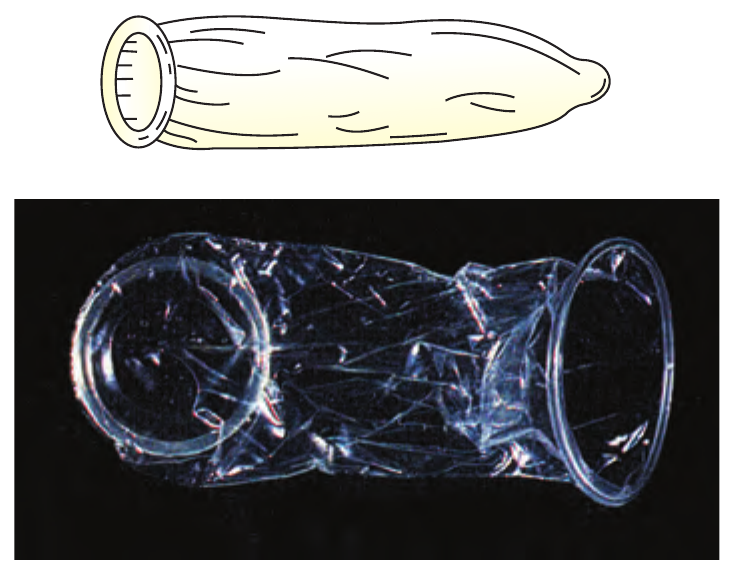
Condoms are barriers made of thin rubber or latex sheath that are used to cover the penis in the male or vagina and cervix in the female, just before coitus so that the ejaculated semen would not enter into the female reproductive tract. This can prevent conception.
'Nirodh' is a popular brand of condom for the male. Use of condoms has increased in recent years due to its additional benefit of protecting the user from contracting STDs and AIDS. Both the male and the female condoms are disposable, can be self-inserted and thereby give privacy to the user.
Diaphragms, cervical caps and vaults are also barriers made of rubber that are inserted into the female reproductive tract to cover the cervix during coitus. They prevent conception by blocking the entry of sperms through the cervix. They are reusable.
Spermicidal creams, jellies and foams are usually used along with these barriers to increase their contraceptive efficiency.
Intra Uterine Devices (IUDs) are devices inserted by doctors or expert nurses in the uterus through vagina. These Intra Uterine Devices are presently available as the non-medicated IUDs (e.g. Lippes loop), copper releasing IUDs (CuT, Cu7, Multiload 375) and the hormone releasing IUDs (Progestasert, LNG-20).
IUDs increase phagocytosis of sperms within the uterus and the Cu ions released suppress sperm motility and the fertilising capacity of sperms. The hormone releasing IUDs, in addition, make the uterus unsuitable for implantation and the cervix hostile to the sperms.
IUDs are ideal contraceptives for the females who want to delay pregnancy and/or space children. It is one of the most widely accepted methods of contraception in India.
Suggest an edit
Oral, injectable, implant and surgical methods
Oral administration of small doses of either progestogens or progestogen-estrogen combinations is another contraceptive method used by the females. They are used in the form of tablets and hence are popularly called the pills.
Pills have to be taken daily for a period of 21 days starting preferably within the first five days of the menstrual cycle. After a gap of 7 days (during which menstruation occurs), it has to be repeated in the same pattern till the female desires to prevent conception.
They inhibit ovulation and implantation as well as alter the quality of cervical mucus to prevent or retard the entry of sperms.
Pills are very effective with lesser side effects and are well accepted by the females.
Saheli, the new oral contraceptive for the females, contains a non-steroidal preparation. It is a 'once a week' pill with very few side effects and high contraceptive value. Saheli was developed by scientists at the Central Drug Research Institute (CDRI) in Lucknow, India.
Progestogens alone or in combination with estrogen can also be used by females as injections or implants under the skin. Their mode of action is similar to that of pills and their effective periods are much longer.
Administration of progestogens or progestogen-estrogen combinations or IUDs within 72 hours of coitus have been found to be very effective as emergency contraceptives, as they could be used to avoid possible pregnancy due to rape or casual unprotected intercourse.
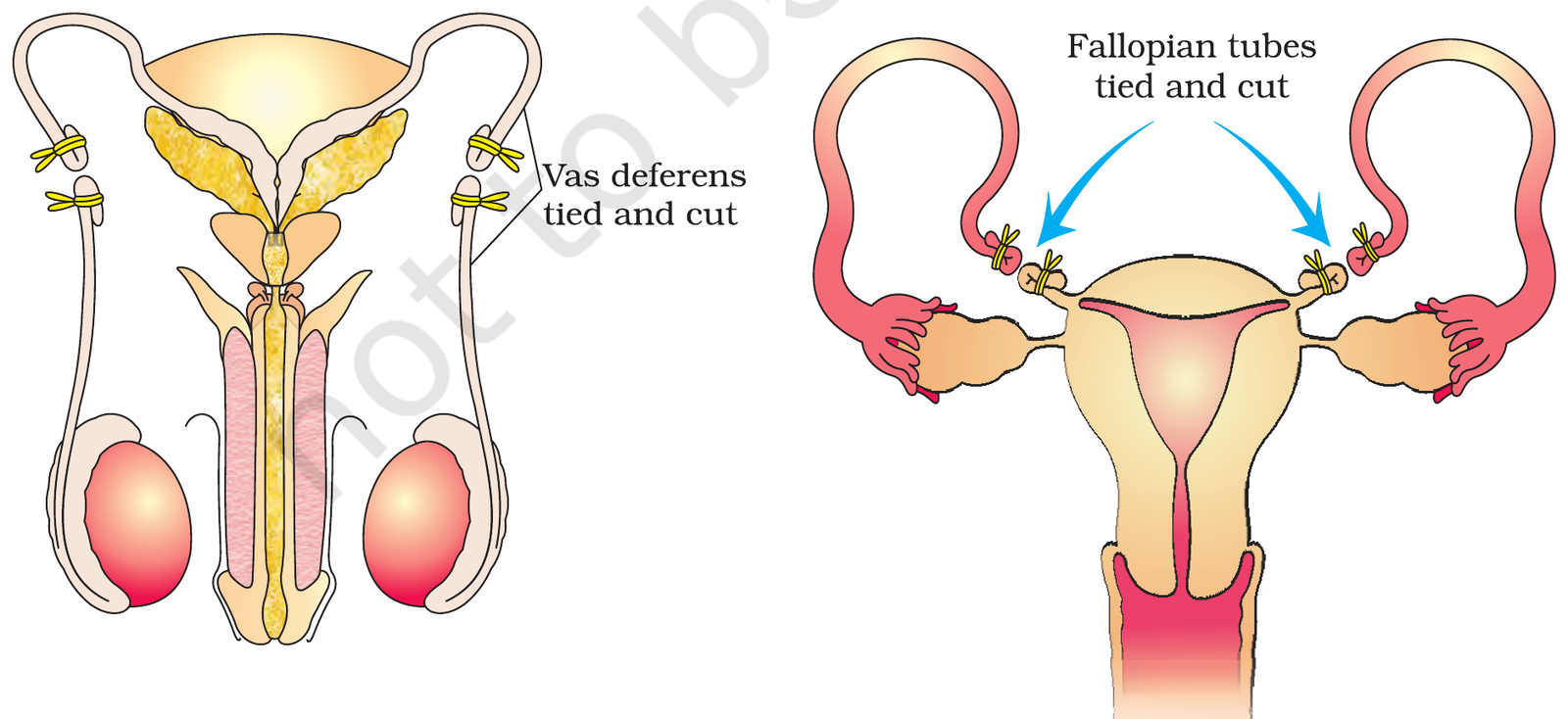
Surgical methods, also called sterilisation, are generally advised for the male or female partner as a terminal method to prevent any more pregnancies.
Surgical intervention blocks gamete transport and thereby prevents conception.
Sterilisation procedure in the male is called vasectomy and that in the female is called tubectomy.
In vasectomy, a small part of the vas deferens is removed or tied up through a small incision on the scrotum, whereas in tubectomy, a small part of the fallopian tube is removed or tied up through a small incision in the abdomen or through the vagina.
These techniques are highly effective but their reversibility is very poor.
Suggest an edit
Practice1 question
Try it now. A wrong answer costs nothing here, try again until you get it.
Which method is a surgical method of contraception for females?
Tubectomy is the surgical method for females: a small part of the fallopian tube is removed or tied up. Vasectomy is the male surgery (vas deferens); CuT and LNG-20 are IUDs.
Table 2 - Types of IUDs
| Type of IUD | Examples | How it works |
|---|---|---|
| Non-medicated | Lippes loop | Increases phagocytosis of sperms within the uterus |
| Copper releasing | CuT, Cu7, Multiload 375 | Cu ions released suppress sperm motility and the fertilising capacity of sperms |
| Hormone releasing | Progestasert, LNG-20 | Make the uterus unsuitable for implantation and the cervix hostile to the sperms |
All IUDs increase phagocytosis of sperms within the uterus; the Cu ions released suppress sperm motility and the fertilising capacity of sperms.
IUDs are inserted by doctors or expert nurses in the uterus through the vagina. They are one of the most widely accepted methods of contraception in India.
Source: NCERT XII, Ch 3, 3.2.
Suggest an edit
Medical termination of pregnancy (MTP)
Medical Termination of Pregnancy (MTP) is intentional or voluntary termination of pregnancy before full term. It is also called induced abortion.
Nearly 45 to 50 million MTPs are performed in a year all over the world, which accounts for 1/5th of the total number of conceived pregnancies in a year.
Government of India legalised MTP in 1971 with some strict conditions to avoid its misuse. The Medical Termination of Pregnancy (Amendment) Act, 2017 was enacted with the intention of reducing the incidence of illegal abortion and consequent maternal mortality and morbidity. According to this Act, a pregnancy may be terminated on certain considered grounds within the first 12 weeks of pregnancy on the opinion of one registered medical practitioner. If the pregnancy has lasted more than 12 weeks, but fewer than 24 weeks, two registered medical practitioners must be of the opinion, formed in good faith, that the required ground exists. The grounds are: (i) the continuation of the pregnancy would involve a risk to the life of the pregnant woman or of grave injury to her physical or mental health; or (ii) there is a substantial risk that if the child were born, it would suffer from such physical or mental abnormalities as to be seriously handicapped. Such restrictions are all the more important to check indiscriminate and illegal female foeticides, which are reported to be high in India.
MTPs are considered relatively safe during the first trimester, i.e., up to 12 weeks of pregnancy. Second trimester abortions are much more risky.
MTP is not a method of contraception: it terminates an existing pregnancy, it does not prevent one.
MTP is also used to get rid of unwanted pregnancies either due to casual unprotected intercourse or failure of the contraceptive used during coitus or rapes.
MTPs are also essential in certain cases where continuation of the pregnancy could be harmful or even fatal either to the mother or to the foetus or both.
Suggest an edit
Sexually transmitted diseases (STDs)
Infections or diseases which are transmitted through sexual intercourse are collectively called sexually transmitted infections (STIs) or venereal diseases (VD) or reproductive tract infections (RTI). They are also commonly called sexually transmitted diseases (STDs).
Gonorrhoea, syphilis, genital herpes, chlamydiasis, genital warts, trichomoniasis, hepatitis-B and HIV leading to AIDS are some of the common STDs.
Among these, HIV infection is most dangerous and is discussed in detail in the chapter on human health and disease.
Some of these infections, like hepatitis-B and HIV, can also be transmitted by sharing of injection needles, surgical instruments, etc., with infected persons, transfusion of blood, or from an infected mother to the foetus too.
Early symptoms of most of these are mostly minor and include itching, fluid discharge, slight pain, swellings, etc., in the genital region.
Infected females may often be asymptomatic and hence may remain undetected for long.
Absence or less significant symptoms in the early stages of infection and the social stigma attached to the STDs deter the infected persons from going for timely detection and proper treatment.
This could lead to complications later, which include pelvic inflammatory diseases (PID), abortions, still births, ectopic pregnancies, infertility or even cancer of the reproductive tract.
STDs are a major threat to a healthy society. Therefore, prevention or early detection and cure of these diseases are given prime consideration under the reproductive health-care programmes.
Though all persons are vulnerable to these infections, their incidences are reported to be very high among persons in the age group of 15-24 years.
One could be free of these infections by following the simple principles given below: (i) Avoid sex with unknown partners or multiple partners. (ii) Always use condoms during coitus. (iii) In case of doubt, go to a qualified doctor for early detection and get complete treatment if diagnosed with the infection.
Suggest an edit
Practice1 question
Try it now. A wrong answer costs nothing here, try again until you get it.
Which of the following sexually transmitted diseases is not completely curable?
Hepatitis-B, genital herpes and HIV cannot be cured. Gonorrhoea, syphilis and chlamydiasis are curable if detected early and treated properly.
Table 3 - Sexually transmitted diseases: cure and prevention
| Disease | How it spreads | Completely curable? |
|---|---|---|
| Gonorrhoea | Sexual intercourse | Yes, if detected early and treated properly |
| Syphilis | Sexual intercourse | Yes, if detected early and treated properly |
| Genital herpes | Sexual intercourse | No: hepatitis-B, genital herpes and HIV are not curable |
| Chlamydiasis | Sexual intercourse | Yes, if detected early and treated properly |
| Genital warts | Sexual intercourse | Yes, if detected early and treated properly |
| Trichomoniasis | Sexual intercourse | Yes, if detected early and treated properly |
| Hepatitis-B | Sexual intercourse; also sharing injection needles, surgical instruments, blood transfusion, infected mother to foetus | No: hepatitis-B, genital herpes and HIV are not curable |
| HIV (AIDS) | Sexual intercourse; also sharing injection needles, surgical instruments, blood transfusion, infected mother to foetus | No: hepatitis-B, genital herpes and HIV are not curable |
Most of the STDs listed above spread through sexual intercourse, but hepatitis-B and HIV can also spread by sharing injection needles, surgical instruments, blood transfusion, or from an infected mother to the foetus. Except hepatitis-B, genital herpes and HIV, other diseases are completely curable if detected early and treated properly.
Source: NCERT XII, Ch 3, 3.4.
Suggest an edit
Infertility and assisted reproductive technologies (ART)
A large number of couples all over the world including India are infertile, i.e., they are unable to produce children in spite of unprotected sexual cohabitation. Inability to conceive or produce children even after 2 years of unprotected sexual cohabitation is called infertility.
The reasons for this could be many: physical, congenital, diseases, drugs, immunological or even psychological.
In India, often the female is blamed for the couple being childless, but more often than not, the problem lies in the male partner.
Specialised health care units (infertility clinics, etc.) could help in diagnosis and corrective treatment of some of these disorders and enable these couples to have children.
However, where such corrections are not possible, the couples could be assisted to have children through certain special techniques commonly known as assisted reproductive technologies (ART).
In vitro fertilisation (IVF, fertilisation outside the body in almost similar conditions as that in the body) followed by embryo transfer (ET) is one of such methods. This is the technique commonly known as the 'test tube baby' programme.
In this method, ova from the wife or donor (female) and sperms from the husband or donor (male) are collected and are induced to form zygote under simulated conditions in the laboratory.
The zygote or early embryos (with up to 8 blastomeres) could then be transferred into the fallopian tube. This is called zygote intra fallopian transfer (ZIFT).
Embryos with more than 8 blastomeres could be transferred into the uterus. This is called intra uterine transfer (IUT).
Embryos formed by in-vivo fertilisation (fusion of gametes within the female) also could be used for such transfer to assist those females who cannot conceive.
In gamete intra fallopian transfer (GIFT), an ovum collected from a donor is transferred into the fallopian tube of another female who cannot produce one, but can provide a suitable environment for fertilisation and further development.
Infertility cases either due to inability of the male partner to inseminate the female or due to very low sperm counts in the ejaculates could be corrected by artificial insemination (AI) technique. In this technique, the semen collected either from the husband or a healthy donor is artificially introduced either into the vagina or into the uterus (IUI, intra-uterine insemination) of the female.
Intra cytoplasmic sperm injection (ICSI) is another specialised procedure to form an embryo in the laboratory, in which a sperm is directly injected into the ovum.
Suggest an edit
Table 4 - Assisted reproductive technologies
| Technique | What is transferred | Where it is transferred |
|---|---|---|
| IVF-ET | Embryo formed by fertilisation outside the body | Fallopian tube (ZIFT, up to 8 blastomeres) or uterus (IUT, more than 8 blastomeres) |
| ZIFT | Zygote or early embryo with up to 8 blastomeres | Fallopian tube |
| IUT | Embryo with more than 8 blastomeres | Uterus |
| GIFT | Ovum (gamete) collected from a donor | Fallopian tube of a female who cannot produce ova |
| AI (IUI) | Semen from the husband or a healthy donor | Vagina or uterus |
| ICSI | A sperm injected directly into the ovum in the laboratory to form an embryo | Laboratory (embryo formed in the laboratory) |
Source: NCERT XII, Ch 3, 3.5.
Suggest an edit
Practice1 question
Try it now. A wrong answer costs nothing here, try again until you get it.
In ZIFT, the zygote or early embryo transferred into the fallopian tube has up to how many blastomeres?
ZIFT transfers a zygote or early embryo with up to 8 blastomeres into the fallopian tube. An embryo with more than 8 blastomeres is transferred into the uterus (IUT).
Surrogacy and adoption
Extra information (beyond NCERT): in surrogacy, the embryo is transferred into the uterus of a surrogate mother, a female who is not the biological mother, to carry the pregnancy to term. The legal issues around surrogacy and ART are complex and governed by law in India.
In India, there are many orphaned and destitute children who would probably not survive till maturity, unless taken care of.
Our laws permit legal adoption and it is, as yet, one of the best methods for couples looking for parenthood.
Suggest an edit
Trap pairs: the confusions NEET tests
- Vasectomy vs tubectomy: vasectomy removes or ties up a small part of the vas deferens (male); tubectomy removes or ties up a small part of the fallopian tube (female).
- ZIFT vs IUT vs GIFT: ZIFT transfers a zygote or early embryo with up to 8 blastomeres into the fallopian tube; IUT transfers an embryo with more than 8 blastomeres into the uterus; GIFT transfers a gamete (ovum), not an embryo.
- Copper IUD vs hormone IUD: copper IUDs (CuT, Cu7, Multiload 375) release Cu ions that suppress sperm motility and fertilising capacity; hormone IUDs (Progestasert, LNG-20) make the uterus unsuitable for implantation and the cervix hostile to sperms.
- Natural vs barrier: natural methods (periodic abstinence, withdrawal, lactational amenorrhea) use no device; barrier methods (condoms, diaphragms, cervical caps, vaults) physically block the entry of sperms.
- Curable vs not curable STDs: gonorrhoea, syphilis, chlamydiasis, genital warts and trichomoniasis are curable if detected early; hepatitis-B, genital herpes and HIV have no cure.
- MTP vs contraception: MTP is induced abortion, legalised in India in 1971 with strict conditions and amended by the MTP (Amendment) Act, 2017; it is not a contraceptive method.
Suggest an edit
Trap Boxes
Lippes loop is a copper-releasing IUD?
Wrong idea: Lippes loop releases copper ions, so it is a copper-releasing IUD.
Lippes loop is a non-medicated IUD. Copper-releasing IUDs are CuT, Cu7 and Multiload 375; hormone-releasing IUDs are Progestasert and LNG-20.
NCERT XII, Ch 3, 3.2
Vaults are a natural method of birth control?
Wrong idea: Vaults are a natural or traditional method, like periodic abstinence.
Vaults are a barrier method: a rubber barrier inserted to cover the cervix during coitus. Natural methods are periodic abstinence, withdrawal (coitus interruptus) and lactational amenorrhea.
NCERT XII, Ch 3, 3.2
Every STD is curable if detected early?
Wrong idea: All sexually transmitted diseases can be cured completely if detected early.
Hepatitis-B, genital herpes and HIV cannot be cured. All the other STDs in NCERT are completely curable if detected early and treated properly.
NCERT XII, Ch 3, 3.4
GIFT transfers an embryo into the uterus?
Wrong idea: In GIFT, an embryo is transferred into the uterus of the female.
GIFT transfers a gamete (an ovum collected from a donor) into the fallopian tube of a female who cannot produce ova. ZIFT and IUT transfer embryos: a zygote or early embryo up to 8 blastomeres (ZIFT) or an embryo with more than 8 blastomeres (IUT).
NCERT XII, Ch 3, 3.5
MTP is a method of contraception?
Wrong idea: MTP is just another contraceptive method, like the pill.
MTP is induced abortion: intentional termination of pregnancy before full term. It was legalised in India in 1971 with strict conditions and amended by the MTP (Amendment) Act, 2017, but it is not a contraceptive method: it terminates an existing pregnancy, it does not prevent one.
NCERT XII, Ch 3, 3.3
Chapter test
5 NEET PYQs. +4 for a correct answer, -1 for a wrong answer, exactly like NEET. Finish the test to earn a medal.
Q1: NEET (UG) 2024, Code R3, Q151
Which of the following is not a natural/traditional contraceptive method?
Periodic abstinence, lactational amenorrhea and coitus interruptus (withdrawal) are natural methods. Vaults are a barrier method: a rubber barrier inserted to cover the cervix during coitus.
Q2: NEET (UG) 2022, Code R1, Q174
Lippe's loop is a type of contraceptive used as:
Lippes loop is a non-medicated IUD. Copper-releasing IUDs are CuT, Cu7 and Multiload 375; hormone-releasing IUDs are Progestasert and LNG-20.
Q3: NEET (UG) 2021, Code P3, Q174
Match List-I with List-II.
| List-I | List-II |
|---|---|
| (a) Vaults | (i) Entry of sperm through Cervix is blocked |
| (b) IUDs | (ii) Removal of Vas deferens |
| (c) Vasectomy | (iii) Phagocytosis of sperms within the Uterus |
| (d) Tubectomy | (iv) Removal of fallopian tube |
Choose the correct answer from the options given below:
Vaults cover the cervix and block the entry of sperm (a)-(i); IUDs increase phagocytosis of sperm within the uterus (b)-(iii); vasectomy removes a part of the vas deferens (c)-(ii); tubectomy removes a part of the fallopian tube (d)-(iv).
Q4: NEET (UG) 2020, Code G5, Q67
In which of the following techniques, the embryos are transferred to assist those females who cannot conceive?
ZIFT (zygote intra fallopian transfer) and IUT (intra uterine transfer) are embryo transfer methods. In GIFT a gamete is transferred, and ICSI injects a sperm into an ovum in the laboratory.
Q5: NEET (UG) 2020, Code G5, Q27
Select the option including all sexually transmitted diseases.
Gonorrhoea, syphilis and genital herpes are sexually transmitted diseases. Malaria, filaria and cancer are not.
Score: 0 · Answered 0 of 5
Flashcards
Tap a card to flip it over and see the answer. Tap it again to flip it back.
In which year were family planning programmes initiated in India?
Tap to flip1951. India was amongst the first countries in the world to initiate action plans and programmes at a national level to attain total reproductive health as a social goal.
Tap to flip backWhat was the population of India at independence, in 2000 and in May 2011, and what was the population growth rate in the 2011 census?
Tap to flipAbout 350 million at independence, close to a billion by 2000, and crossed 1.2 billion in May 2011. The 2011 census put the growth rate at less than 2 per cent, i.e., 20 per 1000 per year.
Tap to flip backWhich days of the menstrual cycle must a couple abstain from coitus in periodic abstinence?
Tap to flipDay 10 to day 17 of the menstrual cycle. Couples avoid or abstain from coitus during this fertile period.
Tap to flip backFor how long after parturition does lactational amenorrhea prevent conception?
Tap to flipUp to 6 months after parturition, as long as the mother breast-feeds the child fully. Ovulation and therefore the menstrual cycle do not occur during the period of intense lactation following parturition.
Tap to flip backWhich IUDs are hormone-releasing, which are copper-releasing, and which is non-medicated?
Tap to flipHormone-releasing: Progestasert and LNG-20. Copper-releasing: CuT, Cu7 and Multiload 375. Lippes loop is a non-medicated IUD.
Tap to flip backHow are oral contraceptive pills taken, and how often is Saheli taken?
Tap to flipOral pills: one tablet daily for 21 days, starting within the first 5 days of the menstrual cycle, then a gap of 7 days. Saheli: once a week.
Tap to flip backName the sexually transmitted diseases listed in NCERT.
Tap to flipGonorrhoea, syphilis, genital herpes, chlamydiasis, genital warts, trichomoniasis, hepatitis-B and HIV (which causes AIDS).
Tap to flip backWhich sexually transmitted diseases cannot be cured?
Tap to flipHepatitis-B, genital herpes and HIV. All the other STDs listed in NCERT are curable if detected early and treated properly.
Tap to flip backPut the ART embryo-transfer steps in order: embryo with more than 8 blastomeres to the uterus, zygote up to 8 blastomeres to the fallopian tube, fertilisation outside the body.
Tap to flipFertilisation outside the body (IVF), then the zygote or early embryo with up to 8 blastomeres into the fallopian tube (ZIFT), then the embryo with more than 8 blastomeres into the uterus (IUT).
Tap to flip backHow many MTPs are performed in a year worldwide, and what fraction of conceived pregnancies is that?
Tap to flipNearly 45 to 50 million MTPs a year, about 1/5 of the total number of conceived pregnancies in a year.
Tap to flip back