 NEET Notes
Home > Biology > Botany > Principles of Inheritance and Variation
Principles of Inheritance and Variation
On this page · 19 sections
- 01Syllabus map
- 02Mendel's laws of inheritance
- 03Inheritance of one gene
- 04Incomplete dominance
- 05Co-dominance, multiple alleles and pleiotropy
- 06Inheritance of two genes
- 07Chromosomal theory of inheritance
- 08Linkage and recombination
- 09Polygenic inheritance
- 10Sex determination
- 11Mutation
- 12Pedigree analysis and Mendelian disorders
- 13Chromosomal disorders
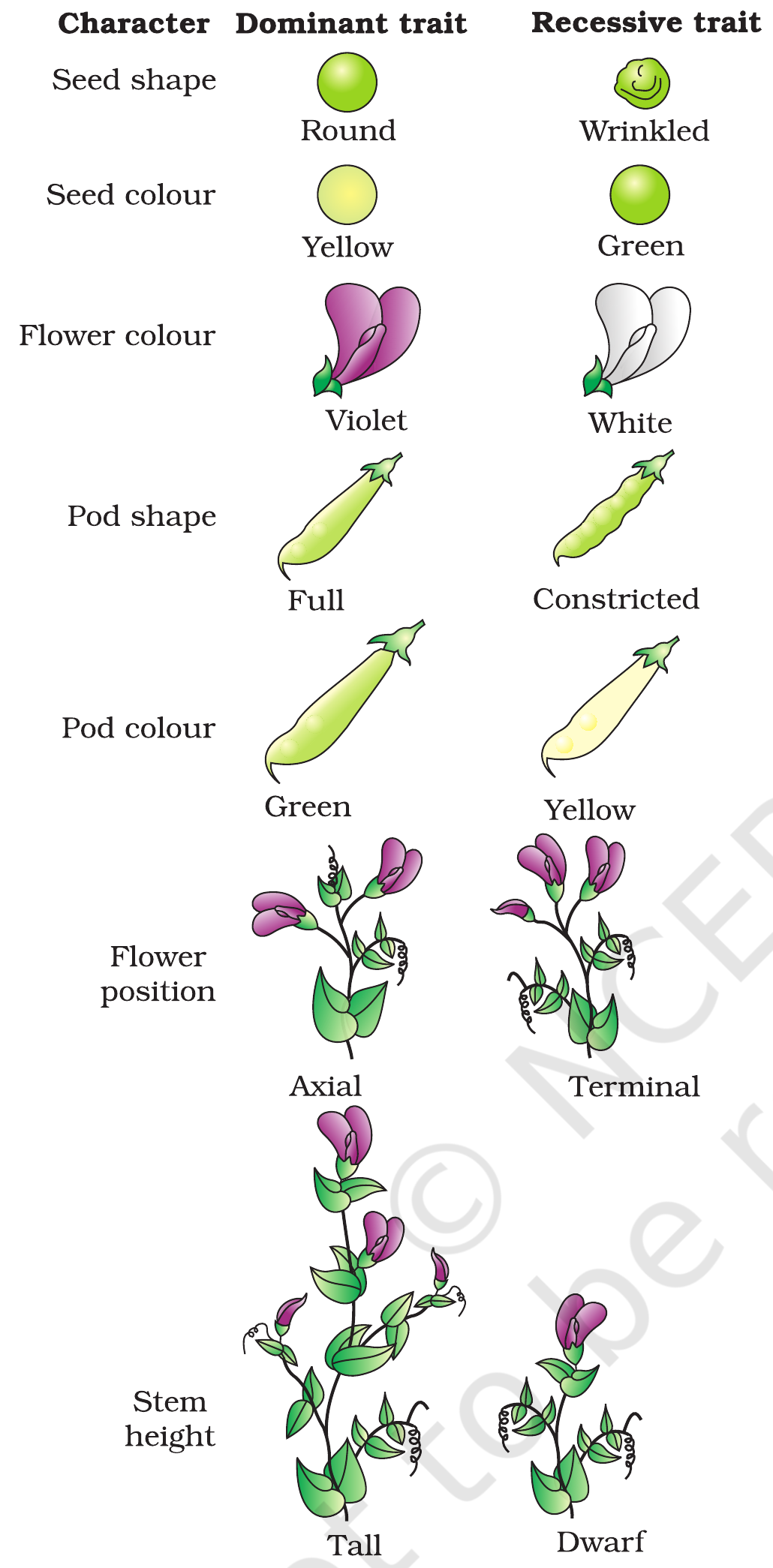
- 14Table 1: The seven pairs of contrasting traits Mendel studied
- 15Table 2: Crosses and their $F_2$ ratios
- 16Table 3: ABO blood groups
- 17Table 4: Sex determination in different organisms
- 18Table 5: Genetic disorders at a glance
- 19Trap pairs: the confusions NEET tests
Mendel's laws, incomplete dominance, blood groups, linkage, sex determination, mutations and genetic disorders, all from NCERT Chapter 4, with the PYQs NEET keeps repeating.
Syllabus map
- NMC Unit: BIO-U07, Genetics and Evolution. NCERT Chapter 4, Principles of Inheritance and Variation (Class XII).
- Subtopics in this chapter (NCERT XII, Ch 4): Mendel's laws of inheritance; inheritance of one gene (monohybrid cross, law of dominance, law of segregation, test cross, incomplete dominance, co-dominance, multiple alleles); pleiotropy; inheritance of two genes (dihybrid cross, law of independent assortment, chromosomal theory of inheritance, linkage and recombination, polygenic inheritance); sex determination; mutation; genetic disorders (pedigree analysis, Mendelian disorders, chromosomal disorders).
- Subtopic checklist: (1) Mendel's experiments and the seven traits; (2) monohybrid and dihybrid crosses and their ratios; (3) test cross; (4) incomplete dominance and co-dominance; (5) ABO blood groups; (6) pleiotropy; (7) chromosomal theory; (8) linkage and recombination frequencies; (9) polygenic inheritance; (10) sex determination in humans, Drosophila, grasshopper, birds and honey bee; (11) mutation and sickle cell anaemia; (12) pedigree analysis; (13) haemophilia, sickle cell anaemia, phenylketonuria, colour blindness, thalassemia and myotonic dystrophy; (14) Down's, Klinefelter's and Turner's syndromes.
- Extra information (beyond NCERT): one flashcard is labelled 'Extra information (beyond NCERT - derived combinatorics rule)': the 2 to the power n rule for counting gamete types (the question itself is NCERT Chapter 4, exercise Q3). Everything else in this chapter is NCERT Chapter 4.
- Excluded topics: molecular basis of inheritance (Chapter 5) and evolution (Chapter 6). Do not import their facts into this chapter.
- Estimated revision time: 12 minutes. Jump links: Syllabus Map, Mendel's Laws, One Gene, Incomplete Dominance, Co-dominance, Two Genes, Chromosomal Theory, Linkage, Polygenic Inheritance, Sex Determination, Mutation, Pedigree and Disorders, Chromosomal Disorders, Tables, Trap Boxes, PYQs, Chapter Test.
Suggest an edit
Mendel's laws of inheritance
Gregor Mendel conducted hybridisation experiments on garden peas for seven years (1856-1863) and proposed the laws of inheritance in living organisms. He selected 14 true-breeding pea plant varieties, which differed in 7 pairs of contrasting traits (Table 1).
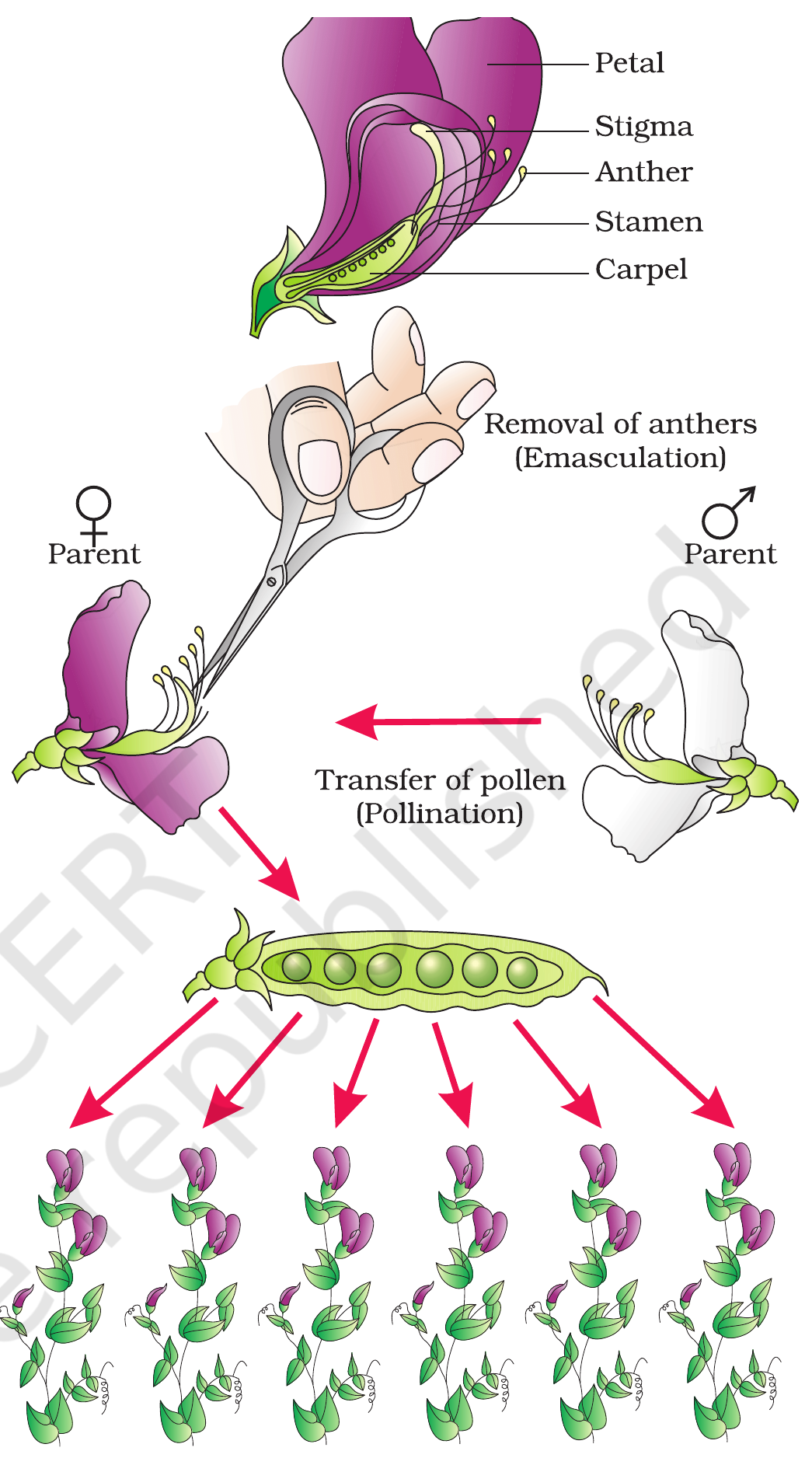
Mendel conducted artificial pollination/cross pollination experiments using several true-breeding pea lines. He selected 14 true-breeding pea plant varieties, as pairs which were similar except for one character with contrasting traits. His experiments had a large sampling size, which gave greater credibility to the data that he collected, and the confirmation of his inferences from experiments on successive generations proved that his results pointed to general rules of inheritance rather than being unsubstantiated ideas.
Mendel's work was published in 1865 but remained unrecognised until 1900, when it was rediscovered independently by three scientists: Hugo de Vries, Carl Correns and Erich von Tschermak.
Mendel proposed three laws: the Law of Dominance, the Law of Segregation and the Law of Independent Assortment. The first two come from the inheritance of one gene; the third comes from the inheritance of two genes.
Suggest an edit
Practice1 question
Try it now. A wrong answer costs nothing here, try again until you get it.
Mendel selected 14 true-breeding pea plant varieties for his experiments. How many pairs of contrasting traits did he study, and what gave greater credibility to the data he collected?
NCERT 4.1: Mendel selected 14 true-breeding pea plant varieties, as pairs which were similar except for one character with contrasting traits (Table 4.1 lists the seven pairs). His experiments had a large sampling size, which gave greater credibility to the data that he collected.
Inheritance of one gene
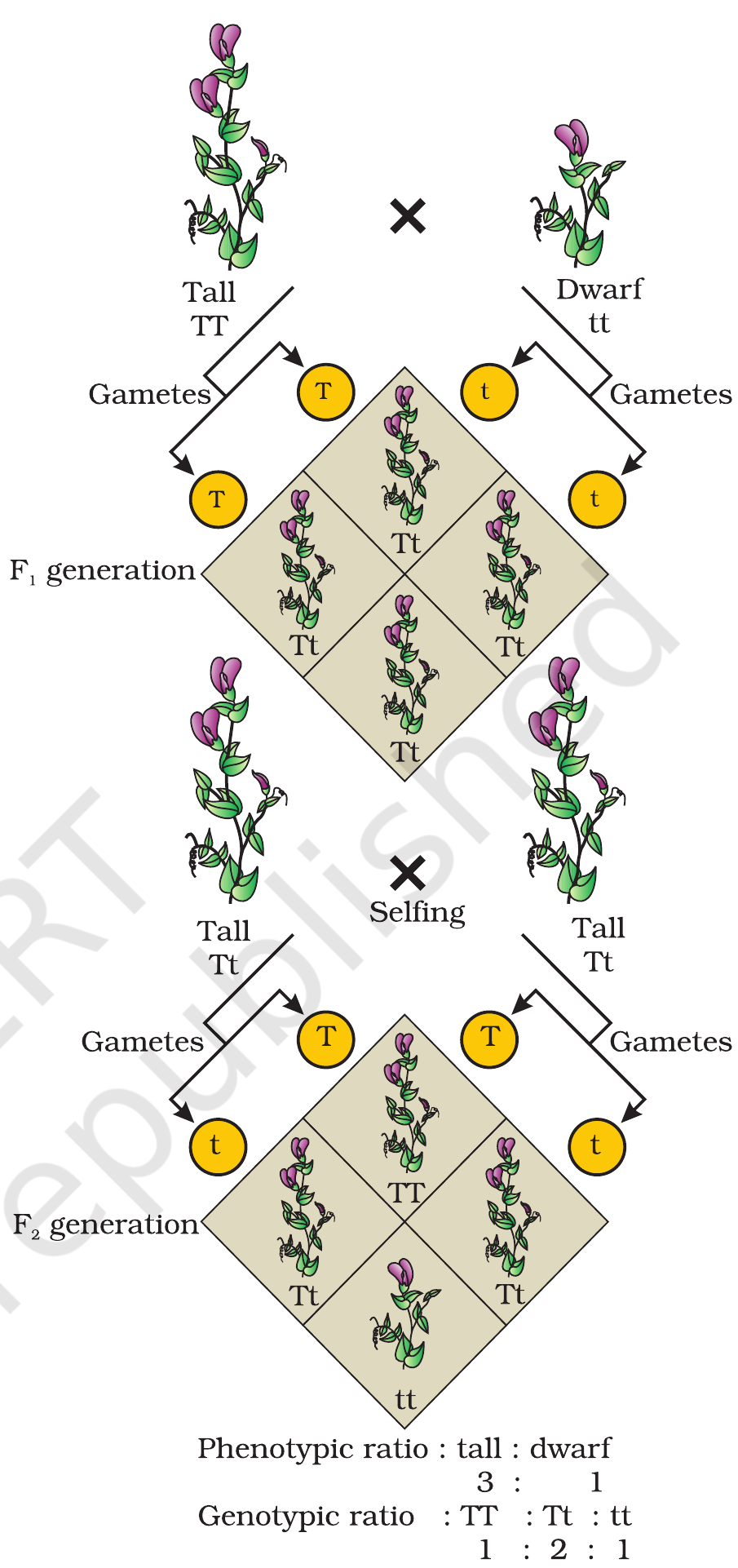
A monohybrid cross studies the inheritance of one pair of contrasting characters. Mendel crossed a true-breeding tall plant (TT) with a true-breeding dwarf plant (tt). All the F1 progeny were tall (Tt). When the F1 plants were self-pollinated, the $F_2$ progeny were 3 tall : 1 dwarf in phenotype and 1 TT : 2 Tt : 1 tt in genotype.
The results of a cross can be understood from a diagram called the Punnett Square. It was developed by a British geneticist, Reginald C. Punnett. The Punnett Square shows the parental tall TT and dwarf tt, and the $F_2$ genotypes 1 TT : 2 Tt : 1 tt (Figure 4.4).
Law of Dominance: characters are controlled by discrete units called factors (genes). Factors occur in pairs. In a dissimilar pair of factors (heterozygous), one member of the pair dominates (dominant) and the other is recessive. The dominant factor expresses itself in the heterozygote; the recessive factor expresses itself only when present in two copies (homozygous recessive).
Law of Segregation: the two factors of a character separate (segregate) during gamete formation, so that each gamete receives only one of the two factors. This is why the recessive dwarf trait, hidden in F1, reappears unchanged in $F_2$. Each gamete receives only one of the two factors.
Test cross: a cross between an individual showing the dominant phenotype (of unknown genotype, TT or Tt) and a homozygous recessive individual (tt), done to find out whether the dominant individual is homozygous or heterozygous. If the progeny are all tall, the parent was TT; if half are tall and half dwarf (1:1), the parent was Tt.
Suggest an edit
Incomplete dominance
Incomplete dominance is the phenomenon in which the F1 hybrid shows a phenotype intermediate between the two parents, because neither allele is fully dominant over the other.
In snapdragon (Antirrhinum sp.), a cross between true-breeding red-flowered (RR) and white-flowered (rr) plants gives pink-flowered F1 (Rr). When the F1 plants are self-pollinated, the $F_2$ ratio is 1 red : 2 pink : 1 white. Here the phenotypic ratio is the same as the genotypic ratio (1:2:1), unlike the 3:1 phenotypic ratio of a normal monohybrid cross.
The alleles do not blend and are not lost: they segregate unchanged in $F_2$, which is why the pure red and pure white phenotypes reappear. Incomplete dominance is not blending inheritance.
Dominance is not an autonomous feature of a gene. For example, starch synthesis in pea seeds is controlled by one gene with two alleles (B and b). BB homozygotes synthesise starch effectively and produce large starch grains; bb homozygotes produce smaller starch grains. After maturation, BB seeds are round and bb seeds are wrinkled, so B seems to be the dominant allele for seed shape. But the starch grains in Bb seeds are of intermediate size, so if starch grain size is considered as the phenotype, the alleles show incomplete dominance.
Suggest an edit
Co-dominance, multiple alleles and pleiotropy
Co-dominance: when both alleles of a gene express themselves together in the heterozygote, neither dominating the other. The ABO blood groups are the classic example. The gene I controls blood group and has three alleles: I^A, I^B and i. The plasma membrane of the red blood cells has sugar polymers that protrude from its surface and the kind of sugar is controlled by the gene I. I^A and I^B are both dominant over i, but when I^A and I^B are together, both express themselves, giving blood group AB. There are 6 genotypes and 4 phenotypes (Table 3).
Multiple alleles: more than two alleles of a gene exist in a population, though one individual carries only two of them. The ABO system (I^A, I^B, i) is the example in this chapter.
Pleiotropy: a single gene controls more than one phenotypic trait. The gene for phenylketonuria is an example: a mutation in the gene coding for the enzyme phenylalanine hydroxylase affects many traits at once, including mental retardation and reduction in hair and skin pigmentation.
Suggest an edit
Practice1 question
Try it now. A wrong answer costs nothing here, try again until you get it.
A red-flowered snapdragon (RR) is crossed with a white-flowered one (rr). What are the phenotypes in $F_2$?
Incomplete dominance: the F1 is all pink (Rr). In $F_2$ the ratio is 1 RR red : 2 Rr pink : 1 rr white, so the phenotypic ratio equals the genotypic ratio, 1:2:1.
Inheritance of two genes
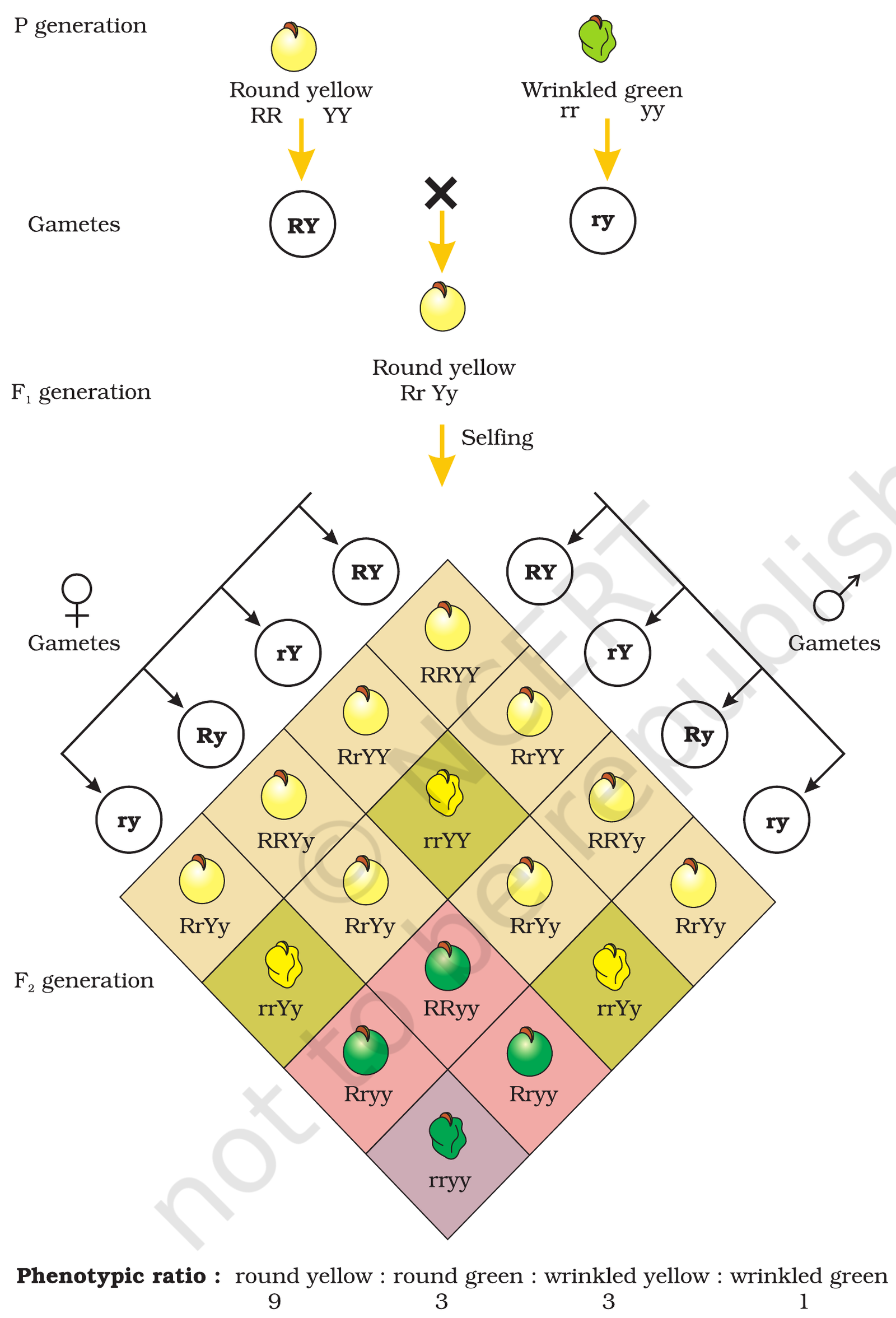
A dihybrid cross studies the inheritance of two pairs of contrasting characters at the same time. Mendel crossed true-breeding round yellow seeds (RRYY) with wrinkled green seeds (rryy). All F1 seeds were round and yellow (RrYy). When the F1 plants were self-pollinated, the $F_2$ phenotypic ratio was 9 round yellow : 3 round green : 3 wrinkled yellow : 1 wrinkled green (9:3:3:1).
Law of Independent Assortment: when two pairs of traits are combined in a hybrid, segregation of one pair of characters is independent of the segregation of the other pair during gamete formation. The 9:3:3:1 ratio is the product of two separate 3:1 monohybrid ratios (3:1) x (3:1).
The law holds only when the two genes are on different chromosomes (or far apart on the same chromosome). When genes are close together on the same chromosome, they are linked and do not assort independently.
Suggest an edit
Chromosomal theory of inheritance
Walter Sutton and Theodor Boveri noted that the behaviour of chromosomes was parallel to the behaviour of genes and used chromosome movement to explain Mendel's laws. Sutton united the knowledge of chromosomal segregation with Mendelian principles and called it the chromosomal theory of inheritance.
The parallels are: both genes and chromosomes occur in pairs; the two members of a pair separate during gamete formation (segregation); and different pairs assort independently of each other (independent assortment). Chromosomes as well as genes occur in pairs, and the two alleles of a gene pair are located on homologous sites on homologous chromosomes.
The theory was confirmed experimentally by Thomas Hunt Morgan and his group, who worked with the fruit fly Drosophila melanogaster. Drosophila is ideal for genetic studies: it can be grown on simple synthetic medium, completes its life cycle in about two weeks, produces a large number of progeny in a single mating, shows a clear differentiation of the sexes (the male and female flies are easily distinguishable), and shows many easily visible hereditary variations.
Suggest an edit
Linkage and recombination
Linkage: genes located close together on the same chromosome tend to be inherited together and do not assort independently. Morgan called the physical association of genes on a chromosome linkage.
Morgan hybridised yellow-bodied, white-eyed females to brown-bodied, red-eyed males and intercrossed their F1 progeny (Cross A). He observed that the two genes did not segregate independently: in the $F_2$, 98.7 per cent of the progeny showed the parental combinations and only 1.3 per cent showed new combinations (recombinants). In Cross B (white-eyed, miniature-winged females crossed with wild-type males), white and miniature wing lie farther apart on the X chromosome, so 62.8 per cent were parental and 37.2 per cent were recombinants.
Recombination: new combinations of genes are produced by crossing over between homologous chromosomes during meiosis. The frequency of recombination depends on the distance between the genes: genes that are tightly linked show very low recombination, while genes that are loosely linked show higher recombination.
The percentage of recombinant progeny is used to work out the distance between genes on a chromosome, and to build genetic maps. Alfred Sturtevant used the frequency of recombination between gene pairs as a measure of the distance between genes and mapped their positions on the chromosome.
Suggest an edit
Practice1 question
Try it now. A wrong answer costs nothing here, try again until you get it.
In Morgan's cross of yellow-bodied white-eyed female Drosophila with brown-bodied red-eyed males, what percentage of the $F_2$ progeny showed recombination in the first cross?
In Cross A (yellow-bodied, white-eyed females crossed with brown-bodied, red-eyed males) 98.7 per cent of the $F_2$ progeny showed parental combinations and 1.3 per cent were recombinants. In Cross B (white-eyed, miniature-winged females crossed with wild-type males) 37.2 per cent were recombinants, because white and miniature wing lie farther apart on the X chromosome than yellow and white.
Polygenic inheritance
Such traits are generally controlled by three or more genes and are thus called polygenic traits. Besides the involvement of multiple genes, polygenic inheritance also takes into account the influence of environment. Human height is one such trait: people are not just tall or short but show a whole range of possible heights. Human skin colour is another classic example: three genes A, B and C control skin colour, with the dominant forms A, B and C responsible for dark skin and the recessive forms a, b and c for light skin. The genotype with all the dominant alleles (AABBCC) has the darkest skin and the one with all the recessive alleles (aabbcc) the lightest.
In polygenic inheritance there is no single dominant or recessive allele for the whole trait: each gene contributes a small additive effect, so the progeny show a range of phenotypes instead of two or three clear classes.
Suggest an edit
Sex determination
Sex determination is the mechanism by which the sex of an individual is fixed. In most organisms it is genetic, decided by the sex chromosomes.
The initial clue about the genetic/chromosomal mechanism of sex determination came from experiments in insects. Henking (1891) could trace a specific nuclear structure all through spermatogenesis in a few insects. He gave the name 'X body' to this structure; it was later concluded that the 'X body' of Henking was in fact a chromosome.
In humans and in Drosophila, the female is XX and the male is XY. The male is heterogametic: it produces two types of gametes, X-bearing and Y-bearing, so the male parent decides the sex of the child. During spermatogenesis, 50 per cent of the total sperm produced carry the X-chromosome and the rest 50 per cent carry the Y-chromosome.
In the grasshopper, the female is XX and the male is XO: the male has only one X chromosome and no Y. The female is homogametic and the male is heterogametic.
In birds, the female is ZW and the male is ZZ. Here the female is heterogametic: she produces Z-bearing and W-bearing eggs, so the female parent decides the sex of the offspring.
In the honey bee, sex is decided by the number of chromosome sets (haplo-diploid sex determination). Females develop from fertilised eggs and are diploid, having 32 chromosomes. Males develop from unfertilised eggs by parthenogenesis and are haploid, having 16 chromosomes. Males produce sperms by mitosis; they do not have a father and thus cannot have sons, but have a grandfather and can have grandsons.
Suggest an edit
Practice1 question
Try it now. A wrong answer costs nothing here, try again until you get it.
In the honey bee, how are males produced?
Honey bee sex determination is haplo-diploid: females develop from fertilised eggs and are diploid, males develop from unfertilised eggs by parthenogenesis and are haploid.
Mutation
Mutation is a phenomenon which results in alteration of DNA sequences and consequently results in changes in the genotype and the phenotype of an organism. In addition to recombination, mutation is another phenomenon that leads to variation in DNA.
Gene mutation (point mutation): a change in a single base pair of DNA. The classic example is sickle cell anaemia: a single base substitution (GAG to GUG) changes the sixth amino acid of the beta globin chain from glutamic acid to valine.
Loss (deletions) or gain (insertion/duplication) of a segment of DNA results in alteration in chromosomes. Since genes are known to be located on chromosomes, alteration in chromosomes results in abnormalities or aberrations. Chromosomal aberrations are commonly observed in cancer cells. Deletions and insertions of base pairs of DNA cause frame-shift mutations.
There are many chemical and physical factors that induce mutations. These are referred to as mutagens. UV radiations can cause mutations in organisms; UV is a mutagen.
Suggest an edit
Pedigree analysis and Mendelian disorders
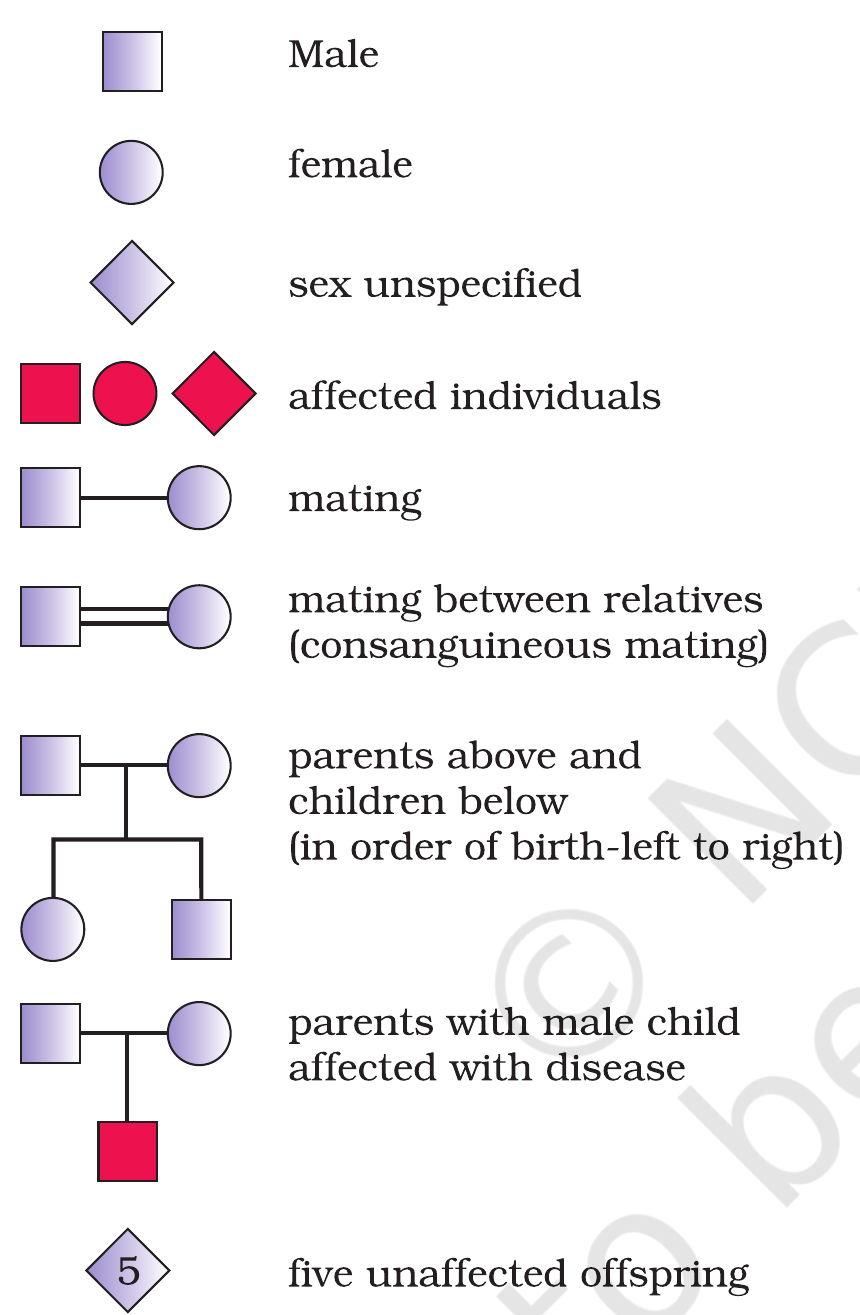
Pedigree analysis is the study of a trait through several generations of a family, drawn as a family tree. In a pedigree, a square stands for a male, a circle for a female, a filled symbol for an affected individual, and a horizontal line between a male and a female for a mating. Pedigree analysis helps to tell whether a trait is dominant or recessive and whether it is autosomal or sex-linked. Figure 4.14 shows a representative pedigree analysis of an autosomal dominant trait (for example: myotonic dystrophy) and an autosomal recessive trait (for example: sickle-cell anaemia).
Haemophilia is a sex-linked recessive disorder. The gene is on the X chromosome. It is more common in males, because a male needs only one defective X chromosome to be affected, while a female needs two. Affected females are rare: they are born only when a haemophilic father and a carrier mother have a daughter. Haemophilic males pass the gene to their daughters (who become carriers), and carrier mothers pass it to half their sons. The family pedigree of Queen Victoria shows a number of haemophilic descendents as she was a carrier of the disease.
Sickle cell anaemia is an autosomal recessive disorder. It is caused by a point mutation in the beta globin gene on chromosome 11, which changes glutamic acid to valine at the sixth position. Under low oxygen, the red blood cells become sickle-shaped and cannot pass through narrow capillaries. The disease is controlled by a single pair of allele, Hb^A and Hb^S. Out of the three possible genotypes only homozygous individuals for Hb^S (Hb^S Hb^S) show the diseased phenotype. Heterozygous (Hb^A Hb^S) individuals appear apparently unaffected but they are carriers of the disease.
Phenylketonuria is an autosomal recessive disorder. The affected person lacks the enzyme phenylalanine hydroxylase, so phenylalanine accumulates in the body and is converted into phenylpyruvic acid and other derivatives. The accumulation leads to mental retardation. These are also excreted through urine because of its poor absorption by kidney.
Colour Blindness: It is a sex-linked recessive disorder due to defect in either red or green cone of eye resulting in failure to discriminate between red and green colour. This defect is due to mutation in certain genes present in the X chromosome. It occurs in about 8 per cent of males and only about 0.4 per cent of females. The son of a woman who carries the gene has a 50 per cent chance of being colour blind.
Thalassemia: This is also an autosome-linked recessive blood disease transmitted from parents to the offspring when both the partners are unaffected carriers for the gene (or heterozygous). The defect could be due to either mutation or deletion which ultimately results in reduced rate of synthesis of one of the globin chains (alpha and beta chains) that make up haemoglobin. Alpha thalassemia is controlled by two closely linked genes HBA1 and HBA2 on chromosome 16 of each parent; beta thalassemia is controlled by a single gene HBB on chromosome 11 of each parent. Thalassemia differs from sickle-cell anaemia in that the former is a quantitative problem of synthesising too few globin molecules while the latter is a qualitative problem of synthesising an incorrectly functioning globin.
Suggest an edit
Chromosomal disorders
Chromosomal disorders are caused by the absence or excess of one or more chromosomes, or by an abnormal arrangement of chromosomes. Failure of segregation of chromatids during cell division cycle results in the gain or loss of a chromosome(s), called aneuploidy. Failure of cytokinesis after telophase stage of cell division results in an increase in a whole set of chromosomes in an organism, and this phenomenon is known as polyploidy.
Down's syndrome is caused by trisomy of chromosome 21: the person has 47 chromosomes instead of 46. This disorder was first described by Langdon Down (1866). Its features are a short stature, a small round head, a furrowed tongue, a partially open mouth, a palm crease, congenital heart disease, and mental retardation. Physical, psychomotor and mental development is retarded.
Klinefelter's syndrome is caused by an extra X chromosome: the person has 47 chromosomes with an XXY sex chromosome set. The affected individual is male, with overall masculine development, but with feminine development such as breast development (gynaecomastia). Such individuals are sterile.
Turner's syndrome is caused by the absence of one X chromosome: the person has 45 chromosomes with an XO sex chromosome set. The affected individual is female, with rudimentary ovaries, a lack of secondary sexual characters, short stature, and sterility.
Suggest an edit
Table 1: The seven pairs of contrasting traits Mendel studied

| Character | Dominant trait | Recessive trait |
|---|---|---|
| Stem height | Tall | Dwarf |
| Flower colour | Violet | White |
| Flower position | Axial | Terminal |
| Pod shape | Inflated | Constricted |
| Pod colour | Green | Yellow |
| Seed shape | Round | Wrinkled |
| Seed colour | Yellow | Green |
Mendel studied 14 true-breeding varieties, one for each trait in the seven pairs.
Source: NCERT XII, Ch 4, Table 4.1.
Suggest an edit
Table 2: Crosses and their $F_2$ ratios
| Cross | Phenotypic ratio | Genotypic ratio |
|---|---|---|
| Monohybrid (TT x tt) | 3 tall : 1 dwarf (3:1) | 1 TT : 2 Tt : 1 tt (1:2:1) |
| Incomplete dominance (RR x rr, snapdragon) | 1 red : 2 pink : 1 white (1:2:1) | 1 RR : 2 Rr : 1 rr (1:2:1) |
| Dihybrid (RRYY x rryy) | 9 : 3 : 3 : 1 | 1 : 2 : 1 : 2 : 4 : 2 : 1 : 2 : 1 |
| Test cross (Tt x tt) | 1 tall : 1 dwarf (1:1) | 1 Tt : 1 tt (1:1) |
In incomplete dominance the phenotypic ratio equals the genotypic ratio. The dihybrid 9:3:3:1 is (3:1) x (3:1).
Source: NCERT XII, Ch 4, 4.2 and 4.3.
Suggest an edit
Table 3: ABO blood groups
| Genotype | Blood group (phenotype) | Antigen on RBC | Antibody in plasma |
|---|---|---|---|
| I^A I^A, I^A i | A | A | Anti-B |
| I^B I^B, I^B i | B | B | Anti-A |
| I^A I^B | AB | A and B | None |
| ii | O | None | Anti-A and anti-B |
I^A and I^B are both dominant over i, and co-dominant with each other. There are 6 genotypes and 4 phenotypes.
Source: NCERT XII, Ch 4, 4.2.2.2 (Table 4.2) and NCERT XI, Ch 15, Table 15.1.
Suggest an edit
Practice1 question
Try it now. A wrong answer costs nothing here, try again until you get it.
A woman with blood group AB marries a man with blood group O. Which blood group is possible in their child?
An AB mother (I^A I^B) gives I^A or I^B; an O father (ii) gives i. The children are I^A i (blood group A) or I^B i (blood group B) only. Blood group AB and blood group O are both impossible in their children.
Table 4: Sex determination in different organisms
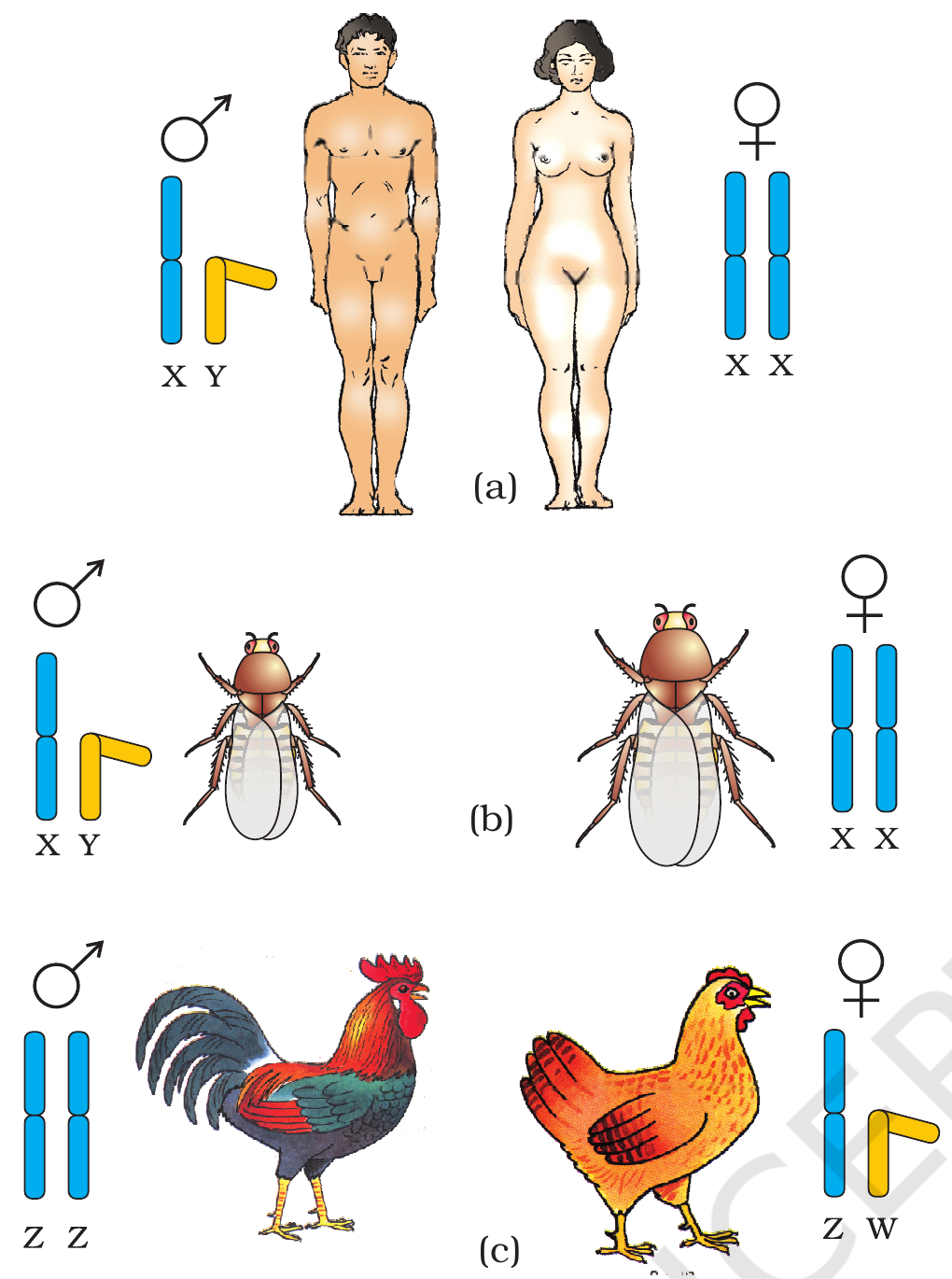
| Organism | Female | Male | Heterogametic sex |
|---|---|---|---|
| Human | XX | XY | Male |
| Drosophila | XX | XY | Male |
| Grasshopper | XX | XO | Male |
| Birds | ZW | ZZ | Female |
| Honey bee | Diploid (from fertilised egg) | Haploid (from unfertilised egg) | None (haplo-diploid) |
In humans the male parent decides the sex of the child; in birds the female parent decides it.
Source: NCERT XII, Ch 4, 4.6.
Suggest an edit
Table 5: Genetic disorders at a glance
| Disorder | Inheritance | Chromosome or gene | Key feature |
|---|---|---|---|
| Haemophilia | Sex-linked recessive | Gene on X chromosome | Blood does not clot; more common in males |
| Sickle cell anaemia | Autosomal recessive | Beta globin gene, chromosome 11 | RBCs become sickle-shaped under low oxygen |
| Phenylketonuria | Autosomal recessive | Phenylalanine hydroxylase gene | Phenylalanine accumulates; mental retardation |
| Myotonic dystrophy | Autosomal dominant | Gene on an autosome | Autosomal dominant example in NCERT Fig. 4.14 |
| Colour blindness | Sex-linked recessive | Gene on X chromosome | Cannot distinguish red from green |
| Thalassemia | Autosomal recessive | Alpha: HBA1 and HBA2, chromosome 16; beta: HBB, chromosome 11 | Reduced globin synthesis; anaemia |
| Down's syndrome | Chromosomal (trisomy 21) | 47 chromosomes | Short stature, furrowed tongue, palm crease |
| Klinefelter's syndrome | Chromosomal (extra X) | 47, XXY | Male, gynaecomastia, sterile |
| Turner's syndrome | Chromosomal (missing X) | 45, XO | Female, rudimentary ovaries, short stature |
Source: NCERT XII, Ch 4, 4.8.2.
Suggest an edit
Trap pairs: the confusions NEET tests
- Dominance vs frequency: a dominant allele is the one that expresses itself in a heterozygote, not the commoner allele in a population. A recessive allele can be far commoner than a dominant one.
- Incomplete dominance vs blending: the F1 is intermediate (pink), but the alleles do not blend and are not lost. $F_2$ gives 1 red : 2 pink : 1 white, so the pure parental types reappear.
- Co-dominance vs incomplete dominance: in co-dominance both alleles express fully (AB blood group shows both A and B antigens); in incomplete dominance the F1 is intermediate (pink snapdragon).
- Linkage vs independent assortment: genes on the same chromosome close together are linked and do not assort independently. Independent assortment holds for genes on different chromosomes.
- Test cross: always the recessive parent: a test cross is a cross with the homozygous recessive parent, done to find the genotype of a dominant individual. The ratio is 1:1 if the parent is heterozygous.
- Haemophilia vs sickle cell anaemia: haemophilia is sex-linked recessive (gene on X); sickle cell anaemia is autosomal recessive (gene on chromosome 11).
- Down's vs Klinefelter's vs Turner's: Down's is trisomy 21 (47 chromosomes); Klinefelter's is 47, XXY (male, extra X); Turner's is 45, XO (female, missing X).
- Colour blindness inheritance: a colour blind father never passes it to his son (the son gets his Y from his father). A colour blind mother passes it to all her sons (NEET 2022).
Suggest an edit
Trap Boxes
A dominant allele is always the commoner allele in a population?
Wrong idea: The dominant allele is the one most people carry.
Dominance describes expression in a heterozygote, not frequency in a population. A recessive allele can be far commoner than a dominant one.
NCERT XII, Ch 4, 4.2
Incomplete dominance means the alleles blend and are lost?
Wrong idea: In incomplete dominance the two alleles blend into a new allele that cannot be separated again.
The alleles stay discrete and segregate unchanged in $F_2$: the snapdragon cross gives 1 red : 2 pink : 1 white, so the red and white alleles reappear pure.
NCERT XII, Ch 4, 4.2.2.1
Colour blindness passes from father to son?
Wrong idea: A colour blind father passes colour blindness directly to his sons.
Colour blindness is X linked recessive. A father gives his Y chromosome to his son, never his X. A colour blind mother passes her X to all her sons, so every son of a colour blind woman is colour blind (NEET 2022).
NCERT XII, Ch 4, 4.8.2
Down's syndrome is caused by an extra X chromosome?
Wrong idea: Down's syndrome is caused by an extra X chromosome, like Klinefelter's syndrome.
Down's syndrome is trisomy of chromosome 21 (47 chromosomes in all). Klinefelter's syndrome is the one with an extra X chromosome (47, XXY).
NCERT XII, Ch 4, 4.8.3
Sickle cell anaemia is a dominant disorder?
Wrong idea: Sickle cell anaemia is dominant, so one affected parent always has affected children.
Sickle cell anaemia is autosomal recessive. Two carrier (heterozygous) parents have a 25 per cent chance of an affected child in each pregnancy (NEET 2021).
NCERT XII, Ch 4, 4.8.2
Chapter test
5 NEET PYQs. +4 for a correct answer, -1 for a wrong answer, exactly like NEET. Finish the test to earn a medal.
Q1: NEET (UG) 2024, Code R3, Q155
Match List I with List II:
| List I | List II |
|---|---|
| A. Down's syndrome | I. 11th chromosome |
| B. α-Thalassemia | II. 'X' chromosome |
| C. β-Thalassemia | III. 21st chromosome |
| D. Klinefelter's syndrome | IV. 16th chromosome |
Down's syndrome is trisomy of the 21st chromosome; alpha-thalassemia maps to the 16th chromosome; beta-thalassemia maps to the 11th chromosome; Klinefelter's syndrome is an extra X chromosome (47, XXY).
Q2: NEET (UG) 2022, Code R1, Q198
If a colour blind female marries a man whose mother was also colour blind, what are the chances of her progeny having colour blindness?
The colour blind woman is XcXc. Her husband got his only X chromosome from his colour blind mother, so he is XcY. All daughters get Xc from both parents (XcXc, colour blind) and all sons get Xc from their mother (XcY, colour blind). So 100 per cent of the progeny are colour blind.
Q3: NEET (UG) 2021, Code P3, Q184
In a cross between a male and female, both heterozygous for sickle cell anaemia gene, what percentage of the progeny will be diseased?
Aa x Aa gives 1 AA : 2 Aa : 1 aa. Only the aa children (25 per cent) are diseased; the Aa children (50 per cent) are carriers.
Q4: NEET (UG) 2021, Code P3, Q161
Persons with 'AB' blood group are called as "Universal recipients". This is due to :
AB plasma has neither anti-A nor anti-B antibody, so an AB person can receive blood of any group without clumping. The antigens A and B are present on the RBCs, not absent.
Q5: NEET (UG) 2020, Code G5, Q49
Select the correct match
Sickle cell anaemia is autosomal recessive, caused by a mutation in the beta globin gene on chromosome 11. Phenylketonuria is autosomal recessive, not dominant; thalassemia is autosomal recessive, not X linked; haemophilia is X linked recessive, not Y linked.
Score: 0 · Answered 0 of 5
Flashcards
Tap a card to flip it over and see the answer. Tap it again to flip it back.
Which seven pairs of contrasting traits did Mendel study in the pea plant?
Tap to flipStem height (tall/dwarf), flower colour (violet/white), flower position (axial/terminal), pod shape (inflated/constricted), pod colour (green/yellow), seed shape (round/wrinkled), seed colour (yellow/green).
Tap to flip backWhat are the $F_2$ phenotypic and genotypic ratios of a monohybrid cross?
Tap to flipPhenotypic ratio 3:1 (3 tall : 1 dwarf); genotypic ratio 1:2:1 (1 TT : 2 Tt : 1 tt).
Tap to flip backWhat is the $F_2$ phenotypic ratio of a dihybrid cross?
Tap to flip9:3:3:1 (9 round yellow : 3 round green : 3 wrinkled yellow : 1 wrinkled green).
Tap to flip backPut these in the order they happened: Morgan's linkage experiments, Sutton and Boveri's chromosomal theory, Mendel's experiments, rediscovery of Mendel's work.
Tap to flipMendel's experiments (1856-1863), rediscovery of Mendel's work (1900), Sutton and Boveri's chromosomal theory (1902), Morgan's linkage experiments with Drosophila.
Tap to flip backWhich of these is an autosomal dominant trait: thalassemia, sickle cell anaemia, myotonic dystrophy, haemophilia?
Tap to flipMyotonic dystrophy. Thalassemia and sickle cell anaemia are autosomal recessive; haemophilia is X linked recessive.
Tap to flip backWhat changes in a DNA segment cause chromosomal aberrations, and where are they commonly observed?
Tap to flipLoss (deletions) or gain (insertion/duplication) of a segment of DNA. Chromosomal aberrations are commonly observed in cancer cells.
Tap to flip backHow many genes control human skin colour?
Tap to flipHuman skin colour is controlled by three genes, A, B and C. Polygenic traits are generally controlled by three or more genes, and the effect of each allele is additive.
Tap to flip backHow many chromosomes are there in Down's syndrome, Klinefelter's syndrome and Turner's syndrome?
Tap to flipDown's syndrome: 47 (trisomy of chromosome 21). Klinefelter's syndrome: 47 (XXY). Turner's syndrome: 45 (XO).
Tap to flip backIn the honey bee, which sex is haploid and how is it produced?
Tap to flipThe male is haploid, having 16 chromosomes; the female is diploid, having 32 chromosomes. Males develop from unfertilised eggs by parthenogenesis; females develop from fertilised eggs.
Tap to flip backA diploid organism is heterozygous at 4 loci (AaBbCcDd). How many types of gametes can it produce?
Tap to flipExtra information (beyond NCERT - derived combinatorics rule): 16 types. The number of gamete types is 2 to the power n, where n is the number of heterozygous loci: 2 to the power 4 = 16.
Tap to flip backHow many genotypes and phenotypes do the ABO blood groups have?
Tap to flip6 genotypes (I^A I^A, I^A i, I^B I^B, I^B i, I^A I^B, ii) and 4 phenotypes (A, B, AB, O).
Tap to flip back