 NEET Notes
Home > Biology > Botany > Sexual Reproduction in Flowering Plants
Sexual Reproduction in Flowering Plants
On this page · 21 sections
- 01Syllabus map
- 02Flower: a fascinating organ of angiosperms
- 03Stamen, microsporangium and pollen grain
- 04Microsporogenesis
- 05The pistil, megasporangium (ovule) and embryo sac
- 06Megasporogenesis and the mature embryo sac
- 07Table 1: Microsporogenesis vs megasporogenesis
- 08Pollination: autogamy, geitonogamy and xenogamy
- 09Agents of pollination: wind and water
- 10Agents of pollination: animals
- 11Table 2: Wind, water and insect pollination at a glance
- 12Outbreeding devices
- 13Pollen-pistil interaction and artificial hybridisation
- 14Double fertilisation
- 15Endosperm
- 16Embryo: dicot and monocot
- 17Seed
- 18Fruit: true, false and parthenocarpic
- 19Table 3: Endosperm and seed types
- 20Apomixis and polyembryony
- 21Trap pairs: the confusions NEET tests
Flower structure, pollen and embryo sac, pollination, double fertilisation, endosperm, seed and fruit, apomixis, all from NCERT Chapter 1, with the PYQs NEET keeps repeating.
Syllabus map
- NMC Unit: BIO-U06, Reproduction. NCERT Chapter 1, Sexual Reproduction in Flowering Plants (Class XII).
- Subtopics in this chapter (NCERT XII, Ch 1): flower as the organ of sexual reproduction; pre-fertilisation structures and events (stamen, microsporangium, pollen grain, pistil, megasporangium, embryo sac); pollination (kinds and agents); outbreeding devices; pollen-pistil interaction; double fertilisation; post-fertilisation structures and events (endosperm, embryo, seed, fruit); apomixis and polyembryony.
- Subtopic checklist: (1) parts of a typical flower; (2) anther wall layers and the tapetum; (3) microsporogenesis and pollen grain structure; (4) ovule structure (funicle, hilum, integuments, micropyle, chalaza, nucellus); (5) megasporogenesis and the 7-celled, 8-nucleate embryo sac; (6) autogamy, geitonogamy, xenogamy; (7) cleistogamous vs chasmogamous flowers; (8) wind, water and animal pollination; (9) outbreeding devices; (10) pollen-pistil interaction, emasculation and bagging; (11) syngamy and triple fusion; (12) endosperm types; (13) dicot vs monocot embryo; (14) albuminous vs non-albuminous seeds; (15) true, false and parthenocarpic fruits; (16) apomixis and polyembryony.
- Extra information (beyond NCERT): none. Everything in this chapter is NCERT Chapter 1.
- Excluded topics: human reproduction (Chapter 2) and reproductive health (Chapter 3). Do not import their facts into this chapter.
- Estimated revision time: 12 minutes. Jump links: Syllabus Map, Flower, Stamen and Pollen, Microsporogenesis, Pistil and Embryo Sac, Megasporogenesis, Tables, Pollination, Outbreeding Devices, Pollen-Pistil Interaction, Double Fertilisation, Endosperm, Embryo, Seed, Fruit, Apomixis, Trap Boxes, PYQs, Chapter Test.
Suggest an edit
Flower: a fascinating organ of angiosperms

Flowers are objects of aesthetic, ornamental, social, religious and cultural value. They have always been used as symbols for conveying feelings such as love, affection, happiness, grief and mourning. To a biologist, flowers are morphological and embryological marvels and the sites of sexual reproduction. The myriads of flowers we enjoy, their scents, perfumes and rich colours, are all there as an aid to sexual reproduction. All flowering plants show sexual reproduction, and the diversity of inflorescences, flowers and floral parts shows an amazing range of adaptations to ensure formation of the end products of sexual reproduction, the fruits and seeds.
In the flower, the male and female reproductive structures, the androecium and the gynoecium, differentiate and develop. The androecium consists of a whorl of stamens representing the male reproductive organ, and the gynoecium represents the female reproductive organ. The two most important units of sexual reproduction develop in the flower: pollen grains (the male gametophyte) develop in the anther, and the embryo sac (the female gametophyte) develops in the ovule (NCERT Figure 1.1).
Suggest an edit
Stamen, microsporangium and pollen grain
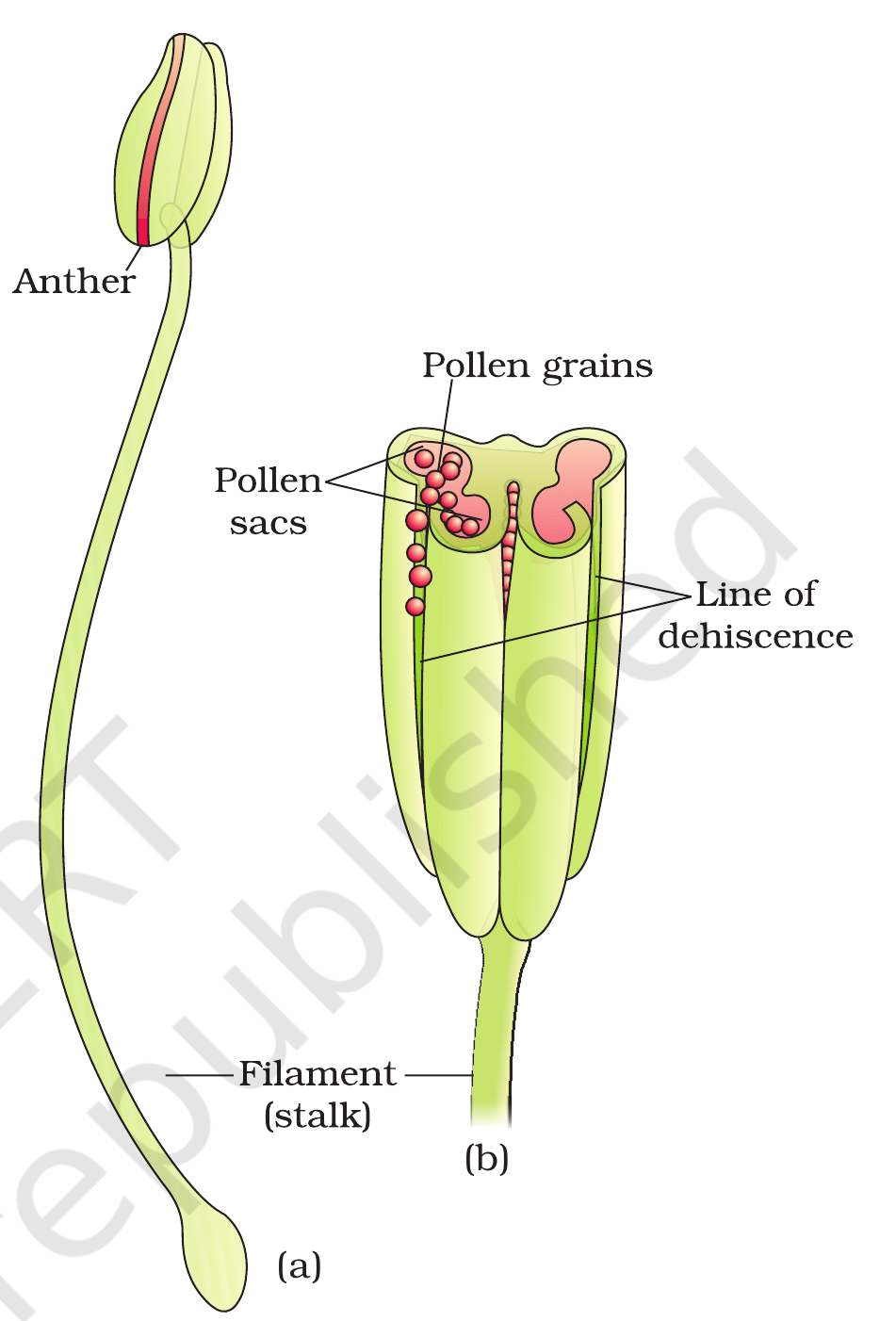
A typical stamen has two parts: the long and slender stalk called the filament, and the terminal generally bilobed structure called the anther. The proximal end of the filament is attached to the thalamus or the petal of the flower. The number and length of stamens are variable in flowers of different species. A typical angiosperm anther is bilobed with each lobe having two theca, that is, they are dithecous. Often a longitudinal groove runs lengthwise separating the theca. In transverse section the anther is a four-sided (tetragonal) structure consisting of four microsporangia located at the corners, two in each lobe. The microsporangia develop further and become pollen sacs. They extend longitudinally all through the length of an anther and are packed with pollen grains.
A typical microsporangium is generally surrounded by four wall layers: the epidermis, endothecium, middle layers and the tapetum. The outer three wall layers perform the function of protection and help in dehiscence of anther to release the pollen. The innermost wall layer is the tapetum. It nourishes the developing pollen grains. Cells of the tapetum possess dense cytoplasm and generally have more than one nucleus.
Pollen grains represent the male gametophytes. They are generally spherical, measuring about 25-50 micrometers in diameter. A pollen grain has a prominent two-layered wall. The hard outer layer called the exine is made up of sporopollenin, which is one of the most resistant organic materials known. It can withstand high temperatures and strong acids and alkali. No enzyme that degrades sporopollenin is so far known. Pollen grain exine has prominent apertures called germ pores where sporopollenin is absent. Pollen grains are well-preserved as fossils because of the presence of sporopollenin. The inner wall of the pollen grain is called the intine. It is a thin and continuous layer made up of cellulose and pectin.
When the pollen grain is mature it contains two cells, the vegetative cell and generative cell. The vegetative cell is bigger, has abundant food reserve and a large irregularly shaped nucleus. The generative cell is small and floats in the cytoplasm of the vegetative cell. It is spindle shaped with dense cytoplasm and a nucleus. In over 60 per cent of angiosperms, pollen grains are shed at this 2-celled stage. In the remaining species, the generative cell divides mitotically to give rise to the two male gametes before pollen grains are shed (3-celled stage).
Pollen grains of many species cause severe allergies and bronchial afflictions in some people, often leading to chronic respiratory disorders such as asthma and bronchitis. Parthenium, or carrot grass, that came into India as a contaminant with imported wheat, has become ubiquitous in occurrence and causes pollen allergy. Pollen grains are rich in nutrients, and pollen tablets are used as food supplements.
Pollen grains have to land on the stigma before they lose viability if they are to bring about fertilisation. The period for which pollen grains remain viable is highly variable and depends on the prevailing temperature and humidity. In some cereals such as rice and wheat, pollen grains lose viability within 30 minutes of their release. In some members of Rosaceae, Leguminoseae and Solanaceae, they maintain viability for months. Pollen grains of a large number of species can be stored for years in liquid nitrogen (-196°C). Such stored pollen can be used as pollen banks, similar to seed banks, in crop breeding programmes.
Suggest an edit
Practice1 question
Try it now. A wrong answer costs nothing here, try again until you get it.
A pollen grain is shed at the 2-celled stage in most angiosperms. Which two cells does it contain?
At the 2-celled stage the pollen grain has a large vegetative cell and a small generative cell floating in its cytoplasm. The generative cell divides into the two male gametes only later, in the remaining species before shedding or during pollen tube growth.
Microsporogenesis
When the anther is young, a group of compactly arranged homogenous cells called the sporogenous tissue occupies the centre of each microsporangium. As the anther develops, the cells of the sporogenous tissue undergo meiotic divisions to form microspore tetrads. Each cell of the sporogenous tissue is capable of giving rise to a microspore tetrad. Each one is a potential pollen or microspore mother cell (PMC). The process of formation of microspores from a pollen mother cell through meiosis is called microsporogenesis.
The microspores, as they are formed, are arranged in a cluster of four cells, the microspore tetrad. As the anthers mature and dehydrate, the microspores dissociate from each other and develop into pollen grains. Inside each microsporangium several thousands of microspores or pollen grains are formed that are released with the dehiscence of anther.
- Sporogenous tissue cells (diploid) undergo meiosis.
- Each cell forms a microspore tetrad (four haploid microspores).
- Microspores separate and mature into pollen grains (haploid male gametophytes).
- Pollen grains are released when the anther dehisces.
Suggest an edit
The pistil, megasporangium (ovule) and embryo sac
The gynoecium represents the female reproductive part of the flower. The gynoecium may consist of a single pistil (monocarpellary) or may have more than one pistil (multicarpellary). When there are more than one, the pistils may be fused together (syncarpous) or may be free (apocarpous). Each pistil has three parts: the stigma, style and ovary. The stigma serves as a landing platform for pollen grains. The style is the elongated slender part beneath the stigma. The basal bulged part of the pistil is the ovary. Inside the ovary is the ovarian cavity (locule). The placenta is located inside the ovarian cavity. Arising from the placenta are the megasporangia, commonly called ovules. The number of ovules in an ovary may be one (wheat, paddy, mango) to many (papaya, water melon, orchids).
The ovule is a small structure attached to the placenta by means of a stalk called funicle. The body of the ovule fuses with funicle in the region called hilum. Thus, hilum represents the junction between ovule and funicle. Each ovule has one or two protective envelopes called integuments. Integuments encircle the nucellus except at the tip where a small opening called the micropyle is organised. Opposite the micropylar end is the chalaza, representing the basal part of the ovule. Enclosed within the integuments is a mass of cells called the nucellus. Cells of the nucellus have abundant reserve food materials. Located in the nucellus is the embryo sac or female gametophyte. An ovule generally has a single embryo sac formed from a megaspore (NCERT Figure 1.7).
Suggest an edit
Megasporogenesis and the mature embryo sac
The process of formation of megaspores from the megaspore mother cell is called megasporogenesis. Ovules generally differentiate a single megaspore mother cell (MMC) in the micropylar region of the nucellus. It is a large cell containing dense cytoplasm and a prominent nucleus. The MMC undergoes meiotic division, which results in the production of four megaspores.
In a majority of flowering plants, one of the megaspores is functional while the other three degenerate. Only the functional megaspore develops into the female gametophyte (embryo sac). This method of embryo sac formation from a single megaspore is termed monosporic development. The nucleus of the functional megaspore divides mitotically to form two nuclei which move to the opposite poles, forming the 2-nucleate embryo sac. Two more sequential mitotic nuclear divisions result in the formation of the 4-nucleate and later the 8-nucleate stages of the embryo sac. These mitotic divisions are strictly free nuclear, that is, nuclear divisions are not followed immediately by cell wall formation. After the 8-nucleate stage, cell walls are laid down leading to the organisation of the typical female gametophyte or embryo sac. Six of the eight nuclei are surrounded by cell walls and organised into cells; the remaining two nuclei, called polar nuclei, are situated below the egg apparatus in the large central cell.
There is a characteristic distribution of the cells within the embryo sac. Three cells are grouped together at the micropylar end and constitute the egg apparatus. The egg apparatus, in turn, consists of two synergids and one egg cell. The synergids have special cellular thickenings at the micropylar tip called filiform apparatus, which play an important role in guiding the pollen tubes into the synergid. Three cells are at the chalazal end and are called the antipodals. The large central cell has two polar nuclei. Thus, a typical angiosperm embryo sac, at maturity, though 8-nucleate is 7-celled (NCERT Figure 1.8).
Suggest an edit
Table 1: Microsporogenesis vs megasporogenesis
| Feature | Microsporogenesis | Megasporogenesis |
|---|---|---|
| Where it happens | Anther, inside each microsporangium | Ovule, inside the nucellus |
| Starting cell | Pollen mother cell (PMC), from sporogenous tissue | Megaspore mother cell (MMC), one per ovule |
| Division | Meiosis | Meiosis |
| Products | Four microspores in a tetrad, all develop into pollen grains | Four megaspores, only one functional, the rest degenerate |
| End product | Pollen grain, the male gametophyte | Embryo sac, the female gametophyte |
Both processes use meiosis, but microsporogenesis gives four working spores while megasporogenesis keeps only one.
Source: NCERT XII, Ch 1, 1.2.1 and 1.2.2.
Suggest an edit
Practice1 question
Try it now. A wrong answer costs nothing here, try again until you get it.
Which statement about megasporogenesis is correct?
The MMC divides by meiosis to give four megaspores, but only one is functional; the other three degenerate. That single functional megaspore forms the embryo sac by monosporic development, inside the ovule, not the anther.
Pollination: autogamy, geitonogamy and xenogamy
The male and female gametes in flowering plants are produced in the pollen grain and embryo sac, respectively. As both types of gametes are non-motile, they have to be brought together for fertilisation to occur. Pollination is the mechanism to achieve this objective. Transfer of pollen grains (shed from the anther) to the stigma of a pistil is termed pollination. Depending on the source of pollen, pollination can be divided into three types.
- Autogamy: pollination is achieved within the same flower. Transfer of pollen grains from the anther to the stigma of the same flower. In a normal flower which opens and exposes the anthers and the stigma, complete autogamy is rather rare. Autogamy in such flowers requires synchrony in pollen release and stigma receptivity and also, the anthers and the stigma should lie close to each other so that self-pollination can occur.
- Geitonogamy: transfer of pollen grains from the anther to the stigma of another flower of the same plant. Although geitonogamy is functionally cross-pollination involving a pollinating agent, genetically it is similar to autogamy since the pollen grains come from the same plant.
- Xenogamy: transfer of pollen grains from anther to the stigma of a different plant. This is the only type of pollination which during pollination brings genetically different types of pollen grains to the stigma.
Some plants such as Viola (common pansy), Oxalis, and Commelina produce two types of flowers: chasmogamous flowers, which are similar to flowers of other species with exposed anthers and stigma, and cleistogamous flowers, which do not open at all. In cleistogamous flowers, the anthers and stigma lie close to each other. When anthers dehisce in the flower buds, pollen grains come in contact with the stigma to effect pollination. Thus, cleistogamous flowers are invariably autogamous as there is no chance of cross-pollen landing on the stigma. Cleistogamous flowers produce assured seed-set even in the absence of pollinators (NCERT Figure 1.9). While assured seed-set is an advantage, the lack of any chance for cross-pollination is a disadvantage of cleistogamy.
Suggest an edit
Agents of pollination: wind and water
Plants use two abiotic (wind and water) and one biotic (animals) agents to achieve pollination. Majority of plants use biotic agents for pollination. Only a small proportion of plants use abiotic agents. Pollen grains coming in contact with the stigma is a chance factor in both wind and water pollination. To compensate for this uncertainty and associated loss of pollen grains, the flowers produce enormous amount of pollen when compared to the number of ovules available for pollination.
Pollination by wind is more common amongst abiotic pollinations. Wind pollination requires that the pollen grains are light and non-sticky so that they can be transported in wind currents. They often possess well-exposed stamens (so that the pollens are easily dispersed into wind currents) and large often-feathery stigma to easily trap air-borne pollen grains. Wind-pollinated flowers often have a single ovule in each ovary and numerous flowers packed into an inflorescence. A familiar example is the corn cob: the ears you see are nothing but the stigma and style which wave in the wind to trap pollen grains. Wind-pollination is quite common in grasses (NCERT Figure 1.10).
Pollination by water is quite rare in flowering plants and is limited to about 30 genera, mostly monocotyledons. Some examples of water pollinated plants are Vallisneria and Hydrilla which grow in fresh water and several marine sea-grasses such as Zostera. Not all aquatic plants use water for pollination. In a majority of aquatic plants such as water hyacinth and water lily, the flowers emerge above the level of water and are pollinated by insects or wind as in most of the land plants. In Vallisneria, the female flower reaches the surface of water by the long stalk and the male flowers or pollen grains are released on to the surface of water. They are carried passively by water currents; some of them eventually reach the female flowers and the stigma. In seagrasses, female flowers remain submerged in water and the pollen grains are released inside the water. Pollen grains in many such species are long, ribbon-like and they are carried passively inside the water. In most of the water-pollinated species, pollen grains are protected from wetting by a mucilaginous covering. Both wind and water pollinated flowers are not very colourful and do not produce nectar (NCERT Figure 1.11a).
Suggest an edit
Agents of pollination: animals
Majority of flowering plants use a range of animals as pollinating agents. Bees, butterflies, flies, beetles, wasps, ants, moths, birds (sunbirds and humming birds) and bats are the common pollinating agents. Among the animals, insects, particularly bees, are the dominant biotic pollinating agents. Even larger animals such as some primates (lemurs), arboreal (tree-dwelling) rodents, or even reptiles (gecko lizard and garden lizard) have also been reported as pollinators in some species. Often flowers of animal-pollinated plants are specifically adapted for a particular species of animal.
Majority of insect-pollinated flowers are large, colourful, fragrant and rich in nectar. When the flowers are small, a number of flowers are clustered into an inflorescence to make them conspicuous. Animals are attracted to flowers by colour and/or fragrance. The flowers pollinated by flies and beetles secrete foul odours to attract these animals. To sustain animal visits, the flowers have to provide rewards to the animals. Nectar and pollen grains are the usual floral rewards. For harvesting the reward(s) from the flower the animal visitor comes in contact with the anthers and the stigma. The body of the animal gets a coating of pollen grains, which are generally sticky in animal pollinated flowers. When the animal carrying pollen on its body comes in contact with the stigma, it brings about pollination.
In some species floral rewards are in providing safe places to lay eggs. An example is that of the tallest flower of Amorphophallus (the flower itself is about 6 feet in height). A similar relationship exists between a species of moth and the plant Yucca, where both species, moth and the plant, cannot complete their life cycles without each other. The moth deposits its eggs in the locule of the ovary and the flower, in turn, gets pollinated by the moth. The larvae of the moth come out of the eggs as the seeds start developing. Many insects may consume pollen or the nectar without bringing about pollination. Such floral visitors are referred to as pollen/nectar robbers (NCERT Figure 1.11b).
Suggest an edit
Table 2: Wind, water and insect pollination at a glance
| Feature | Wind pollination | Water pollination | Insect pollination |
|---|---|---|---|
| Pollen grains | Light and non-sticky, produced in enormous amounts | Long and ribbon-like in seagrasses, protected by a mucilaginous covering | Sticky, so they coat the visitor's body |
| Flowers | Not colourful, no nectar; many flowers in an inflorescence | Not colourful, no nectar | Large, colourful, fragrant and rich in nectar |
| Stigma | Large and often feathery, to trap air-borne pollen | Female flower reaches the surface (Vallisneria) or stays submerged (seagrasses) | Positioned so the animal visitor carrying sticky pollen comes in contact with the stigma while harvesting floral rewards |
| Examples | Grasses, corn cob | Vallisneria, Hydrilla, Zostera | Most flowering plants; bees are the dominant agents |
| Chance factor | Pollen landing on a stigma is chance, so huge numbers are made | Pollen landing on a stigma is chance, so huge numbers are made | Pollen is delivered to the stigma by the visitor |
Wind and water flowers save on colour and nectar but waste pollen; insect flowers spend on rewards and deliver pollen precisely.
Source: NCERT XII, Ch 1, 1.2.3.
Suggest an edit
Practice1 question
Try it now. A wrong answer costs nothing here, try again until you get it.
Which of the following is a water-pollinated plant?
Vallisneria is water pollinated. Water hyacinth flowers emerge above the water and are pollinated by insects or wind; corn is wind pollinated; Yucca is pollinated by its moth.
Outbreeding devices
Majority of flowering plants produce hermaphrodite flowers and pollen grains are likely to come in contact with the stigma of the same flower. Continued self-pollination results in inbreeding depression. Flowering plants have developed many devices to discourage self-pollination and to encourage cross-pollination.
- In some species, pollen release and stigma receptivity are not synchronised. Either the pollen is released before the stigma becomes receptive or stigma becomes receptive much before the release of pollen.
- In some other species, the anther and stigma are placed at different positions so that the pollen cannot come in contact with the stigma of the same flower. Both these devices prevent autogamy.
- The third device to prevent inbreeding is self-incompatibility. This is a genetic mechanism and prevents self-pollen (from the same flower or other flowers of the same plant) from fertilising the ovules by inhibiting pollen germination or pollen tube growth in the pistil.
- Another device to prevent self-pollination is the production of unisexual flowers. If both male and female flowers are present on the same plant such as castor and maize (monoecious), it prevents autogamy but not geitonogamy. In several species such as papaya, male and female flowers are present on different plants, that is each plant is either male or female (dioecy). This condition prevents both autogamy and geitonogamy.
Suggest an edit
Pollen-pistil interaction and artificial hybridisation
Pollination does not guarantee the transfer of the right type of pollen (compatible pollen of the same species as the stigma). Often, pollen of the wrong type, either from other species or from the same plant (if it is self-incompatible), also lands on the stigma. The pistil has the ability to recognise the pollen, whether it is of the right type (compatible) or of the wrong type (incompatible). If it is of the right type, the pistil accepts the pollen and promotes post-pollination events that lead to fertilisation. If the pollen is of the wrong type, the pistil rejects the pollen by preventing pollen germination on the stigma or the pollen tube growth in the style. The ability of the pistil to recognise the pollen followed by its acceptance or rejection is the result of a continuous dialogue between pollen grain and the pistil. This dialogue is mediated by chemical components of the pollen interacting with those of the pistil.
Following compatible pollination, the pollen grain germinates on the stigma to produce a pollen tube through one of the germ pores. The contents of the pollen grain move into the pollen tube. The pollen tube grows through the tissues of the stigma and style and reaches the ovary. In some plants, pollen grains are shed at two-celled condition (a vegetative cell and a generative cell). In such plants, the generative cell divides and forms the two male gametes during the growth of pollen tube in the stigma. In plants which shed pollen in the three-celled condition, pollen tubes carry the two male gametes from the beginning. The pollen tube, after reaching the ovary, enters the ovule through the micropyle and then enters one of the synergids through the filiform apparatus. Many recent studies have shown that filiform apparatus present at the micropylar part of the synergids guides the entry of pollen tube. All these events, from pollen deposition on the stigma until pollen tubes enter the ovule, are together referred to as pollen-pistil interaction (NCERT Figure 1.12).
Artificial hybridisation is one of the major approaches of crop improvement. In such crossing experiments it is important to make sure that only the desired pollen grains are used for pollination and the stigma is protected from contamination (from unwanted pollen). This is achieved by emasculation and bagging techniques. If the female parent bears bisexual flowers, removal of anthers from the flower bud before the anther dehisces using a pair of forceps is necessary. This step is referred to as emasculation. Emasculated flowers have to be covered with a bag of suitable size, generally made up of butter paper, to prevent contamination of its stigma with unwanted pollen. This process is called bagging. When the stigma of bagged flower attains receptivity, mature pollen grains collected from anthers of the male parent are dusted on the stigma, and the flowers are rebagged, and the fruits allowed to develop. If the female parent produces unisexual flowers, there is no need for emasculation. The female flower buds are bagged before the flowers open. When the stigma becomes receptive, pollination is carried out using the desired pollen and the flower rebagged.
Suggest an edit
Double fertilisation
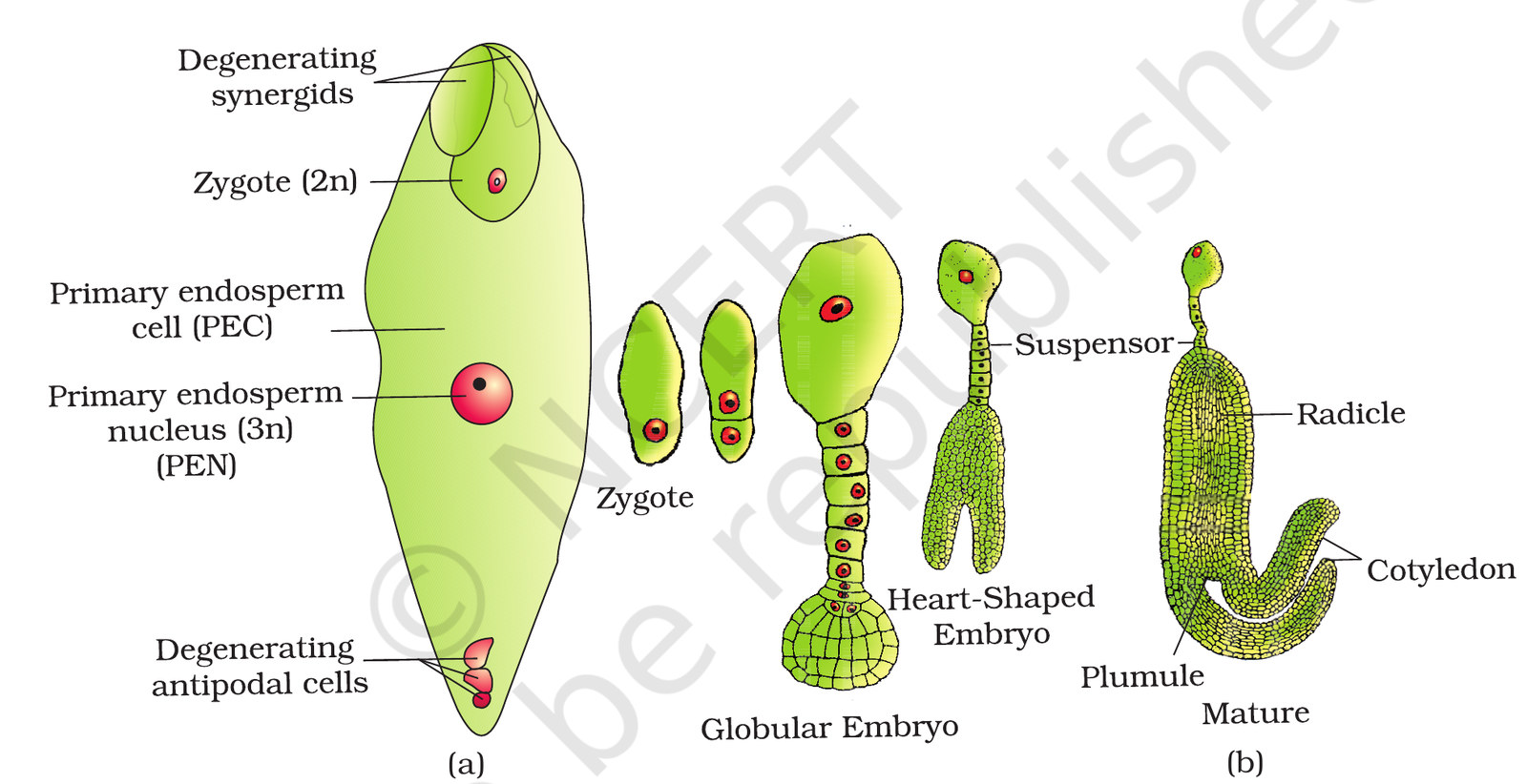
After entering one of the synergids, the pollen tube releases the two male gametes into the cytoplasm of the synergid. One of the male gametes moves towards the egg cell and fuses with its nucleus, thus completing the syngamy. This results in the formation of a diploid cell, the zygote. The other male gamete moves towards the two polar nuclei located in the central cell and fuses with them to produce a triploid primary endosperm nucleus (PEN). As this involves the fusion of three haploid nuclei it is termed triple fusion. Since two types of fusions, syngamy and triple fusion, take place in an embryo sac, the phenomenon is termed double fertilisation, an event unique to flowering plants. The central cell after triple fusion becomes the primary endosperm cell (PEC) and develops into the endosperm while the zygote develops into an embryo (NCERT Figure 1.13a).
- Syngamy: male gamete + egg cell = diploid zygote (2n).
- Triple fusion: male gamete + two polar nuclei = triploid primary endosperm nucleus (3n).
- Double fertilisation = syngamy + triple fusion, unique to angiosperms.
Suggest an edit
Endosperm
Endosperm development precedes embryo development. The primary endosperm cell divides repeatedly and forms a triploid endosperm tissue. The cells of this tissue are filled with reserve food materials and are used for the nutrition of the developing embryo. Most zygotes divide only after a certain amount of endosperm is formed. This is an adaptation to provide assured nutrition to the developing embryo.
In the most common type of endosperm development, the PEN undergoes successive nuclear divisions to give rise to free nuclei. This stage of endosperm development is called free-nuclear endosperm. Subsequently cell wall formation occurs and the endosperm becomes cellular. The number of free nuclei formed before cellularisation varies greatly. The coconut water from tender coconut is nothing but free-nuclear endosperm (made up of thousands of nuclei) and the surrounding white kernel is the cellular endosperm.
Endosperm may either be completely consumed by the developing embryo (for example, pea, groundnut, beans) before seed maturation or it may persist in the mature seed (for example, castor and coconut) and be used up during seed germination. In cereals such as wheat, rice and maize, the endosperm persists in the mature seed.
Suggest an edit
Practice1 question
Try it now. A wrong answer costs nothing here, try again until you get it.
The coconut water of a tender coconut is:
Coconut water is free-nuclear endosperm, made of thousands of free nuclei. The surrounding white kernel is the cellular endosperm.
Embryo: dicot and monocot
Embryo develops at the micropylar end of the embryo sac where the zygote is situated. Though the seeds differ greatly, the early stages of embryo development (embryogeny) are similar in both monocotyledons and dicotyledons. The zygote gives rise to the proembryo and subsequently to the globular, heart-shaped and mature embryo.
A typical dicotyledonous embryo consists of an embryonal axis and two cotyledons. The portion of embryonal axis above the level of cotyledons is the epicotyl, which terminates with the plumule or stem tip. The cylindrical portion below the level of cotyledons is hypocotyl that terminates at its lower end in the radicle or root tip. The root tip is covered with a root cap.
Embryos of monocotyledons possess only one cotyledon. In the grass family the cotyledon is called scutellum that is situated towards one side (lateral) of the embryonal axis. At its lower end, the embryonal axis has the radicle and root cap enclosed in an undifferentiated sheath called coleorrhiza. The portion of the embryonal axis above the level of attachment of scutellum is the epicotyl. Epicotyl has a shoot apex and a few leaf primordia enclosed in a hollow foliar structure, the coleoptile (NCERT Figures 1.13b and 1.14).
Suggest an edit
Seed
In angiosperms, the seed is the final product of sexual reproduction. It is often described as a fertilised ovule. Seeds are formed inside fruits. A seed typically consists of seed coat(s), cotyledon(s) and an embryo axis. The cotyledons of the embryo are simple structures, generally thick and swollen due to storage of food reserves (as in legumes).
Mature seeds may be non-albuminous or ex-albuminous. Non-albuminous seeds have no residual endosperm as it is completely consumed during embryo development (for example, pea, groundnut). Albuminous seeds retain a part of endosperm as it is not completely used up during embryo development (for example, wheat, maize, barley, castor). Occasionally, in some seeds such as black pepper and beet, remnants of nucellus are also persistent. This residual, persistent nucellus is the perisperm.
Integuments of ovules harden as tough protective seed coats. The micropyle remains as a small pore in the seed coat. This facilitates entry of oxygen and water into the seed during germination. As the seed matures, its water content is reduced and seeds become relatively dry (10-15 per cent moisture by mass). The general metabolic activity of the embryo slows down. The embryo may enter a state of inactivity called dormancy, or if favourable conditions are available (adequate moisture, oxygen and suitable temperature), they germinate.
Seeds offer several advantages to angiosperms. Firstly, since reproductive processes such as pollination and fertilisation are independent of water, seed formation is more dependable. Also seeds have better adaptive strategies for dispersal to new habitats and help the species to colonise in other areas. As they have sufficient food reserves, young seedlings are nourished until they are capable of photosynthesis on their own. The hard seed coat provides protection to the young embryo. Being products of sexual reproduction, they generate new genetic combinations leading to variations.
Seed is the basis of our agriculture. Dehydration and dormancy of mature seeds let seeds be stored and used as food throughout the year and also to raise crop in the next season. The period for which seeds remain alive after dispersal varies greatly. In a few species the seeds lose viability within a few months. Seeds of a large number of species live for several years. Some seeds can remain alive for hundreds of years. The oldest is that of a lupine, Lupinus arcticus, excavated from Arctic Tundra. The seed germinated and flowered after an estimated record of 10,000 years of dormancy. A recent record of 2000 years old viable seed is of the date palm, Phoenix dactylifera, discovered during the archeological excavation at King Herod's palace near the Dead Sea.
Suggest an edit
Fruit: true, false and parthenocarpic
As ovules mature into seeds, the ovary develops into a fruit, that is, the transformation of ovules into seeds and ovary into fruit proceeds simultaneously. The wall of the ovary develops into the wall of fruit called pericarp. The fruits may be fleshy as in guava, orange, mango, etc., or may be dry, as in groundnut, and mustard, etc. Many fruits have evolved mechanisms for dispersal of seeds.
In most plants, by the time the fruit develops from the ovary, other floral parts degenerate and fall off. However, in a few species such as apple, strawberry, cashew, etc., the thalamus also contributes to fruit formation. Such fruits are called false fruits. Most fruits however develop only from the ovary and are called true fruits. Although in most of the species, fruits are the results of fertilisation, there are a few species in which fruits develop without fertilisation. Such fruits are called parthenocarpic fruits. Banana is one such example. Parthenocarpy can be induced through the application of growth hormones and such fruits are seedless (NCERT Figure 1.15).
Suggest an edit
Table 3: Endosperm and seed types
| Type | What it is | Examples |
|---|---|---|
| Free-nuclear endosperm | PEN divides by successive nuclear divisions with no walls at first | Coconut water (thousands of free nuclei) |
| Cellular endosperm | Cell walls form after the free-nuclear stage | White kernel of the coconut |
| Non-albuminous seed | Endosperm completely consumed during embryo development | Pea, groundnut, beans |
| Albuminous seed | Part of the endosperm remains in the mature seed | Wheat, maize, barley, castor |
| Perisperm | Remnant of nucellus persisting in the seed | Black pepper, beet |
If the endosperm is gone by maturity, the seed is non-albuminous; if some stays, it is albuminous.
Source: NCERT XII, Ch 1, 1.4.1 and 1.4.3.
Suggest an edit
Practice1 question
Try it now. A wrong answer costs nothing here, try again until you get it.
Which seed retains a part of its endosperm at maturity?
Castor is albuminous: part of the endosperm remains in the mature seed. Pea, groundnut and bean are non-albuminous, their endosperm is completely consumed during embryo development.
Apomixis and polyembryony
Although seeds, in general, are the products of fertilisation, a few flowering plants such as some species of Asteraceae and grasses have evolved a special mechanism to produce seeds without fertilisation, called apomixis. Thus, apomixis is a form of asexual reproduction that mimics sexual reproduction. There are several ways of development of apomictic seeds. In some species, the diploid egg cell is formed without reduction division and develops into the embryo without fertilisation. More often, as in many Citrus and Mango varieties, some of the nucellar cells surrounding the embryo sac start dividing, protrude into the embryo sac and develop into the embryos. In such species each ovule contains many embryos. Occurrence of more than one embryo in a seed is referred to as polyembryony. The nucellar embryos are genetically identical to the parent plant, that is, they are clones.
Hybrid varieties of several of our food and vegetable crops are being extensively cultivated. Cultivation of hybrids has tremendously increased productivity. One of the problems of hybrids is that hybrid seeds have to be produced every year. If the seeds collected from hybrids are sown, the plants in the progeny will segregate and do not maintain hybrid characters. Production of hybrid seeds is costly and hence the cost of hybrid seeds becomes too expensive for the farmers. If these hybrids are made into apomicts, there is no segregation of characters in the hybrid progeny. Then the farmers can keep on using the hybrid seeds to raise new crop year after year and do not have to buy hybrid seeds every year. Because of the importance of apomixis in hybrid seed industry, active research is going on in many laboratories around the world to understand the genetics of apomixis and to transfer apomictic genes into hybrid varieties.
Suggest an edit
Trap pairs: the confusions NEET tests
- Pollen grain vs anther: the pollen grain is the haploid male gametophyte; the anther is the diploid sporophyte that holds it.
- Autogamy vs geitonogamy: autogamy is pollination within the same flower; geitonogamy is another flower of the same plant, functionally cross-pollination but genetically autogamy.
- Cleistogamous vs chasmogamous: cleistogamous flowers never open and are invariably autogamous; chasmogamous flowers open and expose anthers and stigma.
- Syngamy vs triple fusion: syngamy is one male gamete fusing with the egg, giving the diploid zygote; triple fusion is the other male gamete fusing with the two polar nuclei, giving the triploid primary endosperm nucleus.
- Free-nuclear vs cellular endosperm: coconut water is free-nuclear endosperm; the white kernel of the coconut is cellular endosperm.
- Albuminous vs non-albuminous: albuminous seeds keep part of the endosperm (wheat, maize, castor); non-albuminous seeds use it all up (pea, groundnut).
- True fruit vs false fruit: true fruits develop only from the ovary; false fruits have the thalamus contributing too (apple, strawberry, cashew).
Suggest an edit
Trap Boxes
Pollen grain is diploid?
Wrong idea: The pollen grain is diploid, like the anther that holds it.
The pollen grain is the haploid male gametophyte. It sits inside the diploid anther, so one generation lies within the other.
NCERT XII, Ch 1, 1.2.1
Geitonogamy is cross-pollination?
Wrong idea: Geitonogamy is cross-pollination, so it brings new genetic combinations.
Geitonogamy is functionally cross-pollination but genetically autogamy, because the pollen comes from the same plant. Only xenogamy brings genetically different pollen.
NCERT XII, Ch 1, 1.2.3
Cleistogamous flowers can cross-pollinate?
Wrong idea: Cleistogamous flowers can receive pollen from other plants.
Cleistogamous flowers never open, so they are invariably autogamous. There is no chance of cross-pollen landing on the stigma.
NCERT XII, Ch 1, 1.2.3
Double fertilisation means two pollen tubes?
Wrong idea: Double fertilisation means two pollen tubes enter the embryo sac.
Double fertilisation is two fusions in one embryo sac: syngamy (male gamete + egg = diploid zygote) and triple fusion (male gamete + two polar nuclei = triploid PEN). It is unique to flowering plants.
NCERT XII, Ch 1, 1.3
Coconut water is cellular endosperm?
Wrong idea: The coconut water of a tender coconut is the cellular endosperm.
Coconut water is free-nuclear endosperm, made of thousands of free nuclei. The surrounding white kernel is the cellular endosperm.
NCERT XII, Ch 1, 1.4.1
Chapter test
5 NEET PYQs. +4 for a correct answer, -1 for a wrong answer, exactly like NEET. Finish the test to earn a medal.
Q1: NEET (UG) 2023, Code F1, Q128
In angiosperm, the haploid, diploid and triploid structures of a fertilized embryo sac sequentially are :
Synergids are haploid, the zygote formed by syngamy is diploid, and the primary endosperm nucleus formed by triple fusion is triploid. So the sequence is synergids, zygote, primary endosperm nucleus.
Q2: NEET (UG) 2022, Code R1, Q118
Given below are two statements:
Statement I: Cleistogamous flowers are invariably autogamous
Statement II: Cleistogamy is disadvantageous as there is no chance for cross pollination
In the light of the above statements, choose the correct answer from the options given below:
Both statements are correct. Cleistogamous flowers never open, so they are invariably autogamous, and that is a disadvantage because there is no chance for cross-pollination.
Q3: NEET (UG) 2021, Code P3, Q131
A typical angiosperm embryo sac at maturity is:
The mature embryo sac has 8 nuclei but only 7 cells: three antipodals, the egg apparatus (two synergids and one egg cell), and one large central cell holding the two polar nuclei.
Q4: NEET (UG) 2021, Code P3, Q113
The term used for transfer of pollen grains from anthers of one plant to stigma of a different plant which, during pollination, brings genetically different types of pollen grains to stigma, is :
Xenogamy is transfer of pollen to the stigma of a different plant, and it is the only type of pollination that brings genetically different types of pollen grains to the stigma.
Q5: NEET (UG) 2020, Code G5, Q68
The plant parts which consist of two generations - one within the other
(a) Pollen grains inside the anther
(b) Germinated pollen grain with two male gametes
(c) Seed inside the fruit
(d) Embryo sac inside the ovule
Pollen grains (haploid gametophyte) sit inside the diploid anther, and the embryo sac (haploid gametophyte) sits inside the diploid ovule. Both are one generation within the other. A germinated pollen grain with its male gametes is a single generation, and only (a) and (d) clearly represent a haploid gametophyte generation enclosed within a diploid sporophyte.
Score: 0 · Answered 0 of 5
Flashcards
Tap a card to flip it over and see the answer. Tap it again to flip it back.
Name the four wall layers of a microsporangium, from outside to inside.
Tap to flipEpidermis, endothecium, middle layers and tapetum. The tapetum nourishes the developing pollen grains.
Tap to flip backWhat is sporopollenin, and where are the germ pores?
Tap to flipSporopollenin is the material of the exine, one of the most resistant organic materials known. Germ pores are apertures in the exine where sporopollenin is absent.
Tap to flip backPut microsporogenesis in order: microspore tetrad, pollen mother cell, pollen grain, sporogenous tissue, meiosis.
Tap to flipSporogenous tissue, pollen mother cell, meiosis, microspore tetrad, pollen grain.
Tap to flip backA mature angiosperm embryo sac is how many celled and how many nucleate?
Tap to flip7-celled and 8-nucleate: three antipodals, the egg apparatus (two synergids and one egg cell), and one central cell with two polar nuclei.
Tap to flip backDistinguish autogamy, geitonogamy and xenogamy in one line each.
Tap to flipAutogamy: same flower. Geitonogamy: another flower of the same plant, functionally cross-pollination but genetically autogamy. Xenogamy: a different plant, the only type bringing genetically different pollen.
Tap to flip backName three water-pollinated plants and one plant that looks aquatic but is insect or wind pollinated.
Tap to flipWater pollinated: Vallisneria, Hydrilla, Zostera. Water hyacinth (and water lily) flowers emerge above water and are pollinated by insects or wind.
Tap to flip backName the four outbreeding devices that discourage self-pollination.
Tap to flipNon-synchronised pollen release and stigma receptivity; anther and stigma at different positions; self-incompatibility; unisexual flowers (monoecious and dioecious).
Tap to flip backWhat are the products of syngamy and triple fusion?
Tap to flipSyngamy gives the diploid zygote (2n). Triple fusion gives the triploid primary endosperm nucleus (3n). Together they are double fertilisation, unique to flowering plants.
Tap to flip backAlbuminous vs non-albuminous seeds: give two examples of each.
Tap to flipAlbuminous (endosperm persists): wheat, maize, barley, castor. Non-albuminous (endosperm fully consumed): pea, groundnut, beans.
Tap to flip backWhat is apomixis, and what is polyembryony?
Tap to flipApomixis is seed formation without fertilisation, a form of asexual reproduction that mimics sexual reproduction. Polyembryony is more than one embryo in a seed, as in Citrus and Mango nucellar embryos.
Tap to flip back