 NEET Notes
Home > Physics > Ray Optics and Optical Instruments
Ray Optics and Optical Instruments
The path is called a ray of light, and a bundle of such rays constitutes a beam of light.
On this page · 19 sections
- 01Syllabus Map
- 02Introduction
- 03Reflection of Light by Spherical Mirrors
- 04Refraction
- 05Total Internal Reflection
- 06Table 9.1 - Critical Angle of Some Transparent Media
- 07Refraction at a Spherical Surface
- 08Refraction by a Lens
- 09Power of a Lens
- 10Combination of Thin Lenses in Contact
- 11Refraction Through a Prism
- 12Key Formulas of the Chapter
- 13The Microscope
- 14The Telescope
- 15Worked Examples
- 16Trap Pairs
- 17Points to Ponder
- 18Summary
- 19Exercises
Reflection, refraction, total internal reflection, mirrors, lenses, prisms, microscopes and telescopes from NCERT Class 12 Ch 9, with 5 NEET PYQs.
Syllabus Map
- NMC Unit: PHYS-U16, Optics (the ray-optics half of the unit belongs to NCERT Ch 9; the wave-optics half belongs to NCERT Ch 10, not this chapter). NCERT Chapter 9, Ray Optics and Optical Instruments (Class XII, printed pp. 217-253, Reprint 2026-27).
- NMC ray-optics items covered here: reflection of light, spherical mirrors, mirror formula; refraction of light at plane and spherical surfaces, thin lens formula and lens maker's formula; total internal reflection and its applications; magnification; power of a lens; combination of thin lenses in contact; refraction of light through a prism; microscope and astronomical telescope (reflecting and refracting) and their magnifying powers.
- Every NMC ray-optics item is in NCERT Ch 9, so this chapter has no "Extra information (beyond NCERT)" section.
- Dispersion, rainbow and mirage: the old NCERT sections on dispersion by a prism and on natural phenomena were removed in the rationalised book, and they are not in the NMC NEET syllabus either, so they have no section here. Dispersion appears only in NCERT's own one-line Summary point 7, reproduced in the summary section.
- How to use this chapter: learn the sign convention first (section 3), then the mirror and lens formulas, then total internal reflection and the prism, then the instruments. The worked examples (section 15) and the NCERT exercises (section 19) use the same numbers NCERT prints.
Introduction
- Light is electromagnetic radiation of wavelength about 400 nm to 750 nm, the part of the spectrum the human eye (retina) can detect. It is mainly through light and the sense of vision that we know and interpret the world around us.
- Light travels with enormous speed and in a straight line. Its presently accepted value in vacuum is $\textit{c} = 2.99792458 \times 10^8 m/s$; for many purposes it suffices to take $\textit{c} = 3 \times 10^8 m/s$. The speed of light in vacuum is the highest speed attainable in nature.
- The wavelength of light is very small compared with the size of ordinary objects (generally of the order of a few cm or larger), so a light wave can be considered to travel from one point to another along a straight line joining them. The path is called a ray of light, and a bundle of such rays constitutes a beam of light.
- In this chapter we consider the phenomena of reflection, refraction and dispersion of light, using the ray picture of light. Using the basic laws of reflection and refraction, we study image formation by plane and spherical reflecting and refracting surfaces, then the construction and working of some important optical instruments, including the human eye.
Reflection of Light by Spherical Mirrors
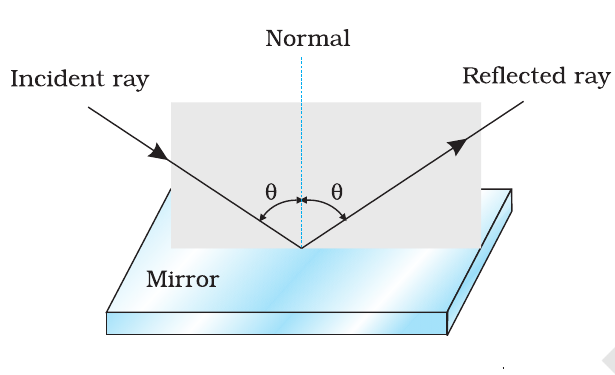




- Laws of reflection: the angle of reflection (the angle between the reflected ray and the normal to the reflecting surface) equals the angle of incidence (the angle between the incident ray and the normal), and the incident ray, reflected ray and the normal to the reflecting surface at the point of incidence lie in the same plane (Fig. 9.1). These laws are valid at each point on any reflecting surface, whether plane or curved.
- For a spherical surface the normal at the point of incidence is along the radius, the line joining the centre of curvature of the mirror to the point of incidence. The geometric centre of a spherical mirror is called its pole while that of a spherical lens is called its optical centre. The line joining the pole and the centre of curvature of the spherical mirror is known as the principal axis.
- Cartesian sign convention: all distances are measured from the pole of the mirror or the optical centre of the lens. The distances measured in the same direction as the incident light are taken as positive and those measured in the direction opposite to the direction of incident light are taken as negative (Fig. 9.2). The heights measured upwards with respect to the x-axis and normal to the principal axis are taken as positive. The heights measured downwards are taken as negative.
- Focal length of spherical mirrors: a parallel paraxial beam, with rays incident at points close to the pole P of the mirror and making small angles with the principal axis, converges at a point F on the principal axis of a concave mirror, and appears to diverge from a point F on its principal axis for a convex mirror (Fig. 9.3). The point F is called the principal focus of the mirror. The plane through F normal to the principal axis is the focal plane of the mirror.
- The distance between the focus F and the pole P of the mirror is called the focal length of the mirror, denoted by f. The geometry of reflection (Fig. 9.4) gives $f = R/2$ (9.3), where R is the radius of curvature of the mirror.
- The mirror equation: if rays emanating from a point actually meet at another point after reflection and/or refraction, that point is called the image of the first point. The image is real if the rays actually converge to the point; it is virtual if the rays do not actually meet but appear to diverge from the point when produced backwards.
- Four convenient rays for tracing (Fig. 9.5): (i) the ray from the point which is parallel to the principal axis; the reflected ray goes through the focus of the mirror. (ii) The ray passing through the centre of curvature of a concave mirror or appearing to pass through it for a convex mirror; the reflected ray simply retraces the path. (iii) The ray passing through (or directed towards) the focus of the concave mirror or appearing to pass through (or directed towards) the focus of a convex mirror; the reflected ray is parallel to the principal axis. (iv) The ray incident at any angle at the pole; the reflected ray follows the laws of reflection.
- From the similar triangles in Fig. 9.5, applying the sign convention (B'P = -v, $FP = -f$, $BP = -u$), the mirror equation is $1/v + 1/u = 1/f$ (9.7).
- Linear magnification (m) is the ratio of the height of the image (h') to the height of the object $(h): m = h'/h = -v/u$ (9.9). Eqs. (9.7) and (9.9) are valid for all cases of reflection by a spherical mirror, concave or convex, whether the image formed is real or virtual (Fig. 9.6).
Practice1 question
Try it now. A wrong answer costs nothing here, try again until you get it.
A small candle, 2.5 cm in size, is placed at 27 cm in front of a concave mirror of radius of curvature 36 cm. At what distance from the mirror should a screen be placed to obtain a sharp image?
NCERT 9.2.3, Eq. (9.7): $f = -R/2 = -18 cm$; $1/v = 1/f - 1/u = -1/18 + 1/27 = -1/54$, so $v = -54 cm$. The screen goes 54 cm in front of the mirror.
Refraction
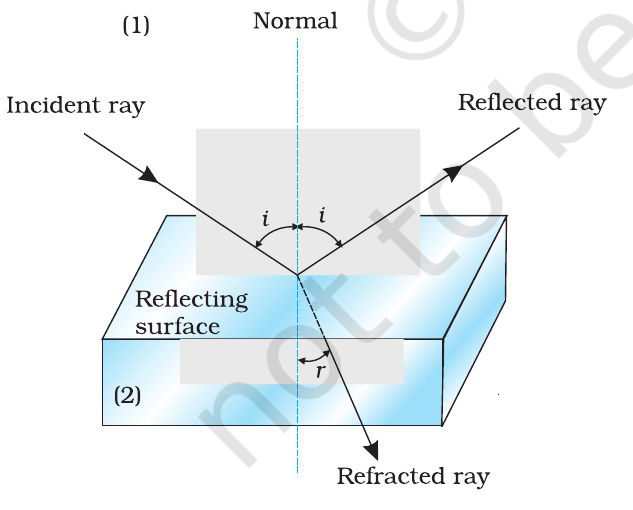

- When a beam of light encounters another transparent medium, a part of light gets reflected back into the first medium while the rest enters the other. A ray of light entering obliquely (0° < i < 90°) changes direction at the interface of the two media. This phenomenon is called refraction of light (Fig. 9.8).
- Snell's laws of refraction: (i) The incident ray, the refracted ray and the normal to the interface at the point of incidence, all lie in the same plane. (ii) The ratio of the sine of the angle of incidence to the sine of angle of refraction is constant: $\sin i/\sin r = n₂₁$ (9.10), where n₂₁ is a constant, called the refractive index of the second medium with respect to the first medium. n₂₁ is a characteristic of the pair of media (and also depends on the wavelength of light), but is independent of the angle of incidence.
- If n₂₁ > 1, r < i, i.e., the refracted ray bends towards the normal. In such a case medium 2 is said to be optically denser (or denser, in short) than medium 1. On the other hand, if n₂₁ < 1, r > i, the refracted ray bends away from the normal, as when an incident ray in a denser medium refracts into a rarer medium.
- Note: Optical density should not be confused with mass density, which is mass per unit volume. It is possible that mass density of an optically denser medium may be less than that of an optically rarer medium (optical density is the ratio of the speed of light in two media). For example, turpentine and water. Mass density of turpentine is less than that of water but its optical density is higher.
- If n₂₁ is the refractive index of medium 2 with respect to medium 1 and n₁₂ the refractive index of medium 1 with respect to medium 2, then $n₁₂ = 1/n₂₁$ (9.11). It also follows that n₃₂ = n₃₁ × n₁₂, where n₃₂ is the refractive index of medium 3 with respect to medium 2 and n₃₁ is the refractive index of medium 3 with respect to medium 1.
- For a rectangular slab, refraction takes place at two interfaces (air-glass and glass-air). From Fig. 9.9, $r₂ = i1$, i.e., the emergent ray is parallel to the incident ray: there is no deviation, but it does suffer lateral displacement/shift with respect to the incident ray.
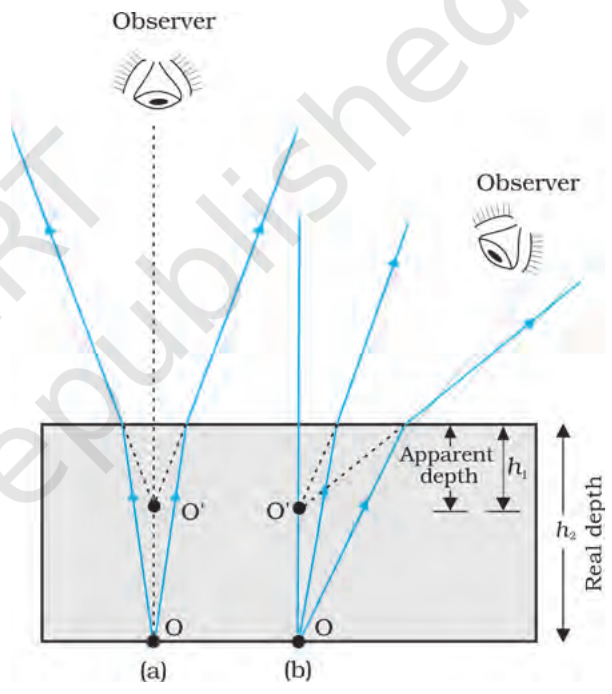
- The bottom of a tank filled with water appears to be raised (Fig. 9.10). For viewing near the normal direction, the apparent depth (h₁) is real depth (h₂) divided by the refractive index of the medium $(water): h₁ = h₂/n$.
Total Internal Reflection
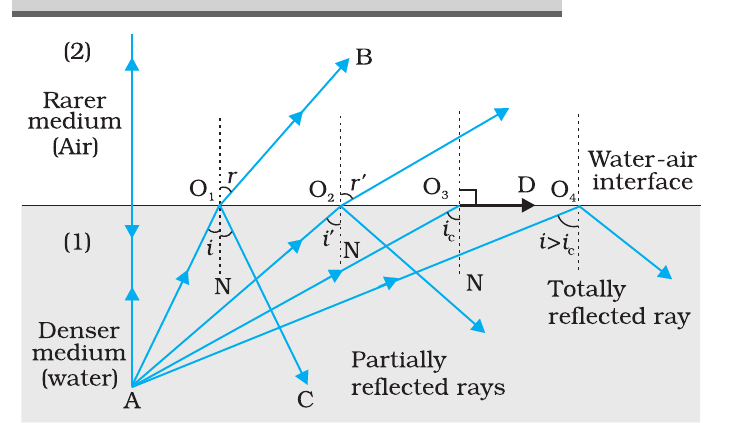

- When light travels from an optically denser medium to a rarer medium at the interface, it is partly reflected back into the same medium and partly refracted to the second medium. This reflection is called the internal reflection. The refracted ray bends away from the normal (Fig. 9.11). As the angle of incidence increases, so does the angle of refraction, till for the ray AO₃, the angle of refraction is π/2 and the refracted ray grazes the surface at the interface. If the angle of incidence is increased still further (e.g., the ray AO₄), refraction is not possible, and the incident ray is totally reflected. This is called total internal reflection.
- When light gets reflected by a surface, normally some fraction of it gets transmitted, so the reflected ray is always less intense than the incident ray, howsoever smooth the reflecting surface may be. In total internal reflection, on the other hand, no transmission of light takes place.
- The angle of incidence corresponding to an angle of refraction 90° is called the critical angle (i_c) for the given pair of media. From Snell's law, $\sin i_c = n₂₁$ (9.12). For values of i larger than i_c, Snell's law of refraction cannot be satisfied, and hence no refraction is possible. The refractive index of denser medium 1 with respect to rarer medium 2 will be $n₁₂ = 1/\sin i_c$. Some typical critical angles are listed in Table 9.1 (section 6).
- A demonstration for total internal reflection: shine a laser beam through turbid water in a glass beaker; the path of the beam inside the water shines brightly. Shine the beam from below the beaker so it strikes the upper water surface at the other end: it undergoes partial reflection (seen as a spot on the table below) and partial refraction (seen as a spot on the roof). Direct the beam more obliquely until the refraction above the water surface is totally absent and the beam is totally reflected back to water (Fig. 9.12). Pour the water in a long test tube and shine the laser light from top: it is totally internally reflected every time it strikes the walls of the tube, as in optical fibres. Take care not to look into the laser beam directly and not to point it at anybody's face.
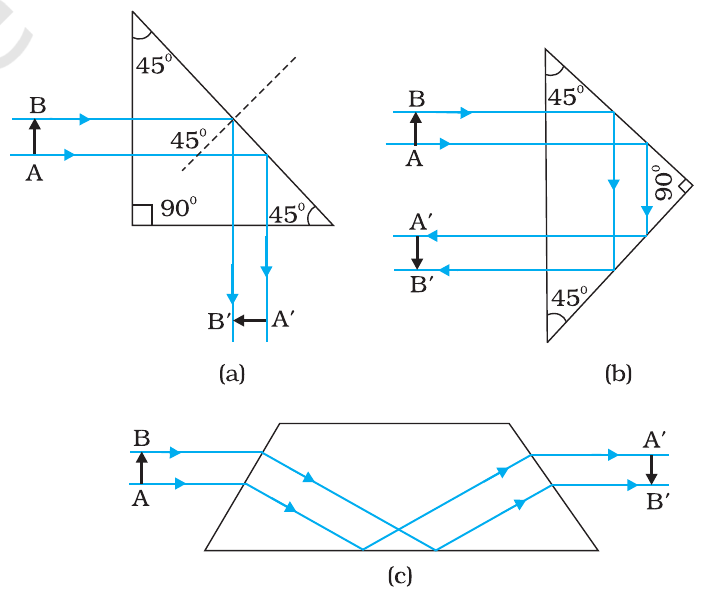
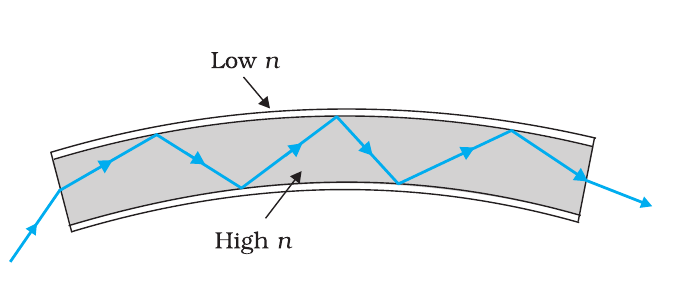
- 9.4.1 Total internal reflection in nature and its technological applications: (i) Prism: prisms designed to bend light by 90° or by 180° make use of total internal reflection (Fig. 9.13). Such a prism is also used to invert images without changing their size. In the first two cases, the critical angle i_c for the material of the prism must be less than 45°; from Table 9.1 this is true for both crown glass and dense flint glass. (ii) Optical fibres: nowadays optical fibres are extensively used for transmitting audio and video signals through long distances. Each fibre consists of a core and cladding. The refractive index of the material of the core is higher than that of the cladding. When a signal in the form of light is directed at one end of the fibre at a suitable angle, it undergoes repeated total internal reflections along the length of the fibre and finally comes out at the other end (Fig. 9.14). Since light undergoes total internal reflection at each stage, there is no appreciable loss in the intensity of the light signal. Even if the fibre is bent, light can easily travel along its length, so an optical fibre can be used to act as an optical pipe. Optical fibres are also used as a 'light pipe' to facilitate visual examination of internal organs like esophagus, stomach and intestines. The main requirement in fabricating optical fibres is that there should be very little absorption of light as it travels for long distances inside them; in silica glass fibres, it is possible to transmit more than 95% of the light over a fibre length of 1 km.
Practice1 question
Try it now. A wrong answer costs nothing here, try again until you get it.
A ray of light travelling in water (refractive index 1.33) strikes the water-air surface at 60° to the normal. What happens to the ray?
NCERT 9.4, Table 9.1: the critical angle for water is 48.75°. The ray strikes at 60°, which is larger than i_c, so no refraction is possible and the ray is totally internally reflected.
Table 9.1 - Critical Angle of Some Transparent Media
- NCERT's Table 9.1, reproduced cell by cell (printed p. 230). The critical angles are with respect to air; NCERT prints the angle values without degree marks.
| Substance medium | Refractive index | Critical angle |
|---|---|---|
| Water | 1.33 | 48.75 |
| Crown glass | 1.52 | 41.14 |
| Dense flint glass | 1.62 | 37.31 |
| Diamond | 2.42 | 24.41 |
- Read the table: the larger the refractive index, the smaller the critical angle. $Diamond (n = 2.42)$ has $i_c = 24.41$, so light inside diamond is totally internally reflected very easily, which is why multiple internal reflections make diamond sparkle (Summary point 2).
Refraction at a Spherical Surface
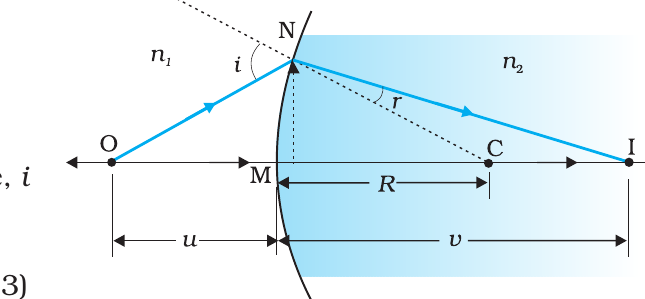
- An infinitesimal part of a spherical surface can be regarded as planar and the same laws of refraction can be applied at every point on the surface. Just as for reflection by a spherical mirror, the normal at the point of incidence is perpendicular to the tangent plane to the spherical surface at that point and, therefore, passes through its centre of curvature.
- Figure 9.15 shows the geometry of formation of image I of an object O on the principal axis of a spherical surface with centre of curvature C, and radius of curvature R. The rays are incident from a medium of refractive index n₁, to another of refractive index n₂. With the aperture (lateral size) of the surface small compared to other distances, the small angle ≈imation applies. For triangle NOC, i is the exterior angle, so i = angle NOM + angle NCM; and r = angle NCM - angle NIM. By Snell's law n₁ sin i = n₂ sin r, or for small angles $n₁ i = n₂ r, giving n₁/OM + n₂/MI = (n₂ - n₁)/MC$ (9.15).
- Applying the Cartesian sign convention, $OM = -u$, $MI = +v$, $MC = +R$, so $n₂/v - n₁/u = (n₂ - n₁)/R$ (9.16). Equation (9.16) gives a relation between object and image distance in terms of refractive index of the medium and the radius of curvature of the curved spherical surface. It holds for any curved spherical surface. Symbols: u is the object distance, v the image distance, R the radius of curvature (positive when the centre of curvature is on the side of the refracted rays).
- Example 9.5 Light from a point source in air falls on a spherical glass surface (n = 1.5 and radius of $curvature = 20 cm$). The distance of the light source from the glass surface is 100 cm. Using Eq. (9.16) with $u = -100 cm$, $R = +20 cm, n₁ = 1$ and $n₂ = 1.5$, $v = +100 cm$. The image is formed at a distance of 100 cm from the glass surface, in the direction of incident light.
Refraction by a Lens
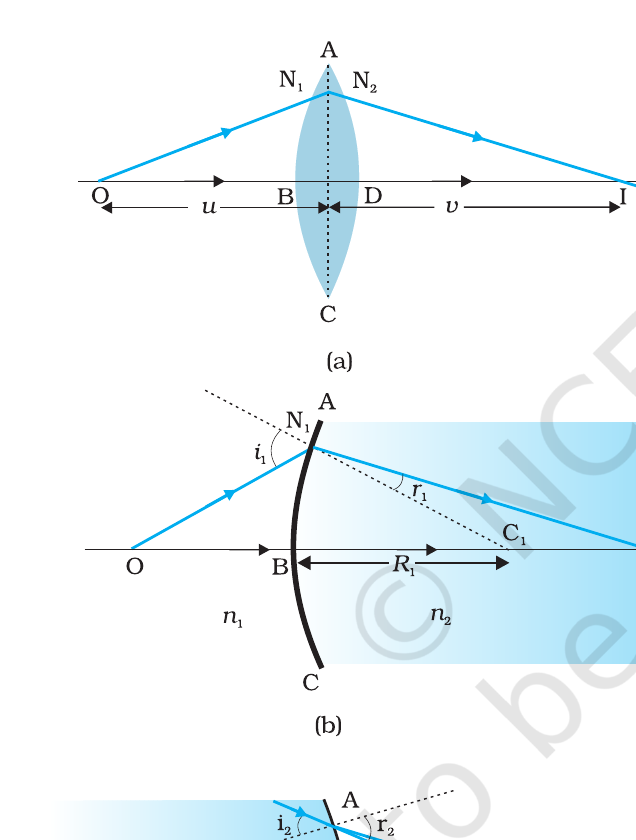
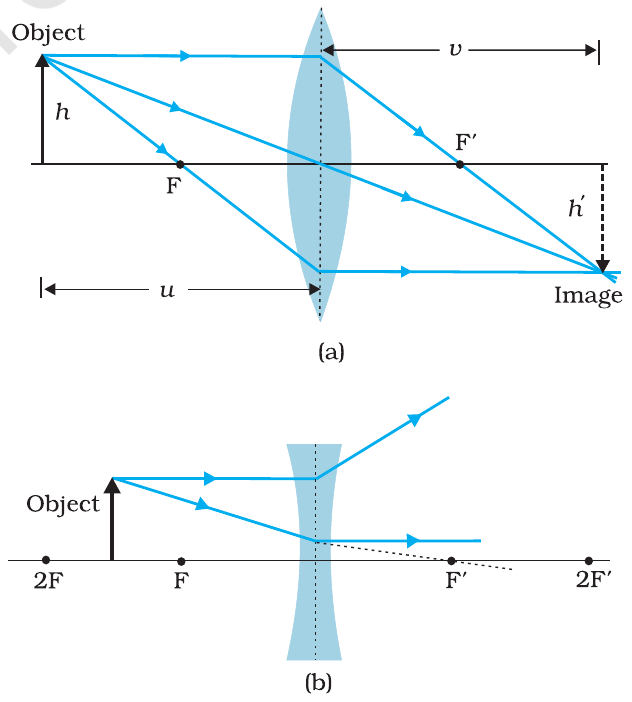
- A thin lens is a transparent optical medium bounded by two surfaces; at least one of which should be spherical. Applying the formula for image formation by a single spherical surface successively at the two surfaces of a lens, we obtain the lens maker's formula and then the lens formula (Fig. 9.16).
- The first refracting surface forms the image I₁ of the object O [Fig. 9.16(b)]. The image I₁ acts as a virtual object for the second surface that forms the image at I [Fig. 9.16(c)]. For a thin lens, $BI_1 = DI_1$. Adding the two surface equations, and putting the object at infinity (OB tends to infinity, $DI = f$), gives $1/f = ((n₂ - n₁)/n₁)(1/R₁ - 1/R₂)$ (9.21). Equation (9.21) is known as the lens maker's formula. It is useful to design lenses of desired focal length using surfaces of suitable radii of curvature. Note that the formula is true for a concave lens also: in that case R₁ is negative, R₂ positive and therefore, f is negative.
- The point where the image of an object placed at infinity is formed is called the focus F, of the lens and the distance f gives its focal length. A lens has two foci, F and F', on either side of it (Fig. 9.17). The two foci, F and F', of a double convex or concave lens are equidistant from the optical centre. The focus on the side of the (original) source of light is called the first focal point, whereas the other is called the second focal point.
- From the same two surface equations, the thin lens formula: $1/v - 1/u = 1/f$ (9.23). Though derived for a real image formed by a convex lens, the formula is valid for both convex as well as concave lenses and for both real and virtual images.
- Three convenient rays for finding the image (Fig. 9.17): (i) A ray emanating from the object parallel to the principal axis of the lens after refraction passes through the second principal focus F' (in a convex lens) or appears to diverge (in a concave lens) from the first principal focus F. (ii) A ray of light, passing through the optical centre of the lens, emerges without any deviation after refraction. (iii) (a) A ray of light passing through the first principal focus of a convex lens emerges parallel to the principal axis after refraction. (b) A ray of light incident on a concave lens appearing to meet the principal axis at second focus point emerges parallel to the principal axis after refraction.
- Magnification (m) produced by a lens is defined, like that for a mirror, as the ratio of the size of the image to that of the object: $m = h'/h = v/u$ (9.24). For an erect (and virtual) image formed by a convex or concave lens, m is positive, while for an inverted (and real) image, m is negative.
- Example 9.6 A magician during a show makes a glass lens with $n = 1.47 disappear$ in a trough of liquid. The refractive index of the liquid must be equal to 1.47 in order to make the lens disappear: n₁ = n₂ gives $1/f = 0$, so f tends to infinity and the lens in the liquid acts like a plane sheet of glass. No, the liquid is not water. It could be glycerine.
Practice1 question
Try it now. A wrong answer costs nothing here, try again until you get it.
A biconvex lens has radii of curvature 10 cm each and is made of glass of refractive index 1.5. What is the power of the lens?
NCERT 9.5.2, Eq. (9.21): $1/f = (1.5 - 1)(1/10 + 1/10) = 0.1$ per cm, so $f = 10 cm = 0.10 m$ and $P = 1/f = +10 D$.
Power of a Lens
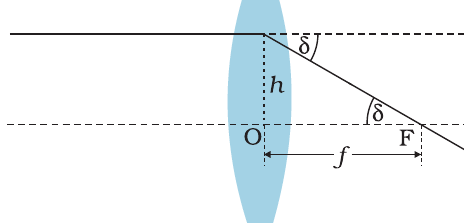
- Power of a lens is a measure of the convergence or divergence, which a lens introduces in the light falling on it. A lens of shorter focal length bends the incident light more, while converging it in case of a convex lens and diverging it in case of a concave lens. The power P of a lens is defined as the tangent of the angle by which it converges or diverges a beam of light parallel to the principal axis falling at unit distance from the optical centre (Fig. 9.18): $P = 1/f$ (9.25).
- The SI unit for power of a lens is dioptre $(D): 1 D = 1 m^{-1}$. The power of a lens of focal length of 1 metre is one dioptre. Power of a lens is positive for a converging lens and negative for a diverging lens. Thus, when an optician prescribes a corrective lens of power +2.5 D, the required lens is a convex lens of focal length +40 cm. A lens of power of -4.0 D means a concave lens of focal length -25 cm.
- Example 9.7 (i) If $f = 0.5 m$ for a glass lens, the power of the lens is +2 dioptre. (ii) The radii of curvature of the faces of a double convex lens are 10 cm and 15 cm; its focal length is 12 cm. Using the lens maker's formula with $f = +12 cm, R₁ = +10 cm, R₂ = -15 cm$, the refractive index of glass is $n = 1.5$. (iii) A convex lens has 20 cm focal length in air. In water (refractive index of $air-water = 1.33, refractive index$ for air-glass = 1.5), its focal length is $f = +78.2 cm$.
Combination of Thin Lenses in Contact
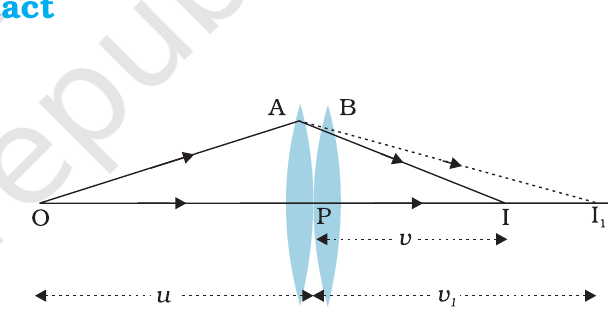
- Consider two lenses A and B of focal length f₁ and f₂ placed in contact with each other. The first lens produces an image at I₁. Since image I₁ is real, it serves as a virtual object for the second lens B, producing the final image at I (Fig. 9.19). Since the lenses are thin, we assume the optical centres of the lenses to be coincident at a central point P.
- For the image formed by the first lens A: $1/v₁ - 1/u = 1/f₁$ (9.27). For the image formed by the second lens B: $1/v - 1/v₁ = 1/f₂$ (9.28). Adding Eqs. (9.27) and (9.28): $1/v - 1/u = 1/f₁ + 1/f₂$ (9.29). If the two lens-system is regarded as equivalent to a single lens of focal length f, then $1/f = 1/f₁ + 1/f₂$ (9.30). The derivation is valid for any number of thin lenses in contact: 1/f = 1/f₁ + 1/f₂ + 1/f₃ + ... (9.31).
- In terms of power, Eq. (9.31) can be written as P = P₁ + P₂ + P₃ + ... (9.32), where P is the net power of the lens combination. Note that the sum in Eq. (9.32) is an algebraic sum of individual powers, so some of the terms on the right side may be positive (for convex lenses) and some negative (for concave lenses).
- Combination of lenses helps to obtain diverging or converging lenses of desired magnification. It also enhances sharpness of the image. Since the image formed by the first lens becomes the object for the second, the total magnification m of the combination is a product of magnification (m₁, m₂, m₃, ...) of individual lenses: m = m₁ m₂ m₃ ... (9.33). Such a system of combination of lenses is commonly used in designing lenses for cameras, microscopes, telescopes and other optical instruments.
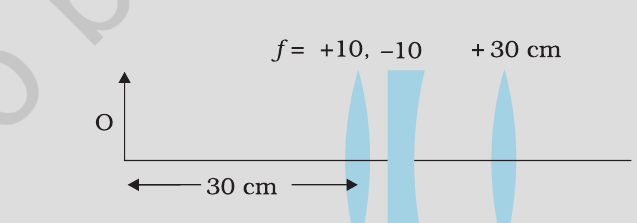
- Example 9.8 Find the position of the image formed by the lens combination given in Fig. 9.20 (object 30 cm from the first lens; $f = +10 cm, -10 cm, +30 cm$). Image formed by the first lens: $v₁ = 15 cm$. This image serves as the object for the second lens, at a distance of (15 - 5) cm = 10 cm to the right of the second lens; it serves as a virtual object, and $v₂ = infinity$. This acts as an object for the third lens, $giving v₃ = 30 cm$. The final image is formed 30 cm to the right of the third lens.
Refraction Through a Prism
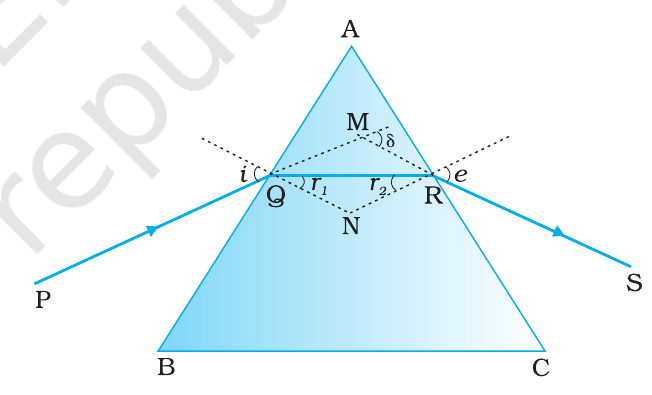
- Figure 9.21 shows the passage of light through a triangular prism ABC. The angles of incidence and refraction at the first face AB are i and r₁, while the angle of incidence (from glass to air) at the second face AC is r₂ and the angle of refraction or emergence e. The angle between the emergent ray RS and the direction of the incident ray PQ is called the angle of deviation, δ.
- In the quadrilateral AQNR, two of the angles (at the vertices Q and R) are right angles. Therefore, the sum of the other angles of the quadrilateral is 180°. From the triangle QNR, r₁ + r₂ + angle $QNR = 180°$. Comparing these two equations, $r₁ + r₂ = A$ (9.34), where A is the angle of the prism.
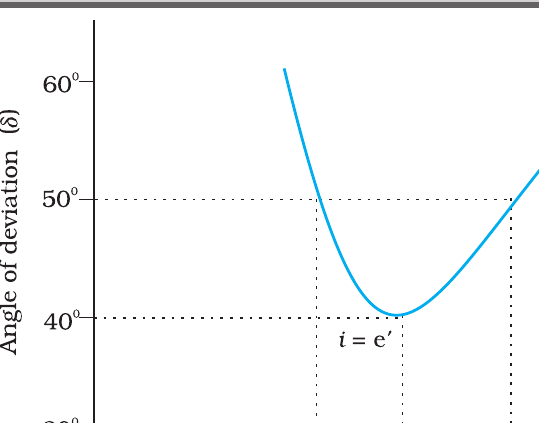
- The total deviation δ is the sum of deviations at the two faces, $δ = (i - r₁) + (e - r₂)$, that is, $δ = i + e - A$ (9.35). Thus, the angle of deviation depends on the angle of incidence. A plot between the angle of deviation and angle of incidence is shown in Fig. 9.22.
- In general, any given value of δ, except for i = e, corresponds to two values i and hence of e. This is expected from the symmetry of i and e in Eq. (9.35), i.e., δ remains the same if i and e are interchanged. Physically, this is related to the fact that the path of the ray in Fig. 9.21 can be traced back, resulting in the same angle of deviation.
- At the minimum deviation Dₘ, the refracted ray inside the prism becomes parallel to its base. We have $δ = D$ₘ, $i = e$ which implies r₁ = r₂. Equation (9.34) gives $2r = A$ or $r = A/2$ (9.36). In the same way, Eq. (9.35) gives Dₘ = 2i - A, or i = (A + Dₘ)/2 (9.37).
- The refractive index of the prism is n = $n₂₁ = sin$[(A + Dₘ)/2]/sin[A/2] (9.38). The angles A and Dₘ can be measured experimentally. Equation (9.38) thus provides a method of determining refractive index of the material of the prism. For a small angle prism, i.e., a thin prism, Dₘ is also very small, and Dₘ = (n₂₁ - 1)A. It implies that thin prisms do not deviate light much.
Practice1 question
Try it now. A wrong answer costs nothing here, try again until you get it.
A thin prism has angle 4° and is made of glass of refractive index 1.5. What is its angle of minimum deviation?
NCERT 9.6: for a thin prism Dₘ = $(n₂₁ - 1)A = (1.5 - 1) \times 4° = 2°$.
Key Formulas of the Chapter
- All the formulas of sections 9.2 to 9.7 in one place. Symbols: u object distance, v image distance, f focal length, R radius of curvature, n refractive index, i angle of incidence, r angle of refraction, e angle of emergence, δ angle of deviation, Dₘ angle of minimum deviation, A angle of prism, P power, D least distance of distinct vision (25 cm), L tube length, fₒ objective focal length, fₑ eyepiece focal length.
| Relation | Formula | Where |
|---|---|---|
| Focal length of a spherical mirror | $f = R/2$ | 9.2.2, Eq. (9.3) |
| Mirror equation | $1/v + 1/u = 1/f$ | 9.2.3, Eq. (9.7) |
| Magnification by a mirror | $m = h'/h = -v/u$ | 9.2.3, Eq. (9.9) |
| Snell's law | $\sin i/\sin r = n₂₁$ | 9.3, Eq. (9.10) |
| Critical angle | $\sin i_c = n₂₁$ | 9.4, Eq. (9.12) |
| Refraction at a spherical surface | $n₂/v - n₁/u = (n₂ - n₁)/R$ | 9.5.1, Eq. (9.16) |
| Lens maker's formula | $1/f = ((n₂ - n₁)/n₁)(1/R₁ - 1/R₂)$ | 9.5.2, Eq. (9.21) |
| Thin lens formula | $1/v - 1/u = 1/f$ | 9.5.2, Eq. (9.23) |
| Magnification by a lens | $m = h'/h = v/u$ | 9.5.2, Eq. (9.24) |
| Power of a lens | $P = 1/f$ | 9.5.3, Eq. (9.25) |
| Lenses in contact | $1/f = 1/f₁ + 1/f₂$; $P = P₁ + P₂$ | 9.5.4, Eqs. (9.30), (9.32) |
| Prism | $r₁ + r₂ = A$; $δ = i + e - A$ | 9.6, Eqs. (9.34), (9.35) |
| Prism refractive index | $n₂₁ = sin$[(A + Dₘ)/2]/$\sin(A/2)$ | 9.6, Eq. (9.38) |
| Simple microscope | m = 1 + D/f (near point); $m = D/f (infinity)$ | 9.7.1, Eqs. (9.39), (9.42) |
| Compound microscope | m = (L/fₒ)(D/fₑ) (infinity) | 9.7.1, Eq. (9.45) |
| Telescope | m = $β/α = f$ₒ/fₑ; tube length fₒ + fₑ | 9.7.2, Eq. (9.46) |
The Microscope
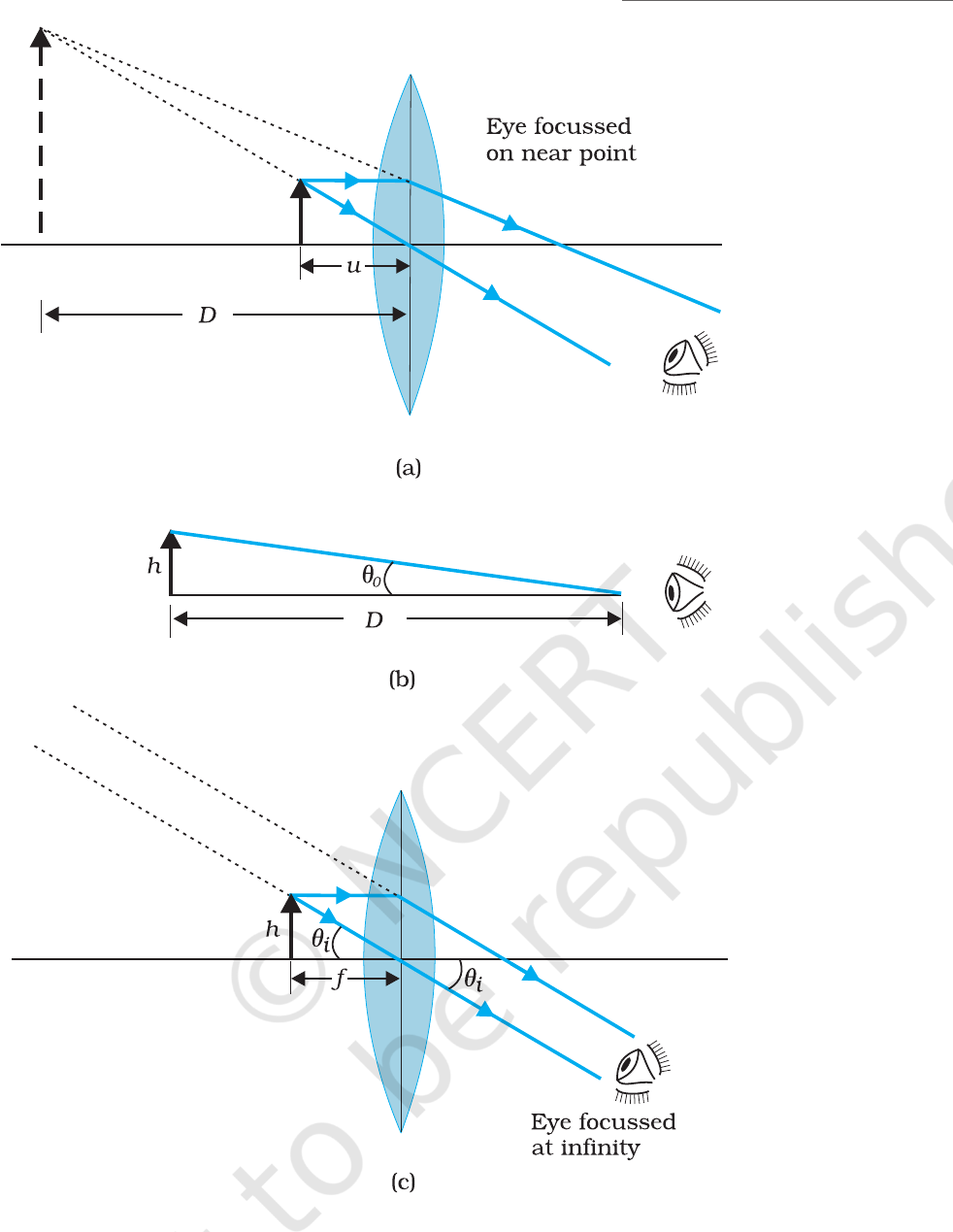
- A simple magnifier or microscope is a converging lens of small focal length (Fig. 9.23). In order to use such a lens as a microscope, the lens is held near the object, one focal length away or less, and the eye is positioned close to the lens on the other side. The idea is to get an erect, magnified and virtual image of the object at a distance so that it can be viewed comfortably, i.e., at 25 cm or more.
- If the object is at a distance f, the image is at infinity. However, if the object is at a distance slightly less than the focal length of the lens, the image is virtual and closer than infinity. Although the closest comfortable distance for viewing the image is when it is at the near point (distance D ≈ 25 cm), it causes some strain on the eye. Therefore, the image formed at infinity is often considered most suitable for viewing by the relaxed eye.
- The linear magnification m, for the image formed at the near point D, by a simple microscope is $m = 1 + D/f$ (9.39). Since D is about 25 cm, to have a magnification of six, one needs a convex lens of focal length, $f = 5 cm$. What a single-lens simple magnifier achieves is that it allows the object to be brought closer to the eye than D.
- The maximum angle the object can subtend, and be clearly visible (without a lens), is when it is at the near point, i.e., a distance D. The angle subtended is tan θₒ ≈ θₒ = h/D (9.40). With the object at $u = -f$, the angle subtended by the image is θᵢ = h/f (9.41). The angular magnification is therefore m = θᵢ/θₒ = D/f (9.42). This is one less than the magnification when the image is at the near point, Eq. (9.39), but the viewing is more comfortable and the difference in magnification is usually small.
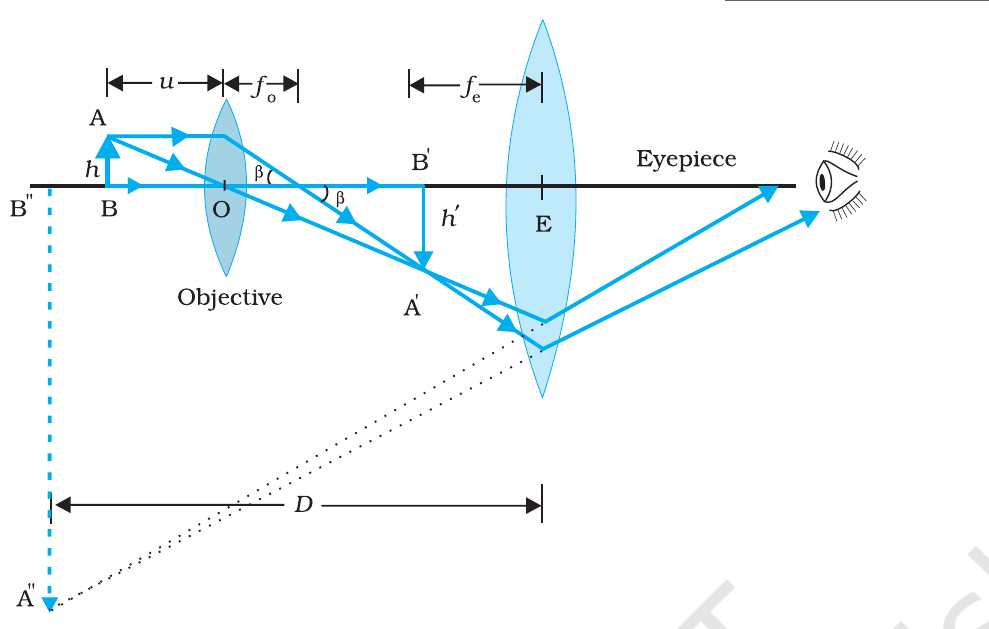
- A simple microscope has a limited maximum magnification (≤ 9) for realistic focal lengths. For much larger magnifications, one uses two lenses, one compounding the effect of the other. This is known as a compound microscope. A schematic diagram of a compound microscope is shown in Fig. 9.24. The lens nearest the object, called the objective, forms a real, inverted, magnified image of the object. This serves as the object for the second lens, the eyepiece, which functions essentially like a simple microscope or magnifier, produces the final image, which is enlarged and virtual. The first inverted image is thus near (at or within) the focal plane of the eyepiece, at a distance appropriate for final image formation at infinity, or a little closer for image formation at the near point. Clearly, the final image is inverted with respect to the original object.
- The (linear) magnification due to the objective is mₒ = $h'/h = L/f$ₒ (9.43), where L, the distance between the second focal point of the objective and the first focal point of the eyepiece (focal length fₑ), is called the tube length of the compound microscope. The (angular) magnification mₑ due to the eyepiece is mₑ = 1 + D/fₑ [9.44(a)] when the final image is formed at the near point, and mₑ = D/fₑ [9.44(b)] when the final image is formed at infinity. The total magnification when the image is formed at infinity is $m = m$ₒ mₑ = (L/fₒ)(D/fₑ) (9.45).
- Example: with an objective with fₒ = 1.0 cm, and an eyepiece with focal length fₑ = 2.0 cm, and a tube length of 20 cm, the magnification is $m = (20/1)(25/2) = 250$. To achieve a large magnification of a small object (hence the name microscope), the objective and eyepiece should have small focal lengths. In practice, it is difficult to make the focal length much smaller than 1 cm.
- In modern microscopes, multi-component lenses are used for both the objective and the eyepiece to improve image quality by minimising various optical aberrations (defects) in lenses.
The Telescope
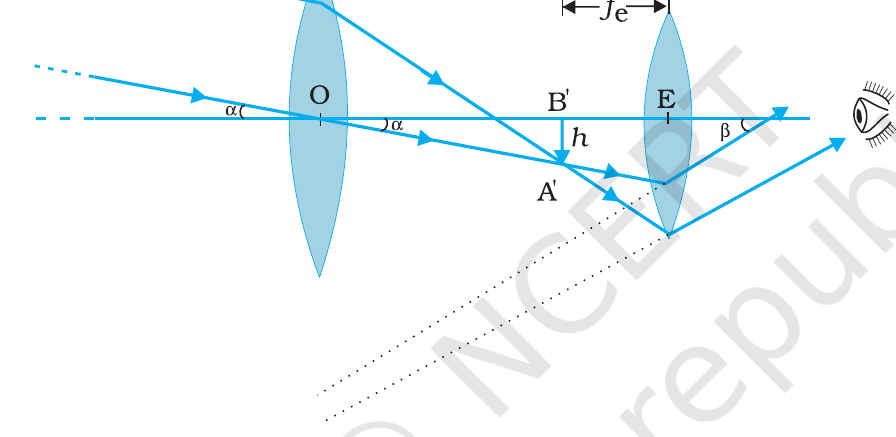
- The telescope is used to provide angular magnification of distant objects (Fig. 9.25). It also has an objective and an eyepiece. But here, the objective has a large focal length and a much larger aperture than the eyepiece. Light from a distant object enters the objective and a real image is formed in the tube at its second focal point. The eyepiece magnifies this image producing a final inverted image.
- The magnifying power m is the ratio of the angle β subtended at the eye by the final image to the angle α which the object subtends at the lens or the eye. Hence m = $β/α = f$ₒ/fₑ (9.46). In this case, the length of the telescope tube is fₒ + fₑ.
- Terrestrial telescopes have, in addition, a pair of inverting lenses to make the final image erect. Refracting telescopes can be used both for terrestrial and astronomical observations. For example, consider a telescope whose objective has a focal length of 100 cm and the eyepiece a focal length of 1 cm. The magnifying power of this telescope is $m = 100/1 = 100$. A pair of stars of actual separation 1' (one minute of arc) appears as though separated by an angle of 100 × 1' = 100' = 1.67°.
- The main considerations with an astronomical telescope are its light gathering power and its resolution or resolving power. The former clearly depends on the area of the objective. With larger diameters, fainter objects can be observed. The resolving power, or the ability to observe two objects distinctly, which are in very nearly the same direction, also depends on the diameter of the objective. The largest lens objective in use has a diameter of 40 inch (≈ 1.02 m). It is at the Yerkes Observatory in Wisconsin, USA. Such big lenses tend to be very heavy and therefore, difficult to make and support by their edges. Further, it is rather difficult and expensive to make such large sized lenses which form images that are free from any kind of chromatic aberration and distortions.
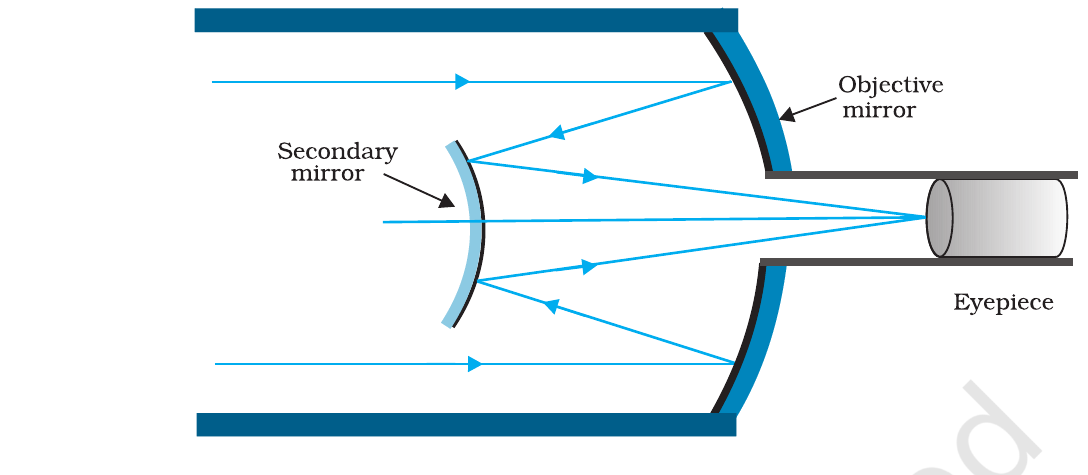
- For these reasons, modern telescopes use a concave mirror rather than a lens for the objective. Telescopes with mirror objectives are called reflecting telescopes. There is no chromatic aberration in a mirror. Mechanical support is much less of a problem since a mirror weighs much less than a lens of equivalent optical quality, and can be supported over its entire back surface, not just over its rim.
- One obvious problem with a reflecting telescope is that the objective mirror focusses light inside the telescope tube. One must have an eyepiece and the observer right there, obstructing some light. This is what is done in the very large 200 inch (≈ 5.08 m) diameter, Mt. Palomar telescope, California. The viewer sits near the focal point of the mirror, in a small cage. Another solution is to deflect the light being focussed by another mirror. One such arrangement using a convex secondary mirror to focus the incident light, which now passes through a hole in the objective primary mirror, is shown in Fig. 9.26. This is known as a Cassegrain telescope, after its inventor. It has the advantages of a large focal length in a short telescope.
- The largest telescope in India is in Kavalur, Tamil Nadu. It is a 2.34 m diameter reflecting telescope (Cassegrain). It was ground, polished, set up, and is being used by the Indian Institute of Astrophysics, Bangalore. The largest reflecting telescopes in the world are the pair of Keck telescopes in Hawaii, USA, with a reflector of 10 metre in diameter.
Practice1 question
Try it now. A wrong answer costs nothing here, try again until you get it.
A telescope has an objective of focal length 100 cm and an eyepiece of focal length 1 cm. What is its magnifying power?
NCERT 9.7.2, Eq. (9.46): $m = f$ₒ/fₑ = $100/1 = 100$.
Worked Examples
- Example 9.1 Suppose that the lower half of the concave mirror's reflecting surface in Fig. 9.6 is covered with an opaque (non-reflective) material. What effect will this have on the image of an object placed in front of the mirror? Taking the laws of reflection to be true for all points of the remaining part of the mirror, the image will be that of the whole object. However, as the area of the reflecting surface has been reduced, the intensity of the image will be low (in this case, half).
- Example 9.2 A mobile phone lies along the principal axis of a concave mirror, as shown in Fig. 9.7. The image of the part which is on the plane perpendicular to principal axis will be on the same plane. It will be of the same size, i.e., B'C = BC. The image is distorted and the magnification is not uniform. The distortion of the image depends on the location of the phone with respect to the mirror.
- Example 9.3 An object is placed at (i) 10 cm, (ii) 5 cm in front of a concave mirror of radius of curvature 15 cm. Find the position, nature, and magnification of the image in each case. The focal length $f = -15/2 cm = -7.5 cm$. (i) The object distance $u = -10 cm: v = -30 cm$, magnification $m = -3$. The image is 30 cm from the mirror on the same side as the object; it is magnified, real and inverted. (ii) The object distance $u = -5 cm: v = +15 cm$, magnification $m = +3$. The image is formed at 15 cm behind the mirror; it is magnified, virtual and erect.
- Example 9.4 While sitting in a parked car, you notice a jogger approaching towards you in the side view mirror of the car. The mirror has $R = 2 m$. If the jogger is running at a speed of 5 m/s, how fast the image of the jogger appear to move when the jogger is (a) 39 m, (b) 29 m, (c) 19 m, and (d) 9 m away? The speed with which the image appears to move is (1/280) m/s at 39 m, (1/150) m/s at 29 m, (1/60) m/s at 19 m, and (1/10) m/s at 9 m. Although the jogger has been moving with a constant speed, the speed of his/her image appears to increase substantially as he/she moves closer to the mirror.
- Example 9.5 Worked in section 7 (refraction at a spherical surface): light from a point source 100 cm from a spherical glass surface (n = 1.5, R = 20 cm) forms its image at $v = +100 cm$.
- Example 9.6 Worked in section 8 (refraction by a lens): a glass lens of $n = 1.47 disappears$ in a liquid of refractive index 1.47; the liquid is not water, it could be glycerine.
- Example 9.7 Worked in section 9 (power of a lens): (i) power +2 dioptre for $f = 0.5 m$; (ii) refractive index of glass $n = 1.5$; (iii) focal length in water $f = +78.2 cm$.
- Example 9.8 Worked in section 10 (combination of thin lenses in contact): the final image is formed 30 cm to the right of the third lens.
Trap Pairs
- Trap: covering half of a mirror gives only half of the image. Correct: the image is still of the whole object; only its intensity falls, to half in Example 9.1.
- Trap: optical density is the same as mass density. Correct: optical density is the ratio of the speed of light in two media; turpentine is optically denser than water but its mass density is less (9.3 Note).
- Trap: any ray going from a denser to a rarer medium is totally internally reflected. Correct: total internal reflection needs i > i_c; below i_c the ray is partly reflected and partly refracted (9.4).
- Trap: a convex mirror can form a real image. Correct: a convex mirror always forms a virtual, erect and diminished image, located between the focus and the pole (9.2.3, Exercise 9.15).
- Trap: a simple microscope magnifies by the same amount whether the image is at the near point or at infinity. Correct: $m = 1 + D/f$ at the near point and $m = D/f$ at infinity, one less (9.7.1).
- Trap: a telescope objective should have a short focal length. Correct: the objective needs a large focal length and a large aperture, for magnifying power and for light gathering power (9.7.2; NEET 2021 Q8).
Points to Ponder
- 1. The laws of reflection and refraction are true for all surfaces and pairs of media at the point of the incidence.
- 2. The real image of an object placed between f and 2f from a convex lens can be seen on a screen placed at the image location. If the screen is removed, is the image still there? This question puzzles many, because it is difficult to reconcile ourselves with an image suspended in air without a screen. But the image does exist. Rays from a given point on the object are converging to an image point in space and diverging away. The screen simply diffuses these rays, some of which reach our eye and we see the image. This can be seen by the images formed in air during a laser show.
- 3. Image formation needs regular reflection/refraction. In principle, all rays from a given point should reach the same image point. This is why you do not see your image by an irregular reflecting object, say the page of a book.
- 4. Thick lenses give coloured images due to dispersion. The variety in colour of objects we see around us is due to the constituent colours of the light incident on them. A monochromatic light may produce an entirely different perception about the colours on an object as seen in white light.
- 5. For a simple microscope, the angular size of the object equals the angular size of the image. Yet it offers magnification because we can keep the small object much closer to the eye than 25 cm and hence have it subtend a large angle. The image is at 25 cm which we can see. Without the microscope, you would need to keep the small object at 25 cm which would subtend a very small angle.
Summary
- 1. Reflection is governed by the equation ∠i = ∠r' and refraction by the Snell's law, sin i/sin r = n, where the incident ray, reflected ray, refracted ray and normal lie in the same plane. Angles of incidence, reflection and refraction are i, r' and r, respectively.
- 2. The critical angle of incidence i_c for a ray incident from a denser to rarer medium, is that angle for which the angle of refraction is 90°. For i > i_c, total internal reflection occurs. Multiple internal reflections in diamond (i_c ≈ 24.4°), totally reflecting prisms and mirage, are some examples of total internal reflection. Optical fibres consist of glass fibres coated with a thin layer of material of lower refractive index. Light incident at an angle at one end comes out at the other, after multiple internal reflections, even if the fibre is bent.
- 3. Cartesian sign convention: distances measured in the same direction as the incident light are positive; those measured in the opposite direction are negative. All distances are measured from the pole/optic centre of the mirror/lens on the principal axis. The heights measured upwards above x-axis and normal to the principal axis of the mirror/lens are taken as positive. The heights measured downwards are taken as negative.
- 4. Mirror equation: $1/v + 1/u = 1/f$, where u and v are object and image distances, respectively and f is the focal length of the mirror. f is (≈imately) half the radius of curvature R. f is negative for concave mirror; f is positive for a convex mirror.
- 5. For a prism of the angle A, of refractive index n₂ placed in a medium of refractive index n₁, $n₂₁ = sin$[(A + Dₘ)/2]/$\sin(A/2)$, where Dₘ is the angle of minimum deviation.
- 6. For refraction through a spherical interface (from medium 1 to 2 of refractive index n₁ and n₂, respectively): n₂/v - n₁/u = (n₂ - n₁)/R. Thin lens formula: $1/v - 1/u = 1/f$. Lens maker's formula: $1/f = ((n₂ - n₁)/n₁)(1/R₁ - 1/R₂)$. R₁ and R₂ are the radii of curvature of the lens surfaces. f is positive for a converging lens; f is negative for a diverging lens. The power of $a lens P = 1/f$. The SI unit for power of a lens is dioptre $(D): 1 D = 1 m^{-1}$. If several thin lenses of focal length f₁, f₂, f₃, ... are in contact, the effective focal length of their combination is given by 1/f = 1/f₁ + 1/f₂ + 1/f₃ + ... The total power of a combination of several lenses is P = P₁ + P₂ + P₃ + ...
- 7. Dispersion is the splitting of light into its constituent colour.
- 8. Magnifying power m of a simple microscope is given by $m = 1 + (D/f)$, where $D = 25 cm$ is the least distance of distinct vision and f is the focal length of the convex lens. If the image is at infinity, $m = D/f$. For a compound microscope, the magnifying power is given by $m = m$ₑ × mₒ where mₑ = 1 + (D/fₑ), is the magnification due to the eyepiece and mₒ is the magnification produced by the objective. Approximately, m = (L/fₒ)(D/fₑ), where fₒ and fₑ are the focal lengths of the objective and eyepiece, respectively, and L is the distance between their focal points.
- 9. Magnifying power m of a telescope is the ratio of the angle β subtended at the eye by the image to the angle α subtended at the eye by the object: m = $β/α = f$ₒ/fₑ, where fₒ and fₑ are the focal lengths of the objective and eyepiece, respectively.
Exercises
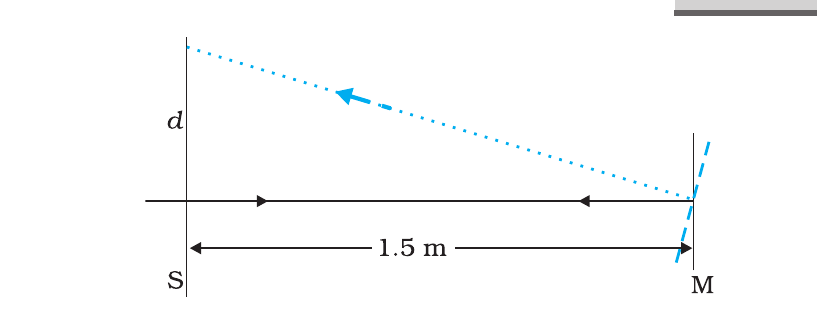
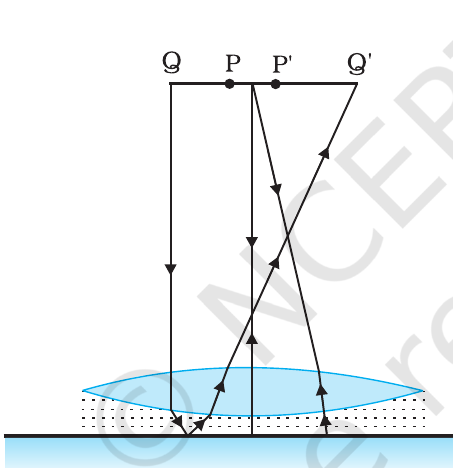
- NCERT Exercises 9.1 to 9.31 (printed pp. 249-253). Answers are not printed in NCERT; work them from the sections above. Figures 9.27-9.30 belong to Exercises 9.4, 9.17, 9.30 and 9.31.
- 9.1 A small candle, 2.5 cm in size is placed at 27 cm in front of a concave mirror of radius of curvature 36 cm. At what distance from the mirror should a screen be placed in order to obtain a sharp image? Describe the nature and size of the image. If the candle is moved closer to the mirror, how would the screen have to be moved?
- 9.2 A 4.5 cm needle is placed 12 cm away from a convex mirror of focal length 15 cm. Give the location of the image and the magnification. Describe what happens as the needle is moved farther from the mirror.
- 9.3 A tank is filled with water to a height of 12.5 cm. The apparent depth of a needle lying at the bottom of the tank is measured by a microscope to be 9.4 cm. What is the refractive index of water? If water is replaced by a liquid of refractive index 1.63 up to the same height, by what distance would the microscope have to be moved to focus on the needle again?
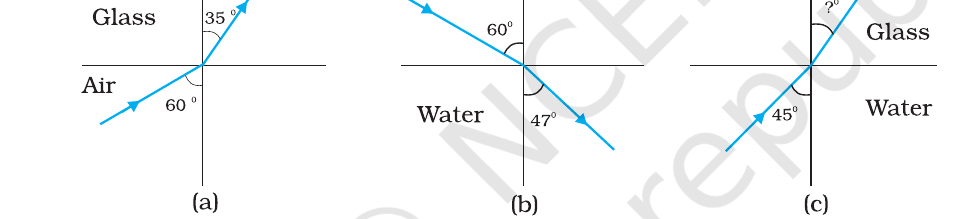
- 9.4 Figures 9.27(a) and (b) show refraction of a ray in air incident at 60° with the normal to a glass-air and water-air interface, respectively. Predict the angle of refraction in glass when the angle of incidence in water is 45° with the normal to a water-glass interface [Fig. 9.27(c)].
- 9.5 A small bulb is placed at the bottom of a tank containing water to a depth of 80 cm. What is the area of the surface of water through which light from the bulb can emerge out? Refractive index of water is 1.33. (Consider the bulb to be a point source.)
- 9.6 A prism is made of glass of unknown refractive index. A parallel beam of light is incident on a face of the prism. The angle of minimum deviation is measured to be 40°. What is the refractive index of the material of the prism? The refracting angle of the prism is 60°. If the prism is placed in water (refractive index 1.33), predict the new angle of minimum deviation of a parallel beam of light.
- 9.7 Double-convex lenses are to be manufactured from a glass of refractive index 1.55, with both faces of the same radius of curvature. What is the radius of curvature required if the focal length is to be 20 cm?
- 9.8 A beam of light converges at a point P. Now a lens is placed in the path of the convergent beam 12 cm from P. At what point does the beam converge if the lens is (a) a convex lens of focal length 20 cm, and (b) a concave lens of focal length 16 cm?
- 9.9 An object of size 3.0 cm is placed 14 cm in front of a concave lens of focal length 21 cm. Describe the image produced by the lens. What happens if the object is moved further away from the lens?
- 9.10 What is the focal length of a convex lens of focal length 30 cm in contact with a concave lens of focal length 20 cm? Is the system a converging or a diverging lens? Ignore thickness of the lenses.
- 9.11 A compound microscope consists of an objective lens of focal length 2.0 cm and an eyepiece of focal length 6.25 cm separated by a distance of 15 cm. How far from the objective should an object be placed in order to obtain the final image at (a) the least distance of distinct vision (25 cm), and (b) at infinity? What is the magnifying power of the microscope in each case?
- 9.12 A person with a normal near point (25 cm) using a compound microscope with objective of focal length 8.0 mm and an eyepiece of focal length 2.5 cm can bring an object placed at 9.0 mm from the objective in sharp focus. What is the separation between the two lenses? Calculate the magnifying power of the microscope.
- 9.13 A small telescope has an objective lens of focal length 144 cm and an eyepiece of focal length 6.0 cm. What is the magnifying power of the telescope? What is the separation between the objective and the eyepiece?
- 9.14 (a) A giant refracting telescope at an observatory has an objective lens of focal length 15 m. If an eyepiece of focal length 1.0 cm is used, what is the angular magnification of the telescope? (b) If this telescope is used to view the moon, what is the diameter of the image of the moon formed by the objective lens? The diameter of the moon is 3.48 × $10^{6}$ m, and the radius of lunar orbit is 3.8 × $10^{8}$ m.
- 9.15 Use the mirror equation to deduce that: (a) an object placed between f and 2f of a concave mirror produces a real image beyond 2f. (b) a convex mirror always produces a virtual image independent of the location of the object. (c) the virtual image produced by a convex mirror is always diminished in size and is located between the focus and the pole. (d) an object placed between the pole and focus of a concave mirror produces a virtual and enlarged image. [Note: This exercise helps you deduce algebraically properties of images that one obtains from explicit ray diagrams.]
- 9.16 A small pin fixed on a table top is viewed from above from a distance of 50 cm. By what distance would the pin appear to be raised if it is viewed from the same point through a 15 cm thick glass slab held parallel to the table? Refractive index of $glass = 1.5$. Does the answer depend on the location of the slab?
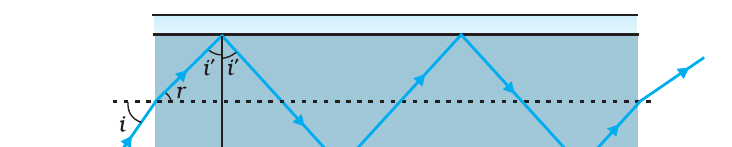
- 9.17 (a) Figure 9.28 shows a cross-section of a 'light pipe' made of a glass fibre of refractive index 1.68. The outer covering of the pipe is made of a material of refractive index 1.44. What is the range of the angles of the incident rays with the axis of the pipe for which total reflections inside the pipe take place, as shown in the figure. (b) What is the answer if there is no outer covering of the pipe?
- 9.18 The image of a small electric bulb fixed on the wall of a room is to be obtained on the opposite wall 3 m away by means of a large convex lens. What is the maximum possible focal length of the lens required for the purpose?
- 9.19 A screen is placed 90 cm from an object. The image of the object on the screen is formed by a convex lens at two different locations separated by 20 cm. Determine the focal length of the lens.
- 9.20 (a) Determine the 'effective focal length' of the combination of the two lenses in Exercise 9.10, if they are placed 8.0 cm apart with their principal axes coincident. Does the answer depend on which side of the combination a beam of parallel light is incident? Is the notion of effective focal length of this system useful at all? (b) An object 1.5 cm in size is placed on the side of the convex lens in the arrangement (a) above. The distance between the object and the convex lens is 40 cm. Determine the magnification produced by the two-lens system, and the size of the image.
- 9.21 At what angle should a ray of light be incident on the face of a prism of refracting angle 60° so that it just suffers total internal reflection at the other face? The refractive index of the material of the prism is 1.524.
- 9.22 A card sheet divided into squares each of size 1 $\mathrm{mm}^2$ is being viewed at a distance of 9 cm through a magnifying glass (a converging lens of focal length 9 cm) held close to the eye. (a) What is the magnification produced by the lens? How much is the area of each square in the virtual image? (b) What is the angular magnification (magnifying power) of the lens? (c) Is the magnification in (a) equal to the magnifying power in (b)? Explain.
- 9.23 (a) At what distance should the lens be held from the card sheet in Exercise 9.22 in order to view the squares distinctly with the maximum possible magnifying power? (b) What is the magnification in this case? (c) Is the magnification equal to the magnifying power in this case? Explain.
- 9.24 What should be the distance between the object in Exercise 9.23 and the magnifying glass if the virtual image of each square in the figure is to have an area of 6.25 $\mathrm{mm}^2$. Would you be able to see the squares distinctly with your eyes very close to the magnifier? [Note: Exercises 9.22 to 9.24 will help you clearly understand the difference between magnification in absolute size and the angular magnification (or magnifying power) of an instrument.]
- 9.25 Answer the following questions: (a) The angle subtended at the eye by an object is equal to the angle subtended at the eye by the virtual image produced by a magnifying glass. In what sense then does a magnifying glass provide angular magnification? (b) In viewing through a magnifying glass, one usually positions one's eyes very close to the lens. Does angular magnification change if the eye is moved back? (c) Magnifying power of a simple microscope is inversely proportional to the focal length of the lens. What then stops us from using a convex lens of smaller and smaller focal length and achieving greater and greater magnifying power? (d) Why must both the objective and the eyepiece of a compound microscope have short focal lengths? (e) When viewing through a compound microscope, our eyes should be positioned not on the eyepiece but a short distance away from it for best viewing. Why? How much should be that short distance between the eye and eyepiece?
- 9.26 An angular magnification (magnifying power) of 30X is desired using an objective of focal length 1.25 cm and an eyepiece of focal length 5 cm. How will you set up the compound microscope?
- 9.27 A small telescope has an objective lens of focal length 140 cm and an eyepiece of focal length 5.0 cm. What is the magnifying power of the telescope for viewing distant objects when (a) the telescope is in normal adjustment (i.e., when the final image is at infinity)? (b) the final image is formed at the least distance of distinct vision (25 cm)?
- 9.28 (a) For the telescope described in Exercise 9.27 (a), what is the separation between the objective lens and the eyepiece? (b) If this telescope is used to view a 100 m tall tower 3 km away, what is the height of the image of the tower formed by the objective lens? (c) What is the height of the final image of the tower if it is formed at 25 cm?
- 9.29 A Cassegrain telescope uses two mirrors as shown in Fig. 9.26. Such a telescope is built with the mirrors 20 mm apart. If the radius of curvature of the large mirror is 220 mm and the small mirror is 140 mm, where will the final image of an object at infinity be?
- 9.30 Light incident normally on a plane mirror attached to a galvanometer coil retraces backwards as shown in Fig. 9.29. A current in the coil produces a deflection of 3.5° of the mirror. What is the displacement of the reflected spot of light on a screen placed 1.5 m away?
- 9.31 Figure 9.30 shows an equiconvex lens (of refractive index 1.50) in contact with a liquid layer on top of a plane mirror. A small needle with its tip on the principal axis is moved along the axis until its inverted image is found at the position of the needle. The distance of the needle from the lens is measured to be 45.0 cm. The liquid is removed and the experiment is repeated. The new distance is measured to be 30.0 cm. What is the refractive index of the liquid?
Trap Boxes
Covering half the mirror gives half the image
Wrong idea: If the lower half of a concave mirror is covered, the image shows only the upper half of the object.
The image is still of the whole object, because the laws of reflection hold for all points of the remaining part of the mirror. Only the intensity of the image falls, to half in Example 9.1. NCERT 9.2.3, Example 9.1.
NCERT XII, Ch 9, 9.2.3, Example 9.1
Optical density is mass density
Wrong idea: A medium that is denser by mass is always optically denser too.
Optical density is the ratio of the speed of light in two media, not mass per unit volume. Turpentine is optically denser than water but its mass density is less. NCERT 9.3, Note.
NCERT XII, Ch 9, 9.3
Any denser-to-rarer ray is totally reflected
Wrong idea: Every ray going from a denser medium to a rarer medium undergoes total internal reflection.
Total internal reflection needs i > i_c. Below the critical angle the ray is partly reflected and partly refracted into the rarer medium. NCERT 9.4, Fig. 9.11.
NCERT XII, Ch 9, 9.4
A convex mirror can form a real image
Wrong idea: Put the object far enough away and a convex mirror forms a real image.
A convex mirror always produces a virtual image, independent of the location of the object. The virtual image is always diminished in size and is located between the focus and the pole. NCERT 9.2.3, Exercise 9.15.
NCERT XII, Ch 9, 9.2.3, Exercise 9.15
Microscope magnification is the same at near point and infinity
Wrong idea: A simple microscope magnifies by the same amount whether the final image is at the near point or at infinity.
The magnification at the near point is $m = 1 + D/f$, while at infinity it is $m = D/f$, one less. The infinity setting is more comfortable for the relaxed eye. NCERT 9.7.1, Eqs. (9.39) and (9.42).
NCERT XII, Ch 9, 9.7.1
A telescope objective should have a short focal length
Wrong idea: A telescope works best with a short-focus objective, like a microscope.
The telescope objective needs a large focal length and a much larger aperture than the eyepiece: the long focus gives the magnifying power and the large area gives light gathering power and resolution. NCERT 9.7.2.
NCERT XII, Ch 9, 9.7.2
Chapter test
5 NEET PYQs. +4 for a correct answer, -1 for a wrong answer, exactly like NEET. Finish the test to earn a medal.
Q1: NEET (UG) 2022, Code R1, Q29
A biconvex lens has radii of curvature, 20 cm each. If the refractive index of the material of the lens is 1.5, the power of the lens is
$1/f = (1.5 - 1)(1/20 + 1/20) = 0.05$ per cm, so $f = 20 cm = 0.20 m$ and $P = 1/f = +5 D$.
Q2: NEET (UG) 2021, Code P3, Q37
A point object is placed at a distance of 60 cm from a convex lens of focal length 30 cm. If a plane mirror were put perpendicular to the principal axis of the lens and at a distance of 40 cm from it, the final image would be formed at a distance of
The lens alone forms an image 60 cm away, 20 cm behind the mirror. After reflection and a second pass through the lens, the final image is virtual, 60 cm from the lens, which is 20 cm from the plane mirror.
Q3: NEET (UG) 2021, Code P3, Q12
A convex lens 'A' of focal length 20 cm and a concave lens 'B' of focal length 5 cm are kept along the same axis with a distance 'd' between them. If a parallel beam of light falling on 'A' leaves 'B' as a parallel beam, then the distance 'd' in cm will be
The parallel beam converges at the focus of A, 20 cm from A. For it to leave B as a parallel beam it must pass through the focus of B, 5 cm from B, so $d = 20 - 5 = 15 cm$.
Q4: NEET (UG) 2021, Code P3, Q8
A lens of large focal length and large aperture is best suited as an objective of an astronomical telescope since
A large aperture gathers more light and improves both resolution and image quality, so all three reasons hold. NCERT 9.7.2 names light gathering power and resolving power as the main considerations.
Q5: NEET (UG) 2020, Code G5, Q139
A ray is incident at an angle of incidence i on one surface of a small angle prism (with angle of prism A) and emerges normally from the opposite surface. If the refractive index of the material of the prism is μ, then the angle of incidence is nearly equal to
The ray emerges normally, so $r₂ = 0$ and $r₁ = A$. Snell at the first face gives $\sin i = μ \sin A$, and for a small angle prism sin A is about A, so i is nearly μA.
Score: 0 · Answered 0 of 5
Flashcards
Tap a card to flip it over and see the answer. Tap it again to flip it back.
What is the focal length of a spherical mirror in terms of its radius of curvature, and what are its signs?
Tap to flip$f = R/2$ (9.3), where R is the radius of curvature. f is negative for a concave mirror and positive for a convex mirror.
Tap to flip backState the mirror equation.
Tap to flip$1/v + 1/u = 1/f$ (9.7), where u is the object distance, v the image distance and f the focal length, all with the Cartesian sign convention.
Tap to flip backDefine linear magnification for a mirror and give its formula.
Tap to flip$m = h'/h = -v/u$ (9.9). A real inverted image has negative m; a virtual erect image has positive m.
Tap to flip backState Snell's law of refraction and the relation between n₂₁ and n₁₂.
Tap to flip$\sin i/\sin r = n₂₁$ (9.10), where n₂₁ is the refractive index of medium 2 with respect to medium 1. Also $n₁₂ = 1/n₂₁$ (9.11).
Tap to flip backDefine the critical angle and give the condition for total internal reflection.
Tap to flip$\sin i_c = n₂₁$ (9.12), where i_c is the critical angle and n₂₁ the refractive index of the rarer medium with respect to the denser one. For i > i_c there is total internal reflection and no refraction.
Tap to flip backGive the refractive index and critical angle of water, crown glass, dense flint glass and diamond from Table 9.1.
Tap to flipWater 1.33, i_c 48.75; crown glass 1.52, i_c 41.14; dense flint glass 1.62, i_c 37.31; diamond 2.42, i_c 24.41 (Table 9.1, with respect to air).
Tap to flip backGive the formula for refraction at a single spherical surface.
Tap to flip$n₂/v - n₁/u = (n₂ - n₁)/R$ (9.16), where u is the object distance, v the image distance and R the radius of curvature of the spherical surface.
Tap to flip backState the lens maker's formula.
Tap to flip$1/f = ((n₂ - n₁)/n₁)(1/R₁ - 1/R₂)$ (9.21). In air $(n₁ = 1)$ this is $1/f = (n - 1)(1/R₁ - 1/R₂)$.
Tap to flip backState the thin lens formula and the magnification produced by a lens.
Tap to flip$1/v - 1/u = 1/f$ (9.23) and $m = h'/h = v/u$ (9.24). m is positive for an erect virtual image and negative for an inverted real image.
Tap to flip backDefine the power of a lens, give its unit, and state its sign for convex and concave lenses.
Tap to flip$P = 1/f$ (9.25). The SI unit is the dioptre $(D): 1 D = 1 m^{-1}$. P is positive for a converging lens and negative for a diverging lens.
Tap to flip backFor a prism, relate r₁, r₂ and A, and give the angle of deviation.
Tap to flip$r₁ + r₂ = A$ (9.34) and $δ = i + e - A$ (9.35), where A is the angle of the prism, i the angle of incidence, e the angle of emergence and δ the angle of deviation.
Tap to flip backHow is the refractive index of a prism found from A and Dₘ?
Tap to flip$n₂₁ = sin$[(A + Dₘ)/2]/$\sin(A/2)$ (9.38), where Dₘ is the angle of minimum deviation. For a thin prism, Dₘ = (n₂₁ - 1)A.
Tap to flip backGive the magnifying power of a simple microscope for the image at the near point and at infinity.
Tap to flipAt the near point: $m = 1 + D/f$ (9.39). At infinity: $m = D/f$ (9.42), where $D = 25 cm$ is the least distance of distinct vision.
Tap to flip backGive the magnifying power of a compound microscope and of a telescope.
Tap to flip$m = m$ₒ mₑ = (L/fₒ)(D/fₑ) (9.45) at infinity, where L is the tube length and fₒ, fₑ the focal lengths of the objective and eyepiece. For a telescope, m = $β/α = f$ₒ/fₑ (9.46) and the tube length is fₒ + fₑ.
Tap to flip backFrequently asked questions
Is it true that covering half the mirror gives half the image?
The image is still of the whole object, because the laws of reflection hold for all points of the remaining part of the mirror. Only the intensity of the image falls, to half in Example 9.1.
Is it true that optical density is mass density?
Optical density is the ratio of the speed of light in two media, not mass per unit volume. Turpentine is optically denser than water but its mass density is less.
Is it true that any denser-to-rarer ray is totally reflected?
Total internal reflection needs i > i_c. Below the critical angle the ray is partly reflected and partly refracted into the rarer medium.
Is it true that a convex mirror can form a real image?
A convex mirror always produces a virtual image, independent of the location of the object. The virtual image is always diminished in size and is located between the focus and the pole.
Is it true that microscope magnification is the same at near point and infinity?
The magnification at the near point is $m = 1 + D/f$, while at infinity it is $m = D/f$, one less. The infinity setting is more comfortable for the relaxed eye.