 NEET Notes
Home > Physics > Magnetism and Matter
Magnetism and Matter
On this page · 20 sections
- 01Syllabus Map
- 02Introduction
- 03The Bar Magnet
- 04The Magnetic Field Lines
- 05Bar Magnet as an Equivalent Solenoid
- 06The Dipole in a Uniform Magnetic Field
- 07The Electrostatic Analog
- 08Table: Dipole Fields, Torque and Energy
- 09Magnetism and Gauss's Law
- 10Magnetisation and Magnetic Intensity
- 11Table: Magnetisation, Intensity and Permeability
- 12Magnetic Properties of Materials
- 13Diamagnetism
- 14Paramagnetism
- 15Ferromagnetism
- 16Worked Examples
- 17Table: Physical Quantities
- 18Trap Pairs
- 19Points to Ponder
- 20Exercises
Bar magnet as a dipole, torque and potential energy, Gauss's law of magnetism, magnetisation and magnetic intensity, diamagnetic, paramagnetic and ferromagnetic materials, from NCERT Ch 5, with 5 NEET PYQs.
Syllabus Map
- NMC Unit: PHYS-U13, Magnetic Effects of Current and Magnetism (magnetism part). NCERT Chapter 5, Magnetism and Matter (Class XII, rationalised book, leph105.pdf, Reprint 2026-27). The PDF title page reads CHAPTER FIVE - MAGNETISM AND MATTER, with sections 5.1 to 5.5, Tables 5.1 and 5.2, one unnumbered physical-quantities table and Figures 5.1 to 5.8. All section and figure references in this chapter use the current book numbering so they can be traced to the PDF.
- Subtopics in this chapter (NCERT XII, Ch 5): introduction (5.1); the bar magnet (5.2); the magnetic field lines (5.2.1); bar magnet as an equivalent solenoid (5.2.2); the dipole in a uniform magnetic field (5.2.3); the electrostatic analog (5.2.4); magnetism and Gauss's law (5.3); magnetisation and magnetic intensity (5.4); magnetic properties of materials (5.5); diamagnetism (5.5.1); paramagnetism (5.5.2); ferromagnetism (5.5.3).
- Subtopic checklist: (1) the five commonly known ideas about magnets, poles, monopoles; (2) iron filings pattern, Fig. 5.1, bar magnet as a magnetic dipole; (3) the four properties of magnetic field lines, Fig. 5.2; (4) axial field of $a finite solenoid B = (μ₀ 2m)/(4π r^3), bar magnet$ as an equivalent solenoid; (5) torque τ = m × B, potential energy $U_m = -m$.B, stable and unstable positions; (6) electrostatic analog, equatorial field $B_E = -(μ₀ m)/(4π r^3)$, axial field $B_A = (μ₀ 2m)/(4π r^3)$, Table 5.1; (7) Gauss's law for magnetism, net flux zero, Fig. 5.5 and Fig. 5.6; (8) magnetisation $M = m_net/V$, magnetic intensity $H = B/μ₀ - M$, $B = μ₀ (H + M)$, $M = χH$, $μ_r = 1 + χ$, $μ = μ₀ μ_r$; (9) Table 5.2, dia-, para- and ferromagnetic ranges of χ, μ_r and μ; (10) diamagnetism, Meissner effect, superconductors; (11) paramagnetism, temperature dependence, saturation; (12) ferromagnetism, domains, hard and soft ferromagnets, temperature dependence.
- Out of scope (named here, not covered): earth's magnetism, declination and angle of dip (not in the rationalised NCERT Ch 5 and not in NMC Unit 13 as briefed; dropped, see the audit); hysteresis loop and Curie's law formula (not in the current NCERT Ch 5; NCERT states the temperature dependence of χ only in words, and no Curie-law formula is added here; see the audit).
- Note on symbols: NCERT prints the magnetic moment as m, the magnetic field as B, the magnetic flux as φ_B, magnetisation as M, magnetic intensity as H, susceptibility as χ, relative permeability as μ_r and permeability as μ. The subscript 0 in μ₀ means free space; the subscript m in U_m, B_m and I_M means magnetic or magnetising; the subscript net in m_net means the net moment of the sample. B, m, M and H are vectors, printed bold in NCERT; χ, μ_r, μ and φ_B are scalars.
Introduction
- Magnetic phenomena are universal in nature. Vast, distant galaxies, the tiny invisible atoms, humans and beasts all are permeated through and through with a host of magnetic fields from a variety of sources. The earth's magnetism predates human evolution. The word magnet is derived from the name of an island in Greece called magnesia where magnetic ore deposits were found, as early as 600 BC.
- In the previous chapter we have learned that moving charges or electric currents produce magnetic fields. This discovery, which was made in the early part of the nineteenth century is credited to Oersted, Ampere, Biot and Savart, among others.
- In the present chapter, we take a look at magnetism as a subject in its own right.
- Some of the commonly known ideas regarding magnetism are:
- (i) The earth behaves as a magnet with the magnetic field pointing approximately from the geographic south to the north.
- (ii) When a bar magnet is freely suspended, it points in the north-south direction. The tip which points to the geographic north is called the north pole and the tip which points to the geographic south is called the south pole of the magnet.
- (iii) There is a repulsive force when north poles (or south poles) of two magnets are brought close together. Conversely, there is an attractive force between the north pole of one magnet and the south pole of the other.
- (iv) We cannot isolate the north, or south pole of a magnet. If a bar magnet is broken into two halves, we get two similar bar magnets with somewhat weaker properties. Unlike electric charges, isolated magnetic north and south poles known as magnetic monopoles do not exist.
- (v) It is possible to make magnets out of iron and its alloys.
- We begin with a description of a bar magnet and its behaviour in an external magnetic field. We describe Gauss's law of magnetism. We next describe how materials can be classified on the basis of their magnetic properties. We describe para-, dia-, and ferromagnetism.
The Bar Magnet
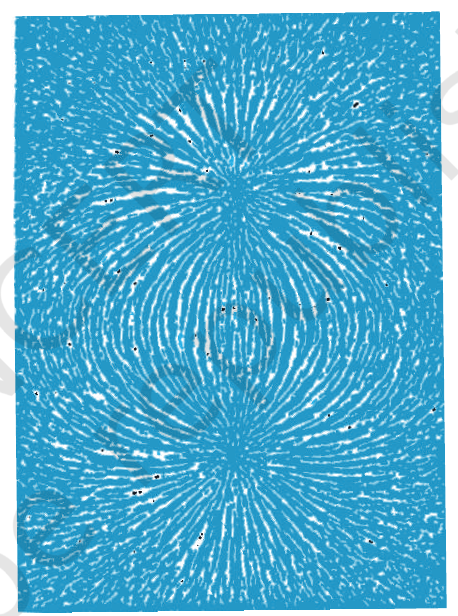
- We begin our study by examining iron filings sprinkled on a sheet of glass placed over a short bar magnet. The arrangement of iron filings is shown in Fig. 5.1.
- The pattern of iron filings suggests that the magnet has two poles similar to the positive and negative charge of an electric dipole. As mentioned in the introductory section, one pole is designated the North pole and the other, the South pole. When suspended freely, these poles point approximately towards the geographic north and south poles, respectively. A similar pattern of iron filings is observed around a current carrying solenoid.
The Magnetic Field Lines
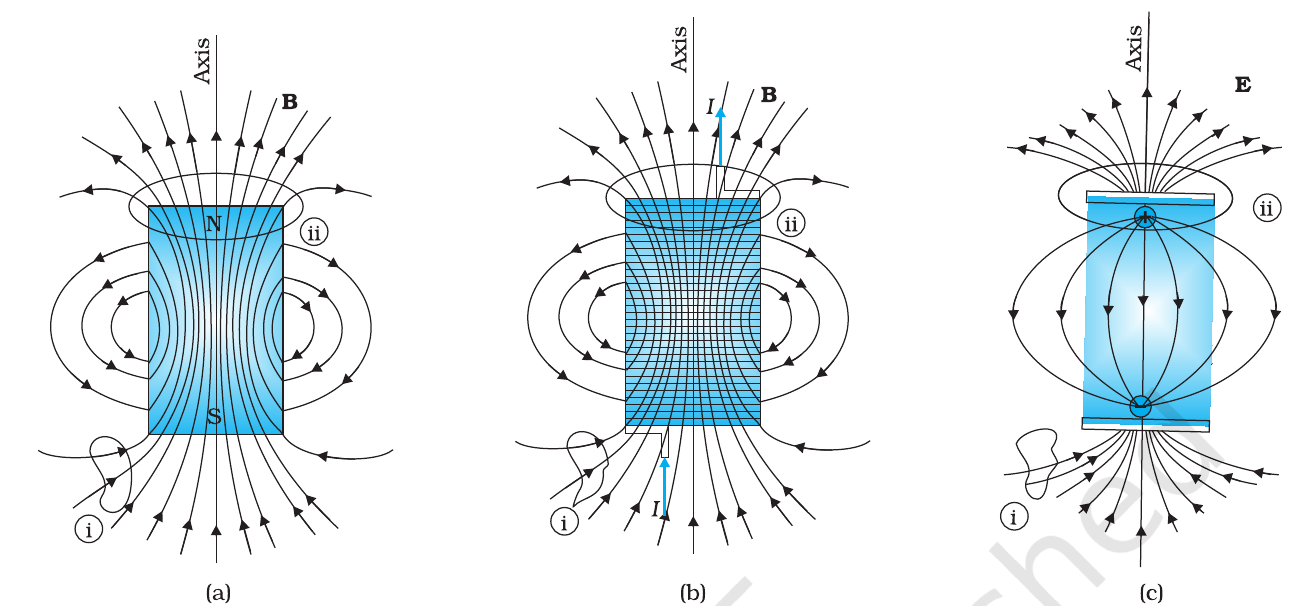
- The pattern of iron filings permits us to plot the magnetic field lines. This is shown both for the bar-magnet and the current-carrying solenoid in Fig. 5.2. For comparison refer to the Chapter 1, Figure 1.14(d). Electric field lines of an electric dipole are also displayed in Fig. 5.2(c). The magnetic field lines are a visual and intuitive realisation of the magnetic field. Their properties are:
- (i) The magnetic field lines of a magnet (or a solenoid) form continuous closed loops. This is unlike the electric dipole where these field lines begin from a positive charge and end on the negative charge or escape to infinity.
- (ii) The tangent to the field line at a given point represents the direction of the net magnetic field B at that point.
- (iii) The larger the number of field lines crossing per unit area, the stronger is the magnitude of the magnetic field B. In Fig. 5.2(a), B is larger around region ii than in region i.
- (iv) The magnetic field lines do not intersect, for if they did, the direction of the magnetic field would not be unique at the point of intersection.
- One can plot the magnetic field lines in a variety of ways. One way is to place a small magnetic compass needle at various positions and note its orientation. This gives us an idea of the magnetic field direction at various points in space.
- In some textbooks the magnetic field lines are called magnetic lines of force. This nomenclature is avoided since it can be confusing. Unlike electrostatics the field lines in magnetism do not indicate the direction of the force on a (moving) charge.
Practice1 question
Try it now. A wrong answer costs nothing here, try again until you get it.
Which of the following is true of the magnetic field lines of a bar magnet?
NCERT 5.2.1: magnetic field lines form continuous closed loops, unlike electric dipole lines which begin on a positive charge and end on a negative charge. Lines never intersect and never emanate from a point.
Bar Magnet as an Equivalent Solenoid
- In the previous chapter, we have explained how a current loop acts as a magnetic dipole (Section 4.9). We mentioned Ampere's hypothesis that all magnetic phenomena can be explained in terms of circulating currents.
- The resemblance of magnetic field lines for a bar magnet and a solenoid suggest that a bar magnet may be thought of as a large number of circulating currents in analogy with a solenoid. Cutting a bar magnet in half is like cutting a solenoid. We get two smaller solenoids with weaker magnetic properties. The field lines remain continuous, emerging from one face of the solenoid and entering into the other face. One can test this analogy by moving a small compass needle in the neighbourhood of a bar magnet and a current-carrying finite solenoid and noting that the deflections of the needle are similar in both cases.
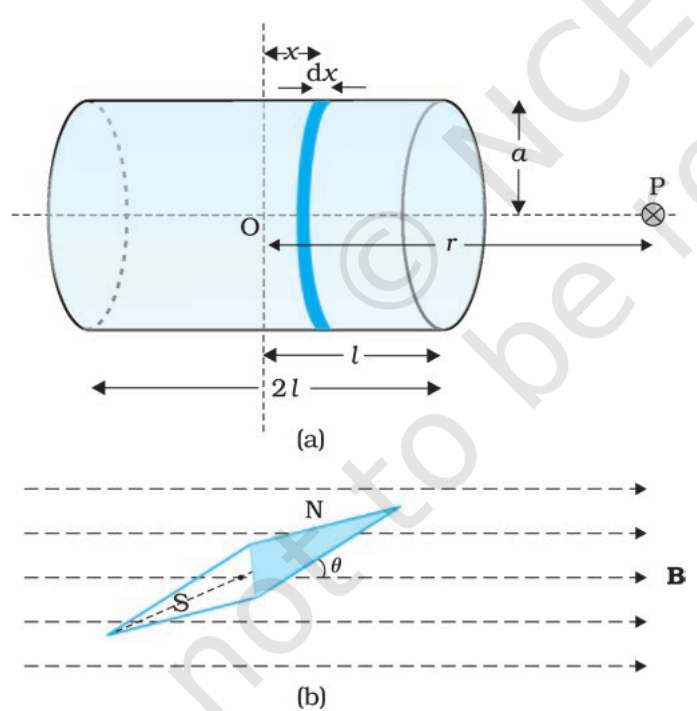
- To make this analogy more firm we may calculate the axial field of a finite solenoid depicted in Fig. 5.3(a). We can demonstrate that at large distances this axial field resembles that of a bar magnet.
- The magnitude of the field at point P due to the solenoid is $B = (μ₀ 2m)/(4π r^3)$ (5.1). This is also the far axial magnetic field of a bar magnet which one may obtain experimentally. Thus, a bar magnet and a solenoid produce similar magnetic fields. The magnetic moment of a bar magnet is thus equal to the magnetic moment of an equivalent solenoid that produces the same magnetic field.
The Dipole in a Uniform Magnetic Field
- Let's place a small compass needle of known magnetic moment m allowing it to oscillate in the magnetic field. This arrangement is shown in Fig. 5.3(b).
- The torque on the needle is [see Eq. (4.23)], $τ = m \times B$ (5.2). In $magnitude τ = mB \sin θ$. Here τ is restoring torque and θ is the angle between m and B.
- An expression for magnetic potential energy can be obtained on lines similar to electrostatic potential energy. The magnetic potential energy U_m is given by $U_m = ∫ τ(θ) dθ = ∫ mB \sin θ dθ = -mB \cos θ = -m$.B (5.3).
- We have emphasised in Chapter 2 that the zero of potential energy can be fixed at one's convenience. Taking the constant of integration to be zero means fixing the zero of potential energy at $θ = 90 \text{degrees}, i$.e.*, when the needle is perpendicular to the field. Equation (5.3) shows that potential energy is minimum (= -mB) at θ = 0 degrees (most stable position) and maximum (= +mB) at θ = 180 degrees (most unstable position).
Practice1 question
Try it now. A wrong answer costs nothing here, try again until you get it.
A short bar magnet placed with its axis at 30 degrees with a uniform external magnetic field of 0.25 T experiences a torque of magnitude 4.5 × $10^{-2}$ J. The magnitude of the magnetic moment of the magnet is
NCERT 5.2.3, Eq. (5.2): $τ = mB \sin θ$, so $m = τ/(B \sin θ) = (4.5 \times 10^{-2})/(0.25 \times \sin 30 \text{degrees})$ = (4.5 × $10^{-2}$)/(0.25 × 0.5) = 0.36 J T^-1.
The Electrostatic Analog
- Comparison of Eqs. (5.1), (5.2) and (5.3) with the corresponding equations for electric dipole (Chapter 1), suggests that magnetic field at large distances due to a bar magnet of magnetic moment m can be obtained from the equation for electric field due to an electric dipole of dipole moment p, by making the following replacements: E → B, p → m, 1/(4π ε₀) → μ₀/(4π).
- In particular, we can write down the equatorial field (B_E) of a bar magnet at a distance r, for r >> l, where l is the size of the magnet: $B_E = -(μ₀ m)/(4π r^3)$ (5.4).
- Likewise, the axial field (B_A) of a bar magnet for r >> l is: $B_A = (μ₀ 2m)/(4π r^3)$ (5.5). Equation (5.5) is just Eq. (5.1) in the vector form. Table 5.1 summarises the analogy between electric and magnetic dipoles.
| Electrostatics | Magnetism | |
|---|---|---|
| Constant | 1/ε₀ | μ₀ |
| Dipole moment | p | m |
| Equatorial field for a short dipole | -p/(4π ε₀ $r^3$) | -(μ₀ m)/(4π $r^3$) |
| Axial field for a short dipole | 2p/(4π ε₀ $r^3$) | (μ₀ 2m)/(4π $r^3$) |
| External field: torque | p × E | m × B |
| External field: energy | -p.E | -m.B |
- Table 5.1 is NCERT's own table, reproduced cell by cell (printed p. 141). The first row has no label printed in NCERT; it is the constant that is replaced in the analogy, 1/ε₀ in electrostatics and μ₀ in magnetism.
Table: Dipole Fields, Torque and Energy
- All the dipole field, torque and energy relations of sections 5.2.2 to 5.2.4 in one place. Symbols: m is the magnetic moment of the bar magnet, p is the electric dipole moment, r is the distance from the mid-point of the dipole, l is the size of the magnet, and the formulas need r >> l.
| Quantity | Electric dipole | Magnetic dipole (bar magnet) |
|---|---|---|
| Axial field | 2p/(4π ε₀ $r^3$) | (μ₀ 2m)/(4π $r^3$) |
| Equatorial field | -p/(4π ε₀ $r^3$) | -(μ₀ m)/(4π $r^3$) |
| Ratio axial to equatorial | -2 | -2 |
| Torque in uniform external field | p × E | m × B |
| Magnitude of torque | pE sinθ | mB sinθ |
| Potential energy | -p.E | -m.B |
| Minimum energy | -pE at $θ = 0 \text{degrees}$ | -mB at $θ = 0 \text{degrees}$ |
| Maximum energy | +pE at $θ = 180 \text{degrees}$ | +mB at $θ = 180 \text{degrees}$ |
- Reading the table: the axial field is twice the equatorial field in magnitude for both dipoles. The torque is zero when the dipole is parallel or anti-parallel to the field, and largest at 90 degrees; the energy is lowest when the dipole is parallel to the field.
Magnetism and Gauss's Law
- In Chapter 1, we studied Gauss's law for electrostatics. In Fig. 5.2(c), we see that for a closed surface represented by i, the number of lines leaving the surface is equal to the number of lines entering it. This is consistent with the fact that no net charge is enclosed by the surface. However, in the same figure, for the closed surface ii, there is a net outward flux, since it does include a net (positive) charge.
- The situation is radically different for magnetic fields which are continuous and form closed loops. Examine the Gaussian surfaces represented by i or ii in Fig. 5.2(a) or Fig. 5.2(b). Both cases visually demonstrate that the number of magnetic field lines leaving the surface is balanced by the number of lines entering it. The net magnetic flux is zero for both the surfaces. This is true for any closed surface.
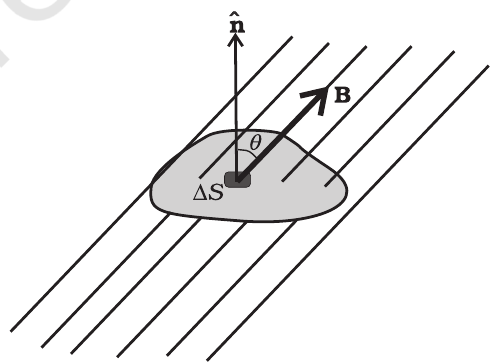
- Consider a small vector area element $\Delta S$ of a closed surface S as in Fig. 5.5. The magnetic flux through $\Delta S$ is defined as Δφ_B = B.$\Delta S$, where B is the field at $\Delta S$. We divide S into many small area elements and calculate the individual flux through each. Then, the net flux φ_B is, $φ_B = sum$ of $Δφ_B = sum$ of B.$\delta S = 0$ (5.6), where 'all' stands for 'all area elements $\Delta S$'. Compare this with the Gauss's law of electrostatics. The flux through a closed surface in that case is given by sum of E.$\delta S = q/ε₀$, where q is the electric charge enclosed by the surface.
- The difference between the Gauss's law of magnetism and that for electrostatics is a reflection of the fact that isolated magnetic poles (also called monopoles) are not known to exist. There are no sources or sinks of B; the simplest magnetic element is a dipole or a current loop. All magnetic phenomena can be explained in terms of an arrangement of dipoles and/or current loops.
- Thus, Gauss's law for magnetism is: The net magnetic flux through any closed surface is zero.
- Karl Friedrich Gauss (1777-1855) He was a child prodigy and was gifted in mathematics, physics, engineering, astronomy and even land surveying. The properties of numbers fascinated him, and in his work he anticipated major mathematical development of later times. Along with Wilhelm Welser, he built the first electric telegraph in 1833. His mathematical theory of curved surface laid the foundation for the later work of Riemann.
Magnetisation and Magnetic Intensity
- The earth abounds with a bewildering variety of elements and compounds. In addition, we have been synthesising new alloys, compounds and even elements. One would like to classify the magnetic properties of these substances. In the present section, we define and explain certain terms which will help us to carry out this exercise.
- We have seen that a circulating electron in an atom has a magnetic moment. In a bulk material, these moments add up vectorially and they can give a net magnetic moment which is non-zero. We define magnetisation M of a sample to be equal to its net magnetic moment per unit volume: $M = m_net/V$ (5.7). M is a vector with dimensions L^-1 A and is measured in a units of A m^-1.
- Consider a long solenoid of n turns per unit length and carrying a current I. The magnetic field in the interior of the solenoid was shown to be given by $B_0 = μ₀ nI$ (5.8).
- If the interior of the solenoid is filled with a material with non-zero magnetisation, the field inside the solenoid will be greater than $B_0$. The net B field in the interior of the solenoid may be expressed as $B = B_0 + B_m$ (5.9), where B_m is the field contributed by the material core. It turns out that this additional field B_m is proportional to the magnetisation M of the material and is expressed as $B_m = μ₀ M$ (5.10), where μ₀ is the same constant (permiability of vacuum) that appears in Biot-Savart's law.
- It is convenient to introduce another vector field H, called the magnetic intensity, which is defined by $H = B/μ₀ - M$ (5.11), where H has the same dimensions as M and is measured in units of A m^-1. Thus, the total magnetic field B is written as $B = μ₀ (H + M)$ (5.12).
- We repeat our defining procedure. We have partitioned the contribution to the total magnetic field inside the sample into two parts: one, due to external factors such as the current in the solenoid. This is represented by H. The other is due to the specific nature of the magnetic material, namely M. The latter quantity can be influenced by external factors. This influence is mathematically expressed as $M = χH$ (5.13), where χ, a dimensionless quantity, is appropriately called the magnetic susceptibility. It is a measure of how a magnetic material responds to an external field. χ is small and positive for materials, which are called paramagnetic. It is small and negative for materials, which are termed diamagnetic. In the latter case M and H are opposite in direction. From Eqs. (5.12) and (5.13) we obtain, $B = μ₀ (1 + χ)H (5.14) = μ₀ μ_r H = μH$ (5.15), where $μ_r = 1 + χ$, is a dimensionless quantity called the relative magnetic permeability of the substance. It is the analog of the dielectric constant in electrostatics. The magnetic permeability of the substance is μ and it has the same dimensions and units as μ₀; $μ = μ₀ μ_r = μ₀ (1 + χ)$.
- The three quantities χ, μ_r and μ are interrelated and only one of them is independent. Given one, the other two may be easily determined.
Table: Magnetisation, Intensity and Permeability
- All the magnetisation, intensity, susceptibility and permeability relations of section 5.4 in one place. Symbols: m_net is the net magnetic moment of the sample, V is its volume, n is the turns per unit length of the solenoid, I is its current, $B_0$ is the field of the empty solenoid.
| Quantity | Symbol | Relation | Units | What it says |
|---|---|---|---|---|
| Magnetisation | M | $M = m_net/V$ | A m^-1 | net magnetic moment per unit volume |
| Field of empty solenoid | $B_0$ | $B_0 = μ₀ nI$ | T | field from the windings alone |
| Field from the core | B_m | $B_m = μ₀ M$ | T | extra field from the magnetised material |
| Total field | B | $B = B_0 + B_m = μ₀ (H + M)$ | T | windings plus material |
| Magnetic intensity | H | $H = B/μ₀ - M$ | A m^-1 | the part from external factors |
| Susceptibility | χ | $M = χH$ | - | how the material responds to H |
| Relative permeability | μ_r | $μ_r = 1 + χ$ | - | analog of the dielectric constant |
| Permeability | μ | $μ = μ₀ μ_r = μ₀ (1 + χ)$, $B = μH$ | T m A^-1 | same dimensions and units as μ₀ |
- Reading the table: H is fixed by the windings (H = nI for the solenoid) and does not depend on the core material, while M and B do. χ is small and positive for paramagnetic materials and small and negative for diamagnetic materials; in the diamagnetic case M and H point in opposite directions.
Practice1 question
Try it now. A wrong answer costs nothing here, try again until you get it.
A solenoid has 1000 turns per metre and carries a current of 2 A. The magnetic intensity H inside the solenoid is
NCERT 5.4, Example $5.5(a): H = nI = 1000 \times 2.0$ = 2 × $10^{3}$ A/m. H depends only on the windings, not on the core material.
Magnetic Properties of Materials
- The discussion in the previous section helps us to classify materials as diamagnetic, paramagnetic or ferromagnetic. In terms of the susceptibility χ, a material is diamagnetic if χ is negative, para- if χ is positive and small, and ferro- if χ is large and positive.
- A glance at Table 5.2 gives one a better feeling for these materials. Here ε is a small positive number introduced to quantify paramagnetic materials. Next, we describe these materials in some detail.
| Diamagnetic | Paramagnetic | Ferromagnetic |
|---|---|---|
| -1 ≤ χ < 0 | 0 < χ < ε | χ >> 1 |
| 0 ≤ μ_r < 1 | 1 < μ_r < 1 + ε | μ_r >> 1 |
| μ < μ₀ | μ > μ₀ | μ >> μ₀ |
- Table 5.2 is NCERT's own table, reproduced cell by cell (printed p. 147). ε is a small positive number introduced to quantify paramagnetic materials.
Diamagnetism
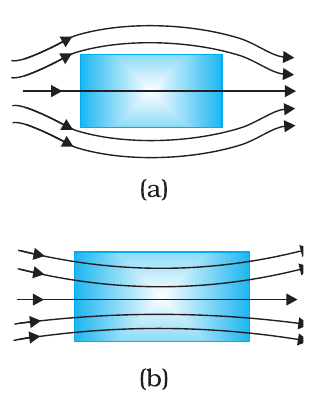
- Diamagnetic substances are those which have tendency to move from stronger to the weaker part of the external magnetic field. In other words, unlike the way a magnet attracts metals like iron, it would repel a diamagnetic substance.
- Figure 5.7(a) shows a bar of diamagnetic material placed in an external magnetic field. The field lines are repelled or expelled and the field inside the material is reduced. In most cases, this reduction is slight, being one part in $10^{5}$. When placed in a non-uniform magnetic field, the bar will tend to move from high to low field.
- The simplest explanation for diamagnetism is as follows. Electrons in an atom orbiting around nucleus possess orbital angular momentum. These orbiting electrons are equivalent to current-carrying loop and thus possess orbital magnetic moment. Diamagnetic substances are the ones in which resultant magnetic moment in an atom is zero. When magnetic field is applied, those electrons having orbital magnetic moment in the same direction slow down and those in the opposite direction speed up. This happens due to induced current in accordance with Lenz's law which you will study in Chapter 6. Thus, the substance develops a net magnetic moment in direction opposite to that of the applied field and hence repulsion.
- Some diamagnetic materials are bismuth, copper, lead, silicon, nitrogen (at STP), water and sodium chloride. Diamagnetism is present in all the substances. However, the effect is so weak in most cases that it gets shifted by other effects like paramagnetism, ferromagnetism, etc.
- The most exotic diamagnetic materials are superconductors. These are metals, cooled to very low temperatures which exhibits both perfect conductivity and perfect diamagnetism. Here the field lines are completely $expelled! χ = -1$ and $μ_r = 0$. A superconductor repels a magnet and (by Newton's third law) is repelled by the magnet. The phenomenon of perfect diamagnetism in superconductors is called the Meissner effect, after the name of its discoverer. Superconducting magnets can be gainfully exploited in variety of situations, for example, for running magnetically levitated superfast trains.
Practice1 question
Try it now. A wrong answer costs nothing here, try again until you get it.
A superconductor cooled to a very low temperature shows perfect diamagnetism. Its susceptibility χ and relative permeability μ_r are
NCERT 5.5.1 and Table 5.2: a superconductor shows perfect diamagnetism, with the field lines completely expelled, χ = -1 and $μ_r = 0$. This is the Meissner effect.
Paramagnetism
- Paramagnetic substances are those which get weakly magnetised when placed in an external magnetic field. They have tendency to move from a region of weak magnetic field to strong magnetic field, i.e., they get weakly attracted to a magnet.
- The individual atoms (or ions or molecules) of a paramagnetic material possess a permanent magnetic dipole moment of their own. On account of the ceaseless random thermal motion of the atoms, no net magnetisation is seen. In the presence of an external field $B_0$, which is strong enough, and at low temperatures, the individual atomic dipole moment can be made to align and point in the same direction as $B_0$. Figure 5.7(b) shows a bar of paramagnetic material placed in an external field. The field lines gets concentrated inside the material, and the field inside is enhanced. In most cases, this enhancement is slight, being one part in $10^{5}$. When placed in a non-uniform magnetic field, the bar will tend to move from weak field to strong.
- Some paramagnetic materials are aluminium, sodium, calcium, oxygen (at STP) and copper chloride. For a paramagnetic material both χ and μ_r depend not only on the material, but also (in a simple fashion) on the sample temperature. As the field is increased or the temperature is lowered, the magnetisation increases until it reaches the saturation value at which point all the dipoles are perfectly aligned with the field.
Ferromagnetism
- Ferromagnetic substances are those which gets strongly magnetised when placed in an external magnetic field. They have strong tendency to move from a region of weak magnetic field to strong magnetic field, i.e., they get strongly attracted to a magnet.
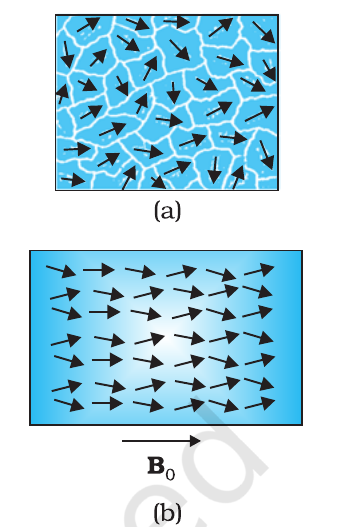
- The individual atoms (or ions or molecules) in a ferromagnetic material possess a dipole moment as in a paramagnetic material. However, they interact with one another in such a way that they spontaneously align themselves in a common direction over a macroscopic volume called domain. The explanation of this cooperative effect requires quantum mechanics and is beyond the scope of this textbook. Each domain has a net magnetisation. Typical domain size is 1 mm and the domain contains about $10^{11}$ atoms. In the first instant, the magnetisation varies randomly from domain to domain and there is no bulk magnetisation. This is shown in Fig. 5.8(a). When we apply an external magnetic field $B_0$, the domains orient themselves in the direction of $B_0$ and simultaneously the domain oriented in the direction of $B_0$ grow in size. This existence of domains and their motion in $B_0$ are not speculations. One may observe this under a microscope after sprinkling a liquid suspension of powdered ferromagnetic substance of samples. This motion of suspension can be observed. Fig. 5.8(b) shows the situation when the domains have aligned and amalgamated to form a single 'giant' domain.
- Thus, in a ferromagnetic material the field lines are highly concentrated. In non-uniform magnetic field, the sample tends to move towards the region of high field. We may wonder as to what happens when the external field is removed. In some ferromagnetic materials the magnetisation persists. Such materials are called hard magnetic materials or hard ferromagnets. Alnico, an alloy of iron, aluminium, nickel, cobalt and copper, is one such material. The naturally occurring lodestone is another. Such materials form permanent magnets to be used among other things as a compass needle. On the other hand, there is a class of ferromagnetic materials in which the magnetisation disappears on removal of the external field. Soft iron is one such material. Appropriately enough, such materials are called soft ferromagnetic materials. There are a number of elements, which are ferromagnetic: iron, cobalt, nickel, gadolinium, etc. The relative magnetic permeability is > 1000!
- The ferromagnetic property depends on temperature. At high enough temperature, a ferromagnet becomes a paramagnet. The domain structure disintegrates with temperature. This disappearance of magnetisation with temperature is gradual.
Worked Examples
- Example 5.1 (a) What happens if a bar magnet is cut into two pieces: (i) transverse to its length, (ii) along its length? (b) A magnetised needle in a uniform magnetic field experiences a torque but no net force. An iron nail near a bar magnet, however, experiences a force of attraction in addition to a torque. Why? (c) Must every magnetic configuration have a north pole and a south pole? What about the field due to a toroid? (d) Two identical looking iron bars A and B are given, one of which is definitely known to be magnetised. (We do not know which one.) How would one ascertain whether or not both are magnetised? If only one is magnetised, how does one ascertain which one? [Use nothing else but the bars A and B.] Solution: (a) In either case, one gets two magnets, each with a north and south pole. (b) No force if the field is uniform. The iron nail experiences a non-uniform field due to the bar magnet. There is induced magnetic moment in the nail, therefore, it experiences both force and torque. The net force is attractive because the induced south pole (say) in the nail is closer to the north pole of magnet than induced north pole. (c) Not necessarily. True only if the source of the field has a net non-zero magnetic moment. This is not so for a toroid or even for a straight infinite conductor. (d) Try to bring different ends of the bars closer. A repulsive force in some situation establishes that both are magnetised. If it is always attractive, then one of them is not magnetised. In a bar magnet the intensity of the magnetic field is the strongest at the two ends (poles) and weakest at the central region. This fact may be used to determine whether A or B is the magnet. In this case, to see which one of the two bars is a magnet, pick up one, (say, A) and lower one of its ends; first on one of the ends of the other (say, B), and then on the middle of B. If you notice that in the middle of B, A experiences no force, then B is magnetised. If you do not notice any change from the end to the middle of B, then A is magnetised.
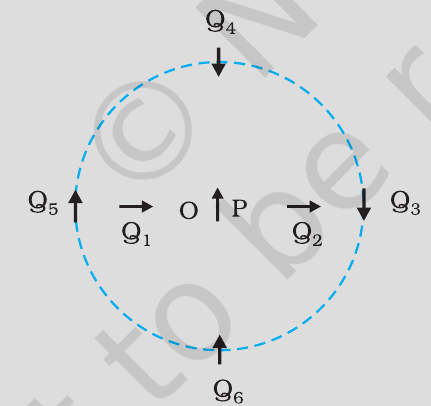
- Example 5.2 Figure 5.4 shows a small magnetised needle P placed at a point O. The arrow shows the direction of its magnetic moment. The other arrows show different positions (and orientations of the magnetic moment) of another identical magnetised needle Q. (a) In which configuration the system is not in equilibrium? (b) In which configuration is the system in (i) stable, and (ii) unstable equilibrium? (c) Which configuration corresponds to the lowest potential energy among all the configurations shown? Solution: Potential energy of the configuration arises due to the potential energy of one dipole (say, Q) in the magnetic field due to other (P). Use the result that the field due to P is given by the expression [Eqs. (5.4) and (5.5)]: B_P = -(μ₀ m_P)/(4π $r^3$) (on the normal bisector); B_P = (μ₀ 2 m_P)/(4π $r^3$) (on the axis), where m_P is the magnetic moment of the dipole P. Equilibrium is stable when m_Q is parallel to B_P, and unstable when it is anti-parallel to B_P. For instance for the configuration Q_3 for which Q is along the perpendicular bisector of the dipole P, the magnetic moment of Q is parallel to the magnetic field at the position 3. Hence Q_3 is stable. Thus, (a) PQ_1 and PQ_2; (b) (i) PQ_3, PQ_6 (stable); (ii) PQ_5, PQ_4 (unstable); (c) PQ_6.
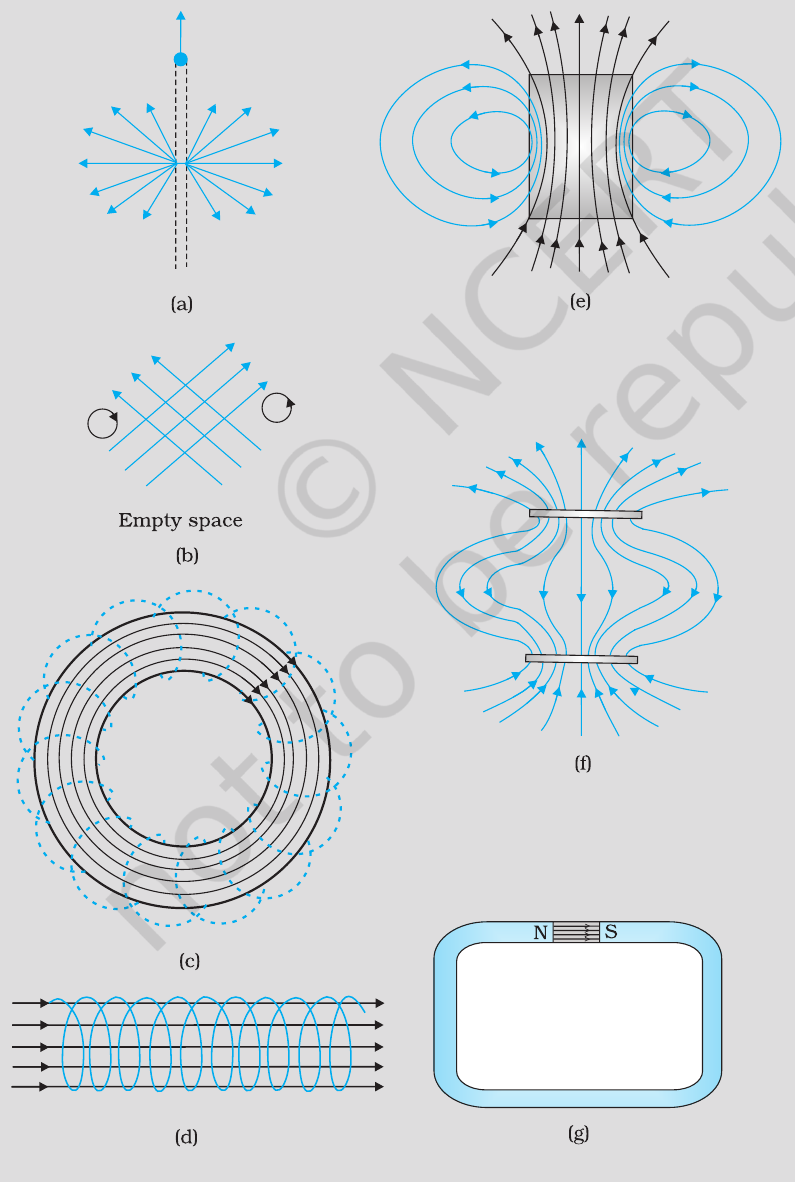
- Example 5.3 Many of the diagrams given in Fig. 5.6 show magnetic field lines (thick lines in the figure) wrongly. Point out what is wrong with them. Some of them may describe electrostatic field lines correctly. Point out which ones. Solution: (a) Wrong. Magnetic field lines can never emanate from a point, as shown in figure. Over any closed surface, the net flux of B must always be zero, i.e., pictorially as many field lines should seem to enter the surface as the number of lines leaving it. The field lines shown, in fact, represent electric field of a long positively charged wire. The correct magnetic field lines are circling the straight conductor, as described in Chapter 4. (b) Wrong. Magnetic field lines (like electric field lines) can never cross each other, because otherwise the direction of field at the point of intersection is ambiguous. There is further error in the figure. Magnetostatic field lines can never form closed loops around empty space. A closed loop of static magnetic field line must enclose a region across which a current is passing. By contrast, electrostatic field lines can never form closed loops, neither in empty space, nor when the loop encloses charges. (c) Right. Magnetic lines are completely confined within a toroid. Nothing wrong here in field lines forming closed loops, since each loop encloses a region across which a current passes. Note, for clarity of figure, only a few field lines within the toroid have been shown. Actually, the entire region enclosed by the windings contains magnetic field. (d) Wrong. Field lines due to a solenoid at its ends and outside cannot be so completely straight and confined; such a thing violates Ampere's law. The lines should curve out at both ends, and meet eventually to form closed loops. (e) Right. These are field lines outside and inside a bar magnet. Note carefully the direction of field lines inside. Not all field lines emanate out of a north pole (or converge into a south pole). Around both the N-pole, and the S-pole, the net flux of the field is zero. (f) Wrong. These field lines cannot possibly represent a magnetic field. Look at the upper region. All the field lines seem to emanate out of the shaded plate. The net flux through a surface surrounding the shaded plate is not zero. This is impossible for a magnetic field. The given field lines, in fact, show the electrostatic field lines around a positively charged upper plate and a negatively charged lower plate. The difference between Fig. [5.6(e) and (f)] should be carefully grasped. (g) Wrong. Magnetic field lines between two pole pieces cannot be precisely straight at the ends. Some fringing of lines is inevitable. Otherwise, Ampere's law is violated. This is also true for electric field lines.
- Example 5.4 (a) Magnetic field lines show the direction (at every point) along which a small magnetised needle aligns (at the point). Do the magnetic field lines also represent the lines of force on a moving charged particle at every point? (b) If magnetic monopoles existed, how would the Gauss's law of magnetism be modified? (c) Does a bar magnet exert a torque on itself due to its own field? Does one element of a current-carrying wire exert a force on another element of the same wire? (d) Magnetic field arises due to charges in motion. Can a system have magnetic moments even though its net charge is zero? Solution: (a) No. The magnetic force is always normal to B (remember magnetic force = qv × B). It is misleading to call magnetic field lines as lines of force. (b) Gauss's law of magnetism states that the flux of B through any closed surface is always zero, ∫_S B.$s = 0$. If monopoles existed, the right hand side would be equal to the monopole (magnetic charge) q_m enclosed by S. [Analogous to Gauss's law of electrostatics, ∫_S B.$s = μ₀ q_m$, where q_m is the (monopole) magnetic charge enclosed by S.] (c) No. There is no force or torque on an element due to the field produced by that element itself. But there is a force (or torque) on an element of the same wire. (For the special case of a straight wire, this force is zero.) (d) Yes. The average of the charge in the system may be zero. Yet, the mean of the magnetic moments due to various current loops may not be zero. We will come across such examples in connection with paramagnetic material where atoms have net dipole moment through their net charge is zero.
- Example 5.5 A solenoid has a core of a material with relative permeability 400. The windings of the solenoid are insulated from the core and carry a current of 2 A. If the number of turns is 1000 per metre, calculate (a) H, (b) M, (c) B and (d) the magnetising current I_M. Solution: (a) The field H is dependent of the material of the core, and is $H = nI = 1000 \times 2.0$ = 2 × $10^{3}$ A/m. (b) The magnetic field B is given by $B = μ_r μ₀ H = 400 \times 4π \times 10^{-7} (N/A^2) \times 2 \times 10^{3} (A/m)$ = 1.0 T. (c) Magnetisation is given by $M = (B - μ₀ H)/μ₀ = (μ_r μ₀ H - μ₀ H)/μ₀ = (μ_r - 1)H = 399 \times H$, about 8 × $10^{5}$ A/m. (d) The magnetising current I_M is the additional current that needs to be passed through the windings of the solenoid in the absence of the core which would give a B value as in the presence of the core. $Thus B = μ_r n (I + I_M)$. Using $I = 2 A$, $B = 1 T$, we get $I_M = 794 A$.
Practice1 question
Try it now. A wrong answer costs nothing here, try again until you get it.
A short bar magnet has a magnetic moment of 0.48 J T^-1. The magnitude of the magnetic field produced by the magnet at a distance of 10 cm from its centre on its axis is
NCERT 5.2.4, Eq. (5.5): $B_A = (μ₀ 2m)/(4π r^3) = (10^{-7} \times 2 \times 0.48)/(0.10)^3$ = (9.6 × $10^{-8}$)/($10^{-3}$) = 9.6 × $10^{-5}$ T along the axis.
Table: Physical Quantities
- NCERT's own summary table of the physical quantities of this chapter, reproduced cell by cell (printed p. 151). Symbols: μ₀ permeability of free space, B magnetic field, m magnetic moment, φ_B magnetic flux, M magnetisation, H magnetic intensity, χ magnetic susceptibility, μ_r relative magnetic permeability, μ magnetic permeability.
| Physical quantity | Symbol | Nature | Dimensions | Units | Remarks |
|---|---|---|---|---|---|
| Permeability of free space | μ₀ | Scalar | $[M L T^{-2} A^{-2}]$ | T m A^-1 | $μ₀/4π = 10^{-7}$ |
| Magnetic field, Magnetic induction, Magnetic flux density | B | Vector | $[M T^{-2} A^{-1}]$ | T (tesla) | $10^4 G (gauss) = 1 T$ |
| Magnetic moment | m | Vector | $[L^{-2} A]$ | A $m^2$ | |
| Magnetic flux | φ_B | Scalar | $[M L^2 T^{-2} A^{-1}]$ | W (weber) | W = T $m^2$ |
| Magnetisation | M | Vector | $[L^{-1} A]$ | A m^-1 | Magnetic moment / Volume |
| Magnetic intensity, Magnetic field strength | H | Vector | $[L^{-1} A]$ | A m^-1 | $B = μ₀ (H + M)$ |
| Magnetic susceptibility | χ | Scalar | - | - | $M = χH$ |
| Relative magnetic permeability | μ_r | Scalar | - | - | $B = μ₀ μ_r H$ |
| Magnetic permeability | μ | Scalar | $[M L T^{-2} A^{-2}]$ | T m A^-1, N A^-2 | $μ = μ₀ μ_r$, $B = μH$ |
- Reading the table: only χ and μ_r are dimensionless; μ and μ₀ share the same dimensions and units. The magnetic moment has dimensions $[L^{-2} A]$ because it is current times area.
Trap Pairs
- Trap: magnetic field lines begin at the north pole and end at the south pole. Correct: the lines form continuous closed loops; inside the magnet they run from the south pole to the north pole, and around both poles the net flux is zero (NCERT 5.2.1, Example 5.3(e)).
- Trap: cutting a bar magnet in half isolates a north pole and a south pole. Correct: cutting gives two smaller bar magnets, each with both poles; isolated magnetic monopoles do not exist (NCERT 5.1, 5.2.3).
- Trap: a bar magnet in a uniform magnetic field feels a net force. Correct: the force is zero; only the torque τ = m × B acts, and the potential energy is $U_m = -m$.B (NCERT 5.2.3, Summary 2).
- Trap: magnetic field lines show the direction of the force on a moving charge. Correct: the force qv × B is always normal to B; the lines show only the direction along which a small magnetised needle aligns (NCERT Example 5.4(a)).
- Trap: a diamagnetic substance is attracted to a magnet and has positive χ. Correct: χ is negative (-1 ≤ χ < 0), the substance is repelled and moves from stronger to weaker field (NCERT 5.5.1, Table 5.2).
- Trap: a ferromagnet keeps its magnetisation at any temperature, and heating strengthens it. Correct: at high enough temperature a ferromagnet becomes a paramagnet as the domain structure disintegrates, and the loss of magnetisation is gradual; only hard ferromagnets keep their magnetisation after the field is removed, soft iron loses it (NCERT 5.5.3).
- Trap: Gauss's law for magnetism gives a flux of q/ε₀ like electrostatics. Correct: the net magnetic flux through any closed surface is zero, $φ_B = 0$, because there are no sources or sinks of B (NCERT 5.3).
- Trap: the magnetic intensity H depends on the core material of a solenoid. Correct: $H = nI$ depends only on the windings; the core changes M and B, not H (NCERT 5.4, Example 5.5).
Points to Ponder
- 1. A satisfactory understanding of magnetic phenomenon in terms of moving charges/currents was arrived at after 1800 AD. But technological exploitation of the directional properties of magnets predates this scientific understanding by two thousand years. Thus, scientific understanding is not a necessary condition for engineering applications. Ideally, science and engineering go hand-in-hand, one leading and assisting the other in tandem.
- 2. Magnetic monopoles do not exist. If you slice a magnet in half, you get two smaller magnets. On the other hand, isolated positive and negative charges exist. There exists a smallest unit of charge, for example, the electronic charge with value $|e| = 1.6 \times 10^{-19} C$. All other charges are integral multiples of this smallest unit charge. In other words, charge is quantised. We do not know why magnetic monopoles do not exist or why electric charge is quantised.
- 3. A consequence of the fact that magnetic monopoles do not exist is that the magnetic field lines are continuous and form closed loops. In contrast, the electrostatic lines of force begin on a positive charge and terminate on the negative charge (or fade out at infinity).
- 4. A miniscule difference in the value of χ, the magnetic susceptibility, yields radically different behaviour: diamagnetic versus paramagnetic. For diamagnetic $materials χ = -10^{-5} whereas χ = +10^{-5}$ for paramagnetic materials.
- 5. There exists a perfect diamagnet, namely, a superconductor. This is a metal at very low temperatures. In this $case χ = -1$, $μ_r = 0$, $μ = 0$. The external magnetic field is totally expelled. Interestingly, this material is also a perfect conductor. However, there exists no classical theory which ties these two properties together. A quantum-mechanical theory by Bardeen, Cooper, and Schrieffer (BCS theory) explains these effects. The BCS theory was proposed in 1957 and was eventually recognised by a Nobel Prize in physics in 1970.
- 6. Diamagnetism is universal. It is present in all materials. But it is weak and hard to detect if the substance is para- or ferromagnetic.
- 7. We have classified materials as diamagnetic, paramagnetic, and ferromagnetic. However, there exist additional types of magnetic material such as ferrimagnetic, anti-ferromagnetic, spin glass, etc. with properties which are exotic and mysterious.
Exercises
- 5.1 A short bar magnet placed with its axis at 30 degrees with a uniform external magnetic field of 0.25 T experiences a torque of magnitude equal to 4.5 × $10^{-2}$ J. What is the magnitude of magnetic moment of the magnet?
- 5.2 A short bar magnet of magnetic moment $m = 0.32 J T^{-1}$ is placed in a uniform magnetic field of 0.15 T. If the bar is free to rotate in the plane of the field, which orientation would correspond to its (a) stable, and (b) unstable equilibrium? What is the potential energy of the magnet in each case?
- 5.3 A closely wound solenoid of 800 turns and area of cross section 2.5 × $10^{-4}$ $m^2$ carries a current of 3.0 A. Explain the sense in which the solenoid acts like a bar magnet. What is its associated magnetic moment?
- 5.4 If the solenoid in Exercise 5.5 is free to turn about the vertical direction and a uniform horizontal magnetic field of 0.25 T is applied, what is the magnitude of torque on the solenoid when its axis makes an angle of 30 degrees with the direction of applied field?
- 5.5 A bar magnet of magnetic moment 1.5 J T^-1 lies aligned with the direction of a uniform magnetic field of 0.22 T. (a) What is the amount of work required by an external torque to turn the magnet so as to align its magnetic moment: (i) normal to the field direction, (ii) opposite to the field direction? (b) What is the torque on the magnet in cases (i) and (ii)?
- 5.6 A closely wound solenoid of 2000 turns and area of cross-section 1.6 × $10^{-4}$ $m^2$, carrying a current of 4.0 A, is suspended through its centre allowing it to turn in a horizontal plane. (a) What is the magnetic moment associated with the solenoid? (b) What is the force and torque on the solenoid if a uniform horizontal magnetic field of 7.5 × $10^{-2}$ T is set up at an angle of 30 degrees with the axis of the solenoid?
- 5.7 A short bar magnet has a magnetic moment of 0.48 J T^-1. Give the direction and magnitude of the magnetic field produced by the magnet at a distance of 10 cm from the centre of the magnet on (a) the axis, (b) the equatorial lines (normal bisector) of the magnet.
Trap Boxes
Field lines begin at north and end at south
Wrong idea: Magnetic field lines begin at the north pole and end at the south pole, like electric field lines.
Magnetic field lines form continuous closed loops; inside the magnet they run from the south pole to the north pole, and around both poles the net flux is zero. NCERT 5.2.1 and Example 5.3(e).
NCERT XII, Ch 5, 5.2.1 and Example 5.3
Cutting a magnet isolates a monopole
Wrong idea: Cutting a bar magnet in half isolates a north pole on one piece and a south pole on the other.
Cutting a bar magnet gives two smaller bar magnets, each with a north and a south pole. Isolated magnetic monopoles do not exist. NCERT 5.1 and 5.2.3.
NCERT XII, Ch 5, 5.1 and 5.2.3
A magnet in a uniform field feels a net force
Wrong idea: A bar magnet placed in a uniform magnetic field is pulled along the field by a net force.
The force on a dipole in a uniform magnetic field is zero; only the torque τ = m × B acts, and the potential energy is $U_m = -m$.B. NCERT 5.2.3.
NCERT XII, Ch 5, 5.2.3
Field lines are lines of force on a charge
Wrong idea: Magnetic field lines show the direction of the force on a moving charged particle at every point.
The magnetic force qv × B is always normal to B. Field lines show only the direction along which a small magnetised needle aligns. NCERT Example 5.4(a).
NCERT XII, Ch 5, 5.3, Example 5.4
Diamagnetic means attracted, χ positive
Wrong idea: A diamagnetic substance is attracted to a magnet and has a positive susceptibility.
χ is negative for diamagnetic materials (-1 ≤ χ < 0); the substance is repelled and moves from stronger to weaker field. NCERT 5.5.1 and Table 5.2.
NCERT XII, Ch 5, 5.5.1 and Table 5.2
Heating always strengthens a ferromagnet
Wrong idea: Heating a ferromagnet always strengthens its magnetisation, and every ferromagnet stays magnetised forever.
At high enough temperature a ferromagnet becomes a paramagnet as the domain structure disintegrates, and the loss of magnetisation is gradual. Only hard ferromagnets keep magnetisation after the field is removed; soft iron loses it. NCERT 5.5.3.
NCERT XII, Ch 5, 5.5.3
Gauss's law gives a flux of q/ε₀
Wrong idea: Gauss's law for magnetism gives a flux of q/ε₀, like in electrostatics.
The net magnetic flux through any closed surface is zero, $φ_B = 0$, because there are no sources or sinks of B. NCERT 5.3.
NCERT XII, Ch 5, 5.3
H depends on the core material
Wrong idea: The magnetic intensity H of a solenoid depends on the core material inside it.
$H = nI$ depends only on the windings; the core changes M and B, not H. NCERT 5.4, Example 5.5.
NCERT XII, Ch 5, 5.4 and Example 5.5
Chapter test
5 NEET PYQs. +4 for a correct answer, -1 for a wrong answer, exactly like NEET. Finish the test to earn a medal.
Q1: NEET (UG) 2024, Code R3, Q4
Match List-I with List-II: List-I (Material): A. Diamagnetic, B. Ferromagnetic, C. Paramagnetic, D. Non-magnetic. List-II (Susceptibility (χ)): I. $χ = 0$, II. 0 > χ ≥ -1, III. χ >> 1, IV. 0 < χ < ε (a small positive number). Choose the correct answer from the options given below:
Diamagnetic: -1 ≤ χ < 0 (II); ferromagnetic: χ >> 1 (III); paramagnetic: 0 < χ < ε (IV); non-magnetic: $χ = 0 (I)$. So A-II, B-III, C-IV, D-I.
Q2: NEET (UG) 2023, Code F1, Q24
The net magnetic flux through any closed surface is
Gauss's law for magnetism: the net magnetic flux through any closed surface is zero, since isolated magnetic poles do not exist.
Q3: NEET (UG) 2022, Code R1, Q14
The dimensions $[M L T^{-2} A^{-2}]$ belong to the
The physical-quantities table gives the magnetic permeability μ the dimensions $[M L T^{-2} A^{-2}]$ and the units T m A^-1 (also N A^-2).
Q4: NEET (UG) 2020, Code G5, Q154
An iron rod of susceptibility 599 is subjected to a magnetising field of 1200 A m^-1. The permeability of the material of the rod is: $(μ₀ = 4π \times 10^{-7} T m A^{-1})$
$μ = μ₀ (1 + χ) = 4π \times 10^{-7} \times (1 + 599) = 4π \times 10^{-7} \times 600 = 2.4π \times 10^{-4} T m A^{-1}$.
Q5: NEET (UG) 2016, Phase I, Code B-Q-X, Q15
The magnetic susceptibility is negative for:
χ is negative only for diamagnetic materials (Table 5.2: -1 ≤ χ < 0). Paramagnetic χ is small and positive and ferromagnetic χ is large and positive.
Score: 0 · Answered 0 of 5
Flashcards
Tap a card to flip it over and see the answer. Tap it again to flip it back.
Write the magnetic field of a short bar magnet on its axis and on its equatorial line (normal bisector).
Tap to flipAxial field (r >> $l): B_A = (μ₀ 2m)/(4π r^3$) (5.5). Equatorial field: $B_E = -(μ₀ m)/(4π r^3)$ (5.4). The axial field is twice the equatorial field in magnitude and opposite in sign pattern. At large distances the solenoid axial field is $B = (μ₀ 2m)/(4π r^3)$ (5.1).
Tap to flip backA bar magnet of moment m sits in a uniform field B. Write its torque, its force and its potential energy, with the stable and unstable positions.
Tap to flipTorque τ = m × B (5.2), magnitude τ = mB sinθ, where θ is the angle between m and B. The force on the dipole in a uniform field is zero. Potential energy U_m = -m.B (5.3). U_m is minimum (-mB) at θ = 0 degrees (most stable) and maximum (+mB) at θ = 180 degrees (most unstable). The zero of energy is fixed at θ = 90 degr
Tap to flip backState Gauss's law for magnetism and the corresponding law for electrostatics.
Tap to flip$φ_B = sum$ of B.$\Delta S$ over all area $elements = 0$ (5.6). The net magnetic flux through any closed surface is zero. For electrostatics the flux through a closed surface is sum of E.$\delta S = q/ε₀$, where q is the charge enclosed.
Tap to flip backDefine magnetisation M and magnetic intensity H, and write B inside a solenoid filled with a material.
Tap to flip$M = m_net/V$ (5.7), net magnetic moment per unit volume; M is a vector with dimensions L^-1 A and units A m^-1. $B_0 = μ₀ nI$ (5.8) for a long solenoid of n turns per unit length carrying current I. $B = B_0 + B_m$ (5.9), $B_m = μ₀ M$ (5.10), $H = B/μ₀ - M$ (5.11), $B = μ₀ (H + M)$ (5.12).
Tap to flip backRelate M, H, B, χ, μ_r and μ for a linear magnetic material.
Tap to flip$M = χH$ (5.13), where χ is the magnetic susceptibility, a dimensionless quantity. $B = μ₀ (1 + χ)H (5.14) = μ₀ μ_r H = μH$ (5.15), where $μ_r = 1 + χ$ is the relative magnetic permeability and $μ = μ₀ μ_r = μ₀ (1 + χ)$ is the magnetic permeability. Of χ, μ_r and μ only one is independent.
Tap to flip backA solenoid (n = 1000 per metre, $I = 2 A$) has a core of relative permeability 400. Find H, B, M and the magnetising current.
Tap to flipExample 5.5: solenoid with core μ_r = 400, n = 1000 per metre, I = 2 A. (a) H = nI = 1000 × 2.0 = 2 × $10^{3}$ A/m. (b) B = μ_r μ₀ H = 400 × 4π × $10^{-7}$ × 2 × $10^{3}$ = 1.0 T. (c) M = (μ_r - 1)H = 399 × H, about 8 × $10^{5}$ A/m. (d) Magnetising current I_M = 794 A.
Tap to flip backGive μ₀/4π, the gauss-tesla and weber relations, and the dimensions of μ₀, B, m, φ_B, M and H.
Tap to flipμ₀/4π = $10^{-7}$ (units T m A^-1). $10^4 G (gauss) = 1 T$. 1 $W (weber) = T m^2$. μ₀ has dimensions $[M L T^{-2} A^{-2}]$; B has $[M T^{-2} A^{-1}]$; m has $[L^{-2} A]$; φ_B has $[M L^2 T^{-2} A^{-1}]$; M and H have $[L^{-1} A]$.
Tap to flip backGive the typical domain size and atom count, the μ_r of ferromagnets, the χ values of dia- and paramagnetic materials, and χ and μ_r of a superconductor.
Tap to flipTypical domain size is 1 mm and a domain contains about $10^{11}$ atoms. The relative magnetic permeability of ferromagnetic materials is > 1000. For diamagnetic $materials χ = -10^{-5}$ and for paramagnetic materials χ = +$10^{-5}$ (Points to Ponder 4). A superconductor has $χ = -1$ and $μ_r = 0$.
Tap to flip backWhat happens when a bar magnet is cut in two, why does a nail feel a force where a needle feels none, and must every magnetic configuration have poles?
Tap to flipExample 5.1: (a) cutting a bar magnet either way gives two magnets, each with a north and a south pole. (b) No force in a uniform field; the iron nail feels a non-uniform field, gets an induced moment and feels both force and torque. (c) Not necessarily: a toroid or a straight infinite conductor has no net poles. (d) R
Tap to flip backList the four properties of magnetic field lines.
Tap to flip(i) The magnetic field lines of a magnet (or a solenoid) form continuous closed loops. (ii) The tangent to the field line at a point gives the direction of the net magnetic field B there. (iii) The larger the number of field lines crossing per unit area, the stronger is B; in Fig. 5.2(a), B is larger around region ii t
Tap to flip backIn Example 5.3, which of the Fig. 5.6 panels (a) to (g) show magnetic field lines rightly and which wrongly?
Tap to flipExample 5.3: (a) Wrong, field lines can never emanate from a point. (b) Wrong, field lines can never cross, and a closed loop of static magnetic field line must enclose a current. (c) Right, lines are confined within a toroid. (d) Wrong, lines must curve out at the solenoid ends. (e) Right, field lines outside and insi
Tap to flip backWhy can a magnetic monopole never be isolated by cutting a magnet?
Tap to flipCutting a bar magnet in half gives two smaller bar magnets with somewhat weaker properties, never an isolated north or south pole; isolated magnetic north and south poles, magnetic monopoles, do not exist. A toroid has no net magnetic moment and no poles. By contrast, isolated positive and negative electric charges do
Tap to flip backWhat is special about a superconductor as a diamagnet, and where else does diamagnetism occur?
Tap to flipSuperconductors are metals cooled to very low temperatures which exhibit both perfect conductivity and perfect diamagnetism: the field lines are completely expelled, χ = -1 and μ_r = 0. This perfect diamagnetism is the Meissner effect. Diamagnetism is present in all substances, but it is so weak in most cases that it g
Tap to flip backClassify a material as diamagnetic, paramagnetic or ferromagnetic from χ, μ_r and μ, with two examples of each.
Tap to flipDiamagnetic: χ negative (-1 ≤ χ < 0), 0 ≤ μ_r < 1, μ < μ₀. Examples: bismuth, copper, lead, silicon, nitrogen (at STP), water, sodium chloride. Paramagnetic: χ positive and small (0 < χ < ε), 1 < μ_r < 1 + ε, μ > μ₀. Examples: aluminium, sodium, calcium, oxygen (at STP), copper chloride. Ferromagnetic: χ >> 1, μ_r >> 1
Tap to flip backFrequently asked questions
Is it true that field lines begin at north and end at south?
Magnetic field lines form continuous closed loops; inside the magnet they run from the south pole to the north pole, and around both poles the net flux is zero. NCERT 5.2.1 and Example 5.3(e).
Is it true that cutting a magnet isolates a monopole?
Cutting a bar magnet gives two smaller bar magnets, each with a north and a south pole. Isolated magnetic monopoles do not exist.
Is it true that a magnet in a uniform field feels a net force?
The force on a dipole in a uniform magnetic field is zero; only the torque τ = m × B acts, and the potential energy is $U_m = -m$.B.
Is it true that field lines are lines of force on a charge?
The magnetic force qv × B is always normal to B. Field lines show only the direction along which a small magnetised needle aligns.
Is it true that diamagnetic means attracted, χ positive?
χ is negative for diamagnetic materials (-1 ≤ χ < 0); the substance is repelled and moves from stronger to weaker field. NCERT 5.5.1 and Table 5.2.