 NEET Notes
Home > Biology > Strategies for Enhancement in Food Production
Strategies for Enhancement in Food Production
Animal husbandry is the agricultural practice of breeding and raising livestock. Plant breeding is the purposeful manipulation of plant species in order to create desired plant types that are better suited for cultivation, give better yields and are disease resistant.
On this page · 14 sections
- 01Syllabus map
- 02Animal husbandry: what it is
- 03Farm management: dairy and poultry
- 04Inbreeding and inbreeding depression
- 05Outbreeding: out-crossing, cross-breeding, interspecific hybridisation
- 06Table: animal breeding methods at a glance
- 07Artificial insemination and MOET
- 08Bee-keeping and fisheries
- 09Plant breeding: the five steps
- 10Table 9.1: disease-resistant varieties
- 11Table 9.2: insect-pest-resistant varieties
- 12Biofortification and single cell protein
- 13Tissue culture: totipotency and micropropagation
- 14Trap pairs: the confusions NEET tests
Animal husbandry, plant breeding, biofortification and tissue culture from old NCERT XII Ch 9: the NEET-tested core, kept because NEET still asks it. With 5 PYQs.
Syllabus map
- NMC Unit: BIO-U08, Biology and Human Welfare. This chapter sits in Unit 8, but the topic is NOT in the current NMC NEET UG 2025 syllabus: the NMC Compendium 2024 lists only Health and Disease and Microbes in Human Welfare under Unit 8, and the words animal husbandry, plant breeding, MOET and food production do not appear anywhere in the Compendium.
- Subtopics in this chapter (old NCERT XII, Ch 9, 2020-21 edition): animal husbandry (9.1); plant breeding (9.2); single cell proteins (9.3); tissue culture (9.4).
- Why this chapter is here: NEET keeps asking it even though the chapter was removed from the rationalised NCERT. NEET asked it in 2021 (three questions), 2023 and 2024. This is a compact chapter: only the NEET-tested core, 14 sections.
- Subtopic checklist: (1) animal husbandry and farm management; (2) inbreeding, outbreeding and inbreeding depression; (3) artificial insemination and MOET; (4) bee-keeping and fisheries; (5) the five steps of plant breeding; (6) disease-resistant varieties (Table 9.1); (7) insect-pest-resistant varieties (Table 9.2); (8) biofortification and single cell protein; (9) tissue culture, totipotency and somatic hybridisation.
- Extra information (beyond NCERT): the whole chapter is extra information. Every section comes from the pre-rationalised NCERT Class 12 Chapter 9 (2020-21 edition), which is no longer in the current NCERT, and none of it is in the current NMC syllabus.
- Excluded topics: human health and disease and microbes in human welfare are the other BIO-U08 topics; each has its own chapter and their facts are not repeated here.
- Estimated revision time: 8 minutes. Jump links: Syllabus map, Animal husbandry: what it is, Farm management: dairy and poultry, Inbreeding and inbreeding depression, Outbreeding: out-crossing, cross-breeding, interspecific hybridisation, Table: animal breeding methods at a glance, Artificial insemination and MOET, Bee-keeping and fisheries, Plant breeding: the five steps, Table 9.1: disease-resistant varieties, Table 9.2: insect-pest-resistant varieties, Biofortification and single cell protein, Tissue culture: totipotency and micropropagation, Trap pairs: the confusions NEET tests.
Animal husbandry: what it is
- Animal husbandry is the agricultural practice of breeding and raising livestock. It is a vital skill for farmers and is as much science as it is art.
- It deals with the care and breeding of livestock like buffaloes, cows, pigs, horses, cattle, sheep, camels and goats, that are useful to humans. Extended, it includes poultry farming and fisheries. Fisheries include rearing, catching, selling, etc., of fish, molluscs (shell-fish) and crustaceans (prawns, crabs, etc.).
- Since time immemorial, animals like bees, silk-worm, prawns, crabs, fishes, birds, pigs, cattle, sheep and camels have been used by humans for products like milk, eggs, meat, wool, silk, honey, etc.
- More than 70 per cent of the world livestock population is in India and China. However, the contribution to the world farm produce is only 25 per cent, i.e., the productivity per unit is very low. In addition to conventional practices of animal breeding and care, newer technologies also have to be applied to achieve improvement in quality and productivity.
Farm management: dairy and poultry
- Dairying is the management of animals for milk and its products for human consumption. Milk yield is primarily dependent on the quality of breeds in the farm. Selection of good breeds having high yielding potential (under the climatic conditions of the area), combined with resistance to diseases is very important.
- For the yield potential to be realised the cattle have to be well looked after: they have to be housed well, should have adequate water and be maintained disease free. The feeding of cattle should be carried out in a scientific manner, with special emphasis on the quality and quantity of fodder.
- Stringent cleanliness and hygiene (both of the cattle and the handlers) are of paramount importance while milking, storage and transport of the milk and its products. Nowadays much of these processes have become mechanised, which reduces chance of direct contact of the produce with the handler. Regular inspections with proper record keeping help identify and rectify problems as early as possible. Regular visits by a veterinary doctor would be mandatory.
- Poultry is the class of domesticated fowl (birds) used for food or for their eggs. They typically include chicken and ducks, and sometimes turkey and geese.
- As in dairy farming, selection of disease free and suitable breeds, proper and safe farm conditions, proper feed and water, and hygiene and health care are important components of poultry farm management.
Inbreeding and inbreeding depression
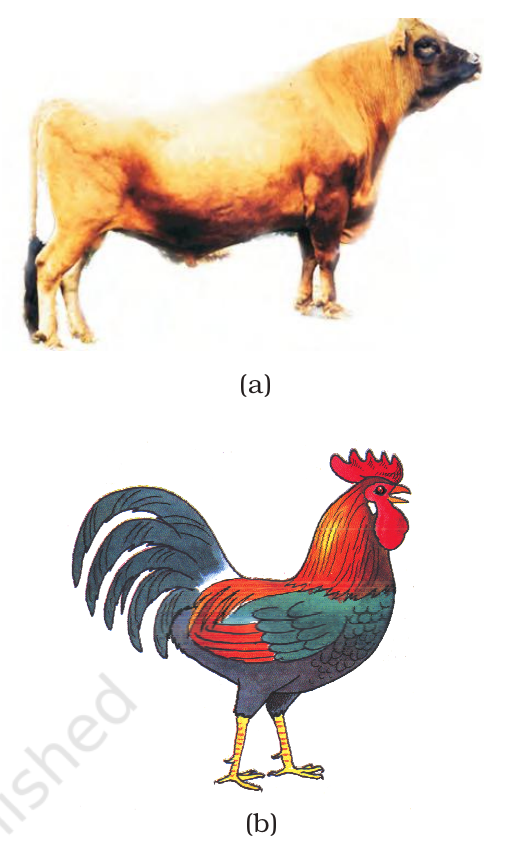
- What is a breed? A group of animals related by descent and similar in most characters like general appearance, features, size, configuration, etc., are said to belong to a breed.
- Animal breeding aims at increasing the yield of animals and improving the desirable qualities of the produce. When breeding is between animals of the same breed it is called inbreeding, while crosses between different breeds are called outbreeding.
- Inbreeding refers to the mating of more closely related individuals within the same breed for 4-6 generations. The breeding strategy is as follows: superior males and superior females of the same breed are identified and mated in pairs. The progeny obtained from such matings are evaluated and superior males and females among them are identified for further mating.
- A superior female, in the case of cattle, is the cow or buffalo that produces more milk per lactation. A superior male is the bull, which gives rise to superior progeny as compared to those of other males.
- Inbreeding increases homozygosity. Thus inbreeding is necessary if we want to evolve a pureline in any animal. Inbreeding exposes harmful recessive genes that are eliminated by selection. It also helps in accumulation of superior genes and elimination of less desirable genes. This approach, where there is selection at each step, increases the productivity of inbred population.
- However, continued inbreeding, especially close inbreeding, usually reduces fertility and even productivity. This is called inbreeding depression. Whenever this becomes a problem, selected animals of the breeding population should be mated with unrelated superior animals of the same breed. This usually helps restore fertility and yield.
- Figure 9.1 shows improved breeds: (a) Jersey cattle and (b) Leghorn chicken. See the chapter diagram.
Practice1 question
Try it now. A wrong answer costs nothing here, try again until you get it.
Which of the following is inbreeding?
NCERT 9.1.2: inbreeding is the mating of more closely related individuals within the same breed for 4-6 generations.
Outbreeding: out-crossing, cross-breeding, interspecific hybridisation
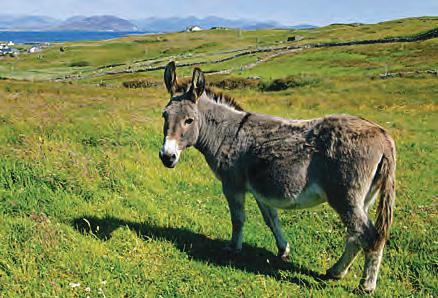
- Out-breeding is the breeding of the unrelated animals, which may be between individuals of the same breed but having no common ancestors for 4-6 generations (out-crossing) or between different breeds (cross-breeding) or different species (inter-specific hybridisation).
- Out-crossing: the practice of mating of animals within the same breed, but having no common ancestors on either side of their pedigree up to 4-6 generations. The offspring of such a mating is known as an out-cross. It is the best breeding method for animals that are below average in productivity in milk production, growth rate in beef cattle, etc. A single outcross often helps to overcome inbreeding depression.
- Cross-breeding: superior males of one breed are mated with superior females of another breed. Cross-breeding allows the desirable qualities of two different breeds to be combined. The progeny hybrid animals may themselves be used for commercial production. Alternatively, they may be subjected to some form of inbreeding and selection to develop new stable breeds that may be superior to the existing breeds.
- Hisardale is a new breed of sheep developed in Punjab by crossing Bikaneri ewes and Marino rams.
- Interspecific hybridisation: male and female animals of two different related species are mated. In some cases, the progeny may combine desirable features of both the parents, and may be of considerable economic value, e.g., the mule.
Table: animal breeding methods at a glance
- The breeding methods of NCERT 9.1.2 at a glance. Learn each method by what is mated, not by name alone.
| Method | What is mated | Key point |
|---|---|---|
| Inbreeding | More closely related individuals within the same breed, for 4-6 generations | Increases homozygosity; needed to evolve a pureline |
| Out-crossing | Same breed, no common ancestors on either side of the pedigree up to 4-6 generations | Offspring is an out-cross; best for below-average animals; a single outcross often overcomes inbreeding depression |
| Cross-breeding | Superior males of one breed with superior females of another breed | Combines desirable qualities of two breeds; Hisardale sheep from Bikaneri ewes and Marino rams |
| Interspecific hybridisation | Male and female animals of two different related species | Progeny may combine features of both parents, e.g., the mule |
| Artificial insemination | Semen of a chosen male injected into the reproductive tract of a selected female | Semen may be used at once or frozen and transported frozen |
| MOET | Cow given FSH-like hormones, then mated with an elite bull or artificially inseminated | 6-8 eggs per cycle; fertilised eggs at 8-32 cells stages transferred to surrogate mothers |
Artificial insemination and MOET
- Controlled breeding experiments are carried out using artificial insemination. The semen is collected from the male that is chosen as a parent and injected into the reproductive tract of the selected female by the breeder. The semen may be used immediately or can be frozen and used at a later date. It can also be transported in a frozen form to where the female is housed. In this way desirable matings are carried out.
- Often, the success rate of crossing mature male and female animals is fairly low even though artificial insemination is carried out. Multiple Ovulation Embryo Transfer Technology (MOET) is one such programme for herd improvement.
- In this method, a cow is administered hormones, with FSH-like activity, to induce follicular maturation and super ovulation: instead of one egg, which they normally yield per cycle, they produce 6-8 eggs. The animal is either mated with an elite bull or artificially inseminated. The fertilised eggs at 8-32 cells stages are recovered non-surgically and transferred to surrogate mothers. The genetic mother is available for another round of super ovulation.
- This technology has been demonstrated for cattle, sheep, rabbits, buffaloes, mares, etc. High milk-yielding breeds of females and high quality (lean meat with less lipid) meat-yielding bulls have been bred successfully to increase herd size in a short time.
Practice1 question
Try it now. A wrong answer costs nothing here, try again until you get it.
In MOET, the cow is given hormones with what kind of activity to induce super ovulation?
NCERT 9.1.2: in MOET the cow is administered hormones with FSH-like activity to induce follicular maturation and super ovulation.
Bee-keeping and fisheries
- Bee-keeping or apiculture is the maintenance of hives of honeybees for the production of honey. It has been an age-old cottage industry. Honey is a food of high nutritive value and also finds use in the indigenous systems of medicine. Honeybee also produces beeswax, which finds many uses in industry, such as in the preparation of cosmetics and polishes of various kinds.
- There are several species of honeybees which can be reared. Of these, the most common species is Apis indica. Bee-keeping can be practiced in any area where there are sufficient bee pastures of some wild shrubs, fruit orchards and cultivated crops. Beehives can be kept in one's courtyard, on the verandah of the house or even on the roof. Bee-keeping is not labour-intensive.
- The following points are important for successful bee-keeping: (i) Knowledge of the nature and habits of bees, (ii) Selection of suitable location for keeping the beehives, (iii) Catching and hiving of swarms (group of bees), (iv) Management of beehives during different seasons, and (v) Handling and collection of honey and of beeswax.
- Bees are the pollinators of many of our crop species such as sunflower, Brassica, apple and pear. Keeping beehives in crop fields during flowering period increases pollination efficiency and improves the yield, beneficial both from the point of view of crop yield and honey yield.
- Fishery is an industry devoted to the catching, processing or selling of fish, shellfish or other aquatic animals. Some of the freshwater fishes which are very common include Catla, Rohu and common carp. Some of the marine fishes that are eaten include Hilsa, Sardines, Mackerel and Pomfrets.
- Fisheries has an important place in Indian economy. It provides income and employment to millions of fishermen and farmers, particularly in the coastal states. Through aquaculture and pisciculture we have been able to increase the production of aquatic plants and animals, both fresh-water and marine. We now talk about 'Blue Revolution' as being implemented along the same lines as 'Green Revolution'.
Plant breeding: the five steps
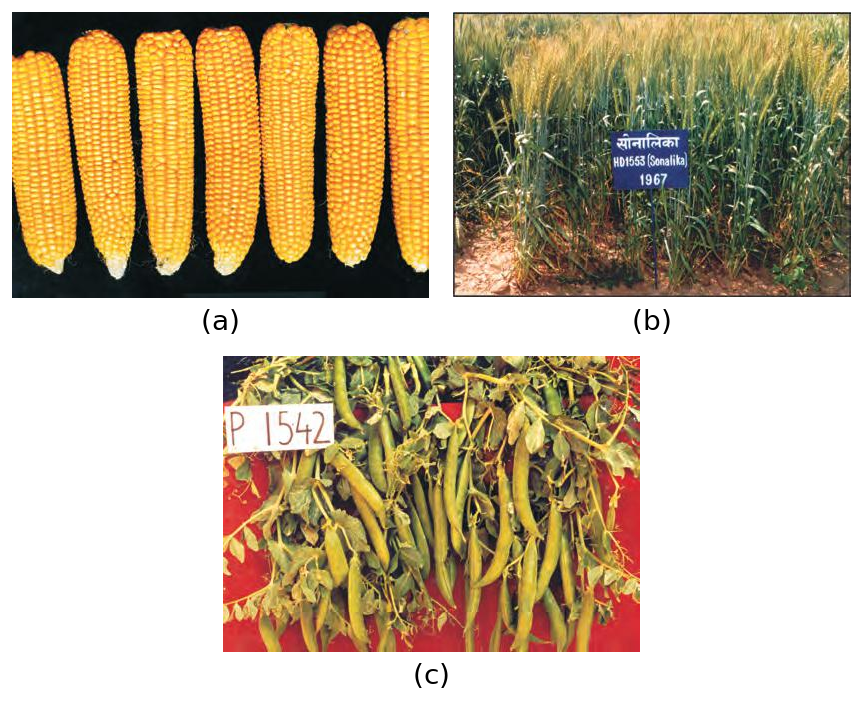
- Plant breeding is the purposeful manipulation of plant species in order to create desired plant types that are better suited for cultivation, give better yields and are disease resistant. Conventional plant breeding has been practiced for thousands of years, since the beginning of human civilisation; recorded evidence of plant breeding dates back to 9,000-11,000 years ago.
- The traits breeders have tried to incorporate into crop plants: increased crop yield and improved quality; increased tolerance to environmental stresses (salinity, extreme temperatures, drought); resistance to pathogens (viruses, fungi and bacteria); and increased tolerance to insect pests.
- The main steps in breeding a new genetic variety of a crop are: (i) Collection of variability: genetic variability is the root of any breeding programme. The entire collection (of plants/seeds) having all the diverse alleles for all genes in a given crop is called germplasm collection. (ii) Evaluation and selection of parents: the germplasm is evaluated so as to identify plants with desirable combination of characters. Purelines are created wherever desirable and possible. (iii) Cross hybridisation among the selected parents: the desired characters have very often to be combined from two different plants. Usually only one in few hundred to a thousand crosses shows the desirable combination. (iv) Selection and testing of superior recombinants: selecting, among the progeny of the hybrids, those plants that have the desired character combination. The selection process decides the success of the breeding objective and requires careful scientific evaluation of the progeny. These are self-pollinated for several generations till they reach a state of uniformity (homozygosity), so that the characters will not segregate in the progeny. (v) Testing, release and commercialisation of new cultivars: the newly selected lines are evaluated for yield and other agronomic traits, then tested in farmers' fields for at least three growing seasons at several locations in the country. The material is evaluated in comparison to the best available local crop cultivar, a check or reference cultivar.
- India is mainly an agricultural country. Agriculture accounts for approximately 33 per cent of India's GDP and employs nearly 62 per cent of the population.
- Green Revolution: the development of several high yielding varieties of wheat and rice in the mid-1960s led to dramatic increase in food production. During the period 1960 to 2000, wheat production increased from 11 million tonnes to 75 million tonnes while rice production went up from 35 million tonnes to 89.5 million tonnes. This was due to the development of semi-dwarf varieties of wheat and rice.
- Nobel laureate Norman E. Borlaug, at International Centre for Wheat and Maize Improvement in Mexico, developed semi-dwarf wheat. In 1963, several varieties such as Sonalika and Kalyan Sona, which were high yielding and disease resistant, were introduced all over the wheat-growing belt of India. Semi-dwarf rice varieties were derived from IR-8 (developed at International Rice Research Institute (IRRI), Philippines) and Taichung Native-1 (from Taiwan). The derivatives were introduced in 1966. Later better-yielding semi-dwarf varieties Jaya and Ratna were developed in India.
- Sugar cane: Saccharum barberi was originally grown in north India, but had poor sugar content and yield. Tropical canes grown in south India, Saccharum officinarum, had thicker stems and higher sugar content but did not grow well in north India. These two species were successfully crossed to get sugar cane varieties combining the desirable qualities of high yield, thick stems, high sugar and ability to grow in the sugar cane areas of north India.
- Millets: hybrid maize, jowar and bajra have been successfully developed in India. Hybrid breeding has led to the development of several high yielding varieties resistant to water stress.
Practice1 question
Try it now. A wrong answer costs nothing here, try again until you get it.
What is the first step in breeding a new genetic variety of a crop?
NCERT 9.2.1: the first step is collection of variability. Genetic variability is the root of any breeding programme.
Table 9.1: disease-resistant varieties
- A wide range of fungal, bacterial and viral pathogens affect the yield of cultivated crop species, especially in tropical climates. Crop losses can often be significant, up to 20-30 per cent, or sometimes even total. Breeding cultivars resistant to disease enhances food production and helps reduce the dependence on use of fungicides and bactericides.
- Resistance of the host plant is the ability to prevent the pathogen from causing disease and is determined by the genetic constitution of the host plant. Some diseases caused by fungi are rusts, e.g., brown rust of wheat, red rot of sugarcane and late blight of potato; by bacteria, black rot of crucifers; and by viruses, tobacco mosaic, turnip mosaic, etc.
- Breeding for disease resistance is carried out by the conventional method of hybridisation and selection, or by mutation breeding. Mutation is the process by which genetic variations are created through changes in the base sequence within genes, resulting in the creation of a new character or trait not found in the parental type. Mutations can be induced artificially through use of chemicals or radiations (like $\gamma$ radiations). In mung bean, resistance to yellow mosaic virus and powdery mildew were induced by mutations.
- Resistance to yellow mosaic virus in bhindi (Abelmoschus esculentus) was transferred from a wild species and resulted in a new variety of A. esculentus called Parbhani kranti.
- Some crop varieties bred by hybridisation and selection, for disease resistance (NCERT Table 9.1):
| Crop | Variety | Resistance to diseases |
|---|---|---|
| Wheat | Himgiri | Leaf and stripe rust, hill bunt |
| Brassica | Pusa swarnim (Karan rai) | White rust |
| Cauliflower | Pusa Shubhra, Pusa Snowball K-1 | Black rot and Curl blight black rot |
| Cowpea | Pusa Komal | Bacterial blight |
| Chilli | Pusa Sadabahar | Chilly mosaic virus, Tobacco mosaic virus and Leaf curl |
Table 9.2: insect-pest-resistant varieties
- Insect resistance in host crop plants may be due to morphological, biochemical or physiological characteristics. Hairy leaves in several plants are associated with resistance to insect pests, e.g., resistance to jassids in cotton and cereal leaf beetle in wheat. In wheat, solid stems lead to non-preference by the stem sawfly and smooth leaved and nectar-less cotton varieties do not attract bollworms. High aspartic acid, low nitrogen and sugar content in maize leads to resistance to maize stem borers.
- Breeding methods for insect pest resistance involve the same steps as those for any other agronomic trait such as yield or quality. Sources of resistance genes may be cultivated varieties, germplasm collections of the crop or wild relatives.
- Some released crop varieties bred by hybridisation and selection, for insect pest resistance (NCERT Table 9.2):
| Crop | Variety | Insect Pests |
|---|---|---|
| Brassica (rapeseed mustard) | Pusa Gaurav | Aphids |
| Flat bean | Pusa Sem 2, Pusa Sem 3 | Jassids, aphids and fruit borer |
| Okra (Bhindi) | Pusa Sawani, Pusa A-4 | Shoot and Fruit borer |
Practice1 question
Try it now. A wrong answer costs nothing here, try again until you get it.
Which variety of Brassica is resistant to aphids?
NCERT Table 9.2: Pusa Gaurav is the Brassica (rapeseed mustard) variety resistant to aphids.
Biofortification and single cell protein
- More than 840 million people in the world do not have adequate food to meet their daily food and nutritional requirements. A far greater number, three billion people, suffer from micronutrient, protein and vitamin deficiencies or 'hidden hunger' because they cannot afford to buy enough fruits, vegetables, legumes, fish and meat. Diets lacking essential micronutrients, particularly iron, vitamin A, iodine and zinc, increase the risk for disease, reduce lifespan and reduce mental abilities.
- Biofortification, breeding crops with higher levels of vitamins and minerals, or higher protein and healthier fats, is the most practical means to improve public health.
- Breeding for improved nutritional quality is undertaken with the objectives of improving: (i) Protein content and quality; (ii) Oil content and quality; (iii) Vitamin content; and (iv) Micronutrient and mineral content.
- In 2000, maize hybrids that had twice the amount of the amino acids, lysine and tryptophan, compared to existing maize hybrids were developed. Wheat variety, Atlas 66, having a high protein content, has been used as a donor for improving cultivated wheat. It has been possible to develop an iron-fortified rice variety containing over five times as much iron as in commonly consumed varieties.
- The Indian Agricultural Research Institute, New Delhi has also released several vegetable crops that are rich in vitamins and minerals, e.g., vitamin A enriched carrots, spinach, pumpkin; vitamin C enriched bitter gourd, bathua, mustard, tomato; iron and calcium enriched spinach and bathua; and protein enriched beans, broad, lablab, French and garden peas.
- Single Cell Protein (SCP): conventional agricultural production of cereals, pulses, vegetables, fruits, etc., may not be able to meet the demand of food at the rate at which human and animal population is increasing. The shift from grain to meat diets also creates more demand for cereals as it takes 3-10 kg of grain to produce 1 kg of meat by animal farming. More than 25 per cent of human population is suffering from hunger and malnutrition.
- Microbes are being grown on an industrial scale as source of good protein. Blue-green algae like Spirulina can be grown easily on materials like waste water from potato processing plants (containing starch), straw, molasses, animal manure and even sewage, to produce large quantities and can serve as food rich in protein, minerals, fats, carbohydrate and vitamins. Such utilisation also reduces environmental pollution.
- Certain bacterial species like Methylophilus methylotrophus, because of its high rate of biomass production and growth, can be expected to produce 25 tonnes of protein. Edible mushrooms are eaten by many people and large scale mushroom culture is a growing industry.
Tissue culture: totipotency and micropropagation
- As traditional breeding techniques failed to keep pace with demand and to provide sufficiently fast and efficient systems for crop improvement, another technology called tissue culture got developed. It was learnt by scientists, during 1950s, that whole plants could be regenerated from explants, i.e., any part of a plant taken out and grown in a test tube, under sterile conditions in special nutrient media.
- This capacity to generate a whole plant from any cell/explant is called totipotency.
- The nutrient medium must provide a carbon source such as sucrose and also inorganic salts, vitamins, amino acids and growth regulators like auxins, cytokinins etc.
- By application of these methods it is possible to achieve propagation of a large number of plants in very short durations. This method of producing thousands of plants through tissue culture is called micropropagation. Each of these plants will be genetically identical to the original plant from which they were grown, i.e., they are somaclones. Many important food plants like tomato, banana, apple, etc., have been produced on commercial scale using this method.
- Another important application of the method is the recovery of healthy plants from diseased plants. Even if the plant is infected with a virus, the meristem (apical and axillary) is free of virus. Hence, one can remove the meristem and grow it in vitro to obtain virus-free plants. Scientists have succeeded in culturing meristems of banana, sugarcane, potato, etc.
- Scientists have even isolated single cells from plants and after digesting their cell walls have been able to isolate naked protoplasts (surrounded by plasma membranes). Isolated protoplasts from two different varieties of plants, each having a desirable character, can be fused to get hybrid protoplasts, which can be further grown to form a new plant. These hybrids are called somatic hybrids while the process is called somatic hybridisation.
- Imagine a situation when a protoplast of tomato is fused with that of potato, and then they are grown, to form new hybrid plants combining tomato and potato characteristics. This has been achieved, resulting in formation of pomato; unfortunately this plant did not have all the desired combination of characteristics for its commercial utilisation.
- Cross-chapter note (NCERT XI, Ch 13, 13.2): when differentiated cells such as leaf mesophyll cells regain the capacity to divide in culture medium to form an undifferentiated mass (callus), the phenomenon is called dedifferentiation.
Practice1 question
Try it now. A wrong answer costs nothing here, try again until you get it.
Which part of a virus-infected plant is used to raise virus-free plants in tissue culture?
NCERT 9.4: even if the plant is infected with a virus, the meristem (apical and axillary) is free of virus, so it is removed and grown in vitro to obtain virus-free plants.
Trap pairs: the confusions NEET tests
- MOET hormone: FSH-like, not LH-like. NCERT 9.1.2 says the cow is given hormones with FSH-like activity for super ovulation. NEET 2021 made LH-like activity the wrong step, so learn the hormone as FSH-like.
- Inbreeding vs out-crossing: inbreeding mates closely related individuals within the same breed for 4-6 generations and raises homozygosity; out-crossing mates animals of the same breed with no common ancestors for 4-6 generations and gives an out-cross. Same breed in both, relatedness is the difference.
- Meristem culture vs micropropagation: meristem culture gives virus-free plants because the meristem is free of virus; micropropagation gives somaclones, plants genetically identical to the original plant.
- Protoplast fusion vs tissue culture: protoplast fusion gives the somatic hybrid pomato; tissue culture rests on totipotency, the capacity of any cell to form a whole plant.
- Biofortification vs disease resistance breeding: biofortification improves nutrition (protein, oil, vitamins, micronutrients); disease resistance breeding protects yield from pathogens. NEET 2021 tested disease resistance as a non-objective of biofortification, so keep the two objectives apart.
Trap Boxes
MOET uses LH-like hormones?
Wrong idea: In MOET the cow is given hormones with LH-like activity for super ovulation.
NCERT 9.1.2: the cow is given hormones with FSH-like activity to induce follicular maturation and super ovulation. LH-like activity is the wrong option in NEET 2021, and it is the trap in that question.
NCERT XII, Ch 9, 9.1.2
Inbreeding always raises productivity?
Wrong idea: Inbreeding always increases the productivity of the population, so the closer the mating the better.
Inbreeding increases homozygosity and exposes harmful recessive genes for selection, but continued inbreeding, especially close inbreeding, usually reduces fertility and even productivity. That fall is inbreeding depression.
NCERT XII, Ch 9, 9.1.2
Pomato is a commercial crop?
Wrong idea: Pomato, the somatic hybrid of tomato and potato, is grown commercially because it combines both crops.
Pomato was formed by fusing tomato and potato protoplasts, but it did not have all the desired combination of characteristics for commercial utilisation.
NCERT XII, Ch 9, 9.4
Biofortification builds disease resistance?
Wrong idea: Biofortification makes crops resistant to diseases, so it is a form of disease resistance breeding.
Biofortification breeds crops with higher vitamins, minerals, protein and healthier fats. It does not create resistance to diseases; that is a separate breeding objective tested in NEET 2021.
NCERT XII, Ch 9, 9.2.4
Any part of a diseased plant gives diseased plants?
Wrong idea: Plants raised from a virus-infected plant are always infected, whatever part is cultured.
Even if the plant is infected with a virus, the meristem (apical and axillary) is free of virus, so culturing the meristem in vitro gives virus-free plants.
NCERT XII, Ch 9, 9.4
Chapter test
5 NEET PYQs. +4 for a correct answer, -1 for a wrong answer, exactly like NEET. Finish the test to earn a medal.
Q1: NEET (UG) 2024, Code R3, Q134
The capacity to generate a whole plant from any cell of the plant is called:
Totipotency is the capacity to generate a whole plant from any cell of the plant. Micropropagation is the method that uses it to make thousands of plants.
Q2: NEET (UG) 2023, Code F1, Q104
In tissue culture experiments, leaf mesophyll cells are put in a culture medium to form callus. This phenomenon may be called as
Leaf mesophyll cells placed in culture medium form callus because the differentiated cells regain the capacity to divide. That regain is dedifferentiation.
Q3: NEET (UG) 2021, Code P3, Q194
Which of the following is not a step in Multiple Ovulation Embryo Transfer Technology (MOET)?
In MOET the cow is given hormones with FSH-like activity for super ovulation, not LH-like activity. The other three options are all true steps in NCERT 9.1.2.
Q4: NEET (UG) 2021, Code P3, Q179
Which of the following is not an objective of Biofortification in crops?
Biofortification improves protein content, oil content, vitamin content and micronutrient and mineral content. It does not build disease resistance in the crop.
Q5: NEET (UG) 2021, Code P3, Q107
Match List - I with List - II.
| List - I | List - II |
|---|---|
| (a) Protoplast fusion | (i) Totipotency |
| (b) Plant tissue culture | (ii) Pomato |
| (c) Meristem culture | (iii) Somaclones |
| (d) Micropropagation | (iv) Virus free plants |
Protoplast fusion gives pomato; totipotency is the explant's capacity to form a whole plant in tissue culture; meristem culture gives virus-free plants; micropropagation gives somaclones.
Score: 0 · Answered 0 of 5
Flashcards
Tap a card to flip it over and see the answer. Tap it again to flip it back.
In MOET, how many eggs does a cow produce per cycle, and at what stage are the fertilised eggs transferred?
Tap to flipInstead of one egg per cycle, the cow produces 6-8 eggs. The fertilised eggs at 8-32 cells stages are recovered non-surgically and transferred to surrogate mothers.
Tap to flip backDefine inbreeding as NCERT does.
Tap to flipMating of more closely related individuals within the same breed for 4-6 generations. Superior males and superior females of the same breed are identified and mated in pairs.
Tap to flip backWhat is inbreeding depression, and how is it overcome?
Tap to flipContinued inbreeding, especially close inbreeding, usually reduces fertility and even productivity. Selected animals of the breeding population are mated with unrelated superior animals of the same breed to restore fertility and yield.
Tap to flip backWhat is Hisardale, and how was it developed?
Tap to flipHisardale is a new breed of sheep developed in Punjab by crossing Bikaneri ewes and Marino rams.
Tap to flip backBy how much did wheat and rice production rise in India between 1960 and 2000?
Tap to flipWheat production rose from 11 million tonnes to 75 million tonnes; rice production rose from 35 million tonnes to 89.5 million tonnes. The rise came from semi-dwarf varieties of the Green Revolution.
Tap to flip backList the five main steps in breeding a new genetic variety of a crop, in order.
Tap to flip(i) Collection of variability; (ii) Evaluation and selection of parents; (iii) Cross hybridisation among the selected parents; (iv) Selection and testing of superior recombinants; (v) Testing, release and commercialisation of new cultivars.
Tap to flip backName the disease-resistant wheat variety in NCERT Table 9.1 and the diseases it resists.
Tap to flipHimgiri resists leaf and stripe rust and hill bunt.
Tap to flip backWhat is Parbhani kranti, and where did its resistance come from?
Tap to flipParbhani kranti is a variety of bhindi (Abelmoschus esculentus) in which resistance to yellow mosaic virus was transferred from a wild species.
Tap to flip backWhat are the four objectives of breeding for improved nutritional quality?
Tap to flip(i) Protein content and quality; (ii) Oil content and quality; (iii) Vitamin content; (iv) Micronutrient and mineral content.
Tap to flip backWhich microbe is named in NCERT for single cell protein, and how much protein is it expected to produce?
Tap to flipMethylophilus methylotrophus, because of its high rate of biomass production and growth, can be expected to produce 25 tonnes of protein. Spirulina is the blue-green alga grown on waste water, straw, molasses, animal manure and sewage.
Tap to flip backWhat must the nutrient medium provide for an explant in tissue culture?
Tap to flipA carbon source such as sucrose, inorganic salts, vitamins, amino acids and growth regulators like auxins and cytokinins.
Tap to flip backWhy is pomato not used commercially even though it is a somatic hybrid of tomato and potato?
Tap to flipThe pomato plant did not have all the desired combination of characteristics for its commercial utilisation.
Tap to flip backFrequently asked questions
MOET uses LH-like hormones?
NCERT 9.1.2: the cow is given hormones with FSH-like activity to induce follicular maturation and super ovulation. LH-like activity is the wrong option in NEET 2021, and it is the trap in that question.
Inbreeding always raises productivity?
Inbreeding increases homozygosity and exposes harmful recessive genes for selection, but continued inbreeding, especially close inbreeding, usually reduces fertility and even productivity. That fall is inbreeding depression.
Pomato is a commercial crop?
Pomato was formed by fusing tomato and potato protoplasts, but it did not have all the desired combination of characteristics for commercial utilisation.
What is the first step in breeding a new genetic variety of a crop?
NCERT 9.2.1: the first step is collection of variability. Genetic variability is the root of any breeding programme.
Which part of a virus-infected plant is used to raise virus-free plants in tissue culture?
NCERT 9.4: even if the plant is infected with a virus, the meristem (apical and axillary) is free of virus, so it is removed and grown in vitro to obtain virus-free plants.