 NEET Notes
Home > Chemistry > Physical > Solutions
Solutions
On this page · 18 sections
- 01Syllabus map
- 02Types of solutions
- 03Concentration: mass, volume and parts per million
- 04Mole fraction, molarity and molality
- 05Table: concentration units
- 06Solubility and Henry law
- 07Table: Henry law constants
- 08Raoult law: volatile liquid-liquid solutions
- 09Raoult law: non-volatile solute and vapour pressure lowering
- 10Ideal solutions
- 11Ladder: non-ideal solutions and azeotropes
- 12Relative lowering of vapour pressure
- 13Elevation of boiling point
- 14Depression of freezing point
- 15Table: Kb and Kf values
- 16Osmosis, osmotic pressure and tonicity
- 17Abnormal molar mass and van't Hoff factor
- 18Trap pairs: the confusions NEET tests
Types of solutions, concentration units, Henry law, Raoult law, ideal and non-ideal solutions, the four colligative properties, osmotic pressure, reverse osmosis and abnormal molar mass.
Syllabus map
- NMC Unit: CHEM-U05, Solutions.
- Subtopics in this chapter (NCERT XII, Ch 1): types of solutions (1.1); expressing concentration of solutions (1.2); solubility of a solid in a liquid and of a gas in a liquid, Henry law (1.3); vapour pressure of liquid-liquid solutions and of solutions of solids in liquids, Raoult law (1.4); ideal and non-ideal solutions (1.5); colligative properties and determination of molar mass: relative lowering of vapour pressure (1.6.1), elevation of boiling point (1.6.2), depression of freezing point (1.6.3), osmosis and osmotic pressure (1.6.4), reverse osmosis and water purification (1.6.5); abnormal molar masses and van't Hoff factor (1.7).
- Subtopic checklist: (1) nine types of solutions from Table 1.1; (2) mass %, volume %, mass by volume %, ppm, mole fraction, molarity, molality; (3) temperature dependence of concentration units; (4) Henry law p = KH x and its applications; (5) Raoult law for volatile liquids and for non-volatile solutes; (6) ideal solutions, ΔmixH = 0 and ΔmixV = 0; (7) positive and negative deviation and azeotropes; (8) the four colligative properties and molar mass from each; (9) Kb and Kf values from Table 1.3; (10) osmosis, osmotic pressure, isotonic, hypertonic and hypotonic solutions; (11) reverse osmosis and desalination; (12) abnormal molar mass, dissociation, association and van't Hoff factor i.
- Extra information (beyond NCERT): none. Everything in this chapter is NCERT Chapter 1.
- Excluded topics: electrochemistry and chemical kinetics, which are the following chapters; do not import their facts into this chapter. The liquid state and vapour pressure of pure liquids belong to earlier classes and are used here only as background for Raoult law.
- Estimated revision time: 10 minutes. Jump links: Syllabus map, Types of solutions, Concentration: mass, volume and parts per million, Mole fraction, molarity and molality, Table: concentration units, Solubility and Henry law, Table: Henry law constants, Raoult law: volatile liquid-liquid solutions, Raoult law: non-volatile solute and vapour pressure lowering, Ideal solutions, Ladder: non-ideal solutions and azeotropes, Relative lowering of vapour pressure, Elevation of boiling point, Depression of freezing point, Table: Kb and Kf values, Osmosis, osmotic pressure and tonicity, Abnormal molar mass and van't Hoff factor, Trap pairs: the confusions NEET tests.
Suggest an edit
Types of solutions
- Solutions are homogeneous mixtures of two or more than two components. By homogeneous mixture we mean that its composition and properties are uniform throughout the mixture. Generally, the component present in the largest quantity is known as solvent. Solvent determines the physical state in which solution exists. One or more components present in the solution other than solvent are called solutes. In this Unit we consider only binary solutions, that is, solutions consisting of two components.
- Each component may be solid, liquid or in gaseous state, giving nine types of solutions (NCERT Table 1.1). Gaseous solutions: gas in gas (mixture of oxygen and nitrogen gases), liquid in gas (chloroform mixed with nitrogen gas), solid in gas (camphor in nitrogen gas). Liquid solutions: gas in liquid (oxygen dissolved in water), liquid in liquid (ethanol dissolved in water), solid in liquid (glucose dissolved in water). Solid solutions: gas in solid (solution of hydrogen in palladium), liquid in solid (amalgam of mercury with sodium), solid in solid (copper dissolved in gold).
- Almost all processes in body occur in some kind of liquid solutions. In normal life we rarely come across pure substances. Most of these are mixtures containing two or more pure substances. For example, the properties of brass (mixture of copper and zinc) are quite different from those of German silver (mixture of copper, zinc and nickel) or bronze (mixture of copper and tin).
- Concentration in everyday terms: 1 part per million (ppm) of fluoride ions in water prevents tooth decay, while 1.5 ppm causes the tooth to become mottled and high concentrations of fluoride ions can be poisonous. Intravenous injections are always dissolved in water containing salts at particular ionic concentrations that match with blood plasma concentrations.
Suggest an edit
Concentration: mass, volume and parts per million
- Composition of a solution can be described qualitatively as dilute (relatively very small quantity of solute) or concentrated (relatively very large quantity of solute), but in real life these descriptions add to confusion, so a quantitative description is needed.
- (i) Mass percentage (w/w): mass % of a component = (mass of the component in the solution / total mass of the solution) x 100. For example, 10% glucose in water by mass means 10 g of glucose is dissolved in 90 g of water, giving a 100 g solution. Commercial bleaching solution contains 3.62 mass percentage of sodium hypochlorite in water.
- (ii) Volume percentage (V/V): volume % of a component = (volume of the component / total volume of solution) x 100. For example, 10% ethanol solution in water means 10 mL of ethanol is dissolved in water such that the total volume of the solution is 100 mL. A 35% (v/v) solution of ethylene glycol, an antifreeze, is used in cars for cooling the engine. At this concentration the antifreeze lowers the freezing point of water to 255.4 K (-17.6 degrees C).
- (iii) Mass by volume percentage (w/V): commonly used in medicine and pharmacy. It is the mass of solute dissolved in 100 mL of the solution.
- (iv) Parts per million: when a solute is present in trace quantities, it is convenient to express concentration in parts per million (ppm). Parts per million = (number of parts of the component / total number of parts of all components of the solution) x $10^{6}$. As with percentage, ppm can be expressed as mass to mass, volume to volume and mass to volume. A litre of sea water (which weighs 1030 g) contains about 6 x $10^{-3}$ g of dissolved oxygen ($O_2$), also expressed as 5.8 g per $10^{6}$ g (5.8 ppm) of sea water. The concentration of pollutants in water or atmosphere is often expressed in terms of ppm.
Suggest an edit
Mole fraction, molarity and molality
- (v) Mole fraction: commonly used symbol for mole fraction is x and the subscript on the right hand side of x denotes the component. Mole fraction of a component = (number of moles of the component / total number of moles of all the components). For a binary mixture with nA and nB moles of A and B, xA = nA / (nA + nB). For i components, xi = ni / (n1 + n2 + ... + ni). In a given solution the sum of all the mole fractions is unity: x1 + x2 + ... + xi = 1. Mole fraction is very useful in relating vapour pressure with the concentration of the solution.
- Example 1.1: mole fraction of ethylene glycol ($C_2H_6O_2$) in a solution containing 20% of $C_2H_6O_2$ by mass. In 100 g of solution there are 20 g of ethylene glycol and 80 g of water. Molar mass of $C_2H_6O_2$ = 62 g mol-1, so moles of $C_2H_6O_2$ = 20 / 62 = 0.322 mol. Moles of water = 80 / 18 = 4.444 mol. x glycol = 0.322 / (0.322 + 4.444) = 0.068 and x water = 4.444 / (0.322 + 4.444) = 0.932, which is also 1 - 0.068.
- (vi) Molarity: Molarity (M) is defined as number of moles of solute dissolved in one litre (or one cubic decimetre) of solution. Molarity = moles of solute / volume of solution in litre. For example, 0.25 mol L-1 (or 0.25 M) solution of $NaOH$ means 0.25 mol of $NaOH$ has been dissolved in one litre of solution. Example 1.2: 5 g of $NaOH$ (40 g mol-1) is 0.125 mol in 450 mL of solution, so molarity = 0.125 x 1000 / 450 = 0.278 M.
- (vii) Molality: Molality (m) is defined as the number of moles of the solute per kilogram (kg) of the solvent. Molality (m) = moles of solute / mass of solvent in kg. For example, 1.00 mol kg-1 (or 1.00 m) solution of $KCl$ means 1 mol (74.5 g) of $KCl$ is dissolved in 1 kg of water. Example 1.3: 2.5 g of ethanoic acid ($CH_3COOH$, 60 g mol-1) is 0.0417 mol in 75 g of benzene, so molality = 0.0417 / 0.075 = 0.556 mol kg-1.
- Temperature dependence: each method of expressing concentration has its own merits and demerits. Mass %, ppm, mole fraction and molality are independent of temperature, whereas molarity is a function of temperature. This is because volume depends on temperature and the mass does not.
Suggest an edit
Practice1 question
Try it now. A wrong answer costs nothing here, try again until you get it.
A solution contains 20% ethylene glycol ($C_2H_6O_2$) by mass in water. What is the mole fraction of ethylene glycol?
NCERT 1.2, Example 1.1: 20 g ethylene glycol (62 g mol-1) is 0.322 mol and 80 g water is 4.444 mol, so x glycol = 0.322 / (0.322 + 4.444) = 0.068.
Table: concentration units
| Unit | Symbol | Definition | Temperature independent? |
|---|---|---|---|
| Mass percentage | w/w | (Mass of component / total mass of solution) x 100 | Yes |
| Volume percentage | V/V | (Volume of component / total volume of solution) x 100 | No, it uses volumes |
| Mass by volume percentage | w/V | Mass of solute in 100 mL of solution | No, it uses volume |
| Parts per million | ppm | (Parts of component / total parts of all components) x $10^{6}$ | Yes, for mass to mass |
| Mole fraction | x | Moles of component / total moles of all components; sum of all mole fractions = 1 | Yes |
| Molarity | M | Moles of solute / volume of solution in litre | No, volume changes with temperature |
| Molality | m | Moles of solute / mass of solvent in kg | Yes |
- NCERT states the rule directly: mass %, ppm, mole fraction and molality are independent of temperature, whereas molarity is a function of temperature, because volume depends on temperature and the mass does not.
- Worked numbers to remember: 10% glucose by mass is 10 g glucose in 90 g water. 35% (v/v) ethylene glycol lowers the freezing point of water to 255.4 K. Sea water has about 5.8 ppm dissolved oxygen. Example 1.1 gives x glycol = 0.068 and x water = 0.932. Example 1.2 gives 0.278 M $NaOH$. Example 1.3 gives 0.556 mol kg-1 ethanoic acid in benzene.
Suggest an edit
Solubility and Henry law
- Solubility of a substance is its maximum amount that can be dissolved in a specified amount of solvent at a specified temperature. It depends upon the nature of solute and solvent as well as temperature and pressure.
- Solubility of a solid in a liquid (1.3.1): every solid does not dissolve in a given liquid. Sodium chloride and sugar dissolve readily in water, naphthalene and anthracene do not. Naphthalene and anthracene dissolve readily in benzene but sodium chloride and sugar do not. Polar solutes dissolve in polar solvents and non-polar solutes in non-polar solvents: like dissolves like.
- Dissolution and crystallisation: when a solid solute is added to the solvent, some solute dissolves (dissolution) and some solute particles in solution collide with the solid solute particles and get separated out (crystallisation). A stage is reached when the two processes occur at the same rate, a state of dynamic equilibrium: Solute + Solvent ⇌ Solution. A solution in dynamic equilibrium with undissolved solute is a saturated solution and contains the maximum amount of solute; an unsaturated solution is one in which more solute can be dissolved at the same temperature.
- Effect of temperature on solid solubility: if dissolution is endothermic (Δsol H > 0), solubility increases with rise in temperature; if it is exothermic (Δsol H < 0), solubility decreases. This follows Le Chatelier principle for the dynamic equilibrium. Pressure has no significant effect on solubility of solids in liquids because solids and liquids are highly incompressible.
- Solubility of a gas in a liquid (1.3.2): oxygen dissolves only to a small extent in water, and it is this dissolved oxygen which sustains all aquatic life. Hydrogen chloride gas is highly soluble in water. Solubility of gases increases with increase of pressure: compressing the gas above the solution increases the number of gaseous particles per unit volume striking the surface, so more gas enters the solution until a new equilibrium is reached (NCERT Fig. 1.1).
- Henry law: at a constant temperature, the solubility of a gas in a liquid is directly proportional to the partial pressure of the gas present above the surface of liquid or solution. In mole fraction form, p = KH x, where p is the partial pressure of the gas in vapour phase, x is its mole fraction in the solution and KH is the Henry law constant. A graph of partial pressure versus mole fraction is a straight line (NCERT Fig. 1.2, $HCl$ gas in cyclohexane at 293 K). Higher the value of KH at a given pressure, the lower is the solubility of the gas in the liquid.
- Effect of temperature on gas solubility: solubility of gases in liquids decreases with rise in temperature. Dissolution of a gas is like condensation and heat is evolved, so by Le Chatelier principle the solubility should decrease with increase of temperature. KH values for $N_2$ and $O_2$ increase with temperature, which says the same thing.
- Example 1.4: $N_2$ bubbled through water at 293 K at a partial pressure of 0.987 bar, KH = 76.48 kbar. x($N_2$) = 0.987 / 76,480 = 1.29 x $10^{-5}$. One litre of water has 55.5 mol, so n = 1.29 x $10^{-5}$ x 55.5 = 7.16 x $10^{-4}$ mol = 0.716 mmol.
- Applications of Henry law: to increase the solubility of $CO_2$ in soft drinks and soda water, the bottle is sealed under high pressure. Scuba divers breathing air at high pressure underwater dissolve more atmospheric gases in blood; on coming to the surface the pressure falls, nitrogen bubbles form in the blood and block capillaries, a painful and dangerous condition called bends. To avoid bends and the toxic effects of high nitrogen concentrations, diver tanks are filled with air diluted with helium (11.7% helium, 56.2% nitrogen and 32.1% oxygen). At high altitudes the partial pressure of oxygen is less than at ground level, so blood oxygen falls and climbers become weak and unable to think clearly, a condition called anoxia.
Suggest an edit
Practice1 question
Try it now. A wrong answer costs nothing here, try again until you get it.
$N_2$ gas is bubbled through water at 293 K at a partial pressure of 0.987 bar. KH for $N_2$ at 293 K is 76.48 kbar. How many millimoles of $N_2$ dissolve in 1 litre of water?
NCERT 1.3.2, Example 1.4: x($N_2$) = p / KH = 0.987 bar / 76,480 bar = 1.29 x $10^{-5}$. One litre of water has 55.5 mol, so n = 1.29 x $10^{-5}$ x 55.5 = 7.16 x $10^{-4}$ mol = 0.716 mmol.
Table: Henry law constants
| Gas | Temperature / K | KH / kbar |
|---|---|---|
| He | 293 | 144.97 |
| $H_2$ | 293 | 69.16 |
| $N_2$ | 293 | 76.48 |
| $N_2$ | 303 | 88.84 |
| $O_2$ | 293 | 34.86 |
| $O_2$ | 303 | 46.82 |
| Argon | 298 | 40.3 |
| $CO_2$ | 298 | 1.67 |
| Formaldehyde | 298 | 1.83 x $10^{-5}$ |
| Methane | 298 | 0.413 |
| Vinyl chloride | 298 | 0.611 |
- How to read the table: different gases have different KH values at the same temperature, so KH is a function of the nature of the gas. At a given pressure, a higher KH means a lower solubility: He (144.97 kbar) is far less soluble than $CO_2$ (1.67 kbar).
- Temperature trend in the table: KH for $N_2$ rises from 76.48 kbar at 293 K to 88.84 kbar at 303 K, and KH for $O_2$ rises from 34.86 kbar at 293 K to 46.82 kbar at 303 K. Rising KH means falling solubility with rising temperature, which is why aquatic species are more comfortable in cold water than in warm water.
Suggest an edit
Raoult law: volatile liquid-liquid solutions
- Vapour pressure of liquid solutions (1.4): liquid solutions are formed when the solvent is a liquid. The solute can be a gas, a liquid or a solid. We discuss only binary solutions: (i) liquids in liquids and (ii) solids in liquids.
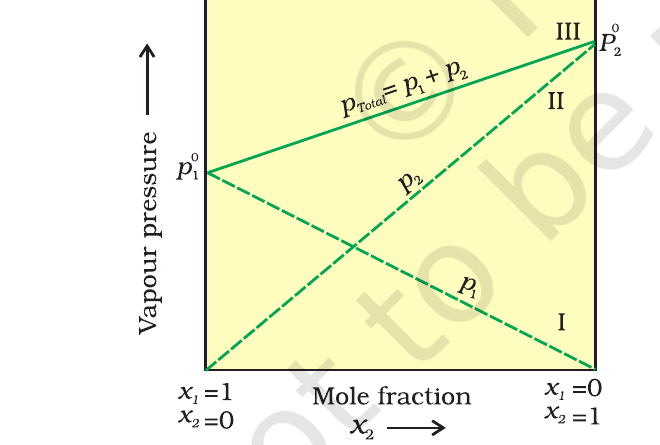
- Raoult law for liquid-liquid solutions (1.4.1): consider a binary solution of two volatile liquids, components 1 and 2, in a closed vessel. Both components evaporate and an equilibrium is set up between vapour phase and liquid phase. Raoult law states that for a solution of volatile liquids, the partial vapour pressure of each component of the solution is directly proportional to its mole fraction present in solution. So p1 = p1^0 x1 and p2 = p2^0 x2, where p1^0 and p2^0 are the vapour pressures of the pure components at the same temperature.
- Total vapour pressure: by Dalton law of partial pressures, p total = p1 + p2 = x1 p1^0 + x2 p2^0 = (1 - x2) p1^0 + x2 p2^0 = p1^0 + (p2^0 - p1^0) x2. Three conclusions follow: (i) total vapour pressure can be related to the mole fraction of any one component, (ii) total vapour pressure varies linearly with the mole fraction of component 2, (iii) depending on the vapour pressures of the pure components, total vapour pressure decreases or increases with the increase of the mole fraction of component 1.
- NCERT Fig. 1.3: a plot of p1 or p2 versus the mole fractions x1 and x2 gives a linear plot. Lines I and II pass through the points for which x1 and x2 are equal to unity. The plot of p total versus x2 (line III) is also linear. The minimum value of p total is p1^0 and the maximum value is p2^0, assuming component 1 is less volatile than component 2, that is, p1^0 < p2^0.
- Vapour phase composition: if y1 and y2 are the mole fractions of the components in the vapour phase, then p1 = y1 p total and p2 = y2 p total, so in general pi = yi p total. The composition of vapour phase in equilibrium with the solution is determined by the partial pressures of the components.
- Example 1.5: vapour pressure of chloroform ($CHCl_3$) is 200 mm Hg and of dichloromethane ($CH_2Cl_2$) is 415 mm Hg at 298 K. Mixing 25.5 g of $CHCl_3$ (119.5 g mol-1, 0.213 mol) and 40 g of $CH_2Cl_2$ (85 g mol-1, 0.47 mol) gives x $CH_2Cl_2$ = 0.688 and x $CHCl_3$ = 0.312. p total = 200 + (415 - 200) x 0.688 = 347.9 mm Hg. p $CH_2Cl_2$ = 0.688 x 415 = 285.5 mm Hg and p $CHCl_3$ = 0.312 x 200 = 62.4 mm Hg, so y $CH_2Cl_2$ = 285.5 / 347.9 = 0.82 and y $CHCl_3$ = 62.4 / 347.9 = 0.18. Since $CH_2Cl_2$ is more volatile, the vapour phase is richer in $CH_2Cl_2$. At equilibrium, vapour phase will always be rich in the component which is more volatile.
- Raoult law as a special case of Henry law (1.4.2): in a gas-in-liquid solution the partial pressure of the gas is directly proportional to its mole fraction, p = KH x. Comparing with pi = xi pi^0, only the proportionality constant differs. Raoult law becomes a special case of Henry law in which KH becomes equal to p1^0.
Suggest an edit
Raoult law: non-volatile solute and vapour pressure lowering
- Vapour pressure of solutions of solids in liquids (1.4.3): this class includes sodium chloride, glucose, urea and cane sugar in water, and iodine and sulphur in carbon disulphide. Liquids at a given temperature vapourise, and under equilibrium conditions the pressure exerted by the vapours of the liquid over the liquid phase is called vapour pressure (NCERT Fig. 1.4a).
- Why the vapour pressure falls: in a pure liquid the entire surface is occupied by the molecules of the liquid. If a non-volatile solute is added to a solvent to give a solution (NCERT Fig. 1.4b), the surface has both solute and solvent molecules, so the fraction of the surface covered by the solvent molecules gets reduced. The number of solvent molecules escaping from the surface is correspondingly reduced, so the vapour pressure is also reduced.
- The decrease in the vapour pressure of solvent depends on the quantity of non-volatile solute present in the solution, irrespective of its nature. The decrease produced by adding 1.0 mol of sucrose to one kg of water is nearly similar to that produced by adding 1.0 mol of urea to the same quantity of water at the same temperature.
- Raoult law in its general form: for any solution the partial vapour pressure of each volatile component in the solution is directly proportional to its mole fraction. For a binary solution with solvent 1 and non-volatile solute 2, only solvent molecules are present in vapour phase. With p1 the vapour pressure of the solvent, x1 its mole fraction and p1^0 its vapour pressure in the pure state, p1 = x1 p1^0. The proportionality constant is the vapour pressure of the pure solvent. A plot between the vapour pressure and the mole fraction of the solvent is linear (NCERT Fig. 1.5). If a solution obeys Raoult law for all concentrations, its vapour pressure would vary linearly from zero to the vapour pressure of the pure solvent.
Suggest an edit
Ideal solutions
- Ideal and non-ideal solutions (1.5): liquid-liquid solutions are classified into ideal and non-ideal solutions on the basis of Raoult law.
- Ideal solutions (1.5.1): the solutions which obey Raoult law over the entire range of concentration are known as ideal solutions. They have two other properties: the enthalpy of mixing of the pure components to form the solution is zero and the volume of mixing is also zero, that is, ΔmixH = 0 and ΔmixV = 0. No heat is absorbed or evolved when the components are mixed, and the volume of solution equals the sum of volumes of the two components.
- Molecular picture: in pure components the intermolecular attractive interactions are A-A and B-B, while in the binary solution A-B interactions are also present. If the intermolecular attractive forces between A-A and B-B are nearly equal to those between A-B, this leads to the formation of ideal solution. A perfectly ideal solution is rare but some solutions are nearly ideal: solution of n-hexane and n-heptane, bromoethane and chloroethane, benzene and toluene fall into this category.
Suggest an edit
Ladder: non-ideal solutions and azeotropes
- Non-ideal solutions (1.5.2): when a solution does not obey Raoult law over the entire range of concentration, it is called a non-ideal solution. Its vapour pressure is either higher or lower than that predicted by Raoult law. If it is higher, the solution exhibits positive deviation; if it is lower, it exhibits negative deviation. The plots of vapour pressure as a function of mole fractions for such solutions are shown in NCERT Fig. 1.6.
- Positive deviation, weaker A-B: A-B interactions are weaker than A-A or B-B, so molecules of A (or B) escape more easily than in the pure state and the vapour pressure rises. Mixtures of ethanol and acetone behave in this manner: in pure ethanol the molecules are hydrogen bonded, and adding acetone breaks some of the hydrogen bonds between them. A solution formed by adding carbon disulphide to acetone also shows positive deviation, because the dipolar interactions between solute-solvent molecules are weaker than those among solute-solute and solvent-solvent molecules.
- Negative deviation, stronger A-B: the intermolecular attractive forces between A-A and B-B are weaker than those between A-B, so the escaping tendency falls and the vapour pressure decreases. A mixture of phenol and aniline is an example: the intermolecular hydrogen bonding between the phenolic proton and the lone pair on the nitrogen atom of aniline is stronger than the hydrogen bonding between similar molecules. A mixture of chloroform and acetone also shows negative deviation, because the chloroform molecule forms a hydrogen bond with the acetone molecule.
- Azeotropes: some liquids on mixing form azeotropes, binary mixtures having the same composition in liquid and vapour phase that boil at a constant temperature. In such cases it is not possible to separate the components by fractional distillation. Solutions showing a large positive deviation form a minimum boiling azeotrope at a specific composition: an ethanol-water mixture on fractional distillation gives a solution containing approximately 95% by volume of ethanol, and once this azeotrope composition is reached the liquid and vapour have the same composition and no further separation occurs. Solutions showing large negative deviation form a maximum boiling azeotrope: nitric acid and water is an example, with approximate composition 68% nitric acid and 32% water by mass and a boiling point of 393.5 K.
- How to use the ladder in a question: first ask whether the vapour pressure is higher or lower than Raoult law predicts. Higher means positive deviation and weaker A-B interactions; lower means negative deviation and stronger A-B interactions. Then match the pair: ethanol + acetone is positive, chloroform + acetone is negative, benzene + toluene is nearly ideal.
Suggest an edit
Relative lowering of vapour pressure
- Colligative properties and determination of molar mass (1.6): the vapour pressure of solution decreases when a non-volatile solute is added to a volatile solvent. Many properties of solutions are connected with this decrease: (1) relative lowering of vapour pressure of the solvent, (2) depression of freezing point of the solvent, (3) elevation of boiling point of the solvent and (4) osmotic pressure of the solution. All these properties depend on the number of solute particles irrespective of their nature relative to the total number of particles present in the solution. Such properties are called colligative properties.
- Relative lowering of vapour pressure (1.6.1): Raoult established that the lowering of vapour pressure depends only on the concentration of the solute particles and is independent of their identity. From p1 = x1 p1^0, the reduction in vapour pressure is Δp1 = p1^0 - p1 = p1^0 (1 - x1). Since x2 = 1 - x1, Δp1 = x2 p1^0. The relative lowering is (p1^0 - p1) / p1^0 = x2. In a solution with several non-volatile solutes, the lowering depends on the sum of the mole fractions of the different solutes.
- Finding molar mass: (p1^0 - p1) / p1^0 = n2 / (n1 + n2). For dilute solutions n2 is much less than n1, so neglecting n2 in the denominator gives (p1^0 - p1) / p1^0 = n2 / n1 = (w2 x M1) / (M2 x w1), where w1 and w2 are the masses and M1 and M2 are the molar masses of the solvent and solute. Knowing all other quantities, the molar mass of solute M2 can be calculated.
- Example 1.6: the vapour pressure of pure benzene is 0.850 bar. A non-volatile, non-electrolyte solid weighing 0.5 g added to 39.0 g of benzene (molar mass 78 g mol-1) gives a solution vapour pressure of 0.845 bar. Substituting: (0.850 - 0.845) / 0.850 = (0.5 x 78) / (M2 x 39), so M2 = 170 g mol-1.
Suggest an edit
Practice1 question
Try it now. A wrong answer costs nothing here, try again until you get it.
A non-volatile, non-electrolyte solid weighing 0.5 g is added to 39.0 g of benzene (molar mass 78 g mol-1). The vapour pressure of pure benzene is 0.850 bar and of the solution is 0.845 bar. What is the molar mass of the solid?
NCERT 1.6.1, Example 1.6: (0.850 - 0.845) / 0.850 = (0.5 x 78) / (M2 x 39), so M2 = 170 g mol-1.
Elevation of boiling point
- Elevation of boiling point (1.6.2): the vapour pressure of a liquid increases with increase of temperature. It boils at the temperature at which its vapour pressure is equal to the atmospheric pressure. Water boils at 373.15 K (100 degrees C) because at this temperature the vapour pressure of water is 1.013 bar (1 atmosphere).
- Why the boiling point rises: the vapour pressure of the solvent decreases in the presence of non-volatile solute. NCERT Fig. 1.7 shows the variation of vapour pressure of the pure solvent and solution as a function of temperature. The vapour pressure of an aqueous solution of sucrose is less than 1.013 bar at 373.15 K, so to make it boil its vapour pressure must be raised to 1.013 bar by raising the temperature above the boiling temperature of the pure solvent. The boiling point of a solution is always higher than that of the pure solvent. A solution of 1 mol of sucrose in 1000 g of water boils at 373.52 K at one atmospheric pressure.
- Formula: let Tb^0 be the boiling point of pure solvent and Tb the boiling point of solution. The increase $\Delta T_{b}$ = Tb - Tb^0 is the elevation of boiling point. For dilute solutions $\Delta T_{b}$ is directly proportional to the molal concentration of the solute: $\Delta T_{b}$ = Kb m, where m is the number of moles of solute dissolved in 1 kg of solvent and Kb is the Boiling Point Elevation Constant or Molal Elevation Constant (Ebullioscopic Constant), with unit K kg mol-1.
- Finding molar mass: if w2 gram of solute of molar mass M2 is dissolved in w1 gram of solvent, molality m = (w2 / M2) / (w1 / 1000) = (1000 x w2) / (M2 x w1). Substituting gives $\Delta T_{b}$ = (Kb x 1000 x w2) / (M2 x w1), so M2 = (1000 x w2 x Kb) / ($\Delta T_{b}$ x w1).
- Example 1.7: 18 g of glucose, $C_6H_{12}O_6$, dissolved in 1 kg of water. Moles of glucose = 18 / 180 = 0.1 mol, so molality = 0.1 mol kg-1. $\Delta T_{b}$ = Kb x m = 0.52 x 0.1 = 0.052 K. Water boils at 373.15 K at 1.013 bar, so the solution boils at 373.15 + 0.052 = 373.202 K.
- Example 1.8: the boiling point of benzene is 353.23 K. When 1.80 g of a non-volatile solute was dissolved in 90 g of benzene, the boiling point rose to 354.11 K. $\Delta T_{b}$ = 354.11 - 353.23 = 0.88 K. M2 = (2.53 x 1.8 x 1000) / (0.88 x 90) = 58 g mol-1.
Suggest an edit
Practice1 question
Try it now. A wrong answer costs nothing here, try again until you get it.
The boiling point of benzene is 353.23 K. When 1.80 g of a non-volatile solute is dissolved in 90 g of benzene, the boiling point rises to 354.11 K. Kb for benzene is 2.53 K kg mol-1. What is the molar mass of the solute?
NCERT 1.6.2, Example 1.8: $\Delta T_{b}$ = 354.11 - 353.23 = 0.88 K. M2 = (2.53 x 1.8 x 1000) / (0.88 x 90) = 58 g mol-1.
Depression of freezing point
- Depression of freezing point (1.6.3): the lowering of vapour pressure of a solution causes a lowering of the freezing point compared to that of the pure solvent (NCERT Fig. 1.8). At the freezing point of a substance, the solid phase is in dynamic equilibrium with the liquid phase. The freezing point is the temperature at which the vapour pressure of the substance in its liquid phase is equal to its vapour pressure in the solid phase. A solution will freeze when its vapour pressure equals the vapour pressure of the pure solid solvent. When a non-volatile solid is added to the solvent its vapour pressure decreases, so it becomes equal to that of solid solvent at a lower temperature. The freezing point of the solvent decreases.
- Formula: let Tf^0 be the freezing point of pure solvent and Tf its freezing point when non-volatile solute is dissolved in it. The decrease $\Delta T_{f}$ = Tf^0 - Tf is the depression in freezing point. For dilute solution $\Delta T_{f}$ is directly proportional to molality m: $\Delta T_{f}$ = Kf m. The constant Kf, which depends on the nature of the solvent, is the Freezing Point Depression Constant or Molal Depression Constant (Cryoscopic Constant), with unit K kg mol-1.
- Finding molar mass: with w2 gram of solute of molar mass M2 in w1 gram of solvent, $\Delta T_{f}$ = (Kf x w2 x 1000) / (M2 x w1), so M2 = (Kf x w2 x 1000) / ($\Delta T_{f}$ x w1).
- Kf and Kb from theory: Kf = (R x M1 x Tf^2) / (1000 x ΔfusH) and Kb = (R x M1 x Tb^2) / (1000 x ΔvapH), where R is the gas constant, M1 the molar mass of the solvent, Tf and Tb the freezing point and boiling point of the pure solvent in kelvin, and ΔfusH and ΔvapH the enthalpies of fusion and vapourisation of the solvent.
- Example 1.9: 45 g of ethylene glycol ($C_2H_6O_2$) mixed with 600 g of water. Moles of ethylene glycol = 45 / 62 = 0.73 mol. Mass of water = 0.6 kg, so molality = 0.73 / 0.60 = 1.2 mol kg-1. $\Delta T_{f}$ = 1.86 x 1.2 = 2.2 K. Freezing point of the solution = 273.15 - 2.2 = 270.95 K.
- Example 1.10: 1.00 g of a non-electrolyte solute dissolved in 50 g of benzene lowered the freezing point by 0.40 K. Kf of benzene is 5.12 K kg mol-1. M2 = (5.12 x 1.00 x 1000) / (0.40 x 50) = 256 g mol-1.
Suggest an edit
Table: Kb and Kf values
| Solvent | b.p. / K | Kb / K kg mol-1 | f.p. / K | Kf / K kg mol-1 |
|---|---|---|---|---|
| Water | 373.15 | 0.52 | 273.0 | 1.86 |
| Ethanol | 351.5 | 1.20 | 155.7 | 1.99 |
| Cyclohexane | 353.74 | 2.79 | 279.55 | 20.00 |
| Benzene | 353.3 | 2.53 | 278.6 | 5.12 |
| Chloroform | 334.4 | 3.63 | 209.6 | 4.79 |
| Carbon tetrachloride | 350.0 | 5.03 | 250.5 | 31.8 |
| Carbon disulphide | 319.4 | 2.34 | 164.2 | 3.83 |
| Diethyl ether | 307.8 | 2.02 | 156.9 | 1.79 |
| Acetic acid | 391.1 | 2.93 | 290.0 | 3.90 |
- How to use the table: Kb and Kf depend on the nature of the solvent. Water has the smallest constants (Kb 0.52, Kf 1.86), so a 1 molal aqueous solution rises only 0.52 K in boiling point and falls only 1.86 K in freezing point. Carbon tetrachloride has the largest Kf (31.8) and cyclohexane the second largest (20.00).
- Worked numbers from the chapter: 1 mol of sucrose in 1000 g of water boils at 373.52 K ($\Delta T_{b}$ = 0.52 K with Kb 0.52). Example 1.7 gives $\Delta T_{b}$ = 0.052 K for 0.1 molal glucose. Example 1.9 gives $\Delta T_{f}$ = 2.2 K for 1.2 molal ethylene glycol in water.
Suggest an edit
Osmosis, osmotic pressure and tonicity
- Osmosis and osmotic pressure (1.6.4): raw mangoes shrivel when pickled in brine (salt water), wilted flowers revive when placed in fresh water, and blood cells collapse when suspended in saline water. All these substances are bound by membranes, which can be of animal or vegetable origin and occur naturally such as pig's bladder or parchment, or can be synthetic such as cellophane. These membranes contain a network of submicroscopic holes or pores. Small solvent molecules, like water, can pass through these holes but the passage of bigger molecules like solute is hindered. Membranes with this property are known as semipermeable membranes (SPM).
- Osmosis: if a semipermeable membrane is placed between the solvent and solution (NCERT Fig. 1.9, level of solution rises in the thistle funnel due to osmosis of solvent), the solvent molecules flow through the membrane from pure solvent to the solution. The flow continues till equilibrium is attained. The flow of solvent from dilute solution to the concentrated solution across a semipermeable membrane is due to osmosis. Solvent molecules always flow from lower concentration to higher concentration of solution.
- Osmotic pressure: the flow of the solvent from its side to solution side can be stopped if some extra pressure is applied on the solution. This pressure that just stops the flow of solvent is called osmotic pressure of the solution (NCERT Fig. 1.10). Osmotic pressure is a colligative property as it depends on the number of solute molecules and not on their identity. For dilute solutions, osmotic pressure is proportional to the molarity C of the solution at a given temperature T: Π = CRT, where Π is the osmotic pressure and R is the gas constant. Also Π = (n2 / V) RT, where V is volume of solution in litres containing n2 moles of solute.
- Finding molar mass: if w2 grams of solute of molar mass M2 is present in the solution, n2 = w2 / M2, so Π V = w2 RT / M2 and M2 = w2 RT / (Π V). Measurement of osmotic pressure provides another method of determining molar masses of solutes. It is widely used to determine molar masses of proteins, polymers and other macromolecules. The method has the advantage over other methods as pressure measurement is around room temperature and molarity is used instead of molality. Its magnitude is large even for very dilute solutions. The technique is particularly useful for biomolecules as they are generally not stable at higher temperatures and polymers have poor solubility.
- Example 1.11: 200 cm3 of an aqueous solution of a protein contains 1.26 g of the protein. The osmotic pressure at 300 K is 2.57 x $10^{-3}$ bar. M2 = (1.26 x 0.083 x 300) / (2.57 x $10^{-3}$ x 0.200) = 61,022 g mol-1.
- Isotonic, hypertonic, hypotonic: two solutions having the same osmotic pressure at a given temperature are called isotonic solutions. When such solutions are separated by a semipermeable membrane no osmosis occurs between them. The osmotic pressure associated with the fluid inside the blood cell is equivalent to that of 0.9% (mass/volume) sodium chloride solution, called normal saline solution, and it is safe to inject intravenously. If we place the cells in a solution containing more than 0.9% (mass/volume) sodium chloride, water will flow out of the cells and they would shrink: such a solution is called hypertonic. If the salt concentration is less than 0.9% (mass/volume), the solution is said to be hypotonic: water will flow into the cells and they would swell.
- Everyday osmosis: a raw mango placed in concentrated salt solution loses water via osmosis and shrivels into pickle. Wilted flowers revive when placed in fresh water. A carrot that has become limp because of water loss into the atmosphere can be placed into water, making it firm once again. When placed in water containing less than 0.9% (mass/volume) salt, blood cells swell due to flow of water in them by osmosis. People taking a lot of salt or salty food experience water retention in tissue cells and intercellular spaces because of osmosis. The resulting puffiness or swelling is called edema. Water movement from soil into plant roots and subsequently into the upper portion of the plant is partly due to osmosis. The preservation of meat by salting and of fruits by adding sugar protects against bacterial action: through osmosis, a bacterium on salted meat or candied fruit loses water, shrivels and dies.
- Reverse osmosis and water purification (1.6.5): the direction of osmosis can be reversed if a pressure larger than the osmotic pressure is applied to the solution side. Now the pure solvent flows out of the solution through the semipermeable membrane. This phenomenon is called reverse osmosis and is of great practical utility. Reverse osmosis is used in desalination of sea water (NCERT Fig. 1.11). When pressure more than osmotic pressure is applied, pure water is squeezed out of the sea water through the membrane. The pressure required for reverse osmosis is quite high. A workable porous membrane is a film of cellulose acetate placed over a suitable support. Cellulose acetate is permeable to water but impermeable to impurities and ions present in sea water. These days many countries use desalination plants to meet their potable water requirements.
Suggest an edit
Abnormal molar mass and van't Hoff factor
- Abnormal molar masses (1.7): ionic compounds when dissolved in water dissociate into cations and anions. If we dissolve one mole of $KCl$ (74.5 g) in water, we expect one mole each of $K^+$ and $Cl^-$ ions to be released in the solution, two moles of particles in all. If we ignore interionic attractions, one mole of $KCl$ in one kg of water would be expected to increase the boiling point by 2 x 0.52 K = 1.04 K. If we did not know about the degree of dissociation, we could conclude that the mass of 2 mol particles is 74.5 g and the mass of one mole of $KCl$ would be 37.25 g. When there is dissociation of solute into ions, the experimentally determined molar mass is always lower than the true value.
- Association: molecules of ethanoic acid (acetic acid) dimerise in benzene due to hydrogen bonding, which normally happens in solvents of low dielectric constant: 2 $CH_3COOH$ ⇌ ($CH_3COOH$)2. The number of particles is reduced due to dimerisation. If all the molecules of ethanoic acid associate in benzene, then $\Delta T_{b}$ or $\Delta T_{f}$ will be half of the normal value, so the molar mass calculated from this $\Delta T_{b}$ or $\Delta T_{f}$ will be twice the expected value. Such a molar mass that is either lower or higher than the expected or normal value is called abnormal molar mass.
- Van't Hoff factor: in 1880 van't Hoff introduced a factor i, known as the van't Hoff factor, to account for the extent of dissociation or association. i = normal molar mass / abnormal molar mass = observed colligative property / calculated colligative property = total number of moles of particles after association or dissociation / number of moles of particles before association or dissociation. Abnormal molar mass is the experimentally determined molar mass, and calculated colligative properties are obtained by assuming the non-volatile solute is neither associated nor dissociated. In case of association the value of i is less than unity, while for dissociation it is greater than unity. The value of i for aqueous $KCl$ solution is close to 2, while the value for ethanoic acid in benzene is nearly 0.5.
- Modified colligative property equations: relative lowering of vapour pressure, (p1^0 - p1) / p1^0 = i x (n2 / n1). Elevation of boiling point, $\Delta T_{b}$ = i Kb m. Depression of freezing point, $\Delta T_{f}$ = i Kf m. Osmotic pressure, Π = i n2 RT / V.
- Table 1.4: values of i for several strong electrolytes. For $KCl$, $NaCl$ and $MgSO_4$, i values approach 2 as the solution becomes very dilute. The value of i gets close to 3 for $K_2SO_4$. At 0.1 m: $NaCl$ 1.87, $KCl$ 1.85, $MgSO_4$ 1.21, $K_2SO_4$ 2.32. At 0.01 m: $NaCl$ 1.94, $KCl$ 1.94, $MgSO_4$ 1.53, $K_2SO_4$ 2.70. At 0.001 m: $NaCl$ 1.97, $KCl$ 1.98, $MgSO_4$ 1.82, $K_2SO_4$ 2.84.
- Example 1.12: 2 g of benzoic acid ($C_6H_5COOH$) dissolved in 25 g of benzene shows a depression in freezing point equal to 1.62 K. Kf for benzene is 4.9 K kg mol-1. M2 = (4.9 x 2 x 1000) / (25 x 1.62) = 241.98 g mol-1. For the equilibrium 2 $C_6H_5COOH$ ⇌ ($C_6H_5COOH$)2, with degree of association x, the total moles of particles at equilibrium are 1 - x + x/2 = 1 - x/2, which equals i. i = 122 / 241.98 = 0.504, so x/2 = 1 - 0.504 = 0.496 and x = 0.992. The degree of association of benzoic acid in benzene is 99.2%.
- Example 1.13: 0.6 mL of acetic acid ($CH_3COOH$), density 1.06 g mL-1, dissolved in 1 litre of water. Moles = (0.6 x 1.06) / 60 = 0.0106 mol, so molality = 0.0106 mol kg-1. Calculated $\Delta T_{f}$ = 1.86 x 0.0106 = 0.0197 K. Observed $\Delta T_{f}$ = 0.0205 K, so i = 0.0205 / 0.0197 = 1.041. Acetic acid dissociates into $H^+$ and $CH_3COO^-$, so with degree of dissociation x, i = 1 + x = 1.041 and x = 0.041. The dissociation constant Ka = [$CH_3COO^-$][$H^+$] / [$CH_3COOH$] = (0.0106 x 0.041 x 0.0106 x 0.041) / (0.0106 x (1.00 - 0.041)) = 1.86 x $10^{-5}$.
Suggest an edit
Practice1 question
Try it now. A wrong answer costs nothing here, try again until you get it.
2 g of benzoic acid ($C_6H_5COOH$) dissolved in 25 g of benzene shows a freezing point depression of 1.62 K. Kf for benzene is 4.9 K kg mol-1. The observed molar mass is 241.98 g mol-1 while the normal molar mass is 122 g mol-1. What is the percentage association of the acid if it forms a dimer?
NCERT 1.7, Example 1.12: the observed molar mass is 241.98 g mol-1 against a normal 122 g mol-1, so i = 122 / 241.98 = 0.504. With i = 1 - x/2, x/2 = 0.496 and x = 0.992, so the degree of association is 99.2%.
Trap pairs: the confusions NEET tests
- Molarity vs molality: molarity is moles of solute per litre of solution and changes with temperature because volume depends on temperature. Molality is moles of solute per kilogram of solvent and does not change with temperature. NEET 2022 R1 Q73 tests exactly this: 0.5 mol in a one molal solution means 500 g of solvent, not 500 mL.
- Henry law vs Raoult law: Henry law p = KH x applies to a gas dissolved in a liquid, with KH a constant for that gas and solvent. Raoult law pi = xi pi^0 applies to volatile components, and is a special case of Henry law with KH = pi^0. A higher KH means a lower solubility, not a higher one.
- Positive vs negative deviation: ethanol + acetone is positive deviation (acetone breaks ethanol hydrogen bonds, weaker A-B, higher vapour pressure). Chloroform + acetone is negative deviation (hydrogen bond between chloroform and acetone, stronger A-B, lower vapour pressure). Benzene + toluene is nearly ideal, not a deviation pair.
- Dissociation vs association: dissociation gives i greater than 1 and an observed molar mass lower than the true value ($KCl$ apparent mass 37.25 g instead of 74.5 g). Association gives i less than 1 and an observed molar mass higher than the true value (ethanoic acid dimer in benzene gives twice the expected mass). Do not swap the two directions.
- Osmosis direction: solvent always flows from lower concentration to higher concentration of solution, that is, from dilute to concentrated. A hypertonic solution (more than 0.9% $NaCl$) shrinks blood cells by pulling water out; a hypotonic solution (less than 0.9% $NaCl$) swells them by pushing water in. Normal saline at 0.9% is isotonic.
- Boiling point vs freezing point: adding a non-volatile solute raises the boiling point ($\Delta T_{b}$ = Kb m) and lowers the freezing point ($\Delta T_{f}$ = Kf m). A solution never boils lower or freezes higher than the pure solvent.
- Colligative properties count particles, not identity: 1.0 mol of sucrose and 1.0 mol of urea in one kg of water lower the vapour pressure by nearly the same amount. What matters is the number of solute particles, which is why electrolytes need the van't Hoff factor i.
Suggest an edit
Trap Boxes
Molarity and molality are the same thing?
Wrong idea: Molarity and molality both measure concentration the same way, and 0.5 mol in a one molal solution means 500 mL of solvent.
Molarity is moles of solute per litre of solution and changes with temperature because volume depends on temperature. Molality is moles of solute per kilogram of solvent and is independent of temperature. In a one molal solution, 0.5 mol of solute sits in 500 g of solvent.
NCERT XII, Ch 1, 1.2
Higher KH means higher solubility?
Wrong idea: A gas with a higher Henry law constant dissolves more, and Raoult law and Henry law are unrelated rules.
Henry law p = KH x is for a gas dissolved in a liquid. Raoult law pi = xi pi^0 is a special case of Henry law in which KH becomes equal to pi^0. A higher KH at a given pressure means a lower solubility of the gas.
NCERT XII, Ch 1, 1.3.2 and 1.4.2
Acetone + chloroform shows positive deviation?
Wrong idea: Acetone + chloroform shows positive deviation from Raoult law, and benzene + toluene is a non-ideal pair.
Ethanol + acetone shows positive deviation because acetone breaks hydrogen bonds between ethanol molecules, so A-B interactions are weaker and vapour pressure rises. Chloroform + acetone shows negative deviation because chloroform hydrogen bonds to acetone, so vapour pressure falls. Benzene + toluene is nearly ideal.
NCERT XII, Ch 1, 1.5.2
Dissociation raises the observed molar mass?
Wrong idea: When a solute dissociates, the observed molar mass comes out higher than the true value, and association makes it come out lower.
Dissociation raises the particle count, so i is greater than 1 and the observed molar mass is lower than the true value: $KCl$ appears as 37.25 g instead of 74.5 g. Association lowers the particle count, so i is less than 1 and the observed molar mass is higher: ethanoic acid dimer in benzene appears at twice its normal mass.
NCERT XII, Ch 1, 1.7
Osmosis flows from concentrated to dilute?
Wrong idea: Water flows from the concentrated solution to the dilute one, and blood cells swell in a hypertonic salt solution.
Solvent flows from lower to higher concentration, from dilute solution to concentrated solution. Blood cells shrink in a hypertonic solution (more than 0.9% $NaCl$) as water leaves them, and swell in a hypotonic solution (less than 0.9% $NaCl$) as water enters. Normal saline at 0.9% is isotonic.
NCERT XII, Ch 1, 1.6.4
Chapter test
5 NEET PYQs. +4 for a correct answer, -1 for a wrong answer, exactly like NEET. Finish the test to earn a medal.
Q1: NEET (UG) 2022, Code R1, Q73
In one molal solution that contains 0.5 mole of a solute, there is
Molality is moles of solute per kilogram of solvent. One molal means 1 mol in 1000 g of solvent, so 0.5 mol needs half that mass: 500 g of solvent.
Q2: NEET (UG) 2021, Code P3, Q95
The correct option for the value of vapour pressure of a solution at 45°C with benzene to octane in molar ratio 3 : 2 is : [At 45°C vapour pressure of benzene is 280 mm Hg and that of octane is 420 mm Hg. Assume Ideal gas]
Mole fractions are 3/5 benzene and 2/5 octane. p = x benzene x 280 + x octane x 420 = 0.6 x 280 + 0.4 x 420 = 168 + 168 = 336 mm of Hg.
Q3: NEET (UG) 2021, Code P3, Q69
The following solutions were prepared by dissolving 10 g of glucose ($C_6H_{12}O_6$) in 250 ml of water (P1), 10 g of urea ($CH_4N_2O$) in 250 ml of water (P2) and 10 g of sucrose ($C_{12}H_{22}O_{11}$) in 250 ml of water (P3). The right option for the decreasing order of osmotic pressure of these solutions is :
Osmotic pressure Π = CRT, so with equal masses in equal volumes the solution with the smallest molar mass has the most moles and the highest pressure. Urea (60 g mol-1) beats glucose (180 g mol-1), which beats sucrose (342 g mol-1), so P2 > P1 > P3.
Q4: NEET (UG) 2020, Code G5, Q115
The mixture which shows positive deviation from Raoult's law is :
Ethanol and acetone show positive deviation: acetone breaks hydrogen bonds between ethanol molecules, so A-B interactions are weaker than A-A or B-B and the vapour pressure is higher than Raoult law predicts. Benzene + toluene and chloroethane + bromoethane are nearly ideal, and acetone + chloroform shows negative deviation.
Q5: NEET (UG) 2020, Code G5, Q113
The freezing point depression constant (Kf) of benzene is 5.12 K kg mol-1. The freezing point depression for the solution of molality 0.078 m containing a non-electrolyte solute in benzene is (rounded off upto two decimal places) :
$\Delta T_{f}$ = Kf x m = 5.12 x 0.078 = 0.399, rounded to 0.40 K. The solute is a non-electrolyte, so i = 1 and no van't Hoff correction applies.
Score: 0 · Answered 0 of 5
Flashcards
Tap a card to flip it over and see the answer. Tap it again to flip it back.
Write the formulas for mass percentage, volume percentage, mole fraction, molarity and molality.
Tap to flipMass % = (mass of component / total mass of solution) x 100. Volume % = (volume of component / total volume of solution) x 100. Mole fraction xi = ni / (n1 + n2 + ... + ni), and the sum of all mole fractions is 1. Molarity = moles of solute / volume of solution in litre. Molality = moles of solute / mass of solvent in
Tap to flip backGive Henry law constants for He, $H_2$, $N_2$ and $O_2$ in water at 293 K, and for $CO_2$ at 298 K.
Tap to flipAt 293 K: He 144.97 kbar, $H_2$ 69.16 kbar, $N_2$ 76.48 kbar, $O_2$ 34.86 kbar. At 298 K: $CO_2$ 1.67 kbar, methane 0.413 kbar, argon 40.3 kbar, formaldehyde 1.83 x $10^{-5}$ kbar. Higher KH at a given pressure means lower solubility.
Tap to flip backHow does the solubility of a gas in a liquid change with temperature, and what happens to KH?
Tap to flipSolubility of gases in liquids decreases with rise in temperature, because dissolution of a gas is like condensation and heat is evolved. KH values for $N_2$ and $O_2$ rise with temperature ($N_2$: 76.48 kbar at 293 K to 88.84 kbar at 303 K), which also shows solubility falling as temperature rises. Aquatic species are
Tap to flip backState Raoult law for a binary solution of two volatile liquids and the total vapour pressure formula.
Tap to flipFor a volatile component i, pi = xi pi^0. For a binary solution p total = p1 + p2 = x1 p1^0 + x2 p2^0 = p1^0 + (p2^0 - p1^0) x2. Total vapour pressure varies linearly with the mole fraction of component 2. In the vapour phase pi = yi p total, and the vapour phase is always richer in the more volatile component.
Tap to flip backName two nearly ideal solution pairs, two pairs with positive deviation and two with negative deviation.
Tap to flipIdeal: n-hexane and n-heptane, bromoethane and chloroethane, benzene and toluene. Positive deviation: ethanol and acetone, carbon disulphide and acetone. Negative deviation: phenol and aniline, chloroform and acetone.
Tap to flip backList the four colligative properties and state what they depend on.
Tap to flipThe four colligative properties are: (1) relative lowering of vapour pressure of the solvent, (2) depression of freezing point of the solvent, (3) elevation of boiling point of the solvent, (4) osmotic pressure of the solution. They depend on the number of solute particles, not on their nature.
Tap to flip backWrite the four colligative property formulas used to find the molar mass of a solute.
Tap to flipRelative lowering: (p1^0 - p1) / p1^0 = x2 = n2 / (n1 + n2), and for dilute solutions = n2 / n1 = (w2 x M1) / (M2 x w1). Elevation: $\Delta T_{b}$ = Kb m, M2 = (Kb x 1000 x w2) / ($\Delta T_{b}$ x w1). Depression: $\Delta T_{f}$ = Kf m, M2 = (Kf x w2 x 1000) / ($\Delta T_{f}$ x w1). Osmotic pressure: Π = CRT = (n2 / V)
Tap to flip backGive Kb and Kf for water, benzene, cyclohexane, carbon tetrachloride and ethanol.
Tap to flipFor water Kb = 0.52 and Kf = 1.86 K kg mol-1. For benzene Kb = 2.53 and Kf = 5.12 K kg mol-1. For cyclohexane Kb = 2.79 and Kf = 20.00 K kg mol-1. For carbon tetrachloride Kb = 5.03 and Kf = 31.8 K kg mol-1. For ethanol Kb = 1.20 and Kf = 1.99 K kg mol-1.
Tap to flip backGive the van't Hoff factor i for $NaCl$, $KCl$, $MgSO_4$ and $K_2SO_4$ at 0.1 m and at 0.001 m, and for complete dissociation.
Tap to flipAt 0.1 m: $NaCl$ 1.87, $KCl$ 1.85, $MgSO_4$ 1.21, $K_2SO_4$ 2.32. At 0.001 m: $NaCl$ 1.97, $KCl$ 1.98, $MgSO_4$ 1.82, $K_2SO_4$ 2.84. For complete dissociation the values are 2.00 for $NaCl$, $KCl$ and $MgSO_4$ and 3.00 for $K_2SO_4$. Values of i approach the complete-dissociation value as the solution becomes very dil
Tap to flip backHow do dissociation and association change the experimentally found molar mass?
Tap to flipWhen a solute dissociates, the number of particles rises, so the observed colligative property is larger and the experimentally found molar mass is lower than the true value: 1 mol $KCl$ (74.5 g) behaves like 2 mol of particles, so its apparent molar mass is 37.25 g. When a solute associates, the number of particles fa
Tap to flip backArrange $NaCl$, $KCl$, $MgSO_4$, $K_2SO_4$ and dimerised ethanoic acid by their van't Hoff factor for complete dissociation or association.
Tap to flipFor complete dissociation i is the number of ions formed: $NaCl$, $KCl$ and $MgSO_4$ give 2, $K_2SO_4$ gives 3. For association i is less than 1: ethanoic acid dimerising in benzene has i near 0.5. For a non-electrolyte with no dissociation or association, i = 1.
Tap to flip backDefine isotonic, hypertonic and hypotonic solutions and give the normal saline concentration.
Tap to flipTwo solutions with the same osmotic pressure at a given temperature are isotonic, and no osmosis occurs between them. The fluid inside a blood cell is isotonic with 0.9% (mass/volume) sodium chloride solution, called normal saline. A solution with more than 0.9% salt is hypertonic: water flows out of the cells and they
Tap to flip back