 NEET Notes
Home > Chemistry > Organic > Aldehydes, Ketones and Carboxylic Acids
Aldehydes, Ketones and Carboxylic Acids
On this page · 18 sections
- 01Syllabus map
- 02Carbonyl compounds: aldehydes, ketones and carboxylic acids
- 03Nomenclature of aldehydes and ketones
- 04Table: common and IUPAC names of aldehydes and ketones
- 05Structure of the carbonyl group
- 06Preparation of aldehydes
- 07Preparation of ketones
- 08Table: preparation routes at a glance
- 09Physical properties of aldehydes and ketones
- 10Nucleophilic addition: mechanism and reactivity
- 11Nucleophilic addition and addition-elimination examples
- 12Table: N-substituted derivatives of aldehydes and ketones
- 13Reduction, oxidation and the aldehyde tests
- 14Reactions of the alpha-hydrogen: aldol and Cannizzaro
- 15Ladder: aldol, cross aldol or Cannizzaro
- 16Carboxylic acids: names, structure and preparation
- 17Acidity and reactions of carboxylic acids
- 18Trap pairs: the confusions NEET tests
Carbonyl chemistry from NCERT XII Ch 8: aldehyde and ketone preparation and reactions, aldol and Cannizzaro, carboxylic acid acidity and reactions, with 5 NEET PYQs.
Syllabus map
- NMC Unit: CHEM-U17, Organic Compounds Containing Oxygen. The same NMC unit also covers alcohols, phenols and ethers, which NCERT treats in Class 12 Ch 7; this chapter covers the aldehyde, ketone and carboxylic acid part of the unit.
- Subtopics in this chapter (NCERT XII, Ch 8): nomenclature and structure of carbonyl group (8.1); preparation of aldehydes and ketones (8.2); physical properties (8.3); chemical reactions (8.4); uses of aldehydes and ketones (8.5); nomenclature and structure of carboxyl group (8.6); methods of preparation of carboxylic acids (8.7); physical properties (8.8); chemical reactions (8.9); uses of carboxylic acids (8.10).
- Subtopic checklist: (1) common and IUPAC names of aldehydes, ketones and carboxylic acids; (2) sp2 carbonyl structure, polarity and resonance; (3) Rosenmund, Stephen, Etard and Gattermann-Koch preparations; (4) boiling point order and solubility; (5) nucleophilic addition mechanism and reactivity order; (6) HCN, $NaHSO_3$, Grignard, acetal and ketal formation; (7) ammonia derivatives and Table 8.2; (8) Clemmensen and Wolff-Kishner reductions; (9) Tollens, Fehling and haloform tests; (10) aldol and cross aldol condensation; (11) Cannizzaro reaction; (12) carboxylic acid nomenclature; (13) six preparations of carboxylic acids; (14) acidity, $\mathrm{p}K_a$ values and substituent effects; (15) esterification, HVZ reaction and decarboxylation.
- Extra information (beyond NCERT): none. Everything in this chapter is NCERT Chapter 8.
- Excluded topics: alcohols, phenols and ethers (Class 12 Ch 7) and haloalkanes and haloarenes (Class 12 Ch 6). Do not import their facts into this chapter.
- Estimated revision time: 12 minutes. Jump links: Syllabus map, Carbonyl compounds: aldehydes, ketones and carboxylic acids, Nomenclature of aldehydes and ketones, Table: common and IUPAC names of aldehydes and ketones, Structure of the carbonyl group, Preparation of aldehydes, Preparation of ketones, Table: preparation routes at a glance, Physical properties of aldehydes and ketones, Nucleophilic addition: mechanism and reactivity, Nucleophilic addition and addition-elimination examples, Table: N-substituted derivatives of aldehydes and ketones, Reduction, oxidation and the aldehyde tests, Reactions of the alpha-hydrogen: aldol and Cannizzaro, Ladder: aldol, cross aldol or Cannizzaro, Carboxylic acids: names, structure and preparation, Acidity and reactions of carboxylic acids, Trap pairs: the confusions NEET tests.
Suggest an edit
Carbonyl compounds: aldehydes, ketones and carboxylic acids
- The carbonyl group is the carbon-oxygen double bond (>C=O), one of the most important functional groups in organic chemistry.
- In aldehydes, the carbonyl group is bonded to a carbon and hydrogen. In ketones, it is bonded to two carbon atoms.
- In carboxylic acids, the carbonyl carbon is bonded to carbon or hydrogen and the oxygen of a hydroxyl group (-OH). In amides the carbon is attached to the nitrogen of a -NH2 group, and in acyl halides to a halogen. Esters and anhydrides are derivatives of carboxylic acids.
- General formulas: aldehyde RCHO, ketone RCOR', carboxylic acid RCOOH.
- Aldehydes, ketones and carboxylic acids are widespread in plants and the animal kingdom and play an important role in biochemical processes of life. Vanillin (from vanilla beans), salicylaldehyde (from meadow sweet) and cinnamaldehyde (from cinnamon) have very pleasant fragrances.
- They are used in many food products and pharmaceuticals to add flavours. Some are manufactured for use as solvents (acetone) and for preparing adhesives, paints, resins, perfumes, plastics and fabrics.
- Higher members of aliphatic carboxylic acids (C12-C18), known as fatty acids, occur in natural fats as esters of glycerol. Carboxylic acids serve as starting material for anhydrides, esters, acid chlorides and amides.
Suggest an edit
Nomenclature of aldehydes and ketones
- Common names of aldehydes are derived from the common names of the corresponding carboxylic acids by replacing the ending -ic of the acid with aldehyde. The location of a substituent in the carbon chain is shown by Greek letters alpha, beta, gamma, delta, and so on. The alpha-carbon is the one directly linked to the aldehyde group, beta-carbon the next, and so on.
- Common names of ketones are derived by naming the two alkyl or aryl groups bonded to the carbonyl group. Substituent locations are shown by Greek letters alpha alpha', beta beta', and so on, beginning with the carbon atoms next to the carbonyl group. The simplest dimethyl ketone is called acetone. Alkyl phenyl ketones are usually named by adding the name of the acyl group as a prefix to the word phenone.
- IUPAC names of open chain aliphatic aldehydes and ketones come from the corresponding alkanes by replacing the ending -e with -al and -one respectively.
- In aldehydes the longest carbon chain is numbered starting from the carbon of the aldehyde group. In ketones the numbering begins from the end nearer to the carbonyl group. Substituents are prefixed in alphabetical order with numerals for their positions. The same applies to cyclic ketones, where the carbonyl carbon is numbered one.
- When the aldehyde group is attached to a ring, the suffix carbaldehyde is added after the full name of the cycloalkane. The ring carbons are numbered from the carbon attached to the aldehyde group.
- The simplest aromatic aldehyde carrying the aldehyde group on a benzene ring is benzenecarbaldehyde. The common name benzaldehyde is also accepted by IUPAC, and other aromatic aldehydes are named as substituted benzaldehydes.
Suggest an edit
Table: common and IUPAC names of aldehydes and ketones
- The common and IUPAC names of some aldehydes and ketones are given in NCERT Table 8.1. The rows below are taken from that table.
| Structure | Common name | IUPAC name |
|---|---|---|
| HCHO | Formaldehyde | Methanal |
| $CH_3CHO$ | Acetaldehyde | Ethanal |
| ($CH_3$)2CHCHO | Isobutyraldehyde | 2-Methylpropanal |
| $CH_3CH$($OCH_3$)CHO | alpha-Methoxypropionaldehyde | 2-Methoxypropanal |
| $CH_3CH_2CH_2CH_2CHO$ | Valeraldehyde | Pentanal |
| $CH_2$=CHCHO | Acrolein | Prop-2-enal |
| o-C6H4(CHO)2 | Phthaldehyde | Benzene-1,2-dicarbaldehyde |
| m-Br-C6H4-CHO | m-Bromobenzaldehyde | 3-Bromobenzenecarbaldehyde |
| $CH_3COCH_2CH_2CH_3$ | Methyl n-propyl ketone | Pentan-2-one |
| ($CH_3$)2CHCOCH($CH_3$)2 | Diisopropyl ketone | 2,4-Dimethylpentan-3-one |
| ($CH_3$)2C=$CHCOCH_3$ | Mesityl oxide | 4-Methylpent-3-en-2-one |
- Also in Table 8.1: gamma-methylcyclohexanecarbaldehyde is 3-methylcyclohexanecarbaldehyde, and alpha-methylcyclohexanone is 2-methylcyclohexanone.
Suggest an edit
Practice1 question
Try it now. A wrong answer costs nothing here, try again until you get it.
What is the IUPAC name of ($CH_3$)2CHCHO?
NCERT Table 8.1: ($CH_3$)2CHCHO is isobutyraldehyde, IUPAC name 2-methylpropanal. The chain is numbered from the aldehyde carbon.
Structure of the carbonyl group
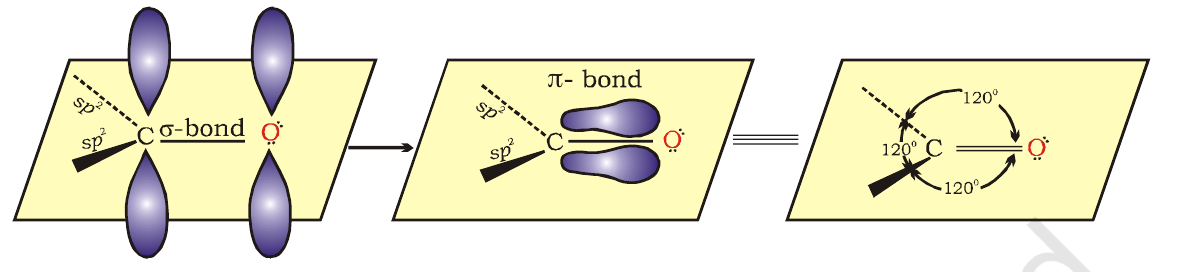
- The carbonyl carbon atom is sp2-hybridised and forms three sigma bonds. The fourth valence electron of carbon remains in its p-orbital and forms a pi-bond with oxygen by overlap with the p-orbital of oxygen. The oxygen atom also has two non-bonding electron pairs.
- The carbonyl carbon and the three atoms attached to it lie in the same plane, and the pi-electron cloud is above and below this plane. The bond angles are approximately 120 degrees, as expected of a trigonal coplanar structure (Fig. 8.1).
- The carbon-oxygen double bond is polarised because oxygen is more electronegative than carbon. The carbonyl carbon is an electrophilic (Lewis acid) centre, and carbonyl oxygen is a nucleophilic (Lewis base) centre.
- Carbonyl compounds have substantial dipole moments and are more polar than ethers. The high polarity is explained by resonance involving a neutral (A) and a dipolar (B) structure.
- In carboxylic acids, the bonds to the carboxyl carbon lie in one plane and are separated by about 120 degrees. The carboxylic carbon is less electrophilic than carbonyl carbon because of the possible resonance structure of the carboxyl group.
Suggest an edit
Preparation of aldehydes
- By oxidation of alcohols: primary alcohols give aldehydes on oxidation.
- By dehydrogenation of alcohols: alcohol vapours passed over heavy metal catalysts (Ag or Cu) give aldehydes from primary alcohols. This method suits volatile alcohols and is of industrial application.
- By ozonolysis of alkenes: ozonolysis followed by reaction with zinc dust and water gives aldehydes, ketones or a mixture of both depending on the substitution pattern of the alkene.
- By hydration of alkynes: addition of water to ethyne in the presence of $H_2SO_4$ and $HgSO_4$ gives acetaldehyde. All other alkynes give ketones in this reaction.
- Rosenmund reduction: an acyl chloride (acid chloride) is hydrogenated over palladium on barium sulphate to give the aldehyde.
- Stephen reaction: a nitrile is reduced with stannous chloride in the presence of hydrochloric acid to the corresponding imine, which on hydrolysis gives the aldehyde.
- Diisobutylaluminium hydride (DIBAL-H) reduces nitriles selectively to imines, followed by hydrolysis to aldehydes. Esters are also reduced to aldehydes with DIBAL-H.
- Etard reaction: chromyl chloride ($CrO_2Cl_2$) oxidises the methyl group of toluene to a chromium complex, which on hydrolysis gives benzaldehyde.
- Chromic oxide ($CrO_3$) in acetic anhydride converts toluene or substituted toluene to benzylidene diacetate, which on hydrolysis with aqueous acid gives benzaldehyde.
- Side chain chlorination followed by hydrolysis: side chain chlorination of toluene gives benzal chloride, which on hydrolysis gives benzaldehyde. This is a commercial method of manufacture of benzaldehyde.
- Gattermann-Koch reaction: benzene or its derivative treated with carbon monoxide and hydrogen chloride in the presence of anhydrous aluminium chloride or cuprous chloride gives benzaldehyde or substituted benzaldehyde.
Suggest an edit
Preparation of ketones
- By oxidation of secondary alcohols, and by dehydrogenation of secondary alcohols over Ag or Cu.
- By hydration of alkynes: all alkynes other than ethyne give ketones on addition of water in the presence of $H_2SO_4$ and $HgSO_4$.
- By ozonolysis of alkenes, as for aldehydes.
- From acyl chlorides: treatment of acyl chlorides with dialkylcadmium, prepared by the reaction of cadmium chloride with Grignard reagent, gives ketones.
- From nitriles: treating a nitrile with Grignard reagent followed by hydrolysis yields a ketone.
- Friedel-Crafts acylation: benzene or substituted benzene treated with acid chloride in the presence of anhydrous aluminium chloride affords the corresponding ketone.
- Worked reagents from Example 8.1: hexan-1-ol to hexanal uses PCC ($C_5H_5NH$+$CrO_3Cl^-$); cyclohexanol to cyclohexanone uses anhydrous $CrO_3$; p-fluorotoluene to p-fluorobenzaldehyde uses $CrO_3$ in acetic anhydride, or $CrO_2Cl_2$ followed by $H_3O^+$; ethanenitrile to ethanal uses DIBAL-H; allyl alcohol to propenal uses PCC; but-2-ene to ethanal uses $O_3$/$H_2O$-Zn dust.
Suggest an edit
Table: preparation routes at a glance
- One starting material can often give the product by more than one route. Learn the reagent, not just the reaction name.
| Target | Starting material | Reagent | Note |
|---|---|---|---|
| Aldehyde | Primary alcohol | PCC or oxidation | Controlled oxidation stops at the aldehyde |
| Aldehyde | Acyl chloride | $H_2$, Pd/$BaSO_4$ | Rosenmund reduction |
| Aldehyde | Nitrile | $SnCl_2$/$HCl$, then hydrolysis | Stephen reaction |
| Aldehyde | Nitrile or ester | DIBAL-H, then hydrolysis | Stops at the aldehyde |
| Aldehyde | Toluene | $CrO_2Cl_2$, then hydrolysis | Etard reaction |
| Aldehyde | Toluene | $CrO_3$ in acetic anhydride, then aqueous acid | Through benzylidene diacetate |
| Aldehyde | Toluene | Side chain chlorination, then hydrolysis | Through benzal chloride; commercial method |
| Aldehyde | Benzene | $CO$ + $HCl$, anhyd $AlCl_3$ or CuCl | Gattermann-Koch reaction |
| Ketone | Secondary alcohol | Oxidation | Also by dehydrogenation over Ag or Cu |
| Ketone | Acyl chloride | Dialkylcadmium | From $CdCl_2$ + Grignard reagent |
| Ketone | Nitrile | Grignard reagent, then hydrolysis | Adds one carbon group |
| Ketone | Benzene | Acid chloride, anhyd $AlCl_3$ | Friedel-Crafts acylation |
| Aldehyde or ketone | Alkene | $O_3$, then Zn/$H_2O$ | Ozonolysis; products depend on substitution |
| Aldehyde | Ethyne | $H_2O$, $H_2SO_4$/$HgSO_4$ | Other alkynes give ketones |
Suggest an edit
Practice1 question
Try it now. A wrong answer costs nothing here, try again until you get it.
Which reagent converts an acyl chloride to an aldehyde without reducing it further?
NCERT 8.2.2: Rosenmund reduction uses $H_2$ over palladium on barium sulphate. $SnCl_2$/$HCl$ is the Stephen reaction, which starts from a nitrile, not an acyl chloride.
Physical properties of aldehydes and ketones
- Methanal is a gas at room temperature. Ethanal is a volatile liquid. Other aldehydes and ketones are liquid or solid at room temperature.
- The boiling points of aldehydes and ketones are higher than hydrocarbons and ethers of comparable molecular masses, because of weak molecular association arising out of dipole-dipole interactions. Their boiling points are lower than those of alcohols of similar molecular masses because of the absence of intermolecular hydrogen bonding.
- NCERT boiling points: n-butane 273 K (mass 58), methoxyethane 281 K (mass 60), propanal 322 K (mass 58), acetone 329 K (mass 58), propan-1-ol 370 K (mass 60).
- Worked order from Example 8.2, increasing boiling point: $CH_3CH_2CH_2CH_3$ < $H_5C_2$-O-C2H5 < $CH_3CH_2CH_2CHO$ < $CH_3CH_2CH_2CH_2OH$. Only butan-1-ol is associated by extensive intermolecular hydrogen bonding, so it boils highest; butanal is more polar than ethoxyethane, so its dipole-dipole attraction is stronger.
- The lower members of aldehydes and ketones such as methanal, ethanal and propanone are miscible with water in all proportions, because they form hydrogen bonds with water.
- Solubility in water decreases rapidly on increasing the length of the alkyl chain. All aldehydes and ketones are fairly soluble in organic solvents like benzene, ether, methanol and chloroform.
- The lower aldehydes have sharp pungent odours. As the size of the molecule increases, the odour becomes less pungent and more fragrant. Many naturally occurring aldehydes and ketones are used in the blending of perfumes and flavouring agents.
Suggest an edit
Nucleophilic addition: mechanism and reactivity
- Contrary to electrophilic addition reactions observed in alkenes, aldehydes and ketones undergo nucleophilic addition reactions.
- Mechanism: a nucleophile attacks the electrophilic carbon atom of the polar carbonyl group from a direction approximately perpendicular to the plane of the sp2 hybridised orbitals of carbonyl carbon (NCERT Fig. 8.2). The hybridisation of carbon changes from sp2 to sp3 in this process, and a tetrahedral alkoxide intermediate is produced.
- This intermediate captures a proton from the reaction medium to give the electrically neutral product. The net result is addition of Nu- and $H^+$ across the carbon-oxygen double bond.
- Reactivity: aldehydes are generally more reactive than ketones in nucleophilic addition reactions, for steric and electronic reasons. Sterically, the two relatively large substituents in ketones hinder the approach of the nucleophile more than the single substituent in aldehydes. Electronically, two alkyl groups reduce the electrophilicity of the carbonyl carbon more effectively than one.
- Example 8.3: benzaldehyde is less reactive than propanal in nucleophilic addition, because resonance reduces the polarity of the carbonyl group in benzaldehyde, so its carbonyl carbon is less electrophilic.
- Reactivity order from Intext Question 8.4 answers: ethanal > propanal > propanone > butanone; p-nitrobenzaldehyde > benzaldehyde > p-tolualdehyde > acetophenone.
Suggest an edit
Practice1 question
Try it now. A wrong answer costs nothing here, try again until you get it.
Why are aldehydes generally more reactive than ketones in nucleophilic addition reactions?
NCERT 8.4.1: sterically, two large substituents in ketones hinder nucleophile approach; electronically, two alkyl groups reduce the electrophilicity of the carbonyl carbon more than one does.
Nucleophilic addition and addition-elimination examples
- Addition of hydrogen cyanide (HCN): aldehydes and ketones react with HCN to yield cyanohydrins. The reaction occurs very slowly with pure HCN, so it is catalysed by a base, and the generated cyanide ion ($CN^-$) readily adds to carbonyl compounds. Cyanohydrins are useful synthetic intermediates.
- Addition of sodium hydrogensulphite: sodium hydrogensulphite adds to aldehydes and ketones to form addition products. The position of the equilibrium lies largely to the right for most aldehydes and to the left for most ketones due to steric reasons. The hydrogensulphite addition compound is water soluble and can be converted back to the original carbonyl compound by treating it with dilute mineral acid or alkali, so these are useful for separation and purification of aldehydes.
- Addition of Grignard reagents: Grignard reagents add to the carbonyl group (Unit 7, Class XII). Addition to methanal gives a primary alcohol, to other aldehydes a secondary alcohol, and to ketones a tertiary alcohol.
- Addition of alcohols: aldehydes react with one equivalent of monohydric alcohol in the presence of dry hydrogen chloride to yield an alkoxyalcohol intermediate known as a hemiacetal, which reacts with one more molecule of alcohol to give a gem-dialkoxy compound known as an acetal. Ketones react with ethylene glycol under similar conditions to form cyclic products known as ethylene glycol ketals. Dry hydrogen chloride protonates the oxygen of the carbonyl compound and increases the electrophilicity of the carbonyl carbon. Acetals and ketals are hydrolysed with aqueous mineral acids to yield the corresponding aldehydes and ketones.
- Addition of ammonia and its derivatives: nucleophiles such as ammonia and its derivatives $H_2N$-Z add to the carbonyl group of aldehydes and ketones. The reaction is reversible and catalysed by acid. The equilibrium favours product formation because of rapid dehydration of the intermediate to form >C=N-Z.
Suggest an edit
Table: N-substituted derivatives of aldehydes and ketones
- The products are >C=N-Z derivatives, from NCERT Table 8.2. Learn the reagent name with the product name as a pair.
| Z | Reagent name | Product name |
|---|---|---|
| -H | Ammonia | Imine |
| -R | Amine | Substituted imine (Schiff's base) |
| -OH | Hydroxylamine | Oxime |
| -NH2 | Hydrazine | Hydrazone |
| -NHC6H5 | Phenylhydrazine | Phenylhydrazone |
| -NHCONH2 | Semicarbazide | Semicarbazone |
| -NH-C6H3($NO_2$)2 (2,4-dinitrophenylamino) | 2,4-Dinitrophenylhydrazine | 2,4-Dinitrophenylhydrazone |
- 2,4-DNP derivatives are yellow, orange or red solids, useful for characterisation of aldehydes and ketones.
Suggest an edit
Reduction, oxidation and the aldehyde tests
- Reduction to alcohols: aldehydes and ketones are reduced to primary and secondary alcohols respectively by sodium borohydride ($NaBH_4$) or lithium aluminium hydride ($LiAlH_4$), as well as by catalytic hydrogenation.
- Reduction to hydrocarbons: the carbonyl group is reduced to a $CH_2$ group on treatment with zinc-amalgam and concentrated hydrochloric acid (Clemmensen reduction), or with hydrazine followed by heating with sodium or potassium hydroxide in a high boiling solvent such as ethylene glycol (Wolff-Kishner reduction).
- Oxidation: aldehydes are easily oxidised to carboxylic acids on treatment with common oxidising agents like nitric acid, potassium permanganate and potassium dichromate. Even mild oxidising agents, mainly Tollens' reagent and Fehling's reagent, also oxidise aldehydes.
- Ketones are generally oxidised under vigorous conditions, that is, strong oxidising agents and elevated temperatures. Their oxidation involves carbon-carbon bond cleavage to afford a mixture of carboxylic acids having a lesser number of carbon atoms than the parent ketone.
- Tollens' test: on warming an aldehyde with freshly prepared ammoniacal silver nitrate solution (Tollens' reagent), a bright silver mirror is produced due to the formation of silver metal. The aldehydes are oxidised to the corresponding carboxylate anion. The reaction occurs in alkaline medium.
- Fehling's test: Fehling reagent comprises two solutions. Fehling solution A is aqueous copper sulphate and Fehling solution B is alkaline sodium potassium tartrate (Rochelle salt). The two solutions are mixed in equal amounts before the test. On heating an aldehyde with Fehling's reagent, a reddish brown precipitate is obtained. Aldehydes are oxidised to the corresponding carboxylate anion. Aromatic aldehydes do not respond to this test.
- Haloform reaction: aldehydes and ketones having at least one methyl group linked to the carbonyl carbon atom (methyl ketones) are oxidised by sodium hypohalite to sodium salts of the corresponding carboxylic acids having one carbon atom less than the carbonyl compound. The methyl group is converted to haloform. This oxidation does not affect a carbon-carbon double bond, if present in the molecule. Iodoform reaction with sodium hypoiodite is also used for detection of $CH_3CO$ group or $CH_3CH$(OH) group, which produces $CH_3CO$ group on oxidation.
- Worked identification from Example 8.4: a compound $C_8H_8O$ forms an orange-red precipitate with 2,4-DNP reagent and gives a yellow precipitate on heating with iodine in sodium hydroxide, but it neither reduces Tollens' or Fehling's reagent nor decolourises bromine water. On drastic oxidation with chromic acid it gives benzoic acid, $C_7H_6O_2$. The compound is acetophenone (phenyl methyl ketone): a ketone (no Tollens/Fehling), a methyl ketone (iodoform positive), and aromatic (no bromine water reaction).
- Uses of aldehydes and ketones: formaldehyde is well known as formalin (40 percent) solution used to preserve biological specimens and to prepare bakelite (a phenol-formaldehyde resin), urea-formaldehyde glues and other polymeric products. Acetaldehyde is used primarily as a starting material in the manufacture of acetic acid, ethyl acetate, vinyl acetate, polymers and drugs. Benzaldehyde is used in perfumery and in dye industries. Acetone and ethyl methyl ketone are common industrial solvents. Many aldehydes and ketones, for example butyraldehyde, vanillin, acetophenone and camphor, are well known for their odours and flavours.
Suggest an edit
Practice1 question
Try it now. A wrong answer costs nothing here, try again until you get it.
Which compound gives a silver mirror with Tollens' reagent but does not respond to Fehling's test?
NCERT 8.4.3: Tollens' reagent oxidises all aldehydes, but aromatic aldehydes do not respond to Fehling's test. Propanone and acetone are ketones and do not reduce either reagent.
Reactions of the alpha-hydrogen: aldol and Cannizzaro
- Acidity of alpha-hydrogens: the aldehydes and ketones undergo a number of reactions due to the acidic nature of alpha-hydrogen. The acidity is due to the strong electron withdrawing effect of the carbonyl group and resonance stabilisation of the conjugate base.
- Aldol condensation: aldehydes and ketones having at least one alpha-hydrogen undergo a reaction in the presence of dilute alkali as catalyst to form beta-hydroxy aldehydes (aldol) or beta-hydroxy ketones (ketol) respectively. The name aldol is derived from the two functional groups, aldehyde and alcohol, present in the products.
- The aldol and ketol readily lose water to give alpha,beta-unsaturated carbonyl compounds, which are aldol condensation products, and the reaction is called aldol condensation. Though ketones give ketols, the general name aldol condensation still applies to the reactions of ketones due to their similarity with aldehydes.
- Cross aldol condensation: when aldol condensation is carried out between two different aldehydes and/or ketones, it is called cross aldol condensation. If both of them contain alpha-hydrogen atoms, it gives a mixture of four products. NCERT illustrates this with the aldol reaction of a mixture of ethanal and propanal.
- Cannizzaro reaction: aldehydes which do not have an alpha-hydrogen atom undergo self oxidation and reduction (disproportionation) on heating with concentrated alkali. One molecule of the aldehyde is reduced to alcohol while another is oxidised to carboxylic acid salt.
- Electrophilic substitution: aromatic aldehydes and ketones undergo electrophilic substitution at the ring, in which the carbonyl group acts as a deactivating and meta-directing group.
Suggest an edit
Ladder: aldol, cross aldol or Cannizzaro
- First ask: does the carbonyl compound have an alpha-hydrogen? That one question decides the reaction.
- Has at least one alpha-hydrogen, dilute alkali: aldol condensation. Ethanal gives 3-hydroxybutanal, which loses water to but-2-enal; a ketone gives the ketol, which loses water to the alpha,beta-unsaturated ketone (for propanone, 4-methylpent-3-en-2-one, mesityl oxide, Table 8.1).
- Two different aldehydes and/or ketones, dilute alkali: cross aldol condensation. If both partners contain alpha-hydrogen atoms, the reaction gives a mixture of four products.
- No alpha-hydrogen, concentrated alkali, heating: Cannizzaro reaction. Methanal and benzaldehyde are the standard examples; one molecule becomes the alcohol and another becomes the carboxylate salt.
- Methyl ketone, sodium hypohalite: haloform reaction, not aldol. The acid formed has one carbon atom less than the carbonyl compound, and the methyl group becomes haloform.
- Neither reaction: benzophenone has no alpha-hydrogen and is a ketone, so it undergoes neither aldol condensation nor Cannizzaro reaction. Butan-1-ol is not a carbonyl compound at all, so it does neither.
- How to use the ladder in a question: count alpha-hydrogens first, then check the alkali strength. Dilute alkali with alpha-H means aldol; concentrated alkali without alpha-H means Cannizzaro; a methyl ketone with hypohalite means haloform.
Suggest an edit
Carboxylic acids: names, structure and preparation
- Carbon compounds containing a carboxyl functional group, -COOH, are called carboxylic acids. The carboxyl group consists of a carbonyl group attached to a hydroxyl group. Carboxylic acids may be aliphatic (RCOOH) or aromatic (ArCOOH) depending on the group attached to the carboxylic carbon.
- Common names end with the suffix -ic acid and come from Latin or Greek names of their natural sources. Formic acid (HCOOH) was first obtained from red ants (Latin: formica means ant), acetic acid ($CH_3COOH$) from vinegar (Latin: acetum means vinegar), butyric acid ($CH_3CH_2CH_2COOH$) from rancid butter (Latin: butyrum means butter).
- IUPAC system: aliphatic carboxylic acids are named by replacing the ending -e in the name of the corresponding alkane with -oic acid. The carboxylic carbon is numbered one. Compounds with more than one carboxyl group use the multiplicative prefix dicarboxylic acid, tricarboxylic acid, and so on, with the positions of the -COOH groups shown by arabic numerals before the prefix.
- Names from NCERT Table 8.3: formic acid is methanoic acid; acetic acid is ethanoic acid; propionic acid is propanoic acid; butyric acid is butanoic acid; isobutyric acid is 2-methylpropanoic acid; oxalic acid is ethanedioic acid; malonic acid is propanedioic acid; succinic acid is butanedioic acid; glutaric acid is pentanedioic acid; adipic acid is hexanedioic acid; tricarballylic acid is propane-1,2,3-tricarboxylic acid; benzoic acid is benzenecarboxylic acid; phenylacetic acid is 2-phenylethanoic acid; phthalic acid is benzene-1,2-dicarboxylic acid.
- Structure: in carboxylic acids, the bonds to the carboxyl carbon lie in one plane and are separated by about 120 degrees.
- Preparation, method 1: primary alcohols are readily oxidised to carboxylic acids with potassium permanganate ($KMnO_4$) in neutral, acidic or alkaline media, or by potassium dichromate ($K_2Cr_2O_7$) and chromium trioxide ($CrO_3$) in acidic media (Jones reagent). Aldehydes give carboxylic acids with mild oxidising agents.
- Preparation, method 2: aromatic carboxylic acids are prepared by vigorous oxidation of alkyl benzenes with chromic acid or acidic or alkaline potassium permanganate. The entire side chain is oxidised to the carboxyl group irrespective of the length of the side chain. Primary and secondary alkyl groups are oxidised in this manner, while a tertiary group is not affected.
- Preparation, method 3: nitriles are hydrolysed to amides and then to acids in the presence of $H^+$ or $OH^-$ as catalyst. Mild reaction conditions are used to stop the reaction at the amide stage.
- Preparation, method 4: Grignard reagents react with carbon dioxide (dry ice) to form salts of carboxylic acids, which give the corresponding carboxylic acids after acidification with mineral acid. Methods 3 and 4 convert alkyl halides into carboxylic acids having one carbon atom more than the alkyl halide, ascending the series.
- Preparation, method 5: acid chlorides hydrolysed with water give carboxylic acids, or more readily hydrolysed with aqueous base to give carboxylate ions which on acidification provide carboxylic acids. Anhydrides are hydrolysed to the corresponding acid or acids with water.
- Preparation, method 6: acidic hydrolysis of esters gives directly carboxylic acids, while basic hydrolysis gives carboxylates, which on acidification give carboxylic acids.
Suggest an edit
Acidity and reactions of carboxylic acids
- Physical properties: aliphatic carboxylic acids up to nine carbon atoms are colourless liquids at room temperature with unpleasant odours. The higher acids are wax-like solids and are practically odourless due to their low volatility.
- Carboxylic acids are higher boiling liquids than aldehydes, ketones and even alcohols of comparable molecular masses, because of more extensive association through intermolecular hydrogen bonding. The hydrogen bonds are not broken completely even in the vapour phase; most carboxylic acids exist as dimer in the vapour phase or in aprotic solvents.
- Simple aliphatic carboxylic acids having up to four carbon atoms are miscible in water due to hydrogen bonds with water. Solubility decreases with increasing number of carbon atoms. Higher carboxylic acids are practically insoluble in water due to the increased hydrophobic interaction of the hydrocarbon part. Benzoic acid, the simplest aromatic carboxylic acid, is nearly insoluble in cold water.
- Acidity: carboxylic acids dissociate in water to give resonance stabilised carboxylate anions and hydronium ion. The strength of an acid is generally indicated by its $\mathrm{p}K_a$ value rather than its Ka value. $\mathrm{p}K_a$ = -log Ka. Smaller the $\mathrm{p}K_a$, the stronger the acid.
- $\mathrm{p}K_a$ values from NCERT: hydrochloric acid -7.0; trifluoroacetic acid (the strongest carboxylic acid) 0.23; benzoic acid 4.19; acetic acid 4.76. Strong acids have $\mathrm{p}K_a$ values below 1, moderately strong acids between 1 and 5, weak acids between 5 and 15, and extremely weak acids above 15.
- Carboxylic acids are weaker than mineral acids, but stronger acids than alcohols and many simple phenols ($\mathrm{p}K_a$ is about 16 for ethanol and 10 for phenol). The carboxylate ion is stabilised by two equivalent resonance structures in which the negative charge is at the more electronegative oxygen atom, while the phenoxide ion has non-equivalent resonance structures with the negative charge at the less electronegative carbon atom.
- Effect of substituents: electron withdrawing groups increase the acidity by stabilising the conjugate base through delocalisation of the negative charge by inductive and/or resonance effects. Electron donating groups decrease the acidity by destabilising the conjugate base.
- The effect of groups in increasing acidity order is: Ph < I < Br < Cl < F < CN < $NO_2$ < $CF_3$. Acids in order of decreasing acidity: $CF_3COOH$ > $CCl_3COOH$ > $CHCl_2COOH$ > $NO_2CH_2COOH$ > NC-CH2COOH > $FCH_2COOH$ > $ClCH_2COOH$ > $BrCH_2COOH$ > HCOOH > $ClCH_2CH_2COOH$ > $C_6H_5COOH$ > $C_6H_5CH_2COOH$ > $CH_3COOH$ > $CH_3CH_2COOH$.
- Direct attachment of phenyl or vinyl groups to the carboxylic acid increases acidity, because of the greater electronegativity of the sp2 hybridised carbon to which the carboxyl carbon is attached. An electron withdrawing group on the phenyl ring of an aromatic carboxylic acid increases acidity, while an electron donating group decreases it: 4-methoxybenzoic acid $\mathrm{p}K_a$ 4.46, benzoic acid 4.19, 4-nitrobenzoic acid 3.41.
- Reactions involving cleavage of the O-H bond: carboxylic acids evolve hydrogen with electropositive metals and form salts with alkalies similar to phenols. Unlike phenols, they react with weaker bases such as carbonates and hydrogencarbonates to evolve carbon dioxide. This reaction is used to detect the presence of a carboxyl group.
- Reactions involving cleavage of the C-OH bond: (1) formation of anhydride on heating with mineral acids such as $H_2SO_4$ or with $P_2O_5$; (2) esterification with alcohols or phenols in the presence of concentrated $H_2SO_4$ or $HCl$ gas as catalyst; (3) reaction with $PCl_5$, $PCl_3$ and $SOCl_2$ to replace the hydroxyl group by chlorine, with thionyl chloride ($SOCl_2$) preferred because the other two products are gaseous and escape the reaction mixture; (4) reaction with ammonia to give an ammonium salt, which on further heating at high temperature gives an amide.
- Reactions involving the -COOH group: (1) reduction to primary alcohols by lithium aluminium hydride or better with diborane; sodium borohydride does not reduce the carboxyl group, and diborane does not easily reduce ester, nitro or halo groups; (2) decarboxylation: sodium salts heated with sodalime ($NaOH$ and $CaO$ in the ratio 3:1) lose carbon dioxide to form hydrocarbons; alkali metal salts on electrolysis of their aqueous solutions undergo Kolbe electrolysis to form hydrocarbons having twice the number of carbon atoms present in the alkyl group of the acid.
- Substitution in the hydrocarbon part: (1) Hell-Volhard-Zelinsky reaction: carboxylic acids having an alpha-hydrogen are halogenated at the alpha-position on treatment with chlorine or bromine in the presence of a small amount of red phosphorus to give alpha-halocarboxylic acids; (2) ring substitution: aromatic carboxylic acids undergo electrophilic substitution in which the carboxyl group acts as a deactivating and meta-directing group. They do not undergo Friedel-Crafts reaction, because the carboxyl group is deactivating and the catalyst aluminium chloride (Lewis acid) gets bonded to the carboxyl group.
- Uses of carboxylic acids: methanoic acid is used in rubber, textile, dyeing, leather and electroplating industries. Ethanoic acid is used as solvent and as vinegar in the food industry. Hexanedioic acid is used in the manufacture of nylon-6,6. Esters of benzoic acid are used in perfumery. Sodium benzoate is used as a food preservative. Higher fatty acids are used for the manufacture of soaps and detergents.
Suggest an edit
Practice1 question
Try it now. A wrong answer costs nothing here, try again until you get it.
Which of the following acids is the strongest?
NCERT 8.9.1: trifluoroacetic acid has $\mathrm{p}K_a$ 0.23 and is the strongest carboxylic acid listed; the order is $CF_3COOH$ > $CCl_3COOH$ > $CHCl_2COOH$ > $FCH_2COOH$ > $ClCH_2COOH$ > HCOOH > $CH_3COOH$.
Trap pairs: the confusions NEET tests
- Tollens vs Fehling: Tollens' reagent oxidises every aldehyde, including aromatic ones, to the carboxylate anion with a silver mirror. Fehling's reagent oxidises aliphatic aldehydes only; aromatic aldehydes do not respond to this test.
- Aldol vs Cannizzaro: an alpha-hydrogen plus dilute alkali means aldol condensation; no alpha-hydrogen plus concentrated alkali and heat means Cannizzaro reaction.
- Clemmensen vs Wolff-Kishner: both reduce the carbonyl group to a $CH_2$ group. Clemmensen uses zinc-amalgam and concentrated hydrochloric acid (acidic conditions); Wolff-Kishner uses hydrazine followed by heating with sodium or potassium hydroxide in ethylene glycol (basic conditions).
- Rosenmund vs Stephen: Rosenmund reduction starts from an acyl chloride with $H_2$ over Pd/$BaSO_4$; Stephen reaction starts from a nitrile with $SnCl_2$/$HCl$.
- Fehling A vs Fehling B: solution A is aqueous copper sulphate; solution B is alkaline sodium potassium tartrate (Rochelle salt). The two are mixed in equal amounts before the test.
- Acetal vs ketal: an aldehyde with alcohol gives an acetal (gem-dialkoxy compound); a ketone with ethylene glycol gives a cyclic ketal.
- Esterification vs HVZ reaction: esterification replaces the C-OH bond of the acid; the Hell-Volhard-Zelinsky reaction halogenates the alpha-carbon of the acid.
- Carboxylic acid vs phenol acidity: a carboxylic acid is the stronger acid (acetic acid $\mathrm{p}K_a$ 4.76 against phenol $\mathrm{p}K_a$ 10), because the carboxylate ion has two equivalent resonance structures with the charge on oxygen.
- Grignard on aldehyde vs ketone: addition to an aldehyde gives a secondary alcohol (methanal gives a primary alcohol); addition to a ketone gives a tertiary alcohol.
- Cross aldol vs aldol: cross aldol uses two different carbonyl partners; if both contain alpha-hydrogen atoms, the mixture gives four products.
Suggest an edit
Trap Boxes
Tollens and Fehling both work for every aldehyde?
Wrong idea: Both Tollens' reagent and Fehling's reagent detect all aldehydes, including aromatic aldehydes like benzaldehyde.
Tollens' reagent oxidises all aldehydes, but Fehling's reagent does not oxidise aromatic aldehydes. Benzaldehyde gives a silver mirror with Tollens' reagent and no reddish-brown precipitate with Fehling's reagent.
NCERT XII, Ch 8, 8.4.3
Aldol condensation happens for any aldehyde or ketone?
Wrong idea: Any aldehyde or ketone undergoes aldol condensation in dilute alkali.
Only aldehydes and ketones having at least one alpha-hydrogen undergo aldol condensation. Aldehydes with no alpha-hydrogen, such as methanal and benzaldehyde, undergo the Cannizzaro reaction with concentrated alkali instead.
NCERT XII, Ch 8, 8.4.4
Fehling solution A is the alkaline tartrate solution?
Wrong idea: Fehling solution A is the alkaline solution of sodium potassium tartrate, and solution B is aqueous copper sulphate.
Fehling solution A is aqueous copper sulphate and Fehling solution B is alkaline sodium potassium tartrate (Rochelle salt). The two solutions are mixed in equal amounts before the test.
NCERT XII, Ch 8, 8.4.3
Ketones are oxidised as easily as aldehydes?
Wrong idea: Ketones are oxidised to carboxylic acids by Tollens' reagent just like aldehydes.
Aldehydes are oxidised even by mild reagents such as Tollens' and Fehling's reagents. Ketones are oxidised only under vigorous conditions, and their oxidation involves carbon-carbon bond cleavage to a mixture of carboxylic acids with fewer carbon atoms.
NCERT XII, Ch 8, 8.4.3
Iodoform test detects any aldehyde or ketone?
Wrong idea: Any aldehyde or ketone with a methyl group gives a positive iodoform test.
Only methyl ketones (compounds with a $CH_3CO$ group) and compounds with a $CH_3CH$(OH) group, which oxidises to $CH_3CO$, respond to the iodoform test. The methyl group becomes haloform and the acid formed has one carbon atom less than the carbonyl compound.
NCERT XII, Ch 8, 8.4.3
Chapter test
5 NEET PYQs. +4 for a correct answer, -1 for a wrong answer, exactly like NEET. Finish the test to earn a medal.
Q1: NEET (UG) 2024, Code R3, Q66
Fehling's solution 'A' is:
NCERT 8.4.3: Fehling solution A is aqueous copper sulphate, and solution B is alkaline sodium potassium tartrate (Rochelle salt).
Q2: NEET (UG) 2022, Code R1, Q81
Given below are two statements:
Statement I: The boiling points of aldehydes and ketones are higher than hydrocarbons of comparable molecular masses because of weak molecular association in aldehydes and ketones due to dipole-dipole interactions.
Statement II: The boiling points of aldehydes and ketones are lower than the alcohols of similar molecular masses due to the absence of H-bonding.
In the light of the above statements, choose the most appropriate answer from the options given below:
Both statements repeat NCERT 8.3: dipole-dipole association raises aldehyde and ketone boiling points above hydrocarbons, and the absence of intermolecular H-bonding keeps them below alcohols.
Q3: NEET (UG) 2021, Code P3, Q60
What is the IUPAC name of the organic compound formed in the following chemical reaction? Acetone --(i) $C_2H_5MgBr$, dry ether (ii) $H_2O$, $H^+$--> Product
Ethylmagnesium bromide adds to the carbonyl carbon of acetone, and hydrolysis gives 2-methylbutan-2-ol.
Q4: NEET (UG) 2020, Code G5, Q118
Reaction between benzaldehyde and acetophenone in presence of dilute $NaOH$ is known as
Benzaldehyde has no alpha-hydrogen and acetophenone has alpha-hydrogens, so dilute alkali gives cross aldol condensation between the two different carbonyl compounds.
Q5: NEET (UG) 2020, Code G5, Q104
Reaction between acetone and methylmagnesium chloride followed by hydrolysis will give :
Methylmagnesium chloride adds to the carbonyl carbon of acetone, and hydrolysis gives tert-butyl alcohol, a tertiary alcohol.
Score: 0 · Answered 0 of 5
Flashcards
Tap a card to flip it over and see the answer. Tap it again to flip it back.
State the Rosenmund reduction.
Tap to flipAn acyl chloride is hydrogenated over palladium on barium sulphate to give the aldehyde: RCOCl + $H_2$, Pd/$BaSO_4$ -> RCHO.
Tap to flip backState the Stephen reaction, and what DIBAL-H does to a nitrile.
Tap to flipStephen reaction: a nitrile is reduced with stannous chloride in hydrochloric acid to the imine, which on hydrolysis gives the aldehyde. DIBAL-H also reduces nitriles selectively to imines, followed by hydrolysis to aldehydes, and reduces esters to aldehydes.
Tap to flip backState the Etard reaction.
Tap to flipChromyl chloride ($CrO_2Cl_2$) oxidises the methyl group of toluene to a chromium complex, which on hydrolysis gives benzaldehyde.
Tap to flip backState the Gattermann-Koch reaction.
Tap to flipBenzene or its derivative treated with carbon monoxide and hydrogen chloride in the presence of anhydrous aluminium chloride or cuprous chloride gives benzaldehyde or substituted benzaldehyde.
Tap to flip backClemmensen or Wolff-Kishner: which reagents reduce C=O to $CH_2$?
Tap to flipBoth reduce the carbonyl group to a $CH_2$ group. Clemmensen: zinc-amalgam and concentrated hydrochloric acid. Wolff-Kishner: hydrazine followed by heating with sodium or potassium hydroxide in ethylene glycol.
Tap to flip backState the aldol condensation and its condition.
Tap to flipAldehydes and ketones having at least one alpha-hydrogen react in the presence of dilute alkali to form beta-hydroxy aldehydes (aldol) or beta-hydroxy ketones (ketol), which readily lose water to give alpha,beta-unsaturated carbonyl compounds.
Tap to flip backState the Cannizzaro reaction and its condition.
Tap to flipAldehydes with no alpha-hydrogen atom undergo self oxidation and reduction (disproportionation) on heating with concentrated alkali: one molecule is reduced to alcohol and another is oxidised to carboxylic acid salt.
Tap to flip backGive the $\mathrm{p}K_a$ values of trifluoroacetic acid, benzoic acid and acetic acid, and of ethanol and phenol.
Tap to flipTrifluoroacetic acid 0.23 (the strongest carboxylic acid), benzoic acid 4.19, acetic acid 4.76, phenol 10, ethanol about 16. Smaller $\mathrm{p}K_a$ means a stronger acid.
Tap to flip backArrange in order of decreasing acidity: $CF_3COOH$, $CCl_3COOH$, $CHCl_2COOH$, $FCH_2COOH$, $ClCH_2COOH$, $BrCH_2COOH$, HCOOH, $CH_3COOH$, $CH_3CH_2COOH$.
Tap to flip$CF_3COOH$ > $CCl_3COOH$ > $CHCl_2COOH$ > $FCH_2COOH$ > $ClCH_2COOH$ > $BrCH_2COOH$ > HCOOH > $CH_3COOH$ > $CH_3CH_2COOH$. (Full NCERT 8.9.1 chain also includes $NO_2CH_2COOH$ > NC-CH2COOH between $CHCl_2COOH$ and $FCH_2COOH$, and $ClCH_2CH_2COOH$ > $C_6H_5COOH$ > $C_6H_5CH_2COOH$ between HCOOH and $CH_3COOH$; group ef
Tap to flip backArrange in increasing order of reactivity in nucleophilic addition: ethanal, propanal, propanone, butanone.
Tap to flipButanone < propanone < propanal < ethanal. Aldehydes are more reactive than ketones for steric and electronic reasons. For aromatics: acetophenone < p-tolualdehyde < benzaldehyde < p-nitrobenzaldehyde.
Tap to flip backWhich aldehydes do not respond to Fehling's test, and why is benzaldehyde less reactive than propanal?
Tap to flipAromatic aldehydes do not respond to Fehling's test. Benzaldehyde is less reactive than propanal in nucleophilic addition because resonance reduces the polarity of its carbonyl group, so its carbonyl carbon is less electrophilic.
Tap to flip backGive the general formulas of an aldehyde, a ketone and a carboxylic acid.
Tap to flipAldehyde RCHO, ketone RCOR', carboxylic acid RCOOH. The carboxyl group -COOH is a carbonyl group attached to a hydroxyl group.
Tap to flip back