 NEET Notes
Home > Chemistry > Organic > Alcohols, Phenols and Ethers
Alcohols, Phenols and Ethers
On this page · 18 sections
- 01Syllabus map: what this chapter covers
- 02Classification: alcohols, phenols and ethers
- 03Table: common and IUPAC names of alcohols
- 04Table: common and IUPAC names of ethers and phenols
- 05Structures of the functional groups
- 06Preparation of alcohols from alkenes
- 07Preparation of alcohols from carbonyl compounds and Grignard reagents
- 08Preparation of phenols
- 09Physical properties: boiling points and solubility
- 10Table: $\mathrm{p}K_a$ values and the acidity ladder
- 11Reactions of alcohols: O-H bond cleavage
- 12C-O bond cleavage in alcohols: Lucas test, dehydration, oxidation
- 13Reactions of phenols: electrophilic substitution
- 14Kolbe, Reimer-Tiemann and other phenol reactions
- 15Commercially important alcohols: methanol and ethanol
- 16Preparation of ethers: dehydration and Williamson synthesis
- 17Table: ethers against alkanes and alcohols
- 18Chemical reactions of ethers
NCERT-mapped Alcohols, Phenols and Ethers notes for NEET 2027: acidity and $\mathrm{p}K_a$, Lucas test, dehydration, ether cleavage, Williamson synthesis, Kolbe and Reimer-Tiemann, with PYQs.
Syllabus map: what this chapter covers
- NMC Unit: CHEM-U17, Organic Compounds Containing Oxygen. This chapter covers the alcohols, phenols and ethers part of that unit: alcohols (identification of primary, secondary and tertiary alcohols; mechanism of dehydration), phenols (acidic nature; electrophilic substitution: halogenation, nitration and sulphonation; Reimer-Tiemann reaction) and ethers (structure).
- Subtopics in this chapter (NCERT XII, Ch 7): classification (7.1); nomenclature (7.2); structures of functional groups (7.3); alcohols and phenols, preparation (7.4.1, 7.4.2), physical properties (7.4.3), chemical reactions (7.4.4); commercially important alcohols (7.5); ethers, preparation (7.6.1), physical properties (7.6.2), chemical reactions (7.6.3).
- Subtopic checklist: (1) mono, di, tri and polyhydric alcohols and phenols; (2) common and IUPAC names; (3) bond lengths and angles; (4) alcohol preparation from alkenes, carbonyl compounds and Grignard reagents; (5) phenol preparation from haloarenes, benzenesulphonic acid, diazonium salts and cumene; (6) acidity and $\mathrm{p}K_a$; (7) Lucas test, dehydration and oxidation; (8) phenol electrophilic substitution, Kolbe and Reimer-Tiemann reactions; (9) methanol and ethanol; (10) Williamson synthesis and ether cleavage.
- Scope note: NMC Unit 17 also lists aldehydes, ketones and carboxylic acids. Those are NCERT Ch 8 and are covered in the companion chapter on aldehydes, ketones and carboxylic acids, not here.
- Extra information (beyond NCERT): none. Everything in this chapter is NCERT Chapter 7.
- Estimated revision time: 12 minutes. Jump links: Syllabus map, Classification, Table: alcohol names, Table: ether and phenol names, Structures, Preparation from alkenes, Preparation from carbonyls and Grignard, Preparation of phenols, Physical properties, Table: $\mathrm{p}K_a$ and acidity, O-H cleavage, C-O cleavage, Ladder, Phenol electrophilic substitution, Kolbe and Reimer-Tiemann, Commercial alcohols, Preparation of ethers, Table: ethers vs alkanes and alcohols, Reactions of ethers.
Suggest an edit
Classification: alcohols, phenols and ethers
- An alcohol has one or more -OH groups attached directly to carbon atoms of an aliphatic system ($CH_3OH$). A phenol has -OH group(s) attached directly to carbon atoms of an aromatic system ($C_6H_5OH$).
- An ether results when a hydrogen of the -OH group of an alcohol or phenol is replaced by an alkyl or aryl group (R-O/Ar-O), for example $CH_3OCH_3$, dimethyl ether.
- Alcohols and phenols are mono, di, tri or polyhydric according to whether they carry one, two, three or many -OH groups.
- Monohydric alcohols are further classed by the hybridisation of the carbon bearing -OH: compounds with a Csp3-OH bond include primary, secondary and tertiary alkyl alcohols, allylic alcohols ($CH_2$=CH-CH2-OH, -OH on an sp3 carbon next to C=C) and benzylic alcohols (-OH on an sp3 carbon next to an aromatic ring); compounds with a Csp2-OH bond include vinylic alcohols ($CH_2$=CH-OH) and phenols (-OH on an sp2 carbon of a benzene ring).
- Alcohols are primary, secondary or tertiary according to whether the carbon bearing -OH is attached to one, two or three other carbon atoms.
- Ethers are simple (symmetrical) when the two groups on oxygen are the same, for example $C_2H_5OC_2H_5$, and mixed (unsymmetrical) when they differ, for example $C_2H_5OCH_3$ and $C_2H_5OC_6H_5$.
Suggest an edit
Practice1 question
Try it now. A wrong answer costs nothing here, try again until you get it.
Which of these is a tertiary alcohol?
NCERT 7.1: the carbon bearing -OH in ($CH_3$)3COH is attached to three other carbon atoms, so it is a tertiary alcohol. Propan-1-ol and ethane-1,2-diol carry -OH on primary carbons, and propan-2-ol is secondary.
Table: common and IUPAC names of alcohols
| Compound | Common name | IUPAC name |
|---|---|---|
| $CH_3$-OH | Methyl alcohol | Methanol |
| $CH_3$-CH2-CH2-OH | n-Propyl alcohol | Propan-1-ol |
| $CH_3$-CH(OH)-CH3 | Isopropyl alcohol | Propan-2-ol |
| $CH_3$-CH2-CH2-CH2-OH | n-Butyl alcohol | Butan-1-ol |
| $CH_3$-CH2-CH(OH)-CH3 | sec-Butyl alcohol | Butan-2-ol |
| ($CH_3$)2CH-CH2-OH | Isobutyl alcohol | 2-Methylpropan-1-ol |
| ($CH_3$)3C-OH | tert-Butyl alcohol | 2-Methylpropan-2-ol |
| HO-CH2-CH2-OH | Ethylene glycol | Ethane-1,2-diol |
| HO-CH2-CH(OH)-CH2-OH | Glycerol | Propane-1,2,3-triol |
- IUPAC rule: drop the 'e' of the alkane and add 'ol'; number the longest chain from the end nearest the -OH group.
- For polyhydric alcohols the 'e' is kept and 'di', 'tri' etc. are added before 'ol', with locants for the -OH positions, for example ethane-1,2-diol.
- Cyclic alcohols use the prefix cyclo with -OH on C-1, for example cyclohexanol and 2-methylcyclopentanol.
Suggest an edit
Table: common and IUPAC names of ethers and phenols
| Compound | Common name | IUPAC name |
|---|---|---|
| $CH_3OCH_3$ | Dimethyl ether | Methoxymethane |
| $C_2H_5OC_2H_5$ | Diethyl ether | Ethoxyethane |
| $CH_3OCH_2CH_2CH_3$ | Methyl n-propyl ether | 1-Methoxypropane |
| $C_6H_5OCH_3$ | Methyl phenyl ether (Anisole) | Methoxybenzene (Anisole) |
| $C_6H_5OCH_2CH_3$ | Ethyl phenyl ether (Phenetole) | Ethoxybenzene |
| $C_6H_5O$($CH_2$)6-CH3 | Heptyl phenyl ether | 1-Phenoxyheptane |
| $CH_3OCH$($CH_3$)2 | Methyl isopropyl ether | 2-Methoxypropane |
| $C_6H_5OCH_2CH_2CH$($CH_3$)2 | Phenyl isopentyl ether | 3-Methylbutoxybenzene |
| $CH_3OCH_2CH_2OCH_3$ | - | 1,2-Dimethoxyethane |
| 2-Ethoxy-1,1-dimethylcyclohexane | - | 2-Ethoxy-1,1-dimethylcyclohexane |
- Common ether names list the alkyl/aryl groups in alphabetical order followed by 'ether'; if both groups are the same, 'di' is added, as in diethyl ether.
- IUPAC: ethers are hydrocarbon derivatives in which a hydrogen is replaced by -OR or -OAr; the larger group is the parent hydrocarbon.
- Phenol is both the common name and the accepted IUPAC name. Substituted phenols use ortho (1,2), meta (1,3) and para (1,4): o-cresol is 2-methylphenol, m-cresol is 3-methylphenol, p-cresol is 4-methylphenol.
- Dihydroxybenzenes: catechol is benzene-1,2-diol, resorcinol is benzene-1,3-diol, hydroquinone (quinol) is benzene-1,4-diol.
- Metamerism in ethers (from NCERT XI, Ch 8, 8.6.1): ethers with the same molecular formula $C_4H_{10}O$ but different alkyl groups around oxygen, such as ethoxyethane ($C_2H_5OC_2H_5$), 1-methoxypropane ($CH_3OCH_2CH_2CH_3$) and 2-methoxypropane ($CH_3OCH$($CH_3$)2), are metamers.
Suggest an edit
Structures of the functional groups
- In alcohols the oxygen of -OH is attached to carbon by a sigma bond formed by overlap of an sp3 hybridised orbital of carbon with an sp3 hybridised orbital of oxygen.
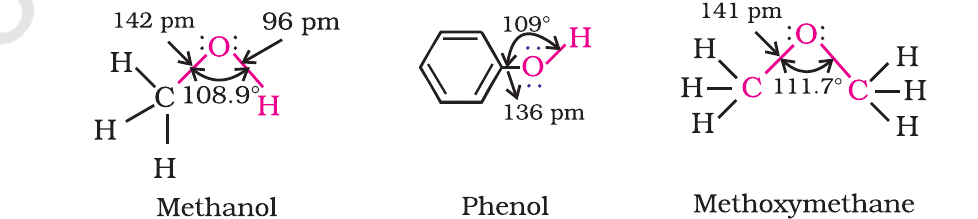
- NCERT Fig. 7.1 shows methanol, phenol and methoxymethane: in methanol the C-O bond is 142 pm, the O-H bond is 96 pm and the C-O-H angle is 108.9 degrees; in phenol the C-O bond is 136 pm and the angle is 109 degrees; in methoxymethane the C-O bond is 141 pm and the C-O-C angle is 111.7 degrees.
- The bond angle in alcohols is slightly less than the tetrahedral angle (109 degrees 28 minutes) because of repulsion between the unshared electron pairs on oxygen.
- The C-O bond in phenol (136 pm) is shorter than in methanol because of partial double bond character from conjugation of the oxygen lone pair with the aromatic ring, and because the carbon attached to oxygen is sp2 hybridised.
- In ethers the two bond pairs and two lone pairs on oxygen sit roughly tetrahedrally; the bond angle is slightly greater than the tetrahedral angle because of repulsion between the two bulky -R groups. The C-O bond length (141 pm) is almost the same as in alcohols.
Suggest an edit
Preparation of alcohols from alkenes
- Acid-catalysed hydration: alkenes react with water in the presence of acid to give alcohols. With unsymmetrical alkenes the addition follows Markovnikov's rule.
- Mechanism in three steps: (1) protonation of the alkene by $H_3O^+$ to form a carbocation; (2) nucleophilic attack of water on the carbocation; (3) deprotonation to give the alcohol.
- Hydroboration-oxidation: diborane ($BH_3$)2 adds to alkenes to give trialkyl boranes, which hydrogen peroxide in aqueous sodium hydroxide oxidises to alcohols. Boron attaches to the sp2 carbon carrying the greater number of hydrogen atoms, so the alcohol formed is the anti-Markovnikov product, in excellent yield.
- Hydroboration-oxidation was first reported by H.C. Brown in 1959; Brown shared the 1979 Nobel Prize in Chemistry with G. Wittig for work on boron compounds.
Suggest an edit
Preparation of alcohols from carbonyl compounds and Grignard reagents
- Reduction of aldehydes and ketones: catalytic hydrogenation with finely divided platinum, palladium or nickel, or treatment with sodium borohydride ($NaBH_4$) or lithium aluminium hydride ($LiAlH_4$). Aldehydes give primary alcohols, ketones give secondary alcohols.
- Reduction of carboxylic acids and esters: $LiAlH_4$ reduces carboxylic acids to primary alcohols in excellent yields, but it is expensive and used only for special chemicals. Commercially, acids are converted to esters and then reduced with hydrogen over a catalyst.
- Grignard reagents react with aldehydes and ketones by nucleophilic addition to the carbonyl group; hydrolysis of the adduct gives the alcohol. Methanal gives a primary alcohol, other aldehydes give secondary alcohols, and ketones give tertiary alcohols.
- Example 7.2: catalytic reduction of butanal gives butan-1-ol; hydration of propene in dilute sulphuric acid gives propan-2-ol; propanone with methylmagnesium bromide followed by hydrolysis gives 2-methylpropan-2-ol.
Suggest an edit
Preparation of phenols
- From haloarenes: chlorobenzene is fused with $NaOH$ at 623 K and 320 atmospheric pressure; acidification of the sodium phenoxide formed gives phenol.
- From benzenesulphonic acid: benzene is sulphonated with oleum, the acid is converted to sodium phenoxide on heating with molten sodium hydroxide, and acidification gives phenol.
- From diazonium salts: an aromatic primary amine with nitrous acid ($NaNO_2$ + $HCl$) at 273-278 K gives a diazonium salt, which warm water or dilute acid hydrolyses to phenol. Aniline gives benzene diazonium chloride, which gives phenol with loss of $N_2$ and $HCl$.
- From cumene: cumene (isopropylbenzene) is oxidised in air to cumene hydroperoxide, which dilute acid converts to phenol and acetone. Most of the worldwide production of phenol is from cumene, and acetone is obtained in large quantities as a by-product.
- Phenol is also known as carbolic acid; it was first isolated in the early nineteenth century from coal tar.
Suggest an edit
Practice1 question
Try it now. A wrong answer costs nothing here, try again until you get it.
Which route gives phenol from benzene via cumene, and what is the by-product?
NCERT 7.4.2: cumene is oxidised in air to cumene hydroperoxide, which dilute acid converts to phenol and acetone. The other three options are real phenol preparations, but none of them goes through cumene.
Physical properties: boiling points and solubility
- Boiling points of alcohols and phenols rise with the number of carbon atoms (stronger van der Waals forces) and fall with branching in the carbon chain (smaller surface area).
- The -OH group takes part in intermolecular hydrogen bonding, so alcohols and phenols boil much higher than hydrocarbons, ethers, haloalkanes and haloarenes of comparable molecular mass. Ethanol and propane have comparable molecular masses but very different boiling points; the boiling point of methoxymethane lies between the two.
- Alcohols and phenols dissolve in water by hydrogen bonding with water molecules. Solubility falls as the alkyl or aryl (hydrophobic) group grows; several lower molecular mass alcohols are miscible with water in all proportions.
- Example 7.3: increasing boiling points (a) methanol, ethanol, propan-1-ol, butan-2-ol, butan-1-ol, pentan-1-ol; (b) n-butane, ethoxyethane, pentanal, pentan-1-ol.
Suggest an edit
Table: $\mathrm{p}K_a$ values and the acidity ladder
| Compound | Formula | $\mathrm{p}K_a$ |
|---|---|---|
| o-Nitrophenol | o-O2N-C6H4-OH | 7.2 |
| m-Nitrophenol | m-O2N-C6H4-OH | 8.3 |
| p-Nitrophenol | p-O2N-C6H4-OH | 7.1 |
| Phenol | $C_6H_5$-OH | 10.0 |
| o-Cresol | o-CH3-C6H4-OH | 10.2 |
| m-Cresol | m-CH3-C6H4-OH | 10.1 |
| p-Cresol | p-CH3-C6H4-OH | 10.2 |
| Ethanol | $C_2H_5OH$ | 15.9 |
- The greater the $\mathrm{p}K_a$ value, the weaker the acid. Phenol ($\mathrm{p}K_a$ 10.0) is far more acidic than ethanol ($\mathrm{p}K_a$ 15.9); NCERT states phenol is a million times more acidic than ethanol.
- Alcohols are weaker acids than water: water reacts with an alkoxide to give the alcohol and hydroxide ion, so water is the better proton donor and alkoxides are stronger bases than hydroxide ions. Sodium ethoxide is a stronger base than sodium hydroxide.
- Acid strength of alcohols falls as electron-releasing alkyl groups (-CH3, -C2H5) raise electron density on oxygen and reduce O-H polarity: methanol is the strongest, then ethanol, then propan-2-ol, then 2-methylpropan-2-ol.
- In phenols, electron-withdrawing groups such as -NO2 raise acid strength, and the effect is strongest at ortho and para positions, where the negative charge of the phenoxide ion delocalises effectively. Electron-releasing alkyl groups lower acid strength, so cresols are less acidic than phenol.
- Alcohols also act as Bronsted bases: the unshared electron pairs on oxygen make them proton acceptors.
- Example 7.4: increasing acid strength is propan-1-ol, 4-methylphenol, phenol, 3-nitrophenol, 3,5-dinitrophenol, 2,4,6-trinitrophenol.
Suggest an edit
Practice1 question
Try it now. A wrong answer costs nothing here, try again until you get it.
Which compound is the strongest acid?
NCERT 7.4.4, Table 7.3 and Example 7.4: three nitro groups at ortho and para positions raise the acidity most, so 2,4,6-trinitrophenol is the strongest acid of the four; ethanol is the weakest.
Reactions of alcohols: O-H bond cleavage
- Alcohols react both as nucleophiles (O-H bond breaks) and as electrophiles (C-O bond breaks in protonated alcohols).
- Reaction with metals: alcohols and phenols react with active metals such as sodium, potassium and aluminium to give the corresponding alkoxides or phenoxides and hydrogen.
- Phenols also react with aqueous sodium hydroxide to give sodium phenoxides and water. Alcohols do not react with aqueous sodium hydroxide.
- Both are Bronsted acids: they can donate a proton to a stronger base. Phenols are stronger acids than alcohols and water because the phenoxide ion is stabilised by delocalisation of the negative charge over the ring (structures I-V), while the charge in an alkoxide ion stays localised on oxygen. Phenol itself is less stable than the phenoxide ion because its resonance structures have charge separation.
- The sp2 carbon of the ring in phenol is more electronegative and electron-withdrawing, which raises the polarity of the O-H bond and favours ionisation.
- Esterification: alcohols and phenols react with carboxylic acids, acid chlorides and acid anhydrides to give esters. With carboxylic acids and anhydrides a small amount of concentrated sulphuric acid is used, the reaction is reversible, and water is removed as it forms. With acid chlorides pyridine is used to neutralise the $HCl$ formed and shift the equilibrium to the right.
- Acetylation is the introduction of the acetyl ($CH_3CO$) group; acetylation of salicylic acid gives aspirin, which has analgesic, anti-inflammatory and antipyretic properties.
Suggest an edit
C-O bond cleavage in alcohols: Lucas test, dehydration, oxidation
- Reaction with hydrogen halides: ROH + HX gives R-X + $H_2O$. The Lucas test uses this: alcohols dissolve in Lucas reagent (concentrated $HCl$ and $ZnCl_2$) while their halides are immiscible and give turbidity. Tertiary alcohols give turbidity immediately; primary alcohols give no turbidity at room temperature.
- Reaction with phosphorus trihalides: alcohols are converted to alkyl bromides by phosphorus tribromide.
- Dehydration: alcohols lose water to give alkenes with protic acids (concentrated $H_2SO_4$ or $H_3PO_4$) or catalysts such as anhydrous zinc chloride or alumina. Ethanol gives ethene with concentrated $H_2SO_4$ at 443 K. Secondary and tertiary alcohols dehydrate under milder conditions; the ease of dehydration follows tertiary > secondary > primary.
- Mechanism of dehydration of ethanol: (1) formation of protonated alcohol; (2) formation of a carbocation, the slowest step and therefore the rate-determining step; (3) loss of a proton to give ethene. The acid used in step 1 is released in step 3, and ethene is removed as it forms to drive the equilibrium to the right.
- Oxidation: primary alcohols give aldehydes with mild oxidants and carboxylic acids with strong oxidants; secondary alcohols give ketones; tertiary alcohols do not undergo oxidation. Acidified $KMnO_4$ gives carboxylic acids directly from alcohols; $CrO_3$ in anhydrous medium stops at the aldehyde; PCC (pyridinium chlorochromate) is a better reagent for primary alcohol to aldehyde in good yield. Secondary alcohols are oxidised to ketones by chromic anhydride ($CrO_3$).
- Vapours of primary or secondary alcohols passed over heated copper at 573 K undergo dehydrogenation to an aldehyde or a ketone, while tertiary alcohols undergo dehydration under the same conditions.
- Methanol poisoning: methanol is oxidised in the body first to methanal and then to methanoic acid, which may cause blindness and death. A methanol-poisoned patient is treated with intravenous infusions of diluted ethanol, which swamps the enzyme that oxidises the aldehyde to the acid and gives the kidneys time to excrete methanol.
Suggest an edit
Reactions of phenols: electrophilic substitution
- The -OH group activates the benzene ring towards electrophilic substitution and directs the incoming group to ortho and para positions, because those positions become electron rich through the resonance effect of -OH.
- Nitration: dilute nitric acid at low temperature (298 K) gives a mixture of ortho and para nitrophenols, separated by steam distillation. o-Nitrophenol is steam volatile because of intramolecular hydrogen bonding; p-nitrophenol is less volatile because intermolecular hydrogen bonding associates its molecules.
- Concentrated nitric acid converts phenol to 2,4,6-trinitrophenol (picric acid), but the yield is poor. Picric acid is now prepared by treating phenol first with concentrated sulphuric acid to give phenol-2,4-disulphonic acid, then with concentrated nitric acid.
- Halogenation: in solvents of low polarity such as $CHCl_3$ or $CS_2$ at low temperature, monobromophenols form. No Lewis acid such as $FeBr_3$ is needed, because the highly activating -OH group polarises the bromine molecule.
- With bromine water, phenol gives 2,4,6-tribromophenol as a white precipitate.
Suggest an edit
Kolbe, Reimer-Tiemann and other phenol reactions
- Kolbe's reaction: phenoxide ion, formed by treating phenol with sodium hydroxide, is even more reactive than phenol towards electrophilic substitution. It reacts with carbon dioxide, a weak electrophile, to give ortho-hydroxybenzoic acid (salicylic acid) as the main product.
- Reimer-Tiemann reaction: phenol with chloroform in the presence of sodium hydroxide gets a -CHO group at the ortho position, giving salicylaldehyde. The intermediate substituted benzal chloride is hydrolysed in the presence of alkali to produce salicylaldehyde.
- Reaction with zinc dust: phenol is converted to benzene on heating with zinc dust. This is the only C-O bond cleavage phenols show.
- Oxidation: chromic acid oxidises phenol to benzoquinone, a conjugated diketone. In air, phenols are slowly oxidised to dark coloured mixtures containing quinones.
Suggest an edit
Commercially important alcohols: methanol and ethanol
- Methanol ($CH_3OH$), also known as wood spirit, was once made by destructive distillation of wood. Today it is made by catalytic hydrogenation of carbon monoxide at high pressure and temperature with a ZnO-Cr2O3 catalyst.
- Methanol is a colourless liquid boiling at 337 K. It is highly poisonous: small quantities can cause blindness and large quantities can cause death. It is used as a solvent in paints and varnishes and chiefly for making formaldehyde.
- Ethanol ($C_2H_5OH$) is made commercially by fermentation. The sugar in molasses, sugarcane or fruits such as grapes is converted to glucose and fructose (both $C_6H_{12}O_6$) by the enzyme invertase; glucose and fructose ferment in the presence of zymase from yeast.
- Fermentation takes place in anaerobic conditions and releases carbon dioxide. The action of zymase is inhibited once the alcohol formed exceeds 14 percent. If air enters, oxygen oxidises ethanol to ethanoic acid, which destroys the taste of alcoholic drinks.
- Ethanol is a colourless liquid boiling at 351 K, used as a solvent in the paint industry and in preparing many carbon compounds. Commercial alcohol is made unfit for drinking (denatured) by mixing in copper sulphate to give it a colour and pyridine, a foul-smelling liquid. Large quantities of ethanol are now also obtained by hydration of ethene.
Suggest an edit
Preparation of ethers: dehydration and Williamson synthesis
- Dehydration of alcohols: ethanol gives ethene with sulphuric acid at 443 K, but at 413 K ethoxyethane is the main product. The formation of ether is a nucleophilic bimolecular ($SN_2$) reaction in which an alcohol molecule attacks a protonated alcohol.
- The method suits ethers with primary alkyl groups only: the alkyl group must be unhindered and the temperature kept low, or the reaction favours the alkene. Dehydration of secondary and tertiary alcohols to ethers fails because elimination competes over substitution and alkenes form easily.
- Williamson synthesis: an alkyl halide reacts with sodium alkoxide to give an ether (R-X + R'-O- $Na^+$ gives R-O-R' + NaX). It is an important laboratory method for symmetrical and unsymmetrical ethers, by $SN_2$ attack of an alkoxide ion on a primary alkyl halide.
- Better results come with a primary alkyl halide. With secondary and tertiary alkyl halides elimination competes over substitution, and with a tertiary alkyl halide an alkene is the only product: $CH_3ONa$ with ($CH_3$)3C-Br gives exclusively 2-methylpropene.
- Example 7.6: the reaction of ($CH_3$)3C-Br with sodium ethoxide is not appropriate for t-butyl ethyl ether; the major product is 2-methylprop-1-ene because sodium ethoxide is a strong base and elimination predominates. The suitable route is sodium tert-butoxide with ethyl bromide.
- Phenols are also converted to ethers by this method, with phenol used as the phenoxide moiety.
Suggest an edit
Practice1 question
Try it now. A wrong answer costs nothing here, try again until you get it.
Ethanol is heated with concentrated $H_2SO_4$. What is the main product at 443 K and at 413 K?
NCERT 7.6.1: ethanol gives ethene with sulphuric acid at 443 K, but at 413 K ethoxyethane is the main product. The product depends on the temperature.
Table: ethers against alkanes and alcohols
| Compound | Formula | b.p./K |
|---|---|---|
| n-Pentane | $CH_3$($CH_2$)3CH3 | 309.1 |
| Ethoxyethane | $C_2H_5$-O-C2H5 | 307.6 |
| Butan-1-ol | $CH_3$($CH_2$)3-OH | 390 |
- Ethers have a net dipole moment because the C-O bonds are polar, but their weak polarity does not much affect their boiling points: they are comparable to alkanes of similar molecular mass and much lower than alcohols. The large gap between alcohols and ethers is due to hydrogen bonding in alcohols.
- Ethers are miscible with water almost like alcohols of the same molecular mass: ethoxyethane and butan-1-ol are miscible to almost the same extent, 7.5 and 9 g per 100 mL of water respectively, while pentane is essentially immiscible. The oxygen of an ether forms hydrogen bonds with water molecules, as the oxygen of an alcohol does.
- Diethyl ether was widely used as an inhalation anaesthetic, but its slow effect and unpleasant recovery period led to its replacement by other compounds.
Suggest an edit
Chemical reactions of ethers
- Ethers are the least reactive of the functional groups. Cleavage of the C-O bond needs drastic conditions with excess hydrogen halides: a dialkyl ether gives two alkyl halide molecules.
- The order of reactivity of hydrogen halides is $HI$ > $HBr$ > $HCl$; cleavage takes place with concentrated $HI$ or $HBr$ at high temperature.
- Mechanism: step 1 is protonation of the ether. Step 2 is attack of iodide, a good nucleophile, on the least substituted carbon of the oxonium ion, displacing an alcohol molecule by $SN_2$. In a mixed ether with primary or secondary alkyl groups, the lower alkyl group forms the alkyl iodide. With excess $HI$ at high temperature the alcohol formed reacts with another molecule of $HI$ to give the alkyl iodide.
- When one alkyl group is tertiary, the halide formed is the tertiary halide: the leaving group departs to give the more stable carbocation ($CH_3$)3C+, so the reaction follows $SN_1$.
- Alkyl aryl ethers are cleaved at the alkyl-oxygen bond because the aryl-oxygen bond is more stable, giving phenol and the alkyl halide. Anisole with $HI$ gives phenol and methyl iodide: the O-CH3 bond breaks because the carbon of the phenyl group is sp2 hybridised and the bond has partial double bond character. Phenol does not react further, because the sp2 carbon of phenol cannot undergo the nucleophilic substitution needed to form the halide.
- Electrophilic substitution: the alkoxy group (-OR) is ortho, para directing and activates the ring as in phenol. Anisole undergoes bromination with bromine in ethanoic acid even without iron (III) bromide catalyst, and the para isomer is obtained in 90 percent yield. Anisole undergoes Friedel-Crafts alkylation and acylation with alkyl or acyl halides and anhydrous aluminium chloride, and nitration with concentrated sulphuric and nitric acids gives a mixture of ortho and para nitroanisole.
Suggest an edit
Practice1 question
Try it now. A wrong answer costs nothing here, try again until you get it.
Anisole is heated with concentrated $HI$. What are the products?
NCERT 7.6.3: alkyl aryl ethers are cleaved at the alkyl-oxygen bond, so anisole with $HI$ gives phenol and methyl iodide. The O-CH3 bond breaks; the aryl-oxygen bond is not cleaved.
Trap Boxes
Phenol is a stronger acid than water, but alcohols are weaker acids than water
Wrong idea: Alcohols are stronger acids than water, so sodium ethoxide is a weaker base than sodium hydroxide.
Alcohols are weaker acids than water: water reacts with an alkoxide to give the alcohol and hydroxide ion. Phenols are stronger acids than both alcohols and water. Sodium ethoxide is a stronger base than sodium hydroxide.
NCERT XII, Ch 7, 7.4.4
Lucas test: the fastest alcohol is the tertiary one
Wrong idea: Primary alcohols react fastest with Lucas reagent and give turbidity at once.
Tertiary alcohols give turbidity immediately, primary alcohols give no turbidity at room temperature. The reagent is concentrated $HCl$ with $ZnCl_2$, and the halides formed are immiscible.
NCERT XII, Ch 7, 7.4.4
Anisole with $HI$ gives iodobenzene
Wrong idea: Cleavage of anisole with $HI$ gives iodobenzene and methanol, breaking the aryl-oxygen bond.
Anisole gives phenol and methyl iodide. The O-CH3 bond breaks because the phenyl carbon is sp2 hybridised and the O-C6H5 bond has partial double bond character; the aryl-oxygen bond is not cleaved.
NCERT XII, Ch 7, 7.6.3
Williamson synthesis works with any alkyl halide
Wrong idea: Any alkyl halide, including a tertiary one, gives the ether with sodium alkoxide.
Only primary alkyl halides give good results by $SN_2$. A tertiary alkyl halide gives only the alkene: $CH_3ONa$ with ($CH_3$)3C-Br gives exclusively 2-methylpropene.
NCERT XII, Ch 7, 7.6.1, Example 7.6
Ethanol with hot concentrated sulphuric acid always gives ethene
Wrong idea: Ethanol with concentrated $H_2SO_4$ gives ethene at any temperature.
At 443 K ethanol dehydrates to ethene; at 413 K ethoxyethane is the main product. The product depends on the temperature.
NCERT XII, Ch 7, 7.6.1
Chapter test
5 NEET PYQs. +4 for a correct answer, -1 for a wrong answer, exactly like NEET. Finish the test to earn a medal.
Q1: NEET (UG) 2023, Code F1, Q89
Which amongst the following be most readily dehydrated under acidic conditions?
Dehydration goes through a carbocation in its slowest step, so the alcohol that forms the most stable carbocation dehydrates fastest. Pentane-2,4-diol gives a secondary carbocation destabilised only by a distant -OH group and has two equivalent -OH sites, while the -NO2 group in the other three options pulls electrons away from the carbocation centre.
Q2: NEET (UG) 2022, Code R1, Q97
Given below are two statements:
Statement I: In Lucas test, primary, secondary and tertiary alcohols are distinguished on the basis of their reactivity with conc. $HCl$ + $ZnCl_2$, known as Lucas Reagent.
Statement II: Primary alcohols are most reactive and immediately produce turbidity at room temperature on reaction with Lucas Reagent.
In the light of the above statements, choose the most appropriate answer from the options given below:
Statement I is correct: the Lucas test uses concentrated $HCl$ with $ZnCl_2$ to tell primary, secondary and tertiary alcohols apart by reactivity. Statement II is incorrect: primary alcohols are the least reactive and give no turbidity at room temperature; tertiary alcohols give turbidity immediately.
Q3: NEET (UG) 2022, Code R1, Q74
Given below are two statements.
Statement I: The acidic strength of monosubstituted nitrophenol is higher than phenol because of electron withdrawing nitro group.
Statement II: o-nitrophenol, m-nitrophenol and p-nitrophenol will have same acidic strength as they have one nitro group attached to the phenolic ring.
In the light of the above statements, choose the most appropriate answer from the options given below:
Statement I is correct: the nitro group withdraws electrons and raises acidity. Statement II is incorrect: o- and p-nitrophenol are more acidic than m-nitrophenol because the phenoxide charge delocalises onto the nitro group only from ortho and para positions ($\mathrm{p}K_a$ o 7.2, m 8.3, p 7.1).
Q4: NEET (UG) 2021, Code P3, Q73
The compound which shows metamerism is :
$C_4H_{10}O$ can be ethers with different alkyl groups on the two sides of oxygen, for example diethyl ether, methyl propyl ether and methyl isopropyl ether, which are metamers of each other. $C_3H_8O$ has only one ether, ethyl methyl ether.
Q5: NEET (UG) 2020, Code G5, Q132
Anisole on cleavage with $HI$ gives :
Anisole is cleaved at the alkyl-oxygen bond: the O-CH3 bond breaks because the phenyl carbon is sp2 hybridised and the O-C6H5 bond has partial double bond character, giving phenol and methyl iodide.
Score: 0 · Answered 0 of 5
Flashcards
Tap a card to flip it over and see the answer. Tap it again to flip it back.
What alcohol class results when a Grignard reagent reacts with methanal, another aldehyde, and a ketone?
Tap to flipMethanal gives a primary alcohol, any other aldehyde gives a secondary alcohol, and a ketone gives a tertiary alcohol.
Tap to flip backGive the $\mathrm{p}K_a$ of phenol and of ethanol, and state how much more acidic phenol is.
Tap to flipPhenol $\mathrm{p}K_a$ 10.0, ethanol $\mathrm{p}K_a$ 15.9. NCERT states phenol is a million times more acidic than ethanol.
Tap to flip backRank primary, secondary and tertiary alcohols by ease of acid-catalysed dehydration.
Tap to flipTertiary > secondary > primary. Tertiary carbocations form most easily, so tertiary alcohols dehydrate under the mildest conditions.
Tap to flip backArrange propan-1-ol, 4-methylphenol, phenol, 3-nitrophenol, 3,5-dinitrophenol and 2,4,6-trinitrophenol in increasing acid strength.
Tap to flipPropan-1-ol, 4-methylphenol, phenol, 3-nitrophenol, 3,5-dinitrophenol, 2,4,6-trinitrophenol.
Tap to flip backWhich alcohols resist oxidation, and what do primary and secondary alcohols give on oxidation?
Tap to flipTertiary alcohols do not undergo oxidation. Primary alcohols give aldehydes with mild oxidants (PCC, $CrO_3$ in anhydrous medium) and carboxylic acids with strong oxidants (acidified $KMnO_4$); secondary alcohols give ketones.
Tap to flip backWhat is the Reimer-Tiemann reaction?
Tap to flipPhenol with chloroform in the presence of sodium hydroxide gets a -CHO group at the ortho position, giving salicylaldehyde.
Tap to flip backWhat is Kolbe's reaction?
Tap to flipPhenoxide ion from phenol and sodium hydroxide reacts with carbon dioxide to give ortho-hydroxybenzoic acid (salicylic acid) as the main product.
Tap to flip backGive the boiling points of methanol and ethanol, and the temperature at which ethanol dehydrates to ethene.
Tap to flipMethanol boils at 337 K, ethanol at 351 K. Ethanol dehydrates to ethene with concentrated $H_2SO_4$ at 443 K; at 413 K ethoxyethane is the main product.
Tap to flip backWhat is the Williamson synthesis, and when does it fail?
Tap to flipAn alkyl halide reacts with sodium alkoxide to give an ether by $SN_2$ attack. It works best with a primary alkyl halide; a tertiary alkyl halide gives only the alkene by elimination.
Tap to flip backIn the Lucas test, which alcohol gives turbidity at once and which gives none at room temperature?
Tap to flipTertiary alcohols give turbidity immediately; primary alcohols give no turbidity at room temperature. The reagent is concentrated $HCl$ with $ZnCl_2$.
Tap to flip backGive the C-O bond lengths in methanol, phenol and methoxymethane, and the C-O-C angle in methoxymethane.
Tap to flipMethanol C-O 142 pm, phenol C-O 136 pm, methoxymethane C-O 141 pm. The C-O-C angle in methoxymethane is 111.7 degrees; the C-O-H angle in methanol is 108.9 degrees.
Tap to flip backRank $HI$, $HBr$ and $HCl$ by reactivity in ether cleavage.
Tap to flip$HI$ > $HBr$ > $HCl$. Cleavage needs concentrated $HI$ or $HBr$ at high temperature.
Tap to flip back