 NEET Notes
Home > Biology > Botany > Morphology of Flowering Plants
Morphology of Flowering Plants
On this page · 17 sections
- 01Syllabus map
- 02Parts of a flowering plant
- 03The root
- 04The stem
- 05The leaf
- 06Phyllotaxy and leaf modifications
- 07The inflorescence
- 08The flower
- 09Calyx, corolla and aestivation
- 10Androecium and gynoecium
- 11The fruit and the seed
- 12Semi-technical description: floral formula and families
- 13Table 1 - Modifications of root
- 14Table 2 - Modifications of stem
- 15Table 3 - Aestivation, ovary position and placentation
- 16Table 4 - The three families
- 17Trap pairs: the confusions NEET tests
Root, stem, leaf, flower, fruit, and seed.
Syllabus map
- NMC Unit: BIO-U02, Structural Organisation in Animals and Plants. NCERT Chapter 5, Morphology of Flowering Plants.
- Subtopics in this chapter (NCERT XI, Ch 5): The root. The stem. The leaf. The inflorescence. The flower. The fruit. The seed. Semi-technical description of a typical flowering plant.
- Extra information (beyond NCERT): root modifications (old NCERT 5.1.2), stem modifications (old NCERT 5.2.1), leaf modifications (old NCERT 5.3.4) and Fabaceae (old NCERT 5.9.1, still in the NMC syllabus as Leguminosae) were removed from the rationalised NCERT chapter. They are included here because NEET still asks them, and each is labelled where it appears.
- Subtopic checklist: (1) root systems, root regions and root modifications (Extra information); (2) stem structure and stem modifications (Extra information); (3) leaf parts, venation, types, phyllotaxy and leaf modifications (Extra information); (4) racemose and cymose inflorescence; (5) flower symmetry, whorls and ovary position; (6) aestivation, androecium and gynoecium; (7) placentation; (8) fruit and seed; (9) floral formula and the families Brassicaceae, Solanaceae and Fabaceae (Extra information).
- Excluded topics: internal anatomy of root, stem and leaf (Chapter 6, Anatomy of Flowering Plants); plant families beyond Brassicaceae, Solanaceae and Fabaceae. Liliaceae is omitted: it was removed from the rationalised NCERT chapter and is not in the NMC family list.
- Estimated revision time: 10 minutes. Jump links: Syllabus Map, Flowering Plant, Root, Stem, Leaf, Inflorescence, Flower, Fruit and Seed, Families, Trap Boxes, PYQs, Chapter Test.
Suggest an edit
Parts of a flowering plant

Morphology is the study of the external structure, form and relative position of different plant organs. Flowering plants (angiosperms) show a great variety in shape, size and form, but all of them have roots, stem, leaves, flowers and fruits.
A typical flowering plant has two systems. The underground part is the root system. The part above the ground is the shoot system, made of stem, leaves, flowers and fruits.
- The root develops from the elongation of the radicle of the embryo. Its main functions are absorption of water and minerals from the soil, providing proper anchorage to the plant parts, storing reserve food material, and synthesis of plant growth regulators.
- The shoot develops from the plumule of the embryo. The stem is its ascending axis, bearing branches, leaves, flowers and fruits.
Suggest an edit
The root
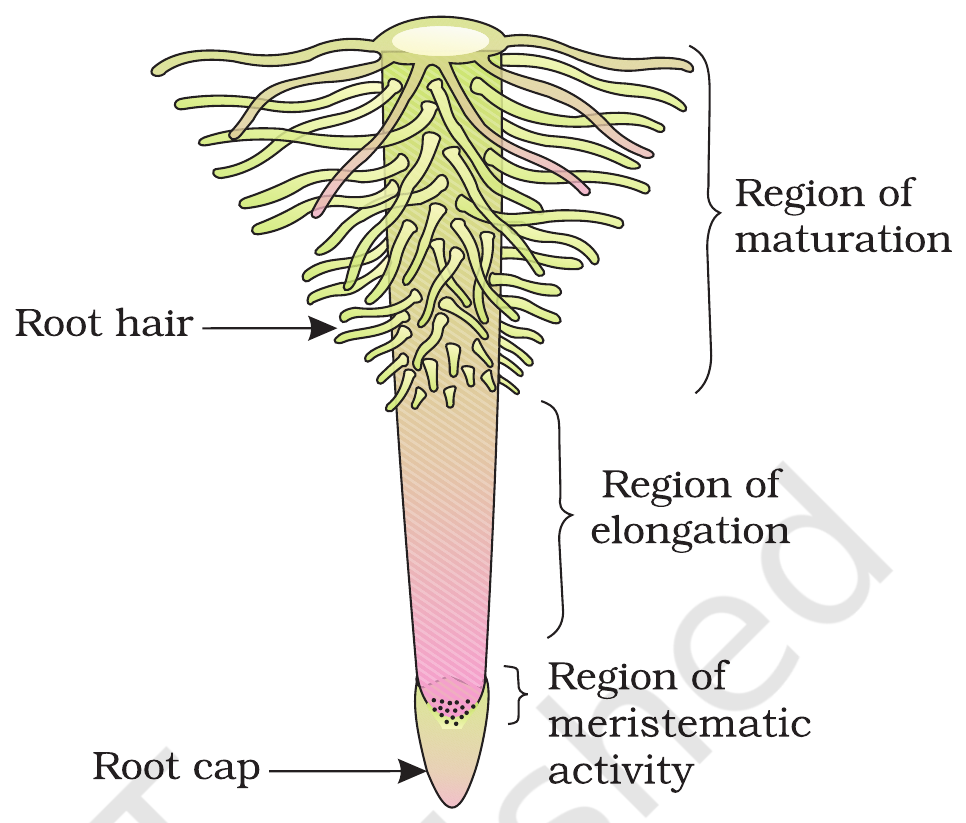
In dicotyledons, elongation of the radicle forms the primary root, which bears lateral roots of several orders (secondary, tertiary and so on). The primary root and its lateral roots together form the tap root system, as in mustard and gram.
In monocotyledons, the primary root is short-lived and is replaced by a large number of roots originating from the base of the stem. This is the fibrous root system, as in wheat and grass.
Roots that arise from parts of the plant other than the radicle are called adventitious roots, as in grass, Monstera and banyan tree.
The regions of the root, from the apex upwards, are:
- Root cap: a thimble-like structure covering the apex. It protects the tender apex as the root makes its way through the soil.
- Region of meristematic activity: a small region just above the root cap, with small, thin-walled cells with dense protoplasm that divide repeatedly.
- Region of elongation: the cells proximal to the meristematic region undergo rapid elongation and enlargement, and are responsible for growth of the root in length.
- Region of maturation: the cells of the elongation zone gradually differentiate and mature. From this region, some of the epidermal cells form very fine and delicate thread-like structures called root hairs, which absorb water and minerals from the soil.
Extra information (beyond NCERT): the root modifications below are from old NCERT 5.1.2, deleted from the rationalised edition. They are included because NEET still asks them.
Roots are modified to perform functions other than absorption and anchorage:
- For storage of food: tap roots of carrot and turnip get swollen and store food; adventitious roots of sweet potato get swollen and store food.
- For support: prop roots of banyan (hanging structures that support the branches) and stilt roots of maize and sugarcane (supporting roots coming out of the lower nodes of the stem).
- For respiration: in Rhizophora, which grows in swampy areas, many roots come out of the ground and grow vertically upwards to get oxygen for respiration. These are called pneumatophores.
Suggest an edit
Practice1 question
Try it now. A wrong answer costs nothing here, try again until you get it.
Sweet potato stores food in a modified:
Sweet potato is a tuberous adventitious root that stores food. Carrot and turnip are swollen tap roots; potato is a stem tuber.
The stem
The stem is the ascending part of the axis, bearing branches, leaves, flowers and fruits. It develops from the plumule of the embryo of a germinating seed.
The stem bears nodes and internodes. The region of the stem where leaves are borne is called a node; the portion between two nodes is called an internode. The stem bears buds, which may be terminal or axillary, and which develop into branches or flowers.
The main function of the stem is spreading out branches, bearing leaves, flowers and fruits. It also conducts water and minerals from the roots to the leaves and the products of photosynthesis from the leaves to other parts. Some stems also store food, give support and protection, and help in vegetative propagation.
Extra information (beyond NCERT): the stem modifications below are from old NCERT 5.2.1, deleted from the rationalised edition. They are included because NEET still asks them.
Stems are modified to perform special functions:
- Underground stems for storage and perennation: rhizome of ginger and turmeric (horizontal, with nodes and internodes); tuber of potato (swollen end of an underground branch, with 'eyes' that are axillary buds); corm of Colocasia and Zaminkand (vertical, condensed).
- Sub-aerial stems for vegetative propagation: runner of grass and strawberry (creeping stem with long internodes); stolon of mint and jasmine (slender lateral branch arising from the base of the main axis, arching downwards); offset of Pistia and Eichhornia (lateral branch with short internodes, a rosette of leaves above and a tuft of roots below); sucker of banana, pineapple and Chrysanthemum (lateral branch originating from the basal underground part, growing obliquely upwards).
- Aerial stems for special functions: stem tendrils of cucumber, pumpkin, watermelon and grapevine (slender, spirally coiled structures from axillary buds, for climbing); thorns of Citrus and Bougainvillea (woody, straight, pointed structures, modified axillary buds, for protection); phylloclade of Opuntia and Euphorbia (flattened or cylindrical green stem that performs photosynthesis, with leaves reduced to spines).
Suggest an edit
The leaf

The leaf is a lateral, generally flattened structure borne on the stem at a node. It develops from the shoot apical meristem and is arranged in acropetal order (younger leaves at the apex). It is the main vegetative organ for photosynthesis.
A typical leaf has three parts:
- Leaf base: the part by which the leaf is attached to the stem. It may bear two lateral small leaf-like structures called stipules. In legumes the leaf base may swell into a pulvinus. In monocots the leaf base expands into a sheath covering the stem partially or wholly.
- Petiole: the stalk that connects the lamina to the stem. It allows the lamina to flutter in the wind, bringing fresh air and cooling the leaf.
- Lamina (leaf blade): the green expanded part, with veins and veinlets. The midrib is the prominent central vein; veins provide rigidity and act as channels for transport of water, minerals and food.
Venation is the arrangement of veins and veinlets in the lamina. In reticulate venation the veinlets form a network, as in the leaves of dicotyledons. In parallel venation the veins run parallel to each other within the lamina, as in the leaves of monocotyledons.
A leaf with a single or undivided lamina is a simple leaf: the lamina is entire, or incised, but the incisions do not touch the midrib. When the incisions of the lamina reach up to the midrib and break it into a number of leaflets, the leaf is called a compound leaf.
- In a pinnately compound leaf, the leaflets are present on a common axis called the rachis, which represents the midrib, as in neem.
- In a palmately compound leaf, the leaflets are attached at a common point, the tip of the petiole, as in silk cotton.
A bud is present in the axil of the petiole in both simple and compound leaves, but there is no bud in the axil of leaflets of a compound leaf.
Suggest an edit
Phyllotaxy and leaf modifications

Phyllotaxy is the pattern of arrangement of leaves on the stem or branch.
- Alternate: a single leaf arises at each node in an alternate manner, as in China rose, mustard and sunflower.
- Opposite: a pair of leaves arises at each node, opposite to each other, as in Calotropis and guava.
- Whorled: more than two leaves arise at a node and form a whorl, as in Alstonia.
Extra information (beyond NCERT): the leaf modifications below are from old NCERT 5.3.4, deleted from the rationalised edition. They are included because NEET still asks them.
Leaves are often modified to perform functions other than photosynthesis:
- Leaf tendrils: for climbing, as in peas.
- Spines: for defence, as in cacti.
- Storage leaves: fleshy leaves that store food, as in onion and garlic.
- The petiole expands, becomes green and synthesises food, as in Australian acacia.
- Insectivorous leaves: modified to trap insects, as in pitcher plant and Venus fly trap.
Suggest an edit
Practice1 question
Try it now. A wrong answer costs nothing here, try again until you get it.
Opposite phyllotaxy is seen in:
In opposite phyllotaxy a pair of leaves arises at each node, opposite to each other, as in Calotropis and guava. Alstonia shows whorled phyllotaxy; mustard and China rose show alternate phyllotaxy.
The inflorescence
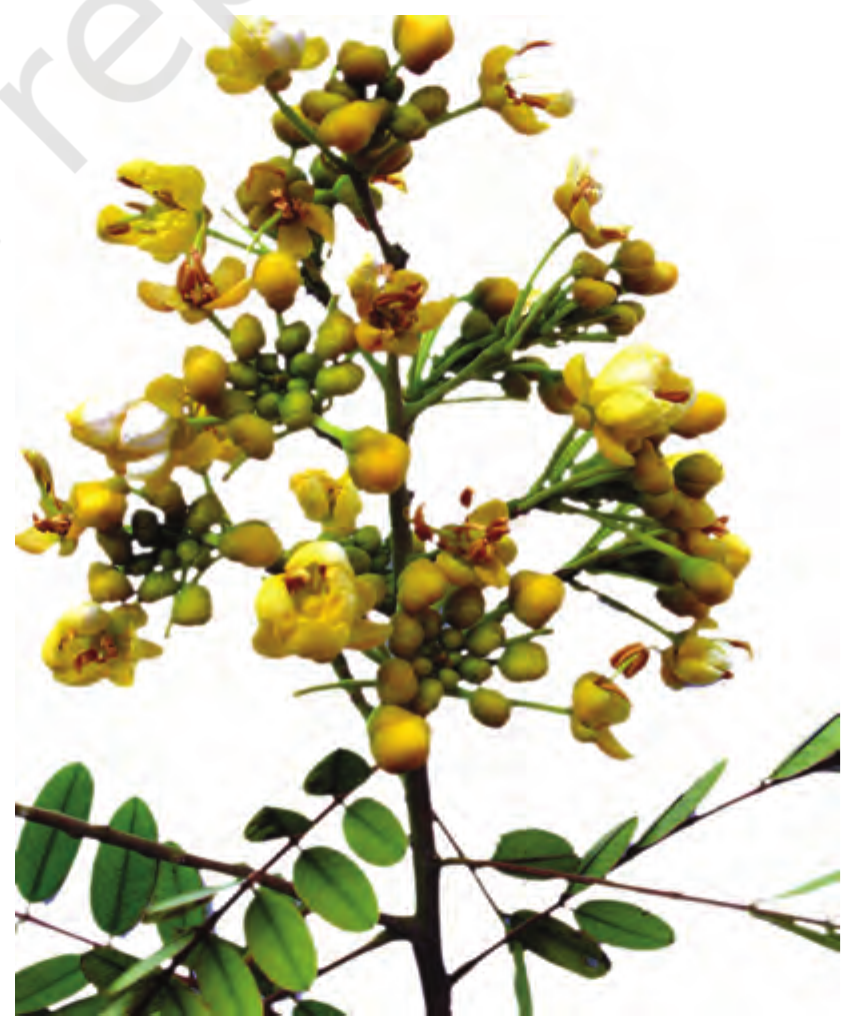
The arrangement of flowers on the floral axis is termed inflorescence.
There are two main types:
- Racemose: the main axis continues to grow, and the flowers are borne laterally in acropetal succession (older flowers at the base, younger flowers at the apex). Growth is indefinite.
- Cymose: the main axis terminates in a flower, so growth is limited. The flowers are borne in basipetal succession (older flower at the apex, younger flowers towards the base).
Suggest an edit
The flower

The flower is the reproductive unit in angiosperms, meant for sexual reproduction. It is a modified shoot: the shoot apical meristem changes to floral meristem, the internodes do not elongate, and the axis gets condensed.
A flower is borne on a stalk called the pedicel. The swollen end of the pedicel is the thalamus or receptacle, on which the four floral whorls are arranged: calyx, corolla, androecium and gynoecium. Calyx and corolla are accessory (non-essential) whorls; androecium and gynoecium are the essential whorls.
A reduced leaf found at the base of the pedicel is called a bract. Flowers with bracts are bracteate; flowers without bracts are ebracteate. When the calyx and corolla are not distinct, they are called the perianth, as in lily.
On the basis of symmetry, a flower may be:
- Actinomorphic (radial symmetry): it can be divided into two equal radial halves in any radial plane passing through the centre, as in mustard, Datura and chilli. Symbol: ⊕
- Zygomorphic (bilateral symmetry): it can be divided into two similar halves only in one particular vertical plane, as in pea, Gulmohur, bean and Cassia. Symbol: %
- Asymmetric (irregular): it cannot be divided into two similar halves by any vertical plane, as in Canna.
On the basis of the number of floral appendages, a flower may be trimerous (floral appendages in multiples of 3), tetramerous (in multiples of 4) or pentamerous (in multiples of 5). A flower having both androecium and gynoecium is bisexual; a flower having either only stamens or only carpels is unisexual.
On the basis of the position of the calyx, corolla and androecium with respect to the ovary on the thalamus, a flower may be:
- Hypogynous: the gynoecium occupies the highest position, while the other parts are situated below it. The ovary is superior, as in mustard, China rose and brinjal.
- Perigynous: the gynoecium is situated in the centre, and the other parts of the flower are located on the rim of the thalamus at almost the same level. The ovary is half-inferior, as in plum, rose and peach.
- Epigynous: the margin of the thalamus grows upward, enclosing the ovary completely and getting fused with it, so the other parts of the flower arise above the ovary. The ovary is inferior, as in guava, cucumber and the ray florets of sunflower.
Suggest an edit
Practice1 question
Try it now. A wrong answer costs nothing here, try again until you get it.
In a hypogynous flower, the ovary is:
In a hypogynous flower the gynoecium occupies the highest position and the other floral parts are situated below it, so the ovary is superior, as in mustard, China rose and brinjal.
Calyx, corolla and aestivation
The calyx is the outermost whorl of the flower, composed of sepals. Sepals are generally green and leaf-like, and they protect the flower in the bud stage. When the sepals are united, the calyx is gamosepalous; when they are free, it is polysepalous.
The corolla is composed of petals. Petals are usually brightly coloured to attract insects for pollination. When the petals are united, the corolla is gamopetalous; when they are free, it is polypetalous. The shape of the corolla varies: tubular, bell-shaped, funnel-shaped or wheel-shaped.
Aestivation is the mode of arrangement of sepals or petals in the floral bud with respect to the other members of the same whorl:
- Valvate: the sepals or petals in a whorl just touch one another at the margin, without overlapping, as in Calotropis.
- Twisted: one margin of each sepal or petal overlaps that of the next one, and so on, as in China rose, lady's finger and cotton.
- Imbricate: the margins of sepals or petals overlap one another, but not in any particular direction, as in Cassia and Gulmohur.
- Vexillary (papilionaceous): there are five petals. The largest (standard) overlaps the two lateral petals (wings), which in turn overlap the two smallest anterior petals (keel). This is characteristic of pea and bean flowers.
Suggest an edit
Androecium and gynoecium
The androecium is the male reproductive whorl, composed of stamens. Each stamen has a stalk called the filament and an anther, which is usually bilobed, each lobe having two chambers (pollen sacs) containing pollen grains. A sterile stamen is called a staminode.
Stamens may be united with other whorls (adhesion) or among themselves (cohesion). When the stamens are free, they are called polyandrous:
- Epipetalous: stamens attached to the petals, as in brinjal.
- Epiphyllous: stamens attached to the perianth, as in lily.
- Monadelphous: stamens united into one bundle, as in China rose.
- Diadelphous: stamens united into two bundles, as in pea (nine united, one free: 9+1).
- Polyadelphous: stamens united into more than two bundles, as in citrus.
The length of the filaments also varies within a flower, as in Salvia and mustard.
The gynoecium is the female reproductive whorl, composed of one or more carpels. Each carpel has three parts: the stigma (the receptive surface for pollen grains), the style (which connects the stigma to the ovary) and the ovary (the enlarged basal part containing ovules).
- Apocarpous: more than one carpel, and the carpels are free, as in lotus and rose.
- Syncarpous: more than one carpel, and the carpels are fused, as in mustard and tomato.
Placentation is the arrangement of ovules within the ovary:
- Marginal: the placenta forms a ridge along the ventral suture of the ovary, and the ovules are borne on the ridge in two rows, as in pea.
- Axile: the placenta is axial, and the ovules are attached to it in a multilocular ovary, as in China rose, tomato and lemon.
- Parietal: the ovules develop on the inner wall of the ovary or on the peripheral part. The ovary is one-chambered, but it becomes two-chambered due to the formation of a false septum, as in mustard and Argemone.
- Free central: the ovules are borne on the central axis, and the septa are absent, as in Dianthus and Primrose.
- Basal: the placenta develops at the base of the ovary, and a single ovule is attached to it, as in sunflower and marigold.
Suggest an edit
Practice1 question
Try it now. A wrong answer costs nothing here, try again until you get it.
Ovules attached to a central axis in a multilocular ovary is:
In axile placentation the placenta is axial and the ovules are attached to it in a multilocular ovary, as in China rose, tomato and lemon. Parietal has ovules on the inner wall; free central has no septa; basal has a single ovule at the base.
The fruit and the seed

The fruit is a characteristic feature of flowering plants. It is a mature or ripened ovary, developed after fertilisation. If a fruit is formed without fertilisation, it is called a parthenocarpic fruit.
A fruit consists of a fruit wall (pericarp) and seeds. When the pericarp is thick and fleshy, it is differentiated into an outer epicarp, a middle mesocarp and an inner endocarp.
In mango and coconut, the fruit is a drupe. It develops from a monocarpellary superior ovary and is one-seeded. In mango, the epicarp is thin, the mesocarp is fleshy and edible, and the endocarp is stony and hard. In coconut, the mesocarp is fibrous.
The seed is the final product of sexual reproduction. A fertilised ovule forms the seed, which is made up of a seed coat and an embryo. The seed coat is the outer protective layer, developed from the integuments of the ovule: it has an outer testa and an inner tegmen. The hilum is a scar on the seed coat where the seed was attached to the fruit, and above the hilum is a small pore called the micropyle.
The embryo consists of an embryonal axis and one cotyledon (in monocotyledons, e.g. wheat and maize) or two cotyledons (in dicotyledons, e.g. gram and pea). The endosperm is the food-storing tissue formed as a result of double fertilisation.
- Endospermic seeds retain a part of the endosperm, as it is not completely used up during embryo development, e.g. castor and maize; generally, monocotyledonous seeds are endospermic.
- Non-endospermic seeds have no residual endosperm, as it is completely consumed during embryo development, e.g. bean, gram and pea; some monocots, as in orchids, are non-endospermic.
In a dicotyledonous seed such as gram, the embryo has an embryonal axis bearing a plumule and a radicle, and two fleshy cotyledons. In a monocotyledonous seed such as maize grain, the seed coat is membranous and fused with the fruit wall; the endosperm is bulky and stores food; the embryo is small and situated in a groove at one end of the endosperm, with one large shield-shaped cotyledon called the scutellum, a short axis with a plumule (enclosed by a sheath called the coleoptile) and a radicle (enclosed by a sheath called the coleorhiza). The outer covering of endosperm separates the embryo by a proteinous layer called aleurone layer.
Suggest an edit
Semi-technical description: floral formula and families

A flowering plant can be described in a semi-technical way with a floral diagram and a floral formula. The symbols used are: Br for bracteate, K for calyx, C for corolla, P for perianth, A for androecium and G for gynoecium. A line under G means a superior ovary; a line over G means an inferior ovary. The symbol ⊕ stands for actinomorphic, % for zygomorphic, ⚥ for bisexual, ♂ for male and ♀ for female. Fusion of parts is shown by brackets, and adhesion by a line drawn above the symbols.
Three families are described in this chapter:
- Brassicaceae (the mustard family, in the NMC syllabus): flowers bisexual and actinomorphic, in a racemose inflorescence. The calyx has four free sepals in two whorls of two each (2+2). The corolla has four free petals in a single whorl, arranged in the form of a cross (cruciform). The androecium has six free stamens in two whorls, two outer short and four inner long (tetradynamous, 2+4). The gynoecium is bicarpellary and syncarpous, with a superior ovary that is unilocular but becomes bilocular due to a false septum, and parietal placentation. The fruit is a siliqua or silicula, and the seeds are non-endospermic. Floral formula: ⊕ ⚥ K2+2 $C_4$ A2+4 G̲(2) (NCERT Fig. 5.16, mustard).
- Solanaceae (the potato family): flowers bisexual and actinomorphic. The calyx has five united sepals and is persistent. The corolla has five united petals. The androecium has five stamens, which are epipetalous. The gynoecium is bicarpellary and syncarpous, with a superior ovary that is obliquely placed, a swollen placenta and many ovules, and axile placentation. The fruit is a berry or a capsule, and the seeds are endospermous. Many plants of this family are sources of food (tomato, brinjal, potato), spice (chilli), medicine (belladonna, ashwagandha), fumigatory (tobacco) and ornamentals (Petunia). Floral formula: ⊕ ⚥ K(5) C̅(̅5̅)̅ A̅5̅ G̲(2)
- Extra information (beyond NCERT): Fabaceae (the pea family, Leguminosae in the NMC syllabus) is from old NCERT 5.9.1, deleted from the rationalised edition. Flowers zygomorphic, with vexillary (papilionaceous) aestivation. Stamens are diadelphous, (9)+1. The gynoecium is monocarpellary, with a superior ovary and marginal placentation. The fruit is a legume. Floral formula: % ⚥ K(5) C1+2+(2) A(9)+1 G̲1
Suggest an edit
Practice1 question
Try it now. A wrong answer costs nothing here, try again until you get it.
The family with vexillary aestivation and diadelphous stamens is:
Fabaceae (Extra information) has vexillary (papilionaceous) aestivation and diadelphous stamens, (9)+1. Solanaceae has five epipetalous stamens; Brassicaceae has six tetradynamous stamens (2+4).
Table 1 - Modifications of root
| Modification | Function | Example |
|---|---|---|
| Tap root swollen | Storage of food | Carrot, turnip |
| Adventitious root swollen (tuberous) | Storage of food | Sweet potato |
| Prop root | Support of branches | Banyan |
| Stilt root | Support from lower nodes of stem | Maize, sugarcane |
| Pneumatophore | Respiration in swampy areas | Rhizophora |
Source: Old NCERT XI, Ch 5, section 5.1.2 (Extra information, deleted from the rationalised edition).
Suggest an edit
Table 2 - Modifications of stem
| Modification | Type | Example |
|---|---|---|
| Rhizome | Underground stem, horizontal | Ginger, turmeric |
| Tuber | Underground stem, swollen end with 'eyes' | Potato |
| Corm | Underground stem, vertical and condensed | Colocasia, Zaminkand |
| Runner | Sub-aerial stem, creeping, long internodes | Grass, strawberry |
| Stolon | Sub-aerial stem, slender lateral branch | Mint, jasmine |
| Offset | Sub-aerial stem, short internodes, rosette of leaves | Pistia, Eichhornia |
| Sucker | Sub-aerial stem, from basal underground part | Banana, pineapple, Chrysanthemum |
| Stem tendril | Aerial stem, from axillary bud, for climbing | Cucumber, pumpkin, watermelon, grapevine |
| Thorn | Aerial stem, modified axillary bud, for protection | Citrus, Bougainvillea |
| Phylloclade | Aerial stem, flattened or cylindrical, photosynthetic | Opuntia, Euphorbia |
Source: Old NCERT XI, Ch 5, section 5.2.1 (Extra information, deleted from the rationalised edition).
Suggest an edit
Table 3 - Aestivation, ovary position and placentation
| Feature | Type | Key character | Example |
|---|---|---|---|
| Aestivation | Valvate | Margins just touch, no overlap | Calotropis |
| Aestivation | Twisted | One margin overlaps the next | China rose, cotton |
| Aestivation | Imbricate | Margins overlap, no fixed direction | Cassia, Gulmohur |
| Aestivation | Vexillary | Standard overlaps wings, wings overlap keel | Pea, bean |
| Ovary position | Hypogynous | Ovary superior | Mustard, China rose, brinjal |
| Ovary position | Perigynous | Ovary half-inferior | Plum, rose, peach |
| Ovary position | Epigynous | Ovary inferior | Guava, cucumber, ray florets of sunflower |
| Placentation | Marginal | Ovules on a ridge along the ventral suture | Pea |
| Placentation | Axile | Ovules on a central axis, multilocular ovary | Tomato, lemon |
| Placentation | Parietal | Ovules on the inner wall, false septum | Mustard, Argemone |
| Placentation | Free central | Ovules on central axis, no septa | Dianthus, Primrose |
| Placentation | Basal | Single ovule at the base of the ovary | Sunflower, marigold |
Source: NCERT XI, Ch 5, sections 5.5 and 5.5.1.
Suggest an edit
Table 4 - The three families
| Family | Symmetry | Aestivation | Stamens | Gynoecium | Floral formula |
|---|---|---|---|---|---|
| Brassicaceae | Actinomorphic (⊕) | Valvate (calyx); imbricate (corolla) | Six, tetradynamous (2+4) | Bicarpellary syncarpous, superior, parietal placentation, false septum | ⊕ ⚥ K2+2 $C_4$ A2+4 G̲(2) |
| Solanaceae | Actinomorphic (⊕) | Valvate | Five, epipetalous | Bicarpellary syncarpous, superior, obliquely placed ovary, axile placentation | ⊕ ⚥ K(5) C̅(̅5̅)̅ A̅5̅ G̲(2) |
| Fabaceae (Extra information) | Zygomorphic (%) | Vexillary (corolla); valvate/imbricate (calyx) | Diadelphous, (9)+1 | Monocarpellary, superior, marginal placentation | % ⚥ K(5) C1+2+(2) A(9)+1 G̲1 |
Source: NCERT XI, Ch 5, sections 5.8 and 5.9 (Brassicaceae, Solanaceae); Fabaceae from old NCERT 5.9.1 (Extra information).
Suggest an edit
Trap pairs: the confusions NEET tests
- Potato vs sweet potato: potato is a stem tuber (its 'eyes' are axillary buds); sweet potato is a tuberous adventitious root. Same function (food storage), different organ. NEET 2018.
- Bud in the axil of the petiole: a bud is present in the axil of the petiole in both simple and compound leaves, but never in the axil of leaflets.
- Australian acacia vs Opuntia: in Australian acacia the petiole expands, becomes green and synthesises food (a modified petiole); in Opuntia the stem is flattened, green and photosynthetic, with leaves reduced to spines (a modified stem, the phylloclade).
- Hypogynous vs perigynous vs epigynous: hypogynous = ovary superior (mustard); perigynous = ovary half-inferior (plum); epigynous = ovary inferior (guava, ray florets of sunflower). The trap is the ovary position, not the flower's shape.
- Parietal vs axile placentation: parietal has ovules on the inner wall of a one-chambered ovary (mustard); axile has ovules on a central axis in a multilocular ovary (tomato). NEET 2019.
- Racemose vs cymose: racemose = main axis keeps growing, flowers in acropetal succession; cymose = main axis ends in a flower, flowers in basipetal succession.
- Monadelphous vs diadelphous vs polyadelphous: one bundle (China rose), two bundles (pea, 9+1), more than two bundles (citrus). Epipetalous (stamens on petals, brinjal) and epiphyllous (stamens on perianth, lily) are adhesion, not cohesion.
- Endospermic vs non-endospermic seed: endospermic seeds retain endosperm (castor, maize); non-endospermic seeds have it fully consumed, food in the cotyledons (bean, gram, pea); orchids are the monocot exception, non-endospermic.
Suggest an edit
Trap Boxes
Potato is a root?
Wrong idea: Potato and sweet potato are both modified roots that store food.
Potato is a stem tuber (Extra information: its 'eyes' are axillary buds on an underground stem). Sweet potato is a tuberous adventitious root that stores food. Same function, different organ.
NCERT XI, Ch 5
Leaflets have buds in their axils?
Wrong idea: A compound leaf has a bud in the axil of each leaflet, just like a simple leaf has one in the axil of its petiole.
A bud is present in the axil of the petiole in both simple and compound leaves, but there is no bud in the axil of leaflets of a compound leaf.
NCERT XI, Ch 5
Ray florets have a superior ovary?
Wrong idea: The ray florets of sunflower sit on top of the ovary, so the ovary must be superior.
Ray florets of sunflower are epigynous: the margin of the thalamus grows upward, encloses the ovary completely and fuses with it, so the ovary is inferior.
NCERT XI, Ch 5
Parietal placentation means ovules on the central axis?
Wrong idea: Parietal placentation is when the ovules are attached to the central axis of the ovary.
In parietal placentation the ovules develop on the inner wall of the ovary or on the peripheral part. In axile placentation the ovules are attached to a central axis in a multilocular ovary.
NCERT XI, Ch 5
Root hairs grow from the root cap?
Wrong idea: Root hairs grow out of the root cap at the tip of the root.
Root hairs are formed by epidermal cells in the region of maturation, where cells gradually differentiate and mature. The root cap protects the apex, the meristematic region divides, and the elongation region grows in length.
NCERT XI, Ch 5
Chapter test
5 NEET PYQs. +4 for a correct answer, -1 for a wrong answer, exactly like NEET. Finish the test to earn a medal.
Q1: NEET (UG) 2023 (Manipur), Code C4, Q103
In Calotropis, aestivation is:
In valvate aestivation the sepals or petals in a whorl just touch one another at the margin, without overlapping, as in Calotropis. Twisted is China rose, imbricate is Cassia, vexillary is pea.
Q2: NEET (UG) 2020, Code G5, Q36
Ray florets have
Ray florets of sunflower are epigynous: the margin of the thalamus grows upward, encloses the ovary completely and fuses with it, so the ovary is inferior.
Q3: NEET (UG) 2019, Code S2, Q28
Placentation, in which ovules develop on the inner wall of the ovary or in peripheral part, is:
In parietal placentation the ovules develop on the inner wall of the ovary or on the peripheral part. The ovary is one-chambered but becomes two-chambered by a false septum, e.g. mustard and Argemone.
Q4: NEET (UG) 2018, Code AA, Q129
Sweet potato is a modified
Sweet potato is a tuberous adventitious root that stores food. Potato, by contrast, is a stem tuber; its 'eyes' are axillary buds (Extra information, beyond NCERT, old NCERT 5.2.1).
Q5: NEET (UG) 2017, Code A, Q118
Root hairs develop from the region of:
Root hairs are fine thread-like extensions of epidermal cells in the region of maturation, where cells gradually differentiate and mature. The root cap protects the apex, the meristematic region divides, and the elongation region grows in length.
Score: 0 · Answered 0 of 5
Flashcards
Tap a card to flip it over and see the answer. Tap it again to flip it back.
Which root system is found in dicots, and which in monocots?
Tap to flipTap root system in dicots (mustard); fibrous root system in monocots (wheat); adventitious roots arise from parts other than the radicle (grass, Monstera, banyan).
Tap to flip backName the four regions of a root from the apex upwards.
Tap to flipRoot cap, region of meristematic activity, region of elongation, region of maturation (root hairs arise here).
Tap to flip backPotato is a stem or a root? And sweet potato?
Tap to flipPotato is a stem tuber (Extra information: its 'eyes' are axillary buds). Sweet potato is a tuberous adventitious root that stores food.
Tap to flip backMost monocot seeds are endospermic, but which monocot is the exception?
Tap to flipOrchids: their seeds are non-endospermic, even though most monocotyledonous seeds (e.g. maize) are endospermic.
Tap to flip backWhich venation is found in dicot leaves, and which in monocot leaves?
Tap to flipReticulate venation in dicots; parallel venation in monocots.
Tap to flip backName the three types of phyllotaxy with one example each.
Tap to flipAlternate (China rose, mustard, sunflower); opposite (Calotropis, guava); whorled (Alstonia).
Tap to flip backName the four types of aestivation with one example each.
Tap to flipValvate (Calotropis), twisted (China rose), imbricate (Cassia, Gulmohur), vexillary (pea, bean).
Tap to flip backWhat is monadelphous, diadelphous and polyadelphous, with examples?
Tap to flipMonadelphous: stamens in one bundle (China rose). Diadelphous: two bundles (pea, 9+1). Polyadelphous: more than two bundles (citrus).
Tap to flip backName the five types of placentation with one example each.
Tap to flipMarginal (pea), axile (tomato, lemon), parietal (mustard, Argemone), free central (Dianthus, Primrose), basal (sunflower, marigold).
Tap to flip backGive the floral formula of Brassicaceae, Solanaceae and Fabaceae.
Tap to flipBrassicaceae: ⊕ ⚥ K2+2 $C_4$ A2+4 G̲(2), G underlined (superior ovary). Solanaceae: ⊕ ⚥ K(5) C(5) A5 G̲(2), G underlined; line over C and A shows adhesion (epipetalous). Fabaceae (Extra information): % ⚥ K(5) C1+2+(2) A(9)+1 G̲1, G underlined.
Tap to flip back