 NEET Notes
Home > Chemistry > Physical > Redox Reactions
Redox Reactions
On this page · 18 sections
- 01Syllabus map
- 02Classical idea: oxidation
- 03Classical idea: reduction
- 04Redox reactions in terms of electron transfer
- 05Competitive electron transfer reactions
- 06Table: half reactions of the electron transfer examples
- 07Oxidation number
- 08Table: the six rules for oxidation number
- 09Ladder: oxygen and hydrogen exceptions
- 10Stock notation
- 11Types of redox reactions: combination and decomposition
- 12Types of redox reactions: displacement
- 13Ladder: disproportionation
- 14The paradox of fractional oxidation number
- 15Balancing by the oxidation number method
- 16Balancing by the half reaction (ion-electron) method
- 17Table: standard electrode potentials at 298 K (selected)
- 18Redox reactions and electrode processes: the Daniell cell
How oxidation and reduction happen together: the classical definitions, electron transfer, oxidation numbers, the four types of redox reactions, balancing, and the Daniell cell with standard electrode potentials.
Syllabus map
- NMC Unit: CHEM-U07, Redox Reactions and Electrochemistry (NMC Compendium 2024, Unit 7).
- Subtopics in this chapter (NCERT XI, Ch 7): classical idea of redox reactions, oxidation and reduction (7.1); redox reactions in terms of electron transfer (7.2); competitive electron transfer reactions (7.2.1); oxidation number (7.3); types of redox reactions (7.3.1); balancing of redox reactions (7.3.2); redox reactions as the basis for titrations (7.3.3); limitations of the concept of oxidation number (7.3.4); redox reactions and electrode processes, Daniell cell and standard electrode potential, Table 7.1 (7.4).
- Subtopic checklist: (1) classical definitions of oxidation and reduction; (2) oxidation as loss of electrons, reduction as gain of electrons; (3) oxidising and reducing agents; (4) Zn, Cu and Ag electron transfer and the order Zn > Cu > Ag; (5) the six oxidation number rules; (6) Stock notation; (7) combination, decomposition, displacement and disproportionation reactions; (8) fractional oxidation numbers as averages; (9) balancing by the oxidation number method; (10) balancing by the half reaction method; (11) redox titrations and indicators; (12) redox couples and the Daniell cell; (13) standard electrode potential and Table 7.1 values.
- Extra information (beyond NCERT): none.
- Excluded topics: the detail of electrochemistry in Class XII (Nernst equation, conductance, electrolysis products) sits outside this Class XI chapter; this chapter covers only the electrode process introduction in 7.4.
- Estimated revision time: 8 minutes. Jump links: Syllabus Map, Classical Oxidation, Classical Reduction, Electron Transfer, Competitive Transfer, Half Reaction Table, Oxidation Number, Rules Table, Oxygen and Hydrogen Exceptions, Stock Notation, Combination and Decomposition, Displacement, Disproportionation Ladder, Fractional Numbers, Oxidation Number Balancing, Half Reaction Balancing, Electrode Potentials Table, Daniell Cell.
Suggest an edit
Classical idea: oxidation
Originally, the term oxidation was used to describe the addition of oxygen to an element or a compound. Because dioxygen is about 20 per cent of the atmosphere, many elements combine with it, which is the main reason they commonly occur on the earth in the form of their oxides.
The reactions 2Mg(s) + $O_2$(g) -> 2MgO(s) (7.1) and S(s) + $O_2$(g) -> $SO_2$(g) (7.2) are oxidation processes by this limited definition. Methane is oxidised by addition of oxygen: $CH_4$(g) + 2O2(g) -> $CO_2$(g) + 2H2O(l) (7.3).
In reaction (7.3) hydrogen is replaced by oxygen, so chemists reinterpreted oxidation to include the removal of hydrogen from a substance: 2H2S(g) + $O_2$(g) -> 2S(s) + 2H2O(l) (7.4).
Oxidation was then extended to other electronegative elements: Mg(s) + $F_2$(g) -> $MgF_2$(s) (7.5); Mg(s) + $Cl_2$(g) -> $MgCl_2$(s) (7.6); Mg(s) + S(s) -> MgS(s) (7.7). Removal of an electropositive element is also oxidation: 2K4[Fe(CN)6](aq) + $H_2O_2$(aq) -> 2K3[Fe(CN)6](aq) + 2KOH(aq), where potassium is removed from potassium ferrocyanide as it changes to potassium ferricyanide.
To summarise, oxidation is the addition of oxygen or an electronegative element to a substance, or the removal of hydrogen or an electropositive element from a substance.
Suggest an edit
Classical idea: reduction
In the beginning, reduction was considered as removal of oxygen from a compound. The term has been broadened to include removal of oxygen or an electronegative element from a substance, or addition of hydrogen or an electropositive element to a substance.
Examples of reduction: 2HgO(s) -> 2Hg(l) + $O_2$(g) (7.8), removal of oxygen from mercuric oxide; 2FeCl3(aq) + $H_2$(g) -> 2FeCl2(aq) + 2HCl(aq) (7.9), removal of electronegative chlorine from ferric chloride; $CH_2$=$CH_2$(g) + $H_2$(g) -> $H_3C$-CH3(g) (7.10), addition of hydrogen; 2HgCl2(aq) + $SnCl_2$(aq) -> $Hg_2Cl_2$(s) + $SnCl_4$(aq) (7.11), addition of mercury to mercuric chloride.
In reaction (7.11) the oxidation of stannous chloride to stannic chloride also occurs, because of the addition of electronegative chlorine to it. Oxidation and reduction always occur simultaneously, so the word redox was coined for this class of chemical reactions.
Problem 7.1 asks for the species oxidised and reduced in: (i) $H_2S$(g) + $Cl_2$(g) -> 2HCl(g) + S(s), where $H_2S$ is oxidised and chlorine is reduced; (ii) 3Fe3O4(s) + 8Al(s) -> 9Fe(s) + 4Al2O3(s), where aluminium is oxidised and $Fe_3O_4$ is reduced; (iii) 2Na(s) + $H_2$(g) -> 2NaH(s), where sodium is oxidised and hydrogen is reduced.
Suggest an edit
Redox reactions in terms of electron transfer
The reactions 2Na(s) + $Cl_2$(g) -> 2NaCl(s) (7.12), 4Na(s) + $O_2$(g) -> 2Na2O(s) (7.13) and 2Na(s) + S(s) -> $Na_2S$(s) (7.14) are redox reactions: in each, sodium is oxidised by addition of oxygen or a more electronegative element, while chlorine, oxygen and sulphur are reduced by addition of the electropositive element sodium.
Sodium chloride, sodium oxide and sodium sulphide are ionic compounds, better written as Na+$Cl^-$(s), ($Na^+$)2O2-(s) and ($Na^+$)2S2-(s). The charges suggest rewriting the reactions as half reactions, each showing electrons explicitly: 2Na(s) -> 2Na+(g) + 2e- and $Cl_2$(g) + 2e- -> 2Cl-(g). The sum of the half reactions gives the overall reaction 2Na(s) + $Cl_2$(g) -> 2NaCl(s).
Half reactions that involve loss of electrons are called oxidation reactions. Half reactions that involve gain of electrons are called reduction reactions.
Oxidation: loss of electron(s) by any species. Reduction: gain of electron(s) by any species. Oxidising agent: acceptor of electron(s). Reducing agent: donor of electron(s).
Sodium, which is oxidised, acts as a reducing agent because it donates electrons to each element it reacts with. Chlorine, oxygen and sulphur are reduced and act as oxidising agents because they accept electrons from sodium.
Problem 7.2: the reaction 2Na(s) + $H_2$(g) -> 2NaH(s) is a redox change because NaH is ionic, Na+$H^-$(s), splitting into the half reactions 2Na(s) -> 2Na+(g) + 2e- and $H_2$(g) + 2e- -> 2H-(g). Sodium is oxidised and hydrogen is reduced.
Suggest an edit
Practice1 question
Try it now. A wrong answer costs nothing here, try again until you get it.
In the reaction 2Na(s) + $Cl_2$(g) -> 2NaCl(s), which species acts as the reducing agent?
NCERT 7.2: sodium is oxidised and donates electrons to chlorine, so sodium is the reducing agent; chlorine accepts electrons and is the oxidising agent.
Competitive electron transfer reactions
A strip of metallic zinc placed in aqueous copper nitrate for about one hour becomes coated with reddish metallic copper and the blue colour of the solution disappears. The reaction is Zn(s) + $Cu^{2+}$(aq) -> $Zn^{2+}$(aq) + Cu(s) (7.15), shown in NCERT Fig. 7.1. Zinc loses electrons to form $Zn^{2+}$ and is oxidised; copper ion gains the electrons and is reduced.
The state of equilibrium for reaction (7.15) greatly favours the products. A strip of copper in zinc sulphate solution shows no visible reaction, and even the very sensitive CuS test with $H_2S$ gas cannot detect $Cu^{2+}$ ions.
Copper metal in silver nitrate solution (NCERT Fig. 7.2) develops a blue colour as $Cu^{2+}$ ions form: Cu(s) is oxidised to $Cu^{2+}$(aq) and $Ag^+$(aq) is reduced to Ag(s) (7.16). Equilibrium greatly favours the products $Cu^{2+}$(aq) and Ag(s).
Cobalt metal in nickel sulphate solution (7.17) behaves differently: at equilibrium both $Ni^{2+}$(aq) and $Co^{2+}$(aq) are present at moderate concentrations, so neither reactants nor products are greatly favoured.
Comparing the three cases, zinc releases electrons to copper and copper releases electrons to silver, so the electron releasing tendency of the metals is in the order Zn > Cu > Ag. This competition for electrons is the basis of the metal activity series and of galvanic cells, in which chemical reactions become the source of electrical energy.
Suggest an edit
Table: half reactions of the electron transfer examples
| Overall reaction | Oxidation half reaction | Reduction half reaction |
|---|---|---|
| 2Na(s) + $Cl_2$(g) -> 2NaCl(s) (7.12) | 2Na(s) -> 2Na+(g) + 2e- | $Cl_2$(g) + 2e- -> 2Cl-(g) |
| 2Na(s) + $H_2$(g) -> 2NaH(s) (Problem 7.2) | 2Na(s) -> 2Na+(g) + 2e- | $H_2$(g) + 2e- -> 2H-(g) |
| Zn(s) + $Cu^{2+}$(aq) -> $Zn^{2+}$(aq) + Cu(s) (7.15) | Zn(s) -> $Zn^{2+}$(aq) + 2e- | $Cu^{2+}$(aq) + 2e- -> Cu(s) |
| Cu(s) + 2Ag+(aq) -> $Cu^{2+}$(aq) + 2Ag(s) (7.16) | Cu(s) -> $Cu^{2+}$(aq) + 2e- | 2Ag+(aq) + 2e- -> 2Ag(s) |
| Co(s) + $Ni^{2+}$(aq) -> $Co^{2+}$(aq) + Ni(s) (7.17) | Co(s) -> $Co^{2+}$(aq) + 2e- | $Ni^{2+}$(aq) + 2e- -> Ni(s) |
Source: NCERT XI, Ch 7, 7.2 and 7.2.1. Each half reaction shows electrons explicitly; the sum of the two half reactions gives the overall reaction. In reaction (7.17) neither side is greatly favoured at equilibrium, while in (7.15) and (7.16) the products are greatly favoured.
Suggest an edit
Oxidation number
A less obvious electron transfer is hydrogen combining with oxygen: 2H2(g) + $O_2$(g) -> 2H2O(l) (7.18). The H atom goes from a neutral (zero) state in $H_2$ to a positive state in $H_2O$, and the O atom from zero in $O_2$ to a dinegative state in $H_2O$. The charge transfer is only partial, better described as an electron shift than a complete loss of electron by H and gain by O, and the same holds for $H_2$(g) + $Cl_2$(g) -> 2HCl(g) (7.19) and $CH_4$(g) + 4Cl2(g) -> $CCl_4$(l) + 4HCl(g) (7.20).
To keep track of electron shifts, the oxidation number method assumes a complete transfer of electron from a less electronegative atom to a more electronegative atom. Equations (7.18 to 7.20) rewritten with oxidation numbers are: (7.21) 2H2 + $O_2$ -> 2H2O, with H 0 to +1 and O 0 to -2; (7.22) $H_2$ + $Cl_2$ -> 2HCl, with H 0 to +1 and Cl 0 to -1; (7.23) $CH_4$ + 4Cl2 -> $CCl_4$ + 4HCl, with C -4 to +4, H +1, and Cl 0 to -1.
Oxidation number denotes the oxidation state of an element in a compound, ascertained according to a set of rules formulated on the basis that the electron pair in a covalent bond belongs entirely to the more electronegative element.
If two or more atoms of an element are present, as in $Na_2S_2O_3$ or $Cr_2O_7^{2-}$, the oxidation number of that element is the average of the oxidation numbers of all its atoms.
The highest oxidation number of a representative element is the group number for the first two groups and the group number minus 10 for the other groups, so the highest value generally increases across a period. In the third period the highest value changes from 1 to 7: Na +1 in $NaCl$, Mg +2 in $MgSO_4$, Al +3 in $AlF_3$, Si +4 in $SiCl_4$, P +5 in $P_4O_{10}$, S +6 in $SF_6$ and Cl +7 in $HClO_4$.
In terms of oxidation number: Oxidation is an increase in the oxidation number of the element in the given substance. Reduction is a decrease in the oxidation number. Oxidising agent (oxidant) is a reagent which can increase the oxidation number of an element. Reducing agent (reductant) is a reagent which lowers the oxidation number. Redox reactions are reactions which involve change in oxidation number of the interacting species.
Suggest an edit
Table: the six rules for oxidation number
| Rule | Statement | Example from NCERT |
|---|---|---|
| 1 | In elements in the free or uncombined state, each atom has oxidation number zero | $H_2$, $O_2$, $Cl_2$, $O_3$, $P_4$, $S_8$, Na, Mg, Al are all zero |
| 2 | For ions of one atom, the oxidation number equals the charge on the ion; alkali metals are +1, alkaline earth metals +2, aluminium +3 in all their compounds | $Na^+$ +1, $Mg^{2+}$ +2, $Fe^{3+}$ +3, $Cl^-$ -1, $O_2^-$ -2 |
| 3 | Oxygen is -2 in most compounds, with exceptions | $H_2O_2$ -1, $KO_2$ -1/2, $OF_2$ +2, $O_2F_2$ +1 |
| 4 | Hydrogen is +1, except when bonded to metals in binary compounds, where it is -1 | LiH, NaH, $CaH_2$: H is -1 |
| 5 | Fluorine is -1 in all its compounds; other halogens (Cl, Br, I) are -1 as halide ions and positive in oxoacids and oxoanions | $Cl^-$ -1; Cl in $HClO_4$ +7 |
| 6 | The algebraic sum of the oxidation numbers is zero in a compound and equals the charge in a polyatomic ion | In $CO_3^{2-}$, C +4 and three O at -2 sum to -2 |
Source: NCERT XI, Ch 7, 7.3. By these rules, metallic elements have positive oxidation numbers, nonmetallic elements have positive or negative oxidation numbers, and transition elements usually show several positive oxidation states.
Suggest an edit
Practice1 question
Try it now. A wrong answer costs nothing here, try again until you get it.
What is the oxidation number of chromium in the dichromate ion, $Cr_2O_7^{2-}$?
NCERT 7.3: oxygen is -2, so 2Cr + 7(-2) = -2, giving Cr = +6. This is the value used in Problem 7.8.
Ladder: oxygen and hydrogen exceptions
- Oxygen -2 almost always: in most compounds oxygen has oxidation number -2.
- Peroxides -1: in peroxides such as $H_2O_2$ and $Na_2O_2$ the oxygen atoms are directly linked to each other and each oxygen is assigned -1.
- Superoxides -1/2: in superoxides such as $KO_2$ and $RbO_2$ each oxygen atom is assigned -1/2.
- Oxygen bonded to fluorine, positive: in $OF_2$ oxygen is +2 and in $O_2F_2$ oxygen is +1, because fluorine is more electronegative than oxygen.
- Hydrogen +1 almost always: in most compounds hydrogen has oxidation number +1.
- Metal hydrides -1: in LiH, NaH and $CaH_2$ hydrogen is bonded to a metal and its oxidation number is -1.
- Fluorine always -1: in all its compounds fluorine has oxidation number -1; it never shows a positive oxidation state.
- Halogens with oxygen, positive: chlorine, bromine and iodine combined with oxygen, as in oxoacids and oxoanions, have positive oxidation numbers.
Suggest an edit
Stock notation
The oxidation number of a metal in a compound is sometimes shown by Stock notation, named after the German chemist Alfred Stock. The oxidation number is written as a Roman numeral in parentheses after the symbol of the metal in the molecular formula.
Aurous chloride and auric chloride are written as Au(I)Cl and Au(III)Cl3. Stannous chloride and stannic chloride are written as Sn(II)$Cl_2$ and Sn(IV)Cl4. Hg2(I)$Cl_2$ is the reduced form of Hg(II)$Cl_2$.
Problem 7.3 gives: $HAuCl_4$ has Au 3, so HAu(III)Cl4; $Tl_2O$ has Tl 1, so Tl2(I)O; FeO has Fe 2, so Fe(II)O; $Fe_2O_3$ has Fe 3, so Fe2(III)$O_3$; CuI has Cu 1, so Cu(I)I; CuO has Cu 2, so Cu(II)O; MnO has Mn 2, so Mn(II)O; $MnO_2$ has Mn 4, so Mn(IV)$O_2$.
Problem 7.4: in 2Cu2O(s) + $Cu_2S$(s) -> 6Cu(s) + $SO_2$(g), copper is reduced from +1 to zero and sulphur is oxidised from -2 to +4, so the reaction is redox. $Cu_2O$ helps sulphur in $Cu_2S$ to increase its oxidation number, so Cu(I) is the oxidant; sulphur of $Cu_2S$ helps copper in both $Cu_2S$ and $Cu_2O$ to decrease its oxidation number, so sulphur of $Cu_2S$ is the reductant.
Suggest an edit
Types of redox reactions: combination and decomposition
- Combination reactions: A + B -> C. Either A and B or both must be in the elemental form for such a reaction to be a redox reaction. All combustion reactions, which use elemental dioxygen, are redox reactions.
Examples: C(s) + $O_2$(g) -> $CO_2$(g) (7.24); 3Mg(s) + $N_2$(g) -> $Mg_3N_2$(s) (7.25); $CH_4$(g) + 2O2(g) -> $CO_2$(g) + 2H2O(l). There is no change in the oxidation number of hydrogen in methane in this combination reaction.
- Decomposition reactions: the opposite of combination reactions, a compound breaks down into two or more components, at least one of which must be in the elemental state.
Examples: 2H2O(l) -> 2H2(g) + $O_2$(g) (7.26); 2NaH(s) -> 2Na(s) + $H_2$(g) (7.27); 2KClO3(s) -> 2KCl(s) + 3O2(g) (7.28). There is no change in the oxidation number of potassium in potassium chlorate in reaction (7.28).
Not all decomposition reactions are redox reactions. The decomposition of calcium carbonate, $CaCO_3$(s) -> $CaO$(s) + $CO_2$(g), is not a redox reaction because no oxidation number changes.
Suggest an edit
Types of redox reactions: displacement
In a displacement reaction an ion or atom in a compound is replaced by an ion or atom of another element: X + YZ -> XZ + Y.
(a) Metal displacement: a metal in a compound can be displaced by another metal in the uncombined state. Examples: $CuSO_4$(aq) + Zn(s) -> Cu(s) + $ZnSO_4$(aq) (7.29); $V_2O_5$(s) + 5Ca(s) -> 2V(s) + 5CaO(s) (7.30); $TiCl_4$(l) + 2Mg(s) -> Ti(s) + 2MgCl2(s) (7.31); $Cr_2O_3$(s) + 2Al(s) -> $Al_2O_3$(s) + 2Cr(s) (7.32). In each case the reducing metal is a better reducing agent than the one being reduced. These reactions find many applications in metallurgical processes.
(b) Non-metal displacement: hydrogen displacement and the rarely occurring oxygen displacement. All alkali metals and some alkaline earth metals (Ca, Sr and Ba) displace hydrogen from cold water: 2Na(s) + 2H2O(l) -> 2NaOH(aq) + $H_2$(g) (7.33); Ca(s) + 2H2O(l) -> Ca(OH)2(aq) + $H_2$(g) (7.34). Magnesium and iron react with steam: Mg(s) + 2H2O(l) -> Mg(OH)2(s) + $H_2$(g) (7.35); 2Fe(s) + 3H2O(l) -> $Fe_2O_3$(s) + 3H2(g) (7.36).
Many metals displace hydrogen from acids, and reactions (7.37 to 7.39) are used to prepare dihydrogen in the laboratory: Zn(s) + 2HCl(aq) -> $ZnCl_2$(aq) + $H_2$(g) (7.37); Mg(s) + 2HCl(aq) -> $MgCl_2$(aq) + $H_2$(g) (7.38); Fe(s) + 2HCl(aq) -> $FeCl_2$(aq) + $H_2$(g) (7.39). The reactivity of the metals shows in the rate of hydrogen evolution, slowest for Fe and fastest for Mg. Silver and gold do not react even with hydrochloric acid.
The oxidising power of the halogens decreases from fluorine to iodine in group 17. Fluorine can replace chloride, bromide and iodide ions, and it attacks water: 2H2O(l) + 2F2(g) -> 4HF(aq) + $O_2$(g) (7.40). Chlorine displaces bromide and iodide: $Cl_2$(g) + 2KBr(aq) -> 2KCl(aq) + $Br_2$(l) (7.41); $Cl_2$(g) + 2KI(aq) -> 2KCl(aq) + $I_2$(s) (7.42). Bromine displaces iodide: $Br_2$(l) + 2I-(aq) -> 2Br-(aq) + $I_2$(s) (7.43). Reactions (7.41) and (7.42) are the basis of the Layer Test for $Br^-$ and $I^-$. The recovery of halogens from halides needs the oxidation 2X- -> X2 + 2e- (7.44); $F^-$ can be converted to $F_2$ only by electrolytic oxidation.
Suggest an edit
Ladder: disproportionation
- What it is: in a disproportionation reaction an element in one oxidation state is simultaneously oxidised and reduced. The reacting substance always contains an element that can exist in at least three oxidation states, present in the intermediate state, and both higher and lower states are formed.
- Hydrogen peroxide: 2H2O2(aq) -> 2H2O(l) + $O_2$(g) (7.45). Oxygen in the -1 state goes to zero in $O_2$ and to -2 in $H_2O$.
- Phosphorus in alkali: $P_4$(s) + 3OH-(aq) + 3H2O(l) -> $PH_3$(g) + 3H2PO2-(aq) (7.46). Phosphorus 0 goes to -3 in $PH_3$ and +1 in $H_2PO_2^-$.
- Sulphur in alkali: $S_8$(s) + 12OH-(aq) -> 4S2-(aq) + 2S2O32-(aq) + 6H2O(l) (7.47). Sulphur 0 goes to -2 and +2.
- Chlorine in alkali: $Cl_2$(g) + 2OH-(aq) -> $ClO^-$(aq) + $Cl^-$(aq) + $H_2O$(l) (7.48). Chlorine 0 goes to +1 in $ClO^-$ and -1 in $Cl^-$. This reaction makes household bleaching agents; the hypochlorite ion oxidises colour-bearing stains to colourless compounds. Bromine and iodine follow the same trend as chlorine.
- Fluorine is different: 2F2(g) + 2OH-(aq) -> 2F-(aq) + $OF_2$(g) + $H_2O$(l) (7.49). Fluorine cannot show a positive oxidation state because it is the most electronegative element, so among the halogens fluorine does not show a disproportionation tendency.
- Problem 7.5: $ClO_4^-$ does not disproportionate because chlorine is already in its highest oxidation state, +7. The others do: 3ClO- -> 2Cl- + $ClO_3^-$; 6ClO2- -> 4ClO3- + 2Cl-; 4ClO3- -> $Cl^-$ + 3ClO4-.
- Problem 7.6 classification: (a) $N_2$(g) + $O_2$(g) -> 2NO(g) is combination; (b) 2Pb($NO_3$)2(s) -> 2PbO(s) + 4NO2(g) + $O_2$(g) is decomposition; (c) NaH(s) + $H_2O$(l) -> $NaOH$(aq) + $H_2$(g) is displacement, hydrogen of water displaced by hydride ion; (d) 2NO2(g) + 2OH-(aq) -> $NO_2^-$(aq) + $NO_3^-$(aq) + $H_2O$(l) is disproportionation, nitrogen +4 going to +3 and +5.
Suggest an edit
Practice1 question
Try it now. A wrong answer costs nothing here, try again until you get it.
Which of the following species does not show a disproportionation reaction?
NCERT Problem 7.5: $ClO_4^-$ does not disproportionate because chlorine is already in its highest oxidation state, +7. The other three disproportionate.
The paradox of fractional oxidation number
Sometimes a compound has a fractional oxidation number for an element: $C_3O_2$, where carbon is 4/3; $Br_3O_8$, where bromine is 16/3; and $Na_2S_4O_6$, where sulphur is 2.5.
A fractional oxidation number is unconvincing at first, because electrons are never shared or transferred in fraction. The fractional value is the average oxidation state of the element, and the structure shows the element present in different oxidation states.
In $C_3O_2$ (carbon suboxide, O=C=C=C=O), two carbon atoms are in +2 and the middle carbon is in zero oxidation state, averaging 4/3. In $Br_3O_8$ (tribromooctaoxide), the two terminal bromine atoms are in +6 and the middle bromine in +4, averaging 16/3. In $S_4O_6^{2-}$ (tetrathionate ion), the two extreme sulphurs are in +5 and the two middle sulphurs in zero, averaging 2.5.
$Fe_3O_4$, $Mn_3O_4$ and $Pb_3O_4$ are mixed oxides with fractional oxidation states of the metal atom. Problem 7.7 uses this: $Pb_3O_4$ is a mixture of 2 mol PbO and 1 mol $PbO_2$. $PbO_2$, with lead in +4, acts as an oxidant and oxidises $Cl^-$ of $HCl$ into chlorine, so $Pb_3O_4$ + 8HCl -> 3PbCl2 + $Cl_2$ + 4H2O. With $HNO_3$, which is itself an oxidising agent, no reaction occurs between $PbO_2$ and $HNO_3$, so $Pb_3O_4$ + 4HNO3 -> 2Pb($NO_3$)2 + $PbO_2$ + 2H2O.
Whenever a fractional oxidation state appears, understand it as the average oxidation number only; the reality, shown by structures, is more than one whole number oxidation state.
Suggest an edit
Balancing by the oxidation number method
Two methods balance redox equations: the oxidation number method and the half reaction method. Both are in use, and the choice rests with the person using them.
Oxidation number method steps: Step 1, write the correct formula for each reactant and product. Step 2, identify atoms which change in oxidation number by assigning the oxidation number to all elements. Step 3, calculate the increase or decrease in oxidation number per atom and for the whole molecule or ion, and multiply by a suitable number so that increase equals decrease. Step 4, if the reaction is in water, add $H^+$ or $OH^-$ ions so that total ionic charges of reactants and products are equal; use $H^+$ in acidic solution and $OH^-$ in basic solution. Step 5, make hydrogen atoms equal by adding water molecules, then check oxygen atoms.
Problem 7.8: potassium dichromate(VI), $K_2Cr_2O_7$, with sodium sulphite, $Na_2SO_3$, in acid solution gives chromium(III) ion and sulphate ion. The skeletal ionic equation is $Cr_2O_7^{2-}$(aq) + $SO_3^{2-}$(aq) -> $Cr^{3+}$(aq) + $SO_4^{2-}$(aq). Chromium changes from +6 to +3, a decrease of 3 per atom, and sulphur changes from +4 to +6, an increase of 2. Making increase equal to decrease gives $Cr_2O_7^{2-}$(aq) + 3SO32-(aq) -> 2Cr3+(aq) + 3SO42-(aq); adding 8H+ on the left balances the charge, and 4H2O on the right balances hydrogen. The balanced equation is $Cr_2O_7^{2-}$(aq) + 3SO32-(aq) + 8H+(aq) -> 2Cr3+(aq) + 3SO42-(aq) + 4H2O(l).
Problem 7.9: permanganate ion reacts with bromide ion in basic medium to give manganese dioxide and bromate ion. The balanced ionic equation is 2MnO4-(aq) + $Br^-$(aq) + $H_2O$(l) -> 2MnO2(s) + $BrO_3^-$(aq) + 2OH-(aq). Manganese changes from +7 to +4 and bromine from -1 to +5.
Suggest an edit
Balancing by the half reaction (ion-electron) method
In the half reaction method the two half equations are balanced separately and then added together.
Steps: Step 1, produce the unbalanced equation in ionic form. Step 2, separate it into half reactions. Step 3, balance atoms other than O and H in each half reaction. Step 4, for acidic medium add $H_2O$ to balance O atoms and $H^+$ to balance H atoms. Step 5, add electrons to balance the charges, making the number of electrons equal in the two half reactions. Step 6, add the two half reactions and cancel the electrons. Step 7, check that the same type and number of atoms and the same charges appear on both sides. For a basic medium, first balance as in acidic medium, then for each $H^+$ ion add an equal number of $OH^-$ ions to both sides; where $H^+$ and $OH^-$ appear on the same side, combine them to give $H_2O$.
Worked example: oxidation of $Fe^{2+}$ to $Fe^{3+}$ by dichromate ions in acidic medium, $Cr_2O_7^{2-}$ reduced to $Cr^{3+}$. Oxidation half: $Fe^{2+}$(aq) -> $Fe^{3+}$(aq) (7.51). Reduction half: $Cr_2O_7^{2-}$(aq) -> $Cr^{3+}$(aq) (7.52). Balancing Cr, O, H and charge gives $Cr_2O_7^{2-}$(aq) + 14H+(aq) + 6e- -> 2Cr3+(aq) + 7H2O(l) (7.56), and multiplying the oxidation half by 6 gives 6Fe2+(aq) -> 6Fe3+(aq) + 6e- (7.57). Adding gives 6Fe2+(aq) + $Cr_2O_7^{2-}$(aq) + 14H+(aq) -> 6Fe3+(aq) + 2Cr3+(aq) + 7H2O(l) (7.58).
Problem 7.10: permanganate(VII) ion in basic solution oxidises iodide ion to molecular iodine and manganese(IV) oxide. The balanced ionic equation is 6I-(aq) + 2MnO4-(aq) + 4H2O(l) -> 3I2(s) + 2MnO2(s) + 8OH-(aq).
Redox reactions as the basis for titrations (7.3.3): in redox systems the titration method finds the strength of a reductant or oxidant using a redox sensitive indicator. Permanganate ion, $MnO_4^-$, acts as the self indicator, and the visible end point is the first lasting tinge of pink after the last of the reductant ($Fe^{2+}$ or $C_2O_4^{2-}$) is oxidised. $Cr_2O_7^{2-}$ is not a self indicator but oxidises the indicator diphenylamine just after the equivalence point to give an intense blue colour. In the iodometric method, $Cu^{2+}$ oxidises $I^-$ to $I_2$ (7.59), iodine gives an intense blue colour with starch, and thiosulphate consumes the iodine (7.60): $I_2$(aq) + 2S2O32-(aq) -> 2I-(aq) + $S_4O_6^{2-}$(aq).
Limitations of the concept of oxidation number (7.3.4): the oxidation process is now visualised as a decrease in electron density and the reduction process as an increase in electron density around the atom(s) involved in the reaction.
Suggest an edit
Practice1 question
Try it now. A wrong answer costs nothing here, try again until you get it.
In the half reaction method, what is added to balance oxygen atoms in acidic medium?
NCERT 7.3.2, Step 4: for reactions in acidic medium, add $H_2O$ to balance O atoms and $H^+$ to balance H atoms.
Table: standard electrode potentials at 298 K (selected)
| Reaction (oxidised form + ne- -> reduced form) | E° / V |
|---|---|
| $F_2$(g) + 2e- -> 2F- | 2.87 |
| $Co^{3+}$ + e- -> $Co^{2+}$ | 1.81 |
| $H_2O_2$ + 2H+ + 2e- -> 2H2O | 1.78 |
| $MnO_4^-$ + 8H+ + 5e- -> $Mn^{2+}$ + 4H2O | 1.51 |
| $Au^{3+}$ + 3e- -> Au(s) | 1.40 |
| $Cl_2$(g) + 2e- -> 2Cl- | 1.36 |
| $Cr_2O_7^{2-}$ + 14H+ + 6e- -> 2Cr3+ + 7H2O | 1.33 |
| $O_2$(g) + 4H+ + 4e- -> 2H2O | 1.23 |
| $Br_2$ + 2e- -> 2Br- | 1.09 |
| $Ag^+$ + e- -> Ag(s) | 0.80 |
| $Fe^{3+}$ + e- -> $Fe^{2+}$ | 0.77 |
| $I_2$(s) + 2e- -> 2I- | 0.54 |
| $Cu^{2+}$ + 2e- -> Cu(s) | 0.34 |
| 2H+ + 2e- -> $H_2$(g) | 0.00 |
| $Fe^{2+}$ + 2e- -> Fe(s) | -0.44 |
| $Zn^{2+}$ + 2e- -> Zn(s) | -0.76 |
| $Al^{3+}$ + 3e- -> Al(s) | -1.66 |
| $Mg^{2+}$ + 2e- -> Mg(s) | -2.37 |
| $Na^+$ + e- -> Na(s) | -2.71 |
| $K^+$ + e- -> K(s) | -2.93 |
| $Li^+$ + e- -> Li(s) | -3.05 |
Source: NCERT XI, Ch 7, Table 7.1. Ions are present as aqueous species and $H_2O$ as liquid; gases and solids are shown by g and s respectively. The full table has more couples; going down the table the strength of the reducing agent increases, and going up the table the strength of the oxidising agent increases.
Suggest an edit
Practice1 question
Try it now. A wrong answer costs nothing here, try again until you get it.
From Table 7.1, which metal is the strongest reducing agent?
NCERT 7.4, Table 7.1: $Li^+$/Li has E° = -3.05 V, the most negative value in the table, so lithium is the strongest reducing agent.
Redox reactions and electrode processes: the Daniell cell
Zinc rod dipped in copper sulphate solution shows the redox reaction of (7.15), with zinc oxidised to zinc ions and copper ions reduced to metallic copper by direct transfer of electrons, and heat is evolved. The experiment can be changed so that the transfer of electrons takes place indirectly.
Copper sulphate solution in one beaker holds a copper rod, and zinc sulphate solution in another beaker holds a zinc rod. At the interface of the metal and its salt solution in each beaker, both the reduced and oxidised forms of the same species are present. A redox couple is defined as having together the oxidised and reduced forms of a substance taking part in an oxidation or reduction half reaction, written with the oxidised form before the reduced form separated by a vertical line or slash: $Zn^{2+}$/Zn and $Cu^{2+}$/Cu.
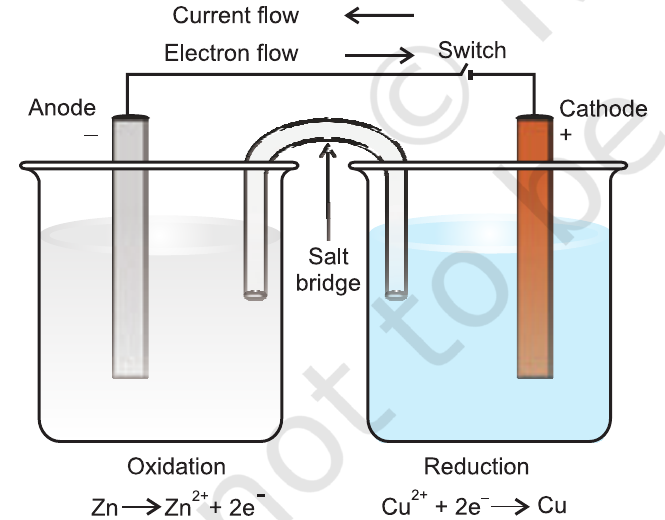
The two beakers are set side by side (NCERT Fig. 7.3). The solutions are connected by a salt bridge, a U-tube containing potassium chloride or ammonium nitrate solution, usually solidified by boiling with agar agar and cooling to a jelly like substance. The salt bridge gives electric contact between the two solutions without allowing them to mix. The zinc and copper rods are connected by a metallic wire with an ammeter and a switch. This set-up is the Daniell cell.
When the switch is off, no reaction takes place in either beaker and no current flows through the metallic wire. When the switch is on: (1) electrons do not travel directly from Zn to $Cu^{2+}$ but through the metallic wire from zinc to copper, while the arrow shows the flow of conventional current in the opposite direction (copper to zinc); (2) electricity flows from the solution in one beaker to the solution in the other by migration of ions through the salt bridge.
The potential associated with each electrode is the electrode potential. If the concentration of each species in the electrode reaction is unity, any gas is at 1 atmospheric pressure, and the reaction is carried out at 298 K, the potential of each electrode is the Standard Electrode Potential. By convention, the standard electrode potential (E°) of the hydrogen electrode is 0.00 volts.
A negative E° means that the redox couple is a stronger reducing agent than the $H^+$/$H_2$ couple. A positive E° means that the redox couple is a weaker reducing agent than the $H^+$/$H_2$ couple. The standard electrode potentials are very important: the electrode potential value for each electrode process is a measure of the relative tendency of the active species to remain in the oxidised or reduced form.
Suggest an edit
Trap Boxes
Oxidation always needs oxygen?
Wrong idea: Oxidation means adding oxygen, so a reaction with no oxygen in it cannot be a redox reaction.
Oxidation is loss of electrons, or a rise in oxidation number. Mg(s) + $Cl_2$(g) -> $MgCl_2$(s) has no oxygen at all, yet magnesium is oxidised from 0 to +2 and chlorine is reduced from 0 to -1.
NCERT XI, Ch 7, 7.1
The oxidation number of oxygen is always -2?
Wrong idea: Oxygen is -2 in every compound, so $H_2O_2$ and $KO_2$ follow the same rule.
Peroxides give oxygen -1 ($H_2O_2$, $Na_2O_2$), superoxides give -1/2 ($KO_2$, $RbO_2$), and oxygen bonded to fluorine is positive: +2 in $OF_2$ and +1 in $O_2F_2$.
NCERT XI, Ch 7, 7.3
Fluorine disproportionates like chlorine in alkali?
Wrong idea: $Cl_2$ in alkali gives $ClO^-$ and $Cl^-$, so $F_2$ in alkali must give $FO^-$ and $F^-$ the same way.
Fluorine cannot have a positive oxidation state because it is the most electronegative element. $F_2$ with alkali gives 2F- + $OF_2$ + $H_2O$, with no disproportionation.
NCERT XI, Ch 7, 7.3.1
In the Daniell cell, current flows from zinc to copper through the wire?
Wrong idea: Electrons leave the zinc anode and travel to the copper cathode, so the current in the wire also flows from zinc to copper.
Electrons flow from the zinc anode to the copper cathode through the wire, but the direction of conventional current is opposite to the direction of electron flow, so current flows from copper to zinc.
NCERT XI, Ch 7, 7.4
A fractional oxidation number means fractional electrons?
Wrong idea: Sulphur in $Na_2S_4O_6$ has oxidation number 2.5, so electrons are shared in fractions of 2.5.
The fraction is only the average. In $S_4O_6^{2-}$ the two extreme sulphurs are +5 and the two middle sulphurs are zero, averaging 2.5; the structure shows whole number states.
NCERT XI, Ch 7, 7.3
Chapter test
5 NEET PYQs. +4 for a correct answer, -1 for a wrong answer, exactly like NEET. Finish the test to earn a medal.
Q1: NEET (UG) 2023, Code F1, Q96
On balancing the given redox reaction, aCr2O72- + bSO32-(aq) + cH+(aq) -> 2aCr3+(aq) + bSO42-(aq) + (c/2)$H_2O$(l), the coefficients a, b and c are found to be, respectively-
NCERT Problem 7.8 balances this reaction as $Cr_2O_7^{2-}$ + 3SO32- + 8H+ -> 2Cr3+ + 3SO42- + 4H2O, so a = 1, b = 3 and c = 8.
Q2: NEET (UG) 2022, Code R1, Q96
In the neutral or faintly alkaline medium, $KMnO_4$ oxidises iodide into iodate. The change in oxidation state of manganese in this reaction is from
Manganese in $MnO_4^-$ is +7. In neutral or faintly alkaline medium permanganate is reduced to $MnO_2$, where manganese is +4, so the change is +7 to +4.
Q3: NEET (UG) 2022, Code R1, Q80
At 298 K, the standard electrode potentials of $Cu^{2+}$/Cu, $Zn^{2+}$/Zn, $Fe^{2+}$/Fe and $Ag^+$/Ag are 0.34 V, -0.76 V, -0.44 V and 0.80 V, respectively. On the basis of standard electrode potential, predict which of the following reaction cannot occur?
Silver, at 0.80 V, is a weaker reducing agent than copper, at 0.34 V, so silver cannot reduce $Cu^{2+}$ to copper. Zinc (-0.76 V) and iron (-0.44 V) can, so only reaction (1) cannot occur.
Q4: NEET (UG) 2022, Code R1, Q53
Given below are half cell reactions: $MnO_4^-$ + 8H+ + 5e- -> $Mn^{2+}$ + 4H2O, E°$Mn^{2+}$/$MnO_4^-$ = -1.510 V; (1/2)$O_2$ + 2H+ + 2e- -> $H_2O$, E°$O_2$/$H_2O$ = +1.223 V. Will the permanganate ion, $MnO_4^-$, liberate $O_2$ from water in the presence of an acid?
The stem gives the oxidation potential E°($Mn^{2+}$/$MnO_4^-$) = -1.510 V, so the standard reduction potential is E°($MnO_4^-$/$Mn^{2+}$) = +1.510 V (matching NCERT Table 7.1, +1.51 V). Thus E°cell = E°cathode - E°anode = 1.510 - 1.223 = +0.287 V. A positive E°cell means the reaction is feasible, so $MnO_4^-$ liberates $O_2$ from water in acid.
Q5: NEET (UG) 2020, Code G5, Q131
What is the change in oxidation number of carbon in the following reaction? $CH_4$(g) + 4Cl2(g) -> $CCl_4$(l) + 4HCl(g)
Carbon is -4 in $CH_4$ because hydrogen is +1, and +4 in $CCl_4$ because chlorine is -1, so the change is -4 to +4. NCERT works this reaction out in equations 7.20 and 7.23.
Score: 0 · Answered 0 of 5
Flashcards
Tap a card to flip it over and see the answer. Tap it again to flip it back.
State the rule for the sum of oxidation numbers in a compound and in a polyatomic ion.
Tap to flipThe algebraic sum of the oxidation numbers of all the atoms in a compound is zero. In a polyatomic ion the sum equals the charge on the ion, as in $CO_3^{2-}$ where C is +4 and three O are -2, summing to -2.
Tap to flip backWhat is the standard electrode potential of the hydrogen electrode by convention?
Tap to flipE° of the $H^+$/$H_2$ couple is 0.00 volts. All other standard electrode potentials in Table 7.1 are measured against it.
Tap to flip backWhich couple in Table 7.1 has the most negative E°, and which has the most positive?
Tap to flip$Li^+$/Li at -3.05 V is the most negative, so lithium is the strongest reducing agent in the table. $F_2$/$F^-$ at +2.87 V is the most positive, so fluorine is the strongest oxidising agent.
Tap to flip backArrange Zn, Cu and Ag in order of electron releasing tendency.
Tap to flipZn > Cu > Ag. Zinc releases electrons to copper, and copper releases electrons to silver, shown by reactions 7.15 and 7.16.
Tap to flip backArrange $F_2$, $Cl_2$, $Br_2$ and $I_2$ in order of oxidising power.
Tap to flip$F_2$ > $Cl_2$ > $Br_2$ > $I_2$. Oxidising power of the halogens decreases down group 17; fluorine can displace chloride, bromide and iodide ions.
Tap to flip backWhat is the oxidation number of oxygen in $H_2O_2$, $KO_2$ and $OF_2$?
Tap to flipIn $H_2O_2$ (a peroxide) oxygen is -1, in $KO_2$ (a superoxide) oxygen is -1/2, and in $OF_2$ oxygen is +2 because fluorine is more electronegative than oxygen.
Tap to flip backWhat is the oxidation number of hydrogen in LiH, NaH and $CaH_2$?
Tap to flip-1. Hydrogen is +1 in most compounds, but when bonded to metals in binary compounds such as LiH, NaH and $CaH_2$ it is -1.
Tap to flip backWrite the disproportionation of hydrogen peroxide and the oxidation states of oxygen.
Tap to flip2H2O2(aq) -> 2H2O(l) + $O_2$(g). Oxygen in the -1 state goes to zero in $O_2$ and to -2 in $H_2O$.
Tap to flip backWrite the overall reaction of the Daniell cell and name the anode and cathode.
Tap to flipZn(s) + $Cu^{2+}$(aq) -> $Zn^{2+}$(aq) + Cu(s). Zinc is the anode (oxidation, Zn -> $Zn^{2+}$ + 2e-) and copper is the cathode (reduction, $Cu^{2+}$ + 2e- -> Cu).
Tap to flip backName the four types of redox reactions in NCERT 7.3.1.
Tap to flipCombination, decomposition, displacement and disproportionation. Examples: $N_2$ + $O_2$ -> 2NO (combination), 2Pb($NO_3$)2 -> 2PbO + 4NO2 + $O_2$ (decomposition), NaH + $H_2O$ -> $NaOH$ + $H_2$ (displacement), 2NO2 + 2OH- -> $NO_2^-$ + $NO_3^-$ + $H_2O$ (disproportionation).
Tap to flip back